



Abstract
Cities worldwide face the challenge of persistent social polarisation that is exacerbated by the mass migration of populations. Scholars have debated whether the planning of public spaces, which presumably fosters inter-group encounter, potentially reduces prejudice against minorities such as migrants, and eventually promotes social inclusiveness. This research uses a large-scale questionnaire survey conducted in 36 neighbourhoods (estates) in Beijing, China, combined with field observations and interviews, to investigate whether the presence, perception and use of neighbourhood-scale spaces of encounter are relevant in predicting residents’ attitudes towards migrant social inclusion, particularly with respect to equal access to citizenship and government welfare. Qualitative and quantitative analyses found that residents’ inclusiveness attitude is less associated with the physical presence of public spaces and facilities in the neighbourhood, and more with actually using such spaces for neighbourly encounters in daily life. The findings echo recent critiques of the romanticised view of public spaces for urban encounters, and suggest that neighbourhood planning of public spaces should incorporate elements from social projects that facilitate meaningful interaction between native and migrant residents to achieve the goal of building an inclusive city.
Introduction
Cities worldwide face the challenge of persistent social polarisation that is exacerbated by the mass migration of populations. International and domestic migrants constantly experience socio-spatial marginalisation in urban society and stigmatisation from native residents (Pincher et al., 2014; Rustenbach, 2010; Tse, 2016; Wang et al., 2010). Extensive studies have examined the exclusion of temporary migrants from economic and social opportunities in Chinese cities (Lin and Gaubatz, 2017; Liu et al., 2013; Wu, 2002; Zhu, 2016). The household registration (hukou) system, which ties welfare entitlement to a person’s hukou status, continues to divide migrants and urbanites, discriminating against the former, despite recent changes to this restrictive practice (Fan, 2008; Lan, 2014).
Beyond institutional discrimination, scholars have also extensively documented the prejudice and stigmatisation that migrants experience in daily encounters with local urbanites (Gu et al., 2016; Liu et al., 2018; Orum et al., 2009; Zavoretti, 2017; Zhang, 2001), affecting their subjective well-being (Chen, 2013; Wang et al., 2010) and their aspirations to fully integrate into urban society (Tse, 2016). Recognising this subtle form of social division, urban scholars have sought to understand the mechanisms that facilitate the social integration of migrant populations (Wang and Fan, 2012; Wang et al., 2016; Wu and Logan, 2016). A growing literature has also explored how the neighbourhood offers a territorial context in which local residents and migrants develop inter-group relationships and affective attitudes towards each other (Li and Tong, 2018; Liu et al., 2018; Wang et al., 2017a, 2017b).
In this study, we extend this emerging line of inquiry with an empirical investigation of the role of neighbourhood public spaces in migrant social inclusion in Beijing, China. We draw from theoretical and empirical writings on urban public spaces for inter-group encounter and inclusiveness (Matejskova and Leitner, 2011; Orum et al., 2009; Piekut and Valentine, 2017; Pincher et al., 2014). Urban theorists and practitioners have long celebrated how the creation of opportunities for inter-group contact in urban public spaces reduces prejudice and promotes integration (Amin, 2006; Jacobs, 1961; Young, 1990), although empirical evidence remains mixed regarding the effectiveness of public spaces in enhancing positive inter-group attitudes.
The empirical analysis used data from a 2017 questionnaire survey of 1280 residents – supplemented with field observations and interviews – in 36 neighbourhoods (estates) in Beijing, to investigate whether the presence of open spaces and commercial facilities in neighbourhoods contributes to a more supportive attitude towards migrants’ equal access to citizenship and government welfare. We focus on neighbourhood-scale public spaces because the neighbourhood constitutes a major site for everyday encounters through enhancing social mixing and providing various public and quasi-public spaces that bring people together (Havekes et al., 2014; Liu, 2019; Pratsinakis et al., 2017; Wang et al., 2017b).
Our intellectual contributions are twofold. First, although the challenges of migration and social polarisation are not unique to Western contexts, studies of urban public spaces and inter-group integration are primarily based on empirical contexts in the United States and Europe. Our study expands the theoretical relevance of this critical debate to the empirical context of migrant social integration in urban China. Although the majority of migrant populations in Chinese cities are not bound to race, ethnicity or religion-based stereotypes, they are not immune to stigmatisation associated with their places of origin and socio-economic status (Wang et al., 2010; Zhang, 2001).
Second, existing studies on the neighbourhood context for migrant social integration in urban China have mostly focused on neighbourhood social environment, that is, social mix and neighbourly interaction (Li and Tong, 2018; Liu, 2019; Liu et al., 2018). Our research draws attention to neighbourhood physical environment and examines whether public spaces may be conducive to promoting inter-group integration. Meanwhile, we join the recent literature (e.g. Liu et al., 2018; Wang et al., 2017a) that looks at more subjective dimensions of social integration – that is, attitudes towards equal citizenship and welfare entitlement for migrant populations – and specifically compare the inclusiveness attitudes of majority-status natives and minority-status migrants.
The remainder of the article proceeds as follows. Following the introduction, we review recent literature on migrant social integration in urban China, as well as writings on spaces of urban encounters, particularly their ambivalent roles in enhancing inter-group inclusiveness. Upon introducing the data collection process, we present descriptive findings from quantitative and qualitative data to highlight the contrasting patterns between local and migrant residents regarding both their inclusiveness attitudes and their engagement with neighbourhood public spaces in daily-life experiences. We then present findings from ordinal regression analyses on determinants of inclusiveness attitudes, and discuss theoretical and policy implications in the conclusion section.
Literature review
Intergroup interaction and integration of migrant populations in China
While hukou-based institutional discrimination tends to attract a lot of scholarly attention, there are also accounts focusing on the interpersonal discrimination and exclusion experienced by temporary migrants in urban China (Chen, 2013; Orum et al., 2009; Zavoretti, 2017). As a minority group in China’s urban society, rural-to-urban migrants experience stereotyping and stigmatisation in their daily-life interactions with local urbanites. They are often associated with being poor, dirty, unintelligent, lacking in taste and prone to violence and crime (Chen, 2013), and are constantly labelled as low-tier populations (diduan renkou) or socially inferior, backwards bumpkins (xiangbalao), due to their different lifestyles, culture, socio-economic status and even accent (Orum et al., 2009; Zhang, 2001). Liu et al. (2018) found that 61.13% of local residents in Shanghai perceived that migrant influx weakened the safety conditions of cities. Local urbanites have also begun to express exclusionary attitudes towards migrants due to fear of competition for government welfare resources from ‘outsiders’.
An increasing number of studies have investigated determinants of migrant integration in Chinese cities. In addition to focusing on individual-level determinants, recent studies have turned attention to the neighbourhood as a key territorial unit for the inter-group integration experiences and attitudes between local residents and migrants (Liu, 2019; Liu et al., 2018; Wang et al., 2016, 2017a). Empirical findings, though, are inconsistent. For instance, Liu et al. (2018) found that migrants living in a neighbourhood with more migrant population are more likely to feel socially excluded. However, Wang et al. (2017b) found that local and migrant residents are more likely to develop affectionate out-group attitudes if living in a neighbourhood with a higher percentage of migrant populations. These findings highlight the complex effects of proximity living on inter-group tolerance and inclusion.
Urban public spaces of encounter and inter-group social inclusiveness
There has been a revival of scholarly interest in the potential of urban public spaces to create opportunities for inter-group contact and eventually to promote social inclusion (Pincher et al., 2014; Valentine, 2008). The social-psychology theory of inter-group contact (Allport, 1954) posits that contact reduces prejudice against the minority group through enhancing knowledge about the other group, reducing anxiety and increasing empathy (Pettigrew, 1998; Pettigrew and Tropp, 2008). Through encountering and connecting with the ‘others’, native residents are likely to experience a reduction in prejudice towards immigrants, while immigrants experience better integration into the mainstream society. The positive effect of inter-group contact is also found in recent studies in the Chinese context (e.g. Gu et al., 2016; Nielsen and Smyth, 2011).
Urban scholars and planners have long celebrated the importance of public spaces – such as green spaces, parks, city streets, markets, sports facilities and public transit – in the pursuit of the inclusive city. Jane Jacobs (1961) envisioned city neighbourhoods with a complex fabric of public streets, squares, parks and public buildings to support vibrant public life and build shared identities. Urban public spaces bring strangers together where citizens are exposed to different backgrounds, cultures and experiences, through everyday negotiations of diversity in public spaces, which enhances understanding and solidarity in connection to the Other (Amin, 2006; Young, 1990). All these contribute to strong empathy and tolerance towards minority groups such as immigrants.
Nevertheless, scholars have recently taken a more critical view towards the sufficiency of public spaces in promoting positive inter-group attitudes and fostering social integration, given mixed empirical findings (Pincher et al., 2014; Valentine, 2008). Public spaces may indeed promote social interaction and cohesion (Cattell, et al., 2008; Kaźmierczak, 2013), but such interaction may be limited to in-group ties. People from different backgrounds may share the same spaces without actually interacting with the Other group in a meaningful way (Holland et al., 2007).
The lack of inter-group contact in public spaces partly results from nuanced forms of socio-spatial segregation in which different social groups tend to have different daily-life patterns in space and time (Kwan, 2013). Even if majorities and minorities may share the same residential environment, the minorities may not use public spaces and facilities as much as the majorities; or even if they do, they may not use them at the same time as the majorities. Due to the divergent space-time activity patterns, living in the same residential environment does not mean similar use of public spaces, or people may use the same spaces without encountering out-group members.
Furthermore, even when out-group contact occurs, such contact may not translate into respect for difference but may rather reinforce stereotypes among majority groups (Matejskova and Leitner, 2011; Pincher et al., 2014). Public encounters can also expose minorities to discrimination and stigmatisation (Cattell et al., 2008), which can make them segregate themselves from wider society and lead ‘parallel lives’ (Matejskova and Leitner, 2011; Phillips, 2006). In an ethnographic study of public spaces in Shanghai, Orum et al. (2009) observed the preconceived stereotypes held by native residents and the self-segregating behaviour of working-class migrants as both groups accessed the same public spaces. They also observed the sentiment among native residents that migrants are ‘outsiders’ who are not equally entitled to the use of public spaces. In other words, a space of encounter can also remake and enact differences (Qian, 2018).
Scholars have also differentiated between inter-group encounters in various types of public spaces (Frøystad, 2006). Piekut and Valentine (2017) suggested that typical public spaces, such as parks, green spaces and city streets, while open to everyone, are actually ‘spaces of transit’ that only generate ‘fleeting encounters’ rather than sustained interaction to improve inter-group attitudes. Instead, quasi-public spaces, such as consumption spaces and workplaces, have greater potential to foster inter-group interactions in a regular and sustained way and based on common goals. Li and Tong (2018) found that, in Chinese cities, workplace-based contact is more effective than neighbourhood contact in fostering inter-group friendship between urbanites and migrants. Qian (2018) argues that quasi-public spaces like shopping malls and coffeehouses, albeit spaces of capitalist consumerism, have become sites of liberation from dominant stereotypes.
Data sources
The empirical research combines multiple sources of data, including a large-scale neighbourhood social cohesion and activity-diary survey, as well as field observations and interviews. Our case study is Beijing, China’s capital city, which has experienced a massive influx of migrant populations over the last three decades. Migrants (8.07 million) accounted for 37.2% of its urban population (21.73 million) in 2016 (Beijing Municipal Bureau of Statistics, 2017). Dramatic spatial and institutional transformation have also created a mosaic-like urban space comprising diverse neighbourhood types, such as traditional inner-city hutong courtyards, work-unit compounds, commodity housing estates, redeveloped neighbourhoods, affordable housing estates and migrant enclaves.
Neighbourhood social cohesion and the activity-diary survey
The main data came from a large-scale questionnaire survey conducted during March–May 2017 in Beijing. The purpose of the survey was to explore the interface between neighbourhood environment, social cohesion and subjective well-being. The questionnaire included an activity-diary survey, in which each respondent was asked to report the spatio-temporal information of all activities and travel over a period of 24 hours on the previous weekday.
We used a multi-stage stratified sampling strategy to maximise the representativeness of the diversity of urban neighbourhoods in Beijing. First, we categorised all sub-districts (jiedao) of Beijing’s main urbanised area into three different areas: the inner city, the inner suburb and the outer suburb. Twelve sub-districts were selected according to the population size of different areas. Second, we consulted sub-district officials to select resident communities (shequ) representing the variety of types, years of construction, built environment and demographic structure in the sub-district, which led to a total of 26 shequ selected (Figure 1). Finally, in each shequ, we obtained the complete address list from the resident committee (juweihui), from which we selected 50 households through a combination of stratified sampling and systematic sampling. In each household, we randomly selected one member of age 18–65 to participate in the survey, with an interviewer asking the questions and recording the answers.

Location of the survey areas and examples of public spaces in selected neighbourhoods.
A total of 1280 valid samples were produced (see Table 1 for sample structure), in which 915 respondents held local urban hukou and 365 respondents were migrants. The share of migrant populations (28.5%) is approximately 10 percentage points lower than the official statistics (37.2%; see Table 1). This is most likely because our sampling strategy – as a neighbourhood survey – did not reach migrant residents living in dorms (e.g. factory dorms or construction sites), which account for at least one third of all migrant populations in Chinese cities (Liu et al., 2017).
Socio-demographic structure of the samples.
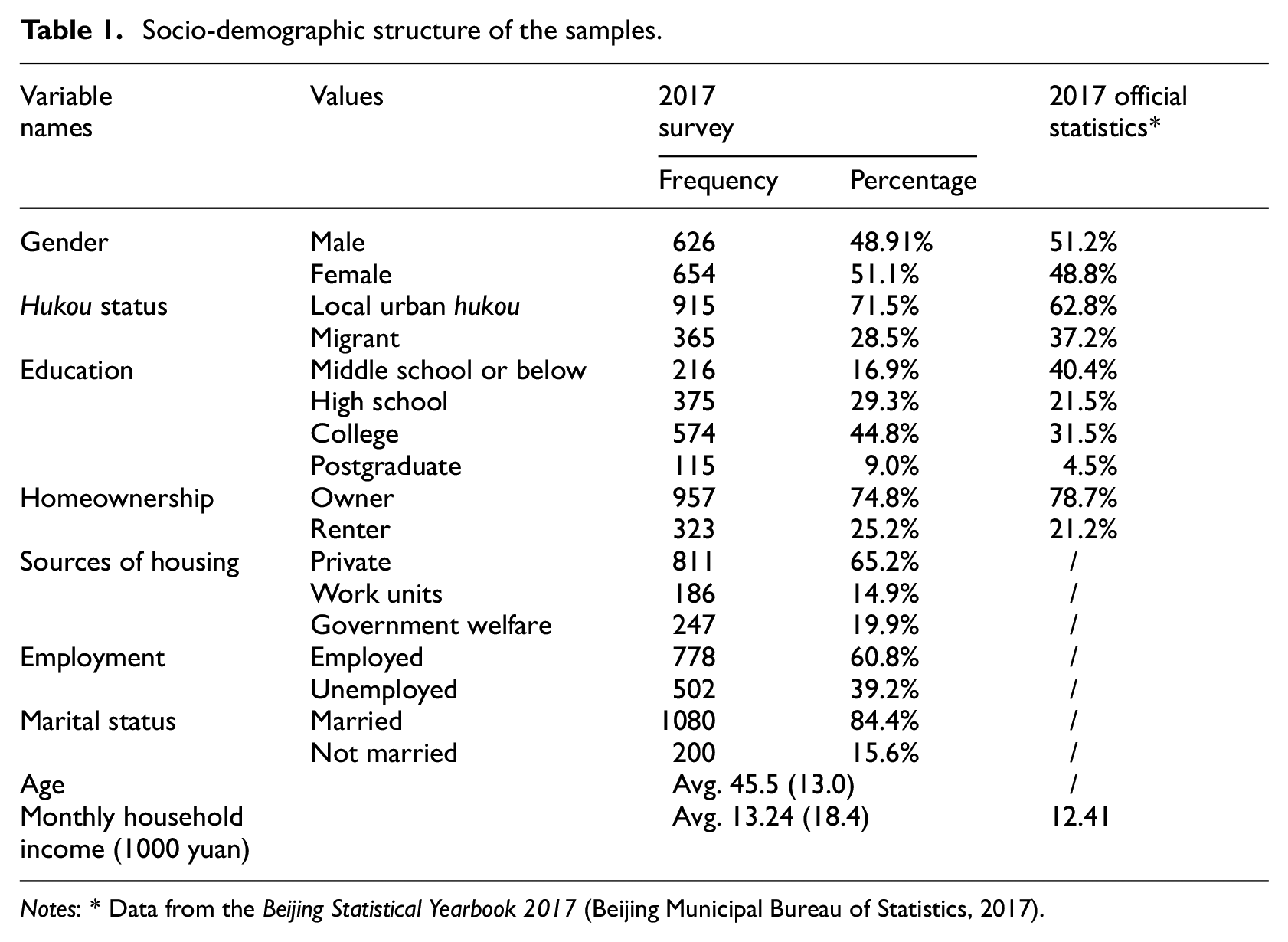
Notes: * Data from the Beijing Statistical Yearbook 2017 (Beijing Municipal Bureau of Statistics, 2017).
Field observation and interviews
We supplemented the questionnaire survey with on-site observations of the presence and use of neighbourhood public spaces. Note that many shequ in Beijing consist of more than one estate (xiaoqu), each with different years of construction, types of housing and property rights, and consequently different physical environments. Therefore, we measured neighbourhood public spaces at the level of the xiaoqu (estate) rather than the shequ. In all of the 26 shequ, we conducted on-site observations in a total of 36 estates.
Our on-site observation first involved measuring the diversity of the public spaces of each estate. We distinguished two types of neighbourhood public spaces, including seven types of open spaces (as a measure of typical public spaces) and nine types of commercial facilities (as a measure of quasi-public spaces) (see Figure 1 for explanations and examples). We observed whether each type of public space is present in the neighbourhood, and generated the diversity scores for open spaces and commercial facilities. In addition, we conducted multiple rounds of field visits to observe the actual use of neighbourhood public spaces by residents, and carried out informal interviews with local and migrant residents to understand how residents perceive and use public spaces in their daily lives and neighbourly interactions.
Initial findings from the descriptive analysis
Comparing inclusiveness attitudes between local and migrant residents
We focus on subjective attitudes towards migrant social inclusion. First, general inclusiveness was derived from the Likert-scale question in the survey asking ‘To what extent do you agree that, regardless of their hukou, everyone living and working in Beijing is a Beijing citizen?’ with the value of one indicating ‘strongly disagree’ and five indicating ‘strongly agree’. Second, welfare inclusiveness was derived from the question asking the extent to which respondents agreed that ‘Everyone living and working in Beijing is entitled to government welfare programmes (such as minimum living standard support and affordable housing).’
We distinguish these two dimensions of inclusiveness attitudes because tolerance is not necessarily the willingness of the majority-status urbanites to allow migrants equal entitlement to welfare resources, and therefore the welfare inclusiveness attitude better captures the level of prejudice in which migrants are considered the ‘Others’ without equal rights to the city. Meanwhile, for local residents, the questions reflect the level of prejudice vis-a-vis inclusiveness of the majority-status urbanites towards migrants. For migrant respondents, the questions capture a self-assessment of rights to the city, based on their own experiences of and aspirations for full integration.
Table 2 presents a comparison of inclusiveness attitudes by hukou status. In both dimensions, a higher proportion of migrant respondents supported inclusiveness than local respondents, although the local–migrant divergence is higher in the welfare-based inclusiveness attitude. Specifically, 76.8% of migrant respondents agreed or strongly agreed that migrants are equally Beijing citizens, while 70.3% of local respondents had a similar attitude (p < 0.05; Table 2). For welfare inclusiveness, 79.5% of migrant respondents either agreed or strongly agreed that migrants are equally entitled to government welfare, while only 51.3% of local respondents said so (p < 0.01; see Table 2). Such divergence reflects the complex attitudes of local residents towards migrant social inclusion. On a superficial level, the vast majority of local residents hold favourable attitudes towards migrants, but the high level of tolerance does not transfer into support for equal rights to the city.
Comparing inclusiveness attitudes by hukou status.
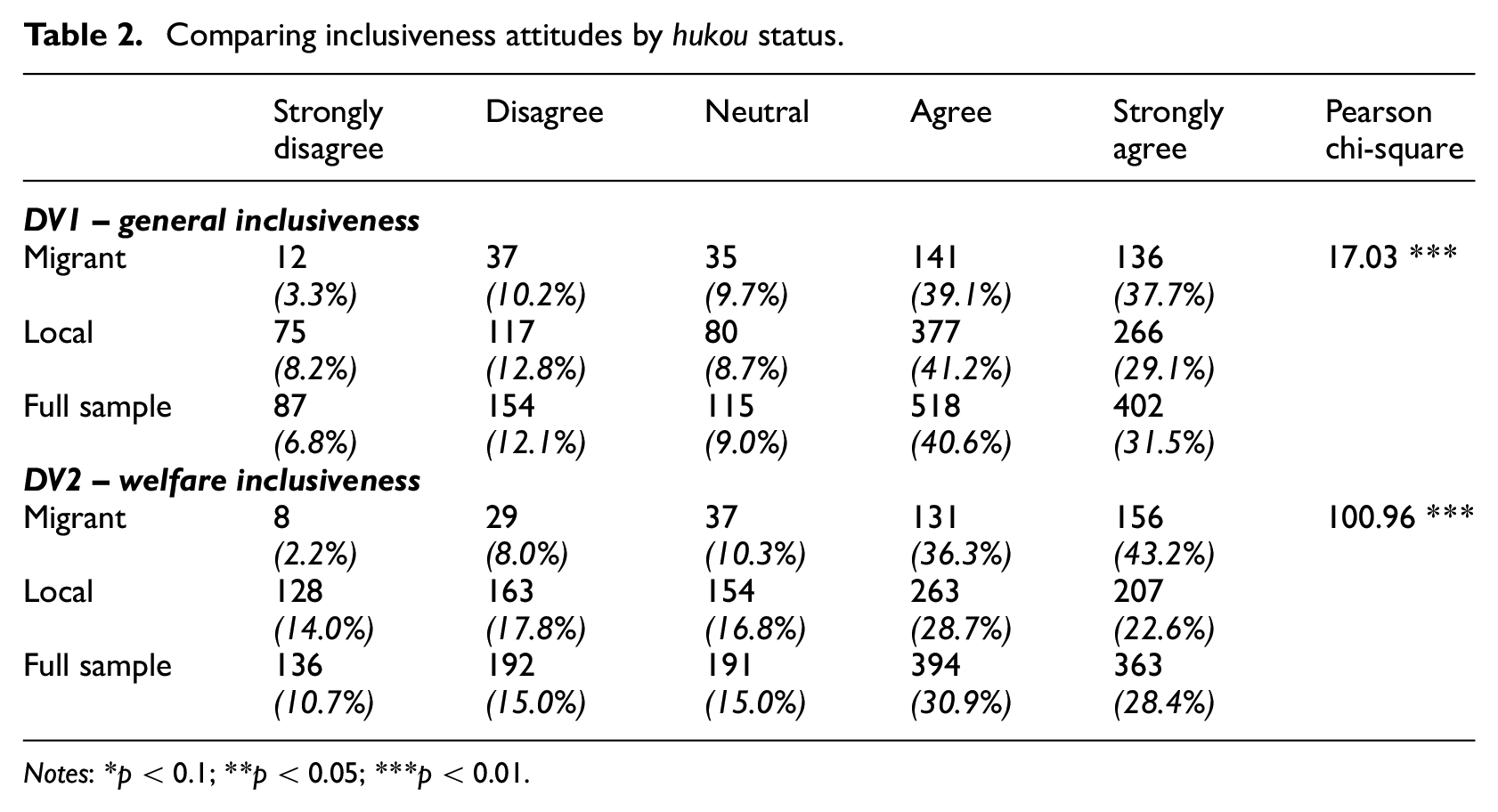
Notes: *p < 0.1; **p < 0.05; ***p < 0.01.
Diversity of neighbourhood public spaces
Figure 2 presents descriptive statistics of the total score for diversity of neighbourhood open spaces (range 0–7) and the score for diversity of neighbourhood commercial facilities (range 0–9) across all 36 neighbourhoods (i.e. xiaoqu). These public spaces are more abundant in some neighbourhoods than others. On one extreme, one neighbourhood possesses all seven types of open spaces (Figure 2-A) and four neighbourhoods offer a maximum of eight types of on-site commercial facilities (Figure 2-B). On the other extreme, eight neighbourhoods possess fewer than three types of open spaces (see Figure 2-A) and six neighbourhoods possess fewer than three types of commercial facilities (Figure 2-B).
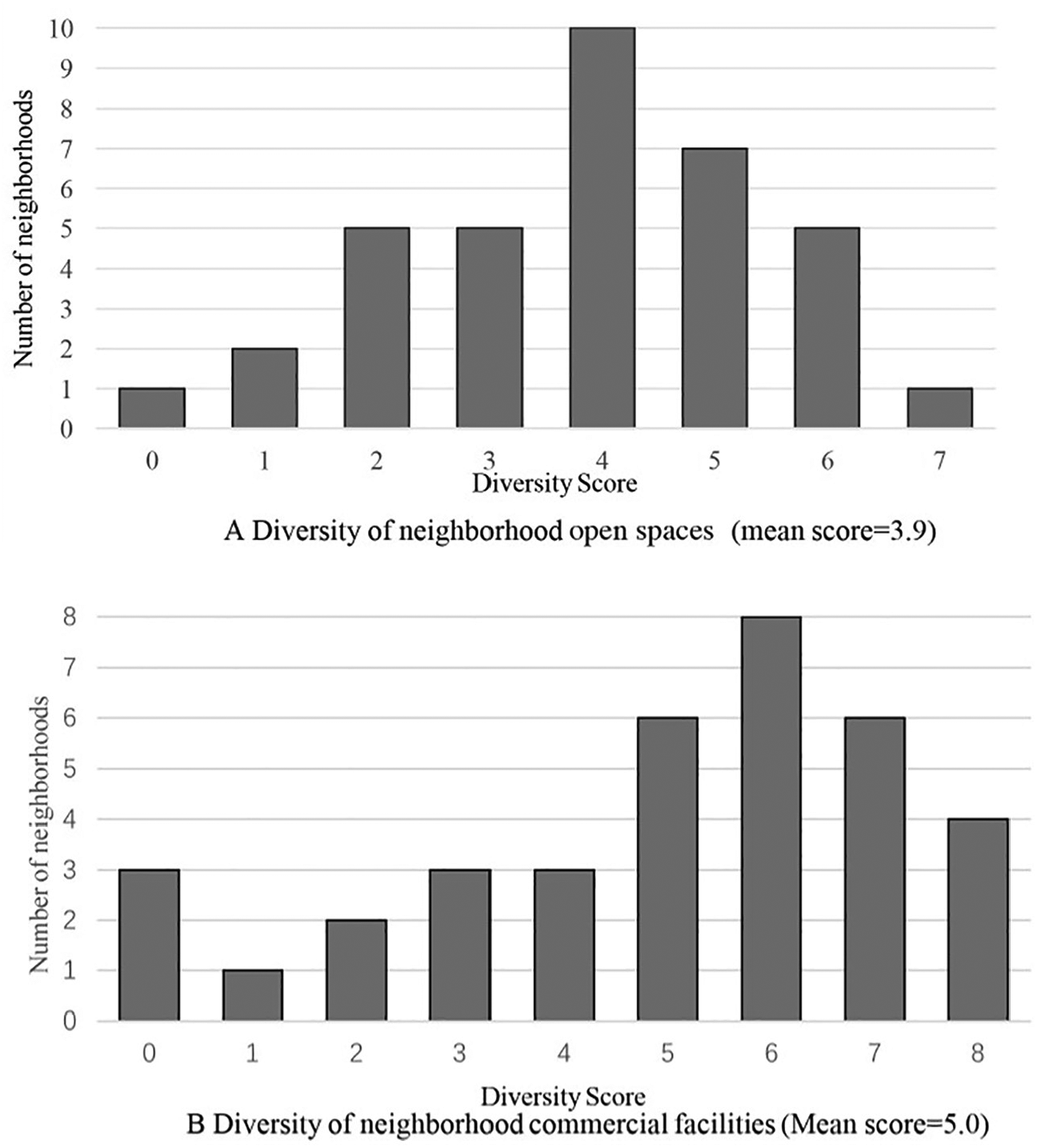
Descriptive statistics of the presence of neighbourhood public spaces.
Encounter in neighbourhood public spaces?
Does the presence of diverse public spaces in the neighbourhood guarantee the use of these spaces for meaningful neighbourly encounter? During field visits, we observed numerous occasions when public spaces were under-utilised, either vacant or mostly used by elderly residents or children. To further illustrate the lack of encounter in neighbourhood public spaces, we constructed space-time path diagrams of residents’ daily-life activities based on information collected through the activity-diary (see Figure 3).
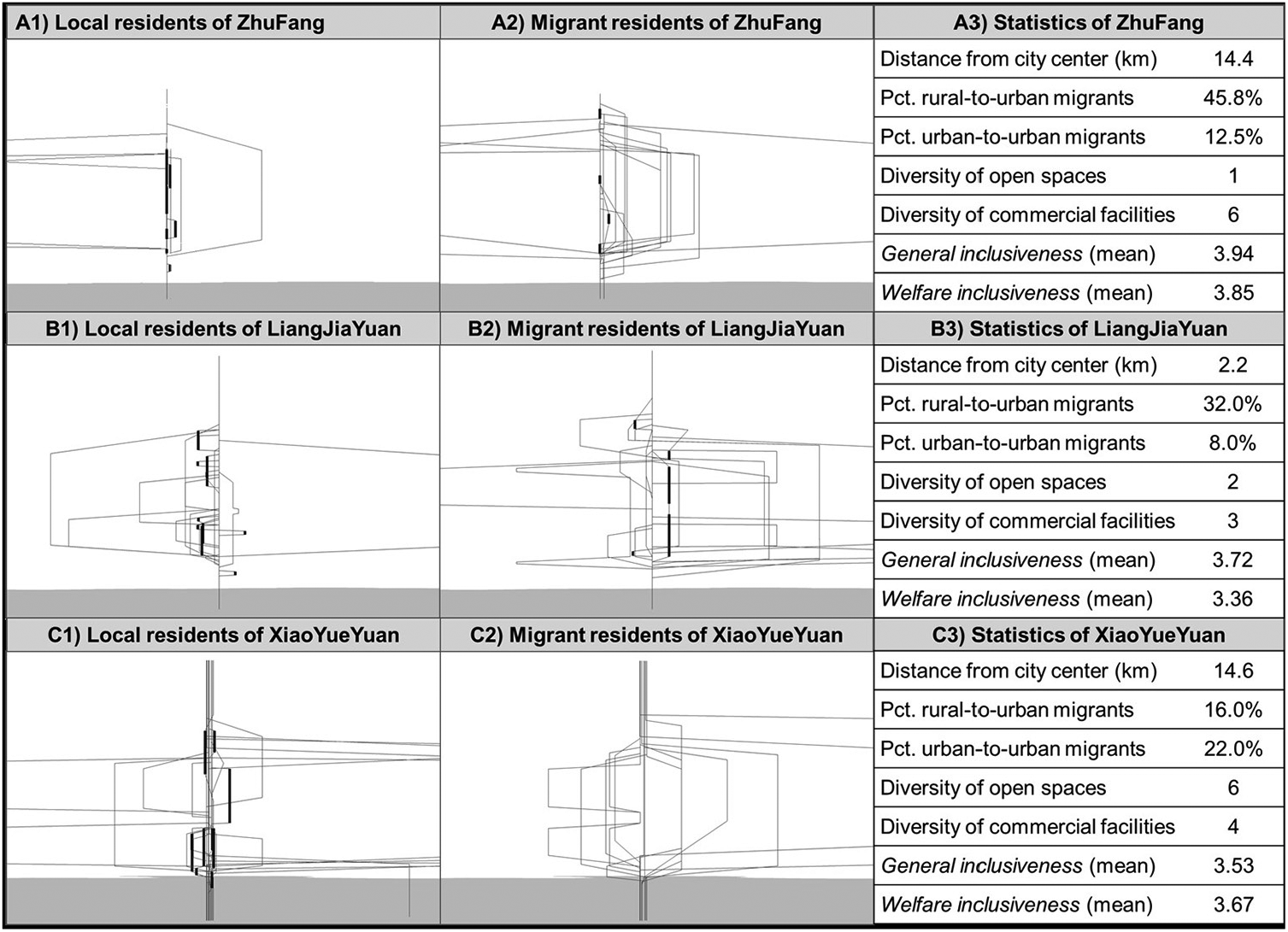
Comparing space-time activity paths between local and migrant residents in three neighbourhoods.
We selected three neighbourhoods with high percentages of migrant respondents but a contrasting presence of open spaces and commercial facilities. Among them, ZhuFang is a typical urban village that, despite its crowded living environment and lack of open spaces, provides diverse shops and services to residents (Figures 1-B2 and 3-A3). LiangJiaYuan is a traditional inner-city hutong courtyard but offers the least diversity of public spaces (Figures 1-A3 and 3-B3). XiaoYueYuan is a suburban commodity housing estate with abundant open spaces and commercial facilities (Figures 1-B3 and 3-C3). Whereas all three neighbourhoods are characterised by higher migrant percentages, most migrants living in XiaoYueYuan are urban-to-urban migrants.
Figure 3 compares the space-time activity paths between local and migrant residents for each neighbourhood. Each path reflects one respondent’s activity-travel pattern over a 24-hour period, with the vertical axis representing the temporal dimension and the horizonal x- and y-axes representing the spatial dimension. In each path, each vertical segment represents an activity in one particular location, and the bold segments in the path diagram highlight out-of-home activities in the neighbourhood.
The activity path diagrams revealed that local and migrant residents differ dramatically in the use of neighbourhood public spaces in their daily lives. In ZhuFang, local respondents spend extensive time on out-of-home activities in the neighbourhood, even on a weekday (Figure 3-A1). Yet migrant respondents tend to have brief and scattered engagement with neighbourhood public spaces, mostly due to their constraints from work-related activities (Figure 3-A2). In XiaoYueYuan, a suburban estate with abundant public spaces, local and migrant residents also display contrasting daily-life patterns. Whereas local respondents spend longer time on out-of-home activities in the neighbourhood (Figure 3-C1), migrant respondents rarely engage in such activities, as indicated by there being no bold segments in Figure 3-C2. Previous studies have shown that residents of commodity housing neighbourhoods, particularly those in the suburbs, have fewer neighbourly interactions (Wang et al., 2017b) and tend to engage in more in-home activities in Beijing (Wang et al., 2011).
By contrast, in LiangJiaYuan, both local and migrant respondents spend extensive time on out-of-door activities in the neighbourhood (Figures 3-B1 and 3-B2), despite the limited presence of open spaces and commercial facilities (Figure 3-B3, diversity scores = 2 and 3). During multiple field visits in this old-town hutong neighbourhood, we also observed frequent use of the small outdoor fitness area by its residents, as well as chatting and greeting taking place along the pedestrian alleys. These case analyses revealed that the presence of public spaces in a neighbourhood does not guarantee actual use of these spaces by its residents. The divergent daily-life patterns, reflected in activity space-time path diagrams, may impede the potential of neighbourhood public spaces for effective inter-group encounter despite both groups living in the same neighbourhood.
On the other hand, even when residents use public spaces in the neighbourhood, that co-existence does not automatically generate meaningful encounters. As one local resident put it, ‘Sometimes I walk around in the neighbourhood and see neighbours. At most we just nod to each other; we rarely talk.’ Inter-group encounter can be more difficult in public spaces. Take LiangJiaYuan as an example, where despite their frequent use of neighbourhood open spaces, local residents expressed that they ‘would mostly interact with other local people’ while using the public spaces, and that, although they ‘knew there were many migrants renting housing here’, they barely knew any. One migrant interviewee described a similar situation in which, when he goes for after-dinner walks to the nearby neighbourhood park, where a lot of local residents also go, ‘we chat and play by ourselves; they [i.e. local people] would not care to talk to us and we would not know what to talk to them about’. This ‘sharing without encountering’ situation can render the presence of public spaces ineffective in the pursuit of an inclusive city.
Determinants of inclusiveness attitudes: Findings from statistical analysis
We conducted multivariate regression analyses to estimate the effects of neighbourhood public spaces on inclusiveness attitudes. We employed ordered logistic regression because the two dependent variables are both measured on a 1–5 ordinal scale, 1 and employed the cluster-robust estimator approach to account for the nested nature of the survey data in which individuals are clustered in neighbourhoods. 2
In addition to the diversity of open spaces and of commercial facilities, we also included four variables capturing perception and use of neighbourhood public spaces. In the questionnaire, we asked each respondent to report, on a 1–4 scale, the frequency of using a series of neighbourhood open spaces and commercial facilities during the previous six months, with the value of one indicating ‘never’ and four indicating ‘very frequently’. We calculated the mean scores for frequency of using open spaces and frequency of using commercial facilities. We also asked respondents to rate, on a 1–5 Likert scale, the extent to which they agreed that ‘my neighbourhood provides a great diversity of facilities and services’ (perceived diversity of neighbourhood facilities) and ‘my neighbourhood provides many opportunities to interact with neighbours’ (perceived opportunity for neighbourly interaction). We controlled for socio-demographic variables, including age, gender, marital status, education, employment status, monthly household income (yuan, logged value), homeownership and sources of housing.
Model results from the full sample analysis
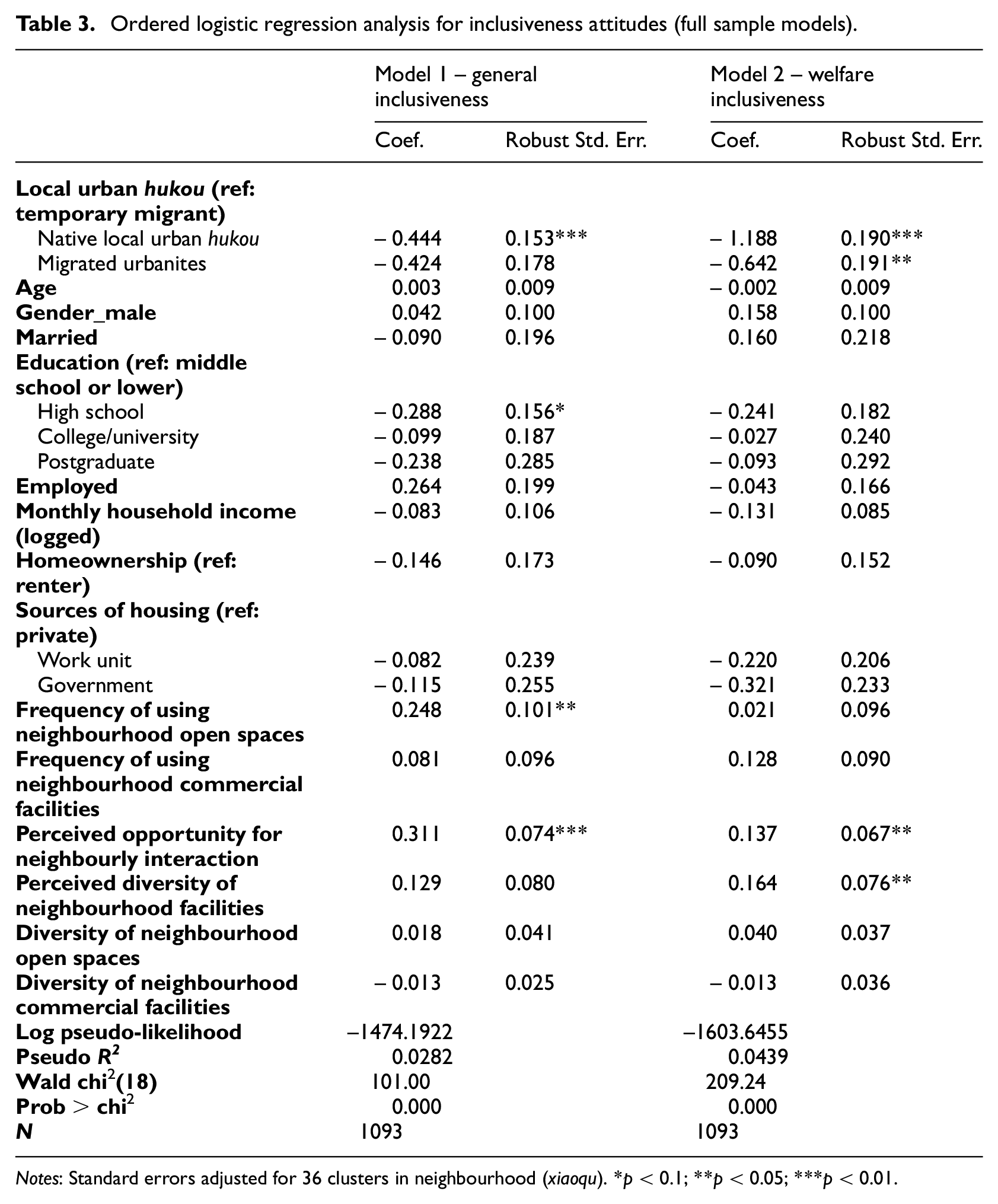
Table 3 reports the model results for the entire sample, with dependent variables being general inclusiveness in model 1 and welfare inclusiveness in model 2. First, hukou status significantly affects both dimensions of inclusiveness attitudes, and the local–migrant difference is more salient in welfare inclusiveness, confirming previous findings from bivariate analyses in Table 2. Compared with temporary migrants, native urbanites (residents born with Beijing urban hukou) are less likely to support giving migrants equal citizenship (β = −0.444, model 1) or equal welfare entitlement (β = −1.188, model 2), both significant at the 0.01 level (Table 3). Permanent migrants, who have become local urban residents after acquiring Beijing urban hukou, do not hold a significantly different view of equal citizenship compared with temporary migrants. However, they are significantly less likely to support equal welfare access for all residents regardless of their hukou status (β = −0.642, p < 0.05, model 2). The greater divergence in welfare-based inclusiveness attitudes across hukou status reflects that a higher level of prejudice against migrants arises when local residents take into consideration potential competition over limited welfare resources.
Ordered logistic regression analysis for inclusiveness attitudes (full sample models).
Notes: Standard errors adjusted for 36 clusters in neighbourhood (xiaoqu). *p < 0.1; **p < 0.05; ***p < 0.01.
Second, neither the diversity of open spaces nor the diversity of commercial facilities significantly predicts either dimension of inclusiveness attitudes (see Table 3). In other words, the presence of neighbourhood public spaces of encounter does not necessarily enhance inclusiveness attitudes towards the minority group. Instead, perceived diversity and frequent use of neighbourhood environment matter more. All else equal, residents more strongly support equal citizenship (general inclusiveness, β = 0.313) and equal welfare entitlement (welfare inclusiveness, β = 0.136) if they perceive their neighbourhoods to offer abundant opportunities for neighbourly interactions. Additionally, more frequent use of open spaces predicts a greater likelihood of general inclusiveness (β = 0.247, p < 0.05, model 1), but not for welfare inclusiveness, while frequency of using commercial facilities is not significant in either model (Table 3).
As previously shown, local and migrant residents tend to have different daily-life patterns which may not correspond to the availability of public spaces. Interviews with residents also revealed the limited use of neighbourhood public spaces, because residents ‘were too busy with work to take part in any neighbourhood activity’ and would rather ‘just stay at home, even on weekends’. One interviewee even expressed that ‘I barely know my neighbours, even in my own building’, despite having lived in the neighbourhood for nine years. We suspect that perceiving greater opportunities for encounter better reflects the experiences of actually engaging with other people in public spaces in everyday life, which has more direct effect on developing inter-group understanding and tolerance.
Distinguishing determinants for local residents and migrants
Table 4 reports results from separate ordered logistic regression analyses for the local sample and the migrant sample. Model results for the local sample largely resemble those from the full sample analysis. The diversity of neighbourhood open spaces and diversity of commercial facilities are not significantly associated with local residents’ attitudes towards migrant integration (see models 3A and 4A in Table 4). Meanwhile, local residents more strongly support equal welfare access if they perceive a greater diversity of neighbourhood facilities (β = 0.208, p < 0.05) and more opportunities for neighbourly interaction (β = 0.195, p < 0.05, model 4A).
Ordered logistic regression analysis for local and migrant samples.

Notes: Standard errors adjusted for 36 clusters in neighbourhood (xiaoqu). *p < 0.1; **p < 0.05; ***p < 0.01.
Regarding the frequency of using neighbourhood public spaces, whether they are open spaces or commercial facilities affects different dimensions of out-group attitudes among local residents. More frequent use of open spaces is significantly associated with a stronger attitude of general inclusiveness (β = 0.275, model 3A) but not of welfare inclusiveness. In contrast, more frequent use of neighbourhood commercial facilities significantly predicts stronger support for equal welfare entitlement (β = 0.123, model 4A), but not for general inclusiveness. As similarly reflected in our field research, out-group interactions of local residents in neighbourhood open spaces are rare, brief and superficial, and at most increase tolerance but not inclusion. Encounters in commercial facilities – as quasi-public spaces – tend to be prolonged and based on shared identities with equal status (e.g. urban consumers), thereby they are more likely to foster inter-group friendships.
Model results for the migrant sample are rather different (refer to models 3B and 4B in Table 4). Note that for migrant respondents, the dependent variables more accurately capture their self-assessment of rights to the city. First, unexpectedly, migrants living in a neighbourhood with more diverse commercial facilities are less likely to strongly support equal welfare access (β = −0.119, model 3B). Second, perceived diversity of commercial facilities positively correlates with a stronger attitude on equal citizenship, but the coefficient is only significant at the 0.1 level (β = 0.256, model 3B). Third, neither variable measuring the frequency of using neighbourhood open spaces and commercial facilities is significant for predicting migrants’ attitudes on social inclusion. These findings further reflect the limitation of public spaces for enhancing migrants’ own attitudes towards inter-group integration. Multiple migrant respondents we interviewed reflected that, even though they ‘would love to interact more with other neighbours to make life easier and more convenient’, they ‘would not know what to talk to them [i.e. local people] about’ or are ‘afraid of saying something inappropriate that could make them unhappy’.
Control variables
Model analyses also revealed several interesting findings regarding other socio-demographic variables. First, in the local sample model, despite no significant gender difference in general inclusiveness (model 3A), male residents are more likely than women to support migrants’ equal welfare access (β = 0.275, model 4A in Table 4). Second, interestingly, it is neither the least-educated nor the most-educated among local hukou residents who hold the most exclusive attitude. Instead, residents who attended high school are significantly less likely to support migrants’ citizenship (p < 0.05, model 3A). Third, although employment status does not significantly affect inclusiveness attitudes among local residents, migrants who are employed are more likely to support equal citizenship (β = 0.506, model 4B). Finally, married migrants more strongly support equal welfare access (β = 0.506, model 4B).
Conclusions and discussion
In this article, we presented a survey-based investigation, supplemented with qualitative data, regarding whether the neighbourhood physical environment, through providing an array of public spaces, has a contextual effect on residents’ attitudes towards migrant integration. Our findings echo the critical debate over the ‘romanticization of urban encounters’ (Valentine, 2008) suggesting that the provision of public spaces necessarily engenders positive attitudes towards difference. Similar to findings from previous ethnographic studies (e.g. Matejskova and Leitner, 2011; Orum et al., 2009; Pincher et al., 2014), we found that the abundance of public spaces in the neighbourhood does not correspond to the frequent use of these spaces with meaningful encounters between local and migrant residents in Beijing. Moreover, our research also offered quantitative evidence that the physical presence of open spaces and facilities in the neighbourhood matters less for inclusiveness attitudes than actually using these public spaces or perceiving greater opportunities for social interaction in the neighbourhood.
We also extend the literature on migrant social integration in urban China by revealing the polarised opinions of local residents and migrants, particularly with respect to equal welfare entitlement. The stronger opposition by local residents reflects a nuanced ‘othering’ process against migrants by the majority-status social group, who have stronger influence over public discourse and policy making in Chinese cities. This necessitates more attention, not only from policy advocates for China’s inclusive urbanisation but also from scholars, to understand the social dynamics shaping the subjective dimension of social integration. Moreover, our research engages the recent debate over the role of the neighbourhood (i.e. social diversity) in inter-group integration in China (e.g. Liu et al., 2018; Wang et al., 2017a, 2017b). Focusing on the physical dimension of the neighbourhood environment, our findings point to the limitation of proximity without actual use or meaningful encounters in public spaces as far as inter-group inclusion is concerned.
The most important policy implication is that planning for an inclusive city extends beyond designing public spaces to ensuring that these spaces are utilised for meaningful encounters. Proximity in the neighbourhood is not enough to bring about positive inter-group attitudes without particular work to bring different people together (Ahmed, 2000). Social projects that bring natives and migrants into a common effort in the neighbourhood can enable sustained and meaningful interactions, which are more effective in generating positive inter-group attitudes (Matejskova and Leitner, 2011). However, in China, neighbourhood organisations either only serve homeowners (property management companies or homeowners’ associations) or primarily serve local residents (residents’ committees, i.e. juweihui), while migrants (mostly renters) are only subject to population management and social control. The recent mass eviction of migrant workers across the spectrum of urban neighbourhoods – which started from political pressure for population control and was accelerated by the Beijing municipal government after a massive fire in a suburban informal settlement in December 2017 – has highlighted the potential conflicts between inclusive urbanisation policy and other social programmes. We argue that building an inclusive city requires the incorporation of local–migrant integration as a salient goal in current community development efforts in China.
Several limitations of this study need to be acknowledged. First, by focusing on the neighbourhood as an everyday space of encounter, we did not consider other types of public spaces such as workplaces or schools. Second, as the research relies on cross-sectional survey data, it is difficult to either infer causality from association, or to fully capture the multi-faceted causal mechanisms in which neighbourhood-scale physical environment, macro-level social institutions and individual life experiences together determine the creation and effectiveness of urban encounters in public spaces. Finally, as we mainly rely on survey-based data supplemented with only informal interviews and non-participatory observations, we were not able to capture the nuanced experiences of encounter in public spaces in everyday life. Future research should employ a qualitative, ethnographic approach to allow for a more accurate interpretation of the socio-cultural meanings of urban public spaces for both local and migrant residents.
Footnotes
Declaration of conflicting interests
The author(s) declared no potential conflicts of interest with respect to the research, authorship, and/or publication of this article.
Funding
The author(s) disclosed receipt of the following financial support for the research, authorship, and/or publication of this article: This research was supported by the National Natural Science Foundation of China under grant numbers 41571153, 41801157, 41571144, and 41529101, and by the Fundamental Research Funds for the Central Universities in China under grant number 18lgpy13.
