



Abstract
A mega city region comprises a cluster of highly networked urban settlements anchored by one or more large cities. Substantial studies have been conducted in the 21st century to theorise the development of mega city regions from two perspectives: one focuses on the rationale/challenges of planning and governance while the other focuses on the economic forces that generate the mega city regions. In China, the outstanding position of mega city regions in China’s economic development has been accentuated in both academic research and recent policies. Recent studies have unpacked the political dynamics of mega city regions in China and identified challenges for planning and governance. The present study approaches this issue through another theoretical lens and deciphers the economic process underneath the recent upsurge of Chinese mega city regions. By unfolding the economic transition since the late 1970s to trace the footprints of mega city region development, the paper contributes a discourse of how different waves of economic transition – that is, rural industrialisation, land-centred development and urban tertiarisation – have been steering individual cities towards super mega city regions. The paper also identifies the distinctive challenges confronting the future development of China’s mega city regions, including jurisdictional fragmentation, socio-spatial inequality and environmental externalities, which were created because of the strong bottom-up initiatives in land development during rural industrialisation. New policies and planning are required in response to these challenges as well as to the emerging new industries in the new wave of economic transition (i.e. from labour-intensive industries to the development of high-tech industries).
Introduction
A mega city region comprises a cluster of highly networked urban settlements anchored by one or more centres (Hall and Pain, 2006; Scott, 2019). In Western countries, mega city regions have evolved through the pathway of ‘cities – city regions – mega city regions’. While being extensively examined in the Western context, mega city regions have also emerged in the rapidly urbanising Global South countries (e.g. Mexico, Indonesia and China). Some of the mega city regions in the Global South are anchored by at least one mega city which has at least 10 million inhabitants. 1 The present study coins a name for this type of mega city region: ‘super mega city region’.
In China, mega city regions have recently been placed at the forefront of policy because of their significant role in China’s urbanisation and economic development. The economic reform since 1978 has led to an unprecedented growth in population and economic development which has been predominantly concentrated in regions such as the Beijing-Tianjin-Hebei region (BTH), the Yangtze River Delta (YRD) and the Pearl River Delta (PRD). 2 These three super mega city regions occupy only 5% of the national land area but are inhabited by 24% of the population and contributed over 40% of the GDP of the national total in 2015. 3
Substantial studies have been conducted since the beginning of the 21st century to theorise the development of mega city regions. Two theoretical positions can be identified: one strand of work focuses on the political dynamics of mega city regions and the rationale/challenges of planning and governance (e.g. Brenner, 2004; Jonas et al., 2014); the other strand focuses on the economic forces that generate mega city regions (e.g. Scott et al., 2001). Regarding China’s mega city regions, while the vast literature concentrates on planning and governance, there seems to be much less scholarly attention paid to the economic forces by which cities evolve into mega city regions. There is thus a clear need to build upon the literature regarding the economic process (e.g. Scott et al., 2001) and decipher the dynamics of Chinese mega city regions through the lens of economic development. As the Chinese government has opted for gradual economic reform leading to ‘multiple and simultaneous economic, social, and spatial restructuring’ (Ma and Wu, 2005), consecutive waves of economic transition since 1978, such as rural industrialisation, land-centred development and recent urban tertiarisation, have had profound impacts on territorial development at various scales. The dynamics of mega city regions can thus be better elucidated by unfolding the different waves of economic transition in the context of gradual Chinese economic reform.
Therefore, in contrast to the abundant literature on the planning and governance of mega city regions in China, this paper frames the process of city region evolution in terms of economic transition. Instead of presenting an empirical case study of typical mega city regions in China (e.g. Pearl River Delta), the paper contributes to the literature with a discourse of how different waves of economic transition in China since 1978 have been steering the evolution of mega city regions along the pathways of ‘cities – city regions – mega city regions – super mega city regions’. Through synthesising the key economic forces driving this transformation, it has the potential to enrich our understanding of such subnational territory and its interaction with the national and global economy.
In what follows, we conceptualise mega city regions and revisit their emergence in China. We then proceed to unpack the pathway and dynamics of mega city region development (i.e. how cities thrive into mega city regions) during the three consecutive waves of economic transition since 1978. Thereafter, we identify the challenges confronting mega city regions in China to inform future planning and governance.
Conceptualising mega city regions
In Western countries, mega city regions have evolved through the pathways of ‘cities – city regions – mega city regions’ (Figure 1). Massive suburbanisation in the post-war period of the 20th century has linked cities and suburbs that were jurisdictionally separate and thus fostered numerous city regions (a.k.a. metropolitan areas or functional urban regions). With continuous urban sprawl and improved inter-city connectivity, different city regions were consolidated into a cluster of urban settlements that were connected by dense flows of people and information. Various labels have been adopted to designate such clusters of networked settlements, such as ‘megalopolis’ by Gottmann (1961), ‘mega-urban region’ by McGee (1991), ‘global city-region’ by Scott et al. (2001), ‘megaregion’ by the Regional Plan Association (RSA) of the USA (Regional Plan Association, 2006) and ‘mega city region’ by Hall and Pain (2006). The present study adopts the term ‘mega city region’ to designate such territories.
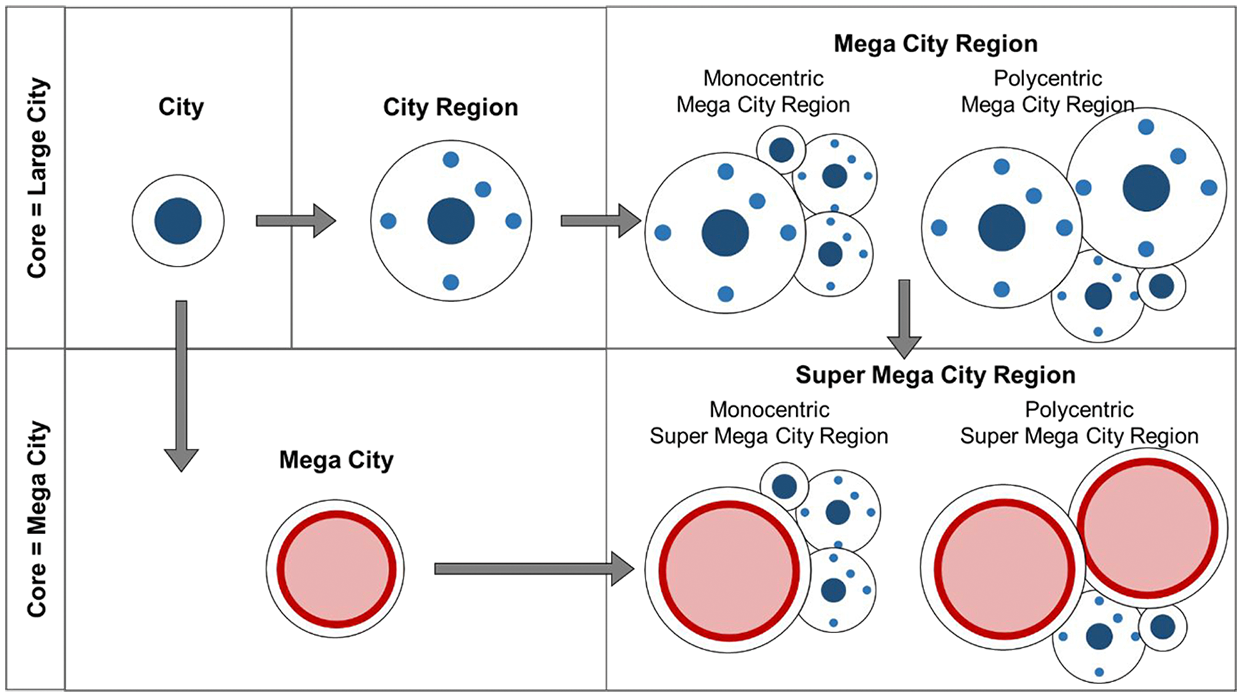
Conceptual diagram of cities, city regions, mega city regions and super mega city regions.
In China, the equivalent terms for city region and mega city region are dadushiqu (i.e. great metropolitan area) and chengshiqun (i.e. cluster of administrative cities), respectively. The term chengshiqun has been extensively used in Chinese official documents and scholarly literature (e.g. Cui and Wang, 1992; Fang, 2009; Fang et al., 2015; Ning, 2011; Soong, 1980; Yao et al., 2016). For example, the 13th Five-year Plan (2016–2020) 4 in China has identified 19 chengshiqun as the national engines of future urbanisation and economic growth.
Mega city regions can be further categorised (Figure 1, Table 1). First, they can be either ‘monocentric’ or ‘polycentric’ depending on the number of core cities. Examples of polycentric mega city regions include Randstad and Rhine-Ruhr in Western Europe (Hall and Pain, 2006). Second, some mega city regions, particularly as found in the rapidly urbanising Global South countries (e.g. YRD, PRD and BTH in China, and the region of Mexico City), are anchored by at least one mega city which has at least 10 million inhabitants. 1 The present study distinguishes these from others and coins the term for them as ‘super mega city regions’.
Categories of mega city regions and examples from China and Western Europe.
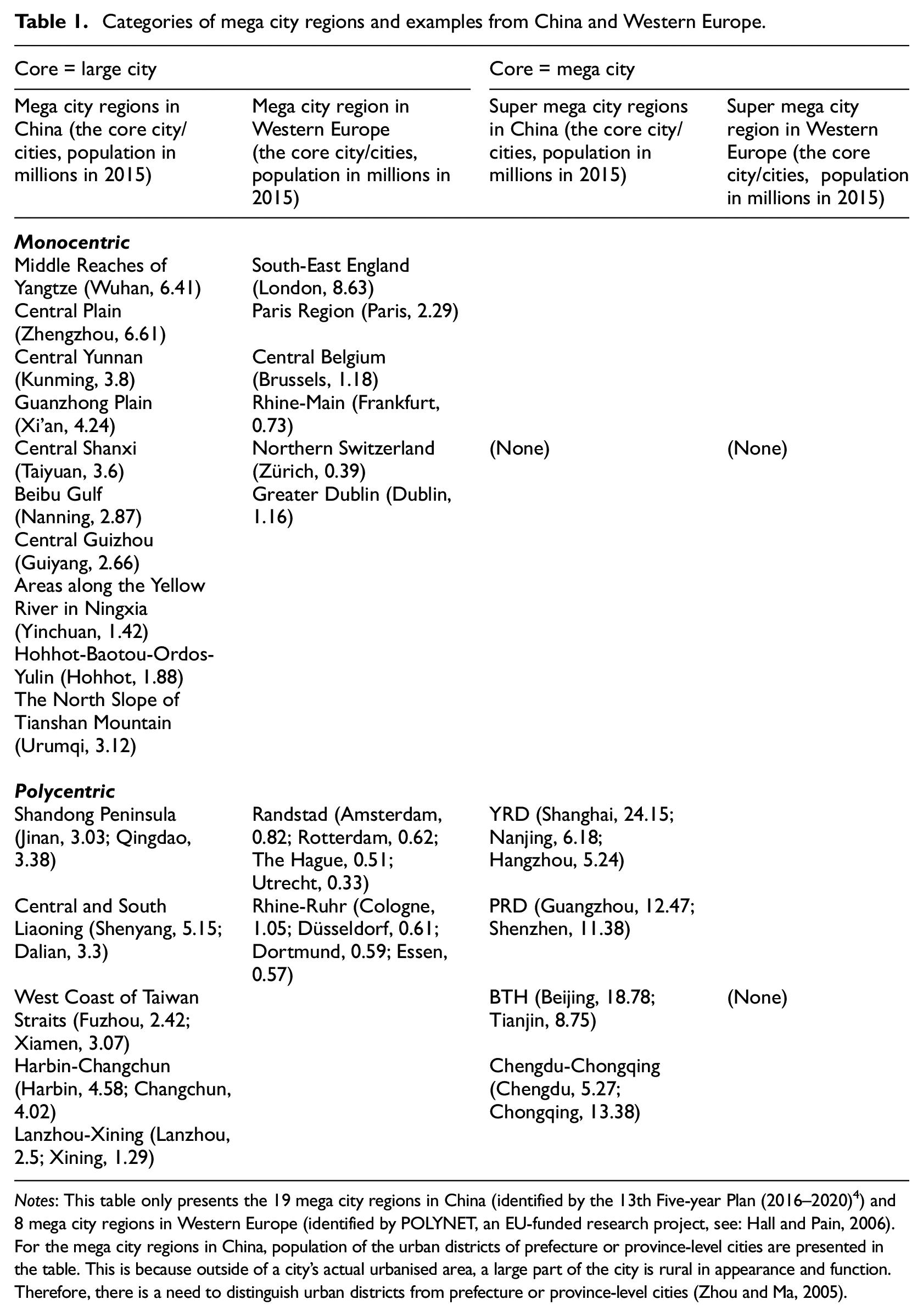
Notes: This table only presents the 19 mega city regions in China (identified by the 13th Five-year Plan (2016–2020) 4 ) and 8 mega city regions in Western Europe (identified by POLYNET, an EU-funded research project, see: Hall and Pain, 2006).
For the mega city regions in China, population of the urban districts of prefecture or province-level cities are presented in the table. This is because outside of a city’s actual urbanised area, a large part of the city is rural in appearance and function. Therefore, there is a need to distinguish urban districts from prefecture or province-level cities (Zhou and Ma, 2005).
Super mega city regions can be formed through different pathways. They can be developed from non-super mega city regions through population growth of the core cities (Figure 1). PRD is a typical example. It evolved from a group of small- or medium-sized cities in the early 1980s, to an urban system with four city regions and several cities in the early 1990s. In the decade following, it became a polycentric mega city region and thereafter developed into a polycentric super mega city region in the early 2010s (Table 2; Figure 2). Furthermore, a super mega city region (e.g. the region of Mexico City and the region of Jakarta) can also be directly formed by an existing mega city and nearby cities/city regions that were originally disconnected (Figure 1). The following sections will adopt these concepts to articulate mega city region development in China.
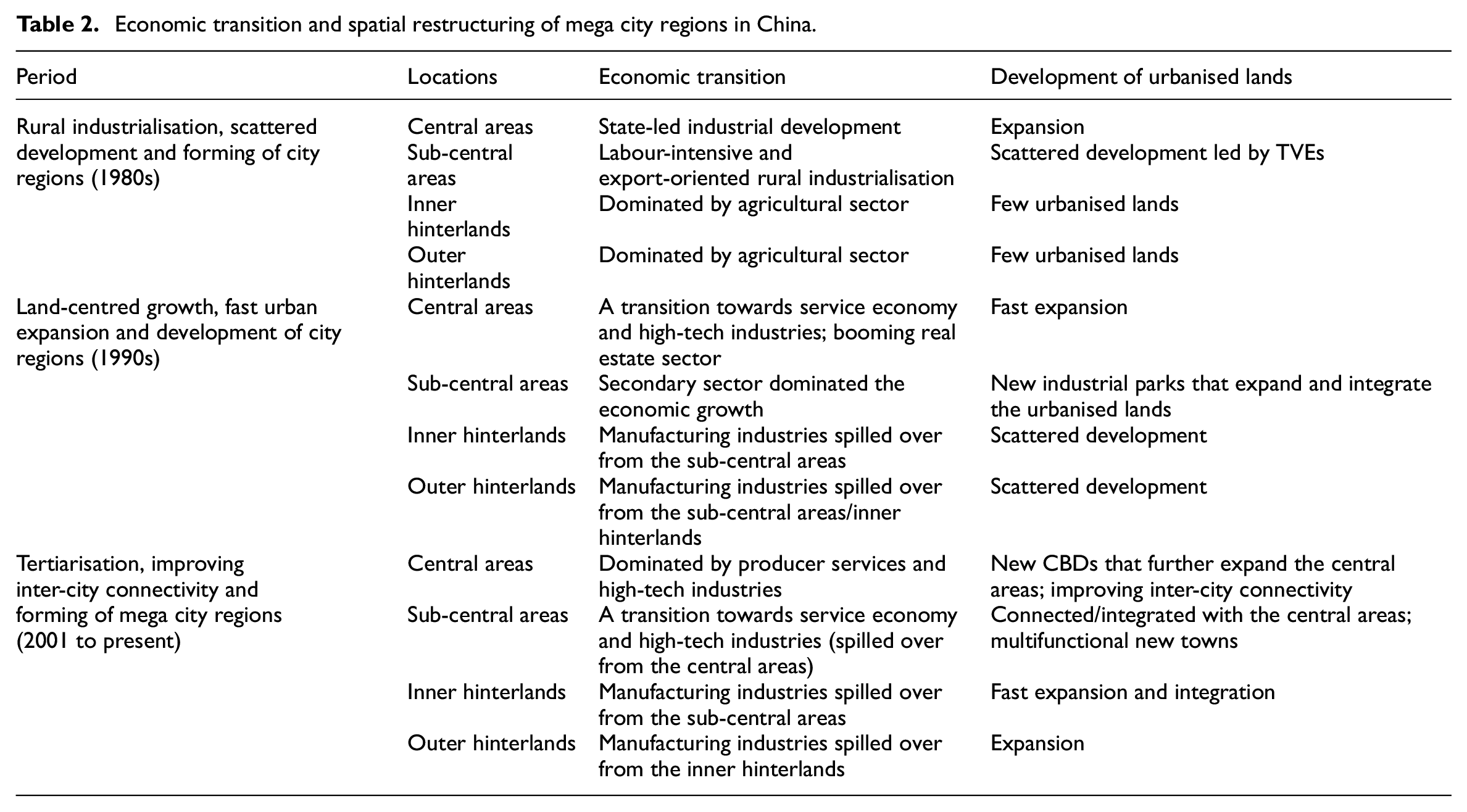
Economic transition and spatial restructuring of mega city regions in China.

Evolution of PRD from city regions to super mega city region.
Theoretical background of mega city region development in China
Vast literature regarding the development of mega city regions has existed since the beginning of the 21st century. According to Scott (2019), two major strands of studies on mega city region development can be identified. One strand, in response to the worldwide spread of neoliberal economic and political policies, focuses on the planning and governance of mega city regions (e.g. Brenner, 2004; Jonas et al., 2014; Ward and Jonas, 2004). Much of the literature has invoked the collapse of Fordist-Keynesian capitalism and the rise of a post-Fordism regime as a basic driving force behind the upsurge of mega city regions (Ma and Wu, 2005; Swyngedouw, 1997; Tömmel, 1997). The diffusion of neoliberalism promotes a ‘zero-sum’ politics of territorial competition (Peck and Tickell, 1994) and a growing tendency towards urban entrepreneurialism (Harvey, 1989). The governance and planning of mega city regions thereby constitute a mediating function in delivering regulatory spaces and necessary facilities to lubricate capital flows (Xu and Yeh, 2011). For European countries, the call for creative regional institutions is widespread for post-Fordist economic governance (Hall and Pain, 2006). Similarly, countries under federalism, such as the USA, have experienced a dramatic resurgence of regional coordination and governance (Brenner, 2002).
The other strand of literature focuses on the economic forces that generate mega city regions (e.g. Scott et al., 2001). This strand of work holds that mega city regions constitute distinctive socio-spatial formations that are undergoing major transformation because of the impacts of globalisation and post-Fordist economic governance (Xu and Yeh, 2011). Scott et al. (2001) view these regions as motors of national or global economic growth. Recent decades have witnessed an escalating tendency of geographic clustering of certain economic activities, for example, technology-intensive production and software development, business and financial services (including corporate headquarters), and cultural and innovative industries (Scott, 2019). Several studies identify the ways that productivity is raised by such urban concentration (e.g. Clark, 2002; Scott, 2017; Storper, 2013; Taylor and Derudder, 2016). For instance, firms being part of spatially concentrated clusters have greater access to a variety of suppliers and business opportunities (Clark, 2002). Such a process is accentuated by globalisation because large city regions function as territorial platforms that enable local firms to encounter global markets (Scott et al., 2001). Moreover, urban concentration intensifies creativity and innovation through the enormous flows of knowledge that occur alongside the transactional links of local firms (Taylor and Derudder, 2016). The concentration of firms seeking higher productivity has laid the basis for new rounds of urban expansion and suburbanisation. In addition to concentration effects, some other studies also underscore the effects of intra-firm linkages in the context of producer service development, since such linkages have remarkably networked and consolidated jurisdictionally separate cities (Taylor et al., 2008; Yeh et al., 2015b).
Regarding mega city regions in China, existing studies concentrate on the first strand and focus on entrepreneurial urban expansion and inter-city coordination as the political dynamics of mega city regions. Entrepreneurial local governments have adopted many possible means to expand urban areas, such as through administrative annexation that absorbs nearby rural counties (or county-level cities) into urban districts (Wu, 2016; Zhang and Wu, 2006). Such a process helps to link different jurisdictional units in a region and to consolidate their governance (Wu, 2016). Meanwhile, policies and spatial plans to enhance inter-city coordination, which have become a major priority on the government’s agenda (Yeh and Xu, 2010), serve as another mechanism of mega city region development in China. Recent decades have witnessed a prominent upward trend of rescaling of governance towards the regional scale, evidenced by the central government’s spatial plans to strengthen regulatory coordination in mega city regions (Li and Wu, 2013). Focusing on the spatial planning of YRD, Gu et al. (2011) unravel the further depiction of the central state as a powerful regional player in shaping territorial growth through top-down spatial regulation. Xu and Yeh (2016) inspect similar issues through the example of the strategic planning of PRD, which serves to regulate increasingly sophisticated regional development. More recently, the central government has successively issued new regional plans for key mega city regions such as BTH and the Guangdong-Hong Kong-Macau Greater Bay Area (an extended region of PRD), as well as a compendium 5 of dushiquan (literally ‘metropolitan-circle’) as a novel scale for inter-city governance. These regional plans or policies, prepared in a top-down manner, reflect national concerns over inter-city coordination and social/environmental sustainability. In addition to the central government’s spatial plans or policies, the governance of mega city regions has also been implemented through regional institutions at local levels such as joint meetings or projects among city governments (Luo and Shen, 2009; Wu, 2016; Wu and Zhang, 2010).
In contrast to the vast literature on planning and governance, there seems to be much less scholarly attention paid to the economic forces that generate mega city regions in the Chinese context. This study places its analytical focus on the economic process of mega city regions in China. It presents a discourse on how economic transition in China steers individual cities into holistic mega city regions (especially super mega city regions). In what follows, we will decipher the dynamics of mega city regions through the lens of economic transition in the context of Chinese gradual economic reform.
From cities to super mega city regions during economic transition
The Chinese government has opted for gradual economic reform since 1978, leading to remarkable spatial transformation in cities. Post-reform economic development can be better discerned through examining different stages of economic transition. Yeh et al. (2015a) divide urban growth and transformation since 1978 into three main waves or stages, including early economic reform and rural industrialisation, land-centred development and tertiarisation and the rise of producer services. The three waves of urbanisation and economic transition in China are delimited by major changes of state policies which have had great impacts on the market, and the dividing lines between the waves are years when crucial policies or strategies were implemented, such as economic reforms and the open door policy in 1978, reform of urban land in 1988, and the 10th Five-Year Plan (2001–2005) using urbanisation and the service sector to promote economic development in 2001.
These three waves of economic transition, characterised by industrial upgrading (i.e. from agricultural sectors to manufacturing and then to service sectors), tend to concentrate in pre-existing large cities and have profoundly motivated the development of mega city regions in China (Figure 3). Using PRD as an example, this section will thus articulate how different waves of economic transition in China since 1978 have been steering the evolution of mega city regions along the pathways of ‘cities – city regions – mega city regions – super mega city regions’. For illustration purposes, we divide a mega city region in China into the central areas (downtown of the core city), sub-central areas (suburbs of the core city and downtowns of other large/medium cities), inner hinterlands and outer hinterlands.
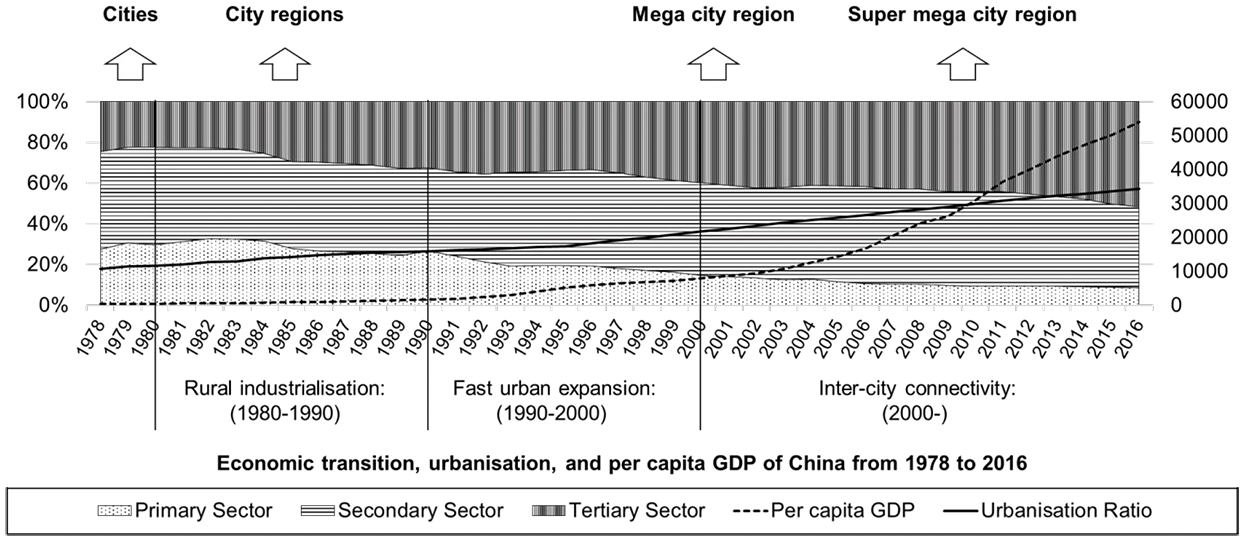
Economic transition and mega city region development in China.
Rural industrialisation, scattered development and the forming of city regions (1980s)
The profound effects of economic reform after 1978 initially materialised in rural areas with the introduction of the Household Responsibility System and the ‘leaving the land but not the village’ policy (Fei, 1989). This dramatically enhanced rural productivity through the development of township and village enterprises (TVEs) (Byrd and Lin, 1990; Chang and Wang, 1994; Yeh et al., 2015a). Benefiting from the substantial reserve of inexpensive surplus rural labour, China in the 1980s managed to involve itself in the global shift of manufacturing industries and attract foreign investment to the national economy. Private and foreign capital was thereby localised in rural areas where investment in TVEs with a large amount of rural surplus labour was allowed.
In this context, coastal regions such as the PRD and YRD were then at the forefront of industrial upgrading among the whole country and evolved from agriculture-dominated regions into intensively urbanised areas. In 1990, the shares of the secondary sector in GDP in BTH, YRD and PRD (48.6%, 51.8% and 43.9%, respectively) were all remarkably higher than the national average (32.4%). 2
Within these regions, industrial upgrading was less prominent in large cities than in smaller ones, as evidenced by the extensive increase in designated towns (Zuo et al., 2002) and the vast population growth in small cities and towns (which contributed more than half of the national population growth from 1979 to 1990) (China State Statistical Bureau, 1999). Before the economic reform in the late 1970s, these regions had been characterised by relatively homogenous spaces and initial centralised development of central areas. In the following decade, the central areas continued to expand under investment from the state (as well as from overseas), while rural industrialisation immensely transformed the rural landscape. Rural industrialisation was initiated by an institutional reform that encouraged local autonomy and the introduction of a fiscal responsibility system (Wong et al., 1995), which gave local government an incentive to develop its own economy (Xu and Li, 2009). This engendered a considerable number of TVEs, inducing a scattered development of industrial land (Table 2).
Take PRD as an example. As the first region of China to implement policies favourable to foreign investment (Lin, 1997), PRD has become the first choice for the cross-boundary transplantation of labour-intensive and export-oriented manufacturing activities from Hong Kong. Such ‘Hong Kong-induced development’ fostered numerous TVEs. In the 1980s, the proportion of employment in the secondary sector in the sub-central areas increased from 27.7% to 48.5% between 1982 and 1990 (Figure 4e and Figure 4f). Industrial districts promptly emerged in PRD (Xu and Li, 2009). Much of the development is located next to villages and thus benefits from low land rent (compared with cities). Moreover, the factories were developed adjacent to roads seeking good accessibility to raw materials and products. Such development bred a scattered pattern of industrial land in the sub-central areas (Yeh and Li, 1999). The central areas and nearby fast expanding sub-central areas began to merge together into city regions (Figure 2a).
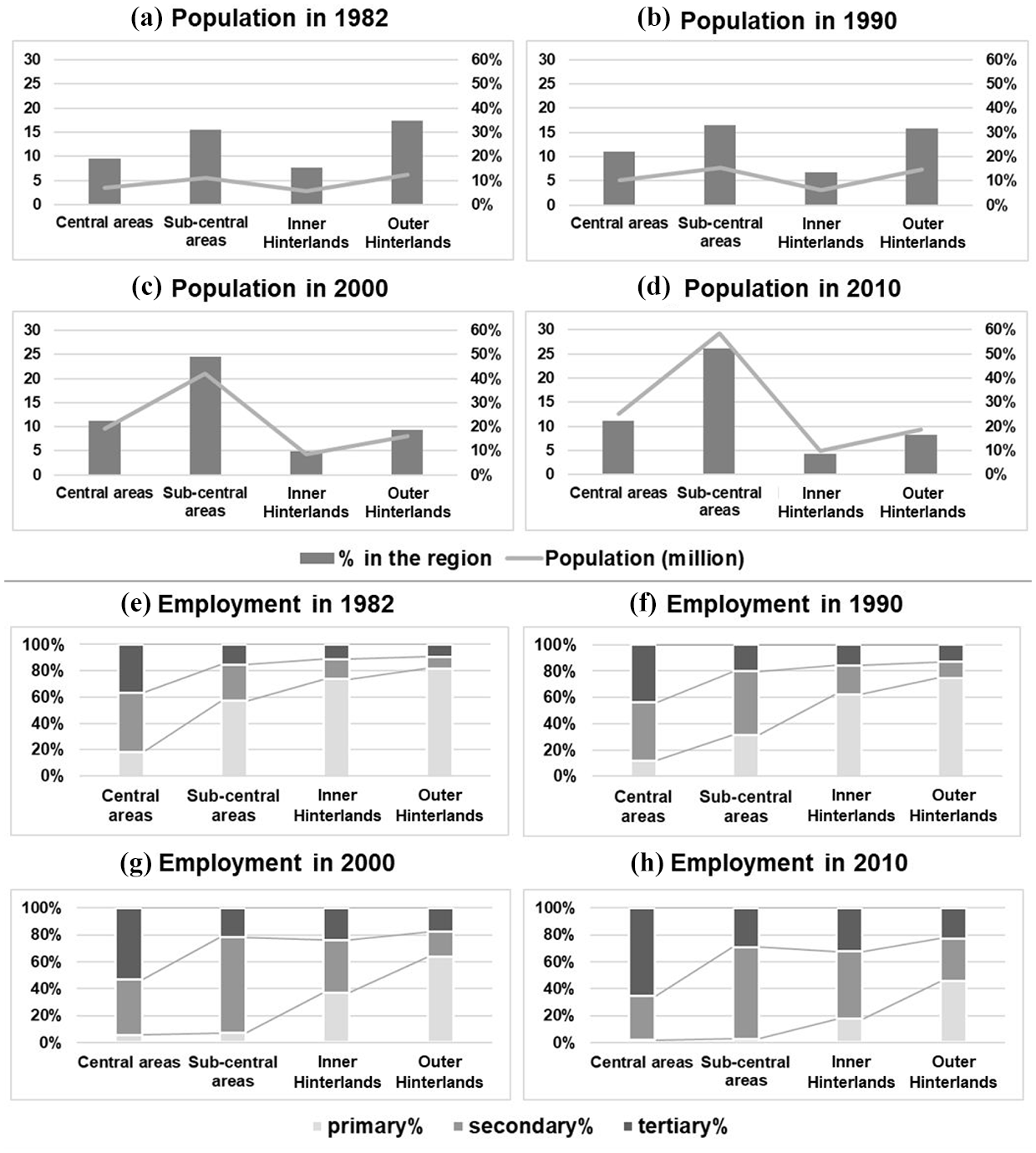
Population and employment in three economic sectors in different locations of PRD.
Land-centred growth, fast urban expansion and development of city regions (1990s)
Successive market-oriented urban land reforms launched rapid urban transformation in Chinese cities through introducing market mechanisms to urban development. A property market was established which induced notable urban sprawl in the eastern regions, especially BTH, YRD and PRD. Massive development of industrial zones, a booming real estate sector and the resultant demand for services have created numerous manufacturing and services jobs in cities and townships (Yeh et al., 2015a), fostering new industrial landscapes in these regions (Table 2): in the central areas, the share of the tertiary sector notably surpassed that of the secondary sector, indicating a transition towards a service economy; while in the sub-central areas, the secondary sector dominated economic growth and further spilled over to the inner hinterlands and even the outer hinterlands. In 1988, the Land Administration Law was modified to allow the paid transfer of land-use rights. The system of compensated use of land established in this period has caused the displacement of land use based on changing land value (Bian and Logan, 1996). The industrial land in the central areas was displaced by commercial and service land, as indicated by the fast growth of employment in the service sector (e.g. in PRD, Figure 4f and Figure 4g). Meanwhile, secondary industries were relocated from central areas to sub-central areas and dominated growth during the 1990s.
Also, with the decentralisation of power triggered by political and economic reforms in the 1990s in China, the land assets under the control of local governments were utilised as an effective incentive. In 1994, the central government introduced a tax-sharing system which reduced the revenue of local governments (Wong, 2000) and thus speeded up the conveyance of urban land, which was outside and beyond the taxable budgetary categories (Lin and Yi, 2011). The increasing autonomy of local governments in land management launched a new wave of development of sub-central areas since the late 1990s (Shen and Wu, 2016), partly through administrative annexation (Zhang and Wu, 2006). Numerous development zones and parks, such as ‘industrial parks’, were developed by the governments to attract investment (Cartier, 2001). In PRD, the population in the sub-central areas had risen dramatically from 1990 to 2000 (Figure 4b and Figure 4c); employment in the secondary sector constituted a dominating proportion in 2000 (i.e. 71.0%), while that in the primary sector dropped to only 7.1% (Figure 4g). These changes indicate that the sub-central areas in PRD in the 1990s have increasingly resembled small, self-contained, industrialised cities (Figure 2b).
Additionally, since 1988 when the central government initiated nationwide housing reform, housing provision and consumption in Chinese cities have undergone gradual but profound changes (Huang, 2004). Housing is no longer allocated by the state without charge; it has become a commodity that circulates in the market. Such reform has drastically stimulated housing demand and thereby steered the real estate industry to a new height. Central areas have expanded fast through the mass construction of commercialised housing projects. The urban population has increased prominently in the outskirts of central areas (Wu and Yeh, 1999).
Tertiarisation, improved inter-city connectivity and forming of mega city regions (2001 to present)
China’s accession to the WTO in 2001 opened the Chinese service market to the outside world. Meanwhile, the 10th Five-Year Plan (2001–2005) launched in the same year envisioned the reinforcement of the service sector to promote economic development and the externalisation of markets for service industries to domestic and foreign investors. The opening up of the service market has enlarged the service sector in the national economy (Yeh et al., 2015a). Similar to the previous stages, industrial upgrading in this period (i.e. tertiarisation) has tended to perform better in the eastern regions among the whole country (Atsmon et al., 2009). In 2015, the shares of the tertiary sector in GDP in BTH, YRD and PRD (56.1%, 52.5% and 54.6%, respectively) all considerably surpassed the national average (40.9%). 2
Tertiarisation has engendered a new urban mosaic and spatiality since 2000 (Table 2). Not only the widespread residential districts and shopping centres but also the upsurge of central business districts (CBDs) have permeated into the urban landscape in Chinese cities (Yi et al., 2011). Instead of utilising the old downtowns, new CBDs were built to direct new development and further expand the central areas.
Besides the development of central areas, sub-central areas have also experienced fast growth in both population and employment (Figure 4d and Figure 4h). Affected by the prosperity of expensive residential projects as well as being facilitated by the expansion of metro transit systems, new affordable housing projects are continually pushed toward the edges of the central areas and even to the sub-central areas. Meanwhile, some of the secondary industries have spilled over to the inner hinterlands (which can be seen by the increased employment in the secondary sector from 2000 to 2010 in the inner hinterlands of PRD; see Figure 4g and Figure 4h). Moreover, as evident in the PRD example, in 2010 service industries not only dominated employment growth in the central areas but also constituted a notable part in the economic sectors of the sub-central areas (Figure 4h).
Flows of producer services that extensively network different cities are also steering the development of mega city regions (Yang and Yeh, 2013; Yeh et al., 2015b). Facilitated by forward and backward linkages of producer services, knowledge exchange and business activities arise through corporate office networks of the same firm located in various cities, as well as when the firm purchases inputs from or sells outputs to other firms in a city. These linkages reinforce the functional and networked relationships between cities and hence strengthen connectivity in mega city regions. Continual urban expansion and enhanced inter-city connectivity have eventually steered several city regions into a holistic mega city region networked by freight transport and commuting (Figure 2c). Some mega city regions (e.g. BTH, YRD and PRD) have further evolved into super mega city regions at this stage.
Challenges facing mega city regions in China during economic transition
In the previous sections, we explored how consecutive waves of economic transitions since 1978 have imposed profound impacts on the dynamics of mega city regions in China. The forming of mega city regions in China is not due to the decentralisation of central areas as observed in Western mega city regions. Rather, it has been driven by rural industrialisation in sub-central areas and the fast expansion of central areas. Such a development pathway creates distinctive problems which challenge the future development of Chinese mega city regions. The following sections will articulate the problems facing Chinese mega city regions that have been caused during their evolution.
Jurisdictional fragmentation
One of the challenges confronting mega city regions in China is administrative fragmentation. Strong bottom-up initiatives in land and economic development during rural industrialisation have led to sophisticated administrative structures in China’s mega city regions. PRD is a typical case. The core cities of PRD, Guangzhou and Shenzhen, are two sub-provincial-level cities outranking a prefecture but still ranked lower than a province. Such special status implies a high degree of autonomy. Sub-provincial municipalities are followed by seven prefecture-level cities. Below prefecture level are county-level divisions, which include eight county-level cities, two counties and 31 urban districts. This is followed by more than 230 townships that arose from the scattered development of rural industrial lands.
Such extreme jurisdictional fragmentation has accorded individual cities/towns different levels of bargaining power. Disputes over resources and vicious competition between local governments have become increasingly serious. Inter-city competition was further reinforced with the introduction of a tax-sharing system that incentivised local governments to develop place-marking projects (e.g. large transportation and facelift projects) to enhance cities’ competitiveness (Xu and Yeh, 2005). These vicious inter-city competitions have generated negative externalities such as redundant construction. While individual cities/towns are implementing entrepreneurial strategies to enhance their competitiveness they pay little heed to inter-city cooperation to deal with critical social and environmental problems, as discussed below.
Socio-spatial inequality
The development of mega city regions in China has generated a somewhat distinctive pattern of socio-spatial differentiation compared with those in the West. Unlike the latter, where suburban areas are mostly populated by middle-class families, suburban/sub-central areas in Chinese mega city regions had, until recently, long been dominated by secondary industries that led to a polluted environment and a population of low-income manufacturing workers (Huang, 2004). The development of public affordable/rental housing in recent decades has also brought a considerable number of low-income, long-distance commuters to these areas. However, the sub-central areas, developed from rural industrialisation, tend to lack good quality services and thus the low-income population in these areas generally experiences poor service accessibility.
These problems are reinforced by the persistence of hukou delineation in rural–urban migration within or beyond mega city regions. Hukou delineation has fostered a two-class urban society in China (Chan, 1996) and it excludes rural migrants from welfare (e.g. public housing) to which the majority local hukou population are entitled. Migrants have to utilise the unregulated housing market in urban villages. However, because of the recent extensive demolition of urban villages in central areas, many rural migrants have been relocated towards the service-poor sub-central areas, which has made it more difficult for them to survive. These problems urge the promotion of service accessibility for the underclass as well as further reforms of the hukou system to minimise institutional discrimination.
Environmental externalities
The hasty and often uncontrolled growth in Chinese mega city regions (especially during rural industrialisation) has engendered considerable environmental problems, such as the widespread misapplication of land use, traffic congestion and severe pollution. For instance, the total industrial wastewater discharge, industrial waste gas emissions and industrial solid waste generation volume in China’s mega city regions accounted for over 67% of the national total (Fang and Yu, 2016). The environmental challenges in China’s mega city regions have also been reinforced by the highly unbalanced development and prominent intra-regional inequality. Affordable housing projects developed in suburban/sub-central areas have led to the prevalence of long-distance commuting. Within mega city regions, central areas have been surrounded by bedroom communities, making traffic pollution even worse (Yang et al., 2014).
These environmental challenges urge a more balanced spatial pattern of mega city regions and inter-city cooperation to maintain environmental sustainability in fast-growing Chinese mega city regions.
Conclusions and prospects
Mega city regions, despite being long discussed in literature, are not a passing phenomenon. They are likely to persist and to further enlarge their economic footprints and economic impacts. Echoing the work by Scott et al. (2001), which explicates how economic transformation in a globalised era engenders new rounds of urban expansion and thus fosters the development of mega city regions, the present study decodes the economic process underneath the recent upsurge of Chinese mega city regions. The paper’s original contribution lies in a discourse on how different waves of economic transition since the late 1970s have been steering the evolution of mega city regions in China along the pathways of ‘cities – city regions – mega city regions – super mega city regions’.
Regions such as YRD and PRD have been at the forefront of industrial upgrading, such as rural industrialisation and tertiarisation. During the early economic reform, rural industrialisation profoundly transformed the rural landscape in some regions into scattered industrialised settlements that constituted part of city regions. Land-centred development thereafter launched rapid urban transformation in the way that industrial land in the central areas of mega city regions was displaced by commercial and service land and how secondary industries, relocated from central areas, drove the growth of sub-central areas during the 1990s. Tertiarisation in recent decades fostered new CBDs that further expanded the central areas. Forward and backward linkages of producer services heightened inter-city connectivity within regions. The continuous urban expansion, together with enhanced inter-city connectivity and a substantial population influx, eventually consolidated individual cities into holistic, super mega city regions (Yeh et al., 2015b).
Simply put, the forming of mega city regions in China is not due to the decentralisation of central areas as observed in the Western mega city regions. Rather, it has been driven by rapid rural industrialisation in the sub-central areas and the fast expansion of central areas. Strong bottom-up initiatives in land and economic development during rural industrialisation have fostered fragmented administrative structures and vicious competition between local governments, which pay little heed to inter-city cooperation to deal with critical social and environmental problems. The sub-central areas, developed from rural industrialisation, tend to lack good quality services and thus the low-income population (especially migrants) in these areas generally experiences poor service accessibility. The hasty and often uncontrolled growth of Chinese mega city regions has also engendered environmental problems such as the widespread misapplication of land use, traffic congestion and severe pollution. The future development of mega city regions in China requires more effective reforms and policies targeted at the challenges mentioned above, such as novel regional institutions to coordinate the conflicting interests of local agencies within different jurisdictions, reforms of the hukou system and the equalisation of basic public services, and policies for pollution abatement and prevention through inter-city cooperation. It is noteworthy that new versions of regional plans for key mega city-regions such as BTH and the Guangdong-Hong Kong-Macau Greater Bay Area have established several visions that could address some of these concerns. For instance, they propose novel approaches for the cross-jurisdictional coordination of different governance agents (or even diverse political systems) to achieve certain goals such as economic cooperation and integration, environmental planning and ‘function dispersal’ (i.e. inducing industrial transfer).
With the continuous rise of per capita GDP in major cities, 6 a new wave of economic transition from labour-intensive industries to the development of high-tech industries (especially industry 4.0 7 ) is burgeoning in China. Such transformation will profoundly influence the spatial structure of mega city regions. Different from labour-intensive industries that require cheap land and labour costs, high-tech industries prefer a clean and appealing environment for R&D activities by ‘knowledge workers’ (Ritter, 1990). As old, polluted industrial districts cannot suit high-tech industries, new high-tech areas with decent working and living environments have been thriving in newly developed districts of mega city regions. An example is the way that a Shenzhen-based technology giant has recently relocated its R&D department to the Songshanhu Area in Dongguan, because of the good urban design and scenery in this area. This relocation, creating a new inter-city commute, has strengthened the linkage between the two cities. New approaches to financialising these high-tech industries are also emerging in the super mega city regions (He et al., 2016). To attract new types of producer services (e.g. venture capital firms and private equity funds) and well-educated and talented workers, entrepreneurial local governments have been improving the aesthetics of the urban landscape so as to transform old industrial districts into entertainment and creative industry districts (an example is the Taikoo Warehouse Creative and Cultural District in Guangzhou). We will experience a new wave of planning and development to improve the overall environment of mega city regions in China (e.g. enhancement of inter-city transport networks, redevelopment of old industrial areas and ecological restoration of environmental degradation areas) in response to these emerging new industries.
Footnotes
Declaration of conflicting interests
The author(s) declared no potential conflicts of interest with respect to the research, authorship, and/or publication of this article.
Funding
The author(s) disclosed receipt of the following financial support for the research, authorship, and/or publication of this article: We would like to thank the financial support from Chan To-Haan Endowed Professorship Fund of the University of Hong Kong, Humanities and Social Sciences Prestigious Fellowship Scheme (HSSPFS) (HKU-37002617) and General Research Fund (HKU-17603617) of the Hong Kong Research Grant Council, and Strategic Public Policy Research Grant (S2017.A8.007.17S) of the Policy Innovation and Co-ordination Office of the HK SAR Government.
