



Abstract
Increasingly, greening in cities across the Global North is enmeshed in strategies for attracting capital investment, raising the question: for whom is the future green city? Through exploring the relationship between cities’ green boosterist rhetoric, affordability and social equity considerations within greening programmes, this paper examines the extent to which, and why, the degree of green branding – that is, urban green boosterism – predicts the variation in city affordability. We present the results of a mixed methods, macroscale analysis of the greening trajectories of 99 cities in Western Europe, the USA and Canada. Our regression analysis of green rhetoric shows a trend toward higher cost of living among cities with the longest duration and highest intensity green rhetoric. We then use qualitative findings from Nantes, France, and Austin, USA, as two cases to unpack why green boosterism correlates with lower affordability. Key factors determining the relation between urban greening and affordability include the extent of active municipal intervention, redistributional considerations and the historic importance of inclusion and equity in urban development. We conclude by considering what our results mean for the urban greening agenda in the context of an ongoing green growth imperative going forward.
Introduction
Cities are increasingly being caught up in paradoxes and tensions between a litany of demonstrable benefits of green urbanism and acute instances of socio-spatial injustice (Haase et al., 2017). Urban greening projects such as Chicago’s 606 (Rigolon and Németh, 2018) or Paris’s Promenade Plantée (Heathcott, 2013) are ever more attractive to city governments because of their possibility to stimulate private investment and real estate development. At the same time, these projects have been shown to generate processes of displacement and gentrification – both in the creation of archetypal spaces such as New York’s High Line (Loughran, 2014) and in more ‘ordinary’ greening (Wolch et al., 2014). Furthermore, these projects are linked to racialised and ethnocentric socio-natural relations that are reproduced in the creation and use of green spaces (Brownlow, 2006; Byrne and Wolch, 2009; Finney, 2014). Therefore, at this moment when a green-sustainable-resilient planning orthodoxy is guiding the agenda of more and more cities (Connolly, 2018a) with widespread support and recognition (Anguelovski et al., 2018b; Krueger and Gibbs, 2007), it is necessary to unpack and illustrate the particular dynamics underlying the diffuse tension between urban greening and socio-spatial injustice.
To date, physical urban greening interventions have been shown to increase nearby property values (Been and Voicu, 2006; Conway et al., 2010; Heckert and Mennis, 2012; Immergluck, 2009) and spur gentrification (Anguelovski et al., 2018b, 2018c; Wolch et al., 2014). Yet we know much less about: (a) how the extent to which municipal governments employ broad green discourses to promote their cities on the world stage relates to cost of living in those cities, and (b) how planning processes, policy interventions and overall municipal approaches related to greening mitigate (or exacerbate) unaffordability and social inequity. In response, our paper builds on existing research in the fields of critical geography, urban political ecology, environmental justice and green gentrification, with a unique focus on the issue of green branding.
We make three main contributions. First, we quantitatively assess the somewhat nebulous relationship between green branding and affordability, with clear and direct urban environmental equity/justice implications. Second, we forward the conversation about how policies, regulations or interventions that exist or are emerging can protect long-term residents against processes of green gentrification and displacement (Anguelovski et al., 2018a; Gould and Lewis, 2017; Lang and Rothenberg, 2017). Third, we mobilise a methodologically innovative data set of urban green trajectories from 99 cities in Western Europe, the USA and Canada assembled by a large research team (BCNUEJ, 2018). This sample of 99 cities represents over 95% of mid-sized cities (population between 0.5 million and 1.5 million) in those regions. We focus on mid-sized cities because they increasingly attract sizeable national and international private investments and have international exposure. Furthermore, capturing the full green trajectory of mid-sized cities is more feasible in comparison with mega or global cities, thus reducing error or the possibility of missing data.
Before presenting our research design and results, we anchor our paper in a discussion of the (urban) green growth agenda, the role and implications of urban greening as a widespread strategy and why social equity considerations are of fundamental importance.
Green city boosters: Considering urban green growth, city affordability and social equity
Cities around the world are increasingly ‘going green’, a process that entails programmes to reduce urban waste and air pollution, promote clean energy and mobility policies or increase the quantity and quality of urban green spaces, to name a few. Since the early 1990s, cities have produced and implemented numerous municipal environmental strategies, policies and projects around urban sustainability and greening (e.g. Local Agenda 21). Such initiatives are supported by national programmes such as Greening America’s Communities run by the Environmental Protection Agency in the USA and rewarded by supranational initiatives such as European Green Capital Awards. 1 The promotion of the greening agenda has continued through the European Commission’s (2015) research and innovation policy to pushing Nature-Based Solutions (NBS) – interventions supported and inspired by nature that simultaneously give economic, social and environmental benefits – and will likely continue to intensify globally in the future, building on urban greening discussions at the 2016 Habitat III conference in Quito (United Nations, 2017).
While the broad notion of urban boosterism has a long history (Hall, 1993; Harvey, 1989), a reorientation has begun in recent decades in the context of urban sustainability efforts and the attractive prospects of ‘green growth’. In particular, since 2008, green growth also appears to offer a possible way out of the financial crisis that began that year as ‘nature’ provides new frontiers for finance capital investment (Arsel and Büscher, 2012; Brand, 2012). In response, cities as diverse as Vancouver, Milan and Philadelphia have become green boosters, using pro-environmental branding strategies and practices as a way to ‘sell’ themselves as desirable places to invest and live (McCann, 2013). A green city brand can be related to a vision for increased urban environmental political oversight and/or an ambition to develop urban environmental qualities to gain market advantage (Beatley, 2011). Some frontrunner sustainable cities such as Copenhagen and Malmö have only recently combined environmental improvements with economic growth to successfully brand themselves, pointing to how green place brands operate squarely within the predominant neoliberal urban governance framework (Anderberg and Clark, 2013; Gulsrud et al., 2013).
The attractiveness of green city branding is particularly prominent because of what some call ‘green gaps’ that create potential new types of rents for municipalities, investors and more privileged groups of residents (Anguelovski et al., 2018a) seeking to capture value from green projects, increasing economic growth and/or improving competitiveness (Dooling, 2009; Quastel et al., 2012). Often, the creation of these new green rents is undergirded by discourses highlighting how greening provides win–win benefits and public goods for all. Municipalities also deploy new financial instruments and tools – from green bonds to property-assessed clean energy programmes – in order to finance urban greening (Knuth, 2016). Such projects also embody green capitalism trends (Prudham, 2009; Wallis, 2010), whereby attempts to resolve economic and ecological crisis are integrated into new circuits of capital accumulation and supposedly sustainable growth trajectories. Many of these green projects are flagship symbols of a global smart, sustainable and resilient city planning orthodoxy (Connolly, 2018a, 2018b).
Critiques of the notion and practice of branding for green growth abound in the critical geography and urban theory literature. Some argue that green growth is used as a cover to restart urban capital accumulation (Holgersen and Malm, 2015) and accumulation by green dispossession (Safransky, 2014), a form of ‘green’ value grabbing (Andreucci et al., 2017). At the extreme, experimental eco-cities are emerging as technological fixes or ‘sustainability fixes’ (Goodling et al., 2015; Long, 2016; Rosol et al., 2013; Tretter, 2013; While et al., 2004) that mostly ensure the continuation of business-as-usual rather than a transition to a new green economy (Caprotti, 2014) or to more transformational approaches to sustainability. Sustainability, in many of these cases, correlates solely with the economically lucrative dimension of ecological innovation, whereby notions of economic constraint are ultimately transcended and social considerations are relegated to the market (Cugurullo, 2013; Hodson and Marvin, 2010).
Economic growth and environmental improvement are also often seen as compatible, and positive, in more everyday cases of urban greening. Improvements to the urban environment are known to increase property values, which can trigger the physical, cultural and/or social displacement of vulnerable residents; improvements include well-kept community gardens (Been and Voicu, 2006), greening vacant lots (Heckert and Mennis, 2012) or greening more broadly (Conway et al., 2010). Even just the announcement of future green-space development can trigger a rise in property values (Immergluck, 2009). These facts win the interests of green growth-oriented cities and developers despite the possible negative impacts on vulnerable residents, as they see that creating a more environmentally sustainable city is indeed compatible with business-as-usual, just ‘greener’ (Davidson, 2012; Swyngedouw, 2007).
Other green growth critiques highlight that the concept neglects the social dynamics of sustainability because of a tendency towards apolitical or post-political approaches to sustainability planning that lack attention to equity issues (Anguelovski et al., 2018a, 2018b; Gibbs et al., 2013; Swyngedouw, 2007). Sustainability fixes are increasingly being contested as prime tools for urban economic competitiveness to the detriment of ecological sustainability or social justice (Walker, 2016; While et al., 2004), and they have been shown to co-opt or partially appropriate activists’ claims for social justice and inclusion (Long, 2016). Admitting that sustainable development is not a reality because of increased environmental problems and growing social inequality, several international agencies and institutions now include the idea of social inclusion in their push for green growth (e.g. OECD, 2012; World Bank, 2012). For instance, the European Commission has ascribed NBS to the list of ‘socially inclusive green growth’ tools (European Commission, 2015).
After decades of neoliberal planning and governance strategies that fuel intercity competition and municipal entrepreneurialism (Harvey, 1989; Sager, 2011), being green indeed serves to attract capital and growth, even while ‘social inclusion’ appears elusive. Reflecting this circumstance, Molotch’s (1976) growth machine theory has recently been expanded towards theorising the inner workings of the ‘green growth machine’ (Gould and Lewis, 2017; Lang and Rothenberg, 2017; Loughran, 2014). The revalorisation of land and real estate as a result of green space development (Been and Voicu, 2006; Conway et al., 2010; Heckert and Mennis, 2012; Immergluck, 2009) that drives the green growth machine benefits certain (generally White middle to upper middle income) residents at the expense of others (low income and minorities), pointing towards processes generating social exclusion rather than inclusion (Anguelovski et al., 2018b).
The (‘socially inclusive’) green growth discourse furthermore ignores the uneven urban race and class relations that have been demonstrated, particularly in the US context, to be deeply intertwined with the location of environmental amenities (Boone et al., 2009; Heynen et al., 2006; Wolch et al., 2005). Consequently, while there are some exceptions, greening interventions tend to be concentrated in higher-income, White neighbourhoods, meaning that these urban residents have (historically) disproportionately benefited – and often continue to benefit – from physical urban greening. This process has been dubbed green gentrification (Checker, 2011; Dooling, 2009). If questions of social equity are not directly addressed, evidence suggests that far from becoming socially inclusive, sustainable and ‘green’ communities can and do become commodities (Dale and Newman, 2009; Luke, 2005) or green enclaves of environmental privilege (Anguelovski et al., 2018a; Park and Pellow, 2011). Strategies towards socially inclusive green growth in the case of urban greening can paradoxically generate greater inequality rather than social cohesion (Haase et al., 2017), a finding also emerging from studies on green gentrification (Anguelovski, 2014; Hamilton and Curran, 2012).
In sum, there is clearly a conflictual yet dialectical relationship between the urban green growth agenda and social equity concerns. If questions of social equity are not directly taken into account in urban greening interventions, green growth will ultimately be a business-as-usual approach likely to create new privileged green enclaves. Yet, to date, there is little empirical evidence that demonstrates the full extent of the relationship between green branding and costs of living or about how cities are intervening in this relationship. Therefore, we consider the following questions: first, to what extent does the degree of green branding – that is, urban green boosterism – predict the variation in city affordability? And second, how can cities be proudly green and sustainable while also addressing the potential exclusionary effects of urban greening initiatives?
Data and methodology: Unpacking urban green boosterism, affordability and social equity
The originality of this paper lies in bringing together an extensive historic data set of the qualitative greening trajectories of 99 European, American and Canadian cities with quantitative data on cost of living, population and purchasing power, and semi-structured interviews with key local stakeholders in two selected cities. The following subsections explain in detail these quantitative and qualitative data sets and how we mobilised them in this paper.
Quantitative methodology and analysis
For our quantitative methodology, we used linear regression modelling to assess the relationship between green boosterism (via greening rhetoric classifications, described below) and city affordability (via the cost of living plus rent index, also described below). We adjusted the model with three basic measures which may explain (often large) variations in cost of living, and are available for most cities in the sample: (1) city population size given the variation of city sizes in our sample; (2) region (USA, Canada or Western Europe) in order to account for substantial variation in governance and policy environments affecting local economies by region; and (3) local purchasing power, to recognise that people’s ability to pay for living expenses depends on how much they earn or own. All statistical analysis was conducted using STATA version 14.2.
Dependent variable: Affordability
Affordability was measured through a cost of living plus rent index sourced from the Numbeo database, which aggregates data from user inputs and other sources to generate cost of living indexes by city. 2 The cost of living plus rent, index is a relative indicator of the cost of consumer goods prices, including groceries, restaurants, transportation, utilities and rent, indexed against the cost of living in New York City. While cost of living indexes have been used in other studies to demonstrate how lower-income residents are affected by multiple types of price increases in cities, including housing (Albouy et al., 2016; Guerra and Kirschen, 2016), the use of Numbeo in scholarly studies is novel and incorporates a broad spectrum of costs while providing comparable data across the majority of cities in our sample.
We consider the cost of living plus rent index to be an appropriate measure for city affordability because the Numbeo database uses a robust methodology to estimate the true cost of living through locally accurate sources that account for variation in local spending patterns. Higher cost of living and monthly rent increase urban inequality and segregation, reducing the quality of life for low-income and minority residents and possibly leading to displacement (Goldsmith and Blakeley, 2010).
Primary independent variable: Urban green boosterism
To measure urban green boosterism, we mobilised the codes generated from our collective analysis of the greening trajectories of 99 mid-sized cities across Western Europe, the USA and Canada (the details on creating these codes are explained in the qualitative methods section below). We developed a categorical classification system to measure green boosterism along two dimensions, resulting in the following five levels: (1) high intensity/long duration; (2) high intensity/short duration; (3) moderate intensity/long duration; (4) moderate intensity/short duration; and (5) low intensity. For the first dimension, intensity, planning documents were considered to have a high level of rhetoric when they included bold statements such as ‘being the most sustainable city in the region/world’. Low intensity cities included no such statements. Cities were ranked on a second, temporal dimension, indicating if rhetoric has been present since 1990 (long duration) through to rhetoric occurring only over the past 10 years (short duration). 3
Control variables
To assess economic activity and growth as control variables, we included a measure of local purchasing power. Purchasing power scores were taken from the same online database described above (Numbeo) and relate to the power in buying goods and services in a city relative to the average wage in that city. Similar to the measure of cost of living, it is expressed as a percentage relative to the purchasing power of those earning an average wage in New York City, based on the estimated average cost of living for a family of four living in each city.
We first tested the assumptions of linear regression using pre- and post-hoc analysis where appropriate. The final model showed no sign of violating assumptions of multicollinearity or heteroscedasticity, and assumptions of linearity, normality of residuals and linearity were met. We found no evidence of specification errors.
We do not use a strict 0.05 level of statistical analysis, as statistical research warns against the strict use of a 95% confidence interval threshold (Greenland et al., 2016). In addition, our relatively small quantitative sample and the complexity of the real-world scenario in which costs of living are experienced are not likely to meet such strict tests for statistical significance. We chose instead to examine the data for trends, taking these limitations into account. We acknowledge that there are limitations in this analysis in the sense that other variables impact affordability including: land use factors; zoning permitting, construction and regulatory factors; and funding and finance factors. Those variables were not included in the model since they would have required within-city, per-city or per-greening intervention analysis that was outside the scope of this paper.
Qualitative methodology and analysis
In the paper, we also use selected qualitative case examples in order to illustrate and contextualise our quantitative findings. The two cities selected from our 99-city database are Nantes, France, and Austin, Texas, USA. Given space constraints, our goal for bringing in the case examples is not to conduct a full in-depth qualitative data analysis of green (in)equity in Austin and Nantes, but rather to illustrate some of the trends we have identified in the quantitative analysis. In particular we aim to present – in an exploratory way – what measures, regulations and interventions municipalities can put in place (e.g. Nantes) or what barriers are faced (e.g. Austin) to ensure that green branding can be associated with affordability and equity, rather than the opposite. 4 These basic case profiles offer a preliminary notion of why greening and affordability may or may not trend together.
Our selection of these two cities was driven by the fact that both cities articulate significant green boosterism through obtaining the highest possible score in greening rhetoric, yet Austin exemplifies a city that has rapidly become more unaffordable in recent years, and Nantes, a city that has maintained relative affordability. Both cities also show variation in the results for several social equity-related variables we coded in a similar fashion to the method described for rhetoric, where urban green interventions in Nantes were relatively more equitable than interventions in Austin. These measures of social equity include the use of greening as a revitalisation strategy in low-income/minority neighbourhoods, the presence of a city-wide goal for universal access to green space, and a moderate level of procedural participation in municipal greening projects. 5
Qualitative data collection procedures
The two case examples draw on (1) our qualitative data from the comprehensive historic analysis of Western European, US and Canadian city green trajectories we conducted (described below), and (2) 30 semi-structured interviews with key policymakers, real estate developers and community activists across Nantes and Austin.
To create the greening trajectories for our 99 mid-sized cities, we first reviewed all available city planning and policy documents related to urban physical greening and overall environmental planning from 1990 to the present by searching and identifying each municipality’s website(s), reports, plans, policy documents, press releases and online archives. For most cities, several researchers ensured that we exhaustively covered the available material and contacted local agencies and experts. We then triangulated across primary documents, local expert feedback and secondary literature within a series of group meetings over a six-month period where we continuously developed interpretations and a joint coding scheme. We searched for all primary documents since 1990 as this year signals the beginning of almost three decades of urban sustainability planning, a time that saw increased tensions and interventions across competing social, economic and ecological urban greening goals (Beatley, 2011).
In order to ensure internal consistency of the scoring process and adhere to a high level of inter-coder reliability, we held regular coding workshops in which all researchers agreed on specific, detailed descriptions and criteria for assigning codes (e.g. the urban boosterism code explained previously). This involved some debates but ultimately the full team agreed upon a robust classification. Last, we used the coded documents to produce a 1500-word greening policy trajectory and timeline of key greening initiatives since 1990 for each city, focusing on urban green space development (BCNUEJ, 2018). We verified each trajectory with local experts who reviewed our summaries, commented on them and suggested edits and additional resources. We used this systematic and comparable set of trajectories to confirm and fine-tune our coding results, and to select the two cities to more deeply explore the relationship between urban boosterism and city affordability.
Additionally, we conducted interviews during fieldwork in each city in October 2017 (Nantes) and January 2018 (Austin). Interviewees were identified and selected via a snowball sampling approach through previous research experience in those cities, local academic colleagues and the policy/plan document review. They represented a wide range of key local stakeholders whose long-term knowledge of green planning and/or urban development helped understand each city’s green trajectory as well as the challenges and opportunities for creating greener and socially equitable cities. Interviews followed a semi-structured interview guide (see Appendix 1, available online), which was designed for a broader study, where we focus on questions related to: greening trajectory of each city with its main characteristics; interventions and shifts over time; politics and governance of urban greening; concrete key greening projects and interventions; partnerships for greening interventions; connection between greening and equity/inclusion goals and related equity and green equity projects or measures.
Results: Unpacking green boosterism, city affordability and social equity considerations
In Table 1, we present the cities included in the quantitative study charted across two dimensions – cost of living in quintiles and ranking of greening rhetoric – demonstrating the range of timeframes and intensity of green rhetoric across the sample. In Table 2, we present summary statistics describing the sample as well as our regression analysis.
Intensity and duration of greening rhetoric since 1990 relative to cost of living quintile among the 88 cities analysed.
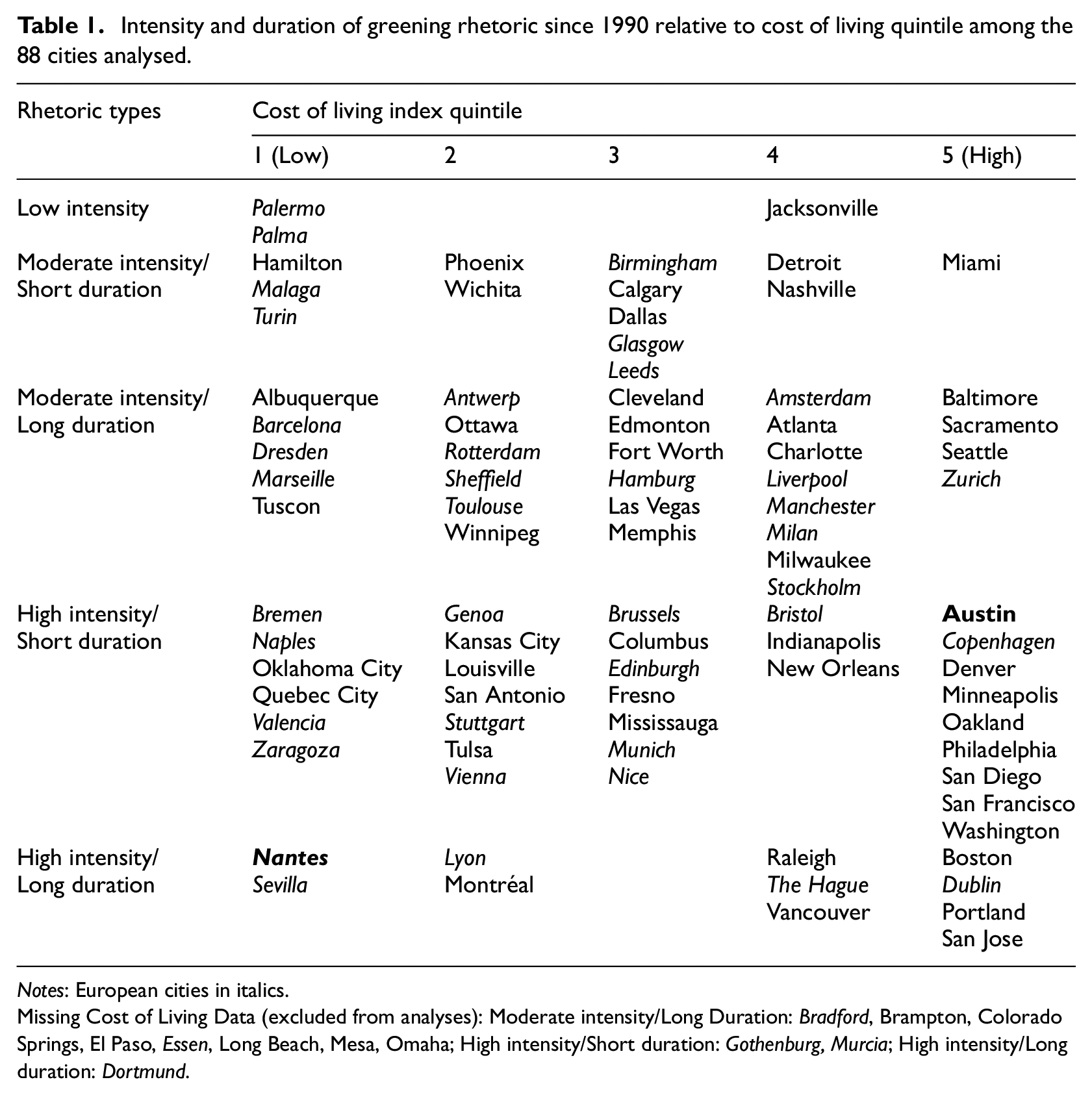
Notes: European cities in italics.
Missing Cost of Living Data (excluded from analyses): Moderate intensity/Long Duration: Bradford, Brampton, Colorado Springs, El Paso, Essen, Long Beach, Mesa, Omaha; High intensity/Short duration: Gothenburg, Murcia; High intensity/Long duration: Dortmund.
Summary descriptive statistics, regression coefficients (β) and p-values for the multiple linear regression model, indicating the relationship between each characteristic and cost of living for the 88 cities analysed.
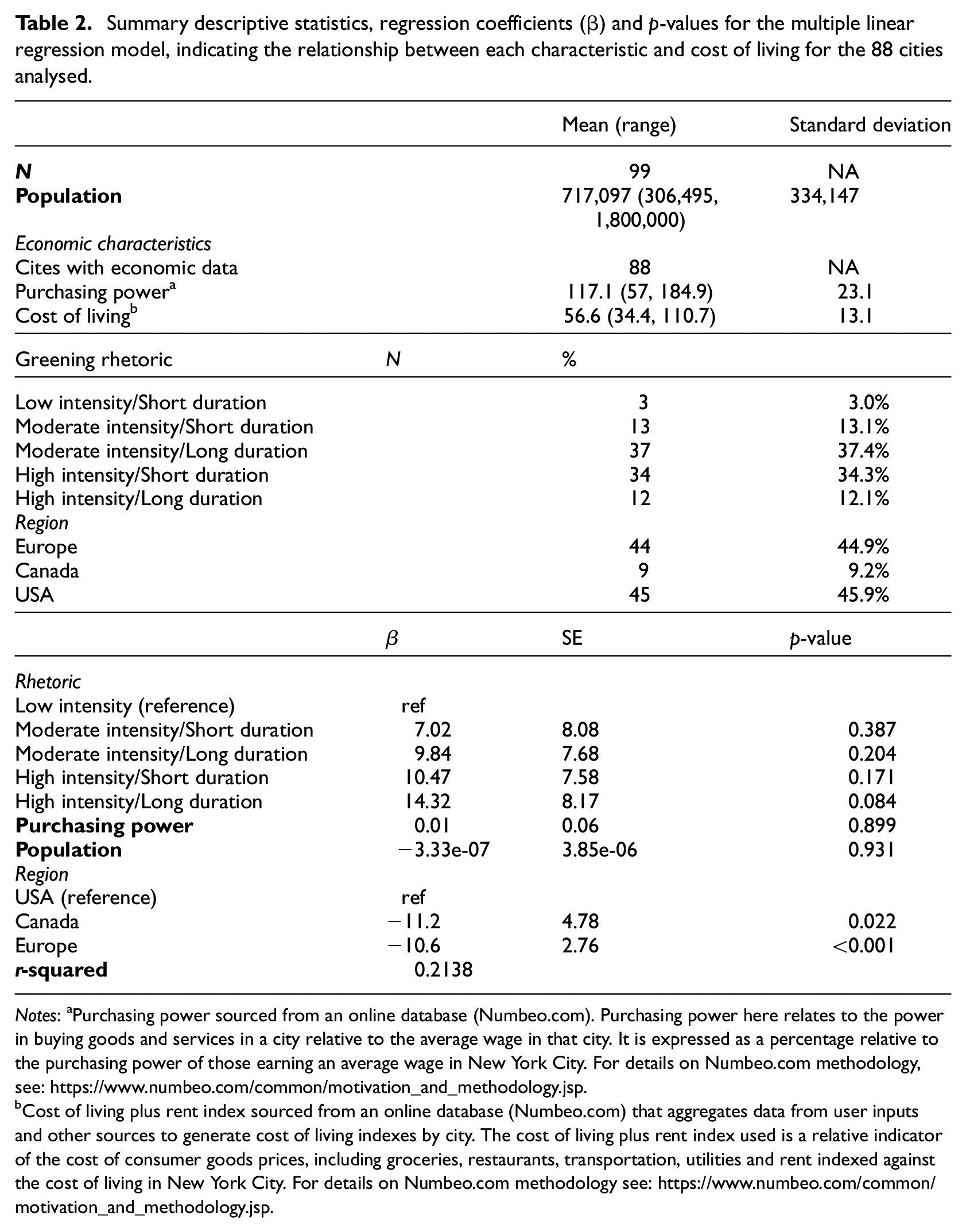
Notes: aPurchasing power sourced from an online database (Numbeo.com). Purchasing power here relates to the power in buying goods and services in a city relative to the average wage in that city. It is expressed as a percentage relative to the purchasing power of those earning an average wage in New York City. For details on Numbeo.com methodology, see: https://www.numbeo.com/common/motivation_and_methodology.jsp.
Cost of living plus rent index sourced from an online database (Numbeo.com) that aggregates data from user inputs and other sources to generate cost of living indexes by city. The cost of living plus rent index used is a relative indicator of the cost of consumer goods prices, including groceries, restaurants, transportation, utilities and rent indexed against the cost of living in New York City. For details on Numbeo.com methodology see: https://www.numbeo.com/common/motivation_and_methodology.jsp.
Despite a relatively small sample size, and low r-squared value indicating that the measured indicators do not account for all variability in cost of living by city (as expected), this analysis revealed a trend toward higher cost of living among cities that had demonstrated a high level of rhetoric over an extended duration (since at least 1990) compared with cities with low internal rhetoric around greening (β = 14.3, p = 0.084, see Table 2). Although not statistically significant according to a conservative 0.05 threshold, we did find a noteworthy trend. In other words, if this trend holds, a higher greening rhetoric over a prolonged period of time is associated with higher unaffordability, even when controlling for purchasing power, a city’s size, and region, which we might expect to account for differences in cost of living.
Beyond urban entrepreneurialism’s embrace of greening as a way to attract capital and investment (Harvey, 1989), this finding may reflect a somewhat unforeseen or at least an insufficiently unpacked element of the shift from industrial-driven development towards tertiary-sector activity (Hall, 1993). Selling itself as a green city may be one component in making a city more unaffordable, as our results show a tendency for cities with high rhetoric over a long period to be less affordable than those with the least amount of rhetoric. This may occur because talking the green talk may be associated with the revalorisation of urban space in ways that seem to create or exacerbate increasing costs of living. By controlling our quantitative analysis for city-level purchasing power, we take into account the difference in average standard of living between each city in the sample, but not the distribution of economic activity within each city. However, our finding that the highest level of green boosterism over a long period of time is potentially linked to higher cost of living, despite a reduced sample of only 88 cities included in the final regression model (because data on cost of living was only available for 88 cities), is evidence that changes may not be equitably distributed within a city, as lower-income and working-class populations experience greater burden through affordability decreases.
We now turn to the two case studies to unpack how and why green boosterism and low affordability come to be correlated in cases such as Austin, USA, and not correlated in cases such as Nantes, France. We use these cases to understand how these contexts arose and how cities are mitigating and have set out to mitigate (or not) the effects we see here.
Nantes: A long-term commitment to a green and equitable city through affordable and controlled development
Nantes is located at the confluence of the Loire and Erdre rivers with a population of 298,029 inhabitants, of which 8.5% are foreign-born. 6 Over the last 30 years the city has successfully transformed its urban development drivers from shipyard industries to new technologies, culture and art and green infrastructure, giving the city the second highest employment growth in France. We classified Nantes’s green boosterism as being of ‘high intensity, long duration’ and Numbeo assigns a relatively low cost of living including rent score of 45.46 (standardised cost of living is 20 percentage points lower than Austin and less than half of the New York City reference).
Starting in the late 1980s and early 1990s, Nantes reoriented its development and marketing strategy by converting former industrial lands into cultural centres, promoting biotechnology and creative industries. The municipality also built a strategy for greening, sustainable development, social cohesion, solidarity and livability (SAMOA, 2009). Throughout the city, the municipality has created attractive, high-quality landscaped places, as illustrated by the substantial part of the city budget dedicated to greenspace: 6% of the total city budget, more than twice that spent on security, for instance (Ville de Nantes, 2017). The initial greening goals set in the late 1980s have been met with the quantity of green space doubling over the past 20 years, to reach 57 m2 of green space per capita and a total of 100 municipal parks. Nantes’s reconversion into a green city culminated with the 2013 European Green Capital Award.
The first large-scale environmental transformation in Nantes – l’Île-de-Nantes – took place from 1994 onwards through one of the largest urban brownfield-site redevelopment projects in Europe. Here, a former industrial shipyard district was converted into a multipurpose, culturally diversified and environmentally centred neighbourhood that brought affordability and inclusion to the centre of the planning process. Overall, this intervention created new high-tech and creative industry centres, social housing (1800 housing units, constituting 23% of all housing built), affordable housing (1650 housing units, making up 22% of all housing built), universities, green spaces and eco-districts. From the start, the municipality assigned the management of the project to SAMOA, a local public corporation with mostly public investors, 7 which guided decisions towards development without speculation, including those related to housing affordability, and converted the riverside into green areas with bike lanes, pedestrian spaces, two new parks and eco-districts. In 2015, 7 km of longitudinal green space was created on the Île-de-Nantes’s Berges du Faubourg, hosting inclusive environmental education workshops, intergenerational social games and gardening activities and nature trails.
Through the Île-de-Nantes and other large regeneration projects, the creation of eco-districts (éco-quartiers) has been instituted as a holistic, long-term approach used by the city to combine open and green space creation, population density management and affordable housing (Ville de Nantes and Nantes Métropole, 2012). Eco-districts have been developed as green districts with strong social equity and affordability, and significant social housing components. In one of the Île-de-Nantes’s main eco-districts, Prairie-au-Duc, inaugurated in 2009 as a ‘neighbourhood for all in a contemporary park’ (SAMOA, 2009), housing prices were slated to be 20–25% lower than the Nantes average and 10–15% less than downtown Nantes, an objective which contrasts with eco-districts as ecological enclaves for eco-friendly upper-income residents. To ensure affordability in such green interventions, the project also plans for housing maintenance costs and fees paid by residents to be 40% of the cost of those in market-based housing.
In those eco-districts, a diversity of housing schemes seeks both social inclusion and environmental quality. In the Bottière-Chénaie ZAC eco-district, which includes green spaces and a 5-ha linear park running alongside a small stream, 2400 diversified and accessible housing units are being built by 2020, divided between 30% social housing, 25% ‘affordable’ housing, and 40% market rate. In other eco-districts, affordable housing schemes also include Social Rental Mortgage (PLS in French, a mortgage for the construction or rehabilitation of a unit to be rented as social housing) and social housing purchase (Accession Sociale in French). Such a diverse set of frameworks and tools inserted within the design process of green projects ensures that a variety of working- and middle-class residents can reside in areas of Nantes a with a high environmental quality.
In addition, to avoid the stigma and discrimination associated with social housing, a large portion of Nantes’s social housing is scattered through the city rather than concentrated in a specific area. The aim here is to avoid segregation, a common occurrence in French cities. The attempt to ‘integrate’ all residents within the urban space – especially socially vulnerable groups – is reinforced and supported by a municipal commitment to connect all parts of the city via an efficient, environmentally friendly and affordable public transit system.
Beyond the Île-de-Nantes landmark projects and several eco-districts, the City of Nantes has articulated a city-wide sustainability and greening strategy around a healthy, welcoming and socially equitable eco-city, where green spaces are connected with one another to build ‘green stars’ or green and blue lines. 8 As an elected official explained in an interview: ‘green spaces have a huge budget in the city because [greening] has been a real municipal commitment for the long term. And this commitment has also been on par with the cultural commitments of the city and with affordability commitments’ (emphasis added). The city’s green space strategy – which combines small neighbourhood parks, green corridors and large city-wide historic parks – privileges an equality-driven approach, which ensures universal access to green space through an entire municipal area rather than investment in specific flagship projects. Much of this strategy is inscribed in the 2007 SCOT urban planning framework (Schéma de Cohérence Territoriale).
Nantes’s ability to become a green and equitable city with reasonable affordability rests on a long-term municipal commitment to place green space restoration or expansion at the centre of all urban projects (i.e. brownfield, post-industrial, under-used or empty sites) and to accompany all green interventions with diverse types of social housing projects and regulations as decided by the municipality or metropolitan area (interviews with public official and with green space manager). Affordability and equity are also ensured through a municipal land use conversion and rezoning scheme that uses a special planning status (ZAC –Zones D’Aménagement Concertée– Integrated Development Zone 9 ). In ZACs, municipal planners control all project developments and locations rather than leaving private developers as ‘free agents’. In this way, when requesting construction permission developers must follow comprehensive city-driven mapping and planning controls. As a result of those commitments and practices, in Nantes the percentage of social housing provision in relationship to new housing construction is 27%, higher than in most French cities. Nantes also boasts a long-term goal of 25% of affordable housing for new housing construction, with sale prices limited to €2400/m2.
Social and green policy works in unison in Nantes, possibly acting as a barrier against elite green enclaves and environmental gentrification, even in so-called regenerating neighbourhoods. While Nantes’s attractiveness in France and the migration of college-educated residents and entrepreneurs – many of whom have higher purchasing power – are making the entire city more prone to higher property prices, the city is committed to inward densification. The municipality often takes advantage of large amounts of unused urban space to densify housing construction and systematically integrate new green space into new housing complexes to avoid over-inflation of housing costs in case of housing shortages.
The City of Nantes furthermore perceives green spaces as an opportunity to co-design, co-produce and co-manage urban parks, gardens, esplanades and greenways together with residents. It is committed to bringing residents closer to green spaces, encouraging them to take cultural, social and artistic ownership of different spaces. Several parks host workshops with schools from low-income neighbourhoods; others organise food competitions featuring the diverse cultures of Nantes’s residents. Despite these successes, some questions remain about the ability of Nantes’s socio-environmental projects to more consistently value its ethnic minorities (8% of residents) and build on their identities and ‘city uses’ to further this city green project and vision.
In sum, while the municipality of Nantes builds on the value of greening for attracting educated middle-class residents leaving Paris in search of quality of life, greenness and culture, it places inclusion and equity at the centre of its public policies. Nantes conceives its green spaces more as a factor of inclusion than exclusion, especially through a wide variety, quantity and density, and as a driver of inclusive territorial and housing development. Despite recent housing price increases throughout the city as a whole, strong emphasis on social and public housing construction and related financial schemes allows Nantes to top the list of accessible and relatively affordable green cities, especially for the working- and lower middle–class residents who can benefit from those units and schemes.
Austin: Green boosterism and unaffordability from past to present
The city of Austin, Texas (USA), stands in stark contrast to Nantes. Austin has been a pioneer in the global green building movement since the 1990s and is among the most rapidly growing tech-centred municipal economies. With a vision to be a ‘beacon of sustainability’, Austin has long had a highly publicised reputation as a green and culturally progressive city (Long, 2016). Upon analysis, Austin received the same ‘high intensity, long duration’ urban boosterism classification as Nantes. At 65% of New York City’s cost of living plus rent, this Numbeo score was among the highest for mid-sized cities in our data set. As an archetypal ‘green tech city’, Austin is a prime example of high green boosterism alongside falling affordability, though the city has recently tried to address this dynamic.
Austin has long been considered exceptional within American urbanism in a positive sense when it comes to environmental preservation (Busch, 2017) but its racial segregation gives it a negative exceptional status. To enforce a 1928 land use plan that designated a ‘Negro District’ on the east side of the city, the municipal government threatened to cut off city services to African Americans who did not relocate. These strong racist norms later reinforced a concentration of the Latinx population on the east side. This overt and openly enforced racist land use policy led over time to a highly segregated residential pattern and deep inequalities in terms of access to quality schools and city services, all of which endure to this day. The segregation of the population, though, did not particularly affect the overall cost of housing prior to 1990. Until this point, Whites, Hispanics and African Americans all had access to relatively affordable – albeit segregated – housing.
In the 1990s, however, Austin became a centre of growth for the technology industry, which propelled the city into the heart of the global economy, and the fact that the city had extensively preserved its natural ecosystem was essential to continued expansion. Highly paid technology workers could afford to choose between locations based on such intangibles as the local environment. By 2015 this advantage helped transform Austin from a relatively sleepy college and government town into the fastest-growing large or mid-sized US city (Kolko, 2016).
Yet, despite this growth, Austin did not fare well in terms of redressing racial and economic inequalities. Between 2000 and 2010, Austin’s population grew by 20.4%, but it was the only one of the ten fastest-growing cities in the USA to lose African-American population, with a 5.4% decline (Tang and Ren, 2014). The main reasons African Americans stated for leaving were unaffordability (56%) followed by poor educational opportunities (24%) and overt racism (16%) (Tang and Falola, 2017). While the Latinx population has continued to grow, its historically strong working class began to be forced outside of the city limits by rising property taxes and cost of living in the 2010s.
This rapid growth that began in the 1990s also exacted environmental costs. Undeveloped areas that had helped keep watersheds healthy quickly became sites for new office and housing development, and runoff began to affect water quality and flood intensity. In response, long-time middle class and mostly White residents organised to push development away from sensitive groundwater recharge zones in south and west Austin. However, the growth continued and there was a fundamental clash between the need to accommodate large numbers of new residents and businesses and the desire to preserve large amounts of green space within city limits.
The answer to this clash was a ‘Smart Growth’ plan, which launched Austin’s contemporary public green boosterist agenda in the mid-1990s. Here the city designated east central Austin as a ‘desired development zone’, pushing new growth away from the most sensitive western Austin areas of the watershed occupied largely by White middle- and upper-income residents toward areas on the east side. New amenities were also created in the east side, including greening initiatives such as parks, greenbelts and brownfield clean-ups. Specifically, a US$40 million municipal bond initiative to purchase new parkland in the city sought to make major acquisitions on the east side in light of the new push for development. In the words of one high-level city agency member, ‘we were trying to buy land out there ahead of development and hopefully draw development out there with parkland. And it was hugely successful.’
At the same time, a common reflection emerged from those who negotiated the Smart Growth Plan in the 1990s: African-American and Latinx east side residents ‘were not at the table’. Recently, one of the primary environmental activists who supported Smart Growth publicly apologised for the negative effect this brought for east side residents. 10 The push to build Austin’s green credentials in terms of preservation on the west side and new greening on the east side came at great expense in terms of gentrification, displacement and continued injustice for lower-income people of colour in the city, based on uncontrolled growth in historically segregated areas. In short, east side growth reflected the intersection of strong greening and weak housing policy – a stark contrast to the Nantes approach.
East Austin soon became one of the most rapidly gentrifying neighbourhoods in the country, which displaced many low-income people of colour (Maciag, 2015). Inequality worsened citywide as a result, so that by 2017 Austin had the fourth largest wage gap between the highest-income and middle-class households in the country (Wile, 2017). Today, it seems clear that people of colour and low-income residents who were not at the table during the development of the green boosterist agenda codified in smart growth and sustainability plans in the 1990s paid the social cost of the accommodation between growth and environmental interests. In contrast to Nantes, despite asserted efforts, meaningful opportunities for participation by those most affected remain limited. One community organiser described an example of an effort to address these issues: ‘the city … put together a Gentrification Taskforce in 2002 … that did a whole series of studies and came out with recommendations, and where did it go? It went on the shelf too just like our environmental justice went there before.’
To make matters worse, the politically conservative Texas state legislature has ensured that there is no state or regional support for addressing housing costs. The city has tried to take a similar path to that of Nantes by repeatedly passing ordinances to create programmes that address its rising affordability crisis but, unlike Nantes, the state has repeatedly blocked those ordinances. In 2005, Texas became one of two American states to outlaw inclusionary zoning, precluding cities from putting mandatory affordability or rent control requirements on new developments. Further, the state and city provide minuscule resources for public housing, and public funds directed toward housing are subject to political contestation. While much of the subsidised housing in Austin is generated by federal tax credits, the production of this type of housing has been legally limited by the state legislature and the expense of construction makes it difficult to accomplish. The extremely limited state and city resources available are in part reflective of the Texan desire to generate a ‘business-friendly’ and low-tax environment. In all, as Austin grew rapidly into a green tech city throughout the 1990s and early 2000s, it did so with almost no interventions to ensure affordability or equitable outcomes for residents and steep limitations on local spending. Rather, private developers have almost entirely determined housing outcomes, and greening has mostly followed and fuelled the market toward more expensive gentrified low-income and minority neighbourhoods.
Partly in response to political challenges to the inequitable outcomes of the green growth policies of the city, the Austin City Council approved a new office of equity in 2016. Its main task is to evaluate the impact of existing policies on racial equity and to recommend alternative policies. Most recently, this office’s equity evaluation is turning toward the land use and greening policies that helped generate a city that was designated the most economically segregated in the country in 2015 (Florida and Mellander, 2015). Prominent experts in the city are informing the effort and there is hope that the equity office’s power to reach across agencies may have some ability to change the historical pattern of ineffectiveness around these issues. However, Austin faces serious institutional hurdles and shows the challenges for affordability created in the absence of the underlying conditions for strong participatory process, state and federal support, and a unified push from the local population toward equitable growth outcomes. In this context, Austin is left with cross-agency coordination as a potential tool for managing the green tech growth dynamics. It remains to be seen if the tight link between greening and unaffordability coupled with almost no historic attention to equity that made Austin an extreme example of unequal green growth can be undone with this tool, but it is perhaps the best option available in Austin’s context.
Discussion and concluding thoughts
As the urban greening agenda permeates urban politics at an international scale, this paper questions for whom the ‘branded’ green city is being created. While research has shown that physical urban greening increases property values, little is known about the relationship between cities’ green discourses and cost of living, nor about urban greening planning and policy processes that mitigate (or exacerbate) growing unaffordability. In our quantitative analysis, we found a trend toward a positive association (p = 0.084) between high levels of urban greening boosterism (specifically for those cities where a high-intensity rhetoric was observed over a long time period) and unaffordability, even when controlling for population size and economic measures. While these findings do not indicate a causal relationship, and we have recognised the limitations in our analysis, these observations indicate a process by which green boosterism is tightly intertwined with urban revalorisation that leads to less affordability and a more limited elite access to the benefits of urban greening.
The two case examples of Nantes, France, and Austin, USA, unpack the nuances of urban green boosterism and affordability relationships, where the Nantes case points to important measures the city can take, within a progressive regional/national planning framework, to ensure affordability and livability for everyone in the green city. Meanwhile, the Austin case shows the struggles cities face in the absence of such a framework, especially in the face of deep-rooted historical racial inequities, and the importance of developing more roundabout approaches such as the cross-agency equity initiative. Here we discuss and reflect on these findings and what they mean more broadly in the context of the urban green growth agenda and more socially equitable cities.
Several lessons emerge from the Austin and Nantes cases. First, despite the significant role of the market in shaping affordability, Nantes illustrates that municipal public interventions can play a role in ensuring lower costs of urban living. The case made evident that a city can have combined policies, strategies and practices to make urban greening centred on equality/equity principles as well as residents’ needs, where the revitalisation of underprivileged neighbourhoods and post-industrial sites actively aims to benefit current inhabitants. Eco districts combine green-space development with social housing provision, while the designation of special planning status (ZAC) ensures municipal control over the development and management of urban spaces. The latter is particularly powerful in its potential to protect residents from real estate speculation and rent capture. Through these measures, Nantes as a municipality has a strong capacity to enforce – and move beyond – the social housing goals set at the regional level, further supported by central state housing policy that makes this housing available to the most vulnerable populations. 11
Austin, on the other hand, not only kept greening and social equity policies distinct, but actively linked greening with market-led development, especially when Smart Growth plans were developed in the 1990s. This left urban development entirely in the hands of private developers and exacerbated the effect of a limited – both financially and legally – ability to build social housing or implement other types of affordability measures. Further, communities of colour in east Austin who would be most affected by changes in affordability were almost entirely excluded from green planning efforts beginning in the 1990s, meaning that the effects beyond environmental benefits felt most acutely by these residents were not taken into account. Austin does show, though, that even when larger state support for combined programmes is not only absent but furthermore hostile to regulating affordability, there are other avenues such as cross-agency initiatives that can be explored. Together, these cases demonstrate Dale and Newman’s (2009: 670) statement: ‘it is not exactly clear whose interests sustainable urban community development serves, unless equity through affordability is deliberatively planned for, and funded with, strong political will and leadership’.
Another important dimension to highlight is Nantes’s active use of social redistributive strategies over Austin’s market-based approach. Nantes redistributes a significant amount of taxpayer money into socio-environmental uses such as social housing or green-space maintenance, as seen by the €23 million for green-space maintenance in the 2017 budget, which is €76 ($86) per capita and 6% of the overall budget compared with Austin’s US$63 per capita and 2% of its budget. This difference is also deeply reflective of the political economic context of France, as a country with one of the highest taxes in Europe, as compared with the USA, where taxes and, in turn, social services are reduced. While Texas and Austin’s business-friendly environment further prides itself on low tax rates, 12 similar to other French cities Nantes charges a variety of different local taxes which provide more leverage for the city to fund socio-environmental priorities. In sum, a combined social-environmental agenda reflects a larger social commitment to a strong public realm.
The issue of priorities connects to a critical point: the historical dynamics and relations in processes of urban development, growth and segregation. The Austin case in particular highlighted the historic processes of racial segregation and broader social inequality as being of fundamental importance in the relationship between green talk, greening practice, cost of living and social equity. Austin’s experience is one rooted in long cycles of racial and class inequality, which undeniably form part of systemic inequalities deeply intertwined with land use and green-space development. It also reflects the extraordinarily high proportion of the city budget spent on police (i.e. ‘order maintaining’) services (40%), whereas green-space spending and social housing in relation is marginal to none. Yet, we recognise the need for further research on Nantes to unpack if and how foreign-born residents are integrated into and form part of processes around green-space development and access, as racism and exploitative social relations still operate in France. In this light, further qualitative research is needed on understanding how social, cultural and institutional conditions produce inequality (Pulido, 2015) in relation to greening and city affordability.
Our research makes clear that cities aspiring toward a green identity need to move beyond slogans and visions to focus on socially equitable planning and decision-making processes that do not increase costs of living and thereby push the poor and minorities out of their homes in the name of a green city. In other words, the paper shows that green talk is intertwined with practices that reproduce inequality and uneven urban development. Further interrogation of this relationship between green talk, city affordability and social equity requires understanding in greater detail how green rhetoric and practice sit in broader urban development strategies, and to unpack how, exactly, it materially and discursively contributes to increased cost of living and gentrification processes. While our work takes a macroscale and case-based approach to understand these relationships, there is also a need for understanding bottom-up community and/or social movement contestation or resistance to green city branding, the commodification of green space and related processes of gentrification. These multiple and in-depth approaches are critical in helping identify dynamics through which greening can be fully realised as a universal amenity for all rather than a private good captured by privileged residents.
Supplemental Material
APPENDIX_Interview_Instrument – Supplemental material for Urban green boosterism and city affordability: For whom is the ‘branded’ green city?
Supplemental material, APPENDIX_Interview_Instrument for Urban green boosterism and city affordability: For whom is the ‘branded’ green city? by Melissa Garcia-Lamarca, Isabelle Anguelovski, Helen Cole, James JT Connolly, Lucía Argüelles, Francesc Baró, Stephanie Loveless, Carmen Pérez del Pulgar Frowein and Galia Shokry in Urban Studies
Footnotes
Funding
The author(s) disclosed receipt of the following financial support for the research, authorship, and/or publication of this article: This article is part of a project that has received funding from the European Research Council (ERC) under the European Union’s Horizon 2020 research and innovation programme (grant agreement No 678034). It is also part of a project that received funding from the European Union’s Horizon 2020 research and innovation programme under grant agreement No 730243.

Notes
References
Supplementary Material
Please find the following supplemental material available below.
For Open Access articles published under a Creative Commons License, all supplemental material carries the same license as the article it is associated with.
For non-Open Access articles published, all supplemental material carries a non-exclusive license, and permission requests for re-use of supplemental material or any part of supplemental material shall be sent directly to the copyright owner as specified in the copyright notice associated with the article.
