




Abstract
This critical commentary confronts and explores the – so far under-recognised and under-researched – emergent global crisis of urban housing affordability and affordable housing provision. This crisis results from the fact that housing-related household expenses are rising faster than salary and wage increases in many urban centres around the world; a situation triggered by at least three global post-Global Financial Crisis megatrends of accelerated (re)urbanisation of capital and people, the provision of cheap credit and the rise of intra-society inequality. Reflecting on the recent findings of extensive comparative ethnographic research across Western countries, and analytically approaching housing affordability and affordable housing issues from a broadly understood intersection of political and economic spheres (e.g. issues of state and market, governance and regulation, policy and investment), the paper pursues four key objectives: raising awareness of the crisis, showing its extent and context-specificity but also the severe social as well as problematic spatial implications, linking current developments to key academic debates in housing studies and urban studies, and importantly, developing a research agenda that can help to redress the currently detectable ‘policy–outcome’ gap in policy making by asking fresh and urgent questions from empirical, theoretical and political viewpoints. This intervention ultimately calls for more dedicated and politicised knowledge production towards achieving affordable urban futures for all.
Introduction: A new global crisis in the making
Just as the world has become used to the wide-reaching and painful implications of the Global Financial Crisis (GFC), there is another global crisis in the making; the Global Urban Housing Affordability Crisis. This term reflects the accelerating trend of housing-related household expenses rising faster than salary and wage increases in many urban centres around the world (Perry, 2015; Pittini, 2012). While a considerable number of homeowners, investors and speculators have materially benefited from these conditions, rising numbers of people and households in both developed and developing countries face rather bleak options. Many of these people are forced to live in overcrowded or badly maintained accommodation while, for others, housing may eat up so much of their income that their food choices, healthcare needs, educational prospects and sustainable commuting options are heavily compromised. The implication for younger people can be the choice between homeownership and deciding to have children. In worst-case scenarios, people are being priced out of urban housing markets, face forced dislocation or evictions, or are left with no choice but to join the homeless people on the streets. These distressing outcomes and deep contradictions make a fertile ground for new urban conflict as the riots in Athens, Milan, London and Dublin demonstrate (Berry, 2014). Worryingly, housing cost/household income mismatches in metropolitan areas are likely to get worse as almost half a billion urban households globally are expected to live in crowded, substandard housing conditions in ten years’ time (McKinsey Global Institute, 2014).
This critical commentary draws urgent attention to this issue from an advanced Western countries’ perspective. Based on deeper reflection on the findings of extensive comparative ethnographic research (including more than 110 research interviews and workshops with experts across Europe, Asia and Australasia) and a close reading of critical urban and housing-focused literatures, the extent of the crisis is outlined, social and spatial implications shown and early responses by policy makers evaluated. A summarising argument for a ‘policy–outcome gap’ in policy making under current globalising and neoliberalising conditions between housing affordability discourses and strategies, and actually achieved affordability outcomes, shifts the focus of the discussion to critical issues of failures in the work of states, markets and regulation. To this end, the paper provides five entry points into relevant academic debates that confront urban housing dimensions from intersecting political and economic perspectives. This analysis forms the basis for a new research agenda on urban housing affordability that promises to reveal new insights into understanding, imagining and working towards more affordable urban futures in a complex and dynamic world.
Extent and effects of unaffordable urban housing on a global scale
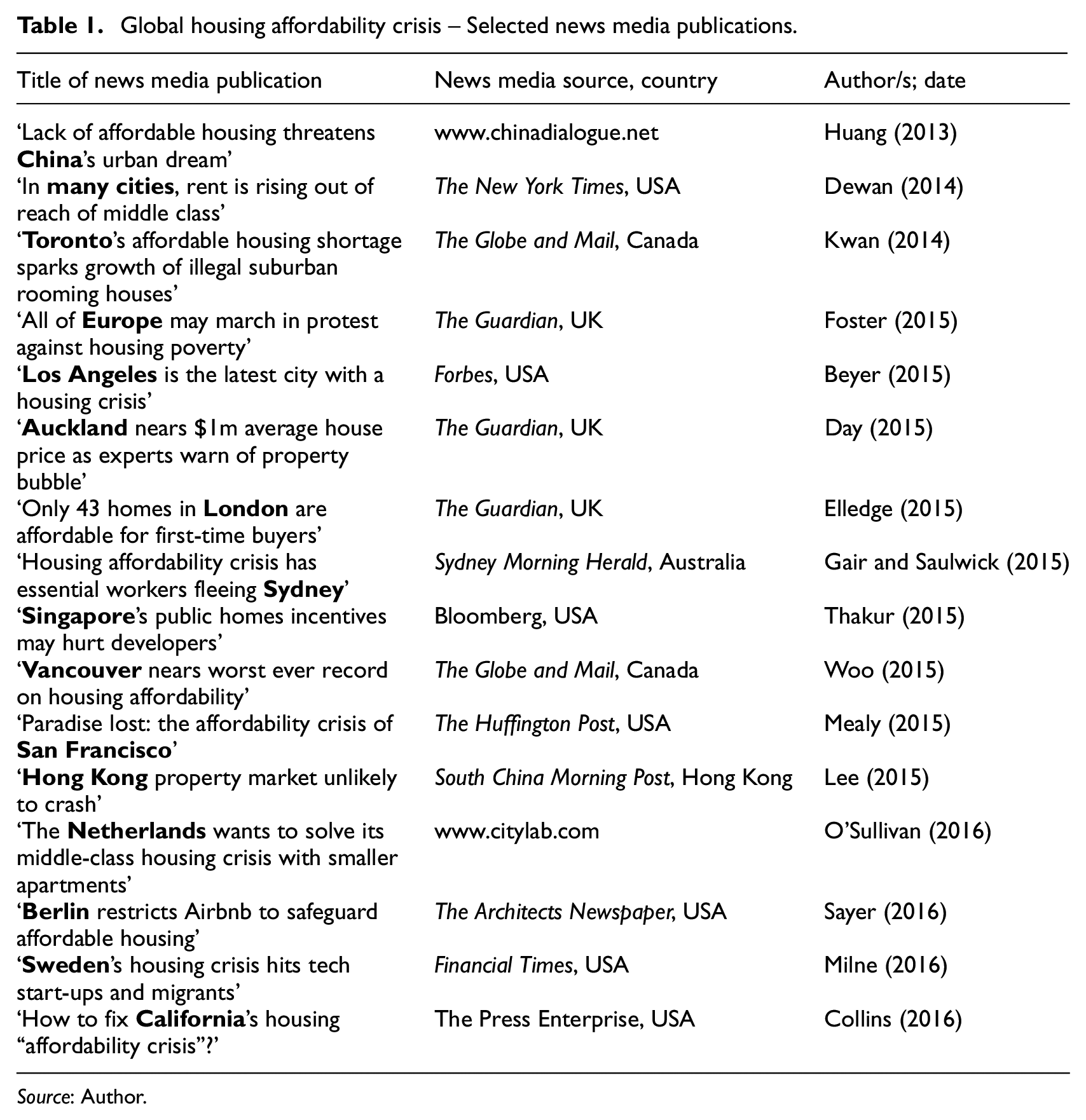
Recent international news media publications colourfully illustrate the global nature as well as the locally distinct ways of politicising mounting housing affordability and affordable housing challenges (Table 1). Clearly, trends towards increasingly unaffordable housing for some – and substantial capital gains and steeply growing housing-related incomes for others – have become more pronounced in the years following the GFC. Many growing cities are affected; capital cities, global cities, high-amenity cities, economically viable cities, Asia-Pacific rim cities, university cities, new employment hubs, but also cities of consumption. Indeed, it is the world’s 100 largest cities that capture two-thirds of McKinsey’s Global Institute’s ‘Affordability Gap’. The evidence is thus becoming overwhelming that this urban housing crisis is global in scope. Yet in contrast to the GFC that originated in subprime financed housing stock in the USA and spread via global financial centres to countries and populations worldwide, this new global crisis emerges simultaneously across many metropolitan regions around the planet.
Global housing affordability crisis – Selected news media publications.
Source: Author.
Decreasing housing affordability now outplays other serious housing-related shortcomings such as health outcomes, energy efficiency and climate change impact because it is directly touched by three contemporary global megatrends. The (re)urbanisation of capital and people has pushed-up demand for housing, the provision of cheap money has facilitated extensive mortgage lending and the rise of intra-society inequality has reduced the ability of lower socio-economic households to pay growing housing and energy bills. While affordability concerns relate to both, housing-related household expenses as well as net household incomes, policy making communities, social advocates, business and the media have framed the problem overwhelmingly as an affordable housing challenge. Accordingly, the spotlight has been put almost everywhere on questions of how to release more land, build more houses and apartments and reregulate mortgage and rental markets rather than to deal with the more contentious issue of how to help households to earn salaries and wages in line with rising housing expenses.
The social and spatial implications of unaffordable housing provision for people, families, households and communities are severe. First, rising housing deprivation of low income groups in severely unaffordable housing markets now cause widespread financial stress and hardship. Second, so-called key workers including police officers, teachers, nurses, cleaners and tradespeople often provide essential urban services but are increasingly priced out of tight metropolitan housing markets. Third, people on the move – either those wanting or needing to move house or others often desperately trying to escape escalating local war, conflict, disaster or instability – generate additional newcomer-led housing demand which further escalates housing shortages. Amongst longer-term crisis implications are, first, a middle class housing affordability problem that arises in both homeownership and private rental societies. Reduced access to homeownership and less affordable rentals threaten the material status and upward social mobility of those core constituents of Western democracies. By doing so they may pose a serious risk for future social harmony, political participation and economic citizenship. Second, urban housing is becoming a key site of growing inter-generational divisions as many post-baby boomers unable to buy homes and save for retirement are currently facing material decline relative to the generation of their parents (Wetzstein, 2012). Third, the combined effects of market and governance failure regarding housing may lead to further segregated, dysfunctional or even dystopian cities featuring decaying neighbourhoods, rising economic inefficiencies and irreversible environmental externalities.
Mainstream policy responses and a ‘policy–outcome’ gap
Housing affordability has indeed been put on the agenda of policy makers in many jurisdictions worldwide. Ambitions and interventions range widely; from the prevailing narratives of boosting land and housing supply as well as removing ‘red and green tape’ to a heightened emphasis on value capture and improved land sale processes. A key concern lies with reducing housing bubble risks through measures such as loan-to-value ratios and debt-to-income ratios as well as restricting non-resident foreign direct investment in housing. Barriers to social housing have been heightened in some countries, while others have seen isolated new social and communal housing initiatives. Some hope can be drawn from new shared equity homeownership schemes and partnership developments in pilot projects. Clearly, market-friendly interventions dominate affordable housing discourses and policy. Even where reregulation attempts to protect tenants from market excesses as in the case of Germany’s (so far ineffective) ‘rent increase cap’ policies, there are growing concerns over the resulting constraining effects on private investment (Kholodilin and Ulbricht, 2014). Worryingly, existing policy settings – those that are supported by, and are beneficial to, the main voting groups and housing system insiders – seem to have been further cemented since the GFC and thus deepened winner/loser dichotomies.
While the jury is still out on the long-term and cumulative effects of many of these policy measures, in-depth empirical research by the author suggests that there can be reasonable doubt that urban housing affordability outcomes across Western jurisdictions are being currently maintained let alone improved. It appears that a gap is currently opening up between the imaginaries, discourses, intentions and strategies aiming to deliver affordable urban housing for all, and the so-far detectable outcomes which indicate that for a substantial proportion of urban residents those envisaged goals are actually not being delivered. This ‘policy–outcome gap’ can, intellectually, be linked to our lack of understanding about how affordable decent housing can effectively be put into place in high-demand urban centres located in open, market-based Western societies. Therefore, attention needs to shift to the complex and contextually specific interplay of forces, strategies, interactions and processes between the political and economic spheres in the field of urban housing. By framing the intellectual challenge in this particular way, this paper follows a recent call to urgently bring back political economy into housing questions (Aalbers and Christophers, 2014).
This intervention thus examines the global housing affordability/affordable housing challenges in relation to the role, key rationalities, strategies and processes with regards to globalising housing investment processes on the one hand, and the role, logic, strategies, practices and processes of state-regulatory apparatus’ on all geographical scales on the other hand. Five complementary entry points will guide the analytical engagement with urban land and housing markets and hierarchies: first, the (re) positioning of housing in globalising urban political economies that is understood here as wider structural factors reshaping the conditions for investment and governance; second, changing housing systems and tenures that constitute both mediating influences and specific outcomes of political and economic work; third, land and housing markets, sectors and development processes that form key sites in which housing affordability outcomes are determined; fourth, the role, capacities and politics of state actors and governance arrangements representing key housing actors on all geographical scales as investor, partner and regulator; and fifth, policy development and implementation construed as planned and implemented strategies to generate desired effects on housing affordability outcomes.
Anchoring the crisis in key academic debates: Five entry points
Urban housing in globalising political economies
Housing now plays a key role in globalising national and urban political economies. The current crisis can thus be rooted within debates in the international literature concerned with the financialisation of housing under contemporary globalising capitalism and the crucial role of urban land development in capital accumulation processes. This critical perspective on the broader structural shifts and contradictions in economy and society identifies the rise of a speculative type of global finance – real estate capitalism (Aalbers and Engelen, 2015) that features a shift of land and housing from a role in the secondary circuit of capital (Harvey, 1982) to a centre stage position in today’s low-growth Western economies (Christophers, 2011).
Housing is increasingly viewed as investment rather than a home. In fact, households have become a frontier of capital accumulation, not just as producers and consumers, but also as financial traders (Bryan and Rafferty, 2014). Schwartz and Seabrooke (2008) contend that nowadays residential housing and housing finance systems have important causal consequences for political behaviour, social stability, the structure of welfare states and macro-economic outcomes. Their ‘varieties of residential capitalism’ approach moves beyond domestic institutions and local cultures to link housing outcomes to transnational trends in the deregulation of housing finance that have altered incentives and preferences for financial institutions, home owners and would-be home owners. Importantly, they demonstrate how housing systems are built from political struggles over the distribution of welfare and wealth.
Under globalising economic conditions, demand for residential housing in major cities is spurred by global market synchronisation and associated demand pressures that lead to gentrification and displacement of residents. In a post-GFC environment, gentrification is said to have become the default process of urban remaking driven by the prospect of exploiting planetary rent gaps (Slater, 2017). As a result, poorer households are being pushed out into peripheral urban locations and confronted with increased distance to metropolitan employment (Randolph and Tice, 2014). Anti-gentrification policies, however, are often politically controversial as they are viewed as potentially stifling sought-after private investment in the built environment and therefore threatening economic growth and urban regeneration.
Housing people and transforming tenures
Alongside a proliferation of emergency shelters and informal housing arrangements, tenure transformations under neoliberal housing policy settings have seen a further commodification of residential housing and a marginalisation of state-assisted tenure options. These developments lie at the heart of academic debates on the rise of precarious housing and living arrangements, increasing signs of housing exclusion across many places and magnified differences between those inside markets and allocations systems and those wanting to gain access. Put simply, accessing adequate housing across Western cities seems to have become a question of privilege rather than one of human right.
From a historical Anglophone perspective, the post-Second World War consensus on promoting general homeownership gave rise to a promotion of ‘subprime’ homeownership under more market-embracing policies in the 1990s and 2000s; a tendency that ultimately triggered the GFC. Under more risk-averse regulatory frameworks the post-GFC years have seen the advocacy of ‘prime-homeownership’ (Forrest and Hirayama, 2015) and increasing affordability pressures for those unable to keep pace with skyrocketing land, property and housing costs. Consequently, access to housing has become a more pronounced form of societal division that often excludes now the younger generation, those people coming from poorer and lower middle-class backgrounds and those who are materially, socially and physically disadvantaged. In this context, Smith (2015) describes the spatial and financial paradox around homeownership housing and confronts the absurdities around the construction of homeownership as the preferred tenure model across the Anglophone world.
Social housing has generally been further marginalised in recent years, or – as in Eastern Europe – never took off. The neoliberal decades witnessed the privatisation of substantial segments of national social housing stocks and/or a co-opting of non-profit and community providers at a time when an increasing number of lower-income urban households have joined waiting lists for subsidised housing programmes (Holm, 2006). In contrast, and despite the fact that the private rented sector is politically not seen as a legitimate competitor to homeownership across many Western countries (Stephens, 2016), private renting is currently the fastest growing tenure. In fact, the spread and promotion of individual and institutional private landlordism – where the property-poor are paying market rents to the property-rich (Forrest and Hirayama, 2015) – is likely to transform our cities in fundamental ways. Providing affordable and secure housing for this emerging ‘generation rent’ (Eaqub and Eaqub, 2015) thus becomes paramount and requires a philosophical-cultural shift to make private rental a legitimate and respectable investment and tenure choice as well as a rebalancing of the power between landlords as current winners and tenants as currently losers (Wetzstein, 2016).
(Un)affordable housing development and construction
Exploring housing affordability against the background of intensifying capitalist urban (re)development invites a critical review of issues such as land acquisition, housing development and construction costs. In this context, the theorising of land has been challenged recently by Christophers (2016) who – ultimately challenging Marx and Polyani – sees land not as a fictitious entity but as very real capital and real commodity. Others argue that land development processes can be better understood through a close engagement with the underlying calculative practices. Indeed, the actual business models, accountancy practices and calculative tools of investors and developers deeply matter for assessing housing affordability prospects. In the post-GFC context of Australia, for example, large developers are still able to finance their developments while many small and medium-sized developers borrowing on a project-specific basis find it difficult to access finance (Rowley et al., 2014).
Lagging housing development has often been blamed on ineffective (local) planning processes and contradictory planning policy goals (Demographia, 2017). Insights into the development viability appraisal process in the UK reveal, for example, that it is in fact a rather closed process, weakly governed and deeply contentious, especially in relation to the nature of the assumptions behind the models (McAllister et al., 2016). Planning systems, more generally, are currently constructed as key intervention fields for more affordable housing supply while also being blamed for slow responsiveness (Ball, 2011) and strangling market forces by ‘red and green tape’ (Haratsis, 2010). Reformed planning systems promise more land available in the right locations, for example, by means of inclusionary zoning (Mekawy, 2014) or fast-track development in special housing zones (Murphy, 2016). Yet, international examples from the UK, Ireland, Hong Kong and Australia clearly show the limited extent to which planning can increase the supply of affordable housing (Paris, 2007).
Today’s arguably most influential private sector vision on how to understand and tackle housing affordability challenges (McKinsey Global Institute, 2014) emphasises comprehensive cost reduction and industrial building methods in order to boost housing construction. However, such recommendations are not easily achieved at all. While local labour shortages may push-up wages in the industry (Wetzstein, 2011), relatively fresh insights into UK housing construction highlight the ‘lock-in’ of industries in traditional structures and practices. Comprehensive and sustained work and efforts by key actors in the industry actually aim to maintain the status quo (Lovell and Smith, 2010). This finding plainly illuminates the policy constraints under neoliberal conditions even if one assumes sufficient political will to change outcomes. Given the still overriding expectation of governments that the private sector has a key role to play in providing affordable housing, scholarly work on how markets actually work is central to test the appropriateness of such assumptions. In this context, markets have recently been interpreted as socio-materially constructed and mediated by the performative value of artefacts or market devices such as contracts that connect actors and technologies within coordinating institutional arrangements (Rydin et al., 2015).
Urban housing and the neoliberal state
While affordable housing – especially for lower income groups – has been traditionally supported by some kind of state subsidy, housing is now but one amongst many policy fields where state apparatus’ have moved away from direct provision to an ‘at-a-distance’ enabling governmental role within complex multi-scale governance arrangements. In addition, public expenditure under post-GFC austerity regimes has been markedly reduced so that state investment in affordable housing has often not kept pace with the growing demand. Vexed problems of increasingly unaffordable housing worldwide therefore reflect a crisis concerning the role, abilities, capacities and expectations of the state and associated governance interests.
In housing systems, the state can perform different roles. As an owner and manager of land and housing stock it fulfils a direct, investment-focused role, while a regulatory role is about influencing the behaviour of other actors. Complimentary to a reduced active state role in delivering subsidised housing, complex reregulation has lately assigned new housing-related functions to this institution. In the Canadian context, for example, the state has become an active player in the process of mortgage securitisation by insuring, directing and funding of residential mortgage-backed securities. This new state purpose constitutes and justifies a federal shift from the provision of social rental housing toward supporting a rental market increasingly characterised by private sector individual-unit landlord-investors (Walks and Clifford, 2015). According to Dewilde and De Decker (2014), more state intervention in housing provision usually results in good housing conditions and low housing cost burdens for all low-income tenure and age groups. However, they also detected a general trend towards a growing role of the family/household in housing provision across Europe with the risk of associated subjective housing cost burden also strongly increasing while housing conditions deteriorate.
Housing Governance shifts have seen an up- and downscaling of regulatory responsibilities and an inclusion of non-state actors such as reserve banks and rating agencies. In this context, intra-state governance dilemmas and contradictions have emerged in many sites; for example between EU state-aid regulations (supporting older notions of a residual social housing sector) versus city-coalitions arguing for broader defined affordable housing sectors (Policy maker/Vienna, personal communication, 7 December 2016). Tensions can also be detected on the issue of how to incentivise new affordable housing stock building, between the need to protect homeowners and tenants who are already in the housing market/system and those seeking access to those systems. Another issue is the controversial funding and development of associated public infrastructure such as schools, kindergartens and parks.
(Affordable) housing policy development and implementation
The rise of soft (advanced neoliberal) governmental practices in housing policy development such as associative and calculative practices, self-regulation, policy and best practice transfer, memorandums of understandings, etc. make affordable housing policy implementation rather a challenging task. The key reason lies in their nature of aiming to influence other actors in regards to housing governance and investment rather than to direct them. In this new policy environment, the mobilisation of policy and best practice across a fast-moving, globalising world has become a key instrument in political and administrative tool boxes. Prince (2012) links such policy mobility to the extension of the hegemonic ‘regimes of truth’ that define policy norms and the production of governance structures such as global policy networks. Peck (2011) makes a case for moving beyond rational-choice frameworks and essentialised, formalist representations of policy transfer and advocates a social-constructivist understanding of policy mobilities and mutations that is sensitive to the constitutive roles of spatiotemporal context.
An equally recent concern with evidence-based policies has permeated Western policy making communities; led by desires and ambitions of actors to base decisions on quantifiable and trustworthy sources of knowledge. Jacobs and Manzi (2013), however, argue that far from rational and technocratic logic, policy is more about assembling the evidence to support particular ideologies. Thus, so called evidence justify ideology rather than rooting policy more effectively in real processes and trajectories. Clearly, this role of ideology in housing policy making deserves more empirical and theoretical attention, for example in relation to the role of lobbyists in developing and keeping policies as well as the crucial constitutive role of the media in shaping discourses on housing (Jacobs, 2015). The related issue of policy capture is discussed by Gurran and Phibbs (2015) who show how Australian governments have used the political strategy of ‘look busy, but change little’ in order to help key interests and the status quo to prevail.
Post-GFC housing systems and policy seem ‘locked-in’, unable, for example, to respond quickly and adequately to the urgent need for private tenant protection in the Anglosphere and possibilities for broader home ownership in cities of ‘renter nations’ such as Germany and Austria. This broad observation invites reflection on the nature of housing policy trajectories in-between path-dependence and innovation. According to Malpass (2011), housing policies and housing systems do change but often slowly and in small, gradual and incremental ways. They can therefore be better understood as correctives to housing markets (Bengtsson and Ruonavaara, 2011). From a methodological viewpoint, historical and comparative forms of investigation are necessary if we are to better comprehend the ambitions and scope of contemporary housing interventions (Jacobs and Manzi, 2017). Austin et al. (2014) show how path-dependent policy and policy transfer converge in national contexts. By means of tracing affordable housing provision through the planning system in the UK, Australia and New Zealand, they highlight interesting convergence-divergence-convergence dynamics over time.
Towards a transformative research agenda on improving urban housing affordability
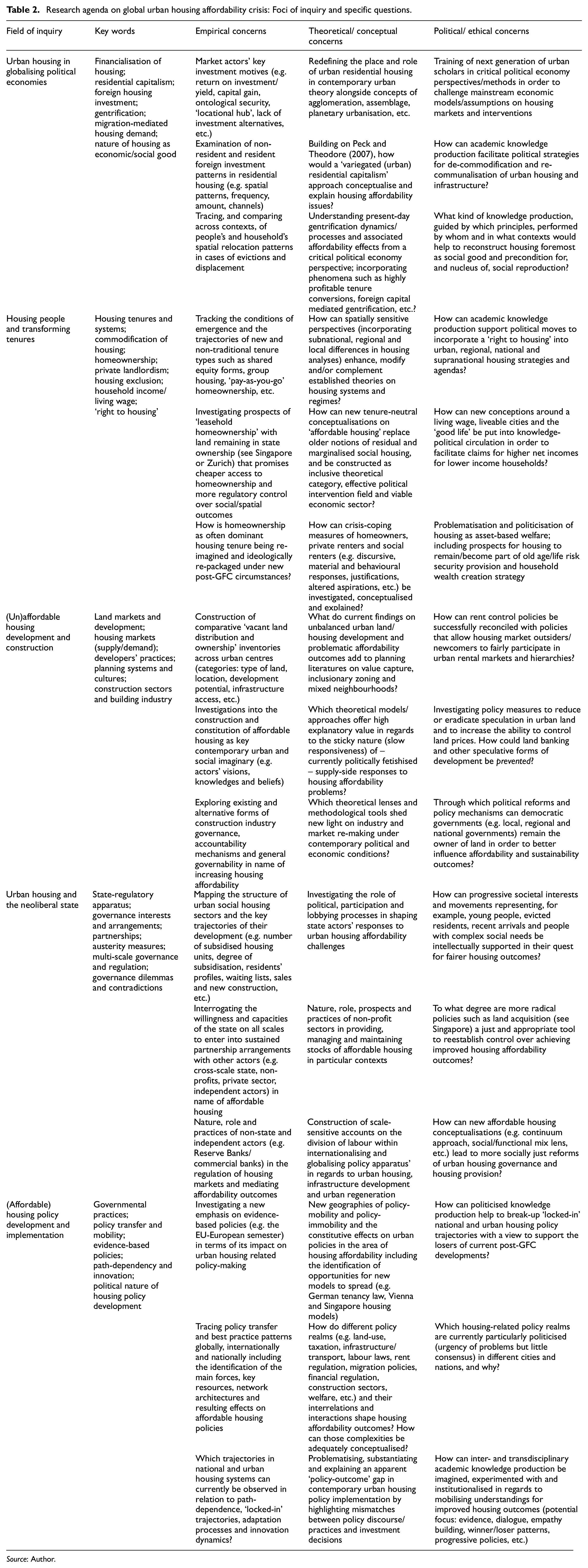
Table 2 outlines a research agenda that promises a more consolidated and critical approach to investigating challenges around housing affordability and affordable housing in urban contexts. In alignment with the previously introduced five entry-point framework and led by a desire to not only intellectually grasp issues but to help resolve problems, important research foci and detailed questions are assembled in three categories: empirical concerns, theoretical/conceptual concerns and political/ethical concerns. The first grouping directs attention to the many ‘transformations on the ground’ by emphasising research needs that generate insights regarding issues such as actor intentions, the playing-out of processes as well as identifying and measuring outcome patterns. The second category allows those findings to be placed into a theoretical context; highlighting links and gaps to international literatures, theoretical frameworks and existing theories. The last grouping illuminates the important ‘change the world’-type political and ethical implications that arise out of deeper and critical reflection. The latter constitutes an increasingly important academic intervention field in the face of unbalanced and excluding housing markets and deeply concerning social and spatial outcomes. Particular attention should therefore be paid to making
Research agenda on global urban housing affordability crisis: Foci of inquiry and specific questions.
Source: Author.
As housing affordability outcomes are affected by multiple policy interventions ranging from urban and regional planning, labour market polices, transport policy to taxation and monetary policies (Yates, 2008), researchers have to take note and come to terms with these profound complexities, overall constraints, unavoidable contradictions and difficult trade-offs policy makers face in their daily work. Thus only dedicated and well-resourced interdisciplinary and transdisciplinary intellectual work will promise advances that will have a (positive) real-world impact. Well-funded research projects with contributors from, amongst others, comparative and international political economy, housing economics, political science, urban planning, sociology and geography fields promise better returns than the singular efforts of individual disciplines. Likewise, an active and open engagement with practitioners on the coalface within both more conservative (e.g. panels, advisory groups) and more innovative (e.g. workshops, laboratory) settings would allow the academy to immerse itself immediately and more relationally in transformational societal change. From a methodological viewpoint, both qualitative and quantitative strategies should be pursued in a complimentary and creative fashion. The former should not only be acknowledged for their ability to embrace the complexities of our world that allows many housing related decisions, for example those on new institutional design, pilot projects and impact evaluation, to be taken with more confidence and boldness. They could also be strategically useful to help interpreting the results of empirical quantitative models in urban land and housing economics that evidently suffer from an underdetermination problem and thus notoriously undervalue contextual and institutional aspects (McMaster and Watkins, 2006).
While housing has been claimed to be uniquely distinct in nature and – technically speaking – not actually ‘comparative’ (Oxley, 2001), comparative intellectual endeavours are nevertheless more important than ever before. Such commitment should not only seek to compare housing systems, structures and features across the globe and attempt to identify outcome patterns of convergence and divergence. Equally, if not more important, are investigations into the constitutive dimensions for particular housing outcomes; those shaped by historically and spatially specific context and conditions, emerging out of contingent developments and their cumulative effects, but also actively made and remade by the deliberate decisions and actions of specific actors. By creatively inserting those dimensions into a global cross-urban dialogue (see also Robinson, 2011) we may reward ourselves with a more nuanced and meaningful style of comparative work; one that moves far beyond simple best/worst practice investigations by illuminating and explaining how those practices have emerged over time. These insights could meaningfully inform and facilitate crucial contextual knowledge production for actors concerned with day-to-day housing governance and investment decisions. As a result, housing affordability and affordable housing problem-solution framings may actually move from a currently widespread emphasis on ‘believe in what should work’ towards actually ‘knowing what does and does not work’ under particular conditions.
Conclusion: Towards affordable urban futures
This intervention makes a case for comprehensively problematising unaffordable housing conditions for a growing number of – in this case Western – urban households; urging us to seriously rethink the causes and effects behind current failures of markets and governments/governance to provide an essential good for human survival and flourishing. Housing stands for several important societal realms that have been transformed in the age of global neoliberalism as too often gains made through global market synchronisation and integration have been privatised while the risks and losses have been socialised. In a current political-economic system where capitalism manages the state rather than state managing the economy (Jacobs and Manzi, 2014), and where rising intra-society inequality polarises nations and cities, progressive housing outcomes will not easily be achieved. This is in particular the case in a post-GFC political environment of public austerity and new conservatism where governments generally have less capacity or inclination to intervene in the name of those who are losing out. Yet accepting the status quo, and taking the ‘policy–outcome gap’ in relation to affordable urban housing as a given, is not an option. There will be much courage, effort and leadership needed in civil societies and in political systems to tackle this global crisis. We researchers and intellectuals are called to contribute our part to the common and urgent task of reimagining, planning and building affordable urban futures for all.
Footnotes
Funding
Funding was received from Fritz Thyssen Stiftung für Wissenschaftsfoerderung 10.15.1.014SO.