



Abstract
Fiscal incentives are frequently used to stimulate property development in distressed communities but the efficacy and impacts of this approach have been contested. In this study, a theory of real estate production was utilised to evaluate the Opportunity Zones (OZ) policy in the USA. Qualitative data collected from interviews and fieldwork are analysed to understand how the property development scene of a predominantly African-American neighbourhood had been affected by the OZ designation. Interviewees, including black local developers, represented diverse types and scales of real estate production. It was found that new investment capital was flowing into Bronzeville but not into projects proposed by small, local developers and community organisations. This was largely for two reasons: first, the less experienced and resource-constrained players had insufficient resources and expertise to connect with the OZ-induced investors. Second, when they were connected, their projects were deemed highly risky and thus unattractive. The perception of risk was likely amplified in Bronzeville, a historically marginalised black neighbourhood. For tax-based urban revitalisation policies to increase marginalised communities’ access to capital, appropriate public interventions must be accompanied to level out the playing field for the under-resourced and historically marginalised players of real estate production. One such intervention might be to create and support a network of financial intermediaries that specialise in connecting capital to projects proposed by black developers, other non-profit developers and community organisations. Without such measures, policies such as OZ are likely to exacerbate existing inequalities rather than uplifting disadvantaged communities.
Introduction
Fiscal incentives have become one of the most popular tools used to promote economic development in distressed communities. However, the efficacy and impacts of this approach are highly debated. The expansive literature on enterprise zones, tax-based redevelopment initiatives, tax increment financing and US tax credit programmes contains highly conflicting evidence regarding not only the size of the impact but also their distributive outcomes. Moreover, little is known about how these fiscal incentives affect property (i.e. real estate) development, despite the fact that most, if not all, incentive-backed initiatives aim to stimulate real estate development. On the other hand, the influence of tax policies on physical space has become so pronounced that scholars have called for a closer investigation of the ‘much overlooked role of tax in urban processes’ (Tapp and Kay, 2019).
In this article, a theory of real estate markets developed by Theurillat et al. (2015) is utilised to explain how fiscal incentives affect urban property development. The Opportunity Zones (OZ) policy in the USA, a federal policy that offers capital gains tax benefits to spur economic development in distressed communities, is analysed. Although eligible investments are not restricted to real estate developments, the incentive structure and the eligibility criteria make real estate the most suitable type of investment.
The experience of a predominantly African-American neighbourhood located on the South Side of Chicago, Bronzeville, was analysed to investigate how the OZ designation affected its property development scene. Although Bronzeville has a distinct trajectory of urban redevelopment because of systemic racism, this article concerns the variations within Bronzeville, making it possible to generate knowledge that has implications for other low-income communities that have become the target of tax-incentivised revitalisation policies.
Multiple levels of real estate production – from the most commercialised to the least – were found in Bronzeville, and the actors working within each level had been differentially impacted by the OZ designation. Investment capital was flowing into Bronzeville but small, local developers and community organisations have had very little success in attracting investment dollars. This was largely for two reasons: first, the conventional investors of real estate were used to investing in only the most commercialised form of real estate production, which meant that the under-resourced and less experienced players had little chance of connecting with the investors to begin with. Second, even if they were connected with investors, their projects were deemed highly risky and thus unattractive. Such a perception of risk was likely exacerbated by the neighbourhood’s long-standing stigma as a black neighbourhood and by the fact that the players themselves were black.
The findings of this study offer several important lessons regarding tax-based urban revitalisation policies targeting real estate development. First, the experience of Bronzeville reveals that differing intensities of real estate production can co-exist in the same neighbourhood but operate in silos. Given that investors, particularly large-scale ones, are familiar with only the most commercialised forms of real estate production, integrating the differing layers of production could potentially facilitate new capital flowing into projects that are closer to the community’s needs. Moreover, the challenges faced by Bronzeville’s black developers and organisations reveal the systemic racism that underlies investment decision-making. These findings suggest a critical need for public intervention to integrate the distinct levels of real estate production and mitigate the perceived investment risk. In the absence of such measures, policies such as OZ will likely exacerbate existing inequalities rather than uplift disadvantaged communities.
Literature review
Tax incentives and property development
Fiscal incentives are frequently used to stimulate property development in distressed urban communities (McGreal et al., 2002; Tapp, 2019; Williams and Boyle, 2012). These incentives come in many forms, including tax credits (a dollar-for-dollar reduction in tax liability); deductions and exclusions of taxable income; tax deferrals; property tax abatements; and an elaborate public financing mechanism based on the future stream of property taxes, known as ‘tax increment financing’ (TIF). Despite their widespread use, however, relatively little is known about how these fiscal incentives have altered the property development dynamics of the targeted areas.
Geographically targeted economic development initiatives, commonly referred to as enterprise zones, are among the most common vehicles for distributing fiscal incentives. However, the literature on enterprise zones covers little about the tax benefits component of the initiatives despite the fact that tax incentives have been the major, if not the only, component of enterprise zones (General Accounting Office (GAO), 1999, 2004; Herbert et al., 2001). Moreover, no study to date has analysed how the zone designations have affected the targeted areas’ real estate development activities.
Studies on the various tax credit programmes in the USA offer some insight. Ryberg-Webster and Kinahan (2017) found that tax credits were used in places with wide-ranging economic statuses, including very low-income neighbourhoods, and that both market rate and affordable housing were produced as a result. Eriksen and Rosenthal (2010) found that Low Income Housing Tax Credit (LIHTC) has been effective in creating affordable housing but at the expense of market-rate units that would have been built otherwise. One study on New Markets Tax Credit (NMTC) (Freedman and Kuhns, 2018) reported that the eligible census tracts have seen more supermarket entries than the non-eligible tracts. These three studies collectively suggest that tax credit programmes with a narrow focus have achieved the programmes’ goal to some extent but with limitations.
Although most empirical studies on TIF have focused on identifying how the TIF designation affected existing property values, rather than ground-up developments, several other studies offer valuable insights. Gordon (2008), for example, reports how the TIF districts in and around St. Louis were used to finance the development of suburban power retail centres rather than being used to revitalise inner-city neighbourhoods. In her seminal article, ‘Selling city futures’ (2010), Rachel Weber cautions that TIF could lead to an oversupply of commercial real estate, using Chicago as a case study. By contrast, also using Chicago, Lester (2014) found no evidence that the TIF designation had had any discernible effect on construction activities.
Studies on TIF and real estate development suggest that fiscal incentives can have vastly differing impacts on property development depending on the strength of the submarkets and that market strengths vary considerably even within the same city. This study contributes to the literature on tax incentives and real estate development by analysing how the actors operating within the same, disinvested inner-city neighbourhood have been differently impacted by the OZ designation.
Race and urban redevelopment
Race mediates the processes and outcomes of urban redevelopment (Anderson and Sternberg, 2012; Ross and Leigh, 2000; Wilson and Sternberg, 2012). Because Bronzeville, a predominantly African-American community with historical and cultural significance, was utilised as a case study for this research, the existing literature on the relationship between race and urban redevelopment is reviewed here. Insights from these studies are used to contextualise the current study’s findings to the issue of racially mediated urban redevelopment.
It is well chronicled that the urban renewal policies of the 1950s and 1960s and the predatory lending practices were racially charged, disproportionately affecting low-income communities of colour, particularly those of African-American descent (Avila and Rose, 2009; Gordon, 2008, 2019; Hyra and Rugh, 2016; Wacquant, 2010; Wyly et al., 2009). More recently, research has shown that urban black neighbourhoods that are well-poised to be gentrified have experienced slower gentrification than their non-black counterparts, which is likely due to their racial composition (Hwang and Sampson, 2014). Scholars have convincingly argued that this can be explained by the stigmatised imageries of black poverty and public housing (Boyd, 2008; Smith, 1996).
The reluctance of the white middle class to move into low-income black neighbourhoods gave rise to a different form of gentrification led by the black middle class, referred to as ‘black gentrification’ (Anderson and Sternberg, 2012; Boyd, 2008; Hyra, 2008; Moore, 2009). Scholars have arrived at contrasting conclusions regarding whether this form of gentrification leads to a more equitable development pattern. Moore (2009) paints a hopeful picture, using Philadelphia as a case study. She found that middle-class African-Americans were willing to invest their social, economic and cultural capital to improve the quality of life for low-income black neighbourhoods. By contrast, Hyra (2008) investigated Bronzeville, Chicago and Harlem, New York and reported little evidence of ‘racial uplift’ brought about by black gentrification. He concludes, ‘Rather than acting as a support mechanism of the poor, [middle-class African-Americans] instead use their heightened political power to remove the undesirables’ (p. 148).
More recently, Wilson and Sternberg (2012) argued that a new phase of racialised urban redevelopment emerged in 2005. Instead of depicting poor black communities as plagued with persistent crime and collective incompetence, they are now characterised as ‘aspiration-blunted’ and ‘structurally-compromised’ (p. 989), thus humanising the rhetoric about the racialised poor. They go so far as to argue that this new revisionist governance holds the possibility of re-centring the politics of resource distribution, potentially opening the door for progressive social change (p. 932).
Theoretical framework: Three levels of real estate production
Currently, there is no dominant body of theory that explains the process and outcomes of real estate production (Fainstein, 2001; Kim et al., 2020; Theurillat et al., 2015; Weber, 2015). Beyond the orthodox neoclassical urban economics (DiPasquale and Wheaton, 1996), some scholars have focused on the players, institutions and processes of real estate production, adopting either an institutionalist (Guy and Henneberry, 2000; Weber, 2015) or Marxist (Beauregard, 1994; Fainstein, 2001) lens. Others have developed Marxian land rent theories to explain the changes in real estate prices and markets (Haila, 1988; Harvey, 1974, 1982; Jäger, 2003; Park, 2014). An increasing number of scholars are beginning to analyse the intimate relationship between real estate and the broader capital market (Gotham, 2006; Weber, 2010). The neoliberal urbanisation literature (Swyngedouw et al., 2002; Weber, 2002) and the gentrification literature (Lees et al., 2008; Smith, 1987; Stein, 2019; Wyly and Hammel, 2004) have also shed light on the production of real estate. However, both theoretical and empirical studies of real estate production have largely focused on the most commercialised forms found in major global cities.
Dissatisfied with the lack of a comprehensive theoretical framework that explains real estate production under diverse market conditions, Theurillat, Rerat and Crevoisier proposed a new theory in their 2015 Urban Studies article ‘The real estate markets: Players, institutions and territories’. They proposed an analytical framework based on the work of French historian Braudel (1985), who classified economic life into three stages as they relate to capitalism. The authors likewise classified real estate markets into three categories, depending on the intensity of commodification.
The first level of the real estate market consists of self-production. In this stage, real estate is produced for and by its end users (i.e. occupants of the space). In this form of real estate production, real estate is not an investment asset but is rather produced for its use value. The second level of the real estate market is based on exchange value. In this stage, properties are developed by industry professionals, whose aim is to sell or rent those properties to end users for profit. The third level is also based on exchange value but rather than developing properties to sell/rent to end users, real estate is produced to be traded in the financial market. Thus, this final stage is inextricably intertwined with the workings of the capital market, with institutional investors and large-scale real estate developers acting as the key players.
The authors posit that the first stage is predominantly found in rural areas, the second in urban areas and the third in major metropolitan areas. However, they acknowledge that these three stages are likely to co-exist and overlap in reality, particularly in areas under gentrification pressure (Theurillat et al., 2015: 1427–1428). This study examines one such area where all three stages of real estate production are expected to be observed. By conceptually differentiating real estate production into different intensities, this theoretical framework allows for a nuanced analysis of how each stage has been differentially affected by the OZ designation, that is, the variations that may exist within a single neighbourhood.
Opportunity zones
The OZ policy in the USA is the latest variation of the place-based economic development strategy commonly referred to as ‘enterprise zones’. The US federal government has implemented three variations of enterprise zones: Empowerment Zones/Enterprise Zones; Renewal Communities; and NMTC. Enacted as part of the 2017 tax bill, the Tax Cuts and Jobs Act, the OZ policy offers investors capital gains tax benefits when capital gains are reinvested in low-income communities.
These place-based initiatives have been promoted as strategies to spur economic development in distressed communities. As such, target areas are chosen based on socioeconomic indicators, such as poverty level, income level and unemployment rate. The selection criteria for OZ were very broad. Census tracts had to have either a 20% or higher poverty level, or 80% or below area median income, which meant that 45% of US census tracts were eligible for OZ designation. Then, the governors of each state selected 25% of the eligible tracts as OZs. With broad eligibility criteria and discretion given to the governors, questionable designations have been reported across the nation. Nevertheless, researchers who compared the selected OZs with the eligible-but-not-selected tracts concluded that the states, on average, had chosen relatively disadvantaged census tracts (Gelfond and Looney, 2018; Theodos et al., 2018).
Although eligible investment activities are not limited to property development, industry professionals agree that the incentive is most suitable for real estate development deals (including both ground-up development and major rehabilitation). This is largely due to the built-in incentive for long-term commitment, as well as several qualification criteria, such as the stipulation that 50% of the business income needs be generated within the OZ. Therefore, the OZ policy has largely been viewed as a tool to stimulate property development in distressed communities. Illustratively, one private investment firm has raised US$500 million from over 500 investors for its first OZ fund and deployed to 12 different real estate development and acquisition deals across the county. 1
The prevailing approach to evaluating the effects of place-based initiatives is to undertake a quantitative analysis of the key socioeconomic indicators, such as employment and poverty rates, and property values, both before and after the zone designation. However, because OZ had been in effect for less than two years at the time of this study, quantitative, longitudinal analyses of the policy’s impact present considerable challenges (Chen et al., 2019). Moreover, real estate developments are inherently idiosyncratic, difficult to observe and take time to materialise, warranting a qualitative investigation of the policy’s early impacts.
Background and methodological note
About Bronzeville
Located in the South Side of Chicago, Bronzeville is in close proximity to the downtown, the McCormick Place convention centre and the lakefront. The City of Chicago officially recognises 75 ‘community areas’ used for statistical and planning purposes. For the purpose of this study, the following community areas are thought to constitute Bronzeville: Douglas, Grand Boulevard, Washington Park and Fuller Park (see Figure 1 for reference).
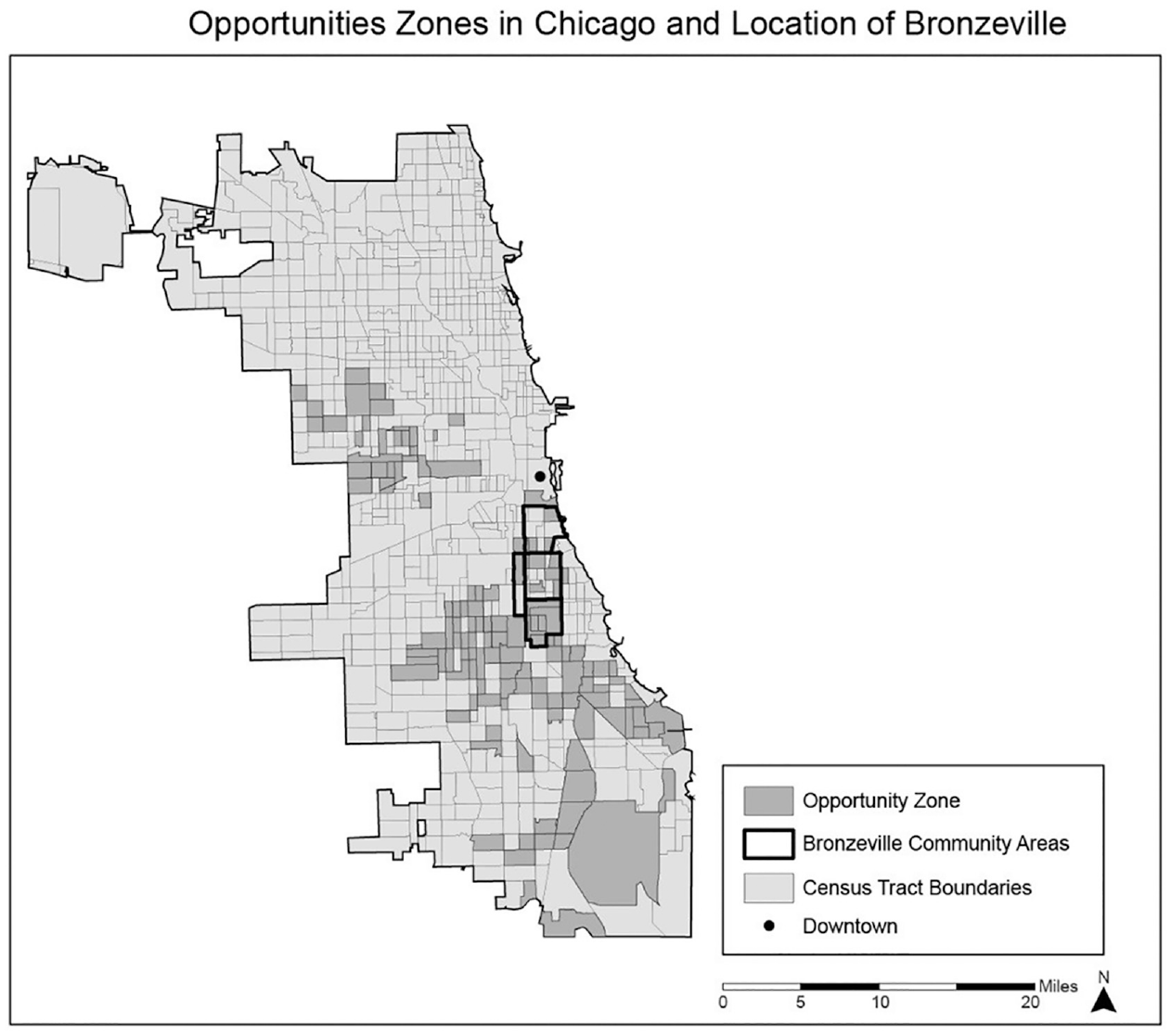
Opportunity Zones in Chicago and the location of Bronzeville.
Bronzeville has received considerable attention from policymakers and academics alike. It is referred to as the ‘Black Metropolis’, after an influential book written by Drake and Cayton (1993). The African-American sharecroppers migrating from the south during the Great Migration were essentially forced to live within the general boundaries of today’s Bronzeville, which became the epicentre of a rich black culture. In the words of Freeman (2019: 7), Bronzeville was the ‘ghetto’ that was also ‘a haven and a springboard for upward mobility’.
Nevertheless, the racially charged urban renewal policies of the 1950s and the white exodus from inner-city neighbourhoods (Gotham, 2002; Hirsch, 1998; Holliman, 2009) pushed Bronzeville into a prolonged state of concentrated poverty and disinvestment. This trajectory was subsequently exacerbated by the rapid growth of joblessness in the 1970s and 1980s (Wilson, 1997). Although Bronzeville’s public housing projects, which for decades stood as stark symbols of poverty and crime, have been demolished and redeveloped into mixed-income communities, recent efforts to revitalise Bronzeville have failed because of the lingering conceptions of black poverty (Anderson and Sternberg, 2012).
Sternberg and Anderson (2014) chronicle the trajectory of Bronzeville’s ‘non-white’ gentrification, which began in the 1980s and continued through the 1990s and 2000s. Led by black middle-class homeowners who were attracted to the neighbourhood’s rich cultural history, a pro-growth community development organisation was formed to revitalise Bronzeville, which also aligned with the then-mayor’s neoliberal growth agenda. In response, a coalition of low- and middle-income residents was formed to advocate for low-income housing and alternative forms of living that came to be juxtaposed with the neoliberal policies (Sternberg and Anderson, 2014: 3206).
Quantitative analyses undertaken by the Urban Institute (Theodos and Meixell, 2019; Theodos et al., 2018) confirm Sternberg and Anderson’s (2014) account. Their analysis shows that Bronzeville’s census tracts already had relatively high levels of loan issuance and equity investments prior to the OZ designation. They also identified five census tracts in Chicago that had high levels of socioeconomic change prior to the designation and all five were located in and around Bronzeville. This confirms that the neighbourhood was experiencing gentrification prior to the OZ designation.
Case selection rationale
Bronzeville thus represents a low-income neighbourhood that had been on the trajectory of gentrification. Incentivising property developments in this context is a double-edged sword. On the one hand, investments could be used for the benefit of existing residents, such as building affordable and workforce housing and grocery stores. On the other hand, they could be used to develop luxury housing and office buildings that would yield little benefit for the existing residents.
Although this study is based on a single case, its findings will be relevant to other gentrifying low-income communities subject to tax-based revitalisation policies. This is because the study focuses on the possible differences that may exist within the neighbourhood, rather than the neighbourhood’s revitalisation as a whole. By analysing the experiences of a diverse range of real estate industry professionals, the study chronicles if and why some developers were more successful than others in securing OZ-induced capital.
Moreover, Bronzeville’s trajectory of gentrification has been heavily mediated by its racial composition. The evidence is clear that predominantly black neighbourhoods well poised for gentrification have experienced slower process because of the stigmatised images of black poverty and public housing. The fact that Bronzeville has been the target of numerous tax-based urban revitalisation initiatives (see Figure 2 for reference) but is yet to experience the dramatic economic growth could be taken as evidence of racially mediated redevelopment. 2 Therefore, this study will be particularly relevant for other similarly racialised neighbourhoods.
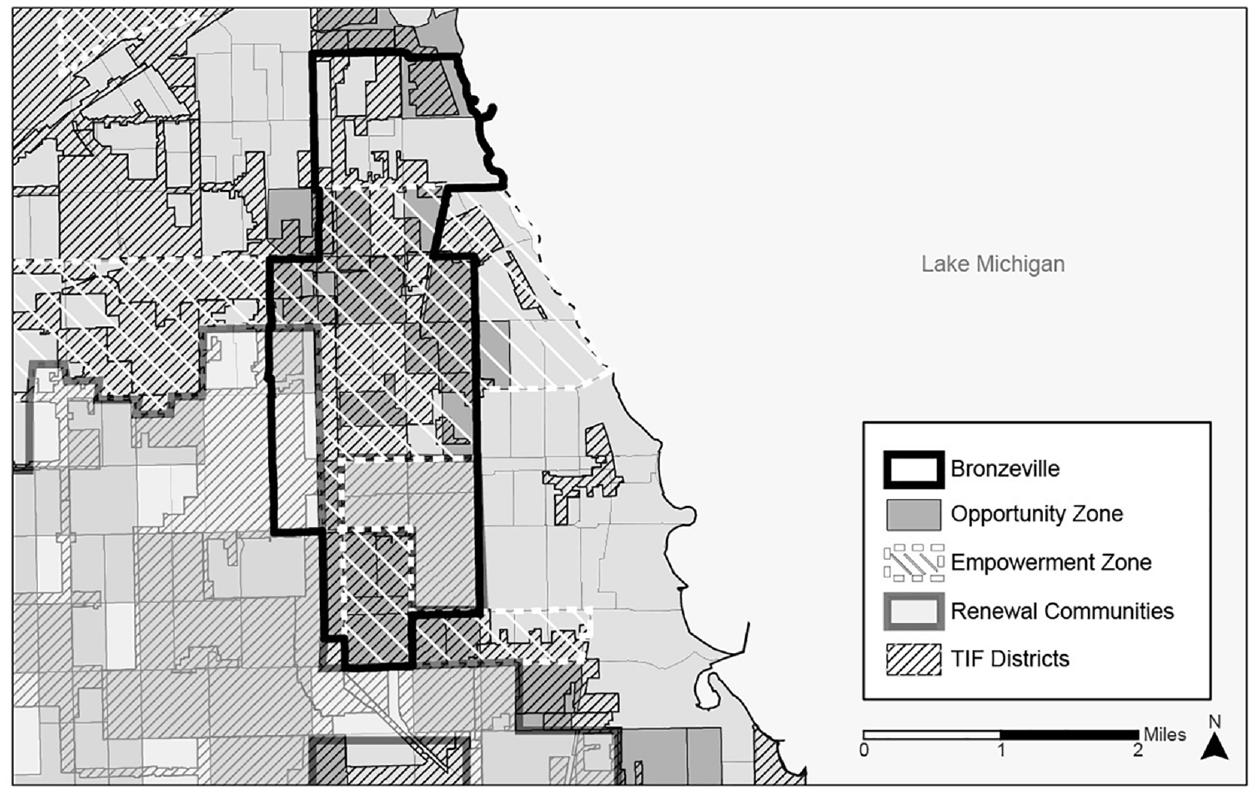
Overlapping boundaries of the various tax incentive zones in and around Bronzeville.
Data collection
Data were collected between January 2019 and April 2020 by means of 21 interviews and fieldnotes from a week-long site visit in July 2019. Secondary data were obtained from local newspapers, development news publishers and public records. During the site visit, the author attended meetings of the community groups and met with local developers, community organisations and staff members of local politicians.
The interviewees were largely identified through snowball sampling, asking each interviewee for a list of key players in Bronzeville’s property development scene. 3 This sampling approach continued until the interviewees started to refer to the individuals or groups that had already been approached, at which point data collection through interviews was determined to be saturated. 4 Of the 21 interviews, four were follow-up interviews. The sample comprised four black local developers, two non-profit developers, three community organisation leaders, two lenders, two politicians, two investors, one realtor and one public official. The interviews lasted between 45 minutes and 1 hour. Most of the interviews were not recorded, thus, detailed records were constructed based on the notes taken by the interviewer. The two interviews that were recorded, with the consent of the interviewees, were transcribed. Only two of the 17 interviewees were female.
Findings: OZ and Bronzeville’s three levels of real estate production
Stage one: Community-based organisations and non-profit developers
In the first stage of real estate production, real estate is created by its future users. The effort of a grassroots housing advocacy organisation, Housing Bronzeville, is representative. Started by a group of local residents concerned with rising housing prices, Housing Bronzeville has been fighting for affordable homeownership since 2004. The central goal has been to develop affordable housing on the city-owned vacant lots in the neighbourhood. There were over 2000 vacant lots in Bronzeville in 2009 (Hanson and Parsa, 2017).
In 2009, Housing Bronzeville secured a tentative commitment from the local alderman to set aside a number of vacant lots for affordable housing. Since then, the team has been working ceaselessly to get the project off the ground but their attempts to secure funding have been unsuccessful. With the new OZ designation, members of Housing Bronzeville and their development team were hopeful that they might be able to tap into the potential investor pool drawn to the tax incentive. According to their preliminary plan, the estimated total construction cost of the first phase was US$324,900 and they were hoping to secure US$100,000 from the OZ funds.
However, conversations with the representatives of Housing Bronzeville revealed that their chance of securing investments from OZ funds was very low. The representatives displayed little understanding of the tax law and the workings of the investment industry. Illustratively, the first phase of the project will include construction of 13 for-sale single-family homes but the structure of the OZ incentive largely applies to rental properties. Although it is theoretically possible to make a for-sale project an eligible investment, the structuring of such deals will be highly complicated and investors are unlikely to take such big risks with a grassroots community organisation such as Housing Bronzeville. Moreover, the group was neither connected to potential investors nor working with savvy intermediaries who might have been able to help them secure potential investors.
The lack of familiarity with the OZ programme was also apparent in other community-based organisations. A president of another highly influential organisation also displayed little understanding of the law. He reported having ‘very early’ discussions with potential partners but said that no concrete opportunities had emerged. His understanding was that the incentive would ‘go away soon’ and he did not think there would be an ‘opportunity to build up infrastructure to take advantage’, when in fact investors have until 2027 to take advantage of the tax benefits.
These conversations with the community-based organisations in Bronzeville suggest that their grassroots community development efforts were unlikely to benefit from the OZ policy. It is extremely difficult for organisations with little expertise, experience and resources to access the investors who are enticed by the tax benefit. These organisations not only face difficulty connecting with the investors, their lack of expertise and experience also render their projects extremely risky and non-investable.
The more experienced non-profit developers, who were not black and had extensive experience with NMTC and LIHTC, also did not report nor anticipate substantial benefit from the OZ designation. One affordable housing developer, whose company had been building in Bronzeville for more than 25 years, stated that OZ had been a ‘disappointment’. In his view, the tax benefits only lower the financing costs in ‘a marginal way’, whereas Bronzeville’s projects needed deep subsidies. A president of another non-profit developer echoed this sentiment, commenting that the OZ tax incentive was ‘just another tool in our toolbox’. His company was, in fact, close to securing an investment from an OZ fund but he projected that this was likely to be a ‘one-off’ deal. He noted that the deals are unique and challenging in low-income communities, thus, it would be difficult to find one-size-fits-all industry standards that can scale the impact of the OZ policy.
Based on his experience with tax credit deals, the interviewee reflected on the difference between the OZ policy and the tax credit programmes. With tax credit programmes, credits are allocated to projects already vetted by government entities, which, in effect, mitigates the investment risk. With the OZ policy, investors are left to assess the risk and return regimes on their own. Therefore, most projects in OZs will be viewed as highly risky and this perception will likely exacerbate when projects are led by black developers. Moreover, the tax credit industry has ballooned over the years (Ryberg-Webster and Kinahan, 2017; Tapp, 2019), aided by the emergence of industry standards, criteria for investment decision-making, and professional accounting and legal services. These support structures have collectively lowered the risk of investing in tax credit projects, thus increasing the investment pool. By contrast, the OZ policy holds little potential to be scaled up.
Stage two: Local developers
A strong presence of stage two real estate production was also found in Bronzeville. This stage is characterised by the activities of black local developers and brokers. The interviewed local developers had successfully completed many small-scale projects in the neighbourhood. They were experienced in communicating with the national, regional and local financial institutions; deeply engaged in local politics; and versed with the local regulatory framework. All of these developers were long-time residents of the neighbourhood. Thus, they had a vested interest in the neighbourhood’s long-term success, while also developing properties for a living. One developer, for instance, had become interested in Bronzeville because he saw it as an ‘emerging market’. Having lived in the neighbourhood for more than a decade, he characterised himself as the ‘biggest advocate of Bronzeville’.
Interviews with these black developers revealed that many of them had been struggling to tap into the new pool of investors drawn to the OZ tax benefits, despite having a sound understanding of the mechanics of tax law and where the potential lay for their projects. One developer, for instance, had spoken on a popular podcast focused on OZ, during which he had pitched his workforce housing project; he had been seeking support from the city officials, the local alderman and philanthropic organisations, and he had been actively pursuing opportunities to get as much publicity as possible on local and national media.
However, even with such robust efforts, this developer was yet to secure investment, after trying for over a year. During a follow-up interview, he reported facing ‘heavy challenges’ in his attempts to secure OZ investment for his project. Institutional investors and established wealth managers were seldom interested in a project in a low-income neighbourhood proposed by a small-scale developer. Those that had shown interest were ‘jittery’ and ‘nervous’, and looked for additional measures to ‘de-risk’ the investment, such as financial commitments from the city or a philanthropic organisation. The challenges faced by this developer, along with the experiences of stage one actors, is indicative of the racially mediated redevelopment process that Bronzeville has experienced for decades. Despite strong fiscal incentives, investors are still seeing developments in low-income, black communities led by black developers as highly risky.
When a black developer was able to tap into the OZ-induced investment capital, it did not come from the stage three investors but from unconventional sources of capital. One local developer secured investment through his accountant, who had high-net-worth clients who had not previously invested in real estate. When the OZ programme came online, the two jointly created an OZ fund and raised capital from the accountant’s clients.
Located in the northern end of Bronzeville, this project is a three-storey commercial building that offers rental spaces for beauty industry professionals. This team also has control over other vacant parcels in the same block and was preparing to develop two additional projects, an office space rental property and a mixed-use building, also funded with OZ-induced investment dollars. As a local developer and a long-time resident of the neighbourhood, the developer’s goal was to ‘develop a sense of community for the area’ by developing a critical mass of commercial properties and creating a vibrant commercial corridor. The salon rental project was completed in 2020 (Figure 3).
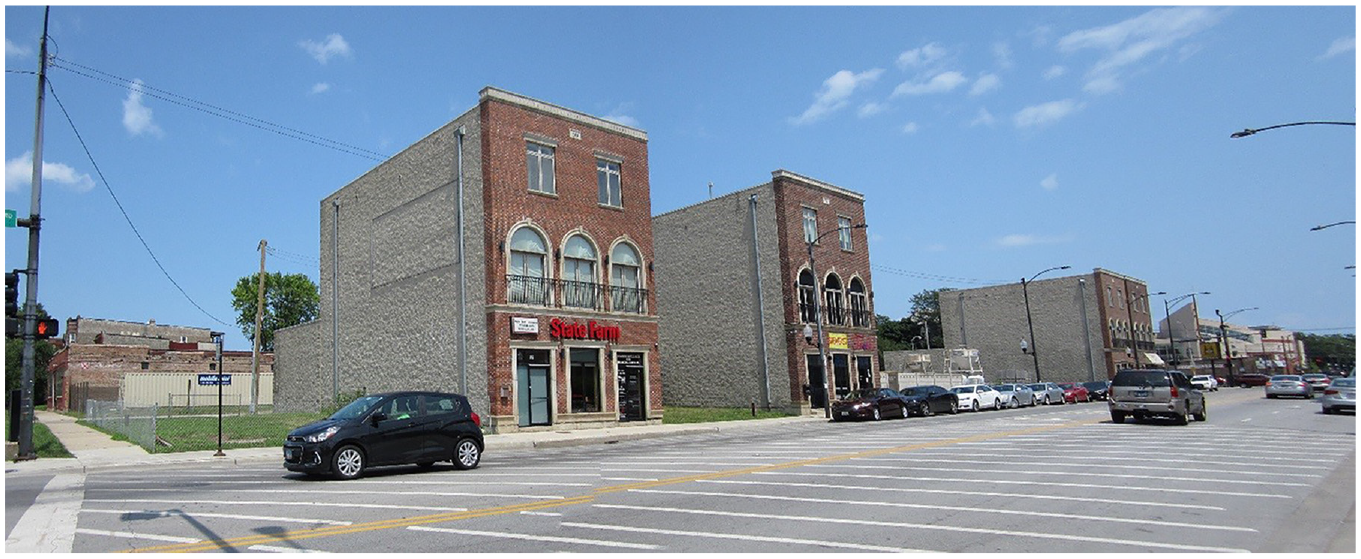
View of the block where the developers of the salon rental property are aiming to build two additional rental real estate properties.
The developer of the salon rental project attested to the critical role played by the OZ policy.
I had been told ‘No’ for three years on doing three commercial projects on Pershing Road. I am about to do those three over the next two years […] because of the opportunity zones. Because it has enabled me to find investors who are quite okay with parking their capital gain in a qualified fund for 10 years.
His experience demonstrates the critical role of financial intermediaries who can connect mid-sized investors, a group that has not traditionally been part of real estate production systems, to small-scale developers. The developer’s financial partner believed that the design of the OZ policy opened up new opportunities for mid-sized investors because of the ‘simplicity of the regulations’. He believed that, by staying small, they were able to keep the overheads and management costs low, enabling them to offer returns that were ‘comparable to whatever is available on the market’. Moreover, their long-standing work relationship enabled the accountant to vouch for the developer’s expertise and credibility, which was critical for this developer, who had been told ‘no’ from conventional lending and investment institutions.
However, it is equally important to acknowledge that the projects executed by the local developers might not benefit the low-income residents of the neighbourhood. Scholars have cautioned that black gentrification does not necessarily lead to more equitable development outcomes. These local developers, who are middle-class gentrifiers, do care for the neighbourhood’s long-term success but are likely unaware of how their actions and good intentions may lead to the displacement of low-income residents.
Stage three: Institutional investors and large developers
Finally, stage three real estate production activities were also spurred by the OZ designation. The most prominent example of a stage three production is the redevelopment of the former Michael Reese hospital site, a nearly 100-acre waterfront parcel just south of downtown and near the McCormick Place convention centre. This city-owned parcel was unsuccessfully pitched for the 2016 Olympics bid and for Amazon’s HQ2 bid. In 2017, the city selected a development team, but the programming and phasing of the development has not been finalised. It is anticipated to be some form of multi-billion-dollar mixed-use project.
‘It is not an accident that the Michael Reese site ended up in an opportunity zone’, commented a local developer. An investigation by a real estate news outlet, The Real Deal, revealed that this site was initially not selected as an OZ, but state officials ‘intervened in spring 2018’ to add the site (Nitkin, 2019). Later, the principal of the development firm leading the redevelopment effort co-founded an OZ fund with an individual who had engineered the initial OZ bill. As of January 2020, the group has secured an investment commitment from a prominent regional bank and is working to raise additional capital for the project.
The story of the Michael Reese development demonstrates that individuals and groups with a wealth of resources and connections tend to be the primary beneficiaries of the tax incentives. Unlike community organisations, non-profit developers and local developers, who are all struggling to tap into the potential investor pool, the developers of Michael Reese quickly secured investment commitments. These contrasting stories illustrate that access to resources, or a lack thereof, has been a decisive factor for whether Bronzeville’s actors have been able to tap into the investment interests drawn to the fiscal incentives.
One pathway for community organisations and non-profit developers to benefit from OZ-induced investors is by partnering with the stage three developers. However, there seemed to be little interest in doing so. One non-profit community-based developer reported receiving a ‘predatory’ offer from a large ‘downtown developer’, whom he had approached with a rehabilitation project to build a cultural centre in Bronzeville. Another prominent local developer has entered into a partnership with a large development firm to develop a vacant site just outside Bronzeville but has not experienced much enthusiasm from the firm to advance the project.
Conclusion
The investigation into Bronzeville’s three levels of real estate production revealed that the actors operating within each level had had vastly different experiences in their attempts to take advantage of the OZ designation. Actors operating within the least commercialised and most resource-constrained form of real estate production were facing considerable challenges securing investment capital attracted by the special tax zone. By contrast, actors in the most commercialised stage were well poised to tap into this new investment pool. Being designated as OZ, thus far, has done little to uplift Bronzeville’s low-income community groups or to boost their access to capital. The policy’s disappointing impact can be partially explained by the disconnection between the differing levels of real estate production that co-exist in Bronzeville. Investment capital drawn to the tax benefit remained largely within the most commercialised form of real estate production, rather than flowing into the projects led by community members.
The experience of one local developer offers some hope. He and his partner were able to pioneer new sources of capital because of the OZ designation. For them, the simplicity of the OZ regulations and minimal government oversight eliminated the need for an army of tax and legal experts to qualify for the tax benefit. The low overheads and management costs made it possible for their small-scale project to offer competitive rates of return, which attracted small and mid-size investors who had not invested in real estate prior to the OZ designation.
The successes and failures of the stage one and two actors together highlight the pivotal role played by financial intermediaries. In the world of real estate investment, intermediaries often operate as the matchmakers who connect projects to capital. However, mainstream intermediaries are mostly in the business of connecting the stage three developers to investors. The under-resourced players, on the other hand, lack sufficient conduits to connect to the investor pool. When a black developer successfully secured investment, it was through an entrepreneurial intermediary rather than established firms specialising in real estate investing. For investment capital to flow into community-oriented projects, an infrastructure of financial intermediaries is needed to integrate the three layers of real estate production and to pioneer new sources of investment capital.
Moreover, even when Bronzeville’s under-resourced players did connect with potential investors, this rarely led to actual investments. Existing research on race and urban development has clearly demonstrated that race is a crucial mediating factor that shapes the redevelopment of disinvested urban neighbourhoods (Anderson and Sternberg, 2012; Boyd, 2008; Smith, 1996; Wilson and Sternberg, 2012). Consistent with these findings, Bronzeville’s community members and developers were faced with investors who saw their projects as highly risky and unattractive, which is likely heightened by the stigmatised image of the neighbourhood, as well as their own racial identities.
The challenges faced by Bronzeville’s under-resourced players highlight the important role of the public sector. With the US tax credit programmes, the government, in effect, has lowered the investment risks by allocating tax credits only to projects that are viable and competitive. By contrast, the public sector is marginally involved in the implementation of the OZ policy, leaving investors to assess the risk and returns of investment opportunities on their own. Accordingly, investors are likely to avoid projects that are perceived as highly risky, the majority of which are located in black communities, led by black community organisations and black developers. Risk mitigation by the public sector will also expand the pool of investment capital, as exemplified by the tax credit markets.
Lastly, although tax-incentivised revitalisation policies have been touted as a tool for levelling out economic inequality, scholars and practitioners have questioned the sincerity of this motive. While the true intents of the policymakers are likely to vary, these policies do provide an expanded window of opportunity for marginalised communities. This research finds that tax-based revitalisation policies increase the potential investor pool interested in low-income communities, but the historically marginalised and under-resourced players lack sufficient conduits and resources to attract such investors and are faced with implicit and systemic bias of the investment community. Wilson and Sternberg (2012) argued that historically marginalised communities may be able to take advantage of the emerging rhetoric of the structurally compromised poor to recentre the politics of resource distribution. Future research on urban revitalisation policies should aim to identify the specific ways in which these marginalised communities can be economically empowered and what role the public sector can play in strengthening their pathways to empowerment.
Footnotes
Acknowledgements
I thank the residents and developers of Bronzeville, who graciously offered their valued time, local knowledge and experience for this research. In particular, I am deeply grateful to the members of Housing Bronzeville for opening their doors and sharing their community-organising experience. I thank Jack Porter and Kailon Thompson for their outstanding work as research assistants. Lastly, I thank the three anonymous reviewers and the editor for their insightful comments and suggestions on earlier versions of this article.
Declaration of conflicting interests
The author declared no potential conflicts of interest with respect to the research, authorship, and/or publication of this article.
Funding
The author received no financial support for the research, authorship, and/or publication of this article.
