




Abstract
This paper explores the 71-year (1947–2018) history of land expropriation in urban Bangladesh. It examines three interrelated questions regarding land occupation. First, how does the state and market pursue their mutual and competing class interests by expropriating land? Next, how does the state and market deploy primarily extra-economic means to seize land? Finally, how do actors, strategies and purposes of land expropriation vary from one political regime to another? This article addresses these questions by engaging with extant theories of land dispossession and class analysis and collecting a wide range of empirical evidence from Dhaka, Bangladesh. It argues that state and market actors in different political regimes use extra-economic means to accumulate land, creating preconditions for capitalism and expanding the existing capitalist system. To elaborate on this argument, it examines three factors of land expropriation: class, power and structure. The class dimension examines state and market actors who pursue their respective class interests by grabbing land. The power dimension explores land occupation strategies: who can use what forms of legal or illegal means to expropriate land. The structural factor shows how actors, methods, and purposes of land accumulation vary from regime to regime. Overall, this paper examines historical and contemporary forms of class interests attached to land accumulation, distinct mechanisms and purposes of land expropriation, and the nature of capitalist transformation under various political regimes.
Introduction
This paper explores various mechanisms and purposes of land expropriation, different forms of class interest attached to land accumulation, and the trend of capitalist transformation in urban Bangladesh. To do so, the paper examines three interconnected research questions. First, how do state actors, such as lawmakers, military officers and bureaucrats and market actors, such as capitalists in the formal and informal economic sectors, pursue their mutual and competing class interests while accumulating land? Next, how do state and market actors deploy primarily extra-economic means, such as political and legal power, as well as violence, to expropriate the land of peasants, the public and elites? Third, how do actors, means and purposes of land expropriation differ from one type of political regime to a different kind of regime?
To investigate the questions posed above, I draw on several relevant theories of land expropriation such as Marx’s (1995) idea of primitive accumulation,
To build the arguments of this paper, I examine the 71-year (1947–2018) history of land occupation in Dhaka, Bangladesh, and identify three factors of land expropriation: class, power and structure. The class factor examines how state and market actors pursue their respective class interests by expropriating land. The power factor explores how state and market actors simultaneously deploy legal and illegal means to occupy the land. The structural factor shows how actors, strategies and purposes of land accumulation vary from regime to regime. Together the three factors contributed to creating preconditions for capitalism and expanding the capitalist sector in urban Bangladesh. This research relies on four sets of empirical evidence: life histories, a survey of private slums, a land-use survey, and interviews.
This article is divided into seven sections. This introduction is followed by a historical background on land expropriation in Bangladesh. The third section will engage with the relevant theoretical debates on land expropriation and class analysis to build the paper’s arguments. In the fourth section, I will discuss the methodology and the sources of data for my research. Next, my research findings will be presented according to the four types of political regimes that Bangladesh has transitioned through over the last 71 years: Pakistani rule (1947–1971), dominant party authoritarianism (1971–1975), clientelistic authoritarianism (1975–1990) and vulnerable democracy (1991-present). In the sixth section, I will further engage with the theories of land dispossession and class analysis to analyse the evidence on the political economy of land dispossession and capitalist transformation in urban Bangladesh. Finally, the conclusion emphasises how it is often the Other – the poor, women, Hindus, non-political persons and elites of the opposition parties – that become the main victims of land dispossession.
Background information
Land expropriation is a recurring feature of colonial and postcolonial Bangladesh. The British colonial administration imposed the notion of private property in India in 1793, allowing Zamindars, or landlords, to buy land from the state and tax tenants to use that land. The Zamindari system was abolished in 1950, shortly after Pakistan and India emerged in 1947 from British colonial rule. The land that is now Bangladesh became East Pakistan and was ruled by West Pakistan 1 from 1947 to 1971. During this time, the Pakistani state used several methods to begin seizing land in East and West Pakistan. First, each Zamindar’s land in excess of 33.3 acres was seized by the state and turned into Khas (public) land. Then the state – led by the military and bureaucrats – created and implemented over half a dozen discriminatory land laws to seize land primarily owned by Hindus, 2 who despite being one of the Bangladeshi religious minority communities, owned 80% of the country’s total urban land in 1947 (Lambert, 1950). The state declared all land owned by Hindus who had fled to India in 1947 and had not returned by 1950 as ‘abandoned property’. West Pakistani and East Pakistani elites began to take land now available for public lease (seized from both Hindus that had fled in 1947 and from the Zamindari system) in order to create commercial spaces. In the process, poor tenants and minority communities were violently evicted from their land. During the India-Pakistan war of 1965, the Pakistani state passed laws to label all Hindus’ landed property as ‘enemy property’, making it eligible for confiscation.
Global capitalism and discriminatory developmental practices entered Pakistan in the mid-1960s with the help of the United States. The US began investing heavily in creating a capitalist class to destroy the possibility of a communist government emerging in Pakistan (Alavi, 1972). These capitalist interventions further dispossessed millions of people from their land and homes in rural and urban centres, including Dhaka (Feldman, 2016; Muhammad, 1992; Siddiqui et al., 2010). The continuance of enemy property laws and the introduction of new land laws in Independent Bangladesh after 1971 further dispossessed millions of Hindus, Muslim peasants, the middle-class and indigenous people from their land (Adnan, 2013, 2016; Feldman, 2016; Feldman and Geisler, 2012; Siddiqui et al., 2010).
A similar historical trend of land expropriation is found in Panthapath (my research site), Dhaka, between 1947 and 2018. During British India’s partition in 1947, the Panthapath area was a peripheral zone of Dhaka city and had an agricultural economy. Hindu Zamindars and Hindu elites held over 60% of land in the Panthapath area; the colonial state and Muslims owned the rest of the land. However, a small number of peasant families had their own land. Most of the peasants living on and using the land were Muslims who typically lived adjacent to their farmland in houses called Tong Ghor. Up until 1947, these poor peasants had an independent livelihood system based off of fishing in the canal or other bodies of water, and farming the fields and open areas (Mondal, 2021).
However, between 1947 and 1971, state and market actors began transforming Panthapath into part of urban Dhaka by evicting about 300 peasant families in order to build real estate companies and factories for products such as glass, cigarettes, electronics and clothing. This process of land expropriation in Panthapath continued, and from 1971 to 1990 approximately 400 peasant families and many landlords were evicted. Starting in 1989, the Panthapath street project (L.A. case no: 40/89-90 and 40B/89-90) replaced the canal with a central road and in the process removed nearly 900 peasant families from their land (Government of Bangladesh, 1993). In total, between 1947 and 1990, nearly 6000 peasants (about 1600 families) were evicted from their homes and approximately 200 acres of land was expropriated in order to develop the Panthapath area into part of urban Dhaka (Mondal, 2021). This dispossession transformed most of the peasants 3 into wageworkers and agricultural land into sites of capital investment, creating two vibrant economic sectors 4 in Panthapath: formal and informal. The formal economic sector includes more than 700 units of real estate and private residential buildings, Asia’s eighth largest shopping mall, banks, hospitals and other commercial enterprises. The informal economic sector consists of 147 commercial slums and many small enterprises. Together these sectors contributed to creating and sustaining the capitalist system and are an acute form of socio-spatial inequality in the area.
Theorising land expropriation
This section engages with two sets of literature – historical and ongoing debates on land dispossession and the Neo-Marxist theory of the state and class. Together, these theories are the foundation of this paper’s arguments on how state and market actors in different political regimes pursue their class interests by occupying land through extra-economic means, thus creating and reproducing capitalism in Bangladesh. Two foundational theories regarding land expropriation – primitive accumulation (PA) and accumulation by dispossession (ABD) – identify distinct mechanisms and purposes of land expropriation. Marx (1995: 507) defines PA as ‘an accumulation not the result of the capitalistic mode of production, but its starting point’. He argues that PA created the preconditions for capitalism by coercively transforming common land into private property, converting the dispossessed peasants into wage workers, and transforming social property relations. Marx (1995: 512–513) shows that the English bourgeoise acquired land owned by the state and peasants through commodification, privatisation, forceful expulsion, and legal means (or the ‘parliamentary form of the robbery’). According to Marx (1995: 441), once a capitalist system is established, it reproduces itself through two forms of capitalist accumulation: (a) expanded reproduction – generating new capital through successive investment of profits, and (b) the centralisation of capital – redistributing capital among and within the capitalist entities.
Harvey (2003) argues that ABD primarily redistributes various forms of surpluses and landed wealth from the bottom to the top rather than generating a new cycle of capital. Its major function is to solve the crises created by the overaccumulation of capital at home by releasing a set of assets and labour power at a very low cost abroad and immediately turning them into profitable use. According to Harvey (2003: 137–182), ABD engages both market mechanisms, such as financialisation, privatisation and commodification of goods and services, and coercion, such as violence, to redistribute wealth and resources, dispossessing various groups of people inside (e.g. a factory owner) and outside (e.g. an independent producer) the market.
Several alternative versions of theories regarding PA and ABD exist in the literature on land dispossession. Among those, Levien’s (2012, 2015) theory of regimes of dispossession and Adnan’s (2013, 2016) idea of land alienation are instrumental in understanding land expropriation. Levien (2012, 2015) argues that contemporary land grabbing in India cannot be fully explained by Marx’s PA because capitalism is already in place, either in a traditional or advanced form. Levien (2012: 939;
Adnan’s (2013, 2016) theory of land alienation explains land dispossession in two key ways. First, drawing examples from India and Bangladesh, Adnan (2013: 94) argues that ‘it is self-evident that primitive accumulation must be an ongoing process when capitalist expansion takes place in the context of co-existing non-capitalist sectors’. Second, Adnan (2016: 6–13) identifies a ‘fourfold classificatory schema’ of land occupying strategies: direct-forced, direct-unforced, indirect-forced and indirect-unforced. The first type of land expropriation (direct-forced) occurs when state and non-state actors use coercion to grab land rather than using laws. The second mechanism of land alienation (direct-unforced) occurs when state and market actors use mediation, persuasion, negotiation and fraud to acquire land. The third type of land alienation (indirect-forced) refers to situations when landowners are forced off their land through violence or the threat of violence (including sexual violence against women) that results from unintended consequences of decisions made by state or market actors. The final form of land dispossession (indirect-unforced) occurs when land grabbers capitalise on landholders’ vulnerability with debt, poverty, traditional property rights, or natural and human-made disasters.
Three more theories that are very relevant for this paper include Roy’s (2011) notion of elite illegality, Suykens’ (2015) idea of land disappearance, and Feldman’s (2016) theory of Otherness. Roy (2011: 260–270) argues that state authorities in Indian cities grab land by violently evicting the urban poor from slums in the name of ‘public purpose’. She shows that state agencies criminalise urban poverty and slum settlements and violently evict the poor tenants to provide land to the capitalists (see also Bhan, 2012). She (2011: 270) calls this process ‘elite illegality’ or ‘elite informality’. Suykens (2015: 488) argues that land occupation was organised in urban slums of Bangladesh by a ‘patronage network’ developed and maintained by various actors, including slumlords, landlords, strongmen, formal state officials and elected politicians. These actors maintain land ownership through dakhal, ‘a property regime based on forceful occupation’, and they solve land disputes and establish land ownership rights through interactions and negotiations (Suykens, 2015: 488). Feldman (2016) argues that both the state and elites used extra-economic means, such as discriminatory land laws and legal coercion, to expropriate the land of Hindus. Labelling Hindus as ‘enemy’ and as a ‘threat to national security’ have made Bangladeshi Hindus the Other whose land can be taken by the state and the market.
I draw on empirical evidence 5 and the above theories to make this paper’s central argument: how state and market actors created preconditions for capitalism and reproduced the capitalist system under different political regimes by pursuing their class interests attached to coercive land accumulation. I elaborate on this idea by examining three factors of land expropriation: class, power, and structure. First, the class factor examines how the state and market pursue their mutual and competing class interests by accumulating land. Not only do market actors acquire land to pursue their own class interests, but state actors also expropriate land to pursue their class interests. This idea is built on Alavi’s (1972) Neo-Marxist theory of the state and class interest. According to Alavi (1972: 60), postcolonial states, such as Pakistan and Bangladesh, did not become the spokespersons of the capitalist class as Marxist theory suggested. Rather, these states are relatively autonomous, where not only capitalists but also military officers, bureaucrats, lawmakers and politicians pursue their competing or mutual class interests by accumulating capital (see also Kochanek, 1993: 107–354). By reflecting on Alavi’s idea, I identify two forms of state actors behaving according to their class interest: (i) a bureaucrat, army officer, or a lawmaker pursuing their individual class interest by creating their own businesses on expropriated land, and (ii) a state agency, such as the Bangladesh Army or the Bangladesh Railways, pursuing their collective class interest by creating their own departmental business outlets on seized land. In other words, the emphasis is on the state itself, in various forms, pursuing its own class interest. I also build on Levien’s idea of the state as a ‘land broker’, Roy’s notion of ‘elite illegality’, and Suykens’ conception of ‘patronage network’ to examine how state agencies serve the class interests of capitalists (formal and informal) by helping them accumulate land and wealth.
Second, the power factor of land expropriation explores how the state monopolises extra-economic means, and how the market also gains access to extra-economic means to grab land. I define the term power as the ability to use legal (e.g. discriminatory land laws) and illegal (e.g. violent force) means by both state and market actors to expropriate land. We see a strategic state-market nexus in Bangladesh, in which capitalists, military officers, and bureaucrats turn into lawmakers, while the process also works in reverse— military officers, bureaucrats, lawmakers and politicians turn into capitalists (Alavi, 1972; Kochanek, 1993). It is telling that at the top of the country’s political leadership, more than 60% of lawmakers in the current parliament are businesspersons (The Daily Star, 2019). I engage with Adnan’s ‘fourfold classificatory schema’ of land occupation strategies, Roy’s insights of ‘elite illegality’, Levien’s idea of ‘regimes of dispossession’, and Suykens’ notion of ‘dakhal’ to understand how both state and market actors use extra-economic means to accumulate land.
Finally, the structural factor explores how actors (class), strategies (power) and purposes (creating preconditions for capitalism or reproducing the existing capitalist system) of land occupation differ across four political regimes 6 in Bangladesh: Pakistani rule (1947–1971), dominant party authoritarianism (1971–1975), clientelistic authoritarianism (1975–1990) and vulnerable democracy (1991-present). This structural factor also examines ethnic/religious, gender, political and poverty dimensions of land dispossession. I draw on Feldman’s idea of Othering identity to explain how Hindus (religious minority), women (gender), elites in the opposition party (political) and the poor (poverty) can all be seen as the Other. Due to their weaker position in the power structure, these groups are unable to resist coercive land occupation. While Hindus’ Otherness is mostly defined by discriminatory land laws, the poor, women, elites and non-political persons from the majoritarian group (i.e. Muslims) are treated as the Other due to their lack of political power. Together, the three factors (class, power and structure) contributed to creating preconditions for capitalism 7 as well as expanding the capitalist sector through the centralisation of capital in urban Bangladesh.
Figure 1 highlights how the three factors and four regime types individually and collectively contributed to the urban capitalist transformation in Panthapath since 1947. Panthapath transformed from an agricultural sector into an urban capitalist site through four distinct political regimes that took the area through three phases of capital accumulation: (1) the primitive accumulation phase (1947–1971), (2) the coexisting period of primitive and capitalist accumulation (1971–1990) and (3) the continuing phase of the centralisation of capital while ending primitive accumulation (1991-present). For example, under Pakistani rule (1947–1971), West Pakistani elites maintained a colonial relationship towards peasants and landowners in Dhaka and across East Pakistan, using the levers of power to dispossess locals from their land. For the dominant party authoritarian regime (1971–1975), party members in the newly independent state emerged as the dominant political power and began accumulating control over land. In the clientelistic authoritarian regime (1975–1990), the military had substantial control over the three factors of land occupation. During the vulnerable democratic regime (post-1990), capitalists-turned-politicians gained control over the state and market to expropriate land from the powerless. Thus, although the process of land dispossession has continued unabated in Dhaka since 1947, the power dynamics of by whom and how the land has been seized have changed significantly, driven by political changes (structure), and by class and power factors.
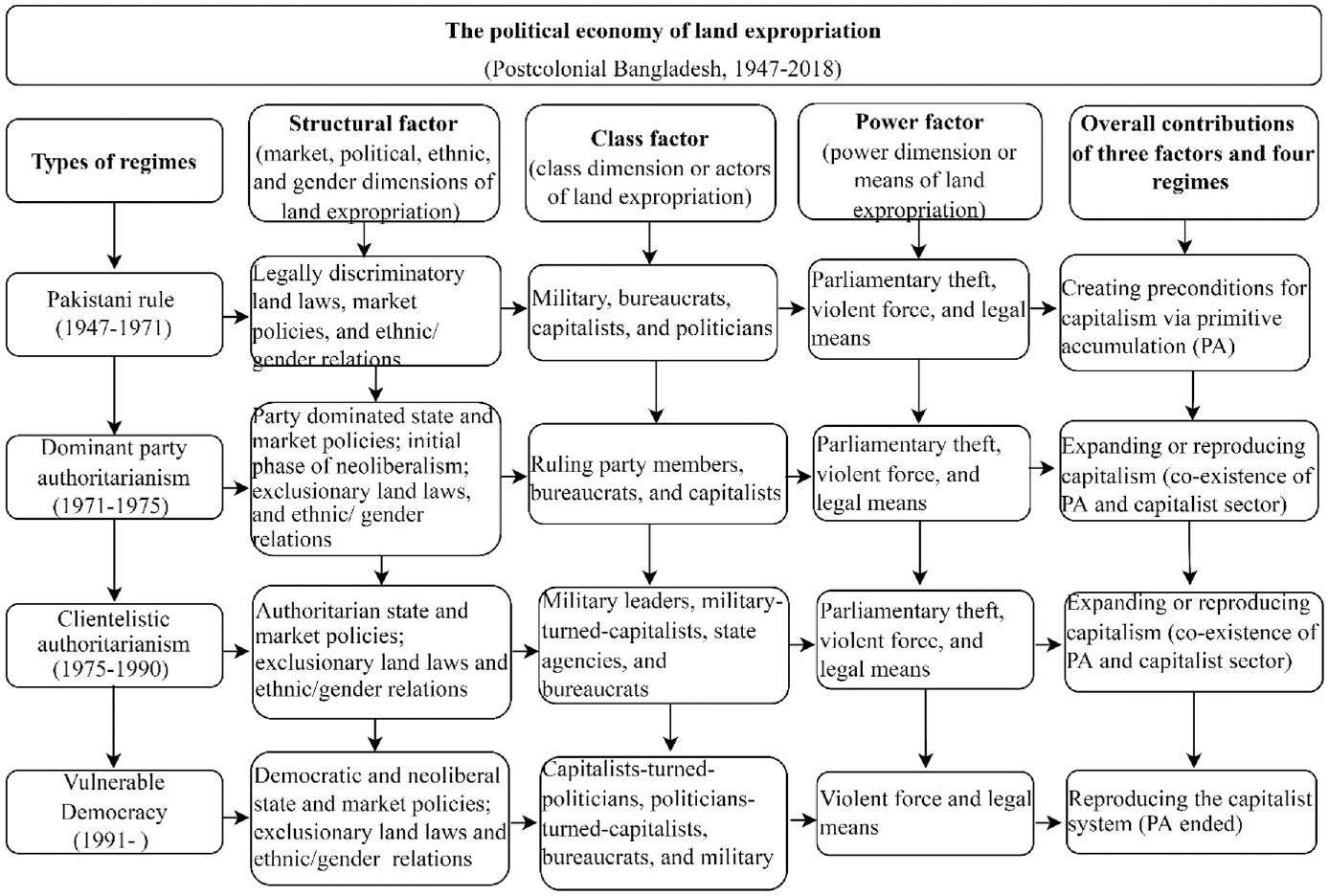
The individual and collective contributions of the three factors and four regimes of land dispossession.
Methodology and data sources
As discussed above, Panthapath was a peripheral zone of Dhaka city and had an agricultural society in 1947. From 1947 to 1990, the area became a vibrant capitalist site within Dhaka. I selected this area for my analysis because it is an ideal historical example of how an agrarian society transformed into an urban capitalist society. Moreover, evidence of land dispossession, impoverishment, and so-called development is plentiful. In addition, I am also able to draw upon my decade long first-hand experience of living and working in this area in order to better understand Panthapath’s transformation.
In this article, I use four sets of empirical evidence: 32 life histories 8 of dispossessed people living in private slums located in the 500-m buffer zone on both sides of the one-mile long Panthapath street; a survey of 147 slums located in the same area; a land-use survey of 1007 structures situated in the 200-m buffer zone on both sides of Panthapath street; and 17 interviews with local inhabitants in a variety of professions. I collected life histories from 32 respondents (19 men (59.4%) and 13 women (40.6%) between the ages of 43 and 77) that I selected using snowball sampling. These conversations covered a wide range of issues, including their life-long experiences with forced evictions, violence, poverty and slum life, as well as the political-economic and socio-spatial transformation of Panthapath over the decades. I used purposive sampling to collect 17 interviews with land officers, lawyers, scholars, activists, politicians and capitalists (aged between 47 and 80 years old) who could speak to land dispossession, slum housing and development in Panthapath, Dhaka and Bangladesh more broadly.
I conducted the land use survey to collect information from 1007 commercial and residential buildings and plots in the study area with the help of five research assistants. We administered a questionnaire with 18 land-use-related questions and interviewed one person from each house/building: either the owner or the senior resident. We discussed the previous and current owners of the plots of land, the causes of conflict between various groups of landlords, and the numbers of illegally expropriated plots. Lastly, I collected information from 147 privately-owned slums while interviewing a slum manager from each slum. Each slum houses seven to 400 working-class families. I administered a questionnaire with 26 questions about various issues, including illegal land occupation and predatory practices of the slum business. Finally, as per Institutional Review Board guidelines, all respondents’ names in this paper are kept anonymous to protect human subjects.
Land expropriation in urban Bangladesh: Findings
Pakistani rule, 1947–1971
During the period after the end of British rule, 1947–1971, half a dozen discriminatory land laws were enacted in Pakistan to help military leaders, bureaucrats, politicians and capitalists expropriate and reclaim land from Hindu Zamindars, Hindu and Muslim elites, and the poor. These laws included the East Bengal (Emergency) Requisition of Property Act (XIII of 1948), the East Bengal State Acquisition and Tenancy Act (1950), the Evacuees Acts of 1949–1957, the Disturbed Persons Rehabilitation Ordinance of 1964, the Order XXIII of 1965, the East Pakistan Enemy Property Administration and Disposal Order (1966) and the Continuance of Emergency Provisions Ordinance of 1969 (Barkat et al., 2008; Feldman, 2016). In addition to these land laws, the Pakistani state reduced the amount of agricultural land owned by one West Pakistani family from over 2000 acres to 500 acres. This allowed the emergent industrial bourgeoisie in West Pakistan to access that land in order to build their factories and businesses. However, those West Pakistani business elites pressured the government to increase the land ceiling for East Pakistani landlords from 33.3 acres to 125 acres (Muhammad, 1992: 21–22). This law had created a serious obstacle for the East Pakistani potential capitalists who were interested in acquiring land to develop new factories and businesses.
My field data reveals that after the partition in 1947, the state evicted many peasant families from their places in Panthapath. The West Pakistani military and bureaucrats-turned-capitalists, as well as some East Pakistani elites, came forward to expropriate that land. The three stories below provide insights into land expropriation in Panthapath.
Taiyab Sarker, a 68-year-old retired land officer (Tahsildar), explained a new world to me during our three meetings as I sought to understand the lived effects of land dispossession in Panthapath since 1947. Before the abolishment of the Zamindari system in 1950, Mr. Sarker’s father was a clerk to Kalam Maulavi, one of the tax collectors for Rajeshwar Roy Chowdhury, the biggest Hindu landlord in this area. Mr. Sarker, who knew about the Zamindari system from his father, mentioned that Mr. Chowdhury had over 300 acres of land in Panthapath and its surrounding areas. When Mr. Chowdhury left for India after the abolition of the Zamindari system in 1950, the Pakistani state took over a portion of that land for its own commercial purposes and made the rest of the land available for public lease. Mr. Sarker claimed that ‘West Pakistani Borolok (elites) acquired most of that land without paying anything to the state and took possession by violently evicting the poor’. Most of this land was agricultural land and wetlands. Several military officers were able to take advantage of relationships with bureaucrats to obtain the false documentation needed to seize a significant portion of Mr. Chowdhury’s land (see also Adnan, 2013; Feldman, 2016). Mr. Sarker estimated that five out of 300 acres of land are now state-owned, and the rest of the land, 98.3%, was confiscated by bureaucrats, military personnel and capitalists.
Moktar Ali – a 70-year-old Muslim farmer – was evicted from his own land, a 15-decimal plot, during the mid-1960s. A West Pakistani glass-factory owner, a sibling of a military officer, forcefully seized his land without paying him. According to Mr. Ali, ‘it was the land which his grandfather got from a Zamindar as a gift some 100 years back…We didn’t have any legal documents proving our ownership’. This land was the only source of income for him and his family and as a result of losing his land and livelihood, he was forced to become a wageworker in a factory manufacturing TVs.
Shahid Miya, a 66-year-old landlord, described how a West Pakistani bureaucrat-turned-businessman took 0.86 acres of land owned by his family while violently evicting nearly 50 peasant families who used this land. According to Mr. Miya, ‘my father was killed by thugs hired by the land grabber to take possession of our land’. A multi-storied private hospital is now located on the land Shahid Miya’s family previously owned.
The dominant party authoritarianism, 1971–1975
During the Liberation War of Bangladesh, the provisional government continued all land laws in force on 25 March 1971 through the Laws of Continuance Enforcement Order, 1971. This law mimicked many of the same rules that considered Hindu property as ‘enemy’ property before independence. The Bangladesh Parliament merely replaced the word ‘enemy’ with ‘vested’ and renamed the act as the Vesting of Property and Assets in 1972. Due to the continuation of these land laws, party members, bureaucrats and capitalists continued to seize opportunities to expropriate land.
The newly created Bangladeshi state nationalised all industries and business institutions left by West Pakistanis or created by the East Pakistani elites. However, within a few years, the state had failed to profit from the nationalised industries and started selling those factories/businesses to private companies. Party members, businesspersons, military officers and bureaucrats bought most of those factories and land on which factories were located, paying nothing or next-to-nothing (Khan, 2011; Kochanek, 1993; Muhammad, 1992). Muhammad (1992: 40) claims that the new bourgeoisie emerged in independent Bangladesh by ‘grabbing the abandoned landed wealth of Hindus and plundering the state’s resources’. Khan (2011: 76) argues that new elites were involved in ‘intense primitive accumulation’, and that they then accumulated assets and resources using ‘formal and informal political power’. This was the initial phase of neoliberal capitalism in Bangladesh. The three stories below illustrate the process of land expropriation and the creation of new businesses in Panthapath under the regime of dominant party authoritarianism.
My interview with a Hindu woman, Shikha Talukder, a 67-year-old retired elementary school teacher, illustrates the traumatic experience of losing her land. Ms. Talukder lost her 13 decimals of land because the land office purposefully labelled her land as vested property, which was a well-documented way of stealing land owned by Hindus. A month before the former President Mujibur Rahman’s killing in 1975, a few musclemen hired by a politician-turned-real estate owner came to her house one evening and showed her a lease contract document. They told her that government officials had listed the land as ‘Vested Property’. She responded to them: ‘We have been living in this place for three generations and we are not leaving. It is our property; we will save it…we will go to the court tomorrow to get back our land’. The following night, those same men came to her house and threatened to kill her family. Within two weeks, they had evicted the family from their home and land.
The famine of 1974 was a turbulent and violent period and it created numerous opportunities for the elites in Panthapath to occupy land (see also Muhammad, 1992). My interviews with a famine-stricken slum dweller, Kamal Hosen, 64, and a landlord, Sazzad Khan, 73, explored three significant pieces of evidence. First, many famine-stricken residents of rural areas migrated to urban centres, including Dhaka. Some landlords in Panthapath built slum housing on seized land and rented it out to the migrant poor. According to Mr. Hosen, ‘five new commercial slums appeared during this time on the northern side of the canal’.
Next, thousands of young adults and rural middle-class families moved to Dhaka, including Panthapath, for work. The emerging real estate companies – owned by party members, military officers and bureaucrats – began to expropriate land in order to construct houses to meet the demand of the new urban middle class (see also Shafi, 2008). Mr. Khan had three plots of land in Panthapath that were four, six and seven decimals. A real estate company, jointly owned by a party member and a bureaucrat, seized his seven-decimal plot of land and evicted 20 peasant families who had been living on that land for generations.
Third, during this famine, the nation faced a series of severe crises, including the economic downturn and conflict among political parties. In January 1975, former President Mujibur Rahman created a one-party government named BAKSHAL. Many members affiliated with this party accumulated a vast amount of land across the country, including in Panthapath. Muhammad (1992: 42) observed that ‘the famine of 1974 was the golden period of the emergence of millionaires’ in a newly born Bangladesh. Indeed, during this period, Mr. Khan also lost his four decimal plot of land.
Clientelistic authoritarianism, 1975–1990
Military leaders and members of the military-backed political party dominated state power and controlled market mechanisms under this regime and became the primary land grabbers. Between 1977 and 1985, the Ministry of Land empowered land officers to enlist the lands of Hindus as ‘vested property’, keeping much of it for themselves, and leading Hindus to flee in massive numbers (Panday, 2016). Hindus and other marginal subjects became increasingly disenfranchised by land reform policies and Constitutional amendments.
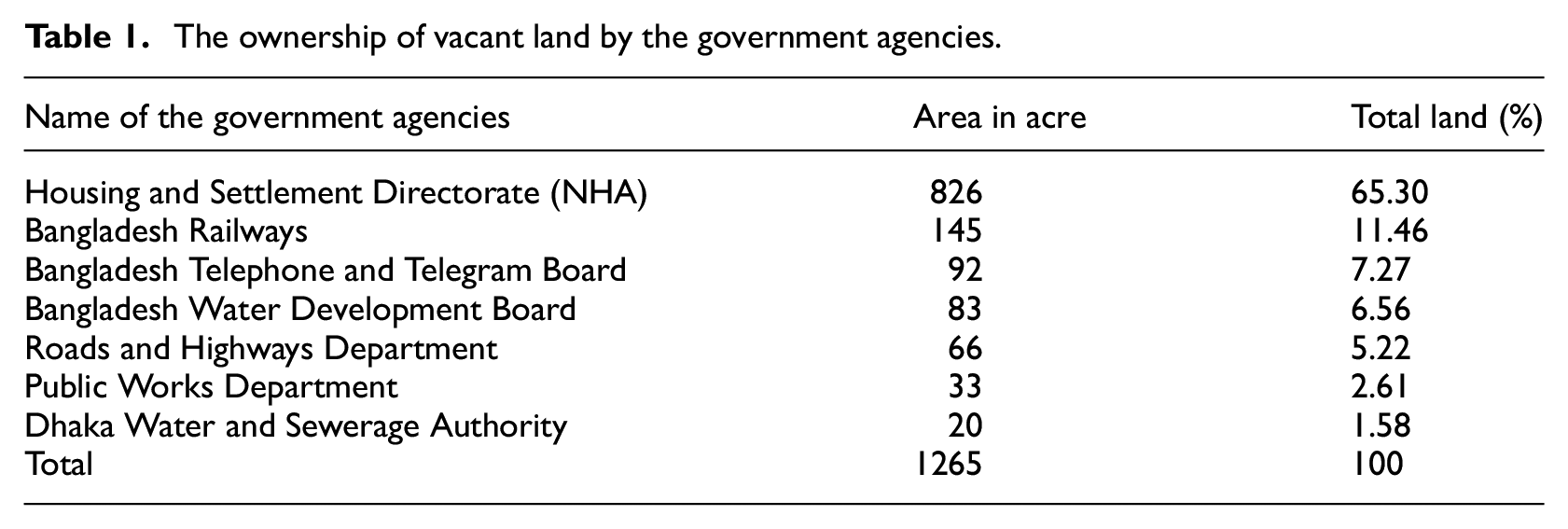
Under this regime, the Industrial Policy of 1982 further created opportunities for military officials, politicians, and capitalists to seize land for building factories and businesses. According to Muhammad (1992: 107), ‘the country’s richest persons occupied 3000 acres of land under different names in Dhaka and its outskirts’. In their 1985 study, Siddiqui et al. (2010: 7) showed that housing companies ‘illegally occupied’ more than 600 acres of Khas land in Dhaka. The Asia Development Bank, in their 1992 study (Table 1), found that during the military regime seven government agencies expropriated 1265 acres of vacant land for official needs and for creating departmental business outlets (Shafi, 2008: 3–7). This land was where the poor used to squat and work. State agencies also gave much of that grabbed land to the politicians and real estate companies, owned mainly by the army officers.
The ownership of vacant land by the government agencies.
The two stories below show how the military regime organised and controlled land dispossession. Sayma Khatun, a rice-cake vendor in her late 60s and a former worker in a cigarette factory, mentioned that nearly 300 peasants and working-class families, including her own family, were evicted from their slum in the first year of the military regime. It was the Water Development Board (WDB) that took the land. Ms. Khatun recounted: ‘we protested their uninformed eviction but failed. The authorities demolished our houses while most of us were at work…We lost most of our belongings, including our houses where we had been living for generations’. One of the country’s top industrialists was behind this land grab. He worked through a military officer who directed the WDB to evict the slum dwellers so that the industrialist could clear the land and build a large storehouse on the 10-decimal plot.
A 67-year-old TV mechanic, Shahidul Bari, was a worker in the Nikkon TV factory owned by a West Pakistani Bihari business person named Alauddin Shams. It was the largest factory in the Panthapath area, located on 0.83 acres of land and employing nearly 300 workers. Mr. Shams left for West Pakistan in 1971 while his wife – Aleya Khanam, an East Pakistani woman – took over that business. Ms. Khanam lost half of her land during the mid-1980s when a real estate company, owned by a military officer, grabbed that land from the southern side of the TV factory, where nearly 30 peasant families were living in Tong Ghor. The military officer used false legal documents and violent force to occupy that land. Ms. Khanam, her workers and peasants protested this land expropriation, but they failed due to a lack of political power. She continued this business until 1988, when another real estate company, this time owned by a lawmaker, forced her to sell the factory and the land.
Vulnerable democracy, 1991–present
Weak democratic institutions, politicised bureaucracy, competitive clientelism and informally modified formal institutions are the major features of this regime (Khan, 2011). At its inception, neoliberal capitalism gained momentum and an important restructuration occurred in rural and urban economies, including urbanisation and industrialisation. Between 1990 and 2010, government agencies, lawmakers, politicians and business elites expropriated over 1.3 million hectares of public and private land across the country, including over 6000 acres of land expropriated in Dhaka (Feldman and Geisler, 2012; Muhammad, 1992; Shafi, 2008; Siddiqui et al., 2010). Moreover, the state’s so-called developmental projects and urban elites evicted the residents of over 200 slums, nearly 317,665 people, in Dhaka between 1989 and 2017 (Islam, 2006; Nawaz, 2004; Nazrul, 2003; Shafi, 2008).
A top business conglomerate, Bashundhara Group, which owns Asia’s eighth largest shopping mall in Panthapath, recently grabbed approximately 100 acres of public land in Badda, Dhaka and ‘sold out every single plot without caring for approval from the city development authority’ (Chowdhury, 2007). Siddiqui et al. (2010: 192) characterised this land accumulation trend as an ‘outright plunder and loot of state and abandoned property’. This trend can be further illustrated by the following case studies and by the land use survey and the slum survey.
Rashed Khan, 73, is one of the biggest landlords and an influential political leader in the area. He presently owns 60 decimals of land, having lost over 80 decimals of land during 1990–1995. Three different entities (a lawmaker, a politician, and a real estate company) from the political party ruling at the time were able to take a large part of his land. According to Mr. Khan, ‘I lost many plots of land when I was in the opposition political party, but I gained some of them back when my party came to power’. Those three persons as well as Mr. Khan used political power, fake legal documents, and violence to occupy and keep control over the land. Under this regime, plots of land in Panthapath often changed hands repeatedly as a result of political transitions.
The Land Use Survey (Table 2) provides a breakdown of recent trends of land expropriation in Panthapath. It includes 20 neighbourhoods (and 26,147 people) in the study area, which is broken up into 1007 plots of land covering 163 acres. The survey shows that 1003 plots have commercial and residential structures, while four plots are open land. Of the total 1007 plots, 989 are privately –owned plots, and 18 are government-owned plots. Among the land studied in this survey, 129 plots of land, or 4.22 acres, are reported as illegally seized and are currently disputed. These 129 plots of land are all currently privately-owned and used for commercial purposes, but were originally Khas land (33 plots), Vested Property and (36 plots) privately-owned (60 plots). Three groups of elites participated in this land grab: political, state and business.
The recent trends of land expropriation in Panthapath.
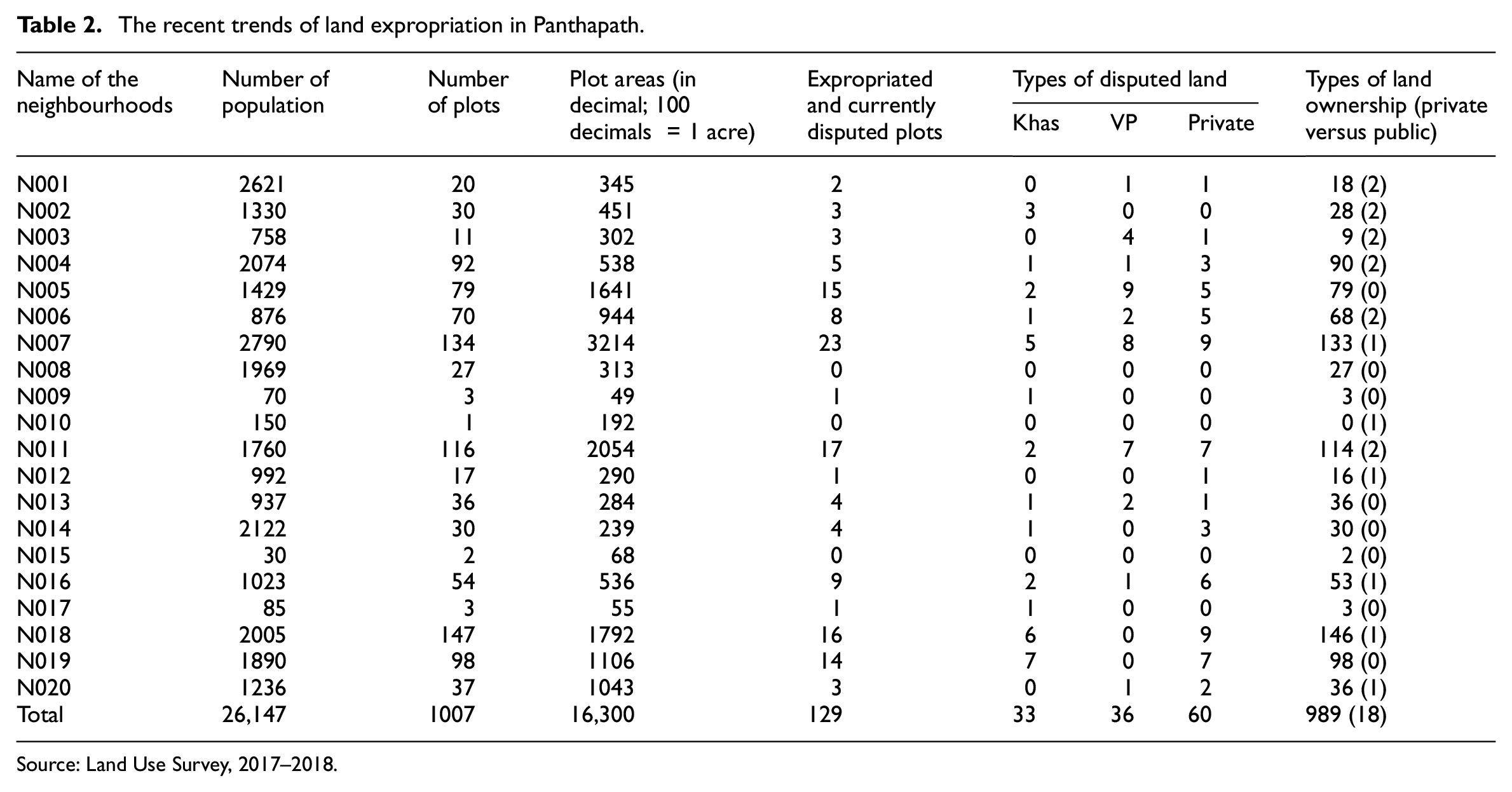
Source: Land Use Survey, 2017–2018.
The Slum Survey in Panthapath provides evidence on how different groups of elites compete with one another, or even work together, to confiscate and control a piece of land. The survey reveals that at least seven groups of people – businesspersons, lawmakers, politicians, landlords, slumlords, land officers and gangs – are engaged in land expropriation and control of land housing 147 commercial slums. Currently, more than 70 slums are located on legally disputed land in Panthapath. In most cases, a plot of land housing a slum has multiple competing ownership claims. Seizing a plot of land, building a slum on it and renting out slum houses to the poor is a crucial strategy for controlling expropriated land. This business model creates a vibrant informal economic sector in the area. The survey also shows that, due to forced eviction, the now dispossessed peasants become either wageworkers or self-employed, and later become tenants.
Finally, the study finds that while Bangladeshi Hindus lost 2.6 million acres of land since 1947 (Barkat et al., 2008; Panday, 2016), they have lost almost all of their previously owned land in Panthapath. Their land ownership in the study area declined from 60% in 1947 and 20% in 1971 to 0.006% in 2018. The land dispossession also created a tremendous level of spatial segregation, where 78.62% of the population, considered wealthy or middle class, live on 95.73% of the land, and 21.38% of the total population that is considered poor live on only 4.27% of the land (where the 147 slums are located).
Discussion
This section analyses the findings by engaging with the theories discussed above, further elaborating on the dynamics of power, class and structure in the process of capital accumulation in Panthapath, Dhaka. One major finding of this paper is that land dispossession in Panthapath between 1947 and 1990 opened approximately 200 acres of land by evicting nearly 6000 peasants and created an urban capitalist sector. This evidence tells us, consistent with Marx’s (1995) idea of primitive accumulation, that primitive accumulation was present in Panthapath until 1990. During that period, as Adnan (2013) observes, primitive accumulation and the capitalist sector coexisted in the area. By 1990, elites had taken all of the peasants’ land in Panthapath, and primitive accumulation ended. Since 1991, land dispossession in Panthapath has remained a recurring phenomenon that contributed to reproducing the capitalist sector by redistributing land from one capitalist to another one. Marx (1995) calls this the centralisation of capital.
My interviews with Mr. Sarker, Mr. Ali and Mr. Miya illustrate the three factors of land dispossession in Dhaka under Pakistani rule (1947–1971). Mr. Sarker’s story shows how market and state actors (class) expropriated 98.3% of 300 acres of land through legal means and violent coercion (power). Six discriminatory land laws were used to expropriate that land, a process which Marx (1995) calls parliamentary theft and Feldman (2016) describes as the construction of Otherness. Mr. Sarker’s story also shows that the Pakistani state used coercion, what Levien (2015) calls ‘state-mediated force’, to transfer public land to capitalists and state actors in West Pakistan and East Pakistan. The state also showed its class interests by confiscating land for commercial purposes and selling land to capitalists. Mr. Ali’s and Mr. Miya’s stories detail how a business elite, a bureaucrat-turned-businessman, and a military officer confiscated land by making false documents and killing people, and how they capitalised on that land by building a factory and a hospital. Both stories demonstrate that the state and market actors pursued their class interests. Together the three stories show that primitive accumulation created preconditions for capitalism in Panthapath between 1947 and 1971.
Due to the nationalisation and privatisation of businesses and industries under the dominant party authoritarian regime (1971–1975), state and market actors pursued their conflicting and mutual class interests by expropriating land. They occupied that land through various extra-economic means. Ms. Talukder’s story shows how a minority woman lost her land through legal and coercive means by a politician-turned-businessman. Mr. Hosen’s and Mr. Khan’s stories also show how famine, an example of Adnan’s (2016) indirect-unforced mechanism of land occupation, created enormous opportunities for political and business elites in Panthapath to expropriate land. Mr. Hosen’s story further demonstrates that land dispossession created an informal capitalist sector in Panthapath when the land grabbers built five new commercial slums on the seized land to rent out to the dispossessed peasants. Together the three stories show that primitive accumulation was present in the area to create preconditions for capitalism. These stories also show that the idea of Otherness in urban Bangladesh goes beyond Feldman’s (2016) dimension of Otherness. In fact, the state and market collaborated to reproduce a four-dimensional Othering identity (a structural factor) in Panthapath: Hindus (ethnic dimension), women (gender dimension), elites in the opposition parties (political dimension) and the poor (poverty dimension). While Hindus are treated as Other due to their legally defined minority status, other groups in the majoritarian community are often treated as Other because of their marginal position in the power structure.
The clientelistic authoritarian regime (1975–1990) empowered military leaders, state agencies and capitalists to expropriate land across the country. The evidence (Table 1) shows that various state agencies under the military government grabbed nearly 1300 acres of public land in Dhaka for their (departmental) commercial purposes and that those state agencies provided some land to private companies. The military-backed Bangladeshi state agencies acted as a land grabber, investor and land broker (from Levien’s (2015) point of view). Ms. Khatun’s story is an example of how a state agency (i.e. the Water Development Board), directed by an army officer, acted for an industrialist to coercively grab land from peasants. Her story also shows how a state agency, an army officer, an industrialist and the land office worked together to coercively transfer land from peasants to the capitalist. Ms. Khatun’s experience can be understood through the lens of a ‘patronage network’ (Suykens, 2015) and ‘elite illegality’ (Roy, 2011). Her story is also evidence that, as Adnan (2013) reminds us, primitive accumulation coexisted with the capitalist sector in Panthapath until 1990. Mr. Bari’s narration about Ms. Khanam (the TV-factory owner) shows how a state actor (a lawmaker) and a market actor (a real estate owner) pursued their mutual class interests by expropriating land in conflict with a business elite. This kind of land accumulation, which began after 1975, is an example of the centralisation of capital, discussed by Marx (1995). Mr. Bari’s story also shows how Ms. Khanam (an elite) experienced dispossession because of her multiple Othering identities: for example, as a woman, ethnic minority, and a non-political person.
Since 1991, on average, nearly 50% of lawmakers in parliament have been business elites. Over 62% of lawmakers (180) are now the country’s top businesspersons. Accordingly, under the vulnerable democratic regime (1991-present), mostly capitalists-turned-lawmakers and politicians-turned-capitalists have expropriated over 1.3 million hectares of agricultural land across the country and over 6000 acres of land in Dhaka. Recently, a leading business group illegally grabbed over 100 acres of public land from one spot in Dhaka. According to Alavi (1972), these are typical examples of the state-market nexus in Bangladesh, where capitalists can use legal means and violence to expropriate land. Mr. Khan’s story serves as an example of how the state and market – in the form of a lawmaker, politician, and a real estate company – pursued their class interests through competition and cooperation in order to expropriate a vast amount of land. His experience of gaining and losing land depending on the political party in power clearly documents a broader pattern linking political power, dispossession and capitalist accumulation. His story is also an example of the centralisation of capital.
The land use survey (Table 2) demonstrates that over 12% (129 of 1007 plots) of the total land in Panthapath still has unresolved legal disputes because that land was illegally acquired by three elite groups: political, business and state. The slum survey also provides evidence illustrating how seven groups of people compete or work together to expropriate land and capitalise on that land by building 147 slums. Both surveys show that multiple groups of elites are currently pursuing their competing and mutual class interests by expropriating and capitalising on land. These survey findings are also two crucial examples of the centralisation of capital. The evidence of land loss by Hindus (from 60% in 1947 to 0.006% in 2018) shows how the three factors (class, power and structure) contributed to dispossessing Hindus in Panthapath. Finally, the evidence shows that primitive accumulation and capitalist accumulation have transformed a traditional society into an urban capitalist society in Panthapath, creating an extreme form of spatial segregation where 21.38% of the total population (poor) live on only 4.27% of the total land (147 slums).
Conclusion
This paper has examined the political economy of land expropriation in urban Bangladesh. It has explored actors, strategies and purposes of land dispossession by collecting empirical evidence from Dhaka, Bangladesh. It has argued that both capitalists and state actors seize land to pursue their competing and mutual class interests in different political regimes. It has shown that not only state actors, but market actors also deploy discriminatory land laws and legal/illegal coercion to expropriate public and private land. It has further argued that land expropriation in different regimes created preconditions for capitalism and reproduced the existing capitalist sector. These arguments are built on the extant theories of land dispossession and the Neo-Marxist theory of the state and class.
To elaborate on these arguments, this article has investigated three factors of land dispossession: class, power and structure. The class dimension has investigated how state and market actors pursue their respective or mutual class interests by occupying land. The power factor has explored how those actors exercise legal and illegal power to seize the land. The structural dimension has showed how actors, strategies, and purposes of land accumulation vary in four political regimes: Pakistani rule (1947–1971), dominant party authoritarianism (1971–1975), clientelistic authoritarianism (1975–1990) and vulnerable democracy (1991-present).
This paper’s key findings have shown that the poor, women, Hindus, non-political persons and elites of the opposition parties are the main victims of land dispossession. The poor also are the victims of spatial injustice because they are forced to live in highly congested and unhygienic slum settings. The article has also found that state and market actors pursued their mutual and competing class interests in different political regimes by occupying land, which transformed Panthapath, a formerly agricultural area, into a capitalist sector. After the end of primitive accumulation in Panthapath in 1990, this dispossession has also reproduced the capitalist sector – both formal and informal – through the centralisation of capital. Lastly, the changes seen in Panthapath – land dispossession leading to capitalist transformation and the reproduction of the capitalist system – have been mirrored throughout many of the urban centres of Bangladesh.
Footnotes
Acknowledgements
I gratefully acknowledge the intellectual support of my mentors at Virginia Tech: David L. Brunsma, Nicholas Copeland and Dale Wimberley. Editors and anonymous reviewers provided me with constructive feedback to improve the quality of the article. My friend, Alex Radsky, Washington and Lee University, helped me tremendously in clarifying the paper’s arguments. I sincerely thank all of them.
Declaration of conflicting interests
The author declared no potential conflicts of interest with respect to the research, authorship, and/or publication of this article.
Funding
The author received no financial support for the research, authorship, and/or publication of this article.
