



Abstract
Since 2013, when the first urban Heat Action Plan in India was developed in and for the western city of Ahmedabad, Gujarat, there are now more than 30 such plans focused on different cities, regions, and entire states in the country, many following the original template developed in Ahmedabad. This article investigates the temporal and spatial politics of such heat action planning, asking: what is the nature of thermal governance that Heat Action Plans posit? Based on our analysis, we suggest that two key attributes characterise Indian Heat Action Plans: first, they frame heat waves as disasters; second, as the Ahmedabad template has travelled to other locations, Heat Action Plans have ceased to engage with their local contexts in any meaningful way. We further argue that such a conceptualisation of Heat Action Plans has produced important obfuscations, shaping official knowledge about and responses to extreme heat in ways that are unable to grapple with the messy, uneven, and contested nature of the socio-political terrains in which they are supposed to intervene.
Introduction
India is among the countries susceptible most vulnerable to the impacts of climate change. According to the most recent Intergovernmental Panel on Climate Change (IPCC) report, several parts of the country are expected to experience increasing frequency and intensity of heat waves in the upcoming century (Masson-Delmotte et al., 2021). By 2050, the city of Hyderabad, for example, is projected to witness doubling or even tripling of the number of heat waves that last longer than a week (Reusswig and Meyer-Ohlendorf, 2012).
Such predictions and recent experiences of the devastating impacts of heat waves have catalysed action aimed at understanding and mitigating the effects of extreme heat. Most notably, these have taken the form of Heat Action Plans (HAPs) – plans that identify vulnerabilities and elaborate protocols aimed at mitigating impacts resulting from exposure to extreme heat, preventing loss of life and property in particular. Since 2013, when the first urban HAP was developed in and for the western city of Ahmedabad, Gujarat, local and regional Disaster Management Authorities have developed more than 30 HAPs focused on different cities, regions, and entire states in the country. Many, as we discuss later in this article, follow the original template developed by the Ahmedabad HAP. This rapid proliferation of heat action planning, in part, is a result of a mandate from India’s National Disaster Management Authority (NDMA) for vulnerable regions in the country to develop HAPs. It is also testament to the creativity and entrepreneurialism of the protagonists of the Ahmedabad HAP, who expended great efforts at developing resources and proactively communicating the Ahmedabad experience in order to promote and facilitate its wide uptake.
In subsequent years, much has been written in celebration of the Ahmedabad HAP and its afterlife (NRDC International: India, 2020). We do not, however, know much about the dynamics of its scaling. What are the implications of the rapid scaling up of heat action planning in India? Which elements of the original plan scale up and which do not? Have the assumptions that were made and the governance mechanisms developed for the city of Ahmedabad held true for other cities and regions? To what extent have the models of thermal governance developed for Ahmedabad been adaptable to other contexts? As the primary policy response to the threat of rising temperatures and increasing frequency of heat waves, what is the nature of thermal governance that HAPs in India posit?
We take these questions as starting points for our analysis in this article. We examine various Indian HAPs and surrounding grey literature, attending especially to key framing devices and embedded assumptions. While we have reviewed most HAPs in India, the bulk of our examples in this article derive from the Ahmedabad HAP and the HAP for the state of Telangana, of which Hyderabad is the capital city. Based on this analysis, we identify two key attributes that characterise Indian HAPs: first, they encode heat waves as disasters; second, as the Ahmedabad template has travelled to other locations, they have ceased to engage with their local contexts in any meaningful way. We further argue that such a conceptualisation of HAPs has produced important obfuscations, shaping official knowledge about and responses to extreme heat in ways that are unable to grapple with the messy, uneven, and contested nature of the socio-political terrains in which they are supposed to intervene. Our argument here is not unlike Nastar (2020) in its overall evaluation of HAPs, however, rather than examining claims of on-the-ground efficacy of heat action planning, our focus instead is on understanding embedded assumptions in HAPs and ways in which they travel and shape ideas and practices of thermal governance.
The article is structured as follows. In the next section, we briefly review the evolution of HAPs in India through the lenses of ‘scale’ and ‘modularity’ as elaborated in recent anthropological scholarship. In the subsequent section, we demonstrate two key assumptions in the framing of Indian HAPs: the institutionalisation of a heat wave-as-disaster imaginary, and a highly diminished engagement with the ‘local’. In the section after that, we build on disaster studies scholarship to draw out the implications of conceptualising HAPs in this manner. In particular, we highlight ways in which existing HAPs leave intact structural conditions and inequalities that create vulnerabilities to extreme heat, thus potentially undermining their own efficacy. If a key argument of the paper is that HAPs have scaled up rapidly by erasing their spatio-temporal contexts, in conclusion, we ask what reinscribing such contexts implies for the design and further development of future HAPs? Drawing on theorists of ‘southern urbanisms’ (Bhan, 2019; Simone, 2020) to highlight ‘vulnerability’ as a fundamental feature of the contexts to which they are responding to, we ask: how might Indian HAPs be imagined differently?
Replicating heat action plans in India: Ahmedabad and beyond
In 2010, record breaking temperatures in the city of Ahmedabad in western India led to an estimated 1344 deaths and catalysed action across the country’s disaster response, health and urban authorities (Langa, 2017). In 2012 a consortium of agencies and international partners secured funds to undertake a dedicated study of climate-health in the city, focused on the impact of heat waves. The heat research initiative in Ahmedabad was led by the Natural Resources Defence Council (NRDC), a US based non-profit environmental advocacy group set up in the 1970s, and the Public Health Foundation of India (PHFI), an Indian public–private partnership established by the Government of India in 2006 to advance public health education, training, research, and advocacy. ‘The Ahmedabad Heat and Climate Study Group’, as it became known, secured a £200k grant from the Climate Development Knowledge Network (CDKN), funded in part by the Governments of the Netherlands and Canada, as well as the International Development Research Agency (IDRA). It received a further £300k in 2014. Over four years, this funding allowed the team to promote their work in Ahmedabad as an international model for urban heat action planning, with early warning systems and preparedness planning tools developed specifically for cities in South and Southeast Asia and Sub-Saharan Africa, and to amplify the impact of their project outcomes through blog posts and magazine articles, as well as dissemination to an international audience of climate development practitioners.
The group advocated for a range of interventions that it deemed ‘critical to saving lives’. These included early warning systems, measures to build preparedness and response capacity for medical and public health professionals, and public awareness messages that would contain information about the harmful impact of exposure to heat on human health as well as suggestions about how to stay shaded, hydrated, and appropriately clothed during the hottest parts of the day, and how to care for neighbours and vulnerable members of the community (Azhar et al., 2014b). It also proposed and piloted a number of specific heat-health interventions. These included the formation of specialist working groups to catalyse cooperation between local government agencies, like public health bodies and meteorological agencies, specialist training for medical officers, an extreme heat early warning system based on probabilistic weather forecasting, and the group’s key plan – a Heat Action Plan. As the first of its kind in South Asia, it was this final intervention that was to gain the most traction.
What eventually became the Ahmedabad HAP was the product of significant preparatory work; including multiple studies aimed at identifying vulnerable communities, estimating deaths from extreme heat etc. The Ahmedabad consortium’s findings and analysis have been published in a number of scientific publications that document both particular aspects of the HAP and the process of its development. These include, for example, methodologies to estimate heat-related morbidities and mortalities, vulnerability of particular occupational groups to heat stress, and disconnects between research and policy in heat governance (Azhar et al., 2014a, 2014b, 2017; Dutta et al., 2015; Knowlton et al., 2014). Taken together, this published record highlights the group’s nuanced approach towards both developing a situated understanding of heat-health vulnerability and developing the corresponding governance mechanisms that culminated in the Ahmedabad HAP. Beyond the academy, the group was also prolific in disseminating their research outcomes and approach to an even wider audience, through public events and the development of materials aimed specifically at policy makers. These materials were aimed at sharing and replicating the Ahmedabad experience elsewhere.
The replication of the Ahmedabad HAP in cities across India has frequently been heralded as a successful example of urban policy diffusion. With subsequent mandates from India’s NDMA, more than 30 HAPs have now been developed in India, some for individual cities, others for particular regions, and still other for entire states, all based, at least in part, on the Ahmedabad HAP. This rapid scale up of heat planning is particularly noteworthy, given that recent analyses of India’s national action plans on climate change suggest that a range of ‘institutional, systemic and process barriers’ (from financial constraints and poor inter-ministerial coordination, to a lack of technical expertise and delays in project clearance) stand as major challenges to the efficient implementation of nationwide missions (Rattani, 2018: 31). Internationally as well, programmes such as the Sustainable Energy for All (SEforAll) and the Kigali Cooling Efficiency Programme (K-CEP) champion the Ahmedabad HAP as an exemplary model of heat-health management.
Policy makers and heat-health practitioners often like to describe the proliferation of HAPs across India as a form of ‘scaling up’. In this sense, the phrase is used to describe the adoption of a planning tool based on the Ahmedabad model in other places; and this becomes a metric of success. But while heat action plans may sometimes be literally scaled up – that is expanded from the city level to a wider administrative region or even an entire state – the language of scaling up does not fully help us to understand what this replication entails. If the HAP has travelled widely across India, it is also because it has been modularised, with key aspects and elements lifted out of some documents and dropped into others.
Modularity and scalability are distinct but related concepts and phenomena that require distinct kinds of work, and we briefly disaggregate these. The first regards scale. The contemporary language of scale, as scholars have noted, has roots in the entrepreneurial culture of Silicon Valley valorising virtues such as speed, efficiency, and expansionism (Pfotenhauer et al., 2022). Realising scalar imaginaries, that is, scale work, as evident in efforts expended by oil company executives (Appel, 2019) or humanitarian entrepreneurs (Cross and Street, 2022), involves unique configurations of government as well as market actors and ideologies. Scholars of contemporary India further note that scale work in Indian public culture often takes the form of transposing market logics of efficiency and accountability onto that of a reformed state itself (Khandekar and Reddy, 2015). In this vein, we propose that the work of scaling up HAPs in India involves, first and foremost, a particular political imagination – one that can conceive of forms of knowledge and material tools for planning adopted across an ever-greater number of territories, and that conceives of the rational, efficient and targeted delivery of public goods in a manner equivalent to a commercial operation.
Second is modularisation. Modularisation describes the use of specific, self-contained elements (from textual clauses and framing devices to guidelines, toolkits, and solutions) that are intended to allow a HAP formulated in one place to function like a HAP formulated in another. In this regard, we draw on anthropologist Appel’s work, who makes a compelling case for attending to modularity ethnographically. As Appel (2012) has argued, an ethnographic focus on modularity pushes back against any suggestion that there is an ‘autonomous systematicity’ to the replication of systems and infrastructures, and focuses our attention on the work involved in framing ‘heterogeneity and contingency’ (p. 698). A focus on modularity allows us to better understand the mechanisms by which HAPs are replicated and their diversity.
Efforts to replicate the Ahmedabad HAP have required both scale work and modularisation. Simplifying and standardising a highly-localised HAP based on a nuanced and situated understanding of heat-health vulnerability in ways that would allow it to travel widely was an achievement, involving the production of numerous documents and public presentations that effectively reduced key aspects of the HAP into a series of specific tasks or operations. For example, in a workshop as early as 2011, several lead protagonists presented a report, Climate Change and Health Preparedness in India: Protecting Local Communities in Ahmedabad, Gujarat from Extreme Heat, which summarises key considerations in the development of the Ahmedabad HAP (Mavalankar et al., 2012) with a view to aiding replication. In this report, the Ahmedabad group recommends a ‘Heat-Health Vulnerability Assessment’ as a crucial initial tool for the development of any city specific action plan. The report identified key steps involved in creating such an assessment, emphasising the need for it to accurately capture local demographic characteristics.
Another key output produced and popularised by the Ahmedabad group was the City Resilience Toolkit (Natural Resources Defense Council, 2015). Intended for urban planners, it was written as a how-to-manual to guide the quick development of HAPs in other cities based on the Ahmedabad experience. The toolkit was launched at the COP21 in Paris, December 2015, the same year that one of the world’s deadliest heat waves killed over 2300 people across India. It synthesised key lessons and processes from Ahmedabad into a series of standardised steps for other urban authorities to create their own early warning systems and heat preparedness plans. Available as a downloadable PDF, it includes a seven-step guide to building an HAP based on the Ahmedabad model, with each step accompanied by a checklist (see Figure 4).
In both examples, we see attempts at modularising HAPs in order to facilitate their rapid scaling up. We see that successful modularisation, to varying degrees, precedes the abstraction of HAPs from their local contexts, not unlike the operations of science and policy that scholars such as Latour (1999) and Ferguson (1994) have described. India’s HAPs, we propose, have been replicated in a distinctively modular way, contingent on the resources and levels of engagement by local authorities. As a result, what might appear to be a widely adopted policy tool is in fact much more diverse, with each one of the 30 plus HAPs containing various combinations of the modular components. Our argument thus adds modularisation to other key modes of thermal governance – like improvisation and standardisation (Venkat, 2020) – through which local authorities seek to manage heat in Indian cities.
In the following section, we highlight two key modular elements. Rather than focus on specific tools, we focus on discursive modules that we find widely reproduced in HAPs across India: first, the framing of heat waves as disasters; and second, a highly reductive framing of the ‘local’. In examining these two frames we reflect on the assumptions embedded in the Ahmedabad HAP, and the ways that these assumptions structure how heat is rendered into an object of governance more broadly.
Heat as a disaster
Heat wave is a “silent disaster” as it develops gradually and results in deaths and injuries to humans and animals. Extreme positive departures from the normal maximum temperature, higher daily peak temperatures of longer duration and more intense heat waves are becoming increasingly frequent globally due to climate change.
This unusual hot weather causes major disruption in community infrastructure such as power supply, public transport and other essential services and adversely affects human and animal health leading to physiological stress, sometimes even death. This is also diversely affecting the economy and food production as it is directly affecting the agriculture sector.
Foreword, Telangana HAP (Revenue (Disaster Management) Department, Government of Telangana, 2021)
A key assumption that HAPs naturalise is an understanding of heat waves as ‘disasters’. As the preceding quote from Telangana state’s most recent HAP suggests, a disaster framing is invoked to signal episodes of extreme temperature conditions that adversely, sometimes fatally, impact human and animal health and result in major disruptions to community infrastructures and economic losses. Unsurprisingly then, a key parameter for assessing the success of HAPs is reduced mortality. Telangana HAP’s Foreword, for example, further notes the successful reduction of fatalities from 364 in 2016, the year in which the state’s first HAP was formulated, to nine in 2020; Hess et al.’s (2018) study attributing the reduction in peak summertime all-cause mortality attributed to the Ahmedabad HAP is also frequently cited in public discussions describing the need for developing heat-health governance programmes in the country.
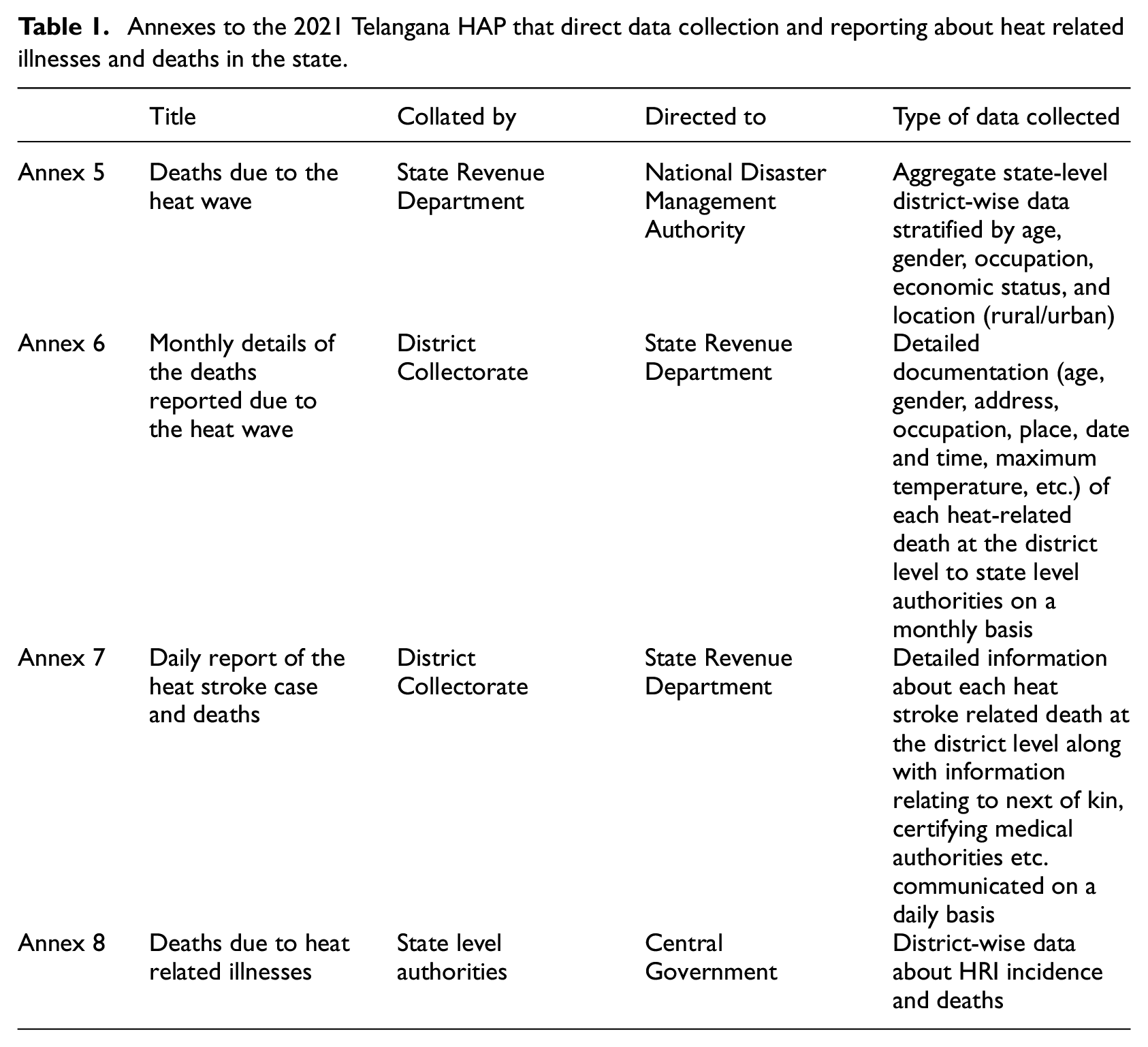
This focus directs data collection and reporting for HAPs. Telangana state’s HAP, for example, includes four templates for data collection, all documenting the incidence of heat related illnesses (HRIs) and deaths in the state (Table 1).
Annexes to the 2021 Telangana HAP that direct data collection and reporting about heat related illnesses and deaths in the state.
A disaster framing also shapes when HAPs direct action. For instance, the Telangana state HAP stipulates that a heat wave is declared on the second day when at least two meteorological subdivisions meet the criteria below on consecutive days: Following criteria is used to declare heat wave conditions prevailing:
(a) Based on Departure from Normal
• Heat Wave: Departure from normal is 4.5°C to 6.4°C
• Severe Heat Wave: Departure from normal is >6.4°C)
(b) Based on Actual Maximum Temperature (for plains only)
• Heat Wave: When actual maximum temperature >45°C
• Severe Heat Wave: When actual maximum temperature >47°C
Revenue (Disaster Management) Department, Government of Telangana (2021: 27)
While there may be some variations to the above criteria based on thermal and topographical profiles of particular places, all HAPs work by defining thresholds for when heat alerts should be issued (see Figure 1).
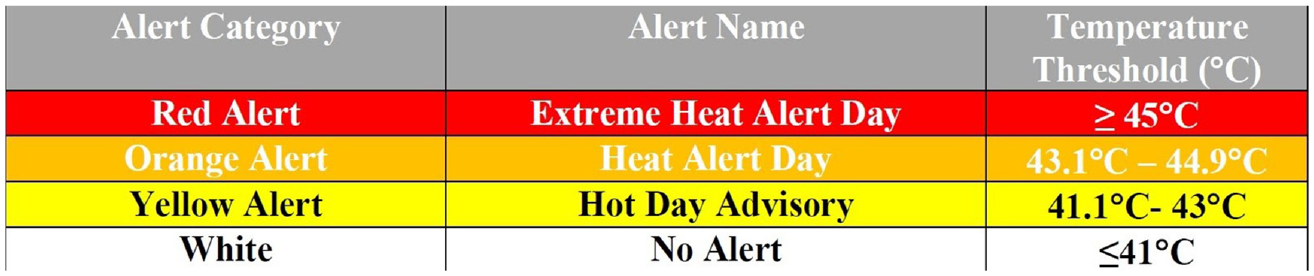
Temperature thresholds for issuing heat alerts as per the 2019 Ahmedabad HAP (Ahmedabad Municipal Corporation, 2019).
Each colour-coded alert level, in turn, defines responsibilities for various institutional actors (e.g. municipal administration, different government departments, civil society partners, emergency responders, health professionals and media professionals) in anticipation of the impending heat wave. These include, for example, ensuring water provision, opening cooling centres, shifting work hours to avoid undertaking physically strenuous work or prolonged exposure to heat during the hottest parts of the day, and continual media broadcasts regarding safety protocols during heat wave periods.
On a more expanded timescale as well, HAPs are articulated through a focus on discrete time periods. HAPs are operationalised over three distinct moments in time: ‘Pre-heat season’, ‘During heat event’ and ‘Post-heat season’. During the pre-heat season, attention is directed at reviewing preparedness, sensitisation of relevant stakeholders, and ensuring smooth communication and interaction across the different departments and institutions. In the case of heat events, a series of protocols (Figure 2) are activated that define roles and responsibilities for various actors and agencies. The post-season is dedicated to identifying successes and challenges for heat action planning within particular locations and HAPs as required based on this exercise. Over time, HAP protocols have been substantially refined, drawing newer stakeholders into heat planning and specifying their responsibilities in ever more detail. The current edition of the Telangana state HAP, for example, is over 100 pages long, of which 27 pages are used to detail actions to be undertaken over these three periods by different stakeholders.
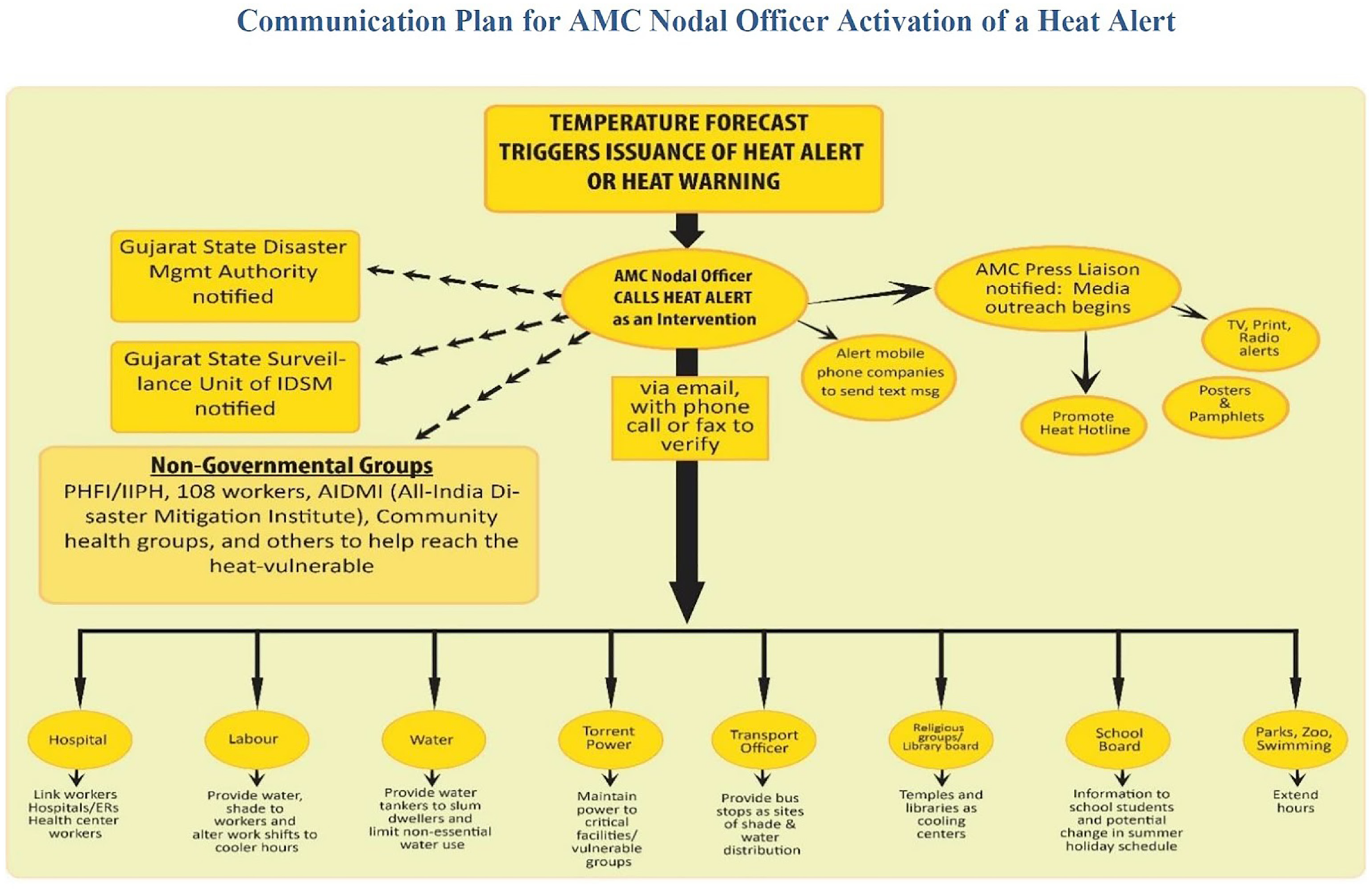
Flowchart depicting communication protocol outlined in the 2019 Ahmedabad HAP. All HAPs include some version, visual or textual, of a communication protocol similar to the one depicted in this image.
Heat and the ‘local’
If one characteristic of how HAPs stage thermal governance is by identifying extreme heat as disastrous, the ways in which HAPs conceptualise the ‘local’ is another. Here, we see that while normative approaches and evaluations of heat action planning across India continue to insist that ‘locally-developed plans are the most effective’ and that ‘one size does not fit all’ (cf. NRDC International: India, 2020), their proliferation nonetheless often appears to be little more than template-like wholesale reproduction of HAPs from one state, district or municipality to the other.
Consider, for example, how HAPs account for vulnerability. In the case of the Ahmedabad HAP, its developers outline a number of key characteristics of the city that are relevant from the perspective of conducting a Heat-Health Vulnerability Assessment: for example, the city’s rapid urbanisation, corresponding loss of green space, and consequent creation of Urban Heat Islands; differences in land use; availability of reliable public transportation between the more industrial Eastern part of the city and the more residential and commercial Western part; particular occupational and age groups that might be additionally vulnerable; as well as the nature of co-morbidities that residents of the city might be living with. What emerges from their discussion is a rich and multi-dimensional engagement with the local, which laid the groundwork for the development of the Ahmedabad HAP.
Yet, as the Ahmedabad template has travelled to other locations, attention to local geographies and political economies goes missing entirely. Instead, the principal mechanism through which India’s HAPs today appear to account for the ‘local’ is through the provision of statistics on mortality or morbidity. By overlaying heat-related mortality/morbidity statistics collected at the district level with temperature data, these documents present what are understood as ‘maps of vulnerability’. Figure 3 depicts this for the most recent HAP for the state of Telangana.
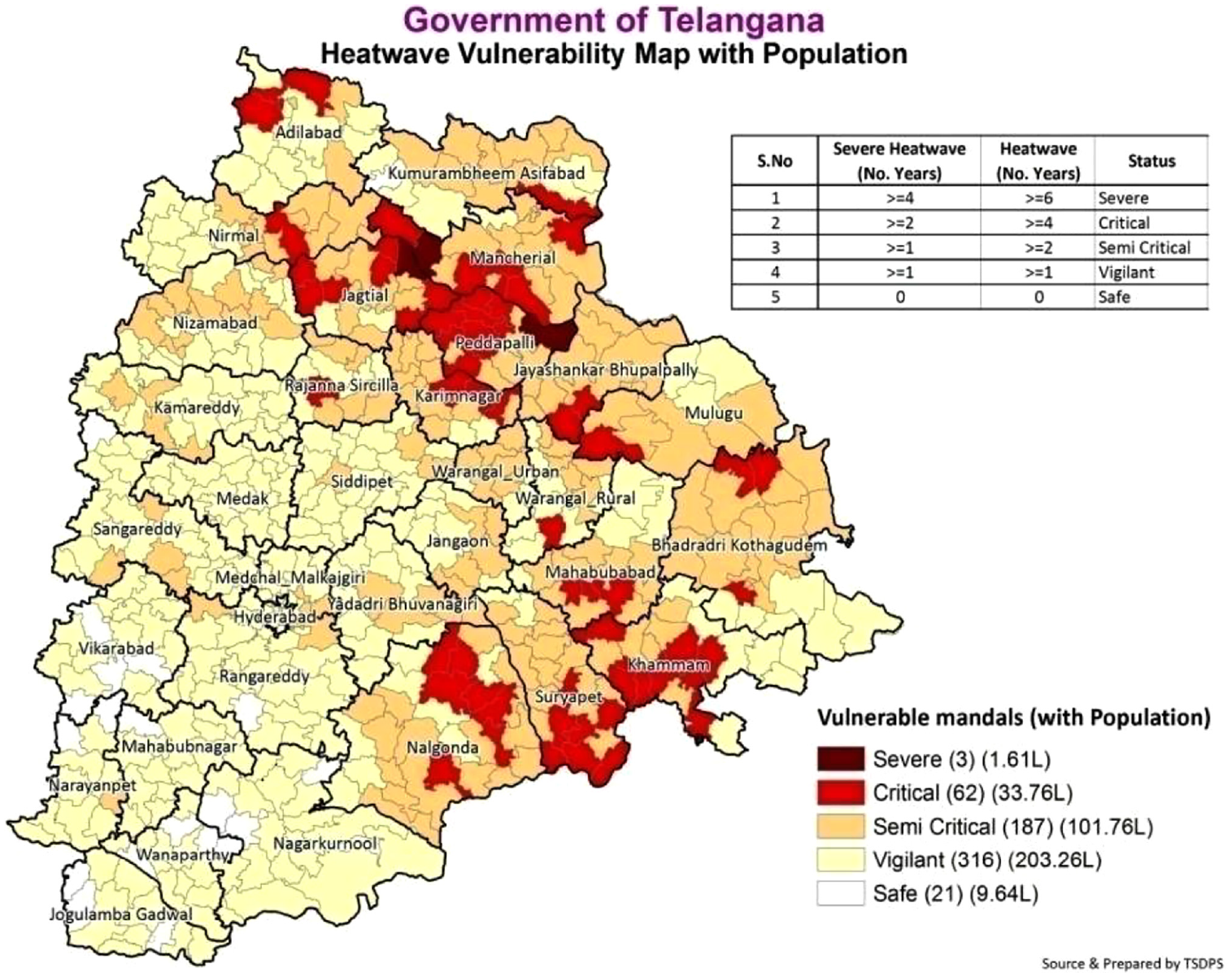
Heat wave Vulnerability Map in Telangana’s 2021 Heat Action Plan (Revenue (Disaster Management) Department, Government of Telangana, 2021: 27).
In some other instances, the local all but disappears from HAPs. In the HAP for Gorakhpur in the northern state of Uttar Pradesh, for example, the only allusion to the local is in the form of photographs of city scenes and charts that mobilise hues of red, orange, and yellow to unique effect (District Disaster Management Authority (DDMA), 2019). In addition, in the 20-page HAP for Hazaribagh in the east Indian state of Jharkhand, the city itself is only referenced once, on the title page. Within the text, the city exists only as a tabular category, the opposite of the rural; and the only social context is an amorphous, digital one: ‘social media’ (DDMA, 2016). And yet, all of these plans are anchored by references to the ‘local’ and ‘local data’.
Ironically, the loss of urban specificity that we see in subsequent HAPs, is testament to how successfully the Ahmedabad HAP has travelled, facilitated by its protagonists. For example, documents such as the City Resilience Toolkit, developed to facilitate heat action planning across locales, inadvertently belie the careful preparatory work involved in the making of the Ahmedabad HAP (Figure 4). The seven-step structure of the toolkit with accompanying checklists, instead facilitates the formulaic adoption of HAPs as bureaucratic tools for heat-health governance. Subsequent conversations with protagonists of the Ahmedabad group foreground another reason for the formulaic adoption of the HAP: mandates from India’s NDMA for vulnerable states to formulate their HAPs make no allowances for the kinds of preparatory work that were conducted in Ahmedabad. Thus, even though the Ahmedabad group has been successful in creating awareness and developing supporting resources for heat action planning, the institutionalisation of HAPs has not facilitated the availability of technical expertise and financial support also necessary for developing locally grounded HAPs.

Part of the checklist for developing a Heat Action Plan included in the City Resilience Toolkit developed by the Ahmedabad consortium.
Obfuscations in thermal governance
The modular dimensions of India’s HAPs that we have described above have important ramifications for thermal governance in the country. The modularity of these plans has facilitated their rapid and widespread adoption – at the level of the city and the state. Yet modularity also introduces new tensions and limits. We argue that the two most widely adopted modular elements – the framing of heat as a disaster and the framing of the local – have produced significant obfuscations that potentially undermine their efficacy as instruments of thermal governance. By institutionalising an understanding of heat waves as disasters, they shape knowledge about and action in relation to heat waves as time limited and urgent. Meanwhile, by engaging their geographies of concern very superficially, they reduce the identification of vulnerabilities to an overlaying of historical data about heat-related mortality/morbidity and temperatures. Our discussion here addresses each of these in turn.
The heat wave-as-disaster framing, of course, is not new. It characterises not just Indian HAPs, but also its antecedents in Australian and European contexts. And as the HAPs demonstrate, such attention to heat waves is important to delineate institutional strategies and communication protocols when heat waves strike. The invocation of disaster also allows for securing additional financial and institutional resources that can be crucial for better preparedness and recovery efforts. Yet, as much Disaster Studies scholarship now also underlines, and as we evidence in the case of Indian HAPs as well, a disaster framing fixates attention on discrete events (e.g. heat wave) delimited in time and space and minimising loss of life and property as the proper objects of governance and response (Fortun and Frickel, 2012; Tierney, 2007, 2012). This results in two key obfuscations.
The first is the time scales of disaster. As Fortun et al. (2017) point out in a recent review article, classic disaster research tended to define disaster and its effects as being delimited in time and space, impacting specific groups of people in ways that can be identified, calculated, and compensated. Locating disaster in this manner, they point out, has significant implications for how disaster operations are carried out, often privileging attention to disaster preparedness and recovery efforts animated by a perceived sense of urgency, and therefore, often overwhelmingly focusing on minimising loss of life and property (see also: Button, 2016; Hilgartner, 2007; Knowles, 2014). Contemporary disaster research argues that such understandings of disaster obfuscate the many ways in which the event reaches both forward and backward in time. Even while ‘natural’ hazards like earthquakes and hurricanes might manifest at a particular moment in time, conditions allowing them to assume disastrous proportions (including, e.g. how built space is configured, uneven access to healthcare services, and existing socio-economic disparities) have often been in place much longer. As much disaster research has also shown, people can experience the effects of disaster over extended periods of time (e.g. diminished physical capacities and compromised health) and even across generations (as in the case of radiation poisoning or exposure to toxins), instantiating what literature scholar Nixon (2011) famously described as ‘slow violence’. Rather than just the acute and spectacular nature of disaster, contemporary scholarship therefore also foregrounds critical attention to what has variously been called ‘slow’, ‘slow-onset’, ‘slow motion’ and ‘chronic’ disaster. In the case of HAPs, this spatio-temporal elision is evident, for example, in the lack of attention to ways in which thermal vulnerabilities themselves may be a product of long-standing historical inequalities or particular urban built forms. While HAPs articulate immediate responses to heat wave events, they leave intact larger structural conditions that configure how populations experience and cope with heat waves.
The second is knowledge about disaster. As Keller (2015) demonstrates in his work on the aftermath of the European heat wave as it played out in Paris, the focus on excess mortality during the 2003 heat wave resulted in positioning the elderly as ‘typical’ disaster victims. In effect, such profiling served to erase other risk factors causing heat illnesses and death, including poverty, addiction, mental illness, and poor housing. Keller demonstrates how such erasures shaped both medical and popular perceptions, whereby deaths among homeless populations and addicts during this period were readily attributed to their condition (of being homeless and/or addicts) while discounting the possibility that they may have been heat wave-related. This knowledge also shaped future policy, directing resource allocation for certain kinds of data collection and interventions targeting particular population groups understood as being vulnerable. Thus, to the extent that HAPs model vulnerability to heat waves through their data collection and reporting procedures, they also stand to further marginalise other groups that may also be susceptible to extreme heat. For Keller, one way to address this ‘murkiness of disaster epidemiology’ is for anecdotal evidence to complement the aggregate modelling of vulnerability on which it relies; however, data collection directed by Indian HAPs, as we have demonstrated in the previous section, does not readily accommodate data beyond those pertaining to incidence of heat related illnesses and fatalities.
Alongside the framing of heat waves as disasters, the erasure of local specificity from HAPs also presents significant challenges and limitations for thermal governance. A widely acknowledged criticism of current, standardised approaches to the management of population heat-health is that they are highly reductive (e.g. reducing vulnerability to absolute temperatures) and insufficiently attentive to specific socio-material contexts that shape human vulnerabilities (Shove et al., 2014; Starosielski, 2022). Whilst the Ahmedabad research group invested considerable effort and energy in accounting for place based contextual factors in the differential vulnerabilities of the city’s population to heat, this component of their study and its significance was lost as the group sought to promote and encourage the replication of heat action plans in other locations. In our analysis, place-based approaches to heat-health vulnerability represent an important module in India’s HAPs; a module that was important to the specific formulation of the Ahmedabad archetype but one that we have not seen replicated.
In effect, HAPs remain distant from the everyday realities of local practice – and politics – casting local geographies in highly idealised terms. The systems of communication and coordination that HAPs posit, for example, belie the degree to which collaborative action across agencies and stakeholders is stymied by bureaucratic inertia and limited institutional capacity. A frequent refrain in our research in Hyderabad, for example, has been that while disaster management authorities in India have readily mobilised around the need for heat action planning, public health authorities have not similarly responded to the seeming urgency that extreme heat presents. Given the realities of limited resources, addressing heat-health has not been a top priority for them.
Place-based studies that seek to establish the importance of contextual factors (from inter community social relationships; patterns of property ownership; and histories of access to grid-based infrastructures for water and electricity) present a critical input into heat action planning. From the vantage point of our research, the deeply contested nature of urban politics also remains invisible in HAPs. One index of this is that HAPs rarely engage with urban design. While they recognise that built form is a key factor in shaping urban thermal profiles, HAPs have no jurisdiction over – and indeed, do not engage (except in passing references) – the domain of urban planning. HAPs limit their attention to thermal mitigation and adaptation, leaving intact elite interests (e.g. the interests of industrialists and real estate developers) and structural inequalities that configure and regulate access to urban space. The only modification to the built form that HAPs champion is for the provisioning of ‘cool roofs’– applying reflective paint to roof tops so that buildings absorb less heat, thus staying cooler than they would have otherwise.
Other political dynamics also remain invisible in HAPs. While the Ahmedabad HAP was developed for deployment at the city-scale, it has been subsequently adapted for entire regions and states, with little consideration for what the implications of this expanded scale of action and its highly fragmented political authorities, might mean for heat action planning. Take again the case of Hyderabad, a city of more than nine million inhabitants, which is India’s fifth most populous city. Hyderabad has dramatically expanded both spatially and in terms of population since the 1990s, when it was first envisioned as a ‘world class’ city that would be developed as a global hub for information technology- and life sciences-based industries. Situated at one end of the Deccan plateau in south-central India, Hyderabad has historically experienced harsh summers under arid conditions; unchecked urban growth has rendered the city even more vulnerable to climate change driven extreme heat and rainfall events. Mindful of this, the state of Telangana, of which Hyderabad is the capital city, has developed its own HAP, now in its sixth edition (HAPs are typically updated on an annual basis). What we have found in our research, however, is that urban governance efforts in Hyderabad are thwarted by the limited political authority available to the city administration. While urban local bodies (ULBs) have been granted greater political standing via the 74th amendment of the Indian constitution, in practice, the political authority of cities is often undercut and usurped by state-level authorities through a variety of legislative manoeuvres. At the same time, decision-making authority in the city is also highly fragmented – the scaling and rescaling of the urban space at different moments in time have implied that there exists a great deal of confusion over which agency or department has jurisdiction over particular areas or functions within the city. As more places in India and elsewhere grapple with heat action planning, reconciling governance across scale will be a key challenge.
Formulating thermal governance from afar, ironically, also limits possibilities for responding to extreme heat: HAPs do not recognise the ingenuity and resourcefulness of urban populations and the many already existing pathways that they have innovated over time in order to achieve thermal comfort. The series of activities described in the second step of the City Resilience Toolkit, for example, includes the collection and analysis of historic temperature and mortality data across the city, the identification of intergovernmental and infrastructural capacities and vulnerabilities to heat, and the identification of vulnerable populations and health risks specific to each group. Here, the emphasis is entirely on ‘factors that increase vulnerability to heat waves’ rather than factors that might militate against vulnerability. ‘Adaptive capacity’ only features as a negative attribute; that is, as something that people do not have, rather than something that they might. This occlusion is perfectly encapsulated by the way that heat-health management strategies address the role of social networks or social connectivity and culture. Any reference to social connection describes its negation. One high profile summary of the work in Ahmedabad produced by the funding agency lists the factors that increase vulnerability to heat waves or ‘heat risk’. These include ‘social isolation’ and ‘cultural norms’. There is no mention of the factors, strategies, or cultural practices that might reduce vulnerability. Practices of communal gathering in shaded spaces during particularly hot parts of the day, the role of high population densities in low income neighbourhoods in effectively working against the social isolation that has been a key contributing factor in heat-related fatalities in Northern contexts (cf. Keller, 2015; Klinenberg, 2015), provision of drinking water by community-level actors and organisations, and the cultures of repair and maintenance that facilitate greater access to cooling and cooling technologies – all remain curiously absent from HAPs and related documents that elaborate official strategies of thermal governance. Indeed, in these documents, ‘adaptability’ or ‘adaptation’ to heat is something done by cities and urban governments, not people.
Conclusion: Southern articulations
In this article, we have described the rapid scaling up of modularised HAPs as a key feature of thermal governance in India. The pace at which HAPs have scaled up in India is indeed impressive, considering that coordinated mechanisms for pursuing climate governance have otherwise been slow to develop. We have further identified two key aspects of HAPs that have become strongly entrenched in the process: one, is the institutionalisation of an understanding of heat waves as disasters, and two, a loss of engagement with the social, political, and economic dynamics that constitute particular places. As a result of this, we argue that HAPs shape knowledge of and action in relation to extreme heat in very specific ways while leaving intact larger structural conditions and inequalities that characterise particular localities. Drawing on our ongoing research in Hyderabad, we also suggest that the messy, uneven, and contested nature of urban socio-politics is also largely invisible in HAPs.
Arguably, elisions of time and place matter across locations where thermal governance is imagined via instruments such as HAPs. The erasures that HAPs enact, however, are particularly striking when thinking about them in ‘southern’ contexts to which plans such as the Ahmedabad HAP describe themselves as responding to. Drawing on Simone and Pieterse (2018), Bhan (2019: 643) describes the ‘southern city’, as an empirical geography where, ‘the majority holds political, economic, spatial and ecological vulnerability’. In such contexts, Bhan notes a crucial paradox whereby infrastructural and governmental systems continue being formulated based on northern logics and experiences that are far removed from the everyday realities of life in the urban Global South. These systems function poorly, then, because they do not take as their starting point the everyday lives of the vast majority that comprises the urban Global South; neither do they take into account the ‘limited fiscal and human capacity and … incomplete administrative systems’ (Parnell and Pieterse, 2010: 150, quoted in Bhan, 2019: 643) that characterise the local state in such spaces.
Despite the extent of its preparatory work and its many nuances, the original Ahmedabad HAP does not begin from this southern vantage point or perspective but rather departs from and instantiates a distinctly northern logic. Building out from a southern perspective, HAPs developed for Indian cities would begin from a different place. Attending to how thermal comfort is achieved – or difficult to attain – and for whom would become a defining element of HAPs. Strategies and tactics of thermal adaptation elaborated over time in particular places – from dietary practices to clothing habits, to adaptations of built spaces, to social practices of gathering in relatively cool spaces and communal distribution of drinking water – would be recognised as integral to the formulation of HAPs. As would the already existing institutional arrangements between state, civil society, and community-based actors – not as idealised flows of information and action from state to society operating independently of their contexts, but rather as mechanisms that actualise and strengthen the capacity of the urban fabric to respond to heat-induced disruptions. While existing HAPs represent important first steps in drawing attention to the problem that is extreme heat and the need for sustained and effective interagency coordination, an important next step is for them to deepen their engagements with the contexts in which they seek to intervene.
Footnotes
Acknowledgements
We gratefully acknowledge inputs from participants at the workshop, ‘Heat in Urban Asia: Past, Present, and Future’, hosted by the Asia Research Institute, National University of Singapore in April 2021, funded by the Ministry of Education (Singapore) Academic Research Fund, Tier 2 Grant, MOE2018-T2-2-120, where an early version of this paper was presented. We are grateful to the three anonymous peer reviewers of this manuscript for Urban Studies, who pushed us to articulate our core conceptual argument as positing the replication of HAPs as an interplay between scale and modularity. Finally, for their editorial guidance and support, we thank Gregory Clancey, Jiat Hwee Chang, and Simon Marvin, the editors of the special issue on ‘Heat and the City: Thermal Control, Governance and Health in Urban Asia’, in which this article is being published.
Declaration of conflicting interests
The author(s) declared no potential conflicts of interest with respect to the research, authorship, and/or publication of this article.
Funding
The author(s) disclosed receipt of the following financial support for the research, authorship, and/or publication of this article: Research for this manuscript was supported by funding from the Economic and Social Research Council’s (ESRC), UK Grand Challenges Research Fund (GCRF) for the project, Cool Infrastructures: Life with Heat in the Off-Grid City (Award No: ES/T008091/1).
