



Abstract
Global capital and highly-skilled international labour are sought by cities for economic growth. Much research has been about Western cities, but less is known about how pro-growth developmental Asian countries, which have become key global hubs, organise their urban planning and policy efforts to gain global capital and skilled labour in their cities. In Singapore, the state is active in reshaping the city into a ‘cosmopolitan grid’ by planning and developing new urban amenity spaces that can attract human capital to fuel the desired urban growth, such as international schools, private housing options, and access to a global selection of goods and services. Oftentimes, the socio-cultural and socio-spatial changes at the neighbourhood level are seemingly ignored, despite the significance of the neighbourhood as a critical social space for the daily practice and formation of social relations in demographically diverse cities. Drawing on cognitive mapping interviews with foreign-born and native-born residents in two upper-middle income suburban neighbourhoods in Singapore, which are recognised as the heartlands of the native-born but have become popular with highly-skilled foreign-born families (namely Western expatriates) in the last decade, this article shows how the top-down rational production of cosmopolitan space by the state framed in a formation of the ‘cosmopolitan grid’ has played out and shaped the everyday production of social space among the native and foreign-born residents which determines the experience and opportunities for integration in this city-state.
Introduction
As cities develop new infrastructure and amenities to compete globally to attract highly-skilled labour and creative knowledge-workers to reside in them, the neighbourhood space becomes a frontier space of global inter-city competition and cosmopolitan aspirations (Beckers and Boschman, 2019; Florida, 2003, 2008; Glaeser and Saiz, 2003). From Amsterdam to Dubai to Singapore, highly-skilled workers compare goods and services that these cities provide before deciding on relocation (Musterd et al., 2016; Van Riemsdijk and Wang, 2017). Employment advancement, quality of educational opportunities for children, housing options, public transportation, shopping spaces, and the safety of residential neighbourhoods are fundamental requirements (Levkovich and Rouwendal, 2016). Urban neighbourhoods have therefore become key sites of economic growth and diversity negotiation, and as Appadurai (1996) wrote, a project of the nation-state.
The (re)production of urban space guided by economic pragmatism introduces new relations between social and cultural groups, new rhythms of daily life, new palpable ways of interaction among residents (Albrechts and Mandelbaum, 2005; Langegger, 2016; Sandercock, 2000). What used to be banal and ‘ordinary’ live–work–play neighbourhood spaces have become infrastructural commodities in the international labour marketplace (Atkinson and Bridge, 2005; Beaverstock, 2011; Chan, 2019). 1 As a new society of highly-skilled foreign elites of different origins arrive and settle in neighbourhoods, which have traditionally been resided in by mostly native-born residents, 2 urban neighbourhoods become giant contact zones ‘where cultures meet, clash, and grapple with each other’ (Pratt, 1991: 34) and the ideals of cosmopolitanism as acceptance of differences showing humility and empathy for others per Appiah (2006) and Beck (2006) are being worked out daily. New lines of tension may emerge, while existing ones are accentuated in neighbourhoods as groups of global and local actors negotiate their different spatial needs and social practices, in order to avoid collision and maintain coexistence. In these spaces of urban change and diversification, one can also expect multiple and divergent ways of place belonging (e.g. Chan, 2022; Fenster, 2004; Savage et al., 2005). 3
Thus, we can expect ‘friction’ in the global flow of talents across cultural, social, and economic borders (Tsing, 2005), particularly in urban spaces where state-led efforts of redevelopment have injected new demographics. However, the effect of socio-cultural changes on the formation of everyday social space in the urban neighbourhood arising from economic-driven urban developments is oftentimes seemingly par for the course.
Through the study of two upper-middle income neighbourhoods in Singapore, a developmental Southeast Asian city-state with a proactive stance in talent recruitment and efficient state-led urban redevelopment, this article discusses the socio-spatial effects of economic globalisation ambitions on the negotiation and formation of everyday urban social space. It draws on Lefebvre’s ([1974] 1991) conceptualisation of the production of social space as an ongoing dialectical interaction between spatial practices of inhabitants (perceived space), mental and abstract representations by experts via plans and maps (conceived space), and the experiences and symbolic meanings of inhabitants (lived space) (Schmid, 2022).
This paper takes Lefebvre’s theory further by interpreting conceived space as not limited to experts’ depictions but including residents’ mental representations of the neighbourhood. Lynch’s (1960) cognitive mapping method and his writings about the elements of environmental imageability are used here to collect and discuss residents’ cognitive maps of their neighbourhood space, and in what ways they are collectively shared. These maps are also embedded with both practical and emotional meanings that offer a glimpse into how residents perceive the neighbourhood space through their daily use and the contours of their lived experiences of social memories and interactions. Together, these perceptions and experiences can in turn affect how the neighbourhood is mentally conceived by residents, which would inform how future planning of the area is undertaken by experts and the government in cities where more democratic participation in planning is sought. The combined Lefebvre–Lynch method enables an analysis of the everyday production of urban space as an interaction of scales between the grand state-expert’s strategic gaze and the neighbourhood residents’ tactical gaze of everyday life, to offer new insights into the relationship between urban planning, economic development, and contemporary immigration in the context of an Asian city (e.g. Glick Schiller and Çağlar, 2011; Sandercock, 2003).
In addition, the paper’s discussion about the socio-spatial imprints of the highly-skilled Western foreign-born in Singapore builds on the rich findings about global labour immigration in Asian cities (e.g. Yeoh and Huang, 2011; Yeoh and Lam, 2016) – and it does so by offering a new perspective about the relational dynamics they bring to the formation of social space in the urban neighbourhoods where they live. Previous writings have focused on employment and workplace (Camenisch and Suter, 2019; Cranston, 2016; Lan, 2011; Meier, 2016) or recreation spaces (Beaverstock, 2011; Chang, 1995). Further, this paper’s discussion adds to the writings on Whiteness in the race relations of post-colonial multi-racial Singapore (Cranston and Lloyd, 2019; Hof, 2021) through elucidating our findings of how highly-skilled White foreign-born neighbours are perceived by native-born Singaporean residents, and how White populations settle and find place belonging in an Asian city. It adds an interesting perspective as White Western populations are assumed to be socio-economically privileged as expatriates and the ‘cultural other’ such that there are no societal expectations for them to integrate, unlike that which is expected of the foreign Chinese and Indian populations. In this way, their presence is also seen by most as institutionally and socially ‘unproblematic’ with little attention being paid to their settlement experiences, particularly vis-à-vis native-born populations. Finally, the empirical findings of this article illustrate how diversity is negotiated in private housing neighbourhoods among socio-economically matched and privileged households, where Singapore’s Ethnic Integration Policy measures and Singapore Permanent Resident Quota do not apply, and where there are fewer state-planned spatial imperatives for social integration such as community clubs and programmes. 4 The findings supplement what we know about everyday multiculturalism practices in public housing in Singapore where these policies apply, and ethnic and nationality mix is tightly managed through a group quota that reflects the overall national ethnic composition of the three major groups – Chinese, Malay, and Indian (e.g. Leong et al., 2020; Wise and Velayutham, 2014).
Production of the ‘cosmopolitan grid’: Immigration, race, infrastructure, and planning
The rise of cosmopolitanism as an ideal and as imagery began in Singapore in the late 1990s when the ambition to become a global city was made clear (Clark, 2019; Yeoh, 2004). In the 1999 National Day Rally Speech, the former Prime Minister of Singapore, Mr. Goh Chok Tong made an explicit statement of the city-state’s vision to be a ‘first world economy and world-class home’ (National Archives Singapore, 1999). In this speech, Mr. Goh outlined his eponymous bifurcated social categories emerging from globalisation in Singapore: highly-skilled foreign elites, described as ‘cosmopolitans’, with an international outlook and commanding high incomes because their skills were in demand by the global market, and the less skilled ‘heartlanders’ whose ‘orientation and interests are local rather than international’ and ‘their skills were not marketable beyond Singapore’ (National Archives Singapore, 1999). 5 To be clear, the drive towards making Singapore a global city attractive to cosmopolitans had the twin goal of making a city which heartlanders would be proud to call home (Yeoh and Chang, 2001). Thus, the systematic pursuit of pro-talent migration policies for highly-skilled labour accompanied the state’s high investment in infrastructural development to build Singapore into a city of world-class living standards (Huang, 2013).
Between 2000 and 2013, Singapore’s population rapidly grew from 3.9 million to over 5 million through immigration, driven by the desire to become a global hub of influential cosmopolitans. Through its pro-talent migration policies for highly-skilled labour 6 and intensive infrastructure development which required low-wage foreign workers for construction (Yeoh, 2006, 2013; Yeoh and Lam, 2016), the foreign-born population nearly doubled from 24% to 43% of the total population between 1990 and 2020 (5.85 million inhabitants) (United Nations Population Division, 2020), of which 475,000 residents are highly-skilled foreign elites and foreign-born dependents (National Population and Talent Division Prime Minister’s Office, 2020). 7
It was assumed that peaceful co-existence would automatically emerge from the ethos of survival pragmatism in this multi-racial postcolonial city-state with an accepted status quo of a majority ethnic Chinese, and two minority ethnic Malay and Indian populations, particularly if the foreign-born talent and workers shared similar ethnic origins to the native-born. As such, little attention was paid to what co-existence and interactions with newcomers would be like spatially and socially, until the public backlash against high immigration growth erupted in 2013, when the White Paper on Population outlined the state’s plan to grow population to 6.9 million by 2030 chiefly by immigration. More foreigners meant stiffer job competition for high wage jobs, further population densification, and a disregard for the daily concerns of the heartlanders in favour of the economic growth promised by highly-skilled cosmopolitans.
The public outcry was largely levelled against further immigration from China and India which juxtaposed awkwardly with the silence regarding the Western White foreign-born. Beyond its smaller population, the silence manifested an implicit ‘White privilege’ of invisibility and the less questioned perception of skill superiority that accompanies Whiteness (Hof, 2021) in a city that continues to carry the imprints of its British colonial past (Chan, 2019). However, as the research finding would show later, this social norm is no longer a given as the Covid-19 pandemic between 2020 and 2022 unleashed yet another strong wave of anti-foreigner sentiments arising from job competition among the native-born and foreign-born skilled labour. In fact, ‘White privilege’ seemed to be waning during the pandemic when numerous White Western foreign-born were charged and deported from Singapore for ignoring lockdown rules.
Infrastructural investment to make Singapore a city and home for ‘upward cosmopolitanism’ (Yeoh, 2013) meant that the planning and development of physical space continued undeterred by the growing complexities of immigration relations. New metro lines and stations, international schools, private condominiums designed in contemporary style architecture, international food and retail offerings were systematically conceived and expanded further beyond the city’s core and into the heartland suburbs. This move dually increased the educational and rental opportunities for the foreign highly-skilled elites, whose access to subsidised local schools and public housing are restricted by state regulations, as well as making Singapore attractive as a home for heartlanders. Within a span of two decades (2003–2023), four new metro lines radiating from and circling the outer core of the city centre were completed. 8 See Figures 1 and 2.
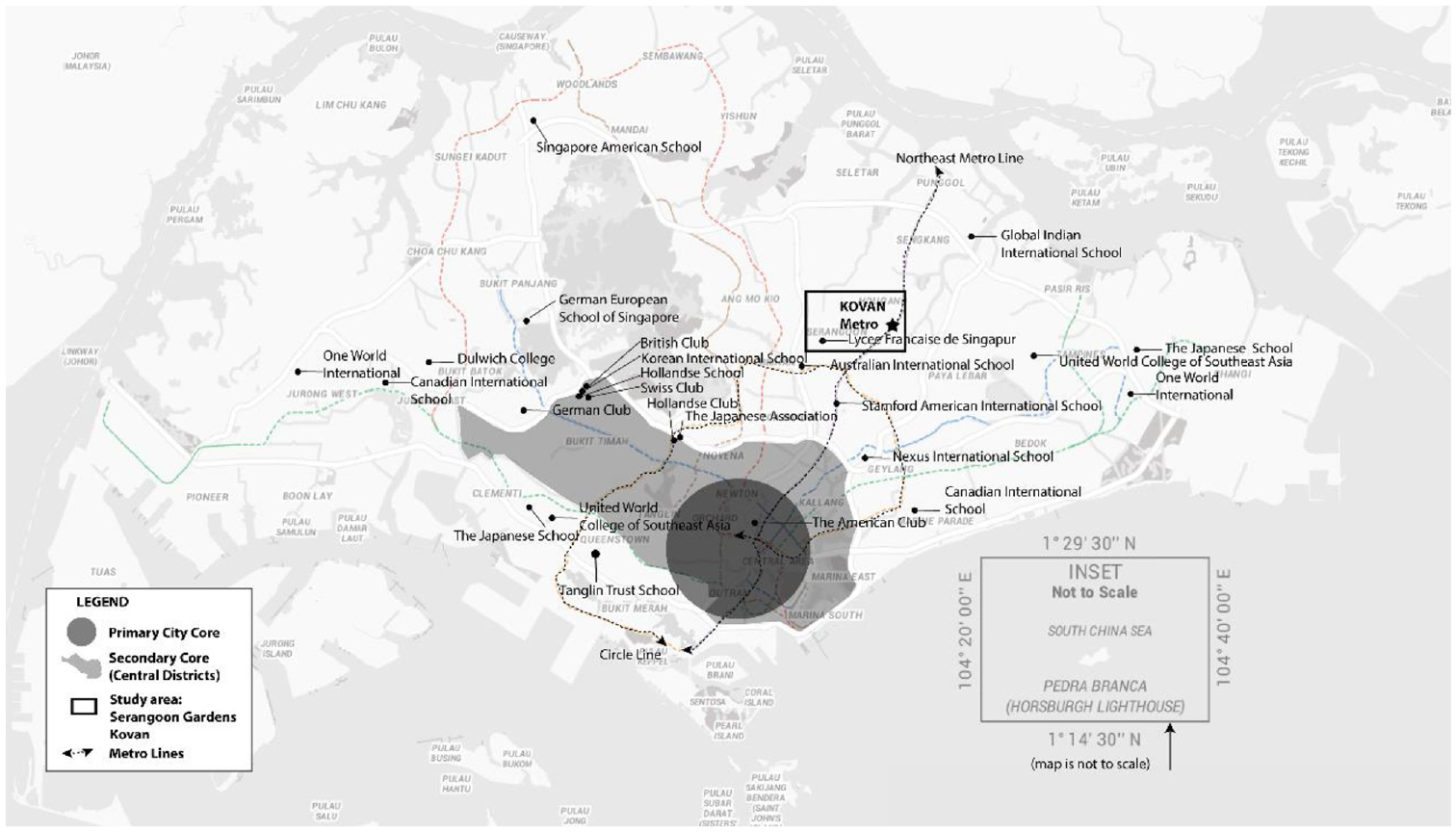
Geography of major international schools and social clubs of the expatriates in Singapore.
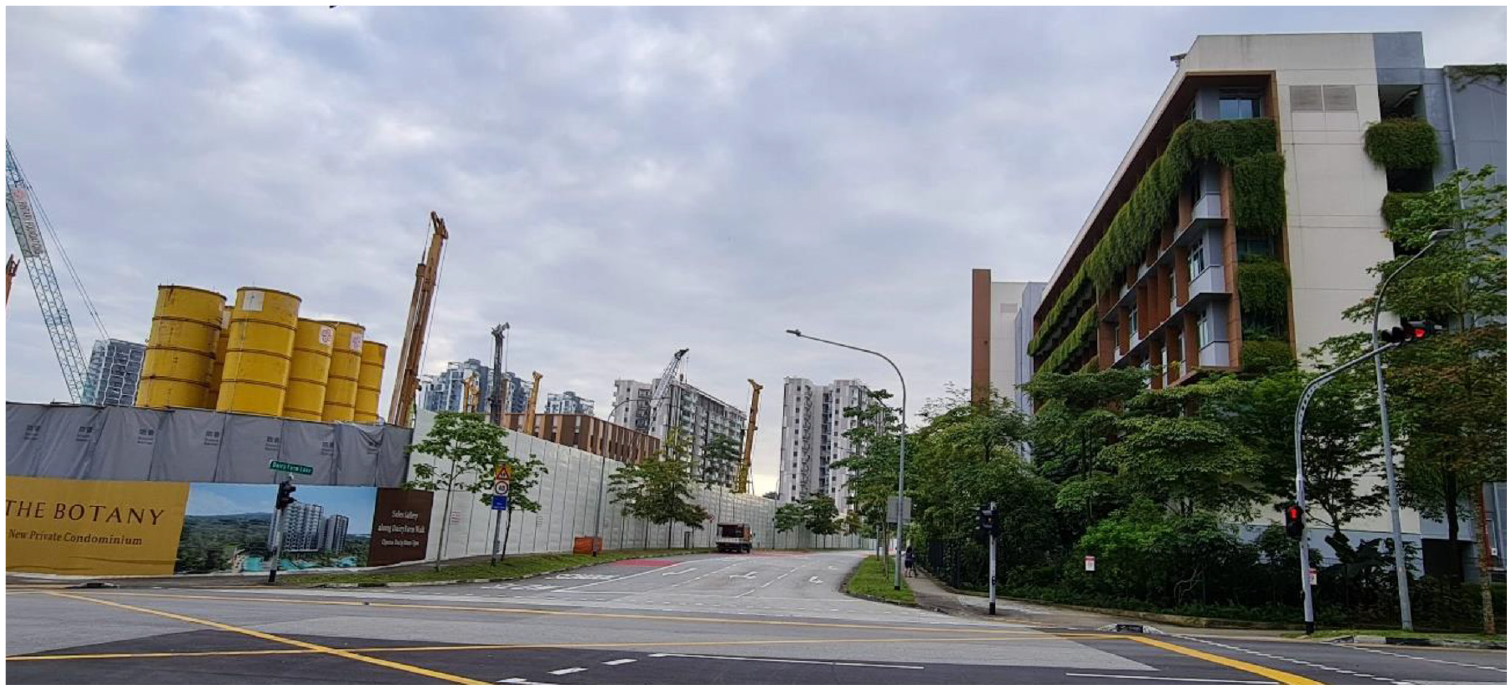
The new campus of the German European School of Singapore in Upper Bukit Timah area opened its doors in 2018 and is now surrounded by five new condominium complexes built in the last decade, while a new complex is currently being developed across the road.
The infrastructural expansion resulted in a redistribution of the highly-skilled foreign-born population from the enclaves traditionally popular with expatriates (particularly White Western expatriates) in and around the city core (Chang, 1995), further into the heartlands largely associated with the everyday space of the local, non-White population. Like the grid, which was a space structuring device to order economic expansion and steer urban development in New York City and Amsterdam in the 1800s by increasing predictability and stability for investors (Kostof, [1991] 1999), so too was the case in Singapore’s highly-orchestrated strategic production of cosmopolitan space by the state. This ‘cosmopolitan grid’ opens up new contact zones in the city because it tampers with the global–local cultural divide by enlarging the comfort zone beyond the city centre and traditional expatriate enclaves for highly-skilled foreign elites to live in the city-state (Chan, 2019). In parallel with the expansion of the grid, the income levels among the native-born have also increased so that opportunities to own and live in private condominiums among different foreign nationalities and ethnicities have likewise grown. Thus, the growth of private residential opportunities created by the grid further intensifies contact and introduces a new form of intergroup dynamics beyond the conventional Chinese–Malay–Indian–Others (CMIO) inter-racial intercourse in multicultural Singapore.
The ‘cosmopolitan grid’ is therefore a metaphorical reference to a new socio-spatial form conceived by the state that restructures the spatial fabric of the city and reconfigures its social contours according to the state’s cosmopolitan aspirations. The reference is also meant to be provocative of the kind of cosmopolitanism within the grid that is enabled but also unwittingly disabled as encounters between the foreign-born and local residents become necessary and frequent, and differences are palpably experienced more than ever, therefore generating a new discourse of integration as the socio-spatial geography of intergroup relations shifts. Through a Lefebvrian lens, the ‘cosmopolitan grid’ is thus a conceived space of the state that dialectically interacts with the perceived and lived space of residents in the neighbourhoods to shape social relations, spatial practices, and lived experiences.
Methodology
We undertook in-depth interviews with various stakeholders including municipal officers working in land use and spatial planning, economic development, and talent immigration (such as a representative from the Human Capital department of Singapore’s Economic Development Board [EDB]), international school principals, and semi-structured cognitive mapping interviews with thirty-three residents of foreign and native origins from two suburban neighbourhoods (Serangoon Gardens and Kovan). Twenty-four native-born (vernacularly referred to as ‘locals’) and nine foreign-born residents (most of whom come from France) were interviewed in their homes or neighbourhood cafes. 9 Each of these in-depth interviews lasted between one to two hours. In addition, we conducted participant observations and multiple ethnographic interviews with shopkeepers, visitors, and international school parents in the two neighbourhoods as part of the reconnaissance of understanding the spatial practices and rhythms between 2017 and 2018, before the interviews with residents were conducted between 2019 and 2020, first in Serangoon Gardens and then Kovan. Between 2020 and 2022, participant observation continued as one author regularly visited the neighbourhoods to see her parents. Such observation provides an avenue for the researcher to immerse in the research environment for a first-hand experience of various dimensions in and out of the setting, such as social behaviour, interactions and relationships as well as spatial, locational and temporal dimensions (Mason, 2002). This allowed us to better understand the social interactions, and routines of residents living in the neighbourhood.
The majority of the native-born participants are long-term homeowners who have lived in the neighbourhoods for at least a decade, with those in Serangoon Gardens arriving in the 1950s, 1990s, and 2000s, and in Kovan, from the 1980s through to the 2010s. In contrast, the foreign-born participants (mostly French) are tenants with an average residency length of about three years, and for whom the recent decade had included multiple relocations across Europe and Asia. In both neighbourhoods, we asked participants during the interview to draw the boundary of their neighbourhood on a Google Street Map and make a sketch of their neighbourhood to understand the conceived space of the neighbourhoods according to residents. Cognitive maps are used to study social position and social distance through the investigation of meanings that people associate with places (Garrido, 2013). Participants are then asked questions about these images and their perceived space of routines, lived space of experiences of social interaction and emotions of belonging in the neighbourhoods.
Upon reflection, our experience of the fieldwork, a process of ground-truthing in itself, hinted at the presence of ‘parallel lives’ (Cantle, 2005) that are at work between the native-born and foreign-born residents. As two female native-born ethnic Chinese researchers, our access to interview native-born residents was much easier through personal social networks and snowball sampling. In Serangoon Gardens where residents are better socially organised, some of the native-born residents were also accessed through social media, such as Facebook groups. We encountered greater difficulties accessing foreign-born participants for this study as we did not have personal contacts and, to our knowledge, they were not part of the Facebook groups we relied on in Serangoon Gardens. Access to these participants predominantly relied on phenotypical identification in public places and approaching them as strangers. Thereafter, we would use snowball sampling to gain access to a few more participants. This presents clear limitations on the representativeness of the sample pool of foreign-born resident populations. Furthermore, access to interviewing foreign-born elites in Kovan was severely hampered by the multiple Covid-19 pandemic lockdowns in 2020, and we were only able to interview three participants. Many highly-skilled foreign elites were also facing work contract termination due to the pandemic disruption.
Seeing like a state: 10 International schools in the ‘cosmopolitan grid’
A key amenity of the ‘cosmopolitan grid’ in Singapore is the coordinated relocation of old international schools outside the city centre to bigger and newer campuses, and an increase in the number of new international schools distributed across the city. Between 1990 and 2020, the number of international schools increased 2.5 times from 24 to 60. The sharpest growth in the number of international schools was between 2010 and 2019 when 20 new international schools were added within a decade. This growth phenomenon mirrored a larger worldwide surge of international English-language schools from 1000 to 8000 schools between 1997 and 2017 (Wechsler, 2017).
The expansion of international schools has been dramatic, deliberate and coordinated, and it forms a critical part of producing the ‘cosmopolitan grid’ in Singapore. In the interview with a representative from Singapore’s EDB, a state agency with a strong mandate to compete and secure foreign capital and labour to make Singapore a thriving business hub, the officer emphasised that foreign talents care about three things: career prospects, employment opportunities for their spouses, and the access to good education for their children. Thus, an international school is conceived by the state as ‘necessary infrastructure’ for economic development. This view was uncannily echoed by an international school principal who saw the role of his school fulfilling this mandate: ‘We provide the infrastructure for foreign businesses to locate in Singapore’.
The rapid expansion of the ‘cosmopolitan grid’ via international schools premised on economic growth is not only numerical but geographically, economically, and socially salient, as it has redefined the use and exchange values of neighbourhoods (Logan and Molotch, 1987). Coordinated strategic spatial planning expanded international schools in the heartlands as a pragmatic land use decision by the state to relocate and redistribute low density uses from the city centre to the peripheries due to the rising land values in the centre. In doing so, international schools, which are recognised as urban development catalysts, bring highly-skilled foreign elite tenants who are willing to pay high rents into suburban residential neighbourhoods to be close to the international schools. Thus, heartland neighbourhoods become ever more incorporated into the exchange values determined by the centre, while their use values change with the new land use and residents. Experiences from other cities have also demonstrated that the presence of foreign-born elites can gentrify and accentuate social changes in urban neighbourhoods despite their temporary residence (e.g. Butler and Lees, 2006; Hayes and Zaban, 2020).
The heightened exchange values that international schools catalysed in their surroundings have socio-spatial implications for the city and its neighbourhoods. Since the beginning of British colonialism in the 1800s, the city centre has always been perceived as the international cosmopolitan space where the foreign-born live, work and play; suburbs were the heartlands of public housing and the local life where foreign presence was not ‘commonplace’ (Wessendorf, 2014). The establishment of international schools in the heartlands began with the relocation of the Singapore American School to the predominantly public housing northern suburb of Woodlands in 1996, which resulted in American families setting up homes in the single-family houses, reconfiguring spatial practices and social events and turning the area around the school into ‘Little America’ (Chan, 2019). In 1999, Lycée Francais de Singapur relocated to Serangoon Gardens – a northeastern suburb, followed by the Australian International School in 2003 to nearby Lorong Chuan, and respectively in 2017 and 2018, new campuses of the Global Indian International School and the Stamford American International School also opened in the northeast.
Ever since the political backlash against foreign immigration in 2013, the production of the ‘cosmopolitan grid’ has taken a mindful, socially-inclusionary approach. As a municipal officer emphasised, state agencies are mindful about decisions regarding international schools because ‘once there, it will be there for a long time’ so the commitment must be ‘a no-regret kind.’
From the interviews, officers spoke about planning and designing international schools to minimise them becoming foreign cultural enclaves. This integration rhetoric was apparently never formalised, but was a mandate tacitly shared by government agencies. Integration was viewed largely through physical and visual interventions although its concerns were social and political. For example, planners told us that they sought to avoid the concentration of international schools in any particular neighbourhoods by searching for sites across the city to ensure even distribution, although it was getting harder with each new development due to the scarcity of vacant land in the 720-square-kilometre island state.
In a separate interview with an international school operator, he recounted that during his negotiation with state agencies about a new international school site in early 2010s, officers emphasised integration with the surroundings. The operator was told that the school should not be disconnected from its physical and social context. In fact, the design of the school building was carefully vetted to ensure its physical integration with its surroundings. In addition, international schools like other local ones are now required to build their sport facilities to enable easy sharing and access by neighbourhood residents. Further, international schools are discouraged from relying on private buses to avoid generating congestion in the neighbourhood, such as in the case of the Singapore American School where a long train of school buses lined the local roads daily. As such, a key criterion for international school is to encourage students to commute on public transport.
Everyday production of social space in the heartlands
Over the last two decades, the northeast suburbs of Singapore have been steadily incorporated into the grand expansion of the ‘cosmopolitan grid’ with four newly-built international schools, new condominiums, two new metro lines (Northeast Line and Circle Line), and many new malls and cafes. See Figure 1. Since the 2000s, the two adjacent but distinct upper-middle income neighbourhoods of Serangoon Gardens and Kovan with single-family homes and condominiums have seen an influx of new highly-skilled foreign elite families, many of whom have moved into the area for their proximity to the four big international schools. Although both neighbourhoods share many traits, the imprints of the ‘cosmopolitan grid’ are differently manifested and experienced by its residents.
Conceived space of the neighbourhoods: Structure, identity and meaning
Serangoon Gardens
Conceived as a planned neighbourhood of single-family homes with front yards lining the streets and a commercial area at the centre that services its residents, Serangoon Gardens was originally designed as a settlement for British, Australian, and New Zealand servicemen and their families in the early 1950s when Singapore was still under British colonial rule (Remember Singapore, 2012; Toh, 2013). From its beginning, Serangoon Gardens – or as it is vernacularly known ‘Ang Sar Lee’ (referring to the red tiled roof houses in local dialect) – was distinctive with a traffic roundabout and its streets named after places in the United Kingdom. In the late 1950s, when Wendy Mun (a resident now in her late 60s, pseudonyms are used for all interviewees) first moved to Serangoon Gardens with her parents, she recalled the uniqueness of the neighbourhood: It was totally new, we were the first and I remember the roads were not even paved: nothing was done, no roads, no fencing, no gates, because it was done the British style. They don’t have fencing and gates; they don’t lock their doors; it is just left open. This is very different from the rest of Singapore.
Over the decades, the spatial structure of Serangoon Gardens has remained largely unchanged, with the exception of the construction of the Lycée Francais de Singapur and a handful of infill developments within its borders.
Kovan
In contrast, Kovan’s origins were characterised by organic growth from multiple kampungs (which means villages in Malay) set in a landscape of rubber plantations. In fact, the neighbourhood was well-known among cab drivers for being a maze of nondescript streets. Unlike Serangoon Gardens, there was no conceived land use zoning, regular parcel sizes, or rational street layout. Instead of red-tiled roofs, houses had zinc-roofs typical of the informal housing that dotted Singapore at one time. Street names reflected an eclectic group of famous merchants and landowners of Chinese, Eurasian, Malay, and British descent. Its location was its place identity as reflected in its old name ‘La gou jio’ referring to its location as the six miles marker from the city centre. As part of the expansion of the ‘cosmopolitan grid’ in the early 2000s, the name ‘Kovan’ emerged with the arrival of a new metro line station in the neighbourhood, taking after one of the many nearby street names. These physical changes transformed Kovan’s identity from a remote heartland suburb into one with international gloss. According to Roland Lee, a native-born resident in his 20s: When I first moved in, there was no Circle Line and there was no Nex Mall. This rather small mall called Heartland Mall was the most significant thing in my neighbourhood and there was really nothing to do… If I wanted to be more accessible to humans and life, I needed to go closer to town. Over the years, we have new malls, new condos and nowadays, we have trendy cafes, Thai food and more eateries.
Analysis of the residents’ conceived space
Analysing the cognitive maps, native-born and foreign-born residents in Serangoon Gardens drew similar sketches of the neighbourhood. A recurring landmark element was the imageable Serangoon Circus traffic roundabout, which formed the centre of their drawings. In addition, drawings included shops and amenities that encircled the roundabout and single-family homes lining both sides of a neighbourhood street. Participants were also able to mark out the locations of their favourite shops and eating places. Further, residents of different nationalities, residency length, and ages conceived Serangoon Gardens with a common set of boundaries. Residents used similar adjectives to describe the identity and lived space in Serangoon Gardens as ‘cosy’, ‘village’, ‘quiet’, and ‘comfortable’ (see Figure 3).
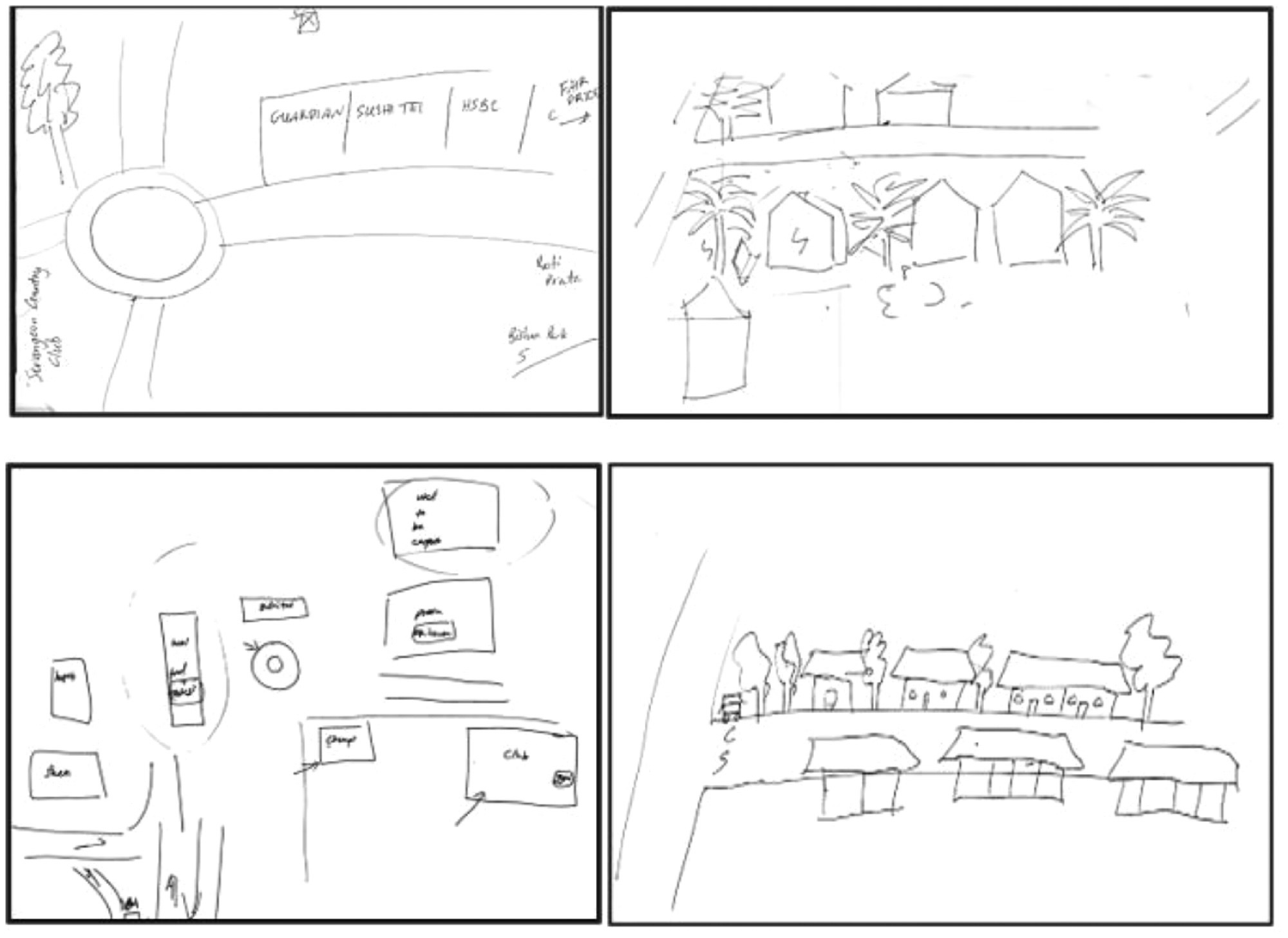
Maps of Serangoon Gardens. Top: a shorter-term Canadian resident in her 50s with a seven-year residency (left) and a French resident in her 30s with a two-year residency (right). Bottom: Long-term residents from Singapore: a resident in his 20s with 10 years’ residency (left) and a resident in her late 60s with 60 years’ residency (right).
In contrast, residents in Kovan did not share a common set of neighbourhood boundaries. Depending on where the participants lived and how familiar they were with the residential streets, the neighbourhood boundaries would differ. In fact, many residents drew two sets of boundaries: one set of boundaries that marked the immediate area surrounding their homes and another of the familiar places they frequented in and around Kovan. Most of their drawings had no recurrent central landmark, except for the Kovan metro station and the major arterial Upper Serangoon Road in sketches drawn by the native-born and foreign-born newcomers. Most other long-term residents’ sketches were abstract with few to no street markings but were composed of familiar places and commercial retail amenities. The conceived space of Kovan residents is like an image of a slice of Swiss cheese with holes and gaps of information in between the elements, structured mostly by practical routines around different commercial and retail amenities (see Figure 4).
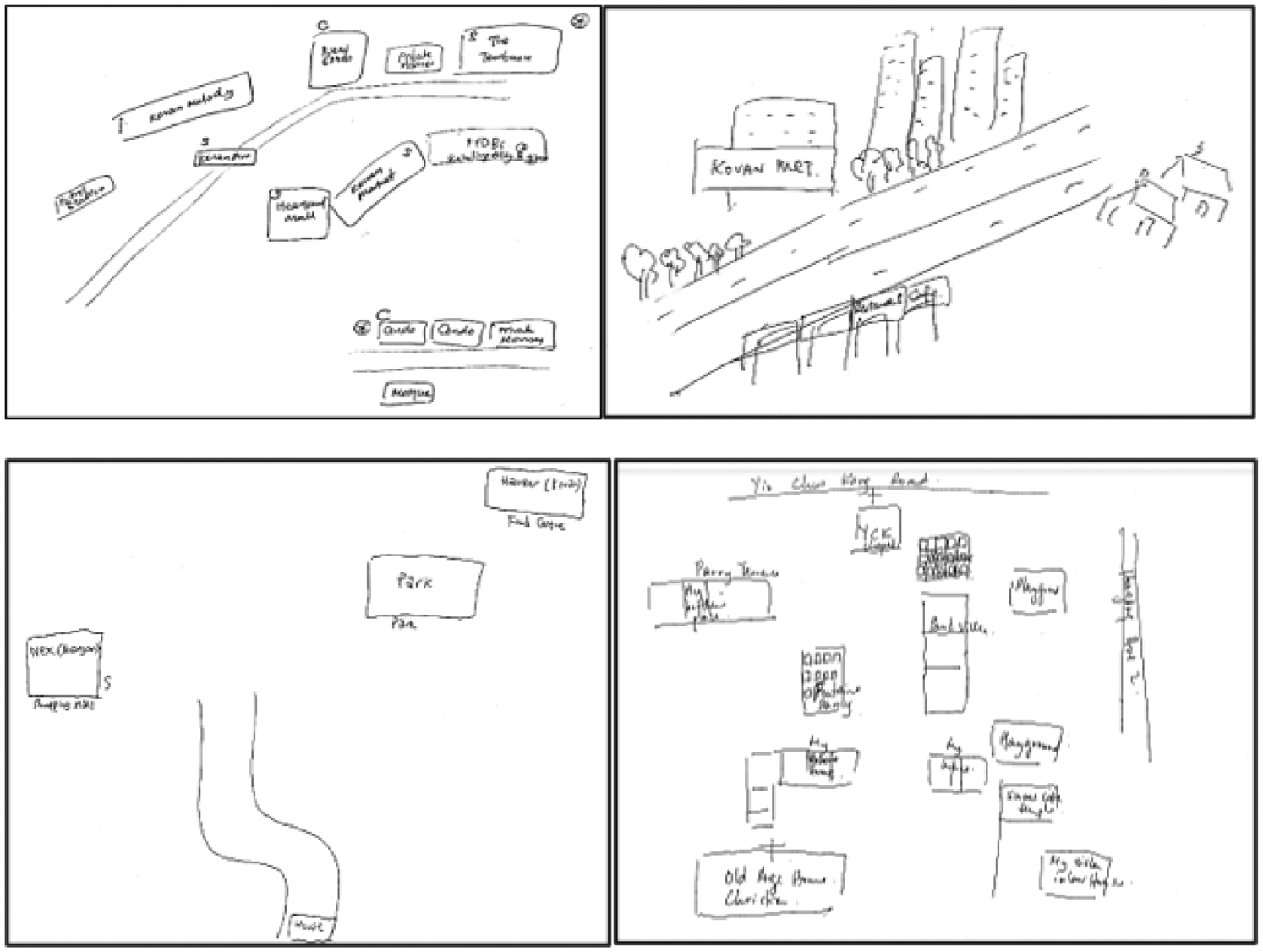
Maps of Kovan. Top: Short-term Singapore residents (less than five years): a resident in her 20s (left) and a resident in her 40s (right). Bottom: Long-term Singapore residents (about 20 years and longer): a resident in his 20s (left) and a resident in her 60s (right).
In sum, the conceived space of Serangoon Gardens among its residents has greater convergence, suggesting a more imageable place owing to its historical planned structure that has remained mostly unchanged over the decades despite the demographic shifts. This convergence of the conceived space of the neighbourhood has a bearing on the possibility of growing a shared sense of place identity among its diverse residents (Lynch, 1960).
Comparatively, Kovan’s imageability is much weaker, likely due to the multiple changes to the neighbourhood structure from the organic expansion of the villages over time, and the neighbourhood being impacted more directly by the large-scale urban redevelopment arising from the production of the ‘cosmopolitan grid’. This led to the demolition of old buildings, land acquisition, erection of new condominiums, and street widening starting in the late 1990s. The lack of convergence in the conceived space correlated with a lack of a shared sense of place identity among its residents. There was no shared imagery or common gathering place identified in the residents’ sketches, indicating a divergence in the perceived space of spatial practices and lived space among its residents, that is, a mosaic of multiple social worlds, per Robert Park and Louis Wirth in their descriptions of city life.
Perceived space and lived space: Routines and belonging
Serangoon Gardens
Due to the historical British presence, Serangoon Gardens has been popularly perceived as perhaps the most Western and cosmopolitan neighbourhood in the heartland suburbs even before Lycée Francais de Singapur arrived in 1999. The place identity of Serangoon Gardens has always had a colonial ‘White’ presence, especially among the many older and long-term residents. They remembered their younger years playing with British children in the 1950s. Thus, when the French and Australians arrived in the 2000s for the international schools, the older residents like Wendy felt a sense of familiarity and a ‘revival’ of the old spatial practices and lived experience: Now you see girls in bikinis walking on the streets. I used to see that in the past when I was about five to six years old. The angmohs
11
used to sunbathe in their gardens—all in bikinis. We didn’t see that for a period of time and now we get to see again. It’s like a revival, the Western culture has come back again.
However, for those in their 20s and early 30s who have grown up in the neighbourhood from the late 1980s without a British colonial presence, there was a stark contrast in how they processed the changes to their perceived space as a result of the ‘cosmopolitan grid’. They felt that there was dilution of their lived space and place belonging by the White newcomers who have brought changes to the way of life and the accompanying gentrification. Among the native-born young residents, the increasing cost of living in Serangoon Gardens also meant that many could not afford to buy or rent their own homes in the neighbourhood they had grown up in and grown to love. Joyce Ang and Candice Lim, two young residents in their 20s, described the changes respectively: (There are) A lot more angmohs. During holiday periods, they have those house parties and what not, it can be quite loud. Quite rabz.
12
Because I see all those young angmohs hanging out outside, they would be like blasting music and those kinds of things. Recently, there are a lot more angmohs. Their lifestyle is quite infiltrated into Serangoon Gardens. We see a lot more Western food. It is like atas
13
Western food. It feels like when there are more international school students, like these expatriates and their families, they sort of make Serangoon Garden feel like a more high-end neighbourhood.
Despite the undercurrents of discomfort, residents described neighbourly relations as polite overall, except for the occasional skirmishes arising from French children cycling on the streets and getting into near collisions with automobiles – a spatial practice that was uncommon among native-born children. Daily social interaction between native-born and foreign-born residents in the public realm were mostly ‘fleeting’.
14
Inter-group social contact was rare, except for the annual Halloween children’s visits organised by the foreign-born residents, and an occasional dinner invitation which a Canadian participant received from her native-born next-door neighbour. These fleeting encounters contrasted with the durable intimate-secondary relations and quasi-primary relations within the social group such as among the native-born elderly neighbours who had developed lifelong friendships, and among the French neighbours many of whom had chosen Serangoon Gardens for the strong social network of French families it offers. This community was an important factor as highlighted by Pierre Lavigne, a French resident: It’s easier to build up friendships with French people so that’s a big reason why people are coming here… If you come here close to the school, it’s not purely practical for the kids but also, you can remain close to the French community, you got people around and able to build up a community. You can interact with others, have friends and not feel alone. That’s important when you come from abroad and you don’t know anyone.
An analysis of the routine destinations of native-born and foreign-born residents reveals that the groups rarely gather in the same public and semi-public places, exhibiting a practice of ‘parallel life’ (Cantle, 2005). In addition, there was a significant divergence in what these two social groups considered as special places in the neighbourhood, where they would go socialise with friends and families.
Native-born residents routinely gathered in two places in the neighbourhood as part of their everyday spatial practices. These places have remained largely unchanged over the decades except for periodic refurbishment. The historic outdoor food court Chomp Chomp and Serangoon Garden Market and Food Centre were particularly important as places of regular spatial practice and as symbolic lived space of memory-making. These places were central to family dinners, particularly among the young residents. Young residents also explained that the store owners, who had been there for decades, were like family who would regularly check in with each other. These were places where durable ties are formed and renewed between patrons and customers in the neighbourhood.
For the foreign-born residents, My Village was a special routine place to do grocery shopping and meet up with friends in cafes. As the only new four-storey retail mall built in Serangoon Gardens over the last five decades, My Village houses multiple restaurants serving international fare, two supermarkets (Fairprice Finest and Little Farms) that curate their product range for its Western clientele, and the Parisian Maison Kayser artisan bakery. Other special routine places of gathering for the French participants include the Lycée Francais de Singapur and their private homes (see Figure 5).
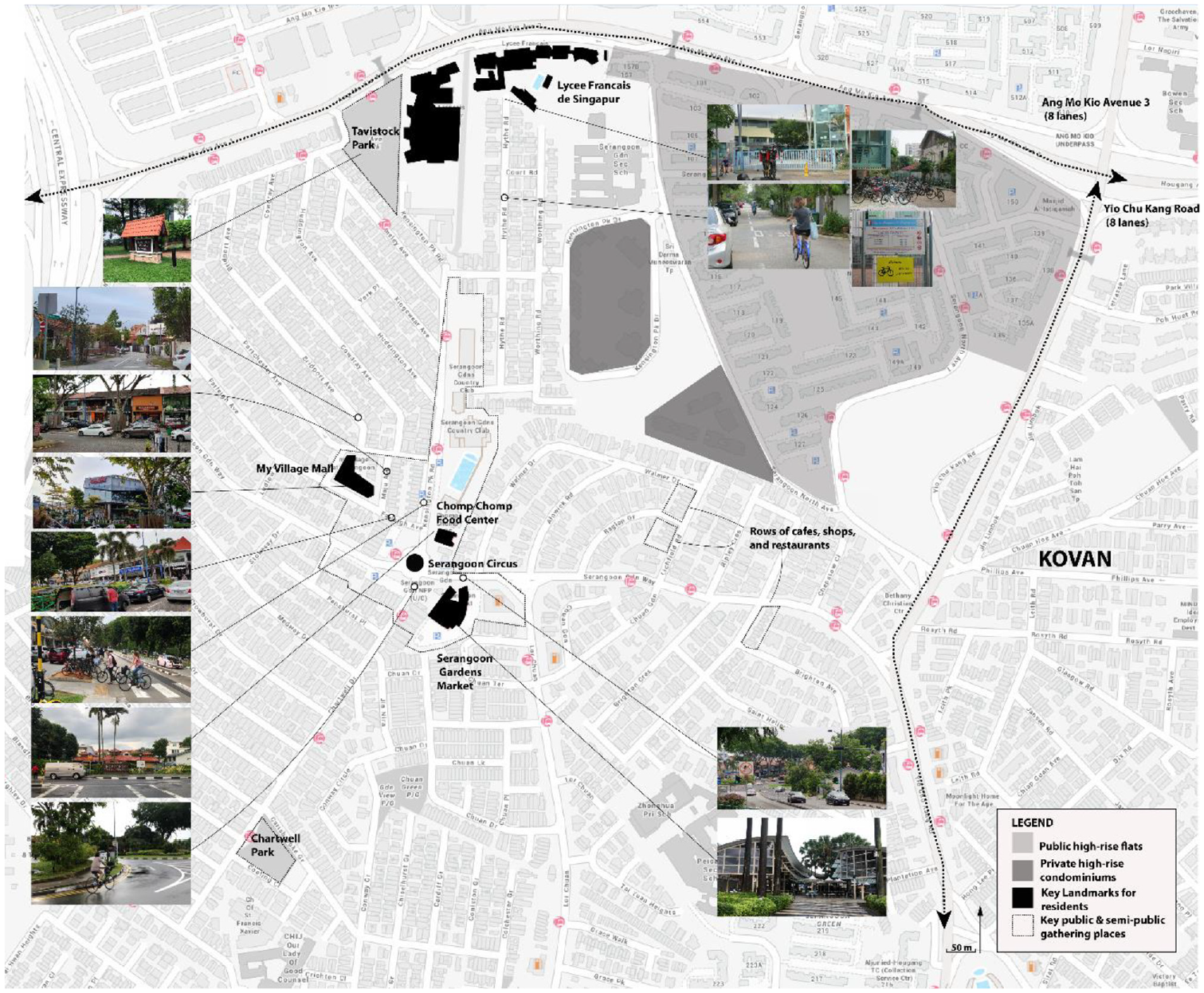
Map of Serangoon Gardens.
It is worth mentioning that My Village portrays a contradiction inherent in the everyday production of social space that illustrates the cultural divergences and the contestation in the lived and perceived spaces between the different generations and origins of residents. Although My Village is a place frequented by all residents, few native-born residents identified it as a significant space of everyday practice. If it was mentioned as a special place by native-born residents, they would refer to what My Village used to be, that is, what was displaced by My Village. The elderly fondly recalled the old Paramount theatre as a major place of social life until it closed in 1983; the young residents talked about the refurbished space with fast-food outlets and the simple Fairprice supermarket before the building was demolished in 2009. The site occupied by My Village is an important symbolic lived space for all residents – the name of the mall ironically suggested a desire for a coherent community, but the significance of the space also unlocked contested feelings of place belonging.
Although residents shared a coherent place identity and strong place belonging in Serangoon Gardens, the formation of their local belongings was different and contradictory in some instances. Young and elderly long-term native-born residents in Serangoon Gardens expressed a strong sense of belonging that was nurtured from having spent their entire lives in the neighbourhood. For them, a sense of belonging was a sense of home – a familiar and comfortable place where the social and emotional anchors of family, friends, and important social gathering spots remained. They spoke with a deep sense of pride that Serangoon Gardens was popularly recognised as a unique neighbourhood which enhanced their sense of place belonging.
For the foreign-born residents, they felt that living in Serangoon Gardens with a vibrant French community and convenient access to French lifestyle goods and services, made everyday life familiarly French. The small village atmosphere also helped them grow their place belonging over time. Serangoon Gardens offered safety and family-life that were important attributes of what a home is. However, their place belonging in Serangoon Gardens did not include the deeper conception of what they felt home should be. Home was tied to their origins, their childhood, and memories of family in Europe.
Kovan
Kovan is a bastion of heartland Singapore, with its namesake Heartland Mall. The sociality of Kovan reflects the humdrum of similar suburban neighbourhoods with private single-family houses and multi-family condominiums – quiet, predominantly residential, gated, car-dependent, narrow sidewalks, few gathering places, and limited neighbourly exchanges. The White Western presence became visible by the mid-2010s – about a decade later than Serangoon Gardens. In the early years of the 2000s, the co-presence of a few White neighbours generated a heightened awareness of difference (Sandercock, 2000). As more foreign-born residents moved into Kovan over time due to the ‘cosmopolitan grid’, native-born residents no longer referred to the foreign-born as simply ‘White’ but as the nationalities of the familiar strangers in their midst (Milgram ([1972] 2010). An elderly native-born resident who regularly walked in the neighbourhood was able to identify several nationalities, including French, Swedish, and Filipino. In Kovan, foreign-born residents appeared to be more diverse in origins, and there was no one distinctive cultural community. Jacques Cortona, who is both French and Spanish, said he purposefully avoided living in Serangoon Gardens because it was a French enclave, and he did not feel that his social network had to be neighbourhood-based. In fact, the cultural diversity in Kovan was more suitable and attractive to his family, who had friends living in different parts of Singapore and came from different parts of Europe.
For native-born residents, the everyday spatial practices in Kovan had not changed much, apart from little imprints of the ‘cosmopolitan grid’ such as seeing more foreign-born White next-door neighbours walking in the neighbourhood, and young foreign Chinese and Indian students who attended a small international school in Kovan. Sociality of Kovan in these single-family homes has remained ordinary and mostly unchanged. What had been a highlight for native-born long-term residents was an increasing convenience of more amenities in Kovan and its better connection to the city centre.
A study of residents’ routines uncovered divergences not only between the native-born and foreign-born residents but also among the native-born residents. Kovan is a neighbourhood with no public gathering places that allow for crisscrossing of routine paths. The only notable public amenity is a temporary dog park popular with native-born and foreign-born residents, where some social interaction unfolds between and within the groups. Instead, it has an eclectic mix of semi-public gathering places like cafes and supermarkets.
According to Monique and Jean Serat, who lived in the condominiums nearby before renting their single-family home, they felt that they were unable to form durable neighbourly relations with the native-born residents. They contrasted their experiences living in condominiums in Kovan, which they felt offered more opportunities to intermingle, though it was limited mostly to their European neighbours. Many friendships were forged through sharing the condominium’s swimming pool. However, spontaneous social interaction opportunities were rare for those who lived in single-family homes. For the foreign-born residents, their house and the Lycée Francais de Singapur were the central places of their social life. They explained that it was their European cultural practice to use the home as a gathering space for friends instead of dining out. For them, most of their daily shopping was done online with only rare visits to the nearby local markets where most native-born shopped.
In deep contrast, the native-born residents socialised in different local cafes and frequented Heartland Mall, Kovan Market and Food Centre, and some also regularly used the shops in Serangoon Gardens due to its proximity. Overall, the spatial and social worlds of all the residents did not overlap much, particularly between the foreign-born and native-born groups. Kovan’s public realm reflects the fleeting ‘throwntogetherness’ arrangement that Massey (2005) wrote about, where no active interaction unfolds or is expected to happen among strangers (see Figure 6).
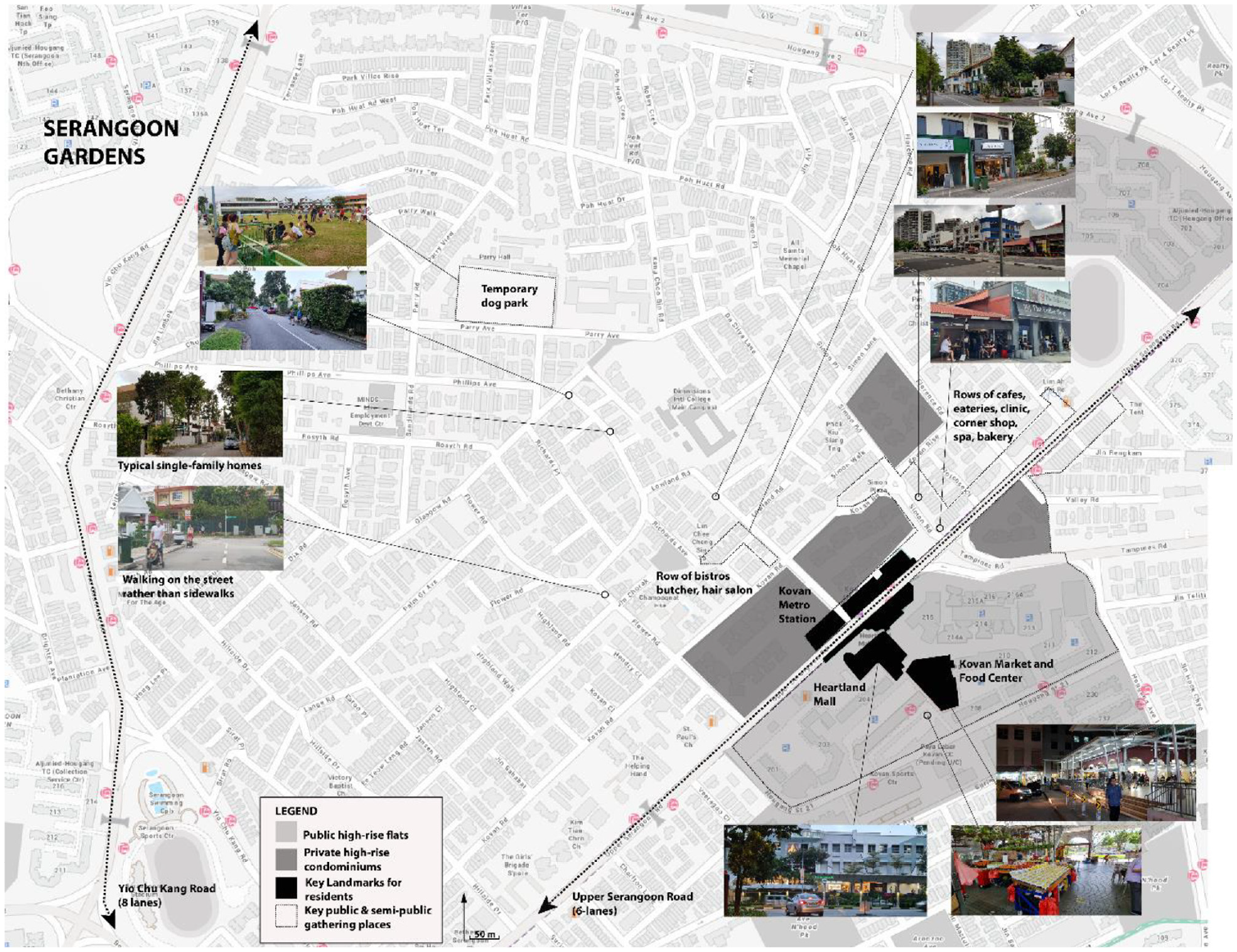
Map of Kovan.
Against the background of seemingly parallel life routines, it is noteworthy that urban civility in demographically diversifying spaces cannot be taken for granted, as seen from Monique Serat’s experience. Monique, a French national in her 40s who had lived in Kovan for about four years, had felt very comfortable and welcomed in Singapore until the onset of Covid-19 in 2020 when anti-immigrant aggression arising from the wider employment competition in Singapore between native-born and the foreign-born elites was keenly felt. Monique recounted facing a difficult experience one afternoon while cycling in Serangoon Gardens – a routine for her as she would ride home with her children from Serangoon Gardens to Kovan after school each day. Being a careful cyclist who followed the traffic rules religiously and a culturally respectful foreign-born, she encountered an aggressive middle-age Singaporean man who shouted at her from his car that afternoon, ‘Go home!’ With a troubled look and clearly still shaken by the incident, she said to me, ‘Some Singaporeans are not happy to see us here’.
In Kovan, native-born and foreign-born residents felt a weak sense of place belonging. Among the native-born, although they felt a deep familiarity and comfort of home in the neighbourhood having lived there for many decades, they did not know their neighbours well. There was no unique sense of place or sense of community. The demographic diversification did not erode or enhance their sense of place belonging. For the foreign-born residents, they were comfortable in the neighbourhood and felt it suited their multicultural belongings. However, there was no emotional attachment as a home because Kovan was not associated with childhood or extended family life. The only participant who articulated a deep connection to Kovan was Natalie Chong, a Chinese Singaporean who had grown up in the neighbourhood and lived in France for a decade. She felt that the demographic diversification in Kovan had created a place of belonging for her half Singaporean–half French family because the neighbourhood allowed her to simultaneously live in two social worlds productively without conflict.
Conclusion
The grand expansion of the ‘cosmopolitan grid’ of amenities and infrastructure in Singapore guided by economic pragmatism has inadvertently reshaped the socio-cultural landscape of suburban neighbourhoods in Singapore as it redistributes foreign-born populations outside the city centre, increases native-foreign-born contact zones, and reshapes societal dynamics, albeit with different effects depending on the place history, the scope of urban redevelopment, and the access to public gathering spaces within each neighbourhood. These factors, in turn shape how demographic diversification is experienced and negotiated in the local public realm as illustrated through the discussion of the new convergences and divergences in the everyday production of conceived, perceived, and lived spaces among different groups of residents across age, residency, and nativity status.
A strong common pattern that emerged in both neighbourhoods was a divergence of spatial practices (perceived space) and lived experiences (lived space) between the native-born and foreign-born residents that created parallel social worlds, despite the groups sharing equal socio-economic status as upper-middle income households, which is commonly believed to facilitate social contact. Interpreting the findings, we make the following conclusions.
In Kovan, the lack of central public or semi-public gathering places created a set of unfavourable socio-spatial conditions for social contact among groups. More critically, foreign-born and native-born residents were attracted to Kovan precisely because it was a neighbourhood that had no single place identity and thus, a social space that ironically accommodated multiple cultural differences without imposing inter-group convergences. Thus, Kovan fulfils its intended role as an efficient ubiquitous plug-and-play location in the ‘cosmopolitan grid’.
In Serangoon Gardens, despite its physical structure that enables more crisscrossing of paths in the day-to-day, diversification has taken on a cultural enclave (Qadeer, 2005) around the Lycée Francais de Singapur that offers amenities and resources that create a comfort bubble for foreign-born residents. This reduces the need to venture out of the zone for the needs of daily life. The bubble motif is mirrored by the native-born long-term residents as well, with their established spatial practices and social relations. However, we wonder how long the bubbles will co-exist given that gentrification and socio-cultural diversification brought about by the ‘cosmopolitan grid’ will invariably displace existing patterns of everyday life and places that many of the native-born residents hold dear. The displacement effects had been mostly felt by the young native-born residents who seemed to be socio-economically and socio-culturally alienated by the changes.
Nevertheless, the strong imageability of Serangoon Gardens, due largely to its spatial structure that has remained unchanged and its well-connected physical layout that facilitates walking to public gathering places, has enabled the sharing of a congruent place identity among residents of different social and cultural groups. These conditions have developed a strong sense of place belonging in all residents, despite the divergences of spatial practices and lived experiences among the groups. In comparison, Kovan residents did not share a strong coherent conceived space of the neighbourhood. There was clear absence of a collective place identity and evidence of a weak sense of place belonging in the neighbourhood among all its residents, which could be due to its lack of a distinct spatial structure and place history, the lack of accessible public gathering spaces that facilitate encounters, and the extensive redevelopment to its built environment as part of the ‘cosmopolitan grid’ expansion.
Thus, how the physical space of a neighbourhood is planned and designed matters for the formation of a collective social space. When routine paths are designed to intersect and a strong structure of accessible public and semi-public places exists, a neighbourhood space is more likely to develop place belongingness among its residents, like in Serangoon Gardens. Having place belongingness is an important building block for collective consciousness to form, notwithstanding that place belongingness can also be contested by diversity and undermine the formation of collective life. However, the expansion of the ‘cosmopolitan grid’ into the heartlands has in fact produced more quasi-public and private gated amenities, like condominiums and international schools, which are non-porous urban spaces that tend towards the formation of even more parallel social worlds.
Admittedly, good physical space design is a necessary condition for the practice of urban civility but alone is insufficient for ensuring quality social contact among groups and enabling inter-cultural learning to occur as a counterforce to the processes that divide, such as the gentrification and cultural differences that accompany the arrival of highly-skilled foreign elites as part of the ‘cosmopolitan grid’ seen in the case of Serangoon Gardens. In addition, despite the keen consciousness of municipal decision-makers in Singapore to physically integrate international schools with its surrounding neighbourhoods through new planning and design standards for international schools, the case examples illustrate that more is required if diversifying neighbourhoods are to develop beyond multicultural sites and become ‘cosmopolitan canopies’ of inter-cultural exchanges (Anderson, 2011), including countering the effects of gentrification that disrupt the sharing of an equal status among neighbours. Social psychologist Allport ([1954] 1979: 281) found that ‘equal status contact between majority and minority groups in the pursuit of common goals’ can reduce prejudice and ‘this effect is greatly enhanced if this contact is sanctioned by institutional supports (i.e. by law, custom or local atmosphere)’.
Therefore, the ‘cosmopolitan grid’ is a powerful physical and social engineering tool that reshapes the production of social space in neighbourhoods because it brings forth economic, social, cultural, and spatial changes. It creates new contact zones to gather and to scatter as social frictions, tensions, and conflicts among social and cultural groups emerge with the daily overlaying of different spatial practices and lived experiences in the same place.
To transform a ‘cosmopolitan grid’ into a truly cosmopolitan space that hones empathy towards differences and enables productive inter-cultural learning of how to do social togetherness amidst differences, it requires a planning consciousness that recognises urban redevelopment as a process that produces new social relations, and one that confronts the intricacies of coexistence as a complex of social, cultural, economic, and spatial interdependencies.
Footnotes
Declaration of conflicting interests
The author(s) declared no potential conflicts of interest with respect to the research, authorship, and/or publication of this article.
Funding
The author(s) received no financial support for the research, authorship, and/or publication of this article.
