



Abstract
How urban entrepreneurialism is enacted at the neighbourhood level while connecting with broader urban processes remains insufficiently explored. This study introduces a novel conceptual framework of multiscalar and multidirectional urban entrepreneurialism to examine the governance of gated communities that involves dynamic interactions between the entrepreneurial local state, developers, gated communities and individual homeowners/investor-citizens. In Chinese cities, the pursuit of quality living and good schools has given rise to ‘education-featured gated communities’ that package privileged access to K–12 schools with tailor-made residential services. By turning education from a public good into a club good that can be capitalised in the housing price and leveraged in urban (re)development, education-featured gated communities are highly sought after by homebuyers, developers, and local states, becoming an important and integral component of urban entrepreneurialism. When the rising demands of gated community homeowners for school places are not met, activism for quality education within gated communities becomes ubiquitous. Drawing on multiple case studies and multi-source empirical data including national and local policies/documents, in-depth interviews, non-participant observation and site visits, this research examines how homeowners negotiate their exclusive right to public schools through intensive interactions with local authorities. We argue that the semi-private governance of gated communities forms the institutional basis for the ‘shareholding enterprise’ centring on property values. By unpacking the multidirectional processes of entrepreneurial governance that built upon an effective feedback loop involving multiscalar entrepreneurial endeavours based on shareholder value, this study offers a nuanced and enriched understanding of contemporary urban entrepreneurialism.
Introduction
In Chinese cities, fierce competition for quality education and the pursuit of quality living have given rise to ‘education-featured gated communities (edu-featured GCs)’ that package privileged access to K–12 schools with tailor-made residential services (He, 2022). By turning education from a public good into a club good that can be capitalised in housing prices and leveraged in urban (re)development, edu-featured GCs are highly sought after by homebuyers, developers, and local states, making them an important component of urban entrepreneurialism at the neighbourhood level. In a nation of homeowners, middle-class households have become investor-citizens cultivated with the shareholder value of their properties/GCs and the associated services (club goods), in which school places account for an important component that can be capitalised in the market. Homeowners of GCs firmly believe in property rights and the associated rights to club goods, ignoring the nature of education as a public good. Purchasing a housing property in edu-featured GCs means not only accessing a home space but also securing a share of prospective income from the property market, in which school places play an essential part in safeguarding and elevating property values. Owing to limited resources, local governments and developers cannot always meet the rising demands and expectations of homeowners as promised. Homeowners’ struggles for quality education are thus ubiquitous. For homeowners, it is unacceptable that the promised school places had transformed from nonrival (granted access) goods based on homeownership to competitive resources to be shared with ‘non-club members’. These activists are not organised simply to defend their privileged access to school places, but also to prevent property value being dampened by the undelivered promise of accessing quality education. Shareholder value upheld by investor-citizens is therefore at the heart of these homeowners’ activism, which also serves to connect individual homeowners with broader urban development initiatives, for example, GCs and urban development strategies. These quotidian yet profound stories offer a unique opportunity to unpack the multifaceted nature and manifestations of urban entrepreneurialism.
To avoid the territorial trap of researching urban entrepreneurialism, a comprehensive understanding of contemporary urban entrepreneurialism necessitates looking beyond the urban-level actors and entrepreneurial endeavours (He, 2020; Phelps and Miao, 2020). While entrepreneurial strategies and practices in neighbourhood governance have not received sufficient scholarly attention in the literature on urban entrepreneurialism (see Cai and He, 2022a; Durose and Lowndes, 2010; Wu and Zhang, 2022 as a few exceptions), examining the intricate interactions between homeowners, developers of edu-featured GCs and the entrepreneurial local state can offer new insights into the ever-evolving urban entrepreneurialism by transcending the narrow focus on the local regime and its strategies for advancing urban projects. Although previous studies have alluded to the importance of multiscalarity and multidirectionality of urban entrepreneurialism (He, 2020; Lauermann, 2014), this study explicitly introduces a novel conceptual framework accounting for the multiscalar and multidirectional dynamics of entrepreneurial policies and practices involving stakeholders at different levels who are actively engaging in the interactive urban processes through different pathways and networks. Not so different from the multidirectional entrepreneurial strategies observed elsewhere involving intensive interactions between policy makers and business interest networks (Lauermann, 2014), the entrepreneurial state in China is not simply shaped by a top-down logic, but by constantly being refashioned through the interactions with bottom-up initiatives of semi-private governance at neighbourhood and individual levels. Drawing on field investigations of multiple study cases for collecting first-hand empirical data in Guangzhou, we further illustrate that these stakeholders, including the entrepreneurial local state, semi-privately governed GCs and individual homeowners/investor-citizens, are brought together to form a ‘shareholding’ enterprise with clear pro-growth goals revolving around land and housing development.
The remainder of the article first elaborates the conceptual framework and situates GCs and homeowners into the debates of multiscalar and multidirectional urban entrepreneurialism; the following section introduces the empirical context of edu-featured GCs and methodology; the next section illustrates how shareholder value is cultivated among homeowners of edu-featured GCs and thereby links school-place activism with wider practices of urban entrepreneurialism; the final section reflects on the theoretical debates and concludes.
Situating GCs and homeowners into multiscalar and multidirectional urban entrepreneurialism
The conceptual framework of multiscalar and multidirectional urban entrepreneurialism
Homeowner activism in edu-featured GCs and their interactions with developers and state agents are integral parts of evolving urban entrepreneurialism at the grassroots level, closely linked to entrepreneurial endeavours of other stakeholders. To capture the complex mechanism of stakeholder interactions and gain an enriched understanding, we propose a conceptual framework of multiscalar and multidirectional urban entrepreneurialism (see Figure 1).
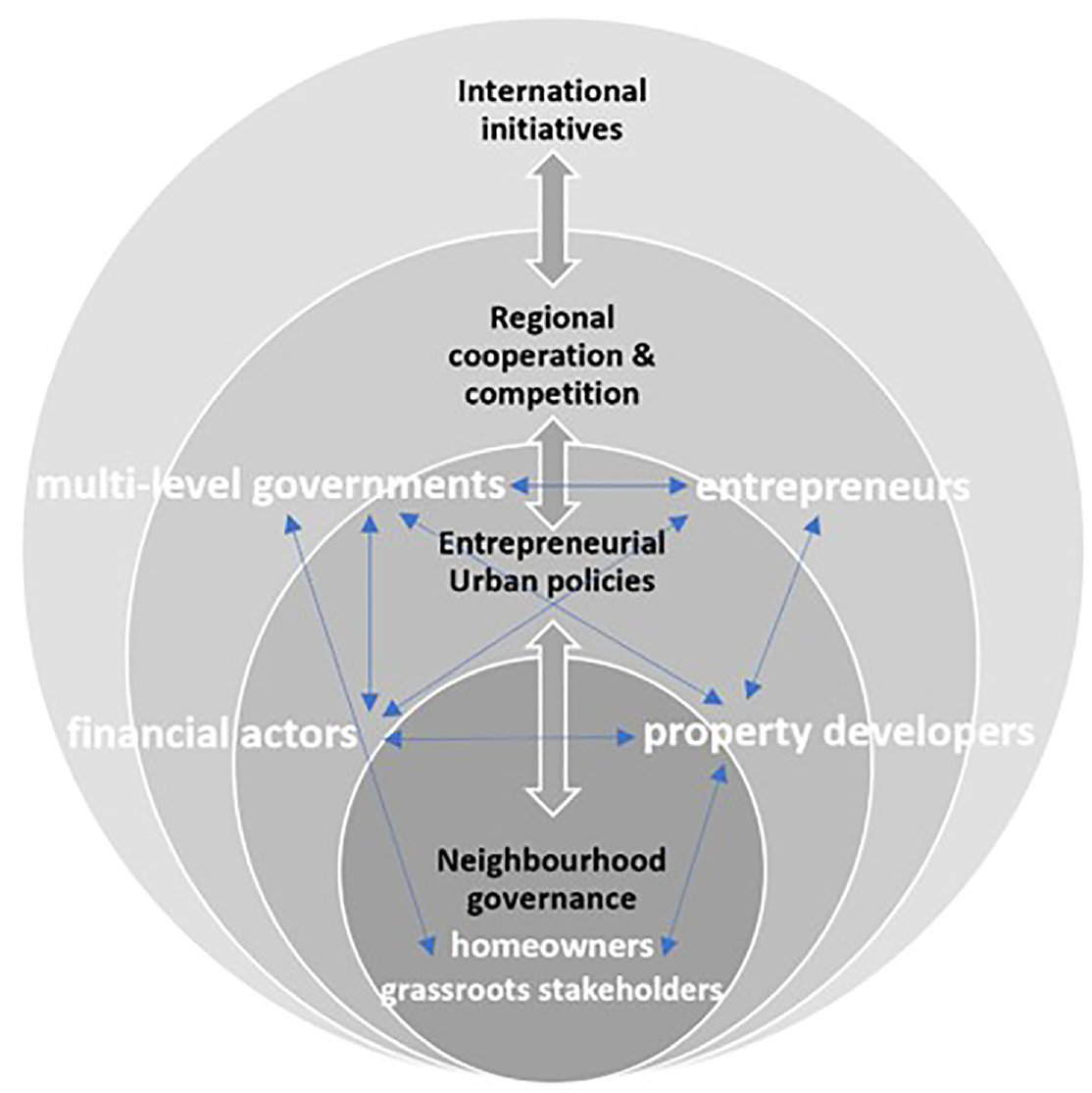
A conceptual framework of multiscalar and multidirectional urban entrepreneurialism.
First, the constantly evolving nature of urban entrepreneurialism has reconfigured the inter-scalar strategies employed by the entrepreneurial local state to develop competitive advantages across multiple scales. The theoretical lens of state rescaling has helped to explore the reconfiguration of urban governance within and across geographical scales – local neighbourhood, city, region, nation-state (Brenner, 2004; He et al., 2018; Ward, 2003). The multiscalar processes of urban entrepreneurialism involve strategies of ‘glurbanisation’ that align and incorporate global and local entrepreneurial endeavours, as well as state projects in cities to achieve economic and political goals in the era of globalisation (He et al., 2020; Jessop and Sum, 2000; Matusitz, 2010; Wu, 2003). The multiscalarity signifies the convergence of values and goals at different scales towards the consensus of pro-growth entrepreneurial endeavours. Through the operation of effective feedback loops, the multiscalarity of entrepreneurial goals forms the prerequisite for multidirectional policy practices and processes. Previous studies tend to view urban entrepreneurialism as a horizontal process, for example, by examining the formation of growth coalitions among the entrepreneurial local state, private sector, and other stakeholders to boost local growth (Hall and Hubbard, 1996; Logan and Molotch, 1987; MacLeod, 2011). Most studies have emphasised multiple strategies and specific toolkits at the urban scale, ranging from introducing new urban spaces for collective consumption, and enhancing the command functions of cities as information hubs, to the extensive construction of urban infrastructures (Harvey, 1989; He and Lin, 2015; Liu and Yau, 2020). In contrast, some studies illustrate how urban entrepreneurialism can go beyond national boundaries under such ambitious programmes as the Belt and Road Initiative (Phelps and Miao, 2020). Yet, these studies have overlooked other strategies and actions at smaller scales, such as neighbourhood dynamics and grassroots activism. This study thus aims to fill this void through the vantage point of neighbourhood governance and homeowner activism.
Second, the multidirectionality of urban entrepreneurialism involves multiscalar stakeholders, including multi-level governments, financial agents, property developers, and social activists, who initiate entrepreneurial ventures reaching out to and forming coalitions and feedback loops with other players. This gives rise to various modes of entrepreneurial governance (Cai and He, 2022a; He, 2020; Liu and Yau, 2020). Besides, the circular process of entrepreneurial policy-making typically involves central design, local experimentation, recentralisation and recirculation or direct diffusion of policy models on a national scale (He et al., 2018). Recent research has revealed that the entrepreneurial turn in urban governance is not a unidirectional process but rather intertwined with practices of new urban managerialism, urban diplomacy, intrapreneurialism and speculation conducted to foster competitive and cooperative inter-urban relationships (Lauermann, 2018; Phelps and Miao, 2020). For instance, local citizens are deemed co-producers of bottom-up policy innovations under new urban managerialism (Phelps and Miao, 2020). Nonetheless, the important roles played by non-state actors, such as financial institutions, entrepreneurs, and grassroots stakeholders, in shaping the multidirectionality (through the processes of localisation, universalisation, mutation, and diffusion) of entrepreneurial urban policies have not been duly recognised or closely examined (He, 2020). This study thus pays particular attention to homeowner activism and their indispensable role in multidirectional entrepreneurial policy making and implementation that involves multiscalar actors.
The co-production of urban entrepreneurialism by multiscalar actors in GCs
As an ultimate form of privatisation, both physically and institutionally, the rise of GCs represents a local response driven by the entrepreneurial shift in urban governance and speculative consumer behaviours in search of security and high-quality lifestyles (McKenzie, 2005a; Rosen and Razin, 2009). Coined by McKenzie (1994, 2011), ‘privatopia’ is a portmanteau of ‘privatisation’ and ‘utopia’, revealing a silent urban revolution induced by private approaches to urban governance. ‘Privatisation’ here refers to a private form of governance and service provision within GCs (Bodnar and Molnar, 2010; Warner, 2011), and ‘utopia’ is a satirical take on GCs being an ‘ideal’ form of privatised residential space and governance (Blakely and Snyder, 1997; Cséfalvay, 2011; Pow, 2007). The term privatopia vividly encapsulates the essence of private governance within GCs, in which private entities take responsibility for providing public infrastructures and services tailored to residents, creating a sense of privilege and exclusiveness (Charmes, 2009; Webster, 2003). Functioning as fundamental units of the club economy, GCs offer various facilities and services, such as education, healthcare, green spaces, and security guards, for consumer-voters who choose the community that alligns with their preferences (McCabe and Tao, 2006; McKenzie, 2005b).
Compared with the North American prototype of ‘privatopia’, Chinese cities are undergoing an ‘incomplete’ transition towards private neighbourhood governance due to the persistent state presence in governing GCs and public land ownership (Cai and He, 2022b; He, 2015; Wu, 2022). While most GCs have embraced the commercialisation of property management service and the introduction of homeowner associations, ‘semi-private governance’ is a more accurate term that captures the hybrid nature of neighbourhood governance in China’s GCs. This can also be seen as a microcosm of the gradualist market reform in China, characterized by economic liberalisation and political domination (Cai and He, 2022a). Notably, (semi-)private governance at the neighbourhood level should not be isolated from the network of entrepreneurial governance at wider scales. For instance, Woo and Webster (2014) elucidated how privately governed GCs are integrated into local urban entrepreneurialism in South Korea by bundling publicly and privately provided local public goods to attract GC inhabitants. Similarly, ‘semi-private’ governance in China’s urban neighbourhoods can be seen as an effective mechanism to enact urban entrepreneurialism at the neighbourhood scale (Cai and He, 2022a).
Recently, more scholarly works have examined the rise of GCs from the perspective of homeowners. Against the backdrop of increasing withdrawal by entrepreneurial local states from the provision of public urban services, the development of GCs is premised not only based on enhanced market efficiency but also on increased consumer/homeowner voices in service delivery (Cséfalvay, 2011; Warner, 2012). According to Hirschman’s exit-voice framework, on one hand, the rise of GCs can be seen as an exit option for citizens from other types of neighbourhoods when the local state fails to ensure the adequate provision of public goods and services (Cséfalvay, 2011). Homeowners of GCs, on the other hand, embrace the voice option to pressure local states to improve service delivery through bargaining, complaining and protesting without moving to a new community. Well-organised voice behaviours, in turn, tend to reduce inhabitants’ inclination to leave GCs (Cséfalvay, 2011; Glasze, 2005). By the same token, Hankins (2007) illustrates how collective demands of gentrifiers for better education helped slow the outflow of residents. These studies clearly demonstrat synergies between the entrepreneurial state and citizens in co-producing urban entrepreneurialism.
In this regard, the proliferation of semi-private governance within GCs and related homeowner activism should be viewed as an integral component of the multiscalar and multidirectional urban entrepreneurialism against the backdrop of China’s booming housing markets. Introducing new configurations of homogeneous residential landscapes and privatised service delivery at the neighbourhood level, the development of GCs has divided Chinese cities into residential enclaves catering to different social groups (Douglass et al., 2012; He, 2013; Qian, 2014). A study in Guangzhou suggests that various forms of enclaves (i.e. GCs, danwei compounds and urban villages) have largely been employed by entrepreneurial local states for localised capital accumulation (He, 2013). Territorial exclusivity and privileged urban lifestyles have become strong incentives for Chinese middle-class citizens to choose GCs as their place of residence (Pow and Kong, 2007; Shen and Wu, 2012; Wu, 2005). In addition, when investment in housing property is bundled with social reproduction in some GCs offering exclusive access to quality schools, it maximises the housing premium generated. Deeply influenced by the enterprising culture, middle-class Chinese parents strive to prepare their offspring to be highly competent and outstanding in a globalising and competitive labour market by enrolling them in high-quality schools offered by ‘edu-featured GCs’, which have become their entrepreneurial strategies to enhance economic and cultural capital (He, 2022). Translating cultural capital in the form of high-quality educational resources into the overall value of the housing property and the neighbourhood, edu-featured GCs thus vividly manifest the co-production of urban entrepreneurialism by multiscalar actors including the entrepreneurial local state, enterprising developers and homeowners.
Cultivating shareholder value and investor-citizens in a nation of homeowners
Club economy explains the underlying market logic for the emergence of collectively and exclusively shared local public goods, known as ‘territorial club goods’, based on ownership-membership arrangements (Buchanan, 1965). The market efficiency of the club economy, in contrast to the failure and insufficiency of governmental provision of unrivalled public goods, especially high-quality ones, justifies and rationalises the global prevalence of GCs (Cséfalvay, 2011; Glasze et al., 2004; Webster et al., 2002). The club economy is practised through the private provision of public goods based on membership, prioritising market rules and individual values over equity and the greater good outside the territorial boundaries of GCs (Chiu et al., 2023). Previous research has delineated how GC homebuyers are attracted and bounded by the club economy, but has largely overlooked the agency of diverse actors and their specific rationales in reinforcing the club economy. Except for a handful of recent debates on the possible ungating of GCs in China (Chiu et al., 2023; Liu, 2019; Zhao and Zou, 2017), most studies cease at the stages of GC production and transaction, with little attention paid to the consumption stage and lives of homeowners after moving into GCs, especially when homeowners engage in rights-defending activities to exert their influence on the (semi-)private governance of GCs. The explanatory power of the club economy in delineating the logic of homeowners’ collective actions at the stage of GC living is thus rather limited.
In this study, we borrow the term shareholder value in corporate governance (Dobbin and Zorn, 2005; Froud et al., 2000) to understand the rationale for homeowners’ collective actions, particularly concerning issues affecting their investments in cultural capital and property value, such as school places allocation. This concept is highly relevant here because it vividly illustrates how urban society is governed based on the logic of governing a corporation, which can be interpreted as a manifestation of post-political governance (He, 2020; Swyngedouw, 2007). We would like to point out that the club economy underwriting the development of a GC still forms the basis of shareholder value among homeowners and binds them with the entire GC, including its physical structures and spaces, services, social relations, and future property values appreciation. Together, these elements create an enterprise-like contractual community. With the increasing integration of property and financial markets, the housing sector is being deeply financialised (Coakley, 1994; Wissoker et al., 2014), bringing together various shareholders, including multi-level governments, financial actors, developers, entrepreneurs, homeowners, and commercial service providers (see Figure 1). Shareholder value thus becomes a dominant logic for urban governance (Tapp, 2020). For GCs, the exclusive provision of club goods, such as school places for homeowners, is analogous to the shareholder value model of corporate governance, with serious externalities for non-shareholder groups, including the exclusionary effect and exacerbated inequalities in services and goods. We thus argue that contractual communities have turned most middle-income homeowners into shareholders of the GCs and more broadly, the prevalent mode of entrepreneurial urban development. Driven by the shareholder value mindset, homeowners naturally deem themselves as shareholders of the GCs and even the wider urban development processes that immediately affect their property values. Thus, they are motivated to contribute to maintaining and expanding the ‘enterprise’ to enhance the value of their shares, even at a cost to the wider society. For instance, Scheller (2016) identified a hierarchy of club goods in American GCs, which locates the importance of the delivery of commons and public goods below improving property values. In this sense, shareholder primacy has overridden other principles such as equal access to quality education and other essential services. More specifically, as we further illustrate in the empirical section, the legitimacy of club goods and economic development have overwhelmed the community logic of distributive justice. While this exclusionary effect is not unique to schooling, the detrimental effect associated with education extends widely and will affect the next generation.
Another concept closely linked to the notion of shareholder value is the making of the investor-citizen, which is actualised through multiple pathways and widely observed in different contexts under global capitalism. In Anglo-American contexts and beyond, citizens have commonly transformed from passive savers and everyday consumers to enterprising and risk-taking investors through the introduction of various FinTech and financialisation products (Lai, 2016; Langley, 2006; Shiller, 2003). Nonetheless, the making of investor-citizens does not necessarily imply the empowerment of citizens and the democratisation of finance. Edwards (2022) trenchantly points out how everyday financialisation in the UK gives rise to seemingly independent investor-citizens who are increasingly mediated and constrained by large institutions and the long-existing mass investment culture. In India, investor-citizens’ investment and personal gains are closely linked to the glorified campaign of nation-building and branding under a combination of capitalism and ethnonationalism (Kaur, 2016, 2020). In China, although citizens’ investment channels have diversified significantly through financialisation in recent decades, the making of investor-citizens is still primarily realised through substantial investments in housing and cultural capital, with tens of thousands of households throwing their life-long savings into the real estate market and children’s education (He, 2022; Huang et al., 2021). In a nation of homeowners with a strong Confucian tradition, this is no surprise. When homeownership becomes the norm, the connotation of housing extends to many other realms other than homes and shelters, leading to ubiquitous investment and speculation in the booming housing market underlying China’s rapid urban development (Huang et al., 2021). When the investment in property value is linked to investments in other vital aspects of social reproduction, such as in the case of edu-featured GCs, the expected return is amplified multiple times from both supply and demand sides (Cai et al., 2022; He, 2022). Viewing homeowners of edu-featured GCs through the lends of shareholder values, they are used interchangeably with investor-citizens in this study.
Notably, under a prevalent entrepreneurial culture, citizens’ investment is never an individual behaviour. Rather, as we demonstrate in this study, investor-citizens commonly embrace shareholder value, believing they will achieve substantial returns through investments in various ‘shareholding’ enterprises, ranging from GCs to urban districts and the entire city. As Le Goix and Vesselinov (2013) suggest, it is widely believed that property values within GCs can be better protected through private governance which facilitates individual homeowners to collectively act towards better maintenance and promotion of their property values. Investor-citizens upholding shareholder value provides a more powerful explanation for this proposition. In this regard, we would like to point out that investor-citizens’ investments go beyond financial inputs; they also include collective actions to strive for and defend their shared privileges and potential returns. Seeing through the conceptual lens of shareholding value, homeowner activism revolves around defending their rights and privileges as ‘shareholders’, either by demanding or resisting certain facilities. In this study, homeowners’ claims for access to school places within GCs or nearby areas offer a case in point to examine the interactions between investor-citizens, developers and the entrepreneurial local state. Shareholder value thus serves as an overarching framework that connects individual investor-citizens with the entrepreneurial local state and other business actors. Their interactions and even conflicts, contribute to refining the dynamic urban entrepreneurialism through multiscalar entrepreneurial practices that unfold in multiple directions (both top-down and bottom-up). This study zooms in to focus on the bottom-up actions and the reasoning behind homeowners/investor-citizens’ efforts to secure their exclusive rights to public schools.
Empirical context and methodology: Examining edu-featured GCs with privileged access to public schools in China
Edu-featured GCs offering privileged access to K–12 school places to homeowners can be seen as an embodiment of the growing ethos of urban entrepreneurialism. By turning education from a public good into a semi-club good, developers of edu-featured GCs usually highlight the quality of education as a key selling point to attract homebuyers (He, 2022). In turn, the prevalence of edu-featured GCs partly reshapes the mode of education provision in major Chinese cities and intensifies the impact of education on the housing market in the context of fierce competition for school places and the ‘attending nearby school’ policy 1 (Cai et al., 2022). This peculiar form of residential development and related homeowner activism offer a unique opportunity to gain a deeper understanding of the multiscalarity and multidirectionality of urban entrepreneurialism in Chinese cities, in which the entrepreneurial endeavours of local states, property developers and homeowners are closely interwined and mutually influenced.
Based on a comprehensive examination of publicly available news reports, documents, and government policies, our investigation of the emergent edu-featured GCs in China reveals three patterns of bundling education resources with residential development. First, since the early 1990s, top real estate developers including Country Garden, Vanke and Agile have experimented with building private schools within or near their residential projects (self-built). Over time, these early attempts evolved into a prevalent form of edu-featured GCs, which are favoured by entrepreneurial local states and parents with high educational expectations. Second, concurrently, it was not uncommon for developers to be commissioned by local states to construct school facilitates within residential projects and subsequently transfer these schools to local education authorities. To stimulate urban development in the surrounding areas and to boost housing prices, branches of existing top-tier schools are highly sought after by local district governments and developers (franchising). A recent education policy that allows prestigious public schools to form education groups with multiple affiliated schools (jituanhua banxue in Chinese) further facilitates the expansion of edu-featured GCs in suburbs where high-quality schools are scarce. Consequently, the practice of prestigious public schools franchising new branches and/or taking over other schools has become common place in providing ‘quality’ schooling for nearby residents, further promoting the development of edu-featured GCs. Third, some real estate developers built edu-featured GCs within the catchment zone of prestigious schools and managed to secure certain school places for homebuyers (co-locating). Rather than establishing a brand-new school, this type of edu-featured GC leverages the reputation of existing top public schools to attract parents who seek elite education.
We then narrow our focus to the case of Guangzhou, the third-largest Chinese city located in southeastern China, which has spearheaded the development of edu-featured GCs since 1994. Guangzhou’s edu-featured GCs exhibit a high degree of diversity, varying in size (from less than 200 to more than 7000 households), location (city centre, inner suburb and outer suburb), and level of privatisation (fully privatised schools, privately built and publicly operated schools, and public schools). Between 2021 and 2022, we undertook multiple field studies in Guangzhou to uncover the complexity of edu-featured GCs and related governance issues. This research makes use of multiple case studies of edu-featured GCs within Guangzhou, building upon a holistic and contextual understanding of the city as a whole and relevant policies spanning the past two decades. The research employs multiple case studies to achieve theoretical replication, where differing outcomes derived from multiple cases contribute to consistent theoretical reasoning (Yin, 1989). Consequently, we selected a mix of ‘successful’ and ‘unsuccessful’ cases representing three types of edu-featured GCs in different locations to examine their similarities and variations in terms of the approaches and outcomes of homeowners’ struggles to secure exclusive school places. The empirical data are drawn from multiple sources, including (1) publicly available national and local policies and documents, news reports, and planning documents pertaining to education and housing development; (2) a total of 35 in-depth interviews with key stakeholders, including officials from municipal and district-level education authorities and district-level comprehensive management of public security offices, planners, developers, school managers, homeowners within and outside edu-featured GCs (see Table 1); and (3) site visits and non-participant observations in the four study cases.
Case studies of edu-featured GCs in Guangzhou.
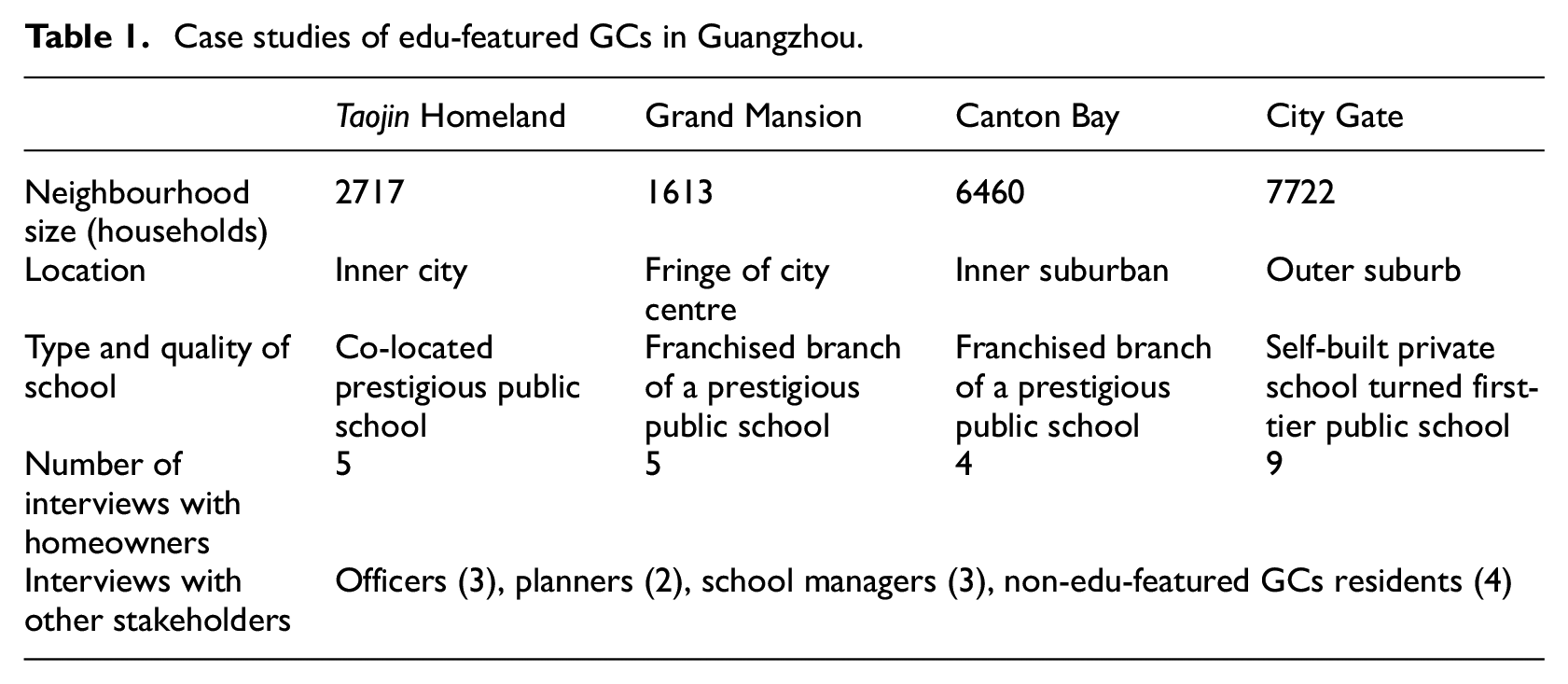
Table 1 summarises the key features of the four study cases. The first case ‘Taojin Homeland’ is an inner-city neighbourhood built next to Zhongxing Primary School, a prestigious public school. Although access to Zhongxing Primary School is not exclusive to residents of Taojin Homeland, most middle-class parents chose to move into this neighbourhood primarily to seek quality education for their children under the ‘attending nearby school’ policy, typically based on homeownership. Our second case, ‘Grand Mansion’, is situated in the heart of Pazhou New Town, the location of the international Canton Trade Fair. Developed by Poly in 2016 as a luxury GC, Grand Mansion’s residents are mostly upper-middle-class households attracted by the picturesque river views, well-manicured green spaces and top-tier property management services offered in the neighbourhood. The establishment of a new branch of a brand-name public school, Zhixin Middle School, in 2018, to which homeowners in this neighbourhood are granted access, further enhances its property values. The third case ‘Canton Bay’ is a residential project of New World Development at the southwestern fringe of Liwan District in central Guangzhou. Canton Bay is surrounded by old factory buildings and low-rise dwellings, presenting a stark contrast to its high-rise and high-density development. A new branch of Xiguan Pui Ching Public School, registered as a Cambridge International School, was built adjecent to the south gate of Canton Bay. Our fourth case, ‘City Gate’, is a suburban, large-scale neighbourhood developed by Vanke, featuring a school that was initially privately established by Vanke and later transferred to local education authorities, ultimately becoming a first-tier primary school in Huangpu District.
These four cases are representative examples of edu-featured GCs in Guangzhou, characterized by quality public schools and privatised neighbourhood services. Multiscalar actors including the entrepreneurial local state, real estate developers, and homeowners, are actively involved in the development and operation of these four edu-featured GCs. Taojin Homeland represents co-locating edu-featured GCs, as this residential project was built within the catchment zone of an existing prestigious public school. Grand Mansion and Canton Bay are franchising edu-featured GCs located in the inner city and suburb, respectively, which provide privileged access to quality schooling for homeowners. City Gate was initially a self-built edu-featured GC, with the developer privately constructing and operating the affiliated school before converting it to a public school, although the school board of City Gate still maintains a significant degree of autonomy. Through the analysis of multiple case studies, this research explores the different processes and outcomes of entrepreneurial governance in relation to the development and evolution of edu-featured GCs. It also identifies the specific conditions, approaches, and results of homeowner activism aimed at securing school places. Based on our research themes, interviewees were selected based on four criteria: (1) homeowners with school-aged children actively participated in education-related community affairs; (2) real estate companies managers knowledgeavke about the development process of edu-featured GCs; (3) government officials responsible for education and grassroots social conflicts resolution; and (4) urban planners involved in planning education facilities in Guangzhou. Each interview took place in the venues chosen by the interviewees (offices or public spaces) and typically lasted for one to two hours. During our fieldwork, we maintained ourselves as ‘outsiders’ to gain an objective and accurate understanding of homeowner activism and their interactions with other stakeholders.
An analysis of semi-privately governed edu-featured GCs and the prevailing shareholder value among multiscalar actors allows us to comprehend how the local state, developers and homeowners engage and interact in multidirectional entrepreneurial ventures. Although the construction of edu-featured GCs mainly occurs at the neighbourhood scale, entrepreneurial practices aimed at securing investment in property development and quality education resources extend beyond physical boundaries and involve multiscalar players and strategies. First, the local state supports the development of edu-featured GCs for three main reasons: (1) to alleviate the fiscal burden of local authorities by relying on developers to construct school buildings and provide school facilities (e.g., playgrounds, cafeterias, sports courts) as a condition for developing residential projects; (2) to distribute quality education resources from the inner city to other urban areas; and (3) to leverage education resources to attract private investment in urban (re)development. It is common for the entrepreneurial local state to serve as a ‘broker’ between willing developers and leading schools to bring quality schools to newly built residential projects. Some developers offer ‘donations’ amounting to tens of millions in exchange for school places in prestigious public schools or for building new branches. These ‘education donations’, paid to local education authorities, are then used to improve education quality in other school districts (interview with a senior planner, August 2021). Therefore, entrepreneurial local state agents, especially education authorities, strategically leverage developers’ investment in edu-featured GCs to stimulate urban development and improve public education in their jurisdictions, all under the guise of promoting education equalisation. Second, speculative developers are indispensable to the proliferation of edu-featured GCs, as they meticulously ‘import’ quality schools and package them with residential projects to lure middle-class homebuyers and generate substantial premiums. The costs associated with importing high-quality education and the long-term risks associated with investments in land, housing, and school construction are largely transferred to homebuyers. This lucrative model of residential development has been duplicated by developers in numerous Chinese cities until the central government initiates crackeddowns on the rapid expansion of private education in 2016, 2018 and 2021, respectively. 2 Nevertheless the introduction of education groups by local states has provided new incentives for developers, as previously elaborated. Third, the growing demand for both quality housing and education has rendered edu-featured GCs an attractive investment for Chinese investor-citizens. Homebuyers of edu-featured GCs perform as entrepreneurial individuals who benefit from property value appreciation induced by the consistent demand for privileged access to prestigious public schools. They also gain enhanced social and cultural capital by participating in a network of like-minded middle-class neighbours. In response to the rising demand for edu-featured GCs, innovative education policies and practices that facilitate the semi-private provision of public schooling, such as building franchised schools, merging weaker schools, and redeveloping/upgrading school campuses to create additional school places, have received enthusiastic support from investor-citizens. United by the concept of shareholder value and the expectation of high returns resulting from the bundled education resource and housing property, multiscalar actors collaborate in entrepreneurial endeavours to promote and safeguard the development of edu-featured GCs through multidirectional interactions involving conflicts, contestations, and compromises.
Homeowners’ struggles for the exclusive right to public schools
The popularity of edu-featured GCs reflects parents’ strong willingness to pay for scarce education resources bundled with residential services, which is also commonly rationalised as a wise investment in real estate and cultural capital for investor-citizens. In China, holding a local hukou (household registration) based on homeownership is the decisive factor for gaining admission to public schools. As a result, middle-class parents actively engage in buying housing in the catchment zone of their preferred schools, considering it a crucial family investment. While competition in the housing market to access school places is ubiquitous worldwide, the club approach to schooling in edu-featured GCs reinforces the perception that the privilege of attending well-performing public schools is reserved for the elite. Compared with the old and cramped edu-apartments concentrated in the inner city (see Wu et al., 2018), Taojin Homeland offers significantly better housing and living conditions. Few residents see this neighbourhood as a permanent home, but rather a worthwhile investment in education and housing. When asked about her family’s relocation plan, one interviewee, a stay-at-home mom of an 11-year-old boy, replied: We bought the current apartment when our child was just born. Our neighbourhood offers the opportunity to study in one of the best primary schools in the city…After my child is admitted to the university in the future, we definitely will sell this property and give the school place to others who really need it. In fact, this neighbourhood is more suitable for families with school-age children.
Another resident of Taojin Homeland confirmed that he had spent a significant amount to buy a tiny apartment there for his son to have access the school, and he considered his money well spent. He praised the developer’s astute business sense. A female resident also spoke highly of Taojin Homeland, convinced that the good school and central location of the GC could ensure considerable growth in property values. From the perspective of real estate developers, not all residential projects should be equipped with good schools. They need to carefully weigh the expected return against the trade-off between investment in education facilities and other development expenditures (e.g., land leasing and infrastructure construction costs). As a manager from a leading real estate company bluntly told us, ‘If target customers of a project are from the lower-class (diaosi in Chinese), nobody will consider spending a huge amount of money and effort to attract good education resources to support it’. In this sense, developers have to align ‘shareholding’ values with the ‘right’ type of investor-citizens, nameky, the middle and upper class, to protect and boost property values, thus ensuring profitability.
Given the importance of quality education in the competition for university admissions and future job prospects, top public schools are the primary goals for middle-class parents in China, especially since private education faced significant restrictions imposed by the central state after 2016. While participating in the fierce competition for school place, parents recognise the need to meticulously evaluate the quality of schools. In the case of Grand Mansion, the initial batch of homebuyers did not know precisely which school would be built, despite the developer’s promise to provide a reputable school. The recent policy promoting education group development in Guangzhou heightened their concerns. Most expressed reservations about the teaching quality of the yet-to-be-built school. In their opinion, a new branch of elite schools with just a prestigious name may suffer from limited resources and low performance. Only when a franchised school is directly managed by the leading school with experienced teachers and administors being dispatched from the main campus can they guarantee their children’s academic performance. To address homeowners’ concerns, the completion of a franchised school covering 30,293 square metres, the Zhixin Experimental School at Pazhou located in the nearby block of Grand Mansion, marked the inauguration of one of the city’s most expensive franchised public schools in 2018. For parents, having their children study on the new Zhixin School campus is perceived as a golden opportunity to prepare them for the best schools at the next level of educational. Property values in this neighbourhood significantly increased immediately after this much-welcomed news was released, well before the school was established. This effect greatly inspires investor-citizens to become ‘shareholders’ of such high-return ventures. As one father of two recalled: There was a huge difference in housing prices before and after the establishment of the new Zhixin School campus. Do you know that almost all the real estate agents, all of a sudden, announced an increase in the listed prices of our community? Within a very short time, transaction prices rose from around 70,000 yuan/m2 to approximately 100,000 yuan/m2. Although housing prices in Guangzhou experienced substantial increases at that time, the effect of the school (on housing prices) was still remarkable.
As mentioned earlier, Guangzhou’s local governments are key shareholders who actively invested in the development of edu-featured GCs to enhance the value of their shares. To achieve this goal, local governments, including municipal and district governments, strategically encouraged the active participation of other stakeholders, such as developers, education groups and middle-class parents in the delivery of K–12 education. They exploited this as an entrepreneurial means to channel a fresh wave of capital into new urban spaces where quality schools had previously been scarce. The following quotation from a middle-class parent living in Grand Mansion, who perceived himself as a shareholder of edu-featured GCs and the broader urban development of Pazhou, illustrates his understanding of the district-level government’s entrepreneurial efforts in establishing the new Zhixin School campus to enhance the attractiveness of residential real estate.
As one of the most crucial development zones in Guangzhou, Pazhou deserves better education resources. The main campus of Zhixin School is located in Yuexiu District, which is quite far from our neighbourhood. I believe the Haizhu district government has made substantial efforts to facilitate the establishment of the franchised school. There has long been a shortage of good-quality education resources in Haizhu District, and they (the district government) are highly motivated to attract more reputable public schools, especially in the newly developed areas.
A senior planner also confirmed that governments and their private sector partners (developers) in Guangzhou frequeently exploited education resources to leverage new town development and urban redevelopment: Both municipal and district governments fully comprehend the strategic importance of education resources. Rent-seeking behaviour is inevitable. Some shrewd developers thus managed to convince the district government to help them attract top school branches to their residential projects to enhance property values. Ultimately, this is a win–win game; after all, education is the foremost investment for parents …
Despite state-orchestrated capital accumulation through channelling private investment into education and urban (re)development, the withdrawal of local authorities from the daily operation of franchised schools foreshadowed some later problems. Due to China’s education decentralisation reform, K–12 schools have considerable autonomy concerning admission criteria and curricula, upholding the promise of the developer to admit only homeowners’ children. Homeowners in edu-featured GCs perceive privileged access to neighbourhood-affiliated schools as the key factor in maximising their shareholder value and believe this privilege should be reserved for homeowners. However, residents of Canton Bay uncovered the phenomenon of ‘banknote students’ who paid extra money to attend Xiguan Pui Ching School without local hukou, which sparked strong discontent among homeowners. They were concerned that the school’s profit-driven behaviour would have negative effects on property values. The breach of the ‘contractual agreement’ among shareholders (homeowners, schools, and local governments) irritated homeowners who took their participation in this entrepreneurial practice very seriously.
Furthermore, homeowners in Canton Bay reported a serious shortage of school places in Xiguan Pui Ching School. The demand for admission to the primary school in Canton Bay exceeded supply in 2021, resulting in some first-year students being unable to attend the school, even though their parents were homeowners. According to the floor plan of this school (with a maximum of 18 classrooms), each of the six grades had a quota of three classes. However, the school had been over-enrolled since 2018 until they ran out of classrooms. This aroused discontent and indignation among parents of children ready for primary schooling. One of our interviewees briefly described how angry parents took vigorous actions to claim their promised exclusive rights to schooling, including joining group petitions, collecting signatures of residents, and presenting their statements to the local education department in Liwan District. Initially, the district education authority did not respond promptly to homeowner activism for school places organised by residents of Canton Bay. Parents then raised objections and protests with the municipal government, arguing that the shortage of school places not only disrupted their lives as consumers but also violated the contract of edu-featured GCs they had signed with developers and local authorities. To quell the public outrage, a comprehensive school expansion plan was announced at the end of August 2021. In this plan, Guangzhou Municipal Planning and Natural Resources Bureau approved the reconstruction of a four-floor complex in Xiguan Pui Ching School, and Liwan District Education Department was tasked with overseeing the expansion project. Consequently, the school announced their plan to enroll up to six classes of first-grade pupils the following year. These additional school places generated from the reconstruction of the school campus, were promised exclusively to homeowners of this community. In this case, the activism of investor-citizens was ‘successful’ and helped prevent any undermining of the ‘shareholding enterprise’ formed by multiscalar actors to ensure its smooth operation towards common entrepreneurial goals. However, this ‘victory’ came at the expense of school choices for non-homeowners.
City Gate, the fourth case of edu-featured GC in this research, faced a credibility crisis regarding the provision of school places in recent years. In 2016, acute conflicts arose due to unequal access right to schooling among City Gate’s residents living in different sub-divisions. City Gate Primary School, decided not to admit children from Area C because of limited school places. Many parents living in Area C took collective action and voiced their demands for school places. As one participant put it, ‘It is unreasonable to exclude us from school admission merely because our apartments are located in Area C. We, like other homeowners from Area A and B, bought the housing at almost the same price’. Notably, opinions among homeowners in City Gate began to diverge. The proposed school enrolment policy that excluded students in Area C was openly supported by some parents living in Area A and B because they believed it could protect their privileged access to the school from being shared by ‘others’, further intensifying controversies within the GC. As a result of the growing discontent and disputes, the Huangpu District Education Department held a consultation meeting with multiple stakeholders, including affected parents, school managers and grassroots officials, to devise a solution. Under pressure from local authorities, City Gate Primary School revised the enrollment plan and began converting some campus spaces, such as teachers’ offices, utility sheds and multi-functional rooms, into new classrooms to accommodate more pupils. Eventually, homeowners from Area C defended their right to schooling and regained their admission eligibility. However, the fundamental problem of insufficient school places in City Gate persisted. Two years later, parents were informed that the school was once again unable to admit all school-age students. The temporary solution proposed by local education authorities was to use a school-place lottery to determine admission rights, with the remainder of the children being transferred to other public schools nearby. What is worse, since 2022, the school has begun to differentiate homeowners’ schooling rights based on the length of residency and housing tenure (i.e., first-hand ownership and second-hand ownership). Parents with longer residency and owners of first-hand housing were placed priority for access to City Gate primary school, while recent homebuyers were placed at a disadvantage. In response, a group of affected parents organised to defend their rights, and similar actions recurred every year: In our neighbourhood, parents whose children are enrolling in primary school this year joined the WeChat group formed two years ago to organise activism. I remember that one year, as a result of rights-defending actions, the primary school was expanded. However, this year, the primary school places were once again in short supply, and nearly 100 children could not study there. The school and the district government failed to keep their promise to homeowners.
Another activist in City Gate expressed their strong motivation for collective actions. A clear consciousness of the shareholder value as an investor-citizen was growing among residents of edu-featured GCs during their interactions with the schools and local governments: When we signed the home-purchasing contract, the developer promised to provide school places to owners. They [the developer and the Education Bureau] should not break their promises. In mid to late March, some parents approached the District Education Bureau to petitions, but they did not receive satisfactory replies. After that, we went to the Education Bureau again in April. I also called the government hotline, and almost all parents have lodged formal complaints about school places. As homeowners, we are justified in claiming our rights. After all, we invested our lifelong savings in these housing properties [and associated services]. If the local authorities failed to anticipate the growing demand for school places, they should find a way to fix it, rather than leaving the homeowners to bear the consequences …
Led by several capable homeowners, the activism for school places at City Gate achieved another victory: they were allowed to send their children to a reputable public school affiliated with another GC within walking distance as a make-shift solution. Nonetheless, this solution faced protests from homeowners in the neighbouring GC, as it infringed on their exclusive rights. While still grappling with this activism, local authorities learned a painful lesson in their future planning for school places and coordination among different stakeholders to sustain the entrepreneurial neighbourhood governance model centred on education resources.
With the fast development of edu-featured GCs in Guangzhou, conflict related to school places began to surge. Initially, homeowners’ disputes over schooling emerged as sporadic incidents. Now the undersupply of school places and resultant homeowner activism has become a pervasive problem associated with the semi-private governance within edu-featured GCs. It is not uncommon to find parents strategically organising right-defending activities to voice their demands, as demonstrated in the cases of City Gate and Canton Bay. Homeowners’ collective actions eventually forced these schools to make changes, including conducting a reconstruction plan and adjusting admission conditions. In the face of frequent homeowner activism, local authorities adjusted policies accordingly to rectify the problems in planning and governing edu-featured GCs. For instance, district-level education departments issued warnings aboust school place shortages in certain edu-featured GCs and made arrangements to ensure all school-aged children in edu-featured GCs could study in surrounding public schools. Although large-scale homeowner activism concerning school places did not take place in the cases of Taojin Homeland and Grand Mansion (partly due to the relatively balanced supply and demand for school places), parents still worried about the quality of schooling and their privileges associated with their heavy investment in housing and education. In all four cases, homeowners’ concerns and activism create an effective feedback loop to sustain the ‘shareholding enterprise’ of the pro-growth coalition led by the entrepreneurial local state, thus ‘rectifying’ the defects of this ‘enterprise’ and optimising its entrepreneurial strategies through bottom-up processes. However, this does not genuinely improve education and housing equity. On the contrary, while GC homeowners are empowered by the shareholding enterprise formed together with the local states and developers as an important mechanism of urban entrepreneurialism, social inequalities associated with the club provision of public education are further reinforced. Worse still, this ‘effective’ model of entrepreneurial governance will be replicated by local states and developers in wider regions through suburbanisation and urban redevelopment.
Conclusions
This study unpacks grassroots entrepreneurial practices in the form of homeowner activism in edu-feature GCs featuring exclusive provision of education service for GC residents, a topic rarely explored in the literature of urban entrepreneurialism. Homeowner activism constitutes an integral component of the multidirectionality and multiscalarity of urban entrepreneurialism. The semi-private governance mode based on the club economy in edu-featured GCs serves as a platform and prerequisite for homeowners to exercise their entrepreneurial endeavours while aiding the entrepreneurial local state and developers in sustaining the development of edu-featured GCs and related entrepreneurial governance. Multiscalar actors involving local authorities, developers and homeowners are drawn together by the expected high returns from this peculiar form of development. For the entrepreneurial local state, edu-featured GCs can not only enhance the tax base by attracting wealthy households but also leverage urban (re)development in less attractive areas (He, 2022). Meanwhile, the extremely high premium has attracted many leading real estate developers in the country to invest heavily in this emergent form of residential development until most recently. For investor-citizen/homeowners, the attraction is obvious. After all, the privilege associated with homeownership to access well-performing public schools within or near the GCs is the dream of many middle-class parents. The semi-private governance mode at GCs thus forms the institutional basis for the ‘shareholding’ enterprise involving multiscalar actors and gives rise to multidirectional entrepreneurial governance as the story of edu-featured GCs unfolds.
This study highlights the critical role of middle-class homeowners in urban entrepreneurialism. Previously perceived as the receiving end of entrepreneurial strategies, homeowners have identified themselves as important shareholders of the local pro-growth coalition centred on edu-featured GCs. They can not only benefit from property value appreciation and gain exclusive access to quality schools through their investment in edu-featured GCs but also are able to voice their demands to influence entrepreneurial policy-making of the local states when their expectations are not met. With the spread of edu-featured GCs in Guangzhou, homeowners in edu-featured GCs have encountered the problem of limited school places and other education-related issues, which undermines the basis for shareholder value and related entrepreneurial endeavours. The club approach of edu-featured GCs, to some extent, did not deliver on its promise of exclusive access to quality education, leading to ubiquitous homeowner activism through informal debates, formal complaints, group petitions and protests. These struggles, in turn, help rationalise the shareholder value among homeowners to legitimise the exclusionary arrangements of schooling that benefit the homeowners yet exacerbate inequalities in wider contexts. More importantly, these grassroots struggles unsettle and influence entrepreneurial governance at the neighbourhood and municipal level through intense interactions with local authorities and developers. As an important ‘shareholder’ of the multiscalar entrepreneurial governance, investor-citizens/homeowners’ discontent may threaten the stability of the ‘shareholding enterprise’ associated with edu-featured GCs. To rectify these problems and stabilise the institutional basis for entrepreneurial governance, local authorities had responded promptly to the requests of homeowners to offer solutions for missing school places and even adjust the general education policies and strategies in the metropolitan region.
A close examination of the general development of edu-featured GCs and the four study cases in Guangzhou, we argue, enriches the understanding of the multiscalar and multidirectional urban entrepreneurialism. The multidirectionality of the evolving entrepreneurial governance driven by multiscalar actors can be seen in several bottom-up and top-down processes explored in this study: (1) the rising demands from investor-citizens (homeowners) inspired the private sector and local states to develop and sustain edu-featured GCs through policy innovations, for instance, introducing education groups after private education was suppressed; (2) investor-citizens are attracted to edu-featured GCs and join forces with the local state and developers based on commonly recognised ‘shareholder value’ to form the ‘shareholding enterprise’ or the pro-growth coalition building upon the semi-private governance mode of GCs; (3) the unmet demands and/or unsatisfactory provision of quality education have pushed homeowners to engage in various forms of struggle and subsequently to demand local authorities fix the defects of the ‘shareholding enterprise’ and optimise the operation of entrepreneurial governance.
One major consequence of this highly responsive and ‘effective’ multiscalar and multidirectional entrepreneurial governance is the consolidation of the shareholding enterprise involving multiscalar shareholders. Furthermore, the exclusive provision of public goods based on semi-private governance exacerbates housing and education inequalities in metropolitan areas (Cai et al., 2022; He, 2022). These findings have a multitude of policy implications. As edu-featured GCs have been widely developed under a prevalent entrepreneurial culture, efforts to enhance education equity cannot rely solely on the provision of more quality schools and school places but should also consider issues outside the educational system, particularly the housing system. The club mode of education provision bundled with housing consumption forms the basis for a resilient shareholding enterprise among local states, developers, and homebuyers. The conflicts between these key shareholders, e.g., homeowner activism, do not unsettle but reinforce this shareholding enterprise through activating an effective feedback loop informing the multiscalar and multidirectional entrepreneurial governance. This has become a culprit of intensified housing and education inequalities. We thus advocate for a shift from shareholder value to stakeholder value in housing and education provision, and urban governance in general, to enable more inclusive development at the neighbourhood and metropolitan scales. In other words, not only the concerns of ‘shareholders’ of the edu-featured GCs, but the wider communities’ broader interests, including those outside of the GCs, should be taken into account in the governance of housing development and education resources distribution.
Seeing through the conceptual lens of shareholder values, this study mainly considers middle-class homeowners as shrewd investor-citizens, while paying less attention to their political, social, and cultural demands and implications. Future research could broaden the lines of enquiry to explore the socio-political consequences of the rising edu-featured GCs and associated homeowner activism. Moreover, cross-city comparisons could enrich our understandings of the context-specific processes of entrepreneurial governance involving multiscalar actors and multidirectional pathways. Future studies can also explore entrepreneurial endeavours initiated by urban actors at regional, national and international scales.
Footnotes
Declaration of conflicting interests
The author(s) declared no potential conflicts of interest with respect to the research, authorship, and/or publication of this article.
Funding
The author(s) disclosed receipt of the following financial support for the research, authorship, and/or publication of this article: Research Grants Council of the Hong Kong SAR, China, Grant No. 17614720; and National Social Science Foundation of China, Grant No. 22CGL058.
