



Abstract
Saudi Arabia’s ‘Vision 2030’ proposes a more diversified society and a less oil-dominated economy, enabled by several ambitious best-practice sustainability urbanisation projects, one of which is the ‘Journey Through Time’ Masterplan for the urban region of AlUla in the Kingdom’s Hegra Valley. The Masterplan proposes an expansion and intensification of existing towns, economically supported by international tourism focused on the Hegra UNESCO World Heritage Site. It thereby couples tangible cultural heritage management with sustainable urban development. Yet the AlUla Masterplan has shown little evidence of engaging with the intangible heritage of traditional ecological knowledge and practices, known in Arabic as hima, which have been intrinsically connected to the ancient heritage fabric for millennia. Based on interviews with community elders and traditional knowledge-holders, site observations of traditional practices and techniques, and a review of government documents and websites, this paper demonstrates that consideration of local hima practices has the potential to integrate urban sustainability transitions together with the preservation of tangible and intangible cultural heritage. It suggests that practices embedded in local hima, like water-use and land-use arrangements, offer sustainable resource management and disaster mitigation options for the AlUla scheme; and that hima’s intrinsic social dimension, and its culture of intergenerational transmission, offers opportunities to connect heritage, community and the regional environment. Our research concludes with the benefits of integrating hima traditional ecological knowledge with cultural heritage preservation and urban modernisation, offering an approach to sustainable transformations of the region’s cities, communities and sometimes fragile resources.
Introduction
In 2016, the Saudi Arabian government launched ‘Saudi Vision 2030’, a 15-year national strategic plan for a more diversified society and a less oil-oriented economy. Amongst its stated goals, there is an explicit focus on environmentally sustainable urbanism, which will accompany new sources of employment, economic growth, improved quality of life for its citizens, conservation and promotion of natural and cultural heritage, and preservation of community values and participation (Saudi Vision 2030, 2016b).
One high-profile project that manifests the Vision is the USD 15 billion development of AlUla, which is outlined in the AlUla ‘Journey Through Time’ Masterplan (AMP). AlUla is both a city and a region 1 and currently has a population of 64,300 people (AFALULA, 2019), distributed mainly across 16 settlements 2 through the Hegra Valley (Figure 1). By 2035, the Saudi government aims to grow the population across the 16 settlements to 130,000 (RCU, 2021) by consolidating existing settlements into a connected, polycentric urban region supported by tourism and modern infrastructure (World Tourism Organization, 2020). The major tourism drawcard is the monumental rock-carved tombs that form part of the UNESCO World Heritage-listed Hegra Archaeological Site, near Hegra town, which is one of the 16 settlements. The ambitious AMP aspires to advance the economic goals of the region by developing this heritage into ‘The World’s Largest Living Museum’ (RCU, 2022). Its urban development will focus on global best-practice sustainability. Its biodiversity ambitions entail setting aside 80% of the county’s land as natural reserves, where vegetation restoration and animal species reintroduction are proposed (RCU, 2021). Water-sensitive agricultural plantations, dubbed ‘cultural oases’, will enhance the appeal of the areas around the town and village cores. In this way, economic sustainability will be cultivated not only by cultural heritage tourism but also by agrotourism and ecotourism (RCU, 2023). Branded the ‘Wadi of Hospitality’, 3 AlUla aims to attract 2 million international and domestic visitors and create 38,000 new jobs (three-quarters in the hospitality sector) (RCU, 2021). In this undertaking, the strategy affirms that the longstanding local communities of the AlUla region will be the core of the transformation (Saudi Vision 2030, 2016a).
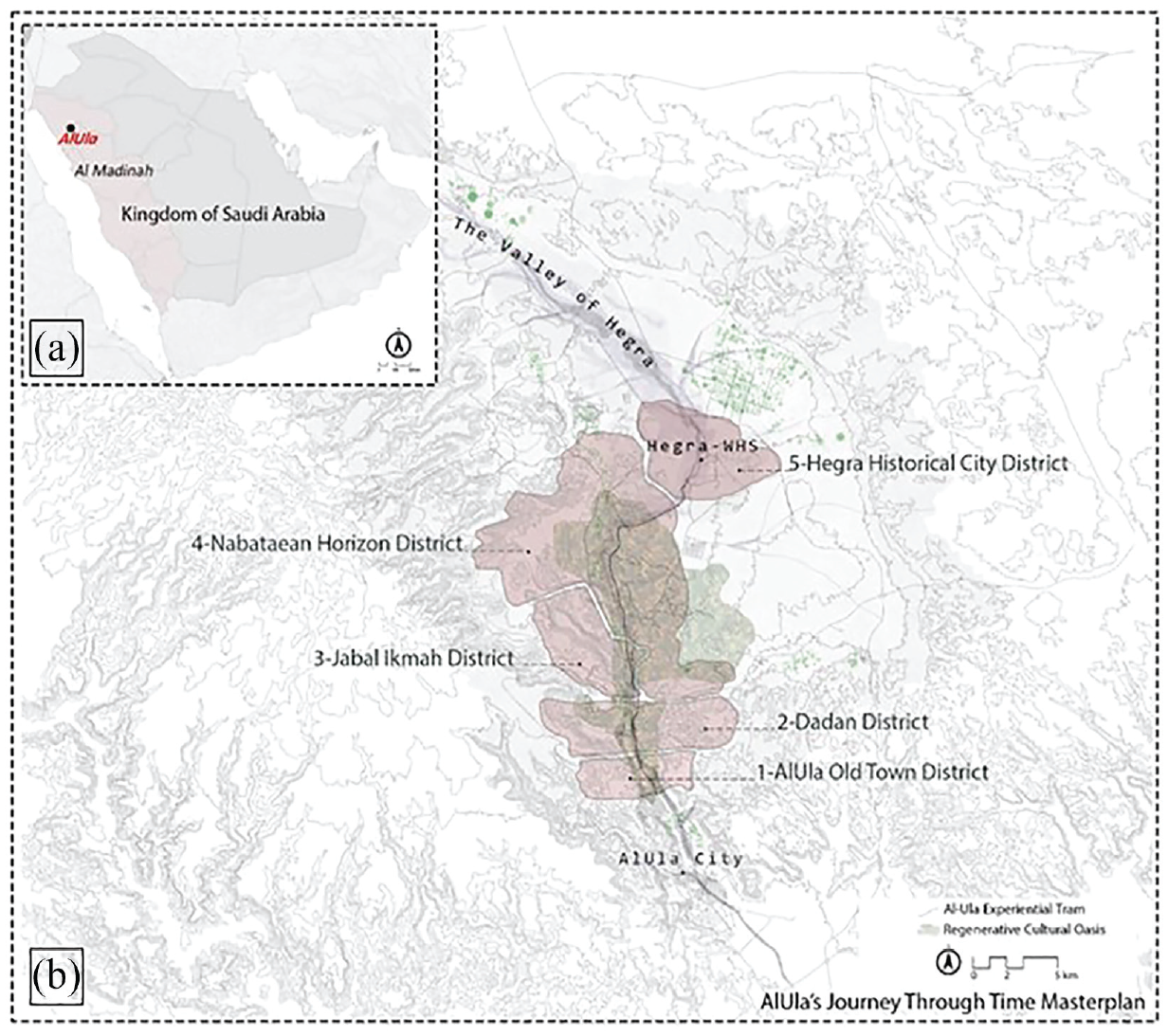
(a) AlUla is located in the northwest of the Kingdom of Saudi Arabia (by Author). (b) AlUla’s five proposed development precincts follow the Hegra River.
However, from our research with those communities, there are tensions between the AMP strategy and the cultural practices that have sustained human life in these desert ecosystems, and that have prioritised care for heritage artefacts for more than 14 centuries. These cultural practices are embodied in local traditional ecological knowledge (TEK) of the region’s communities. The TEK here is known in Arabic as hima (Marsuki, 2009: 215–216). The term hima literally indicates a protected place or territory (Kilani et al., 2007; Llewellyn and Altlasat, 2017: 8), but, in practice, hima is not only spatial but also social and cultural, referring to a range of interconnected types of community knowledge, landscapes, practices and institutions. The knowledge primarily concerns land management for grazing or farming activities. It has established traditional rules and practices governing local natural resource management, including water use and vegetation conservation, habitat protection, and regeneration (Gari, 2006; Kilani et al., 2007). Since the 5th century AD and across changing cultures and technologies, hima knowledge has been transmitted intergenerationally and has adapted practices to sustain human habitation in desert environments across the Arabian Peninsula, fostering enduring relationships between people and natural ecosystems (Gari, 2006; Kilani et al., 2007; Llewellyn and Altlasat, 2017: 8–9). However, despite hima’s cultural longevity, most hima territories were officially abolished by an official decree in 1954 as part of modernisation policies (Kilani et al., 2007). Consequently, many hima practices have almost disappeared, apart from in a few, principally rural, isolated areas where they continue to be practised informally (Gari, 2006; Kilani et al., 2007; Mazzetto, 2023).
Recent research and scholarship have emphasised the importance of TEK in many places across the world and recognise its potential to inform national and supra-national development agendas (e.g. Suleiman et al., 2013). TEK offers authentic models for understanding the mutualistic web of relations between humans and other living beings, and examples of its practice demonstrate that local knowledge protects, adjusts, adapts, utilises, and sustains natural environments and the resources they afford (Berkes et al., 2000). TEK has been, not surprisingly, embedded in local social and cultural norms (AbuZinada et al., 2004; North, 1990) and continues to shape decision-making about community well-being and natural resource use within many indigenous societies (Parween, 2021). In places where globalised tourism has displaced and fragmented local communities, TEK is seen to have the potential to reconnect them with fine-grained environmental management (Allan et al., 2019). This may be the case for AlUla, with its intended urban expansion into the fragile mountainous desert environment. But thus far, the AMP’s planning and promotional documents have not addressed the local hima TEK.
This paper focuses on the tensions in AlUla between the developmentalist vision centred on global values, and the local community culture centred on living in desert ecosystems. To draw out the tensions, we re-frame the AMP’s sustainability principles through the lens of hima, using our research into local hima practices as a basis for suggesting how the sustainability goals of the AMP might take better account of place-specific environmental realities and challenges, whilst also integrating intangible with tangible cultural heritage preservation. We substantiate this comparison with a description of our qualitative research into local hima practices in the AlUla region, adapting the approaches of Abdallah (2013) and Llewellyn (2013). Our goal is to understand how both the AMP and hima can be reconciled in order to build socioecological processes (Gandy and Jasper, 2020) and cultural resilience, adaptation, and sustainability (Yun and Yi, 2023).
Methodologically, our research entailed a review of the Arabic-language literature and documentary sources about current and historical hima practices among communities in the AlUla region; individual semi-structured interviews with 11 local community elders esteemed for their expertise in the traditions of hima knowledge and practices (known in Arabic as Ahlul Hal Wal Aqd), literally ‘those who are qualified to unbind and to bind’ or ‘the wise locals who are capable of making decisions’ (Al-Gilani, 2005: 48); and site observation and documentation, undertaken during May and June 2022 at 24 key locations recommended by elders in and around AlUla Old Town and Hegra with the most traditional settlement and land-use practices. During the site visits, we engaged in participatory walking with five elders and documented the experience through methods outlined by Backhaus et al. (2016), such as photographing, recording, note-taking and sketching. Selection of individual Ahlul Hal Wal Aqd for the interview was based on the recommendations of community members in the AlUla region and the snowball sampling method (Noy, 2008) to ensure diverse representation from different villages. The elders who participated were chosen because of their local practice-based knowledge of water resource management, traditional agricultural activities, hunting and pasturing, and regional history. As key decision-makers within their communities, they take responsibility for resolving environmental concerns and social conflicts and handing down knowledge. The interviews were transcribed before being coded and analysed (following the framework proposed by Braun and Clarke (2012) in relation to themes within contemporary environmental conservation, landscape and resource management, and landscape planning and design. Some site visits and observations were undertaken in the company of community elders.
Possible impacts of the AlUla development project on local traditions and practices
Hegra’s most distinctive feature is 111 Nabatean tombs carved directly into sandstone outcrops and hills that protrude from the now sparsely populated desert landscape (UNESCO, 2008). The tombs are the legacy of the Nabataean Kingdom of the 1st century BCE, when Hegra served as the kingdom’s southern capital (the internationally well-known archaeological site at Petra in Jordan was the northern capital) on the trans-peninsula trading route that was the major source of their wealth and power (Nehmé, 2013; Nehmé et al., 2006; UNESCO, 2023). Nabatean people also farmed the desert ecosystems and built complex water management infrastructure from underground water sources (some of which remain intact). Archaeologists have shown that the Nabateans, as part of their system of governance across the region, designated some sanctuary areas for water conservation (Alpass, 2013: 139; Raymond, 2008: 51) to allow them to sustainably manage natural resources and ensure the long-term viability of their community and its environment. These practices have been interpreted as a precursor to the later emergence of hima in the Arabian Peninsula (Alhammori, 2002). Under Islamic law, hima became an officially recognised legal category (Abdallah, 2013; Llewellyn and Altlasat, 2017: 3–4). During the Islamic Middle Ages (between approximately the 9th and 15th centuries) hima became widespread across both urban centres and rural areas. Key practices that were regulated here through hima included rotational grazing, the establishment of protective boundaries, revegetation (Zahran and Younes, 1990), care for tangible cultural heritage, and the implementation and sustainable management of various water harvesting and conservation techniques such as dams, canals, ponds and wells (Al-Shanqiti, 2013, 2019; Gari, 2006).
Despite being marginalised in the 21st century, hima has continued to persist as a knowledge system and set of practices in the AlUla region. Overseen by local Ahlul Hal Wal Aqd, with their deep understanding of longstanding socioecological dynamics (Eben Saleh, 1998: 179), hima is used to manage natural resources, including pasturelands, hunting grounds, water sources and rainwater harvesting systems (wells, springs, storage cisterns and natural basins); social resources such as recreational spaces; and cultural resources, like the ancient tombs and water infrastructure. Many of these resources are found today in what have been described as hima territories. Their spatiality varies widely in size, ranging from fenced-off parcels as small as 8–10 hectares to expansive open areas exceeding 1000 hectares (Llewellyn and Altlasat, 2017; Zahran and Younes, 1990). Researchers have categorised hima territories into three distinct management levels: section hima (supervised by multiple villages), village hima (managed by a single village) and individual hima (privately operated by a few individuals) (Serhal et al., 2011; Zahran and Younes, 1990), all of which our research has shown are present in the AlUla region.
Some researchers have already raised concerns that the current large-scale urbanisation proposals, such as AMP, with their focus on the tourism value of the tombs, ignore traditional lifestyles and local communities’ needs (Alahmadi, 2021; Alrawaibah, 2017; AlSayyad, 2001; Alshami et al., 2023; Imon, 2017) and thereby threaten the sustainability of traditional hima practices (Alahmadi, 2021: 30). While the AMP states that it intends to empower locals in leading the development in partnership with international collaborators and experts (World Tourism Organization, 2020), and while some local representatives have reported being involved in official institutional programmes related to the development,
4
to date the AlUla proposals have primarily been formulated and promoted with an eye to the luxury domestic, regional and international tourism markets (see some examples marketed in Experience AlUla, 2024). This has created a disjuncture between the cultural value of hima heritage and the economic value of heritage tourism. One example of this disjuncture is already apparent in the AMP’s language, which erases attachment encoded in traditional place names, as foreshadowed by one of the interviewed elders: In the area of traditional place names … our agricultural oases have now been renamed ‘cultural oases’ in the new development. The experts don’t know about the history of our place … When someone develops a place without locals’ involvement, they will contribute to the loss of traditions, given that they are not aware of the value of the place.
5
Other Ahlul Hal Wal Aqd interviewed were concerned that AMP project designers did not understand the importance of preserving traditional landscape modifications. For example, the traditional oqoom (sand berms – see Figure 2) constructed to reduce risks from flash floods would be demolished as part of roadworks; the new construction in sensitive water catchment zones would degrade local water supplies; and the introduced plant species with high water demands, such as oranges, would further strain the already limited water resources within the area. One elder 6 said that traditional infrastructures of springs, have been sustained by deep knowledge of water flow in the environment, the way springs function, and regular cleaning practices, something that reductive modern design, standardised systems operations and simplified maintenance procedures are often intended to minimise. At least five freshwater springs around AlUla region have been in use for more than 100 years and are still maintained using traditional techniques. In contrast, all the springs in the areas designated as ‘cultural oases’ in the AMP have either dried up or are no longer maintained (Nasif, 1995). It is currently unclear if there are plans to restore these springs or if water features shown in landscape design renderings will use mechanical pumps and piped-in water. This is just one of several instances where the AMP has the potential for possibly deleterious socio-environmental change that is counter to the fundamentals of hima.
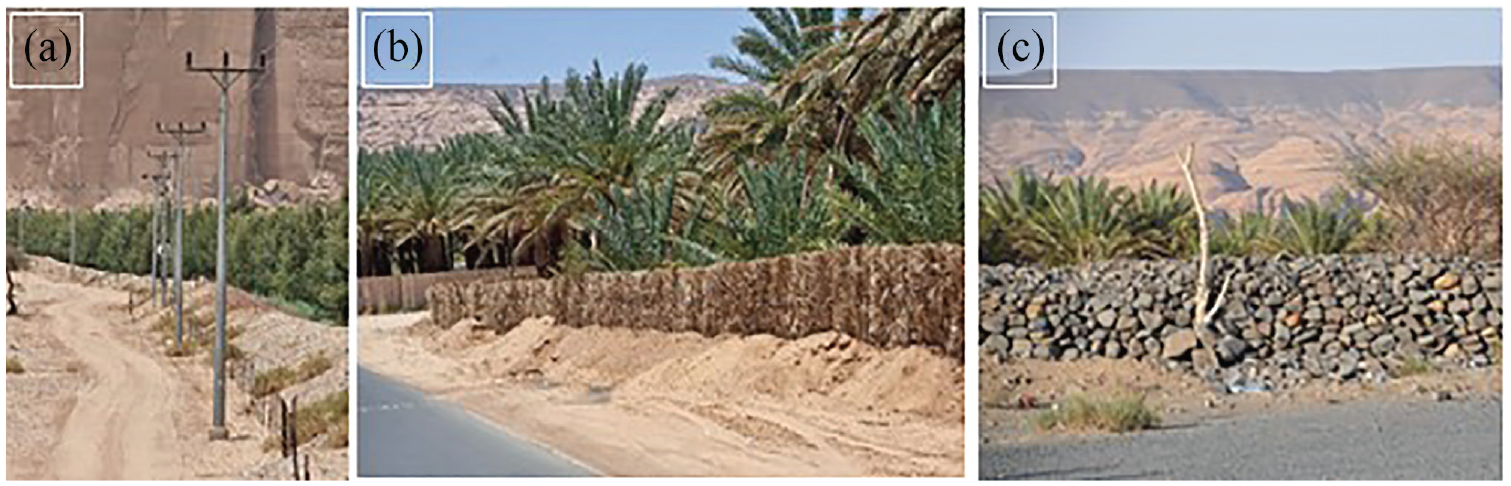
The traditional techniques for mitigating flash floods, erosion and desertification. (a) Oqoom; (b) a combination of oqoom and washea. (c) A traditional stone wall (by the author).
Applying hima to the AMP
According to the Royal Commission for AlUla (RCU) the ongoing project is guided by 12 sustainable development principles, which encompass safeguarding natural and cultural heritage, sustaining ecosystems and wildlife, restoring the built environment, and promoting balanced agriculture (RCU, 2022). While these principles provide a broad framework across several environmental parameters, they do not explicitly recognise traditional knowledge or incorporate the traditional ecological practices of the region. Several case studies elucidate an approach to sustainable development within the project (RCU, 2023), which invoke community involvement and benefits, such as job creation initiatives. However, ‘community’ is referred to in a projective and generic way, and the case studies do not address the integration of hima’s traditional ecological knowledge and practices as an integral element of community traditions and values prevalent in the region.
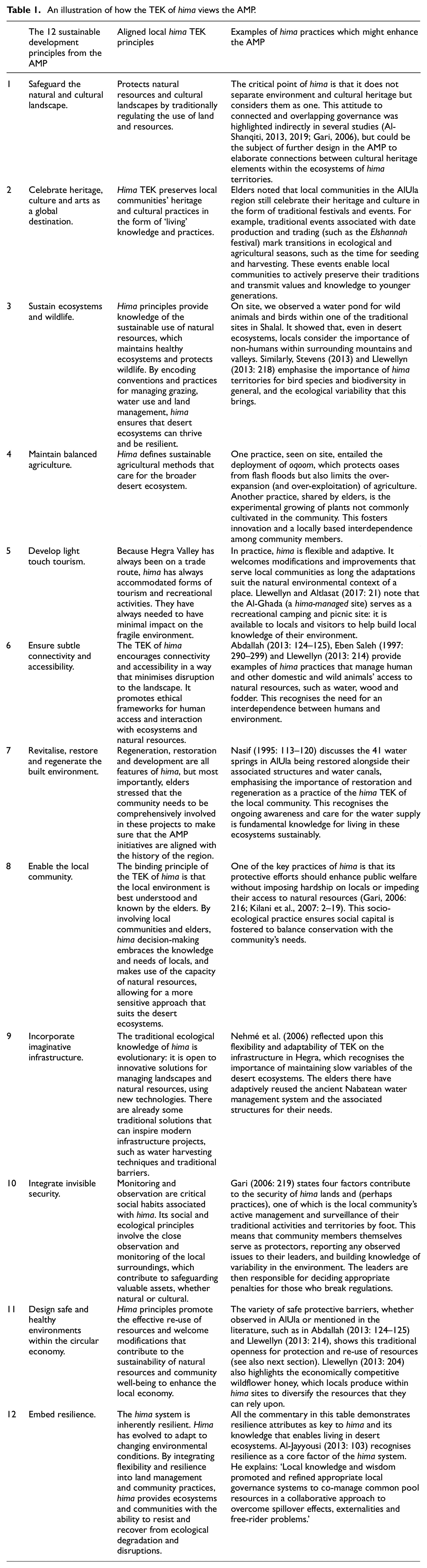
Based on our research into local hima TEK, the following table explains possible alignments with the sustainable development principles of the AMP and contains evidence of specific local hima TEK practices that might enhance the application of hima and sustainability in the implementation of the AMP, through socio-ecological resilience principles (Table 1).
An illustration of how the TEK of hima views the AMP.
The AMP clearly has sound sustainability principles. Furthermore, it can accommodate and maintain the social, cultural and environmental structure of hima. We now expand upon examples of specific hima practices, which we investigated, to demonstrate how hima might guide land-use arrangements, water-sensitivity, disaster mitigation and cultural heritage conservation associated with the AMP.
Hima and water-sensitive patterns of land use
Traditional hima practices in AlUla include principles that guide land use in relation to flooding and water dynamics. Our fieldwork observations identified legible arrangements of land-use across multiple traditionally managed farms (Figure 3). The organisation of land-use zones appears to be common to valley agriculture in Arabia. Research in Medina has noted similar patterns within the valleys in the vicinity of hima territories (Al-Shanqiti, 2019: 119–123). Many of the Ahlul Hal Wal Aqd we interviewed reinforced that this land-use organisation is embedded in hima. One described what is meant by the traditional arrangement of land uses in the area: All the farms were on the edges of the valley. Nothing was in the valley itself. Villages and towns were built in elevated areas, away from the floodplain.
7

Images show the traditional pattern observed across several of the study areas. Some of these areas continue to operate under traditional management systems and collaborate with official organisations, such as in the Shalal and Therbah areas (see e and b). In contrast, the others are managed by official institutions (see a, c, and d). Source: Google Maps and adapted by the Author. Part (f) provides a visual representation of the observed traditional pattern (by the Author).
Another elder described how: Hardly anyone plants [crops] near the mountain. Mostly, locals’ oases are close to the middle of the valley. To avoid the risk of falling rocks expected from mountains, they will make a buffer zone, approximately 20 to 50 metres, between oases and mountains.
8
Yet another noted that: When it comes to flooding, it rarely occurs here [in this settlement] due to our strategic [land use] positioning with respect to the watercourse.
9
These statements indicate the extent to which the customary strictures governing land uses, which connect topographic locations and local water dynamics, avoid inappropriate activities in areas prone to flash flooding. While hima restrictions in other regions of Arabia primarily focus on controlling over-exploitation of scarce resources, the mountain and valley landscape around AlUla and the incidence of orographic rainfall creating sudden seasonal downpours have shaped different imperatives determining land use patterns and different local expressions of hima conventions here.
While the spatial patterns of land use are clearly established in recognition of the precariousness of water security, hima also embedded flexibility and semi-permanence in land use to account for the variability of the region’s hydrology. For example, it was usual practice to rest and rotate agricultural land uses around AlUla, especially in areas that need careful conservation during dry seasons. In the wet, there would be natural regeneration and the recharging of the aquifers that feed wells in their semi-permanent oasis settlements. Hence agriculture around the flood-prone valley floors in AlUla was always transient and seasonal. One elder noted that in seasonal migration patterns, communities temporarily leave their oases after the rainy season and nomadically move to follow pastureland and natural water sources produced by the rains. Another Ahlul Hal Wal Aqd from Hegra noted, ‘hima practices were … common in the AlUla region, where tribes would demarcate and preserve their areas for use during dry seasons.’
10
He added and explained: It is absolutely impossible to cultivate permanent crops in the waterways of a valley. Such areas cannot be cultivated permanently, only, for example, wheat, barley, and vegetables can be cultivated, but not permanent trees or tall plants such as palm trees.
11
These practices enable resilience in dealing with climate fluctuations and may need to have a place in the regional sustainability of the proposed urban areas of the AMP. Yet, on the surface, the AMP proposal to create agro-tourism date palm plantations in the river valley will demand modern infrastructure-heavy methods such as artificial irrigation and imported water in dry seasons, and even then, it may also risk flood damage in wet periods or require engineered flood defences. Although, as previously noted, the AMP’s sustainability principles may seem sound on the surface, but they may be less sustainable when viewed in relation to resourceful hima practices.
Practices that adapt environment to mitigate flash floods, erosion and desertification
Local Ahlul Hal Wal Aqd were similarly concerned that there is an urgent need to include in the AMP the various traditional practices that mitigate the effect of desertification and ecological degradation caused by sandstorms, flash floods, erosion, overgrazing and tree removal. Traditional hima techniques used to address these events include physical interventions like oqoom (barriers or berms), washea (the palm fronds that are used to stabilise the ground and mitigate erosion) and appropriate planting (Figure 2), and land-use adaptations such as strategical alterations to elevation to manage flood exposure. An example of the latter is evident in the Shalal area, in Hegra and around AlUla Old Town, where traditional farms located between the watercourse and hills have elevated built structures to higher levels on man-made mounds.
Around AlUla, oqoom were sited to manage water capacity and built of sand, clay or stone to protect agricultural plots from sandstorms so as to prevent aeolian topsoil loss. The role of oqoom and other traditional barriers has been documented in studies of hima in various regions of Arabia, showing their contribution to the conservation of the hima vegetation cover compared to its surroundings (Llewellyn, 2013: 214). In some areas, oqoom barriers guard agricultural land from sand-slides while protecting crops or orchards from flash flooding. In areas further from watercourses and at lower risk of flooding, washea are used, or can be deployed in combination with oqoom, in especially wind-exposed sites. Oqoom are also used in combination with strategic plantings of trees, such as tamarisk, olives and moringa.
Oqoom provide a benefit as they can stop the northern winds that come loaded with sand that would otherwise cover the whole farm. Also, some trees can be used as windbreaks, such as Al-Athel trees [Tamarisk arabica] – this tree can be planted even in sandy soil.
12
From time to time, I construct windbreaks using Al-Ban trees [Moringa peregrina]. These are the best to use as they require minimal water, especially during their early growth. Yet, their lushness is remarkable, providing consistent greenery. Placing it on the edges of the fields serves multiple purposes, from production [fruit and oil] to saving water [by requiring minimal water until its root system is well established] and shielding against wind and sand.
13
The modern development of the AMP appears to marginalise these traditional adaptive practices that have been developed from environmental knowledge of the land’s capacity to support human activity and minimise harm from environmental events. On site, we observed significant contemporary modifications to a flash-flood-sensitive area due to a road expansion project in the region. The roadworks resulted in the removal of all the oqoom that had historically protected the oases and associated structures from flood risks and wind erosion, without any alternative solutions being implemented. The current development plans, which envisage the consolidation and redevelopment of many traditional farms, may result in the demolition of many of the traditional oqoom and washea structures. The published visualisations for the project’s agro-tourism areas show groves of date palms without any traditional barriers or the subtlety of mounding. Hence, we argue, the AMP sustainability principles can be better implemented through consideration of local hima TEK.
Traditional practices and the preservation of ancient heritage sites
Our observations indicate that hima TEK can play a significant role in conserving tangible cultural heritage elements. Although the main focus of hima is on managing ecosystems and natural resources, it, as an intergenerational knowledge system, contributes to the preservation and maintenance of historic buildings and structures within hima territory. In AlUla, locals who manage their farm oases and surroundings or tend their grazing herds in line with hima practices are actively monitoring and safeguarding cultural heritage sites from outsiders. As one Ahlul Hal Wal Aqd remarked: As a tribe, we used to protect these sites [as part of our traditional hima] and wouldn’t allow anyone to approach them [the tombs and rock art]. If someone from outside the tribe came, we would recognise them immediately.
14
It is perhaps not surprising that the Nabateans in Hegra and AlUla built tombs in the sandstone outcrops that are also where they built water infrastructure. It shows that hima fosters an interconnection between their ancestral heritage and landscape care, and that the hima areas are concerned with both the water conservation infrastructure with the conservation of the tombs. In our site observations we saw that the local community had implemented some of the traditional techniques or practices, such as regenerating agricultural land, or restoring a water well, near a cultural heritage artefact. This aligns with what Nehmé et al. (2006: 58) witnessed: 11 recent water wells were built near the many Nabatean water wells, all contributing to the hima water management system in the region. This relationship between local hima practices and archaeological remains has also been observed elsewhere in Saudi Arabia – in Al-Shajar, Al-Naqi‘ (Al-Shanqiti, 2013), Al-Rabadhah (Al-Shanqiti, 2013; Llewellyn and Altlasat, 2017) and Dhariyyah (Gari, 2006). In AlUla the practice of caring for the tombs and other heritage structures, which extends into daily routines within oases, shows the intrinsic link between environmental and social practices and cultural heritage.
Hima acknowledges the precariousness of the harsh local environment, which has fostered an extreme vigilance against any outside interference or threats to resources, and which has served to protect the Nabatean archaeological sites over time because they form part of the landscape that is actively used and managed rather than neglected and subject to decay or damage. Hima has thus established a form of shared governance based on cultural heritage and environmental knowledge, which has valued and cared for all resources. The lack of acknowledgement of hima in the AMP thus has the potential to dissociate communities and their intangible heritage from the tangible heritage that is intended to form the main drawcard of the future urban expansion.
Discussion
Our site research, our interviews with elders, and extant research all draw attention to hima TEK as a form of sustainable socio-ecological adaptation to the vulnerabilities of this fragile Saudi environment over long timespans (Alhammori, 2002; Nehmé, 2013: 88). However, the AMP reveals little engagement with this form of TEK or consideration of how tangible and intangible cultural heritage in the region might be related. In its current guise, the AMP privileges globalised approaches to sustainable urbanism and heritage conservation formulated by international design consortia (RCU, 2021). Researchers have highlighted the potential negative impacts of this style of approach in the context of other sensitive heritage contexts elsewhere in the world (Jones and Evans, 2012; Rizzo, 2020; Yarker, 2018). An overemphasis on generic international approaches to cultural heritage management and urban development (albeit with an ostensible sustainability focus) has two problems: (1) it discounts the important role of local peri-urban and hinterland environments to maintain biodiversity and ecosystem structure and function of a region (Asad et al., 2022; Ayeni et al., 2014; Tu, 2017); and (2) it ignores traditional vernacular resource management infrastructures and institutions, which have been developed and maintained over generations to tie a community to the environmental particularities of place and landscape (Alahmadi, 2021; Gari, 2006; Hawken, 2017; Jamaludin et al., 2021; Kilani et al., 2007). What is at stake is both the environment and the intergenerational transmission of TEK, with its deep understanding of local ecosystems (Parween, 2021).
Our examination of the AMP through the lens of hima gives rise to three principal considerations. First, hima is a valuable critique of current global approaches to sustainability. Second, hima is limited in its use as a sustainable governance method unless central governments make greater investments in local communities and TEK. Third, authentic sustainability at both the national and local levels needs deeper collaboration.
Hima as an assessment framework for global approaches to sustainability
The TEK of hima offers a valuable critical perspective on contemporary global sustainability strategies. It emphasises the balance needed between human land-use, resource usage and ecological conservation in ways that are calibrated to specific local conditions. Recent globalised sustainability approaches, often deployed rhetorically more in the service of economic growth than local ecological health and repair, can often overlook existing local environmental knowledge and practices. For example, although principle 8 of the AMP is directed towards ‘Enabling the local community’, the existing ecological knowledge and long-term experience with the surrounding ecosystems and heritage already present within the local community do not appear to have been incorporated into the plan or the decision-making process. Social capital, an important hallmark of resilience, is at risk. Because of their awareness of the region’s historical and extreme environmental events of their surroundings, it is essential to consider the locals, especially the elders, as a source of knowledge to realise sustainable and appropriate decisions. The AMP thereby serves as an exemplar of the shortcomings of global systems of sustainability and suggests that researchers and designers need to develop methodologies to enhance processes for integrating local ecological knowledge in modernisation projects.
Hima’s limitations due to current governance models
The potential of hima TEK as a sustainable governance method in Saudi Arabia remains unclear due to the lack of detailed investigation and research into this indigenous system. Due to demographic and socio-economic shifts within local communities, especially amongst younger generations, detailed aspects of the system that have been intergenerationally transferred for centuries may be lost forever. Historically, the governance aspects of the system were structured around social or tribal system configurations and roles. As these structures are eroded through social and economic factors, substantial investment from the official institutions in local communities may be required to preserve and continue the implementation of knowledge and practices for living sustainably in desert ecosystems. Therefore, we argue, concerted investment in documenting and revitalising hima practices could provide critical insights for sustainable land management, but this requires financial and institutional support. It could also tie together the potential for cultural heritage to be instrumental in sustainability. Such initiatives may contribute to the missing aspects of the hima presented by Llewellyn (2013: 205–206), which would also serve as an opportunity to preserve this form of intangible cultural heritage alongside the significant investments being made in the preservation of the tangible cultural heritage represented by the Nabatean monuments. Other international examples might serve as points of reference for the kinds of governmental programmes that might be developed: for example, the recognition and support of Indigenous cultural burning practices in Australia demonstrates the potential role of official institutions’ support in significantly enhancing the application of TEK as a sustainable governance framework (Smith et al., 2021).
The need for deeper collaboration
Achieving authentic sustainability at national and local levels involves deeper collaboration between official experts and institutions, communities, and other stakeholders. An exemplary collaboration model can be seen in the Al-Baydha Project in the Makkah region of Saudi Arabia, where the ecological restoration initiative brought together the Al-Baydha local community, decision-makers and relevant official institutions to achieve better outcomes for both the locals and the environment. The project’s uniqueness lies in the strong relationship between its leader, Neal Spackman, and the local community. This relationship enabled Spackman to comprehensively understand the culture, traditions, history and needs of the locals, as well as the natural environment of the site and the detrimental factors contributing to desertification in the Al-Baydha region (Schwartz, 2020). The approach led to the implementation of a water harvesting system with positive outcomes, such as improved ecological health, which contributed to enhancing local livelihoods by providing some of the local needs. This type of engagement supports one of the main objectives of Saudi Vision 2030, which aims to preserve local communities’ traditional values and identity. The AMP implementation might be similarly enhanced by integrating local hima knowledge and leadership practices. It can lead to sustainable and culturally sensitive development by fostering collaboration and mutual understanding.
Conclusion
This article has explored the TEK of hima, a form of intangible cultural heritage, and how that offers a perspective to review the sustainable principles of AMP and realise a more sustainable vision and inclusive form of cultural heritage preservation for the future of the AlUla region.
Our study of hima suggests that long-term sustainable development in desert ecosystems needs better integration between local communities and their intrinsic relationship to cultural heritage and environmental care, and ambitious sustainable development. Although many hima practices and infrastructures appear small-scale, we argue that together, as a form of adaptive TEK, they provide a substantial, locally attuned basis for designing sustainability transitions for the AlUla region. Hima contrasts with the abstract and generic sustainability principles imported from the outside. These latter, of course, have a role to play in the design of any newly developed urban areas as part of this transformation, but in order to effectively manage the impacts of the new developments at a landscape and regional scale, as well as to protect the intangible cultural heritage of hima itself, hima practices should be comprehensively factored into the design, planning, development and ongoing management processes.
Projecting forward, it is important to develop ways to adapt hima’s ecological principles and practices so that they can be implemented in a modern setting alongside global strategies but without losing their core values. It might require the training of hima expertise amongst locally based designers and planners, project managers, and administrators, as well as the establishment of institutions dedicated to the documentation, adaptation and ongoing implementation of hima practices into the future. This is especially important given the increasing erosion of intergenerational hima knowledge transfer as younger generations shift from agricultural to urban occupations. Without this, there is a risk that the intangible cultural heritage of hima TEK and practices of the AlUla region will disappear, a process plausibly accelerated by the large-scale transformations of AlUla’s tourism-driven redevelopment itself.
The problem of urban development driven purely by cultural heritage tourism focused on historic sites as if they are outdoor museum pieces is that it diminishes local land-use and management traditions and practices, especially those that have developed adaptively and with historical continuity in close conjunction with ecological systems and cultural heritage artefacts. The appeal of tourism can finance short-term settlement and a prosperous hospitality industry. However, sustaining cultural heritage in the long term needs more than inquisitive (and acquisitive) visitors. It requires industries built around a society’s culture. Hima, with its inherent adaptability, invites a long-term approach to planning around intangible cultural heritage, and its adaptability offers a means to arrest its own demise.
Footnotes
Acknowledgements
We would like to express our sincere gratitude to the special issue guest editors, journal editors and the three anonymous reviewers for their invaluable, thoughtful and constructive feedback that significantly improved this article.
We would like to mention that this paper forms part of an ongoing PhD research, and we gratefully acknowledge the traditional elders who contributed their insights to this study. We also thank Dr Abdulkader Al-Gilani for his invaluable feedback on the broader research project.
Declaration of conflicting interests
The author(s) declared no potential conflicts of interest with respect to the research, authorship, and/or publication of this article.
Funding
The author(s) received no financial support for the research, authorship, and/or publication of this article.
