



Abstract
The Arts in Transit project, which took place in Boston, Massachusetts in the 1980s, offers an example of transit art and transit art practice with the potential for engagement with, and agency through, infrastructure. In 1984, the Massachusetts Bay Transportation Authority (MBTA) relocated Boston’s Orange Line from an elevated track to an underground heavy rail system along a 4.7-mile stretch of land referred to as the Southwest Corridor. Arts in Transit was designed and managed by UrbanArts, Inc. as a subcontractee of the MBTA, and installed public art in nine new transportation facilities along the Southwest Corridor through a community-involved process of artwork selection. Though Arts in Transit was a familiar project locally during its time, it is relatively unknown to a wider audience. Through previously unexamined archival materials and interviews with participants, this historical case study uncovers Arts in Transit’s potential for doing infrastructure otherwise through the process and practice of transit art, revealing the processes in which community groups affirmed the sociotechnical nature of mobility infrastructure through the visual.
Introduction
The August afternoon I interviewed Arts in Transit Project Manager Eileen Meny, I sat down to two bowls: one of grapes, and one of peanuts. Meny explained straight away that she was serving me the same snacks that the nonprofit group UrbanArts regularly offered community groups 39 years prior during their evening meetings to determine the artwork in each nearby Orange Line station. “People often got sluggish after sitting for a long period of time,” Meny said, and grapes and nuts were “easy to serve and eat without getting in the way of the conversation” (personal communication, 2024).
Sitting and talking about the Arts in Transit project with Meny, and later with other participants, I was hit sideways by the social reality of the work that UrbanArts had facilitated. Infrastructure, like urban mass transit, draws people together collectively, but it is too easy to miss that without making infrastructure’s social nature evident. Grapes and peanuts on their own are ultimately insignificant, but they were an important part of the way transit infrastructure was done differently, that is, socially, through this unique transit art project in the 1980s. Cultural production in mass transit can critically intervene in urban experiences of infrastructure, and has potential to accentuate infrastructure’s—often hidden—social and collective nature. The Arts in Transit project, which took place in Boston, Massachusetts, offers an example of transit art and transit art practice with the potential to make infrastructure’s sociotechnical totality evident, offering engagement with, and agency through, infrastructure.
Arts in Transit’s unique conditions of public practice surrounding transit art were significant and they merit contemporary examination. In 1984, the Massachusetts Bay Transportation Authority (MBTA, or the T) relocated Boston’s Orange Line from an elevated track to an underground heavy rail system along a 4.7-mile stretch of land referred to as the Southwest Corridor that had been cleared for a cancelled highway project. Arts in Transit was designed and managed by UrbanArts, Inc. as a subcontractee of the MBTA, and sited public art in nine new transportation facilities along the Southwest Corridor. The project lasted from 1983 to 1991 and included offsite cultural projects in its overall scope and reach. It was unique for its time in its use of a Site Committee comprising local residents around each station who were asked to create Community Profiles for their neighborhood to inform the artwork that would be chosen.
Though Arts in Transit was a familiar project during its time to the small groups along Boston’s Southwest Corridor, it is relatively unknown to a wider audience. The non-profit group UrbanArts merged into Massachusetts College of Art and Design in the early 2000s, and unprocessed archives of UrbanArts projects dating from 1983 were eventually donated to the Boston Public Library. This article presents both primary material in the UrbanArts archive and information from interviews with Arts in Transit participants to make a case for deeper understanding of projects such as Arts in Transit that affirm the social and collective nature of infrastructure through transit art. Citizens of the Southwest Corridor, while limited in number, had voice and autonomy over the cultural and visual representations within the stations in their neighborhood. It was this voice and autonomy, related to the visual, that provided an alternative to infrastructure as usual.
Transit art and design, that is, artwork and other visual practice sited in, or visual practice around, transit stations such as subway stops, is an under-researched topic. This article begins by briefly reviewing current scholarly understanding of infrastructure as a sociotechnical system that is deeply implicated in social and spatial injustices. It then provides an analysis of the sparse literature that does exist about transit art, before turning to an overview of the historical case study of Arts in Transit’s permanent art program. It ends with a thorough review of the small, everyday acts of the Site Committees during the project, those details that could only be uncovered through review of primary documents such as meeting minutes and participant reflections. What emerges from these sources are actions and artifacts that point to an alternative means of “seeing” and engaging with infrastructure for the participants, as well as for a contemporary reading of the project.
Infrastructural visibility
Infrastructure is not invisible. Even while geographers, humanists, and anthropologists have increasingly called for methods of infrastructural visibility, infrastructure is both monumental and transparent in its ubiquity (Chachra, 2023). The focus of a great deal of scholarship has been on infrastructure’s nature beyond the material (Amin, 2014; Cowen, 2020; Simone, 2004). Infrastructure is social, spatial, and collective (Star, 1999). Because it is a sociotechnical system (Larkin, 2013), its scale and implications are ultimately inapprehensible without assistance. Infrastructures are networks that are embedded and entrenched in human relations rather than simply inert, apolitical objects (Graham and McFarlane, 2015). As interconnected and interrelated sociotechnical networks, infrastructure works to draw people together through formal or informal networks, shaping and being shaped by the people who connect to them.
Infrastructure has been increasingly recognized as a tool of separation and marginalization rather than unification (Cowen, 2020). “Study a city and neglect its sewers and power supplies,” Latour and Hermant (1998, cited in Star, 1999: 379) said, and “you miss essential aspects of distributional justice and planning power.” Even while infrastructure, through the state, does orderly work of building and maintaining our cities, there is widespread concern about unequal access to infrastructure. Graham and Marvin (2001) referred to this as splintering urbanism, a process of unequal access that results from fragmented, exclusionary, tiered systems of private, semi-private, and public infrastructure.
Infrastructure is implicated in global inequality and unequal access to resources. Calls for visibility attempt to address the ways in which infrastructures reproduce the relationships they enable, which are fundamentally bifurcated and unequal. Infrastructure can provide for basic needs and allow for agency and freedom, but attention to it is attention to the myriad ways these provisions are just as often not enabled through those very same systems. Ferguson (2012) pointed to just how complex infrastructure is, noting the perniciousness with which infrastructures shape our realities because of how difficult it is to ascribe responsibility for infrastructural violence. Inequalities seem to be made inevitable, he argued, “by the walls, pipes, wires, and roads that so profoundly shape our urban environments, even as we take them for granted” (Ferguson, 2012: 559). Infrastructural dispossession, disrepair, lack of provision, and neglect have had disastrous consequences for both groups and individuals. High-profile cases like the Flint, Michigan water crisis (Clark, 2018) and the 2005 levee failure in New Orleans, Louisiana during Hurricane Katrina (Brinkley, 2007) bring infrastructural harm to wider attention. But calls for visibility rest on the rationale that infrastructure and the inequalities it reproduces must be made evident beyond higher-profile crises, and that taking infrastructure for granted exacerbates the inequalities it produces.
Arts in Transit took place at the center of an urban history in which mobility and transportation shaped the built environment and culture of the city. Since at least the 1940s, both freeways and (in)access to public transit in Boston have illustrated multiple examples of infrastructural inequality. Boston’s north–south rapid transit line, the Orange Line, was relocated along the Southwest Corridor as the result of cancellation of Interstate 95, a historic highway project that had been stopped by coordinated acts of citizen protest and activism from across multiple neighborhoods in Boston (Crockett, 2018; Lupo et al., 1971). Before its relocation, the extant Orange Line ran down Washington Street, along the last section of the elevated line built in 1901. The elevated line’s dismantlement and move to the Southwest Corridor was not without its own infrastructural injustice; resident displacement and adequate replacement of transit service on Washington Street remain issues some 40 years later.
Cowen (2020) called for “following infrastructure” in order to understand alternatives to the violence and dispossession of infrastructural systems. There are multiple means to achieve infrastructural visibility, and this article argues that the Arts in Transit project is one such way. Before Arts in Transit is described, the next section reviews the sparse literature that exists about artworks sited in urban mass transit. Though transit art is an understudied phenomenon, analysis of literature that does exist paints a picture of civic ideals that sit alongside motivations toward economic ends. Understanding the context in which transit art has traditionally operated helps make the case for the need to uncover alternatives such as Arts in Transit.
Art in urban mass transit
The global phenomenon of metro art has served many functions outside the esthetic, but has received sparse scholarly attention. Encountering public art in urban mass transit is a worldwide phenomenon, albeit an uneven one. Almost all cities that boast a metro system of some kind have at least a nod toward station design, if not full-scale direct siting of installed artworks such as murals, mosaics, sculpture, mixed-media, or technology-mediated pieces within and around their transit systems. Though the phenomenon of officially sanctioned station art followed a somewhat clear trajectory in cities throughout the United States, the global practice of siting artworks in transit has followed a variety of paths and histories. Incorporating artwork into metro stations is the norm from post-industrial American cities like Cleveland, Ohio with small metro systems to global, competitive cities like Dubai in the United Arab Emirates and Toronto in Canada to cities in the Global South (Enright, 2023).
Despite its widespread international acceptance and practice, installation of public art in urban mass transit is a critically under-studied area. Discussions of transit art in the United States sparsely appeared in scholarly, commercial, and trade literature between the late 1980s and early 1990s, roughly corresponding with the ascendency of transit art in urban settings across the country. These early sources revealed a range of ideals and motivations for placing art in public transportation systems, but almost all characterized subway space as scary and disorienting. These sources underscore profound urban changes taking place throughout the time they were written: the establishment of the automobile as a predominant means of transportation, consequences of mass migration of White residents out of urban environments, the shrinking of public funds within cities, and purposeful disinvestment in urban infrastructure.
These literatures offer motivations for installing artworks in mass transit that run a range from improvement of public space to public values and cultural ideals, but almost all sources discuss shaping and elevating the transport experience to increase ridership. Following large-scale urban renewal post the Second World War, transit providers in the United States faced obstacles winning riders to their systems (Feuer, 1989). For those that are underground, crime or the specter of crime contributed to this difficulty and caused authorities to put transit art to use among a slate of other interventions—police presence, maps and signage, anti-graffiti measures, station refurbishment—intended to attract a dedicated ridership (Abramson, 1994; Amundsen, 1995; Brooks, 1997; Ström, 1994; Yngvason, 1989).
Increasing ridership emerges in these early sources as the primary motivation for siting artworks in mass transit, but what literature exists also regularly regards metro system art as a civic practice alongside a functional role. Fitzpatrick (2009) wrote that while the goals and priorities of Arts for Transit in New York, for example, changed over time, they always stayed close to the original philosophy that the subway should be a great public work. These types of celebratory statements are also present in other publications, which called transit art an “opportunity for the worlds of beauty and bureaucracy to intermingle” (Hall, 1994: 10) and the perfect integration of form and function (Bloodworth and Ayres, 2014) that “reaffirms the role of public utility as a public good” (Orol, 2017: para 7).
Civic ideals can exist independently and authentically, but can easily be employed as a guise for neoliberal urban development. This is often just as evident in the sparse literature about transit art. Miles (1997) was clear that the purpose of siting art in transit is to encourage use of that transit, calling the siting of art a strategy put in place to make public transportation more attractive and to contribute to a positive image of the transport system. Other sources similarly conflate these two rationales, stating that transit art reaffirms “world-class status” for cities (Fotsch, 2007: 130), creates “an aura of uniqueness,” and attracts a “certain class of professionals” who drive a city’s growth (Bertsche, 2013: 17).
It is difficult, then, to extract art’s potential to affirm the collectivity and sociality of infrastructures from its typical entanglement in global, competitive cities and in wealth creation. Even when alternatives are stated, raising the profile of a city is most frequently the motivation for siting art in transit in most sources written in the last two decades. Transit art is frequently used to mask conflict over urban development. Enright (2018: 581) noted that art sited in public transit is “employed in landmark place-making and marketing” and that it generates an esthetic “whereby gleaming new infrastructures cement the exclusive urban forms expected of aspiring global cities and mark the arrival of a metropolis to creative, prosperous, world-class status.” Artworks can easily be utilized to bring legitimacy to cities on a global scale, attracting high-profile events, citizens with high incomes, and tourism dollars.
Situated among national landscapes of fundamentally unjust provision for, and maintenance of, infrastructure, artworks in urban mass transit have been employed by the state and urban developers to raise the global profile of cities and shape public space in service of economic ends. Anand et al. (2018) regarded infrastructure as a “terrain of power” and explored how states frequently build infrastructures to signify their power and prestige, demonstrating their nation as advanced rather than meeting the needs of citizens. However well-intentioned, the practice of installing artwork within mobility infrastructures has strong potential to align with this signification of power. The Arts in Transit project demonstrated that the visual can affect infrastructure, and aligned itself instead with the social and collective nature of infrastructures.
Arts in Transit: The Southwest Corridor
The Arts in Transit project was celebrated in its time for its inclusive approach to siting art and for impressive community involvement in the process of determining and selecting artwork (Karwoska, 1986; Leupold, 1984; Pacella and Storey, 1986). These were processes in which residents of the Southwest Corridor affirmed transit infrastructure as a social, living, dynamic network. Though Arts in Transit took place in a particular time and in its own particular context, it should be considered among other—even contemporary—examples of visual processes that negotiate infrastructural visibility.
The non-profit group UrbanArts won a 1983 public bid to site artwork in the stations of Boston’s soon-to-be-relocated Orange Line. The project would be called Arts in Transit, and between 1984 and 1991 it would install 10 works of art in nine stations and encompass several off-site, temporary projects. Chinatown, South Cove, the South End, Back Bay, Fenway, Mission Hill, Fort Hill, Roxbury, and Jamaica Plain were the ethnically and racially diverse neighborhoods in Boston to which the Orange Line would be relocated, and both economic hardship and racial tension were heightened in many of these neighborhoods as a result of the extended freeway fight (Breitbart and Worden, 1994). The Site Committees each included eight to 10 members of the community who were chosen on a first-come, first-served basis and who had been solicited through a series of public, community meetings as well as intentional outreach to community groups (UrbanArts, 1984b). These advisory groups for each station were asked to complete Community Profiles that detailed the local cultural, historical, and social conditions of their neighborhood. These profiles also included neighborhood histories and wishes for the future of the residents who currently lived there (UrbanArts, 1984a).
The process that UrbanArts followed was set in place through the Urban Mass Transit Administration (now the Federal Transit Administration) of the federal government, which was funding the construction project at close to 90% (Federal Transit Administration, 2024). The process was initially determined by UrbanArts’ predecessor and guide, the Cambridge Arts Council, who had completed a similar project on the Red Line as it was extended north from Harvard Square in Cambridge, Massachusetts in the late 1970s. This earlier pilot project, called Arts on the Line, established standards within the United States; all projects across the country who wished to site art in transportation infrastructure, using federal dollars, would come to use the procedures set by Arts on the Line. The standards called for a minimum level of citizen participation in the process of selecting art (Cruikshank and Korza, 1988). 1 Arts in Transit, through UrbanArts, went far beyond this required participation by focusing on community and neighborhood groups as a key part of the design of the Arts in Transit process (Pamela Worden, 2023, personal communication). Expanding the role of a neighborhood advisory group, the Site Committee, from one of cursory rubber stamping to one of project client, was a key goal of Arts in Transit (Bass Warner, 1991).
The temporary and off-site components of Arts in Transit became, to many, as significant as the siting of the art work itself (Breitbart and Worden, 1994). The separate projects were “Along the El” —also called “The Artist’s Lens: A Focus on Relocation” — “Boston Contemporary Writers,” and “Sources of Strength” (Breitbart and Worden, 1994). The off-site projects produced a portfolio and exhibit of photographs, two literary works inscribed on granite in each station along the Southwest Corridor, and an oral history project that was eventually adapted into a play. Pamela Worden was the President and founder of UrbanArts, and recalled that each of these projects was designed to “achieve a sense of neighborhood identity by tapping into unique community resources and by creating a mechanism for broad community participation” (Breitbart et al., 1992: 12).
Infrastructure as transformation rather than domination
As networks embedded in human relations, that include people rather than simply objects, infrastructures are interconnected and interrelated sociotechnical systems. They draw people together, shaping and in turn being shaped by those who are connected to them. Though this question was not asked by Arts in Transit participants at the time, it behooves us to ask it now—how can that drawing together, and shaping, be done differently? What shape do we want it to take? Arts in Transit offers a least a partial answer to this question. The artwork at each station in the Southwest Corridor was sited through an official, sanctioned, and often bureaucratic process, but neighborhood residents had ownership and input over the selection. That ownership was collective and social. In the social acts to choose artwork undertaken by Site Committee members—sharing of personal photographs, speaking of their individual experiences, and describing their place narratives collectively—the social and collective nature of infrastructural networks was positively affirmed. This section outlines these actions in detail, drawing from archival materials such as meeting minutes and Community Profile drafts as well as the recalled experiences of participants.
UrbanArts respected Orange Line communities as clients or commissioning agents of the project rather than an abstract audience of passive consumers. This attitude shifted Site Committee status away from merely receivers of infrastructural provision to an active and vested participant in the infrastructural relationship with the state through the siting of artwork. Pamela Worden (2023, personal communication) said in reflection on the process that in her way of thinking, the community was a “commissioning agency.” Enabled by UrbanArts, these small citizen groups participated in representing their communities in the process of art selection, foregrounding affirmative attributes of their neighbors and neighborhoods and asserting themselves and their wish to be positively present in an infrastructural process that might otherwise have been determined by the state. This was primarily achieved through the mundane—writing descriptions, attending evening meetings, negotiating with one another, revising meeting minutes, sharing personal items, and conducting station tours. The results of these small acts accumulated to much more than the sum of their parts and were fundamentally social and collective, affirming the social and collective nature of the infrastructure at subject in the work. Regarding community groups as patrons or commissioning agencies shifted a relative amount of control to them and allowed a degree of political power in the infrastructural relationship with the MBTA.
A Community Profile on the area surrounding each station was used as the foundation for the process of art selection. The profile was designed to be collaboratively written by members of the Site Committee, and then shared with the Arts Panel, art experts who would make the ultimate decision on a permanent art selection (Breitbart and Worden, 1994). The intention of this design was to affirm the voice of a representative group of the geographic and demographic residents within roughly a half-mile of each station, placing them in a position not unlike a patron. The profile they were asked to write was to do the work of formal request to the Arts Panel, and was also to be used to help inform the ideas and focus for invited artists. The Arts Panel read and discussed the Community Profile before reviewing potential artists in UrbanArts’ slide registry, and they were asked to consider the profiles made by the Site Committee in their selections (Pamela Worden, 2023, personal communication). This point was emphasized in documents and by several interviewees. Arts in Transit Project Manager Eileen Meny (2023, personal communication) recalled that UrbanArts “wanted the Site Committee to understand that their role was really critical because everything started and ended with them.” Artists chosen to present their work from among the slide registry were also given a copy of the profile to inform their conceptual design and presentation to the Site Committee and Arts Panel, and many Site Committee members also attended artists’ presentations having collectively written the profile.
Personal and communal descriptions of a neighborhood seem, at first, to be quite ordinary, but in the case of Arts in Transit they were substantial. The content of the Community Profiles was unique to each station, but there are some common themes that emerge when looking at the profiles as part of a collection. The population who lived along the Southwest Corridor was racially and ethnically diverse and of mixed income (Mann, 1991). To some extent, both the meeting minutes and the profiles themselves indicate that the Site Committees were concerned with perception from those outside of the Southwest Corridor when making decisions and putting together neighborhood descriptions, and saw Arts in Transit as an opportunity for increased or altered positive knowledge of their neighborhoods. Profiles tended to focus on historical events such as urban renewal related to the cancelled expressway or past business and industry in the area. Almost all spoke positively about their communities, and even when something negative was occasionally described, it was not dwelt on.
Whatever the contents of the narrative, this writing of a Community Profile should be viewed as an act of collective self-determination; the process allowed committees autonomy to craft what can be thought of as a shared rhetorical tool. Each Site Committee was asked to answer subjective questions about their neighborhood, most of which could not have been answered through reference material such as Census records (UrbanArts, 1984a). Archival documents explain that the Community Profile should “reflect the history and character of a community through the personal and professional perspectives of Site Committee members” (UrbanArts, 1984a). The answering of these questions happened first orally in Site Committee meetings, and responses were deemed important enough to be recorded and revised.
Questions were given as one way to elicit responses from the Site Committee, but participants were allowed the freedom to respond in whatever way they saw fit. These allowances gave members narrative agency. Most groups made at least some revision to their Community Profile over time, for which they had to negotiate with each other and with UrbanArts. In other words, they could change their mind, refine their characterizations, or clarify their ideas. An opportunity for revision, even if just for simply editing, is also an opportunity to refine values and ideas and to return to the original sentiments expressed together as a group. Inscription of subjecthood onto the built environment is a powerful model for urban public art processes. These acts of voluntary participation, neighborhood description, a form of speaking to municipal and state authority, were all used by residents to construct themselves as political actors.
Average people in Orange Line communities were likely not used to close-up views of construction projects, and the access and act of touring the station while under construction added to their authority. Tours were arranged and negotiated with station architects and the T, and helped committees make decisions about the direction of the art project (Eileen Meny, 2023, personal communication). Though communities might have been used to attending meetings about construction and could have experience looking at plans in other arenas, to be given a tour of the station, sometimes by the architect, elevated their status beyond abutters. Numerous minutes from Site Committees along the Southwest Corridor mention how useful these tours were in helping them to fully understand the scope and design of the stations about which they were helping to make decisions (UrbanArts, 1984c: December 18; 1985a: February 4).
Planning for Southwest Corridor construction had begun many years earlier, and by the official 1984 groundbreaking, architectural plans and engineering scope had already been determined by the MBTA (Eileen Meny, 2023, personal communication). Multiple citizens along the Orange Line had been involved through Station Area Task Forces and Neighborhood Section Committees while the T was planning, but there is no way of knowing the influence any group had on the infrastructural planning being carried out by the MBTA. The Site Committees were in a different scenario, one in which they were involved in recommendation making that had definite consequences on the direction of their transit stations. Because the artwork in the stations was not a consideration from the beginning of their technical design, and because station construction had been partially started by the time Site Committees began to meet, it might be easy to dismiss these tours as simply means for esthetic enhancement. But social involvement in the visual consideration in the early stages of the project was significant. That the timing was not perfectly situated from the earliest planning processes does not preclude engagement with infrastructure on the part of the Site Committee.
There are instances of Site Committee members bringing in materials to aid the process of Community Profile writing or simply to share with one another. For Ruggles station, Site Committee member Wilfred Holton created a document for the committee that reviewed the data available from the 1980 decennial Census. Holton included the five Census tracts that were appropriately close to the Ruggles station and aggregated their information by hand so that the Site Committee would have a clear basis of evidence from which to build its description (Holton, 1985: December 10; 2023, personal communication). In Jackson Square, members of the Site Committee brought personal photographs to their third meeting to share with one another. Some photographs were from the 1940s to 1960s, but others were as recent as the week before the May 1985 meeting. Once these photographs had been reviewed, the committee moved to talking about their art recommendations (UrbanArts, 1985b: May 8). In these small and seemingly inconsequential ways, Orange Line communities brought themselves and their contributions to the process of Arts in Transit. These social and collective processes and practices affirmed the social and collective nature of infrastructure.
Though the Site Committees were charged with description of their neighborhoods and were not the final decision makers about the artwork that would be installed, artist presentations for all nine stations included at least some members of the Site Committee. This was sometimes representative; for example, two or three members of the committee were chosen to attend the presentations with the Arts Panel, and they were sometimes all-inclusive. However their representation was configured, Site Committee members were, at a minimum, present at artist presentations and heard and saw the proposals. All minutes from artist presentations include time for the Site Committee members present to give their reactions about the proposal presentations, and most minutes include response to their opinions from the Arts Panel (UrbanArts, 1985c: November 22; 1985d: December 19). This dialog indicates that while the Arts Panel was charged, as experts, in making a final determination, it did so through at least some degree of negotiation or consideration with the Site Committee. The Site Committee had further agency in this way, extending its sociality into the choice of artist proposals for the transit station in its neighborhood.
We should not make the mistake of regarding these neighborhood groups as representative of all voices within their geographic communities. The sticky issue of monolithic community voice and the difficulty of collective decision making were certainly present in the process of Arts in Transit and come through in analysis of the Community Profiles. Despite UrbanArts’ inclusive approach, the process of generating the profiles was limited by the people who were in the room. Though UrbanArts worked diligently to outreach and include multiple demographics and representations within each Site Committee, the Community Profile was only authored by those who were present (UrbanArts, 1986a). In some cases, that was around eight people who were all asked to represent a dense half square mile or more of urban residents. No formal process was in place for community members outside of the Site Committee to give feedback into the narrative of their neighborhood, though it does appear that some members queried their neighbors or local businesses where they were able. While “community” here was seen as an absolute good, those who did not participate were supposed to have spoken through those that did. We have no way of knowing the divergent opinions or positions of those who did not take part.
In the wake of the controversy over the removal of Richard Serra’s public installation Tilted Arc in the late 1980s (Jordan, 1987), community input and participation became a central and unquestioned expectation of siting many works in public. Community engagement in many forms also became the antidote to autonomous “signature-style art works” done in public, those that functioned as museum extensions and individual artist advertisement rather than encouragement of public engagement (Kwon, 2004: 65). But community engagement has always been an imperfect process at best. This is exacerbated in urban settings, where population density, cultural and lifestyle difference, and disparate access to basic needs or state attention are all factors. Calling attention to this imperfect community process is necessary in evaluation of power dynamics in communities, and evaluation of equitable access to art and to art making. The alternatives to a community process, though, however fraught that process might be, are equally difficult, if not more so.
In many public art projects, a relentlessly celebratory discourse of community is often called upon despite evidence to the contrary (Joseph, 2002; Kwon, 2004). Arts in Transit adopted this positive disposition at the time of the project. But there is another way to qualify the involvement of community members. Through the Arts in Transit project, UrbanArts assisted community residents in continuing their self-construction as political actors in order to create group narratives of their neighborhoods through the Community Profile. That the concept of community was seen by the participants at the time as an unequivocal good does not foreclose the possibility that participation shifted the infrastructural frame through the visual, even if the scale was small.
UrbanArts’ regard of community groups as equal participants shifted a relative amount of control to them and allowed a degree of political power in the infrastructural relationship with the state. Doing so shifted the infrastructural network of which they were a part, and for the better. Site Committees essentially acted as patrons, but were also representing their communities in the process of art selection, foregrounding affirmative attributes of their neighbors and neighborhoods and asserting themselves in an infrastructural negotiation. By doing this, they accentuated the social nature of infrastructure through the visual processes they undertook.
The arts of Arts in Transit
Social interaction and engagement in a visual process determined the output across the nine stations during Arts in Transit. Two art examples follow, Neighborhood and Faces in a Crowd, as illustrations of the works installed through Arts in Transit. The material outcomes of the process across the stations might not necessarily be consequential on their own, but it was the process to arrive at these transit artworks in which we find the social and collective nature of infrastructure affirmed through the visual.
Susan Thompson’s Neighborhood has an enduring relevance and meaning to the residents living among the Roxbury Crossing station of the Orange Line; the piece reflects and affirms the identities and self-description of the Site Committee that put together the narrative that produced it (Figure 1). The five double-sided canvas banners are painted with vinyl paint to mimic fabric quilts, and hang above the heads of MBTA riders along the station lobby skylight. Approaching from the street, the backs of the banners display design patterns influenced by Native American and African motifs. On the front are historical and contemporary images of Mission Hill and Fort Hill. Thompson’s banners include people of multiple races and ethnicities, ages, abilities, and occupations, and depict local history back to the Revolutionary War and institutional presence such as Roxbury Community College. With a bright palette and relatively simple forms drawn with directness, the frankness of the scenes speaks to the experience of living in the neighborhoods that Thompson portrays.

Neighborhood, Susan Thompson, Roxbury Crossing Station.
In an interview in 2023, Thompson (personal communication) said “[The Site Committee] had parameters they wanted to see addressed. And that’s basically what I tried to do.” Thompson explained that she tried, through the images that she produced, to incorporate the requests and suggestions of the Site Committee, so that it was not just her own ideas, that the artwork would be more than just out of her own conception. Thompson was one of only two local artists chosen through the selective process, and she tried to follow closely the desires articulated by the Site Committee, making the station art successful according to the design of Arts in Transit.
Installed in the Jackson Square transit station’s platform level is James Toatley’s relief, Faces in a Crowd (Figure 2). The piece, at 8 feet high by 14 feet wide, is large enough that it is visible from almost all of the station, including the mezzanine level and stairs down to the platform. The three large faces, two in partial profile and one in full profile, are made of fiberglass-reinforced polyester resin, with bronze filling mixed in to give the appearance of bronze casting. Artist presentation minutes read that Toatley intended the relief to center on the concept of riding a subway, where we encounter others but “we really only see ‘fragments’ of them; never seeing their full face” (UrbanArts, 1985d: December 19).
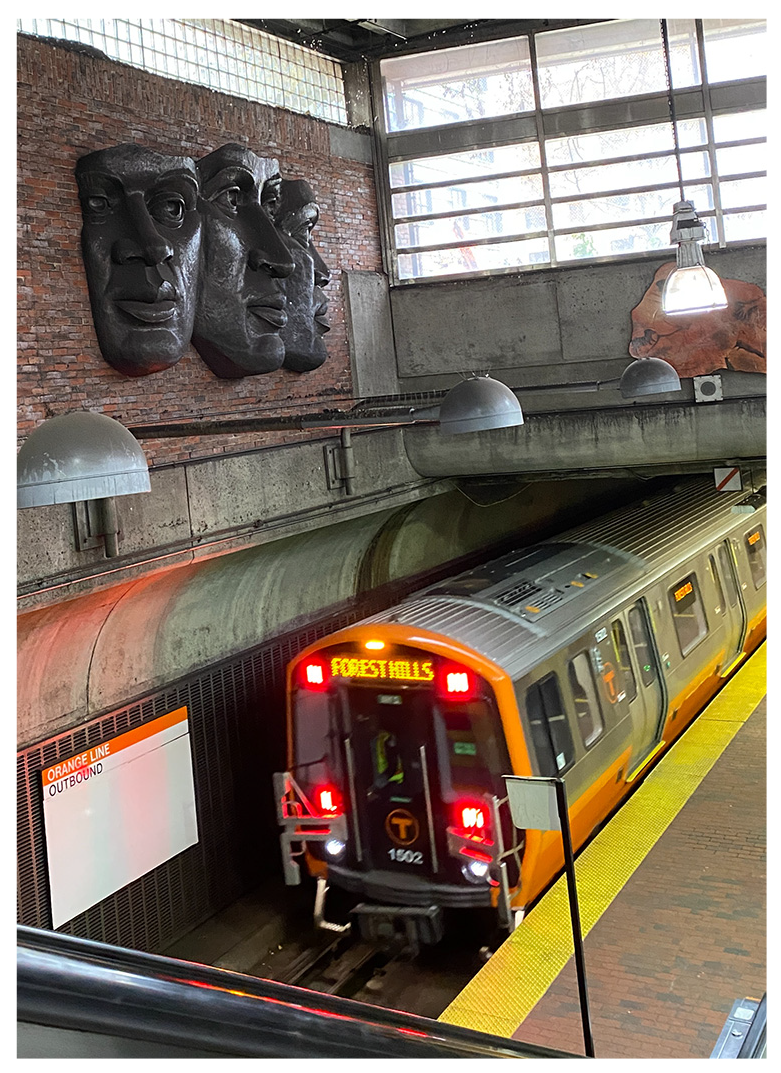
Faces in a Crowd, James Toatley, Jackson Square Station.
At his presentation to the Arts Panel, Toatley received positive feedback, but the gathered group—which included some members of the Site Committee—read the faces in Toatley’s maquette as three Black males. Based on the desires of the Site Committee, the Arts Panel did not wish that one demographic alone be represented and sent Toatley a series of recommendations with his acceptance, among them the request that “the faces in the work should be distinguishable and reflect the cross-generational and racial diversity of the area residents” (UrbanArts, 1986b: January 24). Toatley’s premature death by heart attack in September of 1986 complicated this request. The Arts Panel determined that the commission could continue posthumously, so no requested changes from the original design were possible in the completion of the artwork by Toatley’s wife, Linda Toatley. Nonetheless, Toatley’s artistic focus on the nature of transit infrastructure as collective and social makes the piece an interesting contribution to the 10 pieces of installed art along the Corridor.
These two examples of artworks briefly demonstrate that the process and the outcome were interconnected in the case of Arts in Transit. They offer a glimpse into the possibilities offered by this project to negotiate, connect, and affirm the sociotechnical nature of infrastructure through transit art.
Conclusion
Transit art has the potential to contribute to a more active and critical experience of infrastructure provision, maintenance, and delivery. Rather than putting artworks to use to raise property values, sell riders on public transit, or legitimize global prominence, the Arts in Transit project enabled subjecthood and agency over transit infrastructure through small, ordinary processes, affording critical, visual engagement with the sociotechnical nature of infrastructure. Transit art has the potential for multiple functions, from mere decoration to deployment as a catalyst for urban growth, to critical intervention in urban space. Clarifying rationales of siting transit art as well as the infrastructural inequalities on which the practice sits helps clarify alternatives, especially those with potential for critically accentuating infrastructural visibility. Arts in Transit is one alternative.
Infrastructure is social, spatial, and collective. It is also implicated in global inequality and unequal access to resources. Scholars since the mid-1990s have increasingly called for methods of infrastructural visibility. Infrastructure is not invisible; it is transparent in its ubiquity—because it is both social and technical, its scale and implications are ultimately inapprehensible without aid. There is potential in modes of visual practice to foreground the social nature of the infrastructural, as was the case for Arts in Transit. Transit art and other visual processes around infrastructure help us see more clearly the unsee-able totality of the infrastructures collectively binding us together.
Arts in Transit offered the possibility of doing transit infrastructure otherwise—of infrastructure as transformation rather than domination (Cowen, 2020). UrbanArts oversaw Arts in Transit as a subcontractee of the MBTA, and worked with racially and ethnically diverse members along Boston’s Southwest Corridor to describe their neighborhoods and determine the types of artworks they wished to see installed in new transit stations. Through intentional processes of inclusion, Site Committees were formed to speak for their neighborhoods with the hope of inscribing their histories and desired, positive self-image into the newly built infrastructure. Analyzing Arts in Transit in its specificity, that is, word by word reading of Community Profiles and meeting minutes as well as the recalled, lived experiences of its participants, reveals contemporary possibilities not necessarily present when the project was carried out.
The role of the visual in the infrastructural is powerful, including material visual works like the artworks in transit stations. Arts in Transit has been used here as an example of infrastructural visibility with the power to change infrastructure, but it is not the only example. Additional, critical studies of the global phenomenon of transit art as well as other visual practices that give complex views into the social nature of mobility infrastructures are desperately needed to understand how infrastructure can be “seen” and rendered a site of solidarity and collectivity.
The network of collective humanity that co-exists in, around, and with infrastructure must be teased out, brought forth, made real. The visual-cultural is one powerful means of doing so, equal to the task of reflecting and affirming the complexities of a sociotechnical system far beyond any single person’s imagining. Cultural-infrastructural approaches contribute meaningfully to thinking about transport as a social construct. The visual is a means of making infrastructure transformative through sustained attention to its social complexities. For just under a decade, Arts in Transit demonstrated that infrastructure can be done differently. The legacy of the Arts in Transit project should be to continue to inspire sustained visual attention to, and engagement with, infrastructure, affirming the possibilities for infrastructure as a site of mutuality, alliance, and solidarity.
Footnotes

Funding
The author received no financial support for the research, authorship, and/or publication of this article.
Declaration of conflicting interests
The author declared the following potential conflicts of interest with respect to the research, authorship, and/or publication of this article.
Ethical considerations
An Ethical Approval Certificate was obtained from the University of Sussex.
Consent to participate
Informed Consent Forms available if needed.
Consent for publication
Participants listed as interview subjects in this research gave written informed consent for their names and titles to be shared.