




Abstract
Public transport is a crucial arena where mobility and the public sphere intersect. This article examines transport interventions in Shillong, a small hill city in northeastern India, to show how the publicness of transport has become fragmented despite, and often through, successive state-led interventions. In Shillong, the private interests of transport operators are entwined with the state’s responsibility for passenger welfare through provisional and overlapping governance arrangements. This produces a system that is neither an efficient market solution nor a public good advancing equity. Instead, it creates a precarious arrangement that leaves both providers and users dissatisfied, reflecting a political order shaped by rule through exception and rent extraction rather than simple policy failure, eroding trust in transport infrastructure. The article argues that Shillong’s case illustrates the limitations of simple public-private dichotomies in urban transport and calls for considering it as a contested public sphere, often shaped by precarity and negotiation.
Introduction
“What is public anyway?”
A retired senior bureaucrat in Shillong asked me this question when I inquired whether the city’s shared taxis (vehicles that meet most of Shillong’s transport demand but operate in violation of their permit conditions) could be considered “public transport.” These taxis hold contract carriage permits, which legally restrict them to point-to-point bookings. In practice, however, they ply fixed routes and carry multiple passengers on a shared basis. This makes them the city’s de facto backbone of urban mobility, yet technically “illegal” through a narrow juridico-legal lens. The bureaucrat, deeply familiar with both regulatory frameworks and everyday practices, was well aware of this contradiction. His counter-question unsettled my line of inquiry, but it also revealed a deeper ambiguity: the meaning of “public” in the context of public transport. Rather than centering a formal–informal distinction, this ambiguity points to how publicness is unsettled through the overlapping actions of state agencies, regulatory practices, and everyday governance.
This article takes that ambiguity as its starting point. It examines how different dimensions of publicness, such as legality, ownership, service, and collective good, are unsettled in Shillong’s transport system. Focusing on two government-funded projects to procure buses and microvans, I show how interventions designed to consolidate a meaningful public transport system instead fragmented it further. These schemes did not produce either a coherent market-based solution or a public good oriented toward equity. Rather, they created a precarious assemblage of transport options in which both operators and users remain dissatisfied. I argue that this fragmentation of transport services—driven by overlapping mandates, competing state agencies, and provisional interventions—contributes to the erosion of the city’s public sphere, undermining the link between mobility and collective urban life.
Transport scholarship typically defines public transport in narrow, technical terms: near-universal access, fixed routes and frequencies, and mass capacity (Rodrigue, 2020). In India, a legalist classification adds another layer, distinguishing stage carriage (public transport) from contract carriage (paratransit) permits (Mittal, 2022b). Both approaches reduce publicness to operating conditions, overlooking issues of ownership, funding, and democratic participation. Scholars have critiqued this narrow framing, suggesting that public transport should also be understood in terms of public ownership, public space, public good, and public sphere (Paget-Seekins and Tironi, 2016). While these distinctions provide an important conceptual backdrop, they also risk reifying transport categories in ways that obscure how publicness is actively produced, fractured, and reworked through state-led interventions in practice. This article builds on that critique, asking: what constitutes the “public” in public transport, and how does it emerge—or unravel—in everyday governance?
The case of Shillong is instructive. As the capital of Meghalaya in northeastern India, Shillong is shaped by layered histories of colonial administration, ethnic politics, and fragmented governance. Shared taxis dominate everyday mobility, while state-funded bus and microvan projects have introduced overlapping institutions, short-term contracts, and fragile partnerships—placing the state itself at the center of transport fragmentation. Rather than strengthening transport provision, these interventions have produced new rivalries and regulatory ambiguities. Publicness here is not secured through formalization but becomes contingent and unstable, continually renegotiated among state agencies, private operators, and passengers.
The article draws on longitudinal fieldwork conducted between 2016 and 2024, including archival research, newspaper analysis, and interviews. Archival sources include records from the transport and urban development departments, as well as reports from The Shillong Times, a local English-language daily newspaper that has been published since 1945. I also conducted interviews with current and retired officials, as well as owners, drivers, and conductors of buses, taxis, and microvans. While these interviews informed my broader understanding of transport governance and everyday mobility practices in Shillong, they do not feature prominently in this article. This article relies primarily on government records and newspaper reports, as the analytical focus here is on institutional arrangements, policy trajectories, and the politics of transport provision rather than on individual perspectives. Participants were identified through snowball sampling, beginning with government offices and transport associations. Together, these sources trace how transport interventions were designed, implemented, and contested, and how they reshaped both mobility and the meaning of publicness.
The article proceeds in four parts. The following section reviews debates on the relationship between the city, transport, and the public sphere, with particular attention to recent efforts to conceptualize the publicness of public transport. The third section presents the empirical analysis of transport interventions in Shillong, tracing how the introduction of bus and microvan schemes led to the emergence of new actors, overlapping jurisdictions, and fragile arrangements. The fourth section examines how these dynamics fragmented rather than consolidated publicness, eroding the role of transport as a shared urban good and a space for public interaction. The conclusion reflects on the implications of Shillong’s experience for understanding transport governance in other cities of the Global South.
Transport, publicness, and the fragmented urban sphere
The city and mobility have long occupied a central place in theories of modernity. The city has been understood as the locus of cultural innovation, where the concentration of people, institutions, and exchange produces the “ultimate culture of life” (Mumford, 1938; Simmel, 1903). Mobility, meanwhile, is the enabling condition of this urbanity. It is through movement that social connections are established, work and leisure are accessed, and urban life itself becomes possible. As Cresswell (2006) argues, modernity has always been bound up with the expansion of mobility, from everyday circulation within cities to global flows of people and goods. If the city represents the fixed site of modern culture, mobility provides the fluid medium that sustains it.
Alongside these accounts of urban modernity, Habermas’s (1991) notion of the public sphere offers a normative model of democratic life. In Habermas’s formulation, the public sphere is the domain where private individuals collectively deliberate, hold the state accountable, and generate public opinion. Postcolonial scholarship has pluralized the understanding of the public sphere by challenging the universalizing claims of this framework, and arguing that public spheres emerge in multiple, uneven forms across different urban contexts (Dwivedi and Sanil, 2019; Padawangi, 2013; Robinson, 2006). Rather than assuming a singular Western trajectory, these accounts stress that publicness is contingent and situated, shaped by historical struggles, social structures, and the infrastructures through which everyday life is organized.
Transport is one such infrastructure. It not only enables the circulation that sustains urban economies but also shapes the very constitution of public life. In their wide-ranging essay, Fan et al. (2025) argue that urban transport should be understood as a social construct. Moving beyond a narrow view of transport as physical networks or technical systems, they emphasize how transport is embedded in social, cultural, and political dynamics. Their framework integrates three levels: individual outcomes (such as well-being, opportunity, and exclusion), collective dynamics (meanings, contestations, and mobility flows), and systemic relations (the co-evolution of transport with broader political and economic structures). This social-constructivist perspective is especially useful for cities in the Global South, where transport systems are not only technical artefacts but sites where competing claims to publicness are made and remade.
Recent scholarship has increasingly examined public transport as public space, offering nuanced perspectives on how mobility infrastructures constitute publics. Tuvikene et al. (2023) stress the multidimensional character of transport as public space: it is simultaneously convivial and conflictual, regulated and improvised, embedded in histories of modernization and postcolonial politics. By insisting that public transport deserves recognition alongside streets, squares, and parks as key sites of public life, this body of work expands the conceptualization of transport within urban studies scholarship. Sheller (2023) extends this argument by characterizing public transport as a “kinopolitical” terrain, an arena of micro-political struggle where mobile and atmospheric publics are continuously formed. This lens is valuable for understanding contexts like Shillong, where transport is not merely a service but a political space in which rival agencies, private operators, and passengers negotiate authority and belonging.
At a more granular level, scholars have shown how publicness in transport is mediated by both formal rules and everyday practices. Rink (2023), analyzing Cape Town’s Golden Arrow Bus Service, highlights how conditions of carriage and unwritten norms co-produce the publicness of bus spaces, rendering them liminal zones between openness and exclusion. Joseph and Gopakumar (2023), studying Bengaluru, argue that publicness must be seen as contingent, as it is neither reducible to macrostructural policies nor to spontaneous microsocial interactions, but rather emerges through their entanglement. Public transport in their account is not simply a site of encounter but a dynamic assemblage where governance decisions, operator practices, and rider experiences intertwine. These contributions are crucial for this article, as they suggest that publicness is not an inherent property of transport, but an ongoing achievement that often remains precarious and contested.
This recognition has important implications for urban transport policy. Much contemporary transport planning continues to be framed in techno-managerial terms (Kębłowski and Bassens, 2018), treating mobility as a rational, technical problem to be solved through supply-demand modelling, congestion pricing, or bus procurement. This approach is evident in the narrow, technical definition of public transport that dominates policy discourse, which emphasizes near-universal access, fixed routes and frequencies, and mass capacity (Rodrigue, 2020). Such definitions reduce public transport to the operating conditions of vehicles, obscuring its wider social and political significance. Some scholars have attempted to expand this by arguing that public transport should be understood as public not only through its technical design but also through its role in enabling sociality and inclusion (Paget-Seekins and Tironi, 2016). Yet even these efforts often remain descriptive, delineating properties of modes rather than analyzing their implications for publics. The result is a persistent differentiation between public transport and other forms of shared mobility, often called informal transport, such as autorickshaws or taxis—a binary that is analytically limiting in contexts like the Global South, where such modes often form the backbone of everyday mobility (Behrens et al., 2016; Klopp, 2021).
Research on informality has challenged binary distinctions between “formal” and “informal” transport. While earlier scholarship highlighted the centrality of informal modes in meeting mobility needs in the Global South (Cervero, 1991; Cervero and Golub, 2007), more recent work has shifted toward analyzing “informalities in transport” (Agbiboa, 2016; Mittal, 2022b; Rekhviashvili et al., 2022). This perspective reveals how informality is co-produced through the interactions of states, operators, and users, cutting across North-South contexts. It also shows that informality is not external to the state but often facilitated by policy design, contractual gaps, or selective enforcement. In Shillong, as will be shown, the layering of state schemes, overlapping institutions, and fragile partnerships with private actors has created precisely such conditions of institutionalized informality within public transport.
Critiques of techno-managerialism highlight how transport governance can depoliticize mobility, concealing its distributive consequences, and reinforcing uneven development (Addie, 2013; Oviedo Hernández and Dávila, 2016). In practice, the turn to managerialism often produces what Graham and Marvin (2001) call “splintering urbanism,” infrastructures that deepen socio-spatial divides rather than fostering inclusive publicness. Evidence from across the Global South underscores this pattern, where state-led transport projects often privilege elite mobility corridors while neglecting peripheral populations (Deka, 2017).
Taken together, these literatures reposition transport as a political and social infrastructure that actively shapes cities, publics, and the public sphere. This article contributes to these debates by examining Shillong, a small hill city in northeastern India, where state-led efforts to formalize transport through programs such as the Jawaharlal Nehru National Urban Renewal Mission (JNNURM) have not produced coherent public services but rather a patchwork of agencies, contracts, and fragile arrangements. Far from creating a stable public good, these interventions have intensified competition, undermined regulation, and generated precarious conditions for both passengers and operators. In so doing, they illustrate the limitations of viewing public transport solely as infrastructure or policy, and the necessity of analyzing it as a contested and fragmented public sphere.
Fragmenting public transport in Shillong
Shillong, the capital of Meghalaya, a small hill state in northeastern India (Figure 1), borders Bangladesh to the south and west and Assam to the north and east. It is one of the country’s few Christian- and tribal-majority states. Home to three matrilineal tribes—Garo, Khasi, and Jaintias—alongside migrant communities from the surrounding plains, Meghalaya was carved out of Assam in 1972 after a prolonged tribal struggle that reshaped the region’s political geography (Hussain, 1987). Shillong, which had served as Assam’s capital under the British Imperial rule since 1874, became the new state capital of Meghalaya while Assam’s administrative center shifted to Dispur. Established by the British in 1864 after acquiring land from a local Syiem (chieftain), the city from the outset bore deep social divisions (Hasan, 2011). The British administration recruited Bengalis (and later Assamese) into the bureaucracy, while entrepreneurs from Bengal and elsewhere established businesses. Christian missionaries arriving in the mid-19th century converted a significant portion of the monotheistic, nature-centric Khasi population to Christianity (Syiemlieh, 2005).
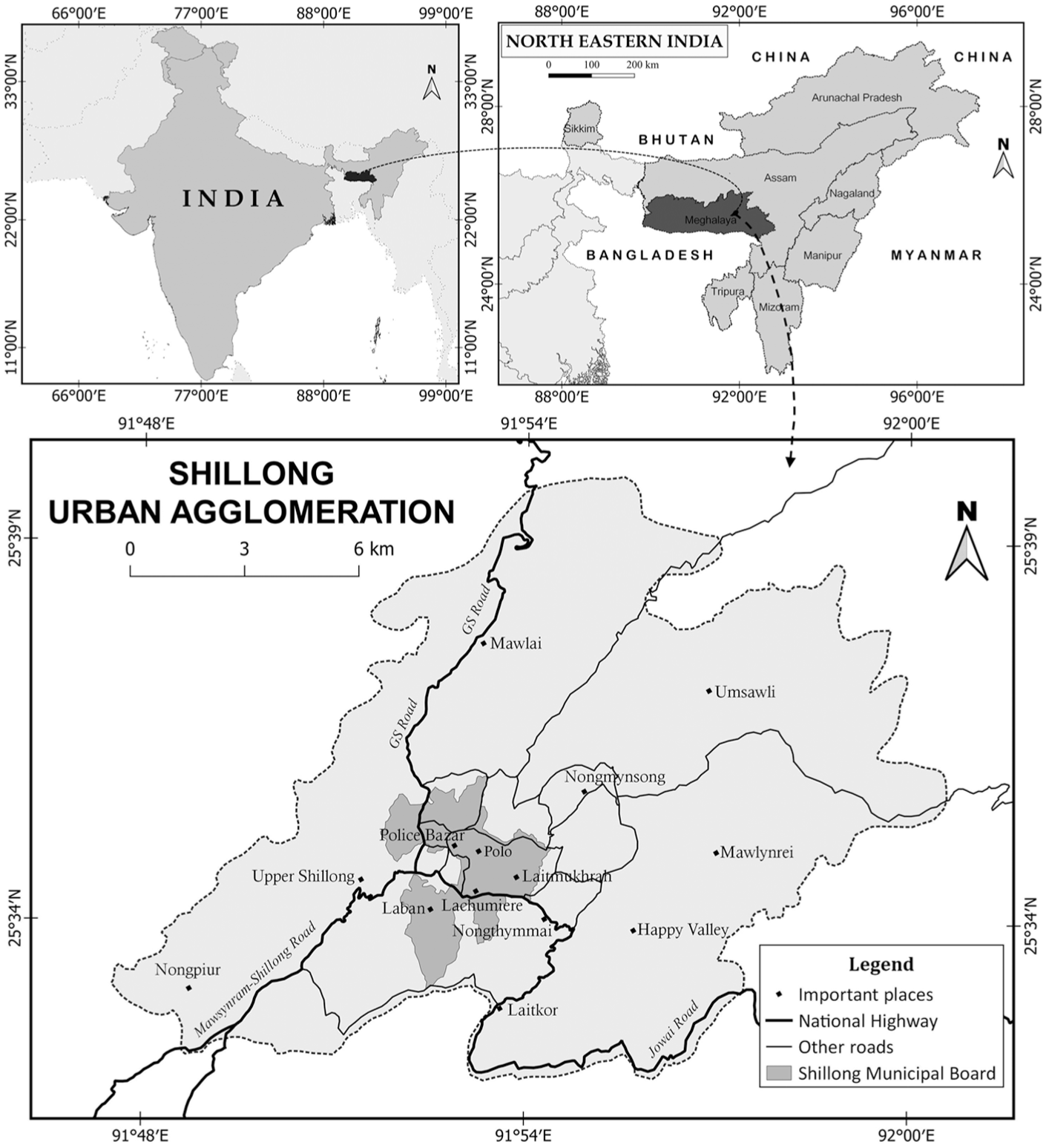
Location of Shillong in India.
These dynamics produced tensions between Khasis (mostly Christian) and non-Khasis (largely Hindus and Muslims). After independence, subtle and overt negotiations turned the city into “a veritable theatre of popular politics” (Hasan, 2011: 88). With statehood in 1972, identity politics became sharper, culminating in major anti-Bengali and anti-Nepali riots in 1979, 1987, 1992, 1997, and 1998 (McDuie-Ra, 2006, 2007). Violence against Dalit Sikhs in 2018 continued this pattern of Khasi aggression against the “outsiders,” often called Dkhar—many times employed as a racist slur used to further xenophobic hate (Das et al., 2025).
These Khasi–Dkhar tensions also influenced Shillong’s transport politics. Public transport began in the 1940s when a Bengali businessman converted military trucks into buses and called them “City Bus.” After Indian independence, the City Bus service expanded under Bengali ownership and was formalized in 1954 through the formation of the Shillong City Bus Syndicate (SCBS), a registered co-operative. Benefiting from the Motor Vehicles Act (MV Act), which favored cooperatives, the SCBS monopolized permits for Stage Carriage vehicles.
After Meghalaya’s formation, the District Transport Office (DTO), the government department responsible for issuing permits, sought to dismantle this monopoly by limiting City Bus permits and encouraging smaller “Mini Buses,” which they argued were better suited to the city’s narrow roads. Owned mainly by Khasis, Mini Buses rivalled City Buses. This policy shift, combined with anti-Dkhar riots, prompted many Bengalis to leave, reducing City Bus numbers. Mini Buses peaked in the 1980s but failed to maintain dominance. Their services were erratic because individual permit holders subcontracted vehicles to drivers and conductors who prioritized profit over regularity.
Economic liberalization of India in the late 1980s and 1990s further transformed Shillong’s transport. The automobile industry in the country expanded (Piplai, 2001); car loans became accessible, and a 1989 amendment to the MV Act liberalized vehicle permits. Many in Shillong applied for local taxi permits, officially designated as Contract Carriage, but in practice operating as shared taxis on fixed routes. Offering better frequency, reach, and speed than buses, they soon became the city’s dominant mode of transport. Taxi owners organized themselves in various “associations” or “syndicates” to control local territories, consolidating their influence.
By the late 2000s, shared taxis had eclipsed both the City and Mini Buses. The arrival of JNNURM-funded buses in 2010 introduced yet another shift. Although designed for Urban Local Bodies to own and operate, implementation took a different course, fragmenting the publicness of transport provision—a process explored in the following subsections.
Making the state the owner of public transport
The push for state-owned public transport in India’s small and medium-sized cities gained momentum with the country’s first National Urban Transport Policy (NUTP) in 2006. Issued soon after the launch of the JNNURM in 2005, one of the largest urban development programs in India’s history, funded by the central government (Sadoway et al., 2018), the policy identified transport as a critical urban concern. JNNURM covered 65 cities, funding between 50% and 90% of project costs, with the remainder borne by state and local governments. Among other issues, the NUTP gave special emphasis to public transport for its social importance and its potential to ease congestion (Pai and Hidalgo, 2009). Guided by this framework, a nationwide bus procurement scheme was introduced in 2009, designed to provide one-time central assistance for intracity urban transport buses. In total, 15,260 buses were sanctioned nationwide in 2009, followed by a further 10,000 in 2013–2014. Shillong, one of the 65 cities selected for JNNURM, procured 120 buses in the first phase and 240 in the second.
The JNNURM bus program aimed to formalize public transport by making municipal governments the owners and managers of new fleets. This was justified as a way to serve the public interest, correct perceived market failures, and extend services into underserved areas, while also reducing externalities such as congestion and unsafe driving (Ponnaluri, 2011). This framing reflects a narrowly technical conception of publicness, in which ownership and vehicle supply serve as proxies for broader questions of access, accountability, and collective benefit (similar to Rodrigue, 2020). It was also argued that if the central government provided one-time assistance towards public transport infrastructure and made municipal governments owners of the buses, the municipal governments would sustain the operation of these buses by investing more money into them through the revenue generated by the buses’ operation (Ministry of Urban Development, 2009). However, little thought was given to how these arrangements would impact the transport governance of cities.
By assuming that central funding and municipal ownership would automatically translate into sustainable and equitable provision, JNNURM positioned the state as the guarantor of the public. For Shillong, this marked a significant shift. Transport was formally brought under a new governance regime in which the municipal tier was expected to act simultaneously as owner, provider, and regulator. Yet, as subsequent sections show, the scheme did not consolidate publicness but fragmented it further. Limited municipal capacity, overlapping jurisdictions, and improvised partnerships opened new arenas of contestation. What was imagined as a straightforward state-led formalization ended up producing precisely the contingent and unstable forms of publicness that shape Shillong’s transport today.
New actors in the transport landscape
The effort to place municipal governments in charge of transport provision through JNNURM quickly encountered resistance from within the state apparatus itself. In most states, transport departments had long been the de jure controllers of urban mobility. They resisted ceding authority to municipal governments, which fell under the jurisdiction of separate urban development departments within the state government. Municipalities also lacked the capacity to manage transport services, making them dependent on transport departments for technical expertise. This interdependence generated prolonged negotiations between state-level transport and urban development departments, producing uneven outcomes across JNNURM cities.
In some cases, control of buses was eventually ceded to transport departments (see Mittal, 2014). In Shillong, however, the urban development department refused to do so. At the same time, it was reluctant to entrust responsibility to the Shillong Municipal Board (SMB). Instead, ownership and oversight were transferred to the Meghalaya Urban Development Authority (MUDA), a parastatal agency with jurisdiction over all urban areas of the state.
The arrival of JNNURM buses, therefore, disrupted long-standing power relations between existing operators and state institutions, making the urban development department a central player in mobility governance. Yet MUDA lacked the operational capacity to run services directly. It turned to private contractors to operate the buses, while also procuring more than 300 seven-seater microvans to supplement them. Central funding rules meant that these vehicles were formally owned by the SMB, introducing overlapping jurisdictions between MUDA, the SMB, and private operators. This layering of responsibilities illustrates how formalization did not consolidate publicness but multiplied competing claims over it. As Joseph and Gopakumar (2023) argue in a different context, publicness emerges contingently from the entanglement of institutions and everyday practices rather than from clear structural arrangements. In Shillong, new actors entered not through coherent planning but through ad hoc reallocations of authority, resulting in a transport system that was both more regulated on paper and more fragmented in practice.
The combined effect of JNNURM buses and microvans was thus not only the diversification of services but also the diversification of governance. Instead of a unified state-led system, Shillong developed a patchwork of institutions, contracts, and private operators whose interests frequently diverged. This outcome resonates with critiques of techno-managerial approaches to transport: while policy treated ownership and procurement as proxies for publicness, in practice the politics of jurisdiction, maintenance, and everyday operation shaped how services were delivered, and to whom. In this way, the very attempt to “make transport public” by placing it under state control opened new arenas of competition and instability.
Multiple state, multiple owners
Shillong’s first allocation of 120 JNNURM buses immediately exposed the contradictions of state-led formalization. The Detailed Project Report (DPR) designated ownership to the Meghalaya Urban Development Authority (MUDA) and operations to the Meghalaya Transport Corporation (MTC). Yet, even before buses arrived, MUDA and MTC clashed over revenue control. MTC demanded full retention, while MUDA insisted on ownership rights and reimbursement only of operational costs. This deadlock revealed that state agencies were more concerned with securing revenue from new resources than with passenger welfare. When the first set of buses arrived in Shillong in October 2010, they stood idle (Meghalaya Urban Development Authority, 2017), 1 sparking public frustration and financial loss. MUDA’s hurried decision to float a tender (Meghalaya Urban Development Department, n.d.), 2 and its willingness to award the contract to an under-qualified Self-Help Group (SHG) showed how expediency and political maneuver could override institutional coherence (The Shillong Times, 2011a).
A temporary compromise was eventually struck. MTC would operate the buses, retaining 70% of the revenue while MUDA, as legal owner, would keep 30%. Under this arrangement, in effect, MUDA extracted revenue simply by virtue of holding nominal ownership, without contributing operationally or financially. It exemplifies what Heller et al. (2019) describe as the “rent extracting cabals,” a regime in which state institutions become arenas for rent-sharing among bureaucratic actors rather than vehicles for collective provision. In Shillong, MUDA’s role was not to strengthen service delivery but to secure a share of revenues, even as capacity deficits left buses poorly staffed and passengers underserved. The attempt to reassert publicness through state ownership thus collapsed into rent-seeking competition between agencies, fragmenting rather than consolidating the governance of mobility.
The service, named the Shillong Public Transport Service (SPTS), was launched in July 2011 with 40 buses operating on 12 routes (The Shillong Times, 2011b). But the deal exposed capacity deficits. MTC lacked permanent staff and relied on short-term hires, creating precarious labor conditions and weak accountability (The Shillong Times, 2011c). Although strong initial revenues demonstrated demand, they also encouraged the urban development department to expand its direct role. Here, public transport became a site of overlapping authority—MUDA as the owner, MTC as the operator, and the DTO as the de jure regulator. Instead of consolidating the publicness of transport, JNNURM deepened fragmentation and widened the scope for discretionary intervention.
The search for supplementary interventions complicated governance further. In September 2011, a high-level meeting at the state government authorized smaller vehicles to serve neighborhoods inaccessible to buses, bypassing the DTO, which had historically overseen urban mobility (Government of Meghalaya, 2011). 3 This decision eroded the DTO’s authority and expanded the reach of the urban development department. Many seven-seater microvans were procured using funds earmarked for Urban Local Bodies by the 13th Finance Commission of India. 4 Because MUDA was ineligible to access this funding, ownership was transferred to the Shillong Municipal Board (SMB), an agency without elected representation. Launched in January 2012 as the Shillong Supplementary Public Transport Service (SSPTS; The Shillong Times, 2012a), the microvans were initially intended as feeders to SPTS, but in practice, they multiplied ownership claims, blurred regulatory authority, and intensified competition.
What was imagined as a consolidation of public transport thus created a patchwork of agencies—MUDA, MTC, SMB, DTO—each asserting partial control. Publicness here did not emerge from state ownership but was contingent and unstable, produced through conflict, improvisation, and overlapping jurisdictions. The case highlights how formalization efforts in the Global South often generate new informalities, as ad hoc fixes and temporary arrangements substitute for coherent governance (Rizzo, 2017). In Shillong, the attempt to “make transport public” through state ownership paradoxically fragmented it further, leaving passengers to navigate a system marked by institutional rivalry and precarity.
Public-private partnership—Shillong style
The Shillong Supplementary Public Transport Service (SSPTS) was initially contracted to the same Self-Help Group (SHG) that had earlier failed to qualify for the SPTS bus tender. Although framed as a “no profit, no loss” scheme, the agreement with the Shillong Municipal Board (SMB) allowed for revenue sharing between the two parties. 5 Disputes quickly arose, with the SMB accusing the SHG of underreporting income. A renegotiated contract replaced revenue sharing with a flat daily payment per vehicle, resembling the informal contracts under which many private-owned vehicles operate across the Global South as public transport. By 2013, the SSPTS fleet had grown to 127 microvans, supplemented by 20 buses under the Shillong Special Transport Service (SSTS). As these services expanded, contracts were divided among four operators, generating continuous struggles with the SMB over routes and payments. What was formally presented as a public–private partnership soon resembled a set of rent-seeking bargains, with private operators securing short-term gains and state agencies extracting rents without ensuring oversight.
Similar conflicts unfolded between MUDA and MTC. By mid-2012, the SPTS fleet had expanded to 50 buses across 19 routes; however, 17 buses were grounded within a year due to poor maintenance (The Shillong Times, 2012b). Rather than providing support to the MTC in maintaining the buses, MUDA withheld subsequent JNNURM buses and shifted to a Public-Private Partnership (PPP) model, justifying this move by citing the “satisfactory” operation of SSPTS microvans by SHGs (The Shillong Times, 2013). When MUDA allowed MTC’s contract to lapse in January 2013, both agencies blamed one another, but the effect was clear. Bus operations had devolved into a patchwork of private operators disguised as SHGs working under loosely defined contracts. This shift reinforced the tendency for state actors to behave less as guarantors of the public good than as brokers between small private operators, institutionalizing a fragile system where accountability was diffused.
By 2019, Shillong’s fleet had expanded to over 360 SPTS buses and around 300 microvans. Yet ownership and operation remained split. MUDA and SMB held the assets while eight different SHGs and contractors ran the services. Contracts contained no binding maintenance clauses, and vehicles quickly deteriorated. Operators prioritized profitable corridors already served by shared taxis, while peripheral areas were neglected. The outcome resembled what scholars of informality describe as institutionalized informalities (Roy, 2005, 2009), where weak regulation and short-term contracting blur the line between formal state provision and informal practice. Instead of expanding equitable access, Shillong’s PPP entrenched competition, weakened regulation, and deepened precarity for both operators and passengers.
By the early 2020s, the fragility of this system had become stark. With no maintenance provisions, the SPTS bus fleet declined steadily, and the SSPTS microvans nearly disappeared. A shared school bus system launched in 2023 collapsed within months due to poor institutional design. Meanwhile, shared taxis, the dominant mode of public transport in the city, also faced a crisis after COVID-19, forcing operators to raise fares, making services increasingly unaffordable (Mittal, 2022a). Traffic congestion worsened, with SPTS buses and SSPTS microvans themselves contributing to gridlock in the city center. What was meant to embody a balanced public–private partnership instead left Shillong with a public transport system that was overregulated in ownership, underregulated in operation, and ultimately unable to act as a public good. In Sheller’s (2023) terms, public transport here did not stabilize into a mobile public sphere but became an arena of fractured publics, shaped by ad hoc bargains and constant negotiation.
Governing transport through temporariness
The Shillong case illustrates how transport interventions have been governed more through ad hoc and provisional fixes than through long-term planning. When buses stood idle due to disputes between MUDA and MTC, tenders were hastily floated. When buses could not reach narrow lanes, microvans were introduced. When maintenance under MTC operation collapsed, short-term rent-seeking contracts with SHGs proliferated. Each measure was provisional, yet over time, these temporary arrangements became the default mode of governance. The temporary became permanent, and the exceptions became rules.
Agamben’s (2005) notion of rule by exception sheds light on these practices more clearly. Faced with recurring crises, such as idle buses, broken contracts, and underperforming operators, the state responded not with systemic reform but with provisional measures: temporary contracts, improvised tenders, and one-off interventions. Each was framed as a stopgap, yet together they became the normal mode of governance. The continual production of exceptions enabled the state to retain control while sidestepping the responsibilities of long-term planning and public accountability. In this sense, Shillong’s transport landscape exemplifies governance through exception. In this state of exception, every breakdown presented an opportunity for the executive to assert discretionary authority, often in ways that privileged rent extraction over public service, making it difficult to distinguish between the public good and profit-making.
Arendt (1958) warned that the collapse of distinctions between the public and the private undermines the very basis of collective life. In Shillong, this collapse is evident in the blurring of responsibilities between state agencies and private operators. Vehicles nominally owned by MUDA or SMB were run by contractors whose primary concern was profit, while state officials extracted rents without committing to service provision. The result was a hybrid system that was neither market-driven nor genuinely public, but a patchwork of ad hoc bargains. Arendt described how, under such conditions, the executive state becomes “faceless,” evading responsibility while consolidating power. This dynamic is evident in Shillong, where no single agency can be held accountable for service failures, despite the bureaucracy’s increasing control over permits, contracts, and revenue streams.
This condition resonates with Simone’s (2020) observation that temporariness has become a permanent feature of urban life, a rhythm through which people endure uncertainty. For operators in Shillong, temporariness means contracts that can be revoked or renegotiated at any time, wages tied to precarious daily returns, and vehicles vulnerable to breakdowns without institutional support. For passengers, it means relying on services whose routes, fares, and quality shift unpredictably. Temporariness thus permeates both sides of the system, shaping mobility as a condition of uncertain endurance rather than stable provision.
Bailey et al.’s (2002) concept of “permanent temporariness” is also useful. They describe how transitional conditions become entrenched, disciplining bodies and fragmenting communities. In Shillong, permanent temporariness allows the state to maintain control while avoiding accountability. By regulating permits and vehicles but outsourcing operations, the bureaucracy disciplines operators into compliance by keeping their access to routes, licenses, and operating permissions contingent and revocable, without guaranteeing stable livelihoods or services. The resulting competition between buses, microvans, and taxis divides groups that might otherwise mobilize collectively. Instead of forming a unified “public” capable of asserting claims, transport providers, and passengers are kept in fragmented struggles for survival.
Transport here also exemplifies what Mohammad and Sidaway (2016) call punctuated temporalities: lives organized around breaks, crises, and uncertain continuities. Each intervention—the arrival of JNNURM buses, the introduction of SSPTS microvans, the launch of the shared school bus scheme—initially promised stability. Yet each soon dissolved into the same cycle of breakdowns, disputes, and ad hoc fixes. These punctuations produced recurring moments of hope and disappointment, eroding trust in both the state and the system.
The analysis of temporariness underscores a broader claim: public transport in Shillong is not simply weak or inefficient, but strategically provisional. By ruling through exceptions, the state avoids committing to stable systems of ownership, financing, and accountability. This leaves operators and passengers in a state of permanent adjustment, fragmented from one another and unable to consolidate collective claims. Far from being outside the state, this condition was produced by the state’s own practices of provisional governance, which transformed exception into norm and temporariness into permanence.
Conclusion: Reconsidering the public in public transport
The question posed by a retired bureaucrat: “what is public anyway?” cuts to the heart of Shillong’s transport system. The case demonstrates that publicness is not guaranteed by state ownership, nor by the market, but is continually negotiated and often undone in practice.
Viewed through the lens of Paget-Seekins and Tironi (2016), in ownership terms, the JNNURM buses were considered “public” because they were state-owned. In operational terms, the SSPTS microvans were “public” because they provided shared mobility. In political terms, shared taxis were “public” because they met the city’s everyday needs. Yet each of these forms of publicness was unstable, fragmented by overlapping jurisdictions, rent-seeking arrangements, and provisional fixes. Cumulatively seen, what emerges is not a deficit of public transport as such, but a persistent inability to stabilize what the public in public transport is meant to be.
The Shillong case thus reveals a contrary dialectic: public transport is homogenized as “public” through state schemes, but segmented in practice through fragmented ownership, informalized contracts, and ad hoc regulation. Equality, plurality, and welfare—the normative foundations of “the public” —are lost in the process. Public transport here is neither a coherent public good nor an efficient market service, but a precarious system where publicness itself is always at risk of fragmentation.
The analysis presented in the article unsettles the dominant understanding of public transport, governance, and the politics of urban mobility. In Shillong, buses, microvans, and taxis reveal that transport cannot be reduced to infrastructure or service provision, nor can governance be read simply as strong or weak. What appears as inefficiency or failure is better understood as a political order in which rents are extracted, responsibilities displaced, and publics fragmented. This perspective reframes public transport scholarship by foregrounding fragmentation and temporariness as constitutive features of governance rather than anomalies to be corrected. It also deepens urban studies accounts of governance in the Global South by showing how rule by exception, rent-seeking, and provisional fixes shape not only infrastructure but the very possibility of collective life. In this sense, the politics of urban transport in Shillong is not just about moving people, but about continually remaking (and eroding) the grounds of the public itself.
This contributes to recent debates by underscoring Fan et al.’s (2025) call to view transport as a social construct whose meaning cannot be inferred from technical definitions or legal categories alone. It extends Joseph and Gopakumar’s (2023) idea of contingent publicness by demonstrating that in Shillong, publics are not simply entangled across micro and macro scales, but are actively fractured by competing state agencies and rent-seeking cabals (Heller et al., 2019). It also demonstrates how public transport as a mobile public sphere (Sheller, 2023; Tuvikene et al., 2023) can be eroded by governance practices that multiply ownership while displacing responsibility.
The dynamics observed in Shillong resonate with experiences elsewhere, suggesting broader relevance beyond this specific case. In Dar es Salaam, for example, the introduction of Bus Rapid Transit sought to formalize public transport but instead displaced informal operators and reproduced precarious labor relations without delivering the promised public benefits (Rizzo, 2017). In South Africa, efforts to restructure minibus taxi systems through partial state intervention have similarly fragmented responsibility and deepened insecurity for workers and users (Wood, 2022). More recently, the Jeepney Modernization Program in the Philippines illustrates how state-led modernization can erode the social foundations of shared mobility, marginalizing drivers and weakening the publicness of transport even as it claims to formalize it (Gatarin, 2024; Sunio et al., 2019). Taken together, these cases suggest that formalization often generates new forms of informality and fragmentation rather than resolving them.
Building on Wood’s (2025) argument that transport “failure” should be understood as a socially and politically produced condition rather than a technical breakdown, this article treats public transport as a key site where publicness is enacted, negotiated, and fractured. Wood shows how transport systems are sustained through hybrid arrangements that entangle private operators with partial and uneven state responsibility, producing shared precarity for workers and users. This article extends that critique by foregrounding the implications of such arrangements for the public sphere itself. Rather than occupying an ambiguous space between public and private, transport systems constitute contested public spheres in which responsibility, care, and authority are continually renegotiated. The analytical shift, therefore, is from transport failure as an outcome to the processes through which publicness is fragmented, reproduced, and challenged in everyday mobility.
At the same time, this article has clear limitations. While drivers and conductors appear throughout the analysis as frontline operators, their everyday perspectives are not examined in depth. Interviews conducted as part of the broader research indicate that many drivers do see themselves as providing a public service, even as they navigate insecure contracts, shifting regulations, and competitive pressures to earn their livelihoods. However, a sustained engagement with their experiences—particularly their relationships with vehicle owners, bureaucrats, police, and passengers—lies beyond the scope of this article, which focuses on institutional arrangements and policy trajectories.
These limits point to several directions for future research. Ethnographic work centered on drivers and conductors could deepen understanding of how publicness is enacted and contested through everyday labor practices and negotiations with owners, bureaucrats, police, and passengers. Comparative research across cities of different sizes and positions within national urban systems, and across countries, could illuminate which transport governance practices travel and which remain locally specific, and how similar techniques of formalization and contracting operate as biopolitical tools shaping state–society relations. Finally, further engagement with the questions of transport justice could move beyond normative assessments of access and equity to examine how fragmented transport systems become sites where claims over responsibility, care, and rights are articulated and contested vis-à-vis the state.
Footnotes
Acknowledgements
I am grateful to the people in Shillong who interacted with me and treated me with generosity and care despite navigating difficult and uncertain mobility conditions in their everyday lives. This article would not exist without their willingness to engage, even when transport itself was a source of strain rather than ease. I also thank James D. Sidaway, Jonathan Rigg, and Tim Schwanen for reading and commenting on earlier versions of the manuscript; their feedback was crucial in sharpening the analysis. All remaining shortcomings are my own.

Ethical considerations
The Faculty of Arts and Social Sciences Ethics Review Committee at the National University of Singapore reviewed and approved the ethical aspects of this research (approval: S-18-070E). Respondents provided oral consent before the interviews began.
Consent to participate
Informed consent was obtained verbally before participation. The consent was audio-recorded in the presence of an independent witness.
Funding
The author disclosed receipt of the following financial support for the research, authorship, and/or publication of this article: The fieldwork for this research was partially funded by the Graduate Research Support Scheme at the National University of Singapore.
Declaration of conflicting interests
The author declared no potential conflicts of interest with respect to the research, authorship, and/or publication of this article.