



Abstract
Cities worldwide are participating in International City Networks (ICNs) to build capacities and develop responses to artificial intelligence (AI)-driven digital transformation, yet the role of ICNs in AI governance remains understudied. Addressing this gap, this article conducts a case study of the Cities Coalition for Digital Rights (CCDR), an ICN advocating for a human rights-based approach to urban digitalization. It asks: How does CCDR membership affect cities’ AI policies? AI is increasingly integrated into urban governance, with cities adopting AI-driven applications to enhance efficiency and sustainability. At the same time, AI raises significant concerns regarding the protection of citizens’ rights, data privacy, equity, transparency, and accountability, requiring regulatory frameworks that define the conditions under which such applications are utilized. Local approaches vary considerably in the extent to which cities adopt application-oriented policies, focused on the use of AI systems, and regulatory policies, which establish governance frameworks and normative principles. This article argues that trans-local interactions within ICNs affect local policy through processes of social learning, enhancing implementation capacities and informing policy preferences. Drawing on data from the Atlas of Urban AI, the article compares 161 AI initiatives from 15 CCDR member cities and 15 non-members. It classifies cities’ approaches in application-oriented and regulatory policies and assesses alignment with CCDR principles. The findings show that CCDR member cities adopt a higher number of AI initiatives and demonstrate greater regulatory depth, with a stronger emphasis on regulatory policies reflecting rights-based, ethical governance, highlighting the active role of ICNs in global AI governance.
Introduction
Cities increasingly assert themselves as global actors, expanding their knowledge, power, and capacities through processes of learning, cooperation, and competition within multi-level and transnational arenas (Curtis, 2014; Tavares, 2016). This actorness is not fixed but dynamically constituted through continuous interactions with other actors, as relational perspectives on city agency emphasize (Keller and Friedrichs, forthcoming, in this issue ). Relationality refers to cities’ enhanced capacities, influence, and policy change through trans-local interactions, particularly via bilateral city-to-city cooperation, in city networks, and partnership with International Organizations (IOs) and non-state actors (Acuto and Leffel, 2021; Kihlgren Grandi, 2020; Leffel, 2021). Within this context, international city networks (ICNs), defined as networks spanning at least three countries with cities as main members (Jakobi et al., 2025), serve as a “transmission belt,” linking local policymaking with global governance and enabling cities to develop collective solutions (Kern et al., 2024; Leffel, 2021). These interactions foster social learning, as cities observe, emulate, and adapt policies in response to shared challenges.
This article examines how membership in the Cities Coalition for Digital Rights affects the AI policies of cities. The Cities Coalition for Digital Rights (CCDR) represents a prominent example of an ICN operating in digital governance. With over 60 member cities and partnerships with UN Agencies, EU-based city networks, and civil society actors, CCDR has been asserting itself as a global advocacy actor for urban digitalization (Cities Coalition for Digital Rights (CCDR), 2025a). By promoting a human rights-based approach to digitalization, the network seeks to both support cities in their digitalization efforts and advocate for digital human rights on the international stage. CCDR promotes responsible, ethical, and rights-based AI policies, providing cities with support and guidance for urban digitalization and enabling them to negotiate their roles and gain recognition within multilevel global governance systems (Calzada, 2021; UN-Habitat and CCDR, 2022). Focusing on the CCDR, this article analyzes the number, regulatory depth, and content of AI policies adopted by cities. To capture variation in how cities govern AI, the analysis distinguishes between application-oriented policies, which involve the deployment of AI-driven tools and systems in urban governance, and regulatory policies, which define the frameworks, rules, and strategic orientations guiding their development and use. Drawing on data from the Atlas of Urban AI, a repository maintained by the Global Observatory of Urban Artificial Intelligence (GOUAI), the article compares AI policy initiatives from 15 CCDR member cities and 15 non-member cities. In total, 161 initiatives are analyzed through qualitative content analysis, distinguishing between application-oriented and regulatory policies and categorizing them by sector and issue area, while also assessing their alignment with the CCDR’s principles and objectives.
AI is being applied across a growing range of governance areas with the potential to enhance efficiency, sustainability, and livability of the city (Müller-Eie and Kosmidis, 2023; Okonta et al., 2025; van Winden and van Den Buuse, 2017). AI can be defined as data-driven, machine-based systems that process inputs, link them algorithmically to stored data, and use learning mechanisms to autonomously generate predictions, decisions, or recommendations for specific tasks (Büthe et al., 2022; Russell and Norvig, 2016: 1723; Wirtz et al., 2019: 599). AI-driven applications can accelerate information processing, improve service quality, administrative efficiency, and effectiveness, and support government decision-making (Jeffares, 2021; Mikalef et al., 2022). At the same time, the use of AI in cities raises significant governance challenges related to data privacy, security, transparency, accountability, equity, and algorithmic bias (Baresi, 2025; Cugurullo et al., 2024; Cugurullo and Xu, 2025). Navigating the uncertainty and limited consensus around AI adoption poses a major challenge for local governments, especially in the absence of comprehensive international and national regulation on this emerging technology (Galceran-Vercher and Vidal, 2024; Ulnicane and Erkkilä, 2023; van Noordt et al., 2025). In this context, cities are required not only to implement AI-driven applications but also to develop regulatory policies that define their purpose, legal framework, and boundaries, and situate them in a larger governance context that accounts for ethical and societal implications of AI (Atkinson et al., 2017; David et al., 2024).
This article argues that membership in ICNs can affect cities’ policy adoption choices through processes of social learning. While city diplomacy research suggests a link between social learning through ICN participation and local policy adoption, research on the implications of ICN activity in digital governance remains limited (Calzada, 2020; Calzada et al., 2023; Palomo-Navarro and Navío-Marco, 2018). AI governance is being constituted through complex multi-level interactions among public and private actors, within which cities occupy a central position: they are key sites for technical development and experimentation with AI (Cugurullo, 2020) and function as governance actors (David et al., 2024; Rodríguez, 2021). Against this backdrop, AI-driven local digitalization is a pertinent field for examining how cities’ trans-local interactions within ICNs may influence both the adoption of AI applications and the development of regulatory frameworks governing their use.
The article begins by theorizing the effect of ICN membership on local policies, deriving three assumptions regarding the number, regulatory depth, and content of local AI policies of CCDR member cities. It then introduces the data and methodology, presenting the Atlas of Urban AI and the qualitative analysis approach used. The CCDR is presented as a case study, outlining its mission and policy recommendations for urban AI governance. The analysis subsequently compares AI policies adopted by CCDR member and non-member cities and interprets the findings regarding the theoretical assumptions linking ICN membership and policy adoption. The results indicate that CCDR membership is associated with distinct patterns in urban AI governance. Member cities have adopted a larger number of AI policies and show a greater regulatory depth, complementing application-oriented policies with regulatory instruments such as strategies, guidelines, and legal frameworks. In addition, the content of these policies closely reflects the normative orientation of the CCDR, emphasizing responsible, ethical, and rights-based AI governance. These findings provide an important first step in the analysis of how trans-local interaction and collective action within ICNs may relationally constitute urban AI policies.
Social learning and local AI policy adoption: The role of International City Networks
Policy adoption, defined as the choice of political actors to introduce new or modify existing government initiatives, results from the interaction of policy characteristics, actor preferences, and implementation capacities (Bennett and Howlett, 1992; Benz, 2021; Howlett and Cashore, 2014). Policies that diverge strongly from the status quo or require substantial institutional change face higher adoption barriers, ranging from incremental “first-order” adjustments to more transformative second- and third-order changes, affecting instruments, goals, and underlying paradigms (Hall, 1993; Nicholson-Crotty, 2009). Learning plays a central role in this process, defined as “the updating of beliefs based on lived or witnessed experiences, analysis, or social interaction” (Dunlop and Radaelli, 2013: 599; Dunlop and Radaelli, 2018). Particularly, social learning, through which governance approaches, values, and norms evolve, is relevant under conditions of uncertainty (Dunlop and Radaelli, 2013; Fricke, 2022; Kemp and Weehuizen, 2005).
AI governance constitutes such a high-uncertainty policy area, characterized by novelty, rapid technological development, limited regulatory consolidation, and significant normative implications concerning accountability, fairness, equality, and democratic governance (Coeckelbergh, 2022: 5; Floridi et al., 2018; Rotolo et al., 2015; Schiff et al., 2021; Ulnicane and Erkkilä, 2023). Cities, as sites of AI experimentation in governance, must assess the potential of AI for service delivery while addressing its legal, ethical, and societal risks (Barns, 2021; Cugurullo et al., 2024; Son et al., 2023). This challenge requires balancing technical implementation with broader governance considerations, which increases the need for external expertise and comparative experience. In this context, learning can be a central mechanism through which cities navigate uncertainty when adopting AI policies, interpreting policy options, and developing responses (Galceran-Vercher and Vidal, 2024; Radu, 2021; Ulnicane et al., 2021; van Noordt et al., 2025).
Building on policy change literature (Hall, 1993; Kemp and Weehuizen, 2005), this article distinguishes between application-oriented and regulatory AI policies. Application-oriented policies refer to the adoption of specific AI-driven tools and practices within existing governance structures, corresponding to first-order, instrument-oriented change. Regulatory policies, by contrast, establish the institutional, legal, and normative frameworks governing AI use and reflect higher-order changes that reconfigure decision-making procedures, accountability mechanisms, and strategic orientation (Hall, 1993). Both policy types are relevant in the context of urban AI governance: while application-oriented policies operationalize AI in service delivery, regulatory policies define the conditions under which such applications are developed and deployed. Integrating AI into governance frameworks is essential, as AI-driven tools and systems are not only technical instruments but inherently political objects. Their design and use embed normative assumptions about socio-technical considerations, such as ethical AI, fairness, efficiency, or the role of the state, thereby shaping how societal values are exercised (Coeckelbergh, 2022: 5; D’Ignazio and Klein, 2020; Ulnicane and Erkkilä, 2023; Zuboff, 2019). Regulatory policies directly engage with this political dimension of AI by defining the rules, standards, and normative principles that structure AI governance.
Local AI policy adoption is influenced by both internal and external factors. Internally, local socio-economic conditions, political institutions, and administrative capacities influence local policymakers’ preferences for adoption and the cities’ organizational and technical capacities to act (Cowley and Joss, 2022; Peters and Pierre, 2012; Pierre, 2019). Externally, multi-level governance arrangements and trans-local interactions provide access to resources, expertise, and guidance for policy development (Busch and Jörgens, 2007; Einstein et al., 2019; Kern et al., 2023; Sheldrick et al., 2017; Shipan and Volden, 2008). ICNs exemplify an arena of such external relations. They facilitate social learning by enabling information exchange, enhancing technical and organizational capacities, and diffusing norms and standards (Abel, 2021; Haupt et al., 2020; Lee, 2019). From a relational perspective, ICNs are not only platforms of capacity building, but political entities through which urban agency is co-constituted through interactions (Keller and Friedrichs, forthcoming, in this issue). As semi-institutionalized actors, they can act as knowledge brokers, policy entrepreneurs, and norm advocates, actively shaping policy instruments and agendas (Davidson et al., 2019; Frantzeskaki, 2019; Jakobi and Loges, 2022; Kern et al., 2024).
Through these mechanisms, ICN membership is expected to affect both application-oriented and regulatory AI policy adoption. By enabling exchange, providing technical assistance, and reducing capacity constraints, ICN membership can facilitate the adoption of application-oriented policies. Simultaneously, through the development and diffusion of governance frameworks and network standards, ICNs can promote the adoption of regulatory policies and increase their depth. In this case study, the theorized effect is expected to be visible in the number, regulatory depth, and content of AI policies adopted by member cities of the CCDR. Therefore, this article makes three assumptions regarding the effects of CCDR membership on local AI governance. First, CCDR member cities are expected to adopt a greater number of AI policies than non-member cities and, second, exhibit a stronger emphasis on regulatory policies. CCDR membership has the potential to lower local barriers to innovation while enhancing the legitimacy of policy initiatives, thereby encouraging cities to allocate resources, build capacities, and commit to more comprehensive AI governance strategies. Third, CCDR membership is expected to affect the content of local AI policies by influencing the normative preferences of policymakers. Through processes of collective action and alignment of shared values, ICNs such as the CCDR, explicitly promoting rights-based, citizen-centric, and ethical AI governance, are likely to induce member cities to adopt policies that will reflect these principles more strongly compared to those of non-member cities.
Data and methods
The article utilizes data from the Atlas of Urban AI, a curated repository developed by the Global Observatory of Urban AI (GOUAI). This project is led by the Barcelona Centre for International Affairs (CIDOB), together with the cities of Barcelona, Amsterdam, and London, in partnership with UN-Habitat, and is associated with the CCDR, contributing to a human rights-based approach to urban digitalization (CIDOB, 2025). The Atlas documents 218 AI initiatives from 74 cities: 93 initiatives originate from 15 CCDR member cities and 125 from 59 non-member cities (CIDOB, 2025). Data for the Atlas were collected between 2021 and 2024 using publicly accessible sources, complemented by survey responses from city officials. To be included, AI initiatives were required to explicitly align with the Global Observatory’s ethical principles (Rodríguez, 2021), involve city governments, focus on urban AI applications, and have a documented planning and implementation process. While the researchers aimed for comprehensive coverage of all projects meeting these criteria, they acknowledge that omissions are possible (Galceran-Vercher and Vidal, 2024). Thus, the Atlas provides systematically collected, transparently selected data on the global landscape of urban AI governance, making it a suitable basis for comparing AI initiatives across cities.
To enable systematic comparison of AI policies between CCDR members and non-member cities, this article analyzes initiatives from the 15 CCDR member cities included in the Atlas and compares them with the 15 non-member cities with the highest number of documented initiatives. This selection strategy facilitates comparison between cities with a substantial level of AI policy activity. However, this approach also introduces a selection bias: As non-member cities are chosen based on the number of documented initiatives, their level of activity is likely overrepresented relative to the broader group of non-member cities. Moreover, the analysis is limited to cities included in the Atlas, potentially omitting CCDR non-member cities that have adopted AI policies but are not included in the dataset. Consequently, the sample does not reflect the overall distribution of AI initiatives between CCDR members and non-members, but rather compares the most active cities in both groups as captured by the Atlas.
To assess the plausibility of the argument that CCDR membership influences the number, regulatory depth, and content of local AI policies, a qualitative content analysis was conducted. The analysis proceeded in four steps. First, the number of AI initiatives across all 30 cities in the sample was compared, distinguishing between CCDR member and non-member cities, providing an initial indication of whether ICN membership is associated with higher levels of AI policy adoption. Second, initiatives were systematically coded as application-oriented and/or regulatory policies. The coding process entailed a structured review of initiative descriptions provided in the Atlas, complemented by additional sources linked therein. Initiatives were classified as application-oriented policies when they referred to the deployment of AI-based tools or applications in urban governance or service provision, such as chatbots or geospatial mapping systems. Regulatory policies were identified where initiatives established rules, guidelines, governance structures, or strategic frameworks governing the development, use, or oversight of AI. The categories are not mutually exclusive, as individual initiatives may combine application-oriented and regulatory elements. For example, Amsterdam’s AI 3D “Point Clouds” Map constitutes an application-oriented policy by providing a LiDAR-based dataset of urban space (City of Amsterdam, 2023), while Helsinki’s Ethical Principles for the Use of AI represent a regulatory policy by defining guiding principles for data and AI use within the city administration (Smart Cities World, 2023). San Josés Anonymized Foot Traffic Data Initiative was coded in both categories, as it combines AI-based analysis with specifying data anonymization procedures and the intended purposes of the application (City of San Jose, 2025).
Third, to examine variation in regulatory depth, initiatives were further classified into sectors addressed using manually developed categories informed by, but not identical to, those in the Atlas. The sectors include: Governance of AI (rules, strategies, and frameworks of AI use), Public Sector (service delivery and administrative use), Mobility (transport and traffic systems), Infrastructure (built environment and urban systems), Security (public safety), Environment and Resources (sustainability and resource management), Social Services (health, education, housing), and Economy and Business (private sector development and innovation). As initiatives may address multiple sectors, categories are not mutually exclusive. To further differentiate regulatory depth within the governance sector, initiatives were additionally coded into subcategories, including AI strategies, guidelines and standards, laws, AI registries, and co-creation projects.
Fourth, to examine whether CCDR membership affects the content of AI policies, an inductive coding approach was employed to identify topics that were frequently addressed in the policies. Eight themes were identified: Ethical Standards, Public Communication and Transparency, Data Privacy, Human Rights, Risk Awareness, Efficiency, Citizen-Centrism, Environment, and Sustainability. A theme was coded as present when it was explicitly referenced in the available materials, including Atlas descriptions and linked policy documents. Overall, the analysis enables a systematic assessment of whether and how CCDR membership is associated with differences in the number, regulatory depth, and content of local AI policy adoption, providing the empirical basis to evaluate the theorized link between ICN membership and local AI policies.
Social learning of AI policies in the Cities Coalition for Digital Rights
The CCDR promotes a human rights-based approach to municipal digitalization, emphasizing the protection of citizens’ rights and needs in processes of digital transformation (CCDR, 2025a). Established in 2018 by Barcelona, Amsterdam, and New York City, the Coalition has expanded to over 60 cities across 23 countries, with a strong presence in Europe and North America (CCDR, 2025a). Its Declaration formulates five core principles: universal internet access; privacy, data protection, and security; transparency, accountability, and non-discrimination of data; participatory democracy, diversity, and inclusion; and open and ethical digital service standards (CCDR, 2019). The Declaration has been recognized by Eurocities and United Cities and Local Governments (UCLG), which collectively represent over 190 local authorities in 39 countries (CCDR, 2025a). Through its partnership with UN-Habitat, the Coalition amplifies its advocacy for a rights-based approach to digitalization, aligning with UN-Habitat’s People-Centered Smart Cities Program, promoting ethical, inclusive, and sustainable digital governance (UN-Habitat, 2019).
The CCDR both functions as a platform for knowledge exchange among cities and articulates a clear normative agenda toward its members and the international community. It promotes cities as active agents in digital governance that (a) play a key role in implementing digital transformation and (b) demand recognition as relevant actors in shaping the international discourse on digital (urban) governance (CCDR, 2019; UN-Habitat and CCDR, 2022). The network provides a platform for city-to-city exchange and capacity building and produces and disseminates knowledge through institutionalized frameworks such as the Digital Rights Governance Framework and the Guide to Mainstreaming Human Rights in the Digital Transformation of Cities (CCDR, 2022; UN-Habitat and CCDR, 2022). These frameworks lower informational and organizational barriers to policy adoption by offering guidance, best practices, and implementation support. At the same time, they promote a distinct governance approach grounded in digital human rights, thereby providing strategic orientation and pursuing the normative goal of promoting rights-based urban digitalization. Additional initiatives, such as policy reports, advocacy articles, and projects, including the Global Observatory of Urban AI or the Digital Rights Helpdesk, further support these functions by providing curated information and access to expertise.
In AI governance, the CCDR explicitly advocates a rights-based approach that addresses both the technical and normative challenges associated with AI policy adoption. Its advocacy emphasizes the need to prevent risks associated with unregulated AI use while ensuring AI-driven innovations align with human rights principles (CCDR, 2025b). The Coalition’s policy framework highlights AI governance concerns, including algorithmic bias, data protection, explainability, and public trust, and advocates for the integration of these principles into local AI policies (CCDR, 2025b). Therefore, the network’s activities fulfill the dual function of providing technical guidance and best practices that can facilitate the adoption of application-oriented AI policies, while also promoting rights-based, ethical AI governance that can be expected to affect regulatory policies adopted by member cities. Within the network, the structured learning environment, access to capacity-building tools, and the clearly defined normative agenda suggest that member cities are not only exposed to instruments that foster policy adoption but are also encouraged to align their policies with shared values and governance standards. Accordingly, CCDR membership is expected to correlate with a higher number of AI policy initiatives, a greater emphasis on regulatory policies, and a stronger alignment with rights-based, citizen-centric, ethical AI policy content.
Comparing AI policies of CCDR members and non-members
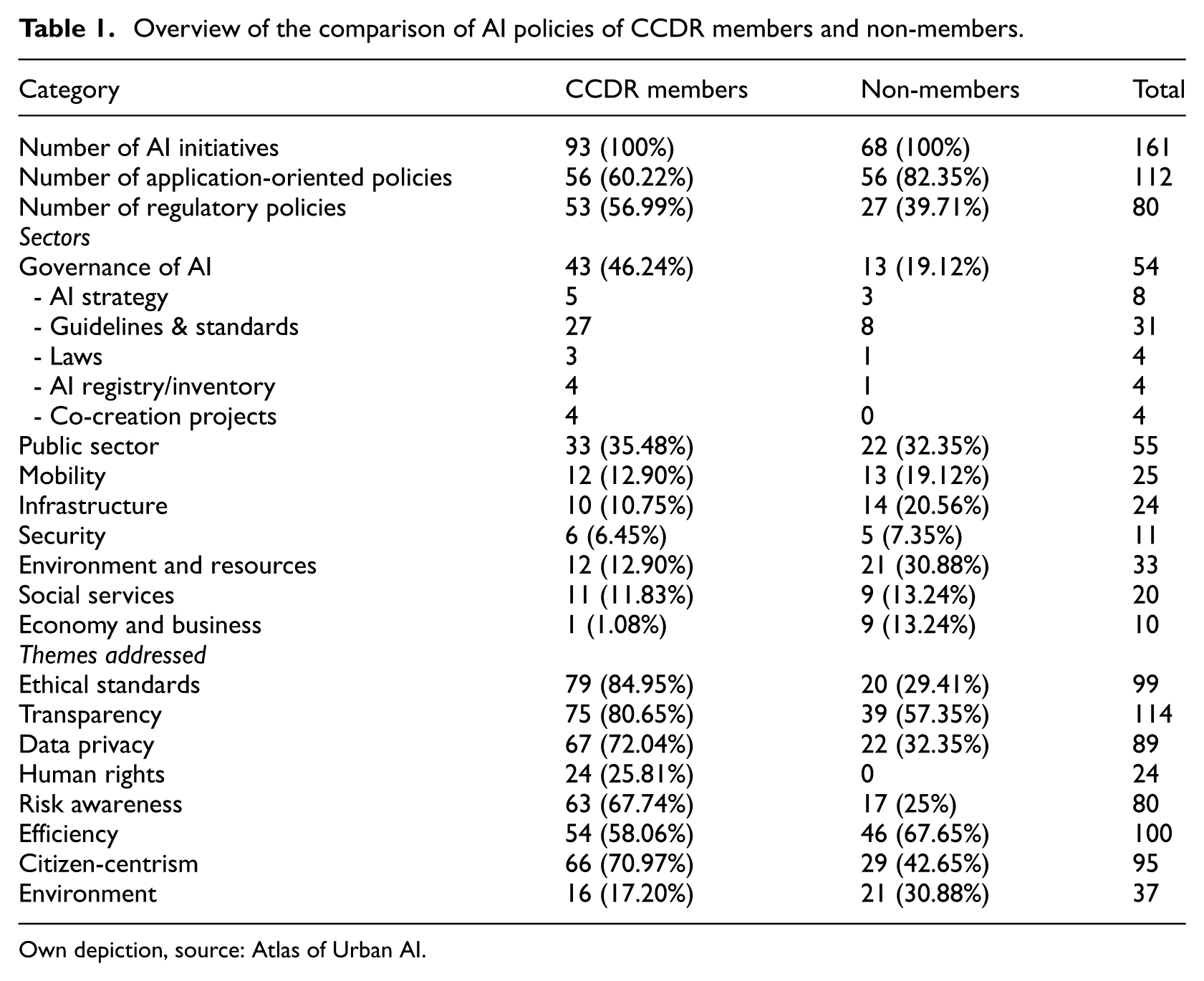
Comparing the AI policies of 15 CCDR members with those of 15 non-member cities reveals notable differences regarding the number, type, and thematic content of the initiatives (see Table 1). Of the 161 initiatives analyzed, CCDR member cities have introduced 93 initiatives, while non-member cities account for 68. This supports the first assumption that CCDR membership correlates with a higher number of AI policies. More pronounced differences emerge regarding the type of policies adopted. Both groups adopted 56 application-oriented policies; however, since CCDR member cities launched more initiatives overall, the proportion of application-oriented policies is greater among non-member cities. In contrast, CCDR member cities have adopted significantly more regulatory policies (53 compared to 27), indicating a stronger orientation toward higher-order policy change. The higher prevalence of regulatory policies among CCDR members thus suggests a greater degree of regulatory depth, as regulatory policies entail the development of frameworks, rules, and strategies specifying how AI is governed, in addition to the primarily operational use of AI that application-oriented policies indicate.
Overview of the comparison of AI policies of CCDR members and non-members.
Own depiction, source: Atlas of Urban AI.
This difference between application-oriented and regulatory policies becomes particularly visible in the sectoral distribution of initiatives. While both CCDR and non-member cities have adopted initiatives across all sectors, emphases vary: CCDR members concentrate more strongly on governance-related policies, with 43 initiatives addressing governance compared to 13 among non-member cities. These initiatives include guidelines and standards, AI strategies, laws, AI registries, and co-creation projects. CCDR members have adopted 27 guidelines and standards compared to eight among non-members. Among non-members, the cities of Dubai, Singapore, and Buenos Aires have adopted AI Strategies, alongside the five CCDR members: Amsterdam, Barcelona, New York City, London, and Vienna. Laws have been introduced by the CCDR cities of Portland, New York, and the non-member city of Boston. AI Registries exist in Portland, San Jose, Amsterdam, Helsinki, and the non-member city of Nantes. Co-Creation Projects, collaborative projects to develop AI governance standards and tools in partnership with government agencies or other cities, are exclusively found among CCDR member cities. The prominence of governance initiatives indicates that CCDR members are more actively engaged in establishing institutional and regulatory frameworks for AI governance, rather than focusing primarily on the introduction of AI-driven applications. In contrast, non-member cities exhibit a comparatively stronger orientation toward application-focused initiatives, suggesting a more instrumental approach to AI governance that focuses on introducing specific AI-driven initiatives to improve service quality and urban environments.
Furthermore, the analysis of policy content supports the argument that CCDR membership is associated with a distinct normative orientation, as CCDR member cities’ AI policies strongly reflect the network’s emphasis on rights-based digital governance. The majority of initiatives address ethical standards (79), transparency (75), data privacy (67), and risk awareness (63), while citizen-centric objectives are present in 66 initiatives. Notably, only CCDR member cities explicitly reference human rights as a foundational element of AI policymaking. Compared to non-member cities, CCDR members place considerably more emphasis on these themes, indicating alignment with the rights-based, ethical AI governance framework promoted by the network. In contrast, although non-member cities also incorporate ethical considerations to a certain extent, they address these themes less consistently and more frequently frame AI initiatives in terms of practical application and efficiency gains.
In sum, these findings correspond to the theorized processes of social learning within ICNs. The higher number of AI initiatives among CCDR members suggests that access to shared knowledge, expertise, and policy guidance facilitates policy adoption. Furthermore, the stronger emphasis on regulatory policies among CCDR cities indicates the dissemination of specific values and strategic orientations through the network. CCDR brings together cities that not only learn from each other regarding the implementation of application-oriented AI policies but also collectively develop shared understandings and guidelines for human rights-based AI governance. These processes translate into regulatory policies adopted by member cities, reflecting the network’s rights-based and ethical approach to urban digitalization. Hence, ICNs like the CCDR have the potential to act as transnational governance actors, relationally constituting the content of AI governance.
At the same time, the findings indicate that CCDR membership cannot be considered the sole explanatory factor for the inclusion of ethical standards in local AI policies. Non-member cities also adopt regulatory policies and support ethical AI governance. Specifically, a third of their policies reference ethical standards and data privacy considerations, while more than half address transparency. Relational processes, such as interactions with other cities and international actors, influence how local actors define priorities, interpret norms, and develop capacity for action. Yet, political and socio-economic conditions shape the ability of cities to engage in those relations, making the processes and outcomes of city networking dependent on a complex interplay of city-specific, contextual, and relational factors. Other relevant considerations that could interact with the observed patterns include greater internal capacities, higher socio-economic status, stronger institutional frameworks, or a more supportive political culture. Cities with more internal capacities are more likely to introduce a higher number and greater regulatory depth of policies, regardless of their ICN affiliations. The findings show that cities such as Dubai, Shenzhen, or Singapore, despite not being CCDR members, have adopted comprehensive AI governance frameworks and incorporated ethical standards. However, the presence of financial and institutional capacities alone does not guarantee the incorporation of ethical standards. For example, Seoul and Hong Kong, while socio-economically advanced and relatively active in AI policymaking (Ang-Tan and Ang, 2022; Joo, 2023), have not emphasized ethical standards in their approaches. This suggests that ICN membership may interact with city-level conditions, amplifying or decreasing local barriers by reinforcing normative goals or providing guidance for policy change.
Furthermore, the data also reveals instances of the impact of intercity collaboration and learning on the adoption of policies outside of the CCDR’s activities. For example, the city of Amsterdam adopted Algorithmic Transparency Standards in 2018, a common data framework for algorithmic registries (CIDOB, 2025). These standards emerged from a collaboration with other cities in the Eurocities Digital Forum Lab. All participating cities have since adopted the standards to enhance transparency and accountability in their local AI initiatives (CIDOB, 2025). Another case is the AI4Cities project, a three-year, EU-funded initiative involving six major European cities (Amsterdam, Copenhagen, Greater Paris, Helsinki, Stavanger, and Tallinn), which aimed to develop AI-driven solutions for climate mitigation in energy and mobility. As a result, the involved cities implemented similar policies aligned with shared sustainability goals. These examples show the impact of relational factors on local policymaking and governance, and how joint participation in projects and ICNs affect both cities’ objectives and their specific AI policies.
In sum, the findings suggest that ICNs such as the CCDR contribute to local AI policy adoption by embedding cities in trans-local learning environments that facilitate knowledge exchange, collaboration, and contribute to the circulation of shared norms and strategic orientations. While ICN membership interacts with local and national contextual factors, it appears to be a relevant factor in increasing the number of policies adopted, promoting regulatory depth, and influencing the content of local AI policies.
Conclusions and outlook
This article analyzed how participation in the CCDR, an ICN in digital governance, relates to local AI policy adoption. It argued that the interactions and collaborations facilitated within the network can support social learning and collective action, thereby strengthening cities’ capacities for policy innovation and interacting with local policymakers’ preferences. Using data from GOUAI’s Atlas of Urban AI, a total of 161 initiatives from 15 CCDR member cities and 15 non-member cities were compared according to the number of policies introduced, the inclusion of application-oriented and regulatory elements, as well as the content of their initiatives. Focusing on the AI initiatives included in the Atlas, it was assumed that members would adopt a greater number of AI policies, including a higher proportion of regulatory policies. Furthermore, it was expected that these policies would more closely align with the normative objectives and principles promoted by the CCDR. The findings support these assumptions, revealing that membership correlates with a higher number of AI policies as well as with higher regulatory depth and ethically oriented policymaking, suggesting that relational processes linked to ICN participation can play a formative role in local AI policy adoption.
Adopting a relational perspective to city agency, the findings suggest a dual dynamic: Cities collectively define the objectives and activities of ICNs through their participation, and these networks, in turn, can shape local policies. This mutual constitution underscores the analytical value of a relational approach for understanding the formation and diffusion of urban policies within complex, multi-level governance systems. Through learning and collection action within the CCDR, cities strengthen their capacities for innovation and are simultaneously influenced in their decisions by the objectives promoted through these interactions. At the same time, the article acknowledges that the effects of CCDR membership interact with city-level and contextual factors, such as socio-economic resources, population size, or the national political system. Moreover, the possibility of inverse causality must be acknowledged, as the findings cannot conclusively determine the extent to which CCDR membership, as opposed to a pre-existing interest in ethical AI governance, accounts for differences in the regulatory depth and orientation of cities’ AI policies. However, the findings indicate that, within the CCDR, member cities engage in the dissemination of knowledge and produce collective responses to the challenges of AI-driven digital transformation, thereby contributing to the ongoing constitution of multi-level AI governance.
This study focused solely on membership in one ICN, the CCDR. However, cities frequently engage in numerous regional and international relations simultaneously. These interactions, including bilateral city partnerships, regional institutions, and engagement in other ICNs, although beyond the scope of this article, could significantly influence local policies. Moreover, the emerging international norm of rights-based digital governance and people-centered smart cities, promoted by actors like the UN, OECD, and EU, likely contribute to the dissemination of ethical AI approaches beyond CCDR-affiliated cities. Lastly, local political dynamics and citizen demands may also drive ethical considerations, independent of ICN participation.
The article builds an important initial step in examining the role of ICNs in digital urban governance and AI policymaking. Further research is needed to identify the causal mechanisms linking city-level capacities, national contexts, and international network participation to local policies. Comparative and longitudinal analyses across a broader, cross-national sample of cities could assess how, and to what extent, ICN membership influences AI policy adoption over time. Open questions remain regarding the local and network-level conditions that enable or constrain the benefits of ICN participation, as well as the coordination and governance of social learning and collective action within digital ICNs. Given the prominence of private actors in this domain, future research should also examine power relations within ICNs and their implications for accountability, fairness, security, and sustainability in urban digitalization. As AI-driven applications become increasingly relevant for urban governance, the relational dynamics of inter-city networking represent a productive research avenue for advancing empirical and theoretical understanding of digital urban governance.
Footnotes
Acknowledgements
The author would like to thank Judith Keller, Gordon Friedrichs, Anja P. Jakobi and Bastian Loges for their feedback, as well as the participants of the workshops “Cities as Global Actors in International Politics,” held at the Max Planck Institute in December 2024 and “International City Networks under Adverse Conditions: The Role of Cities in Global Normative Change,” held in Berlin in February 2026, where earlier versions of this paper were presented.

Funding
The author disclosed receipt of the following financial support for the research, authorship, and/or publication of this article: The research is part of a project on international city networks and global norms (URBANORMS), funded by the German Research Foundation [Grant Number: 468859403].
Declaration of conflicting interests
The author declared no potential conflicts of interest with respect to the research, authorship, and/or publication of this article.
Data availability statement
The dataset will be made publicly available in a repository and is available on request for review.