



Abstract
What led to the boom of Chinese development cooperation in Latin America? This article provides a systematic analysis of China’s foreign behavior, motives, and policies regarding development cooperation toward the region between 2000 and 2014. I propose a comparative framework that defines Chinese development cooperation as a tool of economic diplomacy. Drawing on empirical evidence from AidData’s Global Chinese Official Finance Dataset and Chinese white papers on foreign aid, the findings evidence that China was motivated by multiple and conjunctural factors in providing development cooperation. In the realm of theory, the article contributes to the literature on economic statecraft—filling in gaps in understanding the relationship between economics and politics. Empirically, it provides a set of tools for understanding the important role that development cooperation plays in a nation’s statecraft. Regarding Chinese foreign policy studies, it offers insight into the financial dimension of China’s international economic relations.
Since its World Trade Organization (WTO) accession, China has increased its economic diplomacy (ED) activity in the Latin American region involving several economic fields ranging from investment, trade, aid, and finance. It turned out to be crucial to the development of the “Go Global” strategy as a natural extension of the “Going out” policy in 2000, which totally transformed the landscape of China’s foreign policy and its ED. The actions of two key groups of domestic actors in China were particularly relevant: the international expansion of state-owned enterprises (SOEs), and the increasing finance support from state-owned banks (SOBs). This led to a dramatic boom in loans, grants, and export credits toward Latin American countries to over US$46.5 billion in 2000–2014, through bilateral agreements in which state agencies, SOBs, SOEs, the private sector, and other actors interacted to produce a variety of links (AidData 2017).
What led to the boom? China’s increasing role in ED and the exponential expansion of its development cooperation toward Latin American countries has been the subject of considerable interest in the academic literature. However, comparative studies on Sino-Latin American relations that attempt to integrate the realms of foreign aid and development finance in a single analysis are scarce. This article aims to partially fill this gap by indicating and examining how frames of China’s development cooperation vary with format changes and sectoral allocation in different theaters or contexts. It covers traditional aid, but also financing tools in the form of non-concessional lending that go far beyond China’s aid program, such as export credits, official loans at market rates, and strategic lines of credit provided to Chinese enterprises (J. Xu and Carey 2014). While I am not primarily concerned with the impacts of China’s variegated ED in the region, the present study enables us to understand different and sometimes seemingly divergent trends and rationales. For that reason, the question of why and how China provides development cooperation should be addressed on a case-by-case basis, giving due consideration to the interplay between particular and changing drivers, specific sets of formats, and the combination of sectoral priorities that shape each interaction.
With a view to disaggregating the financial dimension of Chinese ED in Latin America, this article looks at development cooperation through the lens of ED. Drawing on empirical evidence gathered from AidData’s Global Chinese Official Finance Dataset 2000–2014, it maps the political economy of the boom of Chinese development cooperation to Latin America, illuminating the geographic and sectoral allocations of aid and market-based development finance as well as the relationship between the central government and the Ministries, SOEs, and Chinese SOBs.
My assumption is that there was no one singular form of Chinese development cooperation. Rather, there were at least five frames, depending on the different balances between aid and market-based development finance and the sectoral priorities that shaped interactions. The concept of theater is addressed on a case-by-case basis, with due consideration given to the interplay between particular combinations of formats and sectoral priorities.
The first section examines some of the most relevant existing literature on Chinese economic statecraft and development cooperation in Latin America. I next define the conceptual framework for addressing and comparing Chinese ED and development cooperation and unpack the research question and the conceptual definitions of aid and official finance. I then explain China’s approach to foreign aid and development finance and the definition of frames in development cooperation. Next, I describe and compare Chinese development cooperation frames in South American Organization of the Petroleum Exporting Countries (OPEC) countries (Venezuela and Ecuador), the Caribbean basin, MERCOSUR, Peru and Bolivia, and the Pacific Alliance and their distinctive features. The conclusion discusses this study’s main findings in addition to its limitations.
Chinese Development Cooperation in Latin America: Literature Review
China’s development cooperation and the motivations behind its ED have generated numerous debates in the last two decades. Most academic literature focuses on China’s economic statecraft, aid, and investments to African countries. Yet a deeper discussion is required to analyze why and how China has considerably increased its development cooperation commitments with Latin America since the beginning of the 21st century. The main question is: What led to the boom?
Four perspectives have dominated the analysis of the political economy of Sino-Latin American contemporary relations. The first is that Chinese economic statecraft in Latin America has been framed in terms of geopolitical reasons and soft power as primary motivating factors. Ellis (2009) was the first to examine the interplay of strategic and economic factors underpinning China’s statecraft in Latin America. If there is a dominant assumption within this perspective, it is that Beijing uses grants and loans for mega-infrastructure projects as vehicles to ensure its own domestic security and to advance China’s diplomatic isolation of Taiwan. This “stadium diplomacy” has served as a tool to diplomatically persuade those governments who have historically recognized Taiwan as a separate national entity to change their position, and also to ensure that countries that diplomatically recognized the Popular Republic of China remain faithful to the “One China” policy (Ellis 2014b; Hearn and Leon-Manriquez 2011; Hongbo 2017; Norris 2010). Recent research has led to the conclusion that loans are politically driven and formulated with the aim of filling the void left by a declining U.S. presence in the region (Urdinez et al. 2016). These studies reveal that discussions on Chinese ED should take into account the specific conditions of different geopolitical contexts.
A second generation of studies states that China provides development cooperation in order to gain access to natural resources: specifically, oil, minerals, and raw materials. This is the driving concern among scholars analyzing Chinese extractive diplomacy, particularly regarding the China Development Bank (CDB)’s cross-border energy deals in Venezuela, Ecuador, and Brazil. Scholars also highlight the political relevance of agreements related to oil and energy issues, by which loans are engaged, repaid through oil exports to China (Downs 2011; Giacalone and Ruiz 2013; Rubiolo 2010; Wang and Li 2016; Y. Xu 2017). This literature provides useful insights into the complexities of loans-for-oil agreements, and the implications of governance systems in which Chinese and Latin American oil companies share international joint ventures and participate in joint decision-making processes. Consequently, extractive diplomacy is considered as the main driver of Chinese finance.
A third group of studies is concerned with the roles played by China’s “Going Out” policy and state-owned policy banks as central components of the internationalization of the Chinese state and companies. These scholars stress the significance of the state in domestic developmental processes, but also in their overseas infrastructure investments. Gallagher and Irwin (2015, 100) reveal how China’s loans have become tools of a neo-developmental state’s strategy that “guides state and private-sector investments to make commercial profit.” Other studies addressing the issue of the links between state-owned banks, development finance, and infrastructure investments in Latin America are Lum (2009); Gallagher, Irwin, and Koleski (2012); J. Xu and Carey (2015); Kaplan (2016); Stanley and Fernández Alonso (2018); and Dussel Peters, Armony Enrique, and Shoujun (2018).
A fourth group of studies aims to demonstrate certain issues of the domestic competition that underpins China’s development cooperation. They emphasize that decision making in China is open to a multiplicity of agencies, with sometimes contrary interests (Gu et al. 2016). Gonzalez-Vicente (2011, 403) describes the Chinese state’s internationalization as a process of gradual reterritorialization. Such holistic approaches can also be found in works emphasizing the competition between the Ministry of Commerce (MOFCOM) and the Ministry of Foreign Affairs (MOFA) (Varrall 2016). Others underscore the importance of China’s provinces and companies (D. Zhang and Smith 2017; Zhou and Xiong 2017). Myers and Wise (2016; see also Creutzfeldt 2016; Stallings 2016; Ellis 2016) question the myth of the Chinese state as a well-coordinated and monolithic actor. Yang (2015) highlights the role of individual actors and classifies policy designs as top-down (the Chinese government as pioneer), bottom-up (the enterprises as pioneers), and platform designs (quasi-government organizations as pioneers).
Together these four groups of contributions have helped create a better understanding of Chinese ED in Latin America. However, this article brings a new set of considerations by employing a systematic comparative analysis of the different motivations and combinations of formats and sectoral priorities that actually shape Chinese development cooperation in different theaters. A major contribution of this article is thus the comparative approach that allows distinguishing the nature of the motivations behind China’s cooperation initiatives toward five distinctive frames in Latin America, focusing not only on the economic variables, but also on political goals.
Development Cooperation as a Tool of Economic Diplomacy: Analytical Framework
The article adopts an International Political Economy theoretical approach and anchors the analysis on the concepts of ED to understand China’s development cooperation policy. The perspective is original given that there are few studies addressing Chinese policy toward Latin America through these lenses, especially in the realm of aid and international finance (Gallagher, Irwin, and Koleski 2012; Gonzalez-Vicente 2012; Hongbo 2017; Kaplan 2016; Liang 2019; Maggiorelli 2017; Myers and Wise 2016; Stallings 2016; Stanley and Fernández Alonso 2018; Vadell 2019; Wu and Wei 2014; J. Xu and Carey 2015).
With the aim of understanding the ways in which political actors shape aid and development finance, the study assumes that development cooperation is a specific expression of ED. According to Okano-Heijmans (2011, 29–30), ED is “the use of political means as leverage in international negotiations, with the aim of enhancing national prosperity, and the use of economic leverage to increase the political stability of the nation.” It involves a mix of foreign policy objectives and financial, economic, and commercial tools, and, conversely, economic and commercial objectives and political tools in a certain environment (Okano-Heijmans 2011, 27). This is typically a foreign policy practice that is based on the premise that “economic/commercial interests and political interests reinforce one another and should thus be seen in tandem” (Okano-Heijmans 2011, 34). Thus, this analytical approach also assumes that the state is neither the only player nor a coherent unity conducting ED (de Haan 2011; Szatlach 2015). It takes into account the instruments, the theaters, and the processes. Hence, the questions of “what” (formats or instruments), “where” (theaters), and “how” (process) inform the question of “why” (motivations).
In his seminal study of China’s economic statecraft, Norris (2010) notes that China uses economic and financial tools as instruments of foreign policy. Brautigham (2012, 815) emphasizes that Chinese business and politics are often intertwined. Like their Western counterparts, Chinese scholars have produced the term isjingji waiiao [ED] to denote the diplomatic activity concerned with securing economic objectives, and the instrumental use of economic means to achieve national strategic objectives (Norris 2010, 17). For Yao (2015, 1061), China’s ED is closely related to “the country’s dream of regaining its past glory of fuqiang (wealth and power),” but also to preserving the political legitimacy of the communist regime in Beijing.
China’s approach to ED as an integral part of its economic statecraft has undergone significant changes in recent years, embracing the provision of public goods across aid and finance policies (Jiang 2011; Lai 2017; Xiaotong 2016). Rana (2011) states that the official agents—the foreign and economic ministries, the diplomatic and commercial services—now engage in dynamic partnerships with an array of companies. In fact, Chinese ED has been designed to serve Beijing’s commitment to modernize the country. This has been already highlighted in the country’s “Going Out” policy and the 12th Five-Year Plan (2011–2015), and emphasized by the new generation of leaders at the 18th Party Congress in early 2013 (S. Zhang 2016). On the whole, Chinese ED is pragmatic, economically oriented, and independent. At the macro-level, the president, prime minister, State Council, and the Chinese Communist Party shape the grand strategy. At the micro-level, agencies, officials, bureaucracies, and interest groups (i.e., SOEs and local governments) vigorously compete for influence to defend their interests tenaciously (S. Zhang 2016).
China’s Economic Diplomacy and Its Development Cooperation Policy
To describe the different forms of development cooperation, I use van der Veen’s (2011) concept of frames. A frame is a “particular approach to an issue area, which specifies a particular goal relevant to that issue, and which likely suggests a metric to use in assessing the different policy options available” (van der Veen 2011, 30). Development cooperation policy is a “composite and multitool frame” that serves as the answer to the question “Why should we give development cooperation?” Different outcomes are often determined by differences in what state actors see as the goals of a particular policy, and how these goals are pursued by domestic actors at the international level (van der Veen 2011, 14). His general assumption is that there are wide range of plausible goals associated with different development cooperation formats and sectoral priorities. This makes it possible to show that development cooperation is not the same tool at all times and everywhere.
As defined by Malacalza and Lengyel (2011), development cooperation demarcates a broad area of international action in which reimbursable and nonreimbursable modalities of support can operate. Grants entail a classic donor-recipient political relation, primarily representing the participation of the highest political levels in line with the political priorities established by the executive branch and MOFA. By contrast, the signature of a loan agreement is the result of an open trade-off between the different actors implicated (often government agencies, policy banks, and companies) in a particular political and economic decision of promoting trade or/and investments to countries with sufficient repayment ability.
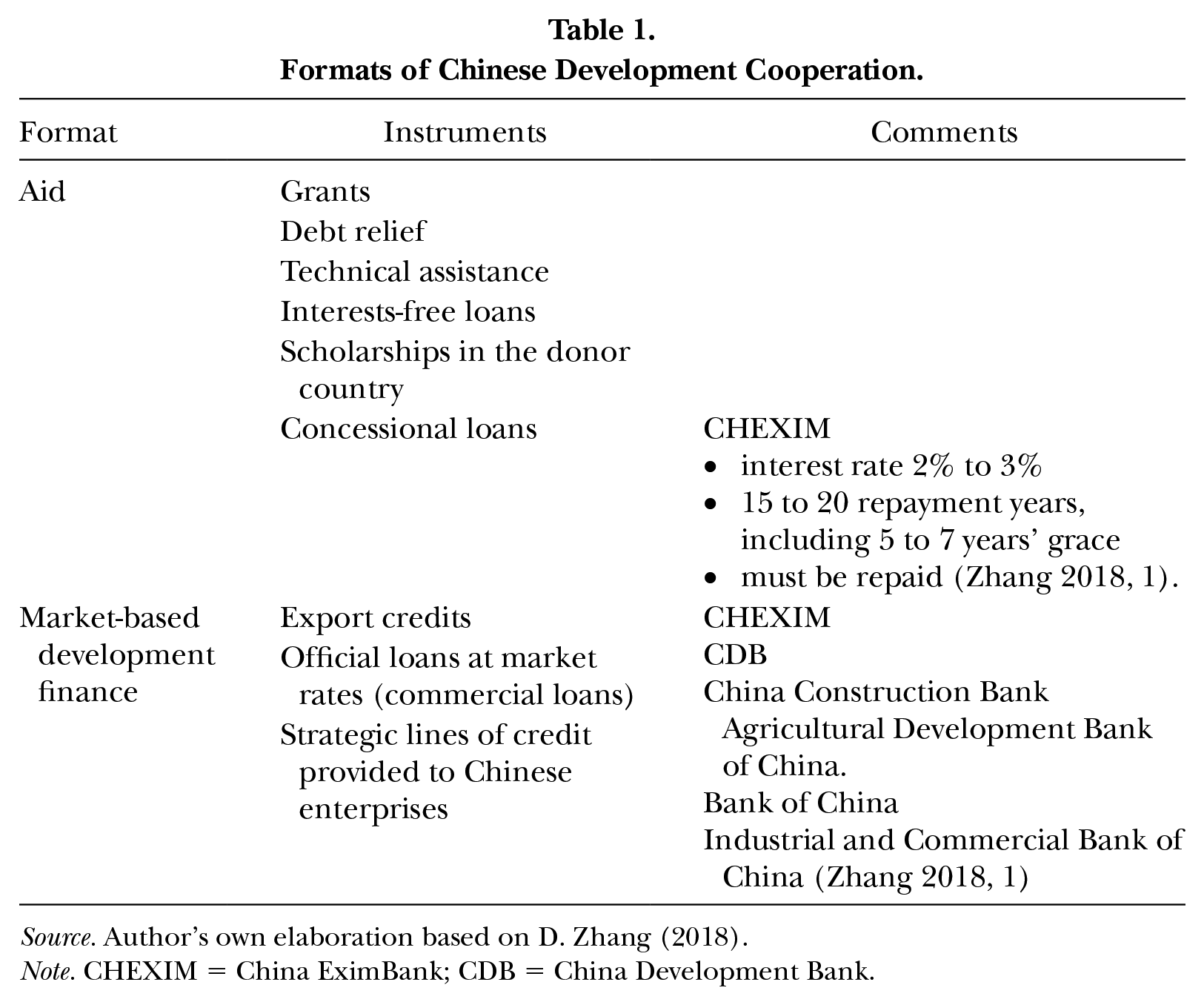
Motivations are closely linked to the choice of formats or modalities. The Chinese approach to development cooperation makes the distinction between foreign aid and market-based development finance. Two white papers on Chinese aid identify three different types of foreign aid: grants, interest-free loans, and concessional loans. Other forms of aid include debt relief, “free” or low-cost technical assistance, access to scholarships (or training programs), tariff exemptions, outright gifts of buildings, equipment, or other capital goods (State Council 2011, 2014). Grants finance the construction of stadiums, hospitals, schools, and other medium and small social welfare projects, while interest-free and concessional loans are used to help the recipient country construct public facilities (Lengauer 2011). Table 1 identifies six empirically existing forms of aid (grants, debt relief, technical assistance, interests-free loans, scholarships in the donor country and concessional loans).
Formats of Chinese Development Cooperation.
Source. Author’s own elaboration based on D. Zhang (2018).
Note. CHEXIM = China EximBank; CDB = China Development Bank.
There are some key differences in what is defined as aid by China compared with OECD/Development Assistance Committee (DAC) member states (Lin and Wang 2016). China includes military assistance, the construction of sports facilities, and subsidized loans for joint ventures and cooperative projects, which are excluded from Official Development Assistance. Meanwhile China excludes scholarships for students studying in China, the costs of refugees inside the host country, and donor administrative costs (Bräutigam 2011, 756). As table 1 shows, China’s market-based and reimbursable development finance goes beyond its traditional official aid program, including export buyers’ credits, official loans at market rates, and strategic lines of credit provided to Chinese enterprises, with the two SOBs—China EximBank (CHEXIM) and the CDB—playing key roles (Carter 2017). CHEXIM provides concessional and commercial loans. The CDB does not give official development aid, providing non-concessional loans at market rates. Examples include the loan-for-oil deals, which are provided for large- and medium-sized infrastructure projects in recipient countries in exchange for oil commitments (Bräutigam and Gallagher 2014).
All existing analyses of Chinese development cooperation policy used in this study apply single-case studies. The present research adopts a qualitative comparative analysis method, which is well suited to middle-range theorizing and the introduction of regional ontologies instead of universal claims. This allows one to generalize results to the whole Latin American region. It also allows one to employ the comparative case-based and inductive approaches often used in qualitative research (Devers et al. 2013, 1). Ragin and Sonnett (2008, 1) also emphasize that “case-oriented explanations of outcomes are often combinatorial in nature, stressing specific configurations of causal conditions. Rather than focus on the net effects of causal conditions, case-oriented explanations emphasize their combined effects.”
For J. Xu and Carey (2015, 3), tracking Chinese development cooperation is a “difficult and contested field of research.” This article gathers information about committed outflows drawing on “AidData’s Global Chinese Official Finance Dataset” from 2000 to 2014 (AidData 2017), which provides statistics on underreported financial flows of aid and development finance. Given the relative weakness of Chinese aid’s statistical system, there are other initiatives to estimate its scale in Latin America. The “China-Latin America Finance Database” by Inter-American Dialogue provides current information only on Chinese policy bank loans by country, lender, sector, and year since 2005 (Gallagher and Myers 2017). Although the data from AidData may not be accurate or complete due to the focus on commitments that is driven by news reports and interviews rather than official disbursements (Bräutigam 2013), the assessment of this database together with the State Council’s white papers enables a tentative comparison between aid and development finance trends.
Naturally, this article does not intend to open every “black box” in Chinese ED and development cooperation decision making. Its purpose is more modest, but nonetheless valuable—namely, to provide a preliminary understanding and framework to examine the combined motivations involved in China’s ED decision making. It also aims to enhance scholars’ ability to analyze the choices and policies of Chinese development cooperation.
Mapping the Boom of Chinese Development Cooperation in Latin America
The reference period (2000–2014) coincides with the boom of Chinese bilateral development cooperation and the influence of the “Go Global” policy in Latin America. Premier Zhu Rongji initiated this policy in 2000 as a natural extension of the “Going Out” policy that has been part of China’s ED since 1998 and became a component of the Five-Year Plan for National Economy and Social Development in 2001. Since joining the WTO in 2001, China began to design a political, economic, and financial strategy to encourage and support firms with comparative advantage to invest overseas and expand their transnational operations. “[T]his has led to a dramatic increase in outward foreign direct investment, rising from an average annual outflow of US$0.5 billion in 1980–90, to over US$31.6 billion in 2001–12” (Wu and Wei 2014, 784).
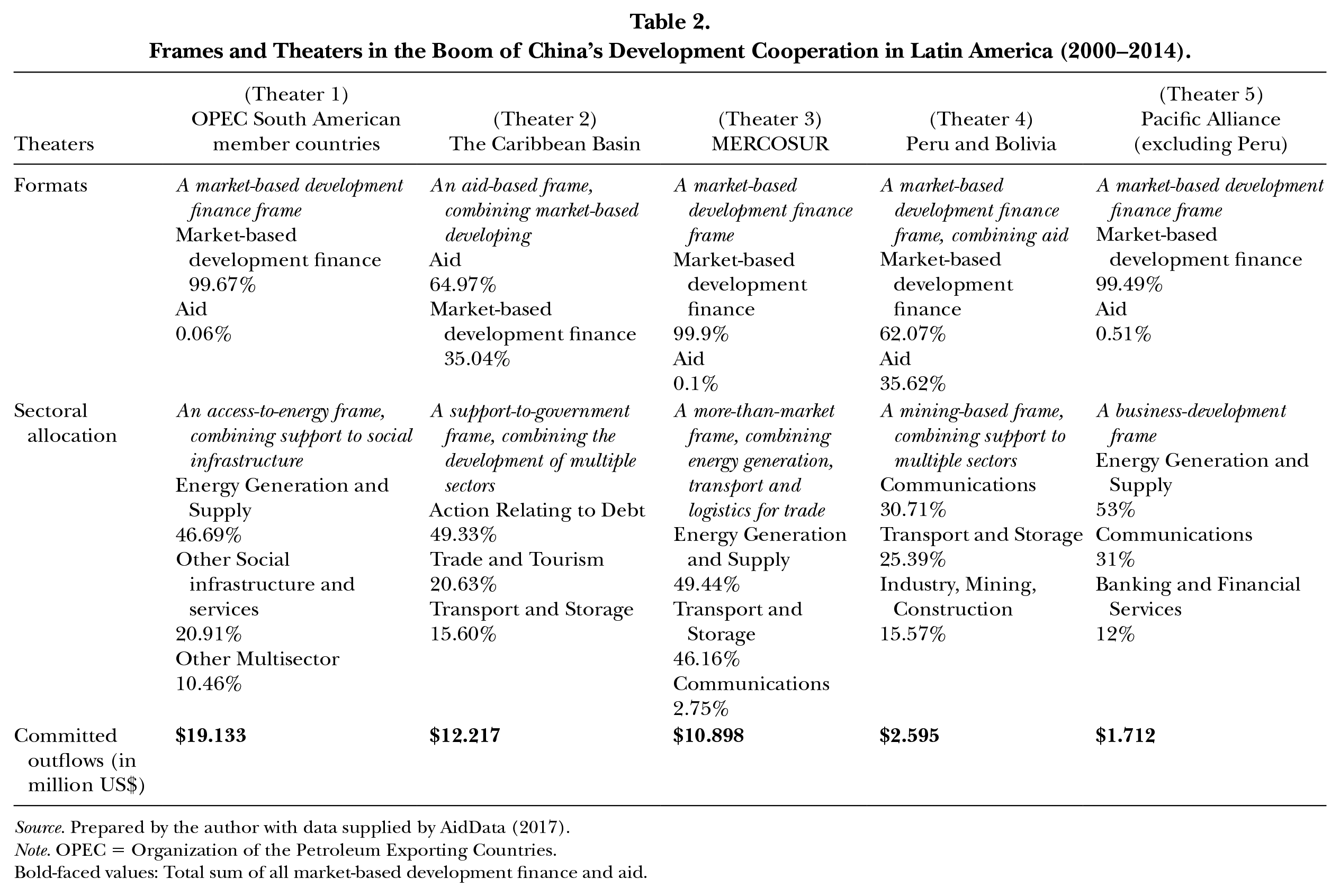
China’s demand for copper, crude oil, iron ore, and soybeans made Latin America a natural partner for trade (Liang 2019). With a focus on financing the primary areas of development and the logistics for trade and business, China increased its loans, grants, and export credits in Latin America to over US$46.5 billion in 2000–2014, through bilateral agreements in which state agencies, SOBs, SOEs, the private sector, and other actors interacted to produce a variety of links (see Table 2). Chinese finance tops sovereign lending over same period from either the World Bank or the Inter-American Development Bank (Gallagher and Irwin 2015). In 2015, China started to work toward using a single, regional body like the Community of Latin American and Caribbean States (CELAC) to coordinate finance and special funds to the region. The China-CELAC Cooperation Plan 2015–2019 was adopted at the First Ministerial Meeting of the China-CELAC Forum.
Frames and Theaters in the Boom of China’s Development Cooperation in Latin America (2000–2014).
Source. Prepared by the author with data supplied by AidData (2017).
Note. OPEC = Organization of the Petroleum Exporting Countries.
Bold-faced values: Total sum of all market-based development finance and aid.
China’s development cooperation in Latin America between 2000 and 2014 was primarily conducted by first-range actors. Major decisions concerning foreign aid and the One China policy were usually made at the top level of the Chinese government, through the Central Working Group on Foreign Affairs, chaired by the president and vice president, and including the vice premier and the State Council. Second-range actors are the Ministry of Finance (multilateral aid), MOFCOM and MOFA. Grants and interest-free loans were managed by MOFCOM, concessional loans by CHEXIM and the CDB, and official loans at market rates by the CDB, CHEXIM, and other policy banks. MOFA played an advisory role to MOFCOM on foreign aid, and worked with MOFCOM in shaping specific aid packages. Beyond the three major ministries, there were also a multitude of national, provincial, and local actors involved in development projects, including Chinese embassies and economic counselors’ offices (D. Zhang and Smith 2017).
Almost all top-down initiatives appeared to be supportive of the One China policy because they advanced through bilateral state-to-state mechanisms and MOFCOM’s aid commitments (Yang 2015). Chinese enterprises simultaneously benefited from a bottom-up approach, when competing to get loans and forge local networks in one or more areas for developing business. “Going Out” as an industrial policy strategy is part of China’s proactive diplomacy in the field. It was designed to encourage and support firms with comparative advantage to invest overseas (Yang 2015).
To identify the wider frames in which China promotes its political and economic objectives, this article identifies five different and specific theaters in which Chinese ED operates (Table 2): OPEC South American member countries (Venezuela and Ecuador), the Caribbean Basin (Antigua and Barbuda, Bahamas, Barbados, Costa Rica, Cuba, Dominica, Grenada, Guyana, Haiti, Jamaica, St. Lucia, and Suriname), MERCOSUR countries (Brazil, Argentina, Paraguay, and Uruguay), Peru and Bolivia, and the Pacific Alliance (Mexico, Colombia, and Chile, excluding Peru).
Theater 1: OPEC South American Countries
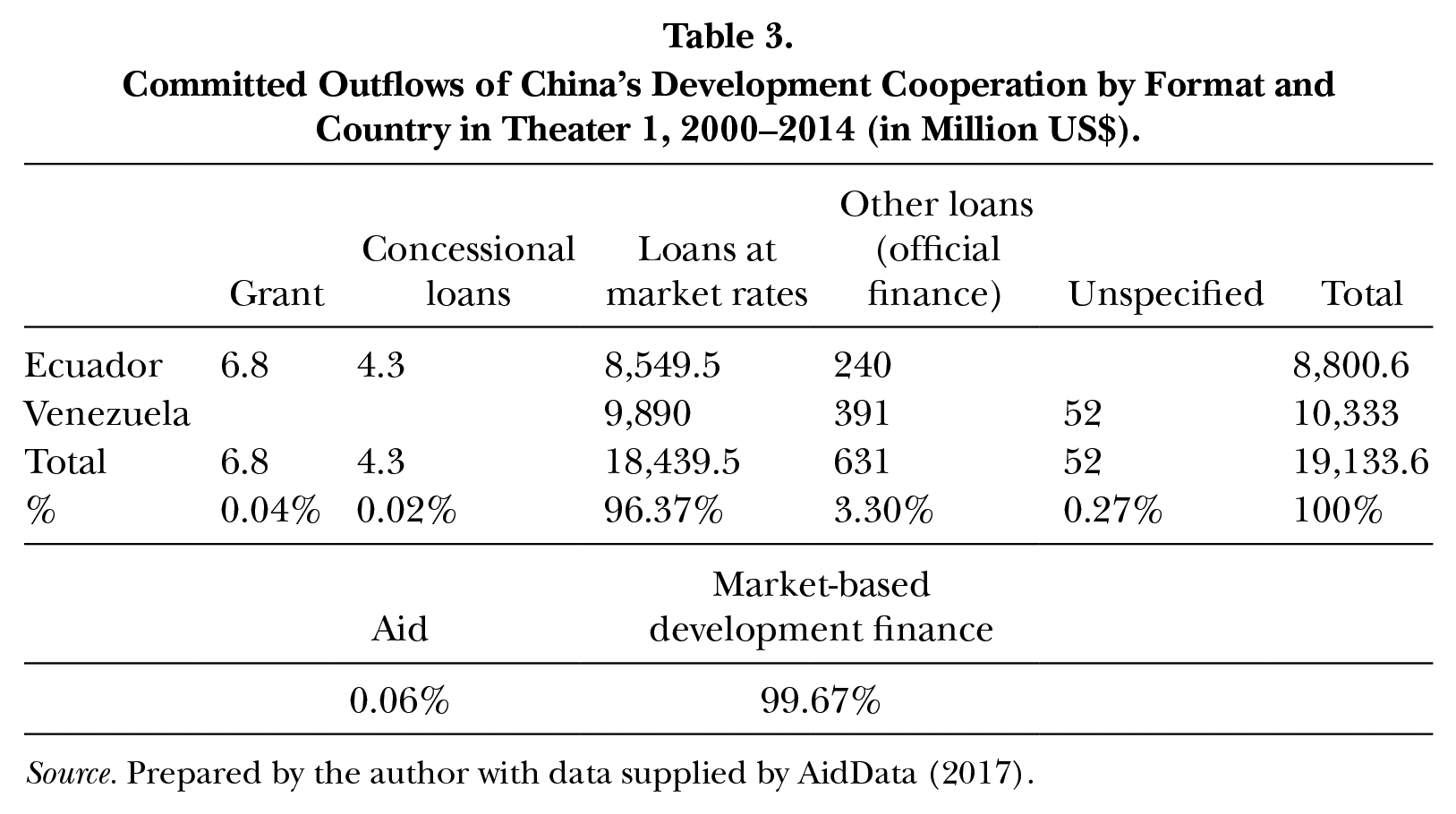
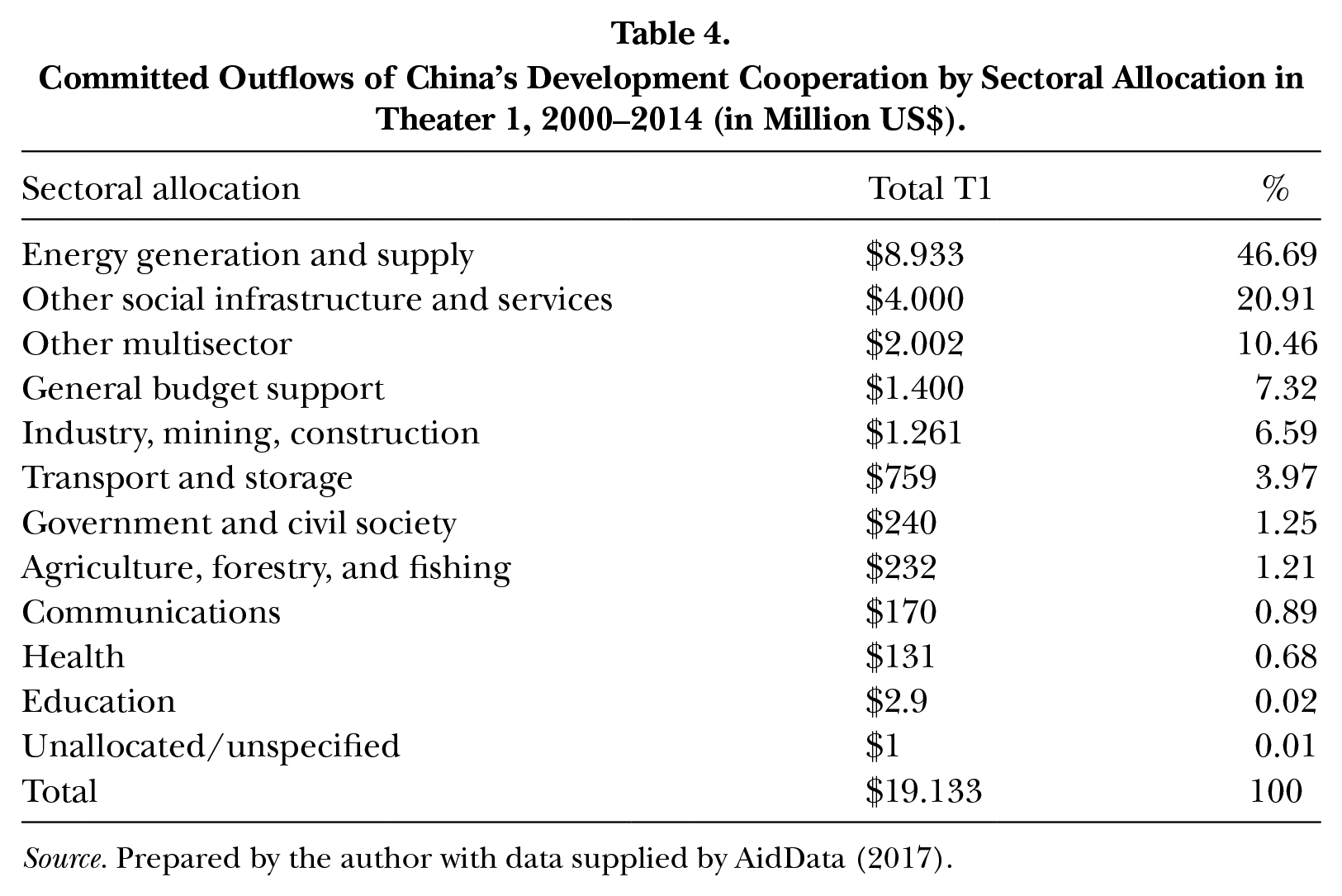
Chinese development cooperation in Venezuela and Ecuador was organized around the economic, developmental, and commercial objectives of ensuring its secure access to oil, support to social infrastructure, and contributing to the expansion and development of Chinese companies (see Table 4). In this respect, intense actions were undertaken in Venezuela, with the largest proven oil reserves in the world, and in Ecuador, the other Latin American member of the OPEC which, combined, received US$19 billion in loans between 2000 and 2014 (Table 3). This implied that lending would stimulate investment better if these countries with limited foreign currency reserves were allowed access to market-based development finance. The deals specify that the recipient country would increase its oil supply to China and that China would invest in the recipient’s agriculture, infrastructure (housing), mining, and energy production, providing support for health, education, housing, and other social infrastructure projects (Table 4) (Bräutigam and Gallagher 2014; Downs 2011; Giacalone and Ruiz 2013; Wang and Li 2016). 1
Committed Outflows of China’s Development Cooperation by Format and Country in Theater 1, 2000–2014 (in Million US$).
Source. Prepared by the author with data supplied by AidData (2017).
Committed Outflows of China’s Development Cooperation by Sectoral Allocation in Theater 1, 2000–2014 (in Million US$).
Source. Prepared by the author with data supplied by AidData (2017).
Chinese loans-for-oil to Venezuela and Ecuador typically flowed through two main conduits. They were either disbursed directly to national governments as public finance under a top-down governance framework, or extended to companies on a bottom-up basis, forming a joint fund, a joint venture, or mixed companies. 2
Chinese market-based development finance also heavily supported investments in resource extraction and infrastructure projects in Ecuador since 2008 (Gonzalez-Vicente 2013). China was responsible for 57 percent of the total foreign investment in this country from 2005–2015 (Krauss and Bradsher 2015). Two loan-for-oil deals were signed with PetroChina, CNPC, and the CDB in 2010 and included the participation of the Ministry of Finance of Ecuador, forming a structure similar to the China-Venezuela joint fund. As some Chinese enterprises have evolved from former ministries—such as PetroChina from the Ministry of Petroleum—they are implementers of central government objectives (Gonzalez-Vicente 2011). By contrast, commercial contracts between Ecuador and Chinese hydroelectric companies resulting from a call for public tenders and private projects have led to intense competition between Sinohydro, Gezhouba, HydroChina, and CNEEC (Garzón and Castro Salgado 2018, 35). This explains, in part, the decision to advance eight Chinese hydroelectric projects financed by CHEXIM and the CDB (Castro Salgado 2014, 58). In the mining sector, the competition between the China Railway Construction Corporation Limited (CRCC) and Tongling Non-ferrous Metals Group Holdings Co. Ltd. created EXSA, a consortium of the two SOEs (Garzón and Castro Salgado 2008, 31).
Theater 2. The Caribbean Basin
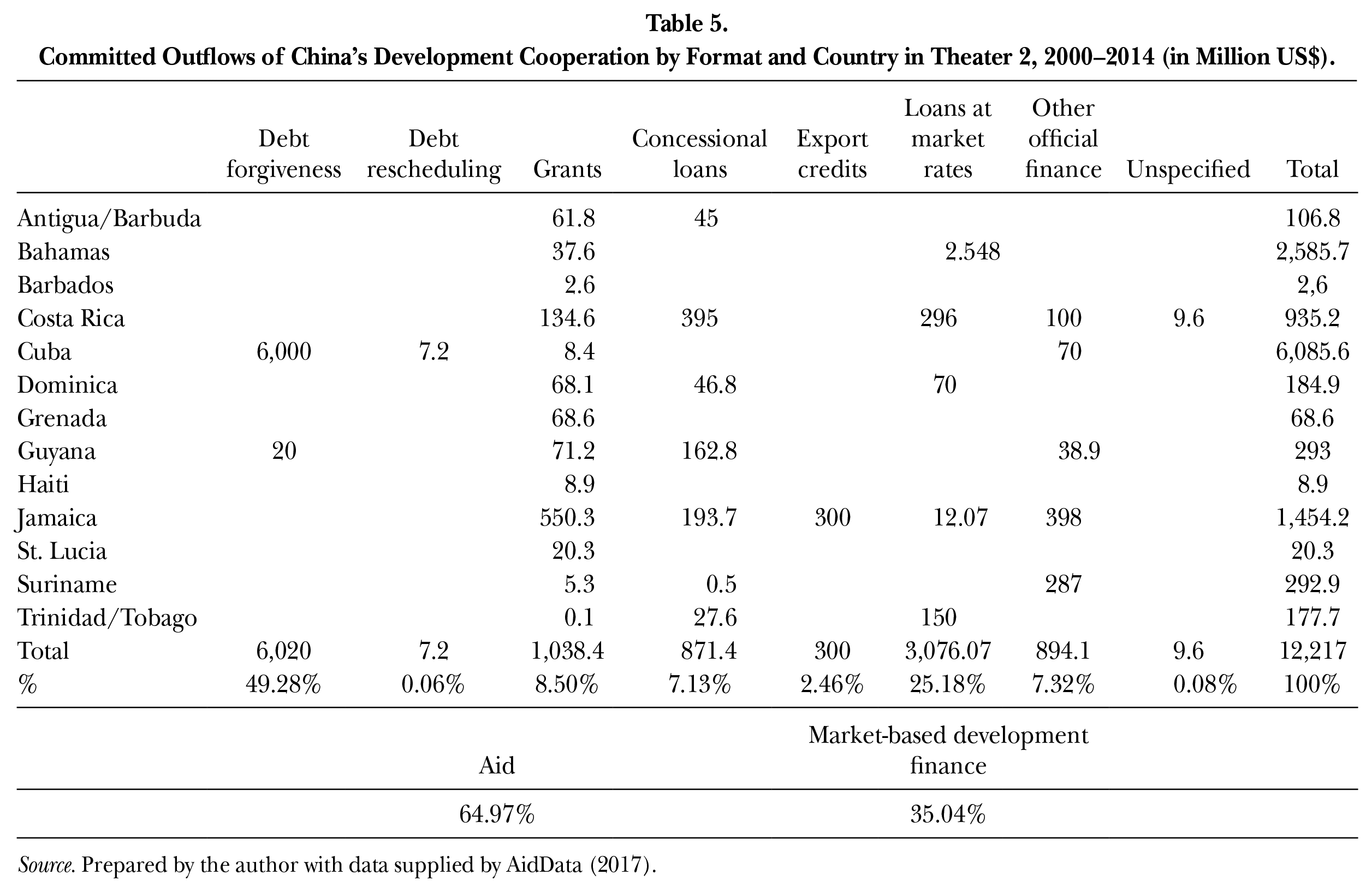
Historically, so-called “Checkbook Diplomacy” has driven Chinese frame toward the Caribbean basin (Will 2012). This subregion reemerged as the crucial battleground where a dozen struggling nations became ensnared in the cross-strait dispute between China and Taiwan. This led to an aid-based political competition granting nonreimbursable funding to states as a way to encourage them to de-recognize Taiwan or China (Erikson and Chen 2007). 3 The spark igniting the conflagration was domestic change in Taiwan. When Chen Shui-bian and his pro-independence Taiwanese Democratic Progressive Party won the presidential election in 2000, China increased its use of targeted aid, grants, and loans that directly thwarted Taipei’s efforts. This quid pro quo strategy was successful, as the cases of Dominica in 2004, Grenada in 2005, and Costa Rica in 2007 demonstrate (Wenner and Clarke 2016). Nevertheless, the election of President Ma Ying-Jeou (2008–2016) marked a turning point in Taiwan’s foreign policy stance toward China. He called for a “diplomatic truce” and China appeared to have accepted his proposal at least until 2016 (Lemus Delgado 2017). However, this did not preclude the end of the provision of Chinese official loans to construction firms, as evidenced by the cases of Antigua and Barbuda, Bahamas, Jamaica, Cuba, Trinidad and Tobago, Dominica, Costa Rica, Guyana, and Suriname presented in Table 5. MOFCOM’s grants and interest-free loans for infrastructure were the major tools in this frame.
Committed Outflows of China’s Development Cooperation by Format and Country in Theater 2, 2000–2014 (in Million US$).
Source. Prepared by the author with data supplied by AidData (2017).
Beijing’s rapprochement with Costa Rica in 2007 was handled in a top-down manner (De Hart 2018). It was perhaps the most controversial due to its proximity to the United States and its history as one of the last holdouts of diplomatic recognition for Taiwan. China gave a US$134 million grant for a stadium and US$791 million in loans (Table 5), signed a free trade agreement, and agreed to partially finance a Chinatown district in San José, the renovation of a Caribbean-bound highway, and the construction of a major oil refinery (De Hart 2012). The stadium was a gift, designed and constructed by AFEC, with imported Chinese laborers and materials. In the case of the highway, CHEXIM agreed to finance US$395 million that would be tied to a commercial contract with Chinese SOE, China Harbor Engineering Company (De Hart 2012, 14).
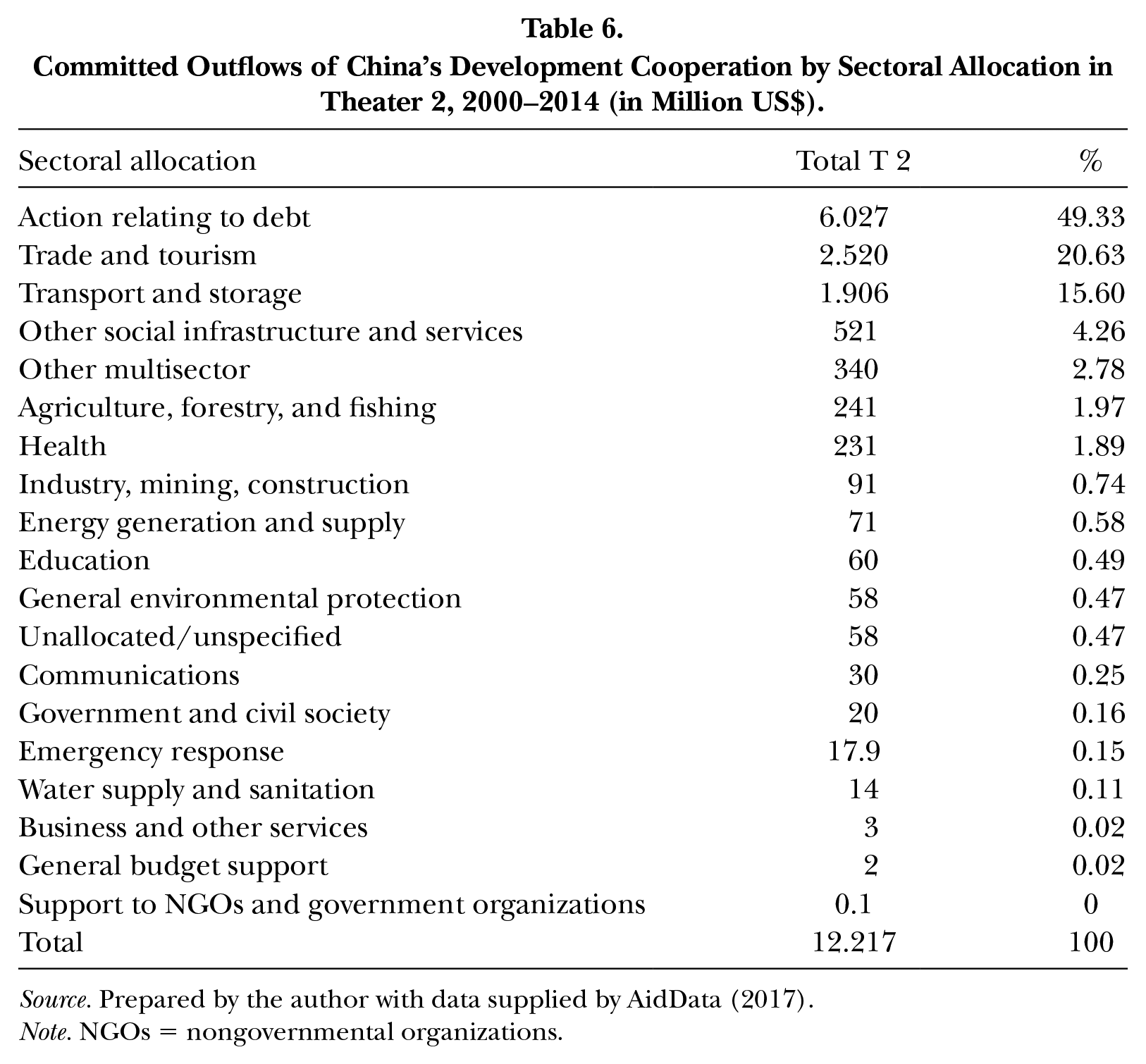
“Carrots” offered by Beijing to Cuba to strengthen historical and political ties have been also economic, including the forgiveness of US$6 billion in previous Cuban debts to Chinese banks (see Tables 5 and 6). In these activities, the Chinese strategy consisted of exercising soft power through aid (mainly grants, debt relief, and donations) rather than through market-based development finance (Ellis 2014a). However, Chinese loans have also been given to promote trade and tourism in Jamaica, Barbados, Antigua, and Barbuda, and the Bahamas. For example, CHEXIM loaned US$2.6 billion in 2011 to Bahamas, the richest country in the Caribbean basin, for the construction of the Baha Mar Resort. Official loans to Chinese construction companies have also contributed to promote investments in the newly constituted Mariel trade zone in Cuba (Table 5).
Committed Outflows of China’s Development Cooperation by Sectoral Allocation in Theater 2, 2000–2014 (in Million US$).
Source. Prepared by the author with data supplied by AidData (2017).
Note. NGOs = nongovernmental organizations.
Theater 3. MERCOSUR
Brazil, Argentina, Uruguay, and Paraguay have become central to the supply of soybeans, grains, and meat, along with cotton, pulp, and tobacco (Turzi 2016). Food and energy security concerns have been central to the motivations for Chinese development finance that was channeled principally through the CDB. As China’s per capita income advanced, along with the acceleration of urbanization, its strategies to ensure resources started to become global. According to Yang (2015, 298), the strategy provided a “stimulating environment for the further development of Chinese commercial enterprises in Latin America.”
There is a relevant literature on how Chinese market-based development finance became a tool of a neo-developmental rationale that guided the process of Chinese state internationalization. The major thrust of this paradigm is that large-scale infrastructure investments and strong railway systems are crucial to improving the export logistics, linking production from the soybeans complex to ports in the Pacific (Gallagher and Irwin 2015; Gallagher, Irwin, and Koleski 2012). For Wilkinson, Wesz, and Lopane (2016), all these efforts in MERCOSUR reveal a “more-than-market” frame, which entails a wide range of initiatives such as loan agreements, land purchases, long-term contracts, joint ventures, direct investments in infrastructure, and logistics for trade.
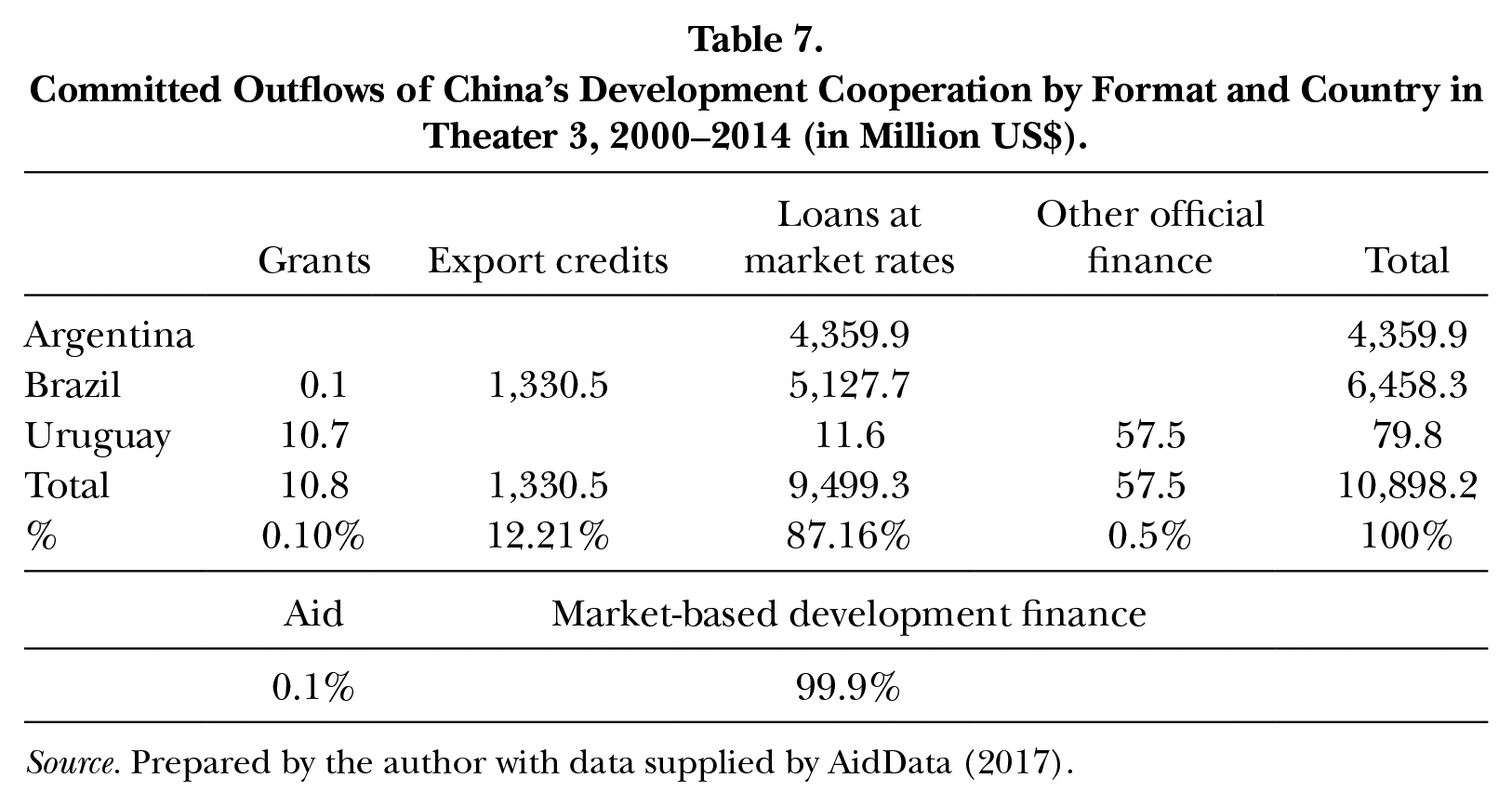
Economic and commercial drivers have guided China’s frame to development cooperation in MERCOSUR (food, energy, roads, transport, and trade). Argentina and Brazil, the most industrialized economies of South America, were two of the four major recipients of official loans at market rates (see Tables 7 and 8). They are good examples of how China supports enterprise internationalization through the provision of official loans at market rates for infrastructure projects such as bridges, airports, ports, highways, railways, and metros (Alves 2012; Turzi 2016; Vadell, Araujo, and Serqueira 2016). Beijing acknowledged the problems that inadequate infrastructure in the Southern Cone poses to trade, when imports become more expensive on their way to the Chinese market because of insufficient roads and highways (Gransow 2015, 7).
Committed Outflows of China’s Development Cooperation by Format and Country in Theater 3, 2000–2014 (in Million US$).
Source. Prepared by the author with data supplied by AidData (2017).
Committed Outflows of China’s Development Cooperation by Sectoral Allocation in Theater 3, 2000–2014 (in Million US$).

Source. Prepared by the author with data supplied by AidData (2017).
The oil and hydroelectric sectors were central to the Chinese frame in this theater, when they engaged in competitive bidding to implement projects, with or without local partners. It then used the contacts and loans as vehicles for developing business in competition with other companies. One example concerns the loans to Petrobras, CNPC, Sinopec, and the Brazilian National Development Bank to develop oil reserves and its discoveries in the pre-salt layer of the Santos Basin (Hirst 2009).
4
The loan agreement was signed between the Ministry of Economy of Argentina and the CDB, the Industrial and Commercial Bank of China, and the Bank of China (Stanley 2018). One interviewee underscored this process: there was a competition between Gezhouba Group and Sinohydro in Argentina, but the first one had forged strong personal relationships with Electroingeniería. After a series of twists and turns, China committed a US$4.7 billion line of credit for the construction of two hydroelectric dams on the Santa Cruz River in Patagonia in July of 2014. The planned dams became the largest ever built by a Chinese company overseas.
5
Theater 4. Peru and Bolivia
Peru and Bolivia received similar but special treatment. The economies of these Andean countries are heavily concentrated in mining projects located in indigenous areas, in a social context of vulnerabilities and high poverty rates. This is clearly an important and central issue. Mining and metal sectors supply the means for a large part of productive activities—from iron ore for steel girders, to the minerals and metals that are processed into the components of cell phones. Yet China lacks the necessary quality and quantity of copper, gold, iron ore, and silver reserves to meet the demand of its domestic market.
Bolivia is the poorest country in the Southern Cone, but its bridging location at the geographic center of South America allowed it to become a hub for energy and transport flows (Ellis 2016). Besides donations in kind of equipment, vehicles, and consumer goods, one important use of Chinese official loans was to improve Bolivia’s deficient infrastructure, which made it difficult to get natural resources to market. Between 2009 and 2011, La Paz received four CHEXIM’s loans for infrastructure and telecommunication developments (Stallings 2016). 6
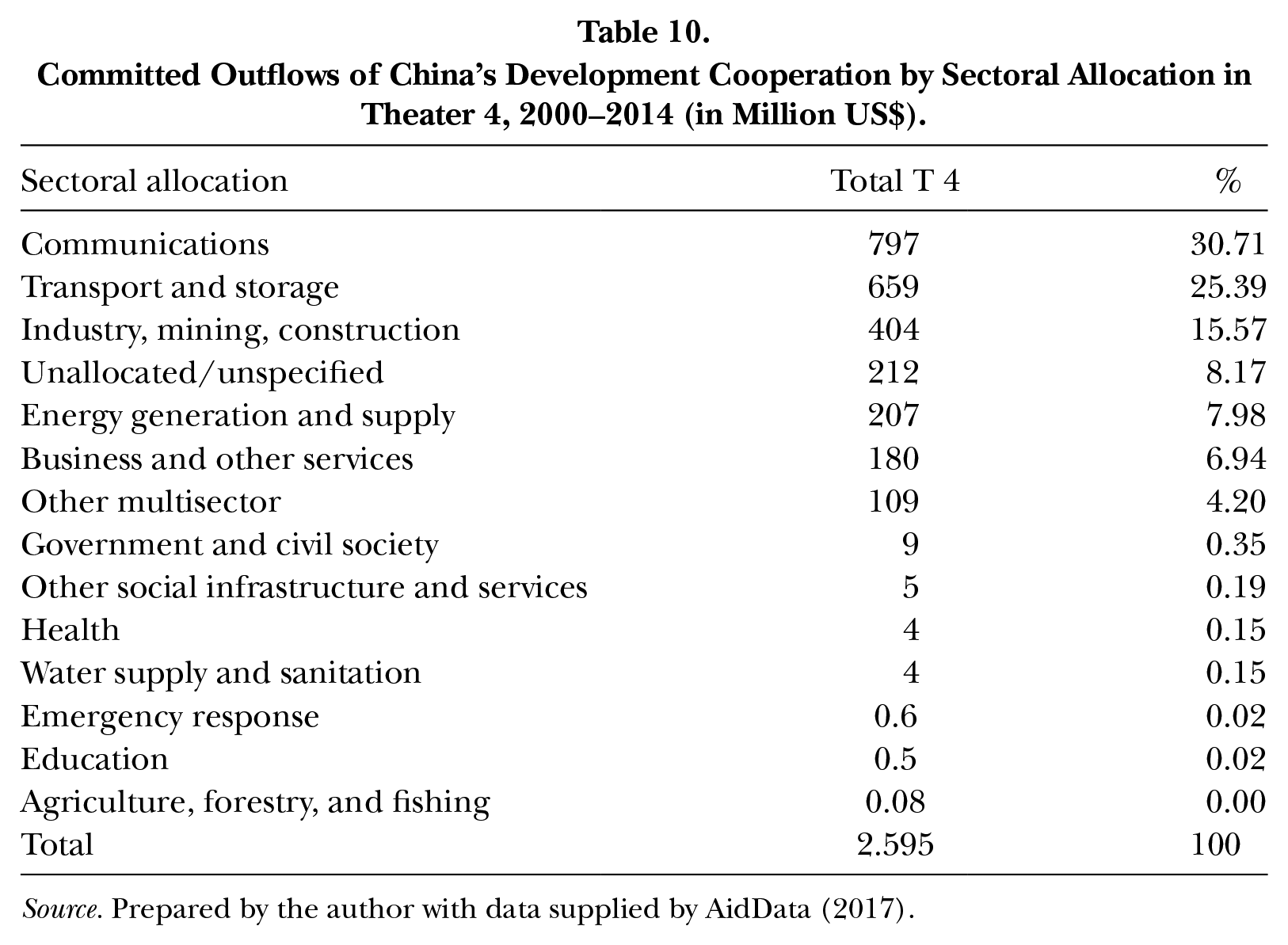
Beijing’s frame in Peru was also undertaken in response to the local demands of the largest ethnic Chinese community, present in the region since the 19th century (Gonzalez-Vicente 2012). 7 The Chinese thirst for minerals in Peru created considerable tensions in local populations, which are located in environmentally sensitive and indigenous territories. The Chinese development cooperation frame thus combined finance to extractive industry developments with grants, and concessional and commercial loans for projects in health, education, culture, and employment (see Tables 9 and 10). 8 In 2004, China agreed to fund the construction of a “friendship center” for US$1 million, in San Borja and to expand the Arzobispo Loayza National Hospital in 2007. However, as Chinese mining companies in Peru felt the pressure from indigenous communities, Chinese diplomacy prioritized those issues on which economic infrastructure could contribute to social integration (Flannery 2013). 9
Committed Outflows of China’s Development Cooperation by Format and Country in Theater 4, 2000–2014 (in Million US$).

Source. Prepared by the author with data supplied by AidData (2017).
Committed Outflows of China’s Development Cooperation by Sectoral Allocation in Theater 4, 2000–2014 (in Million US$).
Source. Prepared by the author with data supplied by AidData (2017).
Theater 5. Pacific Alliance (Excluding Peru)
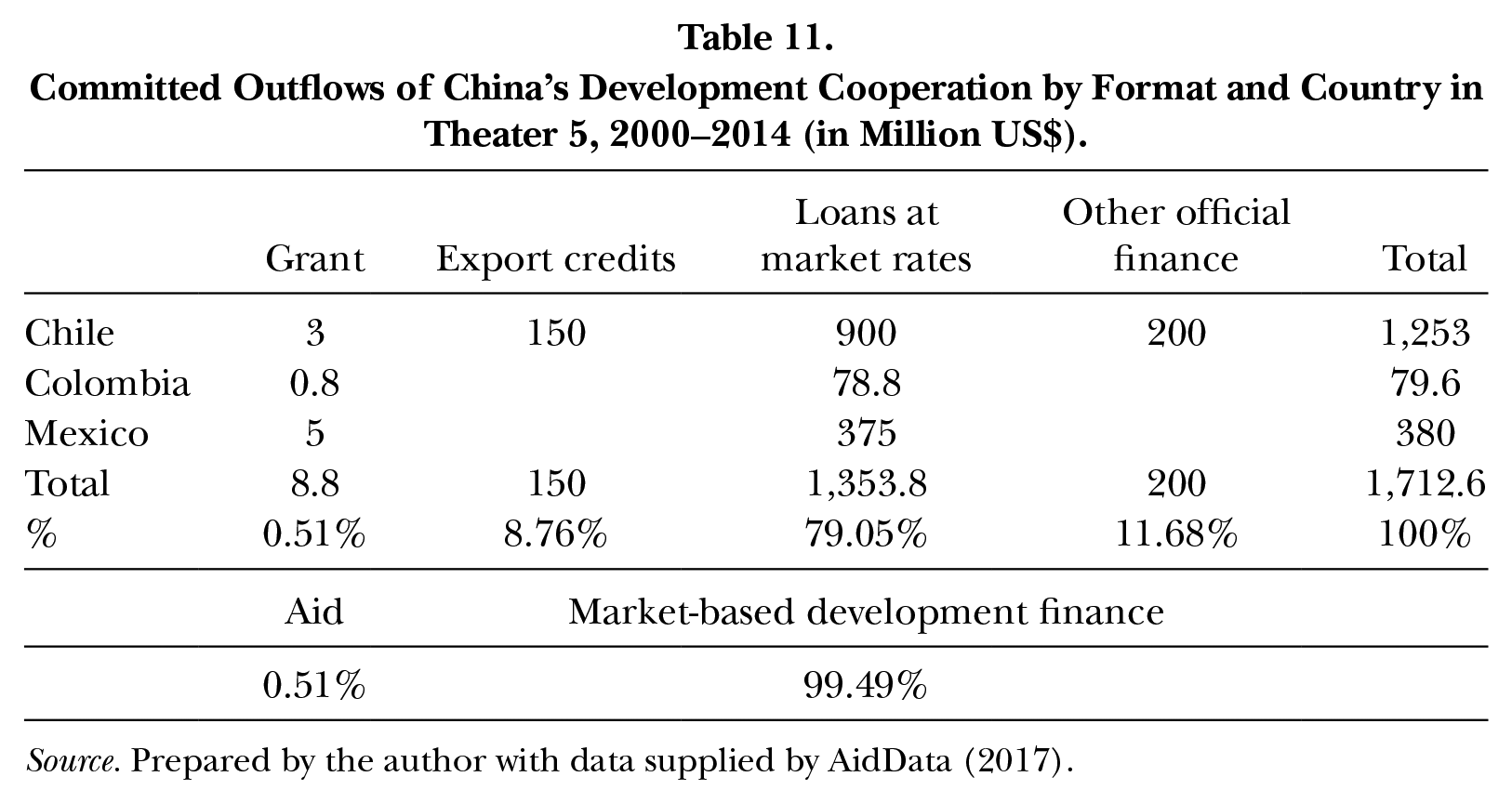
China’s frame in Mexico, Chile, and Colombia was motivated, among other factors, by the need for Chinese firms to access the market and to face global competition. These countries represent a significant economic force: a third of Latin America’s gross domestic product, and all forged ahead on indicators of institutional performance that bring them closer to OECD standards. 10 However, despite the apparent reputation for efficiency, security, and the rule of law, Chinese market-based development finance to these countries between 2000 and 2014 ranked among the lowest in the region (Table 11). The reason for this is that easy access to credit from multilateral banks and international capital markets limited the need for Chinese finance in these countries, even if they were interested in China’s programs of technical assistance and training (Stallings 2016).
Committed Outflows of China’s Development Cooperation by Format and Country in Theater 5, 2000–2014 (in Million US$).
Source. Prepared by the author with data supplied by AidData (2017).
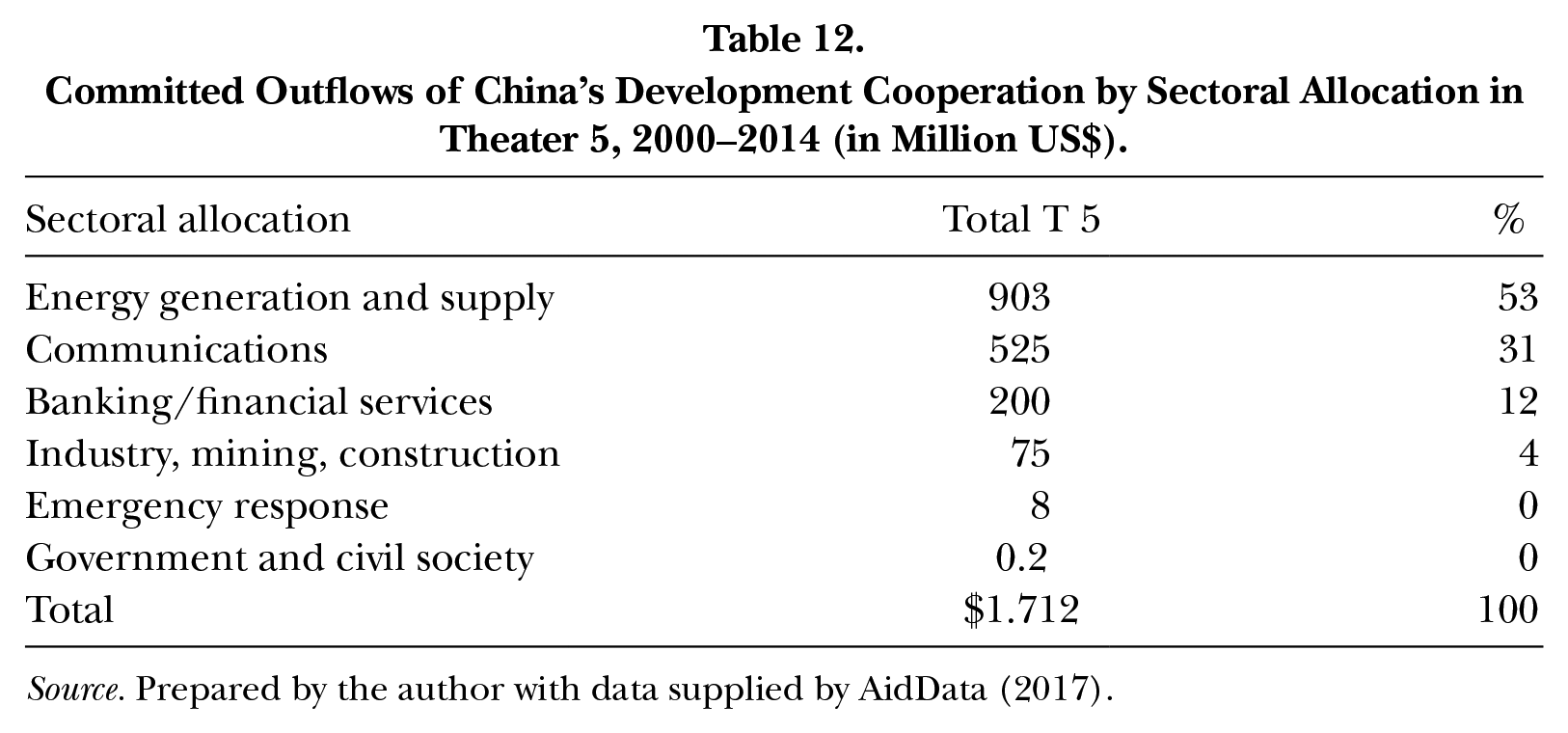
China’s frame in these countries promoted few commitments, which were concentrated primarily in financial facilities, and logistic support for enterprise internationalization (Table 12). According to the evolution of Chinese exports to Latin America from 2000 to 2014, Mexico, Chile, and Colombia have been three of the most important recipients (Comisión Económica para América Latina y el Caribe [CEPAL] 2015). Chile, along with Venezuela and Brazil, is one of the three countries in the region that exhibited trade surpluses with China, and it was the first Latin American country to sign a free trade agreement with Beijing in 2015. Chinese mining companies in Chile engaged with both governments to identify areas where commercial and development interests intersect. This led the CDB to provide commercial loans to create joint ventures or to advance investments. 11
Committed Outflows of China’s Development Cooperation by Sectoral Allocation in Theater 5, 2000–2014 (in Million US$).
Source. Prepared by the author with data supplied by AidData (2017).
By contrast, given their different export specialization, Mexico and Colombia reported an overall deficit with Beijing, which has risen constantly since the start of the century (CEPAL 2015). Chinese investment projects in energy and infrastructure in Colombia registered continuous growth, although lacking support from SOBs. Imbalanced trade has been a sticking point for Mexico’s manufacturing sector, which faced competition from China in both domestic and U.S. markets (Wise and Ching 2018). 12 According to Dussel Peters, Armony Enrique, and Shoujun (2018, 64), the projected high-speed train from Mexico City to Querétaro was the most relevant Chinese infrastructure project proposed in Mexico, but it was canceled in 2015.
Discussion and Conclusions
This article considers development cooperation as tool of ED. It can be defined as an instrument by which the state creates its political and economic relations with other actors in international relations. It also makes the distinction between China’s foreign aid (grants and concessional loans) and market-based development finance (official loans at market rates). In general, aid entails a top-down political decision of providing nonreimbursable resources to a foreign government, whereas market-based development finance is the result of a bottom-up set of interactions among agencies, policy banks, and state-owned or private companies which sometimes act as pioneers in the decision making.
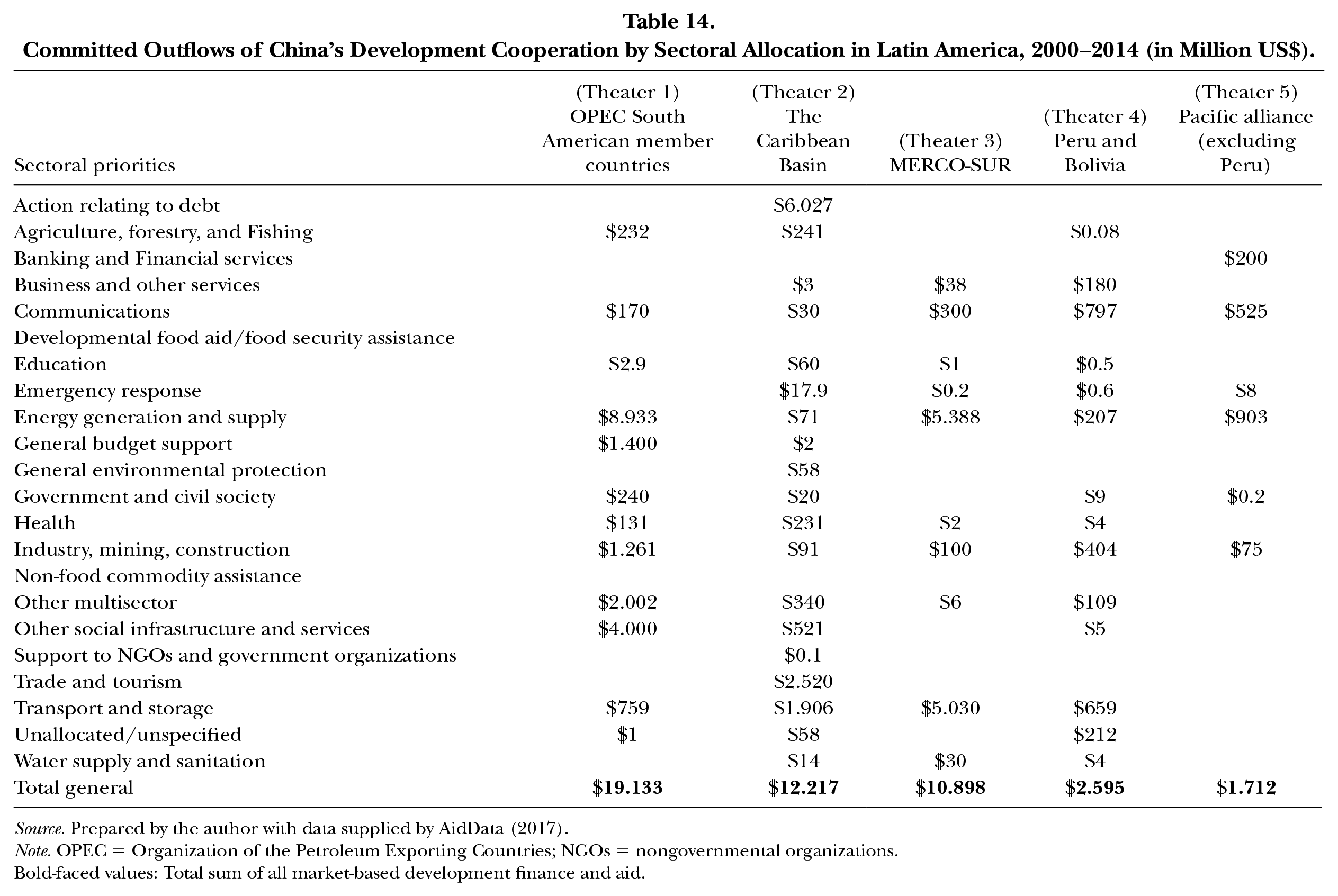
This article demonstrated that there are at least five different theaters resulting from the diverse mix of formats and sectoral priorities that give meaning and purpose to the interactions. The general conclusion is that China intensified its development cooperation to the region, employing aid as a tool of statecraft and embracing market-based development finance as an instrument to create new investment and trade opportunities for Chinese companies. However, this study has found considerable variation within the theaters. Indeed, market-based development finance was a key element for assisting companies to develop offshore business in the infrastructure, energy, and transport sectors in Venezuela, Ecuador, Brazil, Argentina, Peru, and Bolivia. By contrast, aid policy was central for supporting the One China policy in the Caribbean basin through grants and interest-free and concessional loans. As a result, development cooperation represents a contextual and multipurpose category (see Tables 13 and 14).
Committed Outflows of China’s Development Cooperation by Formats and Theaters in Latin America, 2000–2014 (in Million US$).

Source. Prepared by the author with data supplied by AidData (2017).
Note. OPEC = Organization of the Petroleum Exporting Countries.
Committed Outflows of China’s Development Cooperation by Sectoral Allocation in Latin America, 2000–2014 (in Million US$).
Source. Prepared by the author with data supplied by AidData (2017).
Note. OPEC = Organization of the Petroleum Exporting Countries; NGOs = nongovernmental organizations.
Bold-faced values: Total sum of all market-based development finance and aid.
The findings here suggest that it is no longer productive or accurate to view the Chinese state as unitary. Its command over ED and development cooperation is increasingly shaped by political and economic drivers. At the micro-level, China has to deal with the reality that SOEs are turning into powerful market actors, and this has a profound impact not only on the policy-making process but also on shaping China’s ED in a way that serves more certain firm-level and commercial interests than top-down designs. Particularly, oil, hydroelectric, and mining companies in South America seemed to have stronger influence within Chinese state policy and central government plans.
I also highlight the need to improve our understanding of the close link between motivations and frames involved in Chinese aid and development finance. The general conclusion is that China intensified its development cooperation to the region, employing aid as a way of political pressure and market-based development finance as a tool to create new investment and trade opportunities for Chinese companies. However, this study has found considerable variation among the theaters. Indeed, market-based development finance was a key element for assisting companies to develop offshore business in infrastructure, energy, and transport sectors in Theaters 1, 3, 4, and 5. By contrast, aid policy was central for supporting the One China policy in Theater 2 through grants and interest-free and concessional loans. Two types of drivers are common for all theaters: developmental drivers that involve support to economic and social infrastructure projects; and commercial ones focused essentially on opening up new export markets for products and helping Chinese companies to invest and set up manufacturing plants in foreign markets.
The findings also suggest that foreign aid and market-based development finance are separate processes with their own dynamics, but can sometimes be complementary. Foreign aid implies a broad spectrum of donation initiatives and highly visible projects (stadium diplomacy) in line with the One China policy. By contrast, the CDB and CHEXIM’s loans at market rates were the result of an open trade-off between ministries, policy banks, and business companies. This was the case in the Chinese approach to the South American OPEC and MERCOSUR countries, which derived from different forms of state and finance internationalization—primarily driven by the entrepreneurial logic of oil, transport, and construction companies. Yet Chinese engagements also relied on the complementary use of both formats, with the top-down model of foreign aid and the open governance model of market-based development finance shaping interactions in the Caribbean basin and, to a lesser extent, in Peru and Bolivia.
China is, it seems, working bilaterally on a case-by-case approach with each state. Having a better understanding of who is in charge and how those actors are related to one another and to Chinese official policy would offer a clearer prescription for the way forward from a Latin American point of view. It might also highlight who are the potential winners and losers of Chinese policy in Latin America and allow us to think about Latin American development more robustly. The contribution of Chinese ED to Latin American development nevertheless depends on a variety of internal and external factors that this article did not try to capture.
Finally, this study also has significant implications for scholars examining Sino-Latin American relations. If China’s ED, and its development cooperation, is not a homogeneous strategy, it is also important to remind ourselves that Latin America is also diverse—multiple nation states with different histories, experiences, and paths to economic and social development. This article sheds light on the variegated nature of China’s development cooperation from a case-by-case basis. While it focused on Latin America and covered a rich body of empirical data, the analysis here can also be relevant for the comparative study of Chinese ED in other regions. The most important point to be made, therefore, is that the study of the financial dimension of ED should pay closer attention to historically specific theaters and frames.
Footnotes
Acknowledgements
I benefited from the insightful comments and suggestions of my colleagues Monica Hirst, Gabriela Villacis, and Clara Nelson Strachan. I am very grateful to the two reviewers at World Affairs for their appropriate and constructive suggestions to improve the article.
1
Apart from Venezuela and Ecuador, China has negotiated loan-for-oil deals with six different countries: Angola, Bolivia, Brazil, Equatorial Guinea, Ghana, and Russia (Gholz, Awan, and Ronn 2017).
2
CNPC and Petroleum of Venezuela (PDVSA) were the major actors in these loan agreements. In other areas, CRCC led the construction of a railway between Tinaco and Anaco, while a mixed socialist agro-industrial enterprise between China’s Helongjiang Xinliang Grains and Oil Group Co. Ltd. and PDVSA-Agrícola built grain storage areas, rice and soy cultivation, and the production of balanced animal food in the Orinoco Belt. Other projects included collaboration between the Chinese Electric Appliances Corporation and the Venezuelan Corporation of Intermediate Industry. These funds also financed five metro lines, a train from Cúa to Encrucijada, and a highway (Downs 2011).
3
Central America and the Caribbean is home to eight of the 18 countries globally that retain ties to Taiwan: Belize, Guatemala, Haiti, Honduras, Nicaragua, Saint Cristobal and Nieves, Saint Lucia, and San Vicente and the Grenadines. Recently, Panama in 2017 and the Dominican Republic and El Salvador in 2018 established ties with China ( ).
).
4
Another very clear case that illustrates some of these tendencies was the Argentinean hydroelectric project. The Belgrano Cargas railway project has been directed to the purchase of locomotives and wagons and it has sought to rehabilitate the railway line in the Belgrano network, linking the Argentine heartland with the Pacific coast and China (Stanley 2018, 88).
5
Skype interview by author with Juan Uriburu Quintana, an Argentine official involved in the loan negotiation with the CDB and Chinese hydroelectric companies in Argentina, September 26, 2018.
6
According to Stallings (2016), the largest Bolivian joint venture under this bilateral framework is the El Mutún mine, said to be “the largest iron ore deposit in Latin America.”
7
8
9
Chinese investments in Peru include the Morococha silver mine, the Pampa de Pongo (iron ore), the Galeno, Hilorico and Pashpap (copper and gold), the Toromocho deposit (copper), the Rio Blanco deposit (copper), and the Marcona Mine (iron ore). The Shougang Corporation in the Marcona mine since 1992 and Minmetals and Chinalco are the largest Chinese mining SOEs operating in the Andean region (, 49).
10
Mexico became a member of the OECD in 1994, Chile in 2010, and by 2018 Colombia is in the process of joining (Wise and Ching 2018).
11
12
For Wise and Ching (2018, 15), since the 1990s, Mexico began filing anti-dumping complaints against China and, with an eye toward preserving its privileged access to the U.S. market under NAFTA, Mexico was “the very last holdout vote on China’s 2001 entry into the World Trade Organization.”