




Abstract
This study examines the electoral consequences for ideologically right-leaning political parties in the wake of terrorist attacks by employing an original dataset that captures political party vote shares and multiple terrorist indicators. Our analysis extends the partisan voting hypothesis to 56 democracies from multiple regions and levels of development between 1975–2014. Specifically, we find that the origins of terrorist perpetrators, the severity of terrorist attacks, and the frequency of terrorist incidents decrease right-party vote shares in legislative contests when incorporating standard controls. All told, these findings reinforce political psychological reasoning that contends terrorist attacks impact citizens’ emotions and voting calculations.
In the nearly 12 months leading up to Spain’s 2004 national parliamentary elections, public opinion polls showed the conservative Popular Party (PoP; Partido Popular) with a comfortable lead over its competitors. This changed on March 11, 2004, when 191 individuals were killed in a series of coordinated terrorist attacks carried out in Spain. In the wake of the devastating bombings, Spanish Prime Minister Jose Maria Aznar swiftly condemned those responsible and accused members of the Basque separatist Euskadi Ta Askatasuna (ETA) of orchestrating this attack (“Spain’s PM” 2004). A subsequent investigation would find that the plotters had no connection to ETA, despite Aznar's accusation. Between the deadly terrorist attacks on March 11 and Aznar's hasty allegation of responsibility, the PoP suffered a massive reversal of electoral fortunes that ultimately cost the party control of the government (Bali 2007; Lago and Montero 2006). The results of this attack stand in contrast to existing assumptions on terrorism's political consequences that predicts voters should gravitate toward rightist parties in the wake of terrorist attacks. While there are cases that support this prediction, such as with the rightist (Republican) party in the United States, gains in the 2002 Congressional elections following the attacks on 9/11, other cases cast doubt on this expectation. Historical examples from Guatemala and Peru affirm that right-leaning parties that advance hawkish counter-terrorism stances may suffer the same fate as Spain's PoP in the wake of terrorist attacks. What accounts for this discrepancy?
Using an original dataset consisting of more than 50 countries over nearly 40 years, we analyze the electoral performance of rightist parties in the wake of terrorist events. Given this ideological or partisan current, this study is motivated by the partisan voting hypothesis which surmises that parties that embrace certain issues are often evaluated more directly on those issues. The partisan voting hypothesis, moreover, borrows from the literature on the psychological aspects of terrorism. We first consider the psychological effects of terrorism, then examine how individuals process this information into their own political calculi. Finally, we analyze how these processes impact vote choice pertaining to right parties. Specifically, we anticipate that right-oriented parties will suffer electoral consequences in the wake of terrorist attacks to a greater degree than other parties—which is supported by theoretical conjecture, anecdotal evidence, and statistical analyses.
Rightist parties are expected to have diminished electoral support in the wake of terrorist violence for two primary reasons. First, right parties typically prioritize security issues within their campaign platforms more than other parties. Subsequently, when terrorist attacks occur, right parties are punished to a greater degree than other types of parties due to the perceived failure of right parties in fulfilling their specific campaign promises (i.e., protecting state security), and this effect should be most prounced when right parties are the majority party in power. Second, right parties generally advance more hawkish counter-terrorism responses when compared with other political parties on the ideological spectrum, and voters may view these policies as being ineffective following increases in terrorism. More specifically, following a rise in terrorism, voters may view more hawkish counter-terrorism policies of right parties as suboptimal and question their ability to ensure state security.
This article offers three notable contributions to the terrorism literature. First, our findings build on earlier, often single-state analysis of security threats and political behavior (see, for example, Berrebi and Klor 2006; Getmansky and Zeitzoff 2014; Gould and Klor 2010; Kibris 2011), and while such earlier work provides valuable contributions, we present a generalizable theoretical framework given the scope of our modeling. Second, we test the assumption that terrorism leads citizens to vote for right parties to a greater extent in elections cross-nationally. More specifically, researchers have yet to analyze whether the assumed political and ideological effects of terrorism translate into actual voting preferences on election day across multiple states and regions. Thus, we offer a theoretical explanation for the effects that terrorism has on voting behavior in cross-national elections spanning multiple regions and years. Third, we parse our terrorist metric by examining how transnational and domestic terrorist attacks affect vote shares for right parties differently.
The layout of the remainder of the article is as follows. First, we present a discussion of the relationship between terrorism, psychological responses, and political behavior while examining how terrorist attacks affect the vote shares of right parties. We then discuss the effect terrorism has on the vote shares received by political parties based on the nature of the incumbent government. Next, we present our data and methods section and test our theory regarding the influence that terrorism has on right party vote shares. Last, we review the implications of our findings.
Terrorism, Political Behavior, and Right-Party Vote Shares
Terrorism has been found to exert numerous effects on political behavior cross-nationally. These effects include, but are not limited to: voter turnout fluctuations, party system destabilization, declines in incumbent party support, and vote-share surges for new political parties (Bali 2007; Hunter, Bennett, and Robbins 2016; Lago and Montero 2006; Robbins, Hunter, and Murray 2013). One of the central findings in this literature is that terrorism produces notable psychological responses in individuals that can affect political behavior.
Terrorist attacks are typically organized to intimidate a broader populace or with the hopes of swaying public policy. The driving force behind these events is to instill various emotions in the populace ranging from outrage to sadness. Sinclair and Antonius’s (2012) impressively detailed study recaps how, inter alia, such attacks and efforts to prevent future attacks trigger numerous responses. On one hand, at the microfoundational level, these attacks are responsible for increases in PTSD-type symptoms (Sinclair and Antonius 2012), elevated fears of public safety (Seo, Mohammad, and Torabi 2004), and other responses, such as increased alcohol and drug use, occupational disturbances, and general aversion to public life (Stein et al. 2004). Some researchers note that these effects are strongest in close geographical proximity to the attacks (e.g., Manhattanites had stronger emotional and psychological responses in the wake of 9/11 than citizens from cities and states far from New York). Overall, a wide range of psychological research has discovered that terrorism increases anxiety, stress, and in some cases post-traumatic stress disorder (PTSD) in citizens in states where terrorist attacks occur (Bloch-Elkon 2011; Galea, et al. 2003; Laugharne, Janca, and Widiger 2007; McDermott, Philip, and Zimbardo 2007; Merolla and Zechmeister 2009; Rubin et al. 2007; Schuster et al. 2001; Sinclair and Antonius 2012).
The behavioral changes that occur due to terrorism have been found to carry over into the political arena and influence political behavior in democracies. Indeed, research notes that the physiological, psychological, and emotional effects caused by terrorist attacks can influence political behavior by rendering higher voter turnout and by prompting voters to reassess their partisan leanings. A key element in the relationship between citizens’ emotional responses to terrorism and altered political behavior is the increased political learning that occurs as a result of the psychological effects generated by terrorism. Scholars such as Marcus, Neuman, and MacKuen (2000) explain that extraordinary or unusual events can increase citizens’ political interest and political knowledge, which, in turn, can lead individuals to reassess their political views. Thus, new and threatening events cause individuals to pay greater attention to their political environment, acquire more knowledge pertaining to relevant political issues, and reassess their political beliefs. Marcus, Neuman, and MacKuen (2000) explain voter processing through their Affective Intelligence Model, which describes how the two different psychological systems (disposition and surveillance) shape cognitive processes. The default, or disposition system, functions during periods of calm and stability whereby individuals often rely on established political behaviors such as party attachment and habitual voting. The alternative to the disposition system is the surveillance system: the lens through which individuals view developments after an unsettling action takes place. Once activiated or operational, surveillance system citizens are inclined to scrutinize more carefully their surroundings and society and reassess behavioral patterns. In this scenario, voters could reassess or question previous voting loyalties and shift support to other parties.
We argue that terrorism is an event that activates citizens’ surveillance systems due to the stress, fear, and anxiety it induces, which leads persons to reassess their thought processes. This argument is similar to that found in previous studies indicating that terrorist attacks increase citizens’ willingness to show up to the polls on election day (Robbins, Hunter, and Murray 2013) as well as re-evaluate their political preferences due to the emotional effects created by terrorism (Bali 2007; Hunter, Bennett, and Robbins 2016; Lago and Montero 2006). With this in mind, right parties stand to lose the greatest level of electoral support following terrorist attacks for two primary reasons. One, right parties should be scrutinized and punished to a greater extent following terrorist attacks because their policy platforms are more likely to focus on issues pertaining to security. Subsequently, they are likely to be held accountable to a greater extent for their performance in this area based on their prior campaign platforms, especially when right parties are the majority party in the government. Two, following terrorist attacks, we posit that voters may often reject the more hawkish counter-terrorism policies advanced by right parties and view them as being suboptimal.
Argument and Hypotheses
We argue that, in the aggregate, right-oriented parties are more likely to lose electoral support in the wake of terrorist attacks. The reason for this rests with voters’ accountability calculations and is tied to the partisan voting hypothesis (PVH). The PVH is used to explore how terrorism impacts the electorate's political decision making (Berrebi and Klor 2008), which makes voters more likely to lessen their support for right parties following terrorist attacks. The PVH has intellectual roots in Petrocik’ (1996) discussion of issue ownership and Fiorina's (1981) work on retrospective voting. Petrocik's work is notable as it stresses that candidates emphasize issues in their campaigns that highlight comparative “strengths” vis-à-vis their opponents. In this vein, rightist parties are likely to proclaim their readiness to address security concerns, including defensive measures against future terrorist attacks (Berrebi and Klor 2006; Kibris 2011; Koch and Cranmer 2007). When individuals are more attuned to political campaigns, particularly in the wake of tragic events, then their knowledge of candidates’ positions and incumbents’ past performance is expected to be more of an issue in voters’ calculi. Fiorina (1981) and others report that elections are, by and large, an outcome of retrospective evaluations (Key 1966). Thus, electorates are expected to evaluate how politicians and parties have fared with respect to certain issues and use these impressions when deciding who to vote for. In addition, retrospective behavioral approaches consider issues related to economics, morality stances, and politicians’ performance on security matters. The preceding discussion yields multiple points to keep in mind when extending this discussion to the electoral fortunes of different parties.
First, building upon Marcus, Neuman, and MacKuen (2000) Affective Intelligence Model and the PVH (Fiorina 1981; Petrocik 1996), factors exogenous to a campaign or candidate—such as terrorist attacks—can impact electoral races in significant ways as they prompt individuals to pay closer attention to political events and campaign messages, plus the past performances of politicians and political parties. Second, this discussion suggests that individuals will identify which issues are central to electoral evaluations and contemplate which political candidates will provide the most preferable outcome for a given policy. Thus, we believe the PVH helps to explain variations in electoral outcomes following terrorist attacks in democracies. While previous work on terrorism and political ideology may lead some observers to conclude that leftist parties should suffer the most electorally following terrorist attacks, there is theoretical, anecdotal, and statistical evidence that points toward the help given by PVH in explaining why rightist parties may experience more significant electoral declines.
The underlying motivation for this line of reasoning rests on the similar positions that rightist parties have vis-à-vis security threats, such as terrorism (Fordham 1998; Koch and Cranmer 2007; Russett 1990; Schultz 2001). One of the central reasons for the aforementioned argument is based on the winning coalition of supporters of right parties compared with left-oriented or center parties. Researchers contend that the winning coalitions of right parties tend to be more supportive of hawkish responses to terrorism and interstate threats than the winning coalition of other parties (Arena and Palmer 2009; Clare 2010, 2014; Koch 2009; Koch and Cranmer 2007; Koch and Sullivan 2010; Palmer, London, and Regan 2004). In discussing the generally more aggressive policies of right parties with respect to defense, Koch and Cranmer (2007, 314–315) state: “That is, governments of the right are associated with more hawkish foreign policy stances than governments of the left.” Therefore, we contend that, while it may be inaccurate to assume all right parties have uniform policies pertaining to counter-terrorism and defense, based on prior research, we strongly echo the notion that, in the aggregate, rightist parties are more likely to favor stronger, more hawkish counter-terrorism policies than other parties.
We contend that voters may seek to punish right parties for their failure to protect the state as terrorist attacks increase, particularly when the governing party is of the right, due to the right parties’ emphasis in providing for state security combined with the perceived failure of right parties to prevent or decrease terrorist acts. More specifically, following increases in terrorism, right parties may be punished at the polls for emphasizing state security and failing to prevent a rise in terrorist acts. In addition to right parties suffering electoral punishment following terrorist attacks due to their perceived shortcomings in ensuring state security, we argue that in the wake of terrorist attacks, voters may often reject the more hardline defense-oriented policies of right parties and view them as counter-productive. We contend that, following increases in terrorism, voters may view the more hawkish policies of right parties as possibly exacerbating terrorist threats rather than abating them. More specifically, researchers cite numerous examples where government over-reactions to terrorism have produced ineffective counter-terrorism policies that ultimately amplified terrorist threats rather than reducing them (see Bueno de Mesquita and Dickson 2007). Bueno de Mesquita and Dickson (2007) present a nuanced model of government responses to terrorist attacks and contend that the public is often aware of counter-terrorism responses and proposals by government officials. They find that the public may react negatively to overly harsh or repressive counter-terrorism policies following terrorist attacks based on circumstances within their states. Similarly, we contend that democratic populations may fail to gravitate toward parties that advance more hawkish counter-terrorism measures following increases in terrorism for fear that more aggressive policies could exacerbate terrorist threats rather than prevent them.
While right parties have benefited electorally following terrorist attacks in cases such as the United States in 2002 in the midterm elections following 9/11, numerous examples exist that indicate right parties have lost significant electoral support following increases in terrorism in other states. One of the most notable examples of a right party losing support following severe terrorist attacks is the Spanish case mentioned at this study's outset. On March 14, 2004, three days following the horrific terrorist attacks in which 191 individuals were killed, the conservative PoP lost a significant amount of electoral support in a surprising electoral defeat at the polls. While many factors contributed to the electoral outcome, researchers argue that the March 11 terrorist attack was a significant factor that swayed the election results (Bali 2007; Lago and Montero 2006.) In addition, scholars have pointed to specific policies of the PoP, such as incorrectly attributing blame for the attacks and the support for the war in Iraq that contributed to voters losing confidence in the PoP's ability to ensure the protection of the state because voters linked the support for the War in Iraq with the attacks carried out by Al Qaeda in Spain (Bali 2007). As Lago and Montero (2005, 19) state: The failure of the government to sideline Al Qaeda before the election and the fact that Al Qaeda's responsibility for the attacks was ascertained before the election, meant that the issue ceased to be whether terrorism (of either source) had an impact on voting behavior to become a question of both understanding how Islamist terrorism relates to government accountability and anticipating the ability of citizens to punish the government at the ballot box. … a significant part of PSOE electoral gains and PP losses was a result of citizens’ blaming the government for the M-11 attacks because of its active support for the intervention in Iraq; of perceiving manipulation in the information released by the government about the authorship of the attacks; and of assessing negatively governmental performance in the preceding four years. The vote therefore became a key mechanism for citizens to control and, in this case, punish, the government.
The 1985 Peruvian election is another case illustrating that voters may fail to support right parties following significant increases in terrorism. In this case, Peru was inundated with terrorist attacks prior to the 1985 presidential and legislative elections. There were 592 terrorist attacks carried out in Peru in the year leading up to the election resulting in 2,467 deaths (GTD 2020). Many of the attacks were carried out by the Shining Path terrorist organization (also known as the Communist Party of Peru), who wanted to establish a communist dictatorship within the state (GTD 2020). Some observers might have expected the 1985 elections to have been favorable to right parties due to a significant increase in terrorist attacks within Peru and given the leftist nature of the main terrorist threat (the Shining Path). However, the 1985 Peruvian elections were overwhelmingly unfavorable to right parties as the legislative elections brought center-left and left-wing parties to power. Left-leaning parties dominated the 1985 legislative elections which followed an extreme number of terrorist attacks within the state (Georgetown 1985; Nohlen 2005). Thus, during a period that witnessed an extreme terrorist threat in Peru, right parties and candidates lost significant electoral support at the polls.
One important reason we contend that right parties lose electoral support following terrorist attacks (in the aggregate) is due to the potential contagion effects regarding policy outcomes. Researchers have discovered that parties with similar ideological proximity (e.g., left, right, center) benefit or suffer electorally for policy outcomes based on the configuration of political accountability embedded within a given political system (Williams and Whitten 2015). Specifically, researchers have found that parties of similar ideologies may gain or lose electoral support based on policy outcomes related to parties with comparable ideologies (Williams and Whitten 2015). Thus, parties of the left/right/center can suffer electorally if a policy failure is linked with a specific left/right/center party even though different non-governing parties with similar ideologies do not hold power. This is due to “neighborhood” or contagion effects by which political parties with related ideologies may be viewed by voters as being comparable. Similarly, we also contend that parties of the right may suffer electorally following terrorist attacks even if a specific right party does not hold power due to potential contagion effects. The 2007 case of Guatemala offers another real-world example that illustrates the manner in which multiple right parties can lose electoral support following terrorist attacks.
Guatemala was shrouded in violence and terrorism in the period preceding the 2007 presidential and legislative elections. A large increase in terrorist attacks, along with an unprecedented number of political assassinations, dominated the Guatemalan political landscape prior to the September 2007 elections. An estimated 50 terrorist-motivated political assassinations occurred around 2007 and many political candidates took unprecedented measures to protect themselves and their families. 1 The leading presidential candidates from right parties, Alejandra Giammattei (incumbent) of the Grand National Alliance Party (GANA) and Otto Pérez Molina of the Patriotic Party (PaP), advanced strong security platforms aiming to curtail the violence. Many legislative candidates from the GANA and PaP advanced similar policies. However, Álvaro Colom of the center-left National Unity of Hope Party (UNE) ultimately prevailed in a run-off election and unseated the incumbent Giammatteei of the right GANA Party. The legislative elections also saw the center-left UNE Party obtain the largest share of votes. This was a noticeable shift from the 2003 elections in which the GANA candidate won the presidential election and conservative parties such as GANA defeated the center-left UNE in congressional elections (Ace 2007; Azpuru 2007; Farrell 2007). Thus, in the wake of unprecedented terrorist violence in Guatemala, voters did not gravitate toward right parties that advanced strong security platforms in the 2007 elections. Rather, right parties and right candidates lost significant electoral support during this intense period of political violence.
The cases of Guatemala, Peru, and Spain do not present the full universe of electoral results following significant increases in terrorist attacks across democracies. However, the cases do highlight the notion that extending the assumption that terrorism produces more conservative ideologies among voters and translates into political gains by right parties cross-nationally is problematic. The cases also illustrate the point that, while conservative parties in countries such as the United States benefited electorally following terrorist attacks in certain elections (e.g., the 2002 legislative elections), many examples point to opposite results. In each of the three cases discussed above, voters rejected the more hardline, security-oriented platforms of right parties and candidates following significant increases in terrorism within their states. Furthermore, the three cases suggest that voters fundamentally questioned the idea that more hawkish policies advanced by right parties would provide for a more secure state. In addition, it appears that voters may have punished right parties for these stances rather than reward them.
Based on the information previously discussed, we anticipate that rightist parties should experience vote share reductions in the wake of terroristic violence in the aggregate. Formally stated, we expect that:
Right parties’ vote shares should decrease following increases in terrorist attacks.
Rightist parties’ vote shares are expected to decline when casualties from terrorist attacks increase
Based on the PVH, voters should expect rightist parties to attempt to deliver on campaign promises regarding security due to right parties frequently emphasizing security issues more than other parties (Fordham 1998; Koch and Cranmer 2007; Russett 1990; Schultz 2001). Thus, the PVH would plausibly predict that electoral setbacks for right parties would be greater if violent terrorist acts were transnational in nature. Because of this dynamic, it is necessary to examine how the type of attack impacts electoral effects. We specifically anticipate a larger magnitude of effect when attacks are organized and carried out by transnational perpetrators. This leads to our next hypothesis:
Right parties are expected to experience larger electoral declines following increases in terrorist attacks orchestrated by transnational actors.
While we expect right parties to receive less electoral support in the wake of terrorist events, the electoral response is likely to be conditioned by the underlying political context. The previously discussed hypotheses consider how terrorism impacts the electoral support of right parties in a general sense. Next, we consider how the nature of the incumbent government influences this relationship since it is expected that right parties will suffer greater losses following increases in terrorist attacks when the governing party is of right. That is, following increases in terrorism, the PVH anticipates right parties will be punished electorally, especially when they are the incumbent party, due to right parties frequently promoting policies favoring security to a larger degree than other parties combined with citizens observing increases in terrorism. Thus, when the governing party is of the right, we contend that voters will generally punish right parties to a greater extent following terrorist attacks because right parties often prioritize security to a greater degree compared with other parties and failure to prevent attacks is likely to translate into electoral punishment.
Right parties’ vote shares should decrease following terrorist attacks when the incumbent government (i.e., legislature or executive) is controlled by right parties.
With respect to divided government, this phenomenon should decrease the negative effects terrorist attacks have on right party vote shares. Specifically, divided government often results in finger-pointing or blaming when calamitous policies or disastrous events surface due to the difficulty in attributing responsibility to a single party. In this case, the harrowing effects of terrorism that should yield steep electoral declines for right parties are expected to be less than under (right-party) unified government due to the presence of divided government and increased ambiguity regarding accountability.
Right parties’ electoral losses should be reduced when facing terrorist attacks under divided government.
Research Design
To test our hypotheses we collected data and created measures on a wide array of political, economic, and security-related variables that are presented in the preceding section. The data collected include observations from over 50 democracies from 1975–2014. States selected for the study met the baseline democracy score of “six” from the Polity2 measure in the Polity IV Database (Marshall, Gurr, and Jaggers 2019). The Polity2 variable measures the extent that a state is democratic or authoritarian with scores ranging from −10 to 10, and higher scores indicate a state is more democratic. The overall Polity2 variable is based on six different elements that capture multiple regime type features including: executive constraints, regulation of executive recruitment, competitiveness of executive recruitment, openness of executive recruitment, regulation of political participation, and competitiveness of political participation (Marshall, Gurr, and Jaggers 2019). The threshold of “six” is based on a large body of previous research, including the creators of the Polity IV database, that contends that the Polity2 score of six is the threshold beyond which a state is considered democratic due to the notion that states with scores below six do not possess the appropriate institutions or procedures to be labeled democratic (Marshall, Gurr, and Jaggers 2019; Sandberg and Lundberg 2012). Our unit of analysis is state-year. 2
Independent Variable: Terrorism
This study employs multiple terrorism measures to better assess the influence this concept may have on right party vote shares. The data for our terrorism measures were collected from the Global Terrorism Database (GTD).
3
The GTD includes data on domestic and international terrorist attacks and the site defines a terrorist attack as “an intentional act of violence or threat of violence by a non-state actor” in which two out of the three elements below are present:
the violent act was aimed at attaining a political, economic, religious, or social goal; the violent act included evidence of an intention to coerce, intimidate, or convey some other message to a larger audience (or audiences) other than the immediate victims; and the violent act was outside the precepts of International Humanitarian Law.
The first measure employed in this study is the number of terrorist attacks (number of attacks) that occur within each state for each year. This indicator is straightforward in that it registers a count for the number of attacks occurring in a given country-year. This variable tallies attacks orchestrated by both domestic and transnational actors. To assess the potentially disparate effects of perpetrator background, we create two additional measures to account for events planned by domestic actors (number of domestic terrorist attacks) and transnational figures (number of transnational terrorist attacks). Data for these measures all were collected from the GTD.
The three terrorism variables are lagged by one period for two primary reasons. Since it is reasonable to expect terrorist attacks to have a lasting effect on voting behavior, lagging these measures by one year captures this potential effect. Furthermore, many of the attacks that have occurred do not take place immediately proximate to election day, thus a delay is appropriate to capture these effects on a longer time horizon. As well, it is important to include lagged indicators of terrorism to ensure that terrorist attacks are occurring prior to changes in electoral outcomes in order to avoid potential endogeneity problems. This methodological decision helps minimize endogeneity concerns between terrorism and political party vote shares and is commonly seen in time-series analyses (Jimenez-Martin 1999). Furthermore, lagging terrorism variables one period ensures that these measures are occurring temporally proximate to elections, thus strengthening the causal mechanism. Using lagged explanatory variables is also a common practice in studies that examine the behavioral, psychological, and political effects of terrorism. 4
Dependent Variable: Vote Share for Right Parties
The dependent variables used in this study represent the percentage of vote shares received by left, right, and center political parties in legislative elections in a state's lower legislative chamber (if a given state employs a bicameral chamber). To determine the political ideologies of the political parties in our study, we considered the following items: political ideologies, party platforms, and party manifestos. Each party's ideology was based on the following dimensions: economic policy, social policy, foreign policy, defense, and other areas depending on a party's orientation. Thus, in examining parties’ stated ideologies, platforms, and manifestos, we attempt to categorize each party based on publicy available data that indicate if a party can be defined as left, right, or center. In addition, based on prior scholarship, we classify center parties as parties that cannot be be defined as left or right parties and these parties maintain consistent center positions over time (Beck et al. 2001; Hunter et al. 2019). As Beck and others (2001, 17) state: “[centrist parties are] defined as centrist or when the party position can best be described as centrist.” We cross-referenced our coding with the Manifesto Project (Merz and Lewandowski 2016) and the Database of Political Institution (DPI) (Beck et al. 2001) to affirm our analysis. Our findings are consistent with these sources. We also updated our coding to account for any changes in the ideology of political parties that may have occurred over time. This study's coding scheme follows in the traditions of previous studies that have analyzed political parties’ ideologies cross-nationally (Beck et al. 2001; Koch and Cranmer 2007).
In collecting political party data, our dataset expands on the number of parties examined in each state. In this study we include all political parties that received a minimum of two percentage points of electoral votes in a given election. Vote shares were summed for each election year to produce the total vote shares for the political parties in our sample. Electoral data for postcommunist states were gathered from the University of Essex while African electoral data was obtained from the African Elections Database. Meanwhile, Latin American data were obtained from the Political Database of the Americas and other states’ election results were gathered through electoral commissions from numerous states, Adam Carr's website, and Election World. In various cases we consulted states’ own electoral commissions’ websites if the aforementioned sources lacked adequate data. In total, we collected data on 861 political parties.
Control Variables
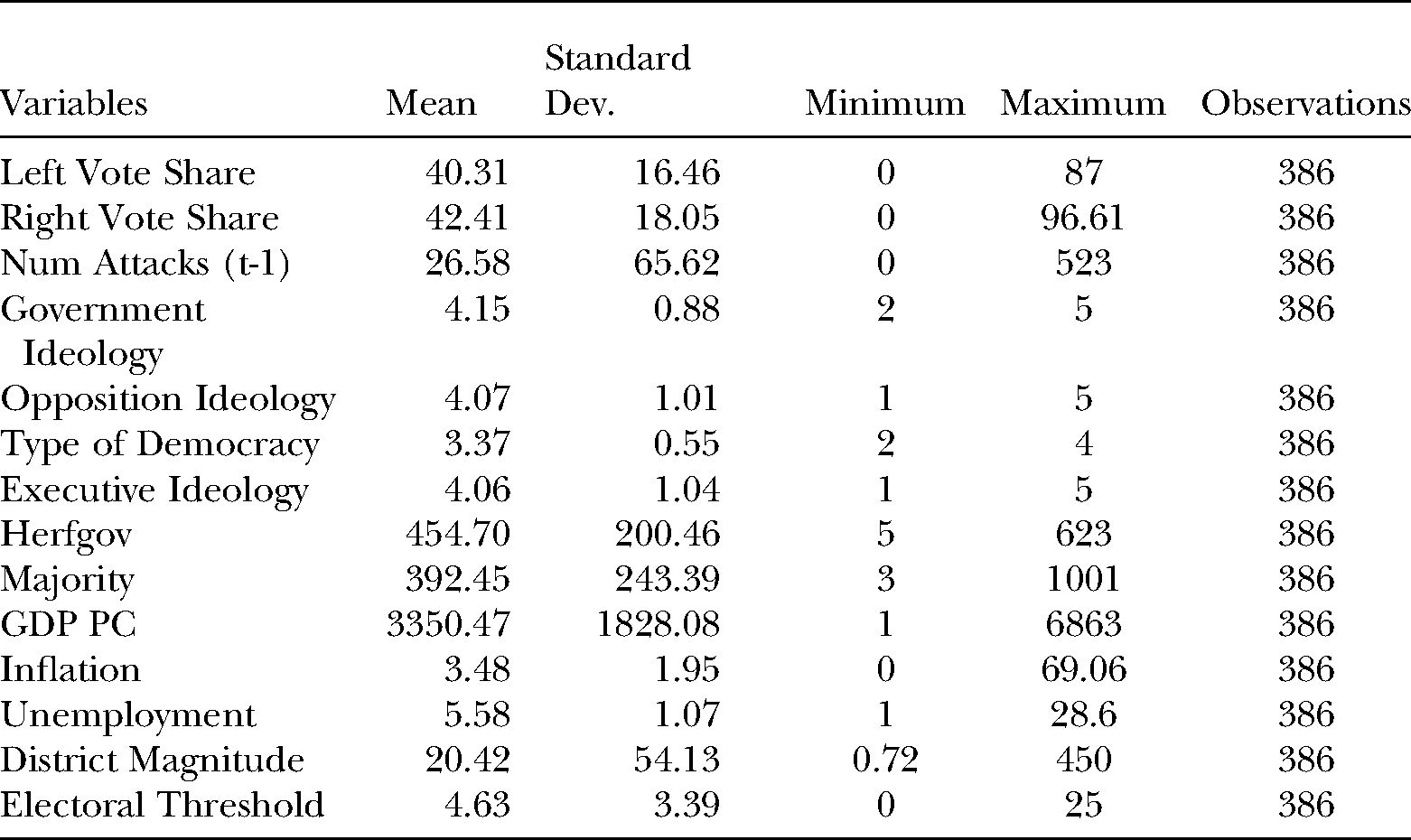
We test the aforementioned hypotheses with the terrorism measures noted above along with measures for political, economic, and institutional characteristics. These controls are commonly used in existing works examining electoral results. To control for domestic political factors, we include indicators to gauge how partisan fractionalization impacts vote shares for right and left parties (Fractionalization). Fractionalization is likely to have an impact on party vote shares, particularly for parties of the right who can benefit from extensive fragmentation. Also included are institutional variables that measure the Type of Democracy (Presidential, Parliamentary, and Assembly Elected President), electoral district size (District Magnitude), and the legal threshold (Threshold) or votes required to earn legislative seats. Economic factors are included in the ensuing analysis as these can often impact right party support. The measures included are: GDP PC (GDP per capita), Inflation, and Unemployment.Table 1
Summary Statistics.
Estimation Method
We employ a pooled time-series approach that spans 1975–2014. Because the study employs continuous dependent variables, we use a linear time-series estimation with panel-corrected standard errors to reduce concerns regarding heteroskedasticity (Beck and Katz 1995). This approach is preferred to fixed effects modeling since fixed effects modeling may reduce or eliminate stable, or time invarying covariates (e.g., District Magnitude, Type of Democracy, etc.) from our analysis (Beck and Katz 2007). In addition, fixed effects modeling is not particularly well-equipped to evaluate variation across panels—which is important in testing our hypotheses (Beck and Katz 2007). Furthermore, Hausman diagnostic tests reveal that fixed effects estimation is not appropriate for our analysis. 5 Aside from this issue, we employ an AR 1 process to control for the presence of autocorrelation (Wooldridge 2002).
Findings
The analysis of the influence terrorist attacks have on political party vote share indicates that terrorism has a significant effect on the percentage of vote shares received by right parties competing in legislative elections. We explore this finding in greater detail with the models below. In particular, we see that it appears that the frequency of attacks, the type of attacks (i.e., transnational or domestic), and the incumbent government's ideology (left or right) also condition the effect terrorist attacks have on political party support.
Table 2 reveals that the Number of Attacks (Num. Attacks) measure, which includes both domestic and transnational terrorist attacks, has a negative and statistically significant effect on the vote share of right parties or confirming our first hypothesis. However, this same measure has an insignificant relationship with the vote share of left parties. Consequently, terrorist attacks, in a general sense, correspond with declines in vote shares for right parties but negligible changes in vote shares for leftist parties.
Regressing Terrorist Attacks on Party Vote Shares.
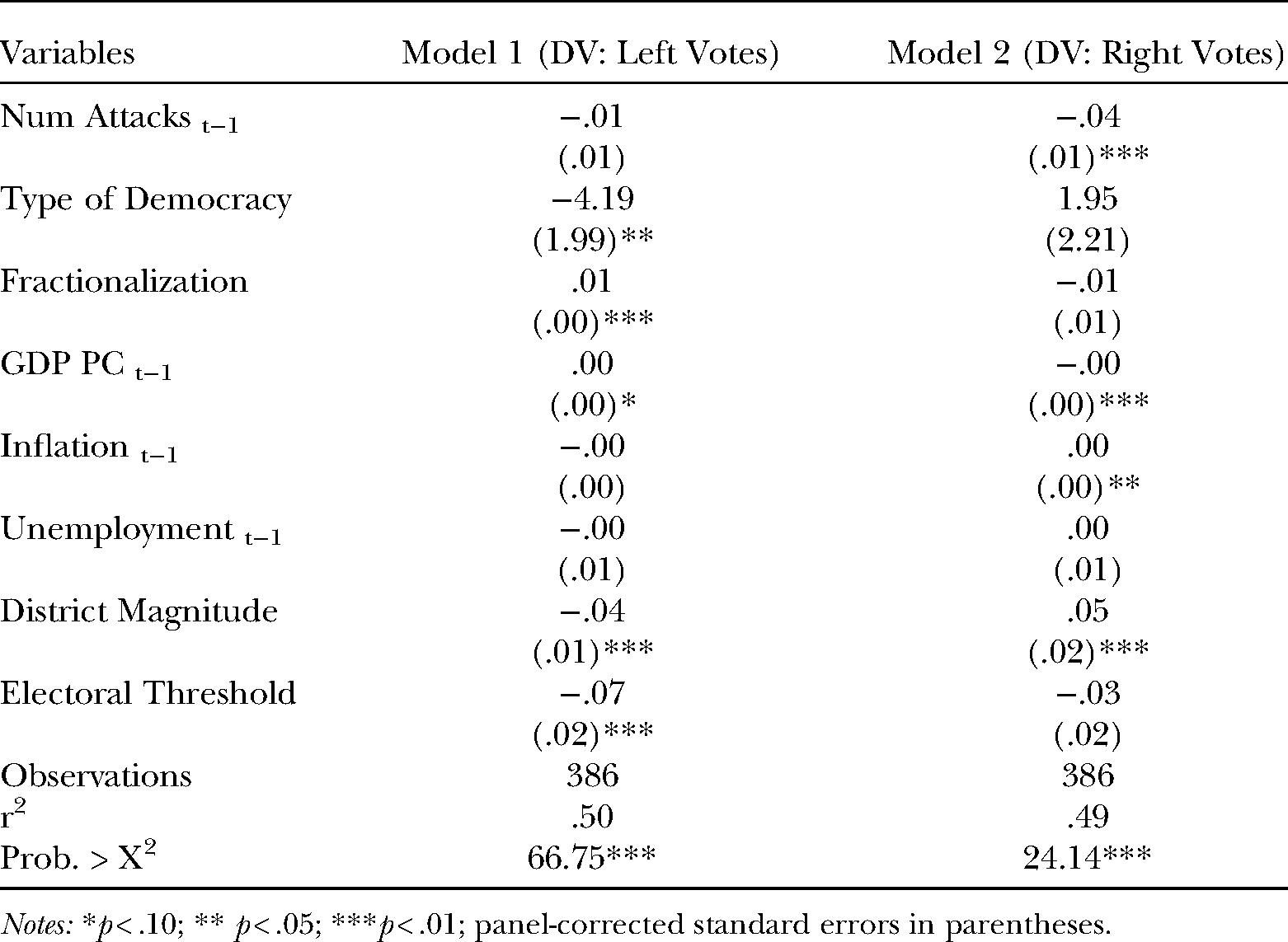
Notes: *p < .10; ** p < .05; ***p < .01; panel-corrected standard errors in parentheses.
In examining the predictive margins in Figure 1, we observe the expected percentage of vote shares received by right parties based on changes in levels of terrorism as the general Number of Attacks measure increases in increments of ten (i.e., ten terrorist attacks per year of observation). When analyzing the predictive margins at the minimum level of terrorist activity (zero attacks for a given year of observation) the expected vote share for right parties is 44.15 percent. When examining the expected vote share for right parties at higher values (e.g., 100 attacks for a given year of observation) the expected vote share for right parties decreases to 40.13 percent, accounting for a 4.02 percentage point decline. Thus, it appears an increase in the general Number of Attacks has a significant and meaningful effect on the expected vote share of right parties in legislative elections in the democracies included in this analysis.
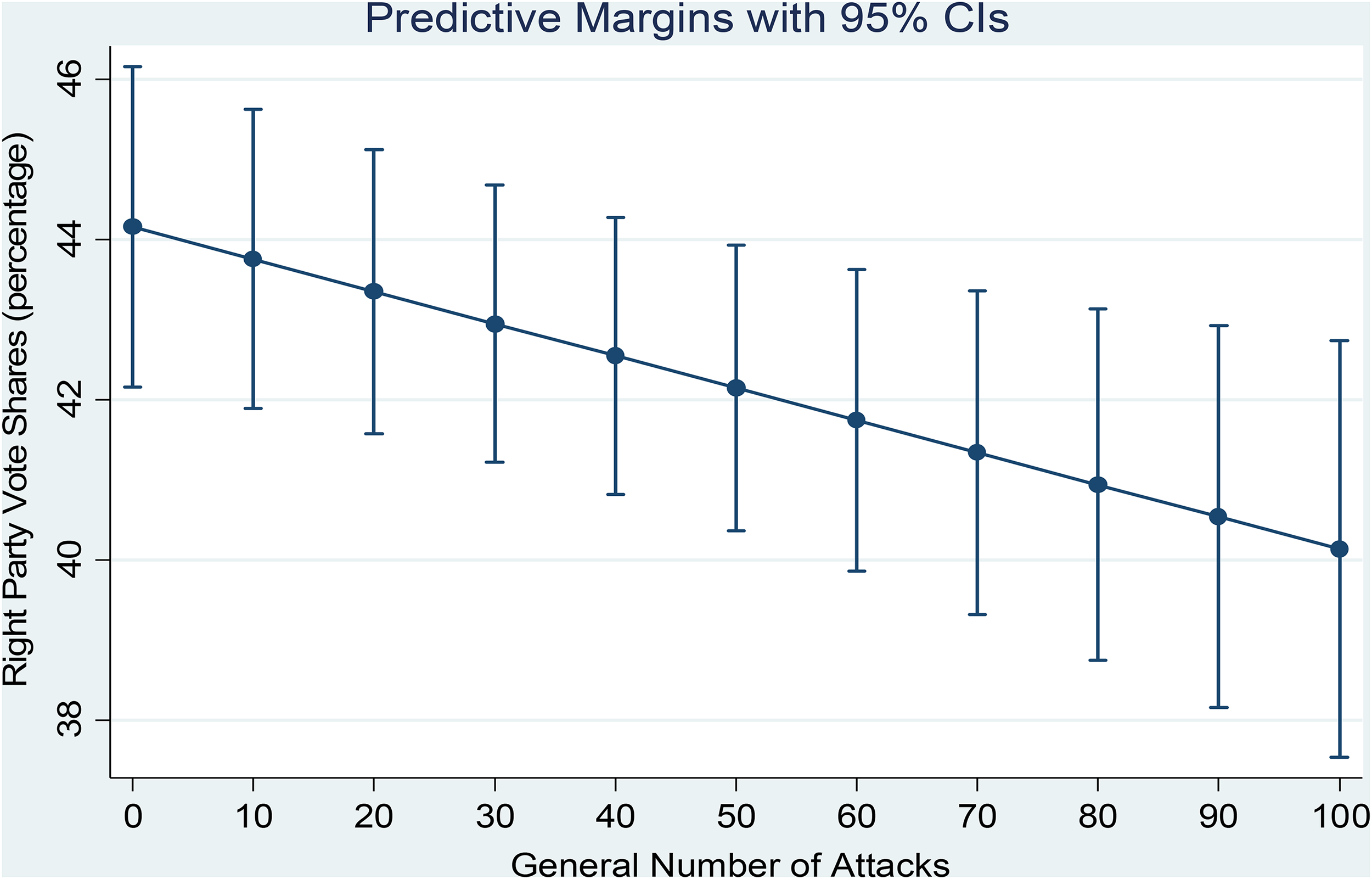
Predictive margins For number of attacks and right-party vote shares.
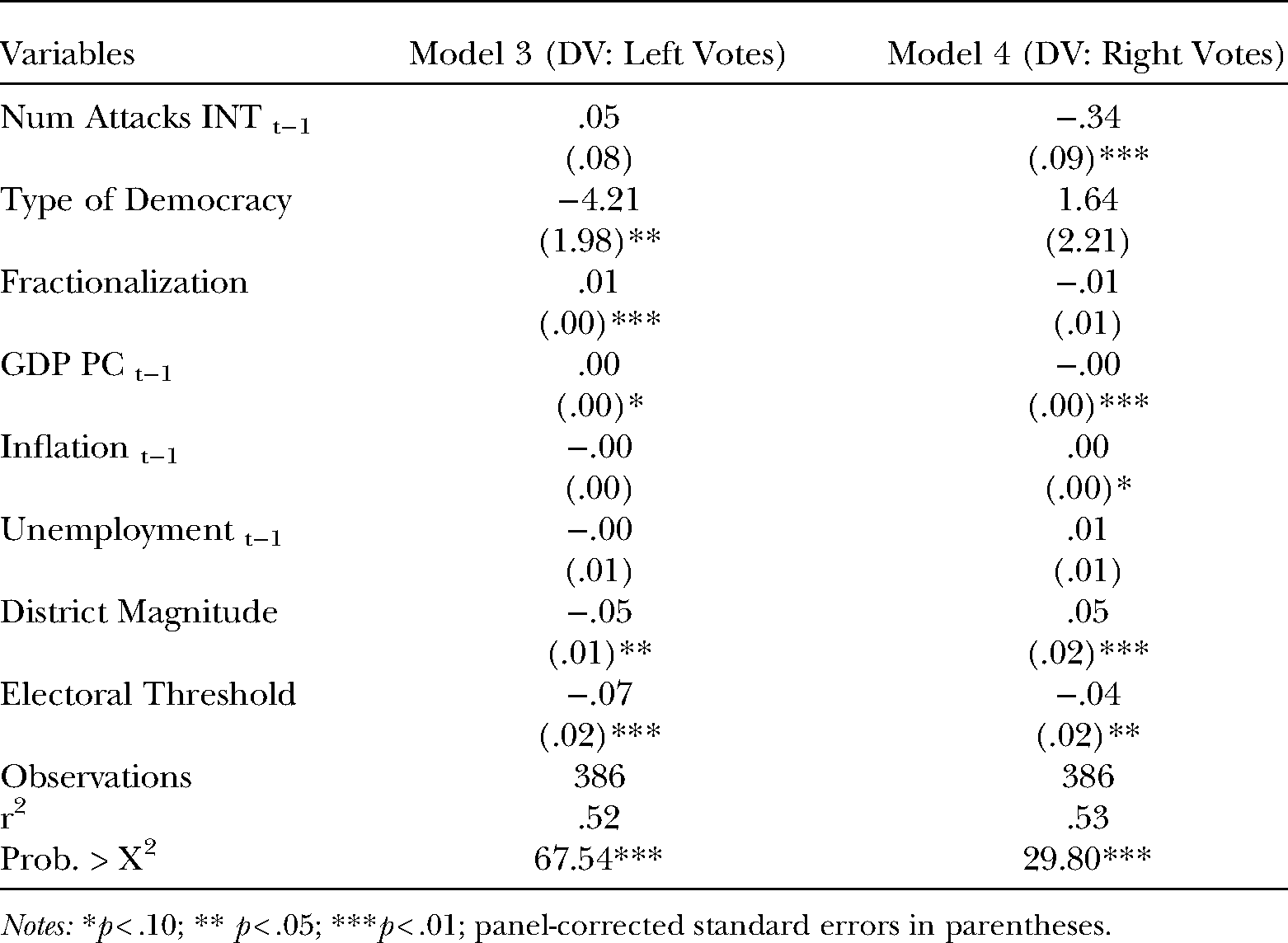
The next set of results examine how the nature of terrorist attacks (i.e., organized by transnational actors or domestic ones) impacts the electoral effects of attacks. We test two sets of models for attacks where the first set considers the effects of attacks carried out by transnational perpetrators and the second set estimates how political support changes in the wake of attacks committed by domestic perpetrators. In regards to Transnational Attacks, in Table 3 shows that the Number of Transnational Attacks variable has a negative and significant relationship with right-party vote share and the number of Transnational Attacks has an insignificant relationship with left-party vote share (see Figure 2 for the predictive margins). However, when analyzing domestic terrorist attacks and their effect on vote choice in Table 4, we see that the Number of Domestic Attacks has a negative and significant effect on both left and right parties, although the coefficient size and significance level is smaller for left parties. Interestingly, although right parties lose voter confidence in the wake of terrorist attacks regardless of the perpetrator(s), parties on the left only lose support following domestic attacks. This finding is similar to previous studies that have found domestic terrorist attacks decrease the election support of left parties (Hunter et al. 2019). One possible explanation for this finding is that leftist parties are held responsible for domestic threats to a greater extent compared with issues pertaining to international threats.
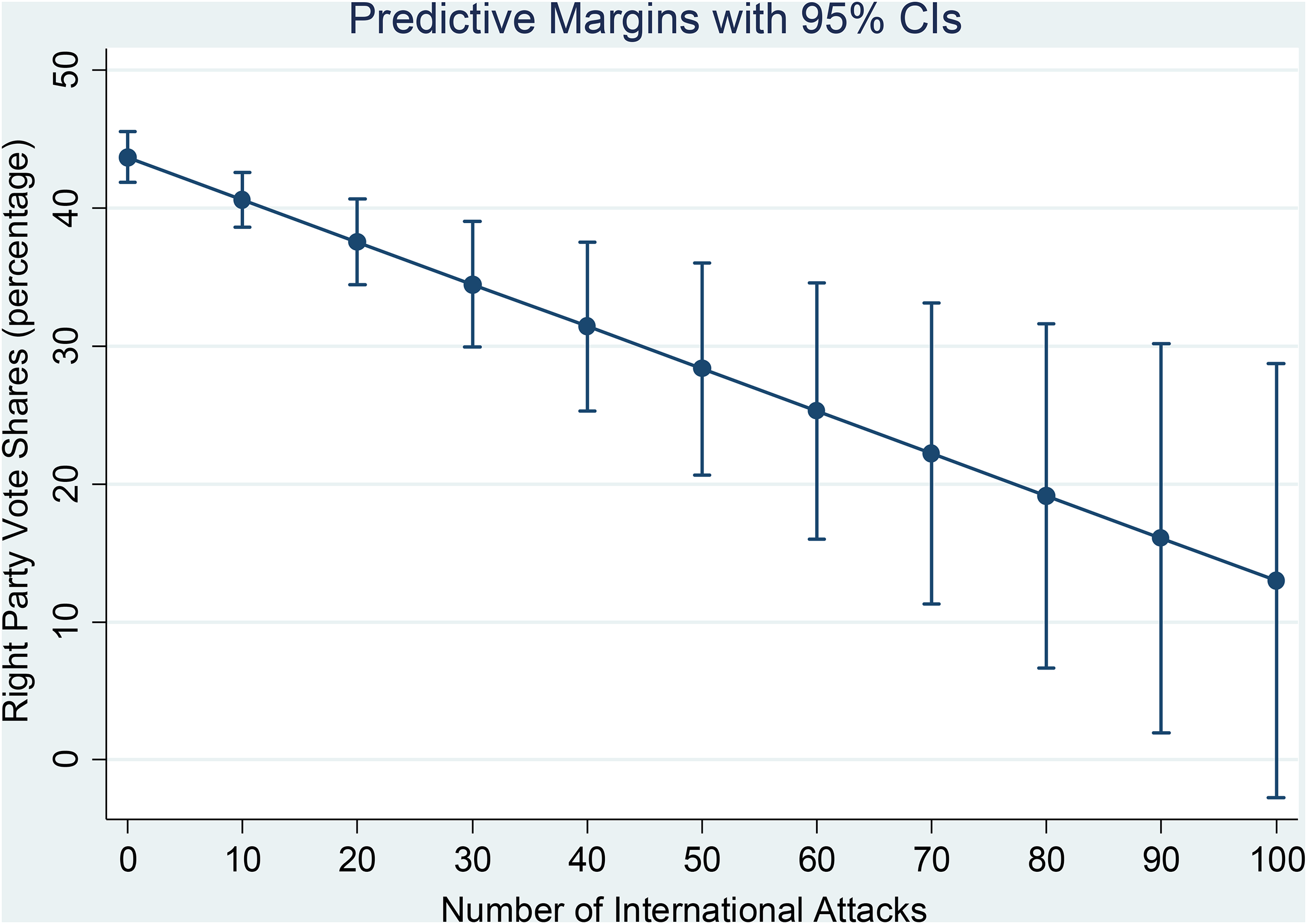
Predictive margins for number of international attacks and right-party vote shares.
Regressing International-Sponsored Terrorist Attacks on Party Vote Shares.
Notes: *p < .10; ** p < .05; ***p < .01; panel-corrected standard errors in parentheses.
Regressing Domestic-Sponsored Terrorist Attacks on Party Vote Shares.

Notes: *p < .10; ** p < .05; ***p < .01; panel-corrected standard errors in parentheses.
We also see that the effect's magnitude rises considerably for right parties when attacks are committed by actors who are not citizens of the state in which an attack occurred, thus affirming Hypothesis 3. While both domestic and transnational coefficients are negative and statistically significant, the number of transnational attacks measure decreases right party vote shares by .34 while the number of domestic attacks variable decreases right-party vote shares by .06. In addition, when examining the predictive margins in Figures 2 and 3 we see that, when moving from minimum to higher levels of terrorist activity for the transnational attacks variable, the expected percentage of vote shares received by right parties decreases from 43.69 to 12.99. When moving from the minimum to higher levels of domestic terrorism, the expected percentage of vote shares received by right parties decreases from 43.77 to 37.93.

Predictive margins for number of domestic attacks and right-party vote shares.
The next set of results examines the electoral consequences of attacks under unified and divided government scenarios (Hypothesis 5). In considering how the nature of the incumbent government conditions the effect terrorism has on political party vote shares, we find in Table 5 that there is a statistically significant and negative relationship between the general Number of Attacks and vote shares received by right parties when the legislature is controlled by a right party. There is also a negative and statistically significant relationship between the general Number of Attacks and right-party vote shares when the executive is a member of a right party. Unified government heightens the accountability faced by parties on the right, as the findings in Model 9 reveal. This finding provides support for Hypotheis 4 that states right parties should lose support following terrorist attacks when the incumbent government is of the right.
Regressing Terrorist Attacks on Right-Party Vote Shares in Different Accountability Scenarios.

Notes: *p < .10; ** p < .05; ***p < .01; panel-corrected standard errors in parentheses.
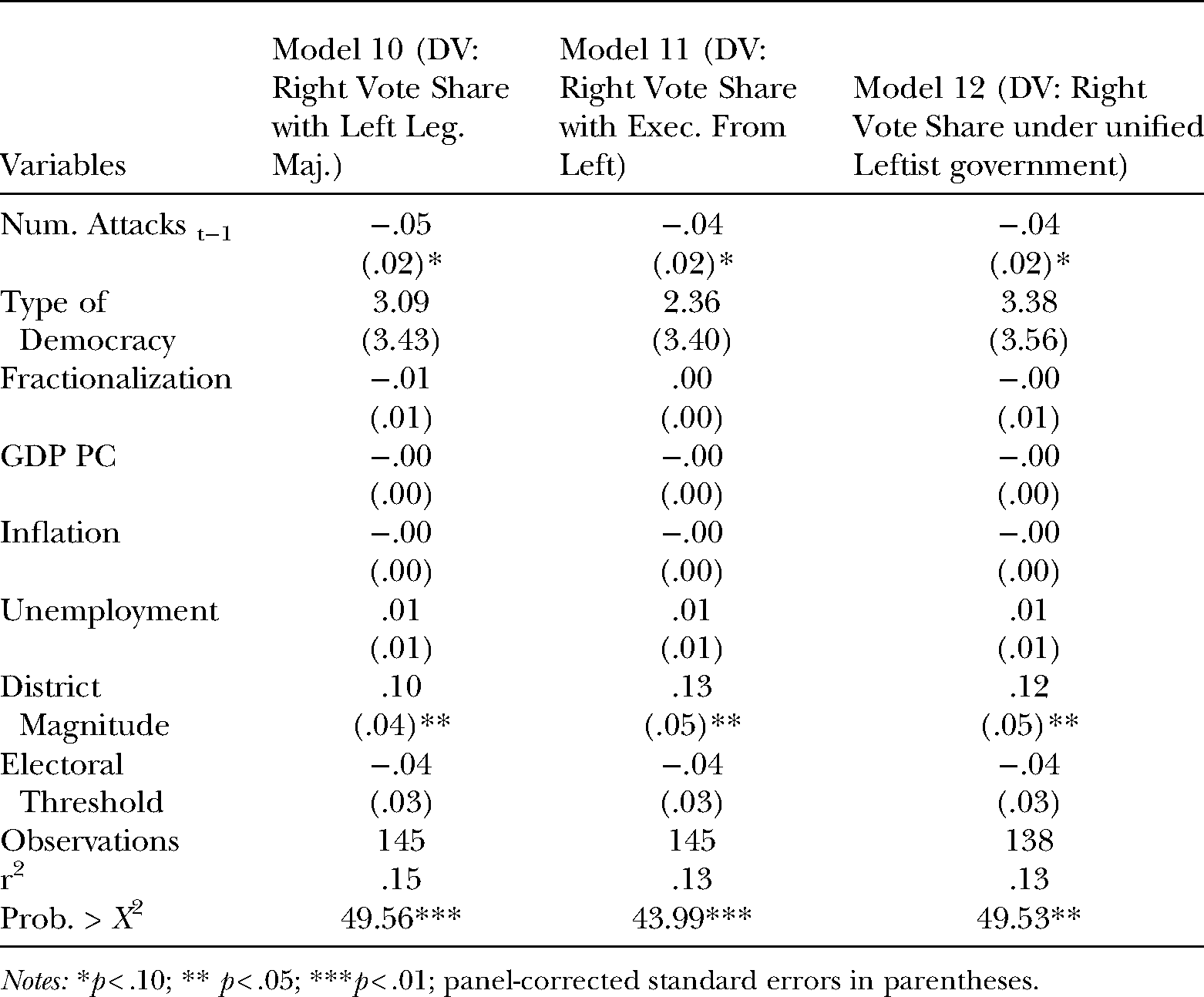
Additionally, it appears that right parties’ vote shares decrease following terrorist attacks across all types of governments. However, the effect is slightly weaker under governments controlled by left parties. In three additional models (Table 6, Models 10–12) we examine the effect the general number of terrorist attacks has on right party vote shares when the executive is a member of a left party, when the legislature is controlled by a left party, and when both the executive and legislature are controlled by left parties. Electoral support for parties on the right remains statistically significant and negative, although the coefficient size and significance levels are smaller compared to the results from Table 5 under right controlled governments. Thus, right-party support declines in both unified and divided governments, although the effect is slightly weaker under divided government.
Regressing Terrorist Attacks on Right-Party Vote Shares in Different Opposition Scenarios.
Notes: *p < .10; ** p < .05; ***p < .01; panel-corrected standard errors in parentheses.
Additional Specifications
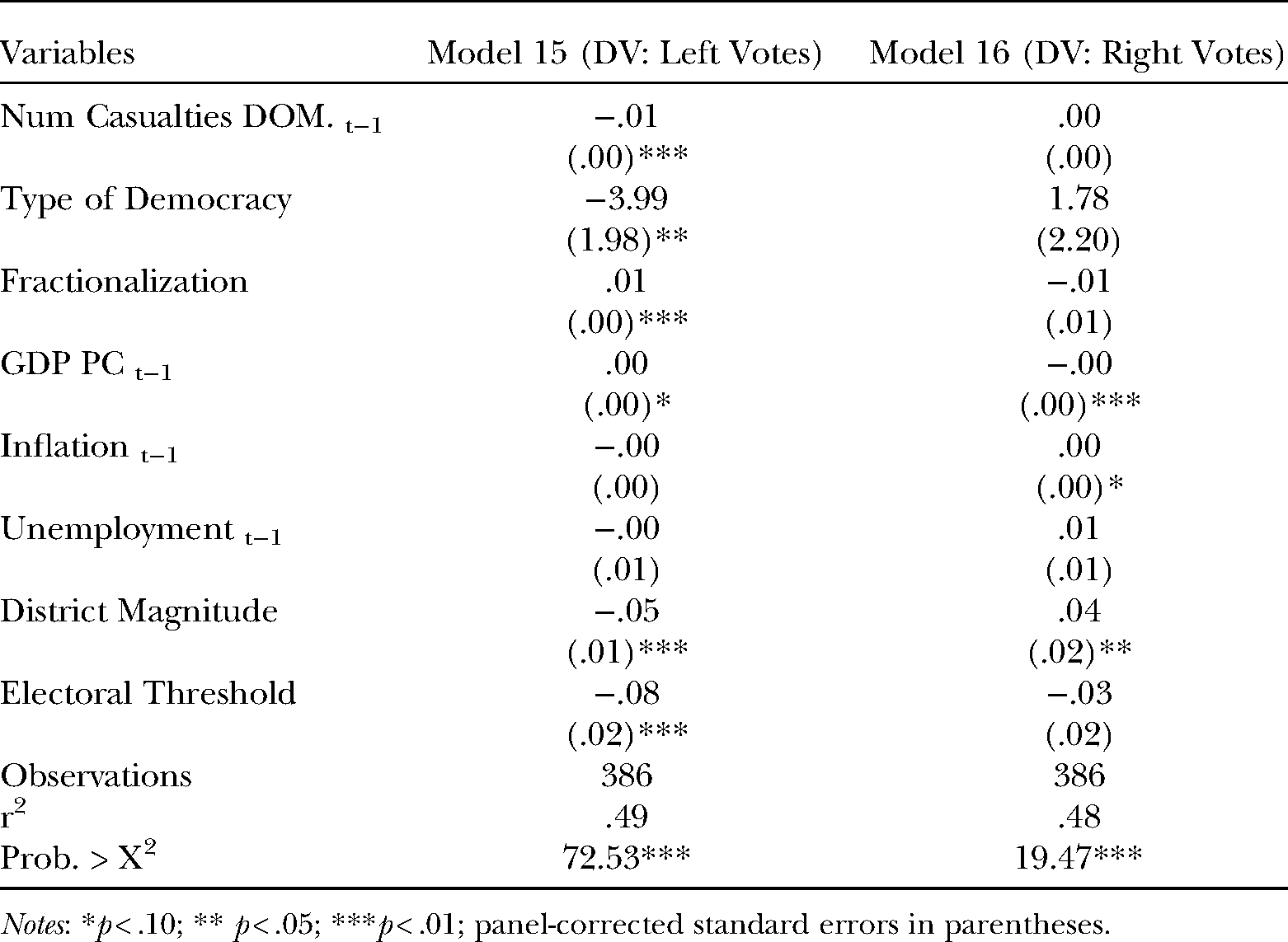
In order to attempt to provide for additional robustness we examine the effect the severity of terrorist attacks (i.e., the number of individuals killed in terrorist attacks) has on the vote shares received by political parties based on the type of terrorist attack. As noted in Hypothesis 2, we anticipate that deadly attacks are more likely to produce electoral hardships for right parties. Table 7 underscores this notion by revealing that the number of individuals killed in Transnational Attacks has a negative and significant effect on the vote shares of right parties and an insignificant effect on the vote shares of left parties. Once more, electoral support for political parties on the right is more clearly impacted by attacks carried out by individuals who are not citizens in the country where the attack occurred. Therefore, right parties tend to pay a higher electoral cost as more severe transnational terrorist attacks occur within their states and left parties pay a larger costs following (Table 8) severe domestic attacks.
Regressing Casualties From International-Sponsored Terrorist Attacks on Party Vote Shares.

Notes: *p < .10; ** p < .05; ***p < .01; panel-corrected standard errors in parentheses.
In examining Table 4 (Models 5–6), one question that emerges is: if both right and left parties lose electoral ground following domestic attacks, which parties increase their percentage of vote shares following domestic attacks? In examining Table 9 (Models 17–18) we find that center parties significantly increase the percentage of vote share they receive following both domestic and international terrorist attacks. This is consistent with previous research that finds that center parties experience an increase in electoral support following domestic and transnational terrorist attacks (Hunter et al. 2019). The argument in such scholarship is that center parties benefit electorally following terrorist attacks due to their frequent moderate and centrist policy positions that may become more appealing to voters in the wake of terrorist attacks.
Regressing Casualties From Domestic-Sponsored Terrorist Attacks on Party Vote Shares.
Notes: *p < .10; ** p < .05; ***p < .01; panel-corrected standard errors in parentheses.
Regressing Terrorist Attacks on Center Party Vote Shares.

Notes: *p <.10; **p < .05; ***p < .01; panel-corrected standard errors in parentheses.
Overall, electoral support was expected to be impacted by terrorism first and foremost and our findings showed this across multiple specifications. Other measures, however, also played a role in predicting partisan support. Grim economic conditions regularly translated into higher support for right parties. Indeed, GDP PC and Inflation were inversely related with right-party support in many of our models, with the latter proving to be a particularly reliable predictor of partisan support. Political institutions were consistent predictors of party support as well. District Magnitude revealed the mixed effects that political institutions have on different partisan interests. Specifically, parties of the left were significantly and inversely related with electoral district size whereas rightist support rose consistently in larger districts. Elsewhere, restrictive electoral systems, as evidenced by Electoral Thresholds, were an anathema to party success and especially for leftist parties.
Conclusion
This article sought to examine the effect terrorist attacks have on vote shares of right political parties competing for office in legislative elections. Our study lends support to the partisan voting hypothesis across a battery of tests with different specifications. We discovered that the nature of the incumbent government conditions the extent that right parties lose electoral support following terrorist attacks. Right parties lose support following terrorist attacks when the incumbent government is of a similar ideology. However, following increases in terrorism, right parties appear to suffer electoral losses regardless of the type of incumbent government that is in place. Furthermore, right parties lose electoral support following both transnational and domestic attacks, whereas left parties only lose support following domestic attacks. In addition, right parties lose a substantially greater percentage of votes following transnational attacks. Overall, these results confirm the general hypothesis that right parties are punished to a greater extent than other parties following terrorist attacks. The question emerges regarding how this finding fits with the conventional assumption that right parties should expect to increase their vote shares in the wake of terrorist attacks.
We believe this finding differs from conventional assumptions on the topic because previous studies linking terrorism with right party electoral gains have focused on a small number of states (through single case study analyses) rather than analyzing cross-national voting patterns in multiple regions. In addition, previous research has examined the effect terrorism has on far-right and moderate-right parties in Europe (see, for example, Wheatley et al. 2019), and future work should consider how terrorist attacks impact parties across the right ideological spectrum in additional regions to ascertain whether or how these events uniquely impact disparate ideological groupings. Furthermore, the majority of previous studies that have documented the relationship between terrorism and citizens’ political ideologies have been primarily confined to North America and Western Europe. Thus, the public opinion data on citizens’ political preferences following terrorist attacks is generally limited temporally and geographically leaving many question unanswered regarding how terrorism influences political ideology and political preferences. Future studies on political behavior should expand the analysis of terrorism's effect on citizens’ political preferences to additional regions. Also, future research should examine how terrorism influences voter preferences in executive elections cross-nationally. Last, while previous scholarhip has investigated the effect security threats have on regime stability and coups (Bove, Rivera, and Ruffa 2019; Owens and Pelizzo 2010), future research should further consider how terrorism affects the likelihood of regime breakdowns. This scholarship could provide unique insight into how the behavioral effects generated by terrorism impact political dynamics within states and the durability of democratic institutions.
