



Abstract
This study investigates self-harm among young lesbian, gay, bisexual, and trans (LGBT) people. Using qualitative virtual methods, we examined online forums to explore young LGBT people’s cybertalk about emotional distress and self-harming. We investigated how youth explained the relationship between self-harm and sexuality and gender. We found that LGBT youth may articulate contradictory, ambiguous, and multiple accounts of the relationship but there were three strong explanations: (a) self-harm was because of homophobia and transphobia; (b) self-harm was due to self-hatred, fear, and shame; (c) self-harm was emphatically not related to sexuality or gender. There was evidence of youth negotiating LGBT identities, managing homophobia, resisting pathologization, and explaining self-harm as a way of coping.
Keywords
Introduction
Young people’s mental health is of global concern (WHO, 2005) but mental health services and research often exclude young people’s marginalized sexualities and genders. Clear links have been demonstrated between Lesbian, gay, bisexual and trans (LGBT) youth, psychological distress, and self-harm (D’Augelli et al., 2005; Scourfield, Roen, & McDermott, 2008; Rivers, 2000), but this rarely features in prevention strategies or public health policies (e.g., see Haas et al., 2011; HM, 2012). Young people’s perspectives have not been adequately included in research investigating why marginalized sexualities and genders may be associated with self-harming. Qualitative research is likely to provide the more nuanced understandings necessary to tackle the problem.
An international body of evidence demonstrates elevated rates of self-harm among youth (e.g., Almeida, Johnson, Corliss, Molnar, & Azrael, 2009; D’Augelli et al., 2005; Fenaughty & Harre, 2003; Grossman & D’Augelli, 2007; King et al., 2007; Nickels, Walls, Laser, & Wisneski, 2012; Rivers & Cowie, 2006; Skegg, 2005; Wichstrøm & Hegna, 2003). Survey evidence suggests that key factors behind this are: homophobic and transphobic abuse; social isolation; early identification as LGBT; conflict with others about sexual or gender identity; inability to disclose sexual or gender identity; and mental health problems (Haas et al., 2011).
The most clearly demonstrated link is between homophobic abuse and negative psychological consequences (McDermott, Roen, & Scourfield, 2008; Rivers & Cowie, 2006). Studies have demonstrated the persistence of homophobic and transphobic abuse reported by LGBT youth (e.g., Grossman, D’Augelli, & Frank, 2011; Rivers & Duncan, 2002). Some have demonstrated links between homophobic abuse and self-harming (Rivers, 2004). Rivers (2000) examined how “repeated exposure to violence or harassment can have detrimental effects upon psychological well-being” (p. 147) and reported on the rate of suicide attempting in relation to school bullying. While much self-harm takes place without suicidal intent, some studies on suicide attempting are relevant for understanding self-harm. This is part of the terminological confusion described by Mangnall and Yurkovich (2008). 1 Of the LGB survey respondents in Rivers’ (2000) study, 19% had attempted suicide once and 8% had attempted suicide more than once due to sexual orientation difficulties. However, multiple suicide attempts rose to 30% of the respondents who were bullied at school.
While trans youth have been studied less, research on transpeople shows high self-harm and suicide attempting rates (Clements-Nolle, Marx, & Katz, 2006; Grossman & D’Augelli, 2007; Kenagy, 2005). 2 There are clear arguments that perceived gender atypicality is as much ground for abuse as LGB identification (Grossman et al., 2011; Rivers & Duncan, 2002). Thus, there are reasons for assuming that trans youth suffer similar abuse effects to LGB youth.
Much evidence about LGBT youth self-harm has been produced via quantitative research that rarely investigates young people’s own interpretations (for similar critiques, see: Fullagar, 2005; Redley, 2003). As others have argued (King et al., 2007), survey research offers little insight into how emotional distress and self-harm are expressed and lived by LGBT youth. Some suggest that qualitative methods may provide “nuanced understandings of LGBT lives” (Martin & D’Augelli, 2009, p. 203).
A small number of qualitative studies have shed light on this issue by considering how young people negotiate stigmatized sexual and gender identities. Research has shown the complex relationships among being young, experiencing distress in relation to sexuality or gender identity, and engaging in self-harming or suicidal acts (Fenaughty & Harre, 2003; McDermott et al., 2008; Scourfield et al., 2008). This work indicates that young people actively construct sexual and gender identities that are not captured by the “fixed” categories in survey research (Hillier & Harrison, 2004). Qualitative research suggests that young people attempt to position themselves as positive sexual and gendered subjects and, when unable to do this, experience psychologically negative outcomes (Fullagar, 2003; McDermott et al., 2008).
Some researchers have used online methods to investigate youth self-harm (e.g., Adler & Adler, 2011; Baker & Fortune, 2008; Rodham, Gavin, & Miles, 2007; Whitlock, Powers, & Eckenrode, 2006). Such studies have shed light on how some youth experience support from virtual discussions of self-harm (Rodham et al., 2007), and see those sites as helping them cope with distress (Baker & Fortune, 2008). The present study takes an online approach and builds on previous insights into how LGBT youth defend themselves against stigmatized aspects of self-harm and suicide attempting, and marginalized genders, and sexualities (Roen, Scourfield, & McDermott, 2008; Scourfield, Roen, & McDermott, 2011). We focus on LGBT youth perspectives on self-harm, expressed online. Few, if any, qualitative studies have previously investigated this topic, population, and setting. This article examines our research findings, addressing the question: “How do LGBT youth explain the role of gender and sexuality in relation to self-harm?” We use the term self-harm to refer to behaviors that are purposefully self-injurious, regardless of whether there is suicidal intent. 3
Method
We use an online qualitative research methodology because this provides unique access to marginalized LGBT youth (Hillier & Rosenthal, 2001) and generates rich “immediate” data that are unmediated by researcher/participant interaction, that is, nonreactive. The context and nature of the online text-based interactions are initiated, motivated, and therefore determined by the young person themselves (McDermott, 2011; McDermott & Roen, 2012).
Ethics
This research did not involve participants. We examined public Internet forums and made no attempt to interact with forum contributors. Consequently, we did not seek consent from individuals because our intention was to analyze publically available documents. We drew upon ethical guidance from the British Psychological Society (2007) and the Association of Internet Researchers’ research ethics guidelines (Markham & Buchanan, 2012). We concur with these guidelines that researchers should (a) respect Internet contributors’ expectations of privacy and (b) consider the extent to which researchers’ observations may potentially harm Internet contributors. These two points operate as inclusion criteria in the present study.
We were interested in web-spaces where young people write about self-harm, sexuality, and gender. We considered, on an individual basis, whether it would be ethically defensible to include a given web-space in our study. If the content of an online interaction was freely available without sign-in requirements, we judged that contributors did not anticipate a level of privacy that would prevent their posts being used for research. In order to protect contributors’ anonymity, we use paraphrasing and very short quotations (Wilkinson & Thelwall, 2011). No identifying information is given about the websites from which data have been drawn. The study was approved by the University of York Research Ethics Committee.
Data Generation
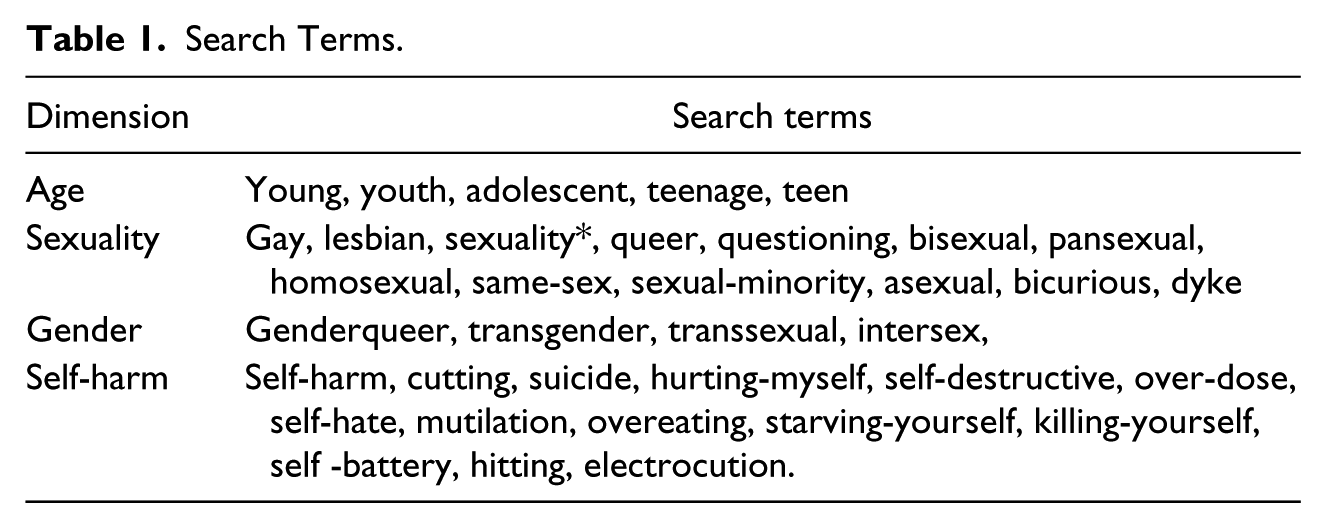
We searched online for sites where youth, sexuality, gender identity, and self-harm were a focus, for example, LGBT youth websites, self-harm support websites, forums, blogs, social networking sites. The search terms used (Table 1) were drawn from existing literature, for example, Hawton, Rodham, and Evans (2006) and our online searching.
Search Terms.
We prioritized rich textual data and included material posted between July 2005 and June 2011, in English, by people stating their age as 16 to 25 years, and addressing our topic. The data set consists of 49 excerpts from 20 websites. Twelve excerpts are from blogs and 37 are from discussion forums. Some excerpts are individual contributions and others consist of dialogue. Given that one author may contribute under different pseudonyms, it is impossible to know how many contributors are involved, but we estimate approximately 290. Data collected from the Internet often lack the key variables that interest social science researchers. We extracted available information about age, sexuality, and gender. The sample included the following sexual and gender identifications: “genderqueer,” “trans,” “female, lesbian,” “female, bisexual,” “pansexual,” “pan-sapphic,” “possibly pan,” “unsure,” “heteroqueer,” “female, gay,” “transgender, straight,” “male, gay,” “androgenous,” “male, bisexual,” “demisexual,” “asexual,” “polyamorous.” (For further details about the search and selection strategy, see McDermott, Roen, & Piela, 2013).
Data Analysis
The data were analyzed thematically using cross-sectional indexing to create categories (Mason, 2002). To improve credibility and reliability, the coding schema (see McDermott, Roen, & Piela, 2013) was devised and applied by all three authors, within Atlas.ti, in preparation for cross-sectional comparison. Queries were run on each individual code, and an analytic document was produced to describe the material emerging. The authors jointly developed the interpretative analysis where contributors’ words and understandings were read in relation to theoretical frameworks. Themes were generated, drawing from the data, research questions, and theoretical framework. Our approach to analysis highlights young people’s perspectives, works from a non-pathologizing view of self-harm, and draws from queer theory (e.g., Butler, 1993; Sedgwick, 1991) to conceptualize sexuality and gender. The analytic process has stayed faithful to the ideas presented by youth rather than trying to draw artificial distinctions between suicidal and self-harming possibilities that appear (sometimes conflated) in the data.
Findings
The present article offers a thematic analysis of contributors’ explanations of the relationship between self-harm, sexuality, and gender. We are interested in how contributors wrestle with explanations and reasons; how they position themselves via their explanations; and how they negotiate the implications of the reasons they give for self-harm.
Much of the writing about the motivations for self-harm revolved around questions of whether being LGB or T might lie behind self-harming. The data show that youth articulate contradictory, ambiguous, and multiple accounts of the relationship between sexuality, gender identity, and self-harm. The three themes we present below reflect how most contributors explained the relationship: (a) self-harm was a result of homophobia and transphobia; (b) self-harm was due to self-hatred, fear, and shame; (c) self-harm was specifically rejected as being related to sexuality or gender. The posts do not necessarily fall neatly into one of the three categories above. To a lesser extent, some contributors also stated that they were uncertain of the relationship or that their sexuality or gender was only partially to account for their self-harm.
Homophobia and Self-Harm
A substantial proportion of the posts involve young people asking for help regarding distress and self-harm arising from homophobia. These data show the young age at which contributors are experiencing severe homophobia, the sense of worthlessness that persistent homophobia can lead to, and the link between homophobia, self-harm, and suicidality. First, we examine the ways young people describe how homophobia, especially at school and from parents, has led to suicidal feelings and self-harming. One 16-year-old lesbian explained how homophobic pressure from her parents was related to her cutting herself. She described her father as “accepting,” but explained that his version of acceptance meant that “I needed to go to a shrink, change the way I look and behave like a girl, and I needed to stop seeing all my ‘gay’ friends! He said I needed to lie to myself.”
Another contributor, described as 13 years old (gender not specified), wrote “I am bi-sexual. I’m always getting made fun of, and I hate it! I’ve thought about suicide . . . a lot . . . I self-harm. My life is horrible.” Another contributor, identifying as gay, male, and 16 years old, wrote about school as a place that he “hated” and where people “started rumors” about his sexuality. As the narrative unfolds, we read that the experience of homophobia was so bad that he changed schools. He described how at the new school, the rumors about his being gay re-emerge, he states “I’m just depressed. I feel worthless. I want to try and kill myself.” At the time of posting, he described feeling unable to improve his situation, finally writing “help.”
These contributors describe self-harm and suicidal feelings as resulting from distress caused by homophobic parents and peers. They write of worry, depression, worthlessness, life being over, and lack of control. In response to these feelings, they consider (or do) harm their bodies. In the midst of their despair, and facing a hostile environment, they see their options as limited, referring to cutting, nearing breaking point, and wanting to die.
The emotions arising from such antagonistic environments are complex, and the contributors describe emotional states such as depression, anger, worry, fear, frustration but also positive feelings about their own sexuality or gender, and increasing confidence and self-worth. One 16-year-old (female) explained that despite being more open about her sexuality at school, she cut herself because she had to keep her sexuality hidden from her parents. She wrote “Well I currently am feeling really strongly about my sexuality . . . that I feel the need to tell them to just STFU and accept it, but I can’t or else I get kicked out.” Subsequently, she states she started cutting again.
It is repeatedly made clear that some LGBT youth consider self-harm to cope with distress caused by homophobia. Part of the picture is that youth feel self-harm is their only or best option to cope with overwhelming difficulties resulting from hostility. Our analysis suggests youth believe they have limited options for coping with homophobia because they feel they have to deal with it alone, as young adults. The posts on the discussion of homophobia and self-harm are saturated with dominant discourses of youth: the journey to adulthood and independence, becoming a “proper” adult. We see this discursive framing, for example, in the phrases “think about your future,” “soon you’ll be independent,” “Your situation is temporary.” One contributor, described as 16 years old, male and gay, responded to another contributor with the advice that coming out to parents is something that could best wait “until your old enough to be out on your own and making your own life and money so you wont have to rely on anyone who may not approve of you being gay.”
This contributor suggests that homophobia must be endured because it will not last forever and the prospect of future independence provides the solution. Adolescence is understood as temporary, and future LGBT adulthood is understood as individual, self-governing, subjecthood (Walkerdine, Lucey, & Melody, 2001). This responsible adult is evident in some contributors’ emphasis on self-reliance and taking control of distressing environments. This might include changing schools, rejecting homophobic peers, and leaving home.
While advice was offered, and sought, it was less often evident that contributors would expect “adult” help. There were suggestions to report school and home-based homophobia to the police or a trustworthy adult at school, but this was a much fainter thread in the data compared to the emphasis on self-reliance. In the face of hostility and without obvious routes of support, waiting for future independence, enduring homophobia, leaving home or school, “faking it,” or seeking help from trustworthy adults are all strategies which rely on the extraordinary individual resources of a young person. These strategies place psychological demands on youth, requiring substantial emotional resilience.
Self-Hatred, Fear, and Shame
Given the animosity some young people encounter in relation to their sexuality and gender, and the uneven social acceptance of same-sex desire and gender variance, it is not surprising that some directly relate their self-harming and suicidal feelings to discomfort with, or hatred of, themselves. One 21-year-old trans contributor wrote of always being “uncomfortable” in his/her body. S/he explained that it made sense to see some connection between self-harm and “identity frustration.” Another, identifying as trans (FTM) and bisexual wrote of having self-harmed “because of gender identity,” and explained that this was quite distinct from sexuality. He wrote “I’m happy being bi,” and that he could “ignore insults.” The crux, however, was to do with living “in a body that I . . . despise.” This was described as torture. Gendered body parts that were unwanted, he explained, were what he cut. Similarly, a 15-year-old transgender contributor makes a direct link between body dissatisfaction and self-harm, writing “It made me really depressed, contemplate suicide, and start self-harming.” It was not only trans contributors who wrote about bodily dissatisfaction, but their contributions to this theme were significant.
The realization of desires that transgress heteronormative boundaries can, for some, be very difficult to cope with. One 15-year-old, gay male wrote When I first realised I was gay, I hated myself ’cause I thought I was doing something wrong. Another 16-year-old lesbian wondered, whether her “drinking,” “smoking pot,” “having thoughts of suicide” and “cutting myself” could, in fact be “from being gay?” Another post from a 19-year-old gay contributor described difficulty admitting to “struggling with accepting my sexuality,” even though that period of struggle had been characterized by drinking, smoking, and eventually spending time “in a psych ward” as a result of cutting. This person explained that it was hard to admit to sexuality as the source of struggle because of feeling “ashamed and afraid.”
In this post, the contributor describes the difficulty of managing the complex emotions associated with marginalized sexuality, such as shame and fear. In describing feeling “ashamed and afraid,” the contributor is referring to the emotional fallout of rubbing up against mainstream heterosexual norms. This reflects the continuing impact of non-heterosexual feelings, practices, and identities being sidelined, silenced, and appearing shameful and distressing.
A discourse of pride was also evident in posts that responded to contributors’ requests for help. Here, contributors replied with reassurance that youth should accept LGBT identity, they should not be ashamed but proud, “you need to be PROUD of who you are” and “you got to be yourself.” Some contributors, encouraging one another to “come out,” acknowledged that it could be difficult but claimed that honesty and openness will make a person happier. One, 20-year-old gay contributor acknowledged “it is important to be true to yourself, to be proud and open of your own sexual identity.”
Resisting the Pathologizing of Queer Youth
A significant theme in our data concerns the argument that sexuality and gender were not related to self-harm. Despite the difficulty of being positioned precariously in relation to youth, sexuality and gender norms, and mental health status, LGBT youth appear to construct their sexual and gender identities in positive ways, by challenging the pathologizing discourses of adolescence, sexuality and gender, and mental illness. This can be a positive identity claim, as one 16-year-old female contributor stated: “Year X is stressful and self harm is my coping mechanism . . . I’m tired of everyone thinking that I am depressed over being a lesbian . . . I love being a lesbian.” Another, 16-year-old lesbian who resisted any causal link between sexuality and self-harm, wrote “i’ve attempted suicide many times and have mutilated myself in the past for much of my school days. but it IS NOT because i’m gay. if anything being gay makes me happier.” Similarly a post from a 17-year-old gay female explains her cutting was not due to her sexuality but “because of low self-esteem and a messed up world. NOT because of my preference for girls.” She wrote of sexuality as something “that I like about myself.” This cybertalk actively rejects the stigmatization and pathologizing of youth lives and desires. The young women reject the assumption that their same-sex desire is the source of psychological angst—both claiming sexuality as a source of strength or something they love. They articulate an understanding of their mental health and distress—attributing distress to individual and social causes (such as school work and self-esteem issues).
We found young people also rejected the pathologizing argument that being gay and young is associated with mental instability. One, identifying as 15 years old and lesbian, responded strongly to research findings showing that gay youth are “more likely to cut or commit suicide.” She wrote that she hates it when this finding is attributed to gay youth being “confused” and she argued emphatically: “It’s not BEING gay,” it is being “tormented and belittled.” This argument was reiterated by other contributors, for example, a young trans bisexual stated, “I think it’s true that LGBT youth are at higher risk for self-harm, mostly because of bullying and social rejection they go through, rather than because of "confusion.” This suggests that young people are well-aware of the negative relationship between sexuality, youth and mental health, and the denigration of their feelings and emotions as “confused.” There is a sense of frustration that homophobia is not seen as the primary cause of distress and self-harm.
As well as arguing that sexuality is not a cause of self-harm among LGBT youth, many contributors explained their self-harm in relation to specific life difficulties unrelated to sexuality or gender. Poor and abusive family relationships were cited repeatedly. One contributor wrote about her alcoholic mother who is verbally and emotionally abusive. This contributor, describing herself as queer, lesbian, and 17 years old, wrote about destructive things her mother said to her, saying she did “everything wrong,” and calling her “a stupid child,” apparently with little or no provocation. This contributor wrote about “self-harm” and “bulimia” as well as describing a sense of “numbness.” This and other posts described parents or caregivers who appeared unable to connect emotionally with their children. This led youth to experience distress, which they attempted to relieve by self-harming.
Discussion
Evidence on LGBT youth and self-harm is dominated by “risk factor” paradigms which do not include the perspectives of LGBT youth themselves, and focus on the quantifiable, at the expense of generating psychosocial understanding. In our previous research, we began drawing from the perspectives of LGBT youth, demonstrating how homophobia operates at an individual level and requires LGBT youth to manage being positioned as abnormal. We documented how LGBT youth negotiated homophobia through “modalities of shame-avoidance” such as minimizing the effect of homophobia, taking full “adult” responsibility for coping, and constructing “proud” identities (McDermott et al., 2008).
Our current findings focus on the attributions LGBT youth make in relation to their self-harming. We examine how they negotiated arguments for and against causal links between being LGB or T and self-harming. Key understandings that emerge from the analysis relate to (a) the role of homophobia, (b) shame, self-hatred, and body-distress, and (c) the importance of defending against pathologizing arguments.
To examine LGBT youth self-harm, we employ a framework for understanding the emotional effects of homophobic and transphobic abuse, and the pathologizing and stigmatizing that are faced in relation to being LGB or T, and to self-harming. There is a long history of pathologization of homosexuality (Roberts, 2011) and transsexuality (Roen, 2001a, 2001b) which has only partially been discredited. There remains continuing tension between those categorized as “queer” and these pathologizing effects (Roen, 2011; Talburt, 2004). For self-harming subjects, too, stigmatizing and pathologizing go hand-in-hand. Despite arguments for prioritizing the perspectives of those who self-harm (Inkle, 2011; Redley, 2003), and despite the potential for psychiatric diagnosis to add to distress rather than alleviating it, the coming edition of the DSM is planned to include self-injury as a diagnostic category (DSM-V, 2013).
The persistence of homophobia as a theme in the data suggests that tackling homophobia is key to understanding and addressing LGBT youth self-harm. Our analysis suggests youth may understand self-harm as a response to hostile environments. Young people’s ways of dealing with homophobia are shaped by lack of support, and the need to navigate the pathologizing and stigmatization of simultaneously being young, being minoritized in relation to sexuality and gender, and self-harming. The online discussions we are analyzing are saturated with understandings about how to negotiate youth and adulthood, how to deal with sexual and gender norms, and how to live with the spectre of mental instability. We contend that lack of support, and the necessity of navigating stigmatization and pathology, help produce self-harm as a coping strategy for LGBT youth facing homophobia-related distress.
A small proportion of the data reflect the experiences of trans youth, and indicate that distress around gender identity and the sexed body may contribute to self-harming. In addition, some LGB contributors wrote about periods of self-hatred or shame because of their sexuality, as a contributor to their self-harming. This was strongly countered, however, by a repeated argument that sexuality is a source of happiness and pride, and not a cause for self-harming. Cultural and queer theorists have suggested that LGBT identities are produced though a shame/pride binary (Munt, 2007; Probyn, 2005; Sedgwick, 2003). They suggest that for some LGBT people, the increasing consciousness of same-sex desire produces feelings of exclusion and marginality. One may be shamed by one’s feelings or may refute shame through discourses of pride (Munt, 2007). Talburt (2004) argues that relying on “proud” queer identity narrowly defines young selves. We argue that the “out and proud” subject-position is difficult to achieve. It relies on one’s resources and is a limited option for dealing with distress and self-harm. Our analysis suggests that the difficulties of negotiating stigmatized identities and navigating sexual and gendered norms, at a young age, can be distressing. Here, self-harm is produced as a way of coping with distress.
Regardless of the contributor’s role in the argument, they are all negotiating living in a world where they are marginalized, stigmatized, and potentially pathologized, not only on the basis of being LGBT youth, but also on the basis of self-harming. Just as LGBT youth reach for ways of articulating “proud” sexuality and gender identities, just as self-harming youth strive to find ways of writing about their self-harm rather than being silenced by shame, so the new DSM-V diagnostic category, “nonsuicidal self-injury,” may characterize many of those whose online posts we have been analyzing, defining them in pathologizing, psychiatric terms.
The struggle of contemporary LGBT youth against homophobia and pathologization is nothing new. Our findings indicate that the regulation of sexual and gender norms continues to create problems for youth who claim an existence outside those norms. The struggle that faces LGBT youth is to carve out a space to live, despite youth discourses through which their emotional distress is minimized; psychomedical discourses through which their embodiment is pathologized; and heteronormative discourses through which their identities and desire are marginalized. In addition, as online posts reflect, contemporary LGBT youth are increasingly having to define their existence in relation to psychological discourses through which their self-harming is read as a sign of mental instability or lack of emotional control.
It is well-established that there are numerous life circumstances that may contribute to the likelihood of a young person self-harming (Gratz, 2003). The focus of the current analysis is not to bring that into question. Rather, the point is to highlight the complexity of the struggle faced by LGBT youth who self-harm, whether they seek to argue that struggles around sexuality and gender identity are to blame for their self-harming, or whether they argue the opposite.
What we see, in the online posts, is evidence of young people managing and negotiating pathologization, marginalization, and stigmatization, while finding ways to articulate LGBT identities. This involves considerable emotional work. In online spaces, young people are vulnerable but also speaking out and articulating their selves. Responding to being positioned as mentally unstable, young, and queer, some LGBT youth use online spaces to do strategic identity work, to articulate possible adult futures involving independence and maturity, and to carefully demonstrate emotional control and rationality. Future LGBT adulthood is firmly understood as entailing proud individual, self-governing, and responsible selves (Fullagar, 2005; Walkerdine et al., 2001), while youth is produced as a time where self-harm may simply be a way to survive.
The advantage of online qualitative methods for accessing data on LGBT youth and self-harm is the creation of detailed data on feelings and experiences. However, these data do have weaknesses because they are not co-created via a researcher and lack demographic detail and so give a partial perspective and limit, what can be inferred from data analysis. Lastly, the prerequisite linguistic competence and access to technology means that online methods reach a sample that is skewed in terms of literacy and Internet access, and exclude those that do not use online spaces to articulate their emotional distress.
Further research is required to develop our understanding of why marginalized sexual and gender identities may be associated with self-harm. Using both online and face-to-face data may create a more complete picture.
Footnotes
Declaration of Conflicting Interests
The authors declared no potential conflicts of interest with respect to the research, authorship, and/or publication of this article.
Funding
The authors disclosed receipt of the following financial support for the research, authorship, and/or publication of this article: This work was supported by a British Academy Small Research Grant.