




Abstract
This study examined the interaction effects between Hong Kong adolescents’ exposure to sexually explicit online materials (SEOM) and individual, family, peer, and cultural factors on their beliefs about gender role equality and body-centered sexuality. Based on a survey design with a sample of 503 high school students in Hong Kong, the results indicated that adolescents’ frequency of accessing SEOM, their intrapersonal reactions to SEOM, their communication with parents about sexuality, their susceptibility to peer pressure, and their acceptance of cultural values regarding sex roles work jointly to affect their conceptions of gender and sexuality, although the main and interaction effects differ across variables. The results partially supported the hypotheses that individual responses to SEOM and relationships with parents and peers with regard to sexuality interact with SEOM exposure in affecting the outcomes. The study provided evidence for the adoption of an ecological perspective to guide the provision of sexuality education.
Keywords
With the rapid growth of Internet technology, Internet surfing has become a major daily activity for adolescents. Internet surfing provides adolescents a convenient and speedy way to acquire information and knowledge that can help fulfill their needs for leisure, learning, and development. Apart from surfing information on sports, music, or other entertainment, adolescents’ accessing sexually explicit online materials (SEOM) is another hot issue of popular discussion. This research is a pioneering attempt to investigate the ways in which young people’s frequency of exposure to SEOM interact with their intrapersonal reactions to SEOM, their communication with parents about sexuality, their experience of peer pressure, and their acceptance of Chinese cultural beliefs, and affect their perceptions of gender and sexuality.
In recent years, there has been a growing trend toward the use of the ecological perspective in understanding adolescents’ sexual development (Colpin, 2006). Based on the word “ecology,” this perspective is related to the application of biological science to the transactions between a human organism and its environment (Bronfenbrenner, 1979). From this perspective, an adolescent is considered as embedded within the social systems labeled by Bronfenbrenner as the “microsystem” (everyday activities, roles, and interpersonal relations experienced by an adolescent in his or her immediate setting), “mesosystem” (the interrelations among two or more settings in which an adolescent actively participates), “exosystem” (settings that do not involve an adolescent as an active participant but in which events occur that affect the adolescent), and “macrosystem” (the broadest cultural context that affects an adolescents’ perception and behavior [Bronfenbrenner, 1979]). The ecological perspective helps us understand adolescents’ psychosocial needs and conceives the environment in which adolescents’ sexual development occurs as a set of contexts ranging from families and peers to schools and communities, and to the sociocultural context. This shifts the focus to the dynamic process in which young people’s personal reactions and environmental influences interact in a transactional relationship. The importance of adopting an ecological perspective in examining the impact of the transactions between adolescents’ media use and their individual, interpersonal, and cultural experiences has been increasingly recognized in the West (Jordan, 2004); however, the investigation of the impact of those transactions on the sexual development of adolescents who are exposed to SEOM is scant. This vital gap in the existing studies needs to be filled as those transactions may amplify or mitigate the effects of accessing SEOM on adolescents’ sexual values, attitudes, and behaviors.
Although scholars from different disciplines have begun to study the patterns, factors, and impact of adolescents’ exposure to SEOM, systematic research in Hong Kong is still very scarce. A survey conducted by Chung et al. (2009) reports that 79.8% of adolescents have accessed SEOM. Among them, 18.9% act for entertainment purposes, 14% for obtaining sexual knowledge, and 10.7% for gratifying sexual needs. The study conducted by To, Ngai, and Iu Kan (2012) found that 44.14% of adolescents reported having viewed SEOM in the previous year. Moreover, adolescents’ intrapersonal reactions to SEOM mediate the effect of the frequency of accessing SEOM. While To et al. (2012) challenge the assumption of a direct relationship between SEOM exposure and its influence on adolescent sexuality, the study focuses on the individual aspect rather than treating the transactions between adolescents and their social environments as the primary unit of analysis. A comprehensive assessment of the intrapersonal responses to SEOM as well as the family and extrafamilial factors is thus awaiting further investigation.
Literature Review and Hypotheses
This study defines SEOM as any erotic materials or messages—textual, visual, or aural—distributed via the Internet that are intended to stimulate sexual responses in users (Lo & Wei, 2005; Peter & Valkenburg, 2006). This study focused on adolescents who access SEOM in terms of surfing websites that contain SEOM and receiving SEOM from other people through various forms of online interaction (Thornburgh & Lin, 2002).
Due to the fact that many adolescents habituate in the digital world, the Internet has replaced television and magazines as the most important source of sexual information for youths (Wallmyr & Welin, 2006). Its impact on adolescents’ beliefs about gender and sexuality has become a frequent topic of discussion. Adolescents’ beliefs about gender and sexuality refer to coherent sets of gender and sexual ideas held by young people (Lottes, 1985). They help adolescents define what is acceptable and preferable in sexual development. Previous studies found that exposure to SEOM exerted considerable influence on adolescents’ agreement with stereotyped notions of gender and sex roles (Peter & Valkenburg, 2007), permissiveness of premarital sex (Lo & Wei, 2005), and recreational attitudes toward sex (Peter & Valkenburg, 2006). In the present study, the degree in which adolescents agree with gender role equality (the belief that gender roles should be similar for males and females) and body-centered sexuality (the belief that body-centered sexuality should be valued in both genders) are used to test the effect of SEOM exposure on adolescent sexuality. The first hypothesis of this study is
Hypothesis 1: Adolescents with a higher frequency of accessing SEOM will have a weaker belief about gender role equality and a stronger belief about body-centered sexuality than those adolescents with a lower frequency of accessing SEOM.
According to Jordan (2004), using an ecological perspective in examining the role of media in children’s development allows for a simultaneous focus on the characteristics of the individual child, the setting of the home, the relationship with the peers, and the ubiquitous cultural environment. Following her argument, a critical review and analysis of the interaction effects between adolescents’ exposure to SEOM and the influences of the individual, family, and extrafamilial factors is articulated as follows:
Interaction effect between adolescents’ exposure to SEOM and individual factors
Drawing on a survey of 745 Dutch adolescents, the study of Peter and Valkenburg (2006) indicates that adolescents’ exposure to SEOM is related to recreational attitudes toward sex, and the relationship is influenced by adolescents’ gender and mediated by the extent to which they consider such material realistic. Based on an online survey of 9,177 adults, Cooper, Scherer, Boies, and Gordon (1999) found that reflection (the cognitive involvement), action (the level of direct activity), arousal (the experience of excitement and stimulation), and excitement (the reported level of excitement) relate to adults’ personal online experiences. Their findings indicate that different people have different experiences in various intrapersonal operations while pursuing sex on the Internet. This study provides insight into the exploration of the intrapersonal reactions to SEOM, but the target of study has been young adults rather than adolescents. Moreover, the interaction effect between the frequency of accessing SEOM and adolescents’ intrapersonal reactions to SEOM requires further examination. The second set of hypotheses of this study is
Hypothesis 2: The interaction between adolescents’ intrapersonal reactions to SEOM and the frequency of accessing SEOM will be negatively associated with adolescents’ belief on gender role equality and positively associated with adolescents’ belief on body-centered sexuality.
• Interaction effect between adolescents’ exposure to SEOM and family factors
Family factors have been regarded as one of the major leading contributions to adolescents’ sexual development. It is found that direct discussion between parents and their children about their views on sex-related issues is associated with adolescents’ sexual abstinence values and safe sexual behavior (Aspy, Vesely, Oman, Rodine, Marshall, & McLeroy, 2007; Miller, Norton, Fan, & Christopherson, 1998). Furthermore, youngsters who have weaker bonding with their families and poor parent–adolescent relationships will be more susceptible to the negative impact of viewing SEOM (Mesch, 2009; Ybarra & Mitchell, 2005). It can thus be argued that adolescents’ communication about sexuality with parents may interact with adolescents’ exposure to SEOM and affect their sexual development. The third hypothesis is
Hypothesis 3: The interaction between adolescents’ communication about sexuality with parents and the frequency of accessing SEOM will be negatively associated with adolescents’ belief on gender role equality and negatively associated with adolescents’ belief on body-centered sexuality.
• Interaction effect between adolescents’ exposure to SEOM and extrafamilial factors
Recent research has cast new light on the associations between exposure to SEOM, peer influence, sexual attitudes, and behaviors. A study of 229 Hong Kong young men who reported to have online pornography viewing showed that the susceptibility to peer pressure was positively correlated with sexual harassment proclivity and sexual permissiveness (Lam & Chan, 2007). For adolescents, sharing and discussing SEOM with peers indeed provides a sense of belonging through common terminology, values, and attitudes (Wallmyr & Welin, 2006; Wolak, Mitchell, & Finkelhor, 2007). Adolescents also prefer seeking help from friends and even online peers when they have problems regarding sex; thus mutual influences may occur (Chung et al., 2009). Focusing on the interaction effect between adolescents’ accessing SEOM and peer pressure, the fourth hypothesis of this study is
Hypothesis 4: The interaction between adolescents’ feeling of peer pressure regarding viewing SEOM and the frequency of accessing SEOM will be negatively associated with adolescents’ belief on gender role equality and positively associated with adolescents’ belief on body-centered sexuality.
The effects of historical traditions and culture on the formation and practices of current sex roles have been found to be subtle but influential (Lottes, 1985). Dominant cultural discourses may produce the “truth claims” on human sexuality, which affect people’s socialization of their sex roles. Such a process shapes the way in which they perceive gender roles and sexual relationships. For instance, according to traditional Chinese culture, men and women should assume different roles, and women should be subordinate to men (To, Tam, & Chu, 2012). Moreover, there is a widespread belief that wives’ individual rights and interests should not rule over the relationship with their husbands. Following this line of thought, females often adopt a submissive role in relationships with their sexual partners (To & Chu, 2009). Although there is a fusion of Chinese and western cultural values in Hong Kong society, the Chinese cultural values may still direct adolescents to accept the stereotyped gender roles and configure their perception of what good sex is. The fifth hypothesis is
Hypothesis 5: The interaction between adolescents’ agreement with Chinese cultural beliefs regarding sex roles and the frequency of accessing SEOM will be negatively associated with adolescents’ belief on gender role equality and positively associated with adolescents’ belief on body-centered sexuality.
To summarize, more studies need to be conducted to provide empirical support about the relationships between adolescents’ exposure to SEOM, the individual, family, and extrafamilial factors and their interaction effects on adolescents’ conceptions of gender and sexuality.
Method
Sampling and Data Collection Procedures
In Hong Kong, 12 years of free and universal education are provided, including 6 years of primary education (equivalent to elementary school), 3 years of junior secondary education (equivalent to middle school), and 3 years of senior secondary education (equivalent to high school). In the 2011/2012 school year, there was a total of 227,278 senior secondary (high school) students in 524 secondary schools (Hong Kong Education Bureau, 2013). In the current research, a cross-sectional quantitative survey was conducted for the senior secondary school (high school) students in Hong Kong. Initially, a random sampling method was adopted. However, due to the sensitive nature of the study topic, the responses from schools were unsatisfactory. Purposive sampling was then used. The data were collected from four local coeducational senior secondary schools. Among the samples, two were religious schools and two were nonreligious ones. Two schools used Chinese as the major medium of teaching language and the other two used English.
In this research, all students of Grade 10 and Grade 11 of each school were divided into two equal groups by random sampling of different classes. Each group of students was assigned one set of the two questionnaires. Then they were invited to fill out the questionnaires voluntarily. The present article focuses on elucidating the results of the first set of questionnaires. The results of the second set of questionnaires have been discussed in To et al. (2012). A total of 546 first set of questionnaires were distributed in four schools, while 513 questionnaires were received and 503 questionnaires were valid for data analysis. The response rate was 94%.
Prior to the study, ethical approval from the Survey and Behavioral Research Ethics Committee of The Chinese University of Hong Kong was obtained. Simultaneously, permission was procured from the school principals for conducting the research on their students. In addition, parents’ consent was cordially sought. Informed written consent was obtained from the students prior to their participation in the survey. The objectives of this research and the way that the data would be processed were clearly specified in the consent forms. The data collection process was done by trained data collectors. The principles of voluntary participation, right of withdrawal, nature of anonymity, and cautious use of the research data were explained to the participants. The participants were invited to fill out a structured paper-and-pencil questionnaire that was collected immediately on completion.
Measures
Most of the measures used in the present study were adapted from a variety of existing scales in Western literature. The measures were pretested on a sample of 46 high school students to refine the questionnaire. Moreover, the applicability of the scales adopted was also tested and found to be satisfactory. Details of the measures are summarized as follows and in Table 1:
Number of Items, Scoring, Range of Total Score, Sample Items, and Reliability of the Scales.

Operational definition of SEOM
Sexually explicit online materials (SEOM) were defined in the questionnaire as any erotic materials or messages distributed via the Internet that are intended to create sexual arousal in users. They were categorized as (a) the materials depicting physically forced sexual activities; (b) delineations of sexual intercourse without the elements of violence or domination; and (c) depictions of nudity (Lo, Neilan, Sun, & Chiang, 1999). These materials often depict subordination, degradation, or humiliation portraying human beings (usually women) as masochistic, subservient, and overresponsive to sexual advances (Lo et al., 1999).
Frequency of accessing SEOM
The frequency of adolescents’ accessing SEOM was explored. Frequency instead of intentionality was used for this study because research findings suggest that adolescents may reach SEOM accidentally, passively, or even unintentionally. They might encounter the materials through online messages, e-mail, or Internet surfing (Mitchell, Finkelhor, & Wolak, 2003; Wolak et al., 2007). Furthermore, many adolescents have had both experiences of intentional and unintentional access to SEOM. They may also feel embarrassed to admit that they access SEOM deliberately. Having these concerns, the research participants were asked if they viewed SEOM in the last year. If access of SEOM was affirmative, five ratings categories were established for them to indicate their frequency of accessing SEOM. The indicator was significantly correlated with the extent to which the participants thought that they accessed SEOM intentionally in the last year (r = .67, p < .000).
Intrapersonal Reactions to SEOM
The scale proposed by Cooper et al. (1999) was adopted as frame of reference to explore adolescents’ intrapersonal reactions to SEOM. The modified scale is comprised of 18 items to explore respondents’ physiological, affective, cognitive, and behavioral responses to SEOM. A person with more active and affirmative reactions to SEOM will be indicated by a higher total scale score.
Communication with Parents About Sexuality
Based on the study of Miller et al., (1998), a six-item scale was developed to measure adolescents’ communication with their parents about sexuality. A higher total scale score indicates more positive communications about sexuality between adolescents and their parents.
Feeling of Peer Pressure Regarding Viewing SEOM
Six items developed by Santor, Messervey, and Kusumakar (2000) and modified by Lam and Chan (2007) were adapted to assess adolescents’ subjective experiences of feeling pressured, urged, or dared by friends to access SEOM. A higher total scale score indicates a stronger feeling of peer pressure regarding viewing SEOM.
Chinese Cultural Beliefs on Sexuality
A scale measuring the influence of Chinese cultural beliefs on adolescents’ conception of sexuality based on Cheung (1996) and To and Chu (2009) was developed. This scale is comprised of 10 proverbs reflecting the Chinese cultural beliefs about sex roles. A higher total scale score indicates a greater agreement with the Chinese cultural beliefs on sexuality.
Beliefs About Gender Role Equality and Body-centered Sexuality
The Scale of Gender Role Equality (eight items) and Scale of Body-centered Sexuality (six items) of the Sexual Ideology Instrument developed by Lottes (1985) were used to assess adolescents’ beliefs about gender role equality and body-centered sexuality. These two scales were created to test Reiss’s hypotheses about the sexual beliefs of Americans, which comprise two fundamental dimensions: gender role equality and sexual permissiveness (Lottes, 1985). Higher total scale scores indicate a stronger belief in gender role equality and body-centered sexuality.
Control variables
The influence of key sociodemographic variables on the relationship patterns hypothesized in the hypotheses sets should be noted. These include students’ age, gender, grade level, religion, family structure, and family financial status. For instance, it was found that boys were significantly more exposed to SEOM than were girls (Fleming, Greentree, Cocotti-Muller, Elias, & Morrison, 2006; Mitchell et al., 2003). These variables were controlled while conducting the regression analyses.
Data Analysis Procedures
Hierarchical regression analysis (HRA) was used for testing the significance of main versus interaction effect models (Todman & Dugard, 2007). The analyses were restricted to the students who reported having viewed SEOM in the last year. First, various measures of the respondents’ gender, age, grade level, religion, family structure, and family financial status were controlled. Second, the frequency of accessing SEOM was treated as a predictor variable; gender role equality and body-centered sexuality were treated as criterion variables. Third, the presumed moderator, such as adolescents’ intrapersonal reactions, was regarded as the predictor variable (with the control of frequency of accessing SEOM) and gender role equality and body-centered sexuality were criterion variables. Fourth, the frequency of accessing SEOM and the presumed moderator was centered by converting them to z scores with means of zero, and the interaction variable was created by multiplying the two z scores together. Fifth, the predictor and the presumed moderator were entered as a group into a hierarchical regression, followed by the entry of the interaction variable. The HRA was repeated for other presumed moderators, that is, adolescents’ communication with parents about sexuality, adolescents’ experiences of peer pressure regarding viewing SEOM, and adolescents’ agreement with Chinese cultural beliefs on sexuality. The possibility of multicollinearity was also checked. It was found that all variance inflation variables were close to one, so multicollinearity would not be a problem (Todman & Dugard, 2007).
Results
Among the 503 research participants, approximately 47.5% were males and 52.5% were females. The mean age of these adolescents was 15.67 (SD = 1.09, range = 14-18). The ethnic composition of all the respondents was Chinese. About 65.5% of them were in Grade 10 and 34.5% in Grade 11. In the sample, 26% had religious beliefs; 79.1% lived with both parents; and 34.7% were receiving various forms of governmental or nongovernmental financial assistance or subsidies at the time of data collection.
Among the 503 research participants, 184 (36.6%) reported having viewed SEOM in the last year. Among them, 25% had viewed it once, 23.9% had viewed it once or twice in 6 months, 28.8% had viewed it once or twice per month, 14.7% had viewed it once or twice per week, and 7.6% had viewed it nearly every day. The mean age of these adolescents was 15.78 (SD = .84, range = 14-18). Approximately 65.2% were males and 34.8% were females. About 64% of them were in Grade 10 and 36% in Grade 11. Of the sample, 20.6% had religious beliefs; 73.4% lived with both fathers and mothers; and 38% were receiving various forms of financial assistance or subsidies from the government at the time of data collection.
The hypotheses of this study predicted that there would be interaction effects between adolescents’ frequency of accessing SEOM and their intrapersonal reactions to SEOM, communication with parents about sexuality, feelings of peer pressure regarding viewing SEOM, and agreement with Chinese cultural beliefs about sex roles on their conceptions of gender and sexuality. The zero-order correlations in Table 2 present some tentative evidence that many predictor variables, presumed moderators, and criterion variables are significantly correlated. Nevertheless, adolescents’ communication with parents about sexuality is one of the exceptions. Its correlations with the frequency of SEOM exposure, gender role equality, and body-centered sexuality are all insignificant.
Summary of Means, Standard Deviations, and Zero-Order Correlations Between Frequency of Accessing SEOM, Intrapersonal, Family, Peer, and Cultural Factors, Gender Role Equality, and Body-Centered Sexuality.

Note. Frequency = frequency of accessing SEOM in the last year (range: 1-5); Intrapersonal = intrapersonal reactions to SEOM (range: 18-72); Family = adolescents’ communication about sexuality with parents (range: 6-24); Peer = adolescents’ feeling of peer influence regarding viewing SEOM (range: 6-24); Culture = Chinese cultural influence on sexuality (range: 10-40); Gender = Gender Role Equality (range: 8-32); Body = Body-Centered Sexuality (range: 6-24).
p ≤ .05. **p ≤ .01. ***p ≤ .001.
In response to Hypothesis 1, multiple regression analyses indicated that the frequency of accessing SEOM was not associated with gender role equality but was positively associated with body-centered sexuality (see Table 3). In response to Hypothesis 2, the findings from the HRA offered empirical support for the positive interaction effect between the frequency of accessing SEOM and intrapersonal reactions to SEOM on body-centered sexuality (see Table 3). In response to Hypothesis 3, the findings indicated that the frequency of accessing SEOM and adolescents’ communication with parents about sexuality had a negative interaction effect on gender role equality and a positive interaction effect on body-centered sexuality (see Table 3). The latter finding was contrary to the hypothesized negative direction of the interaction effect. In response to Hypothesis 4, the positive interaction effect of the frequency of accessing SEOM and adolescents’ susceptibility to peer pressure on body-centered sexuality was supported (see Table 4). In response to Hypothesis 5, the negative main effect of Chinese cultural beliefs on gender role equality and its positive main effect on body-centered sexuality were found. However, there was no interaction effect between the frequency of accessing SEOM and Chinese cultural beliefs on sexuality (see Table 4).
Hierarchical Regression Analyses Predicting Gender Role Equality and Body-Centered Sexuality From Frequency of Accessing SEOM, Intrapersonal Reactions to SEOM, and Adolescents’ Communication About Sexuality With Parents.

Note. Control variables included students’ gender, age, grade level, religion, family structure, and family financial status. Frequency = frequency of accessing SEOM in the last year; Intrapersonal = intrapersonal reactions to SEOM; Family = adolescents’ communication about sexuality with parents; Gender = gender role equality; Body = body-centered sexuality.
p ≤ .05. **p ≤ .01. ***p ≤ .001.
Hierarchical Regression Analyses Predicting Gender Role Equality and Body-Centered Sexuality from Frequency of Accessing SEOM, Peer Influence, and Cultural Influence on Sexuality.
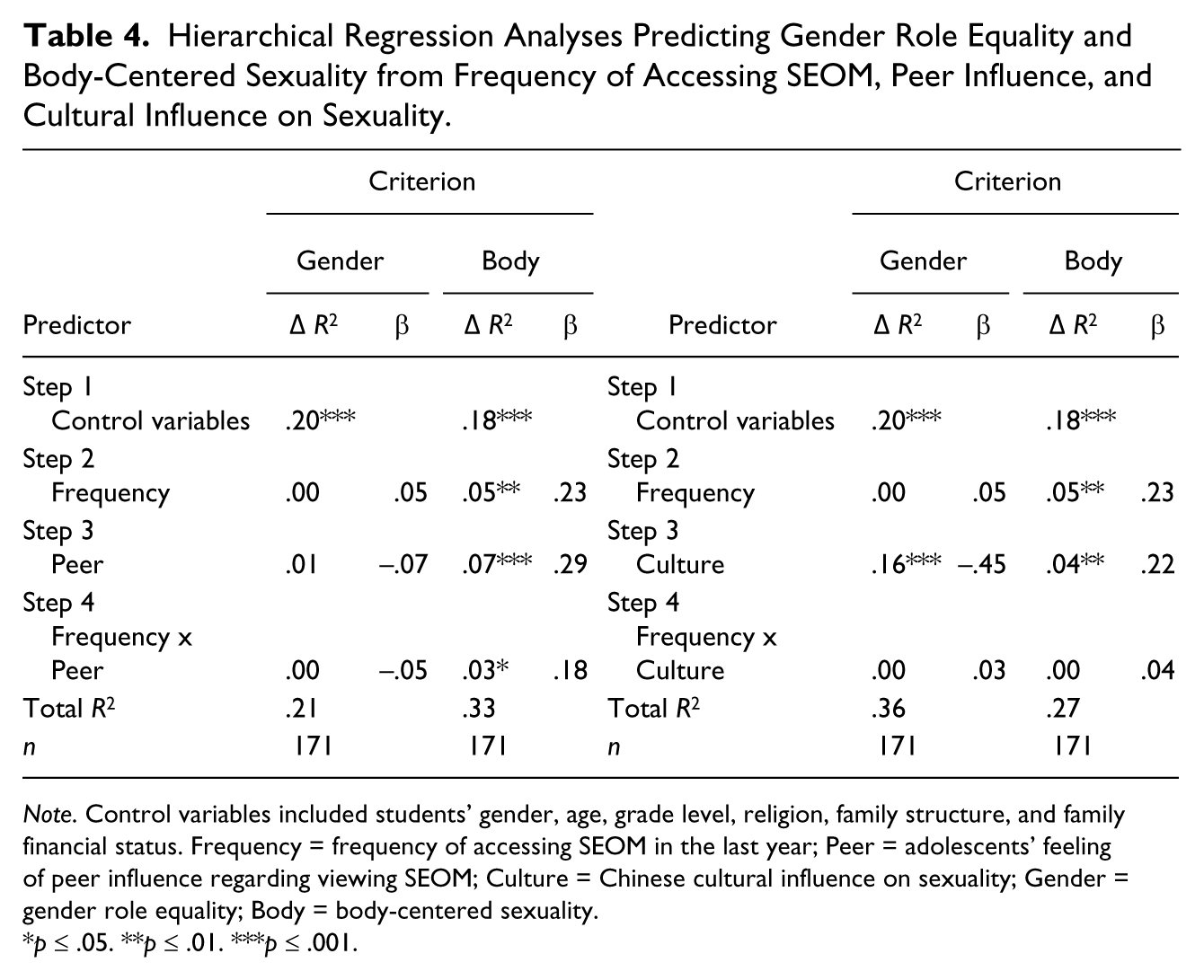
Note. Control variables included students’ gender, age, grade level, religion, family structure, and family financial status. Frequency = frequency of accessing SEOM in the last year; Peer = adolescents’ feeling of peer influence regarding viewing SEOM; Culture = Chinese cultural influence on sexuality; Gender = gender role equality; Body = body-centered sexuality.
p ≤ .05. **p ≤ .01. ***p ≤ .001.
Discussion and Implications
The findings of this research suggest that adolescents’ frequency of accessing SEOM interact with the individual responses to SEOM, the characteristics of the relationships with family and peers in relation to sexuality, and affect their beliefs about gender role equality and body-centered sexuality. These findings are in line with the results of relevant studies and can open up reflection on and discussion of the interaction effects between Hong Kong adolescents’ exposure to SEOM and the influences of individual, family, and extrafamilial factors. Implications can also be drawn and categorized into the research and practice domains.
Emphasizing the linkages between the individual, interpersonal, and cultural factors, the ecological perspective perceives that young people’s sexual attitudes and behaviors are made up of transactions between their exposure to sexually explicit materials and their individual, interpersonal, and cultural experiences (Jordan, 2004). The ecological perspective can offer a framework from which the effects of those transactions can be studied; however, as this perspective remains at a level of abstraction, it needs empirical data for guiding researchers and practitioners to explain and predict the effects. The premise of our research is not only illustrating the ecological perspective but also extracting different interaction effects among the variables and showing how these variables work together. On the individual level, the results show that adolescents’ frequency of accessing SEOM interact with their intrapersonal responses and affect their beliefs about body-centered sexuality. On the interpersonal level, the findings indicate that there are significant interaction effects between the frequency of accessing SEOM and adolescents’ communication with their parents about sexuality as well as their feelings of peer pressure. On the cultural level, even though the findings do not support the interaction effect, there are significant main effects of the cultural impact on adolescents’ perceptions of gender role equality and body-centered sexuality. While the influences of the individual, interpersonal, and cultural factors are varied in terms of degree and path of their effects, the results can partially verify and elaborate on the ecological perspective on the basis of empirical data. They can also help to fill part of the knowledge gap by demonstrating the ways in which the ecological contexts amplify or mitigate the impact of SEOM on adolescents’ sexual development.
The results of the present study echo the previous exploration of the interaction effect between adolescents’ frequency of viewing sexually explicit materials and their personal reactions to those materials on their sexual attitudes through hierarchal regression analyses (e.g., Glascock, 2005; Lo & Wei, 2005; Peter & Valkenburg, 2006, 2007; To et al., 2012). The current results imply that the relationship between frequency of exposure to SEOM and beliefs about body-centered sexuality could be stronger for adolescents who have more active and affirmative reactions to SEOM. In other words, adolescents’ individual responses to SEOM can pave the way to positive or negative consequences. In prevention and intervention, practitioners can play a more active role in enhancing adolescents’ awareness to reflect on how they are subject to the impact of SEOM and how they can make self-directed changes. Nevertheless, no support can be found for the main effect and interaction effect of the frequency of exposure and individual reactions to SEOM on adolescents’ conception of gender role equality, which are inconsistent with the results of other studies that indicate that frequent exposure to SEOM may reinforce a biased categorization of gender roles (e.g., Peter & Valkenburg, 2007). It can be argued that the interpersonal and sociocultural factors may be more influential than intrapersonal factors in explaining and predicting the ways in which adolescents’ perceptions of gender roles are shaped.
There have been controversies about the role of parent–child communication on adolescent sexual development. On one hand, recent studies have suggested that parent–child communication about sex-related issues could reduce the likelihood of youth engagement in premarital sexual relationships and increase safer sexual health practices (Aspy et al., 2007; Miller et al., 1998). On the other, some studies indicate that the differences of the outcomes regarding adolescent sexuality may be affected by the quantity and quality of the communication between adolescents and their parents (Miller, Forehand, & Kotchick, 1999). Unlike the findings of previous research, adolescents’ communication with parents about sex was found to have no main effect on their conceptions of gender and sexuality in the present study. Nevertheless, the findings indicate the interaction effect between the frequency and parent–child communication on gender role equality and body-centered sexuality. More interestingly, while the findings show the negative interaction effect between the frequency of accessing SEOM and parent–child communication on adolescents’ perception of gender role equality, a positive interaction effect between the frequency of accessing SEOM and parent–child communication can be found on adolescents’ perception of body-centered sexuality. It can be contended that the current findings correspond to previous research on both positive and negative impacts of parent–child communication. Although the present study elicited mixed results, it demonstrated that adolescents’ communication with their parents about sexuality has an indirect effect on SEOM exposure; therefore, practitioners should expand their focus of intervention on parent–adolescent communication about prevention of possible negative influence from SEOM on adolescents. This is particularly important in Chinese societies because sex is commonly viewed as taboo in Chinese culture; adolescents are not used to discussing the related topics with their parents (To & Chu, 2009). It could be beneficial for parents to equip themselves with knowledge and skills in initiating conversations with their children about their involvement and even struggles in SEOM.
Being accepted by peers is a psychological need of adolescents, yet such need may exert a profound influence on their sexual behaviors, a fact that has been supported by numerous studies (Ali & Dwyer, 2011; Lam & Chan, 2007; Santor et al., 2000). These studies suggest that while experiencing a sense of belonging in a peer group, adolescents may also have feelings of being pressed and encouraged by others to engage in sex-related activities. The findings of the present study support this proposition by showing that adolescents’ susceptibility to peer pressure is associated with SEOM exposure. Furthermore, both direct and interaction effects on adolescents’ conception of sexuality indicate that susceptibility to peer pressure adds and amplifies the effect of the frequency of accessing SEOM. This study not only lends support to previous literature but it also elaborates on the literature by demonstrating how both main and interaction effects take place in a peer group context. As the findings indicate that peer pressure has a significant impact on the sexual attitudes of adolescents who are exposed to SEOM, relevant programs should enhance adolescents’ awareness of how they are subject to peer pressure and how they can react to it. Intervention and education strategies that acknowledge peer effects should also involve the fostering of positive peer support and learning. Group approaches can help establish a group atmosphere of trust, respect, and understanding so that the participants are willing and ready to share with other group members about their struggles in getting involved in SEOM. They can help adolescents fulfill the need for belonging but at the same time facilitating them to make their own choices with the support of other group members. This can be regarded as an effective buffer against undesirable peer influence.
Much of our contemporary knowledge about adolescents’ exposure to SEOM is embedded in Western academic works, which provide valuable reference materials for local research and practice. However, little attempt has been made to explore the interaction effect between Chinese adolescents’ access of SEOM and the influence of Chinese culture regarding sexuality. This is a notable omission because intrapersonal and interpersonal processes draw heavily on cultural scenarios, which provide the instructional guides for human behavior in subtle ways. Although the findings of the present study do not support the interaction effect of Chinese culture, it was found to have strong main effects on adolescents’ conceptions of gender role equality and body-centered sexuality. They are consistent with the results of existing research on the influence of Chinese traditional beliefs on adolescents’ gender identity constitution and sexual development (Cheung, 1996; To & Chu, 2009; To et al., 2012). They reflect that many adolescents still believe in the portrayal of “feminine” virtues of passivity and submission and “masculine” traits of dominance and aggression in Chinese culture. While pornographic materials often construct women as inferior objects that should fulfill men’s sexual needs, the main effects of both SEOM exposure and gender-biased messages conveyed in Chinese cultural beliefs may exert considerable influences on adolescent sexual socialization. The impact is conspicuous not only on young males but also on young females, since young females have been found to have adopted a silent and passive role in sexual relationships (To et al., 2012). Recognizing that both males and females are being raised in a culture where gender roles are culturally categorized, gender-sensitivity should thus become an essential consideration in sexuality education and intervention.
Limitations of the Study and Future Research Directions
As this research is a first attempt to examine the effects of the individual, familial, and extrafamilial factors on the conceptions of gender and sexuality among Hong Kong adolescents who are exposed to SEOM, several limitations should be taken into consideration. First, even though thoughtful criteria were set during sampling in this study, since our sample was not probabilistic, it is questionable whether the findings can truly represent the target group of the study. However, due to the sensitive subject of exposure to SEOM, it has been observed that the use of nonprobability sampling methods is common in studies conducted in Hong Kong and overseas countries (e.g., Cooper et al., 1999; Lam & Chan, 2007; Peter & Valkenburg, 2006, 2007; Shaughnessy, Byers, & Walsh, 2011). Second, although the cross-sectional design of this research cannot rule out other possible explanations and rigorously demonstrate the causal effects, the same concern has been addressed in related research studies (e.g., Lam & Chan, 2007; Lo & Wei, 2005; Mesch, 2009; Peter & Valkenburg, 2006). Third, a “third-person effect” may exist in relevant studies, referring to a strong tendency of adolescents to underestimate the negative influence SEOM has on them (Lo & Wei, 2002). This problem has been tackled in the data collection process by emphasizing that the data would be kept strictly confidential. Furthermore, more neutral indicators, namely, gender-role equality and body-centered sexuality, have been used to assess the impact of exposure to SEOM instead of sensitive indicators, such as sexually permissive behavior (Lo & Wei, 2005), sexual aggression (Ybarra & Mitchell, 2005), and sexual harassment proclivity (Lam & Chan, 2007).
Regarding future research directions, it is worthwhile to examine the impact of the degree of parent–child communication with fathers and mothers separately on adolescents’ conceptions of gender role equality and body-centered sexuality (Feldman & Rosenthal, 2000). In addition, the interaction effect between adolescents’ frequency of accessing SEOM and their attachment to school can be explored (Mesch, 2009). Last, but not least, this article focuses on testing the hypotheses about the predictive qualities of adolescents’ frequency of accessing SEOM, their intrapersonal reactions to SEOM, their communication with parents about sexuality, their susceptibility to peer pressure, and their acceptance of Chinese cultural beliefs regarding sex roles, which leaves an investigation of other potential mechanisms that generate these predictions. Future research should be conducted using a longitudinal design, random sampling, and multiple respondents.
Conclusion
Based on a survey study of Hong Kong high school students’ exposure to SEOM, their intrapersonal, interpersonal, and cultural experiences, and their conceptions of gender and sexuality, this article demonstrates how the ecological perspective provides a frame of reference in which to examine the interaction effects of various psychosocial correlates. Supported by the results of this research, the ecological perspective can offer a theoretical framework for the provision of sexuality education (Colpin, 2006). Youth workers and sex education practitioners should pay attention to individual adolescents and their surrounding social systems as well as the reciprocal relationship between them. They should also address the individual, peer group, family, school, community, society, and cultural levels of assessment and intervention to create a constructive environment for the sexual development of young people.
Footnotes
Declaration of Conflicting Interests
The author(s) declared no potential conflicts of interest with respect to the research, authorship, and/or publication of this article.
Funding
The author(s) disclosed receipt of the following financial support for the research, authorship, and/or publication of this article: The research was supported by the Direct Grant for Research, Social Science Panel and the Madam Tan Jen Chiu Fund, Department of Social Work, The Chinese University of Hong Kong.