




Abstract
This study evaluates the Youth Development Program (YDP), a component of the federal Workforce Investment Act (WIA). We examine whether the YDP reduced dropout rates among youth in secondary schools in seven school districts in the impoverished Mississippi River Delta in southeast Arkansas. Initially, the program seems to have an impact. Students who participate in the program are less likely to drop out of school than students in a comparison group. However, when other factors are taken into consideration, such as whether the student was “over-age” for their grade (and thus likely had been “held back”), the effect that program participation had on the likelihood of dropping out disappears. In short, we find that when controlling for other factors, no statistically significant relationship exists between program participation and dropout rates. We discuss the implications of the WIA’s YDP failure and school retention programs, more broadly.
Keywords
Introduction
We examine the effectiveness of a program aimed at preventing at-risk students from dropping out of high school in a particularly impoverished part of Arkansas (Jolliffe, 2004; Parry & Schreckhise, 2002; U.S. Census Bureau, 2009). This Youth Development Program (YDP) employed components of social cognitive theory (SCT), which views human behavior as the product of the interactions between an individual’s environmental, cognitive, and personal factors. The tenets of the YDP program stress self-efficacy, with the assumption that at-risk students having increased self-efficacy will be less likely to drop out of school. The program goes beyond what others have done by stressing mentor–mentee relationships. As the mentor requires mentee goals to be task-specific and situational, the individual’s self-efficacy is increased and internalized (Bandura, 1986, 1989; Schunk, 1999). Consequently, mentees with these higher levels of self-efficacy are more likely to set larger goals. Those goals can then be achieved through the strategies and skills, which serve the individual during difficult time periods in their academic careers, and ultimately reduce the likelihood that they will drop out of school (Pajares, 1996).
Our study adds to a considerable amount of research that examines the ability of high school retention programs to combat dropout rates (e.g., Dynarski & Gleason, 2002; Dynarski, Gleason, Rangarajan, & Wood, 1998; Reyes & Jason, 1991). The literature illustrates that successful programs contain elements that combine early intervention, instruction while counseling, tutoring, student engagement, and motivated learning. These are key components of intervention programs manifesting SCT. Even though the YDP was not a consciously designed SCT program per se, it was inspired by the same elements that inspired SCT, such as a desire to not only give children the ability to do better in school, but to provide them with the tools to shape their environment. Environmental conditions and a student’s reaction to them have an impact on the probability that a student will stay in school. If a student is given the tools to cope with a disadvantaged environment—such as positive role models, relationships with mentors, and a positive sense of self-efficacy—might they be less likely to leave school?
Our study also explores the impact that grade retention (i.e., being “held back” in grade) has on the likelihood students will eventually graduate from high school. A considerable amount of research has documented that grade retention has a serious long-term negative impact on a student’s academic career (Jimerson, 1999; Jimerson, Egeland, Sroufe, & Carlson, 2000; Shepard & Smith, 1990; Zill, Loomis, & West, 1997). In fact, this line of research has revealed that nonretained, low-achieving students graduate at higher rates than similar retained students, with similar characteristics, such as their prior levels of academic achievement, suggesting retention has an independent, negative impact on students. Ultimately, we find any potential benefits the YDP has to offer to individuals enrolled in the program are likely to be outweighed by the negative, long-term consequences they face as a result of having suffered past grade retention.
In what follows, we examine past studies examining school retention programs, with an eye to SCT. We then examine whether the Workforce Investment Act (WIA)’s YDP, a program inspired by the tenets of SCT, is in fact, effective in ensuring that kids stay in school.
Effectiveness of Dropout Prevention Programs
An at-risk student dropping out of school may not be a foregone conclusion. Indeed, a number of school retention programs have been developed to avoid this from happening. While great variations in program content, size, goals, and research design prevent simple answers to the question of whether these programs are effective, prior school retention program evaluation studies related to dropout prevention indicate positive effects, in only a few areas. Past evaluation research in examining secondary school dropout is fairly extensive (Christenson & Thurlow, 2004; Dynarski & Gleason, 2002; Dynarski et al., 1998; Fashola & Slavin, 1998; Jang, 2002; Larrivee & Bourque, 1991; McCall, 2003; O’Donnell, Michalak, & Ames, 1997; Reyes & Jason, 1991; Somers, Owens, & Piliawsky, 2009; Somers & Piliawsky, 2004). Generally speaking, these studies suggest that programs that focus primarily on tutoring and instruction have limited to no effect on dropout rates (Christenson & Thurlow, 2004; Dynarski & Gleason, 2002; Dynarski et al., 1998; Reyes & Jason, 1991; Somers et al., 2009).
Counseling combined with academic instruction is effective in reducing dropout rates according to Somers and Piliawsky (2004). They found that programs featuring tutoring and counseling, for 2 hours each day after school, had higher retention rates as compared with those of the control group. When looking at the specifics of the counseling and instruction, Lauer et al. (2006) found that academic assistance and counseling should include individualized attention, tutoring, and mentoring, particularly in the areas of reading and math (Christenson & Thurlow, 2004).
Student engagement is another critical component found in successful dropout prevention programs (Christenson & Thurlow, 2004; Finn, 1989; Perna, 2002; Rumberger, 1987; Somers et al., 2009; Suh & Suh, 2007). Student engagement has a number of features. One feature of student engagement is the development of an expectation, by an at-risk youth, to attend school the next year (Finn, 1989; Rumberger, 1987; Suh & Suh, 2007). Another feature of student engagement was illustrated in a study of 1,800 at-risk youth by Finn and Rock (1997), who found that successful youth had measurably higher levels of self-esteem and were more engaged in the academic process. In their study, Somers et al. (2009) found that successful intervention programs employed strategies that drew connections between school and employment. Christenson and Thurlow (2004) stated that the most effective intervention programs were designed to address indicators of student engagement, such as enthusiasm for school and motivation to learn.
SCT
SCT is a theoretical model that provides useful insight into the way that learning occurs. SCT is a model of human development that posits development is not a monolithic process, but instead human development is characterized by many different types and patterns of changes (Bandura, 1989). Individuals therefore have varying social practices that produce differences in capabilities. Central to SCT is the triadic model of reciprocal determinism (Bandura, 1989). Triadic reciprocal determinism views human behavior as an interaction among environmental, cognitive, and personal factors that all act as interacting determinants influencing each other bidirectionally (Bandura, 1986, 1989). Youth, therefore, are not merely products of their environment; they are also the producers of it. This interplay among personal, behavioral, and environmental factors is central to learning and cognition.
A key component of learned behavior centers on the concept of self-efficacy. Self-efficacy is an individual’s self-perception of competence that directly impacts motivation (Pajares, 1996). The development of a youth’s efficacy generally requires goals that are task-specific and situational (Bandura, 1986, 1989). Consequently, individuals with high levels of self-efficacy are more likely to set larger goals for themselves and develop strategies to acquire skills and knowledge (Pajares, 1996). The knowledge and skills acquired serve youth during difficult time periods in their academic careers and reduce the likelihood they will drop out (Pajares, 1996). Schunk (1999) also found that in the early stages of learning, social influences are dominant. A child will internalize skills and strategies learned via modeling to enhance academic achievement.
Few program evaluation studies exist that examine the impact of SCT-orientated programs on school retention rates. However, studies that have used SCT as a framework for analysis offer clues regarding the impact an SCT-inspired program might have on retention rates. Herman McCall (2003) explored the factors that led alternative education participants to drop out of school. By comparing 16 in-school youth to 16 youth who had dropped out of school, McCall found that positive teacher–student relationships and personalized attention for the students were key indicators that kept students from dropping out. This is consistent with the social cognitive framework that youth learn through imitation and modeling (Bandura, 1986, 1989). Jang (2002) also used SCT as an underlying model in his evaluation of the determinants of delinquent behavior in adolescent youth. His findings suggested that dropout prevention programs that focused on youth relationships with family, school, and peer relationships that also promoted social cognitive ability had an increase likelihood of keeping youth in school.
The At-Risk Youth Program in the Arkansas Delta
Operating within the Arkansas Delta, the WIA Title I-B At-Risk Youth Program provides services to at-risk youth ages 14 to 21 years. The WIA is a Clinton-era federal law designed to integrate the best aspects of private sector efficiency with public sector innovation. Within the framework created by the WIA, governmental agencies determined dropout prevention policies and nongovernmental contract service entities’ implemented dropout prevention services to at-risk youth. In southeast Arkansas, the Southeast Arkansas Economic Development District was the state agency that determined dropout prevention policy and the YDP was one of the nongovernmental, contract service entities that implemented dropout prevention services. Those services consisted of the development of study skills, homework skills, mentoring, tutoring, instruction on how to conduct themselves within a professional environment, along with counseling and support. Services were provided by counselors, on-site, at high schools, and off-site, at specific locations, across the three counties that form the basis for this evaluation.
At-risk youth were defined as individuals who had at least one of the following characteristics: possessed a deficiency in basic literacy skills, dropped out of school, was homeless, a runaway, a foster child, currently pregnant or a parenting teen, or a criminal offender. At-risk youth services were provided by the YDP to in-school youth ages 14 to 21 years of age and out-of-school youth ages 16 to 21. The in-school youth were subdivided into youth, ages 14 to 18, and older youth, ages 18 to 21. Differing strategies were designed to address the challenges that individuals of each group faced. For at-risk youth who faced the danger of dropping out, the YDP administered the program elements designed to educate, train, and retain. Older youth, no longer in secondary school, were assisted by the YDP in finding employment or training.
There are 10 program elements that the YDP implemented under WIA. The program elements consisted of the following: tutoring, alternative secondary school services, summer employment, paid and unpaid work experiences, occupational skill training, leadership development, supportive services, adult mentoring, follow-up services, and comprehensive guidance counseling. In the seven school districts that are the subject of this evaluation, the YDP, working in concert with the Southeast Arkansas Economic Development District, was responsible for providing the services outlined in the 10 program elements. The following is a brief discussion of each of these 10 program elements (Callahan & Massey, n.d.; Wagner, Sturko-Grossman, Wonacott, & Jackson, 2007).
Tutoring and study skills training—This element is designed to provide instruction to improve academic knowledge and the skills of youth in specific areas. The study skills component is designed to improve a youth’s ability to learn by studying independently. These coupled with dropout prevention strategies provided by the contract service provider are intended to keep youth in secondary school until graduation.
Alternative secondary schools services—The statute mandates curriculum services, either inside or outside of the public school system, for at-risk youth with behavioral problems or mental disabilities.
Summer employment opportunities—Local workforce investment boards are required under the statute to provide summer employment opportunities as part of a strategy to address an at-risk youth’s employment and training needs.
Paid and unpaid employment—Work experiences are short-term structured learning experiences that occur in a workplace that fosters work development and career exploration. Work experiences may be paid or unpaid, either in the private, public, or nonprofit sectors.
Occupational skill training—This consists of an organized program of study providing vocational skills that lead to proficiency in performing work-related tasks. A key component of occupational skill training is that training must result in attainment of a certificate or credential.
Leadership development—This consists of exposing at-youth to community service opportunities and life skills training. Life skills training could include parenting, work-behavior, budgeting, mentoring and tutoring, organizational training, prioritizing, and citizenship training.
Supportive services—Under the statute these services may include transportation, child care, or other services to allow at-risk youth to participate in the At-Risk Youth Program.
Adult mentoring—The service provider, through the use of trained staff and program counselors, provide positive role models for at-risk youth by adults.
Follow-up services—Service providers monitor participants after they complete secondary school, during their transition to employment, or continued education.
Comprehensive guidance counseling—Service providers assist youth in making and implementing educational and occupational life choices that impact their development in a positive way.
Program Elements 1, 2, 5, and 6 relate to the triadic relationship expressed within the SCT framework. These program elements impact the youth’s cognitive skill development through social interaction and engagement and tutoring. Particularly noteworthy is that Program Element 8 involves adult mentoring, wherein youth in the program meet weekly with adult mentors who provide nonacademic counseling and encouragement. Mentors build a rapport with participants; inquiring about their outside learning environment, peer group, and family. The Program Elements 3 and 4 impact the youth’s cognitive skill ability through occupationally related environmental influences. By placing the youth in either paid or unpaid summer employment, the youths learn to model prosocial behavior increasing their self-efficacy and reducing the risk of dropping out.
Although much of the school retention program evaluation literature suggests, little can be done to improve dropout rates; empirical studies using SCT as the theoretical framework offer hope that retention rates can be improved. Thus, this evaluation will be the first to test this premise. An empirical test follows the At-Risk Youth Component of the WIA, a program using SCT.
Data and Method
The seven school districts examined in this study had a total population of 20,471 students in Grades 9 through 12 from 2006 to 2008. The 2006-2008 program years were selected due to the availability of empirical data derived from the Arkansas Research Service and access to individual-level treatment youth data obtained from the YDP. Because there have been multiple contract service providers since the implementation of WIA youth services, in the school districts that are the subject of this study, we could only obtain a complete individual-level treatment data set for program years after 2005.
Treatment Group
The treatment group consisted of youth who were receiving WIA-related services, 1 during the period from 2006 to 2008. The population size of the treatment group consisted of the entire population of the YDP program participants for the 2006 to 2008 program years, in the seven school districts. The population of the treatment group was 125 individuals. WIA program administrators identified participants via an application process in which prospective youth filled out application material. The youths completed a Test of Adult Basic Education (TABE) examination which measures basic skills of achievement in reading, language, mathematics and spelling. Ninety-five percent of program participants were considered economically disadvantaged. Because of a limited number of slots available, not all youth who completed the application process were placed in the WIA youth program. Youth selection was left to the discretion of the program administrator. 2
Comparison Group
The comparison group was composed of 338 youths who did not receive WIA-related services. The group consisted of a random 2% sample derived from the total population of youth Grades 9 through 12 who attended the seven school districts from 2006 to 2008. Each youth in the comparison group completed one of two exams in their ninth grade year. Students in their ninth grade year, prior to 2008, took the Iowa Test of Basic Skills (ITBS), which measures student’s abilities in math and literature. Those students in their ninth grade year, in 2008 took the Stanford Achievement Test Series Tenth Edition (SAT-10), which measures competencies in literature, math, and reading.
Dependent Variable
The dependent variable is dichotomous and indicates whether the student was still enrolled at their school, at the end of the academic year for the particular year in question. Students who transferred to another school or who left school to enroll in a GED (i.e., a high school equivalency diploma) program were treated as still enrolled; students who were expelled, or who left school, because of lack of interest, were treated as having dropped out.
Independent Variables
The primary independent variable is dichotomous indicating whether the individual student participated in the WIA Youth Program. We also include several demographic variables that have been found to have a link with the risk of dropping out. In particular, past research has found boys are more likely to drop out of school than girls (Alexander, Entwisle, & Horsey, 1997; Kleinfeld, 2009; Lagana, 2004; Marjoribanks, 2002); African American students are more likely to drop out than White students (Brown et al., 2003; McCall, 2003), while younger high school students are more likely to drop out than high school seniors (Sterns & Glennie, 2006).
Included in the analysis was a variable constructed from student performance test scores, called P-Score. We included this variable to take into account the inherent scholastic abilities of the students, because students frequently drop out for academic reasons (Alexander, Entwisle, & Kabbani, 2001; Sterns & Glennie, 2006; see also Hickman & Wright, 2011). Because participation in the program is voluntary, and because contract service providers determine the eligibility of applicants to the program, it is possible that WIA participation suffers from selection bias (Rossi, Lipsey, & Freeman, 2004). At-risk youth who participated in the WIA program could have been inherently different from those who had not participated in the WIA program. The testing metric for both the treatment and comparison groups sought to identify whether selection bias had occurred. Three tests were used in the model to measure youth performance and control for selection bias. Those tests were the TABE, the ITBS, and the SAT-10. For the three tests used to assess performance, test outputs were converted to a grade-level equivalence value.
Youth in the treatment group were tested by the YDP upon entry into the program to assess their basic skills in reading and math. The TABE was used for this assessment and provided a grade-level equivalence measure for youth participants. This grade-level equivalence score was used by the YDP as an assessment tool to help determine what services were needed for at-risk youth. The TABE grade-level equivalence scores were obtained from the YDP for the at-risk youth participants that comprised the treatment group for the 2006 to 2008 program years.
There were three examination score formats that were used to analyze the performance data in this study. These formats were National Percentile Rank (NPR), scaled scores, (SS), and Grade-Level Equivalency scores (GE). The NPR score compared the achievement of a student or a group of students to the achievement of a national sample of students who were in the same grade and who were tested at the same time of the year. According to the Arkansas Research Center, a division of the Arkansas Department of Education, the NPR can be used as a consistent measure of performance regardless of the test source (G. Holland, personal communication, March 15, 2010). As both SAT-10 and ITBS had an NPR performance output, we were able to convert ITBS scores to their SAT-10 SS equivalent. 3
The constructed performance indicator was created according to the following equation:
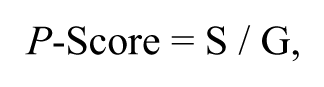
where P-Score stands for performance outcome indicator, S represents grade equivalency score, and G represents grade level.
Also included in the analyses is a measure of whether or not the student is in a grade that would be typical for a student of that age, called Over-Age for Grade (OAFG). Jimerson (1999) asserted that studies linking retention with a student later dropping out of high school “consistently have demonstrated that students who are retained are more likely to dropout prior to graduation than students who are not retained” (Jimerson, 1999, p. 247). Shepard and Smith (1990) found that high school dropouts were 5 times more likely than high school graduates to have been retained at some point in their education (Shepard & Smith, 1990). In fact, this line of research has revealed that nonretained low-achieving students graduate at higher rates than similar retained students with similar characteristics, such as their levels of achievement and parents’ socioeconomic status, suggesting retention has an independent, negative impact on students (Abidin, Golladay, & Howerton, 1971; Jimerson, 1999; Jimerson et al., 2000; Zill et al., 1997;). Because individual-level data on grade retention was not available to us, we used a proxy measure instead. In our study, if a student is 18 years old or younger and in the 12th grade, or 17 years old or younger in the 11th grade, and so on, they were treated as not being OAFG; if they were older than what is the generally accepted age for that grade, we can assume they were “held back” at some point in their previous academic careers and at greater risk for dropping out of school.
Results
Descriptive Results
The demographic breakdown of the two groups is presented in Table 1. Both the treatment and comparison groups have comparable gender distribution with roughly half of each gender in each group. The treatment group tends to be in higher grades; more than half of the members of the treatment group (52%) are in the 12th grade compared with only 13% of the comparison group. Despite this, the median age of both groups is 17 years. Asians and Native Americans are not well-represented in either group, with only 1.5% of the comparison and none of the members of the treatment group being Asian; none of the members of either group were Native American.
Demographic Characteristics of Treatment and Comparison Groups.
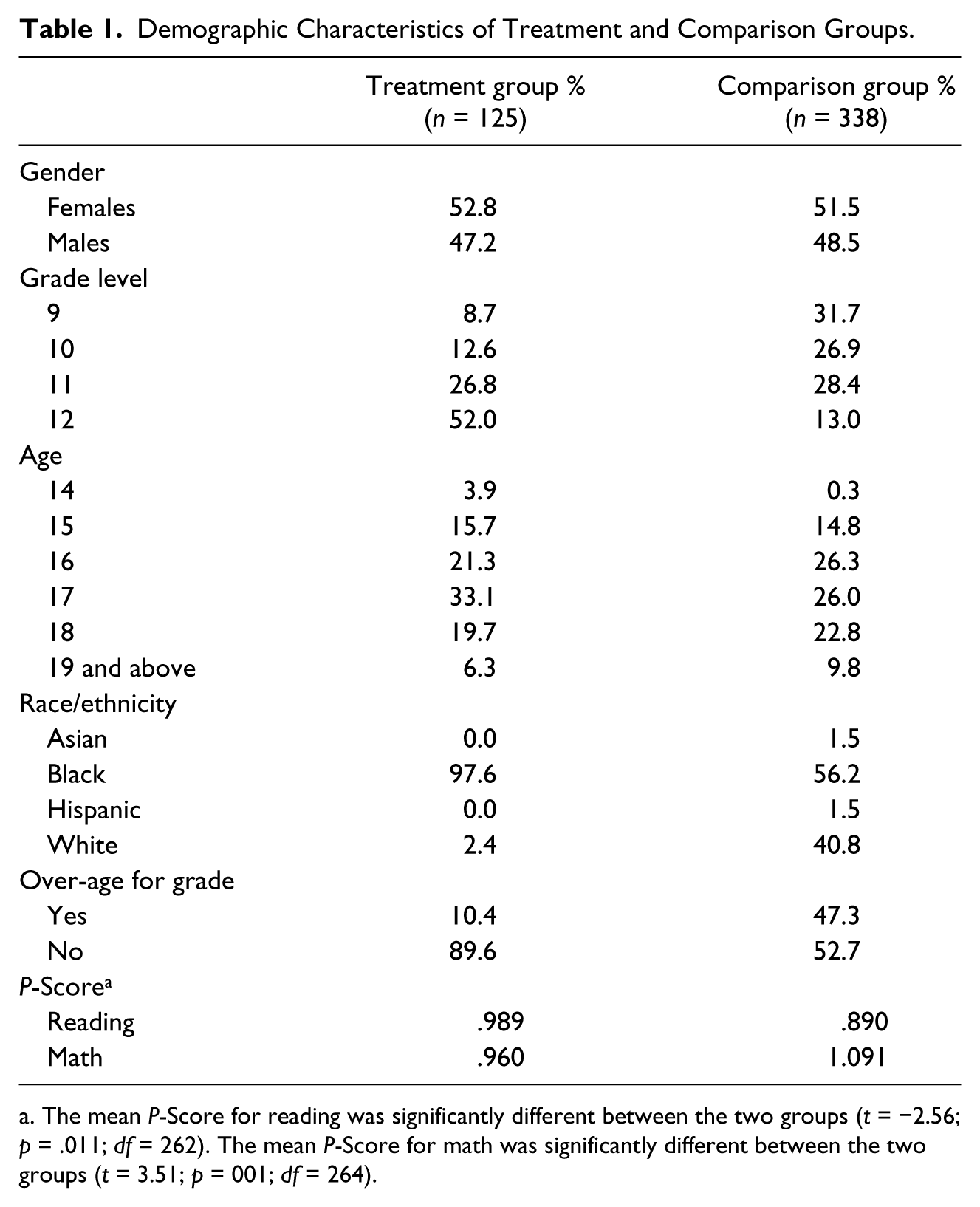
The mean P-Score for reading was significantly different between the two groups (t = −2.56; p = .011; df = 262). The mean P-Score for math was significantly different between the two groups (t = 3.51; p = 001; df = 264).
Also included in Table 1 are breakdowns for whether students in each group are in a grade level that is appropriate for the individual’s age (OAFG), which indicates whether the student had been “held back” at some point in their prior academic career. Interestingly, only 10% of the WIA students were in a grade that was not appropriate for their age, while roughly half (47%) of the comparison group students were not in an age-appropriate grade. Also included in Table 1 are the mean grade equivalent test scores for both groups in reading and math; the WIA students scored higher on reading and the comparison group scored higher on math.
Analytic Results
To what extent is the WIA effective in retaining students? Table 2 presents the overall dropout rate for both groups, broken down by other demographic categories. At first glance, it appears the WIA program is successful in retaining students with only 5.5% of WIA students dropping out, compared with 8.6% of the comparison group students leaving school. Furthermore, across nearly all demographic categories presented, WIA students were less likely than their comparison group counterparts to drop out: male and female WIA students were less likely to drop out, as were Black and White students, as were just about students of all ages with the exception of 17-year-old WIA students being more likely to drop out of school than 17-year-old comparison group members. The Pearson chi-square value reflecting the differences in the distributions between the dropout rates of the treatment group and the comparison group did not reach standard levels of statistical significance (χ2 = 1.13; df = 1; p = .288). In addition, none of the Pearson’s chi-square values reflecting the differences between the treatment group and comparison group for each demographic category reached standard levels of statistical significance. That is, for example, treatment group males were no more likely to drop out of school than were comparison group males.
Dropout Rates by Program Participation and Demographic Categories.

Although WIA students appear to be more likely to stay in school across demographic categories, what happens when other factors are included in the analysis? That is, what happens when we control for the student’s performance, as measured by test scores, and whether or not the student is in an age-appropriate grade? Table 3 presents the results from three logistic regression models that can answer these questions. The dependent variable is dichotomous with students who dropped out coded as 1 and students who were still enrolled coded as 0. The primary independent variable is whether or not the individual student participated in the WIA Youth Program, which is treated as a dichotomous dummy variable, with the value 1 given to individuals in the program and 0 given to individuals who were in the comparison group. Gender was included also as a dichotomous dummy variable with the value 1 given to males, 0 to females. Because only a few Asian or Native American students were included in the two groups, the variable Race is a dichotomous dummy variable, wherein White students were given the value 0 and Black and Hispanic students were given the value 1.
Logistic Regression Models Predicting Secondary School Dropout.
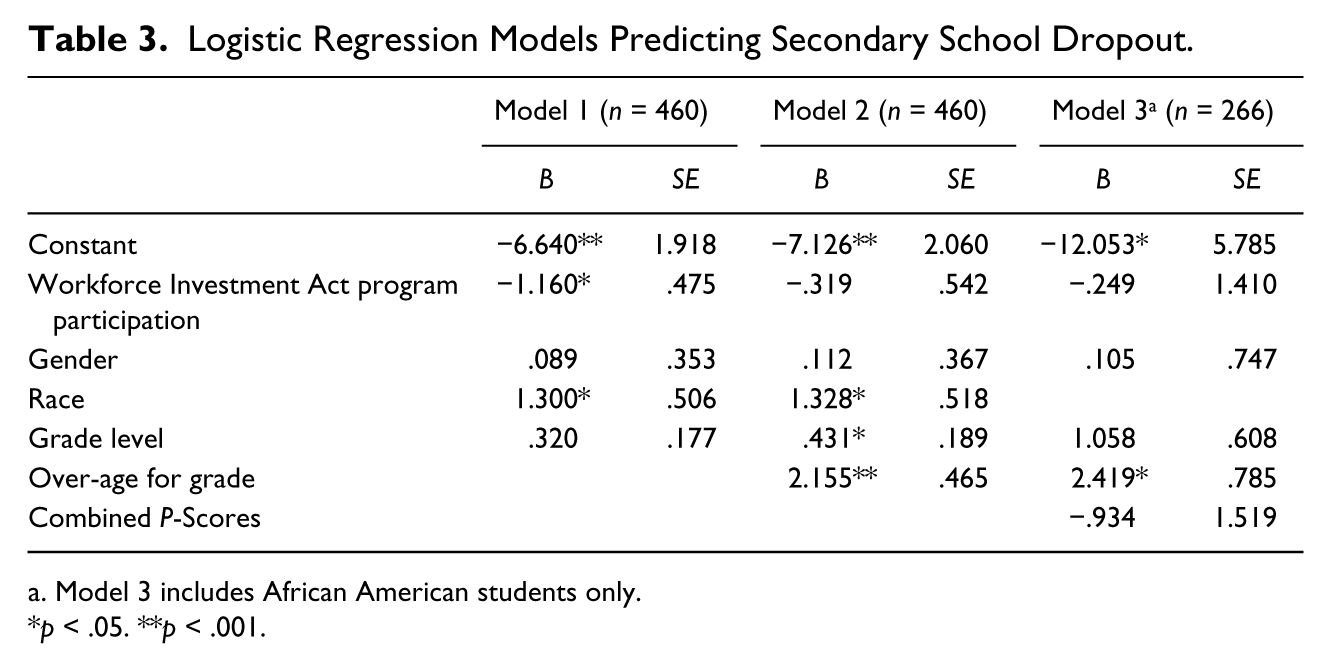
Model 3 includes African American students only.
p < .05. **p < .001.
The first model, which includes basic demographic categories, suggests the WIA program is successful. Controlling for the students’ race, gender, and grade level, it appears that WIA program participation decreases the likelihood a student will drop out of school. However, the second and third models present a slightly different picture. The second model includes a variable indicating whether the student is in an age-appropriate grade. When this variable is included, the variable indicating whether the student participated in the WIA program is no longer significant. Instead, African American students, older students, and students who are OAFG 4 are more likely to leave school, regardless of whether they participated in the WIA program. In Model 3, students’ p values (i.e., their combined grade-adjusted test scores) were included, and again the WIA program participation variable is not significant. It should be noted that Model 3 includes only African American students because none of the WIA students who dropped out were White. This fact, coupled with the fact there were smaller number of cases available in this model because of the limited number of test scores available in the analyses, caused instability in the parameter estimates for the race variable. Nonetheless, the findings point to the importance, once again, of a student being held back in grade as a determining factor for whether the student will eventually drop out of school. These students are more likely to drop out, even when controlling for their scholastic abilities in the form of their P-Scores.
Discussion
The primary aim of this evaluation study was to assess whether the WIA as implemented by the YDP in seven school districts in Southeast Arkansas met program goals and objectives relative to secondary school dropout rate for the 2006-2008 program years. The findings from this study initially indicated that the YDP program participants were less likely to drop out of school. An initial examination of the YDP program suggests the program is indeed a success; in fact our first logit model in Table 3 suggests the YDP is effective in lowering dropout rates, even when controlling for individual demographic variables. However, when we included the variable “Over-Age for Grade,” the relationship between the YDP program participation and secondary school dropout became statistically insignificant and the relationship remained insignificant when we included the students’ test scores. This result suggests that selection bias had occurred during the 2006 to 2008 program years. The selection bias suggested in this study occurred either through participant self-selection or through administrative selection of participants. Simply put, students who were less likely to drop out of school were more likely to enter the YDP program. This is why, in turn, the WIA students seem less likely to drop out.
Limitations and Future Directions
The analyses we present gives a clearer understanding of the impact SCT-inspired programs, such as the YDP, could have on preventing dropout. But the analyses are not without some limits. These include the following:
Selection bias
Not all applicants to the YDP program were admitted. Admission into the YDP was left to the discretion of the program’s personnel. Because those who were admitted to the program could be different from those who were not, a degree of uncertainty is introduced into our analyses. This is because of the possibility that the YDP could be selecting applicants based upon the applicants’ characteristics, which may make them more likely to achieve the program’s goal of completing high school. In fact, Apsler (2009) found the voluntary nature of participation in afterschool programs tend to contribute to selection bias (see also Gottfredson, Cross, & Soule, 2007). However, if this were the case, such “creaming” (see Rossi et al., 2004, pp. 183-185) would not change our findings. Once we took into account the students’ test scores in Model 3, participation in the YDP did not increase the likelihood a student would graduate from high school. If only the most able students were applying—or being admitted by the YDP—they were still no more likely to graduate from high school when other factors were included in the model.
Additional predictors of dropout
A number of other things that are related to dropout were not included in our analysis, simply because we lacked access to the data. These include the students’ early life experiences (Entwisle, Alexander, & Olson, 2005), relationships with their peers (Berndt, 1982), and their own commitment to academic achievement (Rumberger & Thomas, 2000). Any subsequent research of programs like the YDP should, when possible, take these things into account. In addition, we did not examine the characteristics of the schools they attended (see Christle, Jolivette, & Nelson, 2007) and the students’ family’s socioeconomic status (Hill, 1979). It is worth noting, however, the comparison group was drawn from the same schools, in the same largely impoverished region as the YDP participants. Still, measuring the individual-level impact of these variables with any degree of precision is beyond the scope of this line of research. Subsequent research in this area may hopefully fill this void.
Conclusion
Although the WIA’s YDP uses methods found in other studies to have some success in retaining students by including counseling and encouraging student engagement, this program, like all high school retention programs, faces an uphill battle. This is because it is used late in a student’s academic career, the earliest they can enroll in the program being the ninth grade. Much of the more recent literature examining the determinates of a student’s academic success point to things a student experiences much earlier in his academic career as having a significant impact, such as their own abilities, feelings about school, parental involvement and support, and their family’s socioeconomic status when they were younger (Alexander et al., 2001; Entwisle et al., 2005; Pagani et al., 2008). However effective the tenets of the YDP could be in keeping kids in school, this research suggests a child’s decision to drop out of school essentially begins in the elementary school years.
This is not to say that all school retention programs focusing on students in Grades 9 to 12 should be abandoned. They may provide benefits to students beyond the scope of this study, such as potentially increasing the likelihood a student pursues a GED later in life, among other things. But it does suggest that programs that attempt to retain students in school later in life should begin for the student very early in their academic careers.
Footnotes
Declaration of Conflicting Interests
The author(s) declared no potential conflicts of interest with respect to the research, authorship, and/or publication of this article.
Funding
The author(s) received no financial support for the research, authorship, and/or publication of this article.