




Abstract
This study investigates the connection between the reasons why some young people end their education without attaining a university degree and the effect of this decision on the probability of becoming a NEET in a set of European countries. Young people face the highest degree of disadvantage in the Mediterranean and East European countries, whereas in Continental European countries the school-to-work transition is smooth. We use the ad hoc module of the 2016 Labour Force Survey (LFS) and focus on young people aged 15 to 24. Our analysis reveals a positive relationship between the decision to drop out of education for health or family reasons and the probability of becoming a NEET. Conversely, when the reason for not completing university education is the desire to start working, and when the individuals who dropped out of university education gathered work experience during this period, the probability of becoming a NEET decreases significantly.
Introduction
Despite the efforts to create a unique European labor market and reduce socio-economic inequalities, the European Union (EU) member states are characterized by different labor market opportunities. These differences are yet more pronounced when we look at young people and in particular school-to-work transition (STWT) trajectories and levels of youth unemployment (O’Reilly et al., 2018). A useful indicator for assessing the economic and social vulnerability of young people and their labor market participation is the concept of NEETs, which refers to the share of young people
Historically, the Mediterranean and Eastern countries have experienced the highest rates of NEETs, particularly in the context of the economic and financial crisis that unfolded in 2008 (O’Reilly et al., 2018; Tosun et al., 2021). Conversely, the STWT in Continental countries has been smooth and young people do not appear to be disadvantaged in the labor market (Shore & Tosun, 2019; Walther, 2006). The differences in the STWT trajectories between the Continental European countries on the one hand and the Mediterranean and Eastern countries on the other result from the complex interactions of individual, institutional, and structural factors (see, e.g., Pastore, 2018; Pohl & Walther, 2007; Unt & Gebel, 2021).
This study strives to contribute to the literature on STWTs in the EU and takes a particular interest in exploring the potential path for becoming a NEET. More precisely, it focuses on the reasons that lead young people to stop university education and how this decision affects the probability of becoming a NEET in a set of Continental, Eastern, and Mediterranean European countries.
Empirically, this study draws on data originating from an ad hoc module of the Labour Force Survey (LFS), “Young people on the labour market,” which was released in 2016. This data source contains unique information on the educational paths of young people and their labor market experience after leaving education, as well as data on potential explanatory factors such as socio-demographic characteristics (gender, level of education, and degree of urbanization), family background (family size and the parents’ educational attainment levels), and characteristics of the educational system (in relation to the organization of education by levels and specializations).
The analysis concentrates on young people with a low or medium level of education and estimates bivariate Probit models to assess which reasons induce them to leave university and how this decision affects the probability of becoming a NEET in the future. In a second step, we run a non-linear Blinder-Oaxaca decomposition analysis in order to develop a better understanding of how the decision to leave university links with future labor market prospects.
We contribute to the literature in three ways. First, we endogenize the decision to leave university education by differentiating between rural and urban settings, therefore providing a more granular understanding of how young people become NEETs. Second, we conduct a comparative analysis that allows us to control for differing, country-specific contexts. Third, our analysis captures differing contexts within countries in respect of the degree of urbanization and ruralness.
The remainder of this study unfolds as follows. After presenting our theoretical argument, we provide information on the data and the methodological approach. Subsequently, we present the analytical findings and discuss them. In a last step, we summarize our main findings, reflect on this study’s limitations and highlight its contribution to the literature.
Theoretical and Empirical Background
School to Work Transition
STWT and NEETs are the key concepts of this study
In order to cover as many dimensions of the STWT as possible, we define it in a broad manner as the period in which individuals leave the education and training system and find a permanent job. Furthermore, we follow the STWT regimes identified by Walther (2006): the universal STWT regime specific to Nordic countries, the liberal STWT in the UK, the continental STWT in Germany, France, or the Netherlands, and the sub-protective STWT in Italy, Spain, and Portugal.
Walther’s original typology excludes Eastern European countries, the great majority of which has not yet established an STWT regime. There are countries, such as Hungary, whose regimes are closer to the Continental model (see, e.g., Kovarek & Sata, 2021), while others, such as Bulgaria or Romania, have regimes that resemble the sub-protective model (Buttler, 2020). However, the STWT regimes are less consolidated in Eastern European countries and political changes and economic crises have contributed to a certain fluidity of the regimes in place. Given the difficulty to assign the Eastern European countries to a specific STWT regime, this study will contribute to developing an improved understanding of their characteristics.
Our research design covers countries that form relatively homogenous groups with regard to their STWT regimes. We have Austria, Germany, and Switzerland in the sample as representatives of the Continental STWT regime; Italy and Greece have a sub-protective STWT regime in place; and Bulgaria and Romania stand for the “difficult to describe” group of East European countries. By analyzing this set of countries, we are confident that we can develop an improved understanding of the mechanisms that underly the empirical phenomenon of NEETs in different European countries. To this end, we opted for a design choice that facilitates the comparison of countries with high NEETs levels with countries with low NEETs levels.
To select the countries for each STWT regime type, we carried out a cluster analysis with a broader set of countries, which included the Czech Republic, Hungary, and Slovakia for the Eastern European countries, and Portugal and Spain for the Mediterranean countries. The variables selected for cluster analysis were: share of early school leavers, share of tertiary graduates, share of young people with a medium level of education, employment rates for people aged between 15 and 24 years, share of NEETs, ratio between the youth and the adult unemployment rates, fertility rate, and mean age at first child birth. We used the k-means method and repeated the analysis, selecting a different number of country groups as the output. Finally, we chose the groups showing the highest multivariate similarity.
NEETs in Mediterranean, Eastern, and Continental European Countries
Young people become NEETs when the STWT transition fails. It is important to note that NEETs are a highly heterogenous group (De Luca et al., 2020; Mascherini & Ledermaier, 2016; Mascherini et al., 2012a; Yates & Payne, 2006), which makes it rather difficult to reach out to this group with “one size fits all policies” (Shore & Tosun, 2019). This group can comprise women and men, young people with a high level of education and young people without education or with a very low level of schooling. It further comprises young people who for various reasons, such as health or familiar situations, cannot attend school or obtain a job (Furlong, 2006).
Existing research has mostly concentrated on the failure of labor markets and STWT regimes to explain why individuals end up becoming NEETs. Relatively few studies have assessed how the education system defined more narrowly affects NEETs levels (see, e.g., De Luca et al., 2020). Indeed, even if education level is the primary factor affecting the probability of becoming a NEET, the quality and characteristics of the education system should also play a crucial role in determining NEETs levels (Bell & Blanchflower, 2011; Quintini et al., 2007; Zimmermann, 2013). In fact, several variables appear relevant to the relationship between the decision to leave school early and becoming a NEET. These include, first and foremost, family-related characteristics, such as a low socio-economic status, migrant background and male gender, and school-related conditions, such as grade attainment, socio-economic segregation at school and early tracking (see, e.g., Tosun et al., 2021). Furthermore, NEETs are more sensitive to factors linked to the regulation of the labor market, such as the levels of employment protection, minimum wage, active labor market policies, and economic growth (see, e.g., Bacher et al., 2017). The relationship between both labor market policies and economic growth with unemployment levels is complex: High levels of unemployment increase NEET rates but usually reduce the level of early school leavers (ESLs), because in the absence of concrete job opportunities, young people are not encouraged to leave school. The opposite is true for low levels of unemployment (International Labor Organization, 2020).
In 2016, around 11% of young people aged 18 to 24 in the EU were ESLs. Their share ranged from around 5% in Switzerland to 18% in Romania. This high share not only damages a country’s economic potential but has serious social and financial consequences for European societies (Mascherini, Lidia, et al., 2012; Mascherini, Salvatore, et al., 2012). ESLs account for a large share of the NEETs in Europe. The likelihood of ESLs becoming NEETs further increases if combined with other factors that could heighten their vulnerability, such as female gender or migrant status.
In order to quantify young people’s disadvantage in the labor market, it is useful to compare the youth (15–24 years) and the adult (25–64 years) unemployment rates. The ratio between these two rates, namely the youth’s relative disadvantage, shows the highest values in Romania (4.12) and Italy (3.71), against an EU average of 2.46, while the minimum value is in Germany with 1.82. These figures corroborate the common picture that in some European countries, young people leave school and experience a smooth transition, whereas in others they struggle to find a job.
Methodology and Data
Methodology
To assess the effect of (not) completing university education on the probability of becoming a NEET, we proceed in three steps. First, we use basic Probit models to estimate the determinants of the NEET status, that is, the probability of becoming a NEET given a number of covariates capturing personal and contextual characteristics:

where Y* is the probability of being a NEET, X is the set of personal and contextual characteristics and e the erratic component. Y* is a latent variable and denotes whether an individual can be assigned to the binary category of being a NEET or not.
Second, we estimate a series of bivariate Probit models to jointly study the likelihood of discontinuing university education for a specific reason (


where the outcomes are specified as:


Using the bivariate Probit model, we estimate the coefficient of correlation between the two error terms, e1 and e2. When ρ = Corr(e1, e2) is not statistically significant, this means that there is not a significant relationship between the reason for having dropped out of university education and the NEET status. In this case, the log likelihood for the bivariate Probit model is equal to the sum of the log likelihoods of the two univariate Probit models. The bivariate Probit is preferable to the estimation of two separate Probit models since a log likelihood for the bivariate Probit model is different from the sum of the log likelihoods of the two univariate Probit models, indicating a significant link between the two mechanisms. A positive sign of ρ means that a latent variable uniformly affects both the probability of leaving education and of being a NEET. Conversely, when ρ is negative, a latent variable creates “success” on one of the dependent variables and “unsuccess” on the other dependent variable.
Finally, at the third step, we split the sample into two groups, according to the reason for having left education early. The first group (A) contains the individuals who left education for one of the reasons that we consider more connected to being disadvantaged, whereas the second group (B) comprises of all the other individuals. Through Probit models, we estimate the probability of becoming a NEET for groups A and B separately, given the observed characteristics. We decompose the difference in the probability of becoming a NEET into two groups (

The first term at the second member captures the characteristics effect, which measures how much of this difference is due to the observed individual characteristics (

where β* is a weighted average of the coefficient vectors, βA and βB, Ω is a weighted matrix and I an identity matrix (Oaxaca & Ransom, 1994):

Data
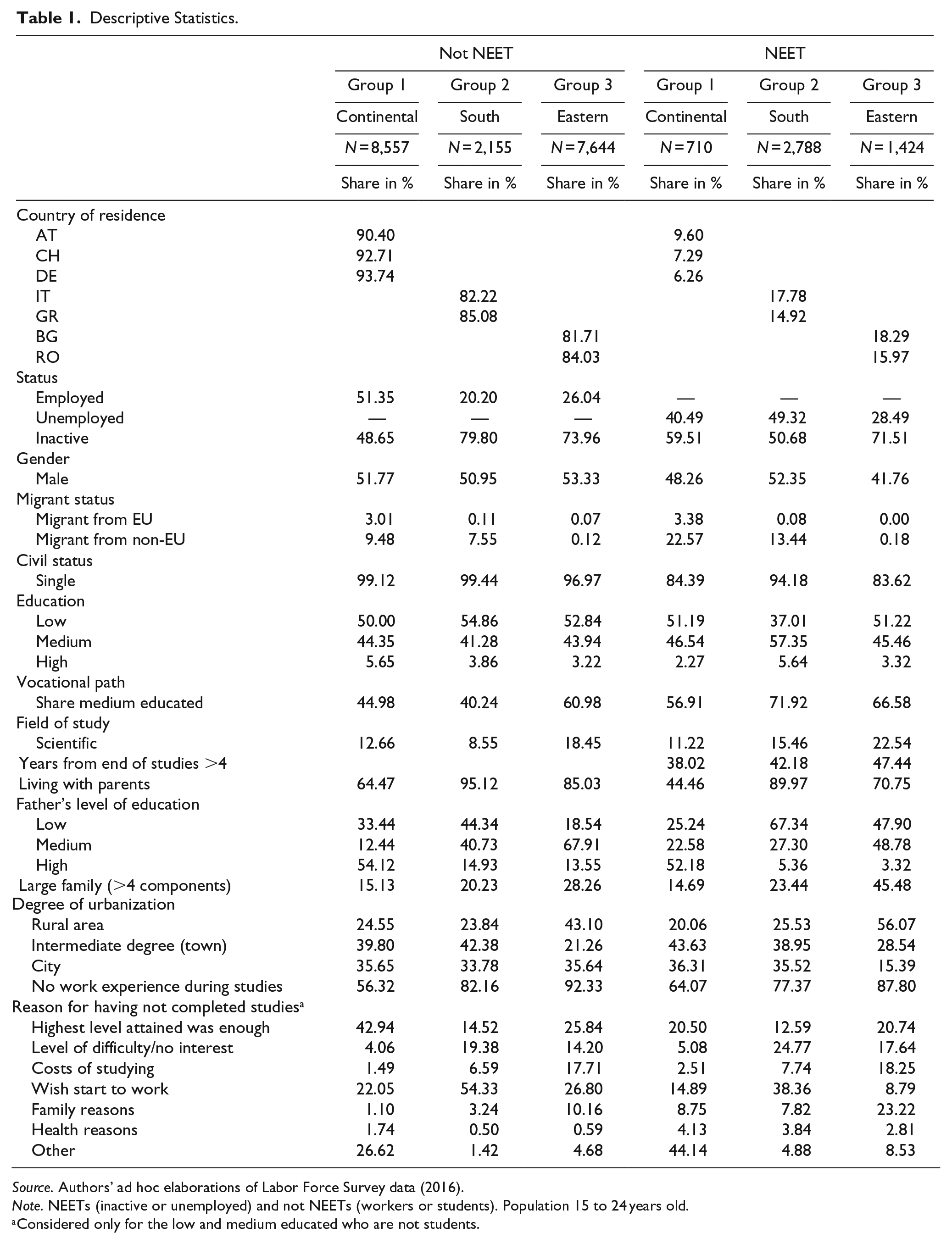
In line with our research interest, we extracted individuals aged between 15 and 24 years from the broader ad hoc module on “Young people on the labour market” of LFS. Table 1 shows the characteristics of our sample by country groups and by being a NEET/not-NEET.
Descriptive Statistics.
Source. Authors’ ad hoc elaborations of Labor Force Survey data (2016).
Note. NEETs (inactive or unemployed) and not NEETs (workers or students). Population 15 to 24 years old.
Considered only for the low and medium educated who are not students.
When inspecting Table 1, it becomes clear that very few individuals in our sample have a migration background in the Eastern European countries (only 0.19% among not-NEETs and 0.18% among NEETs), while the respective rates in Continental countries are 12.49% and 25.95%, and in Mediterranean countries they are 8.66% and 13.52%. Furthermore, we can infer from the table that not-NEETs are more frequently unmarried (99% in Continental and Mediterranean countries and 97% in the Eastern ones) than NEETs are (84% in Continental and Eastern countries and 94% in Southern ones). NEETs, however, tend to have parents with lower levels of education. The difference in the share of young people with highly educated parents among not-NEETs and NEETs reaches 10% in Eastern and Mediterranean countries. Particularly intriguing is the observation that in the Eastern European countries, NEETs mostly live in rural areas (the difference in the percentages among not-NEETs and NEETs living in rural areas is 13% in the Eastern countries and <2% in Mediterranean ones).
When focusing on individuals with low (ISCED 0–2) or medium (ISCED 3–4) education levels who are not NEETs, the main reasons they gave for leaving education early were “the highest level of education is considered enough” (for not-NEETs and NEETs they are, respectively, 43% and 20% in Continental countries, 15% and 13% in Mediterranean countries, and 26% and 21% in the Eastern ones) and “wish start to work” (for not-NEETs and NEETs they are, respectively, 22% and 15% in Continental countries, 54% and 38% in Mediterranean countries and 27% and 9% in the Eastern ones). Conversely, “family reasons” and “health reasons” are more frequently indicated as responses by NEETs than by not-NEETs (the difference in the share of individuals declaring it in the two groups is 7.65% in Continental countries, 4.58% in Mediterranean countries, and 13.06% in the Eastern ones). In particular, family reasons are more commonly indicated by young people living in countries with sub-protective STWT regimes, potentially signaling the need to support their family with care work. The “cost of studying” was selected by 7% of people in Mediterranean countries and 18% of people in Eastern countries, regardless of their status (NEET/not-NEET). The cost of attending university is high in particular in Italy, Bulgaria, and Romania. Only in Continental European countries were “other reasons” named frequently (26.62% among not-NEETs and 44.14% among NEETs). Substantively, it is difficult to understand what “other reasons” refer to—no such information is provided in the dataset. A last noteworthy observation is that in Southern European countries, young people remain in the family for a longer period, which aligns with conceptual work on youth welfare regimes that allude to the family-based systems there (Chevalier, 2016; Tosun et al., 2021).
Results
Probit Models
In the econometric analysis, we focus on those who completed education without attaining a university degree. The civil status of the individual is left out of the analysis to avoid endogeneity issues: whether someone decides to get married and/or to start a family is likely to depend on whether this person is employed or not.
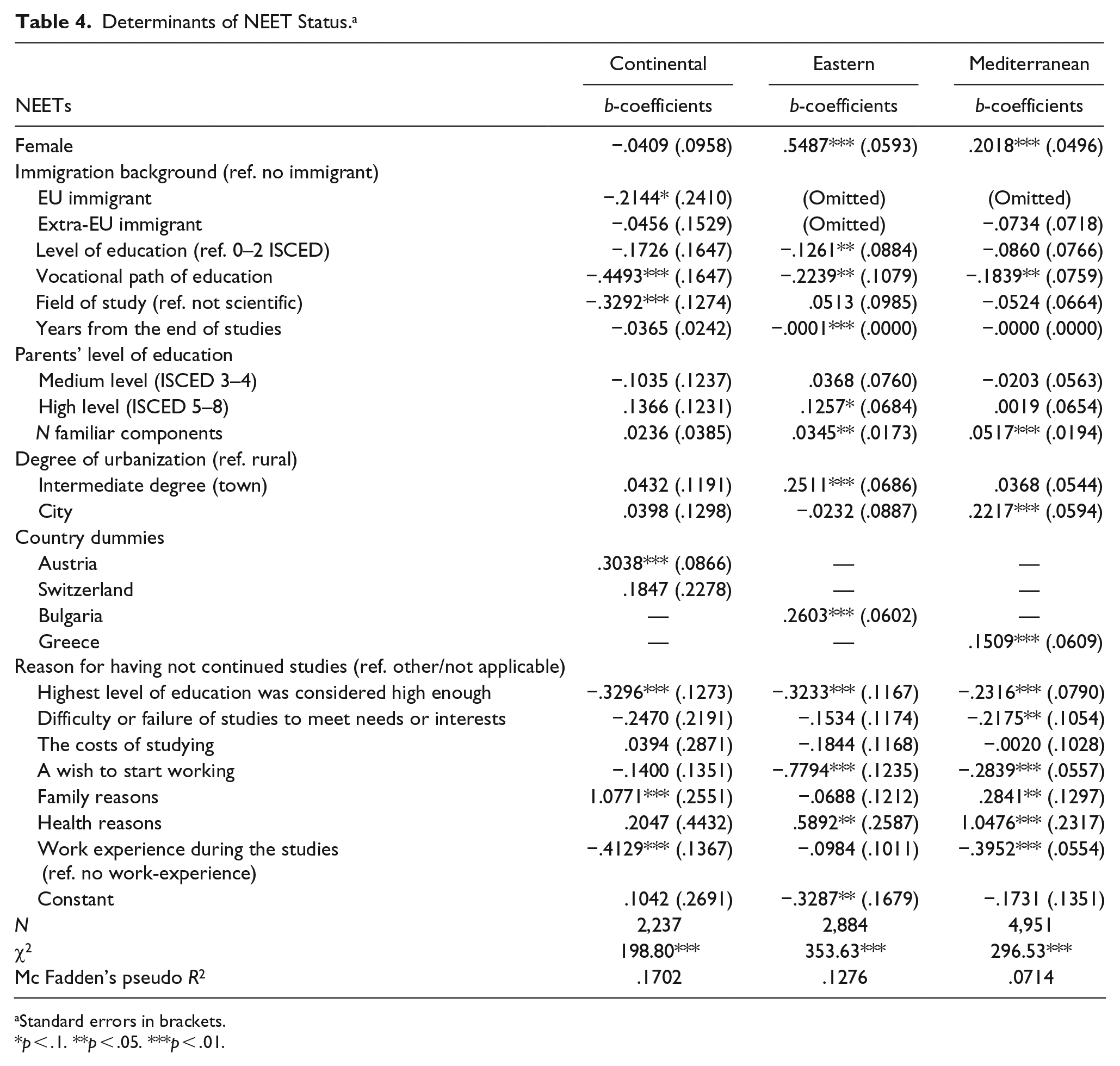
The Probit model for the probability of being a NEET produces some interesting findings. For one, being female significantly increases the likelihood of becoming a NEET in Eastern European (.55) and Mediterranean countries (.20). A medium instead of a low level of education significantly decreases this probability in Eastern European countries (−.13). While studying a science reduces the chances of becoming a NEET in the Continental European countries (−.33), undertaking vocational education, and training reduces this probability in all country groups: the corresponding coefficient is very high in the Continental European countries (−.45), while in Eastern European and Mediterranean countries it corresponds to −.22 and −.18, respectively. Living in a large family increases the probability of being a NEET in Eastern European (.03) and Mediterranean countries (.05). Interestingly, those living in a town in Eastern European countries (.25) and in a city in Mediterranean countries (.22) have higher likelihoods of becoming NEETs. The binary variable capturing the country of residence shows that the probability of being a NEET increases for Austrian young people in comparison to Swiss and Germany ones (.31), for Bulgarians in comparison to Romanians (.26), and for Greeks (.15) compared to Italians. Finally, completing work experience during one’s studies significantly reduces the probability of becoming a NEET in Continental European (−.41) and Mediterranean countries (−.39).
As for the reasons for leaving education early, family reasons are associated with a higher probability of being a NEET in Continental European and Mediterranean countries, while health reasons dominate in the Eastern European and Mediterranean ones. The finding related to health reasons suggests that NEETs rates are unlikely to depend solely on education and employment policies but also on health and welfare policies (see, e.g., Chevalier, 2016). Conversely, when the individual’s motivation for leaving education is the wish to start to work or the belief that the highest level of education (s)he had attained was enough, the probability of being a NEET significantly decreases, in almost all countries.
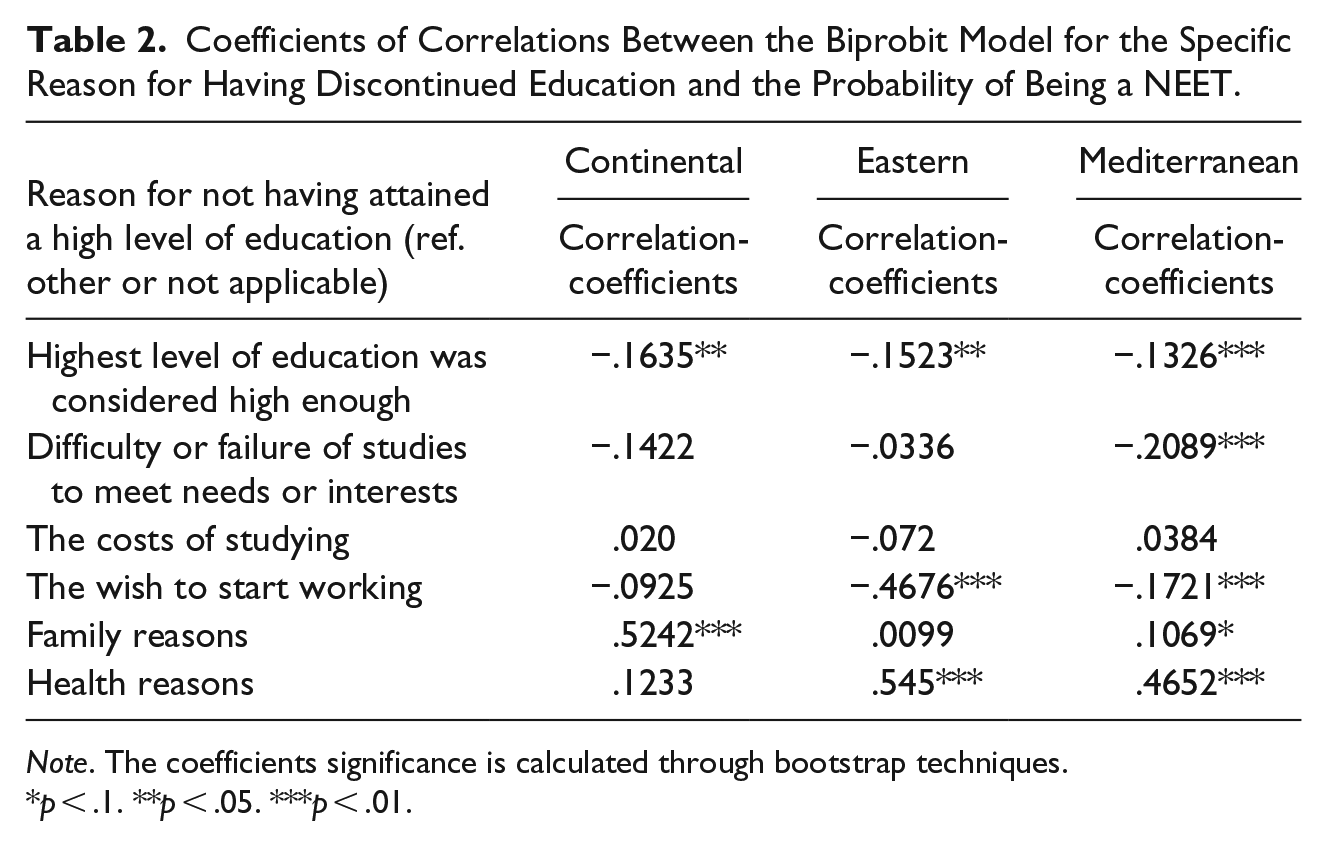
We now turn to the bivariate Probit models connecting the specific reason for leaving university early with the subsequent probability of becoming a NEET. For the sake of straightforward presentation, in Table 2, we only report the correlation coefficients between the two Probit models and leave the other estimates unreported.
Coefficients of Correlations Between the Biprobit Model for the Specific Reason for Having Discontinued Education and the Probability of Being a NEET.
Note. The coefficients significance is calculated through bootstrap techniques.
p < .1. **p < .05. ***p < .01.
We can infer that those who declared their “level of education attained was enough” are less likely to become NEETs, in all countries. Evidently, for these young people, renouncing a university degree was a conscious choice and not related to family or health reasons. The same goes for those who declared that the wish to start work was their main motivation and the effect of this is particularly strong in Eastern countries (−.47), where indeed the NEET phenomenon is mainly connected to inactivity. Conversely, when the choice is due to health or family reasons, the probability of becoming a NEET is significantly higher. This is especially true of the Mediterranean (.54) and Eastern European countries (.47), exposing the absence of efficacious welfare policies in these countries. Family reasons exert instead a strong effect in Continental countries (.52).
An In-Depth Study of the Difficulties Underlying the Decision to Interrupt Studies
After conducting the bivariate Probit model, we split the sample into two groups. The first group comprises of the most disadvantaged young people, whom we identified as those who declared that they had to drop out of university for the costs, health, or family reasons. The second group comprises of the individuals who dropped out for any other reasons. Unsurprisingly, individuals belonging to the first group show higher probabilities of being NEETs than individuals belonging to the second group.
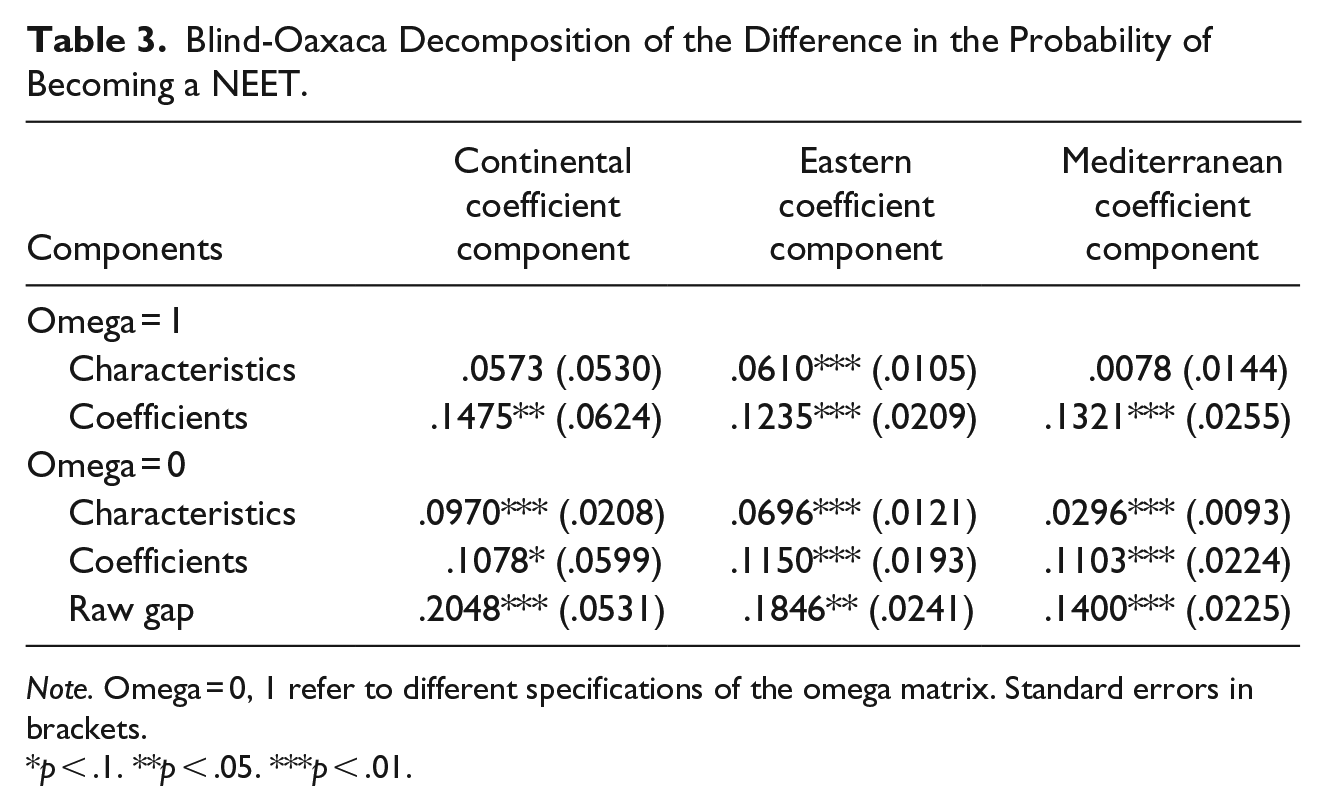
The difference in these probabilities is .2048 in the Continental countries, .1846 in Eastern countries, and .14 in Mediterranean countries (Table 3). We decomposed these differences using the Blinder-Oaxaca non-linear decomposition technique into the component due to the observable characteristics and the component due to the coefficients effect. The first of these components accounts only for .09 in Continental European countries (44%), .07 in Eastern European countries (38%), and .03 in Mediterranean countries (21%). The remainder is due to the coefficients effect and can be interpreted as the different treatment that these two groups of young people receive in the labor market, which strongly penalizes those who experienced difficulties during school or university education.
Blind-Oaxaca Decomposition of the Difference in the Probability of Becoming a NEET.
Note. Omega = 0, 1 refer to different specifications of the omega matrix. Standard errors in brackets.
p < .1. **p < .05. ***p < .01.
Discussion of the Findings
The detailed analyses of the data highlight that the STWT process depends on socio-demographic characteristics like gender (e.g., Dæhlen, 2007; Struffolino & Borgna, 2021), personal decisions regarding school attendance, type of school, entering the labor market early or late (e.g., Boudon, 2016; Lucas, 2001), and skills and motivation (e.g., Pastore et al., 2021; Pinquart et al., 2003; Uka & Uka, 2020). In the countries of Southern and Eastern Europe, young women have a higher risk of becoming NEETs because of family responsibilities (see, e.g., Tosun et al., 2021). The data reveal that the young people considered at higher risk of becoming NEETs opted for short forms of education, that is, predominantly vocational education and training. In all EU countries, graduating from vocational education means early entry into the labor market and reduced opportunities for attaining a university education (Delès, 2018). Pursuing short forms of education can be disadvantageous for individuals who are convinced that entering the labor market early reduces the costs of education. Such individuals regard vocational training as a “safer” option, but they are ultimately at a greater risk of becoming NEETs.
The analysis of the LFS allows us to observe the intergenerational transmission of the failure or success of young people in relation to the labor market: young people whose parents (father) have a lower education level and who come from large families have a higher risk of being NEETs. The results of our analysis are in agreement with other studies on the European level that examined the effect of both maternal and paternal employment on the success or failure of their children in the labor market (Berloffa et al., 2015; Cemalcilar et al., 2019; Kraaykamp et al., 2019; McDowell, 2014). Controlling for other variables (education, social environment), researchers found that the effect of parental employment (both mother and father) increases the likelihood of their sons and daughters getting a job.
Socio-economic characteristics of the country or region (e.g., Kittel et al., 2019), the community to which a young person belongs (rural or urban), national employment policies and programs (e.g., Chevalier, 2016), social assistance, and the education system (e.g., Bronfenbrenner & Morris, 2007) are factors that have been proven to affect the STWT process. In Continental Europe—where the labor market is regulated—the chances of being a NEET are lower than they are in other parts of Europe. In the Southern and Eastern European countries, which are characterized by high rates of early school leaving and have sub-protective social systems in place, young people have a higher risk of failing to integrate into the labor market (De Luca et al., 2020).
Strengths and Limitations
The use of the LFS micro-level data in general and the 2016 ad hoc module with its information on the STWT is this study’s strength. It is the first of its kind to elucidate the reasons for both not completing tertiary education and becoming a NEET subsequently. Evidently, the cross-sectional nature of the LFS is a limitation, which, however, we could surmount by using retrospective information provided in the dataset. Another limitation concerns that the LFS does not include more granular information for understanding why some youth leave education early while others do not. However, cross-country analyses require high sample sizes that only quantitative surveys can provide. Further, the background analysis on national STWT frameworks section 2 offers a contextualization of our findings.
Conclusions
In this study, we analyzed the effects of a set of reasons that can induce young people to renounce higher education (a university degree) on the subsequent probability of becoming a NEET. The decision to stop education without attaining a university degree is made very frequently, especially in certain countries. However, our study suggests that it is not dropping out of a university degree itself that disadvantages young people when they enter the labor market but the specific reason for having made this choice.
When this decision is motivated by the wish to start working or the personal opinion that the level of education attained is sufficient, young people usually find a job with ease. However, when the motivation is connected to family or health reasons, this has repercussions on the long-term perspectives of young people in the labor market. Therefore, in this study, we split the sample of the analysis into two groups according to the individuals’ reasons for having discontinued their education (group 1: health or family reasons or costs of university education; group 2: other reasons).
The results of our analysis showed that those who discontinue higher education for family or health reasons or for the cost of education have a higher probability of becoming NEETs. Decomposing the difference in the estimated probabilities of becoming a NEET for these two groups of young individuals, we find that young people belonging to the first group usually have personal characteristics which already connect them to the NEET status (coming from a large family, being female, having a lower level of education, etc.). However, the larger part of the difference in the probability of becoming a NEET is due to unobserved factors, as shown by the coefficient component of the Blinder-Oaxaca decomposition. This further disadvantage is indeed linked to the way that labor markets reward personal characteristics.
Even if these results are quite common to the three groups of countries analyzed, we can identify some important differences among them. In Continental European countries, the share of tertiary graduates is low compared to the EU-28 average (Austria is an exception) and similar to that of the other countries analyzed. However, in Continental European countries, the share of early school leavers is also low, and the education system is connected to the labor market, guaranteeing many young people a smooth STWT. Nonetheless, the Continental STWT regime requires young people to choose very early on between general or vocational education, and leaving the chosen path later is very difficult. Conversely, in Eastern and Southern European countries, the education systems are sequential and disconnected from the labor market, while vocational training is not able to provide the skills required by employers. This leads to very high NEET rates in both groups of countries, which translates mainly to unemployment in Italy and Greece and economic inactivity in Romania and Bulgaria. The significant effect of family reasons on the probability on becoming a NEET in Continental European and Mediterranean countries suggests that existing welfare policies may need to be reformed (see Chevalier 2016). The significant effect of health reasons in Mediterranean and Eastern European countries highlights the lack of instruments able to guarantee disadvantaged people with disabilities or other health issues a smooth and fast STWT. Consequently, these countries may not only need to revise their welfare policies but perhaps, even more importantly, their health policies as well, with the aim of integrating them with employment policies (Tosun et al. 2019).
Finally, even if not statistically significant, the costs of studying present another issue on which policymakers should reflect. In countries like Italy, tertiary education entails high costs in the form of taxes, even for access to public universities, and merit-based scholarships are unable to cover all of these costs. Furthermore, costs play an important role in the decision (not) to pursue a university degree, especially for those who live in rural areas, who in most cases have to relocate. Policymakers should therefore guarantee and promote access to university for all young individuals and provide welfare services to help with the care needs which still prevent many young people from attaining a high level of education, predisposing them to become NEETs.
The impact of socio-economic and family factors is enhanced by one’s geographical and residential circumstances: the risk of becoming a NEET is higher in rural areas compared to urban ones, at least in Eastern European countries (Table 4) (Kovarek & Sata, 2021). In rural areas, especially in isolated communities, young people tend to drop out of education even if they have a high chance of success intellectually. This can be because their family or community does not value or trust the school, as well as because the models of educational and professional success are missing in the family (Baudelot & Establet, 2007; Van Zanten, 2005) or are in themselves non-existent, giving them no point of reference for transiting to the labor market (Mascherini et al., 2012b).
Determinants of NEET Status. a
Standard errors in brackets.
p < .1. **p < .05. ***p < .01.
Footnotes
Declaration of Conflicting Interests
The author(s) declared no potential conflicts of interest with respect to the research, authorship, and/or publication of this article.
Funding
The author(s) disclosed receipt of the following financial support for the research, authorship, and/or publication of this article: This article is based upon work from COST Action CA18213 Rural NEET Youth Network, supported by COST (European Cooperation in Science and Technology);  . Jale Tosun acknowledges financial support from the Federal Ministry of Education and Research in Germany in the frame of the collaborative project Change through Crisis? Solidarity and desolidarization in Germany and Europe (Solikris).