



Abstract
To understand the purpose acquisition of young emerging adults (18-23), scholars claim we need to learn the types of purposes to which they are committing and how they conceptualize purpose differently from other related concepts such as future goals and the good life. To address these issues, we examined interviews with 229 young emerging adults about their life purpose, future goals, and conceptions of the good life. Although the interviewees’ purposes and future goals fit within shared categories of achievement, relationships, religion, and moral concerns, important differences also emerged. While one fourth of the sample lacked purpose, no one lacked a vision for the good life or future goals. Moreover, their future vision of the good life focused more on individualistic concerns such as happiness, material acquisitions and personal experiences with family being the only communal interest.
Increasingly, scholars have observed the importance of purpose for positive youth development into adulthood (Bronk, 2011, 2014; Burrow & Hill, 2011; Burrow, O’Dell, & Hill, 2010; Quinn, 2012). As a result, a significant amount of scholarship has emerged that examines the development of purpose in adolescents (Bronk, 2011, 2014; Burrow & Hill, 2011; Burrow et al., 2010; Damon, Menon, & Bronk, 2003; Quinn, 2012). Along with this trend, scholars are also observing that the transition into adulthood is now taking much longer because the timing of transition events such as leaving home, finishing school, finding work, getting married, and having children has extended later into the 20s and early 30s for many young people (for a review of these trends, see Arnett, 2000; Shanahan, 2000; Smith & Snell, 2009; Smith, 2011). The result is the decline in the dominance of a particular, default pathway to adulthood. This 18 to 29 age group, known as emerging adults, does not construct pathways from scratch, but selects from a multitude of competing narratives that define adulthood and prescribe routes to reach it (Arnett, 2004).
What the development of emerging adulthood might mean for this group’s development of purpose is subject to some disagreement by two prominent scholars in this area. Jeffrey Arnett (2000, 2004), one of the developers of the concept of emerging adulthood, points out that this extended development allows for a greater chance to develop one’s overall future purpose and life goals. William Damon (2008) admits that he is more concerned about what this might mean for emerging adults’ purpose development and notes, “I would argue that [Arnett’s] optimism is appropriate for only a minor portion of the youth population. For the rest, increased attention on our part is a more appropriate response” (p. 18). Certainly, evidence exists that for emerging adults, the lack of a clear purpose and path to adulthood can prove debilitating (Smith & Snell, 2009; Smith, 2011).
The first step to help determine the extent and nature of emerging adults’ struggle with and journey toward purpose is to explore it empirically. Yet, similar to what scholars report regarding adolescents, how emerging adults as a whole, and not merely college students, think about their purpose has not been subject to extensive research (Hill, Burrow, Brandenberger, Lapsley, & Quaranto, 2010). While some classificatory work has been done, scholars have suggested that additional work is needed (Bronk, 2014). The nature of classificatory work regarding purpose proves challenging, however, because there are similar concepts related to purpose (e.g., meaning, the good life) that have significant overlap but also have important differences (Damon et al., 2003; George & Park, 2013; Hill, Burrow, & Sumner, 2013). Consequently, Hill et al. (2013) suggest that we need empirical research that differentiates purpose from similar constructs “such as meaning in life and eudemonic well-being” (p. 234).
The goal of this study is to contribute to our knowledge of how young emerging adults conceive of purpose and the good life and perhaps differentiate between them. In addition, we hope to explore what the answers might mean for how we approach young emerging adult purpose development. To accomplish these goals, we report and analyze the qualitative responses of a national sample of 229 young emerging adults (18-23) to questions about both purpose and the good life. First, we classify how emerging adults describe their current views of their life purpose and their future vision of the good life they hope to achieve or experience. We then compare their answers with each of these different questions and discuss the implications for how we view emerging adults’ purpose development.
Literature Review
The importance of classifying and understanding how emerging adults think about purpose stems from the recognition that purpose proves important for both youth and adult human development and thriving (Bronk, 2014; Bronk, Hill, Lapsley, Talib, & Finch, 2009; Byron & Miller-Perrin, 2009; Damon et al., 2003). Some of its important positive contributions include happiness (Burrow & Hill, 2011; Kiang, 2012), positive affect (Burrow & Hill, 2011), hope (Bronk et al., 2009; Burrow & Hill, 2011; Burrow et al., 2010), life satisfaction (Bronk et al., 2009), identity formation (Bronk, 2011; Burrow & Hill, 2011), and resiliency (Masten & Reed, 2002). Although the bulk of recent research has focused on adolescents, scholars also find that developing a purpose is a critical aspect of positive human development, flourishing, and life satisfaction for emerging adults and college students (Bronk et al., 2009; Hill, Burrow, Brandenberger, et al., 2010).
A number of past studies have sought to classify specific understandings of life meaning among age groups (De Vogler & Ebersole, 1980, 1983), but scholars generally agree that meaning and purpose should be differentiated (Damon et al., 2003; George & Park, 2013; Kashdan & McKnight, 2009). As a result, in a review of the literature, Damon et al. (2003) lamented that the first and most essential question, “What are the types of purpose that inspire young people today?” (p. 126) has been unanswered. Later, Damon and Bronk (2007) maintained that more attention needed to be paid to the substantive nature of young people’s purposes, as a distinct topic from meaning.
Since the time of this complaint, there have been attempts to classify the purposes of adolescents (Damon, 2008; Hill, Burrow, O’Dell, & Thornton, 2010), college students (Hill, Burrow, Brandenberger, et al., 2010), and inspiring types of purposes among the population in general (Bronk, 2014). For instance, Damon (2008) found the following purposes as important in descending order of importance: family, career, academic achievement, religious faith or spirituality, sports, arts, community service, and political/societal issues. One goal of this study is to see whether we find different or similar types of purposes and a similar level of importance among the types.
Additional studies have also categorized answers to similar questions among emerging adults. For instance, Arnett (2004) conducted qualitative research in which he asked emerging adults, “When you get toward the end of your life, what would you like to say about your life, looking back on it?” (p. 180). In addition, another study looked at the similar concept of life goals among university students (Salmela-Aro & Nurmi, 1997). These latter studies again raise the question, however, of whether one should equate purpose with questions about overall life accomplishments, life meaning, experiences or goals, and overall well-being (Hill et al., 2013). Scholars appear to be divided regarding this question (Hill, Burrow, O’Dell et al., 2010; McKnight & Kashdan, 2009).
In light of this literature and the needs and conflicts mentioned, this study seeks to do two things. First, we use interviews from a broad sample of emerging adults from across the nation to create a classification of stated purposes that can be compared with other classifications. Second, we compare how emerging adults answer questions about their purpose with questions about their vision of future life goals—questions that appear to be similar but that can produce different answers or different types of emphasis in the answer. Through this comparison, we seek to discover how asking different types of questions influences emerging adults’ articulation of their purpose and future goals. Through this process, we attempt to provide some basis for how we might think about the disagreement between Arnett (2004) and Damon (2008).
Method
This study examined one part of the third wave of in-person interviews for the National Study of Youth and Religion (NSYR), which consisted of 230 in-depth personal interviews with 18- to 23-year-olds, a subset of emerging adults. These interviews provided a helpful database for a qualitative study that seeks to listen to the participants themselves and discern how they interpret and respond to questions about life purpose, future goals, and descriptions of a future good life. We did not conduct the interviews ourselves, but we received permission to access the interview database from the NSYR research team.
Conducted between May and September of 2008, respondents were offered a US$75 to US$100 cash incentive to complete the interviews. The original interviews averaged approximately 135 minutes. Those conducting the interviews sought to include young emerging adults who represented a range of demographic and religious characteristics and took into account region, urban/suburban/rural, age, sex, race, household income, religion, and school type (for more detailed information about the method of this phase of the NSYR study and how it fit within the other NSYR studies, see http://youthandreligion.nd.edu/research-design/ and http://youthandreligion.nd.edu/assets/102493/wave3methods_11_5_08_final_with_iv_guide.pdf). Thus, interviews were conducted in 35 different states in all geographic regions in the United States. The interviewees were nearly evenly divided by male (116) and female (114). With regard to race, the respondents identified as follows: 149 White, 33 Black, 25 Hispanic, 8 Asian, 4 Native American, 4, 11 Other. With regard to education, 43 interviewees had completed a high school degree or below, 138 were in the process of completing a “four-year” degree (2 were actually fifth-year students, and 1 was a sixth-year student), 14 had completed an associate’s degree, 30 had completed their bachelor’s degree, and 5 did not provide their level of educational attainment.
The interviewers for the NSYR surveys asked two sets of questions related to the topic under discussion. The first question about purpose was generally asked in the following form:
NSYR: Some people we talk with seem to have a very strong sense of purpose in life, they know exactly what is the value of life, what is important to be or do. Other people seem more disoriented or lost in life, not knowing exactly what their purpose is. How would you describe yourself when it comes to this question of purpose in life?
The second set of questions pertained to future accomplishments or experiences, which considered another way of addressing the topic of purpose. Interviewees were asked about these concepts using two or three questions. Often, these questions were asked consecutively, although sometimes, the interviewees split up the questions. The following is an example: “What ultimately do you want to get out of life? What would living a ‘good life’ look like to you? Is there anything that you really want to accomplish or experience in your life before it’s all over?” These questions do not specifically ask about life purpose, but they cover three concepts or terms usually understood as related or even equal to it. These questions were also asked in a way that downplayed the second component of the purpose definition offered by Damon et al. (2003). For instance, “What you want to get out of life” focuses on personal goals in a more self-focused manner. The second part of the question could also be taken to have a moral or evaluative aspect (i.e., good as in moral or ethical). The third concept again focuses on personal accomplishments or experiences. Although we think it would have also been helpful to have asked participants about meaning in life, the research team did not do so.
While the original study accumulated 230 interviews, for reasons we do not know, one of the interviewees did not address the topics covered in this study, so our sample was considered to be 229. We used an inductive approach to analyze the short-form responses because our desire was to generate themes from the particulars of young emerging adult responses rather than to impose prior frameworks on them (e.g., Hill, Burrow, Brandenberger, et al., 2010). To do this, one author generated codes using a two-cycle coding process (Saldaña, 2013). In the first cycle, he identified distinct categories of response to the questions about purpose and the good life (see Tables 1 and 2). In the second cycle process, he re-examined the first cycle subsets within the largest meta-code categories and re-coded them into either existing codes or new sub-codes (see Tables 1 and 2). A second author then used a similar process to validate the findings. Initially, they shared anywhere from 75% to 100% agreement among meta-codes and the sub-codes with a total inter-rater reliability rating of 86% for both levels of codes. Regarding both meta- and sub-codes, the authors discussed and categorized the portions with which they found differences and came to an agreement regarding areas of difference.
Coding Labels Based On Articulated Purpose.
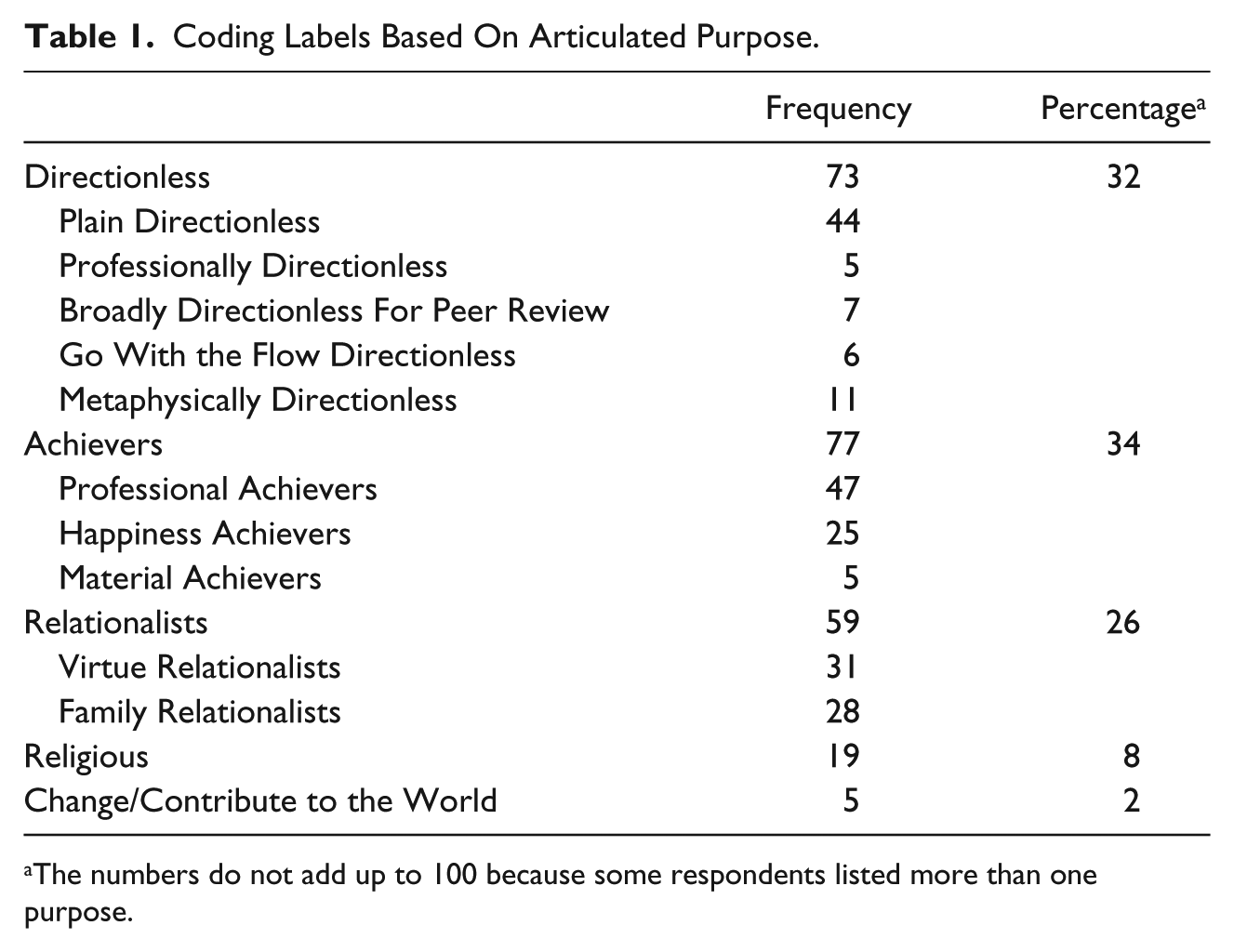
The numbers do not add up to 100 because some respondents listed more than one purpose.
Coding Labels for Both Questions.
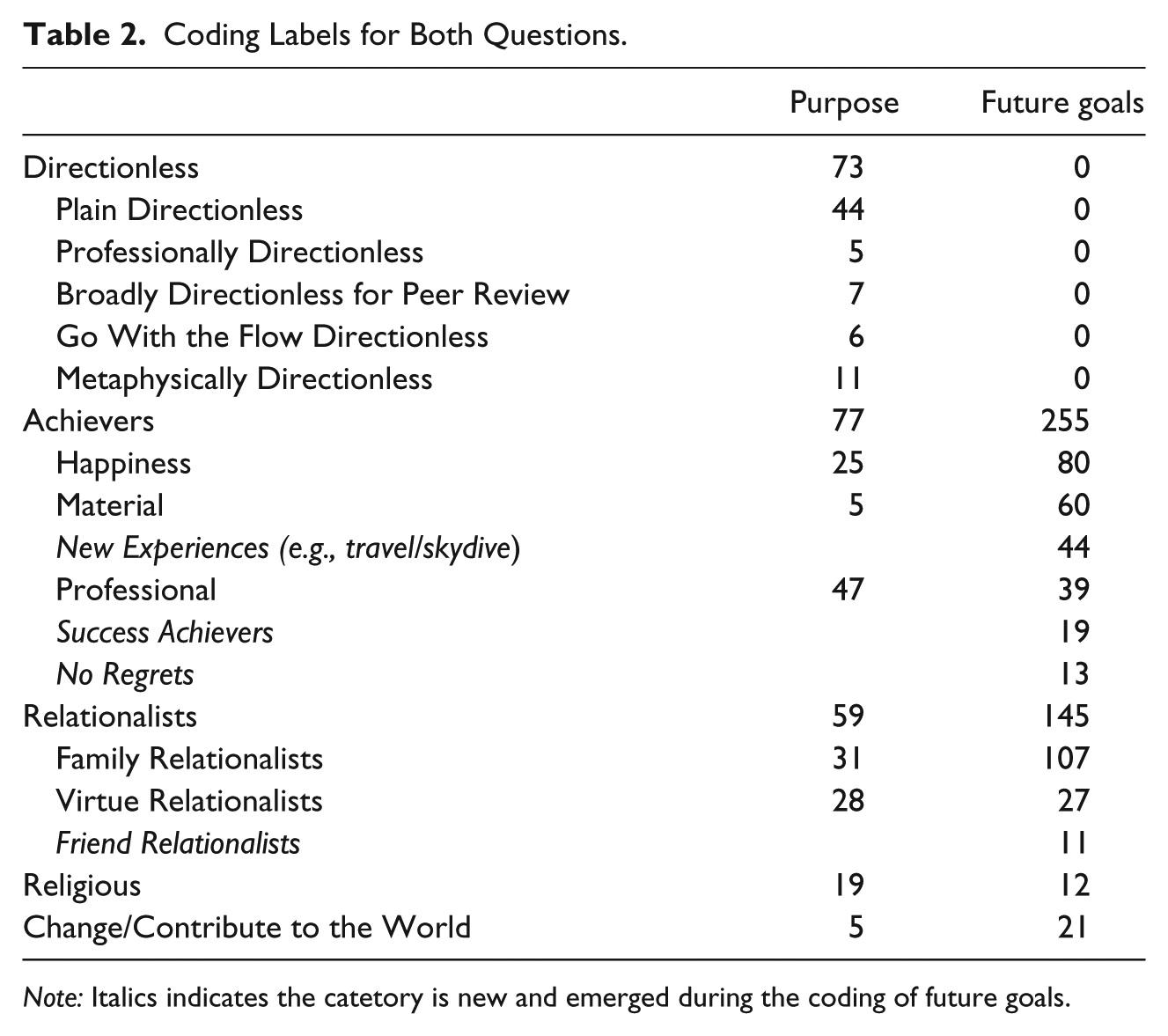
Note: Italics indicates the catetory is new and emerged during the coding of future goals.
Together, through the first round of coding, they found that the answers to the purpose question fit into one or more of five thematic categories, and answers to the second question addressing anticipated life goals, experience, and views of the good life produced four larger categories. This second round coding produced the 10 subcategories for the purpose question and the 9 subcategories for the good life questions described in the findings.
Findings
Purpose
The Directionless
Almost a third of the young adults (73 or 31.9%) in the sample claimed not to have found their purpose. We labeled them the Directionless. Most of these responses (44) were rather straightforward (e.g., “I honestly don’t know what my purpose is.” “I don’t know what I was put here to do.” “I work, pay my bills, and I sleep. And I drink”). We called these the Plain Directionless, because they offered little reason for their lack of purpose.
There were four small subsets that offered reasons. For instance, we labeled one group (5) the Vocationally Directionless, because they considered their purpose to be the same as their job. Because they were not settled on a major or job, they believed they lacked purpose, as this respondent indicates:
I’m still trying to figure out what I’d really like to do. I know that I like working with my hands. I like building things. But at the same time, I suck at math. I started out taking an engineering class, and I failed pre-cal. And it kinda left me wondering, “What should I do next?” So I’m definitely disoriented.
A small second group (7) indicated that they considered finding one’s purpose as a deeper pursuit than finding the right job, but they still confessed that they were unsure what they believed about the purpose of life. We labeled this group the Broadly Directionless, which this person exemplifies: “I’ll be like, ‘What is the purpose of life? Why am I here?’ I never get a good answer [as] to why I am really here. What’s the purpose? Work and work and work until you die . . . .”We labeled a third small group (6) the Go With the Flow Directionless. They were simply satisfied with living in the moment (e.g., “I have no idea what my purpose is.” “It’d be nice to know but at the same time I like just going with the flow, see where life takes me.”). Finally, we call the largest group (11) that offered reasons for their lack of purpose the Metaphysically Directionless. These individuals referred to or implied some type of metaphysical beliefs when discussing purpose. For some, their confusion about the nature or even existence of a larger divine narrative contributed to their disorientation (e.g., “Not really I guess I don’t know.” “I don’t feel like I was put here on earth for any particular reason.”). For others, their lack of current guidance from a Divine Being was cited as a reason for their lack of purpose (e.g., “Right now I’m asking God to show me what my purpose is for being here, because right now I’m really not too sure”). This latter group believed that God or some higher power would eventually lead them to their objectively understood purpose.
The Achievers
We labeled a second major group of respondents the Achievers (77 or 33.6%). They articulated their purpose as something that can be reached by particular accomplishments in life.
We found two general types in this category. Most Achievers were those who identified their purpose as their current or future job—what we call Professional Achievers (47):
I don’t know necessarily if I have a purpose. I think I have a goal. Maybe that’s my purpose, becoming a physician . . . I guess I would consider myself, focused on the fact that maybe my purpose is to become a physician.
The second group, the Happiness Achievers (25), identified happiness as the ultimate goal they want to achieve. As this respondent stated, “I want to be just happy and successful. More happy, I mean, . . . yeah, they function together, I guess.” In addition, although personal happiness functioned as the end goal, it would be obtained by achieving other goals, as this participant explained, “Having a family, a nice family, a good job, nice cars, [and] nice house. Just really being accomplished. . . . Having those things would make me happy.” In a couple of cases, the respondent’s purpose was expressed in almost negative terms, such as, avoiding misery or harm. One interviewee noted, “I have a vague sense of purpose. . . . I just want to be satisfied with my life. I don’t want to be miserable. I would rather be happy and in poverty than filthy rich and miserable.”
Interestingly, very few respondents (5) articulated their purpose in terms of achieving money or material possessions—what we call the Material Achievers (e.g., “I do have material accomplishments I want—like a certain type of house, a certain income. I also want to make a mark”). As with the young emerging adult quoted above, all of those mentioning material possessions included other purposes as well (e.g., “My own practice, you know, get a lot of money. Have a nice house, family”).
The Relationalists
The third group consisted of those individuals who identified their purpose as relating to others. We identified two types within this category: Virtue and Family Relationalists (59 or 25.8%). The Virtue Relationalist (31) outlook was commonly expressed as these three respondents did:
“I always felt like my purpose was to help people.”
“I feel like my entire purpose [is] just to incorporate loving people.”
“You know, as far as I can tell right now, my only purpose in life is to love people . . . .”
The individuals in this category understood their purpose in life as involving demonstration of some kind of virtue or virtues with regard to other people in general (Peterson & Seligman, 2004).
The second type, Family Relationalists (28), derived their purpose from this specific group of relationships. Quite often, family proved to be a purpose that was listed among other purposes: “I definitely want to be married, and like I said, the graphic design thing, I’m dying to go into that. I can’t wait to graduate and just enjoy life, that’s very important right now.” For a number of respondents, family served as the default purpose in the midst of confusion: “I probably don’t, I don’t know what my purpose in life is. I know I wanna grow up and have a family and stuff like that, but I don’t have a plan to get there or anything like that.”
The Religious
The next distinct group included those who specifically mentioned God or religious metaphysical beliefs when discussing their life purpose (19). All of these individuals were either Protestant or Latter Day Saints (LDS) with one exception, a Catholic student who described his purpose as “just get closer to God.” Furthermore, of these Protestants, only one was a mainline Protestant (a Lutheran), while all of the others were non-denominational, Evangelical, or Baptist. Most participants simply summarized their purpose in a succinct manner:
“I know that I have a purpose here. And it’s to serve God and to serve other people.”
“I feel a sense of purpose but that’s my biggest purpose is to love God and bring glory to Him.”
These respondents reported that their purpose, as related to a higher power, brought a clarity that transferred to other aspects of life. As one LDS respondent shared, “I don’t have to wake up and think ‘why I am I here?’ It gives me confidence in situations that other people I’m sure don’t feel confident. So I’m grateful that I know that my Heavenly Father loves me.”
Change the World Transformers
Interestingly, the interviewees as a group expressed little interest in purposes related to changing or transforming the world. Only five interviewees described their purpose as producing some sort of social change. Three of these five were minorities who expressed a commitment to changing one’s local community. As a Latino claimed, “I feel pretty sure about what I’m doing with my life. Service work, but more than just traditional community service. I feel it’s really helping community transformation.” Table 1 gives an idea of the range of responses and the low place given to social change.
Vision of a Future Good Life, Experiences, or Accomplishments
Young emerging adults’ answers to life purpose and future visions of the good life, accomplishments, and experiences demonstrated significant overlap. However, these comparisons also produced some new categories and new emphases. Perhaps most striking, unlike purpose, everyone provided some answer to their future vision of the good life. Usually, interviewees’ answers comprised what might be considered a bucket list of hoped for goals. Table 2 indicates the number of respondents who mentioned the existing categories described earlier, as well as new categories, based on their answers to questions about the good life.
The new dominant languages—Happiness, family, material things, and experiences
The differing wording of these questions clearly changed the focus of the research participants’ responses. As Table 2 shows, when examining the good life, the mention of happiness increased dramatically. When looking at the specific language used, the goal was usually preceded by “just” in various forms: “I just want to be happy”; “I want to just be happy”; “Just to be happy, I guess”; “Just being happy, you know”; “Just happiness”; and so on. Yet respondents really did not mean just happy—happiness went with other things.
For a little over a quarter of this group (28%), happiness involved family. Although a few respondents focused on a spouse (e.g., “have the most loving, caring wife”), the vast majority talked about both marriage and children (e.g., “I would like to be married. I would like to have kids”). Furthermore, only rarely did anyone extend a conception of happiness beyond a spouse or children to sisters/brothers or grandchildren (e.g., of an exception, “I really want to stay connected to my sisters as I am right now”). If the respondents gave a rationale for these goals, it usually connected to their contribution to the participants’ happiness:
“I just want to be happy and to have a family and to be a good parent and I’ve always wanted to have kids, so that would really fulfill my life.”
I would like to have a family you know and have kids and see them be successful and have a family of their own. That would probably make me happy.
In some cases, the basis for increased happiness would involve improvement on one’s own past experience. For instance, one young emerging adult shared, “I just want to be happy. I want to have a life and give my children a good life, a better life than I had.”
For another quarter of our respondents (25%), happiness was associated with good feelings, comfort, and material possessions. This young emerging adult captures the emphasis on feelings that tended to shape these answers:
I have no idea, I just want to be a happy person, I don’t want to be unhappy, I don’t want to be miserable, I don’t want to be depressed, I don’t want to have a job that I don’t like just because I’m worried about money and I don’t want to like be in a relationship just because I have a kid, and like I don’t want to be in a place where I don’t feel comfortable.
Another respondent shared how happiness also often coincided with family, comfort, and financial security:
Just to be happy, to be comfortable. Again, I would like to be married; I would like to have kids. Again, I think those are fundamental pieces or important steps to being happy . . . I think, again, to have the financial means to be happy and not have to worry really about financial situations.
Indeed, the above respondent mentioned most of the prominent emphases associated with happiness such as financial comfort, marriage, and children.
Overall, one of the striking findings about these interviews was the difference between what some interviewees mentioned as their purpose in life and how they articulated their vision of the good life and their future accomplishments and experiences. Those who desired money or material possessions suddenly increased. It should be noted that respondents often did not focus on obtaining a large amount of material goods. Instead, they merely designated certain belongings they hoped to own. Examples include the following:
“Two golden retrievers and the house in the hill country.”
“Have an old rocking chair, and a front porch, and a shotgun.”
“I just want to be able to say that I owned my own stuff, I owned my own house or my own cars.”
“Having my own place.”
Moreover, another group merely focused on an emotional baseline (e.g., “Not having to worry about things”; “Not having to worry financially”). In some cases, they combined the two (e.g., “My own house, my own car and not having to worry about money”). Only rarely did those mentioning material goods speak in grandiose terms, such as the young emerging adult who simply stated, “I want to be rich” or the young emerging adult who dreamt of “my own [legal] practice, you know, get a lot of money. Have a nice house.”
Finally, a whole new category emerged from students’ descriptions of the future good life, what we would label the New Experiences category. The young emerging adults interviewed dreamed of traveling and experiencing the world. They also hoped to try adventures, which, for some reason, meant skydiving for half a dozen respondents. Overall, their imaginary vision of the good life proved to be filled with personal happiness and possessions, family and future travel, and adventure experiences.
The good life without goodness, God, and friends
Overall, no more than 10% of the respondents mentioned larger social causes, virtue, God, or friends when speaking about their imagined good life or future goals. Friends and social change received more mention in this question than when talking directly about purpose, but the numbers still remained small. Even in the cases in which young emerging adults talked about making a difference in another person’s life beyond their own or a family member, their imaginative vision for doing so remained remarkably small. For instance, one young emerging adult noted the following connection with his future dreams:
Basically, being happy and…if I couldn’t benefit myself in some way, then trying to benefit someone else in the same way if they’re able to benefit from it. Like say ten dollars won’t help me but it will help someone else. Then perhaps give them the ten dollars, and in my own way I will feel beneficial, and satisfactory, like I’ve done something.
Another young emerging adult followed the same pattern of first talking about his own dreams and then moving to something beyond himself: “I’d like to skydive, that would be awesome. Wouldn’t mind climbing a mountain—that would be cool. But I mean otherwise, like I just really want to help implement, sort of, a more efficient social structure or something like that.” No one talked of curing a disease, achieving some form of social justice, or changing the lives of hundreds or thousands of people for the better. If big dreams did occur, they happened at the personal achievement level, and their fulfillment was related to career or family goals and not to broad religious or moral ideals. One young emerging adult hoped to “start a business, make it national, make it the biggest business ever and have the most loving, caring wife.” Strikingly, this individual did not talk about being a loving, caring person himself.
In fact, as the low virtue relationalist numbers attest, few used virtue language to describe their vision of the good life. Less than 5% mentioned the role of friends in their view of the good life. A similar 5% mentioned loving or serving God, which was even less than the percentage of people concerned with living with no regrets (6%) and far less than those who hoped to travel or skydive. Indeed, we found the future dreams of these individuals to be largely secular and self-focused. Few mentioned political or civic involvement. This respondent’s quote provides an example of their measured ambitions:
I mean I have no desire to be famous, or anything. I just want to live a very nice, comfortable life, not have regrets. . . . I want to get married. Other than that, no, I have no desire to climb Everest or anything like that. I want to travel in general. There’s nothing I have to see.
These answers also rarely included references to allegiances to social entities beyond the family. In other words, not only was God largely missing from their conversation about the future, but a commitment to other non-familial social entities, such as country, was also almost entirely absent. One exception stood out starkly:
I’ll say this; I served my God, my country, and my family well. And I just did, you know, the best job I could with the talents that were given to me. And that I made an impact in some people’s life and I served my world like God wanted me to serve.
This young man’s reference to serving his country proved an unusual exception. In addition, relationships outside the family, whether God, civic, or communal, were also almost completely missing from this group’s imaginative rendering of their future lives.
Overall, the differences between how emerging adults talked about purpose and the good life proved striking. While almost half included family in their vision of the good life, only 12% understood it as related to their purpose. Only 10.9% mentioned happiness as their purpose, but almost 35% of interviewees sought a long-term sense of happiness. Although only 2% mentioned money or things in ways that connected to their purpose, more than a quarter (26.2%) talked about acquiring money and things in the future to fulfill their good life.
Discussion
To begin, we should note a couple of important limitations that influenced the final nature of our results. First, the three different ways that young emerging adults were asked the second set of questions resulted in respondents focusing on the unique nature of one part of the question. We believe future research in this area would benefit by asking more focused questions such as, “What would living a ‘good life’ look like to you?” Nonetheless, the responses can still be said to have focused on future goals that comprised part of their vision of the good life. Second, the fact that we did not conduct the interviews ourselves limited the richness of the results in that we were not able to ask follow-up or clarifying questions directly related to our research questions. For instance, we believe it would have been helpful to have asked students about any differences between their stated purpose and their future goals.
Overall, the findings from this study, we believe, make two particular contributions to the field. First, although they reinforce findings about the purposes to which young emerging adults are committing or planning to commit, they also identify and help us understand some purposes not highlighted in previous studies. Second, the findings in the study offer further evidence that scholars have suggested we need (Hill et al., 2013) to help us differentiate young emerging adults’ understanding of purpose and their future vision of the good life. It also clarifies why the differentiation is important.
Regarding the first contribution, as mentioned above, Damon (2008) listed the following adolescent purposes in descending order of importance: family, career, academic achievement, religious faith or spirituality, sports, arts, community service, and political/societal issues. Young emerging adults, perhaps not surprisingly in light of their age, appeared to elevate a concern with a career to a higher level. In addition, the categories of service and love of others proved more important. Finally, happiness proved an important category that Damon did not list (although it should be noted that many of the things on the list were considered to lead to the final end of happiness). It is likely that Damon would claim personal happiness does not fit his definition of a purpose (which must focus on a goal outside the self). Similarly, Bronk (2014) lists familial, professional, artistic, religious, and civic/political purposes in her list. Again, Bronk’s (2014) list of purpose types does not include what we call the Happiness Achievers, and it is not exactly clear where Virtue Relationalists would fit (they do not necessarily have religious, civil, or political purposes). Another categorization by Hill, Burrow, O’Dell, et al. (2010) only uses four purpose orientations (pro-social, financial, creative, and personal recognition). While our categories certainly fit with some of Hill, Burrow, O’Dell, et al.’s (2010) work (e.g., the pro-social category fits the relationalists, achievers may look for personal recognition), we think that the typology may be missing some groups (e.g., the religious), and it may not quite capture others (achievers may want financial rewards or personal recognition, or to express their creativity). Overall, we would suggest that current classifications in the literature should include the category of helping/loving others. Moreover, we wonder whether more attention does not need to be given to the fact that while many scholars want to define purpose as something that is pro-social, a significant number of young emerging adults want to define it as related to their personal happiness. This finding leads to the second point of our study.
With regard to the differences between purpose and the good life, our findings would reinforce Hill et al.’s (2013) claim that we must distinguish between purpose and the general concept of well-being or the good life. We found a noteworthy difference in how young emerging adults articulate their life purpose and their future vision of the good life. While purpose and future hopes regarding accomplishments and experiences seem to be similar targets, interviewees were clearly not as unsure about what they conceived of the good life or what they hoped to get out of life. Whereas almost one third of the respondents claimed they did not know their purpose, not one respondent failed to articulate future goals and dreams about the good life. The resolution to this dichotomy is unclear. Asking young emerging adults about their purpose provokes a sense of specificity and permanence they have not yet obtained, whereas asking them about the good life or what they want to get out of life allows them to speak with more freedom.
Moreover, when speaking about purpose, respondents focused on more important and meaningful ends, while questions about future goals tended to elicit individualistic bucket list dreams. In other words, to ask interviewees about their purpose produces much different responses than asking about their vision of the good life or future goals and experiences. The research participants in this study demonstrated an interest in being happy, enjoying life, obtaining material possessions, traveling, skydiving, and achieving a few work goals along the way. Serving others, loving God, and making a positive impact on the world are clearly secondary parts of the good life. Indeed, the only indication that a significant number of young emerging adults look beyond themselves in their future goals comes from their desire for a family.
In sum, apart from the fact that family surfaces as a priority for young adults, the vast majority of future aspirations were self-oriented goals or what Arnett (2004) identifies as individualistic (vs. collectivistic). Individual concerns, such as happiness, material objects, and bucket list sort of experiences, dominate the findings of this study. Only small percentages of the comments focused on what might be considered others-oriented future goals beyond the family (serve/help others, positive impact, love/serve God, and friends). These findings may appear to provide evidence for the narcissistic characteristic of today’s young emerging adults (Twenge, 2006). It may also indicate delayed moral development, because scholars point to others-oriented purposes and others-oriented moral reasoning as significant markers of this age group’s long-term development (Bronk, 2014; Colby, Ehrlich, Beaumont, & Stephens, 2003; Hill, Burrow, Brandenberger, et al., 2010).
Overall, we would suggest that the findings to both of our questions reinforce Damon’s (2008) concern about emerging adults and the consequences of delaying commitment to larger others-oriented purposes and the need for greater attention to helping them develop others-oriented purposes. Moreover, the potential reality that institutions serving young emerging adults, particularly various forms of higher education (Kronman, 2007), are not giving as much attention to this matter certainly will not aid these searching young emerging adults. Perhaps emerging adults need less help understanding their autonomy and more help understanding how to make significant commitments to other larger social goods beyond the self and the family. Studies have found that making sure that young people engage in purposeful activities, such as “helping at home, volunteering in the community, participating in faith-related activities, or engaging in the arts,” nurtures the type of others-oriented purpose we are describing (Bronk, 2014, p. 94). While young emerging adults may be beyond “helping at home,” colleges and universities could likely do more to help their students’ purpose development (for helpful guidance, see Clydesdale, 2015; Colby et al., 2003; Nash & Murray, 2010).
Footnotes
Declaration of Conflicting Interests
The author(s) declared no potential conflicts of interest with respect to the research, authorship, and/or publication of this article.
Funding
The author(s) disclosed receipt of the following financial support for the research, authorship, and/or publication of this article: This work was supported by the John Templeton Foundation under Grant 36656. The National Study of Youth and Religion,  , whose data were used by permission here, was generously funded by Lilly Endowment Inc., under the direction of Christian Smith, of the Department of Sociology at the University of Notre Dame. We have no financial interest or benefit that arises from the direct applications of this research.