



Abstract
Past research has documented that structural factors produce a skewed dating market in African American communities that advantages men over women. Using data collected from a sample of 495 African American young adults (55.8% women, Mage = 22), we tested the idea that African American men can be more selective when choosing dating partners than their female counterparts due to their power advantage. Consonant with this hypothesis, our results indicated that women who had characteristics consistent with men’s mate preferences were significantly more likely to be involved in dating relationships. However, there were no associations between the likelihood of men’s dating frequency or relationship status and whether they typified women’s mate preferences. These findings support the contention that, unlike their male counterparts, African American women may have to compromise their mate preferences and date less desirable partners due to the gendered power disadvantage in the dating market.
Nearly all young people are interested in dating, and most experience an exclusive romantic relationship by late adolescence (Sassler, 2010). Romantic relationships tend to enhance an individual’s well-being (Carr & Springer, 2010; Sutton, Simons, Simons, & Cutrona, 2017) and precipitate quality of unions formed in adulthood (Raley, Crissey, & Muller, 2007). Thus, it is important to study the factors that influence the formation of these early relationships. African Americans under the age of 25 are twice as likely to be single compared with the general population (W. Wang & Parker, 2014). These race discrepancies are not due to differences in the valuation of marriage. Several studies have demonstrated that African Americans value committed romantic relationships, including marriage, as much as members of other race/ethnic groups (Barr & Simons, 2018; Trail & Karney, 2012). Therefore, this suggests that unique circumstances faced by African Americans reduce the likelihood of partnering or being in a serious romantic relationship (Wilson, 1987). The current study investigates gendered power imbalances as possible explanations for this pattern.
The most promising explanations for differences in patterns of partnering emphasize structural conditions that produce an imbalanced dating market for African American men and women (Barr & Simons, 2018; Edin, 2000; Wilson, 1996). Scholars suggest that high rates of mortality and incarceration as reasons for significantly fewer African American men than women in the dating market (Catanzarite & Ortiz, 2002; Xu, Murphy, Kochanek, & Bastian, 2016). Consequently, the ratio of African American women to men in the dating market is about 100:84 compared with 100:99 for Whites (Catanzarite & Ortiz, 2002). This imbalance is further exacerbated by disproportionately high unemployment rates among African American men (Western, 2006), particularly for those with a history of incarceration. As a result, many of these men are not considered viable romantic partners (Debnam, Howard, Garza, & Green, 2017).
In recent years, studies have examined ways that the surplus of African American women relative to African American men gives the latter group a power advantage in dating relationships. Qualitative findings suggest that this advantage results in less commitment to monogamous relationships among men (Eyre, Flythe, Hoffman, & Fraser, 2001; Towner, Dolcini, & Harper, 2015). Furthermore, African American women may find themselves tolerating behavior typically considered objectionable, such as infidelity or acquiescing to intercourse without a condom (Hall, Lee & Witherspoon, 2014; Stephens & Phillips, 2005). These findings suggest that African American men have an advantage that enables them to achieve their preferences in dating relationships while women must be willing to compromise their expectations or be left out of the dating market.
In sum, African American women may stay in relationships with men they find unsatisfactory (Clarke, 2011; Hall et al., 2014) and African American men often dictate the level of commitment in relationships (Eyre et al., 2001; Towner et al., 2015). This suggests that African American women must typify the ideal mate to be partnered but that personal characteristics and behavior may matter much less for men’s ability to date either casually or seriously. The present study extends prior research by examining the dating experiences of 495 African American young adults. We test various hypotheses regarding the ways in which power imbalances in the dating market might differentially influence the dating experiences of African American men compared with women. Based upon past research, we expect to find that this power advantage possessed by African American men enables them to date regardless of their desirable or undesirable characteristics, whereas women will only have success in the dating market if they have characteristics consistent with those of an ideal mate. In the following section, we briefly review studies that address gender differences in preferred partner characteristics before developing our hypotheses about how these preferences will be expressed in our sample.
Gender and Preferred Partner Characteristics
Much attention has been devoted to gender differences in the preferred characteristics of an ideal mate. This research has largely been informed by sexual strategies theory (Buss, 1998), which asserts that men are attracted to women who are young and have a healthy body, because, historically, such women have been more likely to produce offspring. In contrast, women are described as attracted to men who are strong and of high status because such mates have traditionally provided the safety and resources necessary to successfully rear children. While some studies have found that men and women are similar in their rankings of other partner attributes such as love, character, and emotional stability (Boxer, Noonan, & Whelan, 2015), there is, nevertheless, strong evidence supporting the differences specified by sexual strategies theory. Furthermore, there is evidence of sex differences in terms of the characteristics that are important in casual relationship versus a committed, long-term relationship (Li & Kenrick, 2006).
First, studies report that men place greater emphasis upon physical attractiveness as an important partner characteristic (Boxer et al., 2015) regardless of the type of relationship (Buss, 1998). Research has established that physique, the size and shape of one’s body, is the primary determinant of physical attractiveness, explaining 56% of the variance in attractiveness ratings (Tovée, Maisey, Vale, & Cornelissen, 1999). This effect is especially strong for men’s ratings of women’s attractiveness, regardless of race and ethnicity (Grogan, 2007). For example, men prefer female physiques that fall at the low end of the healthy range (i.e., a body mass index [BMI] between 18.5 and 21; Weeden & Sabini, 2005). Some studies have replicated this finding for African American men (Jackson & McGill, 1996), but others report that African American men prefer female body sizes that are slightly larger (BMI: 22-24.9) but still in the healthy range (Freedman, Carter, Sbrocco, & Gray, 2004). Thus, although studies have not examined actual differences in physique of women in dating versus those in committed relationships, according to sexual strategies theory, women with more desirable physiques (e.g., healthy vs. very thin or overweight) would be expected to have greater success in both casual and exclusive relationships (Buss, 1998).
Sexual strategies theory argues that women are also concerned about having a partner who will pass on healthy genes, protect, and support them during child rearing (Buss, 1998). Thus, studies show that, although physical attractiveness is less salient for women than men, women also value this characteristic (Eastwick & Finkel, 2008). Specifically, Brierley, Brooks, Mond, Stevenson, and Stephen (2016) found that men’s waist-to-chest ratio was a primary determinant of women’s attraction. Furthermore, Jackson and McGill (1996) asked African American women to report their preferred height and weight for a same-race heterosexual dating partner and found that the ideal male body corresponded to a healthy BMI (i.e., between 22 and 23). Although there have been no studies that have examined actual differences in the physiques of men in dating versus those in committed relationships, sexual strategies theory suggests that physical attractiveness is more important to women in casual dating relationships than in committed ones (Buss, 1998). For instance, Bryant and Wickrama (2012) found that, among married African American couples, husbands’ weight did not affect wives’ depressive symptoms whereas wives’ weight was positively associated with husbands’ depressive symptoms, suggesting that partner’s body size remains important for married men but not women.
Research also suggests that both men and women favor romantic relationships that are uncomplicated by the presence of children from a previous partner (Buss, 1998; Goldscheider, Kaufman, & Sassler, 2009). Men in particular are less willing to partner with someone who has children from a previous relationship (Goldscheider & Kaufman, 2006), perhaps because they are unwilling to invest resources in another man’s child (Lampard & Peggs, 1999). Women’s greater willingness to enter relationships with men who have children with another partner may be because young offspring are more likely to reside with their mother, thus necessitating less of an investment of time and money in a child who is not her biological offspring (Goldscheider et al., 2009). It should be noted that sexual strategies perspective suggests that men may view women who already have children from a previous partner as a potentially costly mate, whereas having a child with one’s current dating partner should not have a deterrent effect on her attractiveness as a partner.
Finally, sexual strategies theory argues women are most concerned with finding an ambitious mate with good financial prospects (Buss, 1998; Li & Kenrick, 2006). In modern society, criteria for evaluating a potential male partner’s future economic prospects would include factors such as steady employment, pursuit of higher education, and lack of involvement in criminal behavior. Men with a history of crime are generally perceived to lack social respectability or trustworthiness, both characteristics that women deem important in a partner (Edin, 2000; Hurt, McElroy, Sheats, Landor, & Bryant, 2014; Li & Kenrick, 2006; Raley & Bratter, 2004). Some research suggests that women’s position in the labor market has also become more important over time as a determinant of their position in the marriage market (Sweeney & Cancian, 2004). Given recent economic trends, both parties to a couple must work to make ends meet, so both sexes now report being least likely to marry a person who cannot hold a job (Raley & Bratter, 2004).
In summary, men and women are attracted to potential mates with a healthy, attractive physique. This is especially true of men, while for women this preference becomes somewhat less important in long-term relationships. Furthermore, both men and women prefer a mate who does not have children from a prior relationship, although this preference appears to be stronger among men. Finally, women, and to a lesser extent men, are concerned with finding mates who have the potential for financial success. Conversely, a history of criminal behavior would be a red flag with regard to a prospective partner’s potential for employment and financial stability.
The literature on mate preferences has virtually overlooked how various partner preferences play out in actual dating experiences. Specifically, past research has primarily employed one of three methods: participants identify desired characteristics in a hypothetical partner (Fletcher, Tither, O’Loughlin, Friesen, & Overall, 2004); evaluate potential partners based on brief, initial interaction; or explain attraction to a current romantic partner. With regard to the first design, in a review of several studies, Eastwick et al. (2011) found a correlation of .00 between the stated preferences in a hypothetical partner and people’s actual partner selection. While speed dating experiments (Kurzban & Weeden, 2005), a common approach used the second design, have the benefit of real-world interaction with potential partners, the results are based upon initial attraction during a brief exposure and do not necessarily provide insight regarding ongoing relationships. Finally, studies that rely upon assessments of one’s current romantic partner (Luo & Zhang, 2009) have the problem of the halo effect: people are predisposed to attribute positive qualities to someone for whom they have positive feelings (Murray, Holmes, & Griffin, 1996). Most importantly, however, asking participants about their mate preferences does not allow one to determine the effect that various social and physical characteristics have on their actual involvement in relationships. This is best accomplished by linking individuals’ characteristics to their reports about their success in the dating market. Therefore, we test our study hypotheses using participant reports of their involvement in dating and romantic relationships.
The Current Study
It is reasonable to expect that in a sex-balanced dating market, men and women with generally desired characteristics might be more successful in finding mates than their less desirable peers. However, as a consequence of the structural factors described earlier (Wilson, 1996), disadvantaged African American communities often have an excess of women compared with men (Eyre et al., 2001). As a result, African American men living in such communities may possess a significant power advantage in the dating market. This expectation is based on the well-established social psychological concept of the principle of least interest (Blau, 1986; McClintock, 2011) which suggests that those with a greater number of alternatives for potential dating partners will have more power than those with limited avenues. This may translate into African American men being better able to exercise their dating preferences than African American women. Thus, we expect men’s power advantage to be evident in the following ways:
One would expect all of these associations to be especially strong for casual compared to committed relationships.
On the contrary, given the shortage of African American men, women who desire a partner often form relationships with individuals who fall short of their dating preferences. Scholars (e.g., Clarke, 2011) have noted a similar pattern in which African American women remained in or returned to unsatisfactory relationships for the sake of being partnered. Furthermore, Barr, Simons, and Simons (2015) found that the desire to marry helps to structure African American nonmarital relationships in gendered ways. In other words, women may be willing to settle for partners who do not possess ideal partner characteristics.
While one cannot prove the null hypothesis, non-significant findings regarding the associations between the various desired mate characteristics and the dating patterns of men would be an indicator of their greater power advantage in the dating market.
Method
Sample and Procedures
The Family and Community Health Study (FACHS) is a multisite investigation of neighborhood and family effects on African Americans living in a variety of communities in Iowa and Georgia. This nonprobability sample consists of 889 African American children (54% girls) and caregiver(s). In 1997, participants were recruited from 259 block group areas in which African American families made up 10% or more of the population and in which at least 20% of children lived in poverty. Families were contacted by phone using a roster of all fifth graders from schools in the identified neighborhoods, and 84% of the contacted families agreed to participate (see Simons et al., 2016; 2018).
Our research questions are addressed using data from 2007 (Wave 5) when targets were, on average, 22.5 years old (range = 20-24 years). By 2007, targets resided in 35 states across the country. Nearly 700 targets (80% of the original sample) participated in the study at Wave 5. Too few people identified as married (n = 28) or homosexual (n = 20) to make meaningful comparisons, so those individuals were not included in analysis. We were not able to include participants who had a child with their current romantic partner (n = 117) because that question was asked only of those who indicated that they were currently in an exclusive romantic relationship with that partner. Thus, we are unable to examine how dating status, the outcome variable in our study, might vary by presence of child with current partner. Furthermore, our hypothesis regarding presence of children is based upon sexual strategies theory’s assertion that only children from a previous partner are a deterrent to dating opportunities with future partners and has no implications for how presence of a child with a current partner might deter continuation of that relationship. After excluding participants who had missing data on key variables (n = 29, 4.2% of the total sample), our final sample consists of 495 participants (276 women and 219 men). Missing cases were deleted listwise for several reasons. First, Schafer (1999) has reported that a missing rate of 5% or less is inconsequential. Second, attrition analyses using t tests indicated that the individuals included in the present study did not differ in terms of various demographic and personal characteristics, including age, family income, depression, criminal behavior, family structure, and education level, from those who were excluded or missing at Wave 5. Thus, data were considered missing completely at random (Bhaskaran & Smeeth, 2014).
Measures
Dating status
Respondents were asked, “What best describes your current relationship status?” Responses were 1 = not dating, 2 = casually dating, and 3 = exclusive relationship. Respondents who indicated that they dated but did not have a committed romantic partner were coded as casually dating while those who reported having a committed romantic partner, including those who were cohabiting and engaged, were coded as being in an exclusive relationship.
Physique
We assessed respondents’ physique using the Figural Rating Scale (FRS; Stunkard, Sorenson, & Schulsinger, 1983). Participants viewed nine figures and chose which figure most accurately depicted their own body. Although these figures are not explicitly African American in appearance, they have been widely used in studies with African American respondents and have demonstrated validity as a measure of weight (Bulik et al., 2001; Granberg, Simons & Simons, 2015).
We use self-assessments of physique rather than a measure such as BMI because the latter does not necessarily capture a person’s overall physique, muscle tone, distribution of fat, or appearance (Deurenberg & Deurenberg-Yap, 2003; Granberg, Simons & Simons, 2015). For instance, an individual could have a wide frame or more muscle, resulting in a high BMI, when they are not overweight or carrying too much fat. Thus, BMI may be of less use than body size/shape when physique is being assessed as an element of physical attractiveness (Granberg et al., 2015; Nuttall, 2015).
Several studies have assessed the FRS against other standards, including BMI (Bhuiyan, Gustat, Srinivasan, & Berenson, 2003; Bulik et al., 2001). We relied on this literature as well as past research on African American male and female body ideals (Granberg, Simons, & Simons, 2015) to create the body size categories for this measure. This process yielded categories: “thin” (Figures 1, 2, or 3), “healthy” (Figure 4), “overweight” (Figures 5 or 6), and “obese” (Figures 7, 8, or 9).
Parenthood status
Parenthood status was measured using a dichotomously coded variable (0 = no children with previous partner, 1 = one or more child with previous partner).
Employment
Respondents were asked whether they were currently working part- or full-time. Responses were used to construct a dichotomous measure where those who reported that they were employed were coded as 1.
Criminal involvement
To assess engagement in criminal activity and the criminal justice system, respondents were asked if they had ever been to jail and if they had engaged in eight criminal behaviors such as breaking and entering, theft, property damage, and physical assault. Each item was dichotomously coded (1 = engaged in this activity), and summed to form an index of criminal involvement (α = .72).
Control variables
Educational attainment
We control for educational attainment (1 = less than high school to 4 = college graduate/advanced degree) to account for residual components of socioeconomic status beyond employment and income (Raley & Bratter, 2004).
Self-esteem
Self-esteem is often associated with weight and dating (Granberg, Simons, & Simons, 2009). Thus, self-esteem was assessed using six items from the Rosenberg (1965) scale which asks respondents to report their agreement (1 = strongly disagree to 5 = strongly agree) with statements (e.g., “I feel I do not have much to be proud of”) (α for women = .80; α for men = .78).
Skin tone
Research has shown that, among African Americans, individuals with lighter skin are often preferred over darker skinned counterparts as potential mates (Landor & Halpern, 2016). Thus, we control for observer-rated skin tone (Landor et al., 2013). Two trained observers independently rated the participant’s skin tone on a scale of 1 = very light to 5 = very dark. The two evaluations were averaged for a final rating of skin tone.
Family transitions
To control for the potential influence of childhood changes in family structure on young adult dating behavior, we created an index of cumulative family transitions by summing whether family structure had changed during the study (e.g., from a married caregiver household to a single parent household). Scores ranged from 0 to 4.
Positive views of marriage
To account for the possible effect of an individual’s own desire to be partnered on their current relationship status, we include a seven-item scale that captures positive perceptions of marriage (Barr et al., 2015). Respondents indicated their agreement with statements such as marriage “is an important part of life” or “leads to happiness” on a scale of 1 = strongly disagree to 5 = strongly agree (α for women = .71; α for men = .72).
Analytic Strategy
We began by running a fully interactive model, and results demonstrated significant effects by participant sex. Thus, based on this analysis, all subsequent analyses were run separately for men and women. Our analysis examined associations between the independent variables and three types of dating: not dating, casually dating, and exclusively dating. Our hypotheses were tested using multinomial logistic regression to assess the association between our categorical dating status variable, our predictors, and control variables. “Not dating” was used as the comparison group. Three sets of models are presented for both men and women; the only difference in the models is the comparison category used for physique. Specifically, a “thin” physique is used as the comparison group in Model 1, a “healthy” physique is used as the comparison group in Model 2, and an “overweight” physique is used as the comparison group in Model 3. All analyses were performed in Mplus version 6 (Muthén & Muthén, 2010).
Results
Descriptive Statistics
The descriptive statistics are shown in Table 1. A large proportion of women (45.7%) and men (37.0%) were not currently dating. Women were significantly more likely to report that they are not dating than men, consonant with the argument that the dating market disadvantages African American women. A substantial proportion of participants categorized themselves as “overweight”; 37.0% of women (n = 102) and 40.2% of men (n = 88), respectively. These categories are roughly comparable to national rates of being overweight or obese among African American young adults (National Institutes of Health, 2009). Furthermore, men were significantly more likely to categorize themselves as “thin” than women, and women were significantly more likely to categorize themselves as obese compared with men. Significantly more women than men report having biological children (24.6% vs. 14.6%). Furthermore, 42.8% of women (n = 118) and 47.9% of men (n = 105) were currently employed. However, women reported significantly higher levels of education than men. On the contrary, men reported greater criminal involvement and were rated as having darker skin tones than women. Finally, according to Census data on the neighborhoods in which our participants lived in 2007, the sex ratio was 100:83, which is similar to national sex ratios for African Americans (Catanzarite & Ortiz, 2002).
Descriptive Statistics for Women and Men.

Significant gender differences at p ≤ .05 according to chi-square or ANOVA.
Multivariate Analyses
Results for women
Table 2 shows the extent to which body size, parenthood status, and employment impact the probability that African American women in our sample are casually dating or in an exclusive relationship compared with not dating. None of the control variables has a significant effect on dating status. Model 1 shows that, among exclusive daters, women with a “healthy” body size are 3.29 times more likely to be exclusively dating than not dating compared to women with a “thin” body size (β = .75, p = .02). Other body size comparisons for women are shown in Models 2 and 3. As shown in Model 2, “overweight” women are 56% less likely than “healthy” women to be casually versus not dating (β = 0.51, p = .04). Furthermore, “obese” women are 57% less likely to be casually versus not dating compared to “healthy” women, but this relationship only approaches significance (β = –.45, p = .06). For exclusive daters, two additional relationships approach significance. Specifically, compared with “healthy” women, “overweight” women are 51% less likely (β = –.46, p = .06) and “obese” women are 55% less likely (β = –.45, p = .06) to be exclusively dating than not dating. These results are consistent with analysis using “overweight” as the reference category (see Model 3). All significant differences regarding physique were between women with a “healthy” physique relative to women with other physiques. Overall, this pattern of results supports Hypothesis 1, which states that women with “healthy” bodies, relative to under- and overweight women, are preferred by men.
Odds Ratios for Multinomial Logistic Regression Predicting Romantic Status for Women.
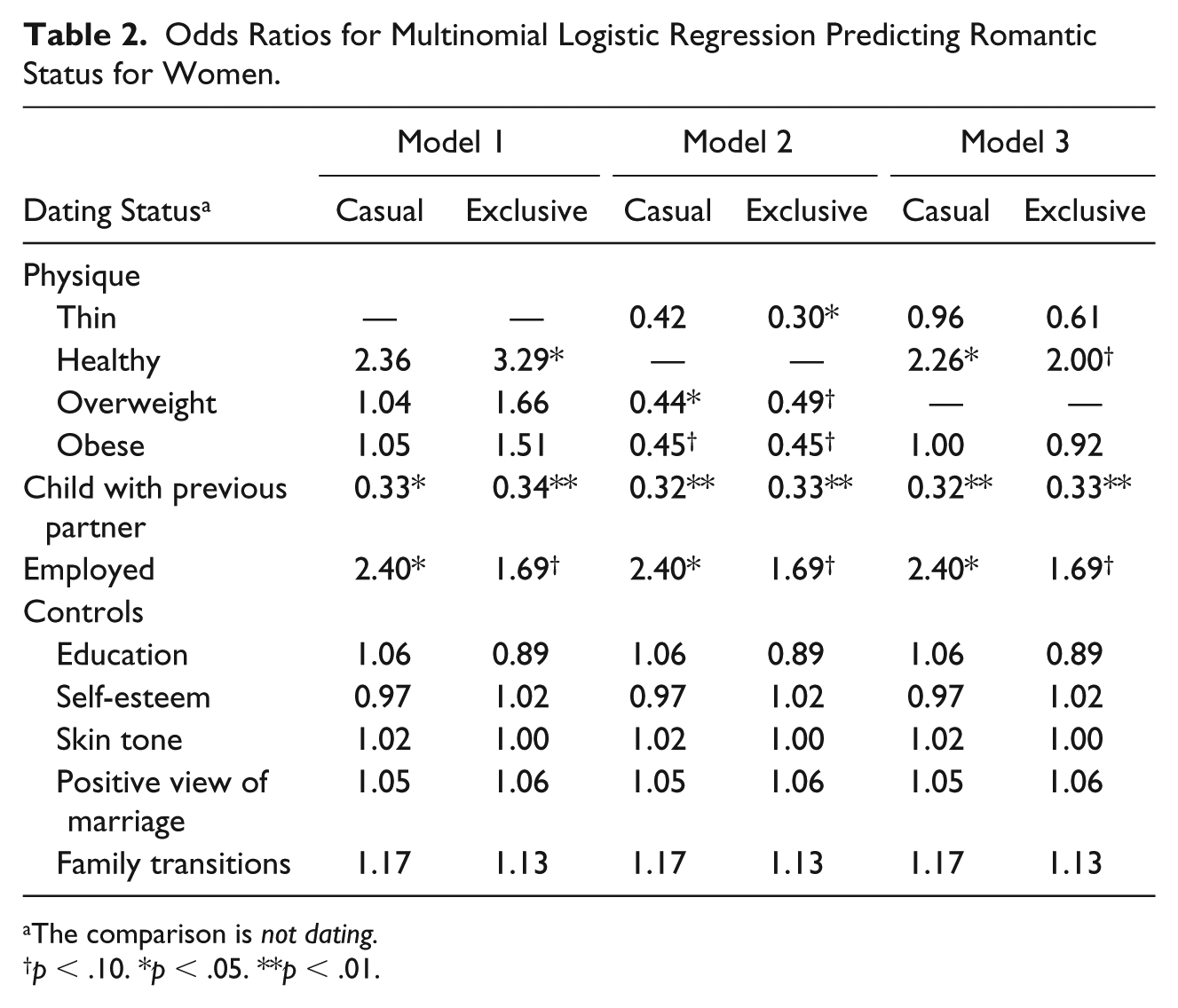
The comparison is not dating.
p < .10. *p < .05. **p < .01.
Women who have one or more children with a previous romantic partner are less likely to be either casually or exclusively dating than their childfree counterparts. Mothers are 67% less likely to be casually dating versus not dating (β = –.61, p = .01) and 66% less likely to be exclusively dating versus not dating (β = –.65, p = .01). Thus, presence of child(ren) with a previous partner constrains women’s dating opportunities. These results provide strong support for Hypothesis 2.
Next, employed women are significantly more likely to be casually dating compared with unemployed women. Specifically, employed women are 2.40 times more likely to be casually dating versus not dating (β = .53, p = .01). Results approach significance for the effect of employment on exclusive dating, with employed women 1.69 times more likely to be exclusively dating than not dating (β = .37, p = .06). These results provide support for Hypothesis 3. Additional analysis (not shown) demonstrated that there were no significant difference between causal and exclusive daters.
Results for men
Consistent with Hypothesis 4, results presented in Table 3 show that none of the factors considered explained dating or relationship status of men. Body size, parenthood, employment, and criminal involvement fail to show a significant association with either casual dating or being involved in an exclusive relationship. These results counter the contention that women are especially concerned with indicators of potential for economic success, particularly when considering long-term mates. Indeed, even criminal behavior did not significantly reduce men’s likelihood of finding dating partners for casual or exclusive relationships. The only coefficient that approaches significance is positive view of marriage (β = .54, p = .04). Men with such views are more likely to be in exclusive relationships than to not be dating. Additional analyses (not shown) also demonstrated that the only significant difference between casual and exclusive male daters was that exclusive daters were more likely to have a positive view of marriage (β = .72, p = .01).
Odds Ratios for Multinomial Logistic Regression Predicting Romantic Status for Men.
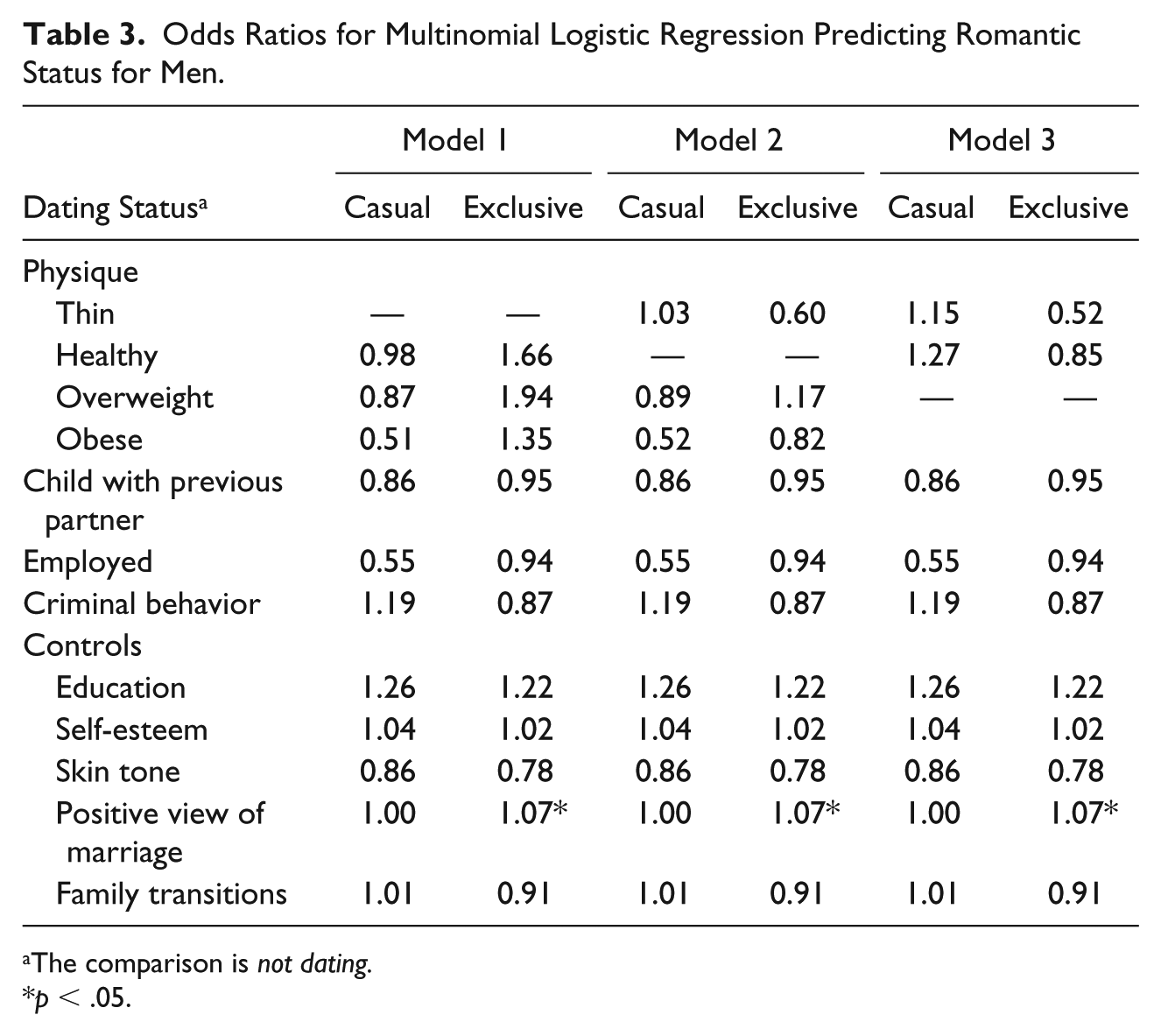
The comparison is not dating.
p < .05.
This pattern of findings is consistent with Hypothesis 4. Although one cannot use statistical tests to prove the null hypothesis, this pattern of findings is certainly counter to what would be expected if the women in our study were able to exercise the mate preferences that have been documented in prior research. The absence of significant relationships is consonant with the contention that the African American dating market is characterized by an imbalance that gives a power advantage to men. Consequently, men are able to exercise their mate selection preferences whereas this is not the case for women.
Discussion
Past research has documented that men and women possess mate preferences that tend to exist across racial/ethnic groups (Buss, 1998; Jackson & McGill, 1996). Men and women want an attractive mate, which often involves an attractive physique (Eastwick & Finkel, 2008; Granberg et al., 2017). In addition, women, and to a lesser extent men, desire a partner who displays the potential for steady employment and financial success (Barr & Simons, 2012; Buss, 1998). Given the high rates of incarceration among African American men and the employment costs associated with prior incarceration, women are particularly concerned about the criminal activities on the part of prospective partners (Hurt et al., 2014; Li & Kenrick, 2006; Raley & Bratter, 2004). Finally, both men and women prefer a mate who does not have children from a prior relationship, although this inclination is stronger among men (Buss, 1998; Goldscheider et al., 2009).
These characteristics are factors that determine one’s success in the dating market. Consonant with the principles of exchange (Blau, 1986) and equity theory (Hatfield & Rapson, 2011), individuals tend to form relationships with partners of comparable resources. Such relationships are viewed as equitable, fair, and satisfying. In sex-balanced dating markets, most individuals will likely establish an equitable relationship where neither party has a power advantage over the other (Hatfield & Rapson, 2011).
Unfortunately, various structural conditions have produced a skewed dating market in many African American communities. High rates of early death, unemployment, and incarceration among African American males have produced an imbalance where there are significantly fewer African American men than women (Edin, 2000; Wilson, 1996). Furthermore, given their disadvantaged histories, many of these men are not perceived as “marriageable” (Debnam et al., 2017). Still, males enjoy a power advantage in an imbalanced dating market because power accrues to the party who has more relationship alternatives (Cook, Cheshire, & Gerbasi, 2006).
The present study examined the way that this power advantage influences dating relationships. We tested the idea that African American males are better able to exercise their dating preferences than their female counterparts. Our findings largely corroborated this expectation. Women of healthy body weight, who did not have children with a previous partner, and who were employed were more likely to be dating or in a committed relationship than women without these characteristics. In other words, women who met men’s mate preferences experienced success on the dating market. On the contrary, there were no associations between men’s body size, employment, parenthood, or involvement in criminal activity and their probability of being partnered, either casually or exclusively. This is consonant with the contention that African American women, given their power disadvantage in the dating market, must settle for less desirable partners or opt out of the dating market altogether. It is likely that female selectivity would increase as their number of potential desirable partners increased (Fisman, Iyengar, Kamenica, & Simonson, 2006).
The current study was among the first to examine gender differences in the extent to which mate preferences are actualized. Although several studies have assessed the impact of structural disadvantage on the marriage market for African Americans (Catanzarite & Ortiz, 2002; Edin, 2000), most of this research has used ecological data to examine the extent to which the shortage of African American males is associated with a reduction in marriage rates (Furstenberg, 2009; Wilson, 1996). We extended this research by using survey data collected from several hundred African American young adults to examine gender differences in reported dating activities and relationship status.
These results have important implications for policy, education, and intervention. Specifically, marriage promotion efforts may actually encourage women’s dependence on men. Therefore, programs and policies that reduce women’s (inter)dependence on men would be helpful. This might mean programs or policies enable kinship networks or foster strong community ties, educational and employment opportunities for Black women, and stronger social safety nets (e.g., access to quality child care, health care).
While the present study extended prior research in several respects, it also contained limitations. First, we do not have information on the race/ethnicity of all participant’s dating partners. However, because large, longitudinal national surveys of youth typically report interracial dating rates of 6.4% (Manlove, Wildsmith, Welit, Scott, & Ikramullah, 2012) to 8.9% (H. Wang, Kao, & Joyner, 2006) among African Americans, it is very likely that over 90% of our sample engage in dating relationships with African American partners.
Second, while we focused on frequency of dating experiences, we did not assess the quality of dating relationships. Consideration of such issues was beyond the scope of the present study. Importantly, however, research shows that power differences foster inequity and dissatisfaction in relationships (Hatfield & Rapson, 2011), so it is reasonable to expect that such factors would be present in our sample as well. Given their power advantage, men are likely less willing to commit to monogamous relationships (Eyre et al., 2001) whereas women are more likely to accept undesirable behaviors (Hall et al., 2014; Stephens & Phillips, 2005).
Third, while participants were asked to indicate whether or not they were employed, we did not have information on the type of occupation held by respondents. Our results are important in showing that employment, in and of itself, had an influence on women’s dating prospects. However, information on the prestige or status of one’s job might yield more nuanced results, and future research may benefit from including such measures.
Fourth, data limitations prevented us from examining whether having a child with one’s current partner was associated with current relationship status. These data were not available for all participants. However, there is no theoretical reason to assume that having a child with one’s current partner would attenuate our pattern of results.
Despite these limitations, the study has a number of strengths. First, we used a sample of African Americans, which allowed us to examine within race variation, an important shortcoming in prior research. Second, while past research has argued that the sex ratio imbalance in African American communities is a potential explanation for marriage patterns among African Americans, the current study extends this focus by examining the ways in which that imbalance is associated with dating and relationship status. Specifically, our study found that the structural conditions responsible for fostering a skewed dating market favor the predilections of males while frustrating those of females. Inequitable dating relationships forged under such circumstances are likely to be at risk for dissatisfaction, volatility, and breakup. It follows that the solution to these relationship problems requires, in large measure, attention to the structural conditions (e.g., discrimination, unemployment, and mass incarceration) that promote an inequitable dating market.
Finally, this study suggests several directions for future research. First, these gender power imbalances are also likely to impact the character and stability of these relationships. This means that there are likely long-term and intergenerational implications of this power imbalance that are currently not very well understood. Second, this study examines dating at one point in time. This is a telling, but likely a conservative, approach. Examining gender differences in patterns of dating across young adulthood and their associations with these ideal mate characteristics will likely offer consistent and perhaps stronger evidence. Third, the health implications of these mismatches in preference versus reality are not well understood, and neither are differences in women who do “settle” versus women who hold out and instead find support in other relationships (e.g., family, friends). Finally, future research could benefit from examining what the gendered power imbalance demonstrated in this study means for interracial dating patterns. One might posit that Black women would simply seek relationships outside their racial group, but there are barriers to this as well, as Black men are actually more likely to find success dating outside their racial group. Examining this paradox seems like an important undertaking.
Footnotes
Declaration of Conflicting Interests
The author(s) declared no potential conflicts of interest with respect to the research, authorship, and/or publication of this article.
Funding
The author(s) disclosed receipt of the following financial support for the research, authorship, and/or publication of this article: This research was supported by the National Institute of Mental Health (MH48165, MH62669) and the Centers for Disease Control and Prevention (029136-02). Additional funding for this project was provided by the National Institute on Drug Abuse and the National Institute on Alcohol Abuse and Alcoholism.