



Abstract
Mate preferences have a long research history in the social sciences, yet given their evolving nature they must be revisited periodically. We use evolutionary psychology and social role paradigms to frame our study and contribute to this body of work in two important ways. First, we examine preference trends over the past 25 years and find that both men and women increasingly place a higher value on a mate’s financial prospects and desire for home and children. Second, we compare results generated from qualitative mate preference data with two popular methods in mate preference literature in terms of substantive findings and methodological utility.
Introduction
For decades, social science research has examined what young adults want in potential marriage partners (see Feingold, 1990, and Powers, 1971, for reviews). This body of research has examined mate preferences using survey data (e.g., South, 1991; Sprecher, Sullivan, & Hatfield, 1994) and experiments (e.g., Li & Kenrick, 2006), both within the United States and across the globe (e.g., Buss, 1989). Mate preferences are defined as cognitions, or mental representations, about the characteristics people desire in romantic partners (Campbell & Wilbur, 2009; Shackelford, Schmitt, & Buss, 2005). Examining mate preferences helps us understand the cognitive schemas individuals in a given society use to select partners and which aspects of these preferences are the most important for driving and organizing human mating and marriage.
The study of mate preferences is fundamental to many branches of the social sciences. Cultural anthropologists point to pair bonding as a fundamental organizing principle of all human societies (Chapais, 2008). Cultural psychologists argue that the need to belong is a major source of human motivation that drives mate selection (Fiske & Fiske, 2007). Cognitive and personality psychologists suggest that mate preferences serve important evaluative functions in interpersonal relationships, especially when one is considering whether a prospective partner meets the ideal standards one has for the relationship (Fletcher & Simpson, 2000). Sociologists propose that changing trends in pair bonding over time in the United States has led to increased selectivity of marriage entry, which suggests the need to examine factors that encourage or dissuade individuals to marry. Taken together, it is clear that the scientific study of mate preferences is at the heart of social science inquiry.
Much of mate preferences research focuses on testing for gender differences based on two predominate paradigms: evolutionary psychology and social role theory. Data often come from young adults’ responses to the mate preference survey, a questionnaire that asks respondents to rank 18 individual characteristics potentially desired in a mate (see Appendix A). Studies find that, on average, men value physical attractiveness more than women, and women value potential for financial prospects more than men (Buss, 1989; Li, Bailey, Kenrick, & Linsenmeier, 2002; Powers, 1971; Shackelford et al., 2005). Studies that have explored changes over the 20th century in men’s and women’s mate preferences find that, although gender differences still exist, mate preferences for men and women have become more similar, with men placing more emphasis on women’s financial prospects and less emphasis on their domestic skills (Buss, Shackelford, Kirkpatrick, & Larsen, 2001).
Although prior research on mate preferences is quite extensive, important questions remain unanswered. First, have mate preferences changed since the most recent data collection performed in the mid-1990s? Have new trends emerged as the “millennial” generation entered marriage markets to seek partners? Second, when asked to name their top mate preferences, what set of qualities emerge? Although using the mate preference survey allows for important historical comparisons and analyses of changing social trends across generations, the instrument may no longer be meaningful for today’s young adults.
Our research attempts to answer these questions. Using quantitative and qualitative data from a 2008 sample of college students, we address the perennial question of what individuals want in a mate. In the quantitative component of our analysis, we examine changes over time in men’s and women’s mate preferences, loosely framed by both evolutionary psychology and social role perspectives. We accomplish this by comparing our 2008 data with historical data garnered from similar respondents replying to the same survey instrument in 1985 and 1996.
In the qualitative component of our analysis, we analyze participants’ write-in responses to a question asking for their top preferences for potential mates. We explore the ways in which the most commonly volunteered responses substantively differ from the 18 items provided in the mate preference survey. We use the qualitative responses to suggest preference dimensions that are important for understanding the mate selection process.
Change Over Time in Mate Preferences
Several cultural and structural changes have occurred in the United States throughout the late 20th century that should affect mate preferences. The median age at first marriage for men and women has continued to climb from 25 and 23 (respectively) in the mid-1980s, 27 and 25 in the mid-1990s, to 28 and 26 by 2008 (U.S. Census Bureau, 2009). One important reason for the rise in the typical age at first marriage is the increase in women’s educational attainment. In the 1980s, young (ages 25-29) men outpaced young women in terms of college completion. Since then, the percentage of young women who have completed college has increased such that, in 2010, a record 36% of young women had attained a bachelor’s degree. This compares with 28% of young men (Wang & Parker, 2011).
Not only has the gender gap in educational attainment decreased over time, the gender gap in earnings has also narrowed, from approximately 65% in the 1980s to 75% in the 1990s, and now close to 80% (Tyson, 2011). The shrinking of the sex-based pay gap is due in part to a fall-off in men’s earnings. After decades of rising wages and relatively lucrative job prospects right out of high school, non-college-educated men have experienced wage stagnation and even wage decreases in industrial sectors since the 1980s (Leicht & Fitzgerald, 2006).
Married women’s and men’s allocation between paid and unpaid work is also becoming more similar over time, although wives still do more unpaid work (i.e., housework and childcare) and husbands do more paid work (Sayer, 2005). For instance, the percentage of married women aged 16 and older in the labor force increased from 50% in 1980 to 61% in 2008, whereas married men’s labor force participation decreased slightly during that time from 81% to 77% (U.S. Bureau of Labor Statistics, 2010). Married women’s financial contribution to total family income has also grown over the past several decades from 28% in 1985 to 36% in 2008 (U.S. Bureau of Labor Statistics, 2010; Whelan, 2006).
As young people today consider their marriage prospects in the context of these demographic changes, they appear to be increasingly defining their projected marital roles away from the specialized male-breadwinner/female-homemaker model toward more egalitarian models (Deutsch, Kokot, & Binder, 2007). It is likely that behavioral changes in men’s and women’s roles within the family have given young, single people alternative marriage models to consider when contemplating what they want in a spouse. Compared to the past, women may be increasingly looking for a mate who is willing to share domestic duties, and men may increasingly be looking for a mate to share responsibility for breadwinning (Cunningham, 2008; Whelan, 2006). This should translate into preferences for partners who have strong long-term earning potential and inclination toward sharing household responsibilities (Oppenheimer, Kalmijn, & Lim, 1997; Sweeney, 2002).
In addition to changes in men’s and women’s family roles, changes in the meaning of marriage and attitudes toward sexuality may also have led to changes in what individuals want in a mate. A shift toward more “individualistic” marriages, where the emphasis is on personal growth and emotional fulfillment within the marriage, may have affected people’s desired preferences in long-term partners (Cherlin, 2009). Also, an increased acceptance of sexual promiscuity may have decreased the importance of chastity in a marriage partner for both men and women (Paik & Woodley, 2009).
Changes in preferences over time are theorized by both the evolutionary psychology and social role paradigms. The evolutionary basis underlying human mating strategies suggests that as environmental conditions change, biologically based preferences for particular characteristics will change as well. Likewise, social role theory predicts that changes in mate preferences should parallel social structural changes in opportunities and access to resources.
Empirical Studies
Few previous studies have explored how men’s and women’s mate preferences have changed over time. One important exception is a study conducted by Buss et al. (2001), in which the authors analyze data on college students’ mate preferences at six different time points, spanning the 1930s to the 1990s. Although their data do not come from students at the same colleges, the data have been collected using the same instrument, the mate selection survey—an 18-item list of individual characteristics potentially desired in a mate (see Appendix A). Respondents are asked to assign each of the 18 characteristics a discrete value ranging from “0” (unimportant/irrelevant in a mate) to “3” (essential in a mate). Ratings of each characteristic are then averaged for men and women separately and then rank-ordered in terms of importance. It is important to note that Buss et al. (2001) do not statistically test whether men’s and/or women’s preferences have changed across time points but instead simply indicate whether a characteristic’s ranking is substantively (not necessarily statistically) different across time.
The authors find that men and women are becoming more similar over time with respect to mate preferences. In 1996, both sexes place “mutual attraction and love” at the top of the list of desired characteristics in a mate, up from 4th for men and 6th for women in the 1930s, supporting the notion of a trend toward individualistic marriage. While “good cook and housekeeper” remained consistently 16th for women throughout the 20th century, this characteristic decreased in importance for men, from 8th in 1939 down to 14th in 1996. Men increasingly valued “good financial prospect” in a marriageable partner, with the characteristic rising from 17th for men in 1939 up to 13th by 1996 (compared to 11th for women in 1996). Other interesting shifts also occurred over time, consistent with the changing social trends we outlined above. Chastity, for instance, fell from near the middle of the list (10 for both men and women in 1939) down to nearly last place by 1996 (16th for men, 17th for women).
Current Investigation
In our study, we analyze both quantitative and qualitative data to answer our research questions. In Part 1 of our analysis, we use quantitative data from the mate selection survey fielded to a sample of college students in 2008 to test predictions about change over time in mate preferences within and between the sexes. We compare our 2008 data with data collected in 1985 and 1996 to accomplish this goal. Given men’s and women’s changing attitudes, behaviors, and roles within the family detailed above, we hypothesize that men’s average valuation of “good financial prospect” will be higher in 2008 than in 1996 and 1985, continuing the upward trend implied by Buss et al.’s (2001) analysis of characteristics’ rank-ordering throughout the 20th century.
Hypothesis 1a: Men’s average valuation of “good financial prospect” will be statistically higher in 2008, relative to men’s average valuation on this characteristic in 1996; and men’s average valuation of “good financial prospect” will be statistically higher in 1996 relative to 1985.
We hypothesize that women will be more likely over time to desire a spouse who intends to engage in housework and childcare. Therefore, we should see an increase in women’s average valuation of “good cook and housekeeper” and “desire for home and family” over time.
Hypothesis 1b: Women’s average valuation of “good cook and housekeeper” and “desire for home and children” will be statistically higher in 2008 relative to women’s average valuation on these characteristics in 1996; and women’s average valuation of “good cook and housekeeper” and “desire for home and children” will be statistically higher in 1996 than in 1985.
We further hypothesize that, in light of women’s expanding participation in the labor market and contribution to household income in recent decades, women should place lower value on men’s financial prospects as their own ability to fill the breadwinning role increases.
Hypothesis 1c: Women’s average valuation of “good financial prospect” will be statistically lower in 2008 relative to women’s average value of “good financial prospect” in 1996; and women’s average valuation of “good financial prospect” will be statistically lower in 1996 than in 1985.
It should be noted that while social role theory predicts a decrease in women’s valuation of financial prospects in a partner as their own ability to fill that role increases, evolutionary psychology does not. This is because, according to the evolutionary psychology paradigm, resource provision should be highly valued by both partners regardless of who is responsible for breadwinning, as more resources help ensure offspring and parental survival and health.
Part 2 of our analysis examines our survey participants’ write-in responses to a question asking for their top three most important characteristics in potential mates. In this part of our analysis, we do not have specific hypotheses. Instead, we inductively explore whether the write-in responses are substantively different than the 18 items provided in the mate preference survey. We also discuss how these qualitative findings fit within the evolutionary psychology and social role paradigms.
Analysis Part 1
Data
In September 2008, we collected data on mate preferences from a sample of 1,108 undergraduate college students (331 males and 777 females). Our data were collected from students at four universities in the United States: the University of Iowa (n = 303), the University of Virginia (n = 282), Pennsylvania State University (n = 243), and the University of Washington (n = 280). Past mate preference studies using the 18-item ranking list have relied on convenience samples from universities at which coauthors had access to the student population; our procedure here is the same. 1 We solicited participation from undergraduates enrolled in general education classes, including introductory sociology, social problems, and psychology courses. Students’ participation was voluntary and anonymous, and no compensation was offered for participation in this study. Participants were asked to complete the survey while seated in their classes. Our survey instrument included the 18-item mate selection items, followed by three open-ended volunteered preference responses, and then basic demographic questions.
Our sample is not nationally representative of college students in the United States, nor can we claim that it is representative of the student body at each university. Convenience samples of college students are commonly used in mate selection studies like ours (see Buss et al., 2001; Hudson & Henze, 1969; Hill, 1945; Hoyt & Hudson, 1981, for details about past college student samples). We decided to survey college students, instead of adults in general, because doing so allows us to maintain historical consistency with these past studies. Furthermore, college students represent an ideal group to test theories on mate preferences because most are never married but are in an active “marriage market.” That is, the college environment is densely saturated with eligible partners and provides opportunities for these eligible partners to meet and form relationships.
Data and Measures
Consistent with previous studies, we used the mate selection instrument to assess mate preferences. The mate selection survey is an 18-item list of various mate characteristics (see Appendix A). This instrument was developed during the late 1930s and early 1940s by Harold Christensen (1947) and Reuben Hill (1945). The instrument asks respondents to rate each of 18 characteristics using the following scale: 0 = irrelevant or unimportant, 1 = desirable, 2 = important, and 3 = essential. Ratings are typically averaged over the analytic sample and then rank-ordered in terms of collective “importance” or “desirability.” A full list of the 18 characteristics included in the instrument can be found in Appendix A. In our survey, no changes were made to the list of 18 characteristics, their ordering, or the rating scale in order to facilitate comparison of our results with previous research.
Method
To test whether mate preferences have changed over the past two decades (Hypotheses 1a, 1b, and 1c), we performed t ests between our 2008 results and the results from the 1996 and 1985 surveys conducted by Buss et al. (2001). 2 To counter the increased probability of Type I error from repeated pairwise comparisons, we used the Bonferroni correction, which reduced our t test significance level from .05 to .025 (.05/2), for two-tailed tests.
Ideally, our data would come from students at the same universities and from the same types of classes, in order to have relatively comparable samples over time. Although the students were sampled from similar types of classes over time (1996 and 1985 students came from introductory psychology classes; 2008 students came from introductory sociology, social problems, and psychology courses), the universities represented in each year are not the same. In 1985, Buss and colleagues surveyed students from Harvard University, the University of California–Berkeley, the University of Michigan–Ann Arbor, and the University of Texas–Austin; in 1996, they surveyed students from the University of Michigan–Ann Arbor, the University of Texas–Austin, and the College of William and Mary in Virginia.
To determine whether our 2008 sample was comparable to the earlier samples, we compared them on two demographic variables: age and marital status (these were the only demographic data provided for the 1985 and 1996 samples used in the Buss et al., 2001, study). We found no substantive differences between the samples on these characteristics. 3
Results From Quantitative Analysis
Table 1 provides demographic information on our sample. The average age of participants was approximately 20 years, and the majority of students were Caucasian/White (71%). Nearly all participants (98.68%) were not married at the time of the study.
Descriptive Statistics, 2008.
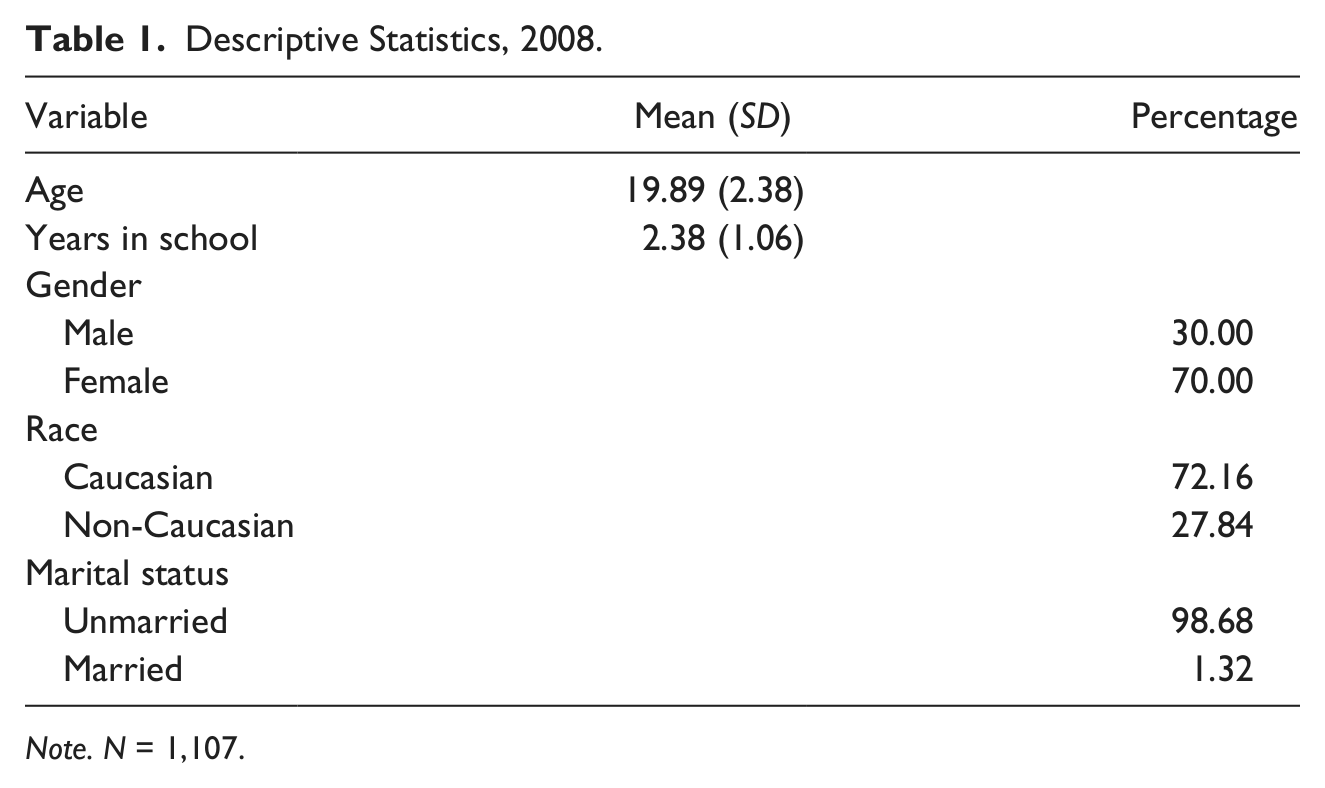
Note. N = 1,107.
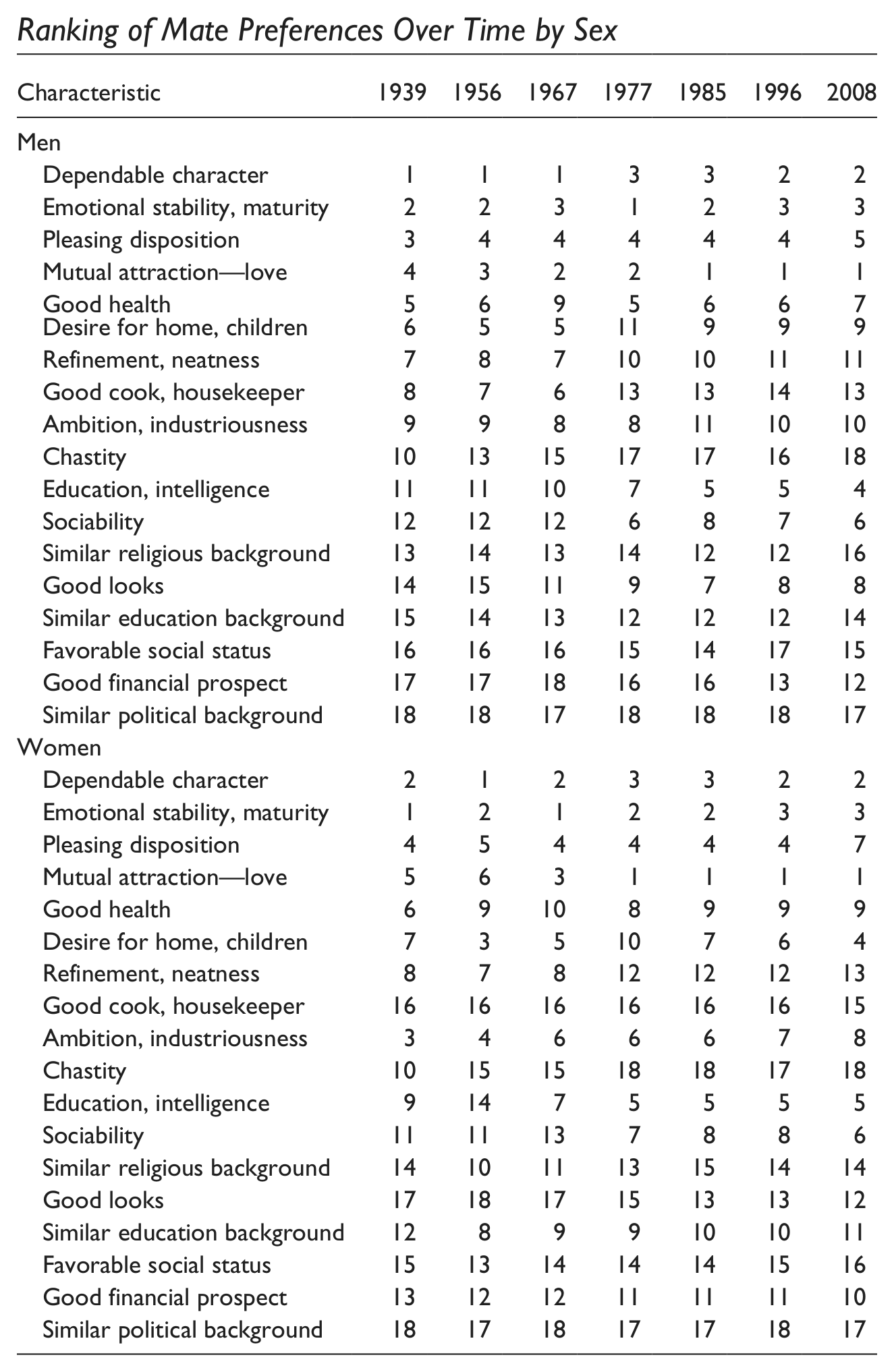
Table 2 displays mean scores and standard deviations for each characteristic listed on the mate preference instrument in our 2008 sample (see Appendix B for the characteristics’ rank-orderings by gender, from 1939 through 2008). Significant between-sex differences are denoted with an asterisk. Since our core hypotheses concern change in mate preferences over the past three decades, we focus our discussion of the 2008 results in context of the results from the earlier studies.
Descriptive Results on 2008 College Students’ Mate Preferences, by Gender.
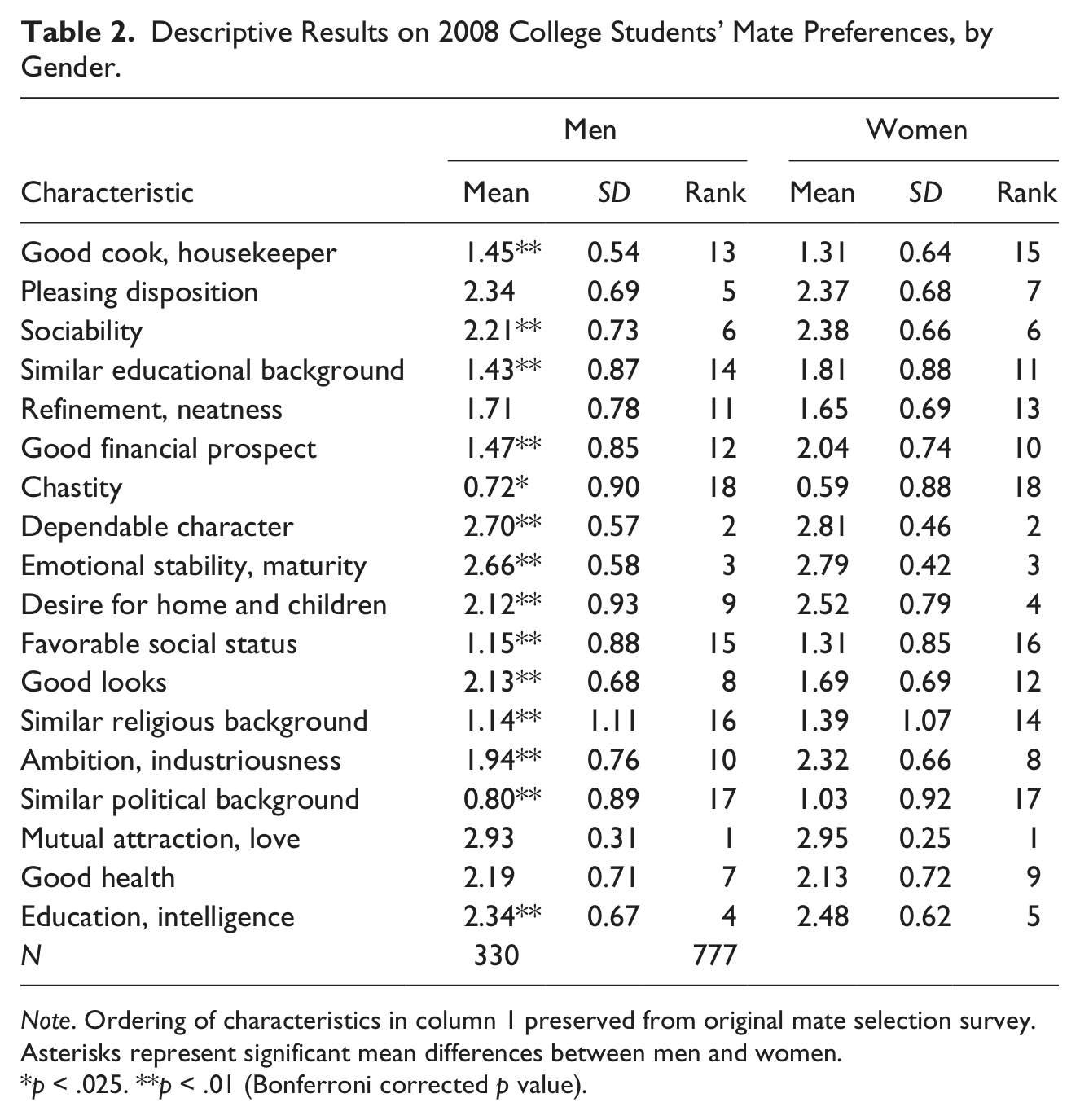
Note. Ordering of characteristics in column 1 preserved from original mate selection survey. Asterisks represent significant mean differences between men and women.
p < .025. **p < .01 (Bonferroni corrected p value).
Table 3 (men) and Table 4 (women) show the means and standard deviations of each characteristic from Buss et al.’s 1985 and 1996 samples (reproduced from Buss et al., 2001) and our 2008 sample. Hypothesis 1a—that men’s valuation of “good financial prospect” in a marriage partner would increase over time—was partially supported. Mean difference tests revealed a significant increase in men’s average rating of “good financial prospect” between the 1985 and the 1996 waves (see Table 2; 1.02 and 1.42, respectively; t = 6.06, p < .001), but no statistical change between the 1996 and 2008 waves (1.42 and 1.47, respectively).
Means, Standard Deviations, and t Tests From the 1985, 1996, and 2008 Samples of Men.
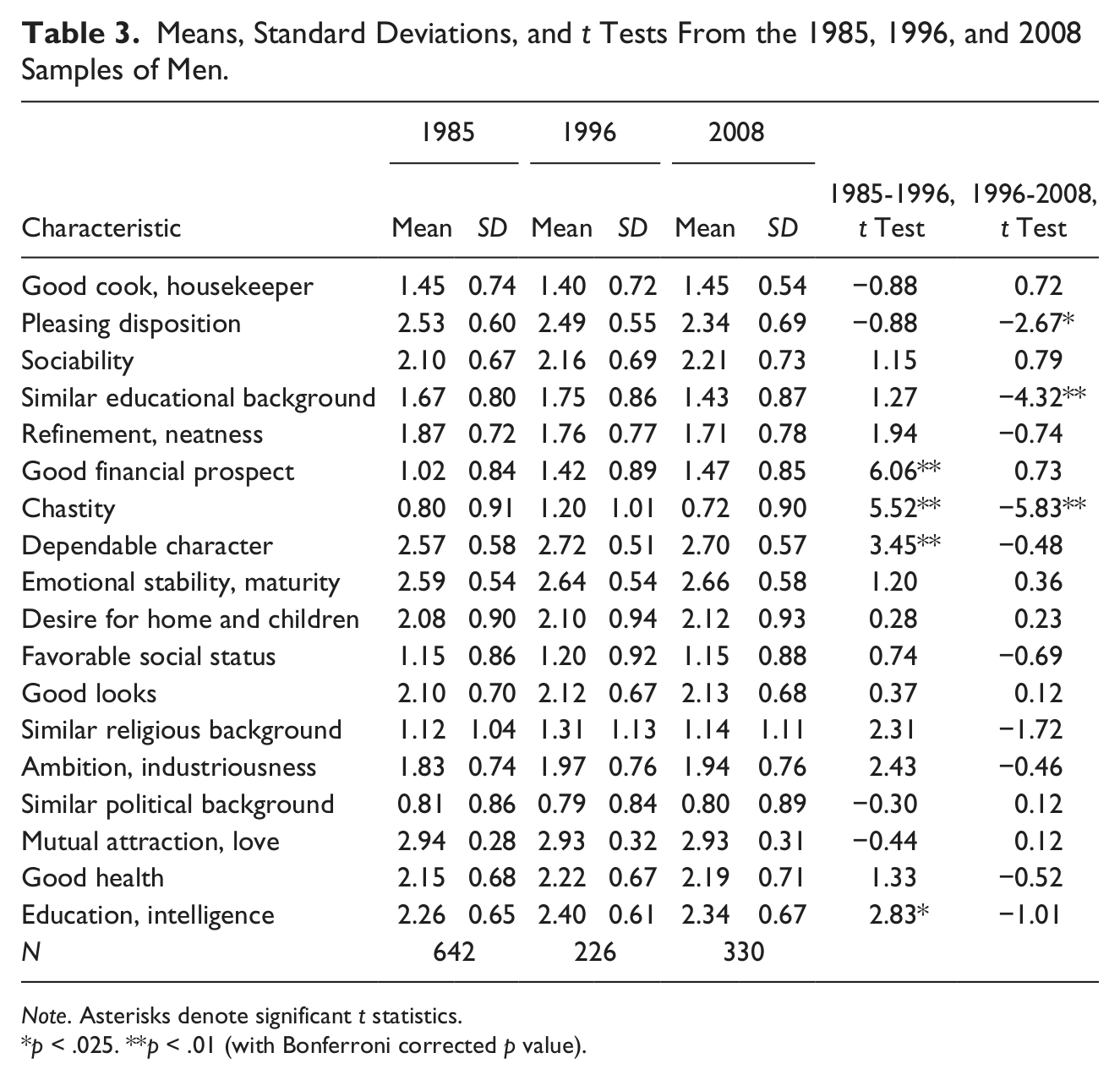
Note. Asterisks denote significant t statistics.
p < .025. **p < .01 (with Bonferroni corrected p value).
Means, Standard Deviations, and t Tests From the 1985, 1996, and 2008 Samples of Women.
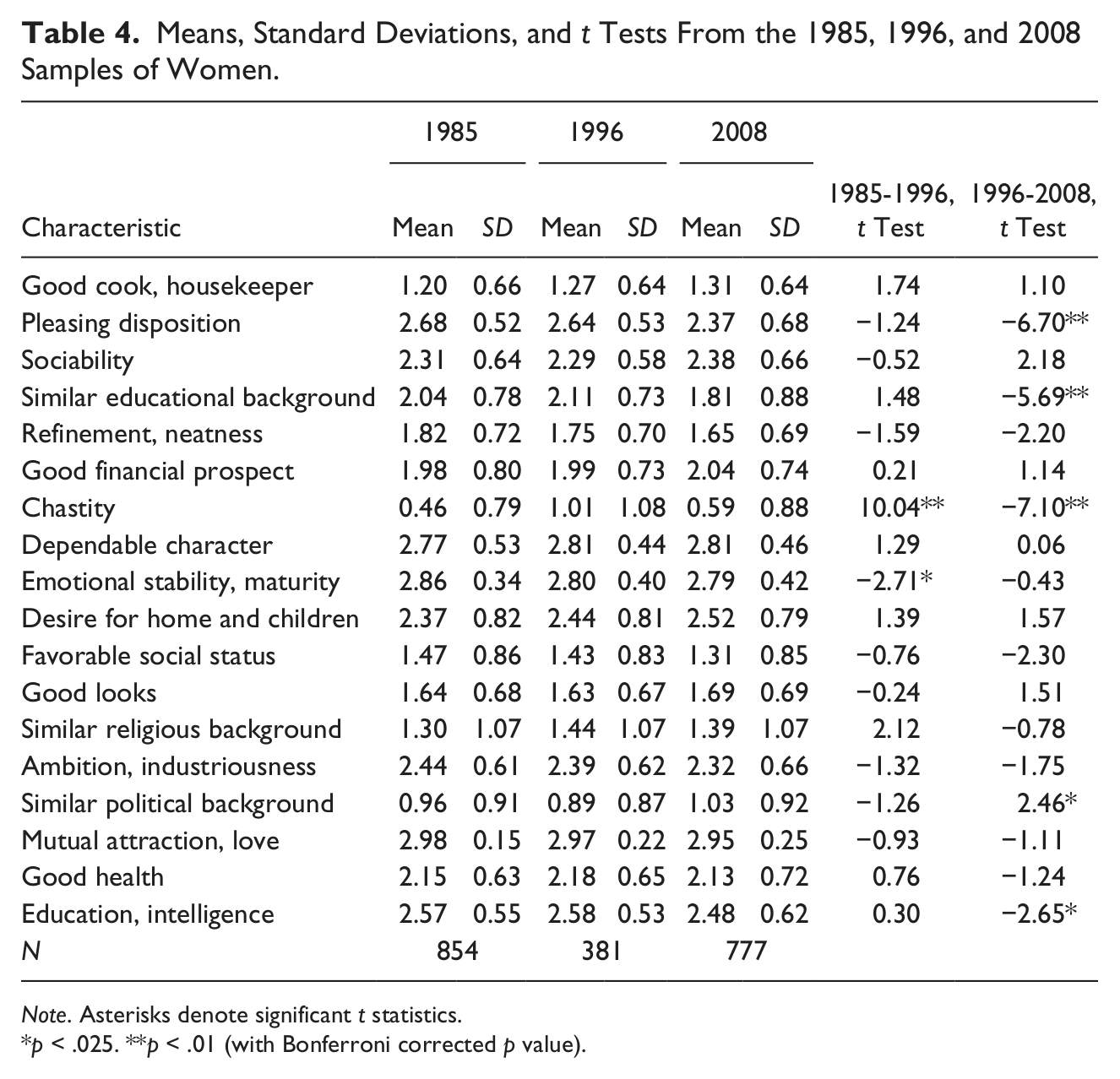
Note. Asterisks denote significant t statistics.
p < .025. **p < .01 (with Bonferroni corrected p value).
Hypothesis 1b—that women’s valuation of the characteristics “good cook and housekeeper” and “desire for home and children” would increase over time—was not supported. Although the mean value for these characteristics did increase, there was no statistically significant change in women’s valuation of “good cook and housekeeper” from 1985 to 1996 (1.20 to 1.27), nor from 1996 to 2008 (1.31). The same is true of women’s valuation of “desire for home and children.” This characteristic had a mean value of 2.37 in 1985, 2.44 in 1996, and 2.52 in 2008 (t = 1.40 and 1.57, respectively).
Finally, Hypothesis 1c was not supported. Women’s average valuation of “good financial prospect” in 2008 (2.04) relative to 1996 (1.99; t = 1.14) is not statistically different, nor is the change in women’s averages in 1996 and 1985 (1.98; t = 0.02). This finding—that women’s valuation of her partner’s financial prospects remains stable over the past three decades—seems to support evolutionary psychology predictions over those from social role theory, namely, that more resources are better than fewer.
Limitations of Mate Selection Survey
The lack of support for some of our hypotheses may stem from methodological issues with the mate selection instrument itself. Although this instrument allows for historical comparisons and analyses of changing social trends across cohorts, we believe that current research using this instrument has limited utility. We discuss these issues and concerns in this section.
First, several of the 18 characteristics are conjunctions, such as “good cook and housekeeper” and “emotional stability and maturity” (italics added). Buss et al. (2001) noted this issue and proposed separating characteristics phrased as conjunctions because they may in fact represent two distinct characteristics. There are seven conjunctions in the list of 18 mate characteristics, which suggests that nearly 40% of the mate preferences instrument is in fact double-barreled response options. It may be more desirable for a mate selection instrument to separate these pairings and use the terms as items in short scales assessing the underlying construct represented by the conjunction (i.e., “ambition and industriousness” could be written as individual items assessing the construct of “power”).
Second, some of the items are ambiguous or outdated. In fact, Buss et al. (2001) suggest that the intended meaning of some of the characteristics used in the survey may indeed be ambiguous, such as “emotional stability” or “refinement, neatness.” As we see in the current version of the mate selection instrument (see Appendix A), there is a parenthetical clarification added to the term chastity. This clarification was not included in the original 1939 administration of this survey, which implies the lack of conceptual clarity. Other characteristics, such as “favorable social status or rating,” reflect outdated terminology or social norms. In her 1988 book on courtship in the 20th century, Beth Bailey explains that this “favorable rating” characteristic refers to a 1930s “system” of rating men and women’s popularity, and therefore desirability as a mate (Bailey 1988, p. 26). This rating system permeated college campus throughout the 1930s and 1940s, complete with letter “grades” to indicate popularity status. Other characteristics, such as “good cook and housekeeper,” reflect more traditional gender role attitudes that are less prevalent in the 21st century and are therefore less useful in determining mate preferences today than in 1939.
Finally, preference studies are limited by the apparent disconnect between consciously articulated preferences (as we present here) and people’s actual dating and marriage choices. Preference studies are generally plagued by the attitude–behavior link, which remains unsubstantiated in studies that compare respondents’ stated preferences to their dating decisions (e.g., Eastwick & Finkel, 2008). This limitation does not, however, negate the value of studying individuals’ preferences for mates. Such preferences highlight those characteristics that are most culturally valued and provide a “snap shot” of the type of mental representations that accompany the institution of marriage.
Analysis Part 2
To begin to address the methodological limitations of the mate selection instrument used in our first analysis, we collected open-ended mate preference responses. Allowing respondents to write-in three of their own preferences rather than evaluate a list of predetermined characteristics provides insight to what young, marriage-aged people consider the most desirable aspects of potential mates.
Data and Measures
Data for this analysis were collected as part of the overall study described in the quantitative analysis sections. After asking participants to assign discrete numeric values to the 18 items in the original mate selection survey, we asked respondents to list their “top three characteristics” preferred in their ideal partner in three open-ended write-in response fields. We collapsed these volunteered responses across all three write-in fields (i.e., we did not assign a ranking of “1” to the response in the first field, etc.; we treated each of the three responses as equally important).
Since these volunteered responses followed the 18-item list, there is reason to suspect that respondents were primed by the mate selection survey characteristics when supplying their volunteered responses. We examined this potential by recording whether volunteered responses appeared in the original 18-item list, in whole or in part, or were unique (did not appear in the 18-item list). 4 Two thirds of responses were unique responses that did not appear in the mate selection survey list, with the remaining one third replicating mate selection items either in full (22%) or in part (11%). This suggests that the list of 18 mate characteristics may have provided language with which respondents could voice their preferences, but that most supplied unique characteristics that were not present in the mate selection survey.
Not all respondents filled in three characteristics; our total sample yielded a total of 3,435 useable written responses, 978 from males and 2,457 from females. In this analysis, our unit of analysis is the person-response, not the person. It was common for respondents to include more than one characteristic or theme in each write-in response. To fully capture the intent of participants’ responses, we coded up to three distinct characteristics present in each write-in response. For instance, one participant wrote “loving, caring, considerate” as a response to the first write-in item. This response was coded as “caring” (i.e., loving, caring) and as “conscientious” (i.e., the characteristic “considerate” is a descriptor of the “conscientiousness” dimension; we describe the process of assigning each characteristic to a given dimension in the section below). This process was repeated for each of the three write-in responses.
Method
We grouped the volunteered characteristics into themes (or dimensions) indicated by large clusters of identical, similar, or synonymous words or phrases. Two research assistants assigned category labels to the respondents’ volunteered responses based on their interpretation of the respondents’ intention and underlying meaning of the word or phrase. We computed the percentage to which two independent coders agreed in their categorization of responses. Interrater agreement for the volunteered responses was 92%. When the coders disagreed in their categorization of a response, the discrepancy was identified and resolved by the research team.
Response categorization was guided by a codebook the research team developed based on past research studies that use qualitative solicited response coding (e.g., Fletcher, Simpson, Thomas, & Giles, 1999) and personality inventories such as the Big Five Inventory (Goldberg et al., 2006), in addition to language and meaning similarities, dictionary definitions, and synonym lists for the words or phrases supplied by the students in their write-in response. We created emergent categories for write-in characteristics that did not fit into the categories derived using the above-mentioned methods. The codebook themes act as umbrella terms, or latent constructs, described by a list of specific characteristics. For instance, the mate preference theme labeled “caring” is indicated by responses that included the terms affectionate, caring, compassionate, empathetic, generous, kind, love/loving, nurturing, selfless, and supportive. Responses that contained characteristics that appear in the mate selection survey were categorized as indicators for the most logically fitting theme (i.e., “dependable character” from the original mate selection survey is categorized as an indicator of the “conscientiousness” theme). Several categories had fewer than nine similar or identical responses (e.g., appreciation appeared only once by one male respondent) and were therefore labeled according to the particular word or phrase as it appeared (e.g., “appreciates me” was coded as “appreciate”; “good cook” was coded as “cook”).
As mentioned earlier, most respondents wrote-in unique responses that did not appear in the list of 18 mate characteristics, though some respondents used identical or near-identical characteristics to those appearing in the original list of 18. Many respondents listed “mutual attraction and love,” which is identical to the wording of this characteristic in the original 18-item mate selection survey. We coded “mutual attraction and love” responses as two distinct categories—attraction and care—based on our critiques of the mate selection instrument (articulated in Analysis Part 1).
Results
Our qualitative analysis is inductively driven, and as such, we do not test specific hypotheses. In this section, we first present the most popular responses and discuss the level of similarity with the 18 items in the mate selection survey. We then discuss these response categories in terms of the evolutionary psychology and social role perspectives, including gender differences in the frequency of reporting these characteristics.
Table 5 shows the number of times (frequency) each characteristic theme appeared for the total sample and separately by sex. Of the 3,435 coded responses, the theme of caring appeared 600 times and comprised 17% of all write-in responses. More than 50% of all written responses were represented by five characteristic themes: care, likeability, conscientiousness, trust, and intelligence.
Preference Characteristic Categories, Frequencies, and Percentages, 2008.
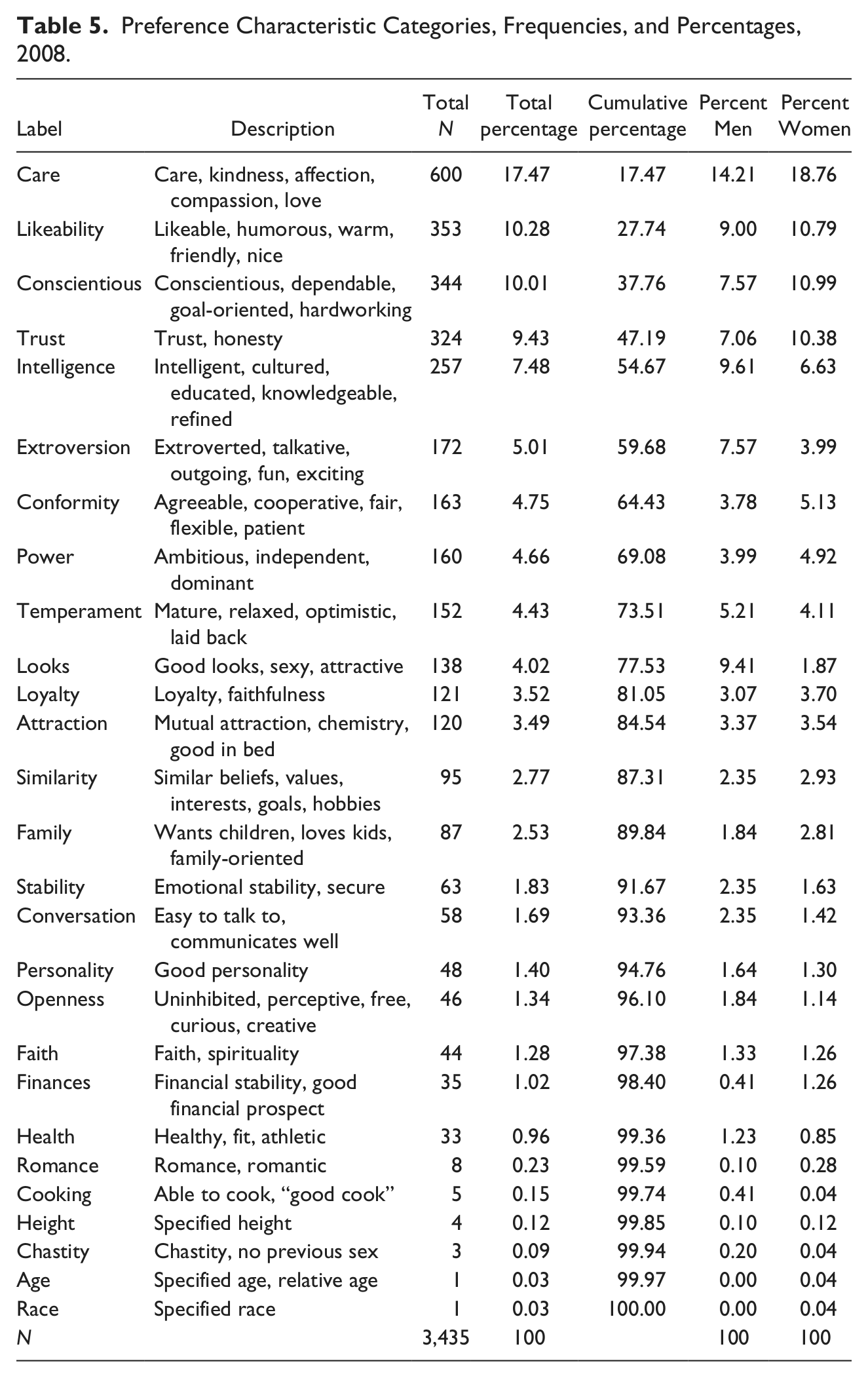
In terms of the care theme, respondents reported “love” far more than any other descriptor within this theme (42% of all responses in this category). This aligns with the trends found in the first part of our analysis and in past mate selection studies. The characteristic “mutual attraction and love,” as it appears in the mate selection survey, reached the rank of #1 in the 1970s for women and in the 1980s for men, and has remained the top most desired mate characteristic since (see Buss et al., 2001). Approximately 14% of men’s responses and 19% of women’s responses indicated some aspect of the care theme as the most desirable characteristic in a mate, which is a statistically significant difference by gender (χ2 = 10.05, p < .01).
The second most popular theme to emerge was likeability, at just over 10% of all responses. Under the theme of likeability, we included characteristics such as “funny” and “sense of humor,” in addition to others such as “nice” and “friendly.” The humor dimension of likeability had the highest volume of responses (81% of responses in this category; results not shown) and is clearly the driving force behind likeability’s high ranking for both genders. Humor comprised 84% of women’s and 71% of men’s responses within the likeability theme. There was a significant gender difference in the frequency of indicating humor within likability (χ2 = 10.59, p < .01). Despite men’s underreporting of humor relative to women within this dimension, likeability is among the top five preferences for both genders. This suggests that a likeable partner, specifically one with a sense of humor, is highly desirable; however, this characteristic is conspicuously absent from the mate selection survey.
The conscientiousness theme comes in as the third most popular preference from our volunteered responses, comprising 10% of all responses. It includes characteristics such as dependable, hardworking, and goal-oriented. Dependability appears on the mate selection survey and has consistently been among men’s and women’s top three mate preferences since the 1930s. In the current study, men indicated this theme significantly less frequently (7.6%) than did women (11%; χ2 = 9.04, p < .01).
Another well-represented characteristic theme was trust, comprising over 10% of all written responses, yet “trust” does not appear in the original mate selection survey. This finding suggests that trust is an important factor in young people’s mate preferences in the 21st century. Trust was indicated in more women’s (10%) than men’s (7%) top most desired characteristics in a marriage partner (χ2 = 9.06, p < .01).
We also found that the intelligence theme—indicated by characteristics such as intelligent, cultured, educated, and knowledgeable—comprised 7% of all write-in characteristics. The conjoined characteristics of “education and intelligence” appear in the mate selection survey list and rank highly among men and women. More men in our sample (9.6%) than women (6.6%) indicated this theme as important in a potential mate (χ2 = 4.27, p < .05). It is interesting to note that “similar educational background” also appears on the mate selection survey but was not indicated by any of our write-in responses. It seems that an assumption of intelligence accompanies the term education in the conjoined mate selection terminology and may be better cast as “educated,” or learned, rather than simply possessing education credentials.
Several other themes emerged from the write-in responses that give us reason to believe that commonly used mate preference measures are at best incomplete. Themes representing loyalty (3.5%), similarity of interests and values (2.8%), communication (1.7%), and openness (1.3%) were all well represented in our data but do not appear in the original mate selection survey. We conducted chi-square test to determine if gender differences in frequency of stating any of the above-mentioned themes exist; we found no significant differences. Another interesting finding from these data is that other characteristics that do appear in the original 18-item list are not well represented in our data. Characteristics such as “good cook and housekeeper” (0.15%) and “chastity” (0.09%) were barely mentioned by our respondents in the write-in response section of our survey, suggesting these characteristics are not topmost among mate preferences.
From an evolutionary psychology perspective, we would expect men to indicate the physical attractiveness of a potential mate more frequently than women, and that is indeed what we find in our qualitative results. The sex differences in reported frequency for the looks dimension (good looks, attractive, sexy) are stark—9.4% of men and only 1.9% of women indicated this theme among their write-in responses (χ2 = 88.95, p < .001). Overall, this theme ranked as the 10th most frequently indicated, which roughly aligns with the 18-item mate selection survey findings, which place “good looks” near the middle of the list. Interestingly, we found evidence of a relatively popular “attraction” theme, indicated by characteristics such as mutual attraction, chemistry, and sexual interaction. Men and women were equally likely to report desiring these characteristics in potential mates (χ2 = 1.36, n.s.).
Similarly, the power theme—indicated by characteristics such as good financial prospect, ambition, dominant, and active—appears in the form of multiple items on the mate selection survey and plays a key role in evolutionary psychology predictions. Women are thought to place greater value on mates with high resource potential and status compared to men; however, we find no significant difference in the frequency with which men and women indicated desiring these qualities in a mate (χ2 = 1.38, n.s.). This theme was the eighth most popularly indicated theme, with 4.7% of all write-in responses.
From a social role perspective, we would expect men to indicate desire for a mate who fulfills traditionally feminine roles within the partnership, such as tending to domestic and child care duties. The family theme in our qualitative data was the 14th most frequently indicated and encompassed characteristics such as desire for home and children (from the original mate selection survey), loves kids, and family-oriented. As with our quantitative analysis, more women (2.8%) than men (1.8%) indicated desire for these qualities in a potential mate; however, this difference was not statistically significant (χ2 = 2.66, n.s.).
Discussion
In this article, we examine the value of mate preference characteristics in light of important social changes throughout the late 20th and early 21st centuries. Data from 2008 college students partially support our sex-differentiated hypotheses. Men place more value on a potential mate’s financial prospects now than in the past, but this increase was only statistically significant between the 1985 and 1996 samples. The increase did not reach statistical significance between 1996 and 2008. Women do not place more value on “good cook and housekeeper” and “desire for home and children” over time. Likewise, women’s valuation of “good financial prospect” remained consistent across time periods, which supports an evolutionary perspective more so than a social role perspective.
In Analysis 2, we use write-in responses to an open-ended mate preferences question to identify a series of latent constructs representing various themes of mate preferences and then compare these themes with those in the mate selection survey. We find evidence of several important emergent themes of mate preferences that do not appear in the original 18-item characteristic list (e.g., humor, trust, loyalty).
Conclusion
It is important for mate preference researchers to better understand what themes underlie mate selection processes because of the potentially far-reaching outcomes that result. Preferences are fundamental to social and behavioral organization. They act as structurally defined cognitive schemas that represent our social, cultural, and personal understanding of interpersonal relationships. Mate preferences give us a gauge of what ideal marriage partners—and ideal marriages—“look” like to members of our culture. The expectations of the marriage relationship itself can be gauged by examining the types of qualities people find most desirable in potential mates.
It is important to study preferences with not only cross-sectional data, as we have done in these analyses, but also with longitudinal data. Long-term romantic partnerships may affect a person’s parental status, financial situation or class status, mental and physical health outcomes, work/career outcomes, and even friendships and other relationships (Smock, 2004; Soons, Liefbroer, & Kalmijn, 2009), so it is important to understand the structure of mate preferences before and after individuals embark on these relationships. Unfortunately, data that include information on individuals’ mate preferences as well as eventual mate characteristics do not yet exist outside of proprietary organizations, such as online dating websites.
Mate preference research has not escaped the trend in psychology over the past few decades of classifying constructs at increasing levels of abstraction, using as few constructs as possible to explain variation in preferences (e.g., Shackelford et al., 2005). Reducing a rich and complex process—such as choosing a romantic partner or parent to one’s children—to a few key indicators misses the opportunity to uncover new patterns in preference desirability. This is especially important as gender roles and attitudes change over time.
It is also essential that the concepts and language by which we measure mate preferences are clear. For ease of reference, the term mate is used throughout this literature to presumably stand-in for the more cumbersome, yet more precise, descriptor of “long-term intimate partner.” Since marriage is not a prerequisite for mating, the continued use of this term is somewhat misleading and technically inaccurate. The use of the term mate may derive from the biological underpinnings of the evolutionary psychology perspective, since it is primarily concerned with the practical realities of evolved gene dissemination processes, but the social reality of long-term partnering is more complex than this term suggests. Also, biological mating is limited to heterosexual male and female pairings, so the use of this term in preference research tacitly excludes nonheterosexually identified respondents. Research suggests that men’s and women’s preferences in a short-term partner (one-night stand) are less stringent then for long-term relationships (marriage partners), so it seems necessary to specific the type of relationship we are assessing (Feingold, 1990) and to be mindful of unintended exclusion by our choice of language.
If scholars can better assess mate preferences, we can further understand the process of mate selection in several important ways. Knowing what people desire in a mate can help describe and predict current and future dating, marriage, and divorce trends; determine the relative importance of stated preferences to actual mating behaviors; and inform current theories of mate selection processes. More comprehensive measures and longitudinal research designs could address the question of whether people actually “know” their preferences (Eastwick & Finkel, 2008). Greater precision in preference assessment may also allow for testing of the nonconscious, automatic processes involved in mate selection for comparison with the self-report data commonly collected in preference studies, and yield data more suitable for testing a variety of theoretical perspectives. In sum, more work is needed to examine the role of adults’ preferences before they are married to determine how, when, and whether preferences act as behavioral guides for initiating romantic partnerships.
Footnotes
Appendix A
Appendix B
Ranking of Mate Preferences Over Time by Sex
| Characteristic | 1939 | 1956 | 1967 | 1977 | 1985 | 1996 | 2008 |
|---|---|---|---|---|---|---|---|
| Men | |||||||
| Dependable character | 1 | 1 | 1 | 3 | 3 | 2 | 2 |
| Emotional stability, maturity | 2 | 2 | 3 | 1 | 2 | 3 | 3 |
| Pleasing disposition | 3 | 4 | 4 | 4 | 4 | 4 | 5 |
| Mutual attraction—love | 4 | 3 | 2 | 2 | 1 | 1 | 1 |
| Good health | 5 | 6 | 9 | 5 | 6 | 6 | 7 |
| Desire for home, children | 6 | 5 | 5 | 11 | 9 | 9 | 9 |
| Refinement, neatness | 7 | 8 | 7 | 10 | 10 | 11 | 11 |
| Good cook, housekeeper | 8 | 7 | 6 | 13 | 13 | 14 | 13 |
| Ambition, industriousness | 9 | 9 | 8 | 8 | 11 | 10 | 10 |
| Chastity | 10 | 13 | 15 | 17 | 17 | 16 | 18 |
| Education, intelligence | 11 | 11 | 10 | 7 | 5 | 5 | 4 |
| Sociability | 12 | 12 | 12 | 6 | 8 | 7 | 6 |
| Similar religious background | 13 | 14 | 13 | 14 | 12 | 12 | 16 |
| Good looks | 14 | 15 | 11 | 9 | 7 | 8 | 8 |
| Similar education background | 15 | 14 | 13 | 12 | 12 | 12 | 14 |
| Favorable social status | 16 | 16 | 16 | 15 | 14 | 17 | 15 |
| Good financial prospect | 17 | 17 | 18 | 16 | 16 | 13 | 12 |
| Similar political background | 18 | 18 | 17 | 18 | 18 | 18 | 17 |
| Women | |||||||
| Dependable character | 2 | 1 | 2 | 3 | 3 | 2 | 2 |
| Emotional stability, maturity | 1 | 2 | 1 | 2 | 2 | 3 | 3 |
| Pleasing disposition | 4 | 5 | 4 | 4 | 4 | 4 | 7 |
| Mutual attraction—love | 5 | 6 | 3 | 1 | 1 | 1 | 1 |
| Good health | 6 | 9 | 10 | 8 | 9 | 9 | 9 |
| Desire for home, children | 7 | 3 | 5 | 10 | 7 | 6 | 4 |
| Refinement, neatness | 8 | 7 | 8 | 12 | 12 | 12 | 13 |
| Good cook, housekeeper | 16 | 16 | 16 | 16 | 16 | 16 | 15 |
| Ambition, industriousness | 3 | 4 | 6 | 6 | 6 | 7 | 8 |
| Chastity | 10 | 15 | 15 | 18 | 18 | 17 | 18 |
| Education, intelligence | 9 | 14 | 7 | 5 | 5 | 5 | 5 |
| Sociability | 11 | 11 | 13 | 7 | 8 | 8 | 6 |
| Similar religious background | 14 | 10 | 11 | 13 | 15 | 14 | 14 |
| Good looks | 17 | 18 | 17 | 15 | 13 | 13 | 12 |
| Similar education background | 12 | 8 | 9 | 9 | 10 | 10 | 11 |
| Favorable social status | 15 | 13 | 14 | 14 | 14 | 15 | 16 |
| Good financial prospect | 13 | 12 | 12 | 11 | 11 | 11 | 10 |
| Similar political background | 18 | 17 | 18 | 17 | 17 | 18 | 17 |
Declaration of Conflicting Interests
The author(s) declared no potential conflicts of interest with respect to the research, authorship, and/or publication of this article.
Funding
The author(s) received no financial support for the research, authorship, and/or publication of this article.