




Abstract
This study examined the relationship between racial discrimination by peers (RDPS) and aggression across 1 year through the mediation of insecurity regarding peer status (i.e., social status insecurity [SSI]) among Latinx adolescents who were part of a school in which they were (a) the majority, (b) the minority, or (c) part of the majority. Participants were 606 Latinx adolescents (60% girls; M = 14.36 years, SD = 0.46 years). RDPS was positively associated with SSI for minority and part-of-the-majority adolescents. For part-of-the-majority adolescents, SSI was positively associated with self-reported aggression and peer-nominated overt aggression. Only SSI and self-reported overt aggression were associated for majority adolescents. Aggressive behaviors were associated with SSI among minority adolescents. SSI mediated the association between RDPS and aggression for minority adolescents. For part-of-the-majority adolescents, self-reported overt aggression and RDPS were mediated by SSI. These findings indicate that RDPS affects minority and part-of-the-majority adolescents’ insecure feelings regarding their peer status, which contributes to aggressive behaviors 1 year later.
Keywords
Representing the fastest growing group of youth in the United States (U.S. Census Bureau, 2016), Latinx adolescents are hindered by a social climate with increasing intolerance and discrimination directed toward them by their peers (Seaton, Neblett, Cole, & Prinstein, 2013). Researchers usually focus on how racial discrimination relates to academic achievement, with less attention given to understanding its association with adolescents’ peer relationships (Wang & Huguley, 2012). However, understanding this relationship is important because racial discrimination by peers might result in some adolescents developing insecure feelings concerning their social standing among their peers, which could lead these adolescents to lash out with aggressive behaviors (Grant et al., 2006). Good peer relationships are linked to academic success (Butler-Barnes, Estrada-Martinez, Colin, & Jones, 2015; Liem & Martin, 2011). To this end, the present longitudinal study examined the relationship between racial discrimination by peers and aggression through the mediation of insecurity regarding peer status (i.e., social status insecurity) among Latinx adolescents who were enrolled in a school in which they were (a) the majority, (b) the minority, or (c) part of the majority. It is important to focus on the experiences of Latinx adolescents, given their status as one of the fastest growing minority groups. Despite being one of the fastest growing minority groups in the United States, little is known about how these adolescents’ concerns about status might influence the association between racial discrimination by peers and aggression. Given the importance of peer relationships in adolescence and the prominence of peer status and aggressive behaviors, it is imperative for researchers to consider the experiences of Latinx adolescents’ insecurity with their social standing, as such a concern might influence their aggressive behaviors, especially when they perceive discrimination by their peers.
Racial Discrimination by Peers and Aggression
Defined as receiving unfair, differential treatment based on race or ethnicity, ethnic or racial discrimination is experienced by ethnic minority children and adolescents in the United States (Szalacha et al., 2003; Williams, Neighbors, & Jackson, 2003). A growing body of literature suggests that ethnic or racial discrimination is also experienced daily by some ethnic minority adolescents, including Black, Latinx, and Asian American adolescents (Fisher, Wallace, & Fenton, 2000; Rosenbloom & Way, 2004). These adolescents not only experience frequent racial or ethnicity-based verbal and physical aggression from peers but also encounter low expectations from adults regarding their employment and education opportunities. For example, one study revealed that 57% of Black, Latinx, White, East Asian, and South Asian adolescents were called racially insulting names by peers, 31% were threatened by their peers due to their race or ethnicity, and 42% believed that they received lower grades in school based on their race or ethnicity (Fisher et al., 2000). In addition, Black, Latinx, and Asian adolescents reported that they experienced ethnic and racial discrimination in and outside of school (Rosenbloom & Way, 2004). Prior research has revealed that almost half of Latinx adolescents in some studies reported racial discrimination, that 47% worried about being discriminated against, and that 12% reported daily incidents of discrimination perpetrated by adults (Huynh & Fuligni, 2010; Szalacha et al., 2003). Furthermore, 76% of Mexican-descent adolescents were exposed to at least one experience of racial discrimination at school (Edwards & Romer, 2008). In a more recent study, Flores, Tschann, Dimas, Pasch, and de Groat. (2010) found that 94% of Mexican American adolescents experienced at least one incident of racial discrimination, with 21% experiencing frequent discrimination in their schools. Of particular importance to this study is Latinx adolescents perceived racial discrimination by peers in school.
Due to the prevalence of discrimination in the United States, Garcia Coll et al. (1997) developed an integrative ecological model for helping to explain the development of ethnic minority children. In their model, they emphasized the importance of studying discrimination as “unique ecological circumstances” for children and adolescents of color. Their model attempted to account for how experiences of discrimination, racism, prejudice, and segregation affect various contexts of development, such as their neighborhoods and schools. Consequently, the model incorporates how experiences of discrimination, racism, prejudice, and segregation affect well-being. Research on this topic revealed that there is an association between perceived discrimination and adolescents’ poorer psychological functioning and that there are various moderators in these associations (Caldwell, Kohn-Wood, Schmeelk-Cone, Chavous, & Zimmerman, 2004; Fisher et al., 2000; Wong, Eccles, & Sameroff, 2003). Furthermore, some of the research using this model has focused on examining the correlates of perceived discrimination by adults separate from perceived discrimination by peers (Fisher et al., 2000; Phelan, Yu, & Davidson, 1994).
Investigating perceived discrimination among adolescents is important as their increasing cognitive abilities enable them to reflect on their experiences and their role within the larger society. Adolescents also become increasingly exposed to the social world, which might increase their experiences with discrimination (Phinney & Chavira, 1995). Within the academic setting, ethnic and racial discrimination by peers and adults are associated with greater depressive symptoms both concurrently and longitudinally among Latinx and Asian American adolescents (Greene, Way, & Pahl, 2006; Hwang & Goto, 2008; Stein, Gonzalez, & Huq, 2012). Discrimination also reduces adolescents’ sense of connection and belonging to their school, which reduces their persistence, academic performance, and engagement (Degarmo & Martinez, 2006; Martinez, DeGarmo, & Eddy, 2004; Roche & Kuperminc, 2012). Not only is racial discrimination associated with internalizing problems, it is also related to externalizing behavior, such as aggression, with such associations increasing during adolescence (Grant et al., 2006). Taken together, these studies indicate that racial discrimination affects adolescents’ overall quality of life by increasing both psychosocial adjustment problems and academic adjustment and performance.
Social Status Insecurity and Aggression
As children enter adolescence, many become concerned with their social standing among their peers. When competition increases for peer status during adolescence, many adolescents might develop concerns or insecure feelings about their social standing among their peers (i.e., social status goals; LaFontana & Cillessen, 2002). Some adolescents might be concerned that their peer status is not as high as they want or that their status is threatened by their peers. Therefore, social status insecurity regarding one’s peer status might be experienced by adolescents, no matter their social standing (Li & Wright, 2014). For example, higher peer status might lead these adolescents to experience competition for popularity or peer liking, which increases their insecurity regarding their status, whereas adolescents with lower peer status might feel insecure due to feeling that their social standing is not as high as they want as they might be rejected or considered unpopular. Research theorizes that concern about peer status could lead some adolescents to defend or promote their status by utilizing aggressive behaviors (Sijtsema et al., 2009). Recent research has linked adolescents’ social status insecurity to overt and relational aggression (Li, Wang, Wang, & Shi, 2010; Li & Wright, 2014).
Despite recent findings in the literature, little attention has been given to the predictors of social status insecurity. It is important to understand the factors that predict social status insecurity because these behaviors are linked to a variety of aggressive behaviors, which can disrupt the academic experience of adolescents. One proposed predictor might be perceived racial discrimination by peers. Given that the social world of adolescents increases in importance, the likelihood of experiencing racial discrimination by peers could also increase, triggering insecure feelings regarding their social standing in the peer group, leading to reduced connections and belongingness to their school (Roche & Kuperminc, 2012). Therefore, the diminishing of adolescents’ connections and belongingness to their school also applies to the peer group, producing social status insecurity, and leading to aggressive behaviors.
School Ethnic Contexts
The school context is important for understanding racial and ethnic discrimination (Grossman & Liang, 2008; Qin, Way, & Mukherjee, 2008). It is especially important for explaining why ethnic minority students might be targeted by peers in a specific school setting. Ample evidence suggests that school ethnic composition influences adolescents’ sense of belonging (Aboud, Mendelson, & Purdy, 2003; Graham & Cohen, 1997). Overall, adolescents feel a stronger connection to their middle and high schools when a proportion of their peers have the same race/ethnic background as them (Benner, Graham, & Mistry, 2008; Postmes & Branscombe, 2002).
Students who are the numerical minority may lack power and prominence within the peer group based on their low representation within the school with little ethnic diversity (Graham & Juvonen, 2002). Consequently, students who are the numerical minority might be targeted more frequently for negative behaviors by their peers from the majority group. In addition, schools with more ethnic diversity might reduce ethnic minority students’ risk of victimization. Adolescents from these schools report that they feel safe and less victimized by their peers, have lower levels of psychosocial and academic difficulties, and have more adaptive attributions following peer victimization (Bellmore, Witkow, Graham, & Juvonen, 2004; Graham, Bellmore, Nishina, & Juvonen, 2009; Juvonen, Nishina, & Graham, 2006). More adaptive attributions following peer victimization reduce negative psychosocial difficulties and can disrupt the cycle of victimization (Graham et al., 2009). It is unclear whether school ethnic composition might affect adolescents’ social status insecurity, and how such exposures influence their aggressive behaviors.
The Present Study
The aim of this study was to investigate the potential mediating effect of social status insecurity in the association between racial discrimination by peers and aggression among Latinx adolescents. These adolescents were from one of three different school compositions in which they were (a) the majority, (b) the minority, or (c) part of the majority. Considering the research on school ethnic composition, it was expected that racial discrimination by peers would relate to social status insecurity among Latinx adolescents from schools in which they were the minority or part of the majority, and that their social status insecurity would relate to relational and overt aggression. Such patterns were not expected among Latinx adolescents who were the majority. Therefore, the following hypothesis was developed for the present research:
Method
Participants
There were 606 adolescents (60% girls) from three public middle schools in the Midwestern United States included in this study. Participants were in the eighth grade, with ages ranging from 13 to 15 years (M = 14.36 years, SD = 0.46 years). Adolescents were from one of three schools in which they were the majority (84% Latinx population, n = 203), the minority (10% Latinx population, n = 202), or part of the majority (43% Latinx population, n = 201). Schools were specifically selected based on state-level data concerning the percentages of different race and ethnicity compositions in the schools. In the state-level report of schools, Latinx students represented roughly 26% of students, 47.8% for White students, 0.2% for American/Indian/Alaskan Native, 0.08% for Native Hawaiian/Other Pacific Islander, 2.6% for Asian, 3.8% for two or more races, and 19.8% Black/African American (Illinois State Board of Education, 2018). In our sample, Latinx adolescents made up 10% of adolescents at one school, yielding the classification of minority status, as they made up less than 26% of students across the state. Part of the majority represented Latinx adolescents who were roughly similarly represented as White students, who make up the majority of students in the state. Latinx adolescents made up 43% of our sample at one school in comparison with 44% White adolescents, yielding the classification of part of the majority for these adolescents. The classification of majority involved Latinx adolescents in a school in which they were represented more than White students and non-Latinx, non-White students. For our sample, these adolescents represented 85% of students at their school, whereas White students included 10% of students. All participants self-reported as Latinx, and they indicated that their families were from Mexico (80%), Puerto Rico (10%), Guatemala (5%), and other (5%), including Argentina, Brazil, and Paraguay. Most of the participants were second-generation students (88%), followed by first generation (10%) and born outside of the United States (2%). Their families were from predominantly lower or middle-class socioeconomic status backgrounds. About 61% of students at adolescents’ schools were eligible for free or reduced-priced lunch.
Procedures
The schools were identified based on demographic information. We were specifically interested in schools in which Latinx adolescents were the majority, the minority, or part of the majority. Consequently, six middle schools that fit this requirement were selected from a list of more than 150 public schools in the suburbs of a large Midwestern city. These schools were also selected because the seventh-grade classrooms were similar in size, approximately 330 students per school in the seventh grade. A letter was sent to the school principal, and three school principals expressed their desire to have their school participate in the study. Classroom announcements were made to all seventh-grade classrooms to explain the importance of participation and what adolescents would be expected to do. No compensation was offered for participating in the study. Approximately 803 Spanish language and English language parental permission slips were passed out to adolescents. There were 723 parental permission slips returned, with 70 parents not allowing their child to participate. Wave 1 data collection occurred in the fall of seventh grade. Nine adolescents were absent at Wave 1 data collection and were not available on the makeup day at their school. Before completing the questionnaires, adolescents gave their assent. All adolescents agreed to participate in the study. They completed questionnaires in the following order: demographic information (i.e., gender, age, ethnicity), peer-nominated aggressive behaviors, self-reported aggressive behaviors, social status insecurity, and racial discrimination by peers. Wave 1 data collection included 639 seventh-grade adolescents.
Wave 2 data collection occurred during the fall of eighth grade. Before data collection, a letter was sent home in the English language and Spanish Language to adolescents’ parents. The letter reminded parents about their child’s participation in the study a year prior. It also asked parents to write their child’s name on the letter and return it to their child’s school if they no longer wanted their child to participate in the study. No letters were returned to school. However, there were 33 adolescents who had moved away or were absent on the days of data collection. At Wave 2, 606 adolescents completed questionnaires on their peer-nominated and self-reported aggressive behaviors.
Measures
Peer-nominated aggressive behaviors
The peer-nominated aggressive behaviors questionnaire assessed peer-nominated relational aggression and overt aggression (Crick & Grotpeter, 1995). Four items assessed relational aggression (e.g., “peers who when mad, get even by keeping the person from being in their group of friends”) and three items assessed overt aggression (e.g., “peers who start fights”). Before completing this questionnaire, adolescents received an ID code sheet. After reading an item, adolescents recorded the ID code that corresponded to the name of a peer who fit the description. The ID code sheets were collected immediately after an adolescent completed this questionnaire. All nominations were tallied and standardized within classroom and school. The items were then averaged for relational aggression and overt aggression separately. Scores ranged from −2.52 to 9.97 for relational aggression and −2.05 to 8.82 for overt aggression. This questionnaire was administered at Wave 1 and Wave 2. Cronbach’s alphas were .87 for relational aggression at Wave 1, .88 for relational aggression at Wave 2, .86 for overt aggression at Wave 1, and .85 for overt aggression at Wave 2.
Self-reported aggressive behaviors
Adolescents answered questions about their self-reported relational aggression and overt aggression. This questionnaire was adapted from the peer-nominated aggressive behaviors questionnaire (Crick & Grotpeter, 1995). There were five items used to assess relational aggression (e.g., “How often do you keep a peer out of a group of peers because you are mad at the peer?”) and three items for overt aggression (e.g., How often do you start fights with others?”). The items were assessed on a scale of 1 (never) to 5 (all the time). This questionnaire was administered at Wave 1 and Wave 2. Cronbach’s alphas were .90 for relational aggression at Wave 1 and Wave 2, .83 for overt aggression at Wave 1, and .84 for overt aggression at Wave 2.
Social status insecurity
This questionnaire assessed adolescents’ feelings of insecurity regarding their social status and social standing using six items, which were rated on a scale of 1 (never) to 5 (all the time) (Li et al., 2010). Sample items included “I worry that my peers don’t like me,” “I feel that my status among my peers is not high,” and “I worry about my popularity among my peers.” This questionnaire was administered at Wave 1 only. Cronbach’s alpha was .87 for social status insecurity.
Racial discrimination by peers
Three items were used to assess adolescents’ perceived discrimination by peers at school, using the Discrimination by Peers subscale of the Adolescent Discrimination Distress Index (Fisher et al., 2000). A sample item included “Other kids exclude you from their activities because of your race/ethnicity.” Items were rated on a scale of 1 (never) to 5 (a whole lot). This questionnaire was administered at Wave 1 only. Cronbach’s alpha was .79.
Data Analysis
The measurement model was examined using confirmatory factor analysis in Mplus 7.4. The full measurement model included all constructs and each construct was modeled as a single latent variable indicated by the individual items of the constructs. The model fit was adequate, χ2 = 1,679.13, df = 919, p < .001, comparative fit index (CFI) = .97, Tucker–Lewis index (TLI) = .97, root mean square error of approximation (RMSEA) = .04, standardized root mean square residual (SRMR) = .03, and all standardized factor loadings were significant (ps < .001). Such significance indicates that these items reliably assessed the constructs. Three structural equation models were conducted to examine the relationship among social status insecurity, racial discrimination by peers, and peer-nominated and self-reported aggression (relational and overt) across the three school types in which Latinx adolescents were the majority, the minority, or part of the majority. Paths were specified from racial discrimination by peers to social status insecurity as well as from social status insecurity to all forms of aggression, along with indirect paths from racial discrimination from peers to all forms of aggression. To control for Time 1 self-reported and peer-nominated relational aggression and overt aggression, these variables were specified to predict their corresponding self-reported or peer-nominated behavioral type at Time 2.
Results
Before examining the study’s hypothesis, correlations were conducted among all variables (see Table 1). Social status insecurity was related positively to racial discrimination by peers and self-reported and peer-nominated relational and overt aggression. Furthermore, racial discrimination by peers was associated positively with all forms of aggression, except it was not related to peer-nominated overt aggression. Each of the aggression variables was related positively to each of each other.
Correlations Among Social Status Insecurity, Racial Discrimination by Peers, and Self-Reported and Peer-Nominated Relational and Overt Aggression.
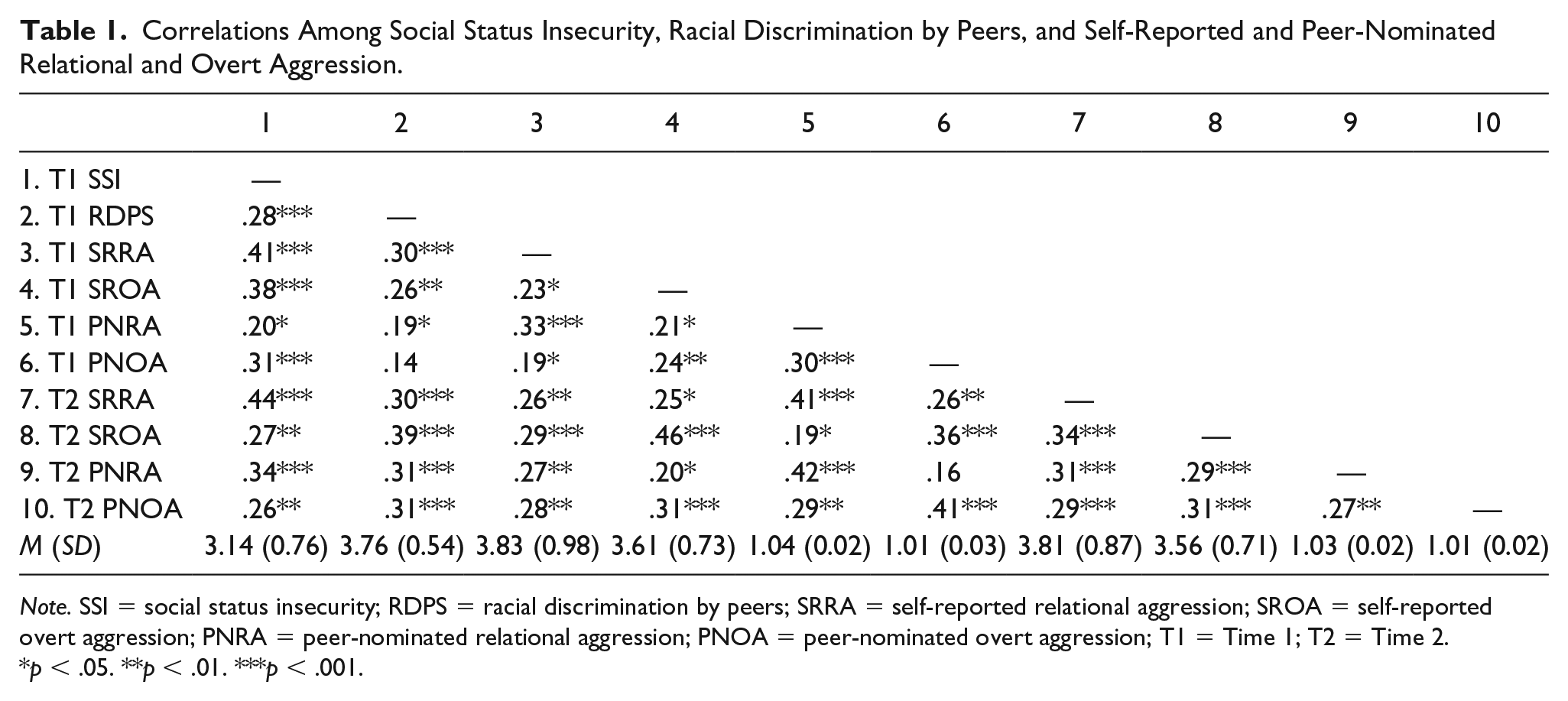
Note. SSI = social status insecurity; RDPS = racial discrimination by peers; SRRA = self-reported relational aggression; SROA = self-reported overt aggression; PNRA = peer-nominated relational aggression; PNOA = peer-nominated overt aggression; T1 = Time 1; T2 = Time 2.
p < .05. **p < .01. ***p < .001.
The results from the structural regression model fit the data adequately (χ2 = 1,680.45, df = 936, p < .001, CFI = .98, TLI = .97, RMSEA = .04, SRMR = .03; see Figure 1). Racial discrimination by peers was positively associated with social status insecurity for minority (β = 0.38, p < .001) and part-of-the-majority adolescents (β = 0.31, p < .001), but these variables were not associated for majority adolescents (β = 0.14, p = n.s.). For part-of-the-majority adolescents, social status insecurity was positively associated with self-reported aggression (β = 0.54, p < .001) and peer-nominated overt aggression (β = 0.58, p < .001). However, only social status insecurity and self-reported overt aggression were associated for majority adolescents (β = 0.48, p < .001). All forms of aggressive behaviors were associated with social status insecurity among minority adolescents (peer-nominated relational aggression: β = 0.22, p < .001; self-reported relational aggression: β = 0.23, p < .05; peer-nominated overt aggression: β = 0.15, p < .05; self-reported overt aggression: β = 0.46, p < .001). Social status insecurity was related positively to self-reported overt aggression for majority adolescents (β = 0.48, p < .001). In addition, social status insecurity mediated the association between racial discrimination by peers and self-reported overt aggression for minority adolescents (β = 0.08, p < .05). Such a finding indicates that racial discrimination is related to social status insecurity, which is then associated with self-reported overt aggression. For part-of-the-majority adolescents, the relationship between self-reported relational aggression and racial discrimination was mediated by social status insecurity (β = 0.06, p < .05). Thus, racial discrimination was related to self-reported relational aggression through social status insecurity.
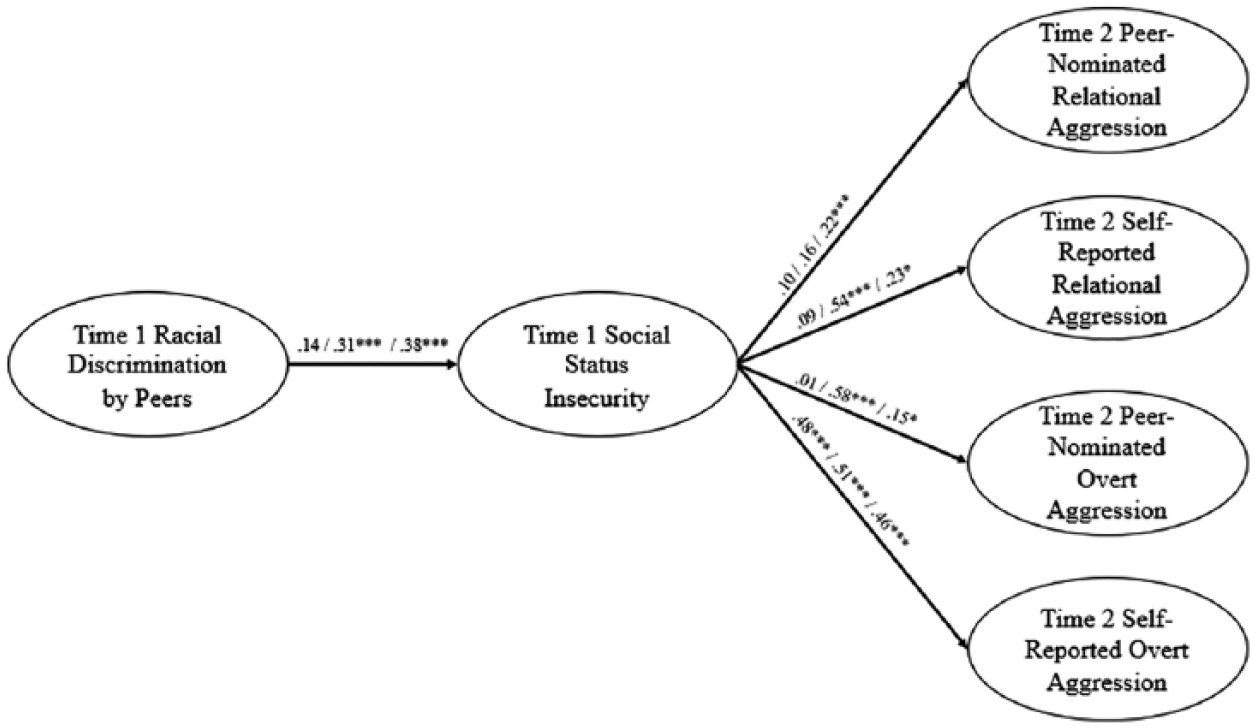
Structural model for the associations among social status insecurity, racial discrimination by peers, and aggression.
Discussion
Racial discrimination has a significant impact on Latinx adolescents’ adjustment and it is perceived as a chronic stressor (Caldwell et al., 2004; Fisher et al., 2000; Wong et al., 2003). Although perceived racial discrimination by peers has received some attention in the literature, little attention has been given to the role of this form of discrimination in adolescents’ confidence in their peer group (i.e., social status insecurity) and how such confidence relates to their perpetration of aggressive behaviors. Furthermore, little attention has been given to the variability in perceived racial discrimination among Latinx adolescents, specifically adolescents from schools with different majority–minority student compositions, and how this variability might influence social status insecurity and their aggressive behaviors. The current study provided a better understanding of how perceived racial discrimination might contribute to Latinx adolescents’ social status insecurity and aggressive behaviors. This study addresses a gap in the literature concerning Latinx adolescents’ insecurity with their status among the peer group and how school composition might influence such insecurities.
Findings from the present study revealed that perceived racial discrimination by peers was associated with social status insecurity among minority and part-of-the-majority adolescents. Experiencing discrimination by peers can be detrimental during adolescence as greater importance is placed on peer relationships during this period (Greene et al., 2006). Given the potential for adolescents to be concerned with their social standing, minority and part-of-the-majority Latinx adolescents might feel threatened by their peers and experience insecurity with their peer group when they perceive racial discrimination by their peers. This insecurity might increase in school settings where Latinx adolescents are the numerical minority because they might lack power and prominence due to low representation within a school with little ethnic diversity (Graham & Juvonen, 2002). Furthermore, the lack of diversity in the school might lead minority adolescents to be more vulnerable to victimization and feel little connection to their school and peers. The nature of the victimization might be more hostile and extreme in such schools. However, part-of-the-majority adolescents might compete more for social standing with the other majority group at their school (Li & Wright, 2014). Perceived racial discrimination was not associated with social status insecurity among majority Latinx adolescents. Because these adolescents are the majority in their school, they might have different peer experiences than Latinx adolescents who are the minority or part of the majority. Majority Latinx adolescents might be at a diminished risk of perceived racial discrimination by peers, leading them to experience less victimization and feel more secure about their social standing among their peers.
We found that self-reported relational aggression and peer-nominated overt aggression were associated with social status insecurity among part-of-the-majority adolescents. In addition, we found that all forms of aggressive behaviors were related to social status insecurity among minority adolescents. Associations were also found between self-reported overt aggression and social status insecurity for majority adolescents. Such findings are corroborated in other research linking adolescents’ social status insecurity to overt and relational aggression among Chinese and American adolescents (Li et al., 2010; Li & Wright, 2014). Feeling insecure about one’s social standing among their peers might lead adolescents to defend their status by engaging in aggressive behaviors (Sijtsema et al., 2009). Consequently, aggressive behaviors might be a way to inhibit further feelings of threat to their social standing or a way to maintain what social standing these adolescents have remaining. Taken together, our findings might indicate that social status insecurity might trigger aggressive behaviors, regardless of school composition. However, more aggressive behaviors were reported by minority Latinx adolescents when compared with part-of-the-majority and majority Latinx adolescents. Minority Latinx adolescents might experience more social status insecurity, given their numerical minority status at their school, leading them to perpetuate more aggressive behaviors in an effort to defend their status. Furthermore, adolescents’ increasing desire for peer relationships might trigger increased social status insecurity and aggressive behaviors. Therefore, due to their desire to engage in peer relationships, adolescents in all school contexts might be prone to feeling insecure about their social standing and engage in behaviors to defend or maintain their status.
The complex relationships investigated in this study are better understood by examining social status insecurity as a mediator in the relationship between racial discrimination by peers and aggressive behaviors. Social status insecurity mediated the association between racial discrimination by peers and aggressive behaviors among minority and part-of-the-majority Latinx adolescents. In particular, racial discrimination by peers was related to social status insecurity, which was then associated with self-reported overt aggression for minority adolescents and self-reported relational aggression for part-of-the-majority adolescents. It is important to highlight the different type of behaviors that racial discrimination by peers and social status triggered among these adolescents. Limited research is available to reconcile these findings with the current literature. Although both minority and part-of-the-majority adolescents perceive racial discrimination by peers, minority adolescents might actually perceive more incidences of this discrimination. Our findings somewhat support this proposal as the mean of minority adolescents’ perceived discrimination by peers is greater than all other adolescents in our study. Because minority adolescents might experience more frequent victimization, they might feel the need to defend themselves using overt aggression. Victimization might involve less overt aggression in schools with Latinx adolescents who were part of the majority. These adolescents might be in competition for peer group centrality or social standing with the other majority group at their school, leading them to retaliate with relational aggression, which is a behavior typically engaged in by adolescents to promote social standing (Li & Wright, 2014). The differences in these explanations are just proposals, and follow-up research should be undertaken to understand more about differences in peer relationships among adolescents from different school contexts.
Limitations and Research Directions
This study utilized a short-term longitudinal design, which makes it difficult to draw long-term conclusions about the associations. This design also makes it difficult to understand the temporal ordering of the variables examined in this study. Consequently, future research should employ longer term designs, incorporating more waves of data collection to better understanding the mediating role of social status insecurity in the associations between perceived racial discrimination by peers and aggressive behaviors. In addition, we considered overt and relational forms of aggressive behaviors. Adolescents are increasingly connected to the digital world and follow-up research might consider whether the findings of the present study also apply to cyber aggression. The nature of social status insecurity needs further investigation. These investigations should focus on understanding the development of social status insecurity and how it is manifested among children and late adolescents. Although we considered adolescents from various school compositions, it is important for follow-up research to better understand the plight of minority adolescents. We also grouped adolescents based on school composition, which was sufficient for our study’s purpose. However, follow-up research might consider examining whether peer experiences depend on the school composition and how the economic status of the surrounding area of the school might affect these experiences. For instance, being part-of-the-majority in an urban school might have different implications than being part-of-the-majority in a suburban school. We relied on school reports to recruit Latinx adolescents based on ethnic minority school composition. Although the area surrounding the school was consistent with the ethnic minority composition of these schools, there could be some errors. Therefore, we recommend the use of more reliable assessments of ethnic majority-minority status, such as the procedure proposed by Bellmore et al. (2004).
Conclusion
The present study examined the mediating role of perceived racial discrimination by peers in the associations between social status insecurity and aggressive behaviors among minority, part-of-the-majority, and majority adolescents. Findings from the present study underscore the importance of considering school composition when examining the experience of Latinx adolescents. Our findings indicate that not all Latinx adolescents have the same peer experiences in school and that these experiences affect their confidence in the peer group and their aggressive behaviors. This focus is important because peer relationships and social standing in the larger peer group is important to adolescents and little attention has been given to the Latinx adolescents’ concerns with their peer status. The findings of this research could be used to inform prevention and intervention programs aimed at reducing Latinx adolescents’ insecure feelings in the peer group.
Footnotes
Declaration of Conflicting Interests
The author(s) declared no potential conflicts of interest with respect to the research, authorship, and/or publication of this article.
Funding
The author(s) received no financial support for the research, authorship, and/or publication of this article.
