



Abstract
Alcohol remains readily available to youth in most countries. We examined the associations between both the on- and off-premises commercial availability of alcohol to youth and their alcohol use, heavy episodic drinking, and alcohol-related harms. We conducted the study using data from a survey of a sample of 594 students in central Mexico between 12 and 17 years of age in 2016. Both the perceived availability of alcohol and the purchasing of alcohol at an off-premises establishment were positively related to past-30-day alcohol use and heavy episodic drinking, as well as to alcohol-related harms in the past year. Consumption at on-premises establishments was also positively associated with alcohol-related harms. Preventive efforts to reduce the availability of alcohol at off- and on-premises establishments, by such strategies as mystery shopper and responsible beverage service programs, are imperative.
Alcohol use, which accounts for almost one third of all deaths of males aged 15 to 29 years in developed countries (Toumbourou et al., 2007; World Health Organization, 2018) and 5% of the total global burden of disease (Rehm et al., 2009), constitutes a significant risk to adolescent physical and mental health (Room et al., 2005). Early initiation and heavy use of alcohol by adolescents and young adults have been linked to impaired neural development (Squeglia & Gray, 2016), as well as a wide variety of other negative outcomes. These adverse consequences comprise both intentional and unintentional injuries (Rehm, 2011), including car crashes (Hasselberg & Laflamme, 2009) and victimization from and perpetration of violence (Miller et al., 2007). Early initiation and heavy use are also associated with suicide ideation, depression, and risky sexual behavior (McCambridge et al., 2011; McMorris et al., 2011; Miller et al., 2007; Wechsler et al., 1995).
Less well understood is how alcohol use and related harms among youth in developing countries are related to perceived alcohol availability from on- or off-premises establishments (Bellis et al., 2009; Paschall et al., 2009), which refers to whether and how often alcoholic beverages are obtained from different retail sources and then consumed (Paschall et al., 2007). This study investigates the extent to which the perceived availability of alcohol is associated with alcohol use, heavy episodic drinking, and alcohol-related harms in a sample of Mexican adolescents.
These questions are important given indications that alcohol use has substantially increased among Mexican youth in recent decades. Surveys of 12- to 17-year-old students in Mexico City, for example, suggest that the prevalence of lifetime alcohol use increased from 55% in 1997 to 71% in 2009 (Medina-Mora et al., 2012). The prevalence of past-month alcohol use increased from 30% to 41% during this same period. In addition, the percentage of adolescent drinkers who began using alcohol before age 12 increased from 40% in 1997 to 48% in 2009.
Research in the United States indicates that adolescents are more likely to obtain alcohol from social sources (e.g., friends) than commercial sources (Paschall et al., 2007; Pemberton et al., 2008). In Mexico, however, where the minimum legal drinking age is 18 years, it may be easier for youth to obtain alcohol directly from commercial sources. No studies have yet investigated within a population of Mexican youth the associations between perceived alcohol availability from on- or off-premises commercial sources with consumption and alcohol-related harms.
This study is based on survey data obtained in three urban areas in Mexico. We investigated whether perceived and actual alcohol availability were associated with alcohol use, heavy episodic drinking, and alcohol-related harms in a sample of 12- to 17-year-old students to better understand how easy it is for Mexican youth in these cities to obtain alcohol and how alcohol availability may influence alcohol consumption and related harms. In addition, we explored whether the association of retail availability with harms could be explained by adolescents’ overall drinking patterns. We expected to find that their overall drinking patterns would not completely explain this relationship in light of the unique contribution that drinking contexts can have in increasing the risk of alcohol-related harms.
Methods
Overview and Study Sample
We obtained data from school-based surveys conducted in 2016 in the contiguous cities of Zacatecas and Guadalupe as well as in Aguascalientes, which is about 50 miles from the other two. The survey was funded by Grupo Modelo and coordinated by the Comisión Nacional Contra las Adicciones (CONADIC), which exercised technical leadership over the development and administration of the survey. The mission of CONADIC, which is part of the Mexican Department of Health, is to support the prevention and treatment of addictions (CONADIC, 2018).
The primary purpose of the survey was to provide data for a multinational effort sponsored by the AB InBev Company to reduce harmful drinking, including the prevention of underage alcohol use. Grupo Modelo contracted with the Latin American Social Sciences Institute (Facultad Latinoamericana de Ciencias Sociales or FLACSO) to conduct the survey. A total of 628 surveys were collected in 10 educational institutions. The anonymous self-administered survey took about 30 minutes to complete. Participating schools assumed responsibility for securing parental permission for their children to participate. At the beginning of the survey, students were informed that their participation was entirely voluntary and that they did not have to complete it. All survey procedures were approved by Mexico’s CONADIC, which also communicated with participating schools and managed FLACSO data collection efforts.
Measures
Alcohol Use
Students were asked, “On how many occasions (if any) have you drunk any alcoholic beverage during the last 12 months?” Seven possible responses ranged from none to 40 or more times. Of the 628 respondents, 594 (95%) provided valid responses to this question. This article focuses primarily on these latter students.
Students who reported any alcohol use in the past 12 months were also asked, Thinking back over the past 30 days, on how many occasions (if any) have you had any of the following to drink … (a) beer, (b) wine, (c) tequila, (d) spirits (rum, vodka, whiskey, brandy), (e) drinks like Sky Blue, (f) alcoholic drinks mixed with energy drinks like Red Bull or Monster, (g) homemade alcoholic drinks?
Heavy Episodic Drinking
Students were asked, “Thinking back again over the past 30 days, on how many occasions have you had … (a) four or more drinks on one occasion, and (b) five or more drinks on one occasion?” Six possible response options ranged from none to 20 or more. The past-30-day heavy episodic drinking measure was based on the frequency of four or more drinks for females and five or more drinks for males, respectively.
Alcohol-Related Harms
Students were asked, Because of your own alcohol use, how often during the last 12 months have you experienced the following … (a) physical fight, (b) accident or injury, (c) serious problems with your parents, (d) serious problems with your friends, (e) performed poorly at school or work, (f) been victimized by robbery or theft, (g) trouble with police, (h) been hospitalized or admitted to emergency room, (i) engaged in sexual intercourse without a condom, (j) engaged in sexual intercourse you regretted the next day, (k) sexual acts against your will or against the will of another person, (l) loss of memory, (m) tried unsuccessfully to stop drinking alcoholic beverages, (n) thought about suicide.
Perceived Availability of Alcohol
Students were asked, In your opinion, how difficult do you think it would be to get each of the following, if you wanted to … (a) beer, (b) wine, (c) tequila, (d) spirits (rum, vodka, whiskey, brandy), (e) drinks like Sky Blue, (f) alcoholic drinks mixed with energy drinks like Red Bull or Monster?
Alcohol Availability From Off-Premises Establishments
Students were asked, Thinking back again over the last 30 days, on how many occasions have you (or one of your friends) bought the following types of alcoholic beverages in a store (grocery store, liquor store, kiosk, gas station, etc.) for your own consumption (off-premises) … (a) beer, (b) wine, (c) tequila, (d) spirits (rum, vodka, whiskey, brandy), (e) drinks like Sky Blue, (f) alcoholic drinks mixed with energy drinks like Red Bull or Monster, (g) homemade alcoholic drinks?
Alcohol Availability From On-Premises Establishments
Students were asked, Thinking back again over the last 30 days, on how many occasions (if any) have you drunk the following types of alcoholic beverages in a pub, bar, restaurant, or disco (on premises) … (a) beer, (b) wine, (c) tequila, (d) spirits (rum, vodka, whiskey, brandy), (e) drinks like Sky Blue, (f) alcoholic drinks mixed with energy drinks like Red Bull or Monster, (g) homemade alcoholic drinks?
Demographic Characteristics
Students reported their age and sex. For all measures, “don’t know” and “I’d rather not say” were also included as response options and were treated as missing data.
Data Analysis
Descriptive statistics were first examined for the sample of 594 students who provided valid and usable data on past-year drinking, and for the subsample of 350 who reported drinking alcohol in the past year. We then used multilevel Poisson regression analyses with the subsample of past-year drinkers to assess relationships between measures of alcohol availability, alcohol use, heavy episodic drinking, and alcohol-related harms, controlling for demographic characteristics. To examine the association of alcohol availability with harms independent of drinking, we controlled for past-year alcohol use in the regression model for alcohol-related harms. We used HLM version 7.03 software to adjust the multilevel analyses for variance attributable to observations (i.e., students) nested within schools (Raudaskoski et al., 2002; Raudenbush et al., 2011).
Results
Sample Characteristics
Table 1 shows descriptive statistics for the study’s variables. For the sample of 594 students, the mean age was 14.7 years and 45% were male. A total of 350 students (59%) reported drinking any alcohol in the past 12 months. On average, students thought alcoholic beverages would be “fairly difficult” to get if they wanted to.
Sample Characteristics, Mean (SD), or Percent.

The mean age of students who had drunk any alcohol in the past year was 14.9 years, and 47% were male. About 57% of these students reported any past-30-day alcohol use, 34% reported any heavy episodic drinking in the past 30 days, and 55% reported at least one alcohol-related harm in the past year (not shown in table). On average, students reported consuming alcohol on one or two occasions in the past 30 days; heavy episodic drinking less than once in the past 30 days; and one or two types of alcohol-related harms in the past year. Regarding the perceived availability of alcohol, 39% of students consistently reported that each of the six different types of alcoholic beverages would be difficult or impossible to get, while about 20% consistently reported that they would be easy to get (not shown in table). However, among past-year drinkers, 78% reported that at least one type of alcohol would be fairly or very easy to get. Over half (51.7%) of past-year drinkers reported buying alcohol at off-premises establishments, while 40.3% reported drinking alcoholic beverages at on-premises establishments on at least one occasion in the past 30 days.
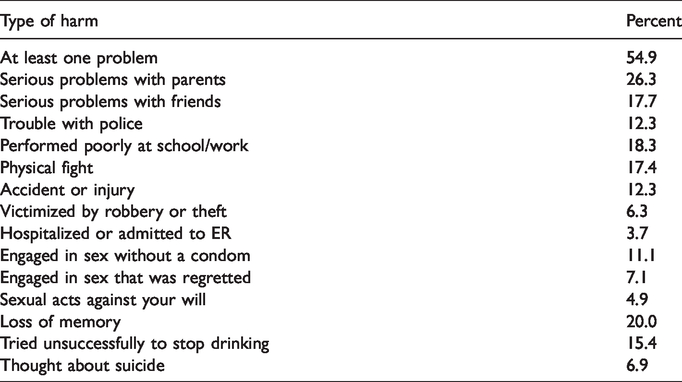
Table 2 shows the percentage of past-year drinkers who reported each type of alcohol-related harm in the past year. At least 15% of past-year drinkers reported each of the following harms because of their drinking: having a serious problem with parents and friends, performing poorly at school or work, being in a physical fight, memory loss, and trying unsuccessfully to stop drinking. At least 10% reported getting into trouble with police, having an accident or injury, and having sexual intercourse without a condom. Overall, 55% of past-year drinkers reported at least one type of harm.
Alcohol-Related Harms in the Past Year Among Past-Year Drinkers, Percent.
Multilevel Analyses
Past-30-Day Alcohol Use
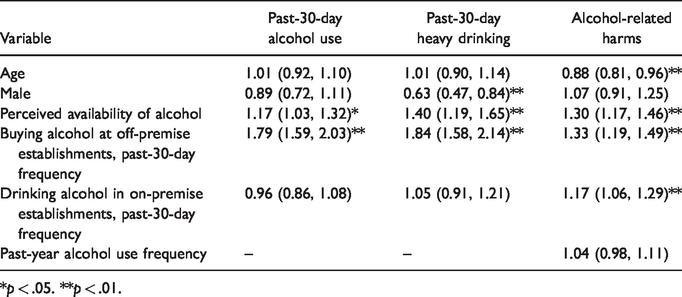
Results of the multilevel regression analyses assessing relationships between alcohol availability and past-30-day alcohol use are in Table 3. Past-30-day alcohol use was significantly and positively associated with a higher level of perceived availability of alcohol and obtaining alcohol at off-premises establishments. Drinking at on-premises establishments, age, and sex were unrelated to past-30-day alcohol use.
Results of Multilevel Poisson Regression Analyses to Assess Relationships Between Alcohol Availability, Frequency of Alcohol Use, Heavy Episodic Drinking, and Alcohol-Related Harms Among Past-Year Drinkers, Event Rate Ratio (95% Confidence Interval).
*p < .05. **p < .01.
Past-30-Day Heavy Episodic Drinking
Past-30-day heavy episodic drinking was positively associated with perceived availability of alcohol, obtaining alcohol at off-premises establishments, and being female. It was not significantly associated with drinking alcoholic beverages at on-premises establishments and age.
Alcohol-Related Harms in the Past Year
Alcohol-related harms in the past year were positively associated with perceived availability of alcohol, obtaining alcohol at off-premises establishments, and drinking alcoholic beverages in on-premises establishments. Alcohol-related harms were inversely related to age. Alcohol-related harms were not associated with past-year alcohol use and sex. We conducted supplemental analyses in which we entered past-30-day alcohol use and heavy alcohol use in the harms model without the perceived and actual availability variables. Both past-30-day alcohol use and heavy drinking were strongly associated with alcohol-related harms in these models. When we included the perceived and actual availability variables in the models, the results reported in Table 3 did not materially change, suggesting that the relationships between past-30-day alcohol consumption variables and harms were accounted for by perceived and actual availability of alcohol.
Discussion
This study examined associations between perceived and actual availability of alcohol and key alcohol-related outcomes in a sample of 12- to 17-year-old Mexican adolescents while controlling for demographic characteristics. Most youth in the sample reported drinking in the past year; over half of the past-year drinkers reported past-30-day alcohol use and one third reported heavy drinking in the past 30 days. Notably, over half reported experiencing at least one type of alcohol-related harm in the past year.
We found that youth who frequently purchased alcohol at off-premises establishments, or had friends who did so, were more likely to engage in past-30-day alcohol use and heavy episodic drinking and to have experienced alcohol-related harms in the past year, as compared with other drinkers or their friends who purchased alcohol less often or did not purchase alcohol at these outlets. Perceived ease of obtaining alcohol was also positively related with past-30-day alcohol use, heavy episodic drinking, and alcohol-related harms in the past year. More frequent drinking at on-premises establishments was not associated with past-30-day alcohol use or heavy episodic drinking but was positively associated with alcohol-related harms, controlling for age, sex, and past-year drinking. These findings suggest that perceived and actual alcohol availability may be uniquely associated with alcohol consumption and related harms. Our findings demonstrate the need to reduce both perceived and actual access to alcohol by underage Mexican youth, in both on- and off-premises establishments.
The lack of an association between past-year alcohol use frequency and alcohol-related harms in the regression model was unexpected and may be the result of shared variance with perceived and actual alcohol availability and demographic characteristics.
This study has several limitations, the most important of which is that its cross-sectional nature precludes causal attribution. For example, it seems possible that rather than perceived availability influencing drinking, youth who drink more frequently seek out sources of alcohol and thus perceive alcohol as more readily available. However, the supplemental analyses suggested that relationships between alcohol consumption variables and harms were accounted for by perceived and actual availability variables, which may have acted as confounders or mediators.
Furthermore, the study’s purposive sample of students may not accurately depict youths’ behavior in the three specified cities in one Mexican state and thus may not be representative of the broader youth population in Mexico. In particular, this study does not adequately describe out-of-school youth or youth from higher socioeconomic status backgrounds, who typically attend private schools. In addition, the wording of the question concerning alcohol purchases from off-premises establishments included both the respondent and the respondents’ friends, so the true proportion of students who purchased from these establishments may have been inflated. Furthermore, both the questions concerning on- and off-premises purchases asked about the number of occasions in which students had successfully purchased each type of alcohol specified, so they could have purchased multiple types on any given occasion. Finally, responses to survey questions may have been subject to social desirability bias (e.g., under-reporting alcohol use) and recall error.
That said, very few studies have investigated alcohol availability, use, and alcohol-related harms among Mexican adolescents. Our findings stress the importance of interventions to reduce youth access to alcohol through preventive measures that reduce both on- and off-premises availability. It is essential that managers, servers, and clerks in off-premises stores, as well as restaurants and bars, understand the importance of checking youths’ IDs prior to sales or service and that owners and managers implement and enforce appropriate policies regarding alcohol sales and service to minors within their establishments. It is also imperative that these responsible service practices be supported by interventions that have demonstrated their ability to reduce sales of age-restricted products to minors, such as law enforcement compliance checks (Biglan et al., 2000; Erickson et al., 2013; Grube, 1997; Scribner & Cohen, 2001; Wagenaar et al., 2005) and mystery shopper programs (Biglan et al., 1996, 2000; Flewelling et al., 2013; Krevor et al., 2011; Moore et al., 2012; Van Hoof et al., 2012).
Footnotes
Declaration of Conflicting Interests
The authors declared no potential conflicts of interest with respect to the research, authorship, and/or publication of this article.
Funding
The authors declared the following potential conflicts of interest with respect to the research, authorship, and/or publication of this article: Drs. Ringwalt, Paschall, Grube, Miller, and Fisher have been supported within the past 3 years by funding from the alcohol industry to evaluate industry-sponsored programs to reduce alcohol sales to minors, underage drinking, and other alcohol-related harms. Dr. Warren has been supported within the past 3 years by funding from the alcohol industry to advise the industry concerning programs it is sponsoring that are referenced earlier. Drs. Gidi and Goldberg were employed by, and have subsequently been supported by funding from, the alcohol industry to oversee the administration of the programs that are referenced earlier.
