



Abstract
This study sought to examine the effects of substance use and stress-induced cognitive impairment on anxiety and depression among college students. The data for this study came from a sample of 328 undergraduate students from a public university. The subjects in this study completed a 101-item self-administered questionnaire, which was part of a larger study on college stress. This study included not only students who are typically expected to seek help at the counseling centers, but it expanded to include self-reported cases of students who do not have documented problems of substance use or anxiety/depression. To address the main objective of this study, an eight-variable model was developed and tested for each of the two outcome variables: anxiety and depression. The results that emerged from this study show that both substance use and stress-induced cognitive impairment have a positive and a statistically significant effect on anxiety and depression in college students.
College is a transitional period when young and non-traditional students choose to further their education, have new life experiences, connect with fresh faces, and expand their social networkd. Students, however, often engage in unhealthy behaviors such as lack of sleep, poor diet, smoking, drinking alcohol, drug use, and so on. These behaviors, in many instances, have consequences that manifest with negative health effects in the long run. The long-term effects of some of these behaviors are psychological in nature, with anxiety and depression as the end result. Social stress, the ability to perform academically, anxiety, depression, and even post-traumatic stress disorder, are mental challenges confronting many college students in today's society (Soet & Sevig, 2006). Stress is often the nexus of all these factors, and college is a time when students experience many different levels of stress. In some instances, this can lead to cognitive impairment as well. To this end, research shows that stress-induced cognitive impairment occurs when students experience high levels of stress repeatedly (Yuen et al., 2012; Han et al., 2017). Some students, such as those with poor coping strategies especially, decide to combat the symptoms of such stress by engaging in some form of substance use - drinking alcohol, smoking marijuana, illicit drugs - as a way of escaping the social reality of college life (Pettit & DeBarr, 2011; Voelker, 2004; Rice, & Van Arsdale, 2010; Baghurst & Kelley, 2015; Mahmoud et al., 2012; Beiter et al., 2014). There are students, on the other hand, who suffer from anxiety and depression and use prescription drugs to cope with those effects. This, in turn, results in even more problematic situations ending up abusing prescription drugs or becoming addicted to them (Zulling & Divine, 2012; Maier et al., 2013).
The effects of substance abuse are prevalent on college campuses and not only affect the abusers, but also students who do not abuse drugs (Leigh, Bowen, & Marlatt, 2005). According to the National Institute on Alcohol Abuse and Alcoholism (2002), more than half a million students were physically attacked by alcohol-influenced students and over three-quarters of a million students were victims of rape and sexual assault related to alcohol abuse (Leigh et al., 2005). From the causal interaction point of view, exposure to college-related stress can lead to alcohol and drug use, and in some cases, cognitive impairment (Brady & Sonne, 1999; Seeman & Seeman, 1992; McEwen & Sapolsky, 1995; Yuen et al., 2012. Likewise, alcohol and drug abuse can exacerbate anxiety and depression (Merikangas et al., 1994; Hasin & Grant, 1987; White et al., 2007). From these causal integrations, it can be said that all these factors are interrelated, and they can co-occur at any given time. Moreover, the effects of college life on students who are already substance users before entering college may increase their use even more, especially if they associate with other students who are substance users (Duncan et al., 2005). This effect includes other areas of college life as well, including cutting classes, procrastination on assignments, academic underperformance and even class failure and academic dismissal (Porter & Pryor, 2007 students may believe that alcohol relieves their depression, although it exacerbates it in the long run.
In summary, the literature suggests that there is a relationship between college stress, substance use, and psychological well-being among college students. The deterministic model that can be derived from prior research on substance use, stress-induced cognitive impairment, and anxiety and depression can be visually displayed in Figure 1.
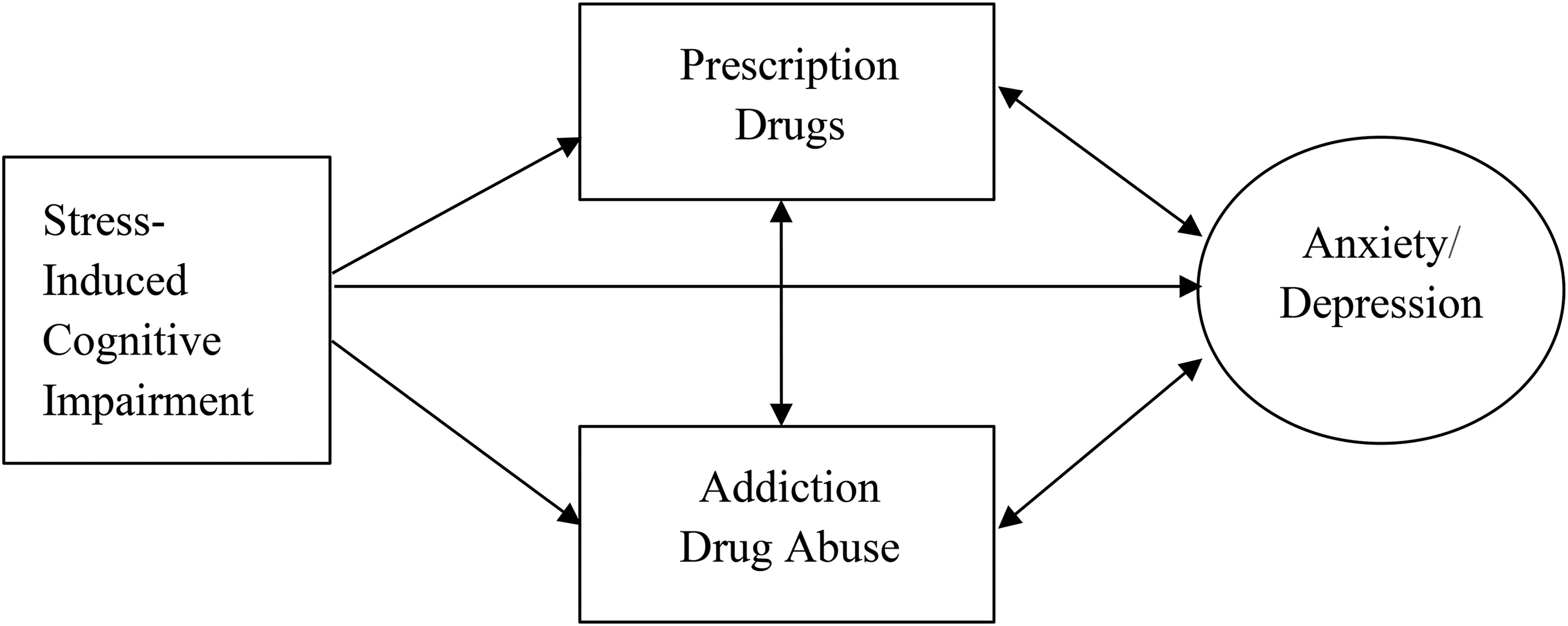
Deterministic model of substance use, stress-induced cognitive impairment, and the psychological well-being.
The current study
The current study had two objectives. The first was to test the effects of substance use on anxiety and depression among college students. The second objective was to examine the effects of stress-induced cognitive impairment on anxiety and depression. We treats substance use as the cause that has an effect on both anxiety and depression among college students. In this study, we hypothesized that substance use comes first, and depression and anxiety are the manifestation effects resulting from substance use. We also hypothesized that stress-induced cognitive impairment is positively associated with both anxiety and depression.
Methodology
Independent variables
The primary independent variables in this study are substance use and stress-induced cognitive impairment among college students. Substance use in this study refers to use of any substance that is considered illegal and illicit, ranging from alcohol use to illicit drugs. This variable was measured using a Likert scale ranging from 0 (no substance use) to 10 (significant problems with substance use). The current study measured substance use from a self-reported questionnaire that was administered to 328 college students as part of a larger study on college stress. Respondents were asked to indicate whether or not they have problems with substance use.
In the case of this study we concluded that self-report was a better method to collect sensitive data of this nature because it included all students, not only those with some type of documented substance use record.
The second predictor in this study is the stress-induced cognitive impairment, which refers to the cognitive functions impaired as a result of exposure to college stress. It was measured using a 6-item index that included the following items: forgetfulness, unwanted or repetitive thoughts, difficulty concentrating, poor judgment, inability to focus, and constant worrying. Each item was measured on a six-point Likert scale, ranging from 0 (Never) to 5 (Daily). The total score for the stress-induced cognitive impairment index ranged from 0 to 36 points.
Dependent variables
The dependent variables in this study were depression and anxiety. This study aimed to predict if substance use and stress-induced cognitive impairment were related to depression and anxiety. Demographic factors (e.g., age, gender, race, marital status, class standing, and employment) were used as control variables. Depression was measured using the Patient Health Questionnaire (PHQ-8), an 8-item scale borrowed from Kroenk et al. (2009). All 8 items were measured on a 4-point Likert scale, ranging from 0 (Not at all) to 3 (Every day), with a maximum total score of 32. The internal consistency of the depression scale was very good, with Cronbach's Alpha =.88. Anxiety was measured using a 21-item Beck Anxiety Inventory (BAI) borrowed from Beck and Steer (1990). Each item was measured on a four-point Likert scale, ranging from 0 (Not at all) to 3 (Severely), with a maximum total score of 84. The internal consistency of the anxiety scale was also very good, with Cronbach's Alpha =.93.
Control variables
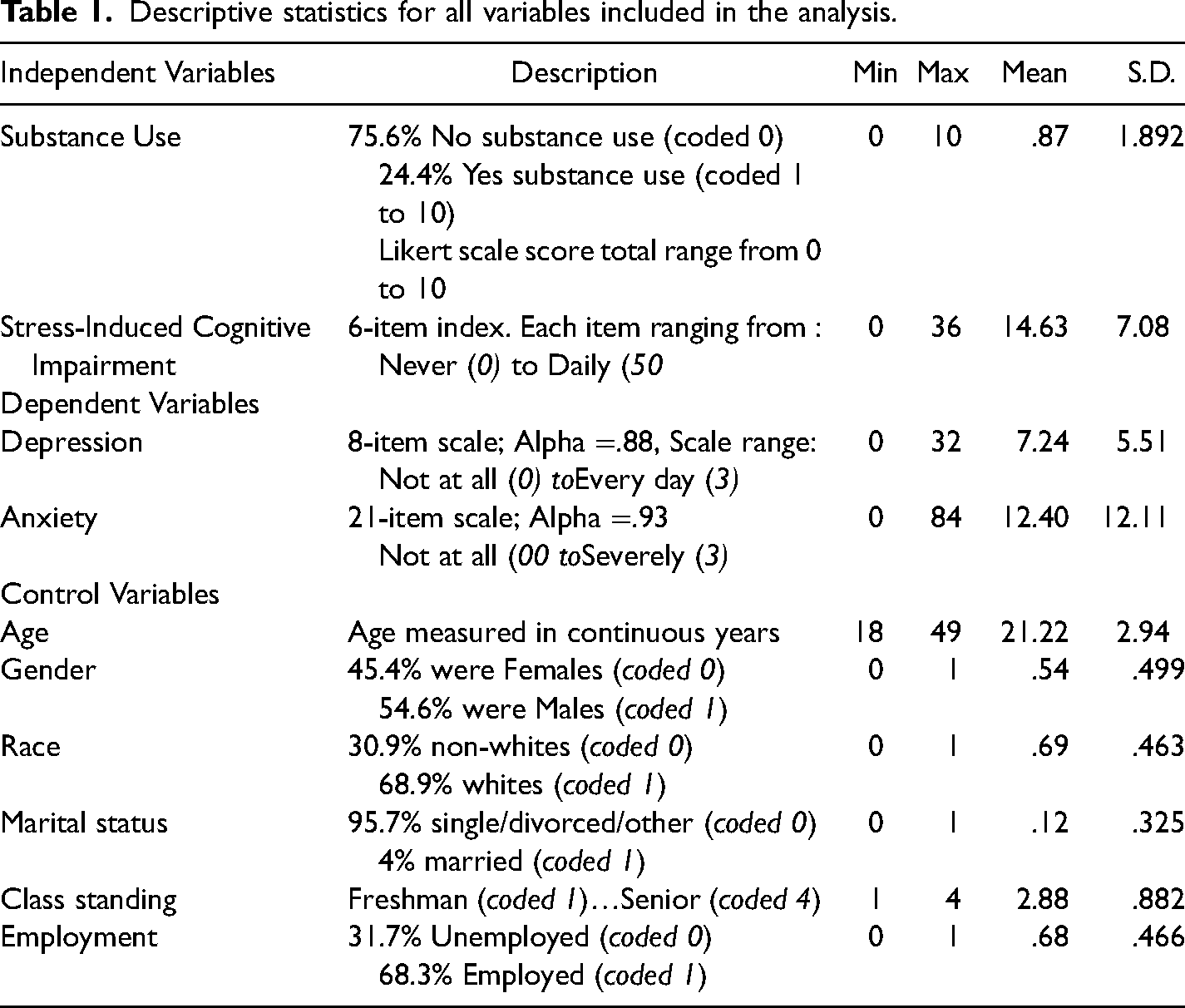
This study included several self-reported control variables – mainly demographic variables (See Table 1). Binary control variables include gender (coded, 1= Male, 0 = Female), race (coded, 1 = Whites, 0 = Non-whites), marital status (coded, 1= Married, 0 = Single/Divorced/Separated), and employment status (coded, 1= Employed, 0 = Unemployed). Additionally, class standing was measured as ordinal (1 = Freshmen, 2 = Sophomore, 3 = Junior, and 4 = Senior) and age was measured in years.
Descriptive statistics for all variables included in the analysis.
Participants
The analyses were based on the data collected from 328 college students at a state university. The participants in this study completed a 101-item self-administered questionnaire, which was part of a larger study on college stress. Of the 328 participants, 6.1% were freshmen, 27.1% were sophomores, 39.3% were juniors, and 27.4% were seniors. The participants ranged in age from 18 to 49 years old, although the majority of them were between the ages of 18 and 22 years old (89.6%, M = 21.2, SD = 2.94). Only students aged 18 and older were included in this study. In terms of gender, 45.4% (n = 149) of the participants were females and 54.6% (n = 179) were males, which is a fairly representative male/female ratio of all college students at the university. The racial composition of the sample was also a good representation of the university students from whom the data were collected. The majority (68.9%) of the participants were Whites, 17.1% were African Americans, 3.7% were Hispanic/Latinos, 2.1% were Asians, and the rest were other races (8.2%). Race was re-coded into a dichotomous variable; (Whites 68.9%, coded 1, Non-whites, 30.9% coded 0, with.2% missing cases).
Collinearity diagnostics
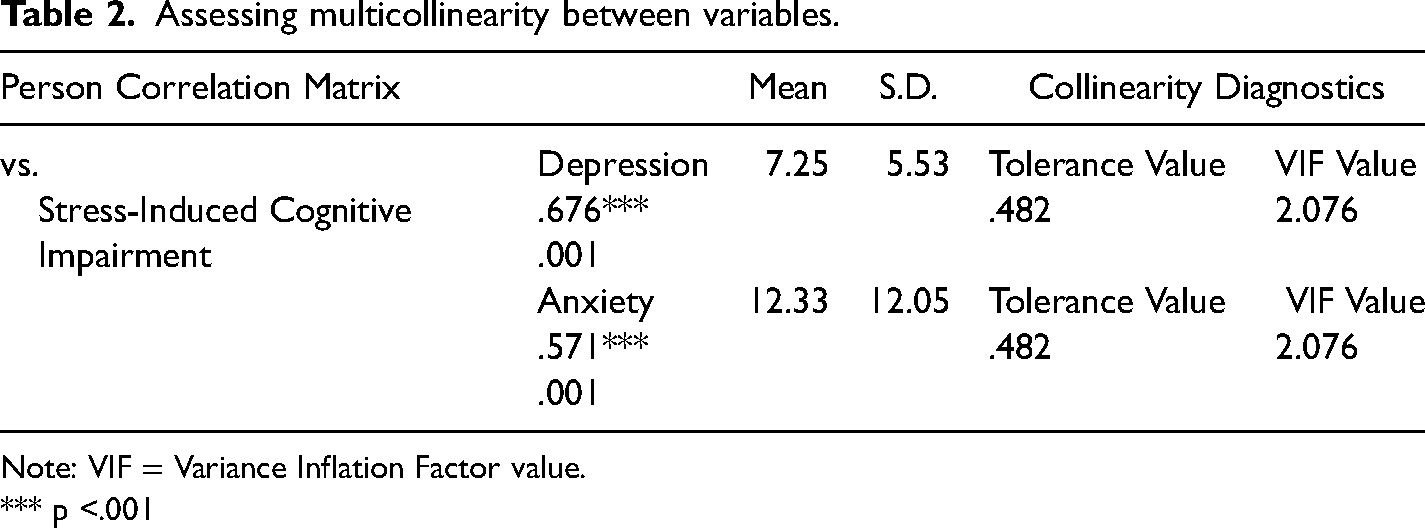
To ensure that the variables included in the regression models did not suffer from multicollinearity, two types of analysis were computed. To address this concern, the correlation matrix and collinearity diagnostics were computed (Table 2A variance inflation factor above three is an indicator of multicollinearity issue with the correlates and anything above five (with the corresponding tolerance value of.2 or less) is a serious indicator of multicollinearity, and a value of 10 (with the corresponding tolerance value of.1) is a definite indicator of multicollinearity (see Field, 2009; Pallant, 2011).
Assessing multicollinearity between variables.
Note: VIF = Variance Inflation Factor value.
*** p <.001
As noted in Table 2, the variables included in the model did not indicate multicollinearity. While the variables were moderately correlated (r =.571 and r =.676, p <.001), the tolerance value (.482) and the Variance Inflation Factor value (VIF = 2.076) were within the normal range, substantially below the cut off values and these variables explain enough independent and unique variance in the model.
Results
Multivariate regression analysis for anxiety
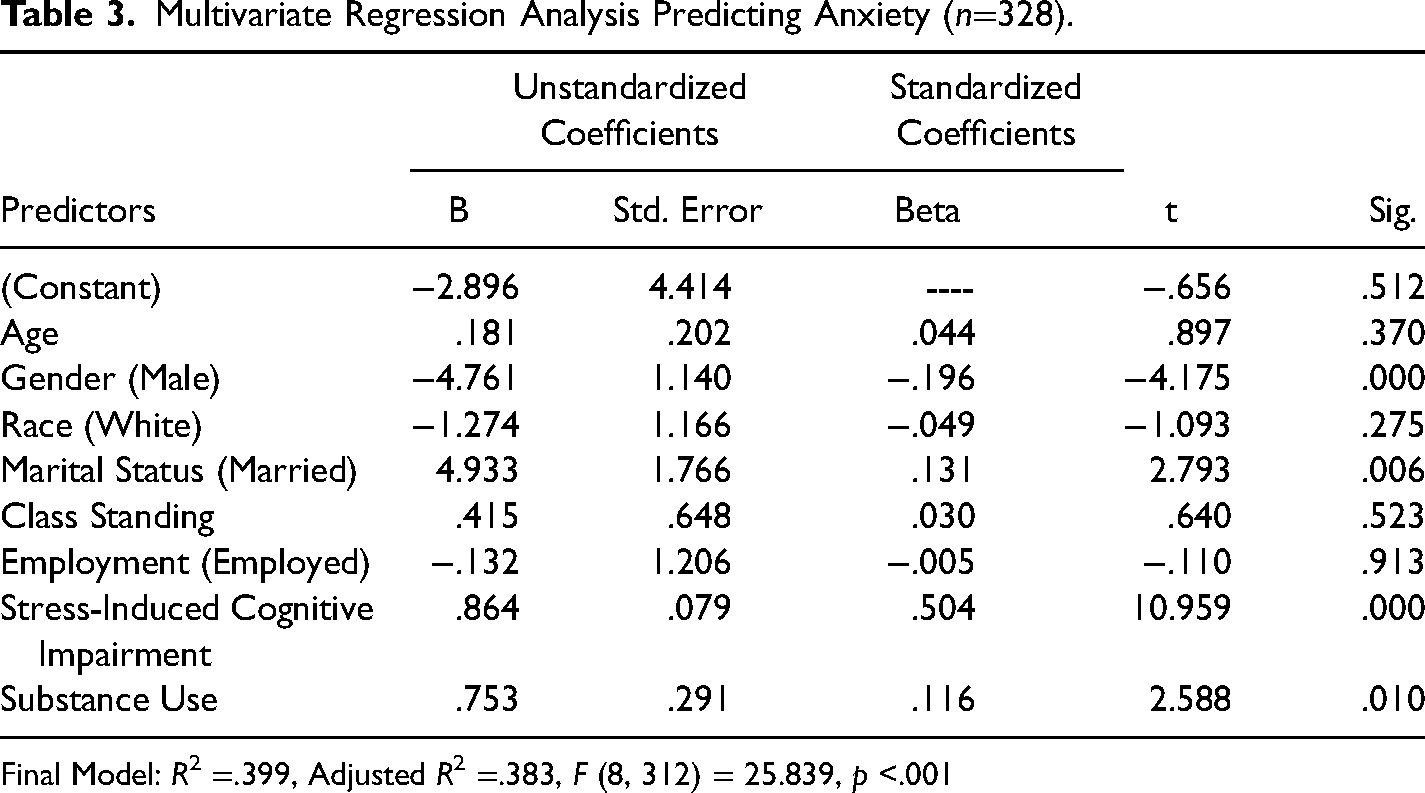
The first outcome measure in this study was anxiety as affected by the substance use and the stress-induced cognitive impairment. Table 3 shows the results of multivariate regression analysis, regressing anxiety on all independent variables. The combination of variables in this eight-variable model was statistically significant in predicting the linear contributions in anxiety, and it had a substantial explanation power, R2 =.399, F(8, 312) = 25.839, p <.001, explaining 40% of the variation in the anxiety. Of the eight variables that were included in this model, four were significantly related toanxiety. Among variables with a significant effect were substance use (β =.753, p <.01)
Multivariate Regression Analysis Predicting Anxiety (n=328).
Final Model: R2 =.399, Adjusted R2 =.383, F (8, 312) = 25.839, p <.001
The results in Table 3 show that every unit increase in the substance use scale was manifested with a.753 unit increase in anxiety, holding all other variables constant. This means students who reported having problems with substance use were more likely to report having problems with anxiety as well. Additionally, for every unit increase in the stress-induced cognitive impairment index (measured 0 to 36), anxiety increased by.864 units. While the increase was not substantial, it is statistically significant (p <.001).
Of the two control variables that had a statistically significant effect in predicting anxiety, gender was negatively associated with anxiety, whereas marital status was positively associated. This means that female students were more likely to experience anxiety compared to male students. Additionally, married students reported a higher level of anxiety compared to students who were not married. Student's age, race, class standing, and employment status were not significantly related to anxiety.
Multivariate regression analysis for depression
The second outcome measure in this study was depression among college students as related to substance use and stress-induced cognitive impairment. The results are presented in Table 4. This eight-variable model was statistically significant in predicting the linear contributions to depression, with R2 =.492, F(8, 312) = 37.731, p <.001, explaining 50% of the variation in the depression. Regression analysis in Table 4 shows that there were three predictors that significantly contributed in predicting depression among college students; namely gender (β = −1.434, p <.01), stress-induced cognitive impairment (β =.499, p <.001), and substance use (β =.267, p <.05). As expected, both the substance use and the stress-induced cognitive impairment were positively related to depression. The data in Table 4 show that for every unit increase in the substance use scale, there was a.267 unit increase in the depression scale. For every unit increase in the self-induced cognitive impairment index, there was a.499 unit increase in the depression scale. Gender was negatively associated with depression, and females were more likely to report having problems with depression compared to males. Student's age, race, marital status, employment, and class standing were not significantly related to depression.
Multivariate Regression Analysis Predicting Depression (n=328).

Final Model: R2 =.492, Adjusted R2 =.479, F (8, 312) = 37.731, p <. 001
Discussion
This study sought to examine the relationships between substance use and stress-induced cognitive impairment on anxiety and depression among college students. A large number of studies have tested the relationship between anxiety, depression, and substance use. Some have used anxiety and depression as factors that lead to substance use (Miller et al., 2002; Berger & Adesso, 1991; Maier, et al., 2013; Cox, Norton, Swanson, & Endler, 1990; Sinha, 2008; Stewart et al., 1997; Hamdan-Mansour et al., 2009; Avdija & Akgul, 2020). On the other hand, others have linked substance use as the cause of anxiety and depression, which may be manifested in the form of withdrawal symptoms (Keychev & Ebmeier, 2015; Deykin et al., 1987).
Both directions of these relationships are correct (Smith & Book, 2008). Substance use can be assumed as an outcome effect resulting from problems associated with anxiety and depression disorder, but it can also be the cause of anxiety and depression disorder. The debate revolves around which one causes the other. Does substance use cause anxiety and depression or do anxiety and depression lead to substance use? Regardless, there is some empirical evidence that suggests substance use causes anxiety and depression among college students, rather than the other way around (Teter et al., 2010; Deykin et al., 1987; Miller et al., 2002).
The current study also provides associative support for this relationship; showing that substance use is significantly related to, and predictive of, both anxiety and depression in college students. In this regard, the current study shows that students who reported having problems with substance use were more likely to report having problems with anxiety and depression as well. These results could mean that substance use comes first; anxiety and depression are the manifestation effects of withdrawal from substance use and not the cause of substance use. However, it should be noted that this study does not claim causality effects. Thus, the results should be interpreted with caution. Nonetheless, these findings are consistent with prior studies on this topic (Keychev & Ebmeier, 2015; Ham et al., 2009).
When substance use is coupled with stress-induced cognitive impairment, the effects on both anxiety and depression increase significantly. The current study is perhaps one of the very few studies that have tested this combined effect. This study shows that stress-induced cognitive impairment is positively associated with anxiety and depression. Stress-induced cognitive impairment occurs when students repeatedly experience high levels of stress (Yuen, et al., 2012; Han et al., 2017). However, this effect is most likely to manifest itself temporarily in college students. One possible explanation as to why stress-induced cognitive impairment has a significant effect on anxiety and depression is that all three of them are rooted in the same spectrum of symptoms. In other words, stress could be the common denominator for all three factors (Sandi, 2013; Yuen et al., 2012; Li et al., 2008; Sapolsky, 2004; Washington, 2009; Van Praag, 2005; Paramita et al., 2012), which suggests that a reduction in stress level may have preventive properties that help students shield from cognitive impairment, anxiety, and depression.
In summary, this study provides a significant contribution to the existing literature on anxiety and depression among college students, as it touches on important variables that are interconnected and can co-occur at any given time, regardless of the temporal order. Nevertheless, as is the case with all research studies, the current study has its own limitations. First, this study utilized a cross-sectional design, which comes with inherent limitations. Second, the data were collected using a convenient sampling method. This may limit the generalizability of the research results to other settings and populations. Third, this research is not intended to examine the cause/effect relationship between variables tested in this study. Instead, it focused on the associative relationships between variables. Therefore, it is suggestive that future studies focus on establishing causal relatinship by utilizing more advanced research designs.
