



Abstract
Culture has been widely proposed by marketing theorists as one of the underlying determinants of consumer behavior. Empirical inquiries in the field of tourism remain scarce, particularly in the understanding of its behavioral influences. The study reported in this article aims to fill the gap by investigating the effect of cultural values on travel motivation and behavioral intention. The analysis of survey data from outbound Chinese tourists reveals that both internal and external values exert a significantly positive effect on travel motivation. Behavioral intention is affected only by internal values. The novelty dimension of travel motivation directly affects behavioral intention. The findings are examined in the context of the rising significance and uniqueness of Chinese outbound tourism. Pragmatic and theoretical implications are discussed.
Culture, defined as a set of beliefs or standards shared by a group of people (Goodenough 1971), is widely accepted among marketing theorists as one of the underlying determinants of consumer behavior, including tourist behavior. However, most previous tourism studies have used nationality to operationalize culture (e.g., Lee et al. 2009). While these studies have contributed enormously to the understanding of the increasingly diversified international tourism market, the use of nationality as the sole surrogate for cultural affiliation has been criticized for underestimating the role of the cultural dimensions or contextual factors that cause the differences (Earley and Singh 1985). Many researchers have argued that nationality alone is insufficient for analyzing consumer behavior, as many countries contain subgroups made up of different ethnicities, social classes, lifestyles, and forms of behavior (McCleary, Weaver, and Hsu 2006).
Hofstede (1997, p. 8) suggested that culture influenced behavior through its four manifestations of values, heroes, rituals, and symbols. Heroes are “persons, alive or dead, real or imaginary, who possess characteristics which are highly prized in a culture, and who thus serve as models for behavior.” Rituals are “expressive, symbolic activity constructed of multiple forms of behavior that occur in a fixed, episodic sequence, and that tend to be repeated over time” (Rook 1985, p. 252). Symbols are a broad category of processes and objects that carry meanings unique to a particular group of people (Geertz 1973). A value has been described by Rokeach (1968, p. 16) as a “centrally held, enduring belief which guides actions and judgments across specific situations and beyond immediate goals to more ultimate end-states of existence.” Values are the forms in which culturally determined knowledge is stored and expressed.
Values are regarded as the deepest of the four manifestations of culture (Hofstede and Hofstede 2005), as they are the basis on which attitudes, cognition, emotions, and behavior evolve (Hills 2002). They are abstract forms of social cognition that serve as powerful explanations of, and influences on, human behavior (Homer and Kahle 1988). Despite the general acceptance of their important role in determining behavior, values have received limited empirical attention in tourism literature. Hence, the study reported in this article is designed to fill this gap by investigating the effects of values on travel motivation and behavioral intention. More specifically, the study aimed to achieve the following research objectives: (1) investigate the effect of value on different types of travel motivation, (2) examine the impact of value on tourists’ behavioral intention, and (3) investigate the influence of different types of travel motivation on behavioral intentions.
Theoretical Model and Hypotheses Development
Values
Culture researchers argue that behavior differs from culture to culture because different cultural groups hold different values (Legoherel et al. 2009). Culture encompasses such elements as shared values, beliefs, and norms, which collectively distinguish particular groups of people from one another (Pizam, Pine, and Mok 1997). These widely shared values are programmed into individuals in subtle ways from an early age (Otaki et al. 1986). Values are resistant to change (Hofstede 1997) and remain evident when an individual is at home or traveling abroad. Values have been widely used to signify culture in the general marketing literature (Sojka and Tansuhaj 1995).
Value is defined by Rokeach (1973, p. 5) as “an enduring belief that a specific mode of conduct or end-state of existence is personally or socially preferable to an opposite or converse mode of conduct or end-state of existence.” Philosophically, the term value defines a relationship between a cognizing subject and the object of the subject’s apprehension (Alicke 1983). From the subject’s perspective value is expressed in a feeling of pleasure or desire in relation to an object (Eaton 1930) or in a state of interest that the object arouses (Perry 1926). The term object refers either to material things such as goods or to abstract ideas or standards such as wisdom, truth, and courage. The value of material objects is typically referred to in an economic sense, and it is well acknowledged that the intrinsic value of material objects is dependent of the needs of a subject. Therefore, the central question in value theory has been whether it is possible to establish the intrinsic worth of more abstract objects. There are two kinds of values depending on whether it is concerning desirable modes of conduct or desirable end states of existence. These two types of values are labeled as instrumental value and terminal value, respectively.
The concept of “values” is informed by a range of disciplines, including anthropology, sociology, and psychology (Vinson et al. 1977) and has been widely used by social scientists to explain a variety of behavioral phenomena, including consumer behavior (e.g., Kamamura and Novak 1992). Values are culturally learned cognitive representations of particular universal human requirements, such as biological needs, the desire for social interaction, and the social institutional demands on the individual (Schwartz and Bilsky 1987). A value is a type of social cognition that is primarily learned or acquired conceptually to help individuals know and understand their interpersonal relations. Because values are inherent, culturally rooted desires, they are transsituational and are stable enough to serve as the standards or criteria of conduct (Williams 1968).
There are two schools of axiology theories in philosophical setting: subjectivity and objectivity. Objectivity doctrines hold that the world exists “in itself,” apart from any relation to an apprehending subject, and the essence of reality exists to be understood in its true and independent form. On the contrary, subjectivity theories converge on the notion that reality inheres in the perceptions and intellections of the knower and that reality is therefore relative as opposed to absolute (Alicke 1983). This distinction leads to the two dimensions of value, external value and internal value, depending on the locus of control.
External values are object directed and are based on knowledge of the object, such as a goal, experience, or situation. These values are symbolized by an object that is difficult to substitute (Prentice 1987). When such objects symbolize status or satisfy needs relating to self-esteem or a sense of belonging, they tend to be of a tangible nature (Kahle 1983). The satisfaction of externally directed values confirms and strengthens the belief component of attitudes (Gnoth 1994). If values are internal dominant, however, their expectation-oriented intentions are internally directed. In contrast to externally directed values, the locus of control of internally directed values rests with the self. The motivation to act is drive based, and interactions with outside objects are associative, in the sense that internal values are directed toward classes of objects rather than specific objects in themselves (Gnoth 1997). For example, to satisfy the need for relaxation, a person can either take a vacation or watch TV at home. The fulfillment of the internal values associated with these acts may reduce the drive to relax (Gnoth 1994). Hence, the distinction between internal values and external values enables us to determine which aspects of tourism are substitutable and whether the quality of expectations is external or internal (Miller 1976).
The most widely known and applied measure of values is Rokeach’s Value Survey (Rokeach 1973), which consists of 18 instrumental values (ideal modes of behavior) and 18 terminal values (ideal end states of existence). However, this scale has been criticized for information loss arising from rank orderings, the impossibility of ties, the difficulty of the lengthy ranking task, and the questionable relevance of the values to daily life (Homer and Kahle 1988). In response to these criticisms, Kahle (1983) developed the List of Values (LOV) scale, which was subsequently tested on a national probability sample. While most previous studies have identified two dimensions of values, external values and internal values, Kahle (1983) noted that certain value loadings could be context specific, even though the dual dimensions tended to remain robust.
The LOV, which was derived from Rokeach’s list of terminal values, has been used to examine behavior related to both leisure (Backman and Crompton 1990) and tourism (Madrigal and Kahle 1994). Adopting a means–end approach, Klenosky et al. (1998) characterized the relationship among the attributes of interpretive services, the benefits associated with these attributes, and the values these benefits help to reinforce. The study developed a better understanding of the factors influencing park visitors’ usage of specific interpretive service offerings (Klenosky et al. 1998).
The Pennsylvania Bureau of Travel Development has used cultural values in tourism market research since 1984. Visitors’ travel selection criteria and their perceived image of Pennsylvania have been examined in relation to their lifestyle and values as measured by VALS (values and lifestyles). The findings have established that lifestyle and value variables are capable of revealing more than simple demographics and thus constitute a more useful tool for understanding travel behavior (Shih 1986).
Pitts and Woodside (1986) used the Rokeach Value Scale to explore the relationship between values and the attributes an individual considers important in leisure or travel. A value-based discriminant analysis model was also developed from the respondents’ travels to specific leisure or recreation attractions. Values were found to be related to differences in choice criteria and to actual behavior. Madrigal (1995) also compared the ability of values to predict travel style to that of Plog’s traveler personality type. The results revealed that values more accurately and effectively predicted travel style than did the traveler personality type.
Using 60 undergraduate student respondents, Pizam and Calantone (1987) analyzed the relationship between values (both general and object specific) and their travel behavior, operationalized by respondents’ description of their last vacation as well as their intentions. Values were measured using a set of six general value scales and an object-specific vacation value scale that was intentionally developed for the study. Study results revealed that travel behavior is significantly associated with a person’s general values and vacation-specific values (Pizam and Calantone 1987). Providing an exploratory understanding to the relationship between value and travel behavior, however, Pizam and Calantone’s findings are confined to their student sample. In addition, the travel behavior measurement scale they developed covered only the attitudinal dimension of travel behavior.
There is growing interest in the cultural influence on travel behavior because of the explosion in international travel. As the marketplace becomes increasingly global, understanding culturally related differences in consumer behavior is becoming critical for market researchers (Ko 1991). The notion of such a relationship, however, appears to be based on intuitive assumptions not supported by empirical evidence in tourism. Although there are a growing number of studies devoted to this area, research into the role of values has been largely missing from the tourism literature, and the extant literature has failed to investigate the underlying mechanism by which values influence travel behavior. This is surprising considering the importance a wide variety of social observers and businesspeople typically assign to values.
Motivation
Motivation is considered to be the cause of human behavior (Mook 1996). It is a disposition or a state of need that drives individuals toward types of action that are capable of satisfying those needs. In the tourism literature, motivation and motive are often used interchangeably because of the semantic similarity between the two concepts. However, many psychologists argue that the terms signify different concepts relating to the dynamic course of human behavior. For example, each motive can trigger various forms of behavior, or motivations, as much as each behavior can be triggered by a variety of motives (H. Murray 1938). Hence, it is important to distinguish between motive and motivation. Research focusing on motives seeks a deeper understanding of the factors that energize individuals toward particular activities, while research into motivation tends to emphasize the distinct situational parameters in which these motives are expressed (Gnoth 1997).
There is a range of psychological conceptions of motive, but psychologists generally agree that “a motive is an internal factor that arouses, directs, and integrates a person’s behavior” (E. Murray 1964, p. 7). Motivation, in contrast, contains the results of situation–person interactions (Heckhausen 1989). It is a collective term for the processes and effects relating to the realization that the selection and implementation of particular forms of behavior can lead to expected consequences. Motivation, in this sense, has a broader meaning than motive. It includes the observed goal directedness of behavior, the inception and completion of a coherent behavioral unit, the resumption of a form of behavior after an interruption, the transition to a new behavioral sequence, and the conflict between various behavioral goals and their resolution (Heckhausen 1989). Hence, the concept of motivation should be used to signify person–situation interactions and processes in which an individual is stimulated by a given (or pursued) situation and the desirable or undesirable expectations of the consequences arising from his or her actions.
Travel motivation has always been considered as the essential part of the dynamic process of tourist behavior, which has drawn great attention from tourism academia since the 1960s, with substantial progress being achieved. Several theories or models have been developed to guide the empirical study of travel motivation, such as the push-pull (Dann 1977), allocentric-psychocentric (Plog 1974), escape-seeking (Dunn Ross and Iso-Ahola 1991), and travel career ladder (Pearce and Lee 2005) models. Existing studies have covered a wide range of the spectrum, including the sociology of travel motivation as a stimulator of actual behavior (Dann 1977; Mansfeld 1992), the development or empirical test of travel motivation measurements (e.g., Crompton 1979), travel motivation of different niche markets (e.g., Hsu, Cai, and Wong 2007), differences in motivation among tourists with varied nationality and cultural backgrounds (e.g., S. Kim and Prideaux 2005), number of visits (Lau 1988), destinations and origins (Kozak 2002), sociodemographic characteristics (e.g., Jang and Wu 2006), and environmental attitude (Luo and Deng 2008). Motivation was also found to be extensively used as a means to divide the tourist market into smaller but meaningful segments (e.g., Beh and Bruyere 2007).
Despite the achievement in understanding travel motivation, there is no widely agreed-on theoretical or conceptual framework (World Tourism Organization 1999) because of the wide range of human needs, methodological difficulties (French, Craig-Smith, and Collier 1995), and culture differences (S. Kim and Prideaux 2005). Travel motivation has mostly been examined in Western society, and nationality has been used as a sole surrogate to investigate culture differences in travel motivation. This lack of understanding calls for more investigations into tourists’ travel motivation.
Emotion-driven motives and cognition-driven motivations occur simultaneously in the formation of perceptions and subsequent expectations in a dynamic flow of action (Gnoth 1997). However, motivations are produced through the values acquired within people’s everyday lives (Ateljevic 1997). Ateljevic (1997) conducted an empirical examination of the effect of the value system on tourism motivation. Based on a semistructured survey of 499 inbound travelers to New Zealand (mostly English-speaking tourists), Ateljevic explained how situational influences, represented by value, influence tourist motivations. The results revealed that urbanization and industrialization in the origin countries created “green values,” or an environmental consciousness, which inspired the desire to seek an authentic natural and green environment in New Zealand.
In the formation of motivations, an individual’s values, which are defined as the strategies used to adapt a situation to one’s needs or oneself to a situation (Kahle 1983), assist in evaluating the potential for objects, situations, or events (in the tourism context, destinations and/or other tourism facilities) to satisfy these values. As the operationalization of social and cultural factors, values can be regarded as indicators of the external environment that influence the individual’s motivation from a sociological perspective. Previous studies have identified two dimensions of values: external and internal. Hence, the following hypotheses are proposed:
Hypothesis 1 (H1): Internal values have a positive influence on travel motivation.
Hypothesis 2 (H2): External values have a positive influence on travel motivation.
Behavioral Intention
It is widely accepted that behavioral intention is the immediate determinant and best predictor of behavior (Fishbein and Ajzen 1975). Behavioral intention, defined as an individual’s anticipated or planned future behavior (Oliver and Swan 1989), represents the expectations of a particular form of behavior in a given setting and can be operationalized as the likelihood to act (Fishbein and Ajzen 1975). Studies of tourists’ behavioral intention mainly focus on two topics, destination choice intention (e.g., Lam and Hsu 2006) and postpurchase behavioral intention (e.g., Kozak 2002), with the latter receiving the majority of attention.
Most of the research into destination choice intention has been informed by the theory of planned behavior (Lam and Hsu 2006). The theory claims that behavioral intention is a consequence of attitude, subjective norms, and perceived behavioral control (Ajzen 1991). The subjective norms are the influence the social environment has on behavior. In this case, the individual perceives that those important to him or her think that he or she should or should not behave in a certain way. Perceived behavioral control refers to how easy or difficult an individual thinks it is to behave in a particular manner. Attitude is the predisposition to respond to a certain situation. Rokeach (1968) contended that values are causally related to attitude and that all attitudes are value expressive. An examination of values can provide a holistic picture of an individual’s critical cognitive structures. Fishbein and Ajzen (1975) also proposed that attitudes toward an object are a function of the beliefs relating to that object and the implicit evaluative responses associated with those beliefs. This implies that values, as an individual’s central beliefs, may influence the individual’s behavioral intention by intervening with attitude.
By integrating research findings and anecdotal evidence, Zeithaml, Berry, and Parasuraman (1996) developed 13 items to gauge a wide range of behavioral intention. After empirical testing, those items were grouped into five categories: loyalty, switch, pay more, external response, and internal response. Loyalty and willingness to pay more are the two dimensions investigated more frequently by researchers in studies on consumer behavior including tourism (Dean, Morgan, and Tan 2002).
Although many scholars have acknowledged the relationship between values and behavioral intention, that relationship has been dealt with by few researchers, in areas such as behavioral intention in service situations (e.g., B. Liu, Furrer, and Sudharshan 2001), behavioral intention toward complaints (e.g., R. Liu and McClure 2001), and behavioral intention in relation to the consumption of sustainable food (e.g., Vermeir and Verbeke 2006). Using a sample of 394 tourists visiting Scandinavia, Madrigal and Kahle (1994) grouped respondents into four mutually exclusive clusters based on values. The four groups were found to differ in terms of vacation activity preferences (Madrigal and Kahle 1994). Pitts and Woodside (1986) examined the relationship between values and the qualities an individual considers important in leisure or travel activity as well as the relationship between values and actual travel behavior. The findings confirmed that values are related to differences in choice criteria and to actual behavior (Pitts and Woodside 1986). Muller (1991) also demonstrated that values can be a fruitful tool for segmenting international tourism markets. Based on these findings, we propose the following hypotheses:
Hypothesis 3 (H3): Internal values have a positive influence on behavioral intention.
Hypothesis 4 (H4): External values have a positive influence on behavioral intention.
There is a paucity of empirical research on the relationship between motivation and behavioral intention, although this association has been suggested in many attitudinal and consumer behavior studies (Huang and Hsu 2009). In an empirical study on potential tourists to four Mediterranean countries, Baloglu (1999) demonstrated that travel motivation can be a predictor of visitor intention. Huang and Hsu (2009) empirically tested the relationship between the motivation to revisit and the intention to revisit in Chinese outbound tourists. The results revealed that the shopping dimension of motivation was the only significant influence on revisit intention (Huang and Hsu 2009). In the context of rural tourism, Li et al. (2010) investigated the effects of motivation on visitors’ perceived image of the destination and their intention to revisit. No significant relationships were identified between motivation and the intention to revisit, although the motivational factor of escape did influence this intention through the tourists’ affective perception of the destination (Li et al. 2010). Hung and Petrick’s (2011) study of cruise ship passengers identified a statistically significant association between the motivation and the intention to go on a cruise. However, the relationships between behavioral intention and the dimensions of motivation were not tested. This leads to the fifth hypothesis. The conceptual model of the study is shown in Figure 1.
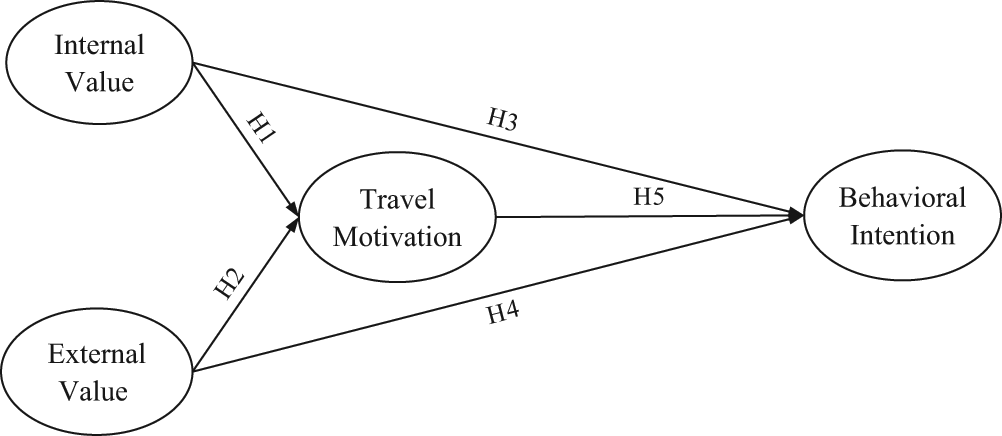
The conceptual model
Hypothesis 5 (H5): Travel motivation has a positive influence on behavioral intention
Method
The data used in this study were collected through a self-administrated survey of Chinese outbound package-group tourists who had traveled overseas for pleasure and were returning from their destination. Copies of the questionnaire were distributed during return flights between March and May 2007. They were distributed to the tourists and collected by tour guides. Each household was allocated one survey. A total of 996 completed surveys were used for the study.
The survey design was based on the literature review. The instrument was first developed in English and then translated into Chinese using a combination of parallel blind translation and modified direct translation as described by Guthery and Lowe (1992). The questions were first translated by two bilingual English–Chinese speakers simultaneously, and the two target versions were compared before consensus was reached. The translated survey document was then reviewed by an expert panel, and revisions were made. This process resulted in an 8.5- by 11-inch booklet with a front cover, an introduction to the purpose of the survey, and 10 pages of questions.
The variables used for the study included the motivation for taking a pleasure trip overseas, values, behavioral intention, and other variables pertaining to tourists’ profile and behavior. The operationalization of motivation drew on the individuals’ psychological attributes. A total of 31 items were selected from the existing tourist motivation scales (e.g., Crompton 1979; Dann 1981; Fodness 1994; Hsu and Lam 2003) and rephrased in statements that are consistent with the context of the present study. These items covered roughly four aspects that have been tapped by previous motivation research, including escape and relax, novel and knowledge, prestigious experience, and self-development (e.g., Crompton 1979). The broad spectrum of those motivation items attempted to capture Chinese tourist motivation as diverse as possible. These statements were offered to the respondents to evaluate with a Likert-type scale that ranges from 1 to 7.
Values were measured by the LOV scale. Respondents were asked to evaluate the importance of each value item on a 1–7 Likert-type scale. They were also asked to choose the most important value in their lives. Four indicators of the dimension of loyalty based on Zeithaml, Berry, and Parasuraman’s (1996) measurement were used to measure behavioral intention. The four items, which were chosen for their consistent satisfactory factor loadings across different studies (e.g., Hung and Petrick 2011), are willingness to recommend the destination(s) to their relatives and/or friends, willingness to encourage their relatives and/or friends to visit the destination(s), willingness to say positive things about the destination (s), and willingness to revisit the destination(s) in the future. All four items were measured on a 1–7 Likert-type scale.
A progressive series of statistical analyses were carried out. First, a frequency analysis was conducted to examine the profile of the respondents. A descriptive analysis was then conducted to summarize visitor motivations for traveling overseas. After a preliminary analysis, which provided baseline descriptive statistics with which to examine the normality of the data, exploratory factor analysis (EFA) with varimax rotation was conducted to identify the underlying motivational and value constructs. Cronbach’s alpha test was then employed to verify the reliability of the variables generated by the EFA.
Structural equation modeling (SEM) with AMOS was used to test the hypotheses, as it deals with causal relationships in a systematic way with multiple latent independent variables, each measured by multiple indicators. Before testing the structural equation model, confirmatory factor analysis was conducted to establish confidence in the measurement model, as it specifies the posited relationships of the observed variables to the underlying constructs. The maximum likelihood method of estimation was employed to test the model. This test was deemed suitable because the confirmatory measurement model needed to be evaluated and/or respecified before the structural equation model could be examined (Anderson and Gerbing 1988). In the final stage of the statistical analysis, a structural equation model was developed to test the research hypotheses shown in Figure 1.
Major Findings
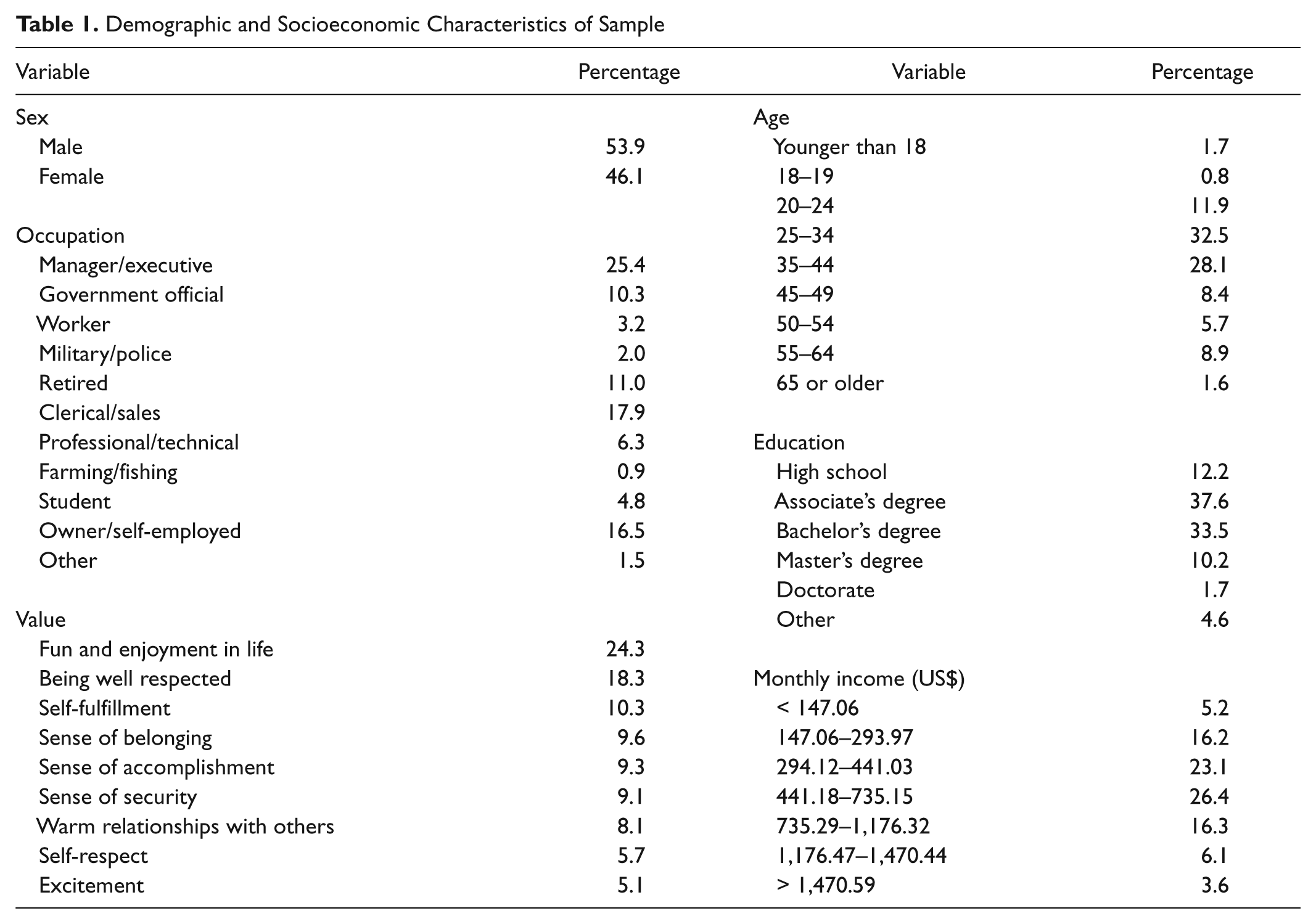
The profile of respondents and the distribution of value selections are shown in Table 1. There were slightly more males (53.9%) than females. Visitors in the 25–34 age group composed 32.4% of the sample, followed by the 35–44 (28.0%) and 20–24 (12.1%) age groups. Respondents older than 50 years of age made up 16.4% of the sample. Almost 50% of the respondents had personal monthly incomes of ¥2,000–4,999, followed by ¥5,000–7,999 (16.3%) and ¥1,000–1,999 (16.2%). A majority of the respondents were well-educated white-collar workers. Among the 996 tourists surveyed, 83.2% had an associate’s degree or above, and 25.4% were managers or executives. Fun and enjoyment in life (24.3%), being well respected (18.3%), and self-fulfillment (10.3%) were the predominant values chosen, followed by sense of belonging (9.6%) and sense of accomplishment (9.3%). Self-respect (5.7%) and excitement (5.1%) were the values least frequently selected by the sample.
Demographic and Socioeconomic Characteristics of Sample
Descriptive analysis was carried out to test the normality of all the variables before testing the measurement model and structural model. The results showed that the sample skewness ranged from –0.835 to 0.493, and kurtosis risk ranged from –1.239 to 0.025. Hence, the assumption of normality was not violated.
The data were then randomly split into two halves to perform two-factor analysis. One-half of the data set (n = 496) was used to conduct EFA, while the other half (n = 500) was used to perform confirmatory factor analysis (CFA). Although there are established and well-accepted measurements for travel motivation and values in the literature, they were developed in Western societies, and the influence of groups, norms, and emotions or impulses on tourist behavior has been underestimated by the values of individualism and rationalism (C. Kim 1998). A previous study also uncovered distinct underlying factors from the same sets of variables among four different nationalities (Osti, Turner, and King 2009). In addition, the EFA procedure can help to decrease multicollinearity or error term correlations among indicators in the confirmatory analysis. Hence, EFA was deemed to be necessary for this study.
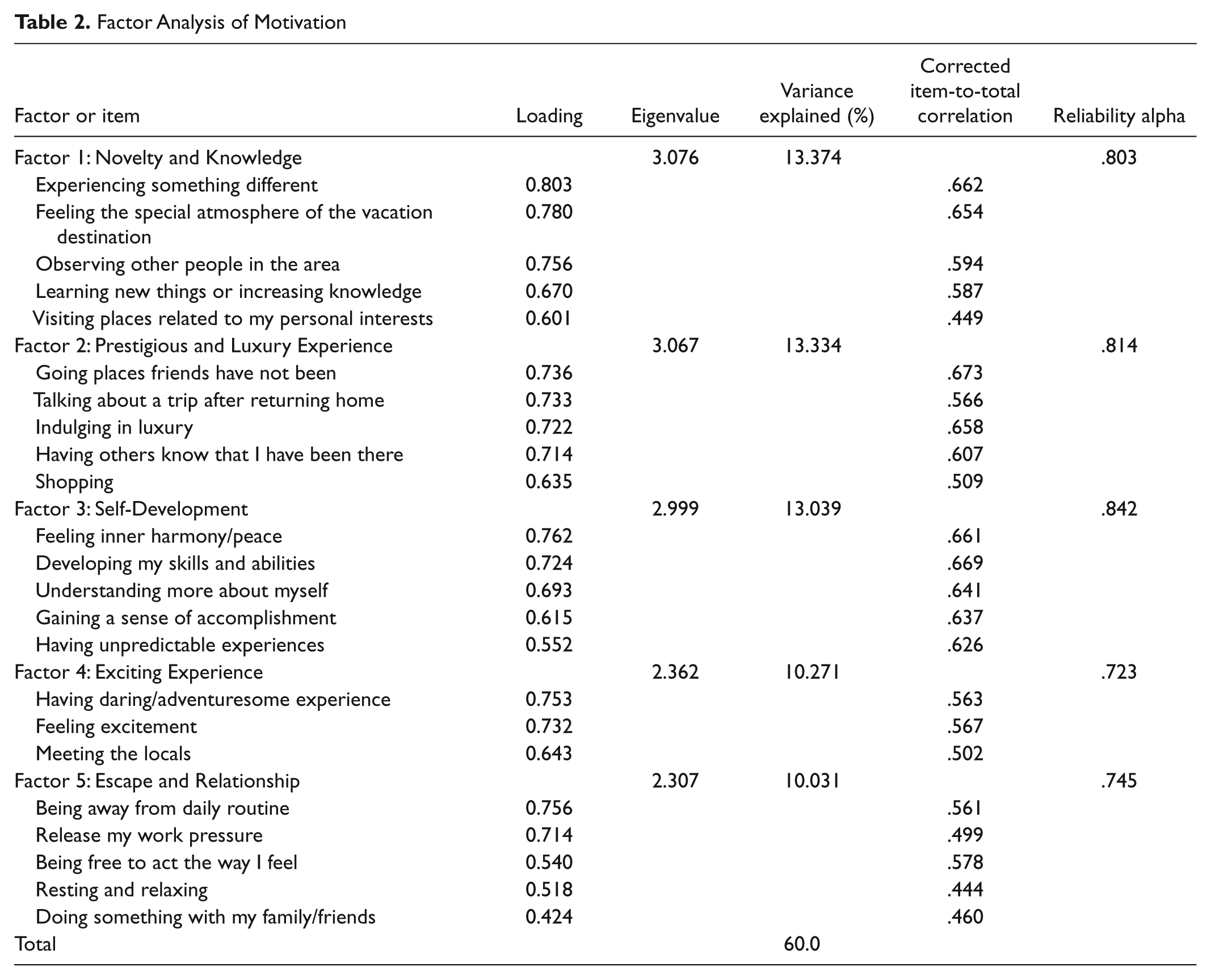
Table 2 presents the results of EFA for motivation and the reliability test. Items exhibiting low factor loadings (< .40), high cross-loadings (> .40), or low communalities (< .50) were candidates for deletion (Hair et al. 2006). The mean value of each motivational statement, which measured the importance of the item to respondents, was also examined as a criterion for deletion as suggested by a previous study (Yoon and Uysal 2005). Out of 31 items, 23 were retained to generate a five-factor solution, explaining 60.0% of the total variance. The reliability coefficients ranged from .723 to .842, and all item-total correlations were above the cutoff point of .3, which indicates satisfactory levels of internal consistency. The five factors were labeled as Novelty and Knowledge, Prestigious and Luxury Experience, Self-Development, Exciting Experience, and Escape and Relationship Strengthening.
Factor Analysis of Motivation
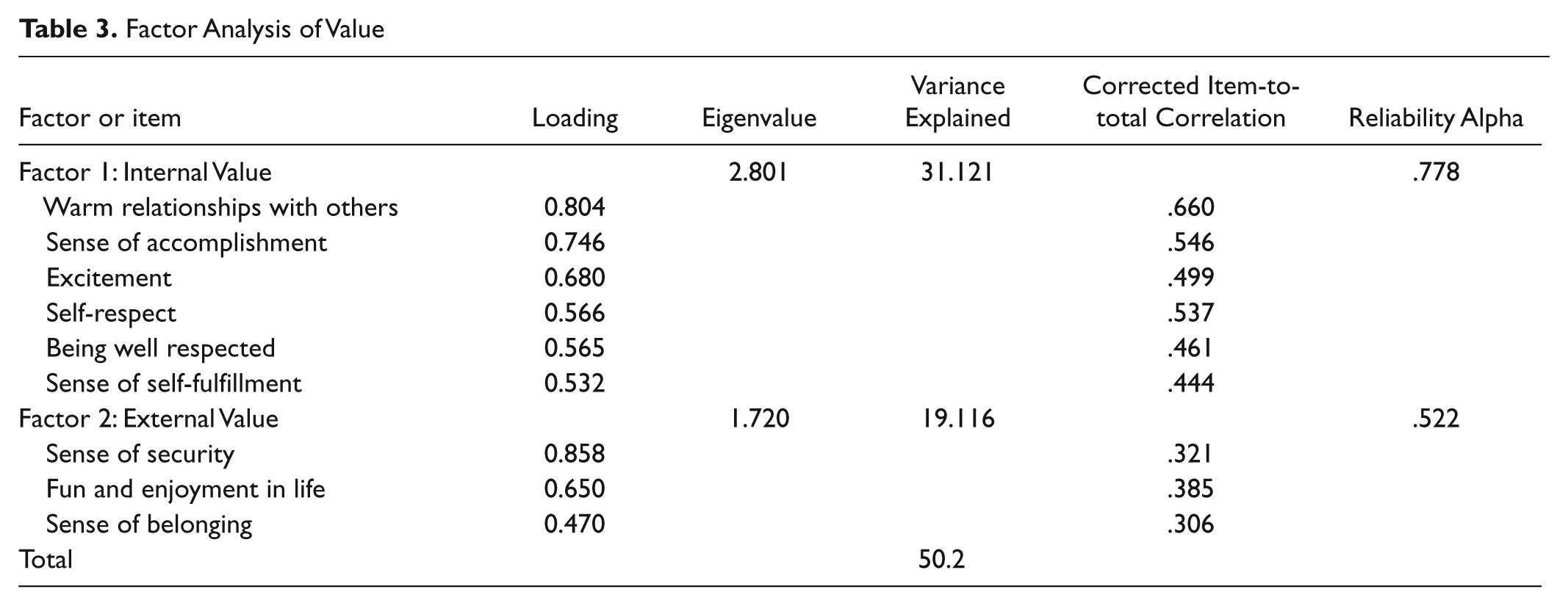
For the construct of values, two factors were extracted that were capable of explaining 50.2% of the variance in the variables (Table 3). Those two factors were labeled Internal Values and External Values. This result was similar to the dimensions identified in previous studies (Kahle 1983), except the statement “fun and enjoyment in life” was loaded on External Values, while the statement “being well respected” was loaded on Internal Values. The reliability test showed that those two factors were within an acceptable value of over .50, as suggested by Pedhazur and Schmelkin (1991). All corrected item-total correlations were above the cutoff point of .3, indicating an acceptable level of internal consistency.
Factor Analysis of Value
The measurement model aimed to link the observed indicator variables and the unobserved latent constructs and to assess the strength of the indicators in relation to the construct. CFA was employed to verify the proposed factor structure and to investigate whether any significant modifications were needed. A two-step CFA was conducted, as suggested by Anderson and Gerbing (1988), to first evaluate each construct separately and then to test the overall measurement model.
The factor loadings are shown in Table 4. Out of 23 motivational items, 22 were maintained for the second stage of the CFA. The item “resting and relaxing” was deleted because of high correlations with more than one motivational construct. Eight out of the nine statements measuring values were maintained. The item “sense of belonging” was deleted because of the low standardized regression weight and a high standardized residue, as suggested by Hair et al. (2006).
Results for the Measurement Model
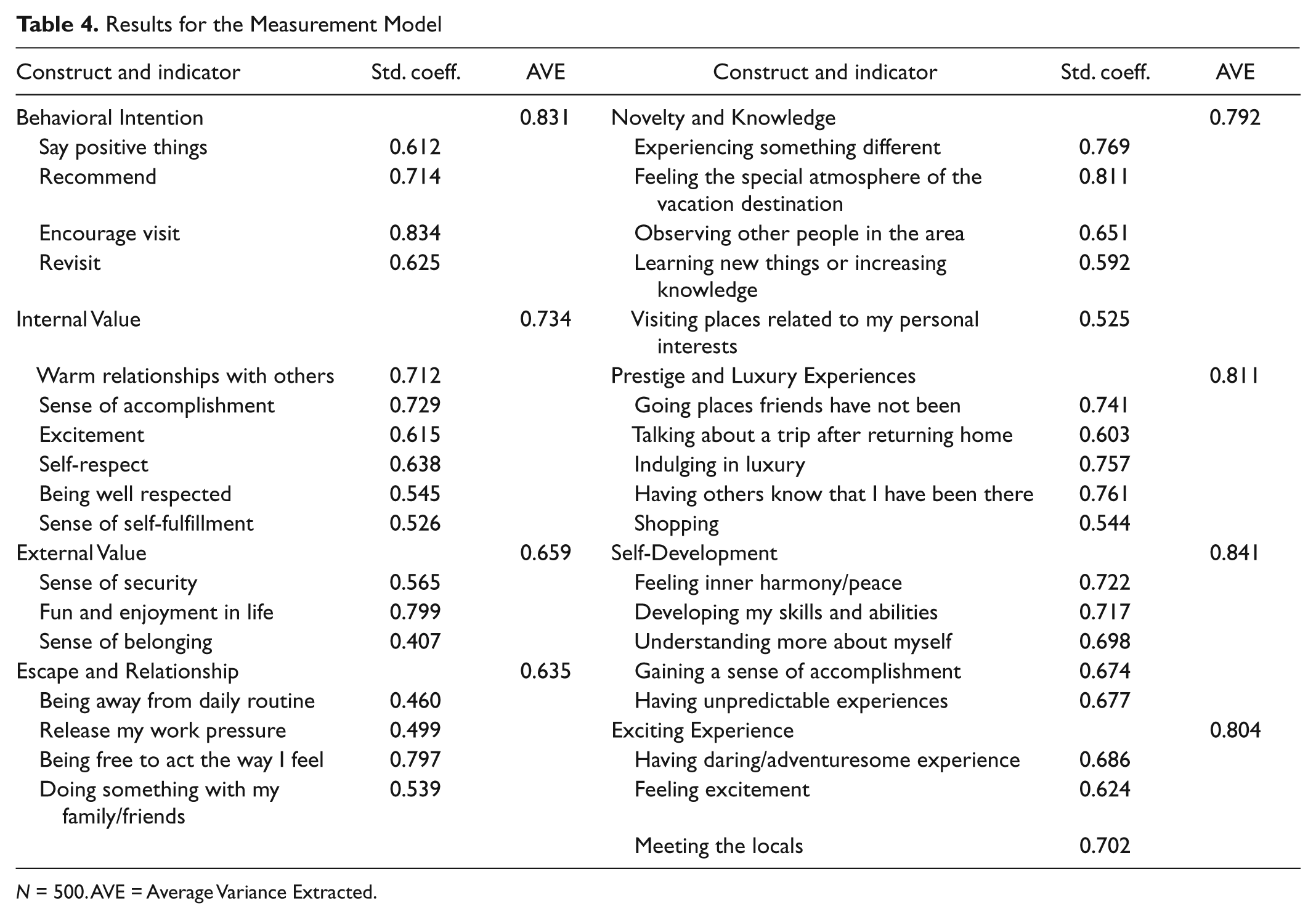
N = 500. AVE = Average Variance Extracted.
As shown in Table 4, all of the loadings for latent constructs in the CFA were significant, suggesting convergent validity (Gerbing and Anderson 1988). Moreover, as the Average Variance Extracted (AVE) of all latent variables exceeded the minimum criterion of 0.5 as suggested by Hair et al. (2006), convergent validity was ensured. Discriminant validity was tested by the AVE method as suggested by Fornell and Larcker (1981). The square root of the AVE for any given construct was greater than the absolute value of the standardized correlation (Table 5) of the given construct with any other construct in the analysis. Hence, discriminant validity was ensured.
Correlation Matrix for the Measurement Model
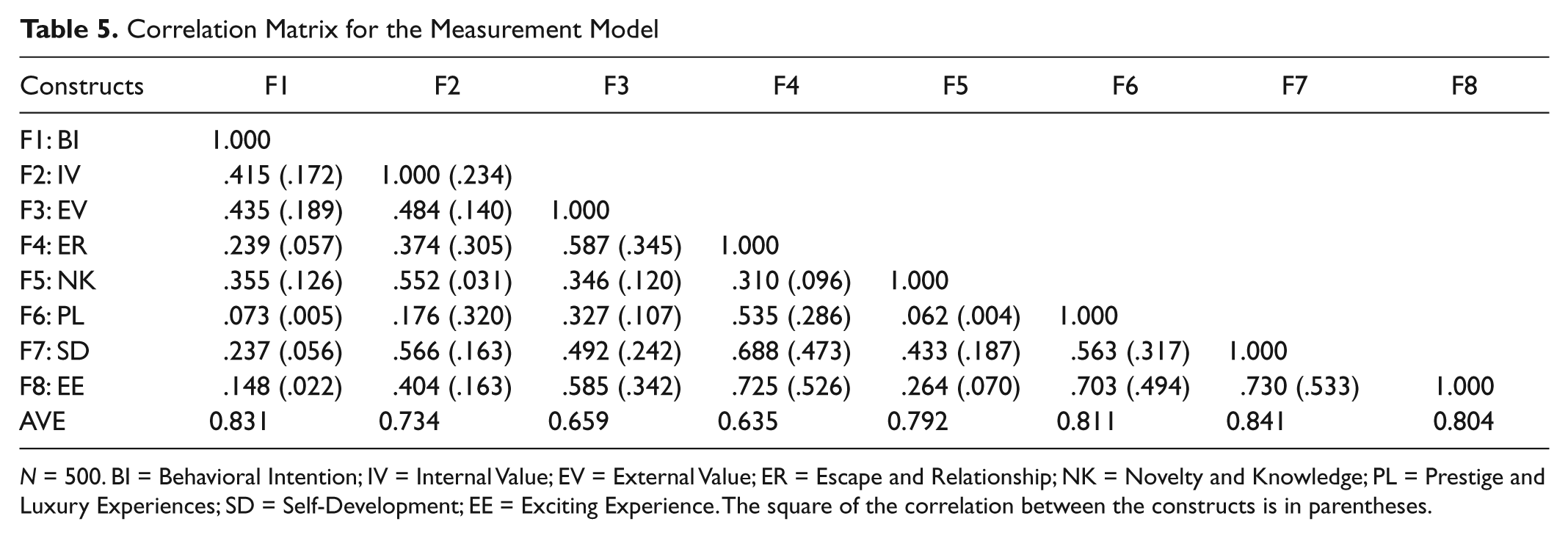
N = 500. BI = Behavioral Intention; IV = Internal Value; EV = External Value; ER = Escape and Relationship; NK = Novelty and Knowledge; PL = Prestige and Luxury Experiences; SD = Self-Development; EE = Exciting Experience. The square of the correlation between the constructs is in parentheses.
The goodness-of-fit indices for the measurement of each construct and the overall measurement model are shown in Table 6. For the construct of motivation, except for the chi-square, all the other indices had an acceptable value, as suggested by Jöreskog and Sörbom (1984) and Hair et al. (2006), with comparative fit index (CFI) = .902 and root mean square error of approximation (RMSEA) = .063. The construct of values had CFI = .924, and RMSEA = .081. The construct of behavioral intention had CFI = .944 and RMSEA = .085. The goodness-of-fit indices for the overall measurement model were CFI = .865 and RMSEA = .061, which indicates an acceptable level of fit between the model and the data. Based on the findings from EFA and the confidence established by CFA, the five research hypotheses were further adjusted.
Goodness-of-Fit Indices of Measurement Model
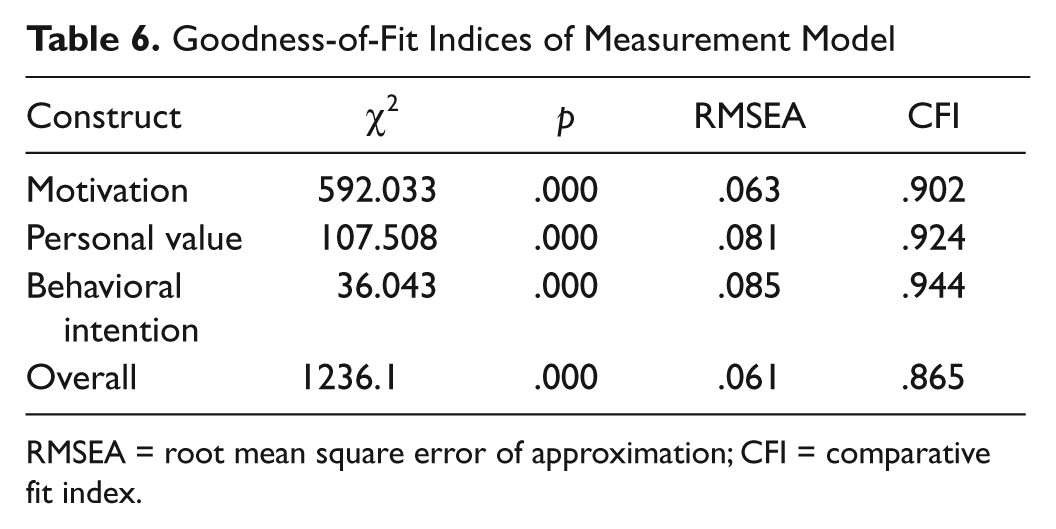
RMSEA = root mean square error of approximation; CFI = comparative fit index.
The proposed structural model was estimated using SEM. The model fit indices and the results from the path analysis are shown in Table 7 and Figure 2. Bentler and Chou (1987) proposed that models with more than 30 items and five factors seldom have a very good fit with the data. The overall structural model had eight factors and 33 items. Hence, it would have been very complex, which would have limited the ability to accurately test its fit (Bentler and Chou 1987).
Goodness-of-Fit Indices and Path Analysis of Structural Model
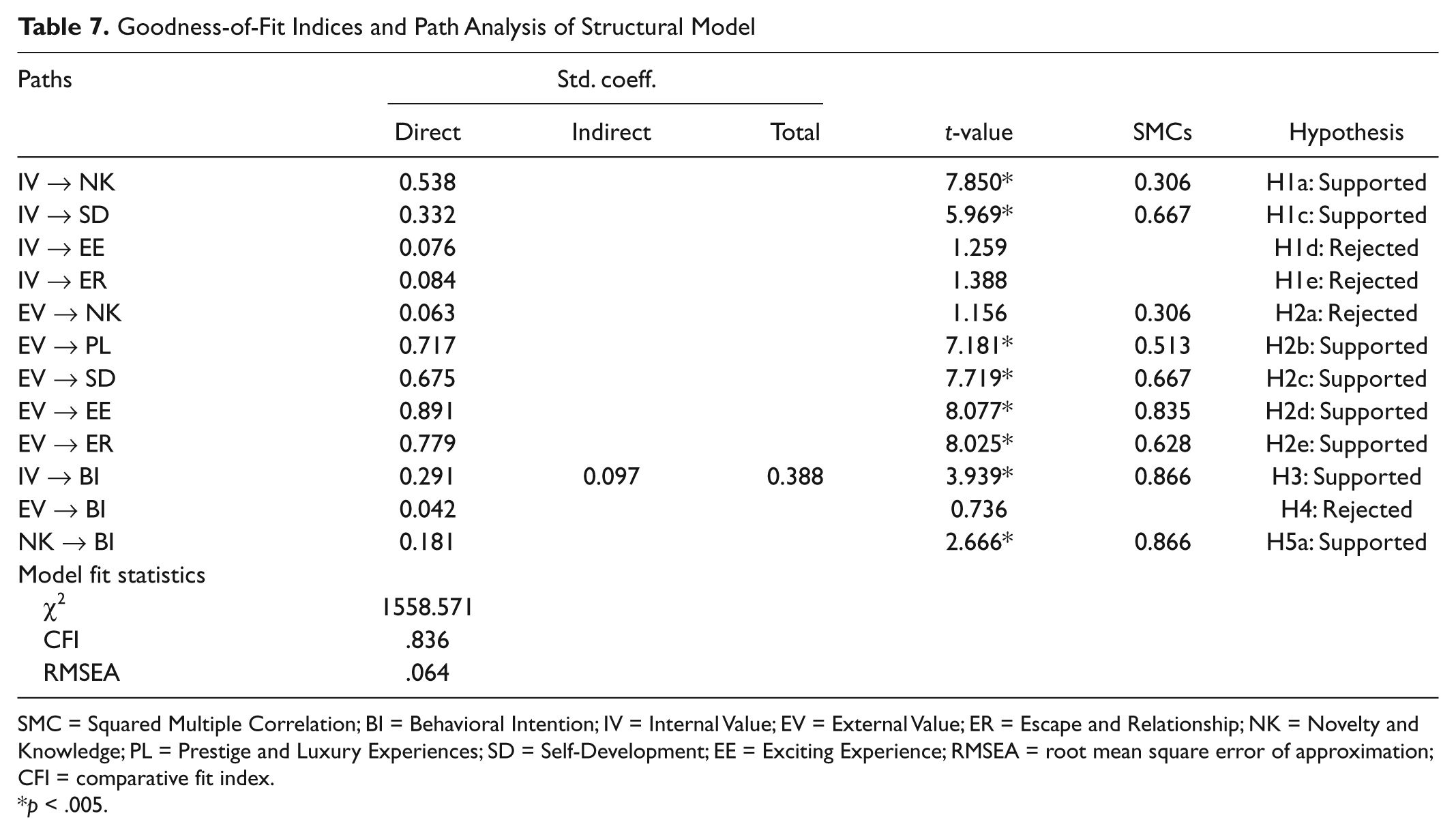
SMC = Squared Multiple Correlation; BI = Behavioral Intention; IV = Internal Value; EV = External Value; ER = Escape and Relationship; NK = Novelty and Knowledge; PL = Prestige and Luxury Experiences; SD = Self-Development; EE = Exciting Experience; RMSEA = root mean square error of approximation; CFI = comparative fit index.
p < .005.
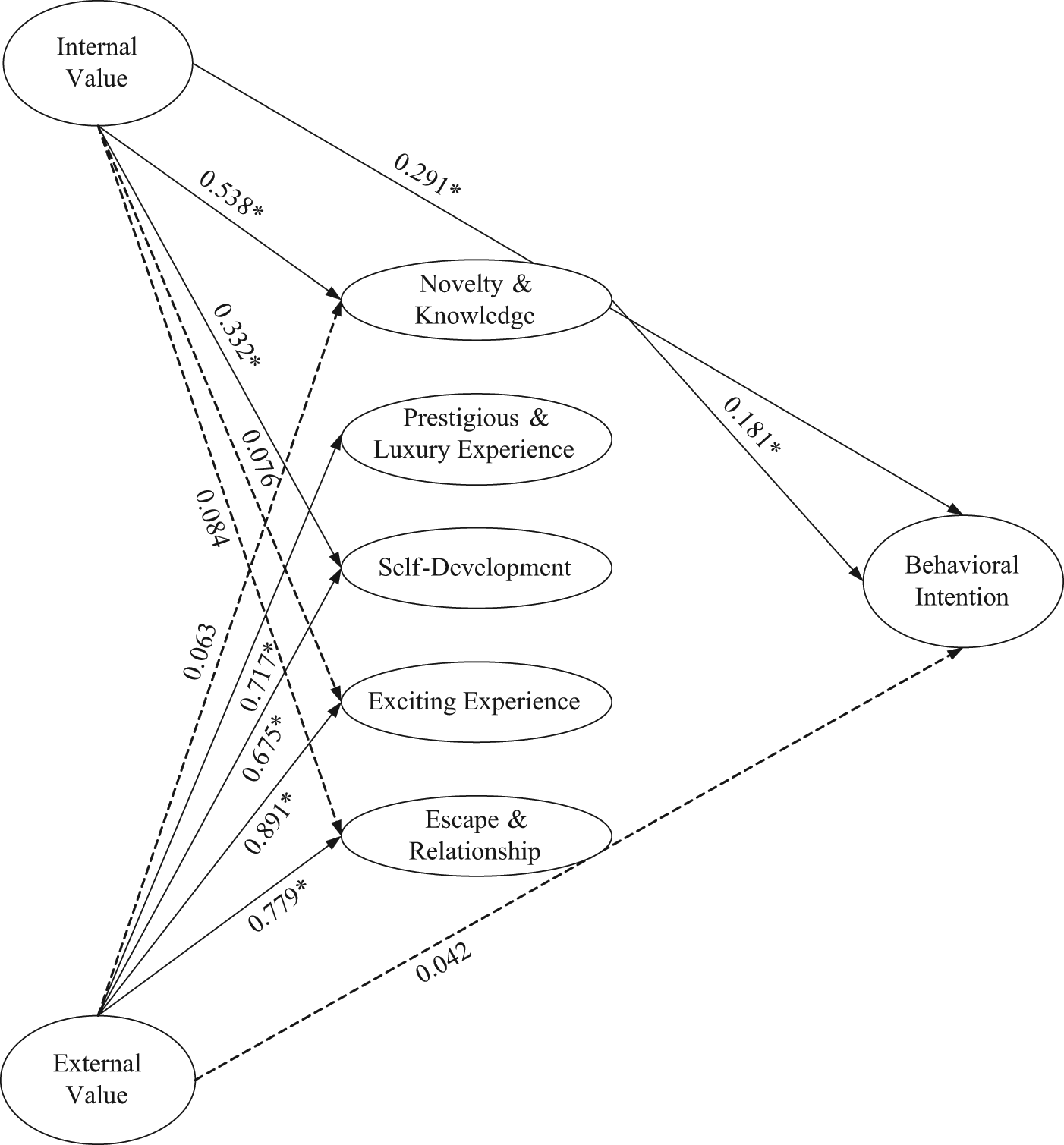
Modified structure model with estimated path coefficient
Model diagnosis through correlation analysis indicated the existence of several suppressor effects. The suppressor was in effect “when the path coefficient and the correlation between latent constructs do not have the same sign, and the original relationship between the two has been suppressed” (Falk and Miller 1992, p. 75). Four paths were detected having positive path coefficients, while negative correlations between the independent variables and the dependent ones, including that of internal value → prestigious and luxury experience, prestigious and luxury experience → behavioral intention, self-development → behavioral intention, exciting → behavioral intention, and escape → behavioral intention. Following suggestions from previous studies (e.g., Vazquez-Carrasco and Foxall 2006), the four paths were deleted. These suppression effects suggested that the regression coefficients between these four pairs of variables could be increased by including a third variable, or a suppressor, in these regressions. The goodness-of-fit indices of the modified overall model included a chi-square of 1558.571 with a p value of .000, CFI of .836, and RMSEA of .064, suggesting modest goodness of fit.
As shown in Table 7, both dimensions of values had positive relationships with the five dimensions of motivation to a certain extent. Internal values had significant relationships with the motivations of Self-Development and Novelty and Knowledge. However, the relationships between Internal Values and Prestigious and Luxury Experience, Exciting Experience, and Escape and Relationship were not established. Hence, H1b, H1d, and H1e were rejected. The external dimension of values significantly influenced all but one motivational factor, Novelty and Knowledge, and H2a was thus rejected.
The standardized coefficient between internal values and behavioral intention was 0.291 (t = 3.939), and it was 0.042 (t = 0.736) for the path between external values and behavioral intention. H3, that internal values have a positive influence on behavioral intention, was thus supported, and H4 was rejected. Only one out of the five paths between motivation and behavioral intention was tested because of the suppressor effects. The path coefficient between novelty and knowledge and behavioral intention was 0.181 (t = 2.666), and H5a was supported.
Discussion and Conclusion
The study reported here extended the body of knowledge on tourism consumer behavior by investigating the effects of values on travel motivation and behavioral intention in the context of mainland Chinese outbound tourists. An emic approach was adopted to promote a complete understanding of culture and its effect on travel behavior. Five groups of hypotheses were developed and validated by structural analysis. Empirical tests of the proposed model provided evidence that values can affect travel motivation and behavioral intention to certain extent.
In the context of Chinese outbound tourists, travel motivation was found to be composed of five underlying factors: Prestigious and Luxury Experience, Self-Development, Novelty and Knowledge, Exciting Experience, and Escape and Relationship Strengthening. Values had two underlying factors: Internal and External. Fun and enjoyment in life, being well respected, and self-fulfillment were found to be the predominant values for the sample. The results from the structural analysis provide empirical support for the commonly held theory that culture, as measured by value, is an underlying determinant of consumer behavior. Values and travel motivation had several direct positive effects on behavioral intention, and values affected travel motivation.
The two dimensions of values were consistent with the dimensions of a national sample surveyed by Kahle in 1983. Respondents’ motivations for novelty and knowledge and for self-development were found to be directly influenced by internal value. Internally oriented individuals tend to want more control over all aspects of their lives (Kahle 1983), tend not to rely on external agents for the fulfillment of values, and are generally more active in terms of travel purchases. Individuals with strong internal values thus tend to be motivated by intrapersonal factors, such as novelty and self-development.
Study results revealed that the external value has direct influence over respondents’ motivation for prestigious and luxury experience, self-development, exciting experience, and escape. Individuals who place more importance on external values tend to be passive and more sensitive to external events (Homer and Kahle 1988). Externally oriented individuals are not prompted by novelty motivations because they tend to place more importance on the sense of security in their daily life. Accordingly, they may not want to be exposed to new and unfamiliar environments. Moreover, externally oriented individuals consider outbound travel as a means of achieving a sense of security, fun, and enjoyment in life and a sense of belonging through interpersonal motivations, such as self-development, prestigious and luxury experience, exciting experience, escaping from daily routine, and relationship strengthening.
The relationship between values and behavioral intention was partially established in that only the internal dimension of values was found to be a significant indicator of behavioral intention. The relationship between the internal values and behavioral intention can be detected in extant literature on the relationship between Chinese values and consumer behavior. In the context of Chinese population, significant values that exert influences over individual’s behavior include face, harmony, guanxi, respect for authority, and yuan (Mok and DeFranco 1999; Yau, Chan, and Lau 1999; Gilbert and Tsao 2000; Gong 2003; Hoare and Butcher 2008). Those values are consistent with the items in internal values to certain extent. For example, the value of harmony implies the individual’s pursuit of warm relationships with others, while the regard for face and authority could explain the desire for sense of accomplishment and respect from others.
With regard to the insignificant relationship between external values and behavioral intention, it is commonly held that social cognition helps individuals to select which situations to enter and what to do once they are in those situations. Both laboratory and survey studies show that values do indeed lead to behavior. However, Kahle (1983) described four conditions in which social cognition does not lead to behavior: (1) adaptively ambiguous or unfamiliar contexts, (2) the formative stages of abstractions, (3) situations with no ostensible adaptive significance or that are subjectively perceived as having no relationship between the abstraction and the situation, and (4) periods of adaptive transformation.
In these unfamiliar or unstable situations, previously held values and other forms of social cognition are unable to guide an individual’s behavior or the way the individual adapts to a situation. There is a call to alter the old adaptation or to develop a new one. In this case, behavior may appear to lead to cognition. This reciprocal relationship between values and behavior can be better understood in the context of exploratory versus familiar behavior. Although exploratory behavior may or may not result from social cognition, it provides valuable information for refining or reformulating the social cognition. Familiar behavior is more consistent with, and results from, social cognition. This explains the insignificant path between external values and behavioral intention.
For many mainland Chinese, outbound travel is exploratory behavior in an unfamiliar environment that is capable of inducing infinite number of stimuli. In this novel situation, past experiences and the extant information are insufficient to form a manageable number of abstractions or social cognitions to manufacture behavior. This is especially true for those individuals who value a sense of security, fun, and enjoyment and a sense of belonging in their life. Because these individuals place more importance on external values, they tend to be more sensitive to the external environment and passive in their behavior (Homer and Kahle 1988).
Only the relationship between the novelty dimension of motivation and behavioral intention was tested and established by the structural analysis in this study. Visitors motivated by the desire to seek novelty were likely to revisit the destination or to recommend the destination to their friends/relatives. This result is consistent with those of Baloglu (1999), Yoon and Uysal (2005), and Huang and Hsu (2009) in that although the theory of planned behavior indicated a relationship between travel motivation and behavioral intention, the effect occurs in only certain motivational dimensions. In the context of Chinese outbound travel, tourists tend to hold a positive postvisit attitude if a destination still appears novel, as novelty seeking is the primary and dominant motivation of outbound travel. Another possible explanation lies in the theoretical underpinning of the measurement of behavioral intention in the service context. This remains the limitation of the present study as well as provide the way forward for future research to understand the complex of tourist behavior in a context as complicated as China.
The study reported in this article makes theoretical and practical contributions to the field. Theoretically, this study is one of the first attempts to incorporate values into the study of travel behavior and to empirically test the relationships among values, travel motivation, and behavioral intention. While values appear to have important implications for tourism marketing practitioners and researchers, the values and the ways in which they influence the behavior of tourists are not clear. Moreover, previous studies have been criticized for failing to explain why people may want to pursue certain types of motivation. It has been claimed that the structure of modern capitalist society may exert an influence on individuals’ travel behavior (Jamal and Lee 2003). The integration of values, which are the actualization of cultural influences, may facilitate the understanding of travel motivation from a sociological perspective.
Second, the study empirically tested a conceptual model of travel motivation based on the dynamic course of behavior. Previous studies of travel motivation have focused either on examining the specific motivations that prompt people to take certain types of vacation (e.g., N. Kim and Chalip 2004) or on the employment of motivation as a means of modeling market segmentation (e.g., Bieger and Laesser 2002). Only a few studies have investigated the relationship between motivation and other behavioral constructs (e.g., Hsu, Cai, and Li 2011). However, investigating the relationships between motivation and other critical behavioral constructs (e.g., attitude, satisfaction, and expectation) in a systematic way can advance our understanding of travel motivation. In that sense, this study contributes to the literature by offering a comprehensive analysis of the relationships between motivation and other constructs.
The third contribution concerns the special context in which this study was conducted. With a history of less than 30 years, the Chinese tourism industry has been undergoing dramatic changes in the past decade. Given that most previous studies were conducted in the context of relatively mature travel markets, it is the right time for academia to focus on newly emerging markets such as China. This study is one of the first attempts to investigate consumer behavior in an emerging market within the global travel marketplace.
With over one-fifth of the world’s population, China is now recognized as the market with the greatest buying potential in the travel and tourism industry. However, previous studies have attempted only to identify tourists and to determine how they behave, leaving aside the fundamental question of what determines their behavior in the particular social and cultural context of China. Destination managers have found that to serve a diverse market profitably they must have complete and accurate information about the individuals who make up each segment. The addition of information about values to demographic information will greatly enhance the effectiveness of any effort, from destination planning to marketing. Destination managers may develop an understanding of how a destination fits with an individual’s life guiding principles and desired value ends. Hence, the empirical findings from this study could be translated into marketing programs in the countries that receive Chinese outbound tourists. For example, destination marketers could emphasize the possibility of achieving values through travel to a destination or even use particular value items in their advertisement campaigns to evoke travel motivation.
During the past five decades, China has undergone frequent sociocultural transformations, and each generation has experienced an epic event. According to Kahle (1983), the significance of the different values in people’s lives varies according to numerous factors, including birthright demographics, personal experience, and social institutions. While the study presented in this article treated the sample as a homogeneous group, future studies should investigate the moderating effects that individual sociodemographic factors, previous travel experience, and other situational factors have on the associations between values and motivation and between personal values and behavioral intention.
Footnotes
Declaration of Conflicting Interests
The author(s) declared no potential conflicts of interest with respect to the research, authorship, and/or publication of this article.
Funding
The author(s) received no financial support for the research, authorship, and/or publication of this article.