




Abstract
Chinese tourists, who are increasingly traveling out of Asia independently, need trustworthy and readily available information sources. This study explores the motives of Chinese tourists who have invested considerable time (mostly more than a week) in creating information-rich, influential, and interactive online travel blogs—effectively creating personalized little “Lonely Planets” that serve these growing information needs. This study assesses the demographic characteristics of the “Lonely Planets” creators, the features of their blogging behavior, and the motivations for the involvement. It reveals six motive categories: “positive self-enhancement through online social connection,” “altruism: being helpful to fellow travelers,” “social status issues,” “personal status and achievement,” “self-documentation and sharing,” and “hedonic enjoyment of blogging.” Superficially, these motivations seem to be similar with previous Western studies of blogging behavior, but significant contextual and cultural issues exist and are explained. Management implications and future research arising from the current study are provided.
Introduction
Lonely Planet, the world’s best known and most popular travel guide book brand, has been considered as a bible by many independent tourists. The series has been a commercial success because of its wide and rich coverage of worldwide destinations (Wheeler and Wheeler 2007). In the contemporary Chinese travel community, a somewhat more private version of travel information communication is emerging: literally thousands of people are posting blogs of their travel experiences. These blogs cover all aspects the travel; for example, applying for a visa, booking the tickets/vehicles/ accommodation, describing local lifestyles, explaining procedures at customs, advising on the must-do experience in the destinations, and offering tips for an enjoyable holiday (see examples at www.qyer.com and www.mafengwo.com ). These blogs are generally in a mixed style of text and pictures and constitute a rich inventory of personal travel stories. They are also read widely. For example, a young Chinese gentleman posted an ongoing travel blog in an online travel community recording his 167 days of self-driving in the United States starting in September 2011. In the next 23 months (till August 2013), his drive tourism blog was looked at on 360,000 occasions, with an average number of visitors per day of 522. In addition, there were 799 interactions with fellow tourists through readers’ questions and the answers provided to these inquiries. These blogs, rich, informative, and interactive, are so influential that the authors of this study consider it appropriate to refer to them as little “Lonely Planets.”
An initial comparison with the existing literature suggested that this little “Lonely Planets” phenomenon is somewhat different from the popular blogging style in the Western travel communities in terms of information size, time investment, and interactive atmosphere (see www.travelpod.com, www.tripadvisor.com, and www.virtual-tourist.com ) (Carson 2008; Li and Wang 2011). This study is interested in exploring (1) who are these “Lonely Planets” contributors? (2) What motivates their “Lonely Planets” creativity? and (3) How do their “Lonely Planets” contributions meet the demands of their readers?
These questions can be initially set in the context of understanding trust and the trustworthiness of information for independent Chinese outbound tourists. The links between the academic literature on facets of trust in online travel sources and the motives of the Chinese travel blog posters are used to identify the specific theoretical contribution of the work and build recommendations for management attention.
The broader agenda of this study also warrants specific justification. As the phenomenon of Chinese outbound tourism grows and begins to exert a powerful influence on many global destinations, it is both pragmatic for destination managers and stimulating for researchers to understand new and distinctive tourism behaviors, forms and characteristics (cf. Ryan and Huang 2013). In particular, research about the Chinese market and Chinese tourists’ needs to be more just a simple extension of studies done in Western and developed countries (Yang, Ryan, and Zhang 2012). The cultural distinctiveness and the novelty of outbound travel for citizens of the world’s most populous country is producing a range of idiosyncratic travel motivations, behaviors, and interests: arguably a blending of communist, consumer, and Confucian interests (Pearce, Wu, and Osmond 2013).
For contemporary tourism researchers, irrespective of their own nationality, there is a value in describing and documenting these emerging trends, interests, and forms of consumption, not just for their own sake but because they generate re-evaluation of the ways tourism has been understood. Travel blogs in China are one item in this generative research agenda. Other themes with potential for intense study both for their own sake and for what they reveal about assumptions in Western research include the politically influenced red tourism, three-generational travel, Chinese ethnic tourism development, and the Chinese quest for health, harmony, and longevity. For Western researchers, including readers of the Journal of Travel Research, it is possible to envisage a future specialization in one or more of these kinds of Chinese tourism emphases. The rationale for publishing and being interested in these Chinese topics is another step in the globalization of knowledge and the construction of an East–West tourism dialogue built on an enhanced mutual understanding (Morris 2011).
Literature Review
Three areas of interest from the existing literature are relevant to the current study. The first group of studies is concerned with online word-of-mouth (WOM) communication in the web 2.0 era. The review work includes initial consideration of people’s motivation in delivering WOMs. The second set of studies looks at the new trends in Chinese outbound tourism. These observations are then complemented by discussing some defining characteristics of the newly independent Chinese travelers’ needs for trustworthy information. Based on the literature review, research directions and aims directing the study and identifying the value of understanding Chinese blogging motivation and its links to their compatriots’ information needs are outlined.
Online WOM, Travel Blogs, and Tourists’ Engagement
Social media, or web 2.0, has been considered as one of the “mega trends” that has significantly affected the tourism system (Bosangit, McCabe, and Hibbert 2009; Leung et al. 2013). It has fundamentally changed the way tourists search, find, and trust, as well as collaboratively produce information about tourism suppliers and tourism destinations (Akehurst 2009; Buhalis and Law 2008; Sigala, Christou, and Gretzel 2012). There are a range of forms of social media that tourists can adopt, including blogs, virtual communities, microblogs, reviews, emails, bulletins, newsgroups, and discussion boards/forums (Litvin, Goldsmith, and Pan 2008). The channel of most relevance to the current study is travel blogs.
Blogs are online diaries or personal journals that can be presented in multiple styles (e.g., text, photos, and videos) (Huang, Chou, and Lin 2010). Different from the traditional diaries, they usually offer open access and allow two-way interaction between the blog sharers and browsers (Litvin, Goldsmith, and Pan 2008). Compared with other forms of online WOM, blogs can contain richer information, because of their intimate diary-style nature. In travel blogs, tourists usually publish their personal travel stories and recommendations. Travel blogs often reveal multiple aspects of a tourist’s experience at a specific destination (Li and Wang 2011).
Travel blogs, as well as other forms of online WOM, share characteristics with traditional WOM communication (Gartner 1993). They are usually considered as unbiased and trustworthy (Mauri and Minazzi 2013). They have been shown to be very influential in tourists’ information searching and decision making (Tussyadiah and Fesenmaier 2009; Volo 2010; Ye, Law, and Gu 2009; Zehrer, Crotts, and Magnini 2011). In addition, researchers and the industry can also access tourists’ voices on blogs and other forms of online WOMs (Akehurst 2009; Banyai and Glover 2012). For example, blogs and other forms of social media have been used to promote destinations (Hays, Page, and Buhalis 2013), to understand destination images represented by tourists (Li and Wang 2011; Pan, MacLaurin, and Crotts 2007; Tse and Zhang 2013; Tussyadiah and Fesenmaier 2008), to understand factors influencing customer satisfaction in a specific area of the tourism industry (Zhou et al. 2014), and review a particular company’s competitive position in the market (Magnini, Crotts, and Zehrer 2011). Indeed, research in and about online WOM is thriving. Leung et al. (2013) recently reviewed the 44 social media–related research articles published in academic journals during 2007–2011. They content-analyzed the research from both the consumers’ and suppliers’ perspectives. They found that consumer-centric studies generally focused on the use and impact of social media in the research phase of the tourists’ travel planning process, especially, the importance of social media in influencing tourists’ decision making (Tussyadiah and Fesenmaier 2009; Ye, Law, and Gu 2009; Zehrer, Crotts, and Magnini 2011).
An area of specific interest to the current study is why people are involved in creating the online WOM. Considerable research has been done in the wider communication area. For example, Lenhart and Fox (2006) interviewed U.S. bloggers and found that people are blogging mainly to share practical knowledge or skills with others, to stay in touch with friends and family, to document personal experiences or share them with others, to motivate other people to action, or to express themselves creatively. Daugherty, Eastin, and Bright’s (2008) study of why people create social media suggested that key motivations include social, ego-defensive, knowledge, utilitarian, and value-expressive aspects. In addition, venting negative emotions (Hennig-Thurau et al. 2004), exercising collective power over companies (Hennig-Thurau et al. 2004), finding intrinsic enjoyment (Litvin, Goldsmith, and Pan 2008), building positive self-enhancement (Hennig-Thurau et al. 2004), developing community citizenship (Tremayne 2007), and fulfilling moral obligations (Wasko and Faraj 2000) have also been identified as motivations for people’s engagement in various online WOMs. Table 1 lists further studies exploring motivations for tourists’ online WOM engagement.
Motivations for Social Media Engagement: Tourists’ Perspectives.

Three features of these studies can be highlighted to build research opportunities in the area of tourists’ motivation for online blogging. First, most research explores tourists’ engagement with general online WOMs, without specifying the type of online activity. According to Litvin, Goldsmith, and Pan’s typology (2008) empirical study, each form of online WOM can be very distinctive, and they may attract different groups of participants. In this sense, studies focusing on a special branch of social media are valuable to develop a better understanding. Second, it is important to identify the role of the participants, as there is a large gap between social media creators and the social media browsers (Yoo and Gretzel 2011), and these two groups of people may be significantly different in terms of social and demographic backgrounds (Rong et al. 2012). Studies to assess the blogging motivations of Chinese tourists are not yet a part of this literature, though the activity and power of the communication has been noted (Choi, Lehto, and Morrison 2007; Tse and Zhang 2013). Most of the previous social media engagement motivation studies in tourism consider users from Western countries. A recent cross-cultural study between American and Korean blogging behavior suggests significant differences in various areas (Lee and Gretzel 2014). Any motivational differences may be rooted in cultural issues. In summary, there is an important opportunity to develop an understanding of Chinese blogging motivation because the phenomenon has not been specifically studied but may help understand the power of online WOM in this important international market.
Chinese Outbound Tourists—The Second Wave
Changes in the origins of tourists, especially the growth in traveler numbers from non-Western countries, have characterized recent trends in the contemporary tourism world (Cohen 2011). A part of this diversification is the growing number and changing nature of the Chinese outbound tourists. Arlt (2013) recently labeled the new movement of Chinese outbound tourism as a second wave of tourism. There are four issues identified in this second wave that build the background for the current research.
First, the market is large, affluent, and growing fast. In 2013, China generated 98.19 million outbound tourists (China Tourism Academy 2014). Chinese outbound tourists spent US$102 billion in 2012, an increase of 37% from 2011 (UNWTO 2013). Studying how this market operates and identifying its information sources and their construction and characteristics are of interest to researchers and marketers (TRA 2012)
A second issue is the growth in the number of independent tourists. While the group tour is still popular among Chinese outbound tourists, growing numbers of Chinese are traveling independently (Arlt 2013; Pearce et al. 2013; Xiang 2013). Traveling independently has a short history in China. At first, it was seen briefly in 2003, when it was dominated by short excursions to tourist attractions (Kristensen 2013). Independent travel, however, has grown especially quickly in the past 10 years, and Chinese independent tourists have extended their footprints overseas (Xiang 2013). For the Chinese, the process of traveling independently overseas involves control over one’s own itinerary, represents new challenges, and confers status (Kristensen 2013; Pearce et al. 2013). Independent travel also delivers spontaneity and moments of unexpected pleasure, and is associated with enhancing one’s knowledge and skills (Tsaur, Yen, and Chen 2010). These perceived advantages, together with an increasingly easier access to visas (Lai, Li, and Harrill 2013), have created a growth wave of independent travel.
Compared with group tour participants, Chinese independent travelers tend to be younger. The age cohort of 16–35 accounts for 52.8% of the whole independent travel market (China Tourism Academy and CYTS 2013). They are generally well-educated and middle class (Zhang 2012); unafraid to be critical of on-site management (Pearce et al. 2013); and want to have new experiences such as driving independently overseas (Kong and Liao 2010; Wu and Pearce 2013). It is anticipated that the number of independent Chinese tourists will keep growing and shape new trends for the whole market (Arlt 2013).
The third issue relevant to this study from the second wave concept is that Chinese tourists are beginning to travel out of Asia in increasing numbers (WTF 2013). These developments are of interest to both industry groups and academic analysts (OTTI 2012; TRA 2012). Studies have been conducted since the late 1990s about Chinese tourists traveling to China SARs (Hong Kong, Macau) and Taiwan (Huang and Hsu 2005; Tse and Zhang 2013; Zhang and Lam 1999). Meanwhile, the growing number of Chinese tourists traveling to other parts of Asia has also attracted academic interest (Kau and Lim 2005; Truong and King 2009). Recently, studies have explored various facets of Chinese outbound tourism in North America (Lai, Li, and Harrill 2013; Xu and McGehee 2012), in Europe (Fugmann and Aceves 2013; Pearce et al. 2013), in Oceania (Fountain, Espiner, and Xie 2011; Sparks and Pan 2009), and other parts of the world (Kaplan 2010). For the present interests, the scope and reach of the new market creates a broad applicability of those studies that explore factors influencing Chinese tourists’ choices and experience.
A fourth and critical issue for the present study is that the Chinese outbound market, especially the independent travel market, tends to be very tech-savvy and empowered by social media (Arlt 2013; Tse and Zhang 2013). Travel, as an information-intensive activity, is strongly influenced by China’s widespread digital connectivity (McKinsey&Company 2013). In a recent longitudinal study, Kristensen (2013) observed that the Chinese independent tourists are particularly well connected with social media, though the formats of engagement vary at different stages of their travel cycle. The China Tourism Academy (2014) reported that nearly 60% of Chinese outbound tourists used the Internet as their information source.
The most popular Internet sources include travel blogs, virtual communities, microblogs, reviews, and websites (Zhang et al. 2013). Within China, a number of online travel communities, focusing on independent traveling, have been established, with considerable numbers of participants creating rich blogs and an even larger population reading and commenting on these blogs (Wu and Pearce 2013). These information and communication options are key to understanding the contemporary Chinese market.
Chinese Blog Use
The cultural context in which Chinese independent tourists use their digital resources and connections is, arguably, distinctive. The differences that can be identified are principally built on the issues of history, cultural values, and trust. Because of the previous strong travel restrictions and the tight political control of the country over access to information, newly independent Chinese travelers are the first citizens from their country to explore the outside world (Morris 2011). They do not have an education built on an extensive understanding of Western and developed cultures (Pearce et al. 2013), nor can they rely on the past experiences of their parents or the travel experiences of older friends (cf. Gunn 1988; Gartner 1993). Nevertheless, Chinese everyday life and cultural norms encourage people to rely on others and to behave in community-minded ways (Nisbett 2003; Reisinger and Turner 2003). Additionally, there is a both a historical and contemporary respect for literary and artistic achievement in many forms (Huang, Chou, and Lin 2008; Pearce et al. 2013).Travel blogs fit both the need for information and offer some artistic scope in their production.
For Chinese tourists planning a novel international trip, travel blogs are likely to appeal to them on a number of grounds. The explanation for this attachment rests in a coalition of the cultural factors already cited but it also derives from recent findings about the perceived trustworthiness of travel blogs among Chinese readers.
In general terms and across a number of communities, it has been established that personally generated, online channels are widely seen as reliable and with high levels of integrity, which build trustworthiness (Dickinger 2011). Gregori, Daniele, and Altinay (2014) have extended the ideas about trust and argue that four facets of trust, notably benevolence, integrity, openness, and competence are the drivers of tourists’ responses to the material they access. In the work of Gregori, Daniele, and Altinay, affiliate and intermediary information and online providers were of primary concern but the same dimensions can be applied to user-generated information, with the possible substitution of the original term competence with the rather broader characteristics of skillful and appealing delivery.
In this context of the appeal of travel blogs, Choi et al. (2012) highlight that blogs are influential sources in early and preliminary phases of tourists’ decision making, and further, that because tourists have time at this juncture, the blogs must be entertaining to have an impact. These views are reinforced by Filieri and McLeay (2013), whose multiple regression study of WOM communication and its influence on accommodation indicated that online reviews with a value added component as well as accuracy, have strong impacts on tourists’ accommodation booking. Similarly, Li et al. (2009) noted the affective power of online material. Further, Huang, Chou, and Lin (2008) working with Taiwanese respondents reported that the motives for reading blogs included affective exchange, entertainment, and information, with those blogs that were seen as well presented and entertaining being the most trustworthy. Hsu and Lin (2008) have proposed a 12-variable research model predicting attitudes toward using blogs for their Taiwanese sample. Perceived enjoyment was easily the most important single variable influencing attitudes towards blog use.
Other recent literature relevant to an understanding of trust and Chinese blog motivation and appreciation is found in the experimental work and then subsequent qualitative analysis of Kusumasondjaja, Shanka, and Marchegiani (2012). They found that the positive online reports were more influential than negative ones but that additionally these kinds of effects were strengthened when there were more clues about the likely identity and similarity of the information provider to the reader. Chinese travel blogs tend to be overwhelmingly positive, and there is access to the reader because of the ability to share and comment on the recorded information. These recent and linked studies concerning travel blog use and its trustworthiness also point consistently to the need to understand to what extent travel blogs meet the user needs. One way of beginning this intensive research agenda lies in a careful examination of the travel blog contributors’ motivation in the Chinese context.
Synthesis: Research Opportunities
Building on these linked ideas in the existing literature, this study seeks to identify the motives for Chinese independent travelers writing travel blogs. It is these independent travelers who are the pioneers of out-of-Asia travel and whose blogs are testimony to self-organized travel and provide explanations for others of ways to cope in new destinations. An associated aim of this descriptive endeavor lies in then assessing the links between these motives and the documented characteristics defining trust that are sought by travel blog users. The potential identification in this process of distinctive features of the Chinese blog communications will be considered, and the implication of the patterns uncovered appraised for their theoretical value for further research and managerial action.
Research Methodology
Data Collection Procedures
Based on the aims of study, we define the participants as those who are actively involved in blog writing. Blog users, who only browse and comment, are not the targets of this study. Thus, this research began with identifying the appropriate social media platforms where Chinese independent out-of-Asia tourists post their “Lonely Planet”–style blogs. Three slightly different sites were finally selected. The first site, www.qyer.com, focuses on outbound independent travel. It is the most popular and interactive online community among the Chinese outbound tourists. Qyer.com, when accessed in January 2013, had 521,530 travel blogs. The second site is www.mafengwo.com, which positions itself as a reliable, independent travel community specifically interested in exchanging informa-tion about self-drive tourism. It pays equal attention to both domestic travel and overseas trips. The third site considered in this study is http://blog.sina.com.cn/, which is the most well-known and comprehensive Chinese blog community. It has been well received by ordinary Chinese who use blogs to express and promote themselves. Travel is an important topic discussed on this site.
Once the sites were confirmed, a Mandarin-speaking researcher read 10 blogs from each continent except Asia. In these 50 blogs, 19 of them presented some reasons why they were creating their own “Lonely Planets.” The researchers also initiated communication with 17 blog posters. In this contact, the researchers disclosed their identities and research interests. The responses from the blog posters enabled the authors to better understand the blogging sphere. Following these steps, a questionnaire-based survey was designed.
The questionnaire survey was later posted online through Qualtrics.com. All the bloggers who were contacted earlier were invited to join in the survey and asked to make any appropriate comments about the survey. Using this feedback, ambiguous items were either removed or edited. The final survey covered questions in three areas: demographic information, blogging motivations, and blogging behaviors. In the motivation section, 22 items were included (see details in the following Results section). Ideas were generated from both previous research about tourists’ involvement with social media (Parra-López et al. 2012; Yoo and Gretzel 2008) and the foundation work conducted in the current study (blog reading, online message communications, and the feedback). These 22 items were measured on a five-point Likert-type scale ranging from 1 = strongly agree to 5 = strongly disagree. In addition to these structured questions, an open question was included to invite the bloggers to make comments on their blogging motivations. Some of the comments are used as quotations to interpret the study findings.
Personalized invitation messages were then sent to a wider audience who had recently posted an informative blog on a non-Asian trip. The web link of the survey was included in all the personalized invitation messages. In case the bloggers had posted more than one non-Asian tour blogs, they were clearly requested to consider one of their most recent non-Asian tour blogs and then answer the questions. In detail, 801 invitations were made (279 through Qyer.com, 312 through mafengwo.com, and 210 through BlogSina) from April to June 2013. It is worth noting that both the 17 online message communications and the survey were conducted in Mandarin. An independent research assistant, who has a tourism research background and who is also fluent in both English and Mandarin, assisted the researchers to check the translation and interpretation issues. Two hundred twenty-two bloggers replied to the author’s request to participate in the survey, with a response rate of 27.7%. Among all the replies, 209 copies of surveys were fully completed and were thus considered as valid data for the research.
Survey participants were asked to specify the destination they wrote about in their recent non-Asian travel blog. Frequency analysis suggests that the order of frequently reported continents were Europe (77/209), North America (50/209), Oceania (48/209), Africa (25/209), and South America (9/209). This distribution of blogs is fairly consistent with the current geographic distribution of Chinese outbound tourists (cf. China Tourism Academy 2014) and supports the focus of the current study—out of Asia.
Data Analysis
The data in this study were analyzed through SPSS 20.0. Principal components analysis (PCA) with varimax rotation method was adopted for the factor analysis to examine the dimensions of Chinese tourists’ motivation in creating “Lonely Planets.” Exploratory factor analysis was used in this study because there was no clear precedent or previous study of this group of tourists’ specific blogging motivations. Before the PCA analysis, KMO (Kaiser–Meyer–Olkin measure of sampling adequacy) and Bartlett’s tests were conducted to indicate the suitability of the data for structure detection. During the PCA analysis process, Cronbach’s alpha and interitem correlations were used to test the reliability of the scales. In addition, descriptive analysis and methods for comparing means (e.g., independent samples t test, and one-way ANOVA) were adopted to enrich the findings of the current research.
Research Findings
Who Creates the Little “Lonely Planets”?
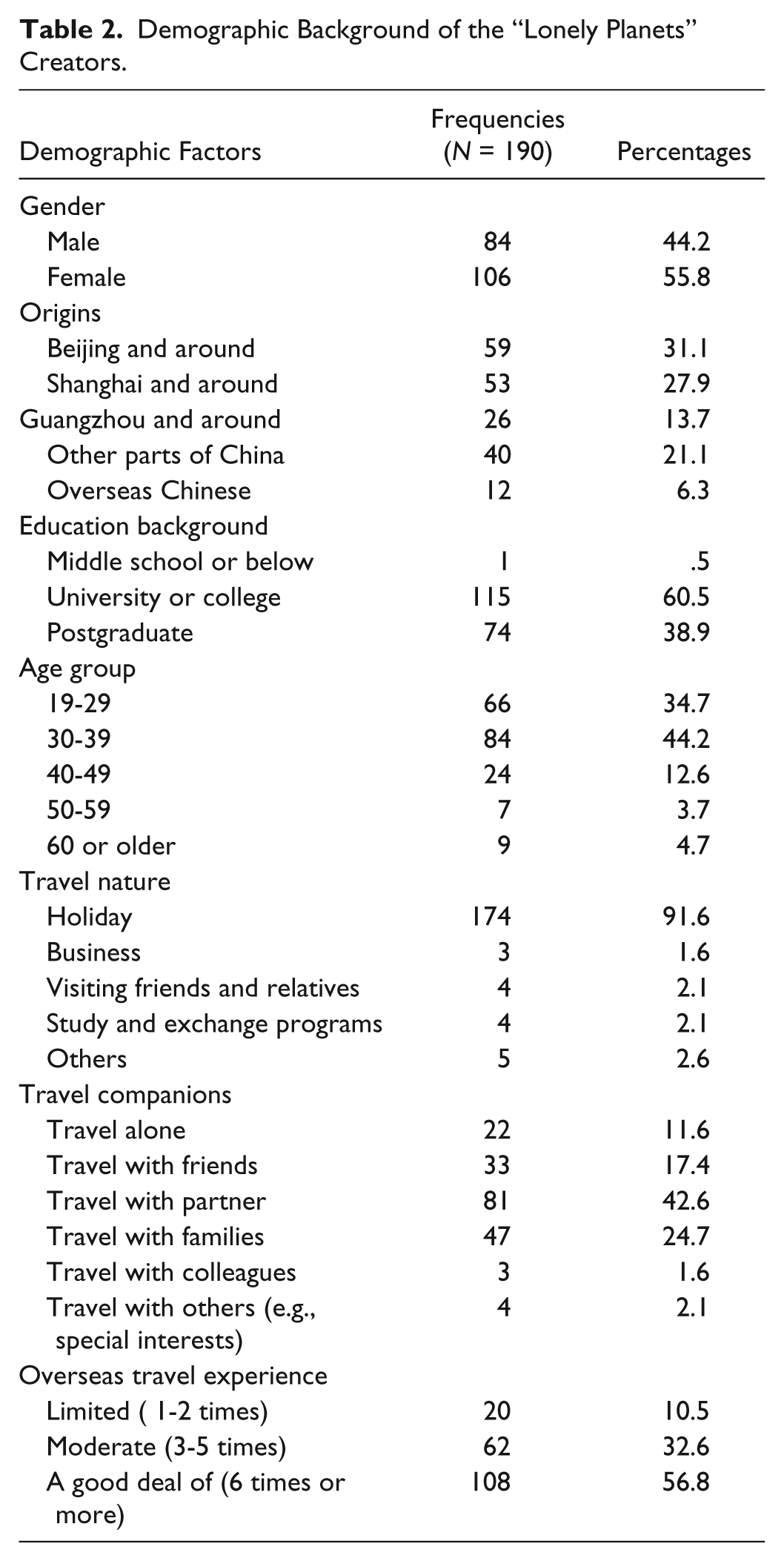
This study is interested in exploring the Chinese independent out-of Asia tourists’ motivations in blogging. To meet the study goals, the research samples were double-checked in terms of their travel style. Nineteen of the 209 respondents reported that their trip was full-packaged, half-packaged, or organized by their working units. Due to the focus of the current study, these 19 respondents were excluded from further analysis. Analysis of the 190 independent out-of-Asia tourists’ demographic factors found that females (55.8% of the sample) were somewhat more involved in writing the blogs (Table 2). Most of bloggers (72.7%) were from coastal China, which is defined as first tier of the market by overseas DMOs. Those blog posters tended to be young, with those in 30s and 20s as the most active players. They were well-educated, mostly with tertiary education background. From the reported blogs, most of them can be described as holiday travelers (91.6%). Traveling with one’s partner, one’s family, and friends were most commonly seen. The bloggers have considerable overseas travel experience, many within Asia as well as out of Asia. More than half of them reported that they had been overseas (including visiting Hong Kong, Macau, and Taiwan) more than six times, while another 32.6% of them had traveled outside the country from three to five times.
Demographic Background of the “Lonely Planets” Creators.
Features Defining the Creation of “Lonely Planets”
Six questions are examined in this section to facilitate our understanding of the Chinese independent tourists’ “Lonely Planets.” Firstly, the time they invested in writing their single travel blog was assessed. It was found that 86.3% of the respondents spent more than 8 hours in writing and editing the blog they considered. As many as one third of the informants invested more than 15 days in posting their travel experience online. Clearly, creating a personalized travel blog is very time intensive. The respondents suggested that the most time-intensive activities are editing and interpreting pictures (75.3%), endeavoring to write beautifully in terms of word choice and fluent sentences (55.3%), checking relevant information from different sources to enrich the knowledge of the sites (32.6%), and interacting with the audience who asked questions and made comments (24.2%).
A question was also asked to benchmark their international blogging behavior against blogging for their domestic trips. Interestingly, as many as one third of the respondents claimed that they did not write domestic blogs. Eighty-three out of 190 reported that they spent a much longer time in blogging about their non-Asian trips, while 42 respondents thought both forms of blogging took them a similar amount of time.
In addition, the respondents’ involvement in the blogging culture was assessed. Respondents were asked to choose one of the following statements that best suited them: (1) Sharers: I not only write blogs, but also offer tips and actively share with fellow travelers (e.g., building PDF version of travel guides); (2) Bloggers: I contribute a few individual travel blogs; (3) Assister: I assist my travel companion writing and editing the blogs; (4) Active seekers: mostly, I don’t write blogs but actively interacting with other blog posters; (5) Passive seekers: mostly, I read the blogs, without any interaction with other online members. This classification was based on Kozinets’s (2010) typology of online users but was adjusted based on the authors’ observations of and communication with the Chinese travel blog contributors. The distribution in this study was: sharers (14.2%), bloggers (58.9%), assisters (2.1%), active seekers (18.4%), and passive seekers (6.3%). In summary, the majority of the respondents are engaged and very active online.
Two more questions were also asked to explore the trip sharing preferences of the sample. A benchmarking question was employed to ask the informants’ attitudes towards the sharing of information through blogs with friends and relatives (F&Rs) compared with the more traditional face-to-face based communication. Two-thirds of the respondents considered the two sharing styles as equally important, while the remaining third regarded sharing directly as more important. Additionally, the bloggers were asked about providing access to their online travel information. In terms of online sharing of the blogs, most respondents (94.8%) offered open access; that is, anyone with access to the Internet could read their stories. One-quarter of the respondents cross-posted their travel blogs in different online communities.
Why Create Little “Lonely Planets”?
This section aims to explore why Chinese independent out-of-Asia tourists were motivated to create their little “Lonely Planets.” The 22 motivation items constructed from the literature and the steps in this study were used as the database. Those who did not evaluate any of the 22 motivation items were omitted from the analysis. As a result, 175/190 sets of answers were considered as valid cases in this section.
The KMO (value = .818) and Bartlett’s tests (df = 210, p = .000) suggested that factor analysis was appropriate for exploring the structure of the matrix. The PCA analysis, with varimax rotation method, revealed six factors when using a scree test where the latent root was greater than one. The eigenvalues combined to give accumulative percentage of 60.04. The six factors were chosen not just by their statistical scores but also because of the clarity of interpretation. The factor names and high loading items, as well as the Cronbach’s alpha values are presented in Table 3. Based on the content in the items, the six factors were labeled as “positive self-enhancement through online social connection,” “altruism: being helpful to fellow travelers,” “social status issues,” “personal status and achievement,” “self-documentation and sharing,” and “hedonic enjoyment of blogging.” Three items from the original 22-item list were not considered in presenting the motivation factors, because the extreme scores they received effectively meant that they were not motivating items for blogging behavior for this sample. The three excluded items were “writing blogs is one of my livelihoods” (mean score = 4.43), “I write blogs at the request of friends and relatives” (mean score = 4.67), and “local travel service providers treated me with scams and I would like to harm them back” (mean score = 4.60). All the means for these three items indicated that respondents mostly strongly disagreed that they were influential items in their blogging behavior.
Motivations for Chinese Independent Out of Asia Tourists’ Blogging Behavior—Factor Analysis (Varimax Rotation Method).
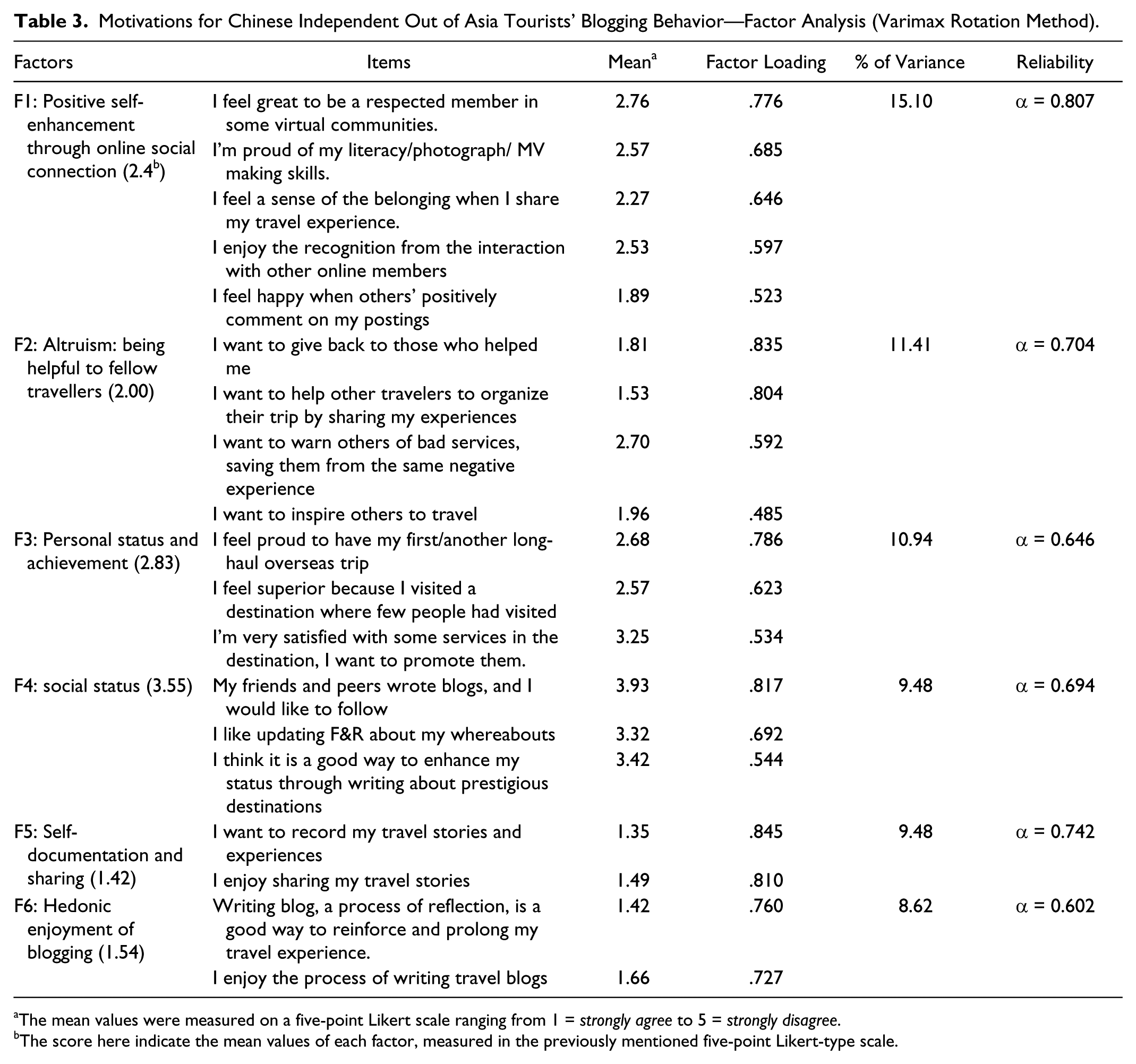
The mean values were measured on a five-point Likert scale ranging from 1 = strongly agree to 5 = strongly disagree.
The score here indicate the mean values of each factor, measured in the previously mentioned five-point Likert-type scale.
Motivations of Highest Importance
An assessment of the mean values of these factors suggested that “self-documentation and sharing” and the “hedonic enjoyment of blogging” are the strongest motivations that push Chinese independent tourists to write an overseas travel blog. Comments from the open-ended question illustrate this motivation. A traveler in his 30s from eastern China who spent more than two weeks in recording his North America trip, commented, The original intention for blogging was not for fellow travelers’ reference. It was more for myself. When I recall this trip in the future, I would like to have some base. When I’m old, I will compile all my travel blogs into a book, and share it with my friends and posterity. They are my footprints in the world.
Similarly, an old traveler from middle China with moderate level of overseas travel experience (3–5 times), who spent more than two weeks on a European trip blogging, suggested, Writing blogs is a fabulous thing to do. I’m very rewarded during the process. I have a deeper impression of the trip, and I also helped others. It is said that traveling is similar with learning history. I totally agree with this view. I learnt a lot through writing blogs, through providing useful and correct information.
Motivations of Moderate Importance
Examination of the mean values indicated that “altruism: being helpful to fellow travelers” and “positive self-enhancement through online social connection” represent a second level of importance for Chinese independent out-of-Asia tourists’ blogging motivations. These two motivations were also frequently recorded at the start of some blogs. These kinds of motivations were highlighted by the survey participants in the open-ended question section. A Cantonese lady in her late 20s traveled to Europe with her partner. She spent 1-2 weeks writing her blog. She offered a typical representation: There are two reasons for travel blogging: to record one’s experience, and also to be helpful to others. The links between these two motivations is the interaction with others. . . . Both are pleasant. Blogging is very time consuming. Feedback from others, however, is very encouraging.
A lady in her 40s from northeast China, with considerable overseas travel experience, has contributed quite a few blogs. She summarized her blogging motivations in two ways, Firstly, to thank those online friends who shared their experiences. Their blogs and tips are very helpful, and I would like to transfer this good heart to others as well. Secondly, to encourage those who don’t have a perfect mastery of languages (like myself) to be braver, to be more unrestrained, to travel in a natural style and enjoy the fun of traveling. My travel blogs, thus, tend to be practical and detailed.
A gentleman in his 40s who posted a blog about his trip in Europe, suggested, I have been writing blogs for quite a while. I don’t mind whether others read it or not. It is more about recording my own trips. But, if some online users read it, find it beneficial, and would like to interact with me, I feel rewarded and will be more likely to communicate with others.
Motivations of Lesser Importance
In addition to the previously mentioned four motivations, “personal status and achievement” can also act as a blogging motivation, for example, a young lady who traveled with her friends and studied in Australia observed, It is my first overseas trip, well, kind of a milestone. I felt great that we had a reunion after 2 years’ graduation. Four girls, self-driving and exploring regional Australia. What a memory!
Last but not least, it is meaningful to point out that at an individual level people are motivated differently. The evidence lies in two areas in the current study. Firstly, updating friends and relatives, following peer culture, and enhancing ones’ social image through blogging, which are labeled as “social status issues” in this analysis, might be quite important to a small group of participants. In broad terms, however, achieving social status goals through posting detailed travel blogs was not a driving issue for many respondents. It is possible to argue that there are many other easier, more obvious ways for young Chinese citizens to assert their position in society, and there is no implication from the present results that social status does not matter. More simply, it is not a key issue in the motivation for writing blogs as reported in these results.
Discussion and Conclusion
This study labeled the Chinese travel blogs as little “Lonely Planets,” because they are rich in information, time consuming to create and edit with their blending of pictures and text, and, most importantly, are influential and far reaching within the Chinese market. The formats of these “Lonely Planets”–style blogs are very different from the blogs that have been studied by earlier scholars worldwide in terms of size, time invested, and interactivity (Pan, MacLaurin, and Crotts 2007; Wenger 2008).
The highlight of the current study is analyzing Chinese out-of-Asia independent tourists’ blogging motivation. The six factors identified in this work, based on their importance level, were “self-documentation and sharing,” “hedonic enjoyment of blogging,” “altruism: being helpful to fellow travelers,” “positive self-enhancement through online social connection,” “personal status and achievement,” and “social status issues.”
Among these factors, “self-documentation and sharing” and “personal status and achievement” are established motivations for travel-related behaviors (Bowen and Clarke 2009). In this study, it was found that the “enjoyment of blogging itself” plays a critical role in Chinese tourists’ efforts to create their “Lonely Planets.” This motivation is close to the “hedonic benefits” identified by Wang and Fesenmaier (2004).
In addition, “altruism: being helpful to fellow travelers” and “positive self-enhancement through online social connection” were found to be crucial to this group (cf. Bosangit, McCabe, and Hibbert 2009). The factor “altruism: being helpful to others” is essentially different from the protective warnings observed by Yoo and Gretzel (2008). In this study, it can be linked more closely with benevolence. It is also about encouraging people to undertake an independent travel style, which the blog authors consider as more fun and enjoyable compared with the traditional package tours. Such encouragement to travel independently is not usually a consideration for Western tourists and bloggers. “Positive self-enhancement through online social connection” can be aligned with Kang and Schuett’s (2013) “identification” and “internalization” factors. It is in these online travel communities that this early group of Chinese out-of-Asia independent tourists has found a sense of belonging, a sense of shared value, and a sense of achievement by being respected by other members who embrace a similar lifestyle (Bosangit, McCabe, and Hibbert 2009).
The authors of this study suggest that these two distinctive motivations are highly relevant in the current specific but critical period in the evolution of Chinese outbound tourism. At present, a large number of Chinese tourists are enthusiastic in embracing a new style of traveling (independently, rather than the traditional tour package) and wish to extend their footprints to attractive but unfamiliar destinations (out of Asia). They do, however, lack experience and confidence (Xiang 2013). Thus, assistance from trustworthy role models and opinion leaders is highly appreciated (Zhang et al. 2013).
An overview of these key Chinese travel blog motivations establishes a tight correspondence with the trust needs of online travel users. The components of trustworthiness identified in the literature are benevolence, integrity, affective quality, identifiability, entertainment, and value-added attributes. Several of the blogging motives identified can be tied to the distinctive Chinese needs for trustworthy material. The appreciation of well-set-out, artistic blogs that have been carefully produced in a time-consuming way, blends well with the information gaps in the educational and social lives of contemporary Chinese travelers. The matching of needs and the purpose of constructing the blogs is also powerfully evident in benevolence, a shared characteristic of the motives and Chinese expectations relating to helping one another in an ordered harmonious society (Fu, Lehto, and Cai 2012; Mok and Defranco 2000; Nisbett 2003). These findings represent a fresh contribution to our understanding of the special place of trust and information needs for the burgeoning Chinese independent market and confirm that the observed motives and subsequent blogging style meet that requirement.
As the Chinese tourists become familiar with the non-Asian world and gain more confidence in exploring distant destinations, fresh research questions can be asked: will this unique time-intensive and highly interactive blogging culture survive? Will it change and become identical with the current blogging culture in Western societies or developed Asian neighbors (Lee and Gretzel 2014)? Or is the unique blogging behavior observed rooted in the distinctive Chinese culture (Mok and Defranco 2000; Pearce et al. 2013)? A longitudinal study of blogging study for Chinese tourists can be considered and developed. Such a study could be of particular interest in the fast-changing online culture (Leung et al. 2013). Figure 1 identifies the potential trajectory of the Chinese outbound tourists’ WOM motivation, and potentially indicates options for further studies.

Chinese out-of-Asia independent tourists’ blogging motivation and its possible evolution.
The present study, which has demonstrated some key motivations for Chinese blogging behavior, may also serve as a guide to stimulate select tourism industry activity. While further and confirming studies are required to build up a bank of evidence for any form of tourism research led advice (Crompton 2005), some preliminary comments can be made. Leung et al. (2013) suggest that marketers and industry personnel can be active in the various forms of social media through promotion, product distribution, communication, management, and education of their personnel. The findings of this study suggest some of these areas for involvement while cautioning against others. All importantly, the cautionary remarks can be that any interference or artificiality in creating blogs set to boost promotion would be counterproductive. The notion that an external body, however well intentioned, is providing commercially relevant material would destroy the trust-linked integrity and credibility that the blogs currently possess. More positively, and following Leung et al. (2013), marketers could stimulate blog writing by way of sponsoring competitions and awarding prizes. Incentives of this type could be creative and distinctive. Such actions would be compatible with building and respecting the appreciation of the blogger’s art and supportive of the motivations revealed in this study. Further, the monitoring of the travel blogs in the context of appreciating why people write them, and what they write about, could serve as industry-empowering education material for businesses and employees.
Chinese tourists will soon be found in many of the world’s destinations in considerable numbers. The special features of travel blog writing considered in this study are but among the many topics in which Western and Chinese colleagues may collaborate to understand this dynamic market and to enrich tourism studies. Indeed, at this point in the evolution of tourism, researchers have many opportunities to explore the forces that shape the surprising and different behaviors of tourists whose expectations and intentions are “made in China.”
Footnotes
Acknowledgements
Appreciation is given to Professor Ulrike Gretzel from the University of Queensland for her penetrating comments on an earlier version of this manuscript. The authors are also grateful to the three reviewers, who offered critical but supportive comments to improve the quality of the work.
Declaration of Conflicting Interests
The author(s) declared no potential conflicts of interest with respect to the research, authorship, and/or publication of this article.
Funding
The author(s) received no financial support for the research, authorship, and/or publication of this article.