




Abstract
Tourism can be considered an educational experience: it is often portrayed as an integral part of personal development, that can be deep and meaningful, and that can change the way tourists think and act on their return. Relatively little however is known about these touristic learning experiences: research evidence on learning and behavior change in ecotourism highlights that the effects of the holiday are often limited unless formal learning opportunities are provided. This article reviews evidence about social tourism for low-income groups, and argues that learning and behavior change can ensue from the holiday experience without these planned, formal learning activities. These unplanned learning opportunities are theorized, and key conditions for learning are identified. Examples are provided of potential learning outcomes and of instances where these can lead to positive behavior change.
Introduction
There are forms of tourism that can be easily linked to learning. Educational tourism can include special interest holidays, language courses abroad, and field study trips (Ritchie 2003). Cultural and heritage tourism have also been linked to their learning functions (Prentice, Sinéad, and Stuart 1998). Many forms of leisure travel on the contrary are seen as “gratuitous” and “hedonistic” (Urry 1990). This article proposes that even tourism forms without formal learning activities can entail opportunities for learning and behavior change.
Learning is increasingly seen as an important motivation for tourism, however, little is known about touristic learning (Mitchell 1998, p. 176). Research has focused mainly on the significance of learning as a motivation for tourism rather than on learning outcomes. An exception is ecotourism, by definition linked to education: one of the arguments commonly used to justify nature-based tourism is that through such experiences, tourists adopt more environmentally responsible attitudes and behaviors (Russell 1994). Orams (1996, p. 83) describes this educational process as “indirect mechanisms which seek to reduce inappropriate behaviour on a voluntary basis through education.” Emerging evidence in ecotourism and nature-based tourism however highlights that the effectiveness of this learning and the impacts on behavior can be limited. In his study on dolphin watching, Orams (1997) shows that unless tourists go through a formal educational programme, they seldom carry out their intentions to change their behavior and become more “green.” Forestell (1993, p. 270) reports similar findings in his study about whale watching: he argues that for the experience to realise its educational potential, a formal teaching element needs to be included, as “real life exposure to a natural situation in the accompaniment of an experienced guide leads to greater increase in knowledge than real life exposure without a guide, or exposure to a knowledgeable guide in an artificial setting.”
So far, research focus has mainly been on formal, planned learning in tourism and its effects, but unplanned learning has stayed rather unexplored. Although educational tourism is a logical focus for tourism learning, it “ignores many of the informal and unplanned opportunities that potentially arise for learning within tourism” (Mitchell 1998, p. 177). Learning, as opposed to education, is not always a structured and planned process but, often, “a lifelong process that is mostly incidental and natural” (Kalinowski & Weiler 1992, p. 17).
Tourism’s potential for unplanned learning is the focus for this article. The article will argue that this learning can occur in tourism forms that do not include formal learning activities. Social tourism for low-income groups was selected as a particularly apt case study for this argument: this form of tourism is argued by policy makers to provide opportunities for learning and changing behaviors (EESC 2006); however, the holiday experience often takes place in leisure settings and very rarely includes formal education.
To examine whether and how this learning takes place, two perspectives on learning will be reviewed that link learning specifically to experience: experiential learning and situated learning. On the basis of these perspectives, conditions for learning during leisure travel can be proposed. This theoretical framework will then be applied to the case study of social tourism for low-income groups, and examples of learning outcomes and behavior change will be provided.
Theoretical Perspectives: Learning and Experience
Experiential Learning
Experiential learning is learning rooted in experience. This form of learning received a high level of attention at the end of the 1970s and during the 1980s. In Boydell (1976), it is defined as a form of learning that “begins with the experience followed by reflection, analysis and evaluation of the experience. The assumption is that we seldom learn from experience unless we assess the experience, assigning our own meaning in terms of our goals, aims, ambitions and expectations” (Boydell 1976, p. 17). Experiential learning, in contrast to traditional classroom learning, engages more than just the cognitive learner. The learning outcomes “involve a cognitive element (increased awareness), an emotional element (changed attitudes) and a behavioral element (changed, interpersonal competence)” (Boydell 1976, p. 19).
The most famous model of experiential learning is Kolb and Fry’s “learning cycle,” which shows the four different steps within experiential learning (Figure 1).
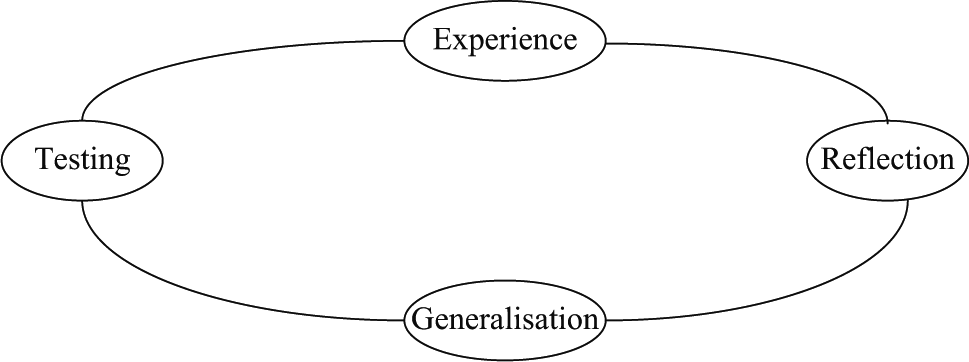
Kolb and Fry’s “learning cycle.”
This cycle explains how the learner goes from experience to knowledge in four steps: first he experiences a new situation, then he reflects on the experience, after which he starts to make generalizations about the experience. These can then be tested in new experiences, which also allow the learner to gain new knowledge. Boud, Cohen, and Walker (1993, p. 10) emphasize how the knowledge takes on a deeper meaning throughout the process: “through entering into a dialogue with our experience, we can turn experiential knowledge, which may not be readily accessible to us, into propositional knowledge, which can be shared and interrogated.”
The potential value of holidays for the experiential learning process was highlighted by Richards in his adaptation of the Kolb learning cycle (Figure 2).
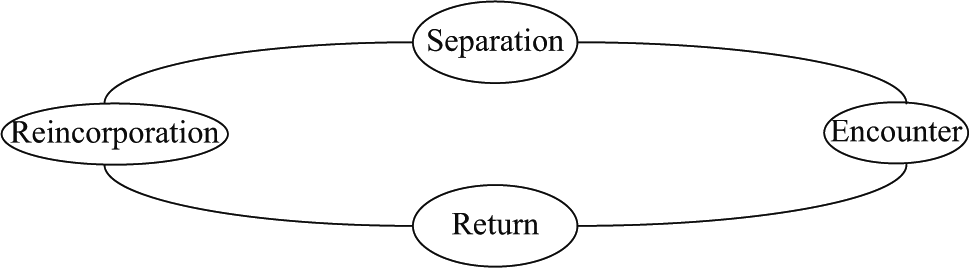
Richards’s adaptation of the Kolb learning cycle.
The concept of separation is particularly useful for tourism. Richards describes it as leaving behind old ideas, experimenting with new ones, and being open minded (Richards 1992, p. 159). Even though this refers to form of psychological separation, this can be supported by a geographical separation: the holiday can allow tourists to look on their everyday life from a distance, and it provides time to reflect if there are areas where a change is needed. Encounter means being faced with problems that need to be solved, and includes an element of risk. A sense of mastery can result from successful problem solving (Richards 1992, p. 159). Being on holiday means being faced with an environment that is usually less familiar than the home environment, and problems may well occur. These can be seen as potential “risks” or conflicts with the participant’s usual behavioral patterns. On their return, the participants can reflect and consolidate the experience, making connections with everyday life. In the reincorporation stage, the participant can prepare for the next challenge ahead, and use previous experiences to stimulate new ones (Richards 1992, p. 160).
The learning cycle illustrates that “while experience may be the foundation of learning, it does not necessarily lead to it: there needs to be active engagement with it” (Boud, Cohen, and Walker 1993, p. 9). This again can be particularly applicable to tourism, in two ways. (1) The holiday is an experience that is often reflected on or reminisced about. This can be in the form of looking over holiday photographs or videos, or talking to friends and family about the time away. (2) The tourist is emotionally involved in the holiday, which stimulates the affective domain of learning. This domain is “the part of human thinking that includes attitudes, feelings, emotions and value systems” (Orams 1996, p. 88). The emotional involvement in the holiday experience is described by Orams as a “likely effective short-cut to inducing behavior change” (Orams 1996, p. 89).
Single- and Double-Loop Learning
The terms single- and double-loop learning refer to two types of learning (or problem-solving) processes and are defined on the basis of the concept of the “theory-in-use.” “People’s theories-in-use are the master programs by which they make sense of, and maintain some semblance of control over, their world. It makes sense for people to protect their theory-in-use” (Argyris 1982, p. 164).
Single-loop learning occurs when “members of the organization respond to changes in the internal and external environments of the organization by detecting errors, which they then correct, so as to maintain the central features of organizational theory-in-use” (Argyris and Schön 1978, p. 18). This means that when individuals are faced with a problem or error, they will try to rectify this without changing the underlying norms or attitudes for behavior. This can also be described as “learning for effectiveness” (Argyris and Schön 1978, p. 28).
Double-loop learning is used in situations where simple error correction is not possible, and where the theory-in-use of the organisation or individual has to be adapted. In case of an organization, this could mean for example that not only the strategies for effectiveness are reviewed but also the very norms that define effective performance (Argyris and Schön 1978, p. 22). Rather than just changing defective strategies or actions, “the error is diagnosed as incompatibility of governing values or as incongruity between organizational espoused theory and theory-in-use” (Argyris 1982, p. 106). This can also be described as “learning to resolve conflicting norms for performance” (Argyris and Schön 1978, p. 28).
As tourism experiences usually take place in “relatively restricted regions of space and periods of time” (Fennell 2006, p. 105), one can question how likely it is that a deep attitude change can result from mainstream tourism experiences. There is limited research evidence that this is possible—Orams (1997) highlights that an “education program, combined with the experience of interacting with dolphins, was an importance influence on tourists’ behavior” (p. 304). This behavior change is not an automatic result of participation in ecotourism: Orams (1997) also highlights that those who did not participate in the educational program did not change their behavior, implying that without formal educational activities, tourism activities may not result in double-loop learning. Anastasopoulos (1992) moreover highlights how tourism can reinforce existing attitudes: his study examined the attitudes of first-time travelers from Greece to Turkey and compared them with those of a control group who did not travel. The results showed that travel to Turkey reinforced the negative image of most tourists rather than changing their attitudes. There is thus little consensus in the research evidence about tourism and double-loop learning—this study will apply the concept to the case study of social tourism for low-income groups.
Situated Learning
Situated learning focuses on how individuals learn in the social reality around them. This theory was developed in the 1990s. The situated learning theory draws attention to the fact that “learners inevitably participate in communities of practitioners and that the mastery of knowledge and skill requires newcomers to move toward full participation in the socio-cultural practices of a community” (Lave and Wenger 1991, p. 29). This means that learning is a social activity and is rooted in participating in activities with a “community of practice” who come together precisely to carry out these activities. This view on learning places emphasis on “comprehensive understanding involving the whole person rather than ‘receiving’ a body of factual knowledge about the world; on activity in and with the world; and on the view that agent, activity, and the world mutually constitute each other” (Lave and Wenger 1991, p. 33).
Every person is thus a member (sometimes a core member, sometimes more on the periphery) of a number of communities of practice. The aim of this involvement can be described as “negotiation of meaning,” a process by which we experience the world and our engagement in it as meaningful (Wenger 1998, p. 53). Each community of practice develops and appropriates a shared repertoire of ideas, commitments and memories, and resources as routines, vocabulary, and symbols that carry in some way the accumulated knowledge of the community (Smith 2003, p. 6).
Leisure travel, as a “movement away from primary social networks (work place, neighborhoods and communities) and insertion into temporary communities” (Fennell 2006, p. 105), could be seen as a good opportunity for immersion into a new community of practice. Some forms of educational holidays can easily function as a gateway into a new community of practice. Even in mass travel, there can be opportunities to discover new communities of practice, however this process may be more incidental. It might not have been the motivation of the tourist to be introduced to something new (in fact, tourists may wish to escape their community of practice), but the opportunities are often there. The tourist may display more exploratory behavior, which can be seen as an “overt expression of curiosity that is aroused by an environment perceived to be novel” (Lee and Crompton in Mitchell 1998, p. 179). The holiday itself, and the people the tourist meets on holiday, cannot usually function as a community of practice in itself, as the holiday is a short-term, temporary experience, and social relationships forged on them lack stability (Fennell 2006). Travel can encourage tourists to discover a new community of practice, or can help to reinforce their position in a community of practice—the community of practice itself however is based on more stable, long-term relationships.
Conditions for Learning
Both experiential and situated learning focus on learning as an interaction between the learners and their environment. From the theory, it emerges that some conditions can encourage and optimize learning.
Goal difficulty level
Successful learning aims make learners reach set goals. An important factor in achievement is the perceived difficulty of the task at hand, and how learners judge their own likelihood of success.
An early visual representation of the role of difficulty for learning can be found in Hebb (1966). The cue function is the “guiding, steering, informational effect” (Hebb 1966, p. 209), which rationally underpins behavior. The arousal function “determines the level of excitement or excitability or wakefulness of the animal, without determining what the behavior will be” (p. 209). The graph shows that arousal or emotion can be “both organizing (making behavior more effective) and disorganizing; it is both energizing and debilitating” (p. 235).
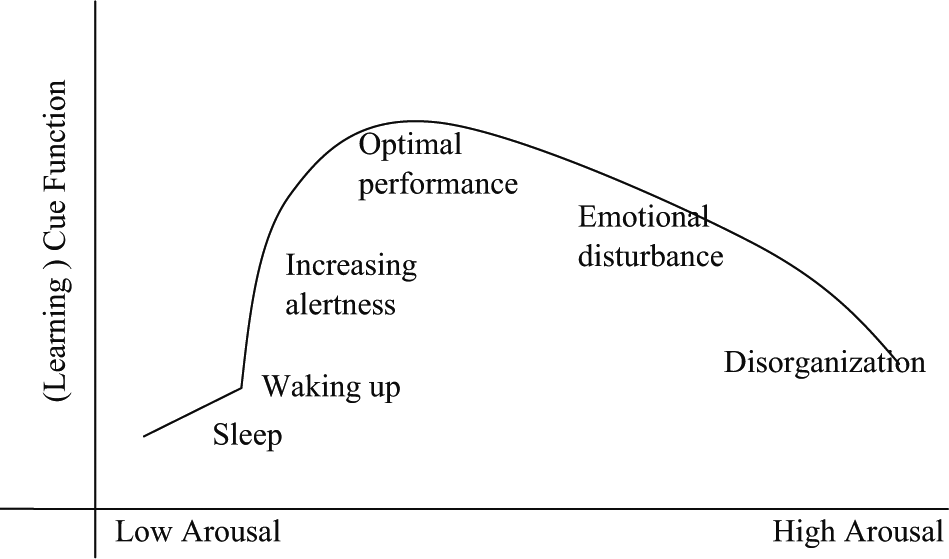
Difficulty levels and their impact on learning.
Figure 3 above shows that “as tension increases (along the horizontal axis), so does motivation to learn (along the vertical axis), up to a certain point. Then motivation declines. Motivation is defined as the tendency to produce organized, effective behavior” (Luft 1984, p. 28). This means that when arousal is low, learning is low because the person is not sufficiently stimulated. This can be linked to the affective domain of learning described earlier: when the learner is bored and emotionally uninvolved, learning is low. In the case of overstimulation learning is equally low, and the person becomes disorganized. Ideally thus the learner should be challenged and simulated, but still feel in control and able to deal with the new information. The curve above is an indication of what this relationship could look like, but “the shape of this curve must be different for different habits” (Hebb 1966, p. 235).
Motivation to learn thus fluctuates with the level of arousal, but which exact goal difficulty is chosen depends on different factors. Some of these are situational, others personal. Examples of situational factors are prior success or failure on the task, incentives, feedback, and participation. More personal factors are self-assurance and maturity (Campbell 1982, p. 79). Campbell found that “there was a significant positive relationship between goal difficulty and increased effort for (respondents) high in self-assurance. . . . For (respondents) low in self-assurance, the relationships between goal difficulty and increased effort were also significant, but negative (Campbell 1982, p. 86). While the respondents with high confidence levels tried harder to achieve the higher goals, the respondents with lower confidence levels reacted to higher goals with less effort. The higher goal for confident respondents presented a more positive level of arousal, whereas the arousal level might have been too high for the less confident ones.
This idea is explored further in studies regarding the dichotomy between performance-approach and performance-avoidance. Rawsthorne and Elliot (1999, p. 328) concluded that an important factor in performance is “whether participants pursuing a performance goal are focused on the possibility of a positive or negative performance outcome.” This means individuals are oriented either toward the attainment of success, or toward the avoidance of failure. Again, the positive and negative influence of arousal levels is highlighted: “Striving to attain success, however defined, may lead individuals to view the task as a challenge, elicit feelings of excitement, and encourage cognitive and affective immersion in the activity. In contrast, performance-avoidance goals, which are focused on the possibility of failure, are hypothesised to produce threat appraisals and elicit anxiety, processes that are detrimental to intrinsic motivation” (Rawsthorne and Elliot 1999, p. 329).
Contact with new communities of practice
In situated learning, contact with a community of practice is seen as the basis for all learning. To learn new skills and become proficient in new “practices,” the learner needs to come in contact with new communities of practice, and “builds legitimacy through learning interactions with other members of the community” (Lesser and Storck 2001, p. 832). Lesser and Storck define the most successful communities of practice along three dimensions:
There must be a series of connections that individuals have to others.
A sense of trust must be developed across these connections.
The members of the network must have a common interest or share a common understanding of issues. (Lesser and Storck 2001, p. 833)
Holidays, because of their temporal nature, may be unable to sustain the continuity necessary to build these communities of practice; however one could argue that they can initiate or support “legitimate peripheral participation.” This concept, coined by Lave and Wenger (1991), refers to becoming an “insider”: “Learners do not receive or even construct abstract, “objective,” individual knowledge; rather they learn to function in a community. . . . . They acquire that particular community’s subjective viewpoint and learn to speak its language” (Brown and Duguid 1991). Although holidays are restricted in time, they are likely to offer increased opportunities to engage in novel activities and behaviors: tourism can encourage “exploration behavior that is central to human development and in gaining an understanding of ourselves and the world we live in” (Mitchell 1998, p. 180).
The theoretical concepts discussed above will now be applied to a case study of social tourism for low-income groups. This case study group is of particular interest here because it can be argued that learning and behavior change are a key motivation for social tourism provision; however, no explicit learning activities are provided. Emerging research in ecotourism by Orams (1997) and Forestell (1993) have suggested that tourists are unlikely to change their behavior after the tourist experience if formal and planned learning activities do not take place: this study will examine if this also applies to social tourism for low-income groups.
Case Study: Social Tourism for Low-Income Groups
Social tourism refers to initiatives that aim to include groups into tourism that would otherwise be excluded from it. Hall defined it as “the relationships and phenomena in the field of tourism resulting from participation in travel by economically weak or otherwise disadvantaged elements in society” (Hall 2000, p. 141). Beneficiaries of social tourism are people who would like to travel but cannot because of a certain disadvantage: this could be the lack of finances for example, or a health problem or disability that makes traveling challenging. Minnaert, Maitland, and Miller (2007, 2009) define social tourism as tourism with an added moral value, of which the primary objective is to benefit the host or the visitor in the tourism exchange. In practice, social tourism usually refers to budget-friendly holidays in the own country, or in some cases day trips to theme parks, museums, and attractions, that are funded or made available at highly reduced rates by charities or agencies in the public sector.
In several countries of the European Union, social tourism is provided either at very limited cost to the state or in ways that simultaneously stimulate the local economy and increase the income of the state via taxation and a reduction of unemployment benefits (Minnaert, Maitland, and Miller 2011). The concept has been implemented in different ways to suit national contexts: several countries operate holiday voucher schemes (e.g., France and Hungary), other countries have established public–private partnerships (e.g., Spain, Portugal, and Belgium). Not only the implementations but also the justifications and goals of social tourism can differ greatly. The development of the working classes, better health for inner city children, wider access to the benefits of tourism, loyalty to unions or companies, and economic development of regions have all been, and in some cases are still, seen as valid reasons for provision (Minnaert, Maitland, and Miller 2011). In the United Kingdom and the United States, social tourism is not usually part of public policy, and is mostly provided via charitable bodies.
The provision of social tourism has been linked to and justified by both social and economic benefits. A growing body of research evidence indicates that social tourism can generate both types of benefits. Minnaert, Maitland, and Miller (2009), Minnaert (2008) and McCabe (2009) have conducted research into the social impacts of participation in social tourism by low-income beneficiaries and have found evidence of benefits ranging from increases in self-esteem, improvement in family relations, and widening of travel horizons to more proactive attitudes to life and participation in education and employment. On an economic level, there is evidence that the development of social tourism can help to sustain jobs in the low season and generate income for host communities. The IMSERSO programme in Spain for example offers dedicated holidays for senior citizens in coastal areas of Spain, during the shoulder season. The holidays are financed through contributions by beneficiaries (70% in a single payment) and the public sector (30% of cost). The State aims to recover its contribution through cost savings and earnings: the scheme allows for longer seasons and increased employment, and the tourist expenditure may lead to higher tax income. Because of these factors, in addition to the potential social benefits for the participants, the contribution of the State is argued to be far outweighed by the financial benefit of the scheme (Minnaert et al. 2010). About 300 hotels participate in the scheme, which has benefited around 1 million participants in the 2008-2009 season and has been estimated to generate or maintain 79,300 jobs. The Spanish government claims that every euro invested yields four euros in tax, spendings, and reduction in benefit payments (www.imserso.es).
The main justification for the provision of social holidays is the notion that everyone has the right to basic tourism provision on one hand (EESC 2006, p. 69), and on the other hand the assumption that “social tourism clearly promotes integration, greater knowledge and personal development” (EESC 2006, p. 76). If this last objective is reached by social tourism, and tourism can indeed lead to greater knowledge and personal development, this would mean that tourism can function as a learning process. This learning process would be largely unintentional.
Fieldwork: Methods
The fieldwork of this study was carried out with the support of the Family Holiday Association, a London-based social tourism charity, which provides 2,200 low-income families in the United Kingdom with a holiday per year. The methods used were semistructured interviews for individual holiday participants, and focus groups for group holiday participants. The respondents were the holiday participants themselves and their support workers or welfare agents (WFAs) (e.g., health workers, charity workers, advocacy workers), who apply for the holiday in the name of the families. The respondents were all on a low income and had not traveled in the past four years, but were otherwise not a homogenous group. In the sample, there were for example families affected by HIV, asylum seekers, families looking after disabled children, parents with mental health problems, and parents in long-term unemployment.
Ethical concerns regarding privacy of the respondents and clear communication with them were of utmost importance for this study. The Family Holiday Association supported the researcher by facilitating contact with the WFA and allowing the use of their logo on the information letters and consent forms. The WFA were first approached for help when selecting participants for the research. They were telephoned and provided with an information letter. They were then asked to give clients who had been allocated a holiday an invitation letter when they next met, and to explain the aims and procedures of the project. This ensured that the respondents could discuss the research with their WFA before participating, should they wish to do so. The WFA was also welcome to be present during the interview to build a relationship of trust. Some respondents chose to be interviewed in the offices of the WFA’s organization with the WFA present, others preferred to be interviewed in a public place near their home. The researcher built rapport with the respondents by talking about the holiday experience first: the activities the respondents had undertaken, the destination, the weather.
A random sample was taken from those participants volunteering to participate in the research. Twenty-eight WFAs responded to the information letter and agreed to speak to their clients who had been on holiday. For each round, respondents were selected in order of receipt of their expression of interest (corresponding with their holiday dates), until theoretical saturation was reached. The fieldwork was carried out in two rounds. The first round was conducted the first month after the holiday and included 40 respondents; the second round was carried out in the sixth month after the holiday and included 30 of the original 40 respondents (a retention rate of 75%).
In the presentation of the findings, all names have been changed. Quotes reproduced literally and without changes to vocabulary and grammar, to preserve their authenticity.
Findings
The study found that participation in social tourism, even though it generally does not include formal learning activities, can result in unplanned learning. The examples below highlight how social tourism provided opportunities for experiential learning. Social tourism could also allow the beneficiaries entry to a new community of practice, or allow them to reinforce their position in a community of practice. Some of these learning outcomes can be argued to be examples of double-loop learning. Although learning outcomes were noted for many of the respondents, these were not universal—the extent to which unplanned learning could take place depended on goal difficulty level and the level of integration with the community of practice after the holiday.
Social Tourism as an Opportunity for Experiential Learning
The experiential learning theory proposes that one can learn from experience if one reflects on it and makes generalizations afterwards (Kolb and Fry 1975). In the case of social tourism, the findings show that the holiday experience was a motivation for reflection in two ways. The respondents had often reflected on their daily lives during the holiday, and on the other hand the holiday is often reflected on after the experience. Both can be the basis for generalizations, as the examples below show.
Daniel, a disabled single father of a teenage son lives on a council estate he describes as very unsafe. The holiday had been an opportunity to get away from the daily stresses, and brought the family closer together:
It was better there because I wasn’t worried as much as at home. Everyday we’d do things, and I’d put it behind me more, and we’d enjoy it more. I know as soon as I was out of my life it did bring us closer. . . . Yeah, since we got back we have been out more, and we have been playing cards and other games, he’s been active. (postholiday interview 1)
Single mother Rachel, who cares for her disabled son, also describes how there is no time for reflection in her daily life. During the holiday, she decided to take a course and change jobs.
The problem is, when you are just in your normal routine, you don’t have time sometimes. . . . You do this, do that, and then the day has gone. And then another day, and another day (post-holiday interview 1).
WFA Aisha also sees this time for reflection as one of the main benefits of the holiday.
Because most of the parents here are so immersed in their own problems and issues that they can’t see beyond that. They haven’t got the time to actually give their children any time, or be able to give to them. So sending them on these holidays gives them that bit of time, that space away from their home environment, sort of the turmoil in their lives. (post-holiday interview 1)
The holiday is also reflected on after the actual experience. Many examples were given of holiday pictures that are a source of pride and joy long afterwards. The memories were also described as important: reflecting on positive experiences could give respondents the courage and confidence to face problems in their life.
Tim had a picture taken with Bob the Builder, and that picture has the proudest place, it’s paper thin now. He’s always touching it, he’s so proud of it. We’ve taken them on courses and done things, and it’s never that that comes up, it’s always the memories of the holiday. (post-holiday interview 2)
The biggest benefit is the memories. We have kids who went 8 years ago, who still tell us now “that was just the best time, when I won that bottle of Champagne doing karaoke.” (post-holiday interview 2)
Attitude and behavior change relating to soft skills like family relationships, independence, and confidence were reported by the great majority of the respondents. Although these changes may be of great importance for the respondents, they have the disadvantage that they are hard to measure, and that it is often hard to isolate the effects of the holiday, particularly after six months. The following example is more tangible and measureable. Three respondents reported on reassessing their intake of medication for stress-related conditions during the holiday in the first round of interviews: Of those three respondents, two were interviewed again in the second round and they both agreed the benefit had sustained:
I stopped taking them myself. They made me feel ill. The doctor said when you take them for so long, after a while sometimes they don’t work anymore. I haven’t taken them for three days and I feel fine.” (post-holiday interview 2)
Single- and Double-Loop Learning
Because for many respondents holidays were a fairly new experience, there were plenty of opportunities for single-loop learning, or learning for effectiveness (Argyris & Schön 1978). The participants were often faced with new situations, such as having to book the holiday, having to go on public transport, getting to know a new place. WFA Anne for example describes how one family “learnt” it could be nice to sit down for dinner together. Again, the time for reflection is highlighted here as an important facilitator to achieve this:
I think the holiday gives them a jumpstart so that they can change things when they come back. I think on holiday you have got that time when the kids are off swimming or doing whatever, that has given them time to think. They sat down to have tea together, which normally doesn’t happen, little things like that. It might seem quite insignificant in the whole scheme of things, but it makes a difference. The changes they have made are small changes but may lead to much bigger changes. (post-holiday interview 1)
The “bigger change” referred to in the quote above may be a form of double-loop learning: a change in attitudes and values, rather than just a change in behavior. The holiday was shown to be a potential opportunity for double loop learning, with outcomes like improved communication or an increased level of confidence:
I had never really done anything on my own so to speak. . . . It definitely made me think a lot more about. . . . I have been having some real problems with my partner and sort of realizing the fact that I don’t need to have someone to cope. . . . So yeah, it helps with that, if you’re thinking “I can’t do this.” (post-holiday interview 1)
As I said, before we went . . . how can I put it in a very subtle way . . . (laughs) we . . . the communication often suffered. But since we went there, and since the family has been back, things are much better, I have noticed a big change in her. She looks quite happy. . . . The holiday was crucial, like starting from a clean slate. (post-holiday interview 1)
Several WFA reported that holidays had encouraged the parents to play with their children. This was seen as a behavior change because many mentioned a lack of play between parent and child before the holiday:
But I think a lot of women actually don’t know how to do that (play) with their children, and so, actually going on holiday is quite difficult, because at home they don’t have to do it, because the children get on with it. (post-holiday interview 1)
The Family Holiday Association, the organization that funded these holidays, only funds holidays for families with children. Increased interaction and playing behavior was reported by the great majority of beneficiaries and WFA:
Because if they really enjoyed the holiday, enjoyed the break, they would say, “Well, let’s not say this was the holiday and go back to how it was. Let’s keep some of those nice things.” Especially when the children’s behavior improves because they are away and they are doing lots of nice things, and they start to think “why was the children’s behavior better then? What can we do at home to keep up that improvement? (post-holiday interview 1)
Conditions for Learning
Although the study yielded many examples of unplanned learning via social tourism participation, it is important to highlight that this benefit was not universal. A minority of participants reported that they had not made any changes to their behavior as a result of the holiday.
Do you think since the holiday you and your family try to spend a bit more time together?
It was something that I was meant to do, but you slip straight back into life so quick that I had forgotten, and today you have just reminded me, it is something that I have to organize. I will have to go home now and have a think about it. You get home and life begins again, and it goes fast, doesn’t it. (post-holiday interview 1)
This finding indicates that there are conditions to the achievement of these learning outcomes that need to be met. These can be linked to goal difficulty level and the level of integration into a community of practice.
Goal Difficulty Level
From the findings of this study, it became clear that choosing the appropriate goal difficulty level for every participant was a key condition for the benefits of the holiday to develop. Choosing the right holiday form for example was important as participants may otherwise be unable to use the holiday as an opportunity for reflecting and experiential learning, or to join a new community of practice. Rupert is a 52-year-old single father with three children, two of which had recently come under his care:
I found it a little hard really. I would have found it easier staying at home, because I have all my equipment and everything here, you know. And there was more to do in the garden here than there was there, you know, for the little ones. (post-holiday interview 1)
Because the holiday proved too challenging for Rupert as a single father, there is a risk of performance avoidance in the future. WFA Anne agrees that holidays that are too challenging for the individual participant can be counterproductive.
Without preparation and a bit of research into what they get when they finally get there, it could be quite daunting for some families. I think it can take you back. Holidays are there to make you move on (post-holiday interview 1).
Many WFA reported avoiding this pitfall by preparing the beneficiaries for their holiday and by supporting them and offering further learning challenges on their return. The holiday was used as an entry to, or the reinforcement of the individual’s position in, the support organization’s community of practice.
Communities of Practice
Situated learning sees learning as joining a new community of practice (Lave and Wenger 1991). For a community of practice to be successful, regular communication must take place, and a rather structured network based on trust and common interest must be formed (Lesser and Storck 2001). Because of the temporal nature of the holiday, it is unlikely that the community of practice encountered there will meet those conditions. However it became apparent that for many beneficiaries the holiday was not a stand-alone experience—it was part of a more long-term form of intervention. Holidays proved to be beneficial as they served as motivations to join a community of practice: that of the support organization. Several WFA commented that some of the beneficiaries were reluctant to engage with the support organization before the holiday, but the preparations and excitement before the trip led to an increased number of visits, an improved trust relationship, and a common interest:
I think what we try to do is pick them at a good time, and get them involved in more and keep them going. (post-holiday interview 2)
Afterwards they might come to a group or they might bring their child to stay and play. They might even not have been confident enough to talk to you before, but then afterwards they are. (post-holiday interview 2)
In several cases, the holiday encouraged the beneficiaries to take up other informal or formal learning opportunities offered by the support organization. As these opportunities were also available before the holiday offer was made, but not taken up, this behavior change can be seen as resulting from the social tourism experience. The following example shows how one of the beneficiaries of a holiday organized a group holiday the year after with the support of her welfare organization:
Yes, I found the place and the camping things as well, and when we go on trips as well. I do a lot more than I did last year. . . . Some mums haven’t done it and I think they are scared of actually coming along. But I think once you do it you’re fine. (post-holiday interview 2)
Formal learning opportunities were also offered in some cases:
What they have also done is, they are now on confidence-building courses as well. And this is all since these holidays, so whether they are connected. . . . I mean both of them went on a holiday and both of them are on the course. (post-holiday interview 2)
A particularly useful opportunity for situated learning were group holidays. For someone who has never traveled before, a group holiday can be a low-threshold way to join the traveling community of practice. In the example below, the single-loop learning (going on holiday) led to double-loop learning (an increase in confidence) and measurable behavior change (part-time job).
We had one family, that was actually last year, and the first time she came on a holiday. And she never done anything like that and she was really scared, about transport and everything. And she took up courage, and came and sat with people from the group, and she relaxed. She really started to come out of herself that first year, and then she applied to come on the next one. She came again, and what a difference. She now works part-time. (post-holiday interview 1)
Where the participant was not integrated into a community of practice on their return, this learning potential was often not achieved. The following example is from the only organization that did not offer support post-holiday:
That’s what happens when you go on holiday, and then when you come back it’s like a whack on the jaw. Because you have had a touch of what life could be like. That could make you feel quite down I would think, because you think “it’s not fair.”
Conclusions
This article has explored the potential for learning and behavior change via tourism. Although it is generally accepted that some forms of tourism can lead to learning (e.g., educational and special-interest holidays), research evidence in the area of ecotourism has shown that the tourism experience only leads to behavior change if formal learning opportunities are provided. This study on social tourism however has found that in this form of tourism, learning and behavior change can take place without formal learning activities. The article has however highlighted that there are conditions to learning: the goal difficulty level needs to be appropriate, and the holiday must present an opportunity to further integrate into a community of practice.
For noneducational forms of tourism, learning is often not seen as a motivation for the holiday. On the contrary, the holiday is usually mainly seen as a time for rest and relaxation, and learning can be seen as the opposite of this. If there are learning outcomes, they are also not predetermined, as opposed to educational tourism forms. The learning outcomes of social tourism can be a new skill, or a new way of looking at certain areas of life. Social tourism can potentially support the personal development of the tourist, or interpersonal development, or both. Examples of these outcomes can be an increased level of self-esteem, a better relationship with fellow tourists, or setting new priorities in life.
Research evidence about the learning potential of different types of holidays is limited, and further research into touristic learning is needed. Much of the existing research focuses on tourism that is formally educational, whereas the unplanned learning opportunities of other forms of tourism have been left largely undiscovered. As social tourism is by nature not entirely different from mass leisure tourism, the question could be raised to which extent all forms of tourism include learning opportunities, and how far tourists act on the learning potential of the holiday by choosing an appropriate level of arousal or by joining communities of practice after their return.
Footnotes
Declaration of Conflicting Interests
The author(s) declared no potential conflicts of interest with respect to the research, authorship, and/or publication of this article.
Funding
The author(s) received no financial support for the research, authorship, and/or publication of this article.