




Abstract
Advertisement and price cues are important sources of information that influence tourists’ service expectations, particularly in the case of newer, less-established hotels. However, it is not clear if such hotels benefit from promising more or less through their advertisements; or price high or low through their price cues. Extant research is also uncertain about the role of culture in moderating the impact of advertisement and price cues on expectations. Using an experimental setup with 218 tourists from three different countries, this study finds that a newer hotel is likely to be better off by offering more service promises through its advertising and high price cues to its prospective visitors. The results suggest that culture influences how tourists process advertising cues but has no influence on price cue influence. The study provides insights for managers on how to develop a segmentation strategy using the cultural profiles of tourists.
Introduction
Imagine for a moment that you are booking a hotel for your next holiday. It will be your first visit to the destination in question and you decide to search the Internet to find a hotel for your vacation. You visit the websites of various hotels with which you are not familiar. Some hotels are offering many service promises such as facilities for scuba diving activities, hot water spas, state-of-the-art rock climbing, with high prices to match. Other hotels are offering few and basic service promises such as cleanliness, safety, security, and significantly lower prices. As you know nothing about these hotels apart from the service promises they make through their websites, you are wondering how to make a decision about where to stay.
Researchers recognize such dilemmas. Therefore, information search and its impact on decision making is a frequently examined topic in tourism research (Fodness and Murray 1999; Chen and Gursoy 2000; Jacobsen and Munar 2012). It is widely recognized that advertising and price signals influence tourists’ service expectations and their decisions regarding travel choices (Chen and Tsai 2007; Forgas-Coll et al. 2012; Lepp, Gibson, and Lane 2011; Money and Crotts 2003; Xu 2010). However, the impact of such marketing signals on expectation formation depends on characteristics such as needs and motives of individual tourists (Gnoth 1997). For example, some tourists are willing to pay more for facilities such as scuba diving or jacuzzis in their room. Others might prefer few and basic amenities at an affordable price. As a result, finding out the optimal mix of service promises that a hotel needs to offer through its advertising and price signals is a complex process. Newer hotels with no established perceptions in the minds of potential consumers face important choices as to how to position themselves for maximum impact in the marketplace. Therefore, the first objective of this study is to understand how newer hotels should pitch their advertising (many or few promises) and price (high or low) signals to influence the service expectations of their prospective visitors prepurchase. In doing so, we extend the work of Walters, Sparks, and Herington (2007) who studied the impact of print advertising stimuli on consumption expectations and stated that “an understanding of the effects of various types of imagery evoking stimuli on tourism consumers’ visionary responses to advertising material is of considerable importance to tourism destination managers” (p. 24). We extend this work by providing images of physical infrastructure, different advertising stimuli and interactions with price variations. Walters, Sparks, and Herington (2007) also incorporated a fictitious destination with no mention of branding in order not to compromise the integrity of their experimental approach and we adopt a similar strategy.
Cultural values of individual tourists play a significant role in the way they process information from marketing signals and make travel decisions (Crotts and Erdmann 2000; Forgas-Coll et al. 2012; Hsu, Woodside, and Marshall 2013; Money and Crotts 2003; Watkins and Gnoth 2011; Weiermair 2000). For example, studies find that German travelers utilize neutral public information sources such as tourist offices to get information about an unknown destination or a tourism firm, while British tourists prefer to use proprietary marketer-generated information sources such as corporate travel departments as sources of information (Chen and Gursoy 2000). Therefore, cultural values play a major role in the way tourists process advertising information and sources (marketer led or third party). In addition, the influence of price as a predictor of service quality and expectations also depends on individual cultural value orientations. For instance, Japanese consumers equate higher price signals as symbols of higher quality, whereas American consumers believe higher price does not guarantee better quality (McGowan and Sternquist 1998). Research shows that higher price even have a strong negative perception from Chinese consumers (Sternquist, Byun, and Jin 2004). Hence, it is crucial to design the optimal mix of marketing signals based on the cultural values of individual tourists. This becomes more difficult when a hotel intends to attract tourists from a variety of cultures. Therefore, the second objective of this study is to understand how newer hotels’ manipulations of advertising (many or few promises) and price (high or low) influence on the service expectations of prospective visitors may be moderated by the cultural values of those prospective visitors. In doing so, we extend important work focusing on consumers’ response to advertising and price variations, notably by Walters, Sparks, and Herington (2007), Stienmetz, Maxcy, and Fesenmaier (2013), Nicolau (2012), and Masiero and Nicolau (2012), by allowing for interactions with cultural factors.
In order to achieve these research objectives outlined, we adopt an experimental approach with 218 subjects from three different countries by exposing them to varying levels of advertising and price promises in the context of a fictitious hotel.
Theoretical Background
Service Expectations and Information Sources in Tourism Research
Information sources available become more important when tourists do not have enough existing knowledge or experiences about particular tourism entities. Extant research highlights that tourists use various types of information sources in order to reduce the uncertainties associated with the travel purchases (Jacobsen and Munar 2012; Money and Crotts 2003). Some of the commonly used information sources are marketer-led communication materials (like hotel websites), advice from friends and family in the form of word of mouth, experiences from earlier visits, and third-party sources like travel guidebooks or travel-related websites such as tripadvisor.com. These information sources are classified as internal sources (such as experiences with a specific hotel), and external sources (such as advertisements and price cues used by the hotel). Together, the internal and external sources employed make up the spacial element of information search discussed by Fodness and Murray (1998). Research suggests that the use of internal and external information sources differ between tourists based on their previous visit experiences (Chen and Gursoy 2000; Gursoy and McCleary 2004) and travel-related experiences (Fodness and Murray 1999). For example, repeat visitors depend primarily on the internal sources of information to generate expectations about their subsequent visits. On the other hand, not surprisingly, first-time visitors tend to use external sources of information to generate their service expectations. Snepenger et al. (1990) termed such tourists as “destination-naïve” and showed that the external source of the travel agent played a major role in the search strategies of such individuals. As this study aims to understand the role of information sources for newer hotels with no established familiarity, it focuses on the first-time, or naïve, visitors and their use of external sources of information. Zeithaml, Bitner and Gremler (2006) further categorize information sources as explicit promises (such as advertisement carried out by the hotel) and implicit promises (such as price signals used by the hotel). They highlight that such service promises influence consumers’ predicted service expectations, namely, “the level of service customers believe they are likely to get.” Hence, this study investigates the role of advertising and price promises on tourists’ predicted service expectations in the prepurchase decision making stage. Figure 1 explains the conceptual framework of this study.
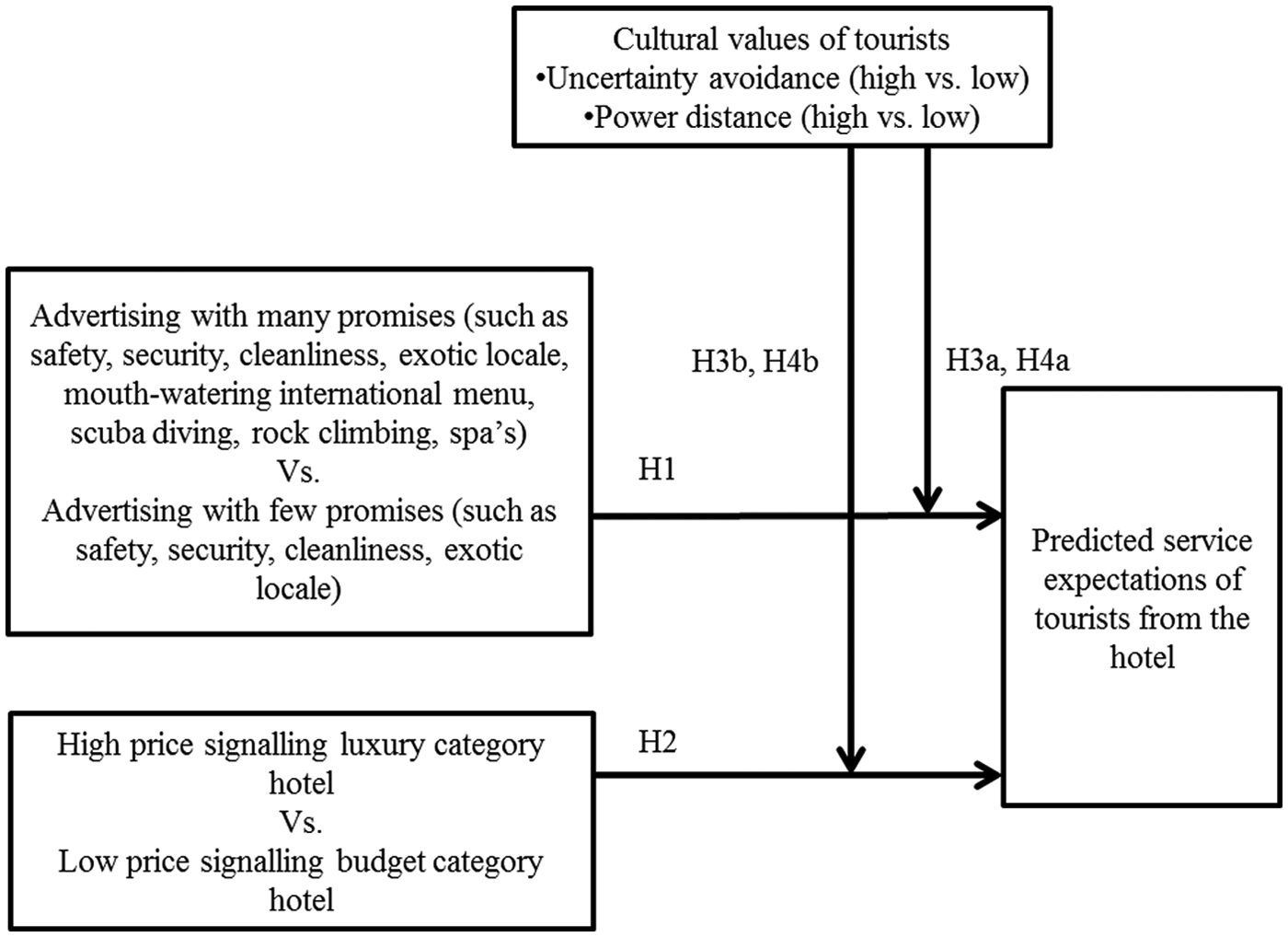
Research model.
Impact of Advertising and Price Promises on Tourists’ Predicted Service Expectations
There is a wide body of research documenting the impact of marketer-generated advertising promises on tourists’ service expectations (e.g. Forgas-Coll et al. 2012; Jacobsen and Munar 2012; Hsu, Woodside, and Marshall 2010; Lepp, Gibson, and Lane 2011; Money and Crotts 2003). However, findings are mixed. For instance, one stream of research posits that marketers can positively influence the expectations of tourists by offering more service promises through their advertising campaign (Jacobsen and Munar 2012; Forgas-Coll et al. 2012; Lepp, Gibson, and Lane 2011). They argue that hotel services are intangible and, hence, pose significant purchase risk. Therefore, tourists, in the prepurchase decision-making stage, use marketer-led communication materials such as websites and brochures of the hotels to gather information in order to reduce the uncertainty and purchase risk. In their Evaluating Destination Advertising model, Stienmetz, Maxcy, and Fesenmaier (2013) noted that such service promises may include information about various facets of the destination, such as dining, shopping, events, etc. Further, Walters, Sparks, and Herington (2007) detail a scenario where a destination-naïve consumer scans the text and images of the information available through advertisements etc. when forming expectations of the destination. On the other hand, a second stream of research argues that tourists are sceptical when they encounter many service promises from unknown entities such as newer hotels (Gursoy and McCleary 2004; Money and Crotts 2003). Tourists perceive that relying on information provided by the unfamiliar hotels through their websites and brochures is risky as it lacks credibility. This perception of riskiness diminishes the service expectations of tourists and reduces the likelihood of visitations. Therefore, instead of using hotel-led advertising promises, tourists are more likely to use neutral sources such as travel guides or third-party travel websites to base their expectations. As establishing credibility is crucial to the success of newer hotels, such arguments suggest that they are better off by making fewer, seemingly more realistic, service promises through their advertising campaign. In spite of this incongruence in findings, past evidence suggests that the marketer-led advertising promises can positively influence the service expectations of tourists. For example, studies find that tourists place greater emphasis on the official tourism websites and brochures in comparison to those of the third-party travel guides in destination choice (Choi, Lehto, and Morrison 2007). In case of absence of internal sources of information (such as familiarity), Lepp, Gibson, and Lane (2011) observe that tourists use information provided by websites of hotels or airlines to make destination choices. Consumer marketing literature posits that increases in advertising often lead to improved brand differentiation, loyalty, and reduced uncertainty in consumers’ minds (Vakratsas 2008; Rao and Bharadwaj 2008). Based on such arguments, this study hypothesizes that
Hypothesis 1: Expectations of service quality will be higher when newer hotels expose their prospective visitors to advertising with many service promises than when they expose them to advertising with few service promises.
Implicit service promises in the form of price cues are among the most salient criteria that influence prepurchase service expectations and consumers’ perceptions of value subsequent to use (Tanford, Baloglu, and M Erdem 2012). Although there is substantial research on the effect of price promises on service expectations, the findings are mixed. For example, one stream of research posits that individuals develop higher expectations when they encounter products or services with high price (Dawar and Parker 1994; McGowan and Sternquist 1998). Such studies suggest that price is an indicator of quality and prestige, and individuals develop higher expectations when purchasing a high-price product or service. On the other hand, another stream of research posits that high price can act as a negative cue (Sternquist, Byun, and Jin 2004; Meng and Nasco 2009). They argue that individuals are less inclined to equate high price with quality for unknown or less prestigious brands. Therefore, high price does not lead to higher quality expectations when the brand is unfamiliar. In spite of this discrepancy, tourism research indicates that higher price signals higher quality and leads to higher expectations. Equally, hedonic pricing research in tourism confirms that there is a positive relationship between price and quality, as signaled by the “star rating” and other attributes of a hotel (Monty and Skidmore 2003; Thrane 2005). Also, Crotts and Erdmann (2000) observe that the service expectations of airlines passengers is dictated by the price they pay. They find that the business and first class passengers have higher service expectations as compared to the economy class passengers. Therefore, tourists generate higher service expectations when they are exposed to higher price signals. Studies on destination tourism highlight that the overall monetary costs (such as the price of accommodation, eating out, travel) play a significant role in shaping tourists’ perceptions. For instance, Forgas-Coll et al. (2012) find that the travelers compare the possible price to be paid for holidays among destinations and the perceived value toward a destination is driven by their price perception. Keane (1997) observes that higher price signals superior quality of tourism destinations. He suggests that tourism entities need to position themselves with a premium pricing strategy as this minimizes the likelihood of quality deterioration in tourists’ minds. Therefore, this study argues that as newer hotels lack familiarity and credibility among the prospective visitors, positioning themselves as a premium service provider with higher price signals will result in enhanced service quality expectations. Hence, this study hypothesizes that
Hypothesis 2: Expectations of service quality will be higher when newer hotels expose their prospective visitors to higher price signals than when they expose them to lower price signals.
Individual-Level Cultural Value Orientation
Hofstede, Hofstede, and Minkov (2010) define culture as “the collective programming of the mind that distinguishes the members of one group or category of people from others.” The role of culture in tourism is a critical issue, and culture has been the subject of empirical and conceptual investigation (Hsu, Woodside, and Marshall 2013; Landauer, Haider, and Pröbstl-Haider 2014; Lin, Morgan, and Coble 2013; Reisinger and Crotts 2010). The task of understanding the influence of culture on how tourists interpret marketing signals to develop expectations toward an unfamiliar hotel is even more important when guests have a variety of cultural value orientations. For example, research suggests that Japanese tourists rely heavily on advice from friends and relatives to decide on their travel purchase, while Australian tourists prefer to use firm-led information sources such as advertising in decision making (Chen 2000; Money and Crotts 2003). More generally, cultural factors have been shown to impact on tourism-related matters ranging from climate change adoption strategies (Landauer, Haider, and Pröbstl-Haider 2014) to the meanings attached to tourism-related images (Lin, Morgan, and Coble 2013). As a result, the influence of service promises made by newer hotels through their advertising and price signals will vary depending on the cultural values of the prospective visitors. However, stereotyping tourists’ behavior based on nationality is questionable, as culture is more of an individual trait rather than country-specific characteristics (Crotts and Erdmann 2000; Pizam and Sussman 1995). Hence, instead of equating country with culture, this study uses individual cultural value orientations as the focus of analysis and explores the impact on tourists’ service quality expectations.
In the travel and tourism domain, the question of which is the most appropriate schema for modeling cultural values has been the subject of some debate (see for instance Hsu, Woodside, and Marshall 2013). However, it has been argued that Hofstede’s approach is the most accepted methodology (Reisinger and Crotts 2010) and an approach that has been used with success in tourism research (Tsang and Ap 2007; Reisinger and Mavondo 2005). Hofstede, Hofstede, and Minkov (2010) classify individual cultural values into five dimensions: uncertainty avoidance, power distance, masculinity/femininity, long-term orientation, and individualism/collectivism. Dawar, Parker, and Price (1996) in their cross-cultural study on interpersonal information exchange find that uncertainty avoidance and power distance are the two most dominant cultural values that influence individuals’ external search behavior focusing on advertising and price signals. Therefore, this study focuses on these two dimensions of culture. Uncertainty avoidance reflects how (un)comfortable members of a society are with uncertainty and ambiguity (Hofstede, Hofstede, and Minkov 2010). Dawar, Parker, and Price (1996) note that high uncertainty avoidance individuals accord a high level of authority to rules. Such individuals have low tolerance for behaviors and ideas that are outside the norm. Power distance reflects the extent to which individual members of society accept unequal distribution of power (Hofstede, Hofstede, and Minkov 2010). Individuals in high power distance cultures expect and accept differences in wealth, social status, and prestige (Schumann et al. 2010).
Moderating Effect of Culture on the Impact of Advertising Promises and Price Cues on Predicted Expectations
Uncertainty avoidance
High uncertainty avoidance individuals try to reduce future uncertainties, whereas the low uncertainty avoidance individuals are risk takers (Hofstede, Hofstede, and Minkov 2010). Past research suggests that risk is a major concern in tourism decision making, particularly when the firm concerned or the destination is relatively unknown (Yavas 1990). Money and Crotts (2003) posit that the high risk tolerance (low uncertainty avoidance) tourists prefer marketer-dominated information sources such as advertising through mass media to those with a low risk tolerance (high uncertainty avoidance). High uncertainty avoidance tourists are likely to rely on personal information sources such as advice from friends and family instead of the hotel-led advertising campaigns to make judgments about an unknown hotel. Tourism literature that explores the relative effects of information sources among the first-time visitors finds that such destination-naïve travelers (facing more uncertainty about the unknown hotel or destination) tend to use more nonmarketer-dominated information sources such as travel agents instead of relying solely on the firm-led information source such as advertising (Chen and Gursoy 2000; Snepenger et al. 1990). Therefore, this study argues that a hotel-led advertising campaign with more service promises is less likely to create an impact on service expectations for tourists of high uncertainty avoidance. This argument is also consistent with studies in a nontourism context, which find that Japanese firms (characterized by high uncertainty avoidance culture) refer to more information sources instead of relying on marketer-dominated sources compared to American firms (characterized by a low uncertainty avoidance culture) (Money, Gilly, and Graham 1998).
Perceptions toward service expectations also differ between cultures. Extant research suggests that the high uncertainty avoidance cultures demand more from the service provider and has lower perceived service quality as compared to the low uncertainty avoidance cultures (Donthu and Yoo 1998 ). This finding is replicated in tourism studies exploring the role of complaint behavior and satisfaction among the hotel guests. For example, Ngai et al. (2007) find that Asian hotel guests (characterized by high uncertainty avoidance culture) are less satisfied with the hotel services and tend to spread a negative feedback among their friends and relatives, as compared to non-Asian guests (characterized by low uncertainty avoidance culture). Therefore, this research argues that the high uncertainty avoidance tourists generate less favorable service expectations when they are exposed to more service promises. Based on these reasonings, this study hypothesizes that
Hypothesis 3a: The increase in expectations of service quality for advertising with many service promises versus advertising with few service promises toward newer hotels will be higher for the low uncertainty avoidance tourists than for the high uncertainty avoidance tourists.
Consumer behavior research indicates that price plays both an allocative (constraint) role and an informational (signal) role in the consumer decision-making process (Völckner 2008). In its informational role, price acts as a cue to consumers. If consumers are uncertain about the quality of the service then they are more likely to rely on the implicit cues such as price with higher price signaling better quality. Making travel purchase decisions from an unknown or unfamiliar hotel poses significant risk to the tourists. Past research suggests that tourists use price signals such as the price of accommodation, food, and other touristic activities as important indicators of prospective trip quality, and such signals influence the image of an unknown destination (Chen and Tsai 2007). Therefore, the use of price signals as indicators of expected service quality and as a source of risk reduction mechanism is well established. However, the impact of price signals on expected service quality differs between cultures. For example, Jin and Sternquist (2003) find that the effects of price on perceptions of quality differ between U.S. (low uncertainty avoidance) and Korean (high uncertainty avoidance) consumers. They show that the U.S. consumers are more value conscious than Korean consumers. Sternquist, Byun, and Jin (2004), when comparing the price perceptions of consumers from various Asian nations, found that Chinese consumers (low uncertainty avoidance) are extremely value and price conscious as compared to Korean consumers (high uncertainty avoidance) and often have a negative perception toward high-priced items involving unfamiliar brands. This suggests that the low uncertainty avoidance consumers are more concerned about the appropriateness and fairness of the perceived quality received and compare this with the price paid (Meng and Nasco 2009). As past tourism literature argues for a positive influence of higher price signals on service expectations, newer hotel can use higher price signals to influence the service expectations of low uncertainty avoidance tourists. However, such higher price signals needs to be supplemented with other positive marketing signals such as many service promises so that the whole offering satisfies the value equation of the prospective low uncertainty avoidance tourists. Based on these arguments, this study hypothesizes that
Hypothesis 3b: The increase in expectations of service quality for higher price signals versus lower price signals toward newer hotels will be higher for the low uncertainty avoidance tourists than for the high uncertainty avoidance tourists.
Power distance
High power distance individuals accept inequality in the society (Hofstede, Hofstede, and Minkov 2010). Consumer behavior research suggests that the high power distance individuals show acceptance of hierarchical structures in society, as well as differential prestige, power, social acceptability, and wealth among its members (Lam, Lee, and Mizerski 2009; Schumann et al. 2010). Therefore, any marketing signal that indicates such differences conforms to the attitudinal preferences of high power distance individuals. Tourism research suggests that there is a difference between high and low power distance tourists in the way they use information sources for travel purchase decision making. For example, Chen and Gursoy (2000) find that the French tourists (high power distance) utilize proprietary communication channels such as promotional materials (brochures) of hotels or airlines as principal sources of information as compared to the German tourists (low power distance), who use third-party communication channels such as independent travel guides. This indicates that the effects of advertisements by newer hotels are likely to create a higher positive impact on service expectations among their prospective high power distance tourists. Research suggests that any advertising that uses expensive symbols and promotes higher social status are likely to influence the power, wealth, and elitism aspirations of high power distance individuals (Albers-Miller and Gelb 1996). Therefore, when an unfamiliar hotel uses many service promises through its advertising such as availability of spas, golden beaches for its customers, or rock-climbing facilities within the hotel premises, then such signals promote the sense of exclusivity, elitism, and a higher place in the society among the high power distance tourists as compared to the low power distance tourists. On the other hand, when hotels uses few service promises indicating only the must-have elements such as safety and security, then such advertisement is less appealing to high power distance tourists in terms of offering them exclusivity. Based on these arguments, this study hypothesizes that
Hypothesis 4a: The increase in expectations of service quality for advertising with many service promises versus advertising with few service promises toward newer hotels will be higher for high power distance tourists than for the low power distance tourists.
High power distance individuals emphasize on differences in social class and distribution of power, wealth, and prestige (Hofstede, Hofstede, and Minkov 2010). Therefore, such individuals consume services that indicate their social elitism. Tourism research exploring the role of culture in choosing travel services suggests that the high power distance tourists as compared to the low power distance tourists prefer to choose destinations and services that enhance their credibility of belonging to a superior social class, higher prestige, and wealth (Crotts and Erdmann 2000; Weiermair 2000). Price is also a key factor that influences the satisfaction and loyalty of tourists when they choose a destination (Forgas-Coll et al. 2012; Money and Crotts 2003). As higher price indicates superior service quality, therefore high power distance consumers will be happier with the notion of unequal delivery of service contingent on price paid, as this is merely a further manifestation of the inequality with which they are generally more comfortable. Therefore, the study hypothesizes that
Hypothesis 4b: The increase in expectations of service quality for higher price signals versus lower price signals toward newer hotels will be higher for the high power distance tourists than for the low power distance tourists.
To summarize, this study hypothesizes that the influence of advertising (many service promises) and price signals (high) on predicted service expectations will be higher for low uncertainty avoidance and high power distance tourists. On the other hand, the influence of such marketing signals will be lower for high uncertainty avoidance and low power distance tourists. Therefore, this study proposes similarities between high power distance and low uncertainty avoidance tourists in the way they interpret such marketing signals to generate expected levels of service. Past research suggests that there are commonalities between these cultural dimensions. For example, Hofstede (1985) in his study on the inter-relationship between national and organizational value systems argues that countries can be grouped based on their scores on uncertainty avoidance and power distance, and people in such groups’ exhibit similarities in their value system. He suggests that people from low uncertainty avoidance and high power distance cultures view an organization as a “family.”Therefore, this study argues that such individuals tend to integrate with the organization more and rely on the marketing signals offered by such organizations largely in their decision making. On the other hand, Hofstede suggests that people from high uncertainty avoidance and low power distance cultures view an organization as a “well-oiled machine.” Therefore, this study argues that such individuals tend to believe that an organization is an “impersonal bureaucracy” and feel distant from it. This leads to a nonchalance attitude towards the marketing signals offered by such organizations.
Method
Study Design and Context
As the research aimed to explore the effects of service promises on tourists’ expectations, we chose an experimental approach to allow for manipulation such promises. Experimental approaches are useful in drawing conclusions about the effects of independent manipulated variables on a study group (Sparks and Browning 2011). We designed two experiments for data collection. The first experiment manipulated the effects of advertising (with many vs. few service promises), and the second experiment manipulated the effects of price (with high vs. low price cues) to understand the resultant influence service expectations of tourists has in the prepurchase decision-making stage. Extant research shows that factors such as past experience and brand recognition/familiarity influence the expectations of tourists toward hotels (Forgas-Coll et al. 2012). Hence, to eliminate the effects of such extraneous factors, this study chose a fictitious hotel (called Hamilton Beach Hotel). The research also aimed to explore the effects of cultural values on tourists’ perception of service promises, and these values were measured using established scales.
Sample
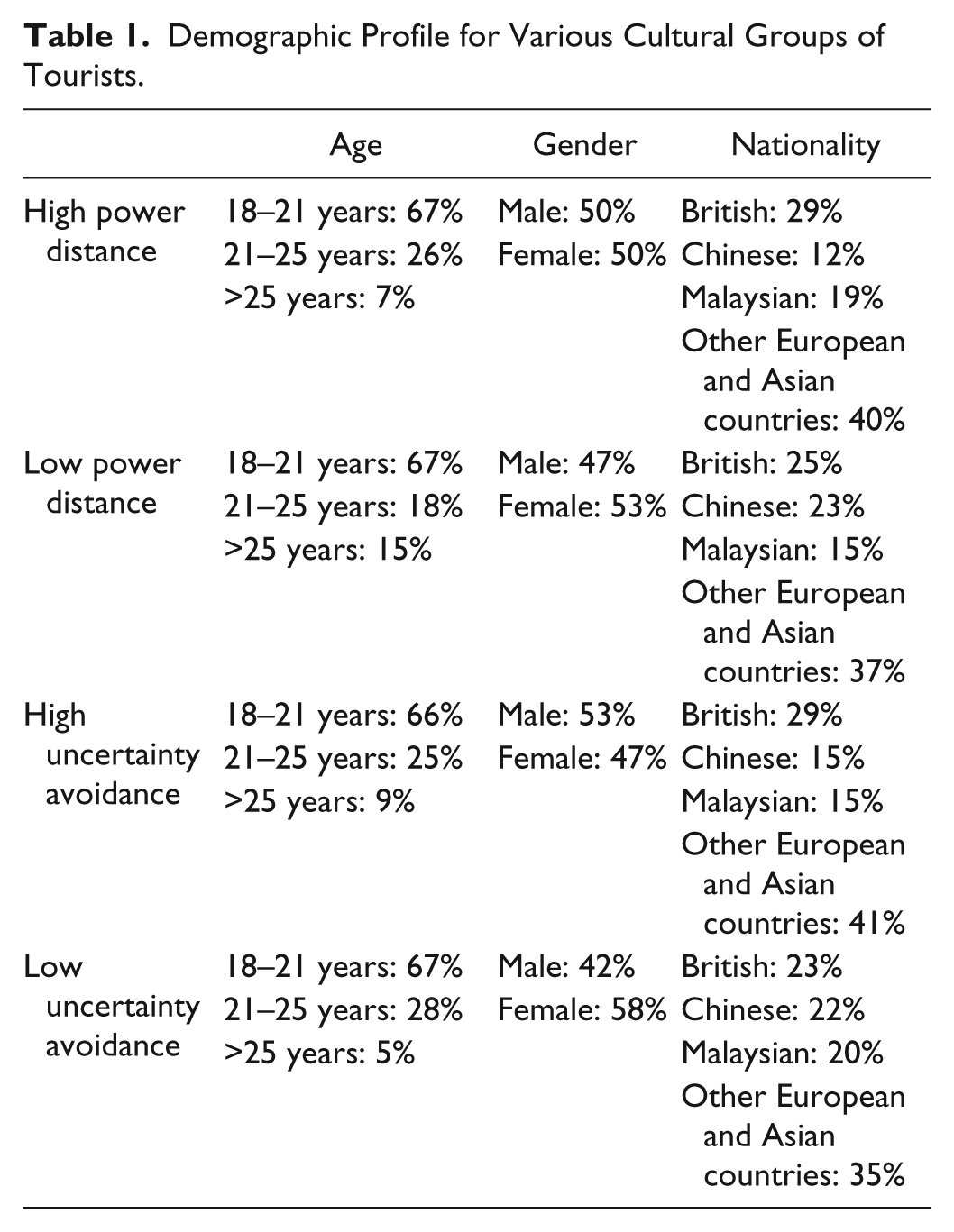
An experimental approach requires that the participants should have sufficient knowledge about the task involved in the experiment (Sparks and Browning 2011). Therefore, the study required participants to have extensive knowledge about using information sources such as advertisements and price cues obtained through the hotel websites in making their choice. This research decided to select participants from a sample comprising undergraduate and postgraduate tourism and business program students of a large British university from its three campuses in United Kingdom, China, and Malaysia. Tourism research often use student sample to represent general tourists in case of experiment-based studies. For example, Lepp, Gibson, and Lane (2011) used a sample of students to represent wider tourists in an experiment to test the effectiveness of a tourism-related website. Student sample is also widely used in areas of cross-cultural research. Schumann et al. (2010) used students of business schools in 11 countries as representatives of bank customers to understand the role of cross-cultural differences in the effects of word of mouth on customers’ service quality perceptions. In addition, tourism studies often advocate the use of student sample to maintain homogeneity and remove the effects of extraneous factors such as age or education that might overshadow the desired effects of experimental manipulations (e.g., Lee and Crompton 1992; Xu 2010). To test the required knowledge of the participants, this study asked two filter questions at the beginning of the survey: their experience of booking a hotel online in the last six months and the importance of the hotel’s website as an information source when they made the booking (5 = very important, 1 = not at all important). These filter questions ensured that the students selected to participate had sufficient touristic knowledge required in this study. The students who answered in the affirmative to the first filter question and scored 4 or more to the second filter question were selected in the final sample. The students in the sample were also acquainted with the theories of consumer behavior and tourism acquired through their university curriculum. This ensured that they have relevant background knowledge about the study context. The study comprised 218 respondents—104 participated in the first experiment and 114 participated in the second experiment. Past tourism studies using student samples had sample sizes between 92 and 255 (Lee and Crompton 1992). The present sample consisted of 48.6% male, largely under the age of 25 years (67.1% between 18 and 21 years, 26% between 22 and 25 years), and 77% were undergraduate students. As the study explored the role of culture, so it was necessary to adopt a multi-country data collection approach. In terms of nationalities, the sample consisted of 26% British, 18% Chinese, 17% Malaysian, and the remaining from the other Asian and European countries. The study used median split of the cultural orientation variable to separate participants into high and low cultural value groups (following Mantel and Kardes 1999). Table 1 provides the demographic profile for various cultural groups.
Demographic Profile for Various Cultural Groups of Tourists.
Service Promise Manipulation
The research used four printed advertisements to manipulate service promises. The study developed the manipulated scenarios in two stages. First, by consulting tourism literature, the researchers collated a pool of key elements that a tourist might expect from a hotel. The list comprised some “must have” elements such as safety and security, cleanliness, warm welcome, good selection of menu, and some “surprise” elements such as sports facilities (like rock-climbing, scuba diving) and leisure facilities (like spas) (Callan and Bowman 2000; Shanahan and Hyman 2007). Second, to enhance the pictorial representation of the manipulated advertisements, the researchers consulted the advertisements and price features from a sample of real-life beach hotels in the premium and economy categories. Based on these, the researchers provided a brief to a professional graphic agency to develop the four printed advertisements.
The first experiment tested the influence of advertising (many vs. few service promises) on the service expectations of tourists. It used two printed advertisements. The first advertisement presented advertising with few service promises. It depicted only the essential and must-have elements like safety, security, cleanliness, and warm welcome. The second advertisement presented advertising with many service promises. It illustrated the essential elements such as safety, security, cleanliness, warm welcome, and additional surprise elements such as mouth-watering international cooking, scuba diving, state-of-the-art rock-climbing facilities, and spas.
The second experiment tested the influence of price (high vs. low cues) on service expectations of tourists. It used the remaining two printed advertisements. However, both the advertisements used here were replicas of the second advertisement (with many service promises) used in the first experiment but with different price tags in the top corner. One had a high price tag to represent high price cues and the other one had a low price tag to denote low price cues. The researchers adopted the price figures (both high and low) from real-life hotels in the premium and economy categories.
Experimental Procedure
This study conducted the experiments and data collection online. Using the database at the university, the researchers sent invitation e-mails to the students to participate in the experiments. A prize draw was used to increase participation. All members of the sample were randomly assigned to one of the experimental scenarios using an online software program. Participants were given detailed background information about the experiment. They were asked to review the printed advertisements used in that particular scenario, imagine that they were potential holidaymakers at this hotel, and complete the questionnaire about their expectations from this hotel, cultural orientations, and demographic details. All responses were anonymous.
Manipulation Check
The manipulation check involved two stages. First, to improve the face validity of the manipulated instruments, the study took opinions from two tourism experts. Based on their feedback, the researchers incorporated few changes in the advertisements such as shortening the length and rewording the service promises. Second, the researchers presented the advertisements to a sample of 60 students across the three country campuses (with similar demographic and cultural profile as intended in the final sample) and asked a series of questions. Thirty subjects were exposed to the advertisements with many service promises and 30 were exposed to the advertisement with few service promises. Subjects were asked, “Compared to most online hotel advertisements you see, did you find this advertisement to be (1) appealing and (2) informative on a 7-point scale (1 = strongly disagree, 7 = strongly agree). t-tests revealed significant differences between the two manipulations (appealing: mean value with more promises = 5.71, less promises = 3.42, t value = 4.35, p < 0.05; informative: more promises = 6.36, less promises = 3.84, t value = 5.31, p < 0.05). Following Voss, Parasuraman, and Grewal (1998), questions were asked on the believability (1 = not at all believable, 7 = very believable) and realism checks (1 = not at all realistic, 7 = very realistic). The study also asked the sample about their predicted service expectations (1 = low quality, 7 = high quality). t-tests revealed significant differences between the stimuli (believability: more promises = 6.51, less promises = 4.87, t value = 8.71, p < 0.05; realism: more promises = 6.21, less promises = 4.21, t value = 12.06, p < 0.05; service expectations: more promises = 6.26, less promises = 4.87, t value = 8.13, p < 0.05). Therefore, the manipulations were successful and suitable for use in the final study.
Measures
The study used established scales to measure relevant constructs. It measured the dependent construct, predicted service expectations, by using 21 items from the SERVQUAL scale comprising five dimensions, namely, tangibles, reliability, responsiveness, assurance, and empathy (Zeithaml, Bitner and Gremler 2006). The study used 10 items from the CVSCALE (Donthu and Yoo 1998) to measure the moderating role of uncertainty avoidance and power distance. Both the dependent and the moderator constructs were measured on a 7-point scale (1 = strongly disagree, 7 = strongly agree). The study also collected demographic variables such as age, gender, nationality, and education levels of the participants. See Table 2 for the full list of items.
Measurement Scale Used in the Study.

Note: All loadings are significant at p < 0.05; loadings: standardized. M = mean; SD: standard deviation. All items were scored on a 7-point scale, where 7 = strongly agree and 1 = strongly disagree.
Analyses and Results
Validation of Scale
The data analysis involved two stages. In the first stage, the validity of the 31-item measurement scale was analyzed using confirmatory factor analysis. The results validate the seven-factor structure. Table 2 shows the items and their corresponding standardized loadings. Data collected across the three campuses and individual cultural values was pooled to ensure homogeneity of the structural model. The model was tested on the criteria of overall fit, reliability, and convergent and discriminant validity. CFA results shows overall goodness of fit for the model. The chi-square χ2(384) = 1918.32, p < 0.01, with χ2/df = 4.99, which is within the acceptable range of 2 and 5 (Marsh and Hovecar 1985). The values of comparative fit index (CFI) = 0.90; incremental fit index (IFI) = 0.90; Tucker–Lewis index (TLI) = 0.89; root mean square error of approximation (RMSEA) = 0.07 (low = 0.06, high = 0.08, with 90% confidence level) are all within acceptable range. The value of goodness-of-fit index (GFI) = 0.83 borders the acceptable limit for good fit. Reliability of the constructs are tested by using Cronbach’s alpha (all values exceed 0.7 with a minimum of 0.74) and composite reliability (all values exceed 0.7 with a minimum of 0.83). The study tests convergent validity of the measurement model in two ways. First, the standardized loadings of all the items are significant on their intended latent construct (p < 0.05). Second, the values of squared multiple correlations (SMCs) of all latent constructs exceed 0.5 (with a minimum of 0.51). To test the discriminant validity of the model, the study uses the average variance extracted (AVE). All the AVE values exceed 0.5 (with a minimum of 0.51), where the squared correlation between any two constructs is less than the AVE by the constructs. This indicates that the model is well specified and suitable for use in further analysis.
Differences in Predicted Service Expectations for Varying Levels of Service Promises
Table 3 shows the results of the descriptive statistics of service expectations of the various cultural groups of tourists when exposed to the experimental manipulations. The study uses the composite of the five SERVQUAL dimensions to calculate predicted expectations. The table shows that the participants who experienced many advertising promises reported higher predicted service expectations (mean = 4.93) than the participants who experienced few advertising promises (mean = 4.27, F = 2.77, p < 0.10). This supports hypothesis 1. Participants who experienced high price signals reported higher predicted expectations (mean = 5.61) than the participants who experienced low price signals (mean = 4.99, F = 9.11, p < 0.05). This supports hypothesis 2.
Differences in Predicted Service Expectations among Various Cultural Groups of Tourists.
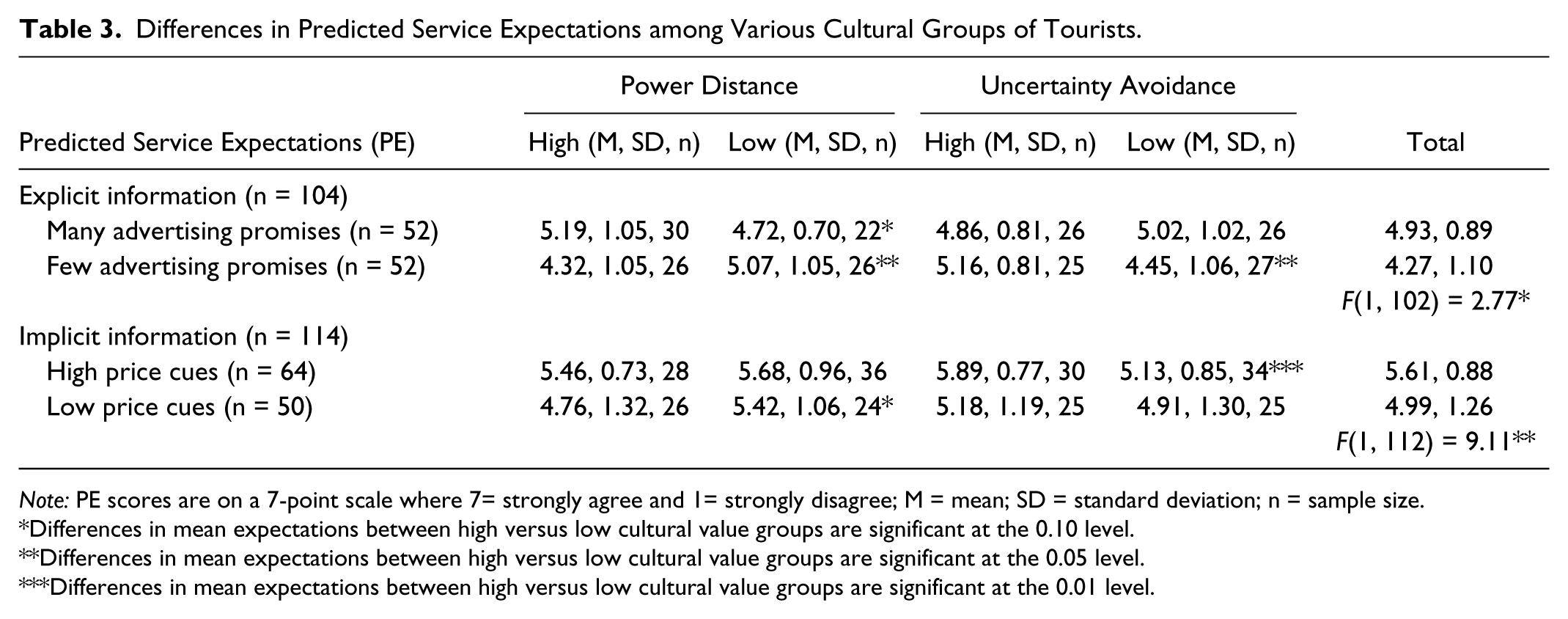
Note: PE scores are on a 7-point scale where 7= strongly agree and 1= strongly disagree; M = mean; SD = standard deviation; n = sample size.
Differences in mean expectations between high versus low cultural value groups are significant at the 0.10 level.
Differences in mean expectations between high versus low cultural value groups are significant at the 0.05 level.
Differences in mean expectations between high versus low cultural value groups are significant at the 0.01 level.
Relationships between Service Promises, Predicted Expectations, and Moderating Effects of Culture
The second stage of data analysis involved testing of the moderation hypotheses (hypotheses 3a, 3b, 4a, and 4b) using analysis of covariance (ANCOVA). Here, predicted expectation is the dependent variable, two service promises (advertising and price manipulations) are the independent variables, culture dimensions (uncertainty avoidance and power distance) are the moderators, and demographic variables (age in years and gender of the tourists) are the covariates. The independent variables in the four manipulated scenarios (with many vs. few advertising promises in the first experiment; and with high vs. low price cues in the second experiment) are represented with +1 and −1 respectively. Four separate models are run to test the effects of the two culture dimensions. Models 1 and 2 test the moderating effect of uncertainty avoidance, whereas models 3 and 4 explore the moderating effect of power distance on the dependent variable. Table 4 illustrates the results.
Results of Hypotheses Testing: ANCOVA Analysis.
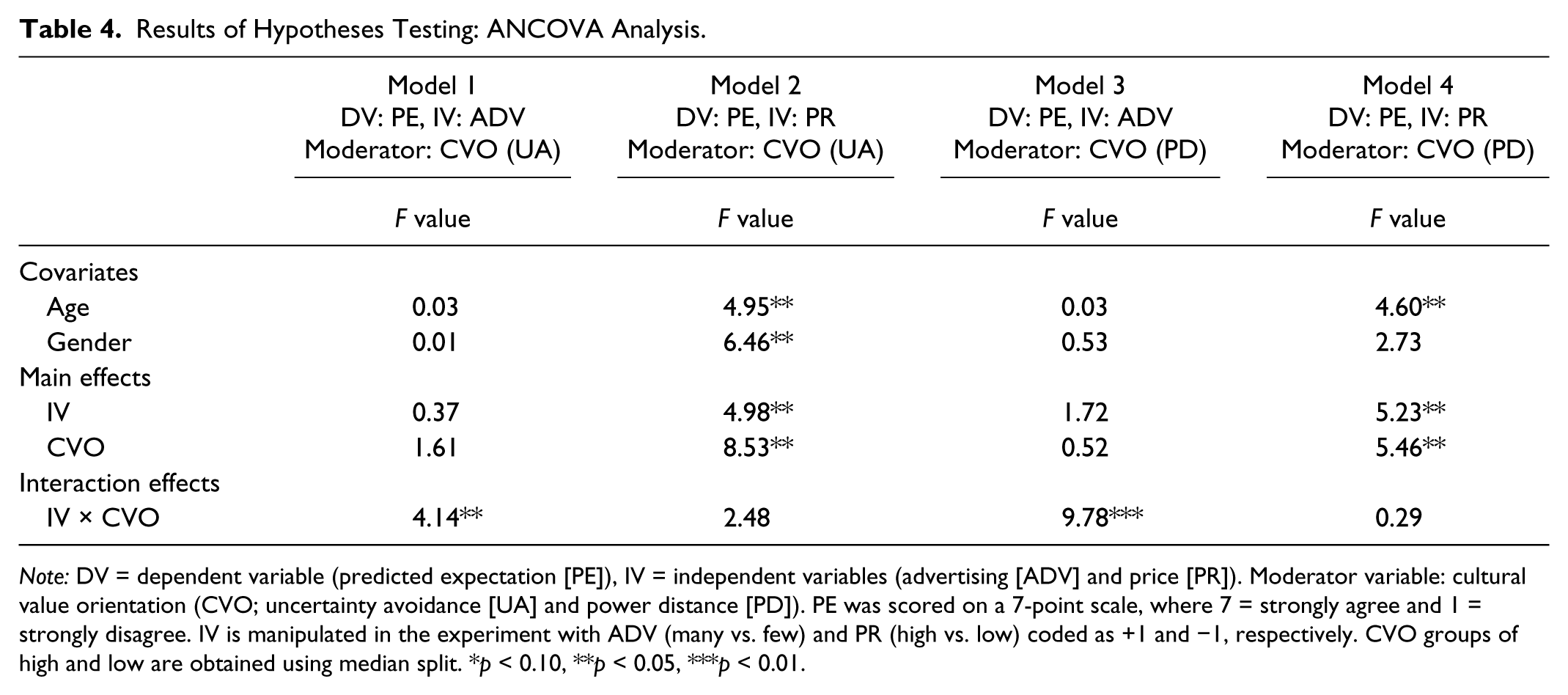
Note: DV = dependent variable (predicted expectation [PE]), IV = independent variables (advertising [ADV] and price [PR]). Moderator variable: cultural value orientation (CVO; uncertainty avoidance [UA] and power distance [PD]). PE was scored on a 7-point scale, where 7 = strongly agree and 1 = strongly disagree. IV is manipulated in the experiment with ADV (many vs. few) and PR (high vs. low) coded as +1 and −1, respectively. CVO groups of high and low are obtained using median split. *p < 0.10, **p < 0.05, ***p < 0.01.
Hypothesis 3a predicted that the low uncertainty avoidance tourists develop higher predicted service expectations when newer hotels make many service promises through their advertisements compared to the high uncertainty avoidance tourists. The product term in model 1shows that there is a significant interaction between advertising promises and uncertainty avoidance (F = 4.14, p < 0.05). As shown in Figure 2, uncertainty avoidance moderates the effect of advertising promises on predicted service expectations. The figure shows that for low uncertainty avoidance tourists, there is an increase in predicted service expectations when they are exposed to many advertising promises as compared to few advertising promises, whereas for the high uncertainty avoidance tourists they decrease. The descriptive values from Table 3 supports the findings. For low uncertainty avoidance tourists, the predicted service expectations increased from 4.45 in the few advertising promises condition to 5.02 in the many advertising promises condition (p < 0.05). For high uncertainty avoidance tourists, the predicted service expectations decreased between the two conditions. Therefore, the results support hypothesis 3a.
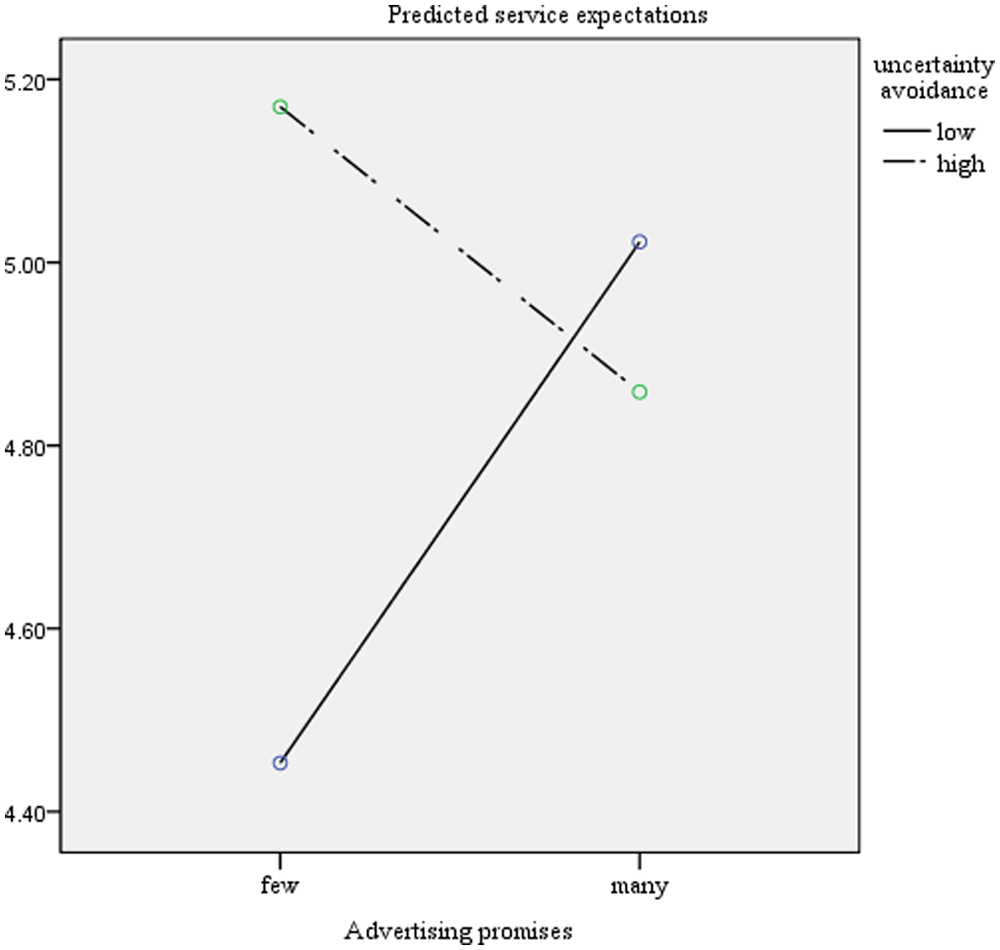
Interaction between advertising promises and uncertainty avoidance on service expectations.
Hypothesis 3b predicted that the low uncertainty avoidance tourists develop higher predicted service expectations when newer hotels expose them to higher price signals compared to the high uncertainty avoidance tourists. The product term in model 2 shows that the effect of price on predicted expectations does not differ between high and low uncertainty avoidance tourists (F = 2.48, not significant). Therefore, there is no interaction effect between uncertainty avoidance and implicit promises in the form of price and, as a result, hypothesis 3b is not supported.
Hypothesis 4a predicted that the high power distance tourists develop higher predicted service expectations when newer hotels make many service promises through their advertisements compared to the low power distance tourists. The product term in model 3 shows that there is a significant interaction between advertising promises and power distance (F = 9.78, p < 0.01). As shown in Figure 3, power distance moderates the effect of advertising promises on predicted service expectations. It shows that for high power distance tourists, there is an increase in predicted service expectations when they are exposed to many advertising promises as compared to few advertising promises, whereas for the low power distance tourists, they decrease. The descriptive values from Table 3 supports the findings. For high power distance tourists, the predicted service expectations increased from 4.32 in the few advertising promises condition to 5.19 in the many advertising promises condition (p < 0.10). For low power distance tourists, the predicted service expectations decreased from 5.07 in the few advertising promises condition to 4.72 in the many advertising promises condition (p < 0.05). Therefore, the results support hypothesis 4a.
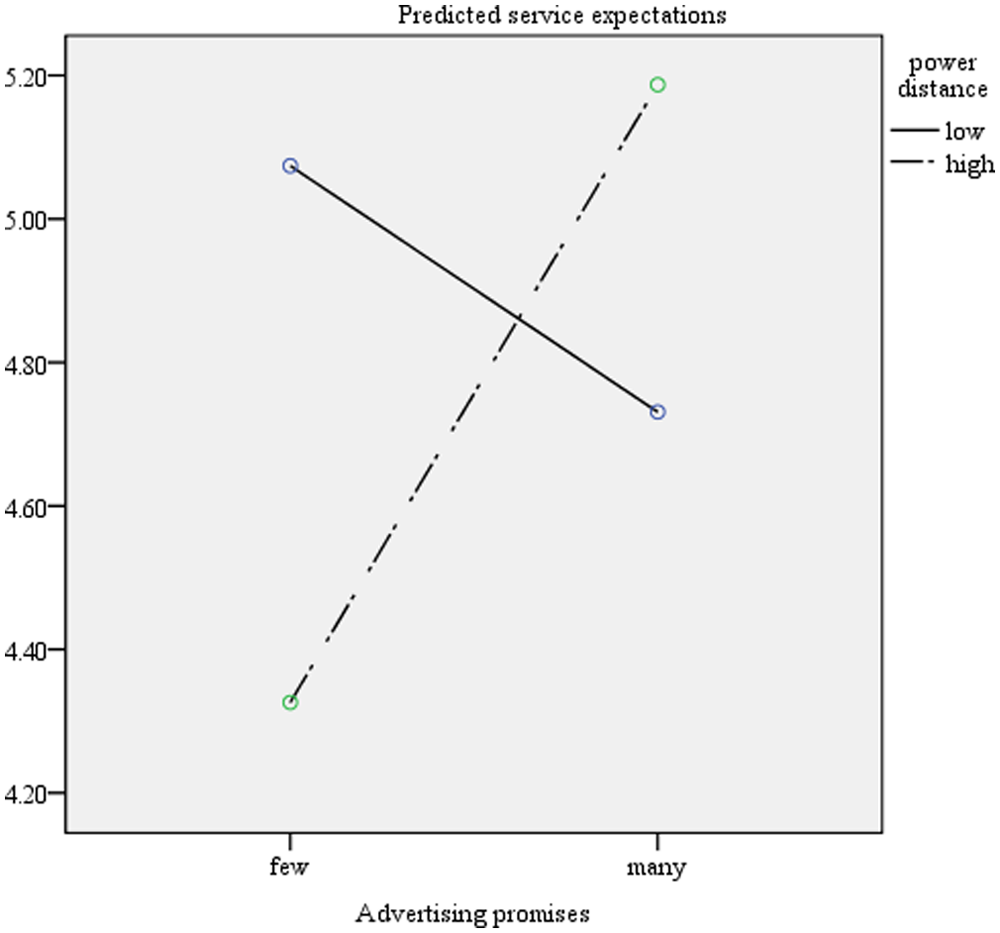
Interaction between advertising promises and power distance on service expectations.
Hypothesis 4b predicted that the high power distance tourists develop higher predicted service expectations when newer hotels expose them to higher price signals compared to the low power distance tourists. The product term in Model 4 shows that the effect of price on predicted expectations does not differ between high and low power distance tourists (F = 0.29, not significant). Therefore, there is no interaction effect between power distance and implicit promises in the form of price and, as a result, hypothesis 4b is not supported.
Discussions and Contributions
This research aimed to explain the role of explicit advertising promises (many vs. few) and implicit price signals (high vs. low) in influencing tourists’ service expectations in case of hotels with no established familiarity. This study finds that such a hotel can increase the service expectations of prospective tourists by offering many service promises through its advertising campaign. Previously, the literature was divided as to whether such a strategy would prove effective in the case of newer hotels as potential consumers may be sceptical of such claims in the face of a lack of familiarity. Our study adds significantly to the weight of evidence that such strategies are equally effective in engendering positive expectations for such hotels, hence adding to current understanding in the area. Projecting a superior image through higher price signals is also seen as effective for hotels that benefit from little consumer familiarity. In the absence of more personal information sources such as past experience or word of mouth, marketer-led information sources such as advertising and price cues are crucial in influencing tourists. Such findings are true even in the case of relatively unknown or new-to-market hotels. As choice uncertainty and purchase risks are pertinent for tourists when a hotel is unfamiliar, understanding how the hotel can make optimal use of service promises through its advertising (many or few promises) and price cues (high or low) is critical when seeking to influence tourists’ prepurchase service expectations.
In addition, this research also explored the role of culture on how tourists process service promises made through advertising and price signals. This study contributes to understanding by showing that uncertainty avoidance and power distance moderate the effects of advertising promises on predicted service expectations for tourists in the prepurchase decision-making stage for newer hotels. Low uncertainty avoidance and high power distance tourists develop higher predicted service expectations when newer hotels expose them to many advertising promises, whereas high uncertainty avoidance and low power distance tourists develop lower predicted service expectations under similar conditions. High uncertainty avoidance tourists, in order to reduce risk and seek absolute truth, develop a strong inclination to use all possible information sources about the hotel before decision making. On the other hand, low uncertainty avoidance tourists prefer service promises that depict superior image of the hotel and create a halo about the possible touristic experience. Therefore, they are likely to take at face value such explicit service promises made by hotels through their advertisements.
For high power distance tourists, many explicit service promises made by hotels through their advertisements promote an enhanced sense of trustworthiness and augment perceptions of superior image of the hotel. On the other hand, low power distance tourists are more amenable to fewer explicit service promises while generating their service expectations. Consequently, the study suggests that hotels that cater to tourists from various cultural backgrounds should use advertising in a discreet, customized fashion depending on the cultural norms of their targeted tourists.
Our findings suggest that low uncertainty avoidance and high power distance tourists have a higher propensity to rely on the advertising signals communicated by the organizations. On the other hand, high uncertainty avoidance and low power distance tourists experience a sense of apathy to the advertising signals used by such organizations. This study extends this literature by identifying the optimal levels of advertising promises (many or few) according to the individuals’ cultural value orientations and commonalities in their interpretations of advertising promises.
However, the study does not find support for the moderating role of cultural value orientations on the implicit service promise (in the form of price)-predicted expectation relationship. The results indicate there is a convergence of cultural norms when tourists evaluate price promises made by hotels. This implies that irrespective of cultural orientations, individuals process price cues in the same way. Hotels use price cues to emphasize their brand positioning either as an economy or as a premium category hotel (Xu 2010). The findings of the study suggest that the use of price cues to signal quality perceptions and the way price impacts tourists’ value judgment is a global phenomenon. Price does impact on consumers’ expectations, but it does so in a similar fashion regardless of individual cultural values. Extant literature suggests that the way consumers use price signals is mixed. One stream of research posits that price is a marketing universal (Dawar and Parker 1994; Dawar, Parker, and Price 1996). Hence, individuals from various cultures have similar interpretation of price signals. On the other hand, another stream of research suggests that individuals from different cultures have different understanding of price signals (Meng and Nasco 2009; Sternquist, Byun, and Jin 2004). The findings of this study conforms to the proposition of universality of price signals and suggests that manipulation of it across cultures is not necessary.
Practical Implications
The findings of this study imply that the managers of hotels that are new-to-market, unfamiliar, or relatively unknown should develop differentiated advertising strategies but standardized pricing strategies depending on the cultural value orientations of tourists. The hotels must expose tourists to many explicit service promises through their advertising campaigns in low uncertainty avoidance and high power distance cultures. Such an approach may well increase the likelihood of choice/purchase, but will also require excellent service delivery in order to ensure that such inflated expectations are met! On the other hand, the hotels must expose tourists to fewer service promises through their advertising campaigns for high uncertainty avoidance and low power distance cultures. This implies that the hotels will need other methods such as highlighting the room facilities or customer satisfaction scores to impart the absolute truth sought by such customers. The findings suggest that the hotels need to identify two clusters of tourists (high, low; and low, high) based on their uncertainty avoidance and power distance scores (using measures like CVSCALE) and manipulate the levels of service promises through their advertising campaigns accordingly. The absence of the moderating role of culture on the relationship between implicit service promise of price and predicted expectation relationships show that there is no need for hotels to manipulate their price cues to target various consumer segments based on their cultural orientation. Price is an indicator of predicted expectations across all cultures. Therefore, tourists’ perception of “If I buy cheap, I will get worse” is very similar across cultures.
Limitations, Future Research, and Conclusion
Notwithstanding the contribution that our study makes, certain potential limitations exist. First, this study manipulated the effects of only two independent information sources (advertising and price promises). Therefore, future research should investigate the effects of other information sources, such as word of mouth, on tourists’ service expectations, or could explore the effects of other cultural value orientations such as long-term orientations to provide further insights. Sparks and Browning (2011) argue that the use of experiments in tourism research is a balancing act between statistical and practical significance of the results. Future research could use an alternative approach such as field study with real life new-to-market hotels to confirm generalizability of findings.
Second, the study used a student sample with specialized knowledge in tourism and consumer behavior theories. Their response may be inherently different from other students or tourists in general. This study used appropriate filter tests to check the suitability of the sample. However, future research could take a sample to represent wider tourist community to improve the generalizability of the results. Finally, the study used the context of a fictitious hotel, which could be viewed as lacking legitimacy. However, there is a strong tradition of using fictitious brands in experimental designs. Indeed, fictitious brands are normally seen as advantageous to avoid contamination of result by actual real-world prior experience or knowledge, when what is of primary interest is reaction to the manipulations used. Future research could incorporate manipulation of brand positioning factors, perhaps by comparing well-known brands aimed at different segments of the market, or by comparing a well-known brand with a fictitious one.
In conclusion, this study identified interactions between advertising promises and individual cultural variables in a tourism context that add to knowledge and lead to important implications for practitioners. Implicit service promises, in the form of price, have the same impact in expectations regardless of individual cultural variables.
Footnotes
Declaration of Conflicting Interests
The author(s) declared no potential conflicts of interest with respect to the research, authorship, and/or publication of this article.
Funding
The author(s) received no financial support for the research, authorship, and/or publication of this article.