




Abstract
A central research topic in tourism management concerns tourists’ choice of specific destinations. The present article reviews and advances the extant literature on destination image. From this review, we suggest that individuals have a multitude of destination associations, the total imagery that relates to the destination, and label this concept destination imagery. Individuals also hold an overall image used as a heuristic or a mental shortcut, which is labeled destination image. The concepts of destination imagery and destination image are distinct, yet they have often been conflated within the literature. The article further provides an extensive review of the literature with regard to the definitions, dimensionality, antecedents, and outcomes of the focal concepts as well as geographical scope of destination imagery and image studies and methodologies. This review has led to a novel understanding and delimitation of the focal concepts within the imagery–image duality model.
Introduction
A central theme in tourism research is the understanding of how tourists evaluate and choose among destinations. This understanding is important for tourism stakeholders ranging from the tourists themselves to the destinations they visit. Destinations are interested in attracting tourists because increased tourism provides benefits such as increased employment and wealth to the destination. Tourism industries and firms are interested in understanding what attracts tourists because they depend on this for making strategic decisions such as where to locate their businesses. Further, tourism industries want to understand tourists’ destination image because it affects their ongoing businesses. Tourists themselves also have an interest in a greater understanding of such tourist choice behavior because this in turn allows destinations and tourism industries to better work toward fulfilling tourists’ needs and wants.
It is therefore not surprising that trying to understand tourists’ destination image (DI) has become one of the most prolific research topics within the field of tourism. Since its inception in the early 1970s (Hunt 1971), the study of DI has been the subject of considerable research (Baloglu and McCleary 1999; Gallarza, Saura, and Garcia 2002; MacKay, and Fesenmaier 1997) and has demonstrated both its theoretical and practical significance. A flourishing literature (Crompton 1992; Decrop 1999; Decrop and Snelders 2004, 2005) also exists on tourists’ choice behavior stages, as well as on tourist typologies. However, an often-mentioned major weakness of this literature is the ambiguity of the DI construct itself and that as yet there is no consensus regarding its conceptual definition and delimitation.
Against this background, the present article aims to present a state-of-the-art review of the key research, trends, and way forward in this area. The study addresses several questions: How do scholars conceptually define DI and is there a consensus in the area? Do scholars view DI as a one-dimensional or a multidimensional concept? Which antecedents may affect tourists’ DI? According to previous studies, which tourism consequences does DI have? Which methods have scholars applied to the study of DI?
Tourists’ visiting decision when choosing a tourist destination is driven by their predispositions related to the particular destination. The most frequently used destination predisposition in tourism is “destination image.” The present article argues that most studies in the extant literature have applied one of, or both of, two distinct concepts and often under the common label DI. Studies have conceptualized DI in a variety of ways with a multitude of varying dimensions. This has created ambiguity and a lack of comparability across studies. This study suggests that these destination dispositions be conceptualized as two distinct concepts within an imagery–image duality (IID) model. The first concept refers to the various associations individuals have in relation to a particular destination. The second concept refers to an individual’s overall image of the destination used to efficiently and quickly make decisions. The two concepts are labeled destination imagery (DY) and destination image (DI) respectively. The article proceeds with a review of the literature on DY and DI, followed by addressing the research questions. Finally, the article suggests ways and aims for future research on these important concepts.
Background and Conceptual Definition
Image constructs are used in many disciplines from psychology to marketing. In psychology, for example, self-image is defined as an individual’s mental picture about himself or herself (Aloise-Young, Hennigan, and Graham 1996). Images may be viewed as stereotypes and are sometimes referred to as self-schema (Rogers, Kuiper, and Kirker 1977); the way we store, categorize, and retrieve information about ourselves. In marketing, consumers are assumed to hold an image of products and organizations determined by factors such as the physical characteristics, packaging, advertising, and price. These images represent, for example, the stereotypical individual, worker, and product, but may also, in part, be the results of stereotyping the generalized, or typical, user (Britt 1960; Grubb and Grathwhohl 1967; Levy 1959). Image constructs generally serve as efficient shortcuts for storing, retrieving, and applying informational cues.
Tourists’ image of a destination represents an efficient shortcut for the array of associations they mentally link it to. Destination information is held at various levels of detail in order to facilitate decision making (Alba and Hutchinson 1987). The most aggregate level is the DI. DI plays an important role for tourists in their decision making regarding destination predispositions, choice, evaluations, and postvisit behaviors (Baloglu and McCleary 1999; Echtner and Ritchie 1991; Gallarza, Saura, and Garcia 2002). Consequently, destination image is acknowledged as one of the core concepts in the tourism management literature.
As mentioned, scholars have conceptually defined DI in several ways, and as yet, there is no consensus. Early on, Hunt (1971) suggested that DI is the impression that people have about a geographic region in which they do not reside. Several studies rely upon a definition of DI as a mix of knowledge, beliefs, feeling, and perceptions. Crompton (1979, 19), for example, defined DI as an individual’s mental representation of knowledge (beliefs), overall perception, and feelings towards a particular destination and continues to argue that it is “a mental conception held in common by members of a group and symbolic of a basic attitude and orientation.” Other scholars also incorporate “belonging to a group” into the definition. For example, Lawson and Baud-Bovy (1977, 16) defines DI as “an expression of all knowledge, impressions, prejudices, and emotional thoughts an individual or group has of a particular object or place”. However, most definitions of DI do not stipulate that DI is necessarily related to groups. MacKay and Fesenmaier (1997, 538) suggest that DI is an overall concept that is “a composite of various products (attractions) and attributes woven into a total impression.” Several other studies suggest that DI is “an overall impression of a destination” (e.g., Frías, Rodriguez, and Castañeda 2008; Gallarza, Saura, and Garcia 2002).
Yet other scholars focus on the multitude of associations held in the memory of tourists. For example, Cai (2002, 723) views DI as “perceptions about the place as reflected by the associations held in tourist memory.” Some scholars (e.g., Tasci, Gartner, and Cavusgil 2007) argue that DI represents an interactive system of thoughts, opinions, visualizations, and intentions toward a destination. Some scholars (e.g., Milman and Pizam 1995) note that DI may not only refer to an image that relates to a destination, but the image could also be one that the public has of a product or an experience. It is also worth noting that these associations are held in “tourist” memory. McClinchey (1999, 9) uses the broader term person rather than focusing on the tourist, stating that DI “includes the perceptions or impressions a person has of a place.”
Two Distinct Concepts
The disagreement in the extant literature regarding what constitutes DI deserves closer scrutiny. There are at least four dimensions along which the extant literature has disagreed upon the definition of the concept. Each point will be discussed with the aim to develop a conceptual definition.
The first issue pertains to who holds the image. While some definitions focus on the tourist, and other definitions focus on the general public, a growing consensus is that there is no inherent assumption that DI must represent a shared understanding. For example, Lawson and Baud-Bovy (1977) state that DI is an expression of knowledge that an individual has of a specific place. Crompton (1979, 18) states that DI is “the sum of beliefs, ideas, and impressions that a person has of a destination.” Baloglu and McCleary (1999, 870) similarly note that DI relates to “an individual’s mental representation [ . . . ] and global impression about a destination.” Bigne, Sanchez, and Sanchez (2001, 607) argue that DI is a “subjective interpretation of reality made by the tourist.” Some researchers, however, also allow for the possibility that DI not only is an individual predisposition but can be shared by a group of individuals. For example, Hunt (1971) notes that DI relates to “impressions that a person or persons hold,” and Embacher and Buttle (1989, 3) note that DI is “held individually or collectively.”
Overall, the broad consensus in the literature is that a single individual can form an image about a destination, and this would be that person’s DI of that particular destination. Many individuals can influence each other and form a similar or common DI, and using the term individual allows for this dynamic without making it mandatory that DI is held by a group or subgroup. However, in several research contexts, it is often appropriate to refer to tourist, person, or peer, and each may be relevant to the study of DI. The DI that is important to theory and practice is the image held by existing tourists as well as potential tourists and those who may influence their decision making (e.g., friends, family, and peers). It is therefore suggested that using the term individual (rather than, e.g., tourist) is most useful. It is further suggested that there is a possibility that groups of individuals may form similar images.
The second issue relates to DI having certain consequences. These may be the individual’s intentions to visit the destination, or his or her behavior during or after visitation. These are consequences, but are not the image itself, and should not be part of the conceptual definition. If they are part of the definition, then testing the effect of DI on such consequences also becomes tautological.
The third issue relates to the antecedents of DI. It could be problematic making these antecedents an integral part of the definition of DI. However, certain proximal antecedents may be used to elaborate upon the definition of DI without them being part of the DI concept.
Fourth, and perhaps most importantly, is the issue that seems to separate previous studies the most—should DI be defined as being an overall and evaluative impression, or is it more of an array of associations that are formed by distinct information for each separate destination? Based on a thorough review of the literature, this study argues that both perspectives exist in the literature and that they are concerned with two separate concepts: Destination imagery and destination image. In the following section, the article will first discuss this understanding of DI and subsequently of DY. The following sections briefly introduce and suggest conceptual definitions of DI and DY respectively.
Destination Image
“The concept image can be applied to a political candidate, a product, a country. It describes no individual traits or qualities but the total impression an entity makes in the minds of others” (Dichter 1985, 75). Gartner (1986) argued that individuals’ perceptions of destination attributes will interact to form an overall image. As such, the DI is not a host of different and more or less descriptive associations or attributes relating to the destination. Rather it is an overall impression—or a condensate (sometimes labeled sum) of impressions. It is a mental shortcut that individuals use to make judgments and decisions efficiently. As Kotler, Haider, and Rein (1993) note, it is not the array of impressions and ideas about the destination but rather the result or “the sum of these beliefs, ideas and impressions that people have of a place or destination.” Kotler, Haider, and Rein (1993, 141) express the summary nature of the DI when stating that “images represent a simplification of a large number of associations and pieces of information connected with the place. They are a product of the mind trying to process, categorize, and essentialize huge amounts of data about a place.”
Since DI is used as a mental shortcut for making judgments or decisions, it is evaluative in nature (rather than descriptive). As Walmsley and Lewis (1993, 218) note, it is “a schema of evaluations that can be used to differentiate among tourism destinations.” Evaluative images are important because of their influence on discretionary trip-making behavior. Frías, Rodriguez, and Castañeda (2008, 167) note that DI is “an overall evaluation expressing the extent to which a destination is liked or disliked.”
Against this background, DI is defined as an individual’s or a group of individuals’ overall evaluative representation of a destination. DI is used as a mental shortcut and will become more readily available the more frequently the individual draws on it (see also Alba and Hutchinson 1987). DI can be viewed as a heuristic, and as the problem-solving literature clearly states, a heuristic is always biased, but can be an effective way of making decisions nonetheless (Gigerenzer and Gaissmaier 2011). The construct is evaluative by nature; allowing the individual to make relative judgments and decisions. Changes in the associations that the individual relates to the destination are mentally checked for consistency with the overall image and its evaluative properties. If there is a discrepancy, the individual will wish to find an explanation to this discrepancy—perhaps as an exception to the rule, or (bad) luck. Alternatively, the image will be revised or amended.
Importantly, some studies (e.g., Baloglu and Brinberg 1997; Baloglu and McCleary 1999; Sparks and Pan 2009) have noted the two distinct concepts and moved toward separately defining these. To a limited extent, this has addressed the ambiguity of DI by clarifying that the summary schema is distinct from the broader imagery or associations that go into its formation by labeling it the overall DI. These important studies have advanced the literature in terms of making it clearer what DI is and what it is not. Although this part of the extant literature has attempted to delimit the concepts, distinct conceptual definitions are yet to be advanced. Ahmed (1991) stated that a central issue in the tourism literature is to delineate the relationship between this overall image (DI) and other related components. The present study therefore builds on this work and goes one step further by suggesting that this overall image be labelled DI, and that individuals’ beliefs about the specific characteristics and the tourist’s mental responses to these be labeled DY.
Destination Imagery
While all the associations that individuals relate to a destination may help create the overall impression of the destination, some researchers are not only interested in the evaluative overall DI but also the individual associations and may wish to group them into dimensions. These associations connected to a destination are part of the imagery that may ultimately affect the DI. Such associations relate to a host of cognitions and feelings concerned with previous actions, experiences, opinions, intentions, visualizations, etc. The associations are drawn from throughout the individual’s memory, and the most salient and important parts may vary depending on the situation and aim. This conceptualization is in line with prior research (e.g., Baloglu and McCleary 1999). Table 1 illustrates selected studies that include measures of either DY or DI.
Selected Examples of Studies Which Use DY and DI Measures.
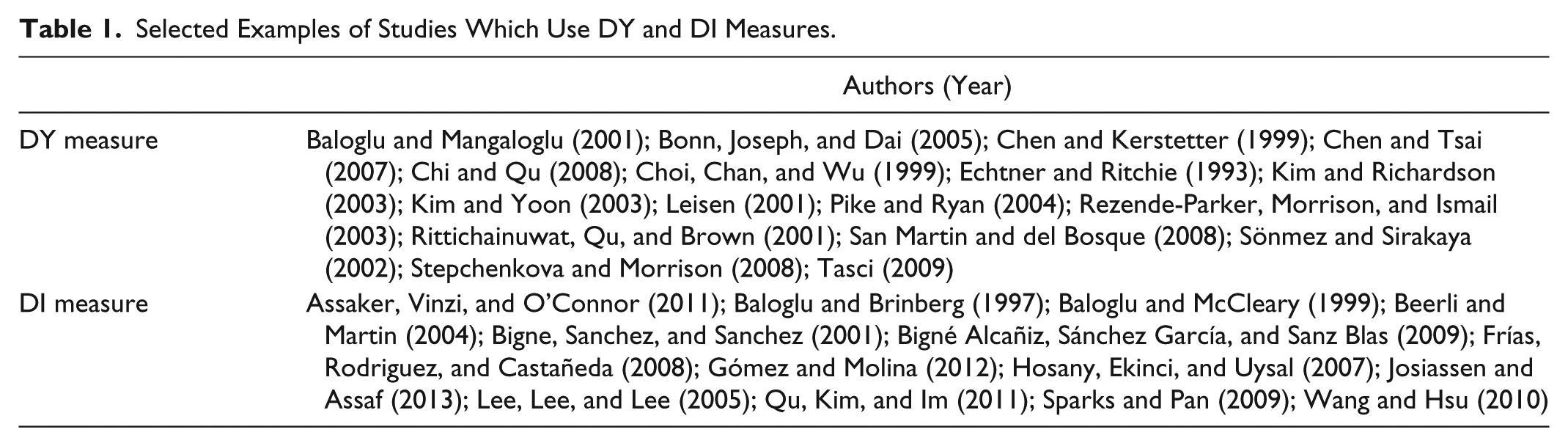
The present study conceptualizes such associations regarding a destination as the destination imagery (DY), and the concept is defined as an individual’s or a group of individuals’ diverse cognitive and affective associations relating to a destination. According to Merriam-Webster and other dictionaries, “imagery” can mean “mental images” or “images collectively.” On the other hand, it is worth noting that imagery in the present context does not refer to the understanding of imagery that is taken by a branch of the psychology literature to mean conscious phenomenological experiences of objects or events (e.g., mentally rotating a car to see what is on the other side; mentally re-experiencing the latest holiday trip).
Individuals who are willing and able to expend more mental resources on their destination decision making use such diverse imagery associations more when making evaluations and decisions (while also checking the continued veracity of the DI) than individuals who expend less resources on their destination decision making (Han 1989; Josiassen, Lukas, and Whitwell 2008). For example, more familiar and involved individuals are willing to expend more resources in arriving at a decision. In contrast, less familiar and less involved individuals will to a greater extent skip looking at their diverse DY and instead rely on the overall DI itself (Han 1989; Josiassen, Lukas, and Whitwell 2008).
The present study presents the imagery–image duality (IID) model in which the concepts of DY and DI coexist, and DY positively relates to the DI concept. As such, an individual’s DI is an outcome of a variety of imagery or associations drawn from his or her memory. It may not be appropriate to suggest a directional relationship when DY is operationalized as a descriptive concept. However, when DY is operationalized as an evaluative concept, the relationship between DY and DI is positive. The following sections review how the extant literature has dealt with the issues of (1) dimensionality, (2) evaluative versus descriptive, and (3) the methods used. Each section also discusses these issues in the context of such destination stereotyping (DY and DI).
Dimensionality of Destination Image and Destination Imagery
The matter of dimensionality has also divided the extant literature. Some scholars (Assaker, Vinzi, and O’Connor 2011; Baloglu and Brinberg 1997; Bigne, Sanchez, and Sanchez 2001; Chen 2001; Josiassen and Assaf 2013; Sparks and Pan 2009; Walmsley and Young 1998) note that DI has a single dimension, while other scholars (Gómez and Molina 2012; Hsu, Wolfe, and Kang 2004; Lee, Lee, and Lee 2005) suggest that it may consist of several dimensions (see Table 2 for examples of these suggested dimensions).
Illustration of the Variety of Dimensions and Labeling in the Extant Literature.
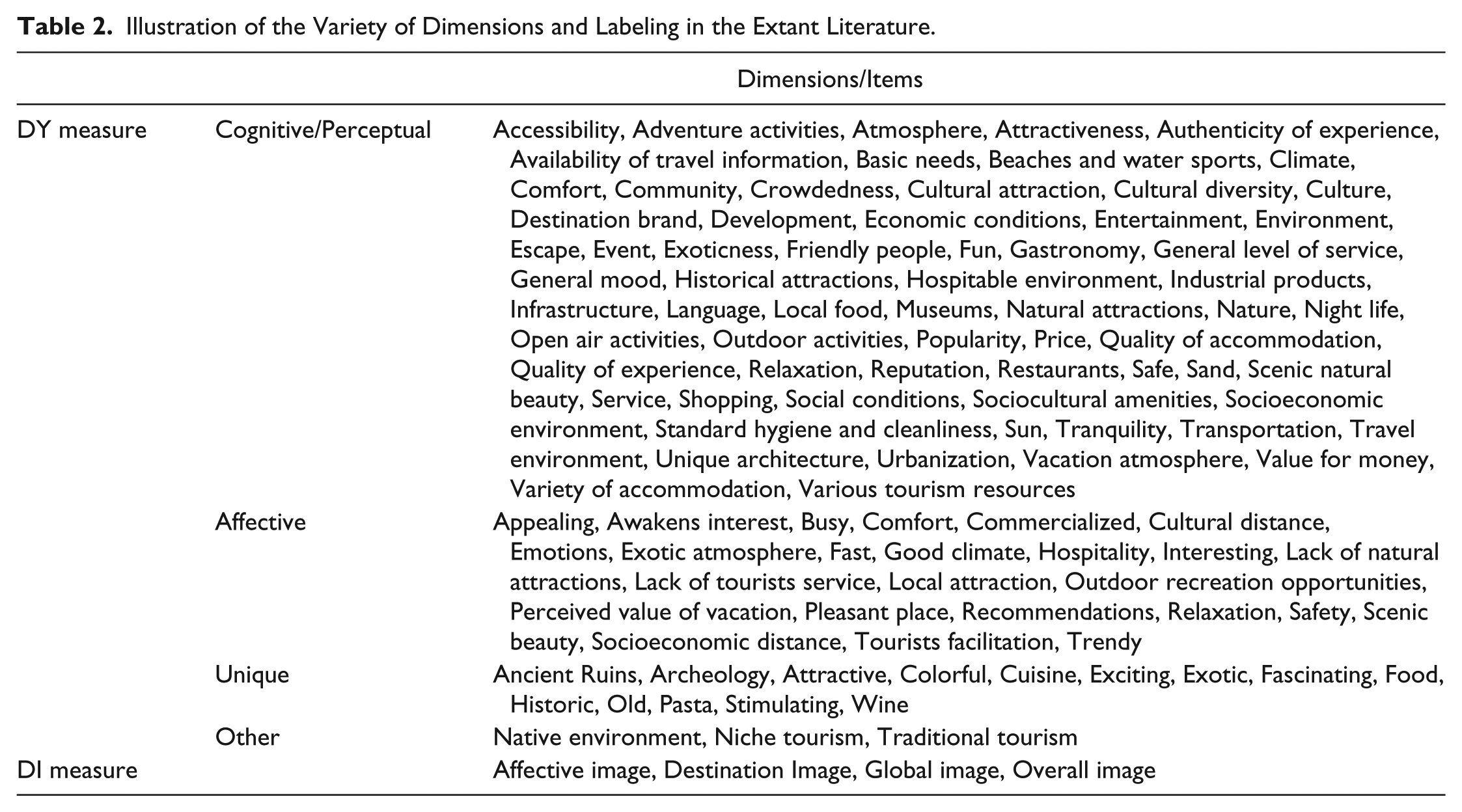
Another dimensionality relates to dividing not only the traits and qualities into dimensions but rather dividing the individual’s mental responses to these qualities into dimensions. In the extant literature, the mental responses have been divided into affective, cognitive, conative, perceptual, unstructured, unique, evaluative, feelings, beliefs, psychological, iconic, and stereotypical dimensions. Rather than focusing on the particular trait, this dimensionality emphasizes whether the individual’s mental response, for example, is one of perception or thinking (cognitive), or one of feeling (affective). Traits that would otherwise be in separate dimensions because they relate to distinct aspects of the destination may be grouped into the same dimension under this approach if they elicit similar mental responses in the individual.
Tourists may have a variety of associations tied to a specific destination. These may relate to the exotic atmosphere, ease of communication, or whether or not it is a pristine area. It is unlikely that such diverse associations spring from one latent construct. Rather, such destination imagery relate to distinct dimensions that often have no or little correlation. Researchers may choose to focus only on some of these, but a reasonably full account of DY would therefore be multidimensional. On the other hand, the individual’s overall impression of the destination that takes into account, consciously but usually subconsciously, relevant factors are distilled into one image. This image (DI) is likely to be a single-dimensional construct.
Descriptive Versus Evaluative Focus of Destination Image and Imagery Studies
The literature also reveals two distinct approaches to the study of DY/DI in terms of being either more of a descriptive, or more of an evaluative, concept. On one hand, some studies clearly view DI as a concept or schema that is used for making efficient judgments and choices. On the other hand, some studies view DI as a concept that focuses on describing the traits and qualities of the destination (in more or less detail) in the minds of individuals. Studies with an evaluative approach use items with scales where the extreme negative value is clearly unfavorable, and the extreme positive value is clearly favorable. Example items are good/bad, pleasant/unpleasant, and liked/disliked. While these are examples of bipolar adjective scales, Likert-type statements asking respondents to which degree they agree with an evaluative statement is another example of using an evaluative approach. Several studies (Bigne, Sanchez, and Sanchez 2001; Sparks and Pan 2009) take an evaluative approach according to which DI is positive or negative.
In studies utilizing a descriptive approach, example items include “multi-cultural,” “varied gastronomy,” “crowded,” “busy,” “Kansas has windy and hot weather (agree/disagree).” Items used in this approach describe the destination and do not have to be of an evaluative nature. These example items could be positive, neutral, or negative traits depending on the individual and the context. As such, if respondents strongly disagree that destination X is multicultural, this does not inherently imply a positive (nor negative) DI. It simply implies that respondents perceive destination X to not be multicultural. Similarly, if respondents strongly agree that a destination is “busy,” this would only reveal that they perceive the destination to be busy. It reflects neither a positive nor negative image overall of the destination, but rather describes a trait the respondent believes to know about the destination. Several studies (Pan and Li 2011; Ryan and Cave 2005) take such a descriptive (rather than evaluative) approach to the concept. Some studies (e.g., Bigné Alcañiz, Sánchez García, and Sanz Blas 2009; Sparks and Pan 2009) have included both approaches to the study of destination stereotyping.
A study by Pan and Li (2011) is an example of an investigation into the effects of DY. Specifically, the study investigated the effects of DY on individuals’ intentions to travel to China. While Pan and Li (2011) used the familiar term DI label, both the conceptual and operational handling of the independent variable (IV) is consistent with an imagery variable rather than an image variable. The IV was defined as “the perceptions and impressions a person has of a place.” The concept is operationalized using three dimensions: (1) stereotypical phrases (e.g., great wall, crowded, food), (2) affective phrases (e.g., exciting, happy, busy, interesting, crowded), and (3) uniqueness phrases (e.g., Great Wall of China, Beijing, Hong Kong, Shanghai, forbidden city, Tiananmen Square, temples). As noted, DY can be either a mainly descriptive or a mainly evaluative concept. As such, some studies have collected data on destination associations trying to include evaluations of these distinct associations, while other studies have merely recorded the extent to which the destination is perceived as “busy” versus “calm” or “exotic” versus “classic” with no aim to ascertain whether, for example, “exotic” or “classic” is preferable. The host of associations themselves may each point in different evaluative directions, and are therefore not an efficient way to make judgments and decisions. For example, “busy” (or “Tiananmen Square”) may be positive to some and negative to other individuals. Such a term is better at describing the destination rather than evaluating it. “Interesting” on the other hand is more of an evaluative term because while tourists may disagree on what is interesting, being interesting in itself is almost always a positive thing. On the other hand, including such items in a DY scale is appropriate and may help describe the intricate nature of the associations that make up an individual’s DY.
Geographical Scope of DI and DY Studies
Destination imagery and image studies have also focused on several geographical destination levels. This research uses the framework of Josiassen et al. (2013) to review extant studies and the context levels they used. Table 3 illustrates that country is the most common destination level. Similar to Josiassen et al.’s (2013) findings in the country of origin literature, the country level is taken by the majority of researchers. Next, and also somewhat frequently investigated, are subnational regions and cities, for example, Frías, Rodriguez, and Castañeda’s (2008) study set in the region of Andalusia and Scherrer, Alonso, and Sheridan’s (2009) study set in the context of wineries on the Canary Islands. On the other hand, Bonn, Joseph, and Dai (2004) is among a minority of studies that have investigated even smaller and more specific areas such as streets. Finally, Chen’s (2001) study of the images that Korean tourists have of Europe and North America is the only study that looked at destination stereotypes in the context of supernational regions. There is a clear gap for research that investigates destination stereotypes related to small confined areas, such as streets, and supernational regions.
Destination Levels.
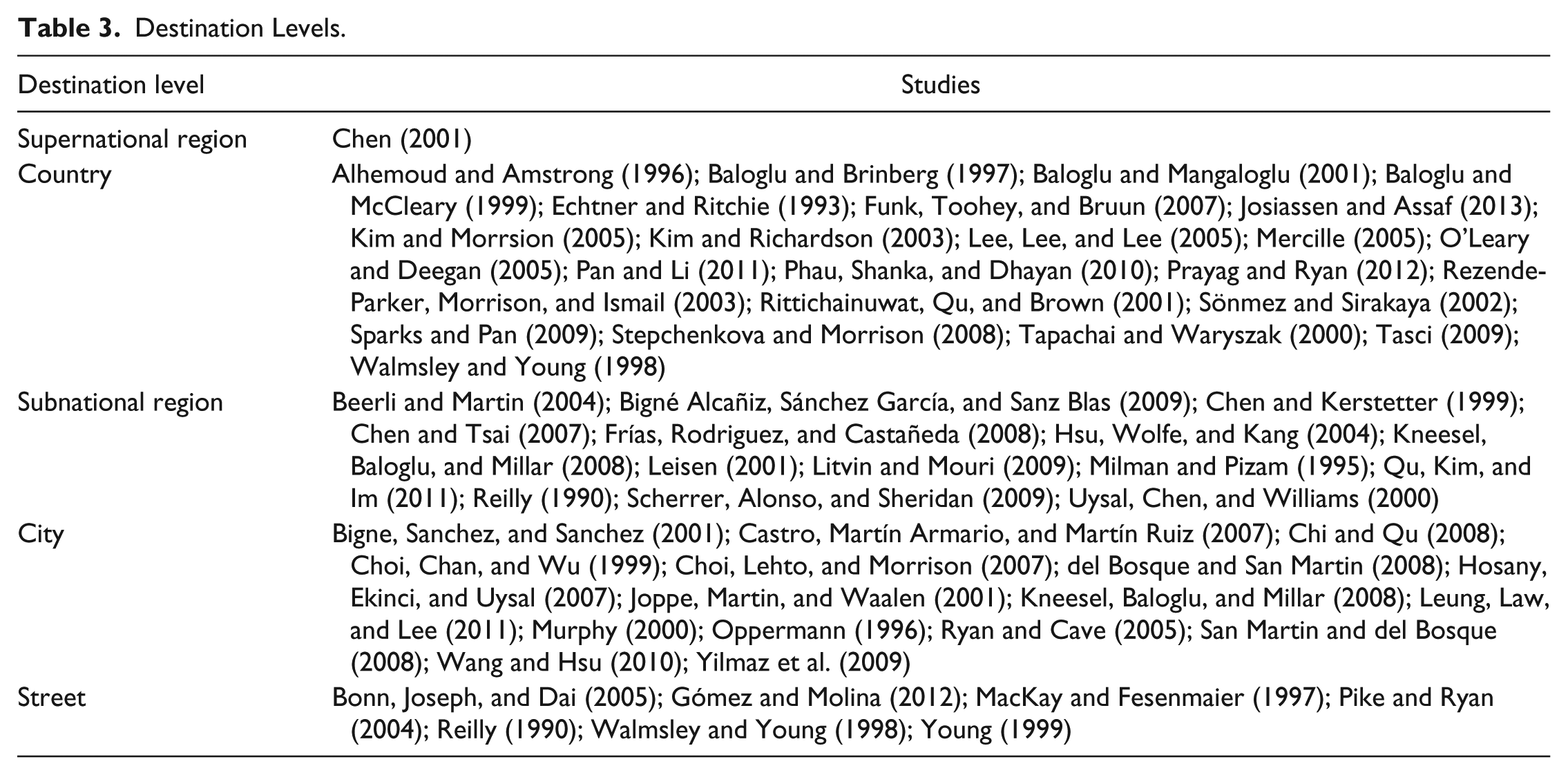
Research on IID in many ways has a place in the wider country of origin literature. From this perspective, the destination image is the category origin image (Josiassen et al. 2013). The category is tourism or destination, and linking this with the geographical level investigated, one can specify the construct investigated. For example, in this perspective, Wang and Hsu (2010) investigated the destination country image, while Gómez and Molina (2012) investigated the destination street image.
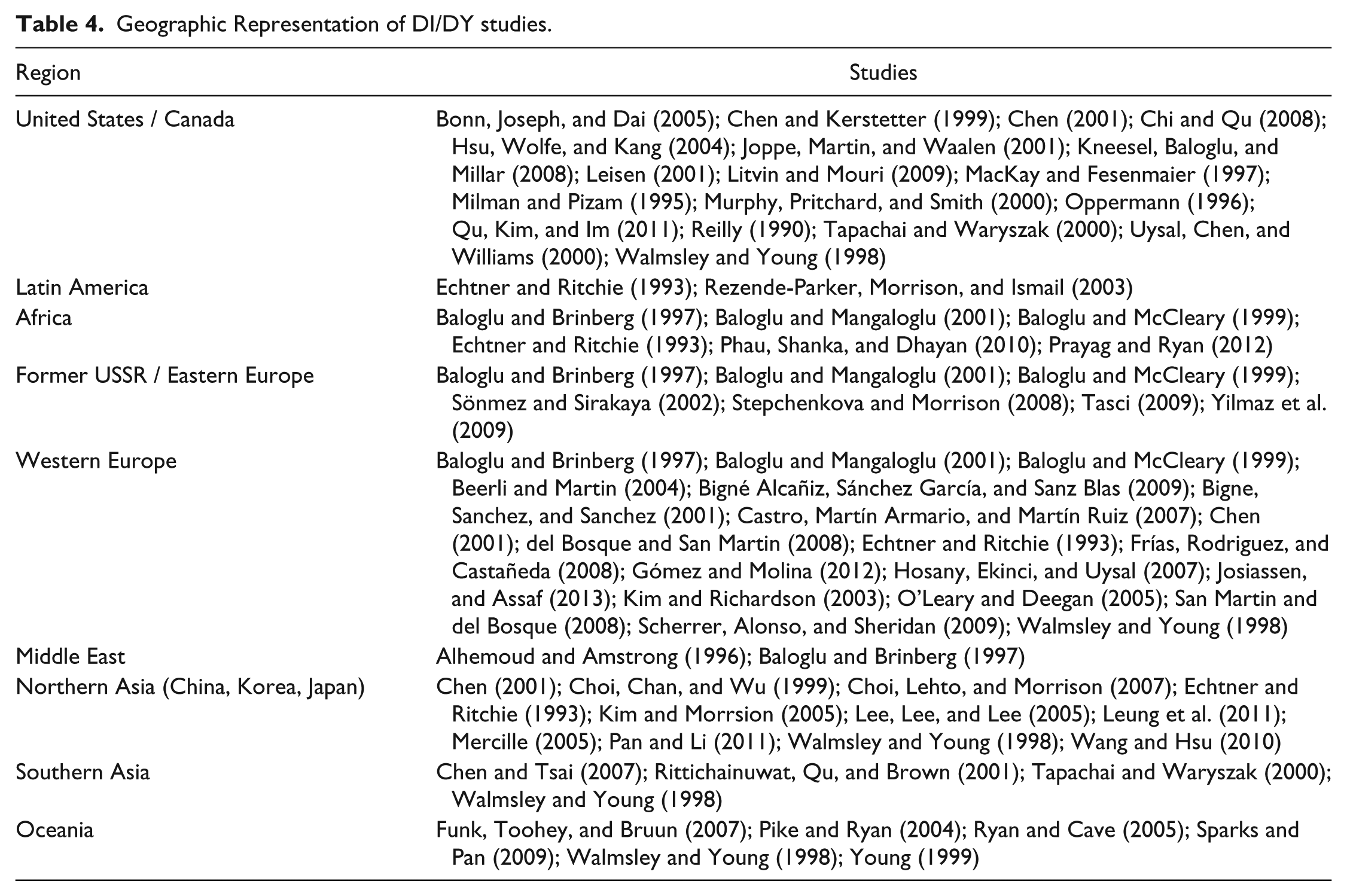
As can be observed in Table 4, DI and DY have been investigated in most regions throughout the world. However, the present selection of studies over the past 25 years suggests that studies have mostly concentrated on destinations in Western Europe and the United States/Canada. Destinations in the Middle East, Southern Asia, and Latin America, on the other hand, still have received scant attention. Interestingly, several studies have been devoted to destinations in Northern Asia and the former USSR/Eastern Europe.
Geographic Representation of DI/DY studies.
So far, destinations have been discussed as objective and well-defined places. However, a branch of research on destinations suggests that they can be understood as “tourist spaces.” Such tourist spaces are coproduced and consumed by tourists (e.g., Cunningham 2006; Diekmann and Hannam 2012; Ponting and McDonald 2013). According to this view, destinations are spaces that are constructed and given meaning through the actions and usage of the people who occupy them (Rakic and Chambers 2012; Wearing, Stevenson, and Young 2010). This notion implies that tourist space can prompt different meanings for different tourists (Thurnell-Read 2011; Tilley 2006). Researchers view tourist spaces as either enclavic or heterogeneous. The former refers to formally planned spaces like tourist resorts and the latter to informal tourist spaces where tourists mingle with other nontourist actors (e.g., Edensor 2000; Jordan 2006; Oppermann 1993). For example, Minca (2000) identified formal and informal tourist spaces on Bali that are spatially segregated but coexist in the same region. That is, the destination can be either socially constructed as a monofunctional space that offers designed ingredients making a holiday a successful product, or as an embedded multipurpose space where tourism is one of many usages. These two types of tourist spaces are based on different interpretations of what it means to be “elsewhere,” and are likely to manifest themselves in distinct DY and DI for the same place.
Methods Applied to the Study of DI and DY
Scholars have applied a variety of data collection and analytical methods to the study of DI. Surveys are often used to collect data. On the other hand, experiments (e.g., Litvin and Mouri 2009) are rarely used. It is also noteworthy that while there are several qualitative studies, quantitative studies still dominate. Some studies (e.g., Chi and Qu 2008; Prayag and Ryan 2012; Stepchenkova and Morrison 2008) have used a combination of qualitative and quantitative techniques. The analytical techniques most often used were regression and structural equation modeling. The mode sample size for studies in this area is approximately 300 respondents.
It is often assumed that the items used to measure a construct reflect the construct and one aims to locate the best possible set of items that reflect the construct. Similarly, one may model a multidimensional framework in which the dimensions reflect a higher-order construct. An alternative approach, however, is the case where the dimensions form the higher-order construct rather than reflect it. Or where the items form the construct rather than reflect it. Table 5 illustrates the differences between a reflective and a formative approach at the indicator to a latent construct level (adapted from Gómez and Molina 2012).
Reflective and formative measurement.
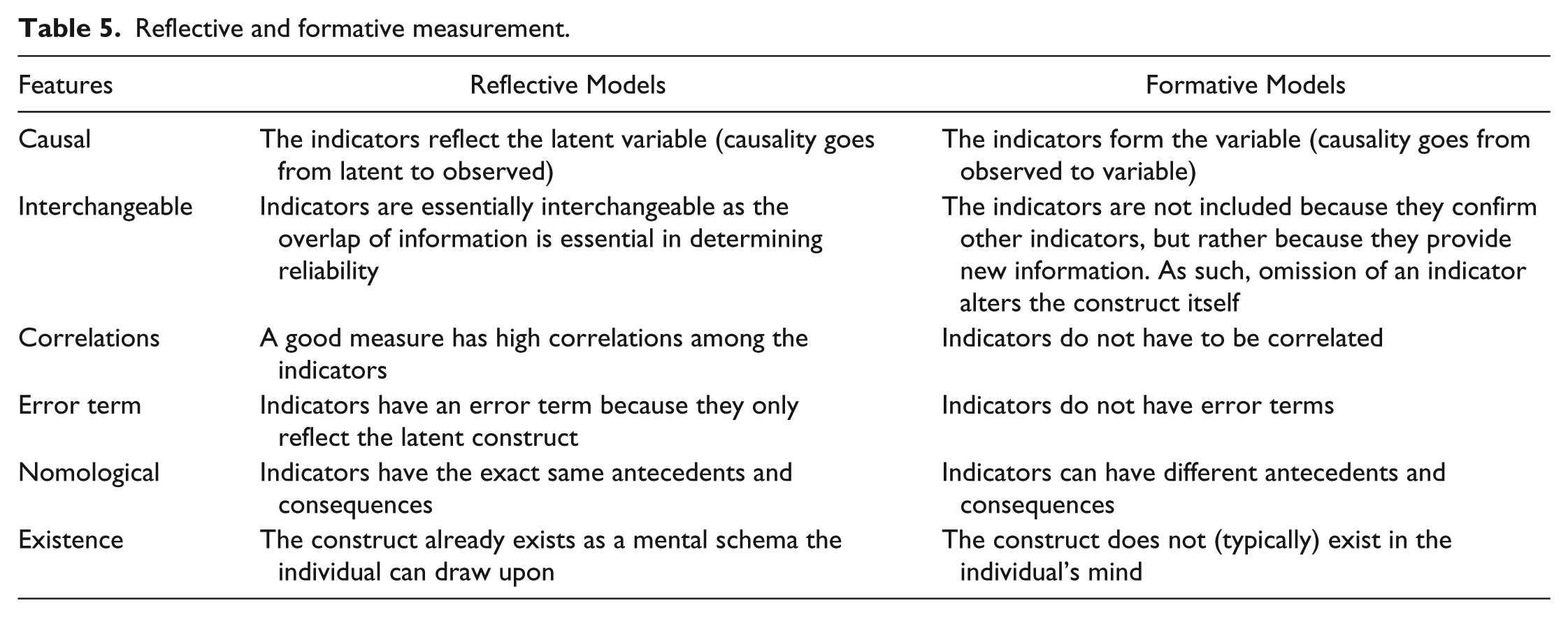
Consequently, DI can often be modeled as a reflective construct reflecting an actual image held in the mind of the individual. This is an existing image or mental schema that the individual holds and can access efficiently to make judgments and choices. On the other hand, many studies of DY would benefit from using a formative modeling approach. Forming a higher-order construct out of an individual’s knowledge of, and response to, different destination traits and qualities is unlikely to be an existing schema held in the minds of the individual. Furthermore, the individual may draw on a different set of knowledge, experience, etc. depending, for instance, on the context and familiarity. Forming a higher-order variable (typically referred to as an index) and measuring it can be interesting for scholars in order to understand the components and how they may together be affected by or affect other tourism concepts.
Another decision rule relates to the internal consistency across dimensions if the concept is multidimensional. In a previous section, it was noted that DY would often be a concept with multiple dimensions. If the dimensions (or indeed the items within a dimension) have different antecedents or consequences, then a formative modeling approach is more appropriate than a reflective approach (Diamantopoulos and Winklhofer 2001).
Antecedents and Consequences Investigated in the Extant Literature
It is interesting for theory and practice to investigate the IID model antecedents and consequences. Figure 1 provides a comprehensive overview of the nomological network of antecedents and consequences that scholars have investigated these concepts within. First, the antecedents will be discussed, followed by the consequences.
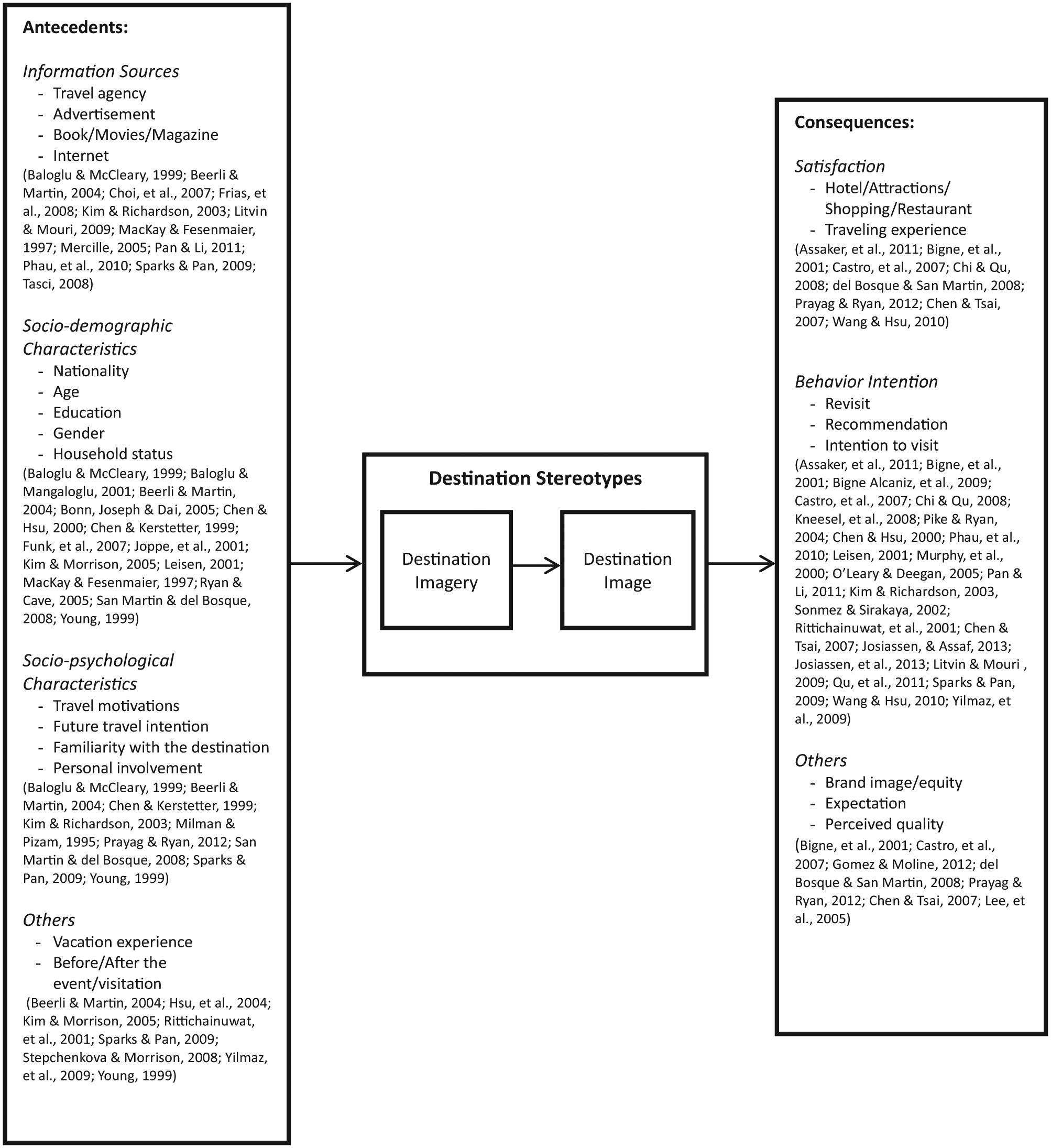
Antecedents and consequences in the imagery–image duality (IID) model.
In regards to the antecedents, they can be divided into information sources, sociodemographic, sociopsychological, and other antecedents. Several articles (e.g., Beerli and Martin 2004; Phau, Shanka, and Dhayan 2010; Sparks and Pan 2009) have focused on the information sources that individuals use to inform their destination decision making. For example, among the factors that Beerli and Martin (2004) noted that influence their DI (and DY) are primary and secondary information sources. Primary sources are the tourist’s own experiences when visiting the destination, while secondary sources are, for example, brochures and travel agents. Sparks and Pan (2009) linked information sources in a theory of planned behavior model. They found that tourists in their decision making mostly draw on television programs, friends, fashion magazines, and travel books.
Sociodemographic variables also affect the focal concepts. Baloglu and McCleary (1999) in an interesting paper looked at the effects of the sociodemographic variables age and education on tourists’ destination associations (divided into affective and cognitive mental responses). Age turned out to have no significant relationship with the affective dimension and an inverse relationship with two of the three cognitive dimensions. Similarly, the effect of education was found to be nonsignificant for the affective dimension, while it was significant for one of the three cognitive dimensions. In another study, Chen and Kerstetter (1999) found that gender, household income, class standing, and home country affected DY/DI responses. Meanwhile, past residence and marital status were found to be nonsignificant drivers of DY/DI.
Sociopsychological characteristics are often (e.g., Kim and Richardson 2003) considered the most differentiating, and therefore interesting, tourist characteristics that drive DY/DI. Kim and Richardson (2003) found that cinema guests’ DY/DI may be influenced by their exposure to movies as well as their empathy and involvement with the film and the film characters. They, for example, used as context the movie Before Sunrise about a young American/French couple who get off their train in Vienna and spend a day there falling in love. This movie was used as the experimental setting because many of Vienna’s historical and cultural places provide a background to the story of the young couple.
It is also among the sociopsychological characteristics that there are some gaps in the extant literature. Concepts such as worldmindedness, conservatism, patriotism, and indeed several other cultural concepts such as collectivism, and cultural openness have received scarce or no attention in the DY/DI literature. Another important perspective on how country information influences consumer dispositions is Josiassen’s (2011) four-concept consumer-bias matrix, including consumer ethnocentrism, consumer disidentification, consumer animosity, and consumer affinity (Josiassen 2011; Klein, Ettenson, and Morris 1998; Oberecker, Riefler, and Diamantopoulos 2008; Shimp and Sharma 1987). Researchers’ understanding of the influence of these four concepts on tourist behavior is, apart from a few studies on consumer ethnocentrism in tourism, virtually nonexistent. These are major gaps future research is urged to delve into.
In regards to the consequences of DY/DI, the extant literature has investigated several potential variables. Some studies (e.g., Assaker 2011; Kim and Richardson 2003; Sparks and Pan 2009) have investigated the effect of DY/DI on the subsequent satisfaction with, for example, the hotel, the attractions, or the shopping opportunities at the destination. Other studies (e.g., Josiassen and Assaf 2013; Phau, Shanka, and Dhayan 2010; Pike 2002) have looked at the impact of DY and DI with tourists’ intentions to recommend, and revisit.
In order to further unearth whether research may come to distinct conclusions depending on whether these destination predispositions are conceptualized as DY or DI, the present study investigated the path coefficients between the two focal concepts and two of the most common outcome variables in the literature: willingness to recommend (WTR) and overall satisfaction (OS). The results show that the average regression coefficient between DY and WTR is 0.11, while the average regression coefficient between DI and WTR is 0.36. Several of the studies (e.g., Bigné, Sanchez, and Sanchez 2009) that related DY to WTR found no significant relationship between the two. Meanwhile, all of the studies that related DI to WTR found a significant relationship. In regards to OS, the average coefficient is 0.31 for studies that relate DY to OS, and higher at 0.45 for studies that relate DI to OS. Again, there were no studies that found an insignificant relationship between DI and OS, while there were studies (e.g., Chen and Tsai 2007) that related DY to OS that did not find their relationship significant. These results support country-of-origin research (Josiassen et al. 2013) that conceptualizes multiple imagery/image concepts with varying levels of proximity to the outcome variable(s).
While caution is necessary when comparing path coefficients across different model specifications, the difference in the significance and magnitude of these two conceptualizations of these destination dispositions is clear. When looking at the construct reliability of DY and DI measures, there is a similar difference. The Cronbach alpha for studies applying DY measures ranged from 0.48 to 0.94 (with the range for cognitive, affective, unique, and combined being 0.52–0.94, 0.61–0.92, 0.76–0.85, and 0.48–0.89, respectively). The Cronbach alphas for studies applying DI measures were generally higher and within the range 0.76–0.96. Overall, these results show that very different conclusions about structural relationships might be the result of measuring different constructs.
Furthermore, while researchers have investigated antecedents and consequences, there is a gap in terms of research on moderating variables. It is likely that the antecedents of the DY/DI concepts interact with moderating variables within the IID model. Research on the contingencies under which DY/DI influences consequences such as intention to visit is also necessary. Against this background, the IID model provides a starting point for investigating the relative importance of DY and DI for tourist decision making in different contexts. This research suggests that future studies investigate the moderating effects of variables within the IID model such as perceived product necessity, perceived responsibility, and cultural similarity.
Moreover, the relationship between DY and DI within the IID model warrants closer scrutiny. The present study suggests that DI is an outcome of DY, and future research should draw on this notion to investigate the nature of this relationship in more detail.
Conclusion and Future Research
The present study reviewed the past literature on destination imagery and image. This literature is arguably at the core of tourism as a research area. However, the myriad of conceptual definitions and labeling has hindered the development of the area. Pan and Li (2011, 134) state that “because most attribute lists are developed idiosyncratically, the image items and dimensions tend to vary from study to study” and go on to note that there is still no consensus on dimensions and much less scales that can be applied in a way as to allow for cross-validation and comparison of results. The present review showed that the DI label has been used to represent two distinct aspects of destination information in the minds of individuals. On one hand, the very aggregate level which is the destination image—or the condensate of impressions. This mental schema exists, and does not have to be formed for each evaluation or choice. On the other hand, there are the multitude of qualities and traits that the individual relates to the destination. These associations exist as individual associations, but usually not as a higher-order construct. If, however, a higher-order construct directly relating to these associations exists in the mind of tourists, it would have to be formed for each evaluation or choice. This leads to the conclusion that there is probably a good reason why DY measures have been idiosyncratically developed and vary from study to study. On the other hand, it also documents that studies that use DI conceptualization and measures can and should be comparable across studies.
Consider, for example, the case where two people have an identical image of visiting Canada as tourists. To make it simple, imagine that both evaluate Canada as a tourism destination as 6 on a 7-point scale, thus a strongly favorable image. However, the reasons (e.g., the destination imagery) behind their identical evaluative DI scores may differ vastly. One individual may positively associate Canada with beautiful nature and tranquility, while another may positively associate the country with the multicultural buzz in the major cities.
Future research may wish to investigate the conditions under which DY and DI have different outcomes. The psychology literature (Kunda and Spencer 2003) suggests that stereotypes are used more under limited cognitive resources (e.g., under time pressure, or stress) or limited involvement. This suggests that individuals might at times make different choices when asked to actively make use of all known associations with the destination (DY) compared to when asked to make use of their stereotypical image (DI).
Some studies have applied either one of these levels of aggregation, and other studies have attempted to apply both levels of aggregation. While either approach in itself can be justified, the lack of conceptual delimitation of labeling and definition has fostered ambiguity and room for error. For example, when studies with distinct conceptualizations of DI are compared, the result can be a seemingly disagreeing literature, while in fact the cause is not different findings but rather different constructs being investigated.
Since DI does not describe individual traits or qualities but rather is the total impression that a destination makes in the minds of an individual, it will often be most appropriate to model this as a single-dimensional and evaluative construct. The nature of the concept as a mental shortcut means that it is not artificially pieced together or formed, but exists in the mind of the individual. Thus, researchers should be able to locate items that best reflect the concept in the minds of respondents or informants. Several studies (Assaker 2011; Baloglu and Brinberg 1997; Bigne, Sanchez, and Sanchez 2001; Chen 2001; Josiassen and Assaf 2013; Sparks and Pan 2009; Walmsley and Young 1998) have measured DI in this manner.
Relative to studies in management or marketing, the formative approach is vastly underused in tourism, and also in the study of DY and DI. Bigné Alcañiz, Sánchez García, and Sanz Blas (2009, 716) state that the construct “is formed from perceptions of its attributes.” In many instances, these attribute dimensions (DY) should be modeled formatively. Thus, this research suggests that studies that model DY as a multidimensional construct would benefit from being modeled with a formative modeling approach. Future studies which wish to investigate and measure the traits and qualities of a destination in the minds of tourists (DY) should strongly consider a formative approach. While formative studies are particularly underrepresented in tourism, recently a few studies (e.g., Gómez and Molina 2012) have modeled the concept this study labels DY in a formative manner. Meanwhile, DI, which is an overall image, may consist of a single dimension, and may be measured with a reflective approach.
The review also showed that studies that focus on the multitude of associations (DY) usually conceptualize a multidimensional concept. A major difference in the way the dimensionality is viewed is whether the focus is on the destination attributes themselves, or on the individual’s responses to them (affective, cognitive, etc.). Further, the DY dimensions are often operationalized in a descriptive manner rather than an evaluative manner. DI studies, on the other hand, tend to operationalize the DI construct as an evaluative construct.
The review further showed that previous studies have looked at destinations from a broad geographical range with some countries more represented (e.g., United States and Canada) than others (e.g., Southern Asia). In terms of destination levels, supernational regions have yet to receive much attention. Meanwhile, the country and city levels have been well researched. Another aspect of geographical range was clear in the review; that the notion of tourist space is very underused in the tourism literature but is quite well developed within the geography literature. The tourism literature should consider the notion of tourist spaces because the tourist’s mental interpretation of the destination would be critical to the imagery and image creation. For example, the present study suggests that interpreting destinations in terms of space could further enhance researchers’ understanding of why and how DY and DI levels and causal links with other variables might vary within the same geographical area (e.g., country or subnational region).
In terms of methods used to study DY and DI, a broad range of both qualitative and quantitative techniques have been applied. Studies applying a formative approach are remarkably underrepresented. Supporting the importance of the area as well as the range of studies that have been done is also the range of antecedents and consequences, which have formed the focus for many scholars. Antecedents relating to, for instance, information sources, sociodemographic, and sociopsychological factors have been investigated. A wide range of consequences have also been investigated from satisfaction with the hotel or the shopping opportunities to whether or not the tourist will revisit the destination.
Further, it would be interesting to investigate the reasons (the experiences they seek) tourists have for visiting particular destinations, and merge such insights (Crouch, Huybers, and Oppewal 2014) within the insights from the IID model. In addition, recent insights (Wong, McKercher, and Li 2014) into hybrid culture destinations and tourists’ interest in these provide an interesting topic to apply the IID model to. For example, to what extent do multicultural information and indeed imagery concerning the hybrid culture at a destination affect tourists’ destination image? There is also a gap in terms of applying the IID model to understand and explain differing DY and DI among differing groups of stakeholders (see e.g., Stylidis, Belhassen, and Shani, forthcoming).
Overall, the present article presents an integrative review of the destination imagery and image literature. Further, the article presents the most comprehensive review of the destination levels (city, country, etc.). For the first time in the destination image literature, it provides a review that leads to recommendations regarding reflective and formative approaches to the study of these concepts. The paper also suggests an important delimitation of concepts so that the multitude of meanings behind the DI term may be clarified for the benefit of future research in this area. Such clarity is crucial in order for research in this area to have a real transformative impact on theory and practice.
Footnotes
Acknowledgements
The authors wish to acknowledge financial support from Copenhagen Business School, and School of Economics, Finance, and Marketing, RMIT University, as well as valuable suggestions from S. Baloglu and B. Higgs.
Declaration of Conflicting Interests
The author(s) declared no potential conflicts of interest with respect to the research, authorship, and/or publication of this article.
Funding
The author(s) disclosed receipt of the following financial support for the research, authorship, and/or publication of this article: The authors wish to acknowledge financial support from Copenhagen Business School, and School of Economics, Finance, and Marketing, RMIT University, as well as valuable suggestions from S. Baloglu and B. Higgs.