



Abstract
Rapid technological change is leading to the introduction of new ways of providing services in the tourism industry. However, the human factor is also key in providing satisfaction to visitors. This article evaluates the preferences of visitors for different service designs at tourist information offices (TIOs). The methodology used is discrete choice experiments. Results show that visitors place higher values on information services received through personal interaction than through automated processes based on new technology. The implication is that the personal interaction continues to be an important element in the design of TIOs, but that new technology may increase the quality of the provision of services and visitor satisfaction. The methodology employed also allows us to identify different visitors’ segments based on their preferences for TIO services.
Keywords
Introduction
Tourist Information Offices (TIOs) 1 play an important role in managing marketing and promotional activities for tourist destinations. By disseminating information through the current and potential visitors, TIOs provide communication and information that can increase the production of tourist services (Mistilis and Daniele 2004). Pearce (2004) defines TIOs as “clearly labeled, publicly accessible, physical places with personnel providing predominantly free of charge information to facilitate travelers’ experiences.”
Thus, it is clear that TIOs constitute an element of the marketing and promotional infrastructure of tourist destinations, since they serve as communication channels for visitors once they arrive at a destination. Through TIOs, visitors can obtain information of the different tourist services that are provided by the destination, such as accommodation, restaurants, and the plethora of complementary activities that are on offer. Some TIOs also act as intermediaries in the provision of visitor services, since they can sell the final services to visitors on site, either online or at their installations. Thus, TIOs have a role in the promotion, preservation, and management of tourist destinations, and for these ends they use a variety of technological and human resources.
Prior research on TIOs has focused on the investigation of the profile of visitors (Mason 1975; Muha 1977) and the use of information by travelers (Fesenmaier, Vogt, and Stewart 1993; Fodness and Murray 1998; Gitelson and Crompton 1983; Gitelson and Perdue 1987). Other studies have examined the differences between visitors and nonvisitors to TIOs (Mason 1975) or have investigated the reasons that visitors stop off at TIOs and their actual behavior once there (Gitelson and Perdue 1987), or have evaluated the effects of TIOs on both visitor behavior and expenditure (Tierney and Haas 1988; Fesenmaier, Vogt, and Stewart 1993; Gitelson and Perdue 1987). Hobbin (1999) summarizes three main conclusions drawn from a literature review on TIOs: 1) the primary reason for stopping at TIOs is to use the restrooms and to obtain information on attractions and facilities, 2) the information obtained at the TIOs influences visitor behavior on both current and future trips, and 3) TIOs have a significant economic impact through increased expenditures.
In order for TIOs to provide the most benefits to tourist destinations, they have to be designed according to visitors’ preferences. Thus, there is scope to improve the profile of TIOs by investigating their preferences for alternative designs of the services included (e.g., Perdue 1995; Ballantyne, Hughes, and Ritchie 2009).
In the present study, we develop a discrete-choice experiment (DCE) aimed at investigating visitors’ preferences for the attributes of TIOs. The question is which of the TIO attributes are most valued by visitors, in addition to how much would visitors be willing to pay for them. This information is essential in order to design the TIOs by taking into consideration the needs of visitors and thereby enhance their contribution to the promotion of the destination.
Another important aspect in designing TIOs is the role of the human factor in attending to visitor queries and the services provided. Recent trends in information and communication technologies allow visitor production systems to increasingly automatize processes, making them less dependent on personal interaction. However, it also recognized, for tourism and the provision of services, that the human factor adds to the quality of the experience and that visitors may prefer to be attended to by a human being rather than an automated process. The application of a DCE in this context allows researchers to empirically test the importance of the “human factor” in the design of TIOs.
The main result indicates in fact, that the most relevant attribute affecting visitor satisfaction at TIOs is “being attended to by a human being.” On average, the importance of the “human factor” for the sample considered was 33% and 27% greater than having “smart” technologies provide information and booking opportunities at the TIO, respectively. In monetary terms, visitors would be willing on average to pay a little more than €3 per visit in exchange for receiving an excellent personal component in the service. Nevertheless, it is also found that different groups of TIO visitors present somewhat different preferences for the design of the office. A finite mixture of normal specification of the DCE allows us to identify different visitor segments and explore specific preferences for each one of those groups.
Material and Methods
Study Method: Discrete-Choice Experiments
The methodology for assessing visitor preferences for alternative proposals for the design of the TIO services is based on a discrete-choice experiment (DCE) (e.g. Louviere, Hensher, and Swait 2000; Louviere 2006; Crouch et al. 2009). DCEs are commonly applied to assess the preferences consumers have for products before they are launched on the market (Louviere, Hensher, and Swait 2000; Train, 2009). They have also been used in tourism for assessing different aspects of the visitor experience (e.g., Morley 1994; Eymann and Ronning 1997; Huybers 2003).
DCEs involve asking visitors to choose between alternative profiles of sets of attributes that define a TIO. The data are gathered by means of structured questionnaires that are given to visitors. The principal advantage of this method is that it allows researchers to assess the preferences for a set of attributes of a policy issue in tourism, such as the basic attributes when designing TIOs. The data from the DCE is modeled using discrete-choice models. Appendix A presents a summary of the DCE model used in the present study.
The present method was developed in mathematical psychology and statistics (Thurstone 1927; Luce and Tukey 1964), and is underpinned by the theory of consumer behavior put forward by Lancaster (1966) and Rosen (1974). It is based on the design of a market for the product under study, according to the variations given by the level of the specific attributes defining the product. The respondent is presented with a set of alternatives defined by the potential levels of the attributes of the products in question and is then asked to choose one of these alternatives against a status quo situation.
DCEs have been extensively applied to inform destination management organizations (DMOs) and contribute to addressing relevant tourism and hospitality issues. Some examples are Morley (1994), Dellaert, Borgers, and Timmermans (1995), Kemperman et al. (2003), Crouch and Louviere (2004), Alexandros and Jaffry (2005), Crouch et al. (2007), Kelly et al. (2007), Araña and León (2008), Crouch et al. (2009), Koo, Wu, and Dwyer (2010), Albaladejo-Pina and Díaz-Delfa (2009), Choi et al. (2010), Nicolau and Sellers (2011), Chaminuka et al. (2012), Fleischer, Tchetchik, and Toledo (2012), Masiero and Nicolau (2012), Grigolon, Kemperman, and Timmermans (2012), Tyrrell, Paris, and Biaett (2012), Landauer, Haider, and Pröbstl-Haider (2013), Araña et al. (2013), Araña and León (2013), van Cranenburgh, Chorus, and van Wee (2014), Grigolon et al. (2014), Choi and Ritchie (2014), León et al. (2014), León and Araña (2014a, 2014b), Carballo et al. (2015). However, as far as the present authors are aware, this study is the first application of DCEs in measuring the relative importance of the different attributes included in TIOs and in eliciting the amount of money visitors are willing to pay for improving such elements.
Fieldwork
The fieldwork was conducted on the island of Gran Canaria (Canary Islands) in 2012. Gran Canaria is an important tourist destination, having received some 3.5 million visitors in 2012. The largest markets are Germany and the United Kingdom, together representing about 70% of the foreign tourist market. National visitors coming from mainland Spain and from the Canary Islands themselves make up about 10% of the total.
Following the DCE, a random sample of 1,850 visitors from different nationalities were interviewed in person based on a structured questionnaire. The sample was a choice based (i.e., only TIO users), taken randomly from the adult population of tourists in Gran Canaria, on finishing their visit to one of the TIOs on the island. 2 The interviews were conducted in person by professional interviewers enrolled with a survey company who were previously trained in dealing with questionnaires that required reading large paragraphs and presenting complex information sets.
The final part of the questionnaire was developed via discussions in three focus groups with visitors randomly selected from the visitor population. Each focus group was conducted in a different language (Spanish, English, and German). Visitors were asked general questions about what they considered to be the most important aspects in the design of a TIO and were then presented with the material from the questionnaire in order to improve their understanding of the questions. One of the main objectives of these focus groups was to compile a final list of the key attributes and the levels that defined the satisfaction of the TIO visitors. Following the DCE recommendations, a combination of open ended and closed questions were used. The qualitative work at this stage was also crucial in identifying a set of specific attributes and a choice scenario that was easy to understand for all respondents, thus minimizing any ambiguity in the perception of the same. Each focus group had between six and eight members from both sexes and three age intervals.
In addition, the questionnaire was explained by a group of five experts on TIOs, who made suggestions on the most important aspects from both a managerial and customer satisfaction perspective. After the discussions in the focus groups, a pretest questionnaire was implemented with a random sample of 180 visitors. The results of the pretest showed that the questionnaire was working adequately for the objectives of the study and that respondents were correctly interpreting the questions posed by researchers. In relation with the design of the DCE, the most important decisions that were tested during the pretest questionnaire were the description of the scenario (wording in several languages, attributes, and attribute levels) and the number of choices that the respondents were given. The insight of the interviewers was crucial in ensuring that the final design worked for the specific application the way that the researchers intended.
The Questionnaire
The questionnaire had three parts. The first part asked questions about the tourist’s trip (length of stay, number of visits to Gran Canaria), the second section focused on TIO-related aspects (reasons behind the visit, satisfaction with service provided, demanded services), and the third focused on the design of the services of a TIO based on the choice between alternative profiles, that is, the DCE.
The visitor answering the questionnaire was presented with the following text prior to the description of the attributes that were to be investigated for the TIO design:
The Tourist Authority of Gran Canaria is trying to improve the services currently provided by the network of Tourist Information Offices so that they provide you with the highest level of satisfaction in meeting your needs. For this reason, it is very important for us to know your opinion about the key aspects of how a TIO should work, what services should be provided, and at what quality levels. The purpose of this study is to know how you would choose between different aspects of TIOs and the different levels of service quality. In previous studies researchers have found that the basic aspects of TIOs are the following.
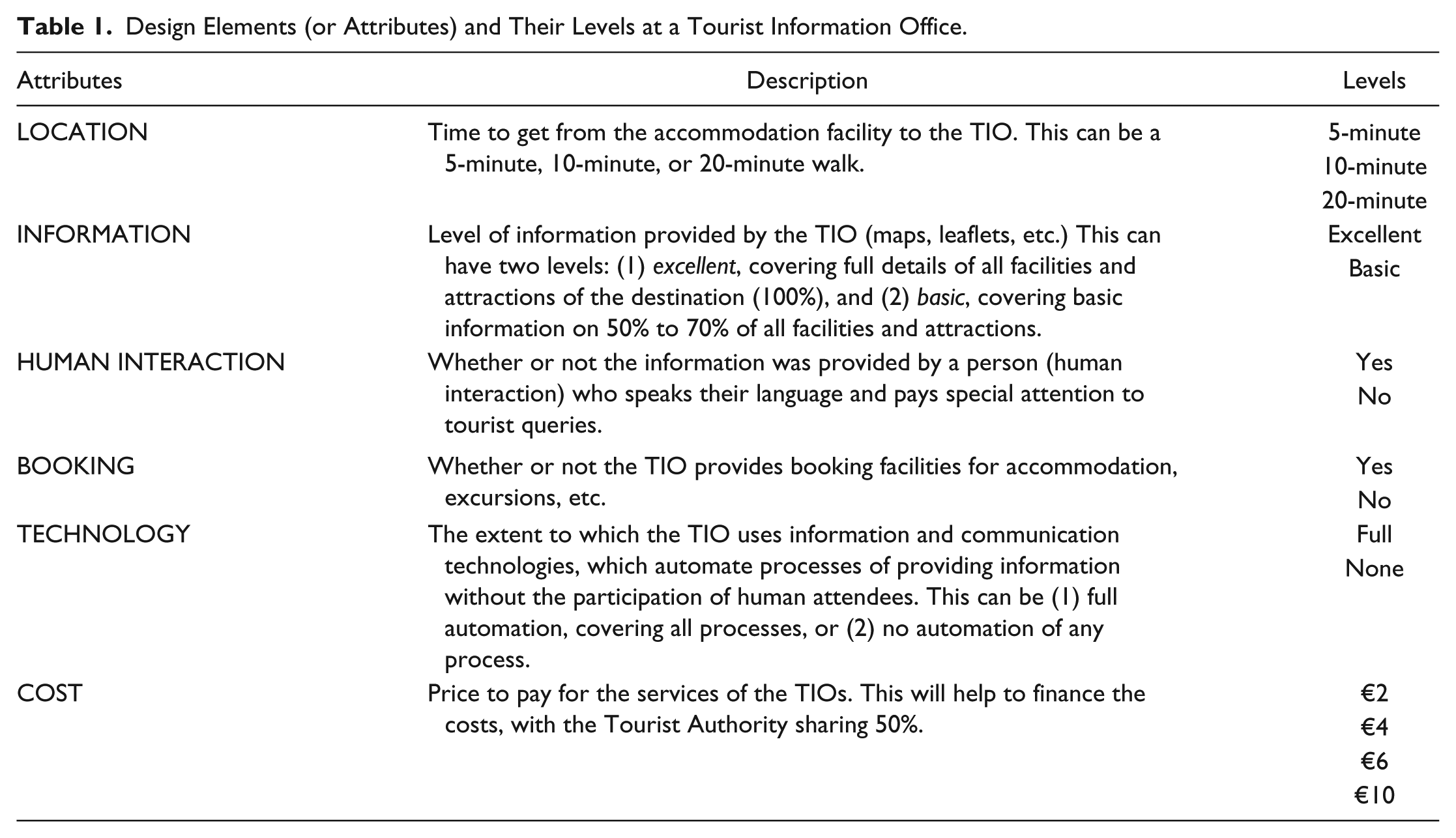
The six aspects or attributes of the TIO and their levels are presented in Table 1, including the cost that the visitor would have to pay for the services provided. The visitor is then presented with various choice questions involving two alternatives for the TIO plus the current situation. Table 2 presents an example of a choice question. There were six successive choice questions involving different design options of the attributes of a TIO. The choice section ends with questions about the reasons for choosing or not choosing some of the design options. The final section of the questionnaire focuses on socioeconomic questions.
Design Elements (or Attributes) and Their Levels at a Tourist Information Office.
Example of Choice Card.

An important aspect in the DCE questionnaire is the design of the set of choice alternatives that are presented to the subject. Since there are three design attributes involving three levels, two involving two levels and one with four levels (price), the number of potential alternatives of TIO design is 33 × 22 × 4. Since this number is too large to be evaluated by the respondent, it has to be reduced by using an optimal design. We employed a Bayesian-efficient design based on the software ngene. 3 The experimental design was chosen because it produces lower standard errors and therefore more reliable parameter estimates for a relatively small sample size. Another advantage of using a Bayesian-efficient design is that it allows to include in the prior distribution some restrictions on the number of choice occasions that are tested in the qualitative stage, so that a respondent was able to respond without fatigue or feeling tired. Therefore, it allows researchers to maximize statistical efficiency and, at the same time, does not compromise respondent efficiency (Severin 2001).
The prior distributions of the parameters of interest were uniform, and the mean values came from the pilot study. Also, the parameter distributions were bounded according to the expected signs (positive or negative) based on previous recommendations (Scarpa and Rose 2008). This led to 24 combinations that were randomly grouped in 12 cards with two combinations.
Results
Model Choice
Recent developments in DCEs (e.g., Keane and Wasi 2013) show that there are different models that can be used to represent the data and that some models are more appropriate than others for capturing heterogeneity across the sample. That is, visitors deciding upon different alternative designs of TIOs may have different preferences based on their individual characteristics and tastes.
Thus, we compare the following models: (1) the conditional Multinomial Logit (MNL) (McFadden 1974), (2) Mixed Logit (MIXL) (Ben-Avika et al. 1997), (3) Latent class (LC) (Kamakura and Russell 1989), and (4) Generalized Multinomial Logit (GMNL), and (5) Scaled Multinomial Logit (SMNL) (Fiebig et al. 2010).
The number of observations was 10,680, each visitor having answered six choice questions, and there were some missing values for the socioeconomic variables. Table 3 presents the statistics of the models to compare their performance with the data of visitors’ responses to the TIO designs. We compared the goodness of fit of the alternative models of heterogeneity using the log likelihood, the Akaike information criterion (AIC), the Bayes information criterion (BIC) and the conditional Akaike information criterion (CAIC).
Results of the Model Selection Criteria (AIC, BIC, CAIC) for the Alternative Flexible Econometric Approaches.
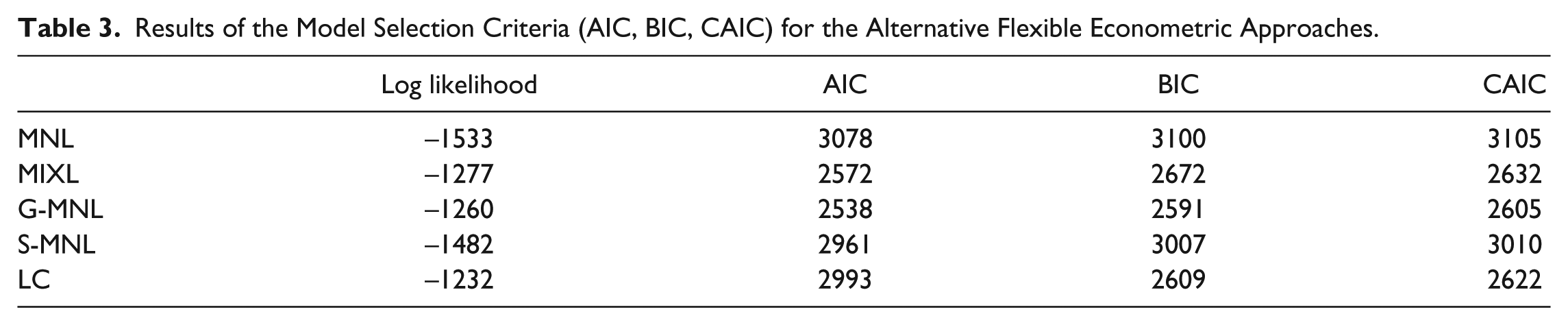
The best model in terms of statistical fit is the Latent Class (LC) with a log-likelihood of −1232. The rest of models considered are further down in the ranking. 4 Thus, in the next few sections, we focus on the results of this model.
Design Attributes and Values
Table 4 presents the results of the parameter estimates of the best model. All attributes of the TIOs are significant at the level 0.01. There are three segments of visitors with different preferences for the attributes of the TIOs. Segment 1 has the largest class membership probability, with 47% of visitors being included in this segment; segment 2 has 35% while segment 3 has the remaining 18% of the pool sample.
Preference Parameters for TIO’s Attributes Using DCE. Preferences for Each Segment and Segment Membership Determinants.
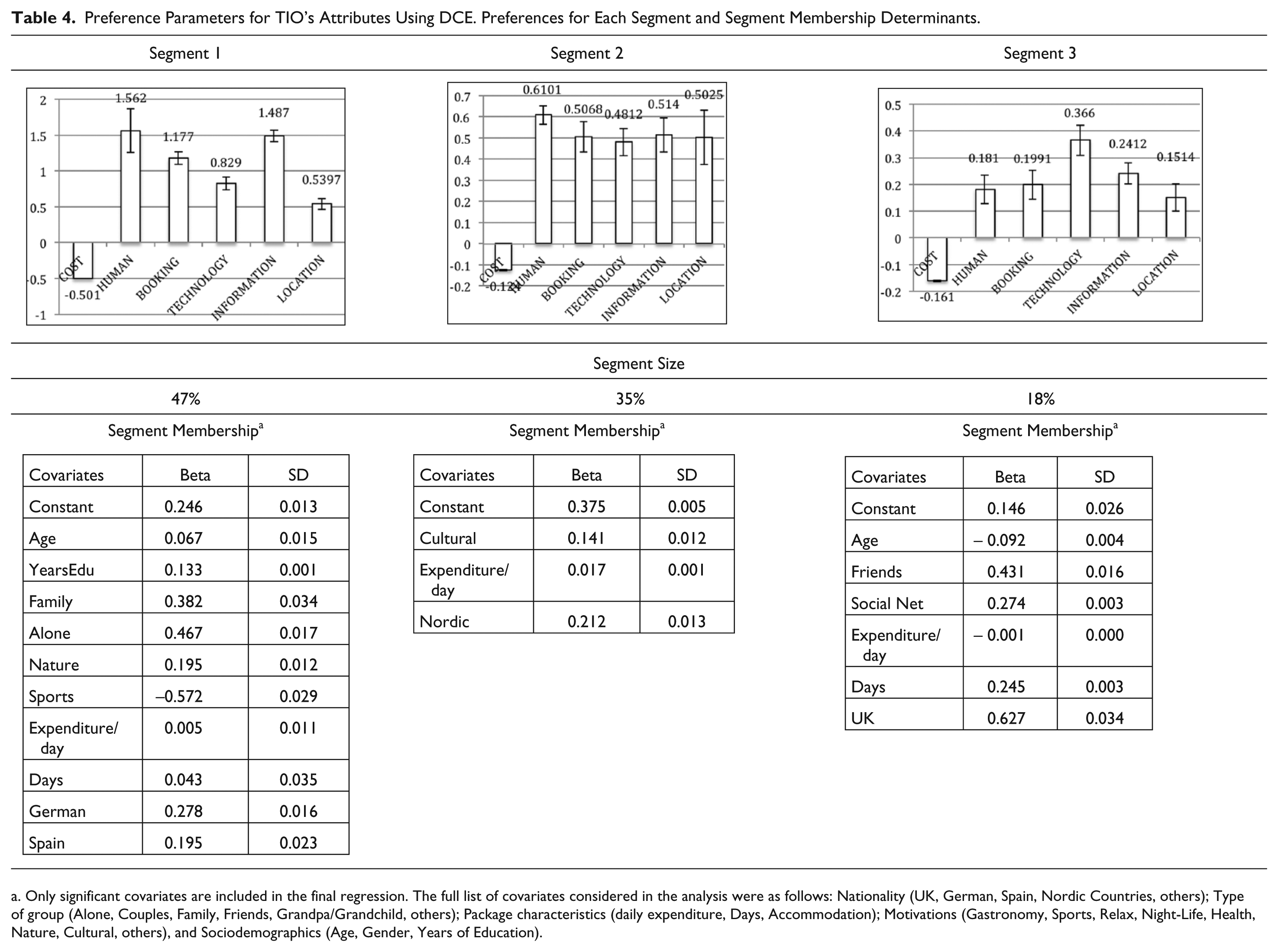
Only significant covariates are included in the final regression. The full list of covariates considered in the analysis were as follows: Nationality (UK, German, Spain, Nordic Countries, others); Type of group (Alone, Couples, Family, Friends, Grandpa/Grandchild, others); Package characteristics (daily expenditure, Days, Accommodation); Motivations (Gastronomy, Sports, Relax, Night-Life, Health, Nature, Cultural, others), and Sociodemographics (Age, Gender, Years of Education).
One of the advantages of LC models is that they allow researchers to identify differences in the preferences for the TIO’s attributes among groups of visitors. This information can be very useful for (re)designing TIOs in different sections based on visitors’ preferences or for shaping the strategies of communicating destination information in order to address the preferences of certain groups of visitors.
The last row in the table presents the covariates that were significant in explaining the characteristics of each one of the segments. Thus, it can be seen that the probability of a visitor belonging to segment 1 increases with the number of years of formal education received (YEARSEDUCA), the average expenditure per day (EXPENDITURE/DAY), and the length of their stay (DAYS). Also, the probability that a visitor presents the preferences represented for segment 1 are higher when he or she comes from Germany or Spain, visits the island alone or with their family, and when one of his or her reasons for the trip includes enjoying nature (NATURE). On the other hand, when one of the purposes of the visit is to do water sports (SPORTS), the probability of belonging to this segment reduces.
The probability of belonging to segment 3 increases when the tourist visits the island with friends (FRIENDS) and when he/she uses social networks (SOCIAL NET) like Twitter, Facebook, or Instagram. On the other hand, the visitor age (AGE), average expenditure per day (EXPENDITURE/DAY), and length of stay (DAYS) are negatively correlated with the probability of belonging to this segment. This may be the case because members of this group are likely to be younger than the average visitor, with a lower expenditure amount per day and a shorter-than-average stay.
The last segment (segment 2) is mainly characterized by visitors coming from a Nordic country (Sweden, Norway, Denmark and Finland) with an above-average daily expenditure and with cultural activities (CULTURE) stated as one of the main activities during their trip. The rest of the potential covariates employed in this analysis were found to be insignificant in explaining this group of TIO users.
The first row in Table 4 presents a bar graph with the mean parameter estimate of the relative importance of each attribute in the TIO design for each segment of the population. Thus, these parameters (e.g., the size of each bar) indicate the contribution of each specific attribute to the visitors’ utility or satisfaction. Segment 1 shows the highest values of the parameters among the segments, followed by those for segments 2 and 3. The cost parameter is negative, indicating that a higher price for the services of the TIO reduces the use by the visitor, and thereby their intention to request the services.
The cost parameter is higher for segment 1 than for the other segments. Thus, the visitors in segment 1 are more sensitive to the price of the TIOs. The attribute corresponding to personal interaction shows the largest parameter utility value for segments 1 and 2, but not for segment 3. Thus, the former two segments place the largest value on the presence of a person who is qualified in the specific attractions and characteristics of the destination and fluent in the language of the visitors.
Table 5 presents the results of the marginal monetary values for each of the attributes of the TIO. The two largest segments (1 and 2) place the largest value on the quality of the human interaction, while the smaller segment 3 places the highest value on the use of technology. Thus, the overall preferences are for more intensive personal attention than for the intensive use of automated processes based on new technology.
WTP Mean for TIO Attributes.
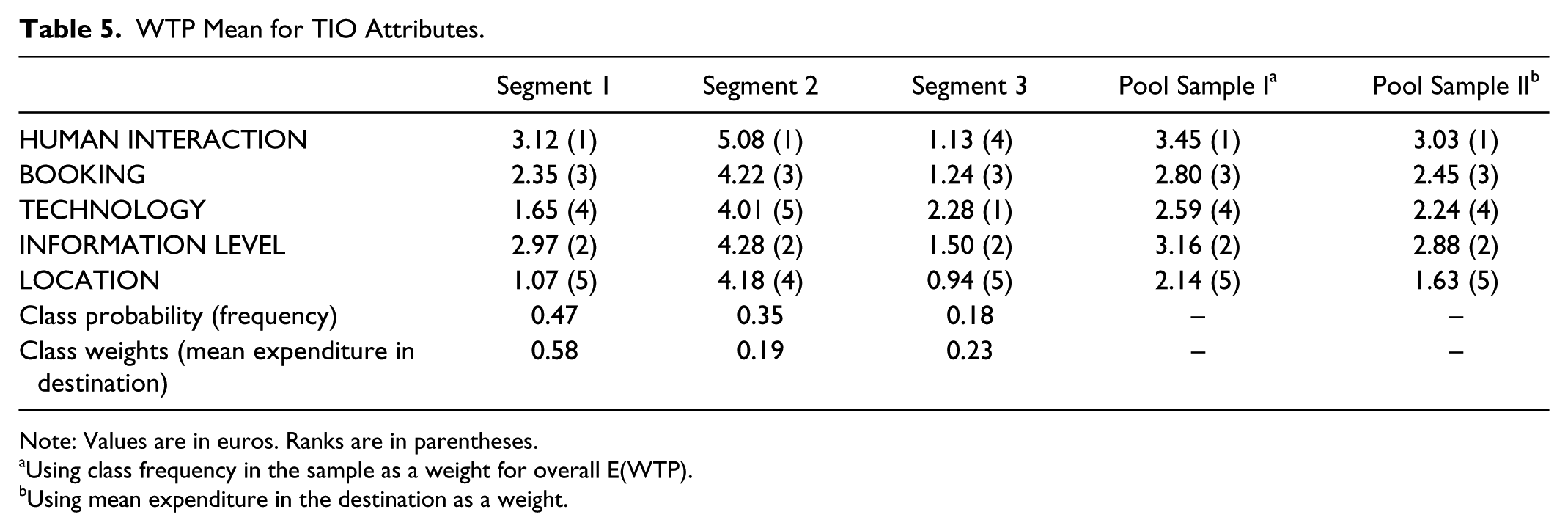
Note: Values are in euros. Ranks are in parentheses.
Using class frequency in the sample as a weight for overall E(WTP).
Using mean expenditure in the destination as a weight.
In addition, segment 2 shows the largest values for all attributes of the TIO, with values ranging from €5.08 for the human factor to €4.01 for the use of technology. Thus, this segment places a stronger preference on the use of qualified personal interactions, although all attributes are highly valued.
Segment 1 puts moderate values on all attributes of the TIO, with the highest value on the human factor (€3.12) and the lowest value on the location of the TIO (€1.07). Segment 3 is the segment with the lowest values on all design attributes, ranging from €2.28 for intensive technology use to €0.94 for the location of the TIO.
Therefore, the segment with lower monetary values for the attributes of the TIO shows a higher preference for a more intensive use of technology and more automated information processes that do not require much personal interaction, while those with higher values for the attributes show a more intensive preference for having high-quality employees at the TIO.
However, the weighted average values of all segments show that the most preferred attribute is the quality of the personal interaction, followed by the level of information available at the TIO, the presence of booking facilities, the use of intensive technology, and the location of the same. This result is valid if the weights are based either on the membership probability or on the share of each segment in the total visitor expenditure at the destination.
Conclusions
Tourist information offices are important elements of the marketing and promotional activities of tourist destinations. The design of tourist information offices should take into account visitors’ preferences in order to maximize their contribution to visitor satisfaction and the competitiveness of the destination. In this article, we have considered the evaluation of the attributes or specific characteristics of TIOs by visitors at a specific destination. This evaluation is useful for improving the design of TIOs based on visitors’ preferences (e.g. Perdue 1995; Ballantyne, Hughes, and Ritchie 2009).
From a methodological point of view, there are two main contributions presented here. First, TIO visitor preferences are elicited using a DCE approach. This methodology allows researchers to estimate the relative importance of the different attributes defined by the information office visitors by using the visitors’ choices. Also, by using visitor choices as a basis for eliciting the importance of the TIOs’ attributes, the well-known biases of using conventional Likert-type scales are avoided (Dolničar and Grün 2013 ; Araña et al. 2013). In addition to this, since choice experiments include price as an attribute, visitors’ preferences can be measured in terms of willingness to pay (i.e., trade-off among attribute quality and price). Visitors’ willingness to pay for specific improvements at the TIO can be easily compared with operational monetary costs, which allows the TIO managers to implement cost–benefit analysis to optimize goals for the office at the destination.
A second contribution of the present research is the use of a heterogeneous mixture distribution to link visitor preferences and choices. This econometric specification has the advantage that it provides information to segment visitors based on their behavior and price sensitivity—and not preestablished segmentation criteria—as the source of heterogeneity. This is referred to in literature as model-based segmentation analysis (Masiero and Nicolau 2012; Dolničar 2004). These results show that in the present application, there are three segments of visitors that value the attributes of TIOs differently: a segment with high values, a segment with moderate values, and a segment with low values.
The segments with high and moderate values share the largest proportion of visitors, about 82%, and place the highest value on being attended by an employee qualified in the attractions of the destination and in the languages of the visitors. The segment with low values places the greatest value on the use of automated processes of information at the TIO by means of new information technologies.
The other TIO attributes that are highly valued by visitors are the quality of the information provided by the TIO and the provision of booking facilities; these two attributes rank second and third in their values for all the segments, and also for the average weighted values across all visitors. The location of the TIO is the least valued attribute for all visitor segments. The intensive use of technology stands fourth for the large segments with high values and first for the small segment with low values.
Thus, the design of TIOs should concentrate on the use of highly qualified human resources, focusing on the largest segments, with high values for the services and attributes of TIOs. They should also provide high-quality and varied information on the attractions of the tourist destination and provide booking facilities for these attractions. However, they also should use automated new information technologies substituting human resources, focusing particularly on a small segment of visitors who place low values on the services of TIOs.
These results prove that human processing is important in the provision of services at TIOs, and that visitors do prefer to be attended by qualified human beings rather than by automated processes based on the use of technology. However, the use of technology might also be useful to complement the design of TIOs, adding value to its services, and enhancing the quality and broadness of information available for visitors at a destination.
A limitation of this study is that it focuses on a single destination (i.e., Gran Canaria), and the target population includes only current TIO users. This seems a reasonable approach when the goal of the DMO is to maximize current user satisfaction levels, understand their preferences or the role in increasing destination loyalty or visitor expenditure. However, if the interest lies in estimating the role of the TIO to attract new visitors to the destination, a sample including also non-users (i.e. either from a population of potential visitors to the destination or from the population of visitors that do not visit the TIO) may be more informative. In addition to this, if one of the DMO interests is aimed at developing word-of-mouth marketing strategies, including local residents who can visit the TIO to convey their preferences, may be also convenient. Nevertheless, further research efforts devoted to understanding the differences in TIO preferences among these sampling options are necessary. This information would contribute to the development of the industry by allowing DMOs to align the design of TIOs with their main objectives.
Footnotes
Appendix A
Declaration of Conflicting Interests
The author(s) declared no potential conflicts of interest with respect to the research, authorship, and/or publication of this article.
Funding
The author(s) disclosed receipt of the following financial support for the research, authorship, and/or publication of this article: The authors fully acknowledge financial support for this work by the European FEDER Fund through Project PI2007/040 from the Agencia Canaria de Investigación, Innovación y Sociedad de la Información in 2009 and under the declaration of Canary Islands as “Objetivo de Progreso”. It has also benefited from the project ECO2012-35112 from the Ministerio de Ciencia y Competitividad and under the same European Framework.