



Abstract
Agent-based modeling (ABM) is a way of representing complex systems of autonomous agents or actors, and of simulating the multiple potential outcomes of these agents’ behaviors and interactions in the form of a range of alternatives or futures. Despite the complexity of the tourism system, and the power and flexibility of ABM to overcome the assumptions such as homogeneity, linearity, equilibrium, and rationality typical of traditional modeling techniques, ABM has received little attention from tourism researchers and practitioners. The purpose of this paper is to introduce ABM to a wider tourism audience. Specifically, the appropriateness of tourism as a phenomenon to be subjected to ABM is established; the power and benefits of ABM as an alternative scientific mechanism are illuminated; the few existing applications of ABM in the tourism arena are summarized; and, a range of potential applications in the areas of tourism planning, development, marketing and management is proposed.
Introduction
Agent-based modeling (ABM) has been defined as “the set of techniques [in which] relations and descriptions of global variables are replaced by an explicit representation of the microscopic features of the system, typically in the form of microscopic entities (‘agents’) that interact with each other and their environment according to (often very simple) rules in a discrete space-time” (Gross and Strand 2000, 27). In other words, ABM is a way of representing complex systems of autonomous agents (also known as objects or actors) and simulating the outcomes of these agents’ behaviors and interactions via the enactment of rule-based decisions that result in an array of potential outcomes; examples of agents include people, businesses, animals, and plants. Rules imposed essentially cause these agents to display certain behaviors appropriate to their nature, for example, they might produce, consume, or sell certain items or resources, or they might shift their location; in more sophisticated models, agents can evolve, allowing learning and adaptation to changes in the system in which they exist (Bonabeau 2000). Agents can operate at a variety of scales and do so within a defined environment or landscape that may be conceptual or concrete, and that can be spatially explicit, that is, in which each agent has a location in space; examples of environments include ecosystems, markets, and urban areas. ABM is flexible in terms of the information and knowledge that can be used to drive it, having the ability to incorporate both qualitative and quantitative, human and physical, data. ABM therefore allows one to generate multiple, realistic futures in a kind of “simulated social laboratory” (Ligmann-Zielinska and Jankowski 2007, 332) in which the complexity of human decision making can be represented and the variety of relationships and interactions that typify the real world manipulated. ABM is especially powerful when applied to interactions between humans and the natural world; ABM’s value is further enhanced by its ability to model complex information in meaningful ways that encourage scientists to cut across disciplines (Epstein and Axtell 1996) and that can be accessible and intuitive enough to also appeal to policy makers, planners, and community members (Zellner 2008).
Though most commonly utilized by ecologists (e.g., Grimm 1999; Grimm et al. 2005), ABM has been successfully deployed in the social science arena since the 1990s; Epstein (1999) cites nearly two dozen applications of agent-based computational models to social phenomena including wealth and price distributions, settlement and unemployment patterns, trade networks, epidemics, and military tactics in that decade. In 2002, Bankes declared ABM “a revolutionary development for social science” (p. 7199), and demonstration of the technique’s application in such areas as land use/land cover (e.g., Parker et al. 2003), urban studies (Benenson and Torrens 2004), and environmental planning and policy (Zellner 2008) has flourished in the decade since. Yet the adoption of ABM within the field of tourism remains minimal—a search for the term agent-based in the archives of this journal, for example, produced just four hits, two articles in which the term appeared in the list of citations and two book reviews, one of which pertained to travel agents—and many of the handful of analyses identified in the extensive search conducted by the authors appear in non-tourism venues in which the majority of tourism practitioners and researchers likely rarely, if ever, look.
According to Bonabeau (2002, 7280), “One of the reasons underlying ABM’s popularity is its ease of implementation.” He goes on to caution, however, that “because the technique is easy to use, one may wrongly think the concepts are easy to master. But although ABM is technically simple, it is also conceptually deep.” The purpose of this paper is to introduce ABM to a wider tourism audience, in so doing demonstrating both the relevance and utility of the application of this technique within the tourism domain as well as some of the conceptual complexities of which the informed user should be aware. The paper is structured as follows: first, the workings of ABM are introduced; second, the power and benefits of ABM as an alternative scientific mechanism are illuminated; third, the nature of tourism and its appropriateness as a phenomenon to be subjected to ABM is established; fourth, the few existing applications of ABM in the tourism arena are summarized; fifth, a broader range of potential applications, in the areas of tourism planning, development, marketing and management, is proposed; and, finally, some of the key limitations of ABM are described.
How ABM Works
ABM is a computational method that involves the design of and experimentation with models composed of agents that interact within an environment. ABM is almost always based on an object-oriented programming language such as Java, C++, or Visual Basic. Agents operate based on predefined sets of “if–then” rules of behavior; agents can have memories of their current and previous states, and can also be programmed to learn about the environment and about the status of other agents using artificial neural networks or evolutionary algorithms such as the genetic algorithm (Abdou, Hamill, and Gilbert 2012). With adequate programming skills, a model can be created “from scratch”; alternatively, a variety of prewritten packages also exist. These range from open source (e.g., Swarm, MASON, and Repast) to shareware/freeware (e.g., StarLogo and NetLogo) to proprietary systems (e.g., AgentSheets and AnyLogic) (for further description and comparison of these and other programs, see, e.g., Crooks and Castle 2012; Gilbert 2008).
Though a full explication of ABM principles and programming is beyond the scope of this article, a general approach to creating an ABM should include the following (per Abdou, Hamill, and Gilbert 2012):
identification and review of existing theories relating to the research question that drive development of the ABM, for input into the modeling environment as characteristics of the agents or as rules that drive agent behavior—these essentially represent model assumptions and, as such, should be clearly stated;
specification of the attributes of the agents and the rules by which they shall operate, and of the characteristics of the environment in which they will function;
model implementation, that is, the setup and execution of the model—setup includes initialization of the simulation while execution involves repeated running of the simulation during which time the agents interact with the environment and other agents according to the specified rules (since ABM often includes stochastic processes, each model run can produce a different output, which therefore raises the question of how many runs are appropriate or necessary; between 30 and 50 is typical [e.g. Epstein 2006], standard deviation can be examined to determine the degree of variability between outputs);
model verification and validation (discussed in more detail in the concluding section).
A brief overview of one of the earliest and classic ABMs serves to illustrate some of the fundamental principles outlined above. Schelling’s (1971) model of household segregation patterns is believed to be the first to represent people and social processes using agent interactions. In his model, agents represented residents of individual dwellings; each dwelling could be occupied—by a black or a white—or could be empty. The environment in Schelling’s ABM represented a city. At the beginning of the simulation, agents were distributed randomly over space; during the simulation, agents move based on their “threshold of tolerance” for other ethnic groups, that is, under the rule that an agent would move once a certain proportion of its neighbors were of the opposite color. The simulation concluded when all agents were “happy” with (i.e., tolerant of) the composition of the dwellings surrounding them; even with these simple rules, segregation patterns similar to those found in real life emerged. The reader is referred to the growing volume of social science–based ABM literature for additional detail (e.g., Adamatti, Dimuro, and Coelho 2014; Heppenstall et al. 2012).
Advantages of ABM
In this section, the advantages of ABM relative to other modeling methods are described; many of these relate to the enforcement within an ABM framework of many fewer restrictions than is typical of traditional modeling formalisms, for example, differential equations, that require the imposition of unrealistic assumptions, including linearity, homogeneity, normality, stationarity, equilibrium, and rationality (Epstein 1999; Bankes 2002). The ways in which ABM overcomes or manages these assumptions are highlighted further below.
First, is the natural fit of ABM as an ontology or representational formalism for social science, particular in its ability to capture the heterogeneous behavior and motivations of, as well as the complex, changing, and sometimes competing relationships between multiple and diverse social agents. Those agents may be individual people, private firms, public institutions, structures, land parcels, etc. In a tourism context, agents could include tourists, tourism suppliers (tour operators, travel agents, accommodations, attractions, etc.), and residents. Simply put, ABM offers a more intuitive method of describing and simulating systems than standard statistical models, the latter of which sometimes use such complicated equations to represent phenomena as to render them analytically intractable (Gilbert and Terna 2000). This enhanced level of realism is critical to ABM’s potential as a real-world decision support system in that users who can understand and relate to a model of reality are more likely to engage with it and make use of its outcomes. As noted by Ligmann-Zielinska and Jankowski (2007), while traditional modeling is abstract, does not encourage interaction, and may result in only one outcome (and what might be interpreted by some as a definitive prediction), ABM offers a flexible alternative that allows the user to visualize the influence of variations in inputs, behaviors and policy on multiple stochastic futures (that are better interpreted as conjectural forecasts rather than deterministic predictions). Further, the type and level of specificity of input is variable, reflecting the purpose of the model, and can include those externalities that are typically not incorporated into traditional models. As such, ABM offers tremendous potential to be deployed in participatory decision support mechanisms such as companion modeling (Étienne 2011) that can be exercised by a variety of researchers, planners, managers, and other stakeholders to produce ranges of plausible outcomes that can in turn inform substantive recommendations regarding real and pressing situations. The focus on the individual, and the ability to “map up” from the micro level of the individual to the macro level of the entire system, contrasts with the dependence of traditional formalisms on aggregated and averaged data (Epstein 1999; Bankes 2002; Lempert 2002; Zellner 2008). Further, the overtly visual nature of ABM is argued to offer a more transparent process and to make outcomes easier to comprehend (e.g., Batty 2007; Kornhauser, Wilensky, and Rand 2009) .
A second critical ability of ABM is the modeling of emergent phenomena, meaning those phenomena such as cultural norms that emerge into society as a result of interactions between individuals and other agents, sometimes even in a counterintuitive manner, and that are not well captured by traditional modeling techniques. Thus, ABM offers a viable alternative in situations when individual behavior is anticipated to be nonlinear, guided rather by thresholds and if–then rules; when individual behavior exhibits memory, path dependence, and temporal correlations; and, when agent interactions are heterogeneous (Bankes 2002; Bonabeau 2002).
A further advantage of the individual-level emphasis of ABM is the ability to decouple individual or micro-level rationality from systemwide or macroscopic equilibrium. As outlined by Epstein (1999), micro rationality is neither a necessary nor a sufficient condition for macro equilibrium; ABM’s focus on individual agents allows varying levels of rationality to be explored, and can account for the achievement of macro-level equilibrium and efficiency in a system where not all individuals exhibit these traits. The employment of rule-based, heuristic approaches in the context of incomplete information can represent a system in which bounded rather than complete rationality prevails.
Finally, ABM enjoys the ability to perform under conditions of extreme uncertainty, in situations where reliable predictions of the future are simply not possible, and in cases when the availability of observed data is limited; as such, ABM offers the potential to serve as a policy simulator in cases where the standard methods of predictive policy analysis cannot be applied (e.g., Lempert 2002), and as a theory builder and tester. This ability is of special relevance to the complex challenges with which global society is increasingly faced.
As a result of these characteristics, ABM serves as a powerful and flexible empirical tool that has tremendous potential to help address some of society’s most enduring challenges, in particular, those of an interdisciplinary nature. According to Epstein (1999, 47), ABM allows us “to transcend certain artificial boundaries that may limit our insight.” As such, it is somewhat surprising that ABM has received such little attention from tourism researchers and practitioners.
Tourism as a Prime Candidate for the Application of ABM
Although these authors did not identify ABM as a potential modeling technique, the scene was actually first set for its application to tourism in a series of articles focusing on chaos and complexity theory in the late 1990s (Faulkner and Russell 1997; Russell and Faulkner 1999; McKercher 1999). McKercher (1999) was thorough and forceful in his arguments in favor of the relevance of chaos and complexity paradigms to tourism. In summarizing the predominant models of the day—including Gunn (1979), Leiper (1990), McIntosh, Goeldner, and Ritchie (1995), Mill and Morrison (1985), Murphy (1985), and Pearce (1989)—McKercher notes their common assumptions: that tourism is well organized, predictable, and can be controlled by planners; that industry stakeholders function in a coordinated manner and that tourism businesses operate in efforts to achieve shared goals; and that the phenomenon of tourism is the sum of its constituent parts. As such, McKercher posits, the models assume tourism to be linear, orderly, and deterministic, whereas in reality, as he goes on to describe, tourism as an industry and an activity is highly dynamic, sometimes even turbulent; is influenced by erratic markets, fickle consumers, and a variety of unpredictable externalities; is not well organized; does not operate in a linear manner; and is characterized by a multitude of independent, competitive, and sometimes rogue private entities (people and businesses) that interact with each other and with public sector organizations within a complex web of power-laden dynamics, resulting in an emergent system in which the outcome can sometimes represent more than the sum of the individual parts.
Russell and Faulkner (1999) echo these observations, situating the prevailing approaches to tourism behavior and development within the reductionist Cartesian and Newtonian approaches to science that emphasize linearity, equilibrium, and structural simplicity; are driven by negative feedback; and explain away individual variations, externalities and exogenous influences as anomalous noise. Instead, Russell and Faulkner suggest that tourism be conceptualized as an open, living system based on the chaos–complexity approach, in which nonlinear relationships and instability prevail, positive feedback is common, and individual differences and externalities drive adaptive responses in a dynamic, self-organizing, and emergent manner. The authors demonstrate the applicability of the chaos–complexity approach via a case study of entrepreneurial activity on the Gold Coast of Australia that emphasizes the vital role of discontinuity, disequilibrium, individual influence, and nonlinear response and that pits agents of change, in this case tourism entrepreneurs (the chaos makers or movers and shakers), against those who seek to control change, in this case tourism planners (the regulators).
Five years after these initial treatises, and in a piece focusing on the place of tourism within the then-emerging notion of sustainability science, Farrell and Twining-Ward (2004) reiterate the weaknesses of the traditional focus on the industrial core of tourism (i.e., markets, destinations, and flows between) and stress the interdependent, nonlinear, complex, and adaptive nature of the complete tourism system (i.e., one that also incorporates all relevant social, economic, geological, and ecological components and processes across a multitude of scales). As they note, “The central problem is that tourism researchers schooled in a tradition of linear, specialized, predictable, deterministic, cause-and-effect science, are working in an area of study that is largely non-linear, integrative, generally unpredictable, qualitative, and characterized by causes giving rise to multiple outcomes, quite out of proportion to initial input” (p. 277). As was the case with the earlier papers, however, ways of operationalizing the approach for which the authors advocate are not presented.
Most recently, Baggio (2008), noting the increasing number of tourism researchers, practitioners, experts, and consultants chasing the common goal of describing, understanding, and forecasting the composition and behaviors of the tourism system, goes on to repeat the observations summarized above regarding the complexity inherent in tourism. Baggio extends those prior discussions by providing tangible evidence of some of the characteristics of tourism that render it complex, but again, operationalization of the concept receives scant attention (ABM is the subject of just two paragraphs of text); indeed, Baggio himself notes in his conclusion that “more work is needed from both a theoretical and a practical point of view” (2008, 16, emphasis in original).
A separate line of articles has focused on the role of and need for increased collaboration in tourism planning. Jamal and Getz (1995) describe tourism planning as characterized by uncertainty, complexity, and the potential for conflict, particularly in what they refer to as emergent tourism settings, in which multiple organizations and interests attempt to coexist despite often varying and sometimes competing or incompatible values and agendas. Reed (1999) supports the need for a more collaborative approach in the face of the uncertainty, complexity, and conflict typical of many tourism planning situations; she goes on to demonstrate the utility of adaptive management as a way of facilitating collaborative planning in emergent tourism settings, particularly in the face of local power relations. Though ABM is mentioned in neither piece, its utility in these kinds of situations will be demonstrated below.
Applications of ABM in the Tourism Arena
In this section, prior studies using agent-based models are reviewed. Given the rarity of ABM’s application in the narrowly defined tourism arena, the scope is widened in the latter part of the review, to include studies of outdoor recreation activity; analyses from other fields that have included mention of tourism in a secondary or tangential manner are also incorporated. The primarily tourism-related studies are summarized in Table 1.
Applications of Agent-Based Modeling in Tourism—A Summary of Studies to Date.
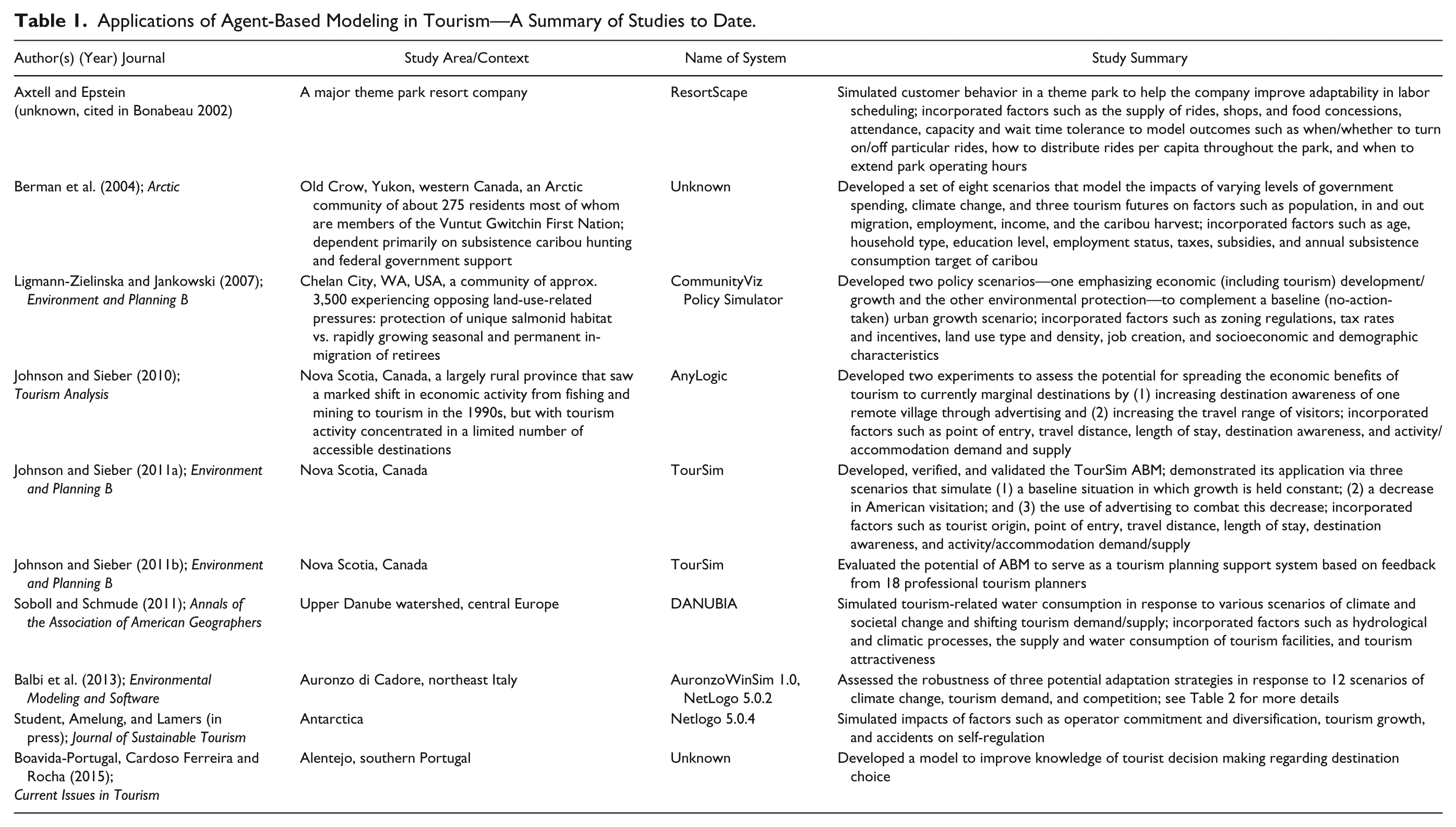
The most concerted focus on the application of ABM in the tourism realm is reflected in a series of papers that apply ABM to various tourism planning contexts in Nova Scotia, eastern Canada, a largely rural province that turned to tourism as an alternative to declining fishing and mining activity in the 1990s. Though the province has succeeded in raising visitor levels, activity remains concentrated in and around Halifax and the Cape Breton region. Johnson and Sieber (2010) describe development of an ABM designed to explore the potential for spreading tourism and its economic benefits beyond the few existing clusters by increasing awareness of other destinations via advertising. The model simulates visitation to 35 destinations based on the heuristic decision-making processes of tourist agents, the typical characteristics and preferences of whom were derived from the Canadian (International) Travel Surveys; the influence of increasing levels of advertising and mobility were simulated via the artificial raising of awareness and travel range. Johnson and Sieber (2011a) expand upon model development and operationalization, including the online interface that allows users to set model parameters and view outcomes in the form of tables, charts, and maps. Verification and validation of the model, titled TourSim, is also discussed. A third paper (Johnson and Sieber 2011b) evaluates the potential for TourSim to serve as a planning support system based on interviews with 18 tourism planners throughout the province. Findings are described as mixed, with benefits such as the ability to generate scenarios of alternative futures—especially when in collaboration with industry and destination stakeholders—and the visual and interactive nature of the tool, tempered by concerns about the lack of transparency in the system. The authors emphasize the need for users to be provided with adequate explanations not just of ABM results but also of the workings of the process itself. Further, they note, “Care must be taken in presenting results not as fact, but as experiments designed to sharpen thinking” (Johnson and Sieber 2011b, 316), a point that enforces the potential of ABM to generate multiple scenarios of the future for further consideration, rather than predict any single course.
More recently, Boavida-Portugal, Cardoso Ferreira, and Rocha (2015) use ABM to study tourist decision making when choosing a holiday destination. Founded on a number of destination choice theories including push–pull factors, loyalty, and the role of expectations, their model aimed to reproduce patterns of tourist destination choice. The model’s emergent patterns are patterns of visitation, which are driven by feedback processes between tourists and other tourists, and between tourists and destinations.
Berman et al. (2004) and Ligmann-Zielinska and Jankowski (2007) consider varying levels of tourism development as one of several potential policy scenarios in their studies of Old Crow, Yukon, and Chelan City, Washington, respectively. The first set of authors incorporate three tourism scenarios—ecotourism, ecotourism-plus road, and mass tourism—into a broader analysis that also considers the possibility of government retrenchment (Old Crow is heavily dependent on federal support) and climate change; outputs indicate potential variations in population, employment, income, and the caribou harvest, on which the community subsists. The latter authors compare the possible outcomes of two policy scenarios—one emphasizing economic (including tourism) development/growth and the other environmental protection—to those of a baseline (no-action-taken) urban growth scenario; outputs simulated include changes in the age distribution of the population, employment levels, and the number and location of new buildings constructed.
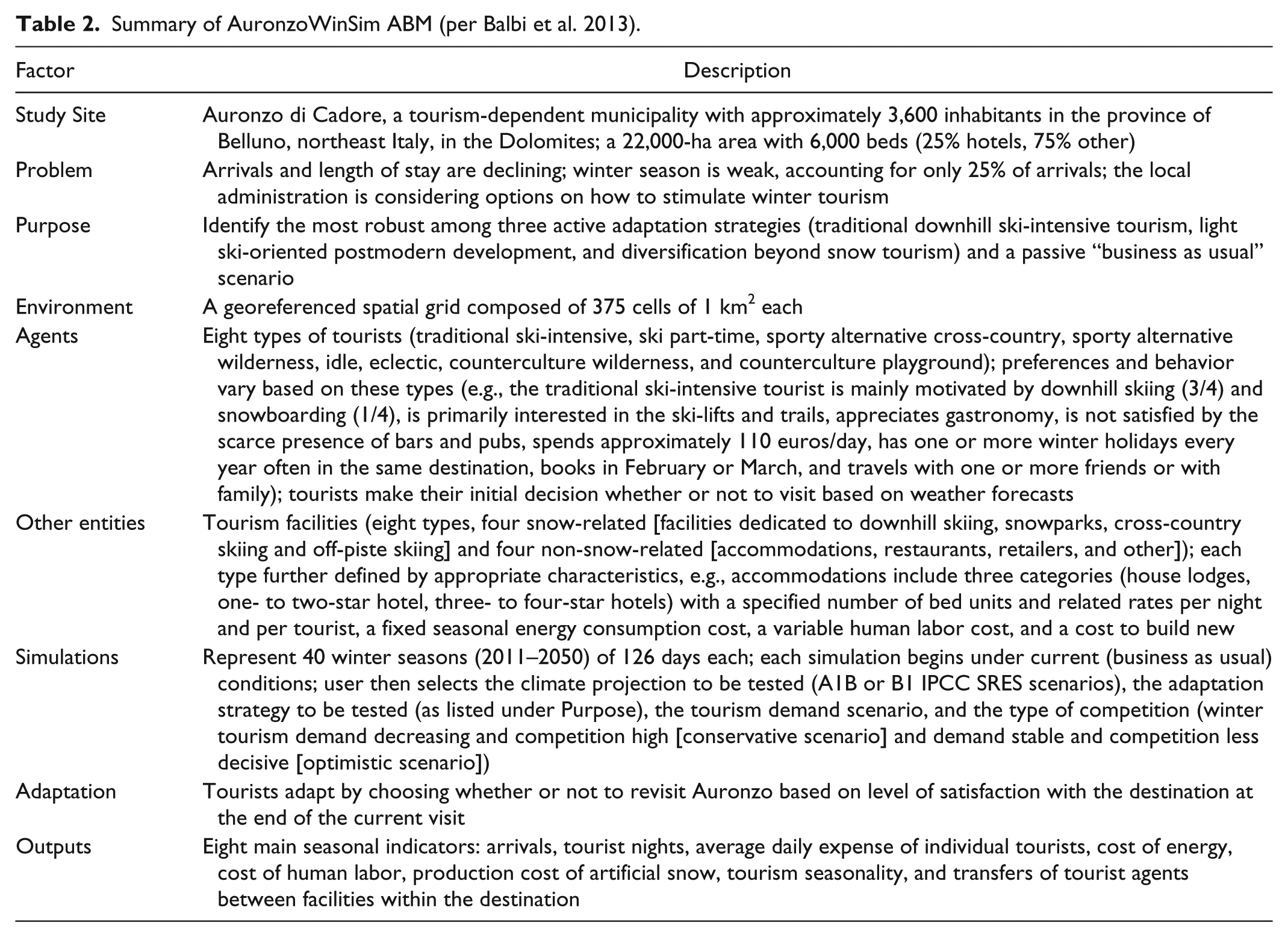
Balbi et al. (2013) use ABM to assess the robustness of a series of alternative adaptation strategies to changing climate, demand, and competition in a tourism-dependent municipality in northeast Italy that seeks to expand its winter tourism industry. The authors consider four adaptation strategies: (1) development of traditional, downhill ski-intensive tourism; (2) light ski-oriented development, with a higher emphasis on back- and cross-country skiing; (3) diversification beyond snow-based tourism, including the development of new indoor facilities and with a focus on a higher quality product; and (4) “business as usual.” The model is calibrated with empirical data, validated via consultation with industry experts, and authenticated by local stakeholders. Of all the tourism-related applications reviewed here, this piece is the most thorough in its exposition of the actual implementation of ABM and identification of the myriad of inputs and outputs possible; these are highlighted in Table 2. The work of Balbi et al. complements an earlier contribution by Soboll and Schmude (2011) that demonstrated the utility of ABM in simulating changing levels of tourism-related water consumption under conditions of climate change. Specifically, the piece describes a model that integrates models of hydrological and atmospheric processes with scenarios of climatic and societal change and a tourism supply/demand component, with a focus on implications for water consumption by ski areas for snowmaking.
Summary of AuronzoWinSim ABM (per Balbi et al. 2013).
Though implications for tourism activity are not explored, Gao and Hailu’s (2012) application of ABM to three recreational fishing sites within Ningaloo Marine Park, Australia, is of relevance. The authors use ABM in combination with an analytical hierarchy process-fuzzy comprehensive evaluation approach to model the outcomes of five alternative management strategies, involving varying levels of access to the sites and fishing pressure. The ABM portion of the system incorporates six submodels, five econometric (trip demand, site choice, trip timing, trip length, and catch rate) and one trophic-dynamic (describing the interactions between the key components of a coral reef environment). Given the volume of global travel that takes place in or involves interaction with natural resource settings, and the tendency of these settings to be increasingly fraught with environmental and user-based conflicts and challenges, the ability to combine multiple existing models of demand and supply as demonstrated by Gao and Hailu should be of great interest to tourism researchers.
By far the most active use of ABM within the broader outdoor recreation arena has involved development and employment of the Recreation Behaviour Simulation (RBSim) program by Gimblett, Itami, and colleagues. RBSim “is a computer simulation program that enables recreation managers to explore the consequences of change to any one or more variables so that the goal of accommodating increasing visitor use is achieved while maintaining the quality of the visitor experience” (Itami et al. 2003, 278). RBSim accounts for physical characteristics such as elevation and the location of infrastructure and facilities, as well as visitor traits such personality type and preferences, transportation mode, travel speed, time available, and fitness level; outputs allow managers to assess the potential implications of increasing visitor numbers and a variety of possible management responses on factors such as parking capacity, queuing times, visual encounters (i.e., visitor perception of crowding), and length of stay. The program and others similar to it have been applied in a variety of national parks and other protected area settings. The majority of these studies have been published as technical reports and a sample may be accessed here: http://cals.arizona.edu/~gimblett/rbsim.html. Additional examples may be found in Gimblett and Skov-Petersen (2008).
An Agenda for Future Use
As we hope has been demonstrated above, the potential utility of ABM to analyze tourism destinations and activity is unquestionable. Tourism is a multiscalar phenomenon, with agents, influences, and impacts operating and occurring at the individual, local, regional, national, and global levels. The number of agents in the tourism system is immense, including tourists, residents of destinations, and the industry, itself made up of countless corporate, public, and not-for-profit concerns. These agents operate in—and both influence and are influenced by—natural and human landscapes; the interaction among actors, and between actors and these landscapes, are complex and not necessarily linear or in equilibrium. The impacts of externalities, though unpredictable, are frequent and sometimes significant (price fluctuations, terrorist attacks, health scares, natural disasters, revolutions in transportation and information technology, etc.). Further, tourism is a multidisciplinary area of study that would benefit from the further coalescing of the multiple relevant perspectives in a more integrated manner. In this section, we suggest a series of specific applications that we believe could make substantial contributions in areas including tourist motivation/behavior, management, planning and development, policy and marketing.
Tourist Motivation and Behavior
Many tourists do not travel alone but in groups (as couples, families, friends, etc.); however, there is relatively little research on how decision making takes place within these groups (Bansal and Eiselt 2004). Interactions between group members are crucial to understanding both the decision-making process, and the final outcome or decision, making this an ideal area of research for the application of ABM. Inspiration for such applications can be found in the work of Schiffman and Kanuk (2000), who distinguish between the different characters in group-based decision making, including influencers, deciders, and buyers.
One of ABM’s most powerful features is its usefulness for testing theories and exploring their implications. Theories regarding motivation are among the most well known in tourism studies. Key examples include institutionalization theory (Cohen 1972), Plog’s (2001) allocentric/psychocentric continuum, approach-avoidance/seeking-escaping theory (Iso-Ahola 1982; Dunn Ross and Iso-Ahola 1991), and the travel career ladder (Pearce 1988). Tourist motivation is central to understanding tourist behavior (Hsu, Cai, and Li 2010; Li et al. 2015). An important discourse in the context of climate change, for example, is on the motivational differences between hypermobile travelers and nontravelers. By formalizing knowledge of the determinants of tourist motivations in ABM models, what-if scenarios can be run to explore the effectiveness of policy interventions.
Tourist motivation is also known to influence destination choice (Kozak 2002) and behavior at the destination. Alegre, Cladera, and Sard (2011), for example, found that motivational differences partly explain variations in expenditures by visitors to Mallorca, Spain. Studies in this field of research have typically taken a static, cross-sectional approach; dynamic features are rare (Hsu, Cai, and Li 2010). ABM can add this dynamic layer, by analyzing a set of distinct future scenarios of changes in the composition and characteristics of visitor populations. These changes can be linked to changes endogenous to the destination, for example, resulting from marketing efforts. They can also relate to exogenous changes, such as ageing and growing travel experience in countries of origin. Pearce and Lee (2005) found that the importance of some motivations, in particular experiencing nature and different cultures, increased with tourists’ level of experience, that is, their position on the travel career ladder. ABM can build on the work by Prebensen, Skallerud, and Chen (2010) on the measurement of tourist motivation.
Management and Modeling of Visitor Flows
Crowding and related user conflict have been identified as a substantial source of dissatisfaction among visitors to a variety of built and natural settings (e.g., Manning 2010; Brown, Kappes, and Marks 2013). As noted above, using ABM to manage visitor flows—with the ultimate intent of increasing satisfaction and thus raising intention to revisit and recommend—has been well documented in park and natural settings; this is not the case for other types of tourism destination. ABM can also be applied to urban and indoor settings, and therefore has potential to assist with visitor flow management in busy city centers, at cultural attractions such as museums, and in any other setting with space constraints. For example, ABM could be used to model the potential outcomes of pedestrianizing certain streets, adding new parking areas, increasing or diversifying public and nonmotorized transportation options, adding new or moving existing displays and exhibits, and the offering of incentives to visitors to change their visitation patterns (e.g., day or time of visit, flow between features within an attraction or between attractions at a destination).
ABM offers especially valuable potential with respect to tourism-related risk assessment and management, especially at transportation hubs, major attractions, and large events. As the emphasis on traveler safety and security continues to increase, and the popularity of festivals and events grows, ways of improving crowd management techniques and testing emergency procedures, such as evacuation plans, is increasingly critical. As described by Bonabeau (2002), the collective behavior of a panicking crowd is an emergent phenomenon resulting from individual-level behaviors and their interactions. ABM could be used to integrate best practices from the realms of events planning/management and safety/security with the emerging knowledge being generated in the field of crowd safety/crowd risk analysis (e.g., Still 2014). As noted above, ABM can be an especially useful and powerful tool in situations (such as risk assessment and management) that benefit from bringing together diverse groups of stakeholders (e.g., event organizers, traffic planners and managers, emergency services representatives) with varying types of knowledge (i.e., decision rules) to identify potential problems and use ABM to frame the range of possible outcomes and development of appropriate procedural and policy responses (in this case with the ultimate goal of minimizing the harmful consequences of crowd panic events by identifying optimal escape strategies).
At the macro level, and in an age of rising air-based, long-haul travel (UNWTO 2014), new and more flexible ways of modeling international flows of visitors will become of increasing utility, providing value to the financers, builders, and suppliers of transportation options, accommodations, food and beverage outlets, and attractions in established and emerging destinations. As demonstrated above in a regional context, ABM is equipped to handle diverse inputs such as current travel patterns, population increases, and tourists’ preferences for a variety of factors such as activity and lodging types and locations.
Tourism Planning and Development
One promising application of ABM in the tourism planning and development realm is an adaptive version of Butler’s (1980) tourism area life cycle (TALC) model. The model has almost exclusively been applied at the tourism area or destination level, using a comparative static approach. In a two-volume review of the TALC model, Haywood (2006, 40) notes, “Given its synoptic nature, [TALC research] does not do justice to the open-ended microprocesses that underlay the trajectories described; . . . TALC studies portray change by transforming it into a succession of positions, but fail to capture the distinctiveness of the voyage from point A to point B. . . . [T]he change that transpires during the journey is ignored.” ABM can address this gap, connecting micro-level processes (e.g., individuals’ actions) to macro-level phenomena (e.g., TALC trajectories).
ABM is also equipped to handle the “edge of chaos” or phase shift phenomena that Faulkner and Russell (1997) identified (these are points of tenuous equilibrium within systems that can result in dramatic transformations with multiple and divergent potential outcomes, for example, at Butler’s stage of stagnation, which he hypothesized could be followed by anything from rejuvenation to absolute decline). As noted earlier, Russell and Faulkner (1999) describe the role of entrepreneurs in some of the turbulent shifts from phase to phase that Australia’s Gold Coast saw during its development; a well-designed ABM could generate scenarios that incorporate the potential outcomes of the activities of these kinds of influential agents. Hovinen (2002) echoes the relevance of chaos/complexity theory in a potential expansion of Butler’s model, and highlights Butler’s concern with the role of carrying capacity and with the need to incorporate factors such as land use, and other environmental and social issues; again, ABM is able to accommodate this multiplicity of actors with diverse, varying, and sometimes seemingly inconsistent and erratic opinions and reactions.
One of the world’s and the tourism industry’s greatest challenges is climate change. Climate change both affects, and is affected by, tourism in many different ways. Vulnerability to climate change and adaptive capacities on the part of tourists and tourism enterprises are major research themes in the rapidly expanding field of climate change and tourism (for an overview, see Scott, Gössling, and Hall 2012). Vulnerability to climate change is traditionally defined by a destination’s exposure, sensitivity, and adaptive capacity (Schröter, Polsky, and Patt 2005; Moreno and Becken 2009). This definition of vulnerability does not, however, explicitly incorporate interacting actors’ behaviors, socioecological interactions and feedback loops, or spatial and temporal dimensions. Within an ABM, vulnerability can be conceptualized as an emergent property of tourism systems resulting from micro-level interactions within tourism communities and destinations. This is a fundamentally different approach to previous studies that tended to conceive of vulnerability as a static feature of destinations (e.g., Perch-Nielsen 2010; Moreno and Becken 2009). ABM allows new questions to be addressed, such as how vulnerability and adaptive capacity change over time, and the drivers of this change to be considered. Understanding these processes better will help foster innovative new ideas for adaptation policies, based on social and behavioral rather than technical solutions. Concepts such as vulnerability and adaptive capacity are also relevant to other issues besides climate change, for example, safety and security, as discussed in the context of visitor flows, above.
Tourism Policy and Marketing
ABM also offers potential in the realm of policy and marketing, particularly in the creation of new, “more desirable” travel/tourism norms. Epstein (1999, 48–49) refers to this opportunity in terms of “fad creation,” whereby “exemplars” such as famous athletes can be used to entice a target population to imitate their behavior more effectively than traditional, educational techniques. Epstein’s point relates to rationality, and his discussion of whether the achievement of macro equilibrium should be considered in terms of the proportion of agents in a system that exhibit rationality, or perhaps, more pointedly, the minimum amount of rationality necessary to generate that equilibrium (especially in the presence of fad creators). Unconstrained by the assumption of linearity typical of traditional modeling techniques, ABM enables the identification and analysis of tipping points such as, in this case, the minimum amount of rationality necessary to generate equilibrium. While Epstein employs the example of “just say no to drugs,” the same thinking could be applied to travel-related behaviors, for example, how to persuade travelers to increase their use of nonmotorized or public modes of transportation, to be more responsible in their use of hotel resources (e.g., turn off the TV and lights when not in the room, conserve water), to be more proactive in protecting themselves from the sun, etc.
Also in the consumer realm, ABM offers a novel approach to the understanding of critical constructs such as purchasing behavior and brand/destination loyalty. Loyalty has most recently been approached using increasingly complex structural equation modeling (SEM) techniques that have assessed the influence of an array of antecedent factors; Nunkoo, Ramkissoon, and Gursoy (2013) report on the range of problematic issues associated with the application of SEM in the loyalty and other tourism-related arenas. ABM provides an alternative means of conceptualizing and simulating loyalty and related outputs such as likelihood to return and recommend. Similarly, ABM could be applied within organizations, to better understand employee dynamics and job satisfaction and to contribute to internal service quality/marketing activities.
Conclusion and Limitations of ABM
Though designed to articulate its potential benefits to the field, the above sections are not meant to suggest ABM might serve as a modeling panacea for tourism researchers. Thus, we conclude with a candid summary of the limitations of ABM.
A model is a simplified view of reality, a way to try and explain how a set of features are related to one another or how a process works (McKercher 1999); no model can capture all the nuances of any system. ABM is no different; thus, this generic limitation continues to apply, as it does to all modeling endeavors. As Bonabeau (2002, 7287) notes, “The model has to be built at the right level of description, with just the right amount of detail to serve its purpose; this remains an art more than a science.” The value of ABM relative to other modeling techniques, however, is that while the rules applied to agents may be simple, their application to individual agents as opposed to aggregated groups enables a variety of outcomes and, hence, a better representation of complexity. That said, the focus on the individual therefore requires identification and description of all of those individuals’ characteristics and behaviors, with associated ramifications both for the amount and quality of data necessary for input and for computational requirements. As noted by Bonabeau (2002), the incorporation of individual human agents, who might exhibit “potentially irrational behavior, subjective choices, and complex psychology” (p. 7287), also complicates quantification and calibration. Thus, though relatively easy to implement from a technical perspective, the input of appropriate data, the statement of realistic rules, and the interpretation of the multiple outcomes produced can be challenging and may be more qualitative than quantitative. Further, while ABM is widely recognized as a powerful tool when exploring complex systems, sensitivity to initial conditions and to even relatively minor alterations to interaction rules makes the use of ABM for predictive purposes more problematic (Couclelis 2002).
According to Crooks, Castle, and Batty (2008), one of ABM’s seven greatest challenges relates to verification (extent to which the model runs in the way it was designed to), calibration (proper adjustment of model parameters and specifications to correspond with theory or data), and validation (extent to which the ABM matches the real-world system it is designed to represent). These are pervasive issues whose full exploration is beyond the scope of this paper, other than to note the huge volumes of data, often of different scales and formats, necessary to begin to address them and the continued debate regarding their operationalization and attainability in the literature. Ngo and See (2012) provide a useful overview of the consideration of calibration and validation during ABM development in the context of land cover change.
With respect to tourist behavior, several studies have highlighted the potential value of improved techniques of data collection and modeling of the spatial and temporal aspects of visitor flows in the context of using these movements as inputs into agent-based models. O’Connor, Zerger, and Itami (2005), for example, note the need for improved understanding of visitor movements in order to allow calibration and validation of agent-based models; they document use of the Alge race timing system to monitor these movements. Xia, Zeephongsekul, and Arrowsmith (2009) demonstrate the use of Markov chain analysis to model spatiotemporal visitor flows on Phillip Island, Victoria, Australia. Though both studies were successful in terms of the implementation of the particular data collection/modeling technique employed, and both emphasize the value of the data collected for potential input into ABM, neither actually enacts this application. Other novel data collection and modeling methods such as global positioning and geographic information systems (Hallo et al. 2012; Grinberger, Shoval, and McKercher 2014), georeferenced photos as posted on Flickr (Girardin et al. 2008), sequence alignment (Shoval et al. 2015), and automated web harvesting (Johnson et al. 2012) could also be integrated into an ABM environment.
To function effectively, ABM requires information (whether based on observation or theory) regarding agents’ goals and interactions. Ideally, domain experts and end users are given opportunities both to provide input regarding these factors and to evaluate the plausibility of the resulting systems and their outputs; ABM then becomes a dynamic process, involving continual refinement and improvement as stakeholders interact with the system (Moss 2002). The stakeholder-friendly nature of ABM is therefore a perfect suit for those tourism planning and development professionals and researchers who have actively campaigned for greater and more meaningful community involvement in tourism-related processes and decisions. Consideration of multiple experts’ opinions is also desirable in order to program agents with the most likely and realistic reactions to changes and events, particularly in the case of the “edge of chaos” or phase shift phenomena that Faulkner and Russell (1997) identified. That said, the degree of complexity and uncertainty inherent in ABM can challenge the communication of simulation processes and results. In response, protocols have been suggested as one way of standardizing the communication of model development; Grimm et al. (2006, 2010) propose the ODD (Overview, Design concepts, Details) protocol, which incorporates seven critical elements of how and why an ABM has been designed. Similarly, Kornhauser et al. provide visualization design guidelines aimed at improving the communication of ABM results. Continuing refinements such as these can further illuminate the utility of ABM for tourism researchers and practitioners.
Footnotes
Declaration of Conflicting Interests
The author(s) declared no potential conflicts of interest with respect to the research, authorship, and/or publication of this article.
Funding
The author(s) disclosed receipt of the following financial support for the research, authorship, and/or publication of this article: Sarah Nicholls’ contribution to this paper was supported by the USDA National Institute of Food and Agriculture, Hatch project 205937. The other authors received no financial support for the research, authorship, and/or publication of this article.