




Abstract
This study extends social capital to specific types of personal relationships that encourage residents’ collective action for rural tourism development. Two communities in South Korea were examined using face-to-face interviews with community leaders, and a structured questionnaire with residents. Five hypotheses that frame tourism development as a coordinated effort of social networks were identified. Findings indicate that the quality of one’s social networks are relevant to the propensity to participate in tourism development. The closer one’s relationship to a community leader of tourism development, the more likely they are to be part of community-based efforts for tourism development. In addition, compared to individualized personal ties among residents, already existing social organizations were critical to enhance collective action of residents. An implication for increased participation in tourism development is for community leaders to reach out and learn from residents who are isolated or less central within community leadership networks.
Introduction
The importance of understanding the relationship between community residents and tourism development has been a longstanding interest of researchers (Gursoy, Chi, and Dyer 2010; Mitchell and Reid 2001; Rekom and Go 2006). Rural tourism brings changes to a community’s living area, therefore as a host, a community’s positive encounters with tourists and related development has been considered critical for successful and sustainable tourism (Gursoy, Chi, and Dyer 2010; Rekom and Go 2006). Because local residents are the major group of people who are influenced by tourism impacts, it becomes important to understand their behaviors associated with tourism (Reid, Mair, and George 2004; Hwang, Stewart, and Ko 2012). Residents may try to minimize the negative changes and maximize the positive impacts, particularly if they have a strong sense of community belonging (Hwang, Stewart, and Ko 2012). Further, involvement of residents encourages the community to channel efforts for tourism development in ways that align with the desires of community residents (Davis and Morais 2004; Dogan 1989; Gursoy, Chi, and Dyer 2010). That is, collective action could enhance the sustainability of tourism development because of processes that empower residents to negotiate a fit between tourism and a community’s sense of itself (McMillan and Chavis 1986).
Collective Action as Necessary for Tourism Development
Although our understanding of community perceptions toward tourism development has grown tremendously, there has been less attention given to understanding residents’ behaviors (McGehee and Andereck 2004; Nunkoo and Gursoy 2012). Resident attitude research is moving in directions that incorporate behavioral issues and recently has become concerned with preferences for who should be responsible for tourism development across various segments of public and private sectors (Draper, Woosnam, and Norman 2011), effects of seasonality on resident attitudes (Vargas-Sánchez, Porras-Bueno, and Plaza-Mejía 2014; Li, Hsu, and Lawton 2015), and effects of residential identity on support for tourism development (Nunkoo and Gursoy 2012). This research extends the evolution of resident attitude research, by focusing on community behavior (cf. Lai and Nepal 2006; Deery, Jago, and Fredline 2012). The behavior of interest in this study is the collective action of residents that is distinct from the behavior of individual residents acting independently. The purpose of this article is to enhance understanding of tourism development as a coordinated effort of social networks—referred to as “collective action”—among residents for rural tourism development.
Over the past couple of decades, research associated with understanding resident behavior as a tourism impact has grown (Hwang, Stewart, and Ko 2012). Research on coping strategies examines residents’ reaction to tourism development as having personalized survival tactics to deal with tourism. Ap and Crompton (1993) have verified a continuum of behavioral strategies of residents, ranging from embracing tourism to withdrawing from tourism-based environments because of their inability to adjust to encounters with tourists. Recent contributions on this topic have examined emotional solidarity between hosts and guests within a Durkheimian-inspired functionalist framework (Woosnam, Dudensing, and Walker 2015; Woosnam and Aleshinloye 2012). Current concerns for residents’ behavior at the group level have been related to collaborative planning and partnership building (Dredge 2006). These studies have emphasized collaboration theory as an optimal solution for sustainable development by balancing the interests among diverse stakeholders (McGuirk 2000). There are several successful cases of community collaboration built on sensitivity to communication processes among tourism-related stakeholders (Grunwell and Ha 2014). In most cases, however, successful collaboration does not happen immediately, but is the outcome of long-term collective action within the community (Hwang, Stewart, and Ko 2012).
Community action associated with tourism is likely to be most effective when done in a collective fashion rather than as a series of uncoordinated individual behaviors. This argument has been advocated by many studies that highlight the role of collective action (Besser 2009; Son and Lin 2008). Collective action, particularly when precipitated by a community resisting an outside threat, empowers a group of residents to address problems from a local perspective (Wilkinson 1986). Collective action also encourages a community to remain strong and have the potential to successfully address external threats of future development (Freudenburg and Gramling 1994).
Tilly and Tilly (1981; also see Breinlinger and Kelly 1996) comprehensively defined collective action broadly as “all occasions on which sets of people commit pooled resources, including their own efforts, to common ends” (p. 17). Their definition not only covered actors in diverse dimensions, ranging from a small village or community to a widespread social movement, but also covered diverse collective behaviors, ranging from “protest” and “rebellion” to all kinds of activities working together such as official meeting, petitioning, picketing, celebrating, and parading. This definition broadly delineates all efforts a community pursues, not only to resolve problems to reflect a local identity and solidarity but also to strengthen a community to successfully address future development (Koutsou, Partalidou, and Ragkos 2014). In other words, collective action as a concept distinguishes the collaboration of community members who participate in acts of solidarity to achieve their common goals from residents acting alone or in contexts of individual coping behavior.
Several scholars have called for the need to better understand local residents’ collective action for tourism development (Reid, Mair, and George 2004). In a recent effort, McGehee, Kline, and Knollenberg (2014) have explored residents’ collective action, utilizing social movement theory in tourism contexts. Their study highlighted the critical role of tourism organizations and collective action in regional development, enhancing residents’ self-efficacy, opportunities for consciousness-raising, and network building. A major contribution of this research line has been a framework to address community oppression and stagnation, as illustrated in Kousis’ study (2000) in which residents were mobilized against tourism entrepreneurs and local governments in Greece, Spain, and Portugal.
A distinguishing feature of this study is its focus on rural tourism in a collectivistic culture in which residents have a history of community-based action independent of oppression and marginalization. Numerous scholars have characterized cultures associated with non-Western societies, such as communities in Asia, as having strong traditions of community-based decision making (Khairullah and Khairullah 2013; Li, Hsu, and Lawton 2015; Liu et al. 2014; Park et al. 2012). Compared to rural communities in Western contexts, the rural community in Korea is well known for its collectivism. Often this collectivism is based on kinship ties and interactions with relatives or family members. That is, social capital and collective action identified in this study may be specific to the ways in which individual action is motivated within societies that share a history of community-based culture. Korean community life is an ideal context to assess the influence of social networks on collective action for rural tourism development and could be distinguished from a framework of social movements in contexts of oppression from a dominant political force.
A stream of tourism research highlights the significance of social capital for sustainable community-based development. These studies adopted relational and structural approaches to understand residents’ collective action participation. This body of research has identified strong ties and trusting relationships among residents as contributing factors for maintaining community support for tourism (Macbeth, Carson, and Northcote 2004). Specifically, Jones (2005) found that strong ties and trusting relationships facilitate collective action that supports proposed tourism development, but these studies limited the boundary of collective action to the residents’ participation in tourism activities, excluding their collective actions to resolve conflict among residents. Moreover, these studies limited their focus on the extent to which social capital promoted tourism development.
This study will extend previous knowledge of rural tourism development by investigating specific types of interpersonal relationships, including social ties, work ties, and ties created through affiliation with organizations and participation in community-based activities. These relationships are interwoven in many different ways, such as through a community hierarchical structure, outsiders as mediators, and through frequent interaction among residents. An investigation on specific types of relationships provides promise to understand policies and practices to enhance tourism development.
Social capital provides a useful theoretical lens to understand the dynamics of a community’s collective action for tourism development. Despite considerable arguments about definitions of social capital and the identification of its components (Halpern 2005), there have been points of common agreement. Social capital is embedded in social structures and networks that provide residents access to resources (Burt 2001). That is, social structures and social networks have been considered fundamental elements of social capital (Coleman 1988; Pretty and Ward 2001; Putnam 1993). In addition, trust and norms have also been emphasized especially among social capital theorists sensitive to collective assets (Putnam 1993; Pretty and Ward 2001). Social capital holds promise to enable individuals of a community to mobilize support for tourism development to solve the challenges of collaboration to attract tourists.
Social capital theory is employed by identifying the kind of relationships between residents (referred to as bonding social capital) and between residents and outsiders (referred to as bridging social capital). Concepts related to social capital, shared behavioral expectations and shared belief among residents (referred to as social norms and trust, respectively), are also employed in this study. Bonding social capital facilitates tourism-related information circulation in the community and allows the information to be quickly shared among members. In turn, relationships among the residents based on these strong ties facilitates the formation of a coherent voice necessary for mobilizing collective action for tourism development. Bridging social capital of a community (generally between local government and external stakeholders) brings support through sources of funds, expertise, facilitating local cultural activities, and through new information related to developing tourism opportunities (Macbeth, Carson, and Northcote 2004; Zahra and McGehee 2013).
Some studies also emphasized the importance of shared norms and trust as an integral part of social capital without which collective action would decrease in effectiveness (McGehee et al. 2010; Rudd 2000). Caillé argued that relationships without trust are just networks created that are not woven connections among residents (as cited in Koutsou, Partalidou, and Ragkos 2014, 206). Trust and reciprocity act as lubricators to facilitate actors’ cooperation within the network by reducing transaction costs that are required for monitoring behaviors, subsequently enhancing quality of the overall network. Without trust, networks are likely to remain a form of acquaintanceship. Shared social norms and trust based on strong ties encourage involvement in collective action through social pressure to match the contribution of peers and sanctions for individuals who break commonly agreed upon rules. In addition, relationships with strong ties generally have developed strategies to raise awareness of the need for community members to follow such rules of participation (Gould 1993, 2003; Ostrom 2000).
Social networks are not only seen as a precondition for the emergence of social norms but also function as communicative routes that facilitate shared behavioral expectations and collective identity (Goodwin and Jasper 2009; Gould 2003). Stone (2001) indicates that the created social norms move through existing networks and become shared among members of a community. In other words, social ties and interactions among potential participants facilitate the sharing of ideas, values, and social norms. Furthermore, these ties help create their collective identity and strong sense of community, which encourages various kinds of collective action (Goodwin and Jasper 2009; McGehee and Santos 2005).
The contribution of this study extends the notion of social capital to specific kinds of relationship within residents of tourism destinations, specifically to understand bonding social capital. Even if actors belong to the same community, each resident has a distinct set of relationships. Behavioral impacts of tourism may be affected by others with whom a resident has connections (Burt 2001). For this reason, social networks, including the strength and quality of social ties, are examined to explore their influence on facilitating tourism development.
Collective Action for Rural Tourism Development
A resident’s participation in tourism development will be affected by his or her distinct set of relationships. Figure 1 describes a community consisting of individuals who share different relationships with other actors. In Figure 1, the individuals located at the center of the community network and interact with each other. In contrast to individuals at the center of the network, individuals marginalized or isolated have comparatively fewer interactions with others. Resident decision making may be influenced by relationships with others (bonding social capital), while those marginalized in the network (i.e., those who do not have as many connections with others) are not likely to participate in community-based tourism development, possibly because of lack of information or motivation for such initiatives (Burt 2001; Lin 2001; Kline et al. 2013).
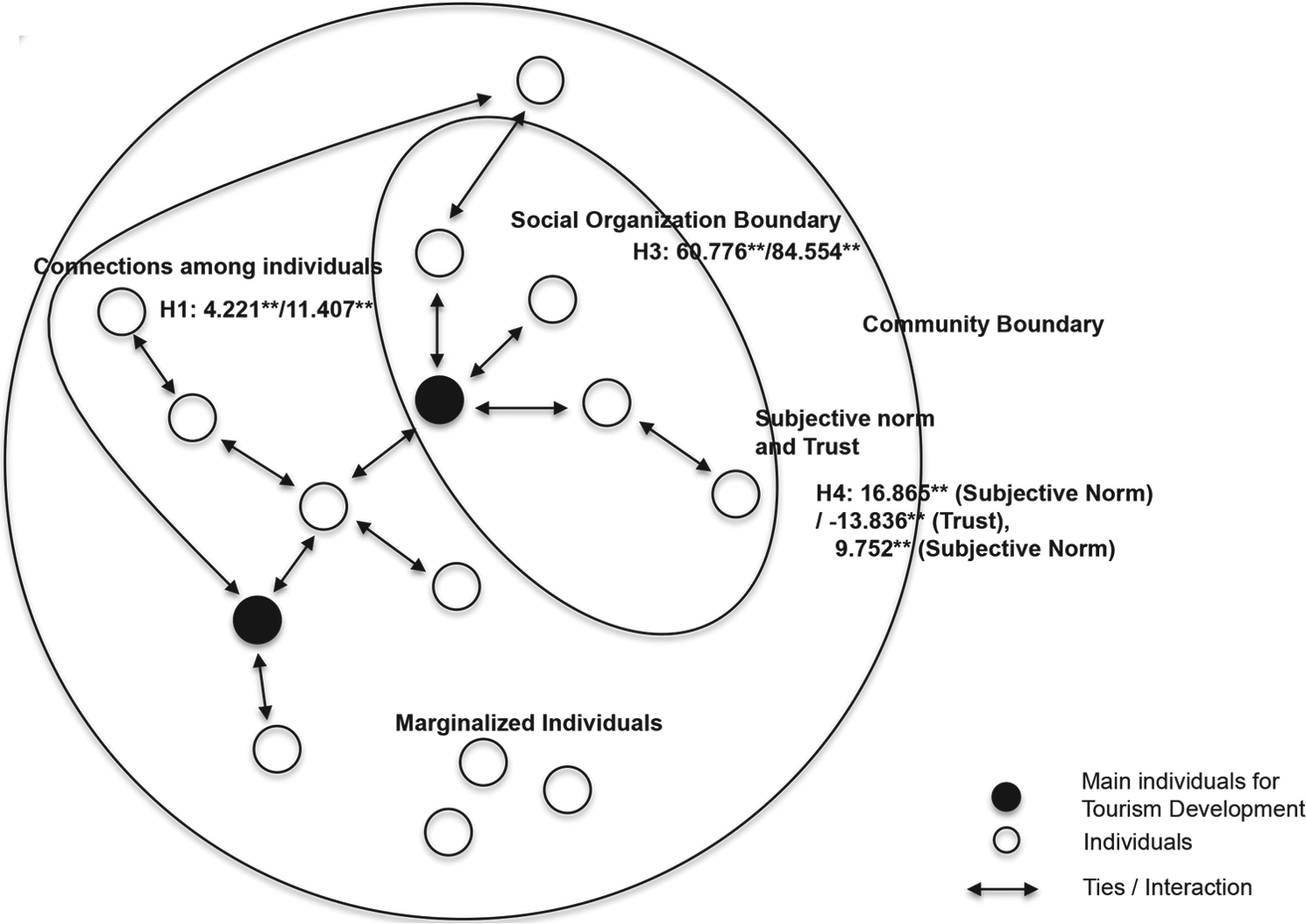
Integrating social capital and collective action in rural tourism.
The following hypotheses have been formulated to examine the influence of social capital on rural tourism development. Two elements of social capital, the network and social norms, will be assessed in order to understand their effects on participation in tourism development activities. Based on roles of social networks, the person who is playing the role of a “star” by being located in the center of the group is likely to have characteristics of community leadership. This person might also serve as a gatekeeper and have power in the control of information and resources between other residents. Other members would recognize this person as a major channel of information because this person communicates information with others in an efficient manner. In contrast, there will be cases where a resident could be characterized as an “isolate,” which means this person has comparatively few connections.
Hypothesis 1: The greater the central position of members in the community network, the more likely they are to participate in tourism development activities.
Each individual’s participation in tourism development is motivated by those who are in close relationships with other individuals. McGehee et al. (2010) stressed the role of social capital as a cornerstone in attaining a higher level of public action and cooperation for mutual benefits from tourism development. With high degrees of social capital (close relationships with other actors), residents are more likely to work together and cooperate for mutual benefits derived from tourism. Because successful tourism development is based on communities prepared to accommodate visitors (e.g., meals, overnight stays, interpretation, programming), coordinated community action and cooperation is needed, and reliant on social capital to do so.
Hypothesis 2: Those who have close relationships with someone highly involved in tourism development will exhibit higher degrees of collective action compared to those who do not have close relationships with these highly involved residents.
McGehee, Kline, and Knollenberg (2014) studied raising awareness among social networks created to tourism organizations. They found that precedence establishes an effective foundation to facilitate future involvement in tourism development for residents. Their findings suggest that participation in one program allows participants to create a space for interactions among residents that previously did not share the community’s common interest. Therefore, expanding one’s knowledge and consciousness exerts a positive impact on the desire to continue participation in further activities to enhance tourism.
In another rural tourism development study, Hwang, Stewart, and Ko (2012) found that town meetings allowed residents to have conversations about tourism-related issues, and these conversations brought together otherwise fragmented members of a community to achieve collective goals. Goodwin and Jasper (2009) argued that the existence of active social organizations facilitates the mobilization of social movement by allowing each member to more rapidly accept new information. Moreover, the active involvement in the organization prevents members from dropping out mainly because of social pressure.
Hypothesis 3: If residents are already involved in community organizations, they are more likely to be involved in tourism development activities.
To advance community goals for tourism may lead residents to sacrifice individual gain to achieve collective goals (Jones 2005; Li, Hsu, and Lawton 2015). Koutsou, Partalidou, and Ragkos (2014) found that trusting relationships sustained local interactions and, subsequently, led to effective collective action for rural development. They indicated that trust is necessary for residents to share similar beliefs and work collaboratively toward the same goal, even though they may have diverse roles within their community.
Hypothesis 4: Higher degrees of trust will enhance residential involvement in tourism development compared to lower degrees of trust.
A community with a strong tradition of norms and sanctions is likely to be one with a history of effective collective action. Social norms are “the mutually agreed or handed-down norms of behavior that place group interests above those of individuals” (Pretty and Ward 2001, 211). Existence of social norms encourage residents’ participation in community-based efforts and provide reinforcement that supports continuation in collective efforts (Ostrom 2000).
Hypothesis 5: Higher degrees of social norms will facilitate a community’s collective action compared to lower degrees of social norms.
Study Methods
Using a multiple-method technique, the empirical portion of this research is directed at two rural communities in South Korea. These communities have a shared history of gradual development as tourism destinations, and in the past decade, have built a walking trail that connects the communities and encourages tourists to enjoy the surrounding countryside. The two methods of this study included face-to-face interviews with a limited sample of leaders in each of the communities that yielded qualitative information (referred to as the community leader questionnaire) and face-to-face interviews using a structured questionnaire with a population sample of residents of each community for both statistic and network analysis (referred to as the community survey).
Study Sites: Two Communities on Jeju Island, South Korea
This study was conducted on Jeju Island, a popular tourism destination at the southernmost tip of the Korean peninsula (see Figure 2). The island has been well preserved not only in its unique, traditional culture and lifestyle but also in its natural landscape (Hwang, Stewart, and Ko 2012).
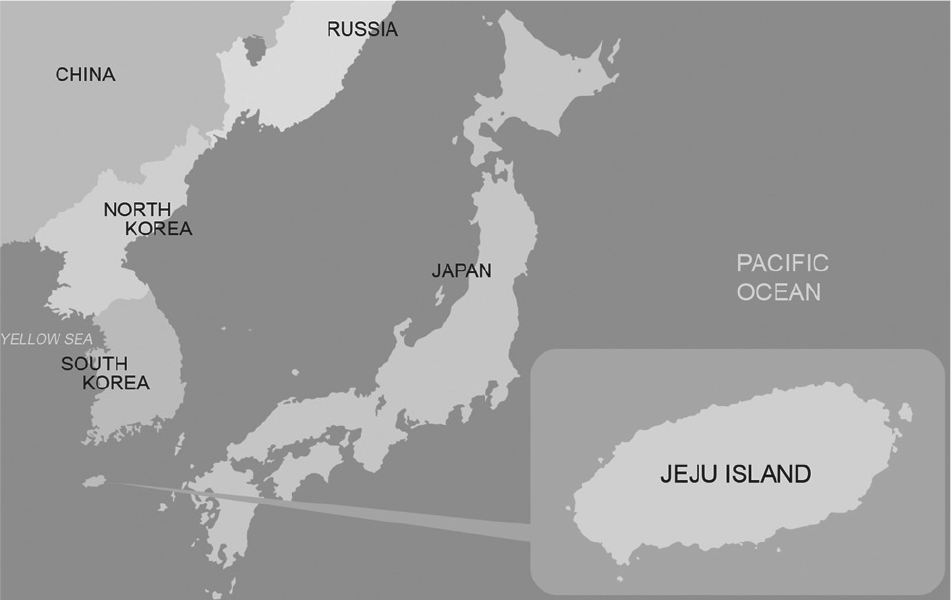
Location of Jeju Island.
Two communities, Nak-Ch’ŏn (Nak-Ch’ŏn community 2010) and Mang-Jang, were examined. Both communities are expected to experience similar degrees of tourism impact based on their designation as a part of the official Olle Trail that runs throughout the island. The Olle Trail Development Project includes 19 trails totaling more than 320 km that connect the entire island. This project was envisioned more than 10 years ago by a local woman to introduce tourists to the beauty and heritage of the island. Second, both communities consist of relatively small social groups (fewer than 90 households) which facilitates the implementation of a social network method. Third, a distinction between these two study communities is their level of community involvement in tourism development. The Nak-Ch’ŏn community has been widely known as a successful case for community-based efforts related to the Olle Trail development, several regional newspapers have highlighted the ongoing collective action there, and it is expected that this community possesses a higher degree of social capital. On the other hand, the Mang-Jang community has received little attention by regional newspapers for its tourism development efforts and has few community-based efforts related to the Olle project. It is expected that different degrees of social capital exist between two communities, implying differences in collective action, and suggesting distinct social impacts of tourism development.
Nak-Ch’ŏn village
As the community with expectations for a high level of community involvement, this community is located on the southwest tip of the island. The number of households in the village is 66 and the total population is 89. Most residents are engaged in agriculture by cultivating barley, beans, and tangerines; tourism represents the second largest industry. Before being designated as a community that would host Olle path #13, Nak-Ch’ŏn failed to attract visitors and tourists despite many efforts, such as changing its name from “Nak-Ch’ŏn” to “9 Ponds” village to distinguish the village from other agricultural villages in Jeju and created small-scale tourism enterprises, which eventually failed (Lee 2010). Nak-Ch’ŏn has since developed a strategy to build 1,000 wooden chairs and is now nicknamed the “Chair Village”; this strategy has become more effective at attracting tourists. This success has been well chronicled in many local newspapers (Lee 2010; Je-min daily newspaper 2010, 2011) and illustrated in the increased village income and numbers of tourists. As specific community efforts related to the Olle Project, the village foreman and treasurer are in charge of managing tourism development. The small-scale enterprises were organized by the village’s young adult group, the women’s association, and the senior citizen’s association. Specifically, the women’s association is in charge of the tourist experience (learning to make tomato jam, barley gangjeong [a barley-coated fried cake], and beer bread), while the young adult group helps visitors experience agriculture with the vegetables and fruits they cultivate (harvesting tomatoes, tangerines, potatoes, and corn). In addition, the group also helps visitors experience fishery in the village pond. Lastly, the elderly group makes traditional musical instruments for the amusement and education of visitors (Lee 2010).
Mang-Jang Port village
Mang-Jang Port village is located in South Central Jeju. It has 39 households, which are mainly situated near the port as well as on both sides of the path that leads to the port. The village is surrounded by farmland with a wide river along one border. Currently, a total of 57 people reside in the community, and most residents are directly engaged in fishery, seaweed farming, or conch or abalone collecting (Jeju Special Self-Governing Province 2007). The village has hosted Olle path #5 since 2008. The locale’s natural beauty is complemented by the traditional architecture of the village, which is the main attractor (Je-min daily newspaper 2011). As part of the community’s involvement in the Olle initiative, they have created fishing experiences for tourists and run an outdoor bar during their summer festival (Je-min daily newspaper 2010). Mang-Jang has rarely been mentioned or highlighted in local newspapers in anything related to the Olle initiative. Mang-Jang is deemed an excellent comparison site because one would anticipate less social capital and collective action compared to the Nak-Ch’ŏn community and suggest less effective tourism development.
Procedures
A mixed-method deign was employed beginning with face-to-face interviews with the leaders in each of the communities to explore trust and social norms among residents. A community survey also was conducted to understand the relational characteristics of these communities (Creswell 2008). The survey largely led the theoretical framework and analysis, with the interviews used to both triangulate and provide insights for explanation (Greene, Caracelli, and Graham 1989). This study was conducted over a period of two months during Spring 2011.
For interviews with leaders, informants were selected on a referral basis (Patton 2002). Leaders of each community considered to have extensive knowledge about their community and deep involvement in community issues were contacted first. The leaders of each community were asked to suggest names of residents who would be aware of the history of community development, and may have differing opinions from each other. The interviews were arranged at a place where interviewees were familiar, and thus comfortable to share their viewpoints. Interviews were conducted with 11 informants, who included five informants from Mang-Jang and six from Nak-Ch’ŏn. The number of informants in each village was based upon the saturation of names being referred to the first author. Each interview was scheduled to last approximately one hour, but often went twice this length. Interview transcription was conducted by the first author as the beginning step of data analysis, and then it was transcribed verbatim from Korean into English. Cross-checking was done by another bilingual researcher fluent in both Korean and English. Both interview transcripts were reviewed for each community, and general themes were derived, identified, and cross-checked (Patton 2002). The general themes were derived and identified by the three researchers separately first and then were compared and discussed among three researchers (two researchers at a time).
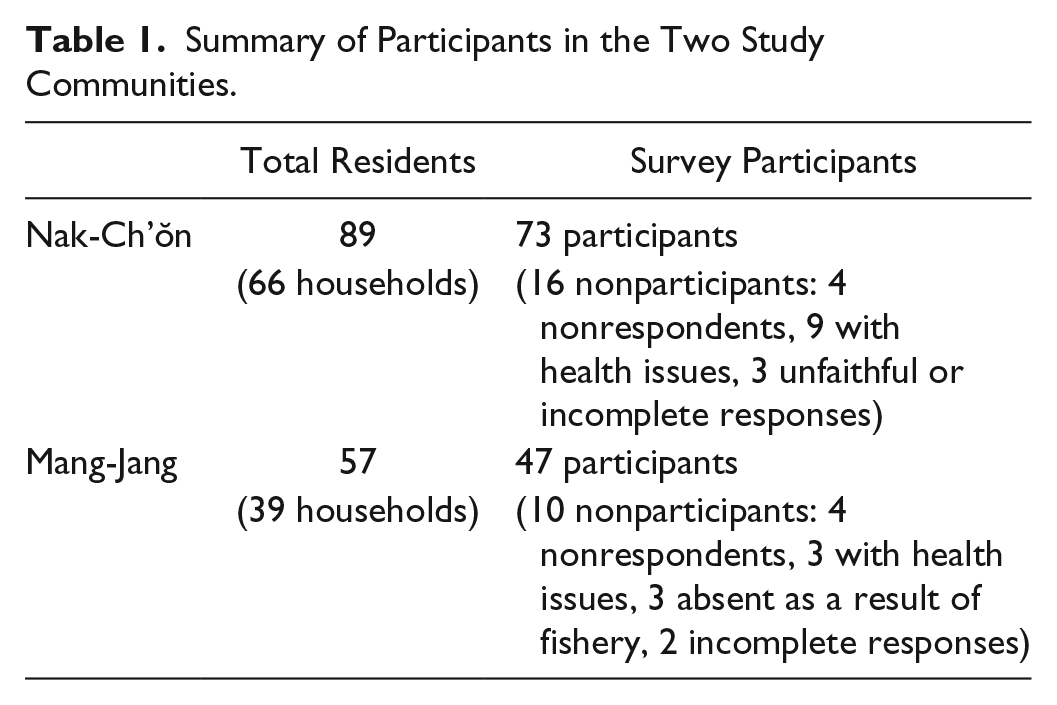
For the community survey, selected leaders were asked to provide a complete list of community residents. The first author visited all heads of household in both communities and asked them to participate in an interview (see Table 1 for sample description). During the community survey, each individual was asked about his or her social interactions (i.e., they dine or have a drink together or are invited to each other’s home). During the analyses, a two-way relationship was required (i.e., both residents acknowledging an interaction) before a meaningful network linkage was documented (Paxton 2002).
Summary of Participants in the Two Study Communities.
Centrality is a key factor in network analysis (Scott, Cooper, and Baggio 2008). The closeness centrality was measured with the network analysis software NetMiner. Closeness centrality allows identification of the extent to which residents are located at the margins or center (as the poles) within a community, which indicates participants who can quickly interact with others in problem solving and are more likely to hear information available within the network (Racherla and Hu 2010; Wasserman and Faust 1994). Social ties with community actors with a higher level of participation in the Olle project were identified through the top five names identified by community residents (names most given by respondents).
As the next step, the existence of relationships with these major actors was assessed based on personal networks, referred to as a sociomatrix. To assess relationships created through involvement in social organizations, residents’ attendance at meetings was used. Members who regularly attended the community meetings related to tourism development were considered individuals who could create social capital and therefore were more likely to participate in collective action. To measure the degree of trust, two items borrowed from Stone’s (2001) study influencing social capital were measured on a seven-point Likert-type scale. The questions were “If you were caring for a child and needed to go out for a while, are you comfortable asking a neighbor for help?” and “Most people in your community can be trusted?”
Subjective norms were measured using two items adapted from Ajzen (2002) based on a seven-point Likert-type scale (1 = strongly disagree to 7 = strongly agree). The questions were “People who are important to me think that I should participate in community activities” and “People who are important to me think that they should participate in community activities.” Degree of collective action in tourism development, the dependent variable, was measured using participation in Olle-related town meetings, town events related to the Olle Project, and the degree of involvement perceived by each individual (i.e., a self-rating of one’s behavior).
To measure residents’ participation, two measures were used in a combined scale. A self-rated participation measure, using a seven-point Likert-type scale (1 = Not at all active to 7 = Extremely active), was the following item: “What has been your level of involvement in Olle related community efforts?” An objective measure was related to participation in specific town meetings which were held in the community in relation with the Olle project, and were identified through analysis of the local newspaper. For each of the events listed that respondents attended, they were asked to check a box.
Results and Discussion
Hypothesis 1, which proposed a direct relationship between centrality of members in a network and the level of participation in collective action, was supported in both communities: Nak-Ch’ŏn (β = 4.221) and Mang-Jang (β = 11.407). The outcomes exhibited in Tables 2 and 3 suggest that for each degree increase in closeness centrality, the degree of participation in tourism development increases by 4.221 and 11.407 (using standardized betas) in Nak-Ch’on and Mang-Jang communities, respectively. The residents possessing a central position within the network were more likely to participate in collective activity related to tourism.
Multiple Regression for Social Capital and Collective Action Participation in the Nak-Ch’ŏn Community.
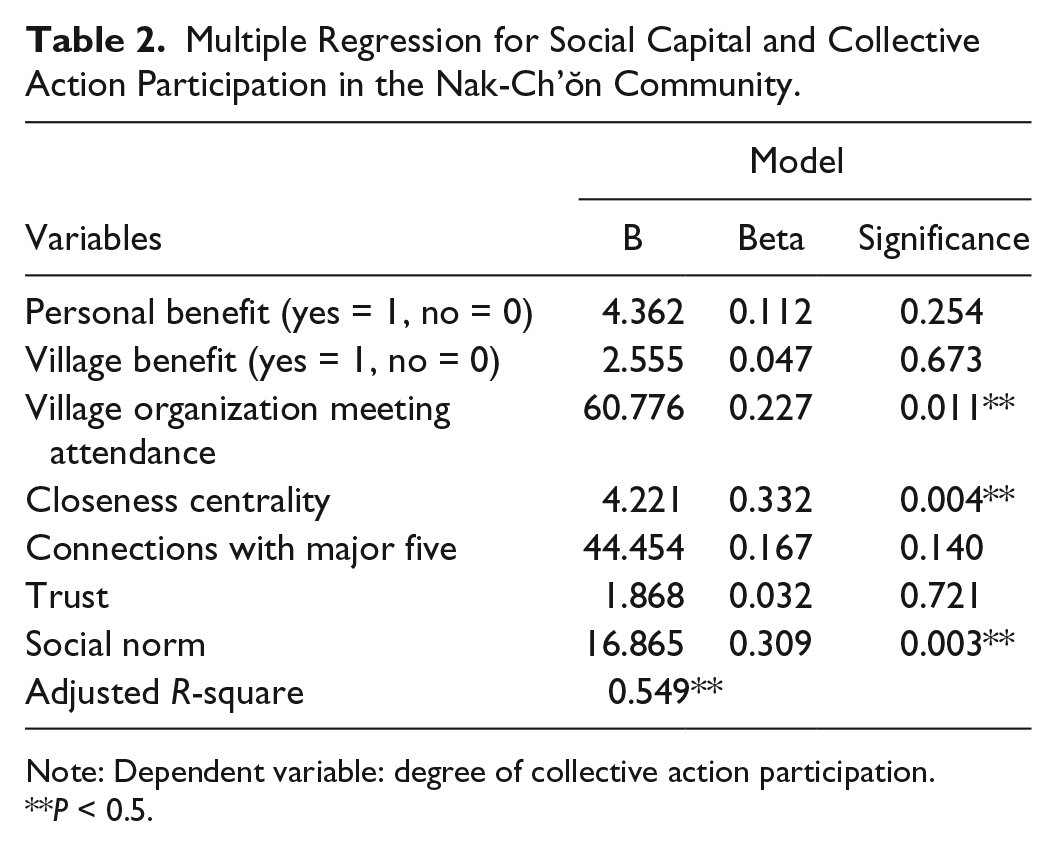
Note: Dependent variable: degree of collective action participation.
P < 0.5.
Multiple Regression for Social Capital and Collective Action Participation in the Mang-Jang Community.
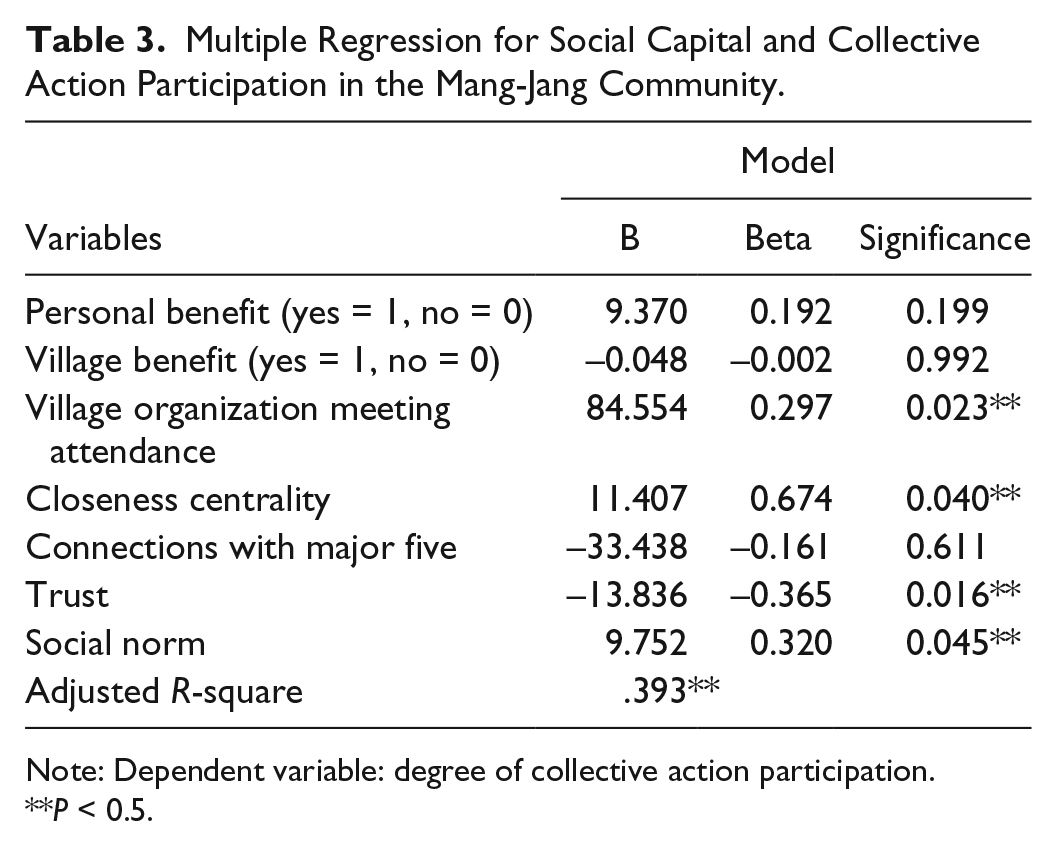
Note: Dependent variable: degree of collective action participation.
P < 0.5.
Strong networks as a tool for information sharing among the members was illustrated in the interview with a farmer from the Nak-Ch’ŏn community:
With the exception of maybe a very few old people, everyone knows about what happens in the village quickly whether it is good or bad news. As you might see, after dinner, many people hang out on the pavilion. Then, everyone finds out what is going on in the village.
The shared, intimate internal network among members has been used as an important tool to convey tourism-related information in a village to connected members. Although most villagers were not able to attend the development committee meetings because they were not a member of the committee, they were informed about the meeting the following day. This was considered to be a short period time for tourism-related information to be shared among the entire community. This was possible because members were closely sharing information with each other based on informal relationships. Furthermore, these personal networks shared among members have strong influence on behaviors of the members within the networks as the following quote reflects (a farmer from the Nak-Ch’ŏn community):
Directing different opinions toward one viewpoint [regarding the tourism theme for each village] started with the persuasion of the old to change their opinions. So, I persuaded my father to participate in the project. . . . Young villagers persuade their parents first and then move to aunts and uncles.
During the process of deciding a theme for each village’s Olle project, there were conflicts that emerged among residents. In the process of resolving conflicts, networks were used to persuade members of opposing groups to modify their opinions in the direction that supports the project and leads to their participation in activities for tourism development.
Hypothesis 2, which proposed that those with close relationships with others who are highly involved in the Olle program will have a comparatively high level of collective action, was not supported in either community: Nak-Ch’ŏn: β = 44.454, P > 0.05; and Mang-Jang: β = −33.438, P > 0.05. This outcome goes against the findings from previous social capital studies that emphasized the existence of close relationships among the actors as a critical element to motivate each individual’s collective action involvement (Putnam 1993; Coleman 1988).
There are several possible explanations for this finding that contradicts evidence from previous research. Membership in social organizations leads to participation in community-based activities, including tourism development. Hence, there were several people without close relationship to tourism leaders who participated in collective activity because of their membership in other social organizations. This was identified through further analysis on the outliers, which presented abnormally higher or lower degree of participation than others compared to their connections with the five major actors. This finding highlights the significance of personal relationships through participation in the same activity as a strategy to control each member’s behaviors.
A second reason for the lack of a significant relationship between the residents’ degree of participation in tourism development and ties to community tourism leaders is that the kinship ties are extensive within both communities. Information sharing may be faster and more efficient when residents are connected through kinship ties. Residents have multiple ways to access new information relevant to tourism and multiple pressures to participate based on their close relationships. These can be through informal routes (e.g., daily conversation with other villagers within both social and work settings) and also through formal routes (e.g., general village meetings, conversations during meetings).
Hypothesis 3, which proposed positive relationships between residents’ interactions with other members through active participation in social organization activities (e.g., youth, women’s, senior citizens groups), and the degree of participation in tourism development was supported in both communities, Nak-Ch’ŏn: β = 60.776, P < 0.05; and Mang-Jang: β = 84.555, P < 0.05. Residents’ tourism-related collective action involvement was conducted by placing the social organizations of a community at the center of social life. That is, most resident participation was practiced as a member of a social organization and led to active involvement.
The finding of the qualitative analysis also supports two elements as the driving force behind participation in tourism development. Mutual interactions and shared social pressure had a strong effect on residents’ participation in tourism. Each member’s behavior was strongly affected by social pressure according to their organization’s rules. This consequently works as the driving force to encourage organization members to actively participate in tourism-related collective action. These findings also support those of previous studies on social movement and collective action. Previous studies emphasize the roles of social organizations to allow members to discuss the nature of the collective goals and strategies. It also expands one’s understanding about the issues related to tourism and ultimately brings fragmented members together to achieve common goals (Goodwin and Jasper 2009; McAdam 1988; McGehee, Kline, and Knollenberg 2014). As emphasized in Putnam’s framework (1993), the active involvement of members in voluntary associations is an indicator of a high level of social capital. Strong social norms and trust will be created through interpersonal interactions as critical elements for achieving collective well-being.
In Nak-Ch’ŏn, most forms of participation were reflected in the direct involvement of social organizations. This trend is clearly presented by one of the farmers from the Nak-Ch’ŏn community:
We know it is important for success that each individual actively gets involved. This portion can be more successfully worked through the youth group’s participation and for other parts the women’s group. . . . Painting can be done better when all villagers work together. We learned that all work could be successfully done when we all work together! I think 90% of our villagers participated in the project. The youth group took charge of carrying chairs to the location and arranging them. The women’s group took charge of operating tourist activities . . . rather than helping with moving the chairs.
The village project in Nak-Ch’ŏn was being administrated based on specific role assignments to each social organization rather than the voluntary help by residents. Besides the joint efforts of the entire community, most participation in tourism could be actively conducted by placing the organizations at the center of tourism planning. The positive impacts of tourism were described by a farmer from the Nak-Ch’ŏn community:
When considering the current situation, villagers belong to social organizations whether it is the youth group, women’s group, or senior citizen’s organization. Since each villager belongs to one of them, it was possible that they actively participate in, and the project in our village can proceed smoothly without any major problem.
This farmer’s viewpoint demonstrated that residents perceived a social pressure to conform to the organization’s rules. The pressure from both social norms work as a driving force to encourage participation.
For hypothesis 4, findings regarding influence of trust on the level of residents’ participation were inconclusive. A high degree of trust did not have a statistically significant influence on degrees of collective action participation for Nak-Ch’ŏn (β = 1.868, P > 0.05). However, a negative association existed in Mang-Jang (β = −13.836, P < 0.05). This finding suggests that residents’ participation in Mang-Jang presents a 13.83 unit decrease as their trust increases 1 unit. A plausible explanation for the rejected hypothesis in Nak-Ch’ŏn community is that trust was consistently high and exhibited little variability, and thus, any statistical test connected to variability in trust would not result in significant differences. A finding of this study also identified a negative association between trust and tourism related collective action involvement in Mang-Jang. This finding is contrary to previous studies which emphasized the positive function of trust as a major element for the creation of social capital (Coleman 1990; Jones 2005).
One possible implication is associated with a free rider problem, that is, the higher the trust the more likely residents rely on others to do the work (Coleman 1990). The findings from the interviews in Mang-Jang suggest the potential for “free riders” (Nicolau and Mas 2014). However, rather than framing that as a problem, community residents forgive and understand another resident’s unexpected absence in a community-based effort. This understanding based on a strong degree of trust probably makes some members not actively participate in the tourism-related activity because they know their absence would be understood by the other members, who are connected as family. Furthermore, these individuals would be aware that although they are absent, others are willing to participate, which resulted in the free rider issue. The following quote from an interview with a farmer from Nak-Ch’ŏn explains the condition of a free rider:
When considering this [All residents are connected in the relationship of relatives], all villagers having different last names are all connected together as a family. For this reason, no villager can treat another villager as a stranger pointing out what the person did wrong because they are connected to each other and share the same genealogy.
For the community in which most members are closely connected with family, relatives, or friends’ relationships, there must be a strong degree of trust and deep understanding on other members’ behaviors based on that trust. The members who perceive such strong trust think that there will be members who will take care of the task without their participation or other members will generously forgive their absence during the collective actions. In turn, these thoughts negatively influence the members’ participation in tourism development.
Regarding subjective norms, a high degree of subjective norms exhibited significantly positive relationships with degrees of participation in tourism development in both communities, Nak-Ch’ŏn: β = 16.865, P < 0.05; and Mang-Jang, β = 9.752, P < 0.05. This finding suggests that in both communities, participation in tourism development will increase as each resident’s perceived social pressure increases. This outcome clearly supports previous findings of social capital, particularly conducted in collective action contexts, which emphasized the importance of shared rules, norms, and sanctions for facilitating the creation of social capital and successful collective action involvement (Park et al. 2012).
Qualitative results not only confirmed a positive association between social norms and social capital but also verified negative aspects of shared social norms on the residents’ involvement. The Nak-Ch’ŏn community has a long history of sharing strong obligations and pressure to assist others when help is needed. They felt pressure to participate in the community-based action for village work. These shared norms encourage involvement in collective action through prompting them to feel guilty for not matching the average contribution of their peers. They also sanction individuals who break commonly agreed-upon rules (e.g., the isolation of those individuals from future community work and relationships) and raise awareness that other members are participating in the collective action (Gould 1993, 2003; Ostrom 2000). Positive association between the existence of social norms and active participation in tourism development was demonstrated through an informant from the Nak-Ch’ŏn community:
When residents have a family event, people always come mainly because the person hosting a family event helped these people previously for similar events. It’s reciprocity. If I received one thing, then I also need to pay back the person someday. That’s the basic rule in our village. . . . In the rural society, this rule is always kept. If not, why should we attend the events hosted by other village members without getting our work done? . . . So, the villagers who did not care for other villagers’ family events may have difficulty in getting help from other villagers.
As illustrated in this interview, there was a social norm of reciprocity that has been tacitly shared among the Nak-Ch’ŏn community as a function of normal life. If a member received any help from a member of the community, he or she would feel a social pressure to reciprocate. If someone does not reciprocate, they cannot expect assistance from other residents. The existence of such social norms in a community forms peer pressure, which forces members of the community to pay more attention to what happens in their village and to be actively involved in community-based actions. Such positive association between the existence of social norms and participation in tourism development was identified through another interview from Nak-Ch’ŏn:
If I need to harvest garlic in our field, I need to hire someone to help me. The people hired from outside our village keep track of their working hours. They are going to only work from 7
This resident suggests there are expected behaviors shared among community residents. Behind this behavior is the expectation that the same amount of effort would be paid back in the future by the recipient. As indicated in the interview, such interaction is known as “Soon O Rum.” This is now considered a rule or agreement that should be kept and followed by members of the community. It is apparent that community members are assisting each other with expectations of future benefits and still maintaining this social norm by helping with extra work. This social pressure works as a driving force that facilitates the members’ participation in tourism development. As supported in this study, motivating social forces are a strong belief that other members are willing to participate and also fear of isolation as a result of one’s absence in tourism-related collective actions.
Strong social norms have also turned out to limit each member’s freedom by imposing collective action participation. This has clearly been presented through the relationships between new residents and the rest of the community as described in the following interview with a farmer from Nak-Ch’ŏn:
Newcomers have to come first to us. They have to go around the village to say hello and introduce themselves to the older residents in the village. They have to help other villagers with work. Don’t they hear the announcement related to the village events? I think they do and then they have to do something to help the events in the village. Why? If they’ve decided to live in our village, they have to come first and do something to help the local villagers.
As identified in the interview, there is strong social pressure in Nak-Ch’ŏn that forces newcomers to conform to existing conditions held by old-timers. This is presented as a form of isolation of the individuals who failed to conform to norms shared among villagers. In a worst-case scenario, the individuals were expelled from the community (a finding from another interview) as a result of their failure to conform. For this same reason, newcomers (i.e., those residents who did not grow up as children in the community) have incentives for active involvement in tourism-related collective action.
Conclusion
The study findings support several of the relationships in Figure 1. Residents’ social networks with others in the community have a positive influence on individuals’ behavior. Participation in collective action in tourism was based on social relationships shared with other residents and was effective at increasing residents’ involvement. Residents’ participation in tourism development was strongly affected by the number of connections with other residents and the quality of these ties (Liu et al. 2014; Park et al. 2012).
The networks created among residents function in several ways. First of all, a dense network based on close connections among residents functions as a communicative route for necessary information about tourism development to be circulated and shared effectively among members. In the long term, this dense network contributes to the creation of trust and social norms required for residents’ behavior and also for effective control of residents’ involvement into community-based tourism. Positive and continuous interactions among residents within a connected network contributed to the emergence of social norms (e.g., norm of trust, norm of reciprocity; Fukuyama 1995; Misztal 1996; Stone 2001; Woosnam, Dudensing, and Walker 2015). Subjective norms have a positive influence on residents’ involvement in community-based tourism. The shared norm encourages residents to interact with others through sanctions on members who violate and raising consciousness of those residents to follow the same rules (Gould 1993, 2003; Ostrom 2000).
Social networks also function as a communicative channel that norms and other cultural messages (e.g., shared behavioral expectations, frames, and collective identity) are transmitted and shared among residents (Goodwin and Jasper 2009; Gould 2003). Consequently, these positive and continuous interactions based on dense networks facilitate the creation of a collective identity of the community and in turn lead to collective action for tourism development (Li, Hsu, and Lawton 2015). However, networks may not always lead to increased participation in tourism development. If the social networks for a community are so dense, or in the case of this study, associated with a high level of trust, residents may leave certain functions (like tourism development) to a limited group of people and not feel pressure to participate.
The positive effect of shared relationships and social norms were maximized within membership of social organizations. Shared ties and positive interpersonal interactions within social organizations functioned to make each resident participate more actively in tourism efforts compared to residents who were relatively isolated. Each resident’s behavior was affected by mutually shared relationships with other members and also regulated by perceived social pressure. These mutual influences and perceived pressure functioned naturally to encourage the residents to actively participate in community-based tourism efforts. Goodwin and Jasper (2009) postulate the critical role of organizations to successfully mobilize social movements. They especially focused on their function as a space not only allowing the members to share and accept new information rapidly but also preventing members from dropping out. The finding that shared relationships and perceived pressure within preexisting community structures function to enhance residents’ participation in tourism development adds an additional layer beyond personal ties as a force behind tourism development.
As limitations, the two study communities were part of a network of rural tourism communities held together by a series of hiking trails in a well-known tourism destination of South Korea. The findings reflect this study context, and to the extent that the findings are transferable elsewhere, future applications should be attentive to differences in size and culture of community, as well as the kind of tourism being developed. In addition, the interviews did not indicate differences in social and political power between the informants interviewed and other members of communities. Their comments were cross-checked with the comments by two informants who did not participate in the collective action (i.e., one informant per each community) and participative observation by the researcher. Both the informants and the observational notes do not suggest the presence of power differentials or oppression; however, further probing of the informants and increased number of informants would be useful to further validate the lack of oppression.
Beyond the hypotheses of this study, an exploratory finding supported reciprocal relationships between social capital and tourism-related collective action. Not only is a high degree of social capital an explanatory factor for residents’ collective action in tourism, but vice versa, residents’ experience of collective action functions as an important element to enhance the degree of social capital within a community. This finding converges with McGehee et al. (2010), who found that the enhancement of social capital through collective action contributes to the maintenance and creation of a collective identity.
This study advanced the understanding of community-based collective action in tourism and broadened previous tourism impact studies in doing so. Social networks are a critical element that encourages residents’ collective participation in tourism development activity. The study contributed to understanding relationships between social capital and tourism-related collective action by identifying specific network conditions of social capital, which delineated beneficial connections to encourage residents’ participation.
As a practical implication, this research holds promise to contribute to tourism development in the two study communities. The research demonstrates effective use of collective action for advancing tourism development and providing a sustainable community-based structure. Residents who are not well connected within the community social network are generally associated with low participation in collective action. This finding suggests that leaders may want to engage various community-based organizations to facilitate residential interaction or reach out to others. As part of any reach-out efforts, leaders may learn reasons for their weak ties with others in the community. As stated in the study findings, encouragement of residents to be involved in social activities in the community may facilitate future participation in tourism development. Leaders may begin with the efforts that offer the marginalized or isolated ones more chances for informal gatherings that enable them to share ideas with others in a village (e.g., having lunch or dinner together, having casual conversations, getting invited to each other’s houses). These social gatherings may function as a cornerstone to lead them to productive conversations about community issues and the future of tourism. In addition, such reach-out efforts also may enhance community-based trust, which was found to increase leader effectiveness and may have implications for participation in collective action for tourism.
Footnotes
Acknowledgements
The authors are grateful for Dr. Carla Costa for her advice in the initial phase of this research, and to several anonymous reviewers whose comments helped improve this paper.
Declaration of Conflicting Interests
The author(s) declared no potential conflicts of interest with respect to the research, authorship, and/or publication of this article.
Funding
The author(s) received no financial support for the research, authorship, and/or publication of this article.