




Abstract
A new model that links climate and seasonal tourism demand is developed to study the effects of home climate, destination climate, and climate difference between destinations and source markets on seasonal tourism demand. Using the dynamic panel data technique, the study focuses on the demand of tourists from Hong Kong for 19 of the major tourism cities in Mainland China. The results show that the home climate, destination climate, and the difference in climate between home and destination cities all have significant influence on tourism demand. Furthermore, demand for Mainland Chinese tourism among Hong Kong residents is found to be driven by the climate at the place of origin, while the effects of destination climate and climate difference are weaker.
Introduction
It is well recognized that tourism in most destinations is seasonal (Martín and Belén 2005). Tourism demand seasonality is caused by two basic components: climatic conditions and leisure time (Butler 1994). “Natural seasonality” refers to the regular changes in climatic conditions at a particular destination during specific periods of the year (Koenig-Lewis and Bischoff 2005). According to Martín and Belén (2005), the climates of both the place of origin and destination influence the timing of travel, further determining the season length and quality of tourism in different regions. Moreover, certain types of tourism are highly affected by seasonality because climate is usually treated as an input in the creation of the tourism product, such as tourism for beaches, winter sports, and water sports (Martín and Belén 2005). However, the relationship between climate and tourism demand is still underresearched (Lohmann and Kaim 1999; Scott and Lemieux 2010; Denstadli, Jacobsen, and Lohmann 2011). Scott and Lemieux (2010) argued that the interaction between climate and tourism is multifaceted and complex. Climate affects tourists (travel motivations, capacity to travel, perceptions of the destination), transportation systems (aircrafts, railways, roads, and ships), and destinations (tourism operators, communities, regulators, insurers/investors, and national tourism organizations). Wall and Badke (1994) conducted an international survey and found that 81% of 66 national and regional tourism organizations considered weather and climate to be the key determinants of tourism to their countries/regions.
The Tourism Climate Index (TCI) developed by Mieczkowski (1985) has been widely used to describe the attractiveness of different tourist destinations (Denstadli, Jacobsen, and Lohmann 2011). TCI is a weighted index indicating the relative importance of the weather and climate variables in terms of their contribution toward tourists’ well-being. Some studies have used this index to model tourism demand (e.g., Goh 2012; Moore 2010; Goh, Law, and Mok 2008; Harrison, Winterbottom, and Sheppard 1999; Amelung, Nicholls, and Viner 2007; Hein 2007). However, research on the relationship between climate/weather and tourist behavior should not be based solely on how climatic dimensions affect tourists’ comfort or well-being. Instead, research should consider a variety of tourists’ interests and motivations in their travel-related decision making (Denstadli, Jacobsen, and Lohmann 2011). For example, tourists might visit places with unfavorable or unpredictable weather conditions based on their interest in exploring places and landscapes they have not visited before (Jacobsen 2001). Previous studies also suggest that novelty seeking is a key motivator for tourists when choosing a destination (Chang, Wall, and Chu 2006; Cohen 1972; Crompton 1979; Dann 1981; Lee and Crompton 1992; Oh, Uysal, and Weaver 1995; Yuan and McDonald 1990).
China is a vast country with diverse climatic and weather conditions that greatly affect the patterns and seasonality of both its domestic and international tourism. Zhou-Grundy and Turner (2014) argued that weather elements must be considered in modeling and forecasting China’s regional tourism demand because China’s territory covers several climate zones, from extreme cold in the north to tropical heat in the south, from a desert environment in the west to a coastal Mediterranean climate in the east. China’s tourism data thus represent an ideal data set to explore the relationship between the weather, climate conditions, and tourism demand. In 2012, China welcomed 132 million inbound tourists, which placed the country among the top three destinations in the world (World Travel and Tourism Council 2013). Of these visitors, 59.45% came from Hong Kong (China National Tourism Administration [CNTA] 2013). Even if we consider only overnight visitors, in 2012, about 57 million inbound overnight visitors traveled to China. Of these visitors, Hong Kong tourists comprised 46.89% (CNTA 2013). Hong Kong is therefore one of the most important inbound source markets for Mainland China’s tourism industry.
China can be divided broadly into seven regions according to climate, geography, and socioeconomic development: East China, South China, North China, Central China, Northeast China, Southwest China, and Northwest China. The geographic conditions of these regions have a particularly strong influence on their climate patterns and natural attributes. As a result, China’s tourism industry, including Hong Kong, exhibits strong seasonality within its regions (Li 2009). Figure 1 shows the seasonal variations in demand for Mainland tourism among Hong Kong residents.
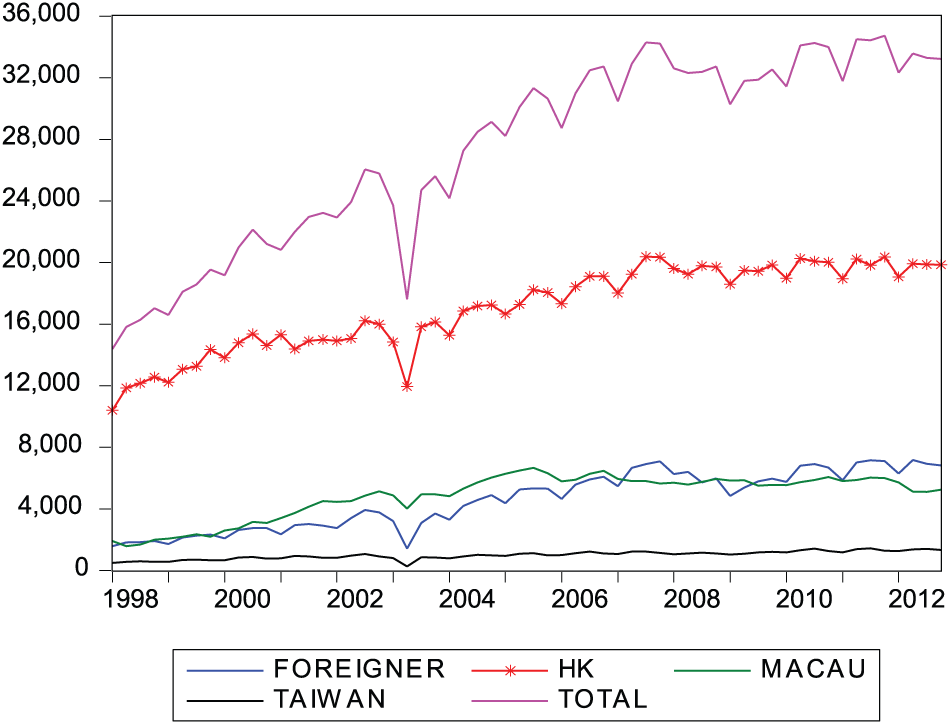
Tourist arrivals to China.
The aim of this study is to establish a link between climate and tourism demand with empirical evidence based on the data of the demand for Mainland Chinese tourism among Hong Kong residents. However, because the territory of China is very large with varying climates, this study focuses on 19 major tourism cities distributed among the aforementioned seven regions in Mainland China: Beijing, Tianjin, Dalian, Qingdao, Jinan, Shenyang, Changchun, Harbin, Shanghai, Nanjing, Hangzhou, Wuhan, Chengdu, Guilin, Guangzhou, Haikou, Chongqing, Kunming, and Xi’an.
The contributions of this research are multiple. First, this study provides a new and comprehensive research framework for the statistical analysis of the effect of climate on seasonal tourism demand. Second, it assesses not only the effects of destination climate and home climate on tourism demand but also the influence of differences between the home and destination climates on tourism demand, which enriches the literature on the influence of climate on tourism demand. Third, unlike previous studies, which ignored seasonal tourism demand at destinations with different climate conditions (Eugenio-Martin and Campos-Soria 2010), this study uses city-level data to differentiate the different tourism demand patterns caused by climate variations. Fourth, this study contributes to the modeling of regional tourism demand by introducing new climate variables into the tourism demand model with a view to explaining the regional tourism demand using city-level data. The empirical results of the study contribute not only to the literature on the effect of climate on tourism demand, but also that on regional tourism demand analysis. The research findings also provide policy makers in both the private and public sectors with useful recommendations for formulating sustainable tourism marketing and development policies.
Literature Review
Destination Climate and Tourist Destination Choice
Previous studies have investigated the effects of destination weather and climate on tourists’ motivations (Klenosky 2002; Kozak 2002; Mintel International Group 1991), the attractiveness and image of the destination (Hu and Ritchie 1993; Pike 2002), travel experience (Jones, Scott, and Khaled 2006), timing of travel (Lohmann and Kaim 1999; Scott and Lemieux 2010), destination choice behavior, and subsequent tourist visitation decisions (Hamilton 2004; Kozak, Uysal, and Birkan 2008; Wilson and Becken 2011). Many studies have confirmed that tourists are motivated to experience different climates, including studies of German, British, and Canadian tourists (Lohmann and Kaim 1999; Scott and Lemieux 2010; Becken 2010). In a British survey carried out by the Mintel International Group (1991), 73% of respondents stated that “good weather” is the key factor for going abroad. Likewise, Kozak (2002) found that “enjoying good weather” is the major factor for travel among German and British tourists in Mallorca and Turkey. Similarly, Klenosky (2002) found that warm climate is a pull factor for those hoping to relax and get a suntan.
Hu and Ritchie (1993) reviewed destination image studies published between the 1970s and 1980s and found that natural beauty and climate are of universal importance in determining a destination’s attractiveness. Pike (2002) reviewed 142 papers on destination images published between 1973 and 2000 and found climate to be a central factor influencing destination image. Jones, Scott, and Khaled (2006) found that climate is important in determining the visitor’s experience, especially for special outdoor events.
Using a nested multinomial logit model, Eymann and Ronning (1997) analyzed the determinants of individuals’ destination and vacation activity choices and found that destination climate is a major determinant. Lohmann and Kaim (1999) found that climate and bio-climate are the third and eighth most influential factors in the destination choices of German tourists. In a study on German tourists departing from Hamburg to various foreign destinations in the summer of 2004, Hamilton (2004) confirmed that climate and sea access were the most important characteristics when choosing a destination. In another study on destination choices, Hamilton and Lau (2004) found that most respondents identified climate as an important destination attribute, the maximum temperature being the dominant climatic attribute (Table 1). Uyarra and colleagues (2005) undertook a similar analysis on tourists who visited the islands of Bonaire and Barbados and found that warm temperatures, clear waters, and low health risks were the main environmental features that had affected their decision to visit these islands. Data on international tourists visiting Zanzibar, Tanzania, point to the same conclusion (Gössling et al. 2006). Using a large database of 45 countries (spanning all continents and climates), Bigano, Hamilton, and Tol (2006) found that tourists prefer countries with a sunny yet mild climate that is neither too hot nor too cold when choosing their destination.
Importance of Destination and Climate Attributes.
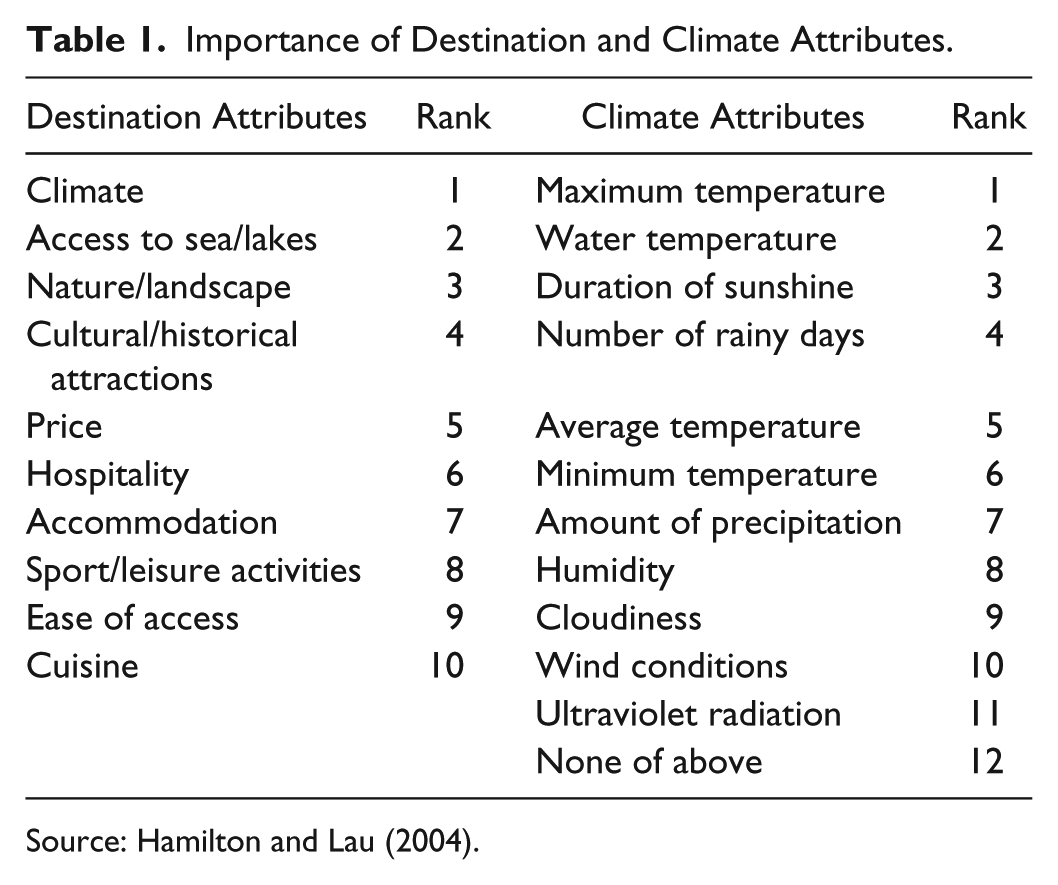
Source: Hamilton and Lau (2004).
These studies provide a good understanding of the climatic/weather factors that might affect tourists’ destination choices. However, the empirical analyses of these studies were not well grounded in a theoretical framework like demand theory. Therefore, they face the possible criticism of being atheoretical; that is, the conclusions of these studies may not be generalized to different origin–destination pairs where the climatic/weather conditions are different.
Effects of Destination Climate on Tourism Demand
Most studies on the effects of climate on tourism demand have focused mainly on the effects of destination climate on tourist arrivals using annual data, while only a handful of studies have examined the relationship between climate variation and seasonal tourism demand.
Arbel and Ravid (1985) looked at the demand for a state park in New York using the time-series econometric approach. They incorporated average monthly temperature and precipitation into their demand model to explain seasonal demand patterns. The results showed that the demand for park visitation usually dropped during cold or rainy seasons. Goh, Law, and Mok (2008) analyzed the seasonal demand for Hong Kong tourism among U.S. and UK residents using the rough sets approach. They also used TCI—developed by Mieczkowski (1985)—to represent the comfort level of the destination climate. The results indicated that the comfort level of the destination climate had a significant positive effect on tourism demand and explained the variability of monthly tourist arrivals better than economic factors.
Using the error-correction model, Goh (2012) studied tourism demand from major source markets (long-haul markets: the United States and United Kingdom; short-haul markets: Japan and China) to Hong Kong. Destination climate was incorporated into a standard tourism demand model controlling for traditional economic variables. Goh also used TCI to represent destination climate comfort, and the results were similar to those of the earlier study (Goh, Law, and Mok 2008). Most recently, Becken (2013) used two cases to analyze the impact of climate on the seasonal variation of visitor nights in a wetland park and a visitor center in Franz Josef Township in New Zealand. She found that seasonality in the wetland was largely driven by temperature, while visitation to the visitor center was mainly affected by daily weather conditions.
The panel data technique has also been used to examine the relationship between climate and tourism demand. Based on monthly tourism data, Bigano et al. (2005) explored the impact of temperature and precipitation on domestic tourism demand in Italy. They found that with the exception of winter sports regions, temperature and precipitation had significant effects on seasonal tourism demand. In particular, temperature was the strongest factor influencing domestic tourism demand in Italy. Their empirical results also showed that the impact of climate on tourism demand varied according to destination type. For instance, they found that the demand for coastal resorts responded more favorably to summer temperature increases than demand for inland resorts.
Taylor and Ortiz (2009) used panel data techniques to study the effects of temperature, precipitation, and sunny conditions on domestic tourism demand in the United Kingdom. They found that monthly climate variables of temperature and sunshine hours had positive effects on three major indicators of domestic tourism, including bed nights, trips, and expenditures. However, the impact of precipitation was not significant. Using a panel model, Moore (2010) used the relative climate index to examine climate’s influence on the demand for Caribbean tourism and found that changes in the seasonal climatic features of a destination relative to those of its competitors led to substitution away from that destination.
Based on an eight-year panel data set of 254 Italian municipalities, Cai et al. (2010) examined the responsiveness of tourist arrivals and the average length of stay to local weather conditions. They broke down temperature into four components: winter, spring, summer, and fall temperatures. The results indicate that temperature at the destination had a significant effect on both domestic and international tourist flows to the region. It was also observed that the destination climate variables had a much stronger effect on domestic tourism demand than on international tourism demand. This may be a reflection of different tourist segments taking different weather conditions into account when making their travel arrangements. The influence of climate on tourism demand also varied across municipalities depending on the type of attractions they offered, such as arts-and-business, hill-and-countryside, sea destinations, and mountain destinations.
The above-mentioned studies have made good attempts to link destination weather conditions with tourist arrivals (no matter whether international or domestic) and shed useful light on the importance of destinations’ weather and climate variables on their tourism demand relative to the effect of economic variables such as tourist income and the costs of tourism in the destination among others. However, these studies did not consider the influence of the weather/climate conditions in the home country/region on the demand for travel.
Effects of Home Climate on Tourism Demand
Climate drives global and national tourist flows, both as a result of tourists’ preferences for a particular climate that suits their holiday activities and in response to weather conditions in tourists’ home countries (Becken 2010, 2013; Maddison 2001). Unfavorable climates or poor weather conditions, either in the year of travel or the previous year (Agnew and Palutikof 2006), act as a push factor for tourists to travel to warmer and drier locations (Lise and Tol 2002). A warmer-than-average summer by 1ºC was found to increase domestic tourism expenditure in Canada by 4% (Wilton and Wirjanto 1998). Hill (2009) observed that despite the global economic recession in 2008–2009, there was an increase in bookings for foreign holidays in the United Kingdom during the rainy season in early summer. However, very few studies have considered home climate as a determinant for domestic or outbound tourism (Eugenio-Martin and Campos-Soria 2010). These studies are summarized below.
First, home climate can significantly affect tourism demand. Saverimuttu and Varua (2014) used a time-series tourism demand model for the period 1994–2011 to test the hypothesis that climate variability in the country of origin (in this case, the United States) is a “push factor” for tourism to the Philippines. The results show that U.S. tourist arrivals in the Philippines significantly increased when the United States had a prevailing cold climate/season.
Second, climate or weather (as the short-term manifestation of climate) in the country of origin affects outbound and domestic tourism differently. Agnew and Palutikof (2006) analyzed the sensitivity of UK tourism to climate change (on intra- and inter-annual scales) and found that outbound tourism demand was more sensitive to climate variations within the preceding year, whereas domestic tourism demand was more sensitive to climate variations in the year of travel. They also found that wetter- and colder-than-average conditions in the preceding year increased the number of outbound trips, whereas drier- and warmer-than-average conditions encouraged domestic trips within the same month. Rosselló-Nadal, Riera-Font, and Cárdenas (2011) found that higher temperatures in the United Kingdom affected British outbound tourism negatively in the following year, but led to a higher propensity to travel domestically in the same year.
Third, several studies have explored the impact of home climate on the substitution between domestic and outbound tourism. Eugenio-Martin and Campos-Soria (2010, 2011) quantified the relationship between home climate and destination choice using a bivariate probit model, GIS, and nonparametric techniques. The results show that home climate is a strong determinant of holiday destination choice. Residents in regions with better climate indices (e.g., those residing in regions where the climate is comfortable during most months) were more likely to travel domestically rather than abroad.
Eugenio-Martin and Campos-Soria (2014) found that tourists from different European regions (165 regions of EU-27 countries) reacted differently to climate variables. They also showed that during an economic crisis, tourists’ decisions to decrease spending on tourism depended on climate conditions at place of origin, Gross Domestic Product (GDP), or GDP growth of the source markets. It is interesting to note that households in regions with uncomfortable climates were less likely to cut back than those located in regions with comfortable climates. In addition, while one may assume that the global economic crisis would lead to a decrease in international tourism, in some countries, it was found to bring new opportunities for domestic tourism by improving its competitiveness relative to international destinations, as a result of budget constraints. However, such behaviors are not consistent across source markets. Regions with comfortable climates are more likely to switch between international and domestic tourism than regions with uncomfortable climates.
These studies emphasized the importance of the weather/climate conditions in the country/region of origin on the demand for travel, which is useful and appropriate in explaining why people want to get away from their home country/region with a view to holidaying in a warmer and more comfortable destination, but these home country/region weather variables can only partially reflect the influence of changes in weather on travel demand for when they make their travel decisions, tourists also often compare the weather conditions of the destination with those of the country/region where they live. To overcome this limitation, researchers need to examine the influence of weather/climate conditions in both the place of origin and the destination, especially the impact of the weather differentials between the origin–destination pairs on tourism demand.
Effects of Climate Difference on Tourism Demand
Climate difference, which is quite different from the concept of climate comfort in previous studies, is a potential travel motivation that has rarely been studied. Several studies support the possibility of climate difference as a motivation for travel. Denstadli, Jacobsen, and Lohmann (2011) examined summer vacationers’ perceptions of weather conditions in Scandinavia. Evidence from a survey in an archipelago north of the Arctic Circle showed that most tourists considered weather conditions during their stay to be fairly comfortable. This result demonstrates that when evaluating whether the weather is suitable for tourism, one should take into account travelers’ motivations and intentions in addition to comfort or well-being.
Furthermore, Martín and Belén (2005) pointed out that the terms “comfortable climate” or “good weather” are entirely relative because they depend on the activity tourists wish to engage in. What might be considered a “comfortable climate” by some may be the opposite for others. This implies that tourists may decide to visit places with what could be perceived as unfavorable or unpredictable weather conditions because of their interest in exploring interesting or famous places and landscapes or climates that they have not experienced before (Jacobsen 2001).
In addition, Cohen (1972, 165) argues that modern man is interested in things, sights, customs, and cultures different from his own precisely because they are different. The novelty-seeking motives of tourists can also explain their choice of destination (Crompton 1979). Petrick (2002) asserted that novelty influences tourists’ decisions to visit a destination. “Otherness” or novelty may be experienced in places with a climate that differs from that of the place of origin. Therefore, seeking a special climate—especially a climate that differs from that of the source region—should be considered when studying the relationship between climate and tourism demand.
Although the weather differentials between home and destination countries are well understood according to the studies mentioned above, there has been no attempt to systematically investigate the extent to which the weather differential affects tourism demand using both country-level and regional-level data. The current study aims to fill this gap.
Rationales for the Current Study
Based on the literature review, one can see that almost all previous studies have focused on the effect of climate comfort on tourism demand, be it home climate as a push factor or destination climate as a pull factor. Furthermore, the studies reviewed in the previous sections have reached several consistent conclusions, including the following: (a) there is a positive relationship between destination climate comfort and tourism demand; (b) there is a negative relationship between home climate comfort and outbound tourism demand and a positive relationship between home climate comfort and domestic tourism demand. However, the relationship between climate and tourism demand may be more complex than expected. The published studies have a few limitations, which are summarized below.
First, most of these studies have estimated the effects of either home climate comfort or destination climate comfort on tourism demand as a push or pull factor, but none of them has tested the joint effects of the destination and home climates on tourism demand.
Second, apart from climate comfort, no studies have explored the influence of climate difference between the destination and home country/region on tourism demand (even when the destination’s weather is perceived as unfavorable/uncomfortable).
Third, one of the major drawbacks of the methods used in previous studies is that the empirical analysis is usually conducted at the national level, ignoring the remarkable climatic variations that can exist within a country. This is particularly relevant for large countries such as China and the United States, and leads to inaccurate assessment of the impact of climate on tourism demand.
Fourth, very little effort has been made to model and forecast inbound tourism demand using econometric methods at the city level, not only in China but also in other countries, with the exception of Tukamushaba, Lin, and Bwire (forthcoming) and Vu and Turner (2006). The reason why the climate variable has not been included in most of the demand studies is that these studies assumed that the climate variables do not change over time and are not a unique product of a destination. Moreover, no previous research has explored the effect of climate on tourism demand for Mainland China, mainly because of the huge climatic variations among different regions within the country and the unavailability of both regional climatic and tourism data.
On this basis, this study proposes a new and more comprehensive framework to study the effects of climate on tourism demand (see Figure 2).
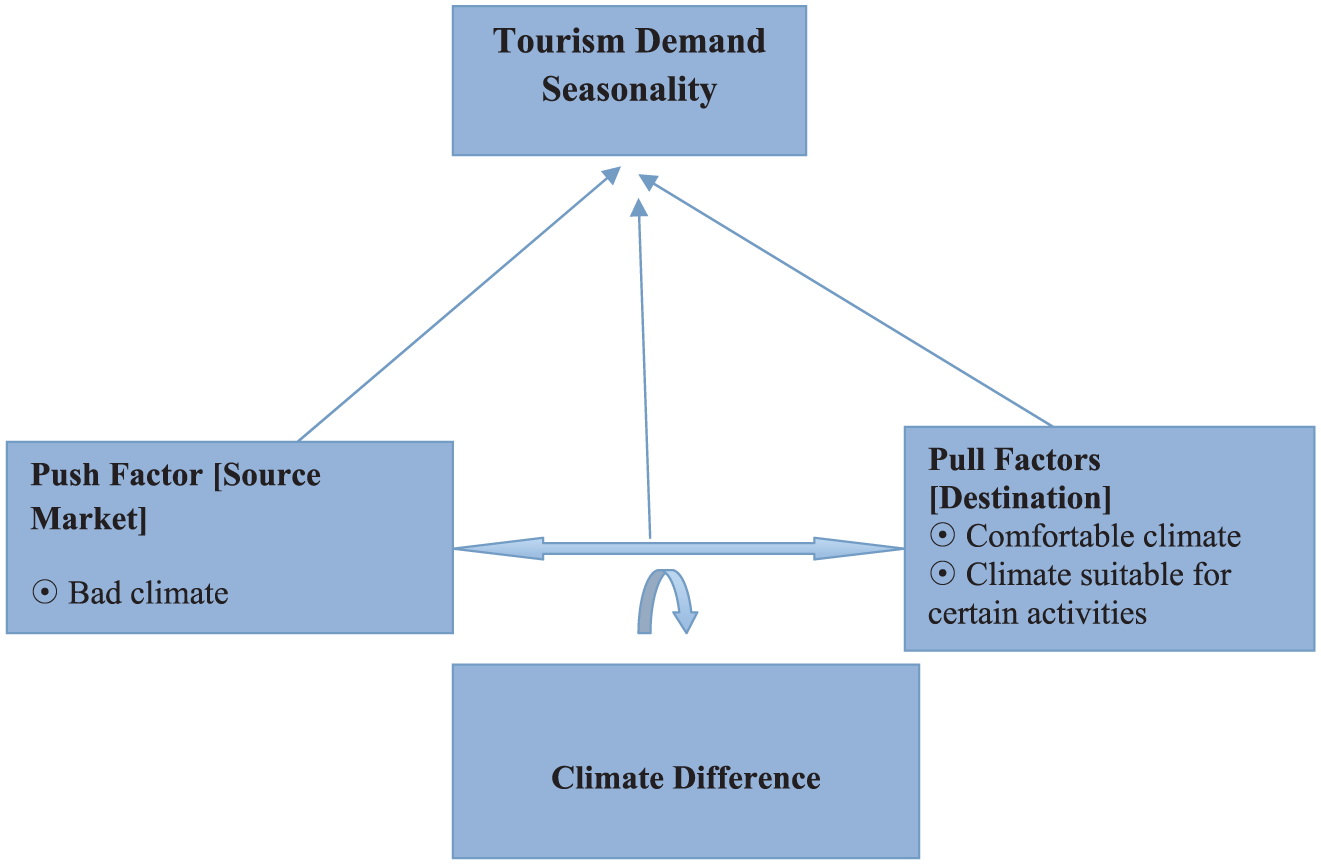
Theoretical framework: The effect of climate on tourism demand seasonality.
This framework is based on the model of “push and pull factors causing seasonality in the tourist destination” developed by Koenig-Lewis and Bischoff (2005), in which the tourism-generating region’s climate is treated as the push factor and the climate in the tourism destination is treated as the pull factor. In this new framework, the “pull and push model” incorporates the effect of climate difference between destination climate and home climate on tourism demand.
Methodology
This study uses data on the demand for Mainland Chinese tourism among tourists from Hong Kong, although we expect that the research findings can be generalized to other destinations where various climates shape seasonal tourism demand patterns.
Model Specification
To customize the empirical model, this study augments the standard tourism demand model with climate variables that belong to the noneconomic determinants of tourism demand (Cho 2010; Falk 2013). From a theoretical point of view, it is possible to limit the number of independent variables because previous research has clearly defined the most important economic factors that affect tourism demand. These factors include income in the country of origin, word-of-mouth (WOM) effect or habit persistence effect, and the price of the destination relative to those of the country of origin. Substitute price is omitted in this study because of the difficulty in identifying substitute destinations for China (Crouch 1995; Lim 1997; Song et al. 2010; Song and Lin 2010).
This study also incorporates climate factors into the standard tourism demand model. Previous studies have often used temperature as a key variable to model tourist visitation (e.g., Hamilton and Tol 2007; Serquet and Rebetez 2011), which includes maximum, minimum, and average temperatures. Furthermore, a number of other climate variables besides temperature have also been used to predict tourist flows, including precipitation, relative humidity, wind speed, and cloudiness (Becken 2013). Becken (2013) included maximum temperature, minimum temperature, rain, sunshine, wind speed, and relative humidity as potentially important predictors. Similarly, De Freitas (2003) suggested that tourism is influenced by a number of weather conditions, including aesthetic factors (e.g., sunshine, solar radiation, high visibility, and cloud cover) and physical factors (wind and rain). By considering both the climatic factors used in previous studies and the climatic data available in Mainland China, this study used the following six climatic factors in the standard tourism demand model: maximum temperature, minimum temperature, average temperature, average humidity, average precipitation, and average hours of sunshine.
Based on the above descriptions, the models used in this study are as follows:
Model 1: Standard tourism demand model
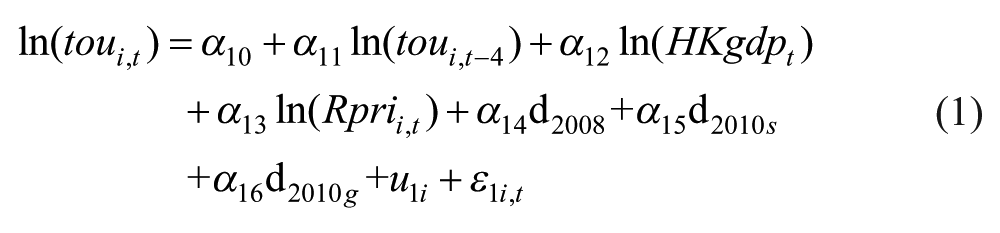
where
Model 2: Destination climate

where
Model 3: Home climate
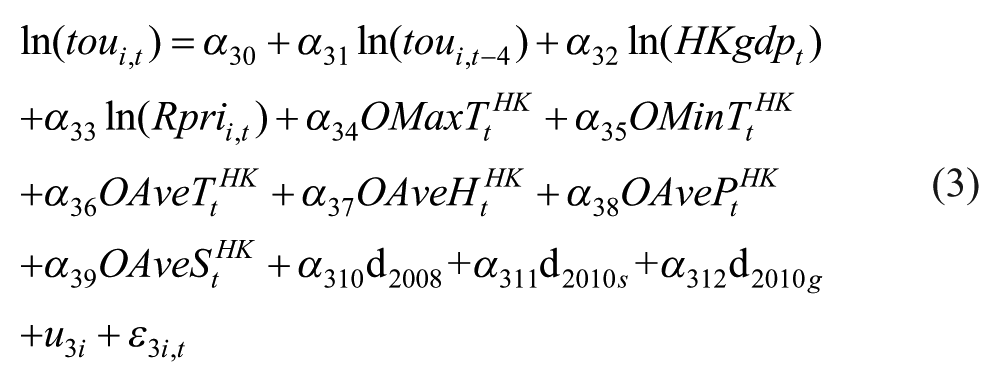
where
Model 4: Climate difference

where
Although other variables, such as marketing expenditure, travel costs, and holidays in the country of origin, are expected to have effects on tourists’ decision to travel to a destination from different points of origin, data on the three variables are either unavailable or difficult to measure (Goh, Law, and Mok 2008; Song and Lin 2010). Moreover, the nature of the panel data enabled us to control these factors when they were time invariant (Falk 2010), and the panel data model used in this study can reduce the potential effect of omitted variable bias (Hsiao 2003, 5–6).
Data Source and Descriptive Statistics
This study used secondary quarterly data. Data on tourist arrivals were collected from the China National Tourism Administration based on visa information. Climatological data on the 19 cities in China and Hong Kong were collected from the China Meteorological Administration and the Hong Kong Observatory. With 2005 as the base year, the independent variables of GDP per capita of Hong Kong (in U.S. dollars [USD]), the CPI of Hong Kong, the exchange rate of Hong Kong dollars to USD, and the exchange rate of RMB to USD were obtained from the latest edition of the IMF International Financial Statistics Yearbook (2006-2011). The CPIs of the 19 cities in Mainland China were collected from Chinese Statistical Yearbooks (2006-2011) via the CEIC China database, also using 2005 as the benchmark year.
The time frame 2006 Q01–2011 Q04 was chosen in this study because it is the longest period of time available for both seasonal tourist and climatic variables. The 19 cities listed above were chosen for the following reasons. First, the China National Tourism Administration (CNTA) website only provides seasonal tourist arrival data for 28 tourism-receiving cities. Of these 28 cities, economic data (GDP and CPI) and climatic data are only available for 19. Second, most of the 19 cities exhibited significant seasonality in tourist arrivals from Hong Kong.
Table 2 shows the descriptive statistics for the variables used in the study across the destination cities and over time. Considerable variation was observed for most variables, except for Hong Kong GDP and relative price. The relatively small variation in GDP is evidenced by the between-group standard deviation of 0, which is the result of the fact that this study uses a single origin (Hong Kong). The relatively small variation in the relative price is attributed to the similarity in price levels of all destination cities within China.
Descriptive Statistics: Variation between Destination Cities and over Time (2006 Q1–2011 Q4).
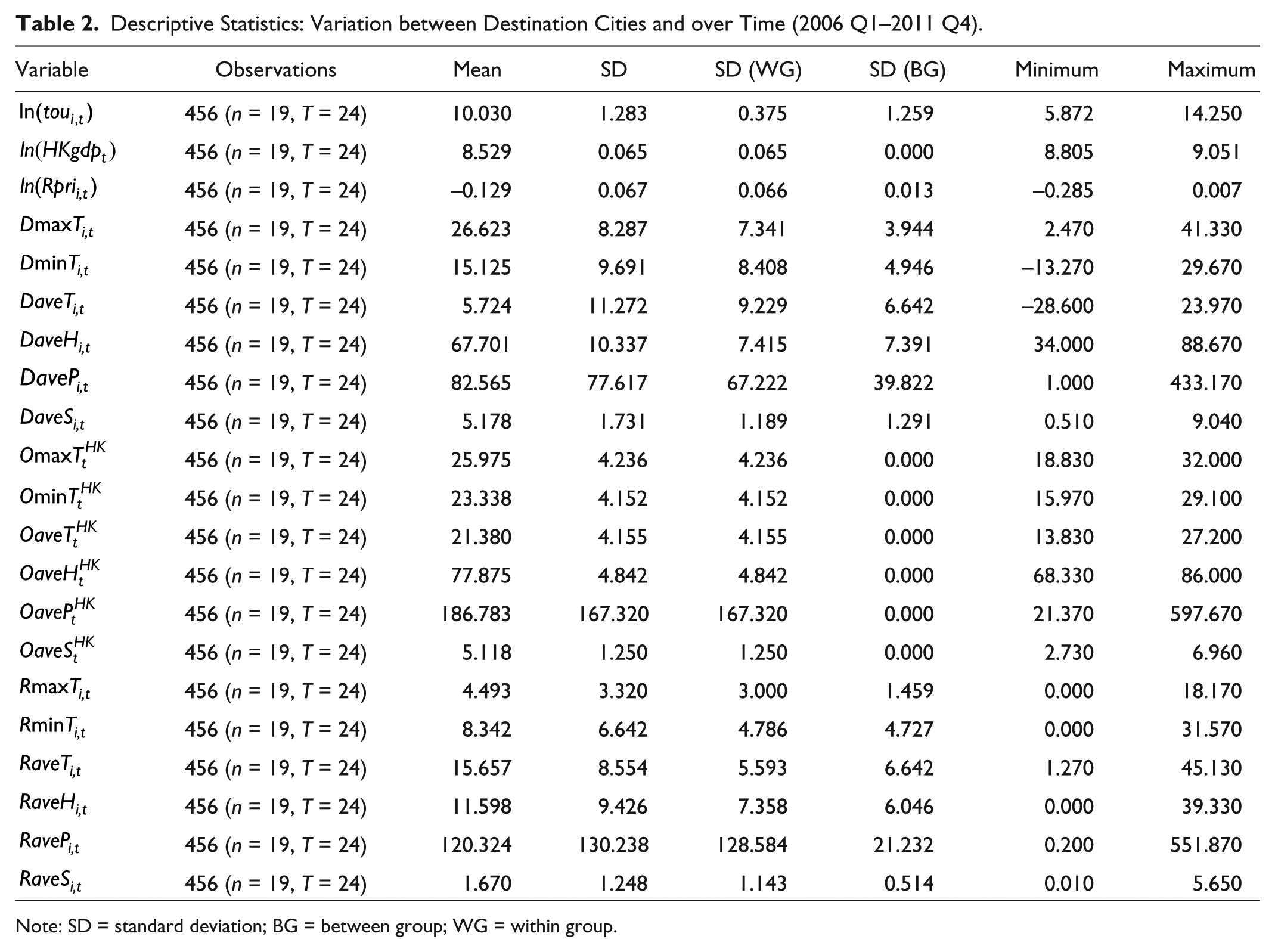
Note: SD = standard deviation; BG = between group; WG = within group.
Empirical Results
Including a lagged dependent variable,
Model 1 in Table 3 estimates Equation (1) of the traditional tourism demand model without climatic factors. The estimated coefficients for the independent variables are largely consistent with those in previous studies. The fourth-order lag of tourism demand, which represents the WOM or the habit persistence effect, has a significant positive effect (coefficient = 0.5776) on tourist arrivals. The income variable of Hong Kong (
Panel Regression Analysis on Tourist Arrivals (Destination Climate Considered).

Note: The values in parentheses indicate the t ratio. The asterisks indicate that the coefficient is significant at the *10%, **5%, and **1% level.
AR(1) and AR(2) refer to Arellano–Bond tests for the first- and the second-order serial correlations, respectively. The Hansen test is used to test for the overall effectiveness of all the instrumental variables.
Equation (2) is estimated to determine the impact of destination climate on tourist arrivals. Model 2 in Table 3 shows similar magnitudes of the coefficients for the fourth-order lag of tourism demand, income of origin market, and relative price. In addition, the coefficient for relative price is not statistically significant at the 10% significance level. The coefficients for the three one-off events (i.e.,
Third, Model 3 in Table 4 estimates Equation (3) in order to determine the effect of home climate on tourist arrivals. The estimated coefficients for the three economic variables are also relatively stable. In addition, the coefficients for the dummies
Panel Regression Analysis on Tourist Arrivals (Home Climate and Climate Difference Considered).

Note: The values in parentheses indicate the t ratio. The asterisks indicate that the coefficient is significant at the *10%, **5%, and **1% level.
AR(1) and AR(2) refer to Arellano–Bond tests for the first- and the second-order serial correlations, respectively. The Hansen test is used to test for the overall effectiveness of all the instrumental variables.
Equation (4) is estimated to determine the impact of climate difference on tourist arrivals. The magnitudes of coefficients for the three economic variables are similar to those estimated by previous studies, which can be found in Model 4 of Table 4. All three dummy variables have significant positive effects on tourism demand. In terms of the climatic variables (the influence of climate difference on tourism demand), the estimation results in Model 4 show that only the maximum daily temperature has a significant positive effect on tourist arrivals, while the other climatic factors are not significant at the 10% level. The coefficient of difference of the maximum daily temperature is 0.0115, which is much smaller than the coefficients for other, economic variables. Nevertheless, this positive relationship means that the greater the difference between the destination maximum daily temperature in Mainland China and Hong Kong’s home maximum temperature in a given season, the higher the tourism demand in Mainland China among Hong Kong residents. If climate is considered a tourism motivation, the difference between home and destination climates may be an important factor that affects tourists’ destination choices.
The estimation consistency of the dynamic GMM depends on whether the lagged values of the endogenous and exogenous variables are valid instruments in the above regressions. The methodology also assumes that there is no second-order autocorrelation in the error. Therefore, this study used the Hansen test for overidentifying restrictions as derived by Arellano and Bond (1991) and the autocorrelation test. The Hansen test results in Tables 3 and 4 show that the instrument variables used in this model estimation are effective, and the Arellano–Bond test shows no second-order autocorrelation. Furthermore, the Wald chi-square, as a significance test for joint explanation of all the independent variables, is significant at the 1% level, suggesting that the models do not suffer from any specification problem.
Conclusions and Implications
This study has attempted to supplement the literature by investigating both theoretical and empirical links between climate and tourism demand. It has used city-level data to explore tourism demand among Hong Kong tourists for 19 major tourist cities in Mainland China. The main contributions of this study are (a) the establishment of a new and more comprehensive framework to examine the effect of climate on tourism demand and (b) empirically testing this framework using the dynamic panel data analysis technique based on the data for tourist arrivals from Hong Kong to Mainland China. Not only does this study enrich the literature on the relationship between tourism demand and climate, it also contributes to studies on inbound tourism in China. Moreover, understanding the relationship between climate and tourism demand—especially the relative importance of specific climate parameters—is highly relevant for tourism operators and other decision makers. Specific conclusions are discussed below.
The following discussion is based on the results of three of the estimated models (Models 2–4). The focus is not necessarily on evaluating which is the best model overall based on model fit but to disentangle the effects of different climate variables on tourism demand. Given that each model has its own merits, the implications of each of the models are compared and contrasted.
First, destination climate, home climate, and climate difference between the destination and source markets all have a significant impact on Hong Kong residents’ demand for tourism in Mainland China. The estimation results indicate that the effect of climate difference between the variation of home and destination climates is a significant determinant of tourism demand for the destination if its climate is significantly different from Hong Kong. This result indicates that the greater the difference between home and destination climates, the more likely it is that Hong Kong tourists will visit that specific destination in Mainland China. This conclusion is quite different from those reported in prior studies on tourism demand (e.g., Goh 2012; Goh, Law, and Mok 2008) and tourism destination choices (e.g., Bigano, Hamilton, and Tol 2006; Gössling et al. 2006), which found that tourism climate comfort and tourism demand have a positive relationship. In other words, these previous studies found that tourists primarily focus on the comfort level of the climate when choosing their destination. However, this study found that the climate difference also plays an important role in determining tourists’ destination choices.
Second, in terms of the magnitude of the coefficients for the home climate, destination climate, and climate difference, it was found that Hong Kong residents’ demand for tourism in Mainland China has been driven by the climate at the place of origin, while the effects of destination climate and climate difference are weaker, though still significant. However, it should be pointed out that the magnitudes of the influences of these climate variables may vary between destination–origin pairs.
Third, among the six climatic factors incorporated into this study, only maximum daily temperature at the destination had a significant positive effect on tourism demand. The maximum temperature difference between the source market and destination also had a significant positive effect on tourism demand. In addition, the maximum daily temperature and average relative humidity in the place of origin positively affected Hong Kong outbound tourism to Mainland China, while the home minimum temperature and home average precipitation negatively impacted Hong Kong tourists’ demand for Mainland China. On this basis, it can be concluded that the maximum daily temperature has the most prominent effect on tourism demand. This conclusion is consistent with a questionnaire survey on the factors affecting destination choices conducted by Hamilton and Lau (2004), which found that most respondents identified climate as the most important destination attribute, maximum temperature being the dominant climatic factor affecting their choice of destination.
This study has incorporated both the destination and home region’s climate variables into a regional demand model, which not only can explain the determinants of regional tourism demand but also increases forecasting accuracy at the regional level. Although this study has not assessed the forecasting ability of the models developed, it can serve as a basis for future investigations. The empirical findings of this study could provide valuable insights for destination marketing organizations (DMOs) in terms of the timing of tourism promotional activities, as well as the promotional messages that DMOs should use to promote their tourism products to targeted markets. Three times/periods are significant for tourism promotion activities. First, a tourism destination could promote itself when destination climate is attractive and comfortable, as “enjoying a destination’s comfortable climate/weather” is an important determinant of tourists’ destination choice. Second, DMOs should market their tourism product during the period when the climate in the source market is uncomfortable or inappropriate for certain tourism activities. Third, DMOs should attach greater importance to promoting their destinations to targeted source markets when there are greater differences between the climates of the place of origin and the destination. It is also important for destinations’ management to understand the important climate/weather variables that determine the demand for their tourism: destination climate, home climate, climate differential, or a combination of these variables. By identifying the type of climate variables that affect the demand for their tourism, tourism destinations can better utilize promotional tools to market their tourism products effectively.
Understanding the impact of climate is crucial to the design of effective policies for targeted markets. A more strategic use of climate-tourism “intelligence” is likely to increase the effectiveness and efficiency of such policies. Furthermore, understanding how climate and tourism interact will be extremely useful for tourism operators and destinations as they adapt to the changing global climate. Tourism planners need to focus more on the effect of climate difference between home and destination on tourism demand because some tourists merely seek a different climate or novel experiences. Therefore, special climates (e.g., climates that differ from that of the source region and may be less comfortable than the climate of origin) should be emphasized in promotional materials/channels in order to attract the targeted market segments. In fact, the term “comfort/comfortable climate” is entirely relative/subjective because its perception depends on the travel motivation of potential tourists.
Different climates are an important travel motivation for tourists. Therefore, market positioning and promotion of the destination is a key factor in attracting tourists. Some destinations have learned to turn potential disadvantages into successful niches. Denstadli, Jacobsen, and Lohmann (2011) argued that it is possible “to sell foul weather/climate.” This has helped to transform less-traveled areas with different and special climatic elements into important resorts, even though these climatic elements are traditionally viewed as uncomfortable or disadvantageous. A good example of this is Tarifa (Spain). Although it has magnificent beaches, as well as other natural resources and interesting monuments, tourism has only recently become an important activity in the local economy. This area appears to have remained undeveloped because of the wind, an element not traditionally highly valued by tourists. However, its wind allows for water sports. This characteristic led to the development of water sport–centered tourism in Tarifa and now the world recognizes it as the “Capital of the Wind” (Martín and Belén 2005; Becken 2010).
As with all academic research, the present study has its limitations. First, some relevant variables, such as substitute price and marketing expenditures, were not included because of data availability, which might bias the estimates of the models, although the use of the panel data approach reduced the possible bias to some extent (Hsiao 2003, 5–6). Second, although the current study considered the lagged dependent variable in the model to examine the influence of the climate variables together with some of the economic variables, more effort could be made in future to examine the dynamic influence of climate variables on tourism demand. The current study did not allow us to do this because the length of these time series is relatively short. Lastly, if the data permits, this study could be further extended to include all major cities in China, in order to obtain more robust results.
Footnotes
Declaration of Conflicting Interests
The author(s) declared no potential conflicts of interest with respect to the research, authorship, and/or publication of this article.
Funding
The author(s) disclosed receipt of the following financial support for the research, authorship, and/or publication of this article: The authors would like to acknowledge the financial support of the Hong Kong Polytechnic University (Grant No. H-ZG1Z).