



Abstract
The destination is the focal point of tourism marketing activities. Many definitions of destinations have been proposed in the past, but it remains unclear what a destination is from a consumer perspective at early stages of the destination choice process. Yet, it is the consumer perspective that matters most. The present study investigates consumer perceptions of what a destination is. Results indicate that (1) consumers have a very broad position on what a destination is, (2) the distance between the destination and home affects the size of the geographical area perceived as destination, and (3) geographically larger destinations are severely underresearched. Findings have implications for both tourism research and tourism marketing, indicating that destinations need to be marketed differently to long-haul tourists.
Introduction
The destination stands at the center of most tourism marketing efforts: destination managers investigate how tourists perceive destinations and, based on this insight, take positioning action. Positioning action is aimed at maintaining or modifying the image of the destination to ensure its attractiveness to prospective visitors (Morgan and Pritchard 2001).
The destination is known to be critical to consumer decision making in tourism (Chon 1990, 1992; Echtner and Ritchie 1991). Destination image “perceived by potential tourists preconditions their behaviours, such as destination choice, trip planning, and activity participation, and also influences post trip destination evaluation. Hence, creating and managing positive image is a cornerstone in planning, promoting, and policy making for tourism destinations” (Lee and Lee 2009, 922).
But what exactly is a destination? According to the United Nations World Tourism Organisation (UNWTO), a destination is “the place visited that is central to the decision to take the trip” (UNWTO 2013). Hunt, in one of the earliest studies of image in the tourism context, understands destination image as “perceptions held by potential visitors about an area” (1975, 1). Both definitions do not imply that a destination is of a certain nature or geographical size; it could be a tourist attraction, a city, a country, or a region smaller or larger than a country. Both definitions, however, point to the consumer as the rater (Rossiter 2011), thus implicitly assuming that destination choice depends primarily on attributes a rater associates with a destination.
This assumption is in contradiction with the psychological literature on cognitive structures as well as consumer behavior–related literature using as a basis the psychological literature on cognitive structures (Alba and Hutchinson 1987). This body of work suggests that other factors play a key role when product alternatives are evaluated, most critically the familiarity of a consumer with a product or product category because not all attributes are meaningful if people lack familiarity. Traditionally, destination choice is seen as the result of people assessing attributes of the destination (Um and Crompton 1990). Some theoretical destination choice models include familiarity with the specific destination (Woodside and Lysonski 1989), but not familiarity in a broader sense that people possess without having traveled to a specific destination. For example, if tourists have spent a holiday in Thailand, they have developed a concept, a cognitive structure, of what to expect from travel destinations within Asia. They have increased familiarity, without direct personal experience of other Asian tourist destinations. This kind of familiarity is postulated in psychological theories to be critical for the development of expertise, which in turn, informs decision making.
The concept of familiarity in tourism is an attractive one because it can be operationalized at market level (distance from the country of origin). By definition, domestic travelers will be more familiar with the country they reside in. They are also more likely to be familiar with tourist destinations which are located in geographical proximity of their country of origin. A link between the size of the geographical unit used in destination choice and the distance from the country of origin was also implicitly postulated in Eymann and Ronning (1997) where a “common sense” aggregation scheme was employed and data were collected on regions where tourists spent their vacation, with the size of the region increasing with distance, but decreasing with the total number of tourists visiting the area. Therefore, if the findings from the psychological literature into cognitive structures generalize to tourism destinations, the effectiveness of marketing activities could be increased by communicating different messages to tourists who live close versus those who live far away from the destination. Such approaches are not common in tourism: traditionally “destinations have used the same destination images or enticements to attract tourists regardless of their country of origin” (Bonn, Joseph, and Dai 2005, 295).
The present study investigates (1) what consumers understand destinations to be in the early stages of the destination choice process, and (2) whether what consumers understand destination to be varies in dependence of the distance of the destination from their home. As such it calls for a broadening of the academic research perspective beyond destinations that are effectively artificially constructed as a result of existence of tourism marketing organizations selling their particular destination, rather than emerging from an understanding which entity tourists think of when making destination decisions. The study also contributes to the further extension of the destination concept by accounting explicitly for the international dimension (Pearce 2013) and its dynamic nature (Beritelli, Bieger, and Laesser 2014). It calls for tourism marketing organizations to think bigger and assess if there might be benefit in combining forces to market larger geographical units jointly to tourists who live far away and to whom the destination that is a product of the existence of the tourism organization is not meaningful.
Results are therefore of value to both academic researchers and tourism marketers; they offer new insights into how destinations are perceived by tourists and provide immediate guidance to tourism marketers about which destination level should be marketed to which source markets. This is of particular importance given that destination marketing is currently heavily influenced by structural drivers such as which geographic entities have their own tourism marketing organizations. The destination represented by a tourism marketing organization, however, may not be the optimal one to communicate to a certain source market. For example, Destination NSW, the tourism marketing organization of New South Wales (NSW), Australia, may wish to attract more tourists from Europe or the USA. By marketing NSW as the destination, however, they may be taking the risk of neither U.S. nor European tourists knowing which destination they are advertising given their lack of familiarity with Australia. Understanding and accepting that most U.S. and European tourists think of Australia only as Australia, on the other hand, would allow a marketing organization such as Destination NSW to communicate the correct geographical entity to those tourists initially and, at a later stage, try to attract them to the state of NSW within Australia.
Literature Review
Perceptions of and information about destinations influence vacation planning via the information search process (Bettman 1986). In tourism research, it is assumed that key destination entities considered by tourists during information search and planning are countries, followed by states, cities, resort areas and provinces (Pike 2002). Larger geographical entities, such as continents, have received little attention (e.g., Lickorish 1991). When they are studied, they are typically equivalent to a region, as is the case with Antarctica (e.g., Davis 1999; Liggett et al. 2011; Splettstoesser and Folks 1994).
Research investigating the effect of destination image on bookings or booking intentions generally assumes that the geographical nature of the destination advertised and the content of the information provided about this destination does not have to be different for source markets differing in their geographical distance from the destination. This is in contradiction with psychological theory about cognitive structures. Cognitive structure refers to both the beliefs consumers hold about a product and the structure in which these beliefs are organized in their brain (Lutz 1975). Cognitive structures make it possible for consumers to discriminate between different objects (Murphy and Medin 1985). In the case of tourism, these objects are products or services. Being able to discriminate enables consumers to decide which product they prefer and will ultimately purchase (Brucks 1986; Nedungadi and Hutchinson 1985).
The simplest level of how objects can be categorized within cognitive structures is referred to as basic level category (Mervis and Rosch 1981). The basic level category is the first level that a consumer who is new to a certain kind of product develops. As consumers develop more knowledge about the product category, their ability to compare a larger number of alternatives increases, as does their ability to differentiate at a more specific level and in a more reliable way (Alba and Hutchinson 1987; Weber and Crocker 1983). Such expert consumers are able to meaningfully process more product information with less cognitive effort (Punj and Staelin 1983). Being an expert consumer “mediates one’s ability to learn about products and the cost of doing so” (Alba and Hutchinson 1987, 418). As a consequence, “novices and experts differ in the amount and types of information they selectively consider” (419).
Methodology
Two survey studies were conducted using a full-service international online panel company that recruits panel members using a wide range of channels to avoid limiting panel membership to heavy Internet users.
Respondents representative of the country in which the sample was collected were invited to participate. Note, however, that representativity is not critical for the present study as its focus is to determine what consumers view as destinations, not which proportion of the consumer population views a destination in which way.
Panel members were invited to participate via email informing them of the topic and time requirement. Participants received a monetary compensation in line with industry guidelines for online market research. Typical response rates for panel-based general population online surveys range between 15% and 20%; the number of invitations sent out is determined based on the expected response rate and the required sample.
One of the two studies generated responses from 4,794 respondents from Australia (959), Canada (966), India (891), United Kingdom (992), and United States of America (906), the second one 1,800 respondents from Australia, Belgium, Canada, Israel, Japan, Jordan, Mexico, Norway, and United States of America (200 respondents from each of those countries). Note that both surveys were syndicated studies that enabled the inclusion of additional survey questions for this research at low cost.
In the survey study aimed at answering the first research question—what consumers perceived a destination to be—respondents were asked the following open-ended question: “If you had no monetary or time restrictions, where would you love to spend a vacation?” This question is similar to the open question used by Um and Crompton (1990) in their study investigating destination choice sets in tourism, with the difference that Um and Crompton use the word “place” in their question, thus directing respondents to think of geographical units. Respondents in the present study were allowed to provide any answer they wanted. The question was deliberately formulated as an open-ended question to avoid any kind of bias impacting on the results. “Open questions play an important role in survey research . . . especially for the assessment of salience and the collection of a wide range of responses . . . because respondents are not influenced” (Dolnicar 2013, 10). Responses were coded by geographical size of the destinations mentioned. Data were analysed using descriptive statistics.
The survey aimed at answering the second research question—whether what consumers perceive to be a destination varies in dependence of the distance of their country of origin and the destination—asked respondents to indicate on a forced choice binary answer scale (as recommended by Dolnicar and Grün 2013) whether or not they considered each of the following destination entities when planning their vacation: attractions, cities/towns, regions, countries, and continents. The exact question wording was as follows: “When you think about where you want to spend your vacation, do you think in terms of” offering the following answer options: “Attractions,” “Cities/towns,” “Regions,” “Countries,” and “Continents,”with respondents having to tick either “Yes” or “No” for each answer option. Answer options were randomly rotated to avoid order effects. This question was asked separately for vacations in general, vacations far away from home and vacations close to home.
Results
What Do Consumers Understand Destinations to Be?
Categorized responses are shown in Table 1. Of all the open-ended responses 3,644 (76%) could be unambiguously classified to one of the categories. Note that Australia can legitimately be coded as a country or continent; Table 1 presents both interpretations.
Identification of the Destination Entity by Tourists Based on Open-Ended Responses.
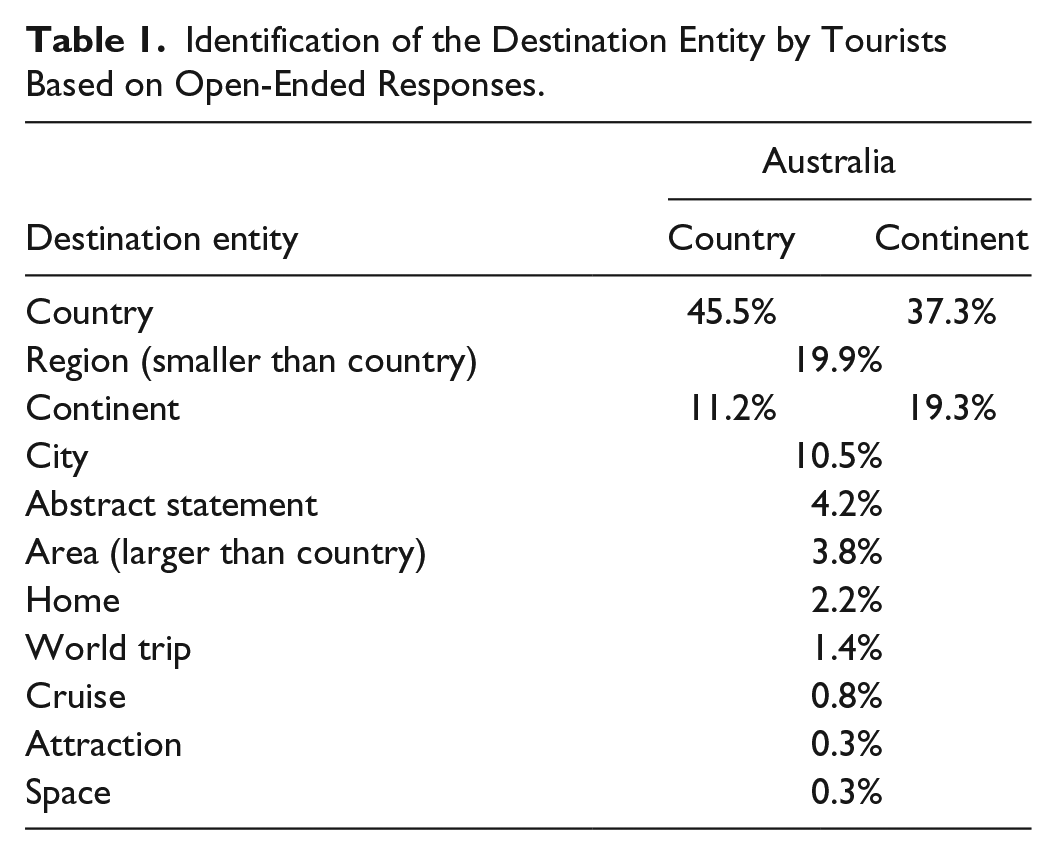
As can be seen, 37% (or 46% if Australia is classified as a country) of respondents named a country, 20% a region, 19% (or 11% if Australia is classified as a country) a continent, and about 11% a city. All other entities were named by less than 5% of respondents. This consumer perception does not match the amount of research attention that is dedicated to each of those entities. In particular, continents are not among the destination entities studied in academic investigations even though the continent is among the top three destination entities named by consumers.
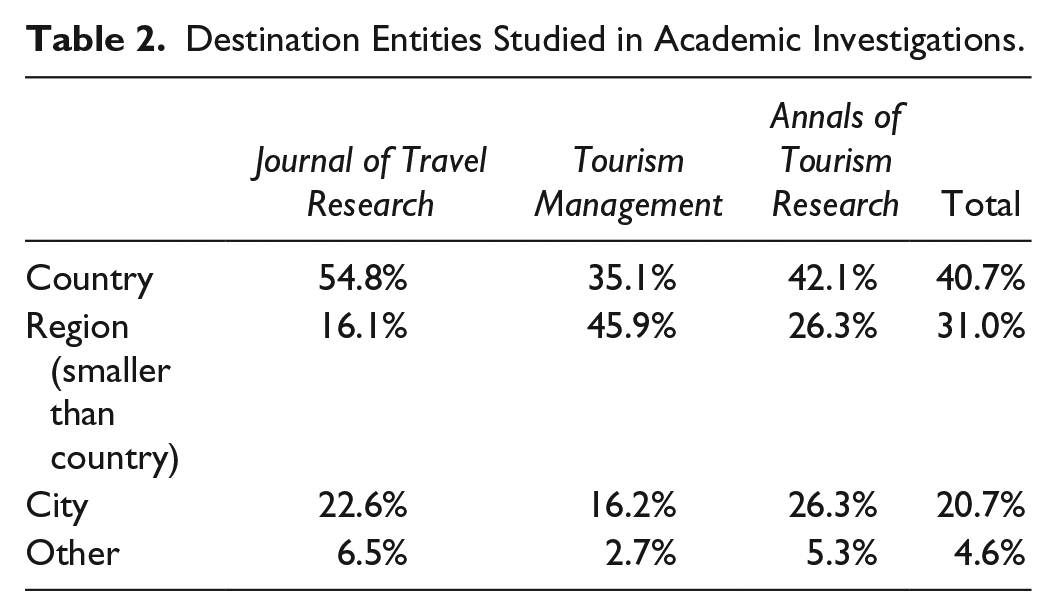
A review of studies investigating destinations or destination image published between 2000 and 2013 in the Journal of Travel Research (31 articles), Tourism Management (37 articles) and Annals of Tourism Research (19 articles) indicates (see Table 2) that the vast majority of destination studies focuses on the country, followed by a region and a city.
Destination Entities Studied in Academic Investigations.
Do Consumer Perceptions of Destinations Vary in Dependence of Distance from Home?
To investigate this question, responses to the closed-ended questions were compared across all kinds of vacations and separately for vacations close to home and vacations far away from home given that distance is a useful proxy for the nature of cognitive structures consumers will have about destination. Importantly, distance between country of origin and destination is a measure that can easily be used as a criterion by marketing managers in directing targeted marketing efforts.
Figure 1 shows the results. Agreement percentages are indicated by the points and linked for the different entities; 95% confidence intervals for the estimated agreement levels are indicated by the vertical lines. As can be seen, the percentages for attractions, cities/towns, and regions remain relatively unchanged independent of whether someone plans a vacation close to home or a vacation far away from home, whereas larger geographical units such as countries and continents are considered by the majority of tourists for vacations far away from home, but not close to home.

Differences for vacations far away and close to home in comparison to any vacation.
This result has immediate practical implications for destination managers: if targeting tourists who reside far away from the destination, it may be critical to consider the image of the continent when designing communication messages and image campaigns. When targeting domestic or short-haul tourists, the image of the continent plays only a minor role.
Conclusions
Two key conclusions emerge from this study: (1) there is no such thing as the destination. Rather, entities of different size and nature represent destinations to tourists. This conclusion is very much in line with Beritelli, Bieger, and Laesser’s (2014) concept of the dynamic destination as multidimensional and segment-related rather than territory-bound and rigid. (2) Tourists’ interest in countries, regions, and cities as destinations is well researched in the academic literature. Other entities are underresearched; they do not receive the attention by researchers that they receive by tourists. Most notably, tourists—in initial stages of the destination choice—frequently view a continent as the destination around which their travel ideation and planning revolves. This proportion of tourists varies in dependence of whether they are planning a vacation close to home or far away from home but can be as high as half of all tourists. Yet, tourism researchers have undertaken virtually no research into the images of continents and their role in vacation planning. Finally, (3) the image of larger geographical units such as continents plays a more prominent role in the context of long-haul tourism.
The latter finding is in line with theoretical predictions relating to cognitive structures: tourists from countries located far away from the destination may have less refined cognitive structures about the destination and thus rely more on basic category levels, such as larger geographical units. The closer to home the destination, the more refined the cognitive structures may be and, consequently, more tourists use smaller, more refined geographical units as destinations. As a consequence, marketing a destination to a source country that is far away may require a stronger focus on larger geographical units, including the continent, an approach that is only rarely taken in tourism marketing presently, which is dominated by marketing an administrative entity as a destination to all tourists, no matter whether domestic or international.
The present study is exploratory and hypothesis-generating in nature and investigates the images of different entities viewed by tourists as destinations independently. As such, the present study contributes by calling for a broader understanding of the term destination and by pointing to continent image and other geographical units larger than a country as deserving more attention.
Footnotes
Acknowledgements
We thank Alexander Chapple for his assistance with literature searches and Logi Karlsson and Homa Hajibaba for comments on earlier versions of the manuscript.
Declaration of Conflicting Interests
The author(s) declared no potential conflicts of interest with respect to the research, authorship, and/or publication of this article.
Funding
The author(s) disclosed receipt of the following financial support for the research, authorship, and/or publication of this article: This research has been funded by the Australian Research Council (salary funding under DP110101347) and the Austrian Science Fund (FWF) under Elise-Richter grant V170-N18.