



Abstract
Tourism’s unique features limit the consumer behavior literature’s ability to explain consumer loyalty. More precisely, existing consumer loyalty models do not consider social and cultural dimensions highlighted by tourism literature. Using new institutional theory, this article proposes a new perspective to explain loyalty. This study of musical festival patrons and managers combines cognitive mapping and questionnaires. Findings demonstrate that shared values between managers and festival-goers influence the latter’s loyalty. More precisely, shared values impact attitudinal loyalty and word-of-mouth, but they do not affect behavioral loyalty. Results also show that festival-goer loyalty decreases more slowly over time when a high level of shared values exist. Beyond music festivals, this study highlights a more sociological approach to explain loyalty over time in tourism.
Introduction
“Themed, public celebrations” or festivals create leisure, social, and cultural experiences (Getz 2005). Festivals offer many benefits including economic (Long and Perdue 1990), social and cultural (Rollins and Delamere 2007), and image and place marketing (Prentice and Anderson 2003). These multiple benefits contribute to an increase in new festivals (Lee and Beeler 2009). With more consumer choices, music festival managers face consumer loyalty issues (Zhang et al. 2014). To succeed in this highly competitive environment, understanding consumer loyalty drivers in a festival context is essential (Lee et al. 2008), especially in Europe where a long tradition of festivals exists (Frey 1994). Loyalty represents a key asset because repeat customers tend “to speak more positively about the festival than occasional visitors, pay less attention to offers by competitors, and are more tolerant of low levels of satisfaction” (Grappi and Montanari 2011, 1129).
However, because festival-goers search for novelty (Jang and Feng 2007; Lee and Crompton 1992), festivals in general and music festivals more precisely need to reinvent themselves constantly (Getz 2002). To address this need, a festival’s choice of artists differs from year to year. How can music festivals thus ensure loyalty over time in a dynamic environment if the line-up of acts always changes? This article argues that the festivals and repeat patrons share some deeper connection, and value congruence between the festivals and attendees explains this connection. Indeed, the festival literature emphasizes that values are important to music festival-goers (e.g., Falassi 1987; Kim, Borges, and Chon 2006). Festival-goers prefer organizations that share common core values (Grappi and Montanari 2011; Thrane 1997). They seek legitimate organizations (i.e., in line with their own norms and values) (Lawrence, Wickins, and Phillips 1997). To date, this value congruency’s impact on event-goers’ loyalty remains unexplored.
Drawing on sociology’s new institutional theory, this article examines loyalty from a sociocultural perspective and highlights why festivals must share values with their environment’s stakeholders (Scott 1994). Values unite a group such as a society or an organizational field (Edwards and Cable 2009; Nohria and Ghoshal 1994; Parsons 1956). Prior studies suggest that people are attracted to firms when they share the organization’s core values (e.g., Maxham and Netemeyer 2003). Value congruency’s major consequence is the organization’s legitimacy (Meyer and Rowan 1977), leading to stronger stakeholder’s (including consumer’s) support (Suchman 1995). To obtain their support, firms must then adopt their customers’ values (Grayson, Johnson, and Chen 2008). As Arnold, Kozinets, and Handelman (2001) suggest, a key support element is consumer loyalty. The present study examines whether or not shared values between festival managers and consumers impact consumer loyalty.
To date, the literature explains loyalty from a psychological perspective, suggesting that loyalty primarily results from consumers’ psychological process (Lichtlé and Plichon 2008). The present study is the first to empirically explain loyalty using a psycho-sociological perspective. Consequently, this research offers two primary contributions to theory and practice. First, the results inform a new institutional-based explanatory theory for loyalty—the environment shapes organizations’ choices (see Meyer and Rowan 1977). New institutional theory posits that loyalty formation reflects affect–context interaction. Consumers and tourism managers evolve within the same socially constructed knowledge structure, sharing representations and values (Rosa et al. 1999). Destination brands adopting consumers’ values become legitimate and obtain their support (Elsbach 1994). Second, following Daniels, Johnson, and De Chernatony (2002), this study measures shared values between consumers and a tourism organization, examining both sides of the dyad. This study examines shared cognitive structure’s impact on loyalty. Results show that shared values between managers and consumers influence consumer loyalty. Additionally, a high degree of shared values positively affects consumer loyalty over time.
Evolution of Loyalty Research
Defining Loyalty
Loyalty helps explain why customers exhibit consistent buying behavior over time (i.e., why tourists visit again). The consumer loyalty literature distinguishes between transactional and relational visions. Loyalty’s transactional vision considers each interaction between tourists and destinations independently without relationship between transactions. The transactional vision defines loyalty both as an empirically observable behavior (Cunningham 1961) and as the expression of a favorable attitude (Fishbein and Azjen 1975; Tonge et al., forthcoming). To explain transactional loyalty, the literature uses two theoretical frameworks (Lichtlé and Plichon 2008). First, operant conditioning theory conceptualizes behavior as a learning phenomenon, suggesting tourists repeat an action leading to a positive result (Skinner 1938). Widely employed to understand the link between satisfaction and loyalty, operant conditioning theory suggests that satisfied tourists tend to return. Second, the theory of reasoned action argues that consumers are rational and act according to the consequences of alternatives (Fishbein and Azjen 1975). In other words, tourists tend to be loyal if they perceive maintaining the relationship provides the greatest benefit.
Consumer loyalty’s relational vision challenges the purely static perspective of the transactional vision. Loyalty’s dynamics assimilate to a promise to maintain the same behavior over time, even in the case of dissatisfaction (Garbarino and Johnson 1999). In this continuous and lasting relationship, commitment and trust are essential (Morgan and Hunt 1994; So et al., forthcoming). However, imposing this definition unfairly attributes trust and commitment only to the relational perspective of loyalty. A transaction’s foundation necessarily requires trust to reduce the uncertainty. Two theoretical frameworks explain relational loyalty (see Lichtlé and Plichon 2008). Psychological commitment theory posits consumers adhere and conform to their own decisions (Kiesler 1971). Commitment links people to their actions. Psychological commitment means that tourists’ relationships with destinations/events strengthen as they continue to visit. Dependence theory conjectures that consumers are unlikely to change their habits if switching costs are high (Ryans and Wittink 1977), helping to explain customer retention. In other words, tourists do not consider other offerings because changing their behavior requires too much effort.
Although conceptual differences exist, these two visions overlap on some key points. For example, highly competitive environments and novelty-seeking motivations found in tourism create conditions where both transactional and relational visions reject strong customer loyalty. Synthesizing these two visions helps to define loyalty as persistent, consistent, and coherent consumer behavior—the underlying framework in all known studies examining loyalty (e.g., Lee, Kyle, and Scott 2012; Li and Petrick 2008; Michaels and Bowen 2005; Nam, Ekinci, and Whyatt 2011; So et al., forthcoming). Despite their respective contributions, loyalty remains poorly understood, particularly loyalty antecedents (Li and Petrick 2008; Lichtlé and Plichon 2008). Research examining the relationship between satisfaction and loyalty shows mixed results (e.g., Garbarino and Johnson 1999; Lee, Kyle, and Scott 2012; Morais, Dorsch, and Backman 2004; Zhang et al. 2014), suggesting a gap between theory and behavior.
Destinations and Loyalty
Many factors including infrequent purchases, choice diversity, or high substitutability mitigate loyalty’s relevance and explanatory framework in tourism (Michaels and Bowen 2005; Zhang et al. 2014). While some authors argue that loyalty should be measured relative to competitors (Taplin 2013), others conclude that tourists are inherently disloyal (Niininen, Szivas, and Riley 2004). McKercher, Denizci-Guillet, and Ng (2012) make a compelling argument that existing frameworks are not adapted to tourism’s specific features. Existing frameworks ignore social and cultural dimensions affecting consumer behavior. Yi and Jeon (2003) confirm this oversight and recommend introducing sociocultural variables to create a more robust explanatory framework of tourist loyalty. Addressing this need also grounds research in a framework better explaining tourist behavior (McKercher, Denizci-Guillet, and Ng 2012). Focusing only on consumption’s tangible elements ignores social and cultural dimensions highlighted in tourism literature (Derrett 2003; Kim, Borges, and Chon 2006).
Regarding this study’s empirical field, customer loyalty plays a crucial role in a music festival’s survival given the overall growth in these events (Getz 2005). Unlike the occasional festival-goer, loyal festival-goers participate more regularly and develop event preferences, even after a bad experience (Hume 2008). Furthermore, loyal customers tend to speak positively about the festival (Grappi and Montanari 2011). However, because festivals are very complex experiences, they do not align easily with the current understanding of loyalty (Hume 2008). The literature offers several explanations for this challenge. First, a festival’s discontinuous nature provides additional challenges to understanding consumer loyalty. Arguably, music festivals are constant prototypes because they need to reinvent themselves each time (Getz 2002). On the other hand, achieving loyalty is difficult when few elements remain common in two successive festival editions. This paradox suggests that artistic offerings alone cannot build festival loyalty because the performers typically change every year (Bowen and Daniels 2005; Lee and Crompton 1992). Even returning musicians’ performances vary considerably. Further, a central component of festivals is novelty seeking, which limits loyalty behavior (Jang and Feng 2007). Finally, Stebbins’s (1996) distinction between serious and casual leisure suggests that festival-goers have different festival career trajectories. While serious event-goers are highly involved and they seek similar events to fulfill their needs, casual event-goers only search for immediate and intrinsically rewarding experiences (Benckendorff and Pearce 2012).
However, festivals exhibit other characteristics—namely symbolic—that receive limited attention in the literature. To meet festival-goers’ needs, festivals celebrate values, ideologies, and identity (Falassi 1987). These characteristics include interactions between festival-goers (Bowen and Daniels 2005), local identity (Derrett 2003), or spiritual exploration (Matheson, Rimmer, and Tinsley 2014). Festival attendees seek to identify with organizations that share their values (Grappi and Montanari 2011; Lawrence, Wickins, and Phillips 1997). Lee and Beeler (2007) conclude that festivals are unique because their core values are important to consumers. These values help to build and to maintain relationships with consumers (Voss, Cable, and Voss 2006). Thus, festival loyalty seems more symbolic and depends on the festival’s overall identity, image, and values (Kim, Borges, and Chon 2006; Wood and Thomas 2006). Arguably, a theoretical framework explaining festival loyalty must look beyond the consumer side and examine the interaction between the firm and the festival-goer. New institutional theory posits that focusing on shared values between the organization and consumers explains festival loyalty.
New Institutional Theory as a Framework for Explaining Loyalty
Organization’s Social and Cultural Embeddedness
New institutional theory focuses on an organization’s cultural and cognitive embeddedness (Meyer and Rowan 1977). While institutionalism concerns social order derived from traditional institutions such as constitutions, the State, or religious systems, new institutional theory focuses specifically on how the environment constructs organizations (Scott 1994). According to new institutional theory, most organizational dynamics come from society’s cultural norms and beliefs (Suchman 1995). Organizations exist inside organizational fields defined as recognized areas of institutional life with shared understandings (DiMaggio and Powell 1983). Within an organizational field (e.g., music festivals), the constituents share values and norms and associate a common sense with the social structures (DiMaggio and Powell 1983; Scott 1994). Successful organizations accommodate societal norms, values, and symbols prevalent in the environment (Du and Vieira 2012). Contrary to explicit regulations, these values serve as implicit guidelines to maintain a moral fit with key publics, including consumers (Handelman and Arnold 1999).
Accepting social norms demonstrates appropriate behaviors and legitimizes the organization (Elsbach 1994). Organizations adopt environmental standards to provide elements of comparison and social acceptance (Zuckerman 1999). Stakeholder endorsement legitimizes organizations and increases their likelihood of success. Legitimate firms exist in a more stable environment because of strong stakeholder support (Deephouse 1996; Meyer and Rowan 1977). Conversely, organizations lacking legitimacy imply limited social support from stakeholder resources (Du and Vieira 2012). Organizations deviating from accepted norms find that stakeholders ignore them, or they incur search costs to try to understand them better (Zuckerman 1999).
Stakeholders make economic (e.g., offerings, prices, or services) and sociocultural (values, norms, and myths) demands (Meyer 1994). After integrating economic and sociocultural norms, organizations must respond appropriately with respectively performative and institutional actions. Prior research has examined performative actions extensively (see Arnold, Kozinets, and Handelman 2001), but institutional actions to answer sociocultural norms generally remain under explored. Appropriate responses to sociocultural norms provide an opportunity for long-term differentiation by being socially acceptable to consumers (Arnold, Kozinets, and Handelman 2001; Handelman and Arnold 1999). In addition, these sociocultural dimensions are central to consumers’ festival choices (Falassi 1987; Lee and Beeler 2007; Morgan 2006).
Shared Values as an Antecedent of Consumer Loyalty
Following new institutional theory, festivals must adopt consumers’ norms and values to obtain support (Grayson, Johnson, and Chen 2008). Values are core ideas that unite a community, such as a local community or a brand community. Barnard (1968) notes that shared values among community members minimizes their divergent interests and enhances their sense of mutual interdependence. Shared values are the ideas, beliefs, and meanings that are mutually accepted by festival-goers and an organization’s managers (Barnard 1968; Nohria and Ghoshal 1994; Parsons 1956). Not surprisingly, evidence supports that value congruence leads to positive outcomes (Edwards and Cable 2009; Nohria and Ghoshal 1994). Consumers and organizations sharing the same values more likely develop lasting relationships. For example, Arnold, Kozinets, and Handelman (2001) describe how Wal-Mart’s success stems from the company’s adoption of popular American myths and values (family, nation, and community). These values help Wal-Mart to create an identity and to retain consumers. Not surprisingly, companies entering foreign markets must adapt to local cultures to be accepted (Bianchi and Arnold 2004). Being considered legitimate by consumers becomes an organization’s goal (Du and Vieira 2012; Elsbach 1994). Adopting the values mainly shared by consumers enhances a company’s legitimacy. For example, Wood and Thomas (2006) demonstrate how embedded shared values unify the Saltaire Festival’s stakeholders. In addition to official values posted on Saltaire’s website, all company actions contribute to transmitting the Festival’s core values (i.e., products, communications, pricing, and distribution channels). This integrated effort signals the organization’s core values to stakeholders.
Firms and their consumers belong to the same community and share values (Landry, Arnold, and Stark 2005). Arguably, shared values exist because managers and consumers belong to the same macro-culture derived from cultural, geographic, and institutional homogeneity (Abrahamson and Fombrun 1994; Porac, Thomas, and Baden-Fuller 1989). Shared beliefs allow organizations to interact with the market because producers and consumers create a socially constructed knowledge structure. Studying an Italian festival, Grappi and Montanari (2011) describe the crucial role that social identification plays with the festival’s values.
All interactions between festival managers and consumers affect and construct this shared values set. The literature suggests that shared organizational values make strategy implementation easier (Badovick and Beatty 1987). Contrary to findings from prior consumer loyalty studies (e.g., Lichtlé and Plichon 2008), festivals cannot ensure loyalty based on their offering because the product is dynamic and changes each year. Drawing on new institutional theory, event-goers should support festivals when shared values exist. Surprisingly, the literature offers little information about shared values’ consequences on consumers’ loyalty. This gap informs the following research question: Do shared values between a festival’s consumers and managers affect consumer loyalty?
Hypotheses
This study investigates music festivals. New institutional theory postulates that festivals seek acceptance from their environment (Meyer and Rowan 1977). Adapting to consumers’ values and desires allows organizations to create loyalty. Prior studies demonstrate that loyalty increases when consumers feel the organization considers their feelings and values, suggesting that shared values improve retention (Arnold, Kozinets, and Handelman 2001; Handelman and Arnold 1999; Landry, Arnold, and Stark 2005). As Ouchi (1980, 138) explains, “common values and beliefs provide the harmony of interests that erase the possibility of opportunistic behavior.” Consumers and managers sharing values support a relational stability (Nohria and Ghoshal 1994). Shared values’ outcome is a loyalty foundation built on mutual interests.
Hypothesis 1: Shared values between consumers and managers positively influence loyalty.
Because loyalty encompasses different aspects, more precision may be necessary to understand the commitment-loyalty link in a service context (see Morgan and Hunt 1994). Specifically, festival loyalty attributes may include attitudinal, intention to recommend, and intention to return. Prior festival research suggests that repeat attendees place higher emphasis on the organization’s overall values than specific offerings (Lee and Beeler 2007). Festival consumers base their choice on festivals’ symbolic features and shared values (delivered by managers). This relationship is consistent in the festival literature, highlighting collective and symbolic dimensions (Morgan 2006). Producers and consumers in aesthetic fields create relationships based on shared values rather than the actual product (see Voss, Cable, and Voss 2006). This rationale informs the following hypothesis.
Hypothesis 2a: Shared values between consumers and managers positively influence attitudinal loyalty.
Besides attitudes, shared values between consumers and managers potentially influence behavioral intentions (Zhang et al. 2014). Adhering to the festival’s values, the consumer legitimates an event’s existence in the market. Incorporating congruent values help the festival reinforce the reason to exist (Meyer and Rowan 1977). Consumers accept and endorse the festival’s purpose, providing some support to the organization (Elsbach 1994; Handelman and Arnold 1999). Values enable the festival to create relationships with attendees (Voss, Cable, and Voss 2006). A study of Brazil’s Festival of Environmental Film and Video confirms that values influence consumers’ motives to come back to the festival (Kim, Borges, and Chon 2006). Consumers emotionally attached to a festival likely return and spread positive word of mouth. The literature suggests that a value convergence between consumers and the organization positively affects behavioral intentions (Bendapudi and Berry 1997; Morgan and Hunt 1994).
Hypothesis 2b: Shared values between consumers and managers positively influence the intention to recommend the festival.
Hypothesis 2c: Shared values between consumers and managers positively influence the intention to return to the festival.
Festivals are public celebrations often held annually. Given some time passes between two editions of the festival, does loyalty evolve during this off-period? Consumers tend to be unstable because loyalty varies according to situations. For example, Dall’Olmo Riley et al. (1997) demonstrate that loyalty evolves in an important manner (i.e., tends to decrease over time). To address this behavior, a longitudinal study is necessary to observe the relationship between shared values and loyalty over time. In addition, this approach reduces common method bias and helps draw causal inference (Rindfleisch et al. 2008).
Values acts like institutions: they are socially and culturally co-constructed by managers and consumers. As new festivals are not well established in consumers’ minds, the events lack shared knowledge with potential consumers (see Rosa et al. 1999). Over time, the festival institutionalizes, and shared values with consumers stabilize and nurture loyalty. Arguably, consumers identify themselves with the festival they attend (Grappi and Montanari 2011). If the festival and personal values converge, consumers likely support the festival in the long term through loyalty (Edwards and Cable 2009). More precisely, consumers sharing many festival values likely exhibit a stronger loyalty than consumers who share only a few values (DiMaggio and Powell 1983). Shared value stability among members of the same organizational field informs the following hypotheses.
Hypothesis 3a: Compared to consumers with a low level of shared values, attitudinal loyalty of consumers with a high level of shared values decreases more slowly over time.
Hypothesis 3b: Compared to consumers with a low level of shared values, the intention to recommend the festival by consumers with a high level of shared values decreases more slowly over time.
Hypothesis 3c: Compared to consumers with a low level of shared values, the intention to return to the festival by consumers with a high level of shared values decreases more slowly over time.
Method
Research Sites
To ensure the data’s quality and the subsequent analyses, the choice was made to test the above hypotheses using data from consumers in situ. Rock music festivals were chosen for two main reasons. First, rock music festivals are events in which one can observe a high degree of consumer volatility because of the wide range of offerings, making the study of loyalty challenging (Getz 2002; Lee and Beeler 2009). Second, the growth in music festivals creates greater competition that raises loyalty as a key competitive advantage (Bowen and Daniels 2005).
This study investigates two major European music festivals: Eurockéennes de Belfort 1 and Paleo Festival Nyon. 2 Eurockéennes de Belfort is a three-day French festival created in 1989 and located in the working-class city of Belfort (50,000 inhabitants). Paleo Festival Nyon is a six-day Swiss festival created in 1976. Nyon is a small Swiss town (20,000 inhabitants) located on the shore of Lake Geneva, an economically robust region of Switzerland. These two festivals are comparable in many respects. Both festivals attract about 30,000 people daily, and they employ similar pricing strategies (average daily ticket price: US$60). These international events are held in July, and they attract the same proportion of nonresident festival-goers (approximately 40%). The two festivals make a considerable economic impact on their regions—approximately US$3 million in direct benefits and US$3.5 million in indirect benefits. Both festivals are fully integrated into their communities. But while Eurockéennes de Belfort creates 400 seasonal jobs each year, Paleo Festival Nyon promotes volunteerism, and more than 4,500 volunteers participate each year. Ticket sales represent one-half of each festival’s revenues.
Despite their similarities, the two festivals differ enough to validate results. First, the overall budgets for these events differ. Eurockéennes de Belfort budgets US$8 million and Paleo Festival Nyon budgets US$29 million for the annual events. Marketing expenses represent 14% and 7% of their budgets, respectively. Their funding structures also differ; Paleo Festival Nyon is a private festival while Eurockéennes de Belfort receives public grants (12% of the budget). They also diverge by their music genre. While Eurockéennes de Belfort focuses on rock music, targeting young festival-goers with artists such as Black Keys, Smashing Pumpkins, Franz Ferdinand, and Queens of The Stone Age, Paleo Festival Nyon embraces different artistic styles, targeting a family crowd with artists such as James Blunt, Neil Young, David Guetta, and Sting. Rock music festivals with different funding structures, different musical genres, and held in two different countries help test the model’s robustness (see Getz, Andersson, and Larson 2007).
In terms of values, Eurockéennes de Belfort promotes three main values. First, the festival promotes an accessible and open-minded event with affordable prices, equal access for people with disabilities, and artistic discovery of unknown artists. Second, the festival promotes sustainable development with waste sorting, clean mobility, and prevention. Finally, Eurockéennes de Belfort promotes a strong local integration by redistributing US$80,000 each year to local associations. Paleo Festival Nyon’s internal charter describes the festival’s main values. These values are based on the notion of respect of festival-goers, volunteers, and artists. Paleo festival Nyon also promotes strong social responsibility with ecological efforts (green energy, clean mobility, and waste sorting) and prevention efforts, particularly responsible alcohol consumption.
Data Collection
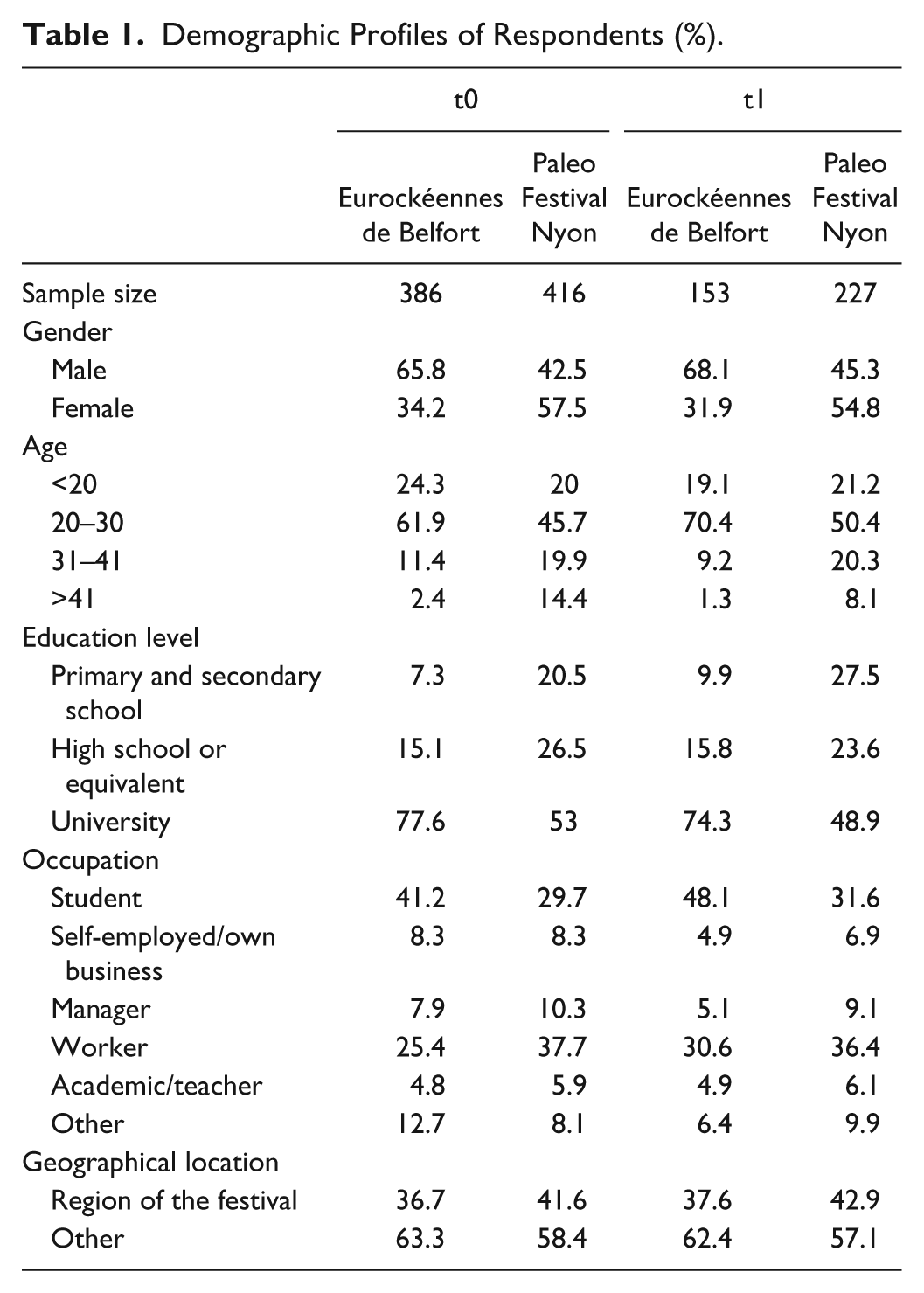
To collect data from two time points, researchers attended the two festivals and collected 1,118 e-mail addresses from festival-goers using a convenience sampling method. Because attendees had a limited time to enjoy the festival, they were not asked to complete the questionnaire during the event. Attendees were sent e-mail messages requesting them to complete two online surveys: one just after the festival (t0) and one four months later (t1). The four-month interval was deemed reasonable because the transition period toward the next edition of each festival was starting. Studying festival-goer loyalty during a time period without any news about the festival provides a measure of the loyalty intensity. Data collected at t0 measured shared values and festival-goer loyalty and data collected at t1 measured festival-goer loyalty over time. Of the 1,118 surveys distributed at t0, 810 were completed (72.4% response rate). Data screening followed recommendations by Tabachnick and Fidell (2007). Univariate data screening (i.e., examining z-scores) and multivariate data screening (i.e., testing Mahalanobis distance) were performed to identify outliers that may skew the data and cause nonnormally distributed data. Eight cases were removed, resulting in a final sample of 802 responses at t0. Of the 802 surveys distributed at t1, 385 were completed (48.0% response rate) but 5 answers were removed following data screening, resulting in a final sample of 380 at t1 (see Table 1).
Demographic Profiles of Respondents (%).
Measuring Shared Values between Managers and Consumers
Shared values between managers and consumers were measured using Daniels, Johnson, and De Chernatony’s (2002) three-step process (see Figure 1). Following this process, festival managers’ values and representations were collected using long interviews. Using these data, festival-goers were surveyed to measure their degree of agreement with the managers’ values. This method was chosen because collecting qualitative values of a representative consumer sample would be difficult. Festival-goers unlikely would be willing to participate in a long interview during the event.

Measuring shared values between managers and consumers (from Daniels, Johnson, and De Chernatony 2002).
First, managers’ values were collected using eight semistructured interviews. To construct the sample, all senior managers from both festivals were selected (director, artistic director, communication director, and partnerships director) (eight semistructured interviews). These interviews were conducted by the first author and focused on how managers define their organization’s positioning and values. Based on the organization values literature (Chapman and Chapin 2014; Nohria and Ghoshal 1994; Ostroff, Shin, and Kinicki 2005; Parsons 1956), the interview questions included questions asking the manager to define their festival, explain the festival’s positioning, and describe the stakeholder relationships. Following the principles of in-depth qualitative research, informants were free to guide the interview’s flow. The interviews lasted one hour on average. They were recorded and fully transcribed. Overall, they accounted for more than nine hours of conversation and produced 32 pages of single-spaced transcribed text. Interviews were then analyzed by cognitive mapping (Eden 1992). Unlike content analysis, cognitive mapping systematically examines both what people think and how they organize their thoughts (Chaney 2010). According to Chaney (2010), there are two families of maps: (1) hierarchically structured maps designed to reveal cognitive categories taxonomies; and (2) continuous maps designed to expose the whole dynamic of a cognitive system. Since the objective is not to categorize concepts but rather to represent all festival values, continuous mapping was employed. All interviews were then coded in simple assertions translating festivals’ core values (e.g., “we develop a community around the festival”; “we offer a very eclectic musical program”; “we work hard at the ecological level”). Then, similar assertions were combined to refine, reduce, and standardize the values (Chaney 2010). Thus, cognitive mapping simplified the managers’ discourse and helped to understand how they structure their organizations’ values. To ensure validity, the maps were approved by their authors (Chaney 2010; Eden 1992). To ensure reliability, a double encoding procedure was conducted and consisted of asking four coders to independently code one part of the data and to compare the extent that researchers and the four coders arrived at the same final structure. This procedure resulted in 72% interrater agreement, which is satisfactory (Chaney 2010). All disagreements were settled by discussion. A total of 148 items were collected for Eurockéennes de Belfort and 202 items for Paleo Festival Nyon.
For the second step, the assertions of each festival were used to construct two questionnaires, one per festival. To ensure the only values captured are effectively shared within each festival, only assertions mentioned at least by two managers were selected. At the end, the questionnaire representing managers’ values of Eurockéennes de Belfort contains 45 items, and the questionnaire representing managers’ values of Paleo Festival Nyon contains 56 items. The factor analysis on the list of values produced a four-factor solution for Eurockéennes de Belfort and a five-factor solution for Paleo Festival Nyon with Cronbach’s alphas above 0.7. Each dimension’s eigenvalue is above 1.0 and explains between nine and 20% of the variance. The total variance explained is 58% for both festivals. Three of the four dimensions are common to the two festivals and consistent with the organization values literature (Chapman and Chapin 2014; Edwards and Cable 2009; Ostroff, Shin, and Kinicki 2005): Corporate Social Responsibility (ecology, volunteers’ policy), Professionalism (experience, reputation, prestige), and Relationships (community, proximity). A dimension labeled Positioning (artistic positioning, touristic positioning) emerged from the data for the two festivals. Another dimension, labeled Innovation (adaptability, flexibility), follows the literature (Ostroff, Shin, and Kinicki 2005), but emerged only for Paleo Festival Nyon. As Paleo Festival Nyon is a private event without public funds, the managers need to constantly innovate to balance the budget.
Third, event-goers completed questionnaires about the festival they attended to assess cognitive proximity between the festival’s managers and consumers. For each assertion, respondents rated their agreement level. These responses assessed the general adherence of consumers to the festival’s values. Daniels, Johnson, and De Chernatony (2002) argue that employing external evaluation (viz., consumers) to evaluate the assertions helps to assess cognitive proximity and thus compare values. Respondents were recruited at each festival site at the very beginning of the event. Five-point Likert-type scales assessed value ratings (1 = strongly disagree to 5 = strongly agree) (see Appendix 1).
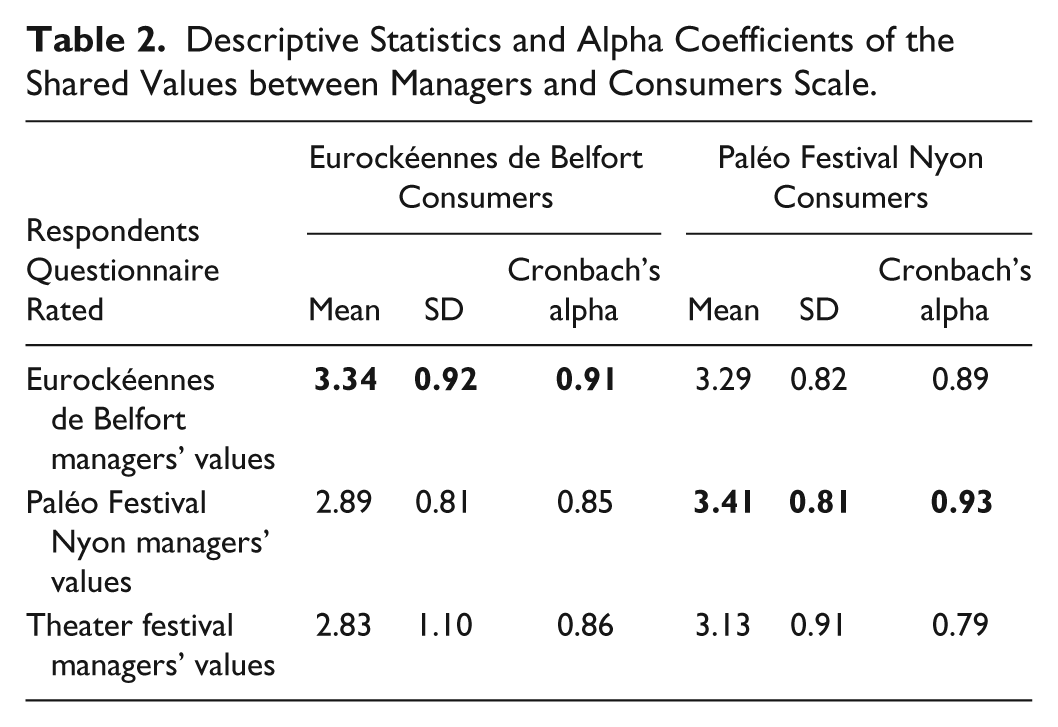
To test the construct’s validity, consumers’ ratings of Eurockéennes de Belfort managers’ values were compared against their ratings of Paleo Festival Nyon and managers’ values from a theater festival (from an exploratory phase). This procedure was repeated with Paleo Festival Nyon consumers. If the rating technique is valid, consumers should discriminate values of a festival they attended from values of a festival they did not attend (Daniels, Johnson, and De Chernatony 2002). One-third of the final sample (260 respondents) participated in this test phase after confirming they never attended the theatre festival. One-factor (origin of map) analysis of variance (ANOVA) with three levels (music festival attended, music festival not attended, and theater festival not attended) was conducted for two different groups (Eurockéennes de Belfort consumers and Paleo Festival Nyon consumers). Significant differences exist between consumers’ ratings of values for the festival attended versus the festival not attended (F values range from 6.67 to 26.32, df = 4, 28; all p <0.05, η² = 0.001). Cronbach’s alpha calculations assessed consumer rating reliability for each festival (music festival attended, music festival not attended, and theater festival not attended). Table 2 shows that the six alpha coefficients are satisfactory, suggesting consumer-rated values of the festival attended correlate.
Descriptive Statistics and Alpha Coefficients of the Shared Values between Managers and Consumers Scale.
Measuring Consumer Loyalty
To test loyalty robustness, this study employs three different measures: attitudinal loyalty, intention of loyalty, and word of mouth. These three measures broadly assess loyalty’s dimensions (Dick and Basu 1994). Attitudinal loyalty is a positive preference for the festival and was measured by Collin-Lachaud’s (2003) scale, previously constructed in a music festival context. This scale includes six items (α = 0.92). Loyalty intention was measured by a two-item (intention to revisit and intention to recommend the festival) scale (α = 0.90) developed by Lee et al. (2008) to study festivals. Consistent with the loyalty literature, 7-point scale items measured each variable (see Table 3).
Psychometric Properties of the Other Constructs.

Results
Phase 1: The Relationship between Shared Values and Loyalty
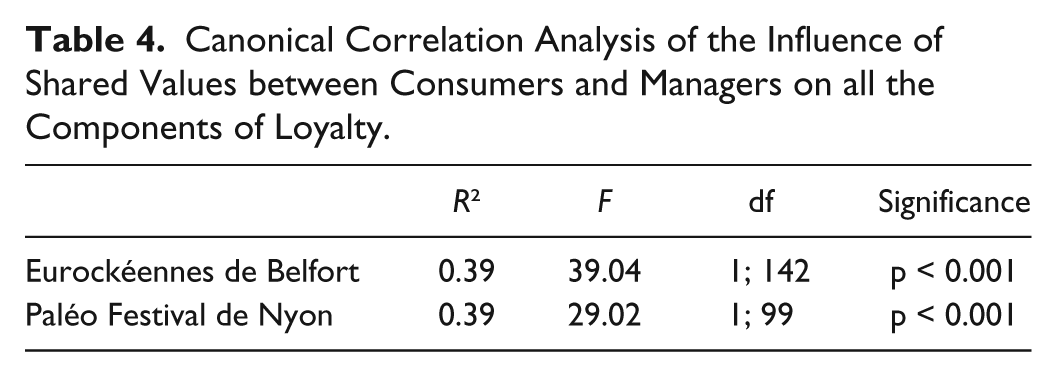
Analyses were performed in two different steps. The first step examined three components of consumer loyalty (attitudinal loyalty, intention to recommend, and intention to return) together. Canonical correlation analysis examined the impact of shared values on this set of variables (Thompson 1984). Results indicate that shared values positively influence all the components of loyalty; the model explains more than 40% of the data’s variance (see Table 4). This result supports hypothesis 1. Interestingly, using the festival-goers’ home (residents vs. nonresidents) as a moderator of the relationship between shared values and loyalty shows no statistically significant difference exists (β = −0.07, t = −1.86, p > 0.10). In other words, this finding means that shared values’ effect on loyalty is not stronger for locals than for nonlocals.
Canonical Correlation Analysis of the Influence of Shared Values between Consumers and Managers on all the Components of Loyalty.
A second step examined all the components of loyalty independently to better understand the effects of shared values. Regression analysis results demonstrate the influence of shared values between consumers and managers on each loyalty measure (see Figure 2). Hypothesis 2a results reveal that shared values between consumers and managers significantly affect attitudinal loyalty for both festivals, explaining 20% of the variance. These findings also support hypothesis 2b. Results show a positive relationship between consumers’ and managers’ shared values and intention to recommend. The variance explained by the models regarding word-of-mouth ranges between 7% for Eurockéennes de Belfort and 14% for Paleo Festival Nyon. Comparing shared values on the intention to return, the t-test result is only significant for Paleo Festival Nyon. In addition, significant differences exist in the r-square. The model r-square for Eurockéennes de Belfort is greater than 10%; however, the Paleo Festival Nyon has much lower explanatory power (1.7%). Consequently, the results are inconclusive for hypothesis 2c.
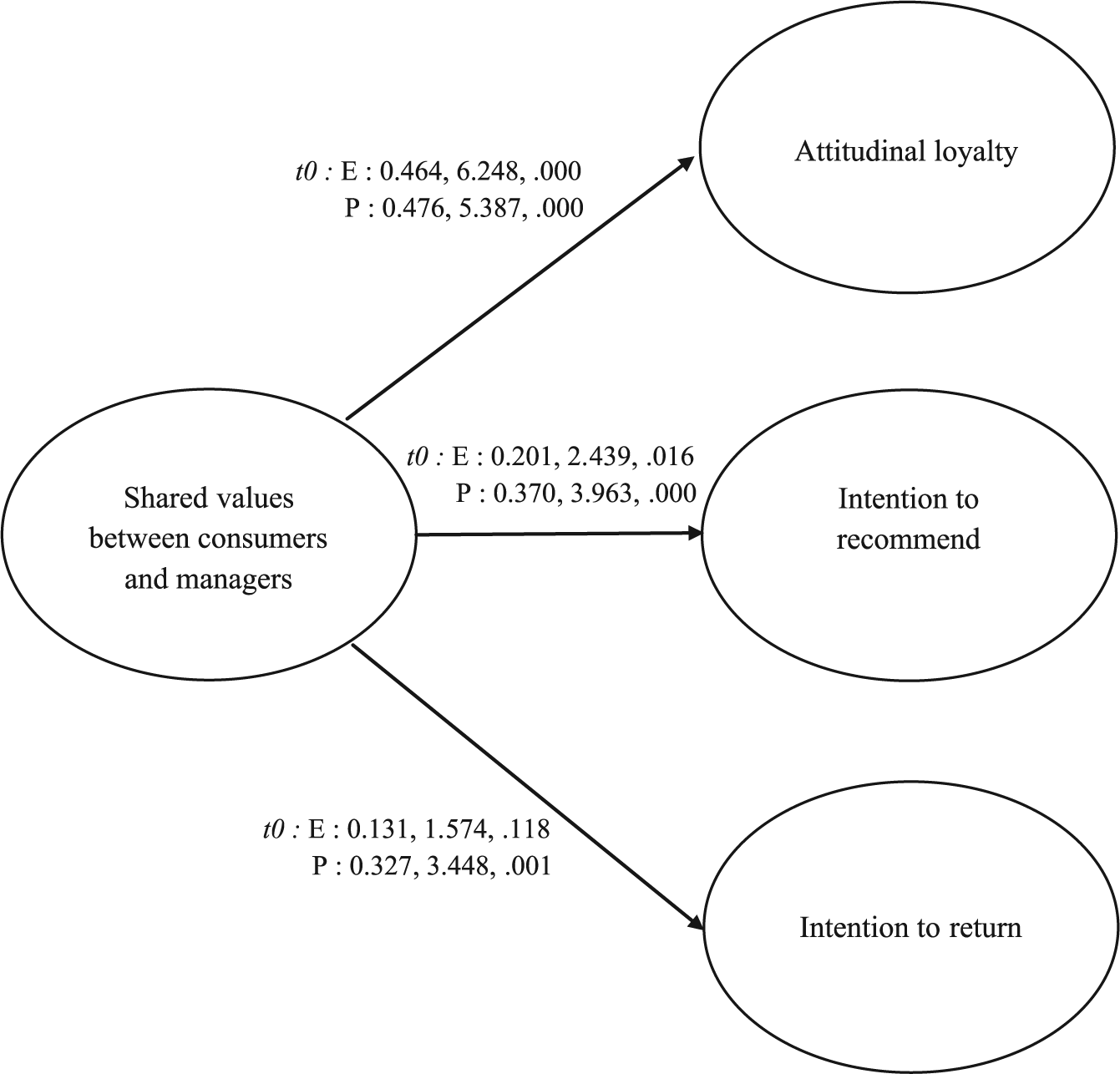
Research results in t0 (Beta, t, p<).
Phase 2: The Interaction Effects between Shared Values and Time on Loyalty
To determine whether or not time affects consumer loyalty, a follow-up study measured consumers’ intentions four months later. The second survey’s response rate decreased (n = 380, 47.4%) (see Table 2). The samples in t0 and t1 exhibit similar profiles in terms of gender and geographic origins, but the two samples differ regarding respondents’ ages for both festivals (χ2 = 53.65, p < 0.001, for Eurockéennes de Belfort; χ2 = 38.62, p < 0.001, for Paleo Festival Nyon), employment type for Eurockéennes de Belfort (χ2 = 46.52, p < 0.01), and education level for Paleo Festival Nyon (χ2 = 61.78, p < 0.001).
An individual growth modeling approach analyzed the longitudinal study (Bliese and Ployhart 2002). Individual growth modeling is part of multilevel models, in which Level 1 fits the aggregated changes of the dependent variables (i.e., attitudinal loyalty, intention to recommend, and intention to return) over time, and Level 2 contains the factors that explain the differences between individuals (i.e., shared values between consumers and managers). The model also contains an intercept parameter to represent the individual’s initial loyalty (see Table 5). Hypotheses 3a–3c were tested by examining the extent to which shared values interact with time in predicting loyalty.
Individual Growth Models for the Changes in Attitudinal Loyalty, Intention to Recommend, and Intention to Return over Time.
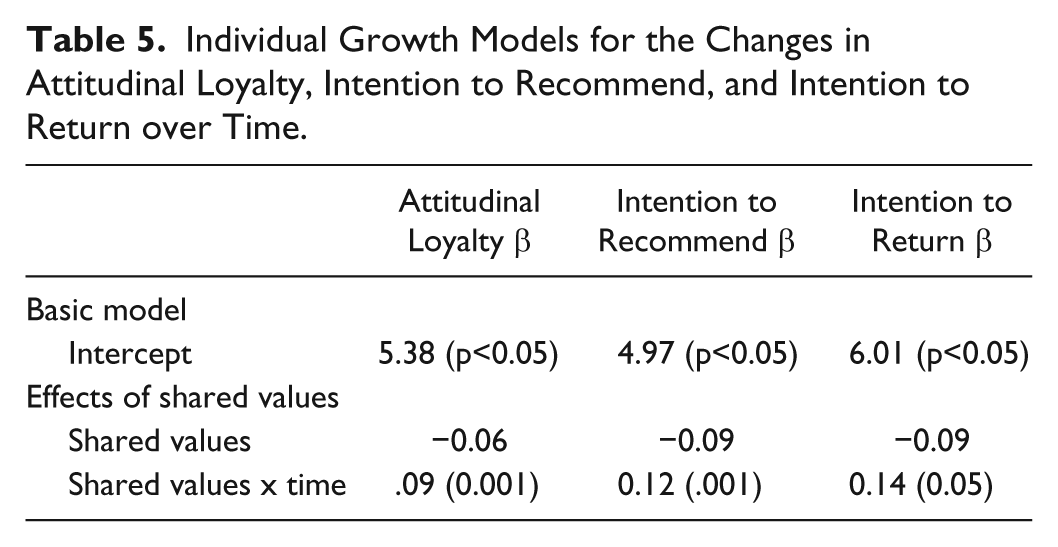
Results show a positive and significant interaction between shared values and time (β = 0.09, p < 0.001, for attitudinal loyalty; β = 0.12, p < 0.001, for the intention to recommend; and β = 0.14, p < 0.05, for the intention to return) supporting hypotheses 3a–3c. These findings indicate that shared values influence the rate of consumer change regarding loyalty over time. Figure 3 shows the pattern of change over time for the two levels of shared values. These findings demonstrate that high shared value congruency positively affects consumer loyalty. Over time, consumer loyalty decreases more slowly when high shared value congruency exists compared to consumers with a low shared value congruency.
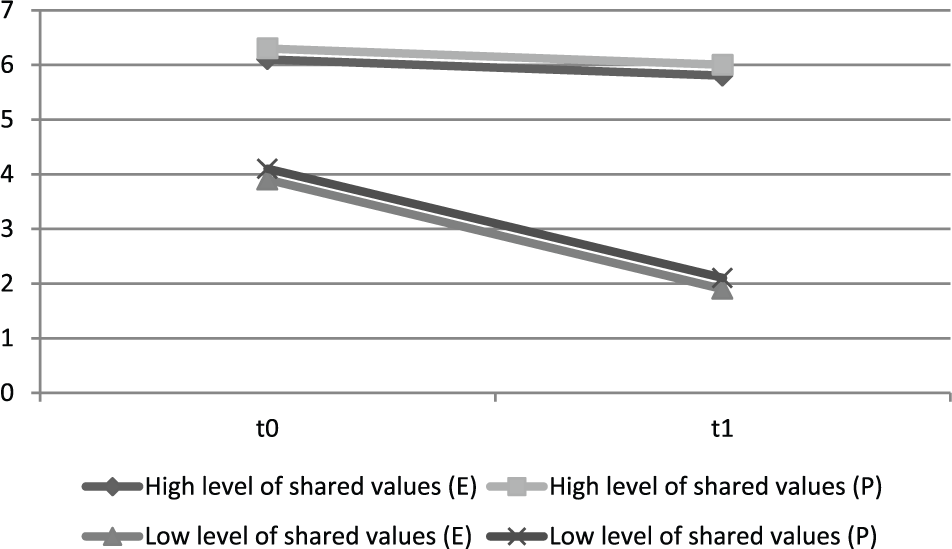
The interaction effects between shared values and time on loyalty (as a composite composed of attitudinal loyalty, intention to recommend, and intention to return).
Discussion
Overall, findings indicate that shared values influence consumer loyalty when examined holistically. Festivals adopting values and norms that prevail within their environment get stronger consumer support. Consumer support includes attitudinal loyalty and positive word of mouth. The new institutional theory approach helps to explain some loyalty aspects, namely, attitudinal loyalty and word of mouth. New institutional theory offers an alternative to inconclusive results from prior tourism studies (e.g., Morais, Dorsch, and Backman 2004). Study results confirm the significance of shared values for music festival-goers. Results also suggest that music festival attendees go beyond economic dimensions and take an interest in sociocultural dimensions representing the festivals’ values. While the results suggest that shared values between managers and consumers influence attitudinal loyalty and word of mouth, the evidence does not support behavioral loyalty’s role. On this last point, further investigation is necessary to determine whether or not a moderation process (e.g., satisfaction) affects the link between shared values and behavioral loyalty.
Festival-goers tend to show long-term support for festivals when they closely identify with the event. Social identification leads to a successful festival (Grappi and Montanari 2011). The attendees feel like they are part of the festival—a gestalt artistic and social project. As Andersson and Getz (2009, 853) note, “most festivals had successfully developed a set of core values.” Consumers and festival become a community, creating a base of stable common values for social interactions. Statistically significant interactions between time and shared values confirm that consumers’ loyalty when they have a high level of shared values maintains or decreases slightly over time.
Conclusion
This study examines how shared values between festival consumers and managers affect loyalty in time. Results offer both theoretical and managerial implications not only for the festival field but also for the entire tourism domain.
Theoretical Implications
This research’s first theoretical contribution lies in how new institutional theory helps to explain festival loyalty. Previous literature suggests that festival-goers’ loyalty comes from tangible features of the offering (Lee and Beeler 2009; Michaels and Bowen 2005; Nam, Ekinci, and Whyatt 2011). However, prior research often reports inconclusive results, especially longitudinal studies (see Morais, Dorsch, and Backman 2004). Because festivals need to reinvent themselves every year to meet festival-goers’ search for novelty, these findings are not surprising (Jang and Feng 2007; Lee and Crompton 1992). As a consequence, the present study contributes to the literature by demonstrating that a deeper connection exists between the festival and repeat patrons. Drawing from new institutional theory, the results suggest that this deeper connection relates to shared values. Study results show that shared values impact attitudinal loyalty and word of mouth. Festival-goer loyalty also decreases more slowly over time when a high level of shared values exists. While the performing artists and festival’s atmosphere change every year, shared values remain stable over time.
More generally, this article highlights a theoretical evolution to explain tourist loyalty. Operant conditioning and reasoned action theories provide a transactional conceptualization of loyalty. Psychological commitment and dependence theories offer relational conceptualizations of loyalty. However, these theoretical frameworks are based on psychology and adopt a psychological action control perspective, suggesting that loyalty only comes from individual actions (Lee, Kyle, and Scott 2012; Li and Petrick 2008; So et al., forthcoming). Without discounting psychological explanations, this research integrates a sociological explanation of loyalty because value formation involves social and psychological processes. To the best of the authors’ knowledge, this study enters unchartered territory by empirically examining loyalty through a sociological perspective. New institutional theory conceptualizes loyalty interactively as a social construction between consumers and destination brands based on shared values. A new institutional perspective addresses the call to reconsider loyalty’s theoretical foundations for tourism (e.g., McKercher, Denizci-Guillet, and Ng 2012). More specifically, tourism contains symbolic and cultural dimensions (Bowen and Daniels 2005; Wood and Thomas 2006). New institutional theory posits that destination brands are embedded in environments influenced by cultural and cognitive norms. Brands adapting to these standards tend to be more successful. Thus, brands adopting local cultural values receive support from consumers (e.g., attitudinal loyalty and word of mouth). Because destination managers and consumers interact within the same knowledge structure and the companies enact value sharing, consumers bond to the brand personified by the destination/event.
In addition, new institutional theory brings a sociocultural view on markets. All actors in the market interact and create a collective macro-culture (Meyer and Rowan 1977; Rosa et al. 1999). This macro-culture is a system of shared understanding that facilitates exchanges between actors. Markets are social processes (Humphreys 2010); they are cocreated by the different actors who share values. Tourist destinations are an indivisible part of their environment, interpenetrated by all stakeholders, including consumers. Tourism companies adopting their environment’s values tend to be better accepted and to receive support in terms of legitimacy (Suchman 1995). This study shows that loyalty expresses an organization’s legitimacy. When an organization adopts an environment’s main norms and values, consumers tend to better accept the organization. The outcome is stable and long-term customer loyalty.
Managerial Implications
This research offers managerial implications for both festival and tourism managers. First, since consumers sharing a festival’s values maintain their loyalty over time, this study highlights the need for festivals to create a brand around key social values. Prior research demonstrates that brands have their own personalities, a “set of human characteristics associated with a brand” (Aaker 1997, 347). To succeed in a highly competitive environment such as Europe (Frey 1994), festivals must thus develop their own brands around values that are shared by visitors. To do so, festivals need to immerse themselves in consumer values in order to identify and understand the values highly cherished by their target audience. These values must become the core of the brand’s personality. Integrated communications reinforce these values to create cognitive congruity with consumers. Anti-marketing positioning (e.g., England’s Hop Farm Music Festival), consumers’ involvement developing the artistic program (e.g., Spain’s Primavera Sound Festival), ethical positioning (e.g., France’s Solidays Festival), or a high-end festival reserved for a few people (e.g., Italy’s Duna Jam Festival) exemplify how festivals can create a strong cognitive proximity between organizers and festival-goers.
More broadly, study results suggest that destination managers must adopt and integrate consumers’ values into all the elements of their branding strategies. These elements include the offering, the global communication strategy, and the pricing strategy. Together these elements form the brand’s overall image. Assuring the organization has congruent values, expectations, and lifestyles of the customers is essential. A key to success is communicating culturally meaningful symbols that closely align with consumers’ values. Destination managers need to identify their customers’ most evocative values and enact them with clear positioning. This point creates an additional challenge for targeting international visitors with different values. In these cases, organizations need to ensure that their global values remain congruent with local values.
Limitations and Further Research
This study encountered unique challenges that present both limitations and opportunities. First, studying music festivals limits methodological choices. Often, festivals are annual events. Thus, the present study only measures loyalty intentions rather than actual behaviors. Although festival researchers often encounter this problem (e.g., Lee, Petrick, and Crompton 2007), further research could focus on measuring behaviors to more accurately understand loyalty’s evolution. Second, the methodological design’s internal validity has limitations owing to some differences between the two samples of the longitudinal study. Further research could test the evolution of festival-goers’ loyalty over time by ensuring that the different samples are identical, especially in terms of respondents’ ages, employment type, and education level. Regarding the use of cognitive mapping, even trying to ensure the method’s validity and the reliability, researchers need to be mindful that the potential effect of personal and processing factors may create distortions. Finally, the relationships between the intention to recommend, intention to return, and attitudinal loyalty need further investigation. For example, attitudinal loyalty can affect the intention to return. Additional research is thus necessary to make the model more complete.
Study results also offer a foundation for future research. First, expanding this research to other festival types would be useful (e.g., heritage, arts and crafts festivals). These other festivals tend to be more uniform and stable in their offerings than music festivals. Are shared values as important for these tourists as for music festival attendees? Second, the link between consumer and manager shared values and loyalty should be tested under conditions where social values are as important as in cultural tourism. More globally, a future research direction should compare tourism driven by hedonic values such as event tourism or ecotourism versus utilitarian values such as business tourism. Logically, tourists’ hedonic values influence this vision of loyalty. Business consumers likely place less value on shared values with the tourism providers. The business travelers’ needs are more utilitarian and features such as comfort and service are primary concerns. Future studies could test these differences. Third, loyalty means that consumers maintain their behaviors even in the case of dissatisfaction (Garbarino and Johnson 1999). A promising direction is focusing on service failures. If visitors have negative experiences and they share the destination or event’s values, at what level does dissatisfaction offset shared values? Further research should test this relationship to enrich the proposed interactive explanatory framework of loyalty. Finally, further research could refine this study’s festival values scale and obverse whether or not the dimensions identified (Corporate Social Responsibility, Professionalism, Relationships, Positioning and Innovation) apply to other settings.
Footnotes
Appendix 1
Declaration of Conflicting Interests
The author(s) declared no potential conflicts of interest with respect to the research, authorship, and/or publication of this article.
Funding
The author(s) received no financial support for the research, authorship, and/or publication of this article.