



Abstract
The study develops a comprehensive picture of tourism demand trends at UNESCO World Heritage Sites (WHSs) with the aim of providing evidence of any growth in demand for specific destinations after the listing of their sites. In contrast to previous literature, this article focuses on the smallest statistical unit (the municipality) to examine WHS impact on the destination. Analyzing 16 Italian WHSs, we show the most relevant trends in hospitality demand, comparing tourism flows at destinations before and after listing. Data show that, on average, growth rates of tourism demand in the 5 years after WHS listing are not higher than growth rates in the 5 years before the listing, but a number of different patterns emerge. The policy and managerial implications of such findings are straightforward: at least for a mature destination like Italy, there is no statistical evidence that WHS listing is associated with accelerating market growth rates.
Introduction
In the words of Buckley (2004), one of the first articles dealing with the relationship between UNESCO World Heritage Sites (WHSs) and tourism, Does designating a site as of World Heritage status alter who visits it? This question is significant for many reasons and for many stakeholders. Site managers may have more people to provide for, perhaps with different interests and languages. Tour operators may gain new or different commercial opportunities. Local residents and regional economies may benefit from increased tourist expenditure. And conservation policy makers may use tourism benefits as one justification for heritage listing. (70)
Does the inscription of a site on the WHS list have a positive effect on tourism demand? More than 10 years after the publication of Buckley’s paper, this is still an open and much debated research question. In fact, although brand awareness of WHSs has increased in major markets, the state of knowledge of its impact is controversial, and in some cases recent literature has misconstrued quantitatively modest statistical evidence to draw general conclusions on tourism flow trends, an issue that needs to be addressed with more care.
Our study contributes to this literature and aims to develop a comprehensive picture of demand trends in Italy, a country blessed with many WHSs, with the purpose of providing evidence of any growth in tourism demand that might have occurred after the official listing of the specific destinations where the sites are located. In contrast to much of the previous literature, this article is neither focused on a single site providing a case study nor does it pool together several different sites in an econometric model regressing the dependent variable, tourism demand, on a vector of independent variables, among which is the WHS listing, to sketch general conclusions.
On the contrary, this article is micro-focused on the smallest statistical unit (the municipality) to examine WHS impact on the local destination, also comparing it with the region it belongs to. Italy possesses the highest number of WHSs globally (they were 51 in September 2015). Analyzing tourism arrivals, overnight stays, and length of stay in 16 Italian WHSs selected on the basis of a set of criteria, we show the most relevant trends in hospitality demand, comparing overall tourism flows at destinations before and after inscription on the WHS list. The time series observed is a mobile range of 11 years, of which 5 years prior to inscription on the WHS list, the year of inscription, and 5 years following inscription (5+1+5). Because of the vast population of WHSs in Italy, the geographical coverage of this study represents an interesting platform for further understanding this topic of research. We therefore hope to provide conclusions that might be more informational and hence useful for policy makers and hospitality managers than general econometric modeling.
The paper is structured as follows: the second section critically analyzes the main results stemming from recent literature and reveals the contribution of our paper to the issue under investigation. The third section highlights the research questions, the data, and the methodology used, while the fourth section presents the main results of our investigation. Finally, a general discussion on managerial and policy implications is carried out in the fifth section.
Literature Review and Contribution to the Research
WHS listing has increased significantly since November 1972, the year in which the Convention Concerning the Protection of the World Cultural and Natural Heritage was adopted by the General Conference of UNESCO. The Convention, which came into force in 1977, has since been ratified by 190 countries: in September 2015, it includes 1,031 sites in 163 countries.
The main objective of the WHS is to preserve natural and cultural heritage of outstanding relevance for future generations. According to UNESCO (2008), the main benefits for countries and sites of being listed on the WHS are (1) a strong commitment to the preservation of the legacy for future generations; (2) a fast lane to access funds for preservation and conservation (including access to emergency funds for dealing with natural disasters or for sites in danger); (3) being a magnet for international cooperation; (4) being an operational framework for implementing a comprehensive management plan; (5) the generation of positive externality on tourism and the rest of the economy.
As regards this last point, the UNESCO designation is sought after by policy makers as a way of promoting the destination where the site is located to generate positive spillovers in the local economy and to trigger an effective path of development for the tourism sector. As the official UNESCO documents report, Finally, the inscription of a site on the World Heritage List brings an increase in public awareness of the site and of its outstanding values, thus also increasing the tourist activities at the site. When these are well planned for and organized respecting sustainable tourism principles, they can bring important funds to the site and to the local economy. (UNESCO 2008, 10)
Based on this “common sense” assumption, research testing the main implications of WHS listing has flourished, particularly fueling noneconomic research. Among many others, the following issues have been investigated: (1) the cultural and political criteria behind the decision of nominating a site for WHS listing, including the lobbying power of local sites toward their governments, and of governments toward the UNESCO Committee; (2) the use of listing as a tool for raising awareness of local cultural heritage and for empowering local communities living near the sites; and (3) the listing as a tool to promote paths of socially and environmentally sustainable development. Since the analysis of these and other noneconomic issues is beyond the scope of this study, we refer to Poria, Reichel, and Cohen (2011) for an introduction and a review of the several issues pertaining to WHS listing, and Bertacchini and Saccone (2012) and Frey, Pamini, and Steiner (2013) to analyze the criteria used by UNESCO when accepting sites on the WHS list.
As regards the main economic and managerial issues under investigation, recent literature has attempted to address the following aspects:
The role of WHS listing in the promotion and management of the destination. This is especially relevant for little-known sites, for which the designation works as a “quality brand” that might guarantee the attractiveness of the destination, ensure a unique and valuable experience for tourists, and raise pride among residents (Poria, Reichel, and Cohen 2011).
The social and economic impact of WHS listing. Indeed, WHS inscription can be seen as a multiplier for economic development, by using heritage to trigger wider socioeconomic impacts based on local culture and identity (VanBlarcom and Kayahan 2011).
The analysis of visitors’ perceptions and attitudes associated with WHSs and their designation (Poria, Reichel, and Cohen 2013).
The impact of WHS listing on tourism flows. Although World Heritage designation is mainly based on preservation criteria, WHS status has relevant implications for tourism by recognizing the value of preservation, by drawing attention to the site, by raising its profile and, in many cases, stimulating demand, particularly for unknown or unexplored sites (Su and Wall 2014).
The present study only examines the link between WHSs and tourism and, for a review of the main results of the other topics, we refer (among others) to Gravari-Barbas and Jacquot (2008), Poria, Reichel, and Cohen (2011), Ryan and Silvanto (2010, 2011), and Zhang, Fyall, and Zheng (2015).
The current debate about WHS listing and destination performances has become more intense over the past decade, with the rapid increase in both the number of listed sites and the availability of tourism data. Methodologies, approaches and results, however, have differed in many respects. First, the tourism performance of a destination has been measured and estimated in several ways. Jimura (2011), Huang, Tsaur, and Yang (2012), Patuelli, Mussoni, and Candela (2013), and Su and Lin (2014) estimated the increase in tourism arrivals (usually international arrivals, except for the case of Patuelli, Mussoni, and Candela 2013, which used domestic arrivals) stemming from WHS listing. A small number of other studies (Cuccia et al. 2013; Yang et al. 2010) used overnight stays as a measure of tourism performance, while Cellini (2011) used the ratio between overnight stays and residents.
Second, literature differs as regards the area under investigation: from analyses of single-site studies (Cuccia 2012; Jimura 2011; Yong Yeu Moy and Phongpanichanan 2014; Poria, Reichel, and Cohen 2011), to the study of single-UNESCO-site countries (Huang, Tsaur, and Yang 2012), to the study of multiple-UNESCO-site countries (Buckley 2004; Patuelli, Mussoni, and Candela 2013; Yang et al. 2010; Cellini 2011; Cuccia et al. 2013) to international coverage through cross-country comparison (Arezki, Cherif, and Piotrowski 2009; Su and Lin 2014).
Third, the methodology used ranges from descriptive statistical evidence and multivariate analysis (Jimura 2011; Cuccia 2012), sometimes analyzed in an experimental treatment setting (Buckley 2004), to parametric testing through panel data and spatial interactions modeling (Arezki, Cherif, and Piotrowski 2009; Huang, Tsaur, and Yang 2012; Yang et al. 2010; Cellini 2011; Patuelli, Mussoni, and Candela 2013; Su and Lin 2014); to DEA and semiparametric testing (Cuccia et al. 2013); to qualitative methodologies through open and semi-structured interviews to understand visitors’ attitudes toward WHSs (Poria, Reichel, and Cohen 2013).
Finally, and most important, previous literature disagrees on the main alleged benefits of being inscribed on the WHS list, which should be added value as a marketing or quality brand. The value of World Heritage as a brand can be maximized to attract tourism, resulting in increased national income. (UNESCO 2012, 7)
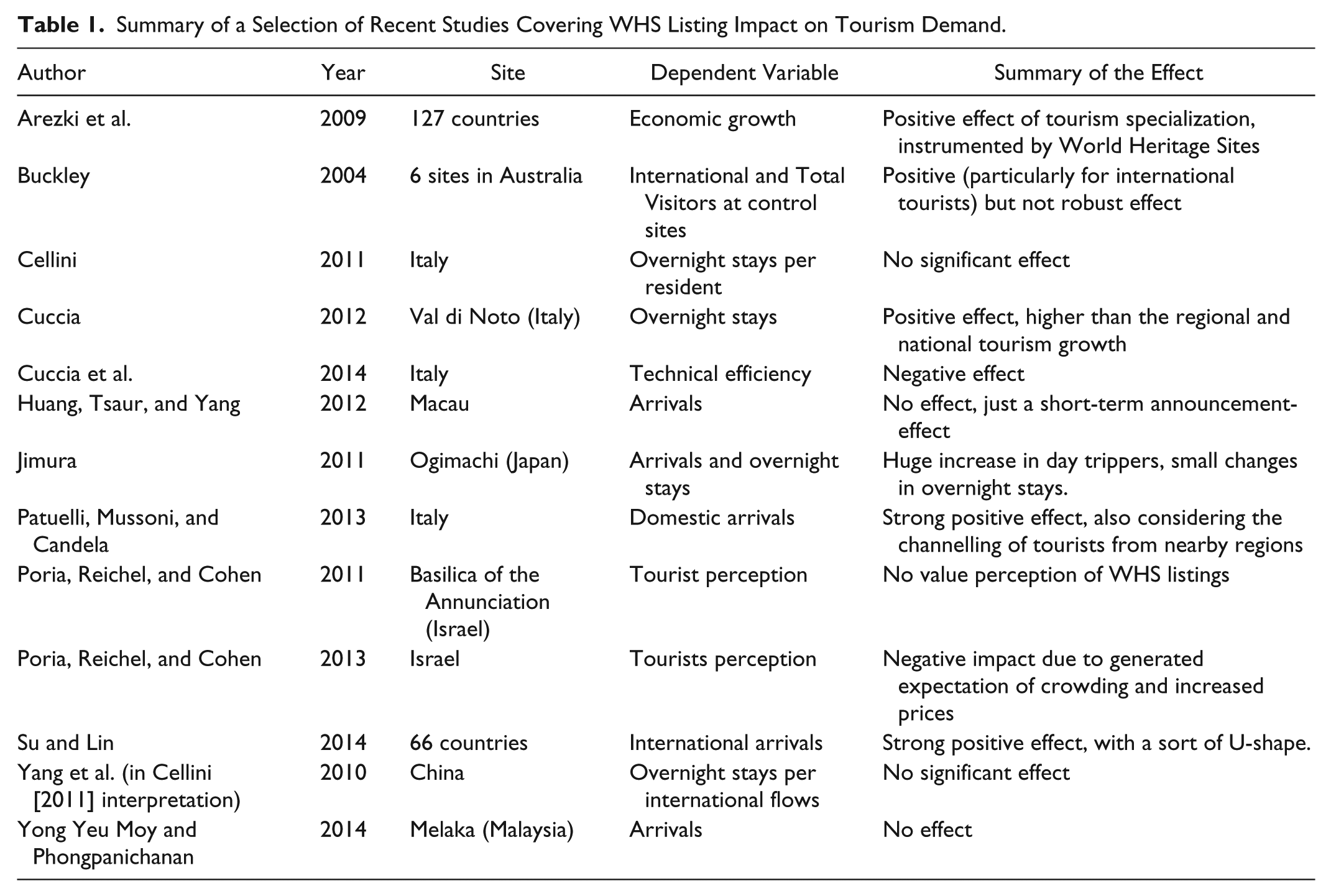
Recent findings about the ability of a WHS listing to impact tourism demand and visitors’ attitudes are quite controversial, in the sign of the relationship (both negative and positive relationships have been detected) and its significance (most of the research records insignificant results, and when the estimated coefficients are significant, results are often nonrobust). Given that the policy relevance of the issue of tourism development conflicts with the controversial results, researchers have in some cases misconstrued statistically modest empirical evidence to draw conclusions on trends in international demand, an issue that needs to be addressed with more care: on this point, see, for example, the critique of Cellini (2011) regarding the conclusions of Yang et al. (2010). A summary of recent literature results is provided in Table 1 for the reader’s benefit.
Summary of a Selection of Recent Studies Covering WHS Listing Impact on Tourism Demand.
Our article contributes to the literature in several aspects. First, as stated above, previous research has generally placed little relevance on the choice of the perimeter of analysis to define “the destination” in which to assess tourism impact. A number of previous papers (Yang, Lin, and Han 2010; Patuelli, Mussoni, and Candela 2013) have studied the effect at a regional or national level, ignoring any substitution effect that might be at play (redistribution of tourists from one place to another) and which might hide the direct impact borne by the site. Theoretically, it is likely that WHS listing has an impact mainly on the site and its surrounding destination. Since the destination can be defined as “a territorial system supplying at least one tourism product able to satisfy the complex needs of tourism demand” (Candela and Figini 2012, 74), it is straightforward to think of the municipality as the system (governed by the local destination management) where hospitality, the main attractions motivating the visit (e.g., natural or cultural resources, events or, as it is relevant to our paper, the WHS site), and other complementary services (e.g., restaurants, leisure services) are located and organized. Just a few papers, coherently with the theory, consider the smallest statistical unit (such as the town(s) where the site is located) as “the destination” where the evaluation of tourism impact is made. Hence, the choice of focusing on the smallest statistical unit compatible with the site (the municipality or a small district of municipalities) is one of our main contributions to literature.
Second, our paper shares Italy as the country under investigation with some of the aforementioned literature (Cellini 2011; Cuccia 2012; Cuccia et al. 2014; Patuelli, Mussoni, and Candela 2013). However, in contrast to Cellini and Patuelli, Mussoni, and Candela, it is not our intent to examine the existence of causal relationships between WHSs and tourism performance through econometric modeling; similarly, we differ from Cuccia (2012) as we do not want to focus on a single WHS either. Our main aim is to identify the characteristics and main patterns of tourism performance of destinations hosting a WHS through the analysis of multiple sites. Hence, our approach could provide a “template” to be replicated in other similar countries (e.g., Spain and France, major destinations hosting several WHSs).
Third, our contribution is to provide valuable information to tourism researchers and practitioners as, to the best of our knowledge, no previous study has collected such a comprehensive data set (1982 to 2013) of tourism flows for the smallest statistical units (i.e., the municipality or, in the case of complex sites, small groups of neighboring municipalities) for Italy. Because of the fact that before 1997 official tourism micro statistics were only stored by local public administration, it is extremely difficult to access data for remote years for several WHS destinations. 1
Starting from these considerations, the main research questions we wish to address are (1) whether WHS listing is associated to any change in the number of visitors at the site/destination level or in its growth rate; (2) whether evidence is robust to the use of different indicators of tourism performance (overnight stays, length of stay); (3) what are the main patterns of tourism performance resulting from Italian WHSs; and (4) what are the policy and managerial implications stemming from the empirical evidence.
As mentioned before, Italy is certainly the most important case study for assessing the impact of WHS listing on tourism, both because of the importance of Italy as a tourism destination (the country has long been the most important destination worldwide for number of international arrivals, and even today, in a more accessible and globalized world, ranks fifth worldwide, according to UNWTO statistics) and for the number of sites listed by UNESCO (Italy has 51 WHS-listed sites in September 2015, the highest number worldwide). The number of listed sites has grown steadily since 1987, with a particular concentration between 1995 and 1998, when, in only 4 years, 21 sites were officially included on the UNESCO list. To sum up, Figure 1 shows total arrivals to Italy (international and domestic) in hotels since the beginning of the official statistics (1956), together with the number of WHS-listed sites.
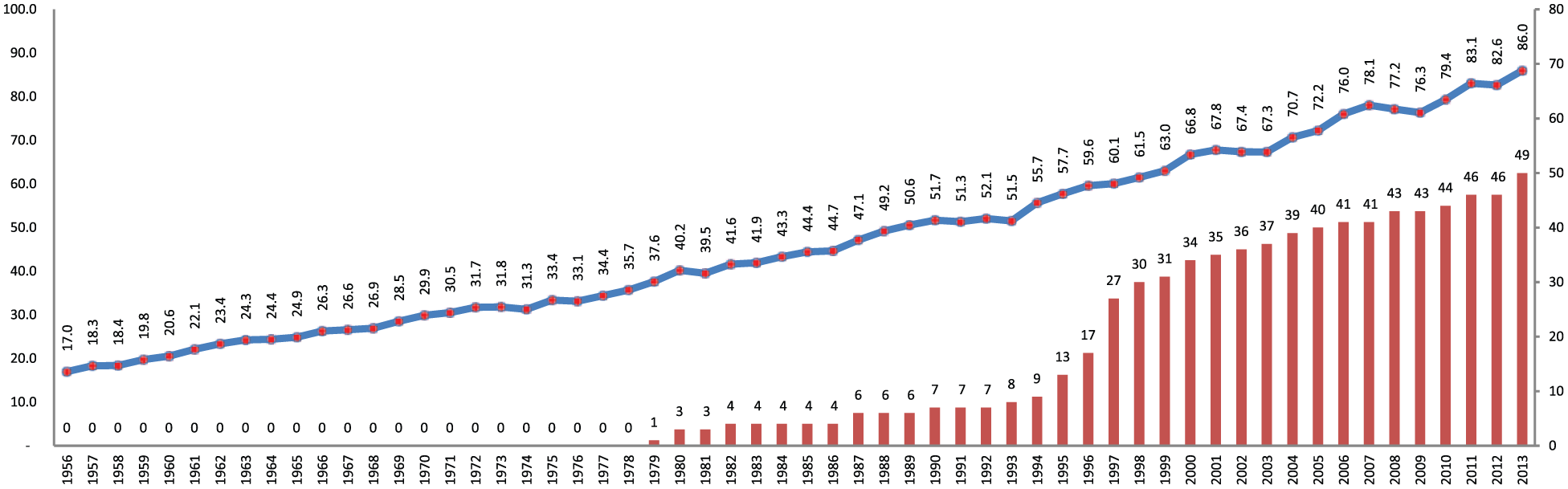
Arrivals in hotels (million) and number of WHSs—Italy, 1956–2013.
Research Methodology and Data
The research focuses on the 50 Italian WHSs listed at the time when our work started, and on their respective destinations. As regards the time span, we considered a mobile range of 11 years, as in Patuelli, Mussoni, and Candela (2013), of which 5 years prior to inscription on the WHS list, the year of inscription and 5 years following the year of inscription (5+1+5).
As regards the geographical area under investigation, we collected data on tourism flows in the destinations hosting the sites where, consistently with the definition outlined in the second section, we consider as destination the municipality or the district of neighboring municipalities (depending on whether the WHS is wide enough to encompass a geographical area larger than the single municipality). This choice was determined by common sense: the most adequate statistical unit to observe for examining the tourism impact of WHS listing is the town where the site is located. Clearly, any evidence of change in tourism demand linked to the WHS should be visible at the municipality level. Should there be no evidence of impact within the destination, this might be due to two scenarios: (1) the site is not able to attract additional tourism following the WHS listing; (2) the site attracts day-trippers who are accommodated in other destinations. Both scenarios would lead to the same conclusion that the site is not effective in retaining tourists within the destination and that, in the end, the WHS listing does not create additional demand for the hospitality system of the destination itself.
With regard to the indicators of tourism performance, consistently with the great majority of studies on tourism, we considered (1) tourism arrivals (domestic and incoming arrivals), the increase of which is an appropriate measure of market growth; (2) overnight stays, which is the closest proxy for tourism expenditure and therefore for the economic impact of tourism; (3) average length of stay (the ratio between overnight stays and arrivals), which might register changes from the tourist side, in the interest generated by the WHS listing. Average length of stay is an important proxy to measure how destinations succeed in retaining tourists longer, perhaps because of the renewed image or branding provided by the listing or a change in the number and quality of “things to do” and “things to see.”
With regard to the methodology, as outlined in the second section we were not interested in looking at the general cause–effect relationship through econometric modeling, both because the country under investigation (Italy) is quite heterogeneous and it would be difficult to generalize conclusions and because we preferred a more market-oriented and operational approach, looking at the performance of the different sites before and after inscription. In a sense, we returned to the original approach used by Buckley (2004).
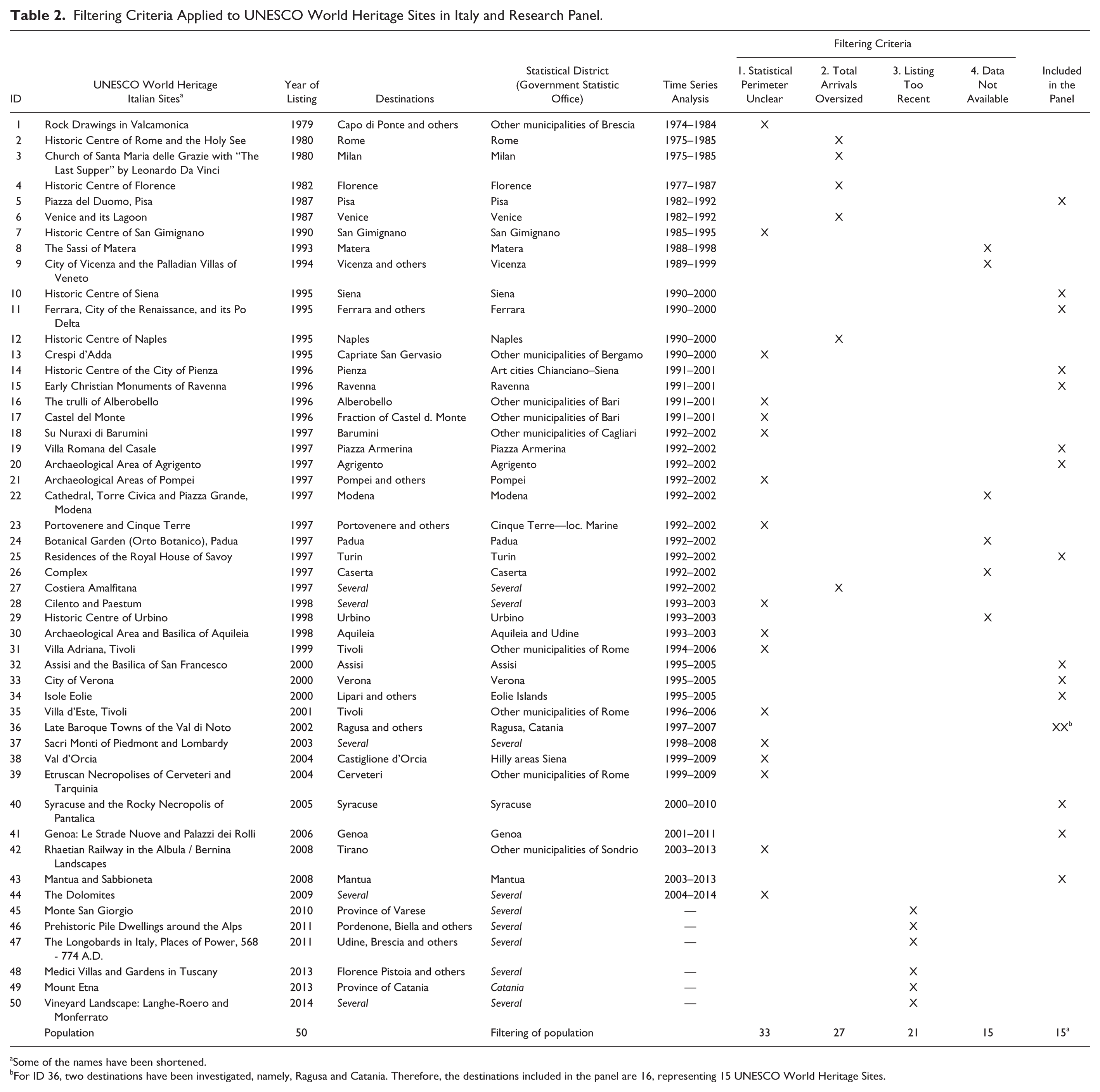
Taking the 50 Italian WHSs, we carried out the necessary filtering to generate a consistent and reliable database. In particular, we selected destinations and sites according to the following criteria:
Assessment of a clear statistical perimeter: given the methodology of collecting official tourism statistics in Italian municipalities, which is often based on districts rather than single cities or towns, it was not always possible to clearly define and isolate destinations hosting WHSs. This is the case for very small municipalities, which are often clustered within a wider statistical unit that also includes other municipalities (e.g., the Trulli of Alberobello: Alberobello statistics fall within the Bari cluster, which is much bigger and geographically widespread, and therefore this WHS is excluded from the sample).
Cut-off of “superstar destinations”: consistently with VanBlarcom and Kayahan (2011), for which the causal relation between WHS listing and tourism flows is weak for sites that were already major attractions prior to their designation, destinations with more than one million total arrivals in the year of listing were excluded. Hence, destinations such as Rome, Venice, Florence, and similar superstars of Italian (and world) tourism, for which the change in flows would not be so evidently associated to WHSs (it is heavily arguable that any increase in arrivals in Rome or Venice would stem from WHS listing) were not considered in this study.
Year of the listing: all sites that had been WHS listed within the last 5 years (i.e., after 2009) were not included in the research, as data for the whole period of 5 years after the year of inscription could not be collected.
Availability of data: we could not source the relevant data for some of the destinations that had been listed more than two decades ago (e.g., Vicenza, Matera), making data collection challenging. This difficulty is also due to the fact that tourism statistics have been completely reorganized since 1997, and data before 1997 are not stored or released in the official online data sets of national and regional statistical offices (ISTAT), nor are they available in local tourism offices, not even paper-based.
Applying the aforementioned selection criteria, a sample of 16 destinations, out of the original population of 50 sites, was filtered. The set of data used for the research is presented in the last column of Table 2. 2
Filtering Criteria Applied to UNESCO World Heritage Sites in Italy and Research Panel.
Some of the names have been shortened.
For ID 36, two destinations have been investigated, namely, Ragusa and Catania. Therefore, the destinations included in the panel are 16, representing 15 UNESCO World Heritage Sites.
Total tourism arrivals were compared, for each destination in the panel, on a year-to-year basis, to obtain the average growth rate in the 5 years before inscription and the average growth rate in the following 5 years (considering the listing year within both periods). We also provided a disaggregated analysis through the breakdown by region of the origin of tourism flows (domestic or incoming tourists) and by type of accommodation (hotels or other establishments). In order to provide a benchmark to evaluate destination market growth, we compared the performance of each destination with the performance of the administrative regions they belong to, to verify any external or market effect. The same exercises were replicated for the other indicators under investigation: overnight stays and length of stay.
As an example, the case of Ravenna was studied in this way:
- WHS: “Early Christian Monuments of Ravenna”
- Year of listing: 1996
- Statistical unit: “Municipality of Ravenna”
- Region to benchmark: Emilia Romagna
- Time series: 1991–2001 (from 5 years before the listing to 5 years after the listing)
- Variables under investigation: Arrivals, overnight stays, length of stay
- Measure: Compound growth rate (%), average of growth rates (%)
- Breakdown: by region of origin (domestic, incoming) and by type of accommodation (hotel and nonhotel establishments)
In order to better evaluate the results, we included two more variables in the analysis, providing additional insights into tourism demand trends:
The size and the development of the hospitality sector, proxied by the number of available beds. This also allowed us to compute a rough index of occupancy rate at the destination level and to monitor the evolution of tourism supply over time. In fact, the trend in demand at a specific destination is also affected by factors others than WHS designation, such as the evolution of the hospitality system, the development of other attractions or investment in infrastructures (du Cros [2006] recalls the case of Lijiang, China, where, after the listing, massive investment in the transport system, including the opening of the airport, led to an exponential growth in arrivals), or even the number of other WHSs in the region (Poria, Reichel, and Cohen 2011). We will come back to this issue in the fourth section.
The social carrying capacity of the destination, proxied by the saturation index in the year of listing. The saturation index is computed as the ratio between daily average overnight stays and residents (Candela and Figini 2012). A modified version of the saturation index was used in Cellini (2011).
Main Findings
Tourism Arrivals
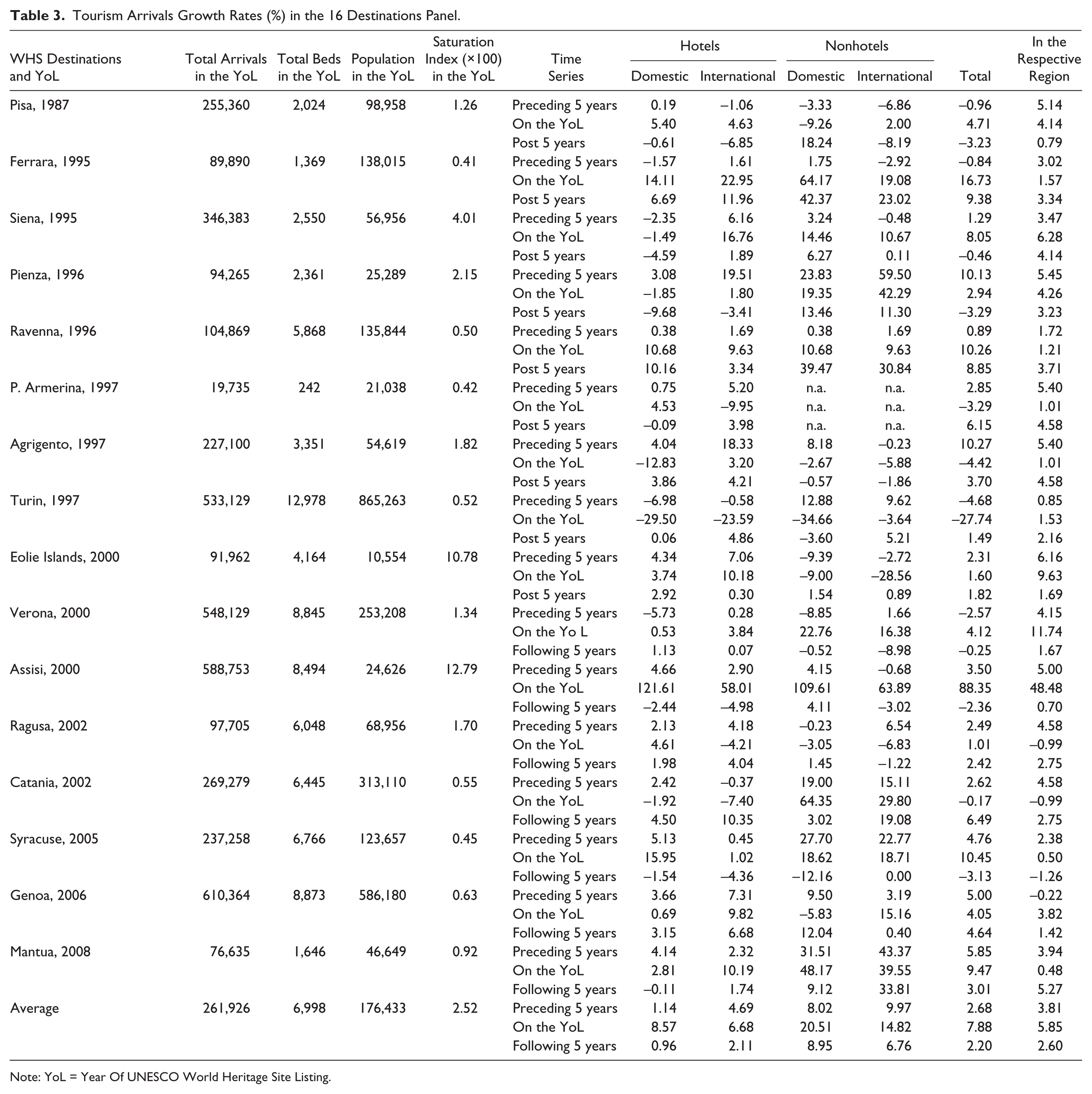
Since arrivals are the most important and intuitive measure of tourism attractiveness, we start our presentation of results by looking at the trend of tourism arrivals in each of the 16 destinations, summarized in Table 3 with a breakdown for hotels and nonhotel establishments and for domestic and foreign flows. The growth rate over the relevant periods were computed as a compound growth rate. To avoid too much dependence on the value of the first year in the series, we also computed the average of the growth rates in the pre- and post-5-year period as a robustness check. Because no significant difference appeared in the analysis of arrivals or overnight stays using this alternative measure, only evidence with the compound growth rate is presented in the remaining of the article.
Tourism Arrivals Growth Rates (%) in the 16 Destinations Panel.
Note: YoL = Year Of UNESCO World Heritage Site Listing.
Overall, 38% (6 of 16) of destinations reported higher growth rates of arrivals in the 5 years after listing than in the 5 years before listing, while the majority of destinations (62%, 10 of 16) reported lower growth rates after listing. Some of the destinations (38%, 6 of 16) showed negative growth rates after listing: Pienza (–3.29%), Pisa (–3.23%), Syracuse (–3.13%), Assisi (–2.36%), Siena (–0.46%), Verona (–0.25%): all these destinations (except Verona where the negative growth rate was higher before listing) showed a worsening in their growth rates after listing.
Only six destinations showed higher market growth rates after inclusion on the WHS list: Ferrara (pre, −0.84%; post, +9.38%); Ravenna (pre, +0.89%; post, +8.85%); Catania (pre, +2.62%; post, +6.49%); Piazza Armerina (pre, +2.85%; post, +6.15%); Turin (pre, –4.68%; post, +1.49%); Verona (pre, –2.57; post, −0.25).
Moreover, the breakdown of demand trends in these destinations did not provide clarification of the overall picture. Although it seems that the positive growth in arrivals stemmed from a very significant growth in foreign demand, particularly for nonhotel establishments (which includes B&B structures), it was not possible to find a clear trend in these segments either: inbound arrivals growth rates increased after listing in only four destinations, and in another destination (The Eolie Islands) the increase in growth rates appeared for nonhotel establishments only. Looking at the hotel segment, on average, both domestic and international flows continued to grow in the five years after the listing, but at a slower pace (+1.14% before vs. 0.96% after for domestic arrivals, +4.69% before vs. +2.11% after for international arrivals).
Finally, in some destinations, there was a clear “champagne effect” in the year of listing: in eight destinations, the growth rate in the year of listing was higher than the growth rates both before and after the listing. However, this was not a general trend either, since the other eight destinations did not show such an effect. The parallel average increase of growth rates in the administrative regions they belong to for the year of listing, however, indicated either that some of the destinations are regionally significant and thus have a strong effect on the mean (e.g., Assisi), calling for caution when commenting on this trend in demand patterns, or that the champagne effect originates from factors external to the WHS listing.
In such a general puzzle, it would be wrong to conclude that the effect of WHS listing on tourism arrivals is always negative or not present, since several idiosyncratic factors might have impacted these destinations during the period under consideration. To cite just one, Assisi suffered a severe earthquake in 1997 that almost caused a “one-year shutdown” of the destination. The same town hosted the Jubilee in 2000, which sky-rocketed arrivals by 88% for that year compared to the year of WHS listing. Furthermore, events such as the designation of Genoa as the “European Capital of Culture 2004,” or the development of new airstrip and landing infrastructures for Catania airport in 2006, might have led to a significant impact on domestic and international demand for these destinations. Before coming back (in the fourth section) to these and other issues that might have impacted the performance of individual destinations, it is noteworthy to recall that for 10 of the 16 destinations under investigation, tourism market growth in the period after WHS listing was dismal.
Overnight Stays
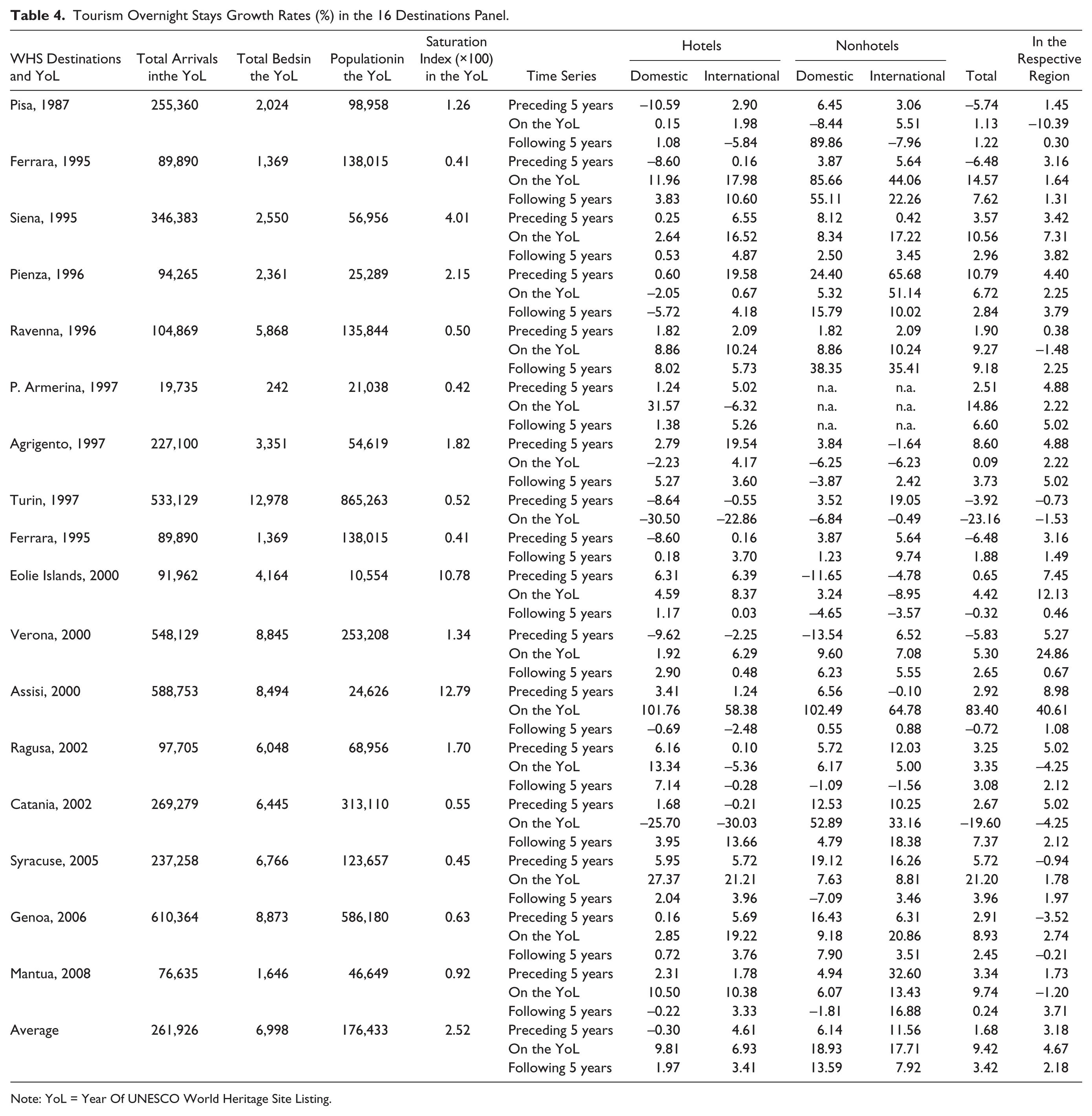
Let us now move to the analysis of overnight stays (Table 4), by adopting the same methodology used for tourism arrivals. Similarly to arrivals, the general picture seems very mixed: in seven destinations (44% of the sample) the annual growth rate of overall overnight stays in the 5 years after the listing was higher than the annual growth rate in the 5 years before the listing. The destinations that increased their overnight stays after receiving the WHS designation for their sites were: Ravenna (pre, +1.90%; post, +9.18%); Ferrara (pre, –6.48%; post, +7.62%); Catania (pre, +2.67%; post, +7.37%); Piazza Armerina (pre, +2.51%; post, +6.60%); Turin (pre, –3.92%; post, +1.88%). These are the five destinations that also increased their arrivals, as shown in Section 4.1, to which Verona (pre, –5.83%; post, +2.65%) and Pisa (pre, –5.74%; post, +1.22%) have to be added. These last two destinations increased overnight stays while decreasing arrivals.
Tourism Overnight Stays Growth Rates (%) in the 16 Destinations Panel.
Note: YoL = Year Of UNESCO World Heritage Site Listing.
Among the rest of the sample (56%), seven destinations (44%) reported lower but positive growth rates after listing and two destinations (12%) reported lower and negative growth rates after listing. Hence, no straightforward evidence of any significant pattern appeared in WHS listed destinations for overnight stays either. However, some interesting comments can be made: first, the increase in the growth rates of overnight stays after WHS listing in the seven aforementioned destinations mainly stemmed from increased volumes of domestic flows. On average, reported measures indicate that domestic overnight stays grew more after listing in both hotel and nonhotel accommodation, while foreign flows did not even keep up with the pre-listing period. This is not fully in line with the picture of arrivals and might be interpreted as a different impact that the “WHS brand” has on domestic and incoming tourists. In fact, the listing might encourage more foreign tourists to visit the site, in a sort of “discovery effect,” while it might encourage domestic tourists to stay a bit longer, in a sort of “quality effect.”
Second, a “champagne effect” in the year of listing is easily visible for overnight stays, as it was for arrivals, in most (10) of the destinations. However, this effect is visible for both destinations with increasing growth rates (four of seven) and for destinations with decreasing growth rates (six of nine). Third, WHS-listed destinations reported a higher increase in nights spent (average +1.68% pre vs. +3.42 post) than the administrative regions they belong to (average +3.18% pre vs. +2.18% post).
Length of Stay
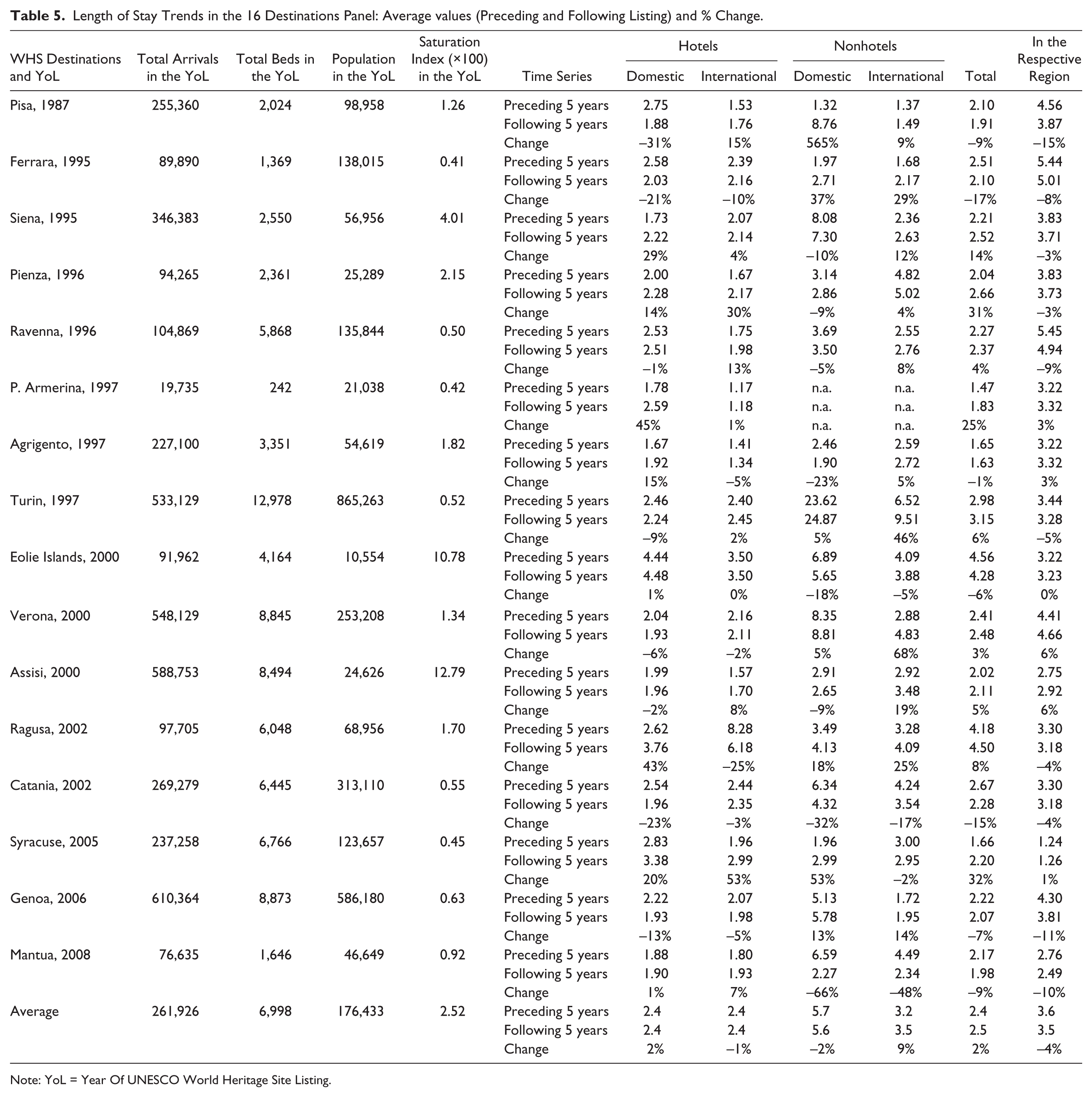
Finally, it is also interesting to look at the trends for the length of stay. The length of stay, whose importance in terms of tourism policy is often underrated, is closely linked to the ability of destinations to propose more “things to do” and more “things to see” to tourists. The analysis of the length of stay for the 16 destinations in our sample is in Table 5, with the breakdown for hotels and nonhotel establishments, for domestic, incoming, and total tourism flows.
Length of Stay Trends in the 16 Destinations Panel: Average values (Preceding and Following Listing) and % Change.
Note: YoL = Year Of UNESCO World Heritage Site Listing.
Since the diminishing length of stay is a general trend of tourism flows worldwide, and a major concern in most Italian destinations, we would have expected a shorter length of stay in all destinations, having to focus on understanding whether the decrease in the destinations hosting WHSs was stronger or weaker than the overall decrease in the administrative regions they belong to. 3 On one hand, one would expect that a positive impact on the length of stay follows WHS listing; on the other hand, Poria, Reichel, and Cohen (2013) reported that the designation might have a negative impact on the experience (as the site might be perceived as more crowded and expensive) and could lead to a shorter stay at the destination.
On average, the length of stay in the 16 destinations increased in the 5-year period after the listing (from 2.4 to 2.5 days, an increase of 2%) while the corresponding regions showed an overall decrease (from 3.6 to 3.5 days, a decrease of 4%). However, as might have been anticipated from the study of arrivals and overnight stays, the disaggregated analysis is quite puzzling. In particular, we reported an increase in the length of stay in 9 of the 16 destinations under investigation (56%): Piazza Armerina (pre, 1.47; post, 1.83); Pienza (pre, 2.04; post, 2.66); Ragusa (pre, 4.18; post, 4.50); Ravenna (pre, 2.27; post, 2.37); Syracuse (pre, 1.66; post, 2.20); Siena (pre, 2.21; post, 2.52); Turin (pre, 2.98; post, 3.15); Verona (pre, 2.41; post, 2.48); and Assisi (pre, 2.02, post, 2.11). Among these 9 destinations, there were four cases (Siena, Ravenna, Pienza, and Turin) in which the trend of length of stay in the region they belong to was negative, three cases (Piazza Armerina, Ragusa and Syracuse) in which the trend in the corresponding region was positive but weaker, and two cases (Verona and Assisi) in which the trend in the corresponding region was positive and stronger.
Moreover, there were 7 destinations (44%) in which the length of stay decreased. In four of these cases (Ferrara, Agrigento, the Eolie Islands, and Catania) the decline in the length of stay was stronger than the trend of their corresponding regions; in the other three cases (Pisa, Genoa, Mantua), the decline in the length of stay was weaker than the trend of the regions they belong to. Overall, 10 of 16 destinations showed better performances (increased or weaker decline in the length of stay) than their corresponding regions.
Sensitivity Analysis
From the combined analysis of arrivals, overnight stays, and length of stay, it is evident that there is no unique pattern in demand trends, but a whole range of different situations: from destinations in which WHS listing did not bring any advantage for tourism (Agrigento, where post-listing growth rates of arrivals and overnight stays were lower than before the listing and the length of stay declined more than in the rest of Sicily), to destinations in which WHS listing is associated with increasing growth rates of arrivals but with a strong decline in the length of stay (Ferrara), to the ones in which WHS listing mainly “convinced” tourists to stay a little longer (Siena, with increasing length of stay but declining arrivals), to many other idiosyncratic evidences. Such diversity of results expands if we consider the breakdown between foreign and domestic tourists and between hotel and nonhotel establishments.
Can we say something meaningful about the reasons why such diversity exists? Before attempting to answer this question, a few considerations are necessary. First, as recalled in the fourth section, idiosyncratic effects might be at play, the mentioned earthquake of Assisi in 1997 being the most important, together with the designation of Genoa as the “European Capital of Culture 2004,” and others. Second, the selected panel of 16 destinations covers 8 administrative regions (Lombardy, Sicily, Tuscany, Umbria, Liguria, Piedmont, Emilia Romagna, Veneto), being representative of different Italian geographical areas (Northern Italy, six sites; Central Italy, four sites; Southern Italy, six sites). Third, coherently with the rich cultural heritage of Italy, 14 of the 16 destinations are cultural sites, while only one (the Eolie Islands) is a natural site and another one (Ferrara and the Po River) is a mixed site, although the area is particularly well known and attractive for cultural tourists.
Given such diversity of destinations and results, our main concern is now to understand whether key factors can be highlighted to explain the different tourism performance of the destinations under investigation. In our opinion, three main issues are of relevance. First, although the time span under consideration (1982–2013) can be considered sufficiently long to be independent of tourism and economic cycles, one might however think that results are driven by the moment in which sites were listed as WHSs. We can exclude such a possibility for two reasons: one, data in Tables 3, 4, and 5 are ranked according to the year of listing and no clear pattern appears in arrivals, overnight stays, or length of stay; two, in order to verify whether there is a time-related effect, we can move from the analysis of absolute performances to the analysis of relative performances, comparing each destination with the performance of the administrative region they belong to in the same period (since the alleged time effect should be invariant within the region). Yet, the performance of destinations hosting WHSs is worse than their corresponding regions in 10 cases of 16 for arrivals, in 6 cases for overnight stays, in 6 cases for length of stays, with only partial overlapping in the aforementioned cases. Hence, no clear pattern emerges from comparing destinations and the regions they belong to.
Second, if we assume that the WHS listing works like an external shock (changing demand for tourism at the destination), we should expect that a twofold effect on quantity is at work: a “direct effect,” stemming from the working of WHS listing as a “quality signal,” hence increasing demand, and an “indirect effect through price,” since the destination can now quote higher prices which embody the “quality premium” stemming from the WHS brand and the additional costs involved in the protection of the site, thus decreasing demand. Since the two effects (direct and indirect) partially trade off, the final impact on tourism is undetermined. The price effect is probably more relevant when there are rigidities from the supply side (i.e., when the occupancy rate is high and the hospitality sector is unable to cope with the increase in tourism, the excess demand can easily drive an increase in prices).
We then checked whether destinations with high and increasing occupancy rates might have experienced a stronger-than-average pressure on prices, thus leading to less increase in demand than, on the contrary, destinations with a more flexible supply side. We thus collected data about price levels in the accommodation sector and compared them with the overall increase in prices in the corresponding regions. ISTAT, the Italian Statistical Office, collects disaggregated data about prices at regional and provincial levels for clusters of economic sectors. Given that such collection of disaggregated data has only been available since 1999, we were able to collect comparable data for seven destinations only: Verona, Assisi, Genoa, Ragusa, Syracuse, Catania, and Mantua (prices were collected for the province the destination belongs to, since price data at the municipality level were not available). In general, prices in the accommodation sector in the five years after the listing increased by about 15%, around 3%–4% more than the overall price index in their corresponding regions. There were two exceptions: Verona (accommodation prices increased 7.2% more than overall prices) and Ragusa (accommodation prices increased 16.6% more than overall prices).
Results show that, first, the change in accommodation prices was not correlated to changes in occupancy rates (the correlation index is only +0.07) and that all destinations were well below full capacity (the highest level of gross occupancy rates was around 42%, although such a figure depends heavily on the impact of seasonality). Second, among this subset of destinations, there were many different performances in terms of arrivals, nights spent, and length of stay. Thus, although the sample is very incomplete, we might exclude any impact stemming from the trend of prices in the accommodation sector to the market performance of destinations.
Third, apart from considerations on economic and tourism development, the main and most important reason for WHS inscription is protection and preservation of the site for the use of future generations (UNESCO 2008). Hence, we might argue that the “branding” and the “preserving” effect of WHS listing might offset each other, since preservation often calls for a more sustainable use of the resource, which, in turn, might imply rationing or other forms of limitations to the site (e.g., restrictions in tourism bus transit, increases in ticket price, visit area/time limitation as in the cases of Piazza Armerina and Val di Noto). In particular, WHS listed sites can be grouped into four clusters according to VanBlarcom and Kayahan (2011): (1) a celebration designation, for which WHS listing is seen as a reward for heritage already preserved; (2) a save our soul designation, for which WHS listing is a sign of attention for unique heritage at risk; (3) a branding initiative, for which WHS inscription is a marketing tool and quality brand to promote the development of tourism and the territory; (4) a place-making catalyst, for which WHS inscription is seen as a multiplier for economic development using heritage to trigger wider socio-economic impacts based on local culture and identity.
In destinations of the first two types, it is reasonable to expect that tourism demand would not increase after the listing: in the celebration designation the achievement itself is a reward, while in the save our soul designation the main efforts are to be concentrated on preserving the heritage. Such fragile sites and monuments are worryingly close to their carrying capacity and the likely effect of listing would be to decrease demand pressure, perhaps through an increase in prices or other forms of rationing. Branding initiatives are instead beautiful natural and cultural heritage sites that are yet not famous worldwide and for which the WHS brand might trigger tourism development. This is the case in which we should expect the strongest increase in demand, together with the last case, place-making catalysts, although in this last case tourism might not be the most important effect of WHS listing.
Which of the four groups do the 16 sites under investigation belong to? Although we have already mentioned that superstar destinations such as Rome, Florence, and Venice were excluded from the analysis, there might be other celebration and save our soul destinations for which the listing did not aim at mainly increasing tourism flows. A proxy that might be useful to cluster destinations in the three aforementioned groups is the saturation index S, a daily average of the ratio between tourists and residents:

where N is total overnight stays, P is local population, and D is the number of days for the period under investigation (the year). An index of this kind provides a clear picture of the pressure exerted by tourists on the territory, being a proxy for the social carrying capacity of tourism. We should expect that destinations with a high S before listing are the ones that were already very popular given the size of the territory, and would not use WHS listing as a tool for increasing tourism flows, and vice versa.
Consistently with this assumption, a weak negative correlation (correlation = −0.317, significant at the 12% level only) appeared between the saturation index and growth in tourism arrivals, meaning that destinations that were already relatively developed before the listing achieved lower market performances after the listing, as expected. Figure 2 shows the gap in post- and pre-listing tourism arrivals growth rates on the x-axis, and the saturation index of destinations on the y-axis, while the size of the destination is presented by the dimension of each balloon. The destinations on the right area of the chart, which had increasing growth rates after the listing, show a lower level of saturation. The destinations on the left area of the chart experienced a decrease in growth rates after listing. The chart also shows that the size of the destinations (in terms of available beds in the year of listing) has a positive correlation although insignificant at the 10% level (correlation = +0.250) with market performance.
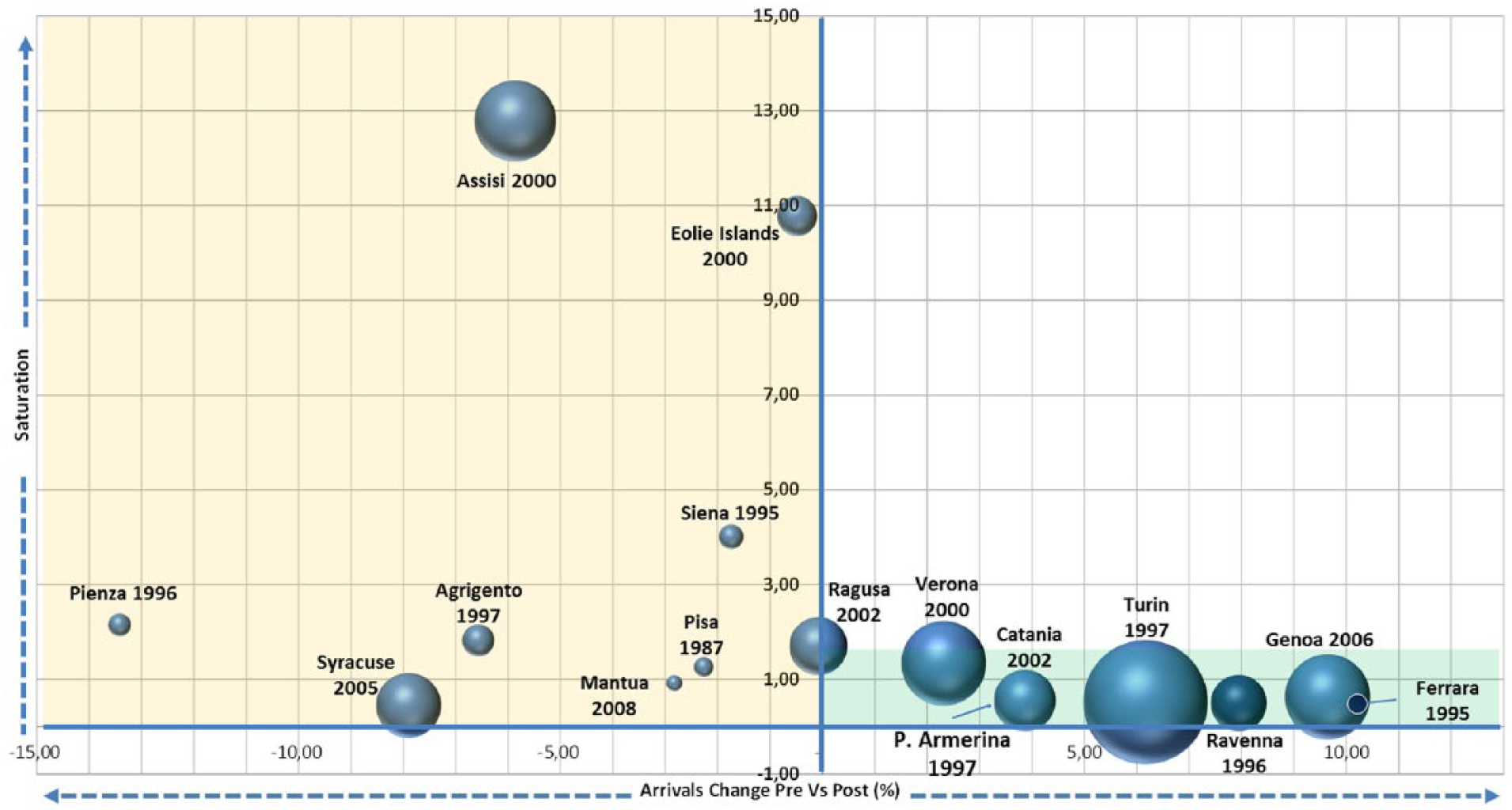
Increase in tourism arrivals for each destination in the panel, by saturation and dimension.
We repeated the same test for overnight stays in Figure 3, where the gap between post- and pre-listing growth rates for overnight stays is on the x-axis, the saturation index for destinations is on the y-axis, while the size of the destination is shown by the size of each balloon.
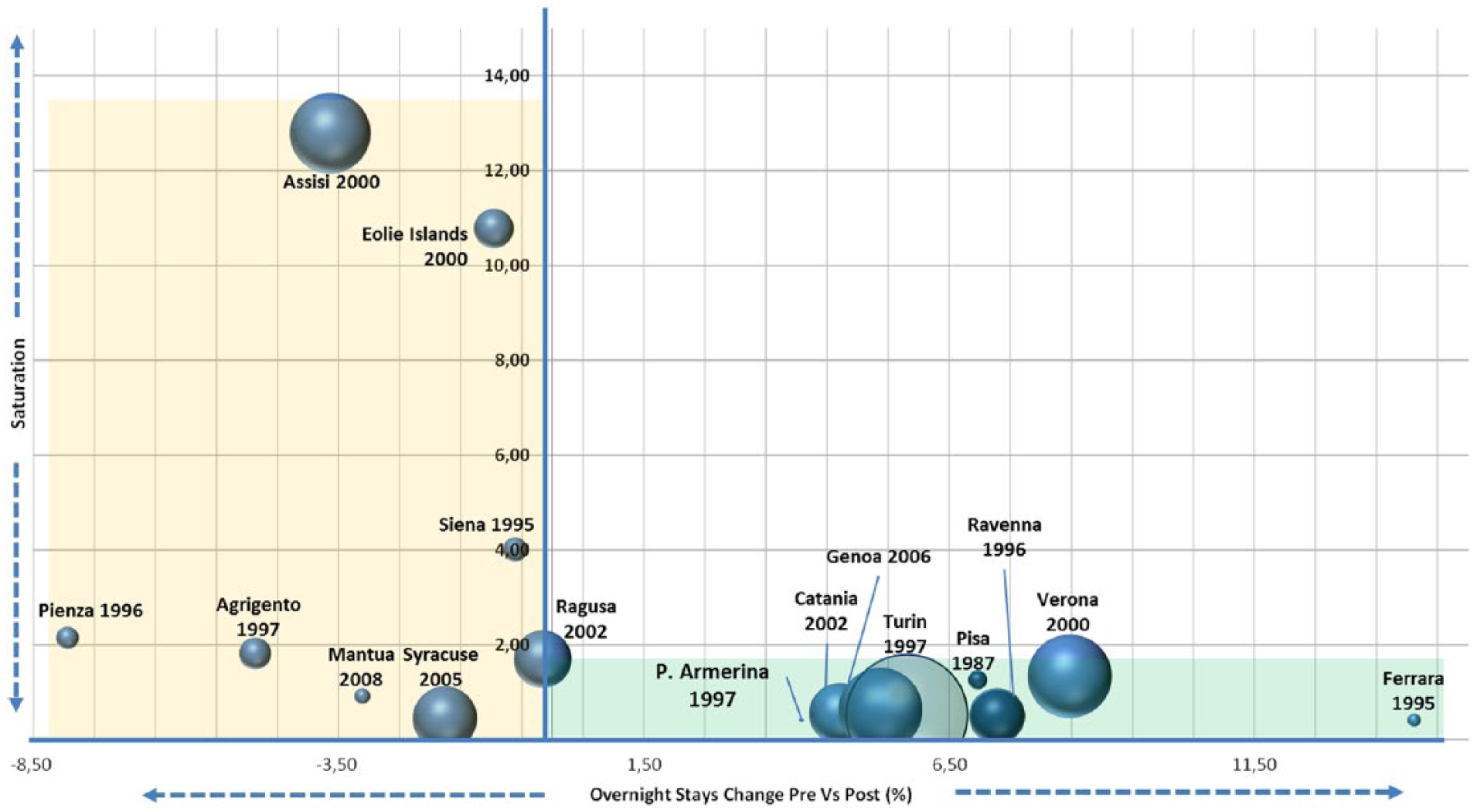
Increase in tourism overnight stays for each destination in the panel, by saturation and dimension.
Again, a weak negative correlation (correlation = −0.405, significant at the 10% level) between the saturation index and the change in growth rates for overnight stays emerged. The chart also shows that the size of destinations has an insignificant although positive correlation (correlation = +0.138) with market performance.
The same exercise was repeated for the length of stay, as depicted in Figure 4. The chart indicates no specific pattern (large and small destinations both performed better after listing, high-saturation destinations performed better after listing, low-saturation destinations showed both an increase and a decrease in the length of stay after listing), and the correlation between saturation and length of stay change (pre vs. post) did not show any clear pattern (correlation = −0.081, insignificant at the 10% level), confirming the overall puzzle stemming from this study.
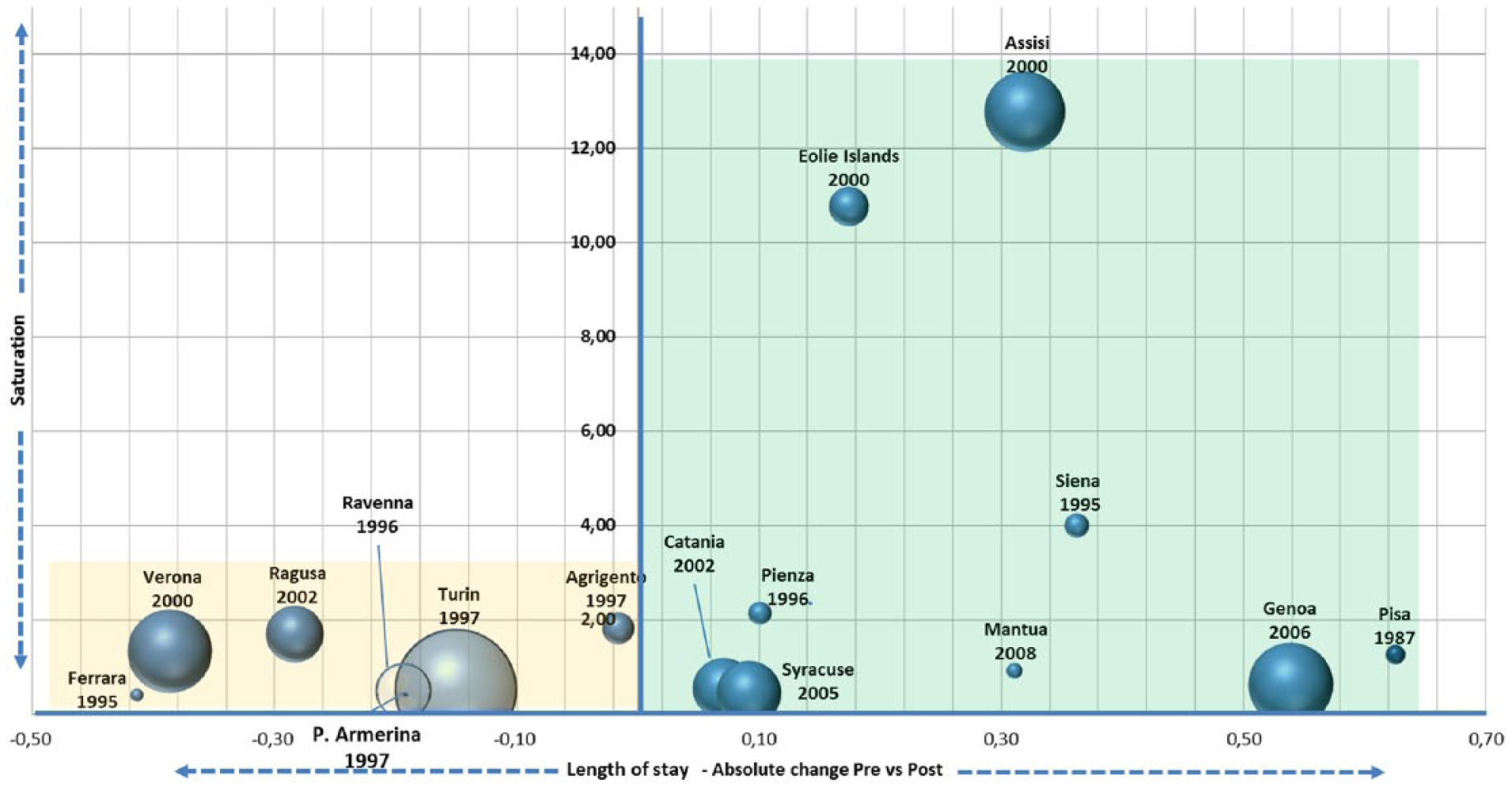
Change in the length of stay (pre vs. post; absolute values in nights) for each destination in the panel, by saturation and dimension.
Conclusions: Policy and Managerial Implications
The present study aimed at developing a comprehensive picture of tourism trends occurring in UNESCO World Heritage Sites, with the goal of providing evidence of any type of change in demand in the destinations hosting the sites after their official listing. The state of the art on the tourism impact of the WHS “brand” is controversial (Poria, Reichel, and Cohen 2011), and our contribution departs from recent literature that makes use of econometric modeling with aggregate data of tourism demand at national or international panels. Such literature has in some cases inferred general conclusions from weak statistical evidence (Yang, Lin, and Han 2010), an issue that needs to be addressed with care (Cellini 2011), especially when the observed area is too wide and many substitution effects might be at play within the territory under scrutiny.
On the contrary, following the approach of a recent strand of research in the field, we focused on the smallest statistical units to precisely evaluate tourism performance locally, in the destination where the site was located (Cuccia, Guccio, and Rizzo 2013; Poria, Reichel, and Cohen 2013). Consistently with this line of research, the present article analyzed 16 Italian WHSs and their respective destinations (municipalities), also comparing them with the administrative regions they belong to, in a sort of “natural experiment.”
As a general conclusion, we did not find any clear pattern in the trend of tourism demand after WHS listing. In more than half of the destinations, growth rates of tourism arrivals and overnight stays in the 5 years after WHS listing were lower (and sometimes negative in absolute values) than growth rates of tourism demand in the 5 years before the listing. However, there is a significant number of destinations where there was a positive trend after listing. The trend of the average length of stay at the destination is equally puzzling: the length of stay increased at some of the destinations, while at others it decreased; for a few destinations the trend was weaker than in the corresponding regions, for others it was stronger. In half of the destinations in the sample, there was a sort of “champagne effect” in the year of listing, but the effect was missing in the other half. In some cases, the champagne effect was very strong, in others it was quite weak, in some cases weaker than a similar effect at the regional level.
We also attempted to investigate whether it was possible to cluster results depending on the timing of the inscription, without finding any evidence. We then checked the relevance of alleged price effect stemming from the impact of the “WHS brand” (that might have counterbalanced the quantity effect) by controlling the occupancy rate of the accommodation sector. Again, we found no pattern whatsoever. Finally, we argued that the tourism impact of WHS listing might depend on the pressure that tourism exerts on the territory. Controlling for the carrying capacity of the destination (measured through the saturation index), we found weak evidence that destinations that were already relatively developed before the listing achieved lower market performances after the listing, consistently with the expectations arising from WHS classification of VanBlarcom and Kayahan (2011).
Given that the main conclusion of the article is that there are no clear-cut conclusions, our main contribution to literature is twofold. First, we argue that diversity is the norm. Even in a relatively small although heterogeneous country such as Italy, the tourism performance of destinations hosting WHSs can be very different indeed. In this respect, our conclusions differ considerably from recent econometric analysis that often found a positive effect of WHS on tourism performance (Su and Lin 2014; Patuelli, Mussoni, and Candela 2013). On the contrary, we ring a clear bell of warning for policy makers and tourism managers as regards the effectiveness of the “WHS brand,” consistently with the results of Rodwell (2002) and Poria, Reichel, and Cohen (2011) among others. As Bandarin (2005) put it, WHS designation can be seen as a double-edged sword. It can be an opportunity, but it can also be a threat, for example, when it is considered a sufficient condition for tourism success. Moreover, as argued by Mazanec, Wöber, and Zins (2007), WHS designation is by its very nature a borderline case of supply factor driving demand, as the processes underlying the UNESCO award are linked to an implicit demand influence. For this reason, destination managers should be aware of hidden tautologies.
The most straightforward policy implication is that, once there is no evidence that a destination listed as a WHS automatically experiences an increase in the growth of demand, hospitality and destination managers should be careful in creating expectations about a boost in demand as a consequence of the listing. They should acknowledge that WHS listing might lead to several advantages for the destination, but there is no statistical evidence whatsoever that market growth rates will accelerate, at least for the majority of destinations in a mature tourism country like Italy. If any effect is at play, it might be through the resilience in the length of stay of tourists, as already suggested by Poria, Reichel, and Cohen (2011) but, again, this trend is not shared by all destinations.
Our second contribution is methodological. We proposed a descriptive approach that was able to detect idiosyncratic and specific effects at the local destination level more effectively than general econometric modeling carried out using national or international data. It would be interesting to replicate our approach in other countries whose size, tourism development, and density of WHSs is similar to Italy’s (e.g., France, Spain, Greece), with the results having direct managerial and policy implications for those sites and destinations.
Other considerations emerge when a more detailed breakdown of the results is carried out. First, in most of the destinations, positive trends in demand are associated with the nonhotel segment and with foreign tourists; WHS listing might therefore be seen as an effective brand in Italy for a specific segment of tourists, namely, foreigners who, at least in small and medium-sized towns, usually prefer to stay outside the main accommodation sector to experience the local culture and lifestyle in a more authentic way (Trunfio, Petruzzellis, and Nigro 2006). 4 Therefore, the policy maker of the destination should acknowledge that WHS branding could impact differently on domestic and foreign demand within different segments, and should support the hospitality sector accordingly, in order to build a coherent and demand-driven cultural product.
Second, as growth rate performances differ dramatically between destinations, with some cities performing well after the listing (such as Ferrara and Ravenna) and others performing poorly (such as Pisa and Pienza), careful consideration must be made when introducing destination management policies that are able to effectively exploit the UNESCO brand potential. More than the listing itself, hence, it is the bundle of promotional, marketing, cultural, and tourism policies implemented by the destination management that might build up an adequate positioning for the destination and transform the WHS listing into a competitive advantage for the hospitality system (Cuccia 2012). Without a comprehensive tourism and cultural policy at the destination level, which necessarily involves coordination between the private and the public sector (Andergassen, Candela, and Figini 2015), WHS recognition risks being an empty brand.
Our final comment is therefore to look at WHS listing for what it should be: worldwide recognition of the outstanding value of cultural and natural heritage, for which a 360-degree cost–benefit analysis has to be carried out and a comprehensive tourism policy has to be implemented. If, on the one hand, the WHS listing brings responsibility for protecting the site and additional costs associated with investing in its conservation, on the other, in specific and particular situations, the quality premium associated with WHS branding might bring about positive tourism and economic spillovers, but without any automatism and only when a dedicated policy for culture and tourism development is planned.
The agenda for further research into this topic has to move closer to the interaction between demand and supply by analyzing more carefully, when data are available, the pattern of growth in the number of beds and establishments in the years after listing to learn more about occupancy rates, dynamics of prices, and real performances of these destinations, along the lines of Cuccia, Guccio, and Rizzo (2013) and to highlight key factors of success for the destinations. Second, we need to learn more about the impact of the number of sites designated in an area/state. Does the second (or subsequent) designation in an area have a different impact from the first one? Is there any substitution or complementary effect between two or more WHSs located in the same region? This issue is relevant for countries or regions with a large number of WHSs and is connected with the topic of multidestination trips from a tourism demand perspective. From the tourism supply perspective, this would have implications for the coordination between tourism policy at the local and the national level, to build synergies between WHSs belonging to the same region or country (e.g., developing cultural routes or other types of “package tours”) and to avoid “cannibalization.” Third, it would be interesting to replicate this work in France, Spain, or Greece (countries very similar to Italy both in terms of tourism development and in the number of WHSs) in order to understand whether the mixed and puzzling evidence stemming from Italy is also shared by its Mediterranean neighbors.
Footnotes
Acknowledgements
The authors thank Valbona Sadiraj for research assistance and for data retrieval; participants to the 9th Global Business Research Symposium (Krakow, May 2014), CBTS 2014 Symposium (Bruneck, December 2014) and Guido Candela for their comments. The usual disclaimers apply.
Declaration of Conflicting Interests
The author(s) declared no potential conflicts of interest with respect to the research, authorship, and/or publication of this article.
Funding
The author(s) received no financial support for the research, authorship, and/or publication of this article.