



Abstract
As the body of work concerning emotional solidarity between residents and tourists continues to grow within the tourism literature, little focus has been placed on how the setting factors into such relationships. Using the Osun Osogbo Sacred Grove (a UNESCO World Heritage Site in southwestern Nigeria) as a study site, this research examines the role visitors’ attachment to the place plays in explaining their perceived solidarity with area residents. From confirmatory factor analysis, a measurement model was established, which revealed strong psychometric properties for the two place attachment factors (i.e., place identity and place dependence) and the three emotional solidarity factors (i.e., feeling welcomed, emotional closeness, and sympathetic understanding). Structural equation modeling demonstrated that each of the place attachment factors explained a high degree of variance (e.g., R2 ranging between 45% and 54%) in visitors’ emotional solidarity with residents. Implications and future research opportunities are offered within the close of the article.
Some of the most pertinent questions in tourism research concern visitors’ satisfaction with destinations, and in turn, individuals’ intentions to return to those places. Scholars have generally come to an agreement regarding the important role place attachment plays in individuals’ behavioral intentions to revisit (Tsai, 2003). This is important for many reasons. For tourists and residents alike, lasting experiences and memories are forged in the place, giving way for the potential of tourists’ attachment to affect their emotional connection to residents. Such connections can increase the likelihood of revisiting.
The theory of place attachment posits that a place becomes a center of symbolic meaning through individual acts of interpretations (Brown & Perkins, 1992; Cresswell, 1996; Stokowski, 2002; Tuan, 1974). When a place is socially constructed, individuals make it an object of reference (Cohen, 1985). As Tuan (1977) has alluded, a space does not become a “place” until consideration is given to the individuals interacting within it along with their shared constructive experiences. Through these interactions, individuals develop emotional bonds with places (Proshansky, 1978; Williams, Patterson, Roggenbuck, & Watson, 1992), which in turn “provide a framework for both individual and communal aspects of identity [ . . . ]” (Brown & Perkins, 1992, p. 284).
Place attachment has been shown to include at least two distinctive dimensions: place identity (Proshansky, Fabian, & Kaminoff, 1983) and place dependence (Stokols & Shumaker, 1981). While place identity refers to the meaning a particular place has to a person (Kyle, Graefe, & Manning, 2004; Proshansky et al., 1983; Tsai, 2012), place dependence highlights the importance of a place in supporting an individual’s future goals and desired activities (e.g., Schreyer, Jacob, & White, 1981; Stokols & Shumaker, 1981; Williams & Roggenbuck, 1989). From a resident’s perspective, however, locals potentially become attached to spaces where they can “practice and preserve” their culture (Scannell & Gifford, 2010). This extends to special feelings for places that are considered sacred by a community, such as religious or historical sites (Mazumdar & Mazumdar, 2004). In a tourism context, visitors’ attachment to places contributes to the perceived authenticity of destinations (Ram, Björk, & Weidenfeld, 2016) and intentions to revisit (Tsai, 2012). However, the discussion of visitor place attachment is not possible without considering on-site social interactions between residents who live in the destination and tourists who come to experience it (Hultman & Hall, 2012).
Place attachment has been studied fairly extensively within the tourism literature (see reviews by Prayag & Ryan, 2012; Ramkissoon, Smith, & Weiler, 2013), and yet it has been rarely and tangentially considered in examining relationships between tourists and host residents (Wang & Chen, 2015).
Emotional solidarity is an emerging theoretical framework within the tourism literature that can aid in explaining connections between residents and tourists and the degree of closeness experienced within destinations. The French sociologist Emile Durkheim, who is credited with the initial conceptualization of emotional solidarity in his text The Elementary Forms of the Religious Life (1915/1995), proposed that a sense of solidarity between individuals is forged as a result of individuals possessing similar beliefs, engaging in common behaviors, and interacting with one another. The most widely accepted conceptualization of emotional solidarity is that of the affective bonds individuals experience with each other, which are characterized by perceived emotional closeness and degree of contact (Hammarstrom, 2005).
Most recently, the Emotional Solidarity Scale or ESS (Woosnam & Norman, 2010) has demonstrated sound psychological properties (i.e., various forms of reliability and validity) in assessing the relationship between tourists and residents. Such work has been instrumental in allowing for greater understanding of the character of host–tourist relationships. To date, shared beliefs, shared behavior, and interaction among tourists and residents all have been shown to significantly predict emotional solidarity (Woosnam, 2011; Woosnam & Aleshinloye, 2013). However, a person’s attachment to a place has yet to be studied in relation to tourists’ emotional solidarity with those residing in the destination. This work is a response to the need for close investigation of host–tourist relationships and specifically how tourists’ bonding with places at a destination affects these relationships. Therefore, the purpose of this research is to examine the role that tourists’ attachment to a place plays in forging an emotional solidarity with local residents.
Given its intimate setting for residents and tourists to interact and the shared purpose/intent of visitors arriving to pay respects to the Goddess of Fertility, Osun, this study was conducted at the Osun Osogbo Sacred Grove (OOSG)—a UNESCO World Heritage Site in Nigeria. The OOSG (with its numerous Yoruba shrines) is located on the periphery of Osogbo, the capital city of the state of Osun in southwestern Nigeria. For over 450 years, residents and tourists have made the pilgrimage to the Grove and the Osun-Osogbo Festival (occurring in August) to pay their respects to Osun and offer their prayers (Probst, 2011). The uniqueness of the Grove is highlighted by multiple factors. Not only is the place considered home to Osun but the primeval forest and the Osogbo River running throughout are thought to possess spiritual powers. Such pull factors reveal just why those in search of fertility as well diasporic Africans visit the sacred place. During the 2-week festival period, great care is given to incorporate visitors into planned activities (e.g., procession, ordination of the King, etc.) and in interstitial moments whereby passersby are encouraged to view and participate in ritualistic performances celebrating the Yoruba culture and heritage. In many instances, residents will open their homes to Grove visitors, which offer even greater opportunities for cross-cultural learning and understanding to occur.
In August of 2013, tourists were intercepted at the Grove and asked to complete an on-site self-administered questionnaire concerning their attachment to the OOSG (through Williams & Vaske’s, 2003, place attachment scale), interactions and relationships with residents of the community (through Woosnam & Norman’s, 2010, Emotional Solidarity Scale or ESS) and various demographic questions. Employing the ESS among tourists in the present study can serve to further validate the scale beyond its utilization with local residents (as was the case with Woosnam & Norman, 2010) and further demonstrate psychometric usability in more novel contexts (Babbie, 2016).
Throughout a 12-day period during the Osun Osogbo Festival, a team of researchers intercepted every fifth attendee and asked if they were (a) a tourist to the area and (b) if they would be willing to complete a questionnaire. Of the 486 tourists who were approached, 75 declined to participate, indicating 411 accepted the invitation (84.6%). Of those 411 distributed questionnaires, three were not completed (99.3% completion rate), yielding an overall response rate of 84.0%. Survey participants were 35 years of age, on average, with slightly more men (52.9%) completing the questionnaire. Sixty-one percent of the sample had at least an undergraduate degree. In terms of nationality, a preponderance (91.0%) of respondents arrived from either neighboring African countries or from one of the other 35 states within Nigeria. Americans (6.0%) comprised the largest group of tourists from outside of Africa. The remaining 3% was composed of respondents from seven additional countries.
Prior to assessing the underlying structure of the relationship between place attachment and emotional solidarity (using structural equation modeling in EQS 6.2), a confirmatory factor analysis was undertaken. The confirmatory factor analysis measurement model (Table 1) yielded a Satorra–Bentler χ2(180, N = 411) = 421.42, p < .001; comparative fit index = 0.94, root mean square error of approximation = 0.06. Each factor loading exceeded 0.70 and reliabilities for each factor surpassed a threshold of 0.80, indicating high internal consistency. Factors also revealed sound validities as demonstrated through significant t test values associated with loadings (i.e., convergent) and average variances extracted exceeding a 0.50 threshold (i.e., discriminant; Woosnam & Aleshinloye, 2013).
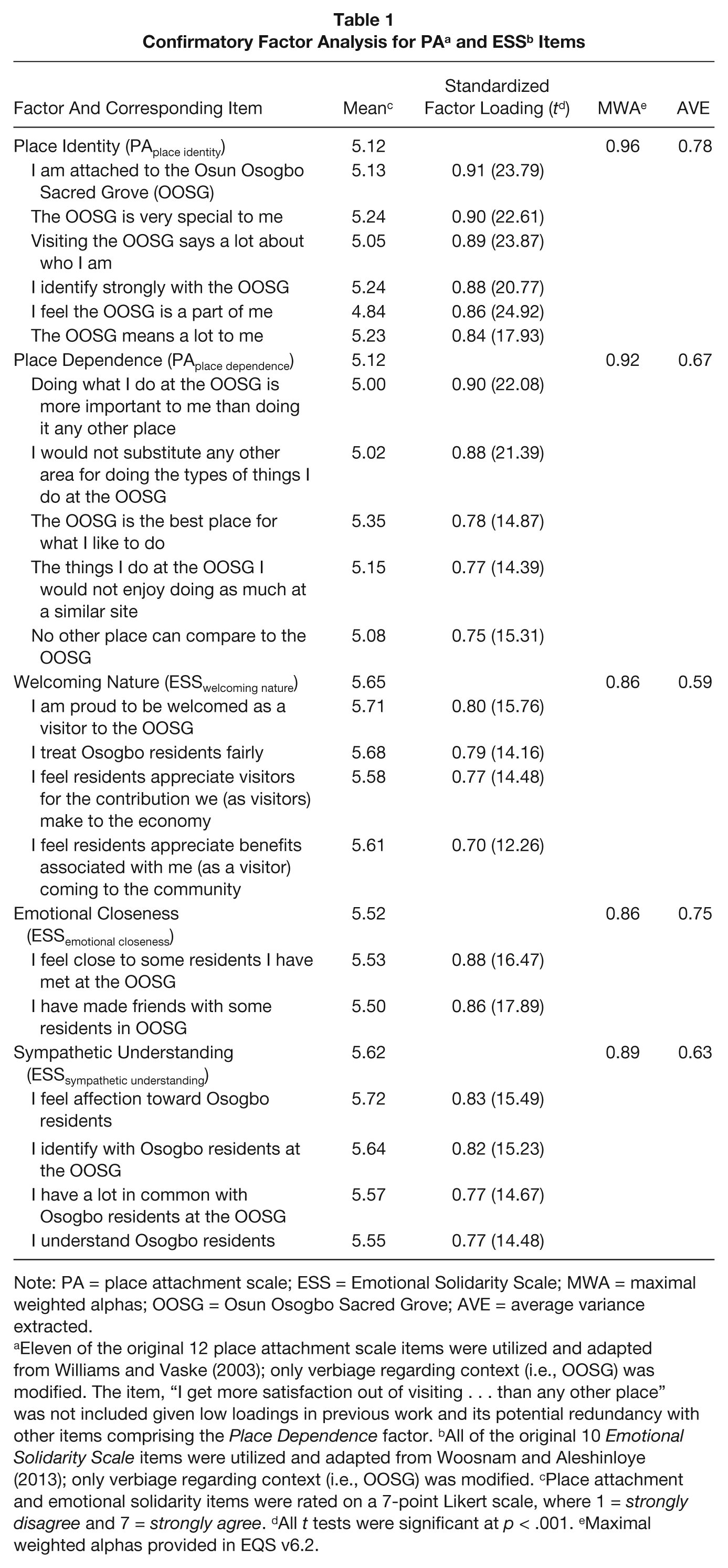
Note: PA = place attachment scale; ESS = Emotional Solidarity Scale; MWA = maximal weighted alphas; OOSG = Osun Osogbo Sacred Grove; AVE = average variance extracted.
Eleven of the original 12 place attachment scale items were utilized and adapted from Williams and Vaske (2003); only verbiage regarding context (i.e., OOSG) was modified. The item, “I get more satisfaction out of visiting . . . than any other place” was not included given low loadings in previous work and its potential redundancy with other items comprising the Place Dependence factor. bAll of the original 10 Emotional Solidarity Scale items were utilized and adapted from Woosnam and Aleshinloye (2013); only verbiage regarding context (i.e., OOSG) was modified. cPlace attachment and emotional solidarity items were rated on a 7-point Likert scale, where 1 = strongly disagree and 7 = strongly agree. dAll t tests were significant at p < .001. eMaximal weighted alphas provided in EQS v6.2.
The structural path model (Table 2) yielded a Satorra–Bentler χ2(179, N = 411) = 564.90, p < .001; comparative fit index = 0.91, root mean square error of approximation = 0.07. Place identity and place dependence were significant predictors in each of the three emotional solidarity models. With the two place attachment factors accounting for between 45% of the variance (as demonstrated in the sympathetic understanding factor) and 54% of the variance (as demonstrated in the emotional closeness factor) in emotional solidarity (based on the squared multiple correlations or R2SMC in Table 2). From each β, it is revealed that visitors’ place attachment with the OOSG is a strong positive predictor of how close they perceive their relationship to be with area residents. 1
Structural Paths Examining Relationship Between PA and ESS Factors
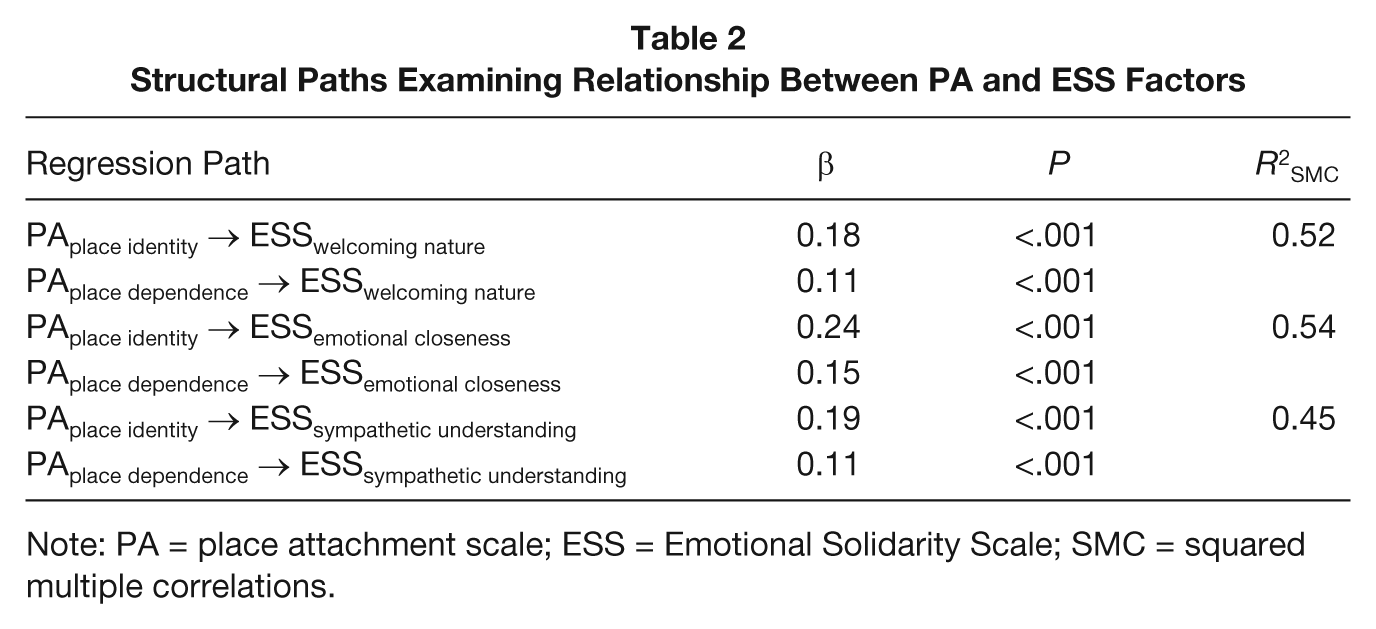
Note: PA = place attachment scale; ESS = Emotional Solidarity Scale; SMC = squared multiple correlations.
This study marks the first time the ESS has shown strong psychometric properties in a context outside of the United States. Additionally, factor means for the ESS are also among the highest reported. This may be due in part to shared beliefs and behaviors tourists likely possess with residents in visiting the Grove, as Woosnam and Aleshinloye (2013) has demonstrated in previous work. Based on the results, it is evident that while dependence on the place was a significant predictor of emotional solidarity in general, place identity served to explain a greater amount of variance in tourists feeling welcomed by and close with destination residents. Such a finding may be attributable to the fact that the OOSG has for many years attracted international diasporic travelers in search of their African “roots” (Woosnam, Aleshinloye, & Maruyama, 2016). The Grove may be considered a central part of such travelers’ identity.
Prior to this work, the only constructs considered within the tourism literature to explain emotional solidarity were shared beliefs, shared behavior, and interaction (see Woosnam, 2011; Woosnam & Norman, 2010). Collectively, the three constructs explained 33% variance in emotional solidarity. The current findings demonstrate that place attachment may serve to be a better predictor of solidarity. Of course, previous work examining predictors of ES has only involved residents and not tourists, as in this study. Moving forward, the ESS should be employed in numerous international contexts (with consideration for countries in the Global North and Global South) among both residents and tourists so as to consider additional predictors of emotional solidarity.
Results of this work provide credence to potentially amend the model put forth in Woosnam (2011) whereby place attachment is added as an antecedent of emotional solidarity. The question becomes one of where attachment fits into the model; is the relationship between place attachment and emotional solidarity mediated by shared beliefs, shared behavior, and interaction or should attachment be considered an antecedent along with those in the initial Durkheim model? If the latter, then other measures serving as antecedents, such as social distance (Yilmaz & Tasci, 2015) and cultural/religious similarities, should be added to the model for further exploration.
Future research should seek to establish the exact role of place attachment in the emotional solidarity model and the effect of place attachment on tourists’ revisit behavior. More specifically, studies could explore the process through which place dependence and place identity are forged within settings and in turn, examine the role such factors serve in explaining solidarity with those residing in the destination. A mixed methods approach whereby an initial qualitative research component (to determine the place attachment formation process) followed by a quantitative research component (to test the relationship between attachment and solidarity factors) may be the most appropriate means by which to undertake this line of research. Moreover, it could be of interest to local stakeholders and tourism planners to understand how these two place attachment factors affect tourists’ perceptions of emotional solidarity with residents. For instance, in our research, the object of reference (i.e., the Grove) was a component of local community identity; however, when tourists view local community as separate or threatening to a place toward which they have developed an attachment, they may be less likely to feel emotional solidarity with local residents. Future research should seek to test this hypothesis.