



Abstract
While researchers increasingly address place meaning and place attachment as the cornerstones for understanding human–place relations, the factors that make a tourism destination meaningful have received less attention. Using Q method, this study investigated the dynamic nature of place meanings from the tourist perspective, and developed a theoretical framework to explain the construction of destination meanings. Data analyses identified four subjective views toward the meanings of destination and four underlying continuums that illustrate how a complex process of co-construction reveals distinct patterns of destination meanings. This study makes theoretical as well as practical contributions to the literature.
Introduction
“Place is a center of meaning constructed by experience” (Tuan 1975, 152). Places in life have meanings. The concept of place meaning refers to the cognitions and evaluative beliefs concerning a setting that reflect “the value and significance of the setting to the individual” (Wynveen, Kyle, and Sutton 2010, 271). Meaning connects people with places (Rapoport 1988). Place meanings have drawn increasing research attention in the environmental psychology, leisure, and tourism literatures as a way to understand human–place relations (Wynveen, Kyle, and Sutton 2010; Hutson, Montgomery, and Caneday 2010).
Place attachment theory illustrated that individuals develop emotional and cognitive bonds with a place over time, and people feel attached to the specific place when they assign meanings to it through human–environment interactions (Low and Altman 1992; Stedman 2002). As Milligan (1998) asserts, “every interaction [with a setting and/or within a setting] bestows some form of meaning on its stage, transforming the site into a known place, but when the interaction involves a higher degree of meaning . . . the place becomes the site of place attachment” (Milligan 1998, 28). Previous empirical studies show an association between particular place meanings and intensity of place attachment, with special meaning categories conferring the highest level of attachment (Stedman 2003; Wynveen et al. 2011). Thus, the concept of place meaning has significant importance in place attachment research.
Despite growing interest in place meanings and attachment research, few studies have explored the diverse patterns of destination meanings from the tourist perspective (Davenport et al. 2010; Kaltenborn and Williams 2002). Tourism and leisure literature provide limited insights into how a destination becomes meaningful to visitors (Smale 2006; Hutson and Montgomery 2010). Recent studies primarily focus on the dimensionality of place attachment (Ramkissoon, Smith, and Weiler 2013a), and the relationship between tourists’ involvement and place attachment (Gross and Brown 2008; Hwang, Lee, and Chen 2005), and the influence of place attachment on pro-environmental behavior, satisfaction, and other behavioral outcomes (Ramkissoon, Weiler, and Smith 2012; Ramkissoon, Smith, and Weiler 2013b; Veasna, Wu, and Huang 2013; Yuksel, Yuksel, and Bilim 2010). However, the literature does not fully address “what” and “how” tourists came to attach specific meanings to a place (Wynveen, Kyle, and Sutton 2010; Hutson, Montgomery, and Caneday 2010).
This study sets out to investigate the nature of place meanings from the tourist perspective using Q method, and to develop a theoretical framework to explain how human–place interactions shaped destination meanings. This study has three objectives: (1) to explore diverse patterns of place meanings; (2) to provide a conceptual framework of destination meanings; and (3) to demonstrate how Q method can help to reveal the subjective meanings of destination. The findings of this study provide theoretical and practical implications regarding the social construction of a meaningful tourism destination.
This study develops a theoretical framework that illustrates how a destination becomes meaningful to tourists. Although scholars have undertaken to understand place meanings in a number of ways, the literature fails to provide a comprehensive understanding of how tourists interpret the meanings of place (Hutson, Montgomery, and Caneday 2010). Gustafson (2001) presents an exception, and proposed a three-pole triangular model to explain how people experienced residential versus nonresidential settings. However, this has little bearing on how tourists find meanings in a destination (Young 1999; Wynveen, Kyle, and Sutton 2010). This study seeks to address this gap.
This study also contributes to the body of knowledge by using Q method to identify diverse tourists’ perspectives of destination meanings. Q method is known as “a method for the scientific study of human subjectivity” (Goldman 1999, 589). It has the advantage of systematically exploring the construction and sharing of representative viewpoints among individuals (Hutson and Montgomery 2010). Yet, only a few tourism researchers have taken advantage of Q method (Wijngaarden 2016; Stergiou and Airey 2011).
A systematic understanding of destination meanings has significant practical implications for sustainable destination planning, marketing, and tourist experience management. The reasons people attach to a place have become more and more critical in today’s competitive tourism market, yet many destination management organizations (DMOs) have not engaged deeply in communicating customized meanings of place with targeted tourists. The findings of this study may help DMOs to better understand tourists’ meaning-making processes, then prioritize their efforts and resources to create valuable meaning by making the tourism experience correspond to tourists’ personal value systems.
Literature Review
The Place Meanings and Attachment
The concept of place meaning represents the nature of perceived relations between individuals and their world developed within the context of specific events (Fife 1994). As Mead (1934) suggested, meaning is not an abstract idea as traditionally conceived, but a concrete aspect of daily life that reflects perceptual, symbolic, and affective experience.
Place attachment theory argues that interactions between the individual, the setting, and the individual’s social worlds form and maintain meanings and subsequent attachment (Tuan 1975; Stedman 2002). Examinations of the meaning of a place reveal cognitive and affective components (Gustafson 2001; Manzo 2005). By engendering strong emotional attachment, place meanings can influence individuals’ attitudes and behaviors (Boyko 2008; Manzo 2005). For example, surveying residents of a lake region in Wisconsin, Stedman (2003) found a positive association between “escaping from urban civilization” and residents’ attachment. Wynveen et al. (2011) studied the meanings five groups of visitors ascribed to a national forest in California, and identified that a sense of comfort and memories of social interaction generated the highest level of attachment.
People feel attached to a place when they assign meanings to it; place attachment concerns the intensity of the human–place bond (Wynveen et al. 2011). Research in the leisure and tourism fields has primarily focused on the influences of place attachment and measuring the intensity of place attachment (Yuksel, Yuksel, and Bilim 2010; Ramkissoon, Smith, and Weiler 2013a, 2013b). For example, Ramkissoon, Smith, and Weiler (2013a) reported significant positive effects of place attachment on satisfaction and pro-environmental behaviors of park visitors in Australia. Veasna, Wu, and Huang (2013) studied international tourists visiting Taiwan and suggested that destination source credibility and destination image have positive impacts on destination attachment, which in turn increases tourist satisfaction.
Place meaning has received less scholarly attention in literature than place attachment; thus, its mechanisms are underexplored (Kyle and Chick 2007). Existing research provides elusive and limited understanding regarding what makes a place meaningful. The meaning-making of place involves a complex process of social, psychological, and cultural interpretations and therefore has a dynamic nature that is difficult to study (Manzo 2005; Williams and Patterson 1996).
Research Perspectives of Place Meaning
Three research perspectives—adaptive, opportunity-structure, and sociocultural—have emerged in environmental psychology to explain the meanings of place (Saegert and Winkel 1990; Williams and Patterson 1996). The adaptive perspective assumes that biological and psychological survival motivate behavior. That is, individuals tend to cope with environmental threats and restore or expand adaptive capacities (Gunderson 2006; Staats, Gemerden, and Hartig 2010). This perspective states that “the natural settings in which they evolved” support the functioning of humans because of our biological and psychological nature (Kyle, Mowen, and Tarrant 2004, 440). However, this approach ignores cultural, social, and economic contexts in which environments exist.
The opportunity-structure perspective focuses on environmental appraisals based on the goal-fulfilling potential of the environment. This perspective involves a relatively tangible property of the environment that instrumentally relates to behavioral and economic goals (Fesenmaier 1990; Obenour 2004). It recasts the adaptive view of landscape aesthetics as “behavior focused on a prominent, overriding goal of environmental encounters” (Williams and Patterson 1996, 511). Many leisure researchers have adopted this approach to address the question of “why” individuals engage in specific leisure activities. For instance, Driver et al. (1991) studied recreation activities in a natural environment, and inferred that personal motives determine people’s preferences. The strength of the opportunity-structure perspective lies in identifying how the structure of the environment affects psychological functioning. However, this approach reduces environment meanings to behavioral utilities, and generally overlooks the symbolic environment (Williams and Patterson 1996).
The sociocultural perspective asserts that the meanings people ascribe to environment are socially conditioned. It treats a person as a social agent who seeks out and constructs meaning in the environment (Hutson, Montgomery, and Caneday 2010; Wynveen, Kyle, and Sutton 2010). Place-identity theory states that meanings derived from place experiences can be “culturally transmitted and . . . integrated into the place-identity of the individual” (Proshansky 1983, 68). A number of previous studies focus on the social use of the environment to embed individuals into groups or community (Greider and Garkovich 1994; Gustafson 2001). However, the sociocultural perspective largely ignores the intrapersonal element.
Researchers propose that synthesis of the three perspectives will better illuminate place meaning (Gunderson and Watson 2007; Kyle, Mowen, and Tarrant 2004). Williams (2014) proposed a conceptual framework to reflect the methodological pluralism on place meanings; however, he discussed the place-making process in general and did not provide any empirical evidence to his framework. Notably, theoretically driven and systematic explanations of the dynamic process of place meaning-making have been scarce in environmental psychology and leisure literature (Williams 2014).
The three perspectives above suggest that specific historic or geographic contexts generate the meanings of place. The previous studies generally focus on residential settings and immediate community. Only a few studies have investigated the variety of meanings attached to non-residential places (Davenport et al. 2010; Gunderson 2006; Wynveen, Kyle, and Sutton 2010). The meanings of a tourism destination remain poorly understood. Therefore, this study addresses this gap by proposing a theoretical framework to explain the construction of destination meanings with an integrated view of previous research perspectives.
Q Method in Tourism and Leisure Research
Q method is a mixed method strategy for the scientific study of human subjectivity (McKeown and Thomas 1988). William Stephenson introduced Q method in 1935. Participants represent their viewpoints by ranking a common set of stimuli (e.g., statements, photographs) and a factor analysis extracts shared perspectives (Stephenson 1993). Whereas R-method (e.g., Likert scales and multidimensional-scaling) commonly uses a predetermined scale to measure an attitude and produces the Pearson product moment coefficient (an “r” statistic), Q method argues that a person’s subjective opinion is only revealed “when he or she expresses a point of view about something concrete from a self-referential standpoint” (Robbins and Krueger 2000, 637). Q method has been applied in a variety of disciplines such as communication and political science, psychology, human geography, and marketing (Brouwer 1999; McKeown and Thomas 1988; Robbins and Krueger 2000; Watts and Stenner 2012).
Interest in Q method in the field of tourism and leisure research has grown recently. Researchers have used it to investigate outdoor leaders’ feeling of connectedness to nature places (Hutson, Montgomery, and Caneday 2010), stakeholder views of place meanings of natural environment (Hutson and Montgomery 2010), student and teacher’s opinions of tourism teaching (Stergiou, Airey, and Riley 2008), performer’s subjectivity in a tourism culture park (Hunter 2014), resident’s perception related to cultural identity and tourism (Hunter 2011, 2013), actors’ subjectivity on problems of event planning (Phi, Dredge, and Whitford 2014), creative tourism experiences (Tan, Luh, and Kung 2014), destination image (Fairweather and Swaffield 2001), and tourist–host interaction (Griffiths and Sharpley 2012; Wijngaarden 2016). A large number of Q studies investigate the perspectives of residents, community stakeholders, or industry professionals (Lee and Son 2015; Phi, Dredge, and Whitford 2014; Rilling and Jordan 2007), while only a few Q studies focus on the tourist’s perception (Correia, Kozak, and Reis 2014; Tan, Luh, and Kung 2014).
Methodology
Q method bridges qualitative and quantitative research by combining the mathematical rigor of quantitative method with the interpretive component of qualitative method (Robbins and Krueger 2000). The role of the researcher is different in Q method and traditional qualitative methods used in human–place studies (Wijngaarden 2016). Traditional qualitative research may suffer from the bias of researcher’s subjectivity, because the researcher plays the primary role in examining the participant’s narrative. In Q method, the process of factor analysis and post-sort interview allows researchers to reflect on themselves as subjective agents and identify the ideas their own views might have obscured (Wijngaarden 2016), a distinct advantage over qualitative methods (Danielson, Webler, and Tuler 2010).
Moreover, by sorting each Q statement and interpreting it in relation to all other Q statements, Q method preserves the holistic nature of a viewpoint better than survey research can (Danielson 2009). Whereas a traditional survey method adopts a selection of objective measurements to capture the participant’s expression on some psychological traits, Q method gives the subjects room to construct their own viewpoint and interpret each statement in their own ways. Q method analyzes subjects’ relationship to shared perspectives among all participants, rather than the relationships between the traits or concepts. Q method seeks to describe a population of diverse viewpoints on a topic rather than a population of people; therefore, a relatively small number of participants is enough (Tan, Luh, and Kung 2014).
In this vein, Q method is considered particularly appropriate for this study to investigate subjective understandings of meanings across a broad range of situations that tourists assigned to favorite destinations. We conducted Q method in five steps: concourse development, P-set sampling, Q sorting, data analysis, and interpretation.
Concourse Development
The first step involved developing a “concourse” (from the Latin concursus, meaning “running together”) and sampling Q statements. The concourse is a technical term used in Q method to describe the population of all the possible statements (or other stimulus items such as pictures and videos) that represent all possible feelings, opinions, or thoughts about the topic of study (Stephenson 1993). A thorough literature review was conducted to look for statements reflecting distinguishing opinions of place meanings (e.g., Hutson, Montgomery, and Caneday 2010; Hutson and Montgomery 2006, 2010; Gunderson 2006; Gunderson and Watson 2007; Gustafson 2001; Kaltenborn and Williams 2002; Knez 2006; Kyle, Mowen, and Tarrant 2004; Manzo 2005; Rapoport 1988; Sixsmith 1986; Smaldone et al. 2005; Wynveen, Kyle, and Sutton 2010; Wynveen et al. 2011; Young 1999). The process ceased when no new opinions could be identified, resulting in a Q concourse of 186 statements.
Then, thematic analysis was employed to generate a sample of representative statements (Q samples) from the Q concourse. In order to reduce bias, three experts sorted the statements into themes and reviewed statements under each theme category. General and encompassing statements were substituted with statements that were similar or closely related. Unclear statements were removed. Forty-eight statements remained, falling into ten themes: personal life course, identity development, relaxation/security, natural elements, exploration/learning, physical activities, social relationships, ancestral/cultural connection, escape/anonymity, and spirituality/meditation. Appendix A lists the 48 statements.
P-Set Sampling
The second step involves sampling tourists who will sort the statements of the Q set, known as the person sample (i.e., P-sample). Purposive sampling involves seeking tourists with diverse experiences. The number of people in the P-sample is most often no more than half of the Q set (Watts and Stenner 2012), but smaller than the Q set (Brouwer 1999). Therefore, the P-sample consisted of 35 participants invited during Spring 2010. It included 21 males and 14 females age 22–80; 16 reported their ethnicity as Caucasian, 11 as Asian, six as Hispanic, and two as African. Twenty-nine participants had international tourism experience.
Q Sorting
Respondents were then requested to express their views on the topic by placing all statements in a Q sorting board (Figure 1). The researcher read a script as follows:
This study is interested in learning your travel experience in a favorite destination. I am asking you to participate in a memory journey exercise to identify what the destination means to you. In order to prepare for your journey, please relax and think of a destination that stands out in your mind as being important, memorable, meaningful, or special to you personally. It might be a place you have been to many times, or a place you have only visited once.

Q sorting board.
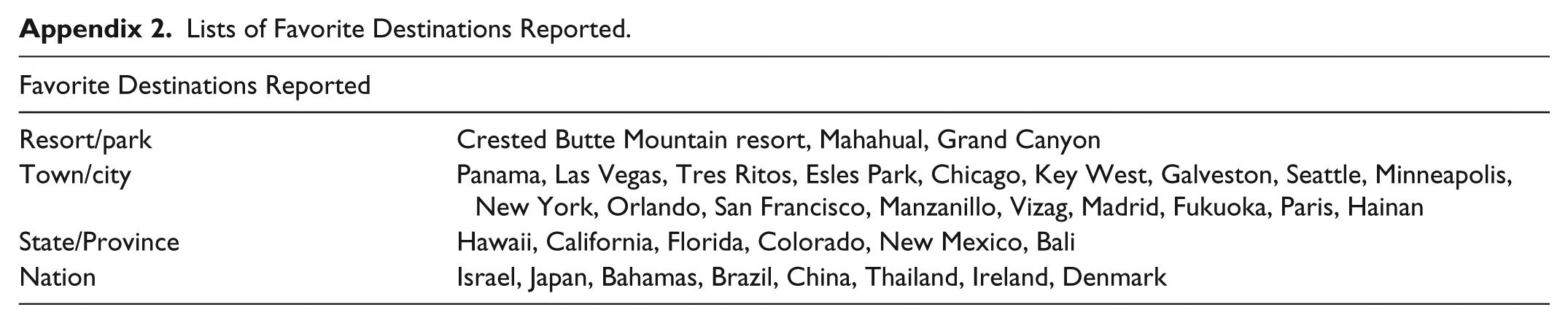
To ensure the participants understand the study’s focus on destination meanings, the researcher presented a prompt adapted from Wynveen, Kyle, and Sutton (2010), asking informants to describe some attributes and activities associated with the favorite destination. Favorite destinations reported included ski resorts, national parks, cities, states, and nations. Appendix B provides a list.
The participants were instructed to read the 48 statements in the Q set and sort the statements into three piles as agreeable, disagreeable, and neutral. Then they were to rank the order of the statements on a sorting board (Figure 1) with a continuum from “most unlike” at one end to “most like” at the other end according to the question: “What does your favorite destination mean to you?” Rank ordering on the “unlike–like” continuum forces participants to compare each of the statements in terms of how they correspond to their personal opinions (McKeown and Thomas 1988). The completed array forms constituted the raw quantitative data to be analyzed. The 11 columns in the arrays were represented by a numerical continuum from −5 to +5.
Next, participants answered a demographics questionnaire, providing gender, age range, race/ethnic group, occupation, and travel experience. Finally, the researcher invited participants to participate in a follow-up phone communication procedure for informing factor interpretation. The purpose of the phone communication is to further investigate the meaning of the sorting, to improve the factor interpretation process.
Data Analysis
The completed array forms constituted the raw quantitative data, with each statement matched to the column statistical value. Using PQ method 2.11 software, the researchers developed a correlation matrix and conducted principal components factor analysis and varimax rotation. The Q factor analysis is an inverse to ordinary factor analysis, because Q factor analysis seeks to group respondents rather than variables (Kline 1994). That is, the factors of Q method are groups of people with similar opinions.
Following the recommendation of Hutson, Montgomery, and Caneday (2010), a sort defines a factor if the correlation between them was greater than 2 and less than 2.5 times the value of the standard error (SE) formula of
Interpretation
Statement interpretation involves applying an “analyst triangulation strategy” (Patton 2002, 560). To understand the patterns of each factor, we compared high positive and negative statement rankings of z-scores, statements that distinguished each viewpoint from other viewpoints, information from post-sort phone interviews, and relevant across array comparisons to interpret the findings. Synthesizing all pieces of data into narratives highlighted defining elements of each subjective view.
Results
The Q factor analysis reveals four types of subjective views that the individuals in the P-sample held. The number of defining loadings per factor determined the number of factors extracted (i.e., at least two significant loadings on one and only one of the factors in the solution under consideration) (Dewar, Li, and Davis 2007). Therefore, we selected a four-factor solution, accounting for 41% of the variance. Of the 35 sorts, 24 defining sorts defined one of the four factors (Table 1).
Factor Matrix with an X indicating a Defining Sort.
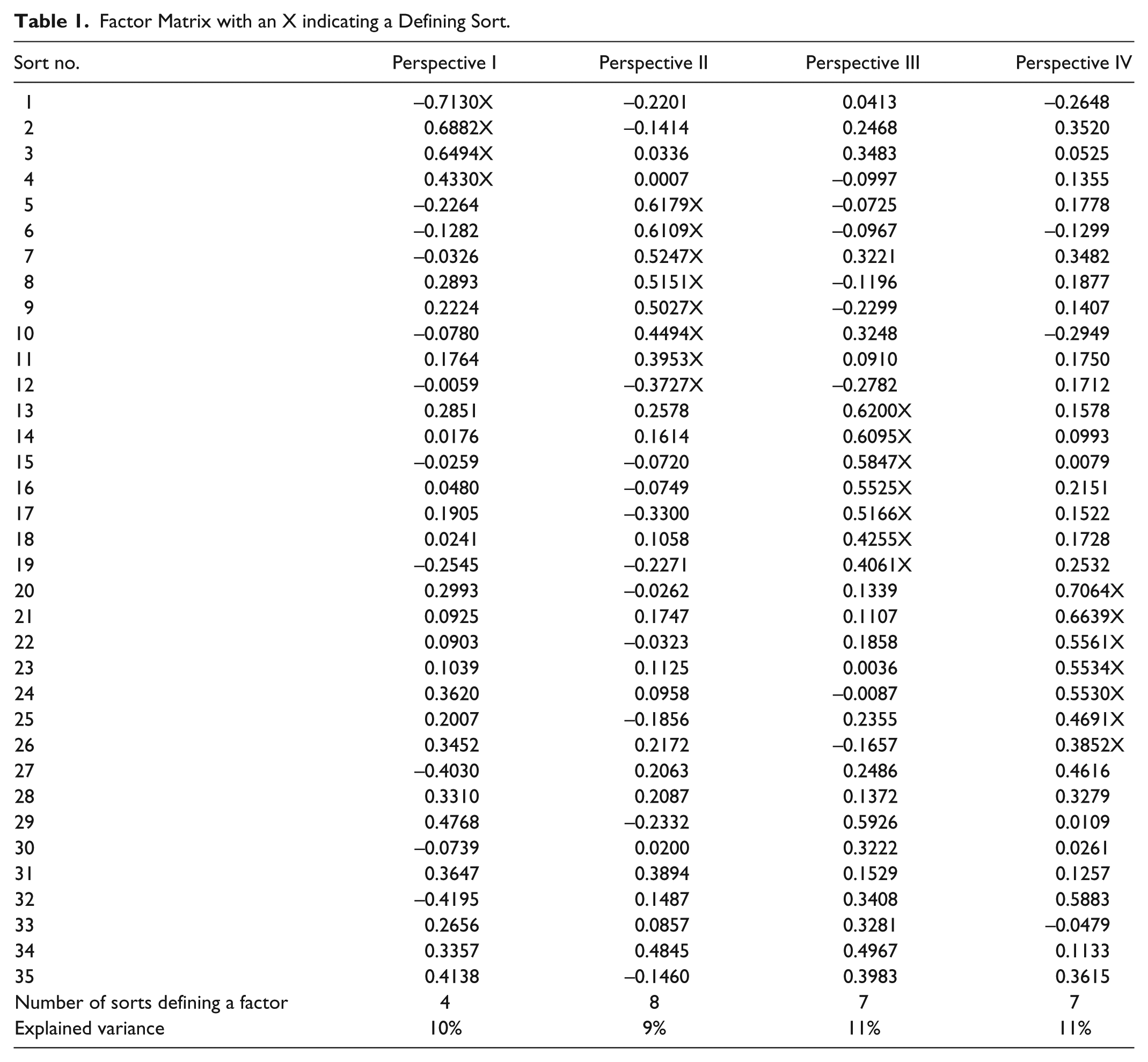
Following Brown’s (1980) guidelines, we examined the highly ranked statements which carried larger z-scores and were positioned closer to the extreme ends of each factor array (i.e., array position −5, –4, –3, +3, +4, and +5). We interpreted the meaning of each statement through both its array position and by the positioning of statements around it, taking the entire distribution of statements into consideration for the interpretation of each perspective. Through the holistic interpretation approach, the researchers identified groups of statements that merged with individual themes, and attributed new meaning “to the statement rather than the original meaning thought by the researchers who developed the statements” (Hutson, Montgomery, and Caneday 2010, 425).
We identified “distinguishing statements,” those that characterize shared views, by estimating the respective errors of the z scores and incorporating these into the formula for determining the standard error of the difference (SED):
Statement Ranking of “Solitude in Nature” Perspective.

Distinguishing statements with significance at p<.05.
Distinguishing statements with significance at p<.01.
Statement Ranking of “Connection of Personal History” Perspective.
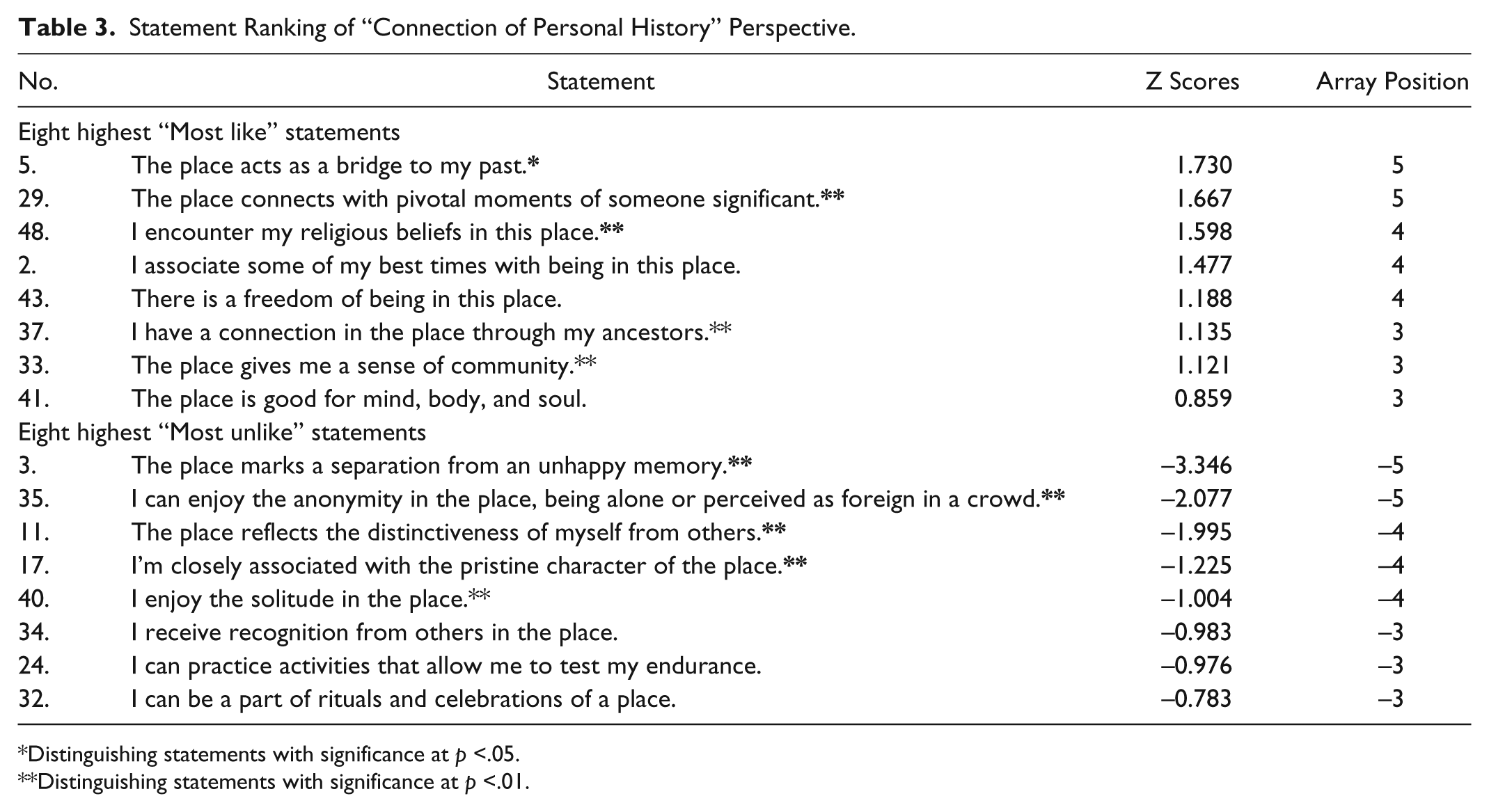
Distinguishing statements with significance at p <.05.
Distinguishing statements with significance at p <.01.
Statement Ranking of “Home for Exploration” Perspective.
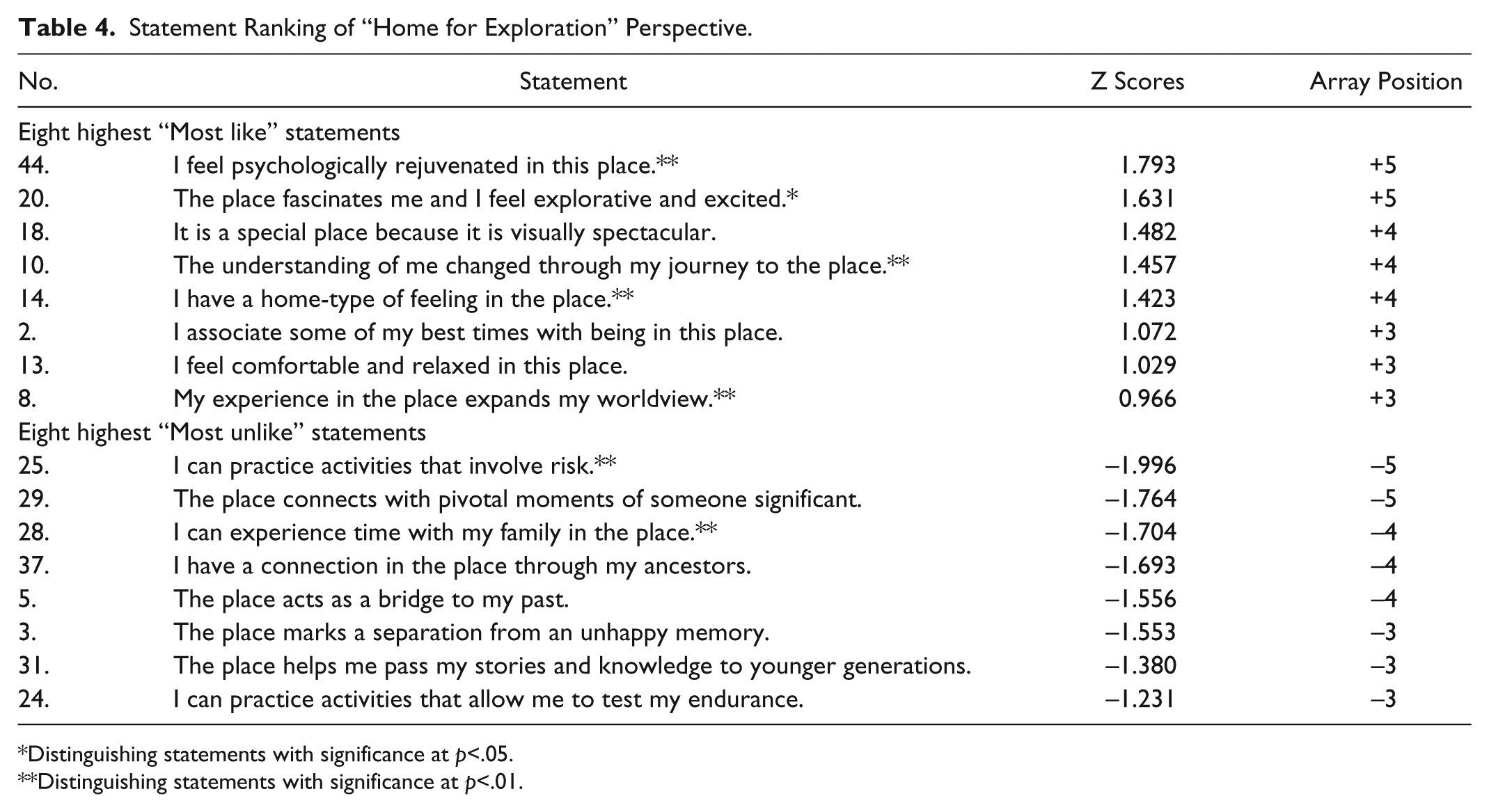
Distinguishing statements with significance at p<.05.
Distinguishing statements with significance at p<.01.
Statement Ranking of “Relax with Family” Perspective.
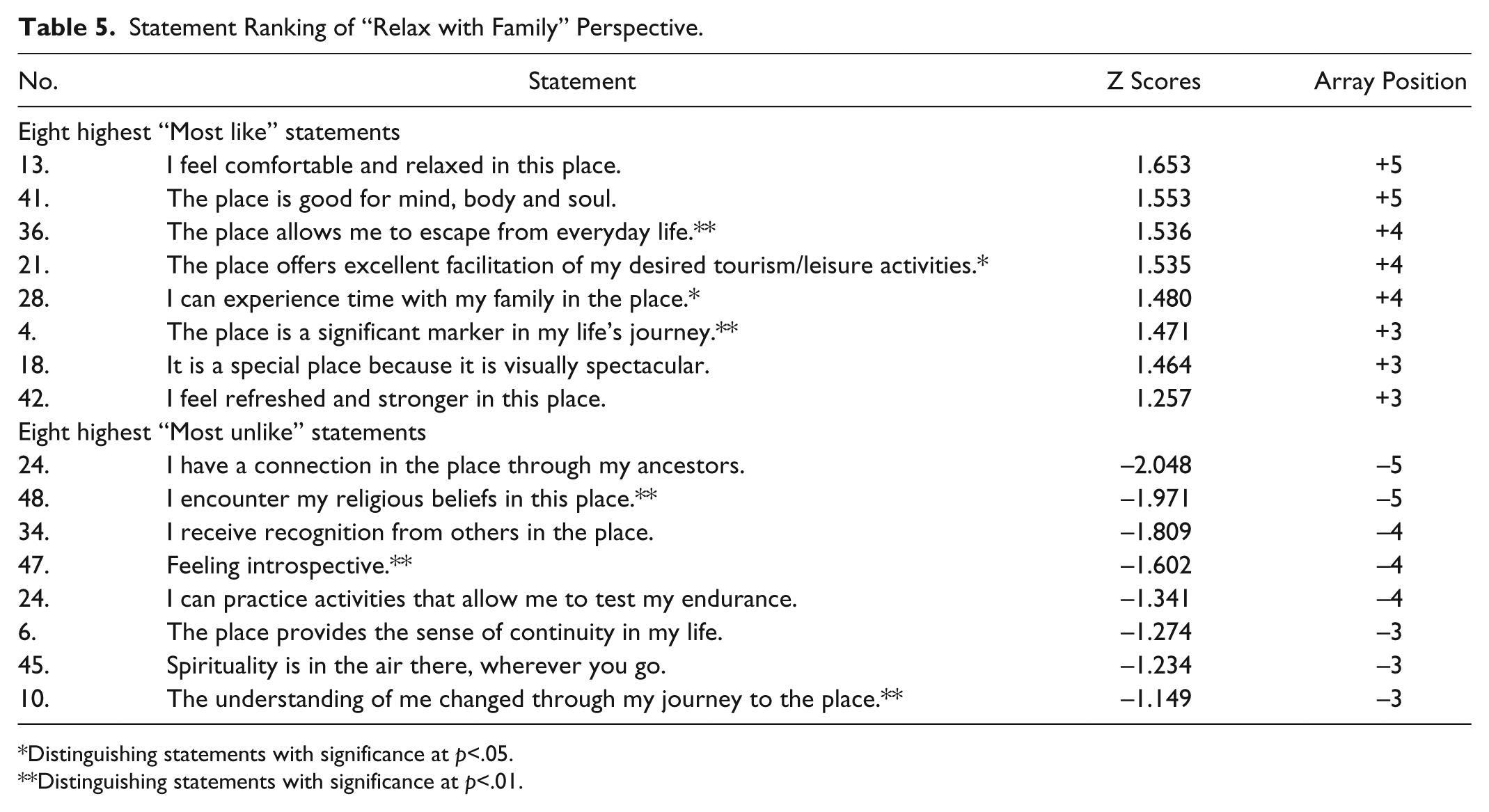
Distinguishing statements with significance at p<.05.
Distinguishing statements with significance at p<.01.
Perspective I: Solitude in Nature
The sorts of four respondents ascribe “solitude in the place” (1.339, +4) as a pivotal meaning for their preferred destination. All had undertaken journeys with the express purpose of avoiding interpersonal and social interactions. They disfavored “experience new people” (–1.341, –3) and “recognition from others in the place” (–1.514, –4). For them, “the other people” in a place had little effect on its power (–1.655, –5). In a follow-up interview, a 27-year-old participant described his experience in a significant destination in this way:
When I was back from a music tour, I stopped by the Grand Canyon for one day. . . . Being alone in the mountains had the highest impact on me. I loved to sit alone on a rock high in the Canyon, looking over the landscape. It was so wonderful that I felt myself becoming a part of the surroundings.
Like this respondent, tourists who prioritize solitude in nature highlight sensory and natural meanings. The ranking of statement 23 (array position: +3) and statement 32 (array position: –3) suggest that those with this perspective ground the meaning of their destinations in the natural environment, rather than in a social or cultural setting. They also emphasized the practice of instrumental activities. The ranking of statements 24 and 25 (array position: +4) indicated these tourists’ interest in adventure activities. As Apter (1990) suggested, these individuals negotiate place meaning by “the way of experiencing what one is doing” (14). The meaning of practicing adventure activities in nature, interlacing with the desire for solitude, made the destination a place for the “refreshed and stronger” self (1.565, +5).
Perspective II: Connection to Personal History
Eight participating tourists encounters their past (1.730, +5) or important moments of someone significant in their lives (1.667, +5) as a primary source of meaning. Place meaning links them to significant life stages, helping them to reflect who they were, and how they became the people they are now. A 56-year-old participant described such feelings:
Although I have been out of Stillwater, Oklahoma for years since graduation, I can still remember my first day on campus as a freshman. . . . My sense of independence was nourished there. That place was shaping who I was, who I am.
For such respondents, personal experience over time creates place meanings. As Rubinstein and Parmelee (1992) argued, “a conflation of space and time [occurs] such that attachment to a particular place may represent attachment to a particular time” (Rubinstein and Parmelee 1992, 142).
As a variant of personal history, some tourists associated a place with significant others, ancestors, community, and religious beliefs (see Table 3), all factors that contribute to their identities. These tourists paid little attention to nature. As a 59-year-old male participant explained:
As an American Indian, I like Manzanillo, Mexico because the place connects to the origin of my ancestry. There is an ancient temple of the American Indian tribe, worshipping their god of dragon. I like to visit there . . . to re-establish the connection with [my] ancestors.
According to the theory of human agency, people have a unique capacity to reflect on their past to make sense of themselves, others, their pursuits, and the adequacy of their actions (Bandura 2006). The meanings in the destination brings the self and “the others” into relationship in a particular time of life. These relationships embedded in the place meanings in turn locate the self in its social position, and thereby shape identity.
Perspective III: Home for Exploration
The sorts by seven respondents define “home for exploration.” This group of tourists feels “psychologically rejuvenated” (1.793, +5) and “explorative and excited” (1.631, +5) in their place. They find the meanings of destination through discovery and exploration of new things, rather than, like those who prioritize a connection to personal history, reflection of the past (–1.556, –4).
From a developmental view, the destination experience expands these tourists’ worldview (0.966, +3), and to some extent changes their understanding of self-identity (1.457, +4). A 56-year-old participant described her feelings thus: “I see the different culture [in Thailand] and the people live in a different way there. The contrast reminds [me] of ‘me,’ helping me to re-think of the way I live.” Tourists holding this perspective highly appreciated the difference and novelty in the destination, and aspired to examine their lives in a new way. The ranking of statements 20, 10, and 8 supports the notion that modern society enables individuals to face a diversity of possible selves, while tourism extends such diversity and influences tourists’ planning of how to live in the future (Desforges 2000).
This perspective also involves the feeling of home in which “home” refers to a place for psychological rejuvenation (1.793, +5), and being comfortable and relaxed (1.029, +3). They had no interest in “activities that involve risk” (–1.996, –5). But they appreciated a welcoming and agreeable community. In a follow-up interview, a 24-year-old participant describes such feelings:
I have a home-type of feeling in San Francisco because of the large community of people that share my interests. . . . It is much easier to exist when everyone isn’t disagreeing with me all the time. I am much less ostracized in San Francisco, so that I decided to move there after I visited it.
Tourists who have this perspective consider place to be an active part of the construction of their identity. While they appreciate novel experiences that change their self-consciousness, they seek to preserve aspects of themselves as well.
Perspective IV: Relax with Family
Seven sorts by participating tourists define “relax with family.” The destination makes these tourists feel comfortable and relaxed (1.653, +5); they regard it as a good place for mind, body, and soul (1.553, +5). They find the meaning of the destination through relaxation with their family (1.480, +4), rather than connection to ancestors (–2.048, –5) or religious beliefs (–1.971, –5).
A 23-year-old female participant said:
I spent a winter vacation in Hainai, China, with my parents before I moved to the U.S. for study. The time is a significant marker in my life because I was going to separate from my family and study overseas after the vacation. As I would not see my parents for a long time, the vacation was very important to me for being with my family.
The destination was a significant marker in the tourist’s life span. Such tourists prefer instrumental activities that suit family tourism (1.535, +4), rather than practicing spiritual or religious activities (see statements 48, 47, 45, and 24).
Conclusion
A Theoretical Framework of Tourism Destination Meanings
By using Q method, this study identified solitude in nature, connection to personal history, home for exploration, and relax with family as distinct patterns of place meanings that participants assign to their favorite destinations. Through further examination of the high-ranking statements and distinguishing statements across the four perspectives, a number of underlying continuums of destination meanings (Figure 2) emerge: intrapersonal–interpersonal, natural–social, reflective–explorative, and instrumental–spiritual.
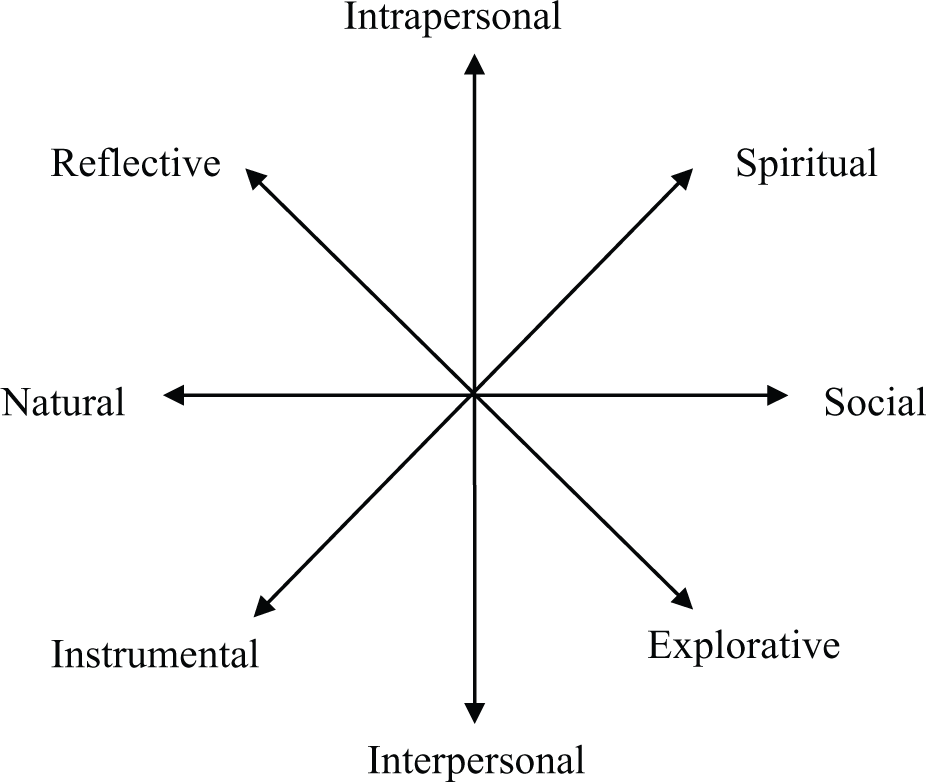
A theoretical framework of destination meaning.
The intrapersonal–interpersonal continuum depicts the meanings of destination in the relationship between self and others. Other scholars have also found that people’s involvement gives places meaning (Sixsmith 1986; Gustafson 2001). Tourists’ involvement exists on a continuum from very self-focused (“intrapersonal”) to very others-oriented (“interpersonal”). Solitude and an attending sense of freedom of action and thought attends one end and emphasis on interactions with family, significant others, ancestors, new people, or community attends the other. Tourists holding the “connection to personal history” perspective highly value memories associated with significant others and ancestors in the destination. Tourists with a “home for exploration” perspective have a feeling of being “at home” when interacting with the local community of the destination.
The natural–social continuum reflects the relationship between tourists and environment, whether it be natural or social. This continuum is based on the literature concerning the ecological meaning or environmental identity (Bragg 1996; Clayton 2003). Humans’ relationships with their proximate environment strongly influences their connection to nature and well-being (Gunderson and Watson 2007; Williams and Patterson 1996). In keeping with Seamon’s (1979) conceptualization of “insideness-outsideness,” knowledge and comfort makes place meaning salient for tourists, which moves them to an insider’s perspective.
The reflective–explorative continuum represents the meanings of destination in relation to time across life span. The literature discusses past and future as major themes in relation to human–place bonding (Gustafson 2001; Morgan 2010). We find that tourists connect their destination with their past and future through reflection and exploration. As Milligan (1998) suggested, a sense of attachment to a specific place reflects its interactional past (e.g., memories in the place) and its interactional potential (e.g., anticipated future experiences in it).
Participants with the “connection to personal history” perspective, reported reflecting on who they were and how they have changed over time. This finding concurs with the theory of place identity that gaining coherence and continuity in one’s self-conception through comparing oneself over time against a place as “a concrete background” makes it important (Korpela 1989). Other tourists expand their worldview and think of their lives in a different way through exploration. Participants referencing a “home for exploration” encounter a variety of lifestyles and use the important place as a base for exploration of the lifestyle and the self.
The instrumental–spiritual continuum describes the meanings of destination related to characteristics of activities and events. Activities and events contribute to the meaning-making process by shaping participants’ attention, enabling them to engage dialogically with their environments and understand others’ narratives. Tourists with the opportunity–structure perspective embrace an “instrumental” meaning, prizing behavioral and economic goals as a source of meaning (Driver et al. 1991; Manfredo, Driver, and Tarrant 1996). Some tourists holding the “solitude in nature” perspective emphasize the practice of activities that allow them to test their personal physical endurance on their own. As Williams (2014) suggested, place meanings have multiple layers, from tangible and widely shared to symbolic and identity-expressive. In this study, the “spiritual” meaning refers to the deeper thinking of the destination as connected to the tourist’s personal values, religious framework, or spirituality. The “home for exploration” perspective shows that some tourists experience psychological rejuvenation in their destination because the place facilitates their deep thinking of self and the world.
In sum, the four underlying continuums (Figure 2) illustrate the construction of various meanings of destination. The meaning of destination derives from the interactions between the tourist and destination at a particular time and context. Tourists impart meanings to destinations in a number of ways and for a number of reasons; therefore, more than one continuum contributes to the construction process of destination meanings for most tourists. The four perspectives exemplify the intertwined combinations of meaning attributes across each of the continuums.
Theoretical Implications
This study’s major theoretical contribution to the literature is a systematic, conceptual framework of destination meanings that is more thorough than prior studies have identified. Figure 2 indicates the complexity and multidimensionality of destination meaning, which depends on tourists’ interaction with both people and places through a variety of events and activities over time. Shift on an individual continuum in relation to the neighboring continuum in Figure 2 creates new meanings. While a wide spectrum of place meanings has been identified, the literature has not explained how tourists engender destination meanings from an integrated perspective, which is offered through this study.
This study adds to the literature by revealing the “reflective-explorative” continuum that illustrates how tourists interpret the meanings of destination in relationship to personal chronicles. The proposed framework highlights the important role of autobiographical memory in shaping the meanings of destination in a tourist’s mind (Knez 2006; Rubinstein and Parmelee 1992). While previous studies have focused on examining the meanings related to destination attributes or the present context of tourism experience (Davenport et al. 2010; Wynveen, Kyle, and Sutton 2010), the meanings related to personal chronicles is understated. This study argues that destination meanings should be understood in a broader context that connects the past, present, and future to help tourists to better define who they are. The “reflective” end of the continuum stresses that the meaning of destination may evolve from reflective thinking of past selves and actions. The explorative end of the continuum indicates that the meaning of the destination may have its origins in thought related to an interest in explorative adventure, thus bringing out the individuals likelihood to explore more readily in the future.
The perspective of “home for exploration” expands place-identity theory by uncovering a dual meaning-making process of identity preservation and identity development. When tourists visit the home-type destination, they affirm aspects of their understanding of themselves while feeling open to explore new things and to changing how they live. New understanding about themselves through the destination experience lead to changes of identity aspects. Therefore, the “home for exploration” perspective indicates that identity preservation and development would happen simultaneously through one destination experience. Because the participants were asked to sort and interpret Q statements in relation to one another, we are enabled to understand the holistic view of participants and examine how different themes are interconnected as a whole. In contrast to existing studies, which consider identity preservation and development as separate processes (Breakwell 1986; Twigger-Ross and Uzzell 1996), this finding sheds new light on rethinking the relationships between the two processes.
Practical Implications
This study suggests that DMOs and hospitality service providers should carefully examine how tourists derive and communicate place meanings from diverse points of view. Because destination development can inadvertently privilege one type of meaning over another, lacking a holistic understanding on place meanings has caused serious problems of placelessness and place detachment (Hutson, Montgomery, and Caneday 2010). This study demonstrates a useful approach to DMOs and hospitality practitioners for meaning-based market segmentation. Instead of using a traditional questionnaire survey, the DMOs could invite tourists to do Q sorting to reveal the meanings they find in a destination. Such processes might involve presenting stimuli such as destination pictures or videos, as well as statements, and be completed either online or offline. Q method has the advantage of capturing subjective opinions through a person’s self-reference. As a result, DMOs could segment and target tourists with different meaning perspectives, and develop advertisement programs that integrate different sets of meaning attributes.
For example, tourists who prioritize a “connection of personal history” will tend to appreciate social interaction and a sense of community; managers and planners should therefore encourage connection between tourists through planned events as well as community involvement in tourist activities. By contrast, attracting tourists who favor “solitude in nature” requires prioritizing resources to protect the natural environment and designing adventure activities rather than social events. Targeting those tourists visiting family or traveling with family, destination marketers can highlight facilities and activities suitable for family groups, and emphasize the collective value of staying together with other family members.
Limitations and Future Study
In spite of this advantage, the Q method approach constrains researchers by the participant’s subjectivity and the construction of Q set. Although we have conducted a thorough literature review to collect a wide variety of possible destination meanings for concourse development, the proposed Q set may not fully cover the themes of meanings. Future research might supplement sources of meaning through in-depth tourist interviews to capture opinions missing in the literature and develop the Q set to reflect these additional sources.
The proposed framework illustrates the construction of destination meanings, and future research is required to validate and confirm it in various destination settings. How do meanings of destination differ by type of tourism destinations or tourists? Future research might select different P-set samples or specific destination contexts to investigate other perspectives beyond the findings of this study.
Future research might also use the distinguishing statements this research identified to create a Likert items survey to produce more generalizable findings about destination meanings. There is a common implementation in Q method literature that the high-ranking and distinguishing statements associated with each perspective can be used to inform the scale development (Brown 2002; Danielson 2009). Therefore, this study offers a pool of distinguishing statements that will inform future studies to further develop a measurement scale of destination meaning.
Footnotes
Appendix
Lists of Favorite Destinations Reported.
| Favorite Destinations Reported | |
|---|---|
| Resort/park | Crested Butte Mountain resort, Mahahual, Grand Canyon |
| Town/city | Panama, Las Vegas, Tres Ritos, Esles Park, Chicago, Key West, Galveston, Seattle, Minneapolis, New York, Orlando, San Francisco, Manzanillo, Vizag, Madrid, Fukuoka, Paris, Hainan |
| State/Province | Hawaii, California, Florida, Colorado, New Mexico, Bali |
| Nation | Israel, Japan, Bahamas, Brazil, China, Thailand, Ireland, Denmark |
Acknowledgements
The authors wish to thank the three anonymous reviewers for their constructive comments to this manuscript.
Declaration of Conflicting Interests
The author(s) declared no potential conflicts of interest with respect to the research, authorship, and/or publication of this article.
Funding
The author(s) received no financial support for the research, authorship, and/or publication of this article.