



Abstract
This study employs a two-group pretest–posttest experimental design to investigate to what extent promotional materials affect the image perceptions, attitudes, and behavioral intentions of potential tourists toward a country-vacation destination in a situation of political and economic conflict between the two nations. Specifically, the study focuses on such psychographic characteristics of tourists as animosity toward the destination country, national attachment to their own country, and consumer ethnocentrism to investigate whether these traits can inhibit the effectiveness of the promotional materials. The findings of the study indicate that intermediate effects of destination advertising include changes in perceptions of country values and overall attitudes. The results also suggest that the amount of change depends on the individual’s level of psychographic variables, most notably animosity.
Keywords
Introduction
Tourist flows exist not only between countries that are friendly to each other but also between those countries that are in a state of political, economic, diplomatic, or military conflict of various levels of intensity, such as South and North Korea (Lee et al. 2012; H. Park 2011), or the United States and Afghanistan (Durko and Petrick 2016). Research on tourism between hostile or divided nations has a long history (D’Amore 1988; Jafari 1989). At its inception, it was proposed that tourism as a people-to-people activity contributes to changing negative attitudes about the host nations for the better and, thus, increases understanding between people, ultimately contributing to peace (Hobson and Ko 1994). Studies by Milman, Reichel, and Pizam (1990), Pizam, Jafari, and Milman (1991), and Anastasopoulos (1992) challenge this proposition, showing that it is not necessarily so. For the attitudes to change, several conditions have to be met, one of them being that the initial attitudes toward the host nation are not extremely negative (Milman, Reichel, and Pizam 1990). Some more recent studies support the proposition that travel can change negative attitudes toward the host country (e.g., Becken and Carmignani 2016), while other studies do not (e.g., Chen et al. 2016; Farmaki 2017).
To give tourism a chance to act as a peacemaker, a decision to visit a country that is a target of animosity in the country-source market needs to be made in the first place. If initial attitudes toward a destination nation are hostile, they are likely to prevent potential tourists from selecting that particular country for further consideration. Whether promotional materials can move destination attitudes in a more positive direction so that the destination country can work its way into the tourist’s “consideration set” (Perdue and Meng 2006) is a worthwhile research question. It should be noted that whether destinations should promote themselves in and welcome tourists from unfriendly markets is a separate matter. Some countries choose to do so. For example, very recent data show that Russian arrivals to Turkey in 2017 have bounced back and are at a four-year high (Vasilchuk 2017), despite the fact that Turkey is one of the three least-liked countries among the Russian public (Levada Center 2016).
Advertising to potential travelers or travel trade companies is an established form of promotion that traditionally includes print, television, radio, or billboards and has now expanded to Internet media (Dore and Crouch 2003). Awareness of advertising and exposure to it influences destination selection decisions (McWilliams and Crompton 1997; Kim, Hwang, and Fesenmaier 2005). However, studies generally estimate the effectiveness of destination advertising on the “macro” level of promotional campaigns (S. Park and Nicolau 2015; Pratt et al. 2010), largely following the framework of the conversion model (Siegel and Ziff-Levine 1990). On the “micro” level of an ad itself, the determinants of an effective ad (e.g., ad source and relevance, incentive, or appeal) have also been identified (Drossos et al. 2007). However, not much attention has been given to investigating how individual characteristics of ad recipients affect responsiveness to an ad and to destination in a broader sense. Considering that in the consumer’s mind, the promotional materials are added to and eventually amalgamated with what is already known about the destination, “the challenge for advertising is to find ways and means to bypass or upset business as usual in the consumer’s brain and to build an enduring perceptual representation of the brand as one that is acceptable and desirable” (Weilbacher 2003, 230).
In view of the issues raised, the focus of the study is on how tourist audiences respond to marketing materials in a situation where the destination country and the source market country are engaged in ongoing political, economic, diplomatic, and/or military conflict. It has several inter-related questions: Can negative perceptions of a country and unfavorable attitudes toward it be mitigated with the promotional information, and if so, to what extent? Can an individual’s characteristics potentially inhibit the effectiveness of the promotional materials? More specifically, how do such psychographic factors as animosity toward the destination country, national attachment of tourists to their own country, and their ethnocentric tendencies affect tourists’ responsiveness to advertising? The current study contributes to the literature on the effectiveness of promotional materials in a situation of conflict (Shani et al. 2010) and provides a new lens to study tourist decision making and travel behavior in conflict in general.
Study Background
Advertising Effectiveness
Frameworks for studying how advertising works go as far back as 1898, when the Attention-Interest-Desire-Action (AIDA) model was proposed (Strong 1925, 76, cited in Vakratsas and Ambler 1999). In the context of an advertising campaign, the message has such characteristics as ad source, distribution channels, and repetition. The quality of an ad, which is associated with its content and execution, is an important factor that marketers pay attention to in the process known as diagnostic pretesting (MacKenzie, Lutz, and Belch 1986). Furthermore, ads are usually designed to have primarily rational or emotional appeal, as it has been shown that advertising need not be informative to be effective (e.g., Aaker and Norris 1982). The former approach emphasizes factual product information and focuses on product attributes, while the latter aims at building a positive brand personality and creating a favorable emotional response. Consumers targeted by an ad are involved in both cognitive and affective processing, inevitably taking into account their previous experience with the brand. Thus, the advertising message is considered an input for consumers (Singh and Cole 1993) that could result in intermediate effects associated with mental processing of that message, which, in turn, would lead to a behavioral response. Intermediate effects include an increased awareness of a brand or a change in attitudes toward the product or brand (Vakratsas and Ambler 1999). Finally, consumer behavior can include a purchase or an active search for more information (Kim, Hwang, and Fesenmaier 2005).
Advertising effectiveness in tourism has been investigated using a number of approaches. For example, econometric models directly connect the characteristics of advertising campaigns with sales or visits (Crouch, Schultz, and Valerio 1992; Kulendran and Divisekera 2007; Woodside 1990), while the consumer characteristics and attitudinal changes toward the product are taken out of the equation. Similarly, conversion studies calculate the probability of a person being persuaded to visit a destination as an effect of advertising efforts (Kim, Hwang, and Fesenmaier 2005; McWilliams and Crompton 1997). In these studies, respondents are usually asked whether they have seen an ad, requested information as a result, and/or visited the destination. Conversion studies, however, focus on actual visitations, while the effects of advertising can be extended to a number of cognitive and affective responses, such as destination image formation (Bojanic 1991; Lepp, Gibson, and Lane 2011; Shani et al. 2010) or a change in attitude toward a destination. In tourism research in particular, exposure to advertising might include a delayed response that would eventually result in visitation in the long term because of an image and/or attitude change (Kim, Hwang, and Fesenmaier 2005).
An experimental design and cross-sectional analysis are more conducive to studying advertising effectiveness from the perspective of its intermediate effects on consumers (Shani et al. 2010). Experimental studies are especially conducive to establishing cause–effect relationships and thereby allowing insights into the decision-making process. Studies on intermediate effects of advertising take into account cognitive, affective, and previous experience aspects of mental processing, either separately or in combination. If taken in combination, such studies may assume a certain hierarchy of these aspects, whether it be cognition-affect-experience (high-involvement hierarchy) or cognition-experience-affect (low-involvement hierarchy). Some studies do not postulate any hierarchy of effects, thus acknowledging that they depend on various moderating variables, or “filters,” such as product type, involvement, and ad characteristics (Vakratsas and Ambler 1999). For example, it was found that ads with rational appeal are more effective when consumers are highly involved with the brand, while emotional appeal works better in a low-involvement situation (Baker and Lutz 2000). Furthermore, in agreement with the Elaboration Likelihood Model (Petty and Cacioppo 1986), Johar and Sirgy (1991) proposed that advertising appealing to the value system is more persuasive when the product is value-expressive, whereas utilitarian appeals are persuasive when the product is utilitarian.
Arguably, involvement with a tourism product is higher than with many types of consumer goods; however, even among tourism products, involvement can be high or low depending on the destination type. McWilliams and Crompton (1997) defined repeat visitations, or trips of low risk or low importance, as a low-involvement situation. However, for long-haul destinations or adventure travel, the tourism product is expensive and requires organizational efforts and time commitments to buy and consume; therefore, there is a higher involvement on the part of the tourist. Moreover, the tourism product is hardly utilitarian, as destination countries cannot be considered separately from the values their nations espouse, making tourism a value-expressive product in many contexts (Fan 2006; Hudson 2014). For example, “All men are created equal” is the value credo of the United States as a nation, which is reflected in a great deal of the country’s cultural products, such as movies or music. Admittedly, perceptions of the destination country’s values can be of various degrees of salience and can evoke different attitudes, but tourists can hardly be totally free of them. It is an internal contradiction that the tourism product often requires high involvement on the part of the consumer (and, as such, is more conducive to utilitarian ad appeal) but at the same time can be very value-expressive (in which case the emotional appeal supposedly works better). This indicates that individual characteristics of ad recipients as well as various situational factors are likely to be influential in processing tourism-related promotional materials.
The influence of personal traits on the mental processing of advertisements might be even more pronounced in the situation of conflict between the two nations. Political, economic, diplomatic, and military conflict inevitably exposes the conflict in values of the two nations and highlights the nature of tourism as a value-laden product. The consumption of such a product and the attitudes toward it are likely influenced by consumers’ psychographic characteristics, such as animosity toward the destination country, attachment to their own country, and their ethnocentric tendencies. These factors have had sufficient coverage in marketing literature dealing with effects of “made-in” country biases on consumers’ intention to buy, but not so much in tourism-related research (Chen, Lin, and Petrick 2013; Moufakkir 2014). Therefore, this study investigates the influence of animosity, national attachment, and consumer ethnocentrism on destination-related attitudes and their role in changing those attitudes as a result of mental processing of promotional materials from countries that are in conflict with the tourism market country.
Psychographic Variables of Animosity, National Attachment, and Consumer Ethnocentrism
Animosity is hostility of various levels of intensity (Amine 2008). As such, it is affective in nature. Since it is country specific (Klein, Ettenson, and Morris 1998), its aspects have been conceptualized from a variety of perspectives, such as war, economic, and political perspectives or stable-situational and national-personal taxonomies (for a review, see Nes, Yelkur, and Silkoset 2012). Animosity can arise from a current circumstance and produce spikes over the background of stable animosity (Jung et al. 2002). While animosity has cognitive, affective, and conative aspects, and is thus attitudinal in nature, it should not be equated with the overall attitude, since even when a person is generally hostile to a country, they still can give it credit by recognizing its achievements (Stepchenkova and Shichkova 2016). Thus, overall attitude is a composite cognitive construct that represents perceptions of all country features as well as their importance in the consumer’s mind (Ajzen and Fishbein 1969 ). One of the tenets of animosity theory is that animosity affects country image but not perceptions of the quality of products produced in that country (Nes, Yelkur, and Silkoset 2012). However, several studies have found a negative effect of animosity on product judgments in situations of intense conflict between the country of the producer and the consumers’ own country (Ettenson and Klein 2005; Nijssen and Douglas 2004; Rose, Rose, and Shoham 2009; Shoham et al. 2006).
Consumption preferences also depend on the level of the consumer’s ethnocentric tendencies. Consumer ethnocentrism is interpreted as a consumer tendency for the protection of the domestic economy (Verlegh 2007). This notion was developed from the sociological concept of ethnocentrism, that is, the propensity of an individual to judge another culture by the values of their own culture (Levine and Campbell 1972; Sumner 1906). The original concept was expanded to represent the beliefs consumers may hold about the “appropriateness, indeed morality, of purchasing foreign-made products” (Shimp and Sharma 1987, p. 280). The buying preferences of some consumers for imports and of others for domestic goods are well documented (e.g., Verlegh 2007), as is a strong negative relationship between consumer ethnocentrism and evaluations of product quality (Klein, Ettenson, and Morris 1998; Shimp and Sharma 1987). It also has been found that when consumers perceive imports as superior to domestic goods, their economic loyalty can be overturned in favor of imported alternatives (Klein et al. 2006). The applicability of the consumer ethnocentrism concept in different cultural contexts has also been confirmed (Netemeyer, Durvasula, and Lichtenstein 1991; Saffu and Walker 2005). In situations of economic conflict between two countries, the notion of consumer ethnocentrism is especially relevant to studying preferences for tourism products to determine whether the findings of marketing studies will hold in the context of vacation destination.
Nationality is a fundamental part of one’s identity (Frew and White 2016; Tajfel and Turner 1986). Identification with one’s country may go beyond the loyalty to one’s ethnic group, especially in such heterogeneous nations as the United States, United Kingdom, Canada, China, and Russia (Sidanius et al. 1997), since attachment to one’s country involves “shared national values and a sense of common national identification” (p. 103). Domestic products often contain social and cultural connotations and may serve as symbols of national identity (Askegaard and Ger 1998). There is little literature on the role national attachment plays in forming a destination image and preferences for destination selection as a form of tourism consumption, the notable exception being Chen, Lin, and Petrick (2013). Furthermore, in a situation of conflict between two nations or groups, social identity theory indicates that group identities may be the source of collectively biased perceptions of outgroup members (Alexander, Brewer, and Herrmann 1999). Accordingly, in the tourism context, both the ethnocentric tendencies of potential tourists and their national attachment may negatively influence their perceptions of and attitudes toward the country-provider of a tourism product and their desire to vacation in that country.
Situational Context
This study is set in the Russia–US context, where Russia is the tourism-generating region and the United States is the vacation destination. The political and economic relations between Russia and the United States have deteriorated in the past 20 years (Levada Center 2016), with the conflict culminating over the events in the Ukraine, Crimea, and Donbass, which led to sanctions imposed on Russia by the collective West: the United States, the European Union, Norway, Australia, Canada, and other countries. Anti-Americanism, that is, a “consistent hostility towards the government, culture, history or peoples of the U.S.” (Amine 2008, 402), manifests itself strongly in the current Russia (Bruk 2016; Cottiero et al. 2015). Russian media portrays the United States as a deeply flawed country, with a corrupt and ineffective political system and social and racial problems, and it incessantly criticizes its international politics (Herszenhorn 2014). The latest data show that 81% of Russians hold negative views about the United States, a sharp increase in negative sentiment from 2013, when only 49% of Russians held negative views toward the United States (Pew Research 2015). The United States is the least-liked country by the Russian population, followed by the Ukraine and Turkey (Levada Center 2016).
In response to Western sanctions, the Russian government imposed a “sweeping ban on the import of meat and meat products, fish and sea food, cheese, milk and milk products, as well as fruit and vegetables from the United States, the European Union, Australia, Canada and Norway” (Felgenhauer 2014). In Russian media, the move was presented as providing an opportunity for the Russian economy to develop new industries. As Prime Minister Dmitry Medvedev stated, “the ban will bring Russia much good—the shelves in our malls will be cleared and filled with Russian produce—we must not miss such an opportunity to expand import replacement” (Felgenhauer 2014, citing Russian news agency Interfax, August 7, 2014). This rhetoric was in unison with the patriotic sentiments highlighting Russia’s achievements in the international arena: Russia organized the Olympic Games in Sochi in 2014, attracted the Formula One race in Sochi in the same year, hosted the 16th World Aquatics Championship in Kazan (July–August 2015), and won the bid to host the 2018 FIFA World Cup and the 2017 FIFA Confederation Cup. The country modernized its military, and by the time of the study had intervened in the conflict in Syria as a strong military power and serious geopolitical player.
The conflict between the two countries has substantially decreased the tourist flows from Russia to the United States. The peak numbers in 2014 (343,310 visitors) dropped in 2015 by 24% and by another 3% in 2016 (US Department of Commerce 2014, 2015, 2016). The feelings of animosity toward the United States, national pride, and consumer ethnocentrism are very much present in contemporary Russia, making the situational context very suitable to study whether promotional materials can have a positive effect on attitudes of tourists toward a destination country that is a target of animosity. More specifically, the study aims to meet two objectives. First, it investigates the effect of the Brand USA promotional materials, namely, the video “Land of Dreams,” on the country perceptions, overall attitude, and desire of Russian tourists to visit the United States as a vacation destination. Second, it aims to comparatively examine the role that each of the psychographic variables plays in changing the perceptions of tourists as a result of the promotional efforts. In connection with the second objective, the study also examines whether the strength of the psychographic variables is associated with the demographic and travel experience variables.
Method
Promotional Video
The study adopted an experimental pretest–posttest design with two treatment groups, experimental and control. The dependent variables were perceptions of the United States as a country and destination as well as overall attitude toward the United States and a desire to visit the country for vacation purposes. The treatment for the experimental group was the “Land of Dreams” video created by Brand USA, a joint initiative of the National Travel and Tourism Office within the US government and the US Travel Association. The Brand USA initiative was the first centralized effort to promote the country to international tourists and increase the competitiveness of the United States. The core features of Brand USA are diversity, music and pop culture, vast natural resources, and an optimistic spirit (Hudson 2014), while the message “fresh, welcoming and inclusive” highlights the “boundless possibilities of the United States” (Montgomery 2011). The two-minute tourism commercial was released on April 23, 2012, aimed at rebuilding destination perceptions of international tourists in all demographic groups and in a large number of geographical markets. This video was distributed multiple times by traditional TV spots and quickly became popular among social networks, such as Facebook, Twitter, and YouTube (Yelaja 2012). The video features images of the country, its landscape and people, and is accompanied by poignant lyrics sung by celebrity musician Rosanne Cash. The video, however, is virtually unknown in Russia (Stepchenkova and Shichkova 2017).
Procedure and Instrumentation
The study was carried out in March 2016 in a large urban center in Russia with a population of 1.3 million people. Approximately 70 travel agencies operate in the city and the surrounding region, and the city is well connected by regular and charter flights with various destinations in Russia and abroad. The data collection was organized through the Tourism Research Center at the city’s premier university. The recruiting process targeted active Russian outbound tourists from the Russian middle class, whose lifestyles and consumption patterns increasingly include leisure vacations abroad (Tekes Report 2015). The recruitment process had the following requirements: study participants (1) had to be at least 18 years old; (2) had to have travelled internationally at least once in the three years prior to the study; (3) had never visited the United States; and (4) were not students at the university. On March 26, 2016, a total of 139 people came to a designated location on the university campus to take part in the study.
A two-group pretest–posttest experimental study randomly assigned participants to the experimental (n = 79) and control (n = 60) groups. To test whether promotional materials can positively influence the destination perceptions of tourists who presumably have a high level of negative affect toward the destination country, the video clip “Land of Dreams,” the hallmark of the Brand USA marketing campaign, was adopted as an intervention for the experimental group. The song from the clip was professionally translated into Russian, with translation verified by the bilingual first author, and used as subtitles for the video. The control group was shown a video of the same length about the university that hosted the study. Prior to the study, both videos were tested on two groups of students to ensure the readability of the subtitles in the “Land of Dreams” video and the “neutral” tone of the video for the control group.
At the pretest stage of the main experiment, all participants were given the same questionnaire. First, the demographic and travel experience questions were asked. Next, to evaluate the image of the United States, 12 descriptive items were used: a friendly country; open for everybody; a diverse country; a country of unlimited opportunities; dynamic; innovative; full of the unexpected; a free country; cultural crossroads; has the great outdoors; wide opportunities for urban excitement; and everything to indulge oneself. These image aspects were measured on a 7-point Likert scale (1 = strongly disagree, 7 = strongly agree), with larger scores indicating a more favorable image. Then, the overall attitude (Evaluate your attitude toward America [the US] as a whole) and visit intention (Evaluate your desire to visit the United States as a tourist) variables were measured using a 1 to 10 rating scale, with larger scores indicating a more positive overall attitude and a higher desire to vacation in the United States.
Considering various aspects of the conflict between Russia and United States at the time of the study, that is, its political, economic, diplomatic, and military sides, and the fact that in the different historic periods the two countries were friends and foes, it was decided that capturing each aspect using available scales would greatly expand the questionnaire and the experimental procedure on the whole. The psychological variable animosity was conceptualized as general animosity, or negative affect, toward the United States (Klein, Ettenson, and Morris 1998) and was measured with three items: I feel resentful toward the United States; I dislike the United States; and I consider the United States to be an adversary of Russia. The operationalization of consumer ethnocentrism followed Shimp and Sharma (1987) and Verlegh (2007) and had six items; for example, a real Russian should always buy Russian-made products; it is not right to buy foreign products because it puts Russians out of jobs; and to buy foreign goods is unpatriotic. The national attachment construct was represented by three items (Verlegh 2007): to live in Russia means a lot to me; I am proud to live in Russia; and I feel very strong connection with Russia. All three psychographic variables were measured on the 7-point Likert scale (1 = strongly disagree, 7 = strongly agree), with larger scores indicating higher presence of a respective trait. The different measurement scales as well as a few other questions not reported in this article were meant to de-emphasize the spatial proximity between groups of questions and to control for mood-induced states (Podsakoff et al. 2003).
At the posttest, the respondents in the experimental group were asked to reflect on what they saw and to supply their three strongest impressions about the United States after watching the video. Then, they were asked again about their overall attitude toward the United States and their desire to visit the country. Lastly, they were given the same 12 items about the image of the United States. The control group had the same questions about attitude, desire to visit, and image. The item order for the 12 image questions in the posttest was rearranged for both groups to minimize the memory effect. At the very end, both groups were given the opportunity to provide additional information if they wanted to and to comment on the study in general.
Analytical Approach
To establish the impact of the promotional video on respondents’ image perceptions, attitudes, and desire to visit, three things needed to be established: (1) no positive bias toward the United States exists in the experimental group as compared to the control group; (2) the attitudes of the control group do not improve after the intervention, as the improvement would signal the presence of confounding factors; and (3) the posttest attitudes of the experimental group improve. Comparisons between the experimental and control groups at the pretest were conducted using independent samples t-tests. Comparisons of pretest–posttest images and attitudes were conducted using the within-subject analysis of variance. To investigate the role that psychographic variables play in changing perceptions as a result of watching the video, a mixed between–within-subject analysis of variance (ANOVA) was conducted, where the within independent variable was time of testing (two levels: pre- and postintervention) and the between-subject factor was the level of the respective psychological variable, low or high.
Results
Sample Profile
Overall, the gender composition of the participants was skewed toward females (63% vs. 37%), with a similar split in both the experimental and control groups. Agewise, the experimental group was younger, Mexp = 27.89, Mcon = 35.02, t = −3.82, p < 0.001, which was also reflected in the respondents’ education level, life stage, and income variables. The groups were equal in their travel experience, that is, the number of trips abroad in the 3 years prior to the study. The respondents’ demographic profile is given in Table 1. The psychographic profiles of the respondents were quite similar. The two groups were the same on animosity, Mexp = 3.30, Mcon = 3.22, t = 0.29, p = 0.775, and consumer ethnocentrism, Mexp = 3.27, Mcon = 2.91, t = 1.49, p = 0.138. However, they differed on the level of national attachment, Mexp = 5.51, Mcon = 5.92, t = −2.13, p =0.035.
Respondents’ Demographic Profile.
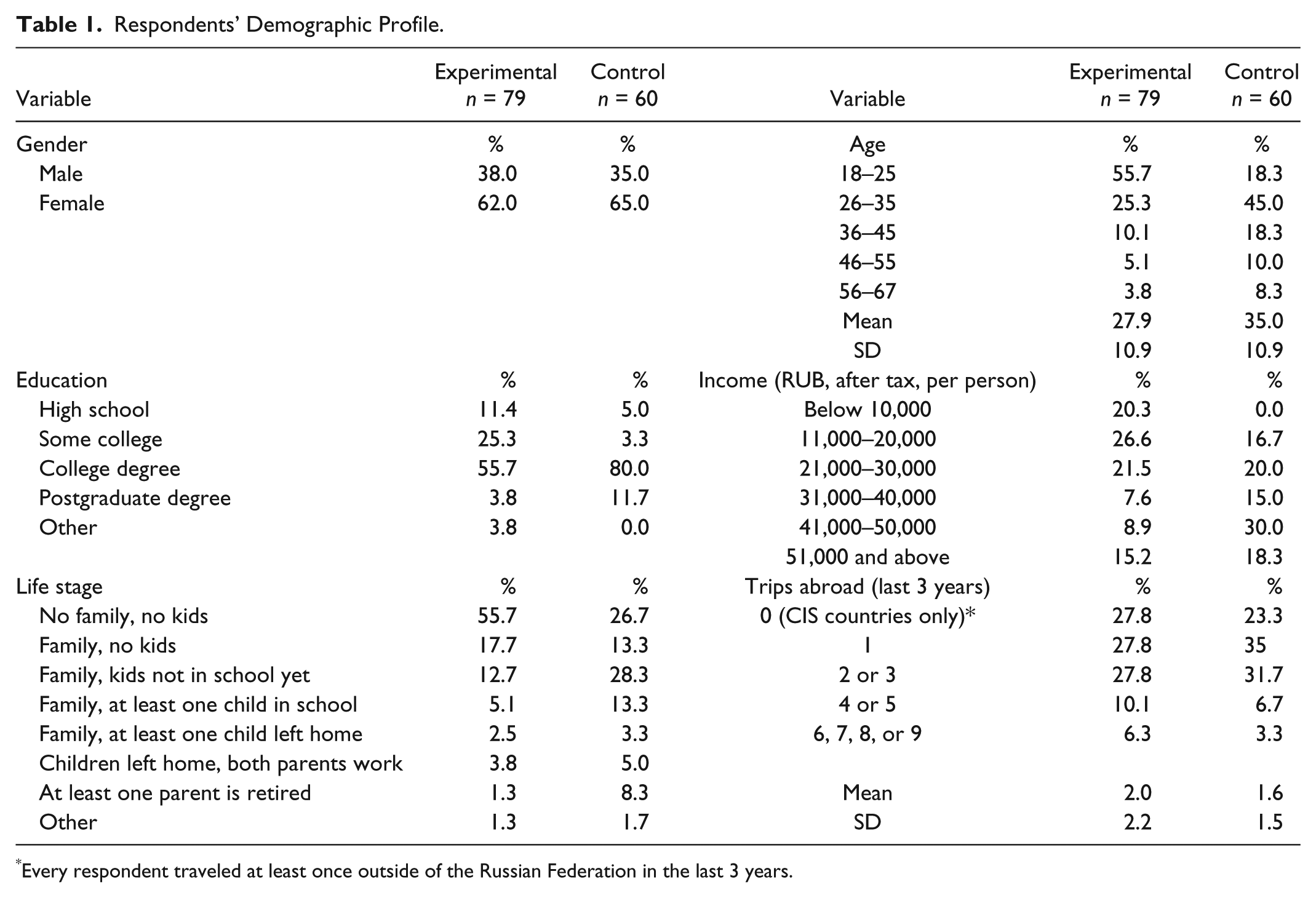
Every respondent traveled at least once outside of the Russian Federation in the last 3 years.
Preliminary Analyses
To investigate whether multiple image items can be grouped into a fewer number of image components for a more focused analysis and concise reporting, principal components analysis (PCA) with Varimax rotation was conducted. Because the sizes of the two groups were too small to conduct PCA separately, the analysis was performed on the whole sample of 139 respondents. The factorability of the matrix was 0.85. Bartlett’s test of sphericity was significant (p < 0.001). All communalities but one were greater than 0.50 (0.48 for diversity), and the factor loadings ranged from 0.59 (innovative) to 0.87 (cultural crossroads). All items were retained in the solution, which converged in 4 iterations and explained 66% of the total variance (Table 2). One image component pertained mostly to the US offerings as a vacation destination (named Tourism Offerings, Cronbach’s α = 0.86), with the anchoring items being urban excitement (0.82), indulgence (0.82), and the great outdoors (0.73). The second image component largely pertained to such country values as being open (0.84), friendly (0.77), and free (0.71), with unlimited opportunities (0.62) (named Country Values, Cronbach’s α = 0.79). The cultural crossroads item (0.87) was the third factor. The obtained three-factor solution on the pretest data was deemed acceptable (Hair et al. 2013). To use these factors in further analyses, it was important to ensure that the three groups of variables identified by PCA had acceptable internal reliabilities at both pretest and posttest and for both the experimental and control groups, which was verified (Table 2). Next, the manifest variables of tourism offerings and country values were created by means of summated scales; the cultural crossroads item stayed the same.
Image Perceptions: Factor Analysis.
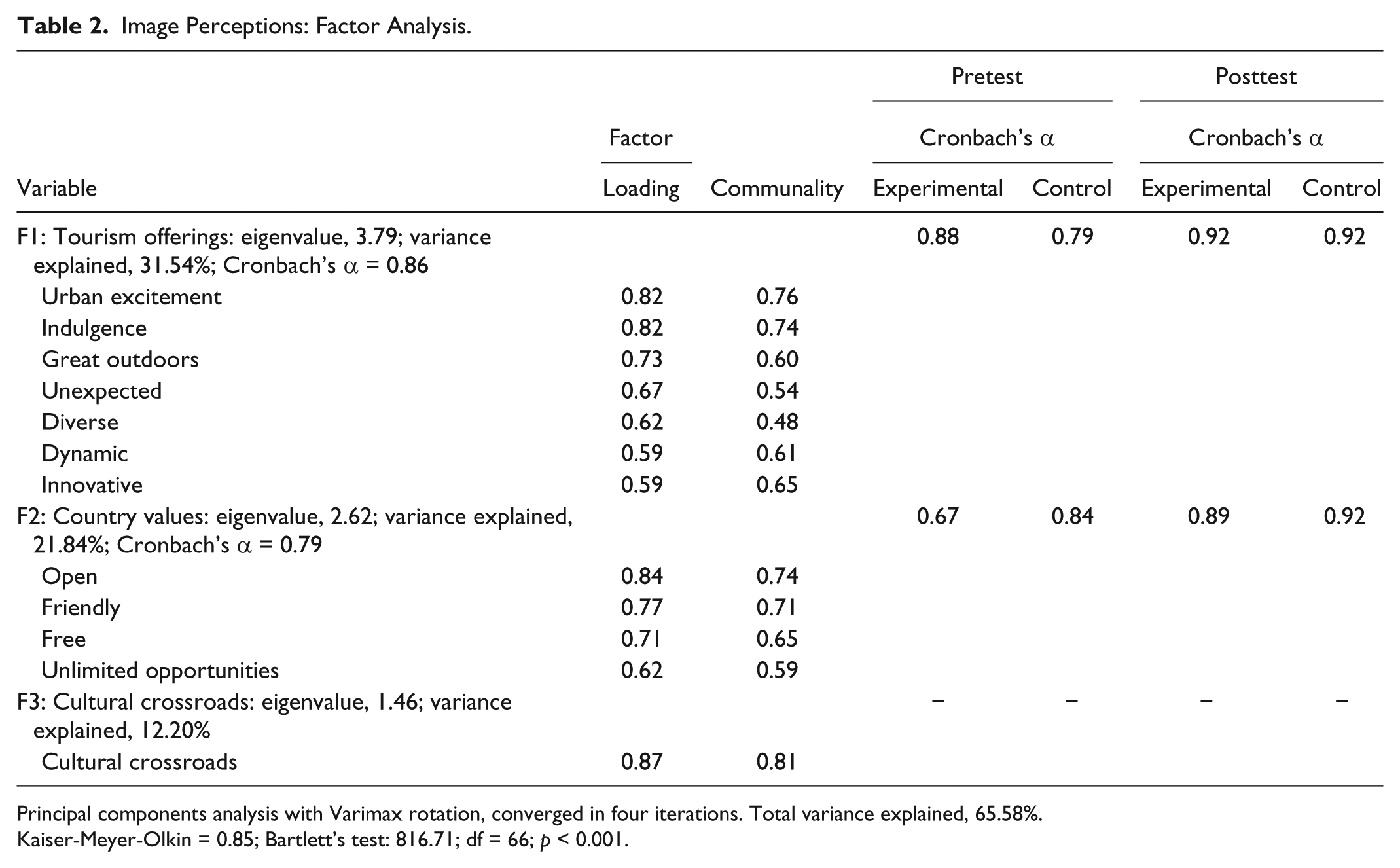
Principal components analysis with Varimax rotation, converged in four iterations. Total variance explained, 65.58%.
Kaiser-Meyer-Olkin = 0.85; Bartlett’s test: 816.71; df = 66; p < 0.001.
The Cronbach’s α for the three animosity items was 0.89 for the experimental group and 0.94 for the control group. For the other two psychographic variables, the Cronbach’s alphas for the experimental and control groups were 0.94 and 0.95 (consumer ethnocentrism, six items) and 0.90 and 0.89 (national attachment, three items), respectively. Therefore, three manifest variables representing the psychographic profile of the respondent, that is, animosity, national attachment, and consumer ethnocentrism, were created by averaging the original individual items.
Effect of the Promotional Video on Respondents
The results of the independent sample t-test showed that the experimental and control groups were equal on the cultural crossroads image aspect, overall attitude, and intention to visit variables. The differences were found on the tourism offerings, Mexp = 5.07, Mcon = 5.48, t = −2.83, p = 0.005, and country values variables, Mexp = 3.88, Mcon = 4.75, t = −4.62, p < 0.001, with the control group holding more favorable views. Next, the study compared the pretest–posttest evaluations of the control group to ensure that no interference (other than the video) that might have swayed the respondents’ opinions to the positive side was introduced into the experiment. The within-subject, or repeated measures, ANOVA was conducted separately for the experimental and control groups. No pretest–posttest differences for the control group were found. For the experimental group, however, the increase in perceptions was found for country values (η2 = 0.070) and overall attitude (η2 = 0.041). The size of the effects can be classified as small effects (Cohen 1988). Table 3 provides pretests-posttest descriptive statistics for both groups along with the test results. Thus, the effect of the promotional video on respondents’ image and attitudes was established. The following analyses are conducted for these two variables only.
Pretest–Posttest Comparisons for Experimental and Control Groups.
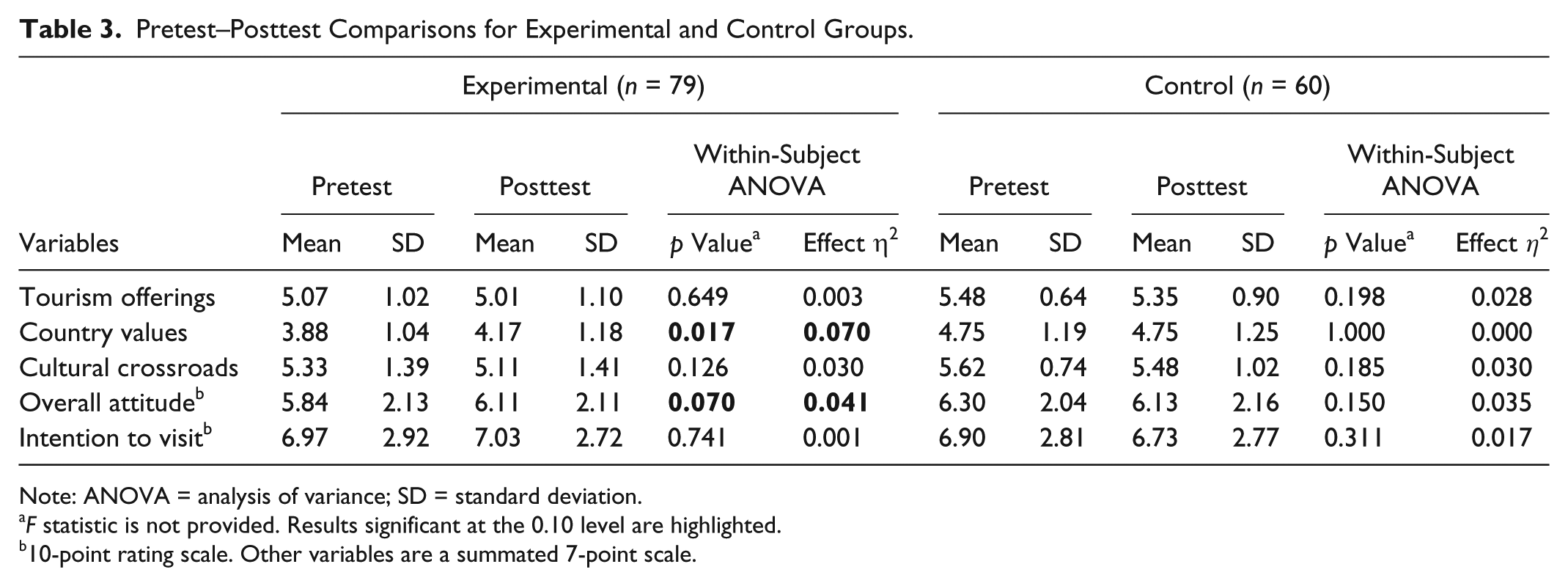
Note: ANOVA = analysis of variance; SD = standard deviation.
F statistic is not provided. Results significant at the 0.10 level are highlighted.
10-point rating scale. Other variables are a summated 7-point scale.
To quantify the main effect, the interaction effect (between the time, pretest–posttest, and group, experimental versus control), and between-subject effects, a mixed between–within-subject ANOVA was conducted. For the country values, the result indicates the presence of pretest–posttest effects, Wilks Λtime = 0.973, F(1, 137) = 3.797, p = 0.053, η2 = 0.027, and an interaction effect of the same size (η2 = 0.027), as the control group did not change their perceptions of the country values (Table 3). Consistent with the t-test results, a between-subject effect, F(1, 137) = 15.603, p < 0.001, η2 = 0.102, was found (Figure 1A). For the overall attitude variable, the main effect was not found; however, an interaction effect was recorded, Wilks Λtime×group = 0.965, F(1, 137) = 4.919, p = 0.028, η2 = 0.035. The nature of the interaction effect was non-ordinal, as the scores in the experimental group increased, Mpre = 5.84, Mpost = 6.11, but decreased for the control group, Mpre = 6.30, Mpost = 6.13, possibly indicating the “fatigue effect” (McLeod 2007). This is further discussed in the Discussion section of the article. Consistent with the t-test results, there was no between-subject effect (Figure 1B).
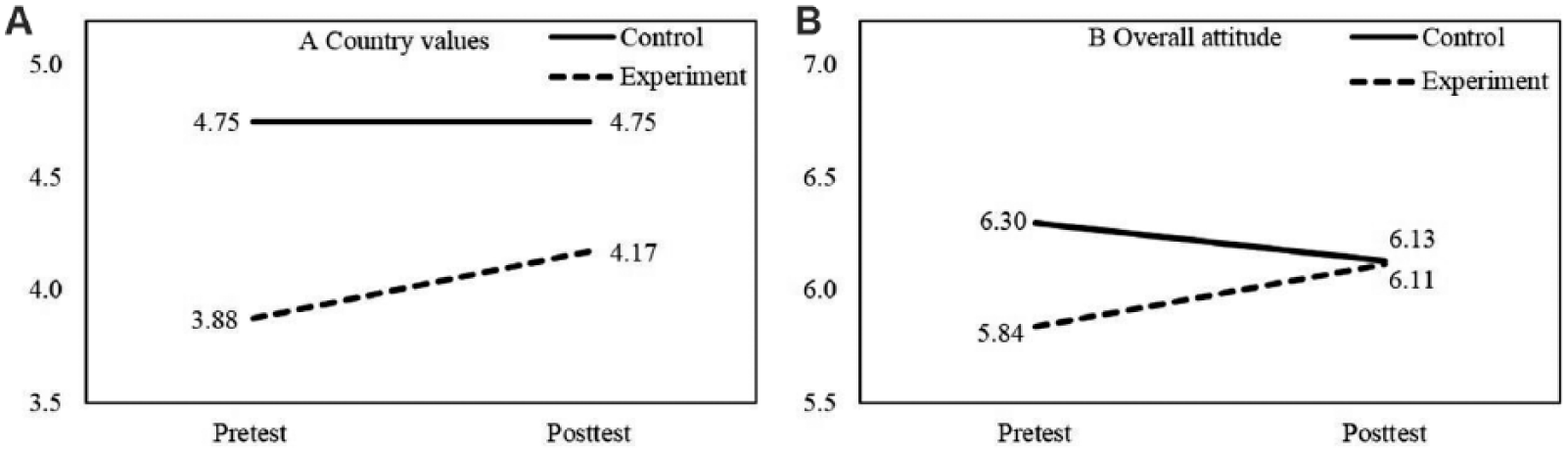
Pretest-posttest change for the two treatment groups, Experimental and Control: A (Country values) and B (Overall attitude)
Animosity, National Attachment, and Consumer Ethnocentrism
Next, the study investigated whether animosity toward the Unites States, national attachment, and consumer ethnocentrism impacted effectiveness of the promotional video. For each psychographic variable, the study assigned respondents into Low and High groups. The distributional shape and the necessity to maintain adequate sample sizes for statistical analyses were taken into consideration. The decision was made to split the respondents on the median; however, whether the median value should be assigned to the Low or High group depended on the comparative sizes of the groups in the experimental and control conditions. Thus, for animosity, the High group had values of 4.0 and above (46 respondents: 30 to 16 split); for national attachment, the High group had values of 6.0 and above (83 respondents: 38 to 45 split); and for consumer ethnocentrism, the High group had values of 3.0 and above (80 respondents: 47 to 33 split).
The change in the pretest–posttest scores on country values and the overall attitude for respondents with different levels of psychographic variables was evaluated using the mixed between–within-subject ANOVA. The within-subjects independent variable was time period (pretest vs. posttest), and the between-subjects factor was the level of the respective psychographic variable: Low vs. High. Since the main effect of the promotional video on the country values and overall attitude dependent variables had already been examined (see previous section, Figure 1), the between-within subject ANOVA analysis was focused on the interaction effect between the time variable (pretest–posttest) and each of the psychographic variables. The analysis also examined whether the image and overall attitude vary for different levels of the respondents’ psychographic traits. Tests for the control group were conducted as well (Table 4).
Psychographic Variables and Pretest–Posttest Change.
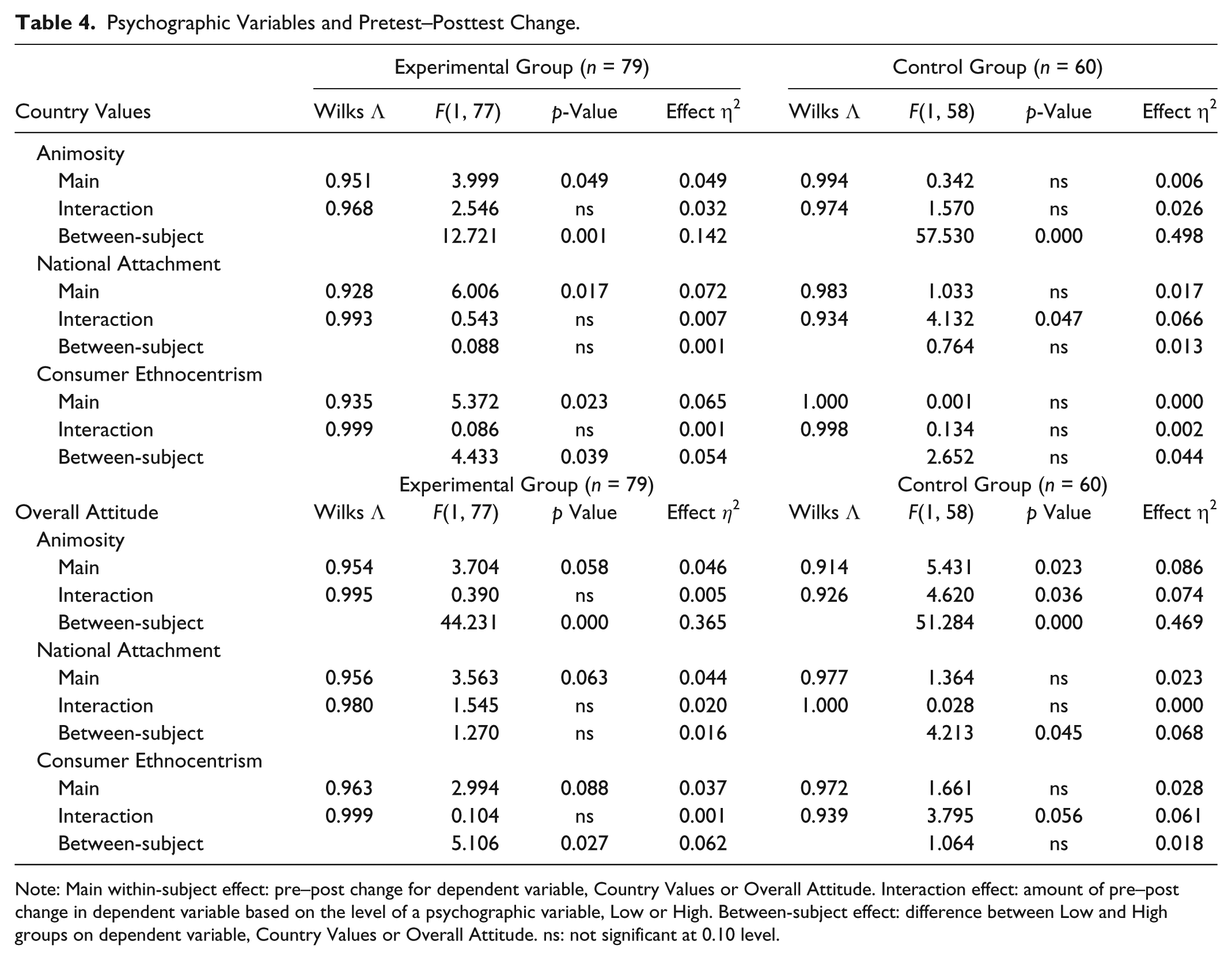
Note: Main within-subject effect: pre–post change for dependent variable, Country Values or Overall Attitude. Interaction effect: amount of pre–post change in dependent variable based on the level of a psychographic variable, Low or High. Between-subject effect: difference between Low and High groups on dependent variable, Country Values or Overall Attitude. ns: not significant at 0.10 level.
In the experimental group, the study was unable to find a statistically significant interaction effect for any of the psychographic variables. However, for country values and animosity, the significant main effect of time (pretest vs. posttest) was largely due to the increase in scores in the Low animosity group, M pre = 4.09, M post = 4.53, and not so much to the increase in the High group, M pre = 3.53, M post = 3.58. The low power of the test (β = 0.351) was the likely reason for the interaction effect (η2 = 0.032) being unable to reach the point of statistical significance (Figure 2A). There was a significant between-subject effect of animosity: participants in the High animosity group tended to have a less favorable country values image, M L = 4.31, M H = 3.56, F (1, 77) = 12.721 p = 0.001, η2 = 0.142 (Figure 2A). Similarly, the High animosity group exhibited lower scores on the overall attitude than the Low group, M L = 6.92, M H = 4.43, F (1, 77) = 44.231 p < 0.001, η2 = 0.365 (Figure 3A).
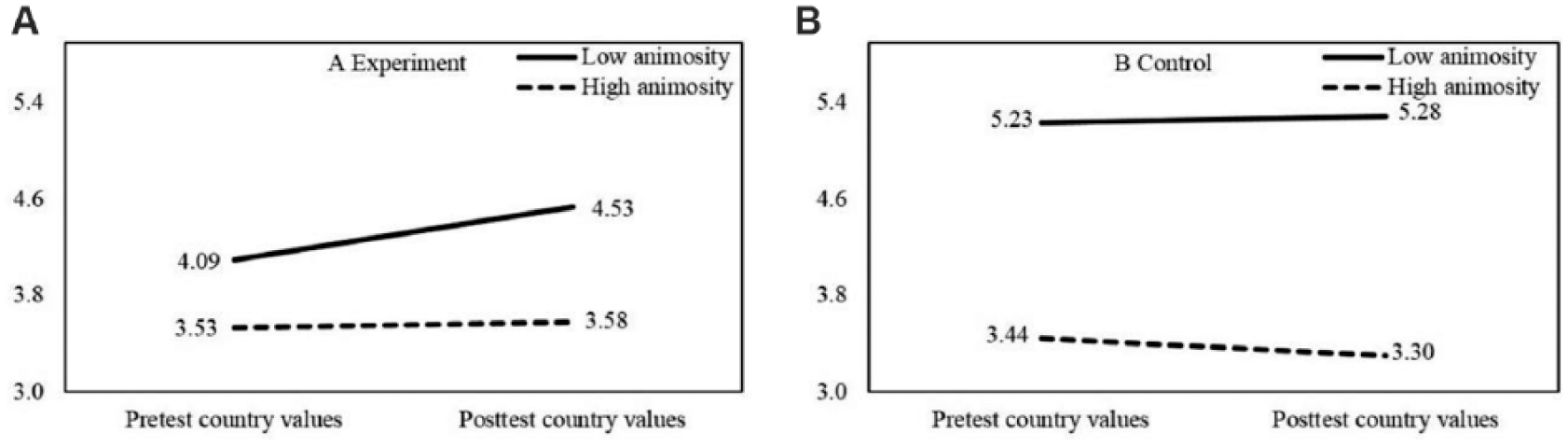
Effect of animosity on country values: pretest–posttest change: (A) Experimental; (B) Control.
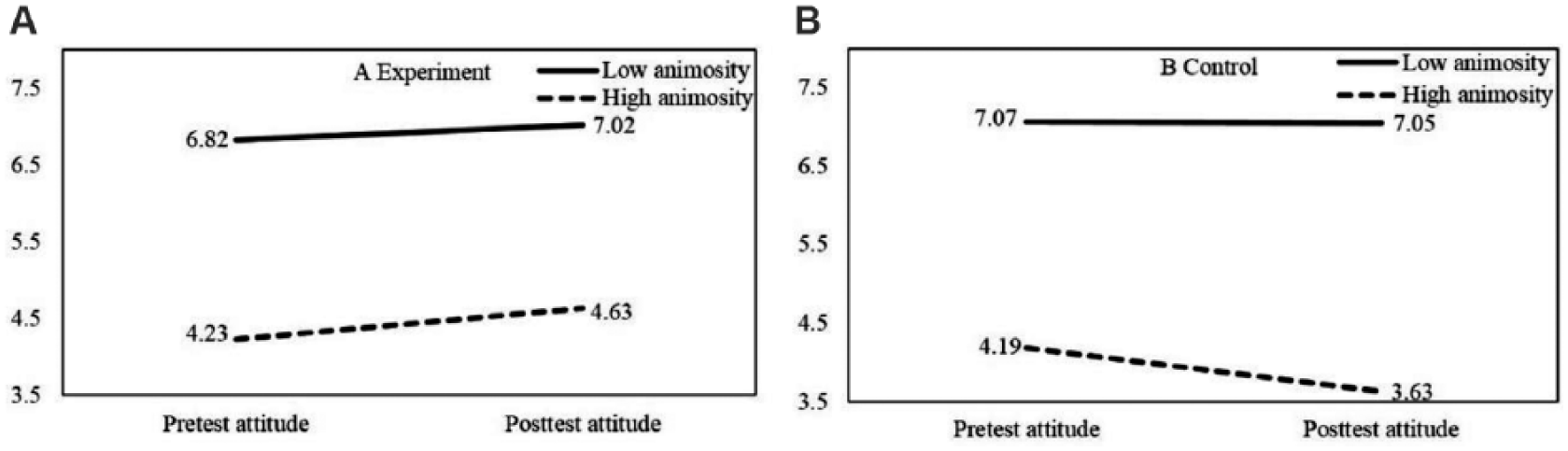
Effect of animosity on overall attitude: pretest–posttest change: (A) Experimental; (B) Control.
For consumer ethnocentrism, the between-subject effects were registered for country values, ML = 4.30, MH = 3.84, F(1, 77) = 4.433, p = 0.039, η2 = 0.054 (Figure 4A), and for overall attitude, ML =6.58, MH = 4.56, F(1, 77) = 5.106, p = 0.027, η2 = 0.062 (Figure 5A). With respect to national attachment, there was no significant interaction effect or between-subject effect for either of the two dependent variables, country values and overall attitude (Table 4, Figures 6A and 7A).
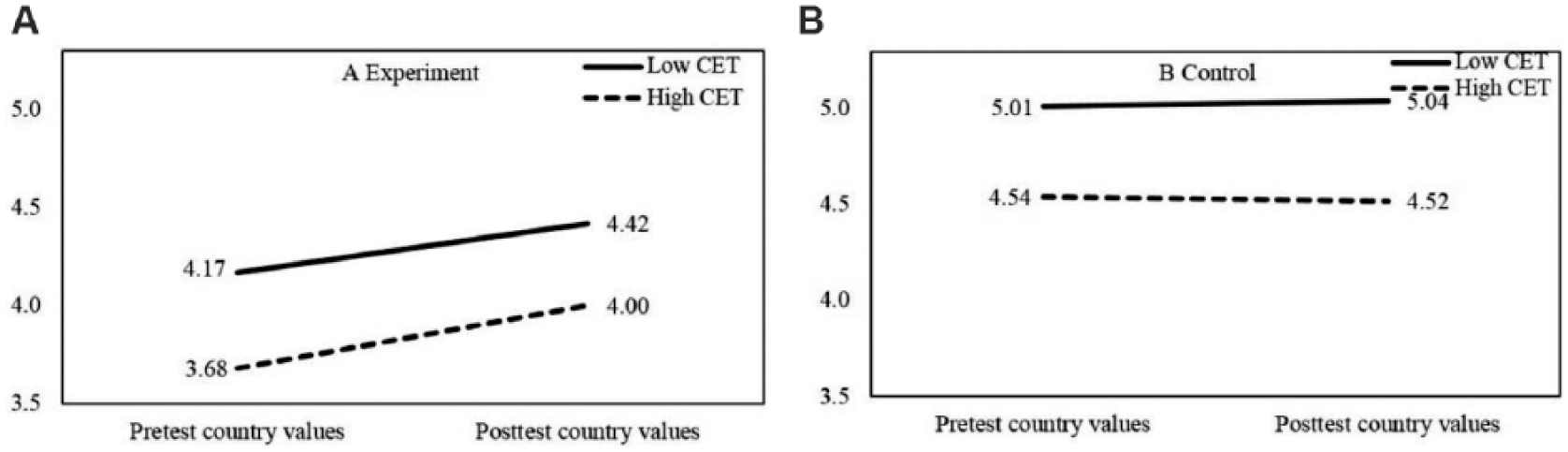
Effect of consumer ethnocentrism on country values: pretest–posttest change: (A) Experimental; (B) Control.
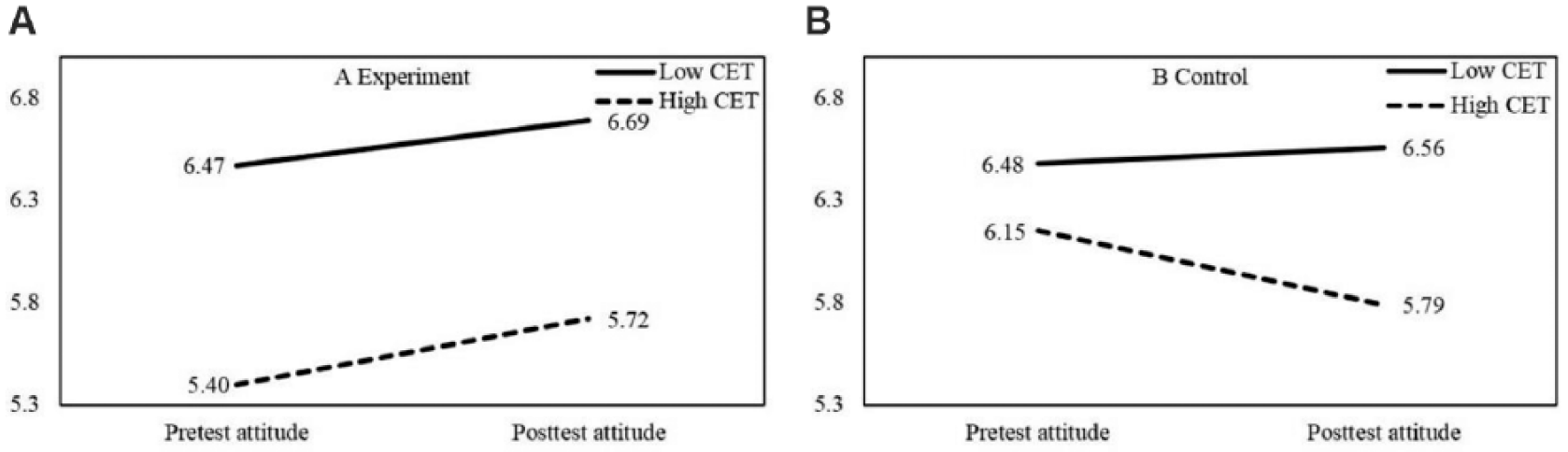
Effect of consumer ethnocentrism on overall attitude: pretest–posttest change: (A) Experimental; (B) Control.
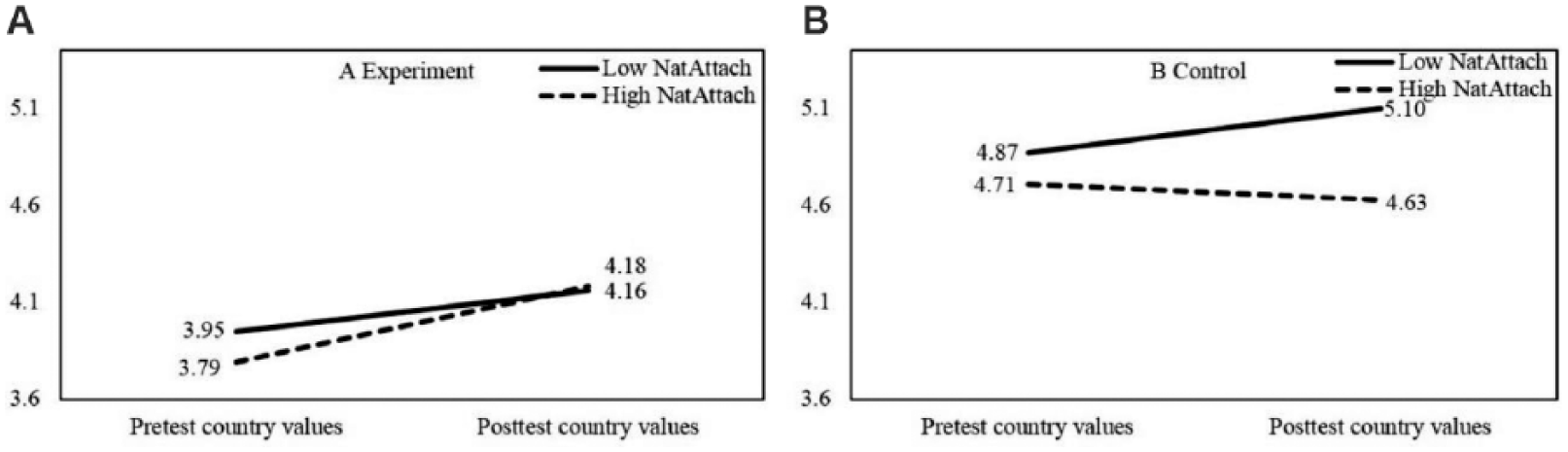
Effect of national attachment on country values: pretest–posttest change: (A) Experimental; (B) Control.
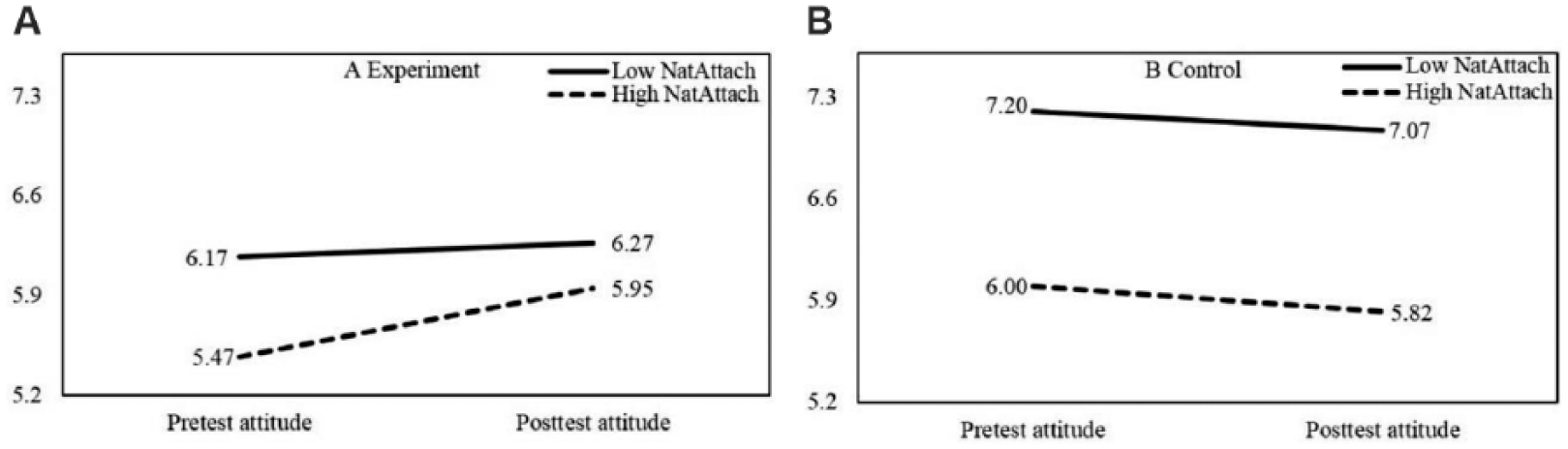
Effect of national attachment on overall attitude: pretest–posttest change: (A) Experimental; (B) Control.
Psychographic Variables and Demographic Groups
The researchers examined whether demographic and travel experience variables can act as predictors of animosity, national attachment, and consumer ethnocentrism. Therefore, a series of one-way ANOVAs were conducted, where the manifest psychographic variables animosity, national attachment, and consumer ethnocentrism acted as dependent variables, while the demographic variables partitioned respondents into groups. To ensure an adequate number of cases in all demographic groups for statistical analyses, some re-coding was necessary. Thus, the education variable was reduced to two categories: people with and without higher education. The life stage variable was re-coded into three categories: single people or families with no kids (younger families); families with pre-school or school children (mature families), and families where at least one child left home (older families). The income variable was transformed into three groups: less than 21,000; 21,000–40,000; and 41,000 and above. Correlation tests were conducted to examine whether the psychographic variables were associated with age and travel experience (number of trips abroad in the three years prior to the study). Two tests returned significant results: first, there was a weak negative correlation, Pearson’s r = −0.21, p = 0.013, between the number of trips abroad and the level of consumer ethnocentrism; second, better-educated respondents demonstrated lower levels of consumer ethnocentrism, F(1, 137) = 5.230, p = 0.024. The results are summarized in Table 5.
Demographic Variables and Pretest–posttest Change.
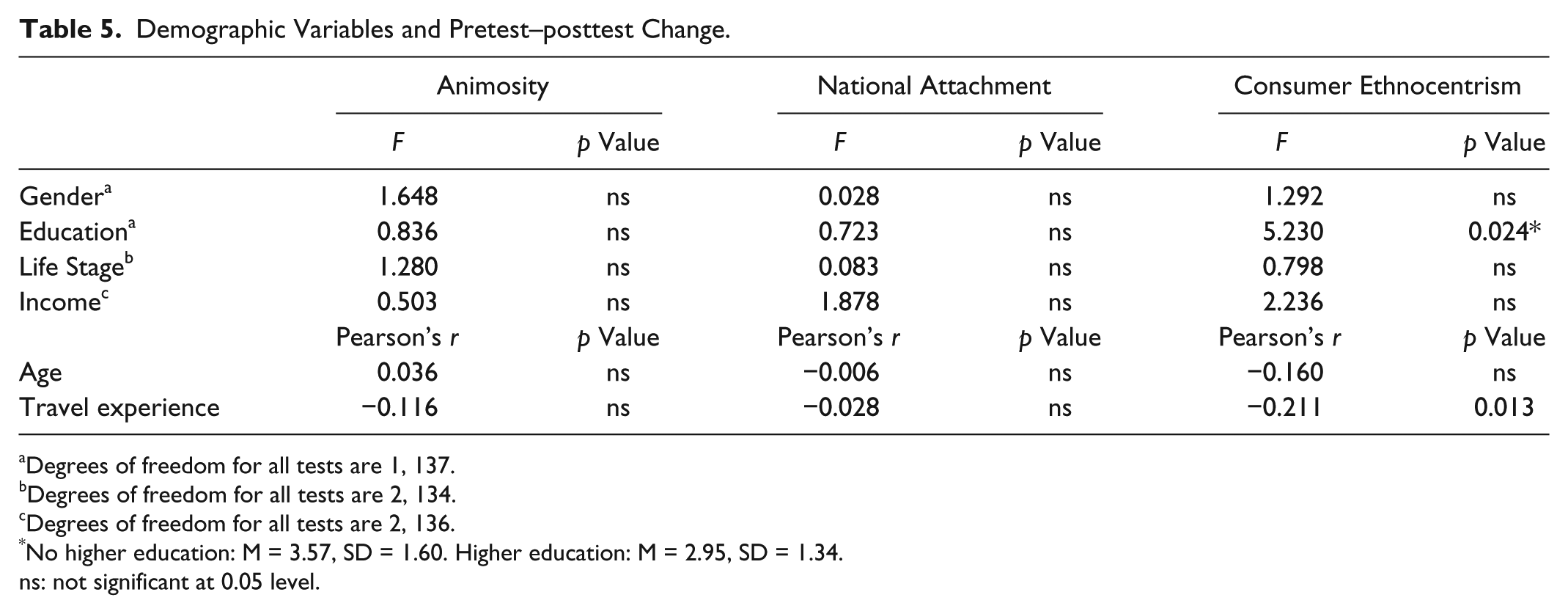
Degrees of freedom for all tests are 1, 137.
Degrees of freedom for all tests are 2, 134.
Degrees of freedom for all tests are 2, 136.
No higher education: M = 3.57, SD = 1.60. Higher education: M = 2.95, SD = 1.34.
ns: not significant at 0.05 level.
Discussion
The results of the experiment indicate that the promotional video impacted image perceptions and the overall attitude of respondents toward the United States. The experimental group improved their perceptions of the United States as an open, friendly, and free country with unlimited opportunities, Mpre = 3.88, Mpost = 4.17 (Table 3, Figure 1A). The perceptions of these image aspects also became more consistent, as indicated by the increase in the Cronbach’s alpha from 0.67 (pretest) to 0.89 (posttest) (Table 2). The overall attitude of the experimental group toward the United States also increased, albeit slightly, after watching the promotional video, Mpre = 5.84, Mpost = 6.11 (Table 3, Figure 1B). In addition, the study provided an indication that intermediate effects of mental processing may depend on the psychographic characteristics of the respondents. The amount of pretest–posttest change in the perceptions of country values varied based on the level of animosity (η2 = 0.032, small size effect) and was mostly due to the respondents in the Low animosity group, Mpre = 4.07, Mpost = 4.53, as the perceptions of the High animosity group stayed practically the same, Mpre = 3.53, Mpost = 3.58 (Figure 2A). The effects of national attachment or consumer ethnocentrism levels on the pretest–posttest change were smaller, rendering animosity the most influential psychographic characteristic in the current Russian context.
From the analysis of the pretest data, it was concluded that the experimental group was not positively biased toward the United States compared to the control group. The differences indicated that the control group had, in fact, more positive perceptions of US cultural values and overall attitude toward the country (Table 3). The absence of a positive change in the scores for the control group at the posttest (Table 3) provided validation for the attribution of positive change in the experimental group from watching the promotional video. A statistically significant interaction effect for overall attitude (decrease for the control group and increase for the experimental group) was found (Figure 1B); the decrease for the control group was interpreted as the “fatigue effect,” known in repeated measures experimental studies (McLeod 2007). To confirm this, the researchers consulted comments that some of the respondents from the control group provided at the end of the posttest questionnaire: respondents expressed irritation about why they had to do the same thing twice and how the video they watched was relevant. Considering that the decrease in overall attitude in the control group was due almost entirely to the High animosity group (Figure 3B), it is plausible to suggest that irritation with a nonrelevant video and quite a long study procedure was the reason for the decrease in scores. It should be pointed out, however, that the study needs not to be concerned with whether the “fatigue effect” existed for the experimental group or not, because the improvement of the image and attitude in the presence of such an effect would be even the stronger evidence to the effectiveness of the promotional video.
It is worth noting that after watching the promotional video, no change was registered for tourism offerings and the cultural crossroads aspects of the US image (Table 3). These results are better understood when placed within the framework of the advertising effects discussed in the Study Background section. Intermediate effects in the mental processing of advertisements can be influenced by various filtering factors, among them being ad appeal and product type. The appeal of the “Land of Dreams” video is largely emotional. Brand USA, by definition, is a value-expressive product, with its Country Values dimension (free, friendly, open and welcoming, with unlimited opportunities) being, arguably, more value-laden, as compared to the Tourism Offerings dimension, which evokes more-functional, or utilitarian, aspects of the country, such as its cities, natural resources, and comfort and relaxation. Therefore, the results seem to be in agreement with the theoretical proposition that promotional materials appealing to the image and value system are more persuasive when the product is value-expressive than when it is utilitarian (Johar and Sirgy 1991).
While the question of whether destination promotional materials can influence perceptions and attitudes of unfriendly tourist audiences has been answered in affirmative by the study, the results pertain to advertising with a largely emotional appeal. Studies in psychology, however, have uncovered the intricate relationships between various types of persuasion materials and change in attitudes, where the attitude type, that is, whether it is based primarily on cognition or affect, plays an important role (e.g., Edwards 1990; Olson and Zanna 1993). Political science studies have found that people resist changing negative attitudes toward political candidates more than positive attitudes (Bizer and Petty 2005) and employ their cognitive capabilities to defend their views. When the conflict between countries intensifies, some of those effects are likely to influence individuals’ responsiveness to promotional materials aimed at changing attitudes and evoking positive feelings toward the destination. From this angle, the result that people with higher animosity toward the United States resist change more than those with less animosity (Figure 2A) complies with previous findings in attitude research. At the same time, the influence of national attachment (and consumer ethnocentrism) on processing of advertisements requires further investigation: the results point to a slightly larger increase in image perceptions and overall attitude in the high attachment group (Figures 6A and 7A), although these results were not statistically significant.
Practical Implications
One interesting result of this study is that Russian tourists’ image perceptions of the United States are quite different for the Tourism Offerings and Country Values factors (Table 3). Before the experiment, the respondents perceived the destination offerings (urban excitement, indulgence, and outdoor opportunities) quite favorably (MTO = 5.25) but had reservations with respect to the country being open, welcoming, and free (MCV = 4.25). Therefore, it is very encouraging that perceptions that constitute the country values aspect of the image improved after watching the promotional video. In another study (Stepchenkova and Shichkova 2017), the authors conducted qualitative interviews with Russian international tourists (none of these subjects participated in the study reported in this paper) about their desire to visit the United States in a situation of strained bilateral relations between the two countries. They found that the respondents had quite favorable perceptions of urban excitement, level of comfort, and outdoor recreational opportunities in the United States but were apprehensive about visiting and wanted assurance that they would be welcomed to the country. They all noted the lack of promotional materials regarding traveling to the United States. The results of the study, therefore, indicate that Brand USA promotion, if present on the market, could change the perceptions of a Russian audience that is generally unfriendly to the United States at present.
Watching the “Land of Dreams” video did not increase the respondents’ desire to visit the United States (Table 3). Yet, one has to keep in mind the short length and one-time airing of the experimental video. Nonetheless, the overall attitude toward the United States marginally improved, which, again, is an encouraging sign for marketers, as attitudes are strong predictors of consumer behavior (Bojanic 1991; Kim, Hwang, and Fesenmaier 2005). Importantly, the study did not assess the longevity of the effect, which could be considered as a limitation. While it would be quite interesting to conduct another posttest to estimate how much of the effect remains, in the absence of a regular Brand USA advertising campaign on the Russian market, it is quite possible that the effect registered by the study would be short lived. In the future research on the topic, a practically useful direction would be to investigate how the size, longevity of the effect, and its conversion to the desire to visit destination depend on the repeated exposure to the advertising materials.
While it was expected that the level of national attachment of respondents would be quite high (median of 6.0 on a 7-point scale), consumer ethnocentrism was moderate overall (median of 3.0). The levels of ethnocentric tendencies, together with a fairly high desire to visit (Mpre = 6.94 on a 10-point scale), were interpreted as an indication that even in the current situation of international sanctions and hostility toward the United States and the collective West, middle-class Russian consumers are not ready to give up the consumption of foreign brands. This finding is in line with results obtained by Kline et al. (2006), Stepchenkova and Shichkova (2017), and Stepchenkova et al. (2017) who found that Russian consumers, although positively inclined toward domestic products, prefer foreign goods when they are clearly superior. Further, in the sample, animosity toward the United States was below the mid-point of 4.0 (M = 3.27, median = 3.0). This too is encouraging, as it indicates that the segment of Russian international tourists represented by the research participants, that is urban, educated, and relatively young, might be quite different from the general Russian population, and their views of the United States are more favorable overall than those of the Russian population as a whole.
Methodological Considerations
The sample aimed to represent Russian international tourists. The way the participants were recruited might have affected the representativeness of the sample in terms of its demographic and psychographic characteristics. However, the participants’ profile, namely, urban, younger, educated, and relatively well-off travelers, is consistent with the profile of the Russian middle class, whose members have incorporated leisure travel into their lifestyles (Tekes Report 2015). The random assignment of respondents to the experimental and control groups resulted in the two groups differing on a number of demographic characteristics, mainly related to age. The study found, however, that animosity and national attachment are not associated with demographic and travel experience characteristics (Table 5). While consumer ethnocentrism is associated with education level and previous travel experience (those with higher education and larger travel experience have lower consumer ethnocentrism levels), the two groups were equal on this variable. These results make the demographic composition of the sample unlikely to impact the validity of the study findings.
The study did not aim to examine how demographic variables impact the effectiveness of advertising. When the promotional materials are designed for a particular demographic group (e.g., newlyweds or seniors), the materials are rigorously pretested for effectiveness with the target audience, which, in a general case, makes testing for demographics somewhat unnecessary. The “Land of Dreams” video, however, was created with the broadest possible audience in mind. It was aired in the international markets (chosen based on six criteria) such as the United Kingdom, Japan, and Canada, and then spreading to Brazil, South Korea, China, India, Germany, Mexico, and Australia (Hudson 2014, 80). None of these countries, while having their issues with the United States, has reached the level of confrontation comparable to that between Russia and the United States. Therefore, the authors would argue, testing for the influence of demographics on changing perceptions would have had value pertaining mostly to the Russian context; the focus should be on the psychographic variables when the transferability of results to other situations of conflict is concerned. Nevertheless, the authors conducted additional analyses (not reported in this article) to estimate the strength of demographic variables in explaining the posttest change in country values and overall attitudes when the effects of psychographic variables are controlled for, that is, when they are used as covariates in the mixed between–within-subject ANOVA. No demographic variable produced a significant (at 0.05 level) main or interaction effect.
For a number of reported tests, the sizes of the Low and High psychographic groups were not equal; however, the size of the smallest group (16 respondents) was still considered large enough, as this sample size is quite common in experimental studies with a factorial design. Moreover, for within-subject tests, when each subject serves as their own control, the sample size in fact doubles, increasing the power of the test. Nevertheless, in several analyses small-sized effects did not reach the level of statistical significance. For example, in the mixed between-within subject ANOVA, for the country value variable (Figure 1A), the main effect of time was 0.027. It falls in the 0.01–0.09 range and is considered a small-size effect (Cohen 1988). It is also deemed practically significant (Kirk 1996). However, this effect did not quite reach the 0.05 significance level (p=0.053). The situation is similar with some other findings (Table 4), indicating that in the future studies, the findings should be verified with larger sample sizes.
The effect sizes of the promotional video on country values and overall attitude are considered small-sized effects (Cohen 1988). To place this result in the context, several factors have to be taken into account, and the most obvious of them are the short duration of the video and its one-time impact. In addition, the poetical aspect of the song might have been reduced by translating it into the Russian language, affecting the emotional appeal of the promotional video overall and resulting in smaller intermediate effects of the advertisement. It is not possible, however, to numerically estimate this effect. Furthermore, one may wonder whether this particular video is simply not very effective with respect to equally improving the perceptions of all 12 image items. While the image items were meant to reflect the essence of Brand USA, features such as innovativeness may not have been sufficiently addressed in the video. In fact, none of the respondents mentioned innovativeness among the three strongest impressions after watching the video. Finally, when the paper discusses improving perceptions, it is assumed that being diverse and multicultural, for example, is a positive country attribute; however, this may not be universally so (Stepchenkova and Shichkova 2016).
To summarize, the study contributes to understanding of how tourists process destination advertising in a situation of conflict between the home and host nations and how psychographic traits of respondents influence mental processing of the marketing materials and impact the intermediate effects of promotion. The study answered in positive the questions stated in the Introduction section regarding the responsiveness of unfriendly tourist audiences to destination marketing materials. The advertising does work in the situation of intense conflict between the country-source market and the country-destination: in a true-experiment study, it was found that perceptions of the country and attitudes toward it can be to some extent improved with promotional information. The study also found that psychographic traits of the respondents can not only serve as indicators of image perceptions and attitudes but also impact an individual’s responsiveness to destination advertising, increasing or reducing its effectiveness. Overall, animosity toward the destination was found to be the most influential variable: people who harbor less intense animosity feelings toward country-destination are more responsive to promotional materials and demonstrate larger intermediate effects to the positive as a result. Consumer ethnocentrism was not found to be influential in moderating the effectiveness of advertising, while the influence of national attachment was found inconclusive and, therefore, requires additional investigation. The study findings on the whole indicate that in a context of strained bilateral relations, marketing global destination brands to unfriendly audiences can be effective in changing images and attitudes toward the positive side.
Footnotes
Correction (November 2023):
The first sentence “Tourist flows exist not only between countries that…” of the introduction section has been revised in this version.
Declaration of Conflicting Interests
The author(s) declared no potential conflicts of interest with respect to the research, authorship, and/or publication of this article.
Funding
The author(s) received no financial support for the research, authorship, and/or publication of this article.