




Abstract
Different treatment of different customers has traditionally been seen as a typical characteristic of tourism services. This research investigates unearned superior treatment in the tourism industry as taking place in a social setting where customers are able to compare the service they receive to that of other customers. Moreover, we take the disadvantaged customers’ point of view and investigate the reactions of customers who receive comparably less than others in such situations. Our results indicate that those customers who receive less than others perceive the service exchanges as more unjust and therefore report lower levels of customer satisfaction and repatronizing intentions as well as higher levels of intentions to talk to others about their experiences. We further investigate whether decisions made by a single versus a group of employees affect the justice perceptions of the encounter. Implications for both research and practice are discussed.
Keywords
Introduction
In the tourism industry, preferential treatment is commonplace, seemingly creating both winners and losers. Queuing for check-in at the airport, for example, one person may be given an upgraded seat (“a WOW moment”) while the person behind, who might be within earshot, is not. However, to date researchers have focused mainly on one facet of such encounters. Specifically, thus far research has predominately “sided with the winners,” examining the effects on individual(s) who receive unearned preferential treatment. As intended by the service providers, positive effects have been found for those receiving unearned preferential treatment including increased loyalty following an airline upgrade (Hwang and Mattila 2018). However, there is also a dark side for these supposed “winners.” Studies have evidenced the experience of guilt and powerlessness when receiving an airline upgrade (Mattila, Hanks, and Zhang 2013; Zhang and Hanks 2015) as well as feelings of social discomfort when buying groceries (Jiang, Hoegg, and Dahl 2013).
As much as research to date has provided valuable knowledge relating to the recipients of unearned preferential treatment, however, it has neglected to provide an accurate understanding of the effects on bystanders in these encounters, namely, those patrons who witness others receiving better treatment but do not receive this themselves. Whereas bystander effects have been investigated in a loyalty program context (e.g., Liu and Mattila 2016; Steinhoff and Palmatier 2016), such encounters often feature some form of input—either explicit or implicit—from the customers regarding the exchange. In contrast, in many of the examples cited above of preferential treatment, the outcomes have been unearned, meaning both those customers who receive preferential treatment and those who do not have the same level of input into the exchange. Given that input is a crucial part of individuals’ perceptions of justice in service encounters (Adams 1963; Konow 2003) this reveals an important research gap. Add to that the fact that these so-called losers are generally the majority in tourism service encounters—in the airline industry, for example, those who remain in their economy class seat surely outnumber those who are bumped up to business class—then the managerial issues of this phenomenon become apparent.
Park and Jang (2015) have provided valuable first insights into this issue, finding that negative effects occur for the onlooker, specifically that individuals who observe others receiving airline seat upgrades suffered from envy and harbored a perception of unfairness. They conclude by calling for further research in this area, in particular for examination of tourism contexts beyond airline upgrades. Building on Park and Jang (2015), our overall contribution is to develop knowledge on the effects of unearned superior treatment from the perspective of those who are on the losing end of service encounters. Specifically, we provide two novel insights.
First, through examining service variability more broadly, we are concerned with unearned superior treatment as opposed to prior research focused on unearned preferential treatment (see Jiang, Hoegg, and Dahl 2013; Park and Jang 2015). Preferential treatment is defined as the provision of “superior social status recognition and/or enhanced products above and beyond standard firm value propositions and customer service practices only for those selected customers” (Lacey, Suh, and Morgan 2007, p. 242). Our focus, superior treatment, extends beyond preferential treatment noted above to include two further circumstances: (a) when an individual receives treatment below the firm’s standard value proposition compared to another who receives standard value and (b) where a number of patrons receive treatment above the value proposition though the treatment of one individual(s) is still better than that of others. This broader perspective thus allows for a greater understanding of the effects on bystanders of other patrons receiving unearned superior treatment to them, which may or may not be a result of overt preference sanctioned by the provider. As such, we will provide findings that have wider applications in the tourism industry. This is important given that service failure is common (see Migacz, Zou, and Petrick 2017) as are hierarchical customer rewards, such as different levels of airline upgrade (Colliander, Söderlund, and Szugalski 2016). Though unearned superior treatment may not be limited to the tourism industry, the focus on human interaction in tourism service settings is especially high (Kandampully 2000). Tourism service employees are often mandated with providing unearned superior treatment to make best use of existing resources (e.g., empty first-class seats or superior rooms) in a way that employees in other service industries are not. The drive for tourism providers to distinguish themselves from the competition (one way being through unearned superior treatment) is increasing with the rapid changes taking place in the industry, such as the prominence of review sites (Mkono and Tribe 2017), the sharing economy such as Airbnb (see Zervas, Proserpio, and Byers 2017), and the low-cost, long-haul flight revolution (Soyk, Ringbeck, and Spinler 2017).
Thus, the uniqueness of tourism settings arguably makes the issue at hand more pressing. Add to that the fact that tourism services are largely considered a high involvement purchase (see Cai, Feng, and Breiter 2004; Park and Jang 2015) where experiences with a service provider is a key driver of satisfaction (Otto and Brent Richie 1996; Poria and Beal 2017; Rajaobelina 2017), then the need to research this issue becomes even more apparent.
Our second novel contribution is providing additional insight into the perceptions of group versus individual decision makers by testing the effects of unearned superior treatment on bystanders when it is delivered by an individual or a group of service employees. As noted by Kouchaki, Smith, and Netchaeva (2015), groups delivering negative decisions to people are often considered more unjust compared to individuals doing the same. This is important as in contemporary organizations, groups are becoming more common and are increasingly responsible for decision making (Kozlowski and Bell 2003). The tourism industry is no exception to this rule. Teams working behind airport counters, in hotel lobbies, and guiding groups of tourists sightseeing is a common occurrence. To our knowledge, however, no study has investigated the perceptions of group decision makers as opposed to individual ones in this setting. Indeed, noting the limitations of their own study, Kouchaki, Smith, and Netchaeva (2015) urge researchers to test this phenomenon in other settings beyond those used in their research. In doing so, we provide additional theoretical insight by investigating how perceptions of group versus individual decision makers are shaped in the tourism industry.
In four studies, we provide an exploration of a range of key performance variables for customers on the losing end of unearned superior treatment in tourism services. We investigate the effects on customer satisfaction, word-of-mouth intention and intention for patronage, as well as perceived justice. Justification for the use of these variables is provided in the review that follows. Given the scarcity of research on the topic, prior related studies have not yet examined these variables. In addition—and responding directly to the call from Park and Jang (2015)—we examine a range of different popular tourism service settings, namely, cafés, hotel counters, and airport check-ins.
Theoretical Framework and Hypotheses
Perceived Justice Effects of Unearned Superior Treatment
Human beings tend to make comparisons with others when the possibility to do so exists (Drèze and Nunes 2009). Here, we assume that a main outcome of such comparisons is justice perceptions. More specifically, we assume that the customers who receive less than their peers, in a situation where he or she is able to compare his or her output to that of others in a service exchange, perceive that the service situation was less just than those who receive the same treatment as their peers. Justice perception is an important psychological phenomenon within social settings (Aggarwal and Larrick 2012). In addition, research has demonstrated it to be an important factor in determining perceptions of a service provider in situations where consumers unacquainted with one another make comparisons of resource allocation outcomes (Söderlund and Colliander 2015).
Tourism operators have long provided superior treatment to selected customers, on the basis that this treatment is earned. Customers may earn these rewards in a number of ways including loyalty, current sales, or potential sales, with these factors carefully segmented within a firm’s offering strategies, for example, frequent-flyer or stayer programs (Lacey, Suh, and Morgan 2007; Mowlana and Smith 1993; Rivers, Toh, and Alaoui 1991). Customers can also experience less objectively earned superior treatment, based on the environment or on their own behavior. Rafaeli and Sutton (1990) have found that less busy stores and demanding customers induced greater cheer in cashiers. In addition, Leary (1996) asserts that a person’s behavior in social interactions (e.g., politeness or modesty) is likely to impact on the impression formed and subsequent behavior of the person interacting with them. Superior treatment may also be unearned and part of the provider’s strategy such as instant-wins, prize draws, or random airline or room upgrades (Jiang, Hoegg, and Dahl 2013; Park and Jang 2015) or due to certain situational factors, for example the employee’s mood during the encounter (Barger and Grandey 2006).
From the perspective of tourists observing others receiving treatment superior to their own, this circumstance may appear unjust, especially when it is perceived that the asymmetry in treatment is unearned. Such perceptions of justice stem from social comparison between peers (in this case customers) of outcomes they have received individually (Drèze and Nunes 2009; Moschis 1976). As such, they become imperative for tourism as a majority of service encounters occur in social environments (see Park and Jang 2015).
The notion of justice perceptions used in the present study is derived from equity theory, which posits that, in a resource allocation situation, an individual P compares his or her ratio of rewards to inputs against those of another individual O (Adams 1963; Konow 2003). If P perceives O’s reward/input ratio as the same as his or her own, then P will perceive that justice is being performed. However, if P perceives that the ratio is unequal, then they will feel the outcome is unjust. Such feelings have been demonstrated by Söderlund and Colliander (2015) as affecting both those subjected to preferential treatment and those observing it in a retail setting. Indeed, the feelings of guilt found by Mattila, Hanks, and Zhang (2013) among those who received airline upgrades indicates that the same mechanisms might be at play in tourism settings. To our knowledge, no existing research has been carried out focused on observation of unearned superior treatment on justice perceptions; thereby, we aim to address this gap here. Based on the reasoning above, we propose that the effect on observers of others receiving superior treatment, provided that the superior treatment is perceived as unearned, will inform the perception that the treatment of customers is unjust.
Hypothesis 1: Unearned superior treatment received by one patron results in lower perceptions of justice for the onlooker who received a lower value treatment.
Negative Consequences of Injustice
Provided that conspicuous asymmetry of treatment affects justice perceptions as hypothesized in hypothesis 1, we propose that such asymmetry will also decrease customer satisfaction for those watching others receiving unearned superior treatment. A core aspect of equity theory is that people, who perceive an injustice in social interactions, are motivated to restore perceived equity. Individuals thus seek to reward or punish others for behavior they perceive as just or unjust, respectively (Konow 2003). Consequently, studies have identified a positive association between perceived justice and customer satisfaction. Söderlund and Colliander (2015) have found that in retail encounters, perceived injustice did indeed lower the customer satisfaction of the interactions among those on the losing end of the preferential treatment. Indeed, that same study as well as Jiang, Hoegg, and Dahl (2013) have suggested that even those who benefit from unearned preferential treatment might not experience increased customer satisfaction as a result. In addition, studies on the effects of service failure have argued for a positive association between perceived justice and customer satisfaction (Gelbrich and Roschk 2011; Maxham and Netemeyer 2002). Other researchers have identified a similar connection between perceived transaction fairness and attitude toward the offers in nonfailure settings (Voss and Jiménez 2010). In a tourism setting, Sirgy (2010) asserts that equity theory can explain levels of satisfaction “in terms of tourists’ perceived ratio of input versus outputs” (p. 246). Furthermore, McCollough (2000) provides a positive association between interaction justice and customer satisfaction in hotel booking scenarios. Similarly, perceived justice following a service failure in luxury Korean hotels has been predictive of customer satisfaction with regards to service recovery (Kim, Kim, and Kim 2009). Given this relationship, it follows that if a customer perceives that he or she receives a lesser value treatment than another, when their input is the same, he or she will be dissatisfied. We thus hypothesize:
Hypothesis 2: Unearned superior treatment received by one patron results in lower satisfaction for the onlooker who received a lower value treatment.
Ensuring customers are satisfied is imperative for tourism providers. This has an impact of their bottom line, as satisfied consumers are more likely to repatronize themselves and encourage others to visit (Petrick 2004). Several studies, as exemplified by the meta-analysis conducted by Curtis et al. (2011), show that customer satisfaction is positively associated with customer loyalty, especially in terms of repurchase and repatronizing intentions. This relationship holds true for a recent study focused on sporting events within tourism (Ahrholdt, Gudergan, and Ringle 2017). In addition, positive effects of both customer satisfaction and perceived fairness on repatronizing intentions were found both in the meta-analysis of antecedents to customer loyalty by Pan, Shen, and Xie (2012), and in the study by Söderlund and Colliander (2015). Based on the assumption that customers on the losing end of tourism service encounters feel a lack of justice and are less satisfied, we thus predict that they will also have lower intention to repatronize. Subsequently, we hypothesize:
Hypothesis 3: Unearned superior treatment received by one patron results in a lower intention to repatronize for the onlooker who received a lower value treatment.
Highlighting the pressing nature of negative traveler reviews online, a recent research study found that “no amount of price reduction was sufficient to offset the impact of unanimously negative reviews” (Book, Tanford, and Chen 2016, p. 993). It is therefore important to understand the relationship between being on the losing end of unearned superior treatment and the intention to enact word-of-mouth. As mentioned earlier, customers who feel they have lost out compared to others will have a greater motivation to restore justice and punish the provider (Konow 2003). Beyond a lower repatronizing intention, a common method of doing so is to tell others about their experience (Berezan et al. 2015). In addition, Berger (2014) suggests that emotional venting is a key antecedent of word-of-mouth behavior. We propose that the negative emotions associated with being treated unfairly as well as the lower satisfaction it results in will lead to increased intentions to tell others about the service encounter. Word-of-mouth is known to have a U-shaped relationship with customer satisfaction; thus, it is most likely to occur when customers are highly delighted or highly dissatisfied (Bansal and Voyer 2000). Indeed, a multitude of studies have identified a strong relationship between customer satisfaction and word-of-mouth intentions (e.g., Cronin, Brady, and Hult 2000). In the tourism industry, Liang et al. (2013) have found that satisfaction with travel consumption experiences has a strong effect on electronic word-of-mouth. Moreover, as the study by White, Breazeale, and Collier (2012) has demonstrated, perceived fairness in a retailing context significantly influences the intentions to spread negative word-of-mouth. Finding theoretical support for the notion that justice perceptions and customer satisfaction will influence word-of-mouth intentions, we hypothesize:
Hypothesis 4: Unearned superior treatment received by one patron results in a higher intention to enact word-of-mouth for the onlooker who received a lower value treatment.
The Impact of a Group versus Individual Decision Maker on Perceived Justice
In addition to hypotheses 1 through 4, we also ask if observing unearned superior treatment will result in lower justice perceptions in the onlooker if the decision is made by a group of employees rather than a single employee. Our hypotheses above have all been based on the assumption that people form their justice perceptions based on the outcomes they receive. That is, people form them based on the distributional justice of the service exchanges (Adams 1963). However, research has also demonstrated that peoples’ justice perceptions have been influenced by information and cues unrelated to fairness per se, but rather by affective information related to the exchange (Barsky, Kaplan, and Beal 2011; van den Bos 2003). That is, people form justice perceptions based on the way they feel about an event rather than its actual outcome. Moreover, research into the interactions between individuals versus groups has demonstrated that people perceive groups to be more deceitful and less trustworthy than individuals (e.g., Hoyle, Pinkly, and Insko 1989; Insko et al. 2001), sometimes referred to as a negative group schema. Thus, if a negative group schema is indeed used as an affective cue for judging the fairness of an exchange, group decisions should be perceived as less just than decisions made by an individual.
Putting this to the test, Kouchaki, Smith, and Netchaeva (2015) have concluded that when given an unfavorable decision, people do indeed find decisions made by groups to be less just than those made by individuals. However, the authors conclude that more research should be devoted to the type of decisions influenced by group versus individual decision makers. Kouchaki, Smith, and Netchaeva (2015) investigate layoffs, hiring and resource allocation within organizations and propose that more research should be performed on a range of decision types. Heeding their call, we tested whether people on the losing end of unearned superior treatment are affected by a group versus a single employee making the decision.
As there was potential for both a negative effect of group versus individual decision making in cases involving unearned superior treatment and the absence of such an effect, an open research question was formulated instead of a hypothesis. That is, we see the potential for a negative group schema being used as a cue for judging the fairness of the transaction, leading to a group decision being perceived as less fair than a decision made by a single employee. This would be in line with the findings of Kouchaki, Smith, and Netchaeva (2015) and we would also expect that this would affect bystanders in relation to unearned superior treatment. However, previous research has also demonstrated that contextual cues for making fairness judgments are especially prevalent in group contexts within organizations. Thus, we also detect the possibility that in situations with less at stake, individuals might not go the extra distance of employing contextual cues when forming justice perceptions. After all, whether or not someone keeps their job would be a more important event in life than whether someone receives a flight upgrade. Testing such boundary conditions of fairness perceptions of group versus individual decision makers is therefore one of the main contributions of this study. Hence, we formulate:
Research question 1: How does unearned superior treatment provided by a group or individual influence justice perceptions in those witnessing unearned superior treatment but who themselves received a lower value treatment?
We put the hypotheses and research question to the test in four studies that cover different sectors within the tourism industry. The first two studies are intended to investigate various forms of unearned superior treatment. The third study provides replication in addition to testing hypotheses 3 and 4. In addition to offering further replication, the fourth study also investigates research question 1. Combined, the four studies provide novel insights into this previously underresearched area of witnessing unearned superior treatment. The reason we believe this gap is yet to be addressed is that research on observation of preferential treatment has focused on “earned” rewards as these are more common given the prominence of loyalty schemes. Despite this being the case, unearned preferential treatment is still a recurrent practice in the tourism service industry, with surprise upgrades deployed to make best use of resources. Furthermore, the lack of research in this area is the impetus of the present study.
Study 1
Study 1 was intended to test hypotheses 1 and 2. In order to do so, we used a between-subjects experimental design with two treatment groups. One group of participants observed equal treatment and the other group observed unearned superior treatment. Similar to many previous studies inspired by equity theory (e.g., Austin and Walster 1974), and in line with our theoretical reasoning, outputs were manipulated while inputs were kept constant. More specifically, the participants received either the same treatment or worse treatment from a tourism service employee than another tourist ahead of them in the line after an identical level of input. Participants were able to overhear the interaction between the tourist ahead of them in line and the service employee and thus were in a position to compare their service output to other tourists.
Stimulus Development
We employed a text-based role-play scenario for our manipulations; we asked each participant to assume the role of a customer who interacted with a service employee in a hospitality setting. Such scenarios have often been utilized in justice research (Huppertz, Arenson, and Evans 1978; Konow 2003; Mattila, Hanks, and Zhang 2013), and we thus deemed it an appropriate method for our study. The scenarios employed throughout this paper were designed in line with Rungtusanatham, Wallin, and Eckerd’s (2011) three-step method to ensure they are “clear, realistic and complete” (p. 9).
The encounter with the tourism service employee took place in an ice-cream café to which the focal tourist (P) had gone to cool off on a hot day. This setting was chosen as representative of a typical tourism hospitality setting that most respondents would be able to imagine. The scenario described how the tourist had to wait for a while before ordering ice cream, because another customer (O) was ahead of them in the line. This other customer was politely greeted by the female service employee, who maintained eye-contact with O while taking the order and wished O a pleasant day after the purchase. This part of the scenario was identical in both experimental groups. In addition, O ordered (and received) exactly the same ice cream that P subsequently ordered (and received). Thus, we held the product constant, while the employee’s treatment of P was manipulated.
In the group observing equal treatment, the employee’s treatment of P was identical to the treatment O received. P was politely greeted by the same employee, who maintained eye contact with P while taking the order and wished P a pleasant day after the purchase. In the group observing unearned superior treatment, however, P was treated less politely by the employee (the employee did not greet P as politely and maintained less eye contact. Also, the employee did not wish P a pleasant day after the encounter). In other words, and in line with the terminology used by Grönroos (2001), in one group both O and P received identical technical and functional service, while P received less functional service than O in the other group (please see appendix A).
Data Collection and Participants
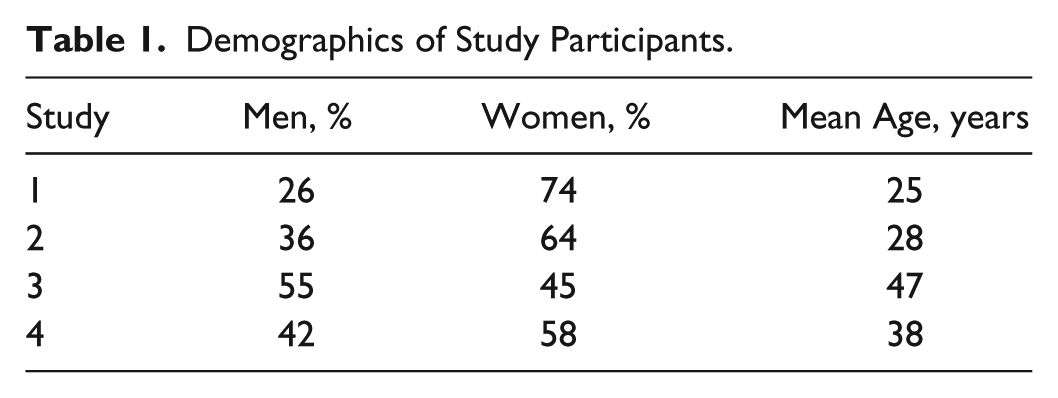
Each scenario version was followed by questionnaire items to measure the variables in the hypotheses. The scenarios were randomly allocated to the participants (N = 78), which we recruited from undergraduate students participating in two different university courses in a European country. The questionnaire was administered in class and respondents were asked to “Please imagine yourself in the following scenario” and to read through the scenario carefully and answer all questions. Using a student sample is a well-established practice in similar research (e.g., Rewtrakunphaiboon and Oppewal 2008) (see Table 1 for the study participants’ demographics).
Demographics of Study Participants.
Measures
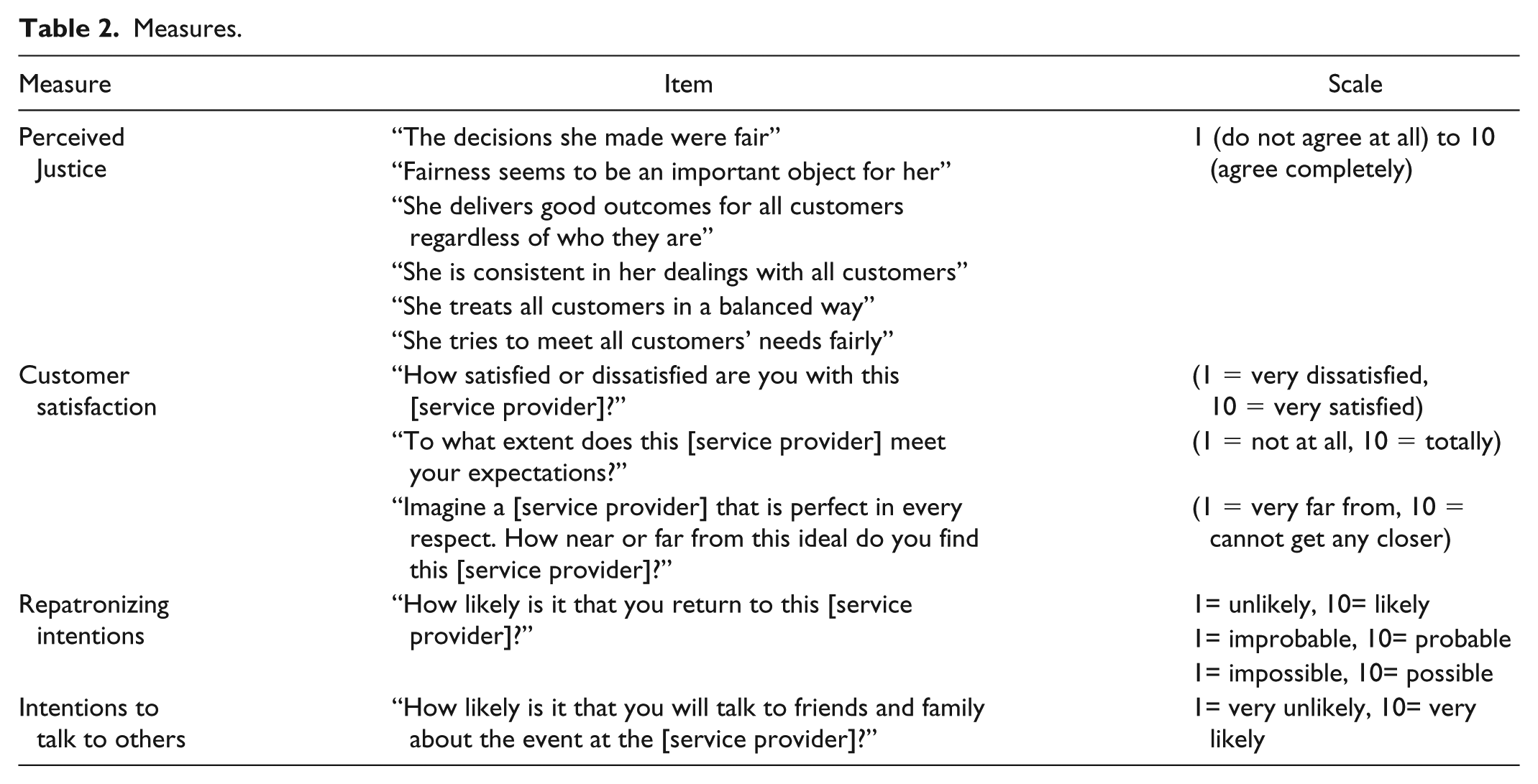
We measured perceived justice in terms of systemic justice; we thus measured the overall perception of justice in the service encounter with items adapted from Beugre and Baron (2001). Söderlund et al. (2014) have used similar items to examine perceived justice in a service encounter context. The measure comprised six items referring to the behavior of the (female) sales associate, and they were all scored from 1 (do not agree at all) to 10 (agree completely). The items were then formed into an index (Cronbach’s alpha = .93). Customer satisfaction was measured by three items used in several national satisfaction barometers (Johnson et al. 2001). Alpha for this scale was .91 (see Table 2 for items and further details on the scales used).
Measures.
Results
In order to ensure the validity of our study, two initial tests were run. Initially, the respondents were asked to rate the realism of the scenario on a 10-point scale ranging from very unrealistic to very realistic. Combining results from the two experimental conditions resulted in a mean of 7.46 on this scale, demonstrating that respondents considered the scenarios to be realistic. In addition, respondents were asked how difficult it was to imagine themselves in the scenarios depicted on a 10- point scale ranging from very difficult to very easy. Combining results from the two experimental conditions resulted in a mean of 7.60 on this scale, demonstrating that respondents considered it easy to imagine themselves as being in this scenario. Satisfied with these results, we continued our analysis.
We used two separate t tests to test the hypotheses. The means for the dependent variables in the two treatment groups are presented in Table 3 below.
Results: Study 1.
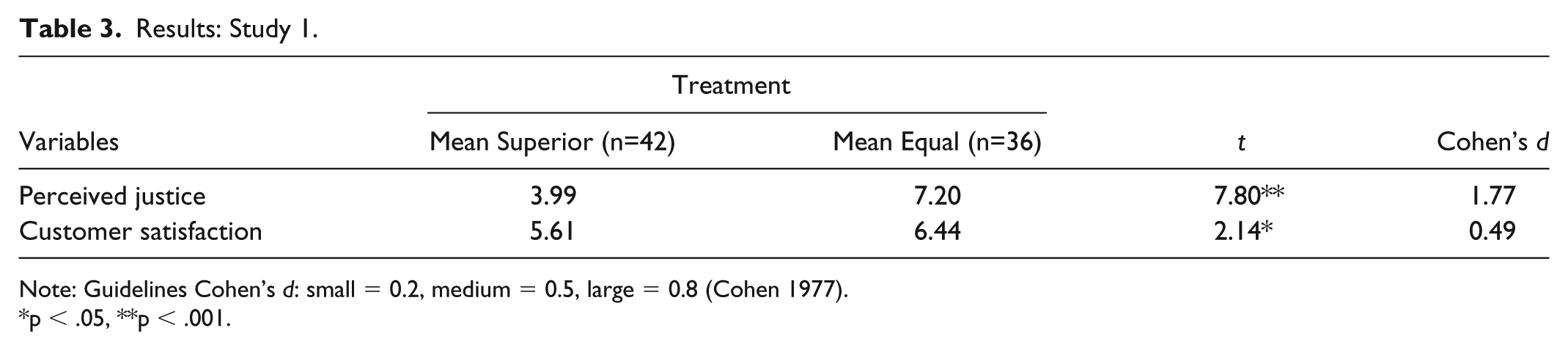
Note: Guidelines Cohen’s d: small = 0.2, medium = 0.5, large = 0.8 (Cohen 1977).
p < .05, **p < .001.
With regard to hypothesis 1, the t test showed that the mean of perceived justice for the group observing unearned superior treatment (mean=3.99) was significantly lower than the mean of perceived justice in the group observing equal treatment (mean=7.20) (t =7.80, p<.001). Hypothesis 1 was thus supported. Analyzing hypothesis 2, the t test showed that the mean of customer satisfaction for the group observing unearned superior treatment (mean=5.61) was also significantly lower than the mean of customer satisfaction in the group observing equal treatment (mean=6.44) (t=2.14, p<.05), meaning that hypothesis 2 was supported.
Discussion
Customers on the losing end of unearned superior treatment, namely, those who receive less functional service than their peers, exhibited lower levels of perceived justice and lower levels of customer satisfaction than those who receive the same service (technical and functional) as their peers. This result can seem fairly intuitive but research has thus far devoted remarkably little focus on disadvantaged customers. That is to say, most studies on unearned preferential treatment and its consequences for customers have concentrated on the impact of preferential treatment on those customers who do receive it (e.g., Mattila, Hanks, and Zhang 2013) and not on the effects on those left behind. Yet our results indicate that a company stands to lose substantially by treating some customers worse than others.
However, the deprived participants in study 1 were not only receiving different service than other customers; they were also receiving relatively poor functional service (i.e., “how you get it” as opposed to “what you get”; Grönroos 2001). That such treatment per se can have adverse effects is unsurprising; many studies show that relatively small details in service employees’ behaviors can have an impact on customer satisfaction. In any event, even though the study 1 results indicated that deprived customers reacted negatively when they were able to compare what they received with what other customers received, this effect may be partly due to the relatively lower high-quality offer for the deprived customers. To be able to assess the reactions of the deprived customer in the case when the received service is perfectly adequate for everyone but varied—and thus to make the inter-customer comparison aspect more salient—we designed a second study in which the treatment of P was kept constant and at a high level, while the treatment of O was either the same as that of P or better.
Study 2
As in study 1, we used a between-subjects experimental design with two treatment groups. Again, one group of participants was observing equal treatment and the other group was observing unearned superior treatment. Again, similar to study 1, outputs were manipulated while inputs were kept constant. Study 2 differed from study 1 in that the employee’s treatment of P was held constant between the two conditions while the treatment of O varied. More specifically, in the equal treatment condition, O received the same service as P while in the observing unearned superior treatment condition O received a better offer than P. This setting mirrors the common practice in the tourism industry as it is often the case that firms upgrade or give preferential treatment to some tourists while others are kept at “base level.” In addition, it offered us a better prospect of isolating the effects of observing unearned superior treatment per se.
Stimulus Development
Again, we chose to employ a text-based role-play scenario for our manipulations and asked each participant to assume the role of a tourist who interacted with a service worker in a hospitality setting. This time, however, we set the scenario in the lobby of a hotel at check-in. Again, we thought that this would represent a typical tourism hospitality setting that most respondents would be able to imagine. In addition, it gave us the opportunity to investigate whether our findings were robust over different hospitality settings. The scenario described how the focal tourist P arrived at a hotel in a foreign country and had to wait for a while before check-in, because another patron O was ahead in the line. As in study 1, the other patron was politely greeted by the female receptionist, who proceeded with O’s check-in process. The service O received, however, differed between the two scenarios. In one experimental group, O was upgraded to a “business room,” described by the receptionist as a slightly better room than the one O had originally reserved. In the other experimental group, O was upgraded to an “executive suite,” described by the receptionist as a much better room than the one O had originally reserved. When it was P’s turn to check in, P was equally politely treated but always upgraded to a business room (both P and O had originally reserved the same type of room, hence input was kept constant). In this scenario, P was thus given an upgrade and treated very well, but in the observing unearned superior treatment condition, O was treated even better. This scenario was created to definitely rule out any confounds of poor treatment in the results (please see appendix B).
Data Collection and Participants
Each scenario version was followed by questionnaire items to measure the variables in the hypotheses (the measures were the same as in study 1). The scenarios were again randomly allocated to the participants (N = 69), whom we recruited from undergraduate students participating in three different university courses in a European country. The questionnaire was administered in class and respondents were asked to “Please imagine yourself in the following scenario” and to read through the scenario carefully and answer all questions (see Table 1 for sample demographics).
Results
In order to ensure the validity of our study, two initial tests on the scenarios were run. Again, the respondents were asked to rate the realism of the scenario on a 10-point scale ranging from very unrealistic to very realistic. Combining results from the two experimental conditions resulted in a mean of 5.68 on this scale, demonstrating that respondents considered the scenarios to be realistic. In addition, respondents were once more asked how difficult it was to imagine themselves in the scenarios depicted on a 10-point scale ranging from very difficult to very easy. Combining results from the two experimental conditions resulted in a mean of 7.20 on this scale, demonstrating that respondents considered it easy to imagine themselves as being in this scenario. Satisfied with these results, we continued our analysis.
Two separate t tests were used to test the hypotheses. The means for the dependent variables in the two treatment groups are presented in Table 4 below.
Results: Study 2.
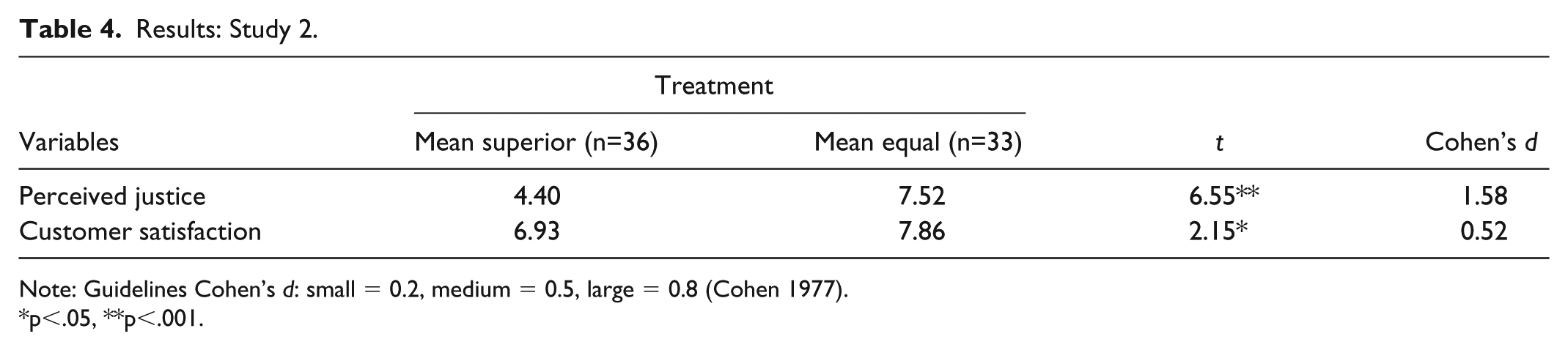
Note: Guidelines Cohen’s d: small = 0.2, medium = 0.5, large = 0.8 (Cohen 1977).
p<.05, **p<.001.
With regard to hypothesis 1, the mean of perceived justice for the group observing unearned superior treatment (mean = 4.40) was again lower than the mean of perceived justice in the group observing equal treatment (mean=7.52). This difference was significant (t =6.55, p<.01). Hypothesis 1 was thus supported also in study 2. As for hypothesis 2, the mean of customer satisfaction for the group observing unearned superior treatment (mean=6.93) was lower than the mean of customer satisfaction in the group observing equal treatment (mean=7.86). This difference was significant (t =2.15, p<.05). Hypothesis 2 was thus supported also in study 2.
Discussion
The fact that observing unearned superior treatment produced lower justice perceptions and customer satisfaction among deprived customers even though those customers received better treatment than originally expected goes to show the strength of our theoretical foundations. The results of studies 1 and 2, covering different industries in the travel and hospitality industry, thus suggest that there is a dark side of preferential treatment and customer prioritization—activities that seem to be on the rise in many firms.
In order to further explore these findings, another study was initiated, covering a different area and including additional key variables.
Study 3
Study 3 tested hypotheses 3 and 4. In this study, we used a between-subjects experimental design with two treatment groups. Again, one group observed equal treatment; the other group observed unearned superior treatment. Outputs were again manipulated while inputs were kept constant. As in study 2, the output of P was held constant between the two conditions while the output of O varied. In the group observing equal treatment O received the same service as P, while in the group observing unearned superior treatment O received a better offer than P.
Stimulus Development
Again, we used a text-based role-play scenario for our manipulations and asked each participant to assume the role of a traveler who interacted with a service worker in the airline industry. In study 3, the scenario comprised a check-in setting in an airport, a common service encounter for tourists.
The scenario described how the focal traveler P arrived at a check-in counter of an airline and had to wait for a while before check-in, because another customer O was ahead in the line. As in studies 1 and 2, the other customer was politely greeted by the female airline employee, who started O’s check-in process, while in study 2, the service O received differed between the two scenarios. Both P and O had booked a ticket in economy class. In the group observing unearned superior treatment, O was upgraded to business class while O was not upgraded in the equal treatment group. P was treated as politely as O but always received the ticket for economy class that was originally reserved. The output for P was thus again held constant across the two scenarios (please see appendix C).
Data Collection and Participants
Once more, each scenario version was followed by questionnaire items to measure the variables in the hypotheses. This time, respondents were recruited through an online web panel of a professional market research company in a Western European country. The respondents were a nationally representative sample of the population in our country of study. Each respondent received a small token that could be exchanged for money or redeemed for products. Respondents were emailed a link to a Qualtrics survey (the survey publishing tool adopted). An anti-ballot stuffing setting was enabled to circumvent multiple submissions from the same participant. Respondents were asked to “Please imagine yourself in the following scenario” and to read through the scenario carefully and answer all questions. The sample consisted of 192 people (see Table 1 for sample demographics).
Measures
Perceived justice and customer satisfaction were measured with the same items as in studies 1 and 2. For repatronizing intentions, we used the question utilized by Söderlund and Colliander (2015) (Cronbach’s alpha= .93). Intention to talk to others was measured with a single item measure emphasizing conversation with others rather than explicit recommendations, the same as used by Söderlund and Mattsson (2009) (see Table 2 for items and further details on the scales used).
Results
Initially, we employed a manipulation check and asked what kind of ticket our respondents had received during the scenario. After retaining only those respondents who had answered this question correctly, we were left with 154 respondents (out of an original 192). To further check our manipulations, we asked our remaining respondents how much better or worse treatment they had received compared to the passenger ahead of them in line. Responses were recorded on a 10- point scale ranging from “much worse” to “much better.” A t test between our two experimental groups revealed that passengers observing unearned superior treatment rated their treatment as being worse (mean= 3.49) than those passengers observing equal treatment (mean = 5.43, p < .01).
Ensuring the manipulations had worked as intended, we once more asked respondents to rate the realism of the scenario on a 10-point scale ranging from very unrealistic to very realistic. Combining results from the two experimental conditions resulted in a mean of 6.97 on this scale, demonstrating that respondents considered the scenarios to be realistic. In addition, respondents were once more asked how difficult it was to imagine themselves in the scenarios depicted on a 10-point scale ranging from very difficult to very easy. Combining results from the two experimental conditions resulted in a mean of 7.61 on this scale, demonstrating that respondents considered it easy to imagine themselves in this scenario.
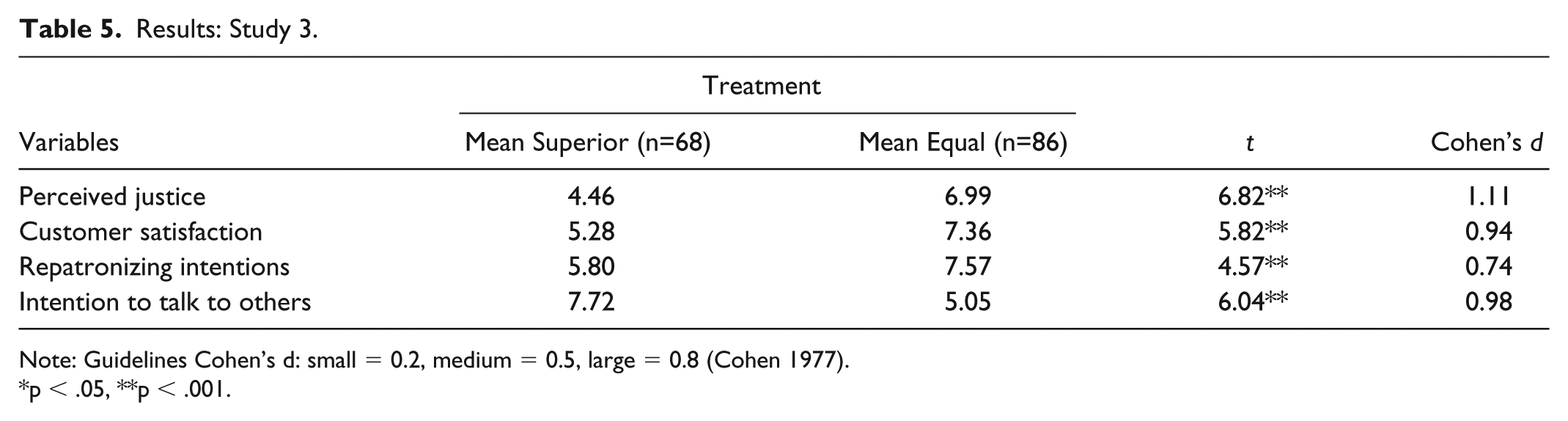
The means for the dependent variables in the two treatment groups are presented in Table 5 below. Again, we used t tests to test the hypotheses.
Results: Study 3.
Note: Guidelines Cohen’s d: small = 0.2, medium = 0.5, large = 0.8 (Cohen 1977).
p < .05, **p < .001.
With regard to hypothesis 1, the mean of perceived justice for the group observing unearned superior treatment (mean= 4.46) was lower than the mean of perceived justice in the group observing equal treatment (mean=6.99). This difference was significant (t=6.82, p<.01); hypothesis 1 was thus supported.
With respect to hypothesis 2, customer satisfaction was lower for the group observing unearned superior treatment (mean=5.28) than the group observing equal treatment (mean=7.36). This difference was significant (t=5.82, p<.01); hypothesis 2 was thus supported.
Moreover, repatronizing intentions were lower for the group observing unearned superior treatment (mean=5.80) than for the group observing equal treatment (mean=7.57); this difference was significant (t=4.57, p<.01). Hypothesis 3 was thus supported. Word-of-mouth intentions were higher in the group observing unearned superior treatment (mean=7.72) than in the group observing equal treatment (mean=5.05). This difference was significant (t =6.04, p<.01); hypothesis 4 was thus supported.
Discussion
Study 3 demonstrated that our theoretical underpinnings regarding justice perceptions and customer satisfaction are valid in yet another situation in the travel and hospitality industry. In addition to perceived justice and customer satisfaction responses, study 3 also showed that observing unearned superior treatment—from the disadvantaged customer’s point of view—affected additional behavioral intention variables, namely, repatronizing intentions and intentions to speak to other customers about the service encounter. More specifically, for disadvantaged customers, intentions to talk to other customers about the service encounter were higher, whereas repatronizing intention was lower. Our finding of increased word-of-mouth intentions following high service variability is particularly important in the social media age where consumer evaluations are becoming ever more imperative. It must be noted that although 38 participants failed the manipulation check, group sizes provided adequate statistical power for analysis. However, given a small unevenness of the group sizes, Mann-Whitney U tests were run and corroborated the findings above, albeit in this case we suggest some caution be observed in relation to the generalization of these results because of the asymmetry in our group sizes.
For the final study, we tested a crucial moderator to the effects found above, namely, whether the decision to bestow a customer with unearned superior treatment is made by a single employee or a group of tourism service employees, in addition to providing replication of the results of prior studies.
Study 4
Study 4 tested our research question 1. We used a between-subjects experimental design with four treatment groups. Two groups observed equal treatment; the other two observed unearned superior treatment. One of the groups observing equal treatment did so by observing a single employee, while the other observed equal treatment by a group of employees. The same split was made between the two groups observing unearned superior treatment. Outputs were again manipulated while inputs were kept constant. As in study 3, the output of P was held constant between the four conditions while the output of O varied. In the groups observing equal treatment, O received the same service as P, while in the group observing unearned superior treatment O received a better offer than P. In addition—and in contrast to our previous three studies—respondents interacted with a male tourism service employee in order to determine if the patterns from our previous studies also held under this condition.
Stimulus Development
Again, we used a text-based role-play scenario for our manipulations and asked each participant to assume the role of a traveler who interacted with an airline industry service worker. For the respondents dealing with a single airline employee, we employed the same stimuli as in study 3, only altering it to make the employee male instead of female (please see appendix D).
Subsequently, we used an additional two scenarios where we altered those variables detailed above so that instead of dealing with a single employee, both O and P dealt with a group of employees. However, they made the same decisions as in the other two conditions. Thus, we tested the effects of observing equal versus unearned superior treatment when the decisions were made by either a single or a group of (male) employees.
The scenarios were pretested in order to ensure both their realism and that respondents were able to imagine themselves in the scenario. Respondents (n = 72) rated the realism of the scenarios on a 10-point scale ranging from very unrealistic to very realistic. This resulted in a mean of 5.85, demonstrating that respondents considered the scenarios to be realistic. In addition, the same respondents were asked how difficult it was to imagine themselves in the scenarios depicted on a 10- point scale ranging from very difficult to very easy. This resulted in a mean of 7.93, demonstrating that respondents considered it easy to imagine themselves in this scenario.
Data Collection and Participants
Each scenario version was again followed by questionnaire items to measure the variables in the hypotheses. The measures were identical to those employed in study 3. Respondents were recruited through Amazon Mechanical Turk and consisted of US residents over the age of 18. Participation was open to people who had a validated track record in past surveys of above 90% approval, and the Qualtrics (the survey publishing tool adopted) anti-ballot stuffing setting was again enabled to circumvent multiple submissions from the same participant. After initially filling out some demographic questions ensuring that they were in fact US residents, respondents were again instructed to “Please imagine yourself in the following scenario” and to read through the scenario carefully and answer all questions. The sample consisted of 500 people (see Table 1 for sample demographics).
Results
We employed three manipulation checks. We again asked what kind of ticket our respondents had received during the scenario. We also asked what kind of ticket the other customer had received. Finally, we asked if the respondent had encountered a single employee versus a group of employees at the check-in counter. After only retaining those respondents who had answered correctly on these questions, we were left with 455 respondents (from an original 500).
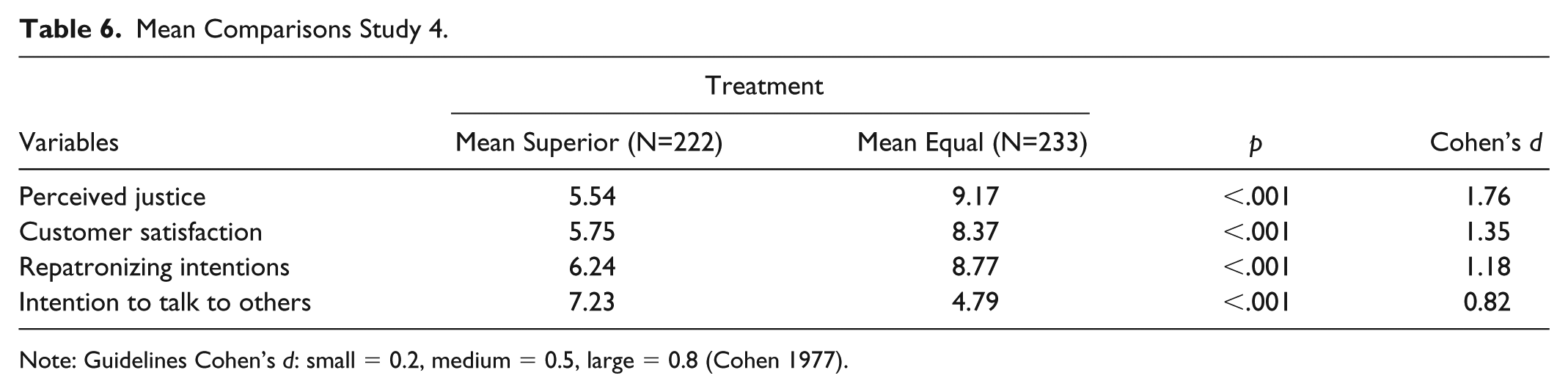
The means for the dependent variables in the two treatment groups are presented in Table 6 below. We used two-way analyses of variance with pairwise comparisons to simultaneously test the means of our dependent variables as well as our research question 1.
Mean Comparisons Study 4.
Note: Guidelines Cohen’s d: small = 0.2, medium = 0.5, large = 0.8 (Cohen 1977).
Hypothesis 1 was once again supported. The combined mean of perceived justice for the two groups observing unearned superior treatment (mean= 5.54) was lower than the mean of perceived justice in the two groups observing equal treatment (mean= 9.17). This difference was significant (p<.01).
With respect to hypothesis 2, customer satisfaction was lower for the groups observing unearned superior treatment (mean=5.75) than the groups observing equal treatment (mean=8.37). This difference was significant (p<.01); hypothesis 2 was thus supported.
Repatronizing intentions were lower for the group observing unearned superior treatment (mean=6.24) than for the group observing equal treatment (mean=8.77); this difference was significant (p<.01).
Word-of-mouth intentions were higher in the group observing unearned superior treatment (mean=7.23) than in the group observing equal treatment (mean=4.79). This difference was significant (p<.01); hypotheses 3 and 4 were thus supported.
With regard to our research question 1, we looked at the interaction effects in our two-way analysis of variance to test whether meeting a single employee versus a group of employees moderated the effect of watching equal or unearned superior treatment on perceived justice. Thus, the dependent variable was perceived justice and our fixed factors were dummy variables of observing equal versus unearned superior treatment as well as having interacted with a single employee vs a group of employees. Whereas testing showed a significant main effect of watching equal or unearned superior treatment (F = 362.372, p <.01) and a significant main effect of having interacted with a single employee versus a group of employees (F= 4.807, p < .05), the interaction effect between the two variables was not significant (F= 1.413, p = .24), meaning that there was no moderating effect of interacting with a single employee versus a group of employees. Therefore, regarding research question 1 our findings suggest that there is no significant effect of a single employee versus a group of employees making decisions regarding unearned superior treatment.
Discussion
Study 4 primarily sought to test whether a single employee versus a group of employees affected justice perceptions of unearned superior treatment in a tourism service encounter. Such an effect had previously been found in interorganizational situations by Kouchaki, Smith, and Netchaeva (2015). In failing to identify such an effect in tourism service encounters representing unearned superior treatment, we not only establish important limitations to the findings of Kouchaki, Smith, and Netchaeva (2015) but also take a first step in investigating the effects of a single decision maker versus groups of decision makers in tourism settings. As a sector where groups of employees (i.e., guides, hotel lobbyists, airline ground staff as well as cabin crew) frequently interact with tourists, such insights are important to researchers and tourism managers alike.
A further finding of study 4 was the support of all our hypotheses, similar to study 3’s findings, but where the service employees portrayed were male rather than female. This further validates our findings concerning how observers of unearned superior treatment react, thereby confirming that such reactions occur irrespective of the gender of the service employees bestowing the treatment.
General Discussion
Summary of Main Results
Our experiments explore the impact on customers of unearned superior treatment within the tourist industry stemming from the service employee in a given setting allowing for intercustomer comparisons. The main pattern was that observing equal treatment produced more positive customer reactions than observing unearned superior treatment for the deprived customer (the customer who receives less/worse service than another customer), even if the outcome for the deprived customer was good per se. More specifically, observing equal treatment produced higher levels of perceived justice, customer satisfaction- and repatronizing intentions and lower levels of word-of-mouth intentions than observing unearned superior treatment. Furthermore, we found that whether the decision made to award unearned superior treatment was made by an individual employee or a group of employees did not affect the observer’s justice perceptions.
Contributions
Our main contribution should be seen in the light of the set of theoretical arguments that have been raised in the literature regarding preferential treatment. Several authors view the preferential treatment of some customers as a characteristic of services with mainly negative consequences (Bateson and Hoffman 1997; Levitt 1976), while others stress its positive consequences (Vargo and Lusch 2004). Few existing studies, however, have assessed what the impact of preferential treatment may be for customers in empirical terms and fewer still have examined the impact on deprived customers. Investigating the effects on this latter group, our results show that this customer reacted negatively to observing unearned superior treatment. These findings should therefore be integrated into the preferential treatment discourse—particularly by authors who adopt the “preferential treatment-is-good” position. Furthermore, these results are valid for both tourism researchers as well as researchers within the general service discourse.
One main reason behind our findings was that we allowed for explicit intercustomer comparison opportunities. The dominant approach in much of the existing research is to view the customer as being alone with the employee. We assumed that humans in general are hardwired to make comparisons with others in exchange situations (Drèze and Nunes 2009; Moschis 1976), and that we are particularly sensitive to outcomes in terms of receiving less than others (Adams 1963), while our results illustrate that this sensitivity seems to be evident in tourism settings. Indeed, given such sensitivity and that many hospitability settings are social in the sense that several customers receive service in the same place, our findings suggest that research regarding customers’ reactions in such settings should take the social context into explicit account, otherwise the results may be misleading. For example, experiments dealing with customer reactions to manipulated service factors may produce exaggerated response levels if the manipulations comprise a setting with only the customer and the employee involved. In addition, surveys to assess firms’ performance comprising situations in which the respondent takes outcomes in terms of comparisons with others into account may result in unexplained variance if explicit questions related to the comparison aspect are absent.
In addition, an increasing number of firms seem to embrace a policy that selected that—only some—customers should receive particularly good offers (Jiang, Hoegg, and Dahl 2013). Some researchers have identified a positive association between receiving preferential treatment and certain variables, such as customer satisfaction, customer commitment, purchase behavior, positive word-of-mouth, and customer share (Gwinner, Gremler, and Bitner 1998; Lacey 2007). This suggests that preferential treatment produces benefits for both the customer receiving the treatment and the firm providing it. Research in tourism has been at the forefront of investigating the potential downsides of unearned preferential treatment. This is likely to be due to the nature of the industry wanting to make efficient use of nonpurchased higher value offerings (e.g., room or seat upgrades).
This research shows that recipients of unearned preferential treatment may indeed experience negative emotions (Mattila, Hanks, and Zhang 2013; Zhang and Hanks 2015), indicating that the effects of receiving unearned preferential treatment is a field worthy of further investigation, especially in a tourism setting. Interesting as those findings may be, however, they are less useful for understanding the effects on those customers who do not receive preferential treatment, in a tourism setting or elsewhere. Our findings (i.e., disadvantaged customers react negatively), should be seen as an additional variable contributing to the emerging literature on preferential and superior treatment, whether it is earned or not.
It should be noted that superior treatment is typically a function of an explicit company policy. Yet superior treatment can also be the result of other factors. Examples are service employee personal preferences for certain customers, employee changes in energy or mood over the workday, and interaction-related factors contingent on variability in customer characteristics (e.g., rapport is established with some customers but not with others). Whatever the reasons behind unearned superior treatment based on factors other than the firm’s policy, its effects on disadvantaged customers has been neglected in existing research, yet our findings show that this customer group deserves to be taken into account by firms concerned about boosting customers’ positive reactions. Indeed, the number of such customers can be high as well as representing a substantial part of the firm’s revenues.
Another important contribution of this paper is our identification of a boundary in relation to the findings of Kouchaki, Smith, and Netchaeva (2015). In doing so, we demonstrate that there is merit to the argument that contextual cues for making fairness judgments are especially prone to occur in group contexts within organizations. By not finding empirical support for the assumption that a group versus a single decision maker in a tourism service setting had a significant effect on fairness perceptions, we demonstrate that negative group schemas are not being used as a cue for judging the fairness of the transaction. Thus, this indicates that individuals tend to use contextual cues only to judge the fairness of their interactions where there is much at stake, such as decisions related to their livelihoods, and not in situations such as in tourism settings.
Implications for Tourism Managers
Given our findings that the deprived customer reacts more negatively given unearned preferential treatment, the implication is that tourism providers concerned about such customers’ reactions should make attempts to reduce its occurrence. This implies a call for standardization activities, such as providing employees with scripts (cf. Tansik and Smith 1991), stressing the need for the same treatment of different customers. This need can also be made salient in training programs and in feedback/evaluation/reward activities in relation to employees.
However, given variability as a general characteristic of humans that deliver service, there is likely to be a limit to the extent to which standardization activities can reduce employee variability. Indeed, given increased individualism in society at large, and allowing for the job satisfaction–boosting effects of a low level of task standardization, one may expect that firms with very high standardization requirements would be unable to attract and retain employees who view a high level of control of their own work situation as an important factor. Therefore, another option is to reduce intercustomer comparison opportunities (e.g., by using queuing systems, thereby allowing each individual tourism service encounter to become more or less private). It should be noted, however, that intercustomer comparisons could also take place without any other customer being present at the same time and place as a focal customer; the rapid growth of social media, in which many customers share service experiences, facilitates a customer’s ability to make comparisons with others (Söderlund et al. 2014). Needless to say, it would be hard for the firm to restrict such comparison opportunities.
Limitations and Suggestions for Further Research
Given the potential damaging effects found by this study, it is imperative that future research is carried out to provide further understanding and ways to mitigate effects. Specific directions for such research are as follows.
Our settings depicted the service employee as a stranger in relation to the participants. Similarly, the other customer with whom the participants were able to compare outcomes was depicted as a stranger, too. However, given higher levels of familiarity and stronger existing social ties between the customer and the service employee, and between the focal customer and the other customer, our results may have been different. For example, a high level of familiarity with an employee implies having interacted with this employee several times, which is likely to result in observations of the employee providing a variety of services. With such reference points, unearned superior treatment may be seen as less disturbing (because we all know that other humans are subject to behavioral variability). Moreover, comparisons with others that we know may produce stronger negative effects if variability is evident. Thus, we suggest that future studies examine different levels of familiarity within tourism service settings when unearned superior treatment is provided to one customer but not others.
A further limitation of our research is that we examined unearned superior treatment in terms of the same employee’s treatment of different customers. Other employee-based types of variability, however, do exist—such as when different employees of the same firm treat the same customer differently, and when the same employee treats the customer differently at different times. In such cases, there are still comparison opportunities for the customer, and they may affect the latter’s reactions. Such sources of service variability thus merit attention in further research.
We would also like to note the rather simplistic nature of our studies. They were based on scenarios and each depicted only two conditions—observing equal versus unearned superior treatment. Even though scenario-based examinations have been previously used for these types of studies, the nature of our experimental designs should be taken into account when considering the broader implications of our research. Going forward, we encourage future researchers to employ other types of investigative techniques in additional settings when investigating these phenomenon so as to further examine the validity of our findings.
Furthermore, we propose that future studies examine the role of possible moderators in understanding the effects of observing unearned superior treatment. Specifically, the effect of customer loyalty levels prior to observation of the service should be investigated. Potentially those with greater loyalty will associate with larger negative effects after realizing they are on the losing end as they feel greater injustice in that their loyalty has not been rewarded. In contrast, less negative effects may arise in the case of more loyal customers as they trust the firm to act equitably, with their overall positive attitude of the provider overshadowing potential negative outcomes. Xia (2013) provides support for the phenomenon of loyal customers siding with the firm in the face of negative information. Further moderators of interest are an individual’s propensity for social comparison and public self-consciousness as subsequent behaviors may be related to those feelings of inadequacy linked to not being chosen to receive the superior treatment (see Gibbons and Buunk 1999; Fenigstein, Scheier, and Buss 1975).
Lastly, future studies should explore the use of different approaches of awarding unearned superior treatment and their impact on the observer. For example, if it is overheard that the superior treatment was due to “random selection” rather than it appearing as nonrandom, then this may help mitigate the negative effects found in the present study.
Footnotes
Appendix A: Scenario Text,Study 1
Appendix B: Scenario Text,Study 2,Identical Opening Text
You have come to a European country to which you have not been before. After arriving at the airport, you have to continue by train. After three hours, the train reaches your destination town. You go by taxi to your hotel.
You enter the hotel and go to the reception desk. Another new guest has arrived just before you and is greeted with a smile from the hotel employee.
“Gowinska!” she says to the other guest.
“Ah . . . do you speak English?” the other guest asks.
“Yes, I do! Welcome! What can I do for you?” she says to the other guest.
The other guest explains that a reservation has been made.
“OK, let me see . . . you have made a reservation for an Economy Class Room, right?” she says.
“Yes, that’s right,” says the other guest.
She looks at the other guest.
“You have not stayed at this hotel before, have you?” she asks.
“No, this is my first visit here,” says the other guest.
Appendix C: Scenario Text,Study 3,Identical Opening Text
You have arrived at the airport for a longer flight abroad. You have plenty of time and calmly walk with your luggage cart toward the line at check-in. Once there you notice that there are only about ten people ahead of you in line and the line moves forward pretty quickly. After a while, it is time for the person ahead of you to check in. The airline employee greets the person ahead of you with a smile.
“Welcome” says the woman behind the check-in counter.
“Thank you” replies the person ahead of you in the line and hands over a folded ticket and a passport.
“Thanks” says the woman behind the check-in counter and starts entering the information into the computer. After about 30 seconds she looks up.
“You booked an economy class ticket, right?” she asks,
“Right.” Says the person ahead of you in the line.
Appendix D: Additional Scenario Text,Study 4,a Group of Employees
You have arrived at the airport for a longer flight abroad. You have plenty of time and calmly walk with your luggage cart toward the line at check-in. Once there you notice that there are only about ten people ahead of you in line and the line moves forward pretty quickly. After a while, it is time for the person ahead of you to check-in. There are three airline employees behind the counter and they greet the person ahead of you with smiles.
“Welcome,” says one of them who is seated by the computer.
“Thank you,” replies the person ahead of you in the line and hands over a folded ticket and a passport.
“Thanks,” says the man behind the check-in counter and starts entering the information into the computer. After about 30 seconds, he turns to his colleagues and they discuss something among themselves for about 20 seconds. They finish their discussion by seemingly agreeing on something and the one by the computer again turns to the customer ahead of you by the counter.
“You booked an economy class ticket, right?” the employee asks.
“Right,” says the person ahead of you in the line.
Acknowledgements
The authors would gratefully like to acknowledge the generous support of the Torsten and Ragnar Söderberg foundations as well as the Jan Wallander’s and Tom Hedelius’ foundation that has enabled this research.
Declaration of Conflicting Interests
The author(s) declared no potential conflicts of interest with respect to the research, authorship, and/or publication of this article.
Funding
The author(s) received no financial support for the research, authorship, and/or publication of this article.