



Abstract
Unearned preferential treatment has been shown to negatively affect bystander customers who observe the treatment but do not receive the benefit. In two studies we examine the watchers’ unfairness perception under different relationship norms. Study 1 compares unearned preferential treatment granted by a hotel versus a host of peer-to-peer accommodation. The unfairness perception is higher in the latter case. The sense of community in the peer-to-peer platform imbues consumers’ evaluation of their interactions with their peer-to-peer hosts with a different perspective based on communal norms. To directly test its moderating role, relationship norm is manipulated in Study 2, which shows that a communal relationship sensitizes the bystander to the unfair treatment that is considered a violation of the communal norms. This unfairness perception is found to have implications for satisfaction and repurchase intention.
Keywords
Life just isn’t fair, is how it used to strike me. Some people can work their butts off and never get what they’re aiming for, while others can get it without any effort at all.
Introduction
In order to delight customers, hoteliers often surprise them by offering unexpected perks. For instance, they may spontaneously select some customers for a room upgrade without extra charges when rooms at higher tiers are vacant. Similar cases occur in the aviation industry, such as a free seat upgrade from economy class to business class. Such phenomena are referred to as unearned preferential treatment (Jiang et al., 2013). There are many positive effects such as enhancing satisfaction, loyalty, and repurchase intention (Hwang & Mattila, 2018). The literature also reports some unintended negative effects (e.g., Mattila et al., 2013), which are especially pronounced among customers who witness the unearned preferential treatment but do not receive comparable treatment. Watchers’ unfairness perception is shown to result in lower satisfaction and repurchase intention as well as negative word-of-mouth (Colliander et al., 2019). Due to limited capacity, the number of customers who can receive unearned preferential treatment is far lower than the number of watchers who may observe it (Colliander et al., 2019). Thus its impact cannot be underestimated, especially when many consumers can easily share reports of their luck online. If you search “How to get a free hotel room upgrade,” you may be surprised by the number of YouTubers who are keen to share their tips.
Meanwhile, building better relationships with their customers has become the utmost priority of many businesses (Gremler et al., 2020). A number of large hotel chains including Hilton Worldwide, Marriott International, and InterContinental Hotels Group launched customer-centric marketing campaigns to deliver personalized service, such as a preferred pillow type and smoking preference (Noone et al., 2003). These marketing strategies stress individual customers’ specific needs and preferences. Some of these relationships increasingly resemble interpersonal ones and are perceived by consumers as based on communal norms rather than exchange norms (Campbell & Winterich, 2018). From a theoretical perspective, such phenomena suggest a general shift from a pure transactional market relationship to a mixed social relationship.
Interestingly, these seemingly closer relationships may backfire when consumers evaluate the service firms’ actions through the lens of communal norms instead of the traditional exchange norms (McGraw et al., 2012). This is especially the case in the sharing economy, in which the peer-to-peer nature is often characterized by close relationships between the service provider and the consumer (Chark, 2019). It is therefore important to reexamine the practice of unearned preferential treatment when service firms are shifting from exchange relationships to communal relationships, particularly in the sharing economy, which has posed a real threat to traditional service providers (Zervas et al., 2017).
This distinction in relationship with the service provider may influence the response of watchers who witness the unearned preferential treatment but do not receive comparable treatment. Theoretically, the present study identifies the moderating role of relationship norm in the effect of unearned preferential treatment on the watchers’ unfairness perception. Communal relationships sensitize watchers’ unfairness perception, and thus they are less tolerant when observing an instance of unearned preferential treatment. These findings have practical significance in that they highlight the potential conflict between communal relationship and unearned preferential treatment, as well as the contributing role of social media and online word-of-mouth in disseminating the social comparison information resulting from unearned preferential treatment.
Theoretical Background
Preferential Treatment
Preferential treatment is “defined as the practice of giving selective customers’ elevated social status recognition and/or additional or enhanced products and services above and beyond standard firm value propositions and customer service practices” (Lacey et al., 2007, pp. 242–243). These customers are given the preferential treatments based on their buying history and loyalty. For example, hoteliers often provide late check-out service and free room upgrades to their loyalty club members; and airlines offer free upgrades and other rewards to members of their frequent flyer clubs. These practices have evolved into essential marketing tools to differentiate and customize the marketing mix in many service firms in their effort to cultivate customer relationships (Zeithaml et al., 2001). Since these benefits are earned through consumers’ efforts, such as their inputs of time and money, the practice is often referred to as earned preferential treatment (Jiang et al., 2013). It has been shown to positively influence relationship commitment and to increase purchases, share of customer, word-of-mouth, and customer feedback (Lacey et al., 2007), as well as to strengthen customer loyalty (Hwang & Mattila, 2018). It could even encourage non-preferred customers to behave in ways that can result in similar preferential treatment for themselves in the future.
At times, preferential treatments are extended to random customers without any explicit reason or additional charges. To differentiate from the case of earned preferential treatment, this related phenomenon is referred to as unearned preferential treatment (Jiang et al., 2013). As in the case of earned preferential treatment, unearned preferential treatment generates similar positive effects (Jiang et al., 2013). Yet it also creates some unintended effects among the recipients, such as a sense of guilt (Mattila et al., 2013) and social discomfort (Jiang et al., 2013). Especially when unearned preferential treatment is conferred in public, its positive effects could be diluted by the feelings of social discomfort, since recipients may worry about being unfavorably evaluated by other customers who observe but do not receive the offer.
Effects on Bystanders
The negative effect of unearned preferential treatment is not limited to the recipients but may extend to other customers who stand by and observe the treatment. The disproportionate level of treatment can be highly visible to others when conferred in public (Lacey et al., 2007). Furthermore, social media provide an effective platform for sharing such information. Consumers often broadcast online their experiences of unearned preferential treatment (Boardman et al., 2016).
Applying the concept of distributive justice, Mayser and von Wangenheim (2013) studied the fairness perception of preferential treatment. Distributive justice is based on the proportionality of inputs and outputs. If outputs are allocated equally, independent of inputs, equality is achieved. If inputs and outputs are in proportion, equity is achieved. Unearned differential treatment violates both equality and equity. Not only do observers not receive the same allocation, but the disadvantage is not justified by the relative inputs. Thus the perception of unfairness is found to be a common reaction among watchers and is driven by benign envy (Park & Jang, 2015). Further, it was found that explaining the preferential treatment to the watchers did not help attenuate the unfairness perception, whereas a tangible compensation did (Y. S. Kim & Baker, 2020).
Relationship Norm
Previous research on preferential treatment identified the role of the type of relationship between the recipient and the watcher. For instance, Park and Jang (2015) explored whether it makes any difference if the recipient is a friend or just a stranger to the watcher. They found that when the recipient is a stranger, watchers’ negative reaction is consistently high, regardless of the value of the treatment. However, deprived bystanders only react negatively when a friend receives a high-value upgrade but not a low-value one.
In this paper, we examine the relationship between the watcher and the service provider. Interpersonal relationships can be built on economic or social factors. This distinction has long been conceptualized by two relationship norms—exchange relationship and communal relationship (Clark & Mils, 1993). In an exchange relationship, such as that between business associates and strangers, people have an obligation to immediately return a comparable benefit in response to the benefit they received. Transactions under the exchange norm are governed by quid pro quo. People expect to make things as even as possible. Thus the exchange relationship is impersonal. The goods and services in the exchange norm are evaluated by well-defined terms, often monetary and objective. By contrast, people involved in a communal relationship are normally motivated by feelings of appreciation and trust, instead of the sense of obligation. They tend to view this communal, interpersonal relationship from the perspective of caring about another party’s needs, rather than the engagement in purely economic exchanges. In turn, they also expect the other party to understand them and respond to their needs. Communal relationships are exemplified by the bonds and behavior among friends and family members.
The concept of relationship norm has been used to explain different phenomena in tourism and hospitality. For instance, high-tiered members, who are more likely to have a communal relationship with the hotel, behave differently in service recovery from nonmembers, whose relationships are exchange-oriented (Lee et al., 2021). Communal relationship was also found to moderate customers’ reactions to a data breach by a hotel (Gao et al., 2021).
Brand Community
While most “consumer–brand relationships are inherently exchange-like” (Aggarwal, 2009, p. 27), marketers now try very hard to create a personal touch when serving their customers. There is a general trend of shifting toward closer brand relationships, which “may increase the likelihood of consumers making evaluations based on communal norms rather than exchange norms” (Campbell & Winterich, 2018, p. 176). To foster long-term success, marketers have been building and developing brand communities (Carlson et al., 2008), which can enhance sales, customer loyalty, and firm profitability (Mandl & Hogreve, 2020). For instance, Harley-Davidson has built a brand community for its passionate fans, and the “intimate community relationships lead to strengthened brand identification” (Zhou et al., 2012, p. 891). These efforts create a sense of community among their customers around the brand—a shared feeling of belonging among consumers of the brand, who in turn tend to abide by a set of norms that is more communal than exchange in nature (Huurne et al., 2020). This shared sense of community was shown to play an important role in the reconstruction of travel experiences (Wood, 2020).
Consumers often join brand communities to express their brand attachment and identification (Swimberghe et al., 2018). Brand enthusiasts identify with the desirable characteristics of the brand (Carlson et al., 2008). This social identification with the brand, in some cases, could help satisfy needs for self-definition (Tajfel & Turner, 1979). Members perceive a sense of community and communal relationships among themselves. These communities may exist in an unobservable and psychological sense (Carlson et al., 2008). The sense of community contributes to members’ social identity built around the brand and the categorization of the members to form a distinct group.
The social identity theory holds that individuals’ personal identities can be derived in part from their memberships in social groups (Tajfel & Turner, 1979). Members often have strong social and emotional ties with other members (Mandl & Hogreve, 2020). The social identity theory further proposes that the intergroup bias frequently takes the form of in-group favoritism and out-group derogation (Tajfel et al., 1979), by exaggerating the in-group’s value or increasing the gap with others to derogate members of the out-group. For instance, individuals tend to allocate more resources to their own group and less resources to the out-group, and they also evaluate in-group members more positively and out-group members more negatively (Howard & Rothbart, 1980). Identifying with an in-group could enhance an individual’s positive self-esteem and help achieve valued distinctiveness (Jetten et al., 1997).
However, the benefits from these more intimate relationships come with a cost. Consumers evaluate their interactions with the service firms from a different perspective based on communal norms. The in-group favoritism is driven in part by the expectation of individuals to receive support and favored treatment from in-group members (Mendoza et al., 2014). Individuals usually have a higher expectation of being treated fairly by in-group peers compared to treatment by someone from an out-group (Mendoza et al., 2014). The research by Mendoza and colleagues revealed that people punish an in-group member more harshly than an out-group member when the former violates the fairness norm. This finding is consistent with the “black sheep effect” (Marques & Paez, 1994) in which deviant in-group members will be evaluated more negatively than out-group members and excluded from the group.
In the marketing literature, this in-group bias was found to amplify the negative effect of service failures (Grégoire & Fisher, 2008). Communal relationships do not mitigate negative effects of service failures and may even exaggerate the negative effects since consumers could view the service transgression as a betrayal by someone from the in-group (Wan et al., 2011). It has been shown that the degree to which a consumer has developed a brand relationship with a firm influences the way the consumer responds to the firm’s immoral behaviors (Newman & Brucks, 2018).
The relationship norm also plays a significant role in fairness perception (Aggarwal & Larrick, 2012). In an exchange relationship, consumers expect to get good value for their money, and sellers expect to offer equivalent goods or services based on the price. Bystanders observing the granting of unearned preferential treatment but not receiving it themselves consider it to be a violation of equality and equity. Thus they feel as if they are being treated unfairly.
In the closer communal relationship, beyond considerations of equality and equity, the less fortunate watchers may perceive the unearned preferential treatment of another of similar standing as a violation of the communal norm. Self-interest is generally expected to be pursued much less under communal relationship norms than under exchange norms (McGraw et al., 2012). The unfairness perception is amplified in the case when violators are considered to be in-group members. For market players, it is likely that the brand love becomes reactance (Mandl & Hogreve, 2020). Members of the brand community are especially disappointed by an unfair treatment (Grégoire & Fisher, 2008). When consumers fail to receive an unearned preferential treatment that is offered to others, they may experience a sense of betrayal or feel a lack of support from their group (Wan et al., 2011). As a result, these deprived bystanders would like to punish their peers for the violation of the communal norm on top of distributive justice (van Prooijen & Lam, 2007). Therefore, we propose that consumers who do not receive unearned preferential treatment when others do are likely to react more negatively in the communal relationship than in the exchange relationship.
Sharing Economy
Whereas service providers in the sharing economy strive to create satisfying service experiences, unlike their traditional counterparts they often are not seasoned professionals with deep pockets, and there exists a high degree of heterogeneity in their services (Mallargé et al., 2019). Instead of emphasizing professional services, peer-to-peer accommodation differentiates itself from traditional accommodation by offering a chance to have social interaction, meaningful encounters, and relationship building (Guttentag, 2015; Tussyadiah, 2015; Tussyadiah & Pesonen, 2016). “Most successful hosts are perceived as friendly, helpful, flexible, and great at communication” (Zheng et al., 2021, p. 5). The sharing platform allows more meaningful interactions with the hosts (compared to a large hotel business) and an opportunity to get to know people from the local neighborhoods (Tussyadiah, 2015). This local connection is a primary motivation to stay with an Airbnb host (Guttentag et al., 2018). “Airbnb prides itself [on] connecting people to authentic travel experiences” (Yu, 2017). In general, “participants of the sharing economy gain and maintain social relationships as a result of sharing behavior” (Tussyadiah, 2016, p. 74).
Interactions in the sharing economy “may have less similarity to traditional marketplace transactions and greater resemblance to interpersonal transactions” (Campbell & Winterich, 2018, p. 176). It has been demonstrated that the relationships between service providers in the sharing economy and their customers are based on communal norms, as they often highlight the ideals of sharing and collaborative consumption, whereas guests’ relationships with traditional hotels are characterized by exchange norms (Chark, 2019; Shuqair et al., 2021). Working toward a caring brand image, hosts in the sharing economy endeavor to pay attention to customer relationships and to maintain friendliness. Thus sharing platforms facilitate social ties that go beyond economic exchanges. In this context, “making friends, developing social relationships with hosts” (Tussyadiah & Zach, 2017, p. 645) represents an important social dimension, which is “interpreted as expressions of openness and mutuality” (Sthapit & Jiménez-Barreto, 2018, p. 89).
Due in part to the above features and reasons, peer-to-peer accommodation sharing platforms such as Airbnb are recognized as good examples of building brand communities (Mandl & Hogreve, 2020). Airbnb’s online forum for its global community of hosts has attracted more than 1.2 million members. Forum topics range from tips to LGBT rights to hosting refugees from Ukraine, and the site features local groups and events as well as new hosts. According to the vacation rental website Hostaway.com, “the Airbnb community is an amazing place that provides useful and actionable tips for hosts of any size. It’s where people share a laugh, vent their frustrations, and debate” (Hostaway, 2023).
Collaborative consumption may contribute to the feeling of being part of a community online or offline and help satisfy consumers’ social needs for sense of belonging (Tussyadiah, 2016). It has been shown that the sense of community permeating the sharing platform can be transferred to the relationships among its members, who share the mission and values of the platform (Huurne et al., 2020). It was found that hosts who could reduce social distance by emphasizing social values in their listings performed better (Nieto García et al., 2020). During the pandemic when hosts had a difficult time financially, Airbnb rolled out a new feature for guests to send support, encouragement, and potentially voluntary financial contributions to their hosts. Some commented about the feature that “Airbnb does have a unique way [to] build community, the ‘kindness card’ initiative is admirable” (Oliver, 2020).
Building on the resource theory framework, Choo and Petrick (2014) conceptualized different resources being exchanged in the guest–host interactions. In particular, two resources—love and money—can be roughly mapped onto the communal and exchange orientations, in light of the relationship norm theory. Thus the sharing economy may change consumers’ attitudes and behaviors regarding consumption (Bardhi & Eckhardt, 2012) and alter their expectations and evaluation criteria (Mallargé et al., 2019).
This brings us back to unearned preferential treatments, which are common among generous and creative Airbnb hosts (Airbnb, 2022). For example, hosts often surprise guests with welcome baskets. Some hosts even give their guests tickets to local shows and sports events (Narine, 2021). Based on the preceding discussion, we note that such circumstances are likely to exacerbate conditions under which unearned preferential treatment has been shown to elicit the perception of unfairness among certain observers.
To summarize, we hypothesize that unearned preferential treatment interacts with service-provider type in shaping unfairness perception. In particular, consumers react more negatively to unearned preferential treatment in the sharing economy than to similar instances with traditional service providers. There is a greater sense of community with the sharing economy platform than with traditional service providers, which shapes the relationship norm between consumers and their hosts. As a result, relationships with the peer-to-peer accommodation hosts are often characterized by communal norms, whereas relationships with traditional service providers tend to be exchange-oriented. We put forth the following hypotheses:
H1: There is an interaction effect between unearned preferential treatment and service-provider type on unfairness perception. Specifically, consumers perceive more unfairness when observing others receive an unearned preferential treatment from a host in the sharing economy than from a traditional service provider.
H2: The sense of community with the provider differs between service-provider types. Specifically, sense of community is higher with a host in the sharing economy than a traditional service provider.
H3: Relationship norms differ between service-provider types. Specifically, the relationship with a host in the sharing economy is more communal-oriented, whereas one with a traditional service provider is more exchange-oriented.
H4: The effect of service-provider type on relationship norm is mediated by sense of community.
Downstream Consequences
Ample research shows undesirable consequences of unfairness perception. For instance, it was found to adversely influence customer satisfaction and repurchase intention (Colliander et al., 2019; Gelbrich & Roschk, 2011; T. Kim et al., 2009; Söderlund & Colliander, 2015). The effects of unearned preferential treatment on the downstream consequences should be mediated by consumers’ unfairness perception. Hence, we hypothesize:
H5: Unearned preferential treatment has stronger negative effects on satisfaction and repurchase intention when the relationship is characterized by communal norms compared with exchange norms.
H6: Unfairness perception mediates the effect of unearned preferential treatment on satisfaction and repurchase intention.
Overview of Studies
To test our hypotheses, we present two studies. Study 1 tests H1 by comparing watchers’ unfairness perception of unearned preferential treatment offered by a traditional service provider to perceptions of the same treatment within the sharing economy. Perception of the relationship norm vis-à-vis a traditional and a sharing-economy service provider is measured. In addition, we test the effect of service-provider type on sense of community and relationship norm (H2–4). In Study 2, instead of measuring, we directly manipulate relationship norms. Along with unfairness perception, two downstream consequences are examined—satisfaction and repurchase intention (H5 and H6).
Study 1
Pretest
A pretest was conducted to identify an unearned preferential treatment that often comes with an accommodation. As in the main study, participants were asked to imagine that they were going to visit Hanoi, Vietnam. Three items (airport pickup, guided tour, and welcome basket) were shortlisted from Zheng et al. (2021), and another four (dinner, room upgrade, free wifi, and local show) were identified from online forums on Airbnb (see Table 1).
The Realism and Accommodation Ratings of the Pretest in Study 1.

Note. Standard deviations in parentheses. T-tests were conducted to check whether the ratings differ between the provider types (hotel vs. Airbnb).
p < .1, **p < .05.
Two criteria were used to assess these seven forms of preferential treatment. First, the unearned preferential treatment had to be perceived as highly realistic. Second, it should be as similar as possible across the service-provider type in order to avoid potential confounding factors. Specifically, we selected preferential treatment that is realistic in both traditional and sharing-economy contexts. In addition, taking into account the unearned preferential treatment, participants’ attitude toward the accommodation by both host types should not differ significantly.
We recruited 500 participants from Amazon’s Mechanical Turk (MTurk; 280 female, Mage = 40.28 ± 10.10 SD). Among them, 79% had a college degree. Each was randomly assigned to one of the seven services and asked to rate the realism, assuming that a hotel or an Airbnb host is going to offer the unearned preferential treatment. Realism was assessed using two items (Cronbach’s α = .90; Colliander et al., 2019) on a 10-point scale (see Appendix A). In order to assess the second criterion, we asked participants to rate the room using seven items (Cronbach’s α = .93) adopted from Han et al. (2010; see Appendix A). The pretest took less than 5 min to complete. Participants were then diverted to an unrelated study.
Of the seven unearned preferential treatments, we found that welcome basket (M = 7.91) received the highest realism score. In addition, its realism (Mhotel = 7.90, MAirbnb = 7.92; t = 0.05, p > .9) and rating (Mhotel = 5.98, MAirbnb = 5.90; t = 0.37, p > .7) did not depend on the service-provider type. Thus, welcome basket was selected as the manipulation for the unearned preferential treatment in the main study.
Method
Design and Sample
A main study was subsequently conducted based on the results from the pretest. For this 2 (treatment: preferential vs. equal) × 2 (provider type: sharing economy vs. traditional) between-subjects design, 500 (292 female) participants were recruited from MTurk. We followed the sample size of Study 4 in Colliander et al. (2019) in which a similar 2 × 2 between-subjects design and the same online panel were used to test an interaction effect. The average age was 39.11 (±14.48 SD). Among them, 91% had a college degree. On average, participants reported that they had traveled 4.61 (±4.72 SD) times for leisure purposes in the past 5 years. Despite being a convenience sample, participants were quite experienced in traveling and thus representative of the group of travelers that our studies sought.
Stimuli and Procedures
Participants were first asked to imagine they were visiting Hanoi, Vietnam, and arriving at the lodging they booked online. We adapted the manipulation of provider type from Chark (2019). In particular, half of the participants were going to stay in a family villa booked by Airbnb, while the other half were staying at a hotel booked by Expedia. The relationship-norm manipulation was assessed by ten items (Cronbach’s α = .90; see Appendix A) adapted from Aggarwal (2004), in which the last three items assessing the exchange relationship were reverse-scored and combined with the first seven assessing the communal relationship to form a Net Communality Score.
Participants then learned about the unearned preferential treatment when they read the comments left by previous visitors to the same family villa. Orthogonal to the provider-type manipulation, half of the participants in the preferential condition were told that they learned on a hotel review website that someone received a welcome basket, while they did not (see Appendix B). The other half of the participants in the equal condition were told that they read about someone staying in the same room as they did, that is, receiving the same treatment.
Immediately after, they were asked to rate their fairness perception of the service provider. Fairness perception was assessed using six items (Cronbach’s α = .99; Colliander et al., 2019; see Appendix A). Sense of community was measured using six items (Cronbach’s α = .92; Carlson et al., 2008; see Appendix A) on a 7-point scale (1 = strongly disagree to 7 = strongly agree). Lastly, they responded to a reality check and demographic questions. The scenario reality was assessed by the same two items as in the pretest (Colliander et al., 2019; Cronbach’s α = .89). On top of age, gender, and education level, participants were asked how many times they traveled for leisure purposes in the past 5 years.
Results
Manipulation Check
A two-way ANOVA revealed that the Net Communality Score did not differ between the preferential treatment and control conditions (F(1, 496) = 0.07, p > .7). The provider × treatment interaction was also not significant (F(1, 496) = 0.31, p > .5). Only provider types resulted in different perceived relationship norm (F(1, 496) = 33.29, p < .001). The manipulation was successful. Specifically, Airbnb was rated higher on the Net Communality Score than the hotel when preferential treatment was observed (MAirbnb = 4.89, Mhotel = 4.63; F(1, 496) = 15.01, p < .001) and not observed (MAirbnb = 4.93, Mhotel = 4.62; F(1, 496) = 18.19, p < .001).
Similarly, provider type made a difference in sense of community (F(1, 496) = 42.30, p < .001). However, the main effect of preferential treatment (F(1, 496) = 1.62, p > .2) and its interaction with provider type (F(1, 496) = 0.08, p > .7) were both insignificant. Specifically, Airbnb was rated higher on sense of community than the hotel when preferential treatment was observed (MAirbnb = 5.22, Mhotel = 4.43; F(1, 496) = 21.53, p < .001) and not observed (MAirbnb = 5.42, Mhotel = 4.55; F(1, 496) = 20.91, p < .001).
We further tested whether sense of community mediates the provider-type effect on relationship norm. A mediation model (Preacher et al., 2007) was estimated with 5,000 bootstrapped samples using the SPSS PROCESS macro (Hayes, 2017; Model 1; see Figure 1). We used the provider type (0 = hotel and 1 = Airbnb) as the independent variable, sense of community as the mediator, and the Net Communality Score as the dependent variable. The effect of the independent variable (type of provider) on the mediator (sense of community; b = 0.82, SE = 0.13, 95% confidence interval [CI] = [0.57, 1.07]) and its direct effect on the dependent variable (Net Communality Score; b = 0.11, SE = 0.04, 95% confidence interval [CI] = [0.03, 0.19]) were both significant. The indirect effect was also significant (b = 0.17, SE = 0.02, 95% confidence interval [CI] = [0.12, 0.22]).
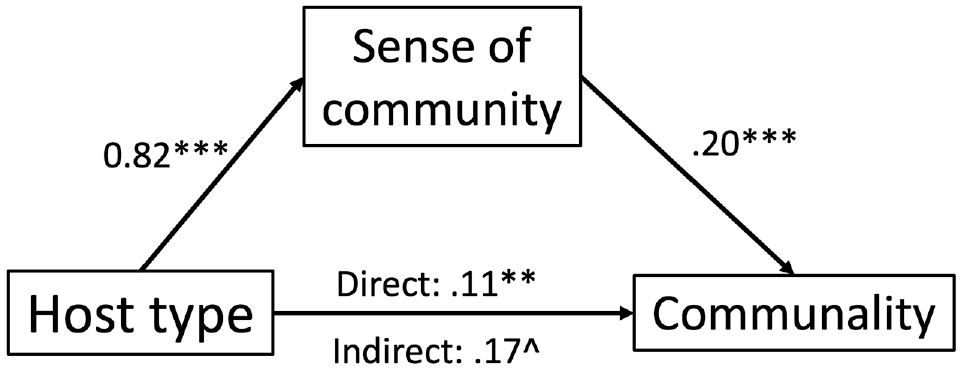
The mediation effect of host types on communality through sense of community.
Confound Checks
A two-way ANOVA indicated that the perceived reality of the scenarios did not differ across the provider types (F(1, 496) = 0.05, p > .8) or the treatment (F(1, 496) = 0.11, p > .7). The provider × treatment interaction was also not significant (F(1, 496) = 0.47, p > .4). Specifically, the preferential treatment did not make a difference in either the case of Airbnb (Mpreferential = 8.00, Mequal = 8.06; F(1, 496) = 0.06, p < .7) or the hotel (Mpreferential = 8.08, Mequal = 7.90; F(1, 496) = 0.52, p < .4).
Fairness Perception
We conducted a 2 × 2 ANOVA on the fairness ratings (see Figure 2). The main effect of provider type was marginally significant (F(1, 496) = 2.89, p < .1). The main effect of treatment was significant (F(1, 496) = 91.59, p < .001). The provider type × treatment interaction was also significant (F(1, 496) = 4.91, p < .03). Looking into the interaction, we found that simple contrasts showed that while treatment made a significant difference in both the traditional condition (Mpreferential = 6.16, Mequal = 7.80; F(1, 496) = 27.46, p < .001) and the sharing economy condition (Mpreferential = 5.28, Mequal = 7.91; F(1, 496) = 68.40, p < .001), the difference is larger in the latter condition.
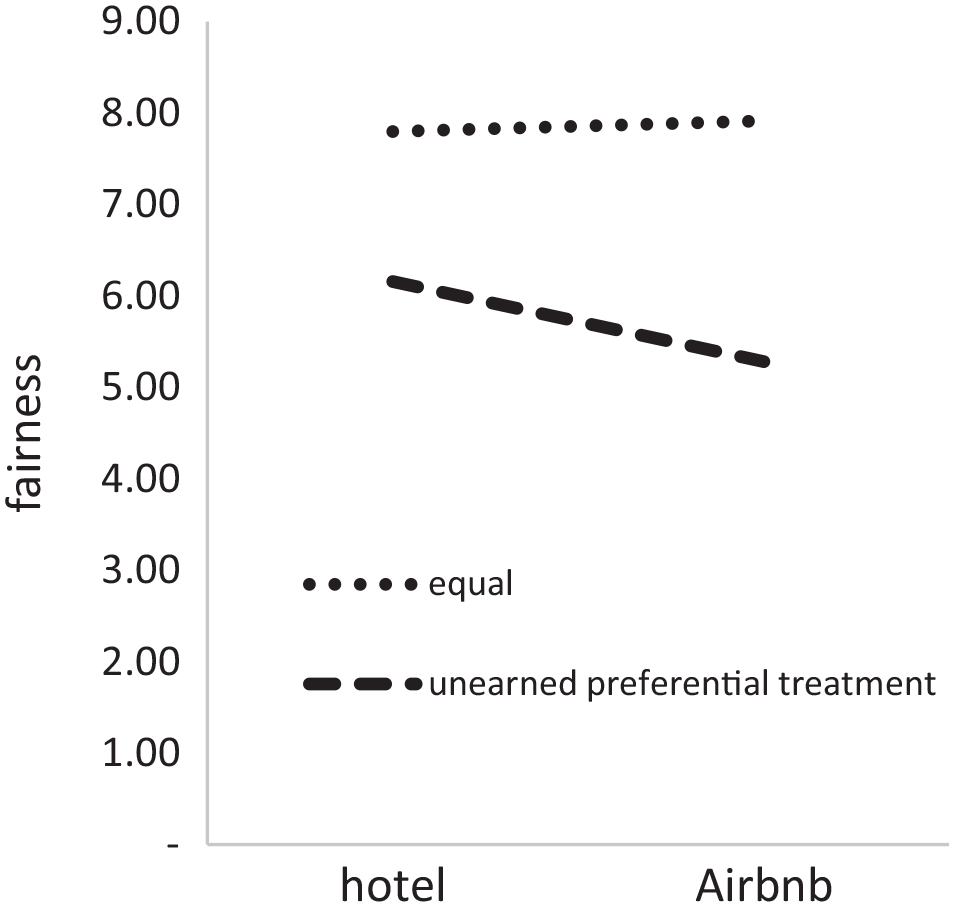
The effects of host types and unearned preferential treatment (dashed line: presence; dotted line: absence) on fairness perception in Study 1.
Discussion
From a pretest, we selected welcome basket from a list of seven different preferential treatments suggested by the literature and online forums. In particular, receiving a welcome basket was perceived to be highly realistic and did not differ between the two provider types in terms of realism and the attitude toward the lodging. In the main study, the effect of unearned preferential treatment on watchers’ unfairness perception is found to be qualified by the service-provider type. The effect with the traditional service providers (Park & Jang, 2015) is replicated, and the negative effect of unearned preferential treatment is amplified when the service provider is from the sharing economy. We further find that the Airbnb platform is associated with a higher sense of community. These two types of providers also differ significantly in terms of consumers’ perception of the operative relationship norms. In particular, they perceive the relationships with traditional service providers as under exchange norms, and the ones with providers from the sharing economy are characterized by communal norms. Lastly, sense of community mediates the effect of service-provider type on relationship norm. This supports the idea that consumers in the sharing economy consider their hosts to be in-group members and thus evaluate fairness based on communal norms, which were violated by the unearned preferential treatment given to others.
Study 2
To further test the process explanation, we abstract away from the sharing economy and directly manipulate the relationship norm in the current study. We also depart from Study 1 by varying the size of the special treatment (Colliander et al., 2019). Thus instead of a qualitative difference being an absence versus a presence of unearned preferential treatment, this manipulation represents a quantitative difference. It has been shown that the value of the unearned preferential treatment affects the degree of negative reaction (Park & Jang, 2015). When people witness the conferring of a more desirable treatment, like an airline seat upgrade, it may lead to a greater sense of unfairness than when another person is given a low-value preferential treatment. In addition, we test H5 and H6 to see if the unfairness perception has any practical significance by examining two downstream consequences, satisfaction and repurchase intention.
Method
Design and Sample
We had a 2 (treatment size: large vs. small) × 2 (relationship norm: communal vs. exchange) between-subjects design. Assuming a medium effect size (i.e., f = 0.25), a power of 0.95 in the interaction effect needs a sample size of 210 (Faul et al., 2007). We recruited 305 participants from MTurk. One participant was excluded since he/she had no experience staying in a hotel. Among the 300 who reported their demographic information, 119 were female. The average age was 32.98 (±10.37 SD). Among them, 82% had a college degree.
Stimuli and Procedures
Participants were first asked to read a scenario about the interaction of two students (adopted from Aggarwal & Zhang, 2006; see Appendix C). Half of the participants were randomly assigned to the communal norm condition in which they read that one of the two students followed communal norms with her friends. The other half of the participants in the exchange norm condition read that the same student followed exchange norms in her relationships. In both conditions, after reading the descriptions, participants were asked to imagine having lunch with the student and deciding how to split the lunch bill. In order to assess the manipulation of the relationship norm, we asked participants to complete a ten-item manipulation check (adapted from Aggarwal & Zhang, 2006; see Appendix A) on a 7-point Likert scale (1 = not at all to 7 = almost certainly). Of these ten items, six were combined into a communal score (Cronbach’s α = .83), and the remaining four composed an exchange score (Cronbach’s α = .78).
After these measures, as an ostensibly unrelated task participants were presented with our second manipulation on the unearned preferential treatment, adapted from Colliander et al. (2019). Orthogonal to the relationship-norm manipulation, half of the participants in the large size condition were told that they witnessed someone who stood nearby receiving a free room upgrade while they were waiting to check in, but they did not receive the same treatment. The other half of the participants in the small size condition, instead of observing a free room upgrade granted to another customer, watched someone receive a quick check-in service while they had to wait in a long queue. Again, the participants did not receive the same treatment. As a manipulation check for the treatment size, participants’ perception of the desirability of the two special treatments was measured using a two-item scale (Cronbach’s α = .77).
Immediately after, they all were asked to rate their fairness perception (Cronbach’s α = .98) as in Study 1, satisfaction on a three-item scale (Cronbach’s α = .93; Colliander et al., 2019), and repurchase intention on a three-item scale (Cronbach’s α = .97; Colliander et al., 2019). These items were measured with 10-point scales. Finally, participants all responded to an experiment reality test, then answered a few demographic questions. Realism was assessed by two items (see Appendix; Cronbach’s α = .82; Park & Jang, 2015).
Results
Manipulation Checks
The manipulation of the relationship norm was successful. The communal score was higher in the communal-norm condition (M = 5.31) than in the exchange-norm condition (M = 5.07; t(302) = 2.12, p < .02). The exchange score was lower in the communal-norm condition (M = 5.06) than in the exchange-norm condition (M = 5.31; t(302) = 1.98, p < .03). The manipulation check of preferential treatment size was also successful. Participants rated a free upgrade to be a superior offer compared to a quick check-in at 5.73, which was significantly higher than the mid-point of the scale (i.e., 4; t(302) = 24.93, p < .001).
Confound Checks
A two-way ANOVA revealed that the perceived reality of the scenarios did not differ across the relationship norms (F(1, 300) = 1.94, p > .1) or the treatment sizes (F(1, 300) = 0.16, p > .6). The relationship norm × treatment size interaction was also not significant (F(1, 300) = 0.12, p > .7).
Fairness Perception
We conducted a 2 × 2 ANOVA on the fairness ratings (see Figure 3). The main effect of relationship norm was significant (F(1, 300) = 36.20, p < .001). The main effect of treatment size was not significant (F(1, 300) = 1.78, p > .1). The relationship norm × treatment size interaction was significant (F(1, 300) = 10.19, p < .002). Simple contrasts showed that while the treatment size did not make a significant difference in the exchange-norm condition (Mlarge = 9.58, Msmall = 8.90; F(1, 300) = 1.58, p > .2), the room upgrade, compared with the quick check-in, was perceived to be less fair in the communal-norm condition (Mlarge = 6.21, Msmall = 7.86; F(1, 300) = 11.27, p < .001).
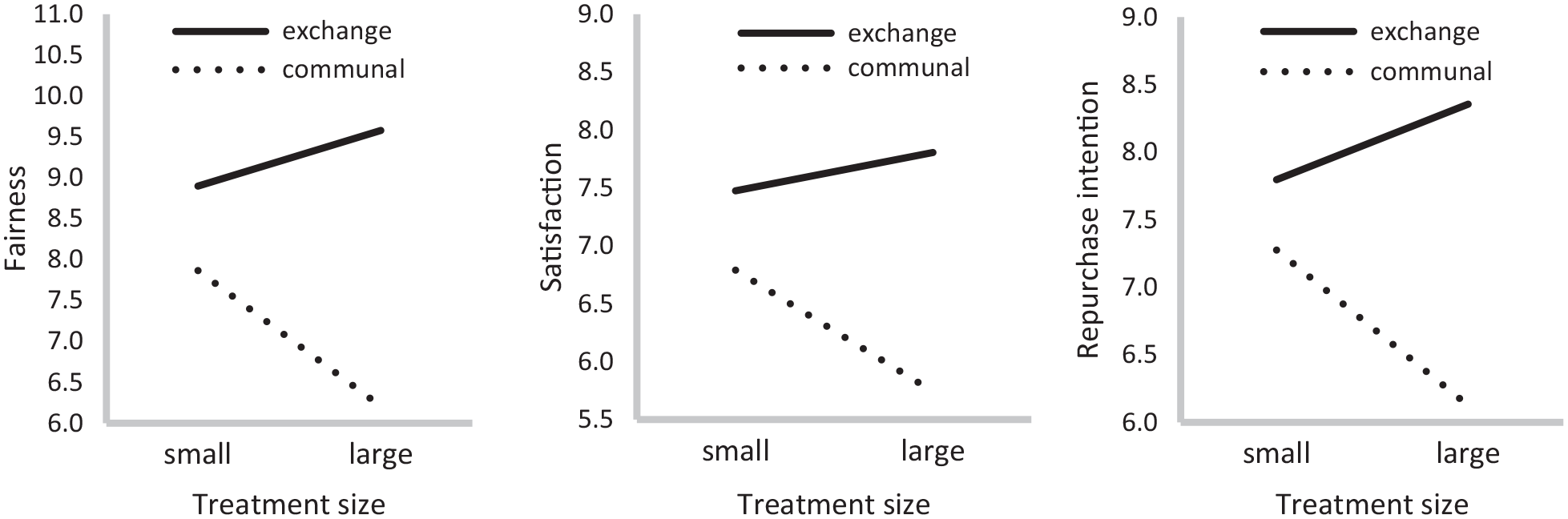
The effects of relationship norm (solid line: exchange relationship; dotted line: communal relationship) and treatment size on fairness perception (left), satisfaction (middle), and repurchase intention (right) in Study 2.
Customer Satisfaction
We conducted a 2 × 2 ANOVA on the customer satisfaction ratings (see Figure 3). While the main effect of relationship norm on satisfaction was significant (F(1, 300) = 30.48, p < .001), the main effect of treatment size was not significant (F(1, 300) = 2.08, p > .1). The relationship norm × treatment size interaction was significant (F(1, 300) = 7.68, p < .006). Simple contrasts showed that while the treatment size did not make a significant difference in the exchange-norm condition (Mlarge = 7.81, Msmall = 7.41; F(1, 300) = 0.81, p > .3), participants were less satisfied in the communal-norm condition with their observation of the room upgrade, compared with the quick check-in (Mlarge = 5.74, Msmall = 6.79; F(1, 300) = 9.77, p < .002).
Repurchase Intention
We conducted a 2 × 2 ANOVA on the ratings of repurchase intention (see Figure 3). The main effect of relationship norm was significant (F(1, 300) = 24.33, p < .001). The main effect of treatment size was not significant (F(1, 300) = 1.12, p > .2). The relationship norm × treatment size interaction was significant (F(1, 300) = 9.36, p < .003). Simple contrasts showed that whereas the treatment size did not make a significant difference in the exchange norm condition (Mlarge = 8.35, Msmall = 7.80; F(1, 300) = 1.84, p > .1), participants were less likely to repurchase when they saw another person receive an unearned room upgrade, compared with the quick check-in, in the communal norm condition (Mlarge = 6.13, Msmall = 7.27; F(1, 300) = 9.32, p < .003).
Moderated Mediation
We test whether perceived fairness mediates the treatment-size effect on the downstream behavioral intentions and whether this mediation effect depends on the relationship norm. Moderated-mediation models (Preacher et al., 2007) were estimated with 10,000 bootstrapped samples using the SPSS PROCESS macro (Hayes, 2017; Model 7; see Figure 4). We used the treatment size (0 = small and 1 = large) as the independent variable, fairness perception as the mediator, and relationship norm as the moderator. Two separate models were estimated with the two behavioral intentions—satisfaction and repurchase intention—as the dependent variables. In both models, the effect of the independent variable (treatment size) on the mediator (fairness perception) depends on which relationship norm is primed (b = −2.34, SE = 0.732, 95% confidence interval [CI] = [−3.78, −0.90]). In the case of satisfaction, whereas the conditional indirect effect was significant when communal relationship was primed (b = −0.96, SE = 0.34, 95% CI = [−1.65, −0.30]), it was not significant when exchange relationship was primed (b = 0.40, SE = 0.26, 95% CI = [−.10, 0.90]). In the case of repurchase intention, whereas the conditional indirect effect was significant when communal relationship was primed (b = −1.00, SE = 0.36, 95% CI = [−1.73, −0.30]), it was not significant when exchange relationship was primed (b = 0.41, SE = 0.27, 95% CI = [−0.09, 0.97]).
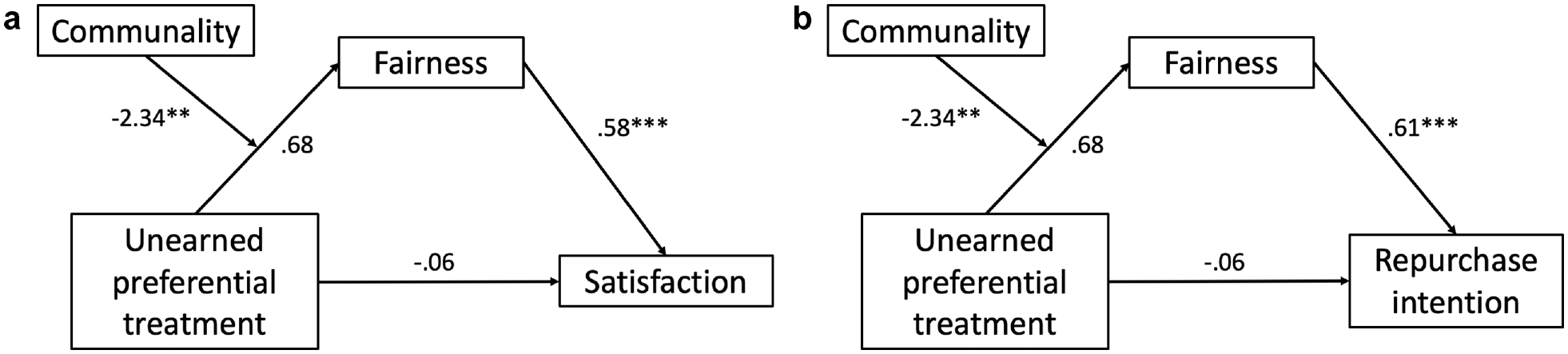
The moderated-mediation models in Study 2. The effect of unearned preferential treatment on satisfaction (upper panel) and repurchase intention (lower panel) through fairness is moderated by communality.
Summary
In Study 1, we demonstrate that the effect of unearned preferential treatment on unfairness perception depends on the service-provider types. The current study extends the findings by directly manipulating relationship norms. While the manipulation is artificial, it has high internal validity in giving direct support to the moderating role of relationship norm. Most of the business-to-consumer relationships in the real world fall somewhere on the exchange–communal spectrum. Our results suggest that when the relationship is characterized primarily by the exchange norm, the negative effect of unearned preferential treatment may vanish. In addition, we extend our exploration of the effect of unearned preferential treatment to two downstream consequences—satisfaction and repurchase intention—finding that the effects on these consumer metrics are mediated by unfairness perception.
General Discussion
Unearned preferential treatment, such as a free upgrade or quick check-in service, is a common practice in the tourism industry. These unearned rewards are used as marketing tools to delight customers, enhance customer satisfaction, heighten customer commitment, maintain customer loyalty, and strengthen positive word-of-mouth (Hwang & Mattila, 2018). However, unearned preferential treatment may cause unintended negative outcomes among recipients, such as guilt (Mattila et al., 2013) and social discomfort (Jiang et al., 2013). Meanwhile, watchers often perceive unfairness (Park & Jang, 2015), and this customer group’s negative reactions to unearned preferential treatment should be of great concern to service firms. Building upon the theory of relationship norms, we investigate whether the watchers’ negative reactions to unearned preferential treatment, such as reduced fairness perception, satisfaction, and repurchase intention, depend on relationship norm.
Two studies are conducted. In Study 1, we compare the watchers’ reaction to unearned preferential treatment offered by a traditional service provider with the same treatment given to someone in the sharing economy. The unfairness perception is higher in the sharing economy, in which relationships are generally perceived to be governed by communal norms rather than exchange norms. Moreover, sense of community is found to mediate the effect of service-provider type on relationship norms. This suggests that consumers having a greater sense of community with the platform consider the service provider as an in-group member and thus are less tolerant when they observe another guest receive unearned preferential treatment.
In order to directly test its moderating role, relationship norm is manipulated in Study 2. Communal norms sensitize the observing bystander to the unfair treatment. While the relationship-norm manipulation is artificial, it allows us to test the moderation of exchange-relationship norm with high internal validity. It is interesting that the difference in magnitude of the treatment size vanishes when exchange norms are highlighted in the relationship. The unfairness perception is further found to have implications on satisfaction and repurchase intention. In particular, unearned preferential treatment has effects on these two downstream consequences through its effect on unfairness perception.
Theoretical Implications
There are a few theoretical contributions. First, we identify the moderating role of relationship norm in watchers’ reaction to unearned preferential treatment. To date, many researchers have made great headway with respect to identifying and understanding factors that moderate the negative effect of unearned preferential treatment. Previously, it was found that watchers’ characteristics can moderate the recipient’s negative feelings (Jiang et al., 2013). Specifically, when the watcher has a higher social status relative to the recipient, the latter’s negative feelings may be offset by the positive feelings of “beating” their superiors. In another study, the psychological state of being in power could moderate the recipient’s satisfaction with the special offer (Zhang & Hanks, 2015). Powerless recipients would exhibit a lower level of satisfaction upon receipt of unearned preferential treatment, especially when their special offers are observed by a close friend compared with a stranger. However, powerful recipients are equally satisfied regardless of the identity of the watcher.
Park and Jang (2015) identified that the relationship status between recipients and watchers may mitigate the sense of unfairness elicited by unearned preferential treatment. Specifically, watchers’ negative reactions are consistently high when a stranger receives unearned preferential treatment, regardless of the magnitude of the conferred bonus. When watchers are very close friends with recipients, they perceive unfairness only when the unearned preferential treatment is valuable and/or highly desirable. In the current paper, we examine the relationship between the service firm and the bystander who is discriminated against. In particular, when the communal relationship with the service firm is activated, it sensitizes the comparison between the watcher and the recipient and thus heightens the unfairness perception. This moderating role of relationship norm between the first and third parties is new to the literature.
Watchers are more likely to perceive unfairness and exhibit a lower level of satisfaction and repurchase intention in the communal relationship. These findings are counterintuitive and show a reverse pattern to some conclusions of previous research, which claimed that the communal norm may mitigate some negative consequences caused by unearned preferential treatment. For instance, a prior study suggests that consumers are more likely to forgive service transgressions when they have a friendly relationship with the business owner (McCullough et al., 1998). Relatedly, the brand-community literature has documented various positive impacts for firms that have strong brand communities (Carlson et al., 2008). The sense of community extends to other users and thus an in-group is formed (Mandl & Hogreve, 2020). Our findings draw attention to an aspect of communal relationships that is often overlooked. That is, people engaged in the communal norm usually show kindness toward the other party, but they also expect the other party to care about them in the same way. This explains why guests have a higher expectation of being treated fairly by an Airbnb host, who is considered to be an in-group peer, as compared to a hotel (Mendoza et al., 2014). Hence, in this respect our study contributes to the relationship-norm literature.
Our findings also contribute to the extant literature on peer-to-peer customer relationship (e.g., Lin et al., 2019). This is especially relevant since these relationships are built less on the concept of ownership (Fritze et al., 2020) and more on sharing and collaborative consumption, thus often being characterized by a communal norm (Chark, 2019). Consumers behave differently in peer-to-peer relationships than they do with traditional service firms (Bardhi & Eckhardt, 2012; Campbell & Winterich, 2018; Mallargé et al., 2019). We contribute to this line of research by documenting the incompatibility of unearned preferential treatment and the concept of collaborative consumption in these peer-to-peer relationships.
Practical Implications
In addition to the theoretical contributions, our findings have several practical implications. First, these findings counter the intuition that an amicable relationship between the customer and the service provider is always a good thing. The current findings suggest that marketers must take into account potential negative reactions of the observing bystanders when conferring unearned preferential treatment to a customer. We show that watchers under communal norms are likely to perceive more unfairness when others receive unearned preferential treatment. Furthermore, the unfairness perception can decrease customer satisfaction and repurchase intention. This implies that equity and equality in allocation are of great concern. Therefore, service firms should pay attention to the fairness perception and be prudent in their use of unearned preferential treatment, especially when the company is successfully projecting a warm and friendly brand image to the public; otherwise, all their efforts may backfire.
To attenuate watchers’ negative reactions, one possibility is to make the unearned preferential treatment appear reasonable. When granting unearned preferential treatment to consumers—especially higher levels of unearned preferential treatment, like a free room upgrade—the service firm should try to give an explicit explanation for the special treatment. For instance, service firms could justify the upgrade by basing it on user history. Bystanders will then be able to align the inputs and outputs, and the unfairness perception may be attenuated. Yet this seemingly reasonable approach was found not to work (Y. S. Kim & Baker, 2020). The same negative effects on perceptions of distributive justice, status, and loyalty are observed in loyal bystanders when unearned preferential treatment is conferred to nonloyal customers. Only tangible compensation to these loyalty program customers can help recover their trust.
Another potentially feasible option is to avoid offering unearned preferential treatment in public. For instance, the front desk employees should try to avoid presenting unearned preferential treatment during rush hours or in front of a row of waiting guests. And it is better to offer unearned preferential treatment to solo customers or less-price-sensitive customers in order to avoid consumer internal comparison. The front office staff could easily identify these customers via their reservation information or historical personal profiles in the hotel’s information system. Nevertheless, it is hard to avoid the situation of customers sharing information via social media (Boardman et al., 2016). This is potentially disastrous as some tourists, who have a higher sense of entitlement and pervasive beliefs that they deserve more than other tourists, may feel malicious envy and formed a negative evaluation of the firm as a result (Martin et al., 2019). Trust has been consistently found to be crucial in sharing economy platforms (e.g., Fleischer et al., 2022). In a study of nearly 1,000 establishments listed on Airbnb, trust and personal reputation was found to play an important role in revenue optimization (Abrate & Viglia, 2019). As an unearned preferential treatment is likely deemed a breach of trust in a communal relationship, hosts of peer-to-peer accommodations are advised to avoid any form of it.
Limitations and Future Research
Our studies were conducted with an online consumer panel. Although participants traveled extensively and could be quite representative of the leisure travelers we are targeting, we can only measure downstream consequences of the unfairness perception such as repurchase intention. Future research of actual customer behaviors would be welcome. We focus on the unfairness perception in our studies, yet watchers of preferential treatment of others may experience different emotional reactions in the disadvantaged situation, such as envy (Park & Jang, 2015), anger, disappointment, and resentment. Future research may examine these other negative emotions and their downstream consequences.
The second study was conducted prior to the outbreak of COVID-19. There were concerns about the relevance and usefulness of the findings. The first study was conducted after the outbreak and addresses this concern. The two studies together offer converging evidence that unearned preferential treatment leads to unfairness perception, and the effect appears to be independent of the pandemic.
Footnotes
Appendix A. Scales Adapted in Studies 1 and 2.
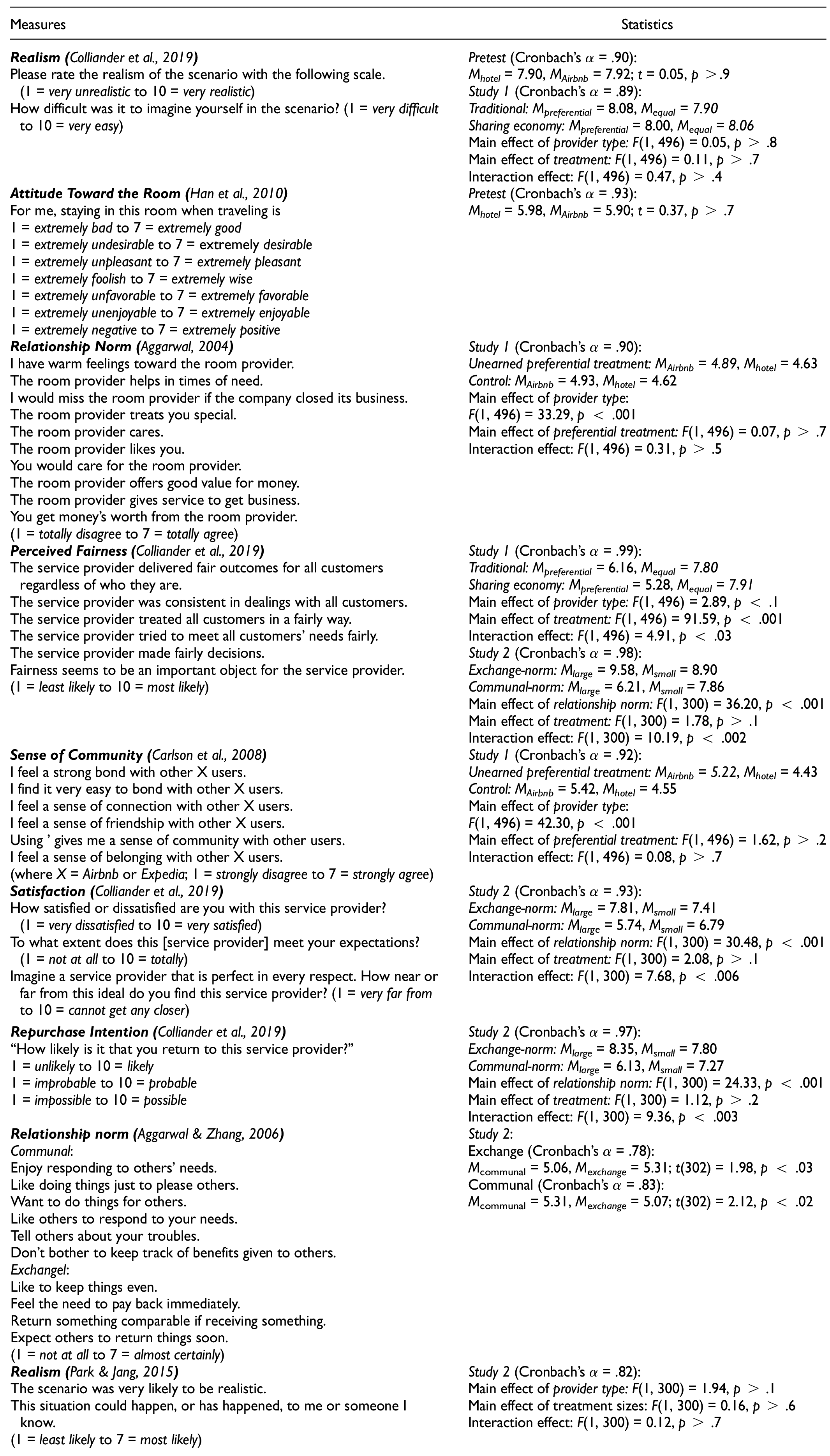
| Measures | Statistics |
|---|---|
Please rate the realism of the scenario with the following scale. (1 = very unrealistic to 10 = very realistic) How difficult was it to imagine yourself in the scenario? (1 = very difficult to 10 = very easy) |
Pretest (Cronbach’s α = .90): Mhotel = 7.90, MAirbnb = 7.92; t = 0.05, p >.9 Study 1 (Cronbach’s α = .89): Traditional: Mpreferential = 8.08, Mequal = 7.90 Sharing economy: Mpreferential = 8.00, Mequal = 8.06 Main effect of provider type: F(1, 496) = 0.05, p > .8 Main effect of treatment: F(1, 496) = 0.11, p > .7 Interaction effect: F(1, 496) = 0.47, p > .4 |
For me, staying in this room when traveling is 1 = extremely bad to 7 = extremely good 1 = extremely undesirable to 7 = extremely desirable 1 = extremely unpleasant to 7 = extremely pleasant 1 = extremely foolish to 7 = extremely wise 1 = extremely unfavorable to 7 = extremely favorable 1 = extremely unenjoyable to 7 = extremely enjoyable 1 = extremely negative to 7 = extremely positive |
Pretest (Cronbach’s α = .93): Mhotel = 5.98, MAirbnb = 5.90; t = 0.37, p > .7 |
I have warm feelings toward the room provider. The room provider helps in times of need. I would miss the room provider if the company closed its business. The room provider treats you special. The room provider cares. The room provider likes you. You would care for the room provider. The room provider offers good value for money. The room provider gives service to get business. You get money’s worth from the room provider. (1 = totally disagree to 7 = totally agree) |
Study 1 (Cronbach’s α = .90): Unearned preferential treatment: MAirbnb = 4.89, Mhotel = 4.63 Control: MAirbnb = 4.93, Mhotel = 4.62 Main effect of provider type: F(1, 496) = 33.29, p < .001 Main effect of preferential treatment: F(1, 496) = 0.07, p > .7 Interaction effect: F(1, 496) = 0.31, p > .5 |
The service provider delivered fair outcomes for all customers regardless of who they are. The service provider was consistent in dealings with all customers. The service provider treated all customers in a fairly way. The service provider tried to meet all customers’ needs fairly. The service provider made fairly decisions. Fairness seems to be an important object for the service provider. (1 = least likely to 10 = most likely) |
Study 1 (Cronbach’s α = .99): Traditional: Mpreferential = 6.16, Mequal = 7.80 Sharing economy: Mpreferential = 5.28, Mequal = 7.91 Main effect of provider type: F(1, 496) = 2.89, p < .1 Main effect of treatment: F(1, 496) = 91.59, p < .001 Interaction effect: F(1, 496) = 4.91, p < .03 Study 2 (Cronbach’s α = .98): Exchange-norm: Mlarge = 9.58, Msmall = 8.90 Communal-norm: Mlarge = 6.21, Msmall = 7.86 Main effect of relationship norm: F(1, 300) = 36.20, p < .001 Main effect of treatment: F(1, 300) = 1.78, p > .1 Interaction effect: F(1, 300) = 10.19, p < .002 |
I feel a strong bond with other X users. I find it very easy to bond with other X users. I feel a sense of connection with other X users. I feel a sense of friendship with other X users. Using ’ gives me a sense of community with other users. I feel a sense of belonging with other X users. (where X = Airbnb or Expedia; 1 = strongly disagree to 7 = strongly agree) |
Study 1 (Cronbach’s α = .92): Unearned preferential treatment: MAirbnb = 5.22, Mhotel = 4.43 Control: MAirbnb = 5.42, Mhotel = 4.55 Main effect of provider type: F(1, 496) = 42.30, p < .001 Main effect of preferential treatment: F(1, 496) = 1.62, p > .2 Interaction effect: F(1, 496) = 0.08, p > .7 |
How satisfied or dissatisfied are you with this service provider? (1 = very dissatisfied to 10 = very satisfied) To what extent does this [service provider] meet your expectations? (1 = not at all to 10 = totally) Imagine a service provider that is perfect in every respect. How near or far from this ideal do you find this service provider? (1 = very far from to 10 = cannot get any closer) |
Study 2 (Cronbach’s α = .93): Exchange-norm: Mlarge = 7.81, Msmall = 7.41 Communal-norm: Mlarge = 5.74, Msmall = 6.79 Main effect of relationship norm: F(1, 300) = 30.48, p < .001 Main effect of treatment: F(1, 300) = 2.08, p > .1 Interaction effect: F(1, 300) = 7.68, p < .006 |
“How likely is it that you return to this service provider?” 1 = unlikely to 10 = likely 1 = improbable to 10 = probable 1 = impossible to 10 = possible |
Study 2 (Cronbach’s α = .97): Exchange-norm: Mlarge = 8.35, Msmall = 7.80 Communal-norm: Mlarge = 6.13, Msmall = 7.27 Main effect of relationship norm: F(1, 300) = 24.33, p < .001 Main effect of treatment: F(1, 300) = 1.12, p > .2 Interaction effect: F(1, 300) = 9.36, p < .003 |
Communal: Enjoy responding to others’ needs. Like doing things just to please others. Want to do things for others. Like others to respond to your needs. Tell others about your troubles. Don’t bother to keep track of benefits given to others. Exchangel: Like to keep things even. Feel the need to pay back immediately. Return something comparable if receiving something. Expect others to return things soon. (1 = not at all to 7 = almost certainly) |
Study 2: Exchange (Cronbach’s α = .78): Mcommunal = 5.06, Mexchange = 5.31; t(302) = 1.98, p < .03 Communal (Cronbach’s α = .83): Mcommunal = 5.31, Mexchange = 5.07; t(302) = 2.12, p < .02 |
The scenario was very likely to be realistic. This situation could happen, or has happened, to me or someone I know. (1 = least likely to 7 = most likely) |
Study 2 (Cronbach’s α = .82): Main effect of provider type: F(1, 300) = 1.94, p > .1 Main effect of treatment sizes: F(1, 300) = 0.16, p > .6 Interaction effect: F(1, 300) = 0.12, p > .7 |
Appendix B. Experimental Materials of Study 1.
Appendix C: Experimental Materials of Study 2
Declaration of Conflicting Interests
The author(s) declared no potential conflicts of interest with respect to the research, authorship, and/or publication of this article.
Funding
The author(s) disclosed receipt of the following financial support for the research, authorship, and/or publication of this article: This work was supported by the University of Macau [Ref: MYRG2020-00167-FBA] and the Higher Education Fund of the Government of Macao SAR [Ref: TET-UMAC-2021-06].
