



Abstract
Following the Reasonable Person Model, this study examines the effects of destination fascination on subjective well-being and destination attachment as well as looking at the subsequent outcome of destination loyalty. A total of 936 responses were collected from tourists to national parks (302), forest recreational areas (300), and theme parks (334). The results of this study prove the effect of destination fascination on improving subjective well-being and destination attachment and shows the effects of subjective well-being and destination attachment on enhancing destination loyalty. Subjective well-being and destination attachment fully mediated effects from destination fascination to destination loyalty. Moreover, extensive validity of the proposed model was verified by engaging different destination types. The findings of this study enrich the base of knowledge about destination fascination in the tourism academy and contributes practical implications for destination management and marketing.
Introduction
Discussions about destination fascination began with studies of human restoration through natural environments in environmental psychology (S. Kaplan 1995). Environmental psychologists pointed out that people spend considerable physical and psychological resources on “directed attention” activities in their work lives, and that these can cause feelings of fatigue, burnout, stress, anxiety, high incidence of mistakes, and low intention toward helping coworkers (Cohen and Spacapan 1978; Moray 1990). Several studies have suggested that a fascinating environment promotes more efficient mental recovery (e.g., Berto 2005; Herzog, Maguire, and Nebel 2003; R. Kaplan and Kaplan 2011). Based on attention restoration theory, Liu et al. (2017) established a 24-item Destination Fascination Scale with six dimensions: fitness, friendliness, uniqueness, attractiveness, mystique, and richness.
Model examination is a common method used in scale development studies to examine criterion-related validity for new measurement scales (e.g., Brakus, Schmitt, and Zarantonello 2009). Using model examination for destination fascination, this study demonstrates the importance of destination fascination by clarifying its outcomes. The Reasonable Person Model (RPM), which shows how fascination (S. Kaplan 1995) leads to human–environment relationships, was proposed by S. Kaplan and Kaplan (2009) to explain the benefits of environment fascination from an integrated and systematic perspective. Based on a person’s information needs and his or her recognition of the information perceived in an environment, the RPM is conceptualized into three phases: model building, effectiveness, and meaningful action (S. Kaplan and Kaplan 2009). The public’s perceived fascination with an environment may shape their recognition of the environment (model building), assist in recovery from fatigue, improve competence (effectiveness), and prompt willingness and attention toward environmentally sustainable development (meaningful action).
Based on RPM, this study proposes the model of destination fascination by conceptualizing (a) destination fascination in the model-building phase, (b) subjective well-being and destination attachment in the effectiveness phase, and (c) destination loyalty in the phase of meaningful action. By reviewing trends in place relationship literature in the field of environmental psychology (Gifford 2014; Gustafson 2001; Lewicka 2011; Raymond, Brown, and Weber 2010; Scannell and Gifford 2010, 2017; Sundstrom et al. 1996), this study further extends the effectiveness phase to include both intrinsic and extrinsic aspects. Through perceived destination fascination, this study argues the “effectiveness” phase happens on the intrinsic side by improving tourists’ subjective positive mental feelings. These include subjective well-being, stress release, and fatigue reduction caused by long-term intention-intensive tasks (Ábrahám, Velenczei, and Szabo 2012; Berto et al. 2010; R. Kaplan and Kaplan 2011; Uysal et al. 2016; White et al. 2010). Since subjective well-being can reflect overall inner feelings (Diener 1984), this study argues subjective well-being as an outcome of perceived destination fascination on the intrinsic side. On the other hand, this study argues that the “effectiveness” phase happens on the extrinsic side, inducing tourists to establish relationships with a fascinating destination. In former studies, the human–environment relationship could be extended to include aspects such as environment attachment, emotional connection to a place, or the willingness to support pro-environmental actions (Corbett 2005; Fielding and Head 2012; Morgan 2010; Ramkissoon, Mavondo, and Uysal 2018). Funk and James (2001) proposed the Psychological Continuum Model (PCM), stating that people’s psychological connection with fascinating leisure engagement takes place on four levels: awareness, attraction, attachment, and allegiance. Following PCM, this study argues destination attachment is an outcome of perceived destination fascination on the extrinsic side.
Moreover, this study considers the validity of the proposed model of destination fascination in regard to model extension, specifically to different types of destinations. In prior empirical studies of RPM, researchers have generally selected natural places as research settings to examine how fascinating natural environments positively influence humans (Hartig et al. 2011; Herzog and Strevey 2008; White et al. 2010). However, tourists can perceive destination fascination from not only natural destinations (such as national parks or botanic gardens) but also from artificial destinations (such as theme parks or shopping malls). Velarde, Fry, and Tveit (2007) also noted that environmental psychologists commonly categorize landscapes into natural and urban, which supports the division of this study by destination types into natural destinations and artificial destinations. Additionally, Velarde, Fry, and Tveit (2007) found that people generally become healthier in natural landscapes than urban landscapes. Using this concept, the proposed model for destination fascination should be examined in different types of destinations in order to clarify model extension and enrich the systematic understanding of destination fascination.
Using RPM, the purpose of this study is to propose and examine the effects of destination fascination on destination loyalty applying both subjective well-being and destination attachment as mediators. Findings of this study will potentially contribute theoretical and practical implications to tourism academy and industry. Theoretically, this study may demonstrate the role of destination fascination on tourism by proposing and examining its effects on subjective well-being, destination attachment, and destination loyalty. By conceptualizing both the intrinsic and extrinsic aspects of the “effectiveness” phase in RPM, the proposed model can enrich the systematic understanding of destination fascination. Additionally, results from examining the effectiveness of the destination fascination model in different types of destinations can clarify the applicability of destination fascination. Practically, findings from this study should provide valuable information for destination marketing organizations about the benefits of and tourists’ behavioral changes caused by fascinating destinations.
Literature Review
Destination Fascination
Liu et al. (2017) defined destination fascination as “the extent to which a destination gives tourists the freedom to pay attention to their interests, to freely explore details in the destination, and to freely and personally define meanings of the destination” (p. 257). Theoretical foundations of destination fascination are generated from discussions about human–environment relationships. S. Kaplan (1983) proposed the Model of Person–Environment Compatibility, arguing that subjective compatibility toward an environment is based on information released by the environment. High person–environment compatibility promotes physical and psychological health and releases stress (S. Kaplan 1983). Later, S. Kaplan and Kaplan (2009) proposed the Reasonable Person Model (RPM) which explains the effects of environment fascination on human sense-making and behaviors. As shown in Figure 1, the RPM begins with model building in which people absorb environmental information and gain sense about the environment. This phase is followed by effectiveness and meaningful action. Model building has the potential to directly influence meaningful action and to influence meaningful action by being effective (S. Kaplan and Kaplan 2009). In the long term, the meaningful action phase can also influence model building through experience accumulation, or it may indirectly influence model building through the effectiveness phase (S. Kaplan and Kaplan 2009).
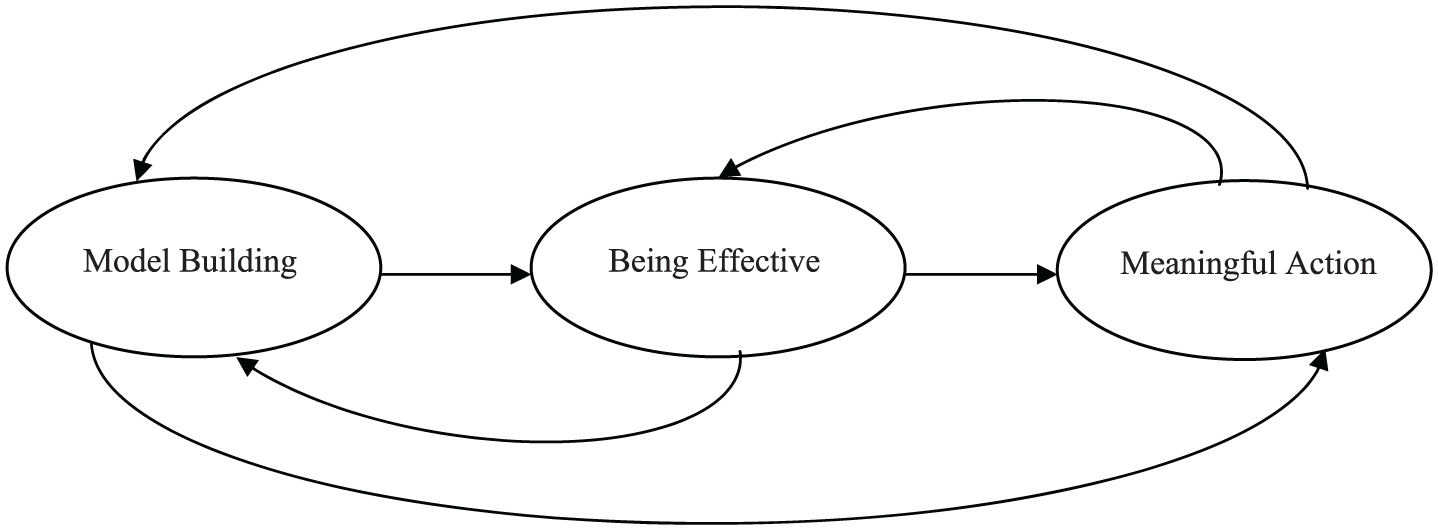
The reasonable person model.
First, the model building phase allows people to store memories and experiences of an environment in order to explain, plan, and analyze that environment (Johnson-Laird 2005). Model building is important for understanding and exploring an environment, utilizing information from the environment to interpret meaning, involving oneself or interacting with the environmental information, and feeling a sense of fascination for the environment (R. Kaplan and Kaplan 1978). According to Liu et al. (2017), fitness, friendliness, uniqueness, attractiveness, mystique, and richness are six dimensions of destination fascination that allow tourists to accumulate information about a destination during the model-building phase. Second, in regard to effectiveness, by processing and managing stored information about an environment, fascinating environments have the potential to strengthen a person’s self-confidence and awareness, increase focus for future works tasks, support recovery from fatigue, and rejuvenate energy for daily work life (Berto 2005; Berto et al. 2010; S. Kaplan and Kaplan 2009). Third, during the meaningful action phase, people participate in an environment to fulfill a need to make a difference, to achieve goals, or to influence the world around them (S. Kaplan and Kaplan 2009). Participation in meaningful action is actualized through behavior, attitude, beliefs, listening, respect, and having a voice (S. Kaplan and Kaplan 2009). Previous studies of environment fascination have explored participation in meaningful action as emotional engagement for environmental protection (Morgan 2010), intention of revisiting a place (White et al. 2010), and awareness and action of protecting natural resources (Fielding and Head 2012).
Based on RPM, this study focuses on the ways destination fascination influences the follow-up phases of effectiveness and meaningful action. Figure 2 shows the research framework for this study. This study looks at both the direct and indirect effects of model building on effectiveness and meaningful action. For the mediating mechanism of effectiveness, this study analyzes the intrinsic and extrinsic properties of effectiveness as a mediator to destination fascination. Intrinsically, this study emphasizes tourists’ subjective well-being, which reflects positive emotion, stress release, and fatigue reduction in a fascinating destination (Ábrahám, Velenczei, and Szabo 2012; Berto et al. 2010; R. Kaplan and Kaplan 2011; White et al. 2010). Extrinsically, this study concentrates on destination attachment, which refers to the extent tourists mentally connect with a destination (Corbett 2005; Fielding and Head 2012; Morgan 2010).
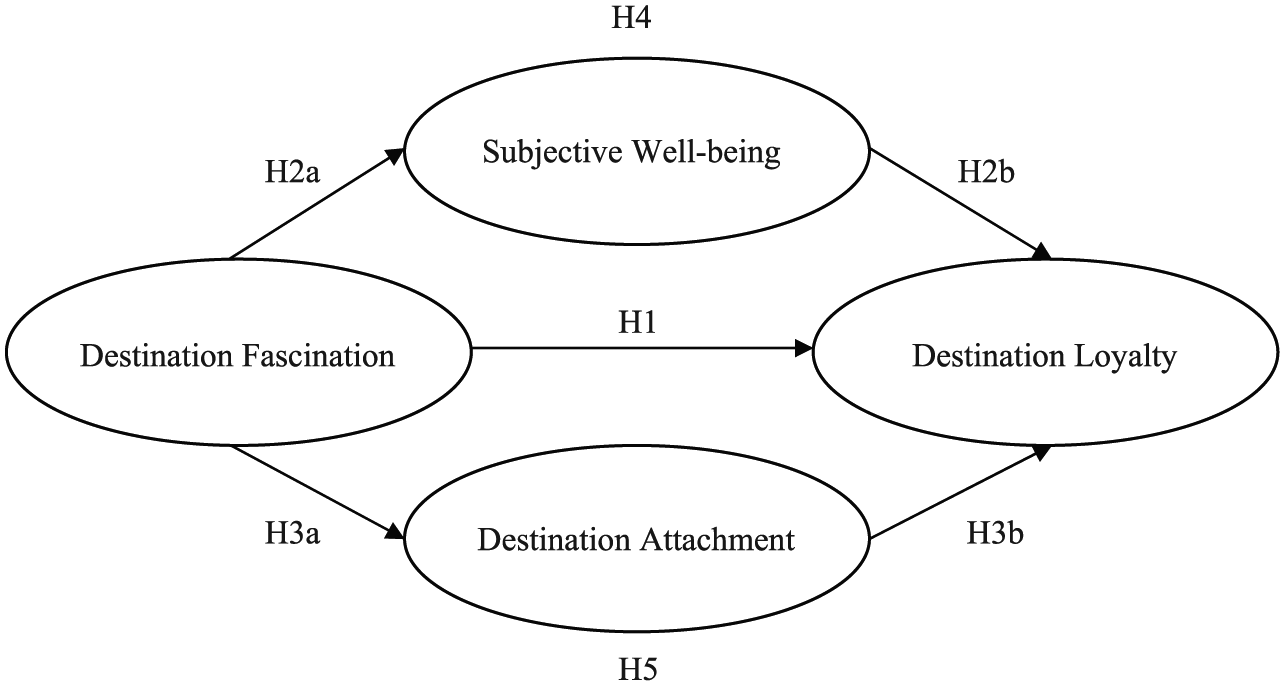
The research framework.
Place relationship literature in environmental psychology (Gifford 2014; Gustafson 2001; Lewicka 2011; Raymond, Brown, and Weber 2010; Scannell and Gifford 2010, 2017; Sundstrom et al. 1996) supports the examination of both intrinsic and extrinsic aspects in the proposed model. Gustafson (2001) conceptualized place meaning as an individual’s reflections on the intrinsic self along with meaning created through extrinsic connections to others and the environment. For the intrinsic quality, Scannell and Gifford (2017) focused on well-being created through human–place relationships and identified several psychological benefits such as memories, belonging, relaxation, and positive emotions. For the extrinsic aspect, studies in place attachment (Raymond, Brown, and Weber 2010; Scannell and Gifford 2010) focus on bonds developed with a place through social/community interactions, natural/environmental connections, and the place experience process. Taken together, this study proposes that tourists’ perceived destination fascination can directly improve destination loyalty by directly enhancing subjective well-being (intrinsic aspect) and destination attachment (extrinsic aspect). Justifications for the proposed hypotheses are explained in the following sections.
Destination Fascination and Destination Loyalty
Dick and Basu (1994) defined customer loyalty as a customer’s relative attitude and loyalty behavior toward a product, brand, service, or store. Strengthening customer attitudes is achieved through cognitive antecedents (i.e., trust, contact, and information clarity), affective antecedents (i.e., emotion, satisfaction, and affection), and conative antecedents (i.e., sunk cost and switching cost) (Dick and Basu 1994). Loyal behavior is an outcome of a loyal relationship and includes the motivation to search for related information, positive word of mouth, repurchase/revisit, and resistance to related negative information (Dick and Basu 1994). Oliver (1999) further classified loyalty into four phases: cognitive loyalty, affective loyalty, conative loyalty, and behavioral loyalty. Cognitive loyalty refers to customers’ recognition of and beliefs about a product; affective loyalty is a customer’s preference for and attitude toward a product accumulated through long-term satisfaction experiences; conative loyalty refers to the customers’ behavioral intentions toward a product, such as a promise for repurchase; and behavioral loyalty represents the integration of the previous three phases to actually engage in repurchase (Oliver 1999). In former destination loyalty studies, conative loyalty is commonly used to measure tourists’ destination loyalty (Chi and Qu 2008; Yoon and Uysal 2005); therefore, this study uses conative loyalty to measure destination loyalty and understand tourists’ revisit intentions and willingness to spread positive word-of-mouth.
Destination loyalty encompasses a perspective that indicates tourists’ long-term revisit behavior toward a destination that connects with their previous travel experiences at the same destination (Oppermann 2000). Revisit intention and positive word of mouth are two behavioral intentions widely used in measuring destination loyalty (Chi and Qu 2008; Hutchinson, Lai, and Wang 2009; Phillips et al. 2013; Yoon and Uysal 2005). In terms of revisit intention, former studies have considered tourists’ intentions toward visiting the same destination as well as tourists’ intentions of visiting the same type of destination or a destination in the same region as a top priority (T. Kim, Kim, and Kim 2009; Lam and Hsu 2006; Loureiro and Kaufmann 2012). Positive word of mouth is achieved when tourists actively spread positive information about a specific destination (Litvin, Goldsmith, and Pan 2008; Phillips et al. 2013; Simpson and Siguaw 2008). Tourists’ willingness and frequency of providing positive word of mouth varies based on destination type and tourists’ familiarity with the destination (Phillips et al. 2013; Simpson and Siguaw 2008). Unlike traditional methods of communication, modern technology allows tourists to engage in more vivid, more interactive, and more updated electronic word of mouth (Litvin, Goldsmith, and Pan 2008).
According to RPM, environment fascination can directly influence visitors’ participation in environment-related actions (S. Kaplan and Kaplan 2009). The extent of a person’s perceived destination fascination can be thought of as the level of perceived positive image of the destination. Destination image studies have proved that destinations with a positive image strengthen tourist loyalty toward the destination (Chi and Qu 2008; Phillips et al. 2013; Tasci and Gartner 2007). Additionally, fascinating environments are more appealing and attract more attention (Berto, Massaccesi, and Pasini 2008). A study by Um, Chon, and Ro (2006) found that destination attractiveness is more powerful than tourist satisfaction in stimulating revisit intentions. Moreover, using the dimensions of destination fascination established by Liu et al. (2017), a fascinating destination motivates tourists to continue exploring the destination, possesses richness of resources that motivate tourists to enjoy diverse experiences, and supplies attractiveness that helps tourists forget daily work stress. The dimensions of destination fascination suggested by Liu et al. (2017) comprise the major types of loyalty antecedents proposed by Dick and Basu (1994), revealing that destination fascination can strengthen tourists’ destination loyalty. Therefore, we propose:
Hypothesis 1: Destination fascination exerts positive effects on destination loyalty.
Subjective Well-Being as the Mediator
Subjective well-being is a person’s subjective, positive evaluation toward their overall life, including work life and leisure life (Carter 2004; Diener and Lucas 2004; Kashdan 2004). Diener (1984) pointed out three features of subjective well-being: (1) it is a subjective feeling, (2) it is evaluated in positive terms, and (3) it includes an individual’s overall evaluation of life. Carter (2004) argued that subjective well-being is the frequency of fluctuation between positive emotions during a certain time period and mentioned that subjective well-being may influence a person’s mid- and long-term behavior. Furthermore, Kashdan (2004) noted that a high subjective well-being involves three elements: (1) frequency and strength of positive emotion, (2) relative lack of depression and anxiety, and (3) overall life satisfaction. From a review of well-being in tourism literature, Uysal et al. (2016) pointed out the necessity of studying the significant mechanism of subjective well-being on tourists’ tourism experiences.
The positive effect of environment fascination on subjective well-being can be considered as positive mental feelings aroused by leisure participation. In prior leisure participation studies, the quality and pleasantness of leisure activities may significantly improve subjective well-being (Ábrahám, Velenczei, and Szabo 2012; Brajša-Žganec, Merkaš, and Šverko 2011; Newman, Tay, and Diener 2014). Brajša-Žganec, Merkaš, and Šverko (2011) explained that leisure activities provide chances to pursue value in life and fulfill a demand by providing people with opportunities to establish social networks, experience positive emotions, and gain skills and knowledge, all of which improve subjective well-being. Ábrahám, Velenczei, and Szabo (2012) sorted leisure activities into seven categories (balance of the intrinsic mind, regular activities, self-awareness and growth, passive leisure, improve health, intelligent leisure, and social leisure), and showed that joyful experiences gained through leisure activities significantly improve subjective well-being. Newman, Tay, and Diener (2014) reviewed 363 studies related to leisure and subjective well-being and summarized five psychological mechanisms to explain how leisure activities improve subjective well-being: (1) provide time for mental recovery and escape from daily life; (2) provide opportunities to be alone; (3) allow for challenging experiences and opportunities to learn new things; (4) create meaning-making experiences; and (5) establish affiliations with others. As a result of positive mental feelings gained through leisure, tourists become motivated to sustain loyalty for a fascinating destination in order to improve subjective well-being.
According to RPM, fascinating environments provide mental recovery, establish meaningful connections to the environment and motivates visitors to interact with the environment (S. Kaplan and Kaplan 2009). Following this logic, mental recovery gained from visiting a fascinating environment may help tourists improve subjective well-being; to sustain this improvement, tourists would tend to maintain loyalty toward that fascinating destination. Guite, Clark, and Ackrill (2006) argued that a good environment allows freedom from crowds and depression, as well as a feeling of comfort and safety; a good environment is like a fascinating environment where people could gain subjective well-being. Based on a sampling of tourists at a national park in Australia, Ramkissoon, Mavondo, and Uysal (2018) found that tourists’ place satisfaction, defined as “the ability of a setting to meet or exceed the emotional, physical and intellectual growth needs of visitors” (Ramkissoon, Mavondo, and Uysal 2018, p. 344), can improve their perceived quality of life. Ramkissoon, Mavondo, and Uysal’s (2018) measurement of place satisfaction includes tourists’ pleasure with their destination experience, which includes multiple destination fascination dimensions (Liu et al. 2017), such as fitness, attractiveness, and uniqueness. Lee, Kruger, Whang, Uysal, and Sirgy (2014) also found that tourists’ perceived well-being in natural wildlife tourism can improve their loyalty toward a destination. In regard to nature-based tourism, H. Kim et al. (2015) further found that tourists’ subjective well-being is improved by perceived values (e.g., self-fulfillment, warm relationships, excitement) associated with a destination, comparable to the destination fascination dimensions of fitness, friendliness, and richness in Liu et al. (2017). This perception of subjective well-being can improve tourists’ revisit intentions toward the destination (H. Kim et al. 2015). This study by H. Kim et al. (2015) supports the potential mediating role of subjective well-being as a driver of the relationship between destination fascination and destination loyalty. Accordingly, this study argues that subjective well-being is a mediator of the relationship between destination fascination and destination loyalty. Hence, we propose the following hypotheses:
Hypothesis 2a: Destination fascination exerts positive effects on subjective well-being.
Hypothesis 2b: Subjective well-being exerts positive effects on destination loyalty.
Hypothesis 4: Subjective well-being mediates the positive relationship between destination fascination and destination loyalty.
Destination Attachment as the Mediator
Morgan (2010) states that the sense of attachment comes from dependence on and emotional engagement with parents in childhood, and that, as people grow and gain chances to explore new environments, they transfer the target of attachment to other objects, things, or environments. Hidalgo and Hernandez (2001) defined place attachment as a person’s emotional connection with a place and argued that place attachment consists of both social-level attachment and physical-level attachment. Yuksel, Yuksel, and Bilim (2010) applied the concept of place attachment to destination attachment and summarized that destination attachment consists of two dimensions: place dependence and place recognition. Place dependence is a physical-level attachment that is sustained by the functional value of a place; place recognition is a social-level attachment that is a mental connection maintained through the investment of psychological resources (Prayag and Ryan 2012; Yuksel, Yuksel, and Bilim 2010). The study by Prayag and Ryan (2012) found that tourists’ engagement with a destination may strengthen destination attachment, and destination attachment can improve destination satisfaction, revisit intention, and positive word of mouth. This study uses the scale of destination attachment developed by Prayag and Ryan (2012) for its reliability and validity and has been applied to other studies such as Veasna, Wu, and Huang (2013). Based on prior literature (Prayag and Ryan 2012; Yuksel, Yuksel, and Bilim 2010), this study defines destination attachment as tourists’ psychological engagement with a destination and proposes that destination fascination strengthens destination attachment and indirectly enhances destination loyalty.
The Psychological Continuum Model (PCM) developed by Funk and James (2001) supports the mediating role of destination attachment as a link between destination fascination and destination loyalty. Funk and James (2001) developed the PCM in the setting of sport fan involvement; however, fans’ feelings of involvement in leisure sports can be similarly conceptualized as tourists’ involvement with fascinating destinations. Following the PCM developed by Funk and James (2001), fans’ psychological connections can be ranked on four levels: awareness, attraction, attachment, and allegiance. Applying this scale to destination fascination, the awareness level is based on information received from extrinsic environments that provide chances to learn about leisure destinations and gain opportunities to participate in leisure; the attraction level is formed when the extrinsic information matches a person’s intrinsic leisure preference and demand (i.e., high attraction is assessed when the match is high); the attachment level represents a person’s perception about the importance and meaningfulness of a destination and considers leisure at the destination an extension of personal core values and self-awareness, and the allegiance level is the decision to commit to a stable and continuous psychological involvement with a destination and considers self as a disciple of the destination producing the behavior of repeatedly visiting the destination (Funk and James 2001). PCM has been widely applied to explain fans’ passionate involvement in leisure sport activities and how they invest psychological resources into leisure activities (Beaton and Funk 2008). Applying PCM to this study, levels of awareness and attraction in PCM can be compared to the formation and perception of destination fascination, the level of attachment as tourist destination attachment, and allegiance as tourist destination loyalty.
The flow of levels in PCM by Funk and James (2001) support the logic of destination attachment as a mediator of the shift from destination fascination to destination loyalty. Through a qualitative approach to explore visitors’ preferences of environments, Korpela et al. (2001) also found that visitors tend to experience positive emotional feelings and connections toward environments that have fascinating features that support relaxation, escape, freedom from worry, and opportunities for reflection. In RPM, environment fascination strengthens people’s relationship with the environment and motivates them to participate in long-term actions with the environment (Kaplan and Kaplan 2009); this strengthened relationship through environment fascination can be considered as destination attachment in this study. Previous studies on environment fascination and environmental restoration have found that people establish emotional connections and a sense of belonging with fascinating environments followed by the accumulation of visits to that environment (Korpela et al. 2001; Morgan 2010).
Literature about destination image and destination attachment show the existence and effects of destination fascination in tourism experiences (Prayag and Ryan 2012; Veasna, Wu, and Huang 2013). In island tourism, Prayag and Ryan (2012) found that place attachment can be improved through destination image, a concept that considers cultural diversity, level of service, and exoticness of the place and is parallel to the destination fascination dimensions of richness, friendliness, and mystique in Liu et al. (2017). In heritage tourism, Veasna, Wu, and Huang (2013) adopted Prayag and Ryan’s (2012) measure of destination image and found it consistently produced a positive effect on destination attachment. Findings from both Prayag and Ryan (2012) and Veasna, Wu, and Huang (2013) demonstrate the positive relationship between destination fascination and destination attachment. To determine destination attachment, Stylos, Bellou, Andronikidis, and Vassiliadis (2017) sampled both British and Russian tourists and found that tourists’ place attachment consistently and positively determined their intention to revisit, showing destination loyalty is a key outcome of destination attachment. In festival tourism, Davis (2016) conducted interviews and summarized that tourists develop place attachment to host places of festivals and that this attachment later improves tourists’ sense of belonging and destination loyalty to the place. Interviewees in Davis’s (2016) festival experience study quoted multiple dimensions of destination fascination described in Liu et al. (2017), including uniqueness, friendliness, and attractiveness. Davis’s (2016) study supports the mediating role of destination attachment as an influencer that moves a fascinating destination experience to destination loyalty. Taken together, we propose the following hypotheses:
Hypothesis 3a: Destination fascination exerts positive effects on destination attachment.
Hypothesis 3b: Destination attachment exerts positive effects on destination loyalty.
Hypothesis 5: Destination attachment mediates the positive relationship between destination fascination and destination loyalty.
Method
Sampling and Data Collection
This study uses on-site surveys conducted in 2016 targeting tourists to national parks (Kenting National Park, Taroko National Park, and Yanmingshan National Park), forest recreation areas (Alishan National Forest Recreation Area, Xitou National Forest Recreation Area, and Taipingshan National Forest Recreation Area), and theme parks (Leofoo Village, Janfusun Fancyworld, and Lihpao Land Theme Park) in Taiwan. The population sampled for this study included tourists to these nine destinations. Using convenience sampling, researchers distributed 120 survey questionnaires to tourists exiting each destination, for a total of 1,080 distributed questionnaires. Of these, this study collected 936 usable responses with a usable response rate of 86.67%, including 302 samples from national parks, 300 samples from forest recreation areas, and 334 samples from theme parks.
Measurement
This study adapted scale items developed in previous studies (Grzeskowiak and Sirgy 2007; T. Kim, Kim, and Kim 2009; Liu et al. 2017; Prayag and Ryan 2012) to measure all constructs (see appendix). A five-point Likert-type scale, ranging from strongly disagree (1) to strongly agree (5), was used to rate all scale items. The operational definition for destination fascination is described as the destination where tourists could freely pay attention, explore details, and define meanings. The 24-item scale established by Liu et al. (2017) was used to measure destination fascination. The operational definition for subjective well-being is described as a person’s positive, subjective evaluation of their overall life. A four-item scale developed by Grzeskowiak and Sirgy (2007) was applied to measure subjective well-being. The operational definition for destination attachment is described as a person’s emotional connection with a destination. The eight-item scale from Prayag and Ryan (2012) was applied to measure destination attachment. The operational definition of destination loyalty is described as tourists’ revisit intention and willingness to provide positive word of mouth for a destination. The four-item scale established by T. Kim, Kim, and Kim (2009) was used to measure destination loyalty.
Data Analysis
This study used SPSS 19 for descriptive analysis of the collected data. LISREL 8.8 was used to run confirmatory factor analysis, structural equation modeling, and multi-group analysis. Structural equation modeling was conducted to examine the proposed hypotheses, and multigroup analysis was performed to check model extension of the proposed model in different destination types.
Results
Profile of Participants
Descriptive analysis of the sample showed that there were more female respondents (51.7%) than male (48.3%). Most participants identified as single (48.6%) with a significant percentage also being married with children (38.1%). Around 62.1% of participants had earned a college degree, and 21.6% participants completed high school. Near half of participants were professional technicians (48.2%) followed by students (17.4%), government employees (11.4%), and business executives (9.1%). Additionally, 40.1% of the participants came from Northern Taiwan, followed by 30.8% from southern Taiwan and 26.8% from central Taiwan. In terms of income status, 36% of participants had incomes ranging between $9,000 and 18,000, 26.8% had annual incomes under $9,000, 22.4% participants had annual incomes between $18,000 and 27,000, and 14.7% earned more than $27,001, annually. Taiwan’s average annual income was $19,626 in 2016 (National Statistics R.O.C. 2017).
Measurement Model
Confirmatory factor analysis (CFA) was conducted to test measurement reliability and validity. CFA results indicated an acceptable model fit, including χ²/df of 4.74, root mean square error of approximation (RMSEA) of 0.063, goodness-of-fit index (GFI) of 0.98, standardized root mean square residual (SRMR) of 0.056, comparative fit index (CFI) of 0.98, and normed fit index (NFI) of 0.98 (Jöreskog and Sörbom 1993). As shown in Table 1, all items were significantly related to their corresponding constructs (p < 0.01), and standardized factor loadings ranged from 0.58 to 0.86. Average variance extracted (AVE) from these constructs ranged from 0.43 to 0.64. Composite reliability (CR) of all constructs ranged from 0.69 to 0.91. On the basis of CFA results, constructs of this study were reliable and valid (Bagozzi and Yi 1988; Gerbing and Anderson 1988; Hair et al. 2010). Table 2 shows correlation of the constructs. To achieve discriminant validity, the coefficient for a correlation between a pair of constructs should be lower than the squared root of AVE for each construct (Fornell and Larcker 1981). Most constructs in the model achieved this requirement, indicating adequate discriminant validity.
Results of Confirmatory Factor Analysis.
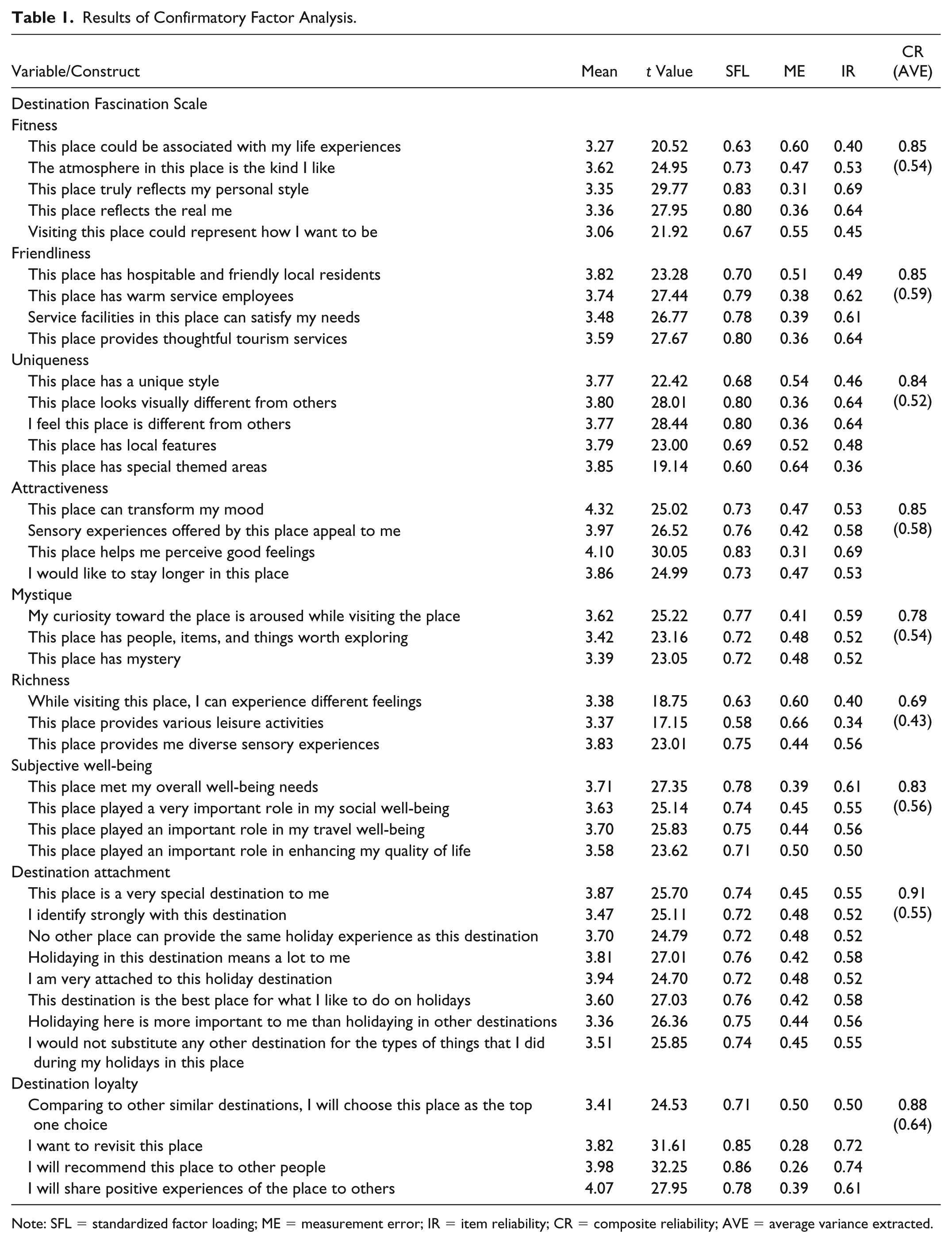
Note: SFL = standardized factor loading; ME = measurement error; IR = item reliability; CR = composite reliability; AVE = average variance extracted.
Correlation Table.
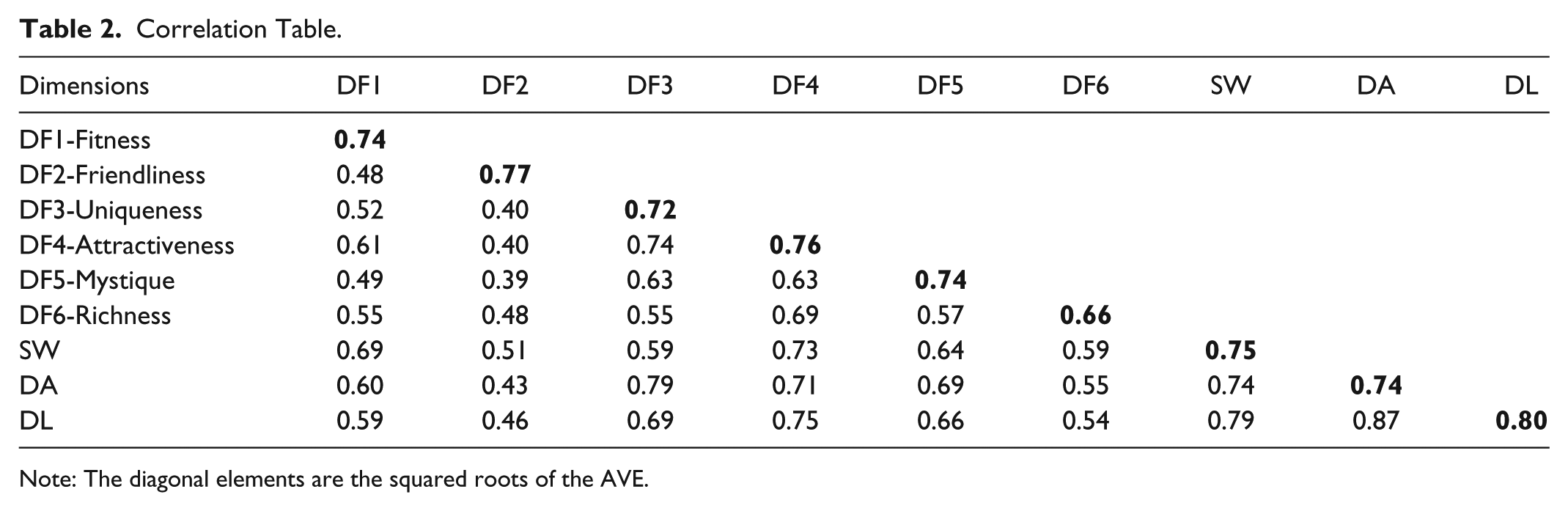
Note: The diagonal elements are the squared roots of the AVE.
Structural Model
Based on CFA results, this study considered destination fascination as a second-order construct with six dimensions in structural equation modeling. Fits indices of the estimated structural model (χ²/df = 8.38, RMSEA = 0.089, GFI = 0.97, SRMR = 0.074, CFI = 0.97, NFI = 0.96) indicated that the model provided an acceptable fit (Jöreskog and Sörbom 1993). As Figure 3 shows, destination fascination was positively related to subjective well-being (β = 0.71, p < 0.01) and destination attachment (β = 0.75, p < 0.01), supporting hypotheses 2a and 3a. Additionally, subjective well-being (β = 0.36, p < 0.01) and destination attachment (β = 0.66, p < 0.01) were positively related to destination loyalty, supporting hypotheses 2b and 3b. This research found that the effect of destination fascination on destination loyalty was not significant (β = −0.01, p > 0.05), thereby rejecting hypothesis 1. The rejection of hypothesis 1, however, indicates important indirect paths for destination fascination to improve destination loyalty by increasing subjective well-being and destination attachment. Table 3 summarizes results of these proposed hypotheses.
Results of the Hypothesized Paths.
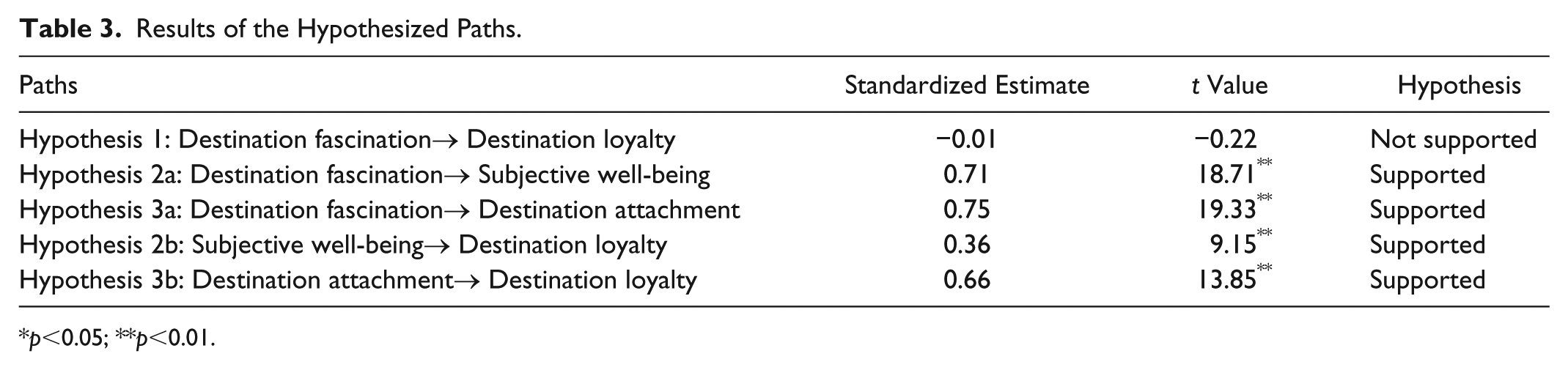
p<0.05; **p<0.01.
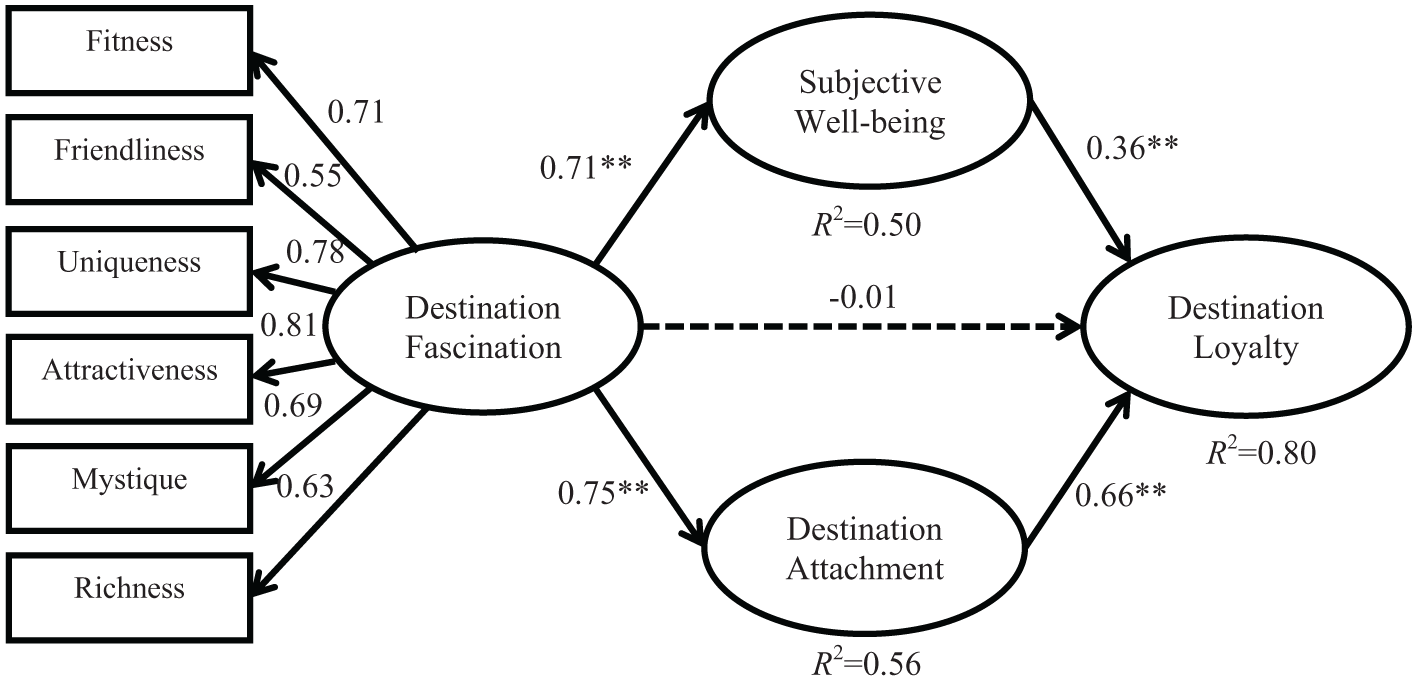
Standardized theoretical path coefficients.
Assessment of Mediating Effects
Based on Judd and Kenny (2010), this study used three steps to examine the proposed mediating effects. Results of the three-step testing are shown in Table 4. Focusing on destination loyalty as the outcome variable in step 1, destination fascination exerted significant positive effects (β = 0.68, p < 0.01), resulting in R2 of 0.46. In step 2-1, destination fascination was positively and significantly related to subjective well-being (β = 0.65, p < 0.01), causing R2 of 0.43. In step 2-2, destination fascination was positively and significantly related to destination attachment (β = 0.71, p < 0.01), causing R2 of 0.51. In step 3, destination fascination was not significantly related to destination loyalty though both subjective well-being (β = 0.31, p < 0.05) and destination attachment (β = 0.61, p < 0.01) positively influenced destination loyalty, resulting in R2 of 0.81. Taken together, the effect of destination fascination on destination loyalty decreased when including subjective well-being and destination attachment as mediators, demonstrating significant mediating effects of subjective well-being and destination attachment on destination loyalty, thus supporting hypotheses 4 and 5.
Mediator Analysis of Full Model.
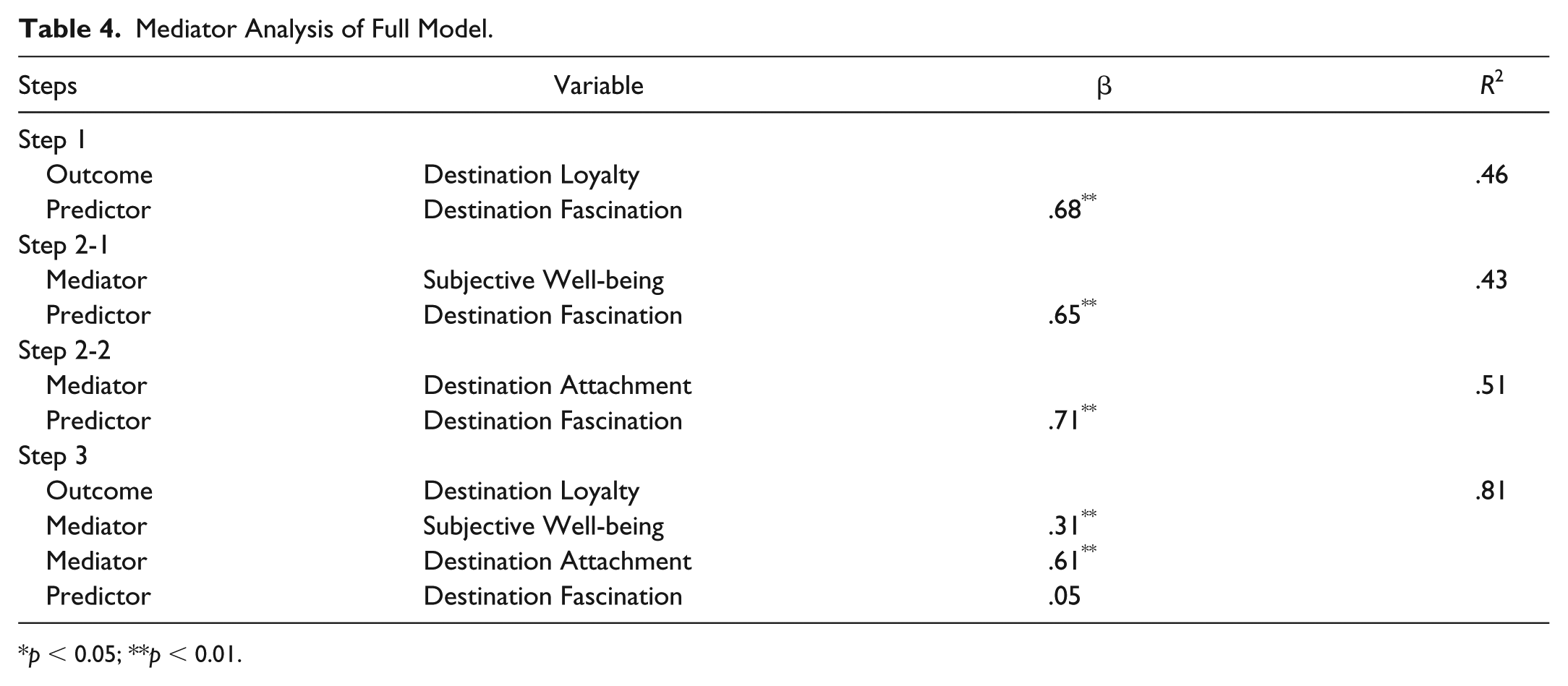
p < 0.05; **p < 0.01.
Further analysis was performed in the proposed model to determine and clarify the direct and indirect effects of subjective well-being and destination attachment as mediators. Based on results of the full model, Table 5 shows that the total effect of destination fascination on destination loyalty was 0.74 (t = 18.60, p < 0.01), indicating that destination fascination improved destination loyalty. On the other hand, the mediating effects of subjective well-being and destination attachment on the relationship between destination fascination and destination loyalty was 0.75 (t = 13.95, p < 0.01). Taken together, these results clarify the complete mediating effects of subjective well-being and destination attachment on the relationship between destination fascination and destination loyalty.
Direct and Indirect Effects in the Proposed Model.
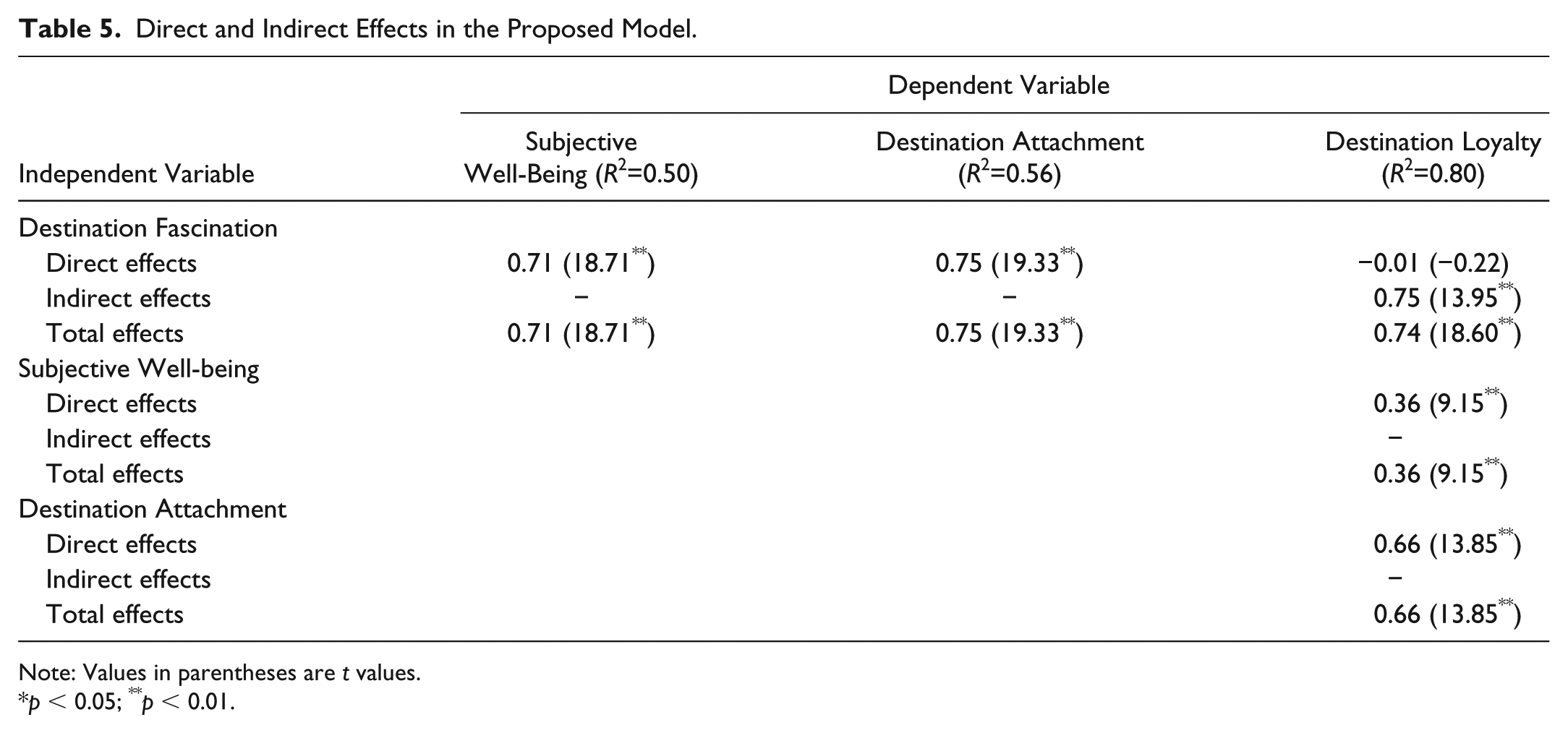
Note: Values in parentheses are t values.
p < 0.05; **p < 0.01.
Extensive Validity of the Proposed Model
The overall collected usable data (936 samples) were sorted into three groups based on destination types: national parks (302 samples), forest recreation areas (300 samples), and theme parks (334 samples). Multigroup analysis was performed to test the model equivalence of destination type on the research model to examine differences among the three groups (Kline 2005). Table 6 summarizes the multi-group analysis. Model A shows the baseline with no constraints among the three groups (χ2 = 2,133.13, df = 612), model B shows the factor loading invariance among the three groups (χ2 = 2,169.99, df = 648), and model C shows the path invariance among the three groups (χ2 = 2,176.54, df = 658). A factor loading invariance among the three groups was conducted by testing the significance of the chi-square differences between two models, one in which the factor loadings were constrained to be the same as the three groups and the other without constraints (Bollen 1989). As shown in Table 6, the chi-square difference was nonsignificant, △χ2 (36) = 36.86, p > .05, suggesting the existence of factor loading invariance. Therefore, a series of multisample SEMs was later conducted to test and identify the path coefficient invariance of these three groups. Results of testing the path coefficient invariance revealed that there was no significant difference in the chi-square values, △χ2(10) = 6.55, p > .05, thereby accepting the model equivalence of destination type in this research model. Taken together, the analytical results show extensive validity of this research model, proving that no differences exist among the three examined destination types.
Results of Multigroup Analysis.

Discussion
The purpose of this study is to examine the effects of destination fascination on destination loyalty, with subjective well-being and destination attachment as mediators. Results of the study showed that destination fascination significantly improved both subjective well-being and destination attachment and that subjective well-being and destination attachment significantly enhanced destination loyalty. Interestingly, there was no significant direct relationship between destination fascination and destination loyalty, supporting the full mediation of both subjective well-being and destination attachment. The full mediating roles of both subjective well-being and destination attachment demonstrate the originality of this study in proposing intrinsic and extrinsic outcomes of destination fascination. These findings enrich the knowledge of destination fascination in the tourism academy (Liu et al. 2017) and extend the understanding of place relationship in environmental psychology (Gifford 2014; Gustafson 2001; Lewicka 2011; Raymond, Brown, and Weber 2010; Scannell and Gifford 2010, 2017; Sundstrom et al. 1996). Moreover, this study examined model equivalence of destination type and found no differences among national parks, forest recreation areas, and theme parks in this model. Since the proposed hypotheses are justified using empirical findings from research in different types of tourism (e.g., island tourism, heritage tourism, nature tourism, and festival tourism) (Davis 2016; Prayag and Ryan 2012; Ramkissoon, Mavondo, and Uysal 2018; Veasna, Wu, and Huang 2013), findings from the model equivalence demonstrate the generalizability of this destination fascination study to apply to other types of destinations. The following sections address theoretical implications, practical implications, limitations, and suggestions for future research.
Theoretical Implications
Following S. Kaplan and Kaplan’s (2009) RPM, this study shows the full mediating roles of subjective well-being and destination attachment in transferring the effects of destination fascination to destination loyalty. It is important to note that by examining the flow of model building–effectiveness–meaningful action of RPM to destination fascination, there is no direct effect of destination fascination (model building) on destination loyalty (meaningful action). This finding validates the applicability of RPM to destination fascination and emphasizes the importance of the effectiveness parameter. In regard to the effectiveness phase, this study enriches the RPM by proposing and examining both intrinsic and extrinsic aspects of destination fascination. The significant existence of two mediators, subjective well-being and destination attachment, provide important empirical evidence to add to place relationship literature in environmental psychology regarding ways place experience influences individuals intrinsically (Scannell and Gifford 2017) and extrinsically (Raymond, Brown, and Weber 2010; Scannell and Gifford 2010).
A significant intrinsic aspect of effectiveness, subjective well-being, recalls the study of Brajša-Žganec, Merkaš, and Šverko (2011) regarding values and opportunities for leisure activities to improve subjective well-being. A fascinating destination allows tourists to experience dimensions of fitness, friendliness, uniqueness, attractiveness, mystique, and richness (Liu et al. 2017), creating an experience in which tourists improve subjective well-being. This gain in subjective well-being from a fascinating destination is a key intrinsic mechanism in tourists’ minds because it enables them to enjoy mental recovery, improve mental health, balance the intrinsic mind, and establish a positive attitude toward future work tasks (Ábrahám, Velenczei, and Szabo 2012; Brajša-Žganec, Merkaš, and Šverko 2011; Newman, Tay, and Diener 2014). The intrinsic mechanism of effectiveness as it relates to subjective well-being motivates tourists to extend loyalty toward a fascinating destination because they want to regain or re-experience improved subjective well-being that is generated through destination fascination. Findings about subjective well-being in this study add knowledge to tourism literature regarding antecedents and outcomes of tourists’ subjective well-being (Guite, Clark, and Ackrill 2006; H. Kim et al. 2015; Lee et al. 2014; Ramkissoon, Mavondo, and Uysal 2018).
On the other hand, significant extrinsic aspects of effectiveness in destination attachment recall the function of PCM by Beaton and Funk (2008). The role of destination attachment in effectiveness expands the scope of effects of destination fascination from changing tourists’ intrinsic minds to establishing an extrinsic mental connection. As Beaton and Funk (2008) argued in PCM, passionate sports fans mentally build attachments to leisure sports, and this study found that tourists who experience fascination for a destination may also perceive strong attachment to the destination. Findings about destination attachment in this study extend understanding about the antecedents and outcomes of destination fascination in tourism literature (Davis 2016; Prayag and Ryan 2012; Stylos et al. 2017; Veasna, Wu, and Huang 2013). Through destination attachment, tourists identify dependence on and recognition for a fascinating destination (Yuksel, Yuksel, and Bilim 2010) and, further, retain loyalty toward the destination (Prayag and Ryan 2012). Tourists who perceive attachment with a fascinating destination possess loyalty toward that destination because the destination has meaning to them, and they tend to sustain stable psychological involvement and mental attachment to the destination (Funk and James 2001; Korpela et al. 2001; Morgan 2010).
Another theoretical contribution of this study is the examination of the extensive validity of this research model in national parks, forest recreation areas, and theme parks. As suggested by former studies (e.g., Bacharach 1989), testing a research model in different types of settings is meaningful and clarifies the validity and reliability of the model within other boundaries. Different from Velarde, Fry, and Tveit (2007), who found that people generally feel better and become healthier in natural environments than urban environments, it is exciting that this study found model equivalence across national parks (natural environments), forest recreation areas (natural environments), and theme parks (artificial environments). The multigroup analysis of destination type in this study provides insightful implications supporting the argument that although people generally feel differently in natural and urban environments (Velarde, Fry, and Tveit 2007), the mechanism driving these outcomes may be the same. That is, tourists may experience high fascination in different types of destinations, improve subjective well-being and destination attachment by visiting different fascinating destinations, and accumulate loyalty toward certain fascinating destinations as a result of the mediating effects of subjective well-being and destination attachment.
Practical Implications
From the analytical results, this study contributes two practical implications for destination marketing organizations (DMOs): one focuses on the intrinsic mechanism of subjective well-being and the other emphasizes the extrinsic mechanism of destination attachment. First, DMOs should make sure they establish fascination for a destination that could significantly improve their targeted tourists’ subjective well-being. Dimensions of destination fascination, such as fitness, friendliness, uniqueness, attractiveness, mystique, and richness (Liu et al. 2017) should be used as elements in creating well-being–driven fascinating destination experiences. For example, DMOs of destinations targeting dating couples could improve tourists’ subjective well-being by guiding tourists to experience fascination in love-related dimensions, such as mystique from local love stories, friendliness from customized memorable dating services, or richness from diverse dining locations and designs. By generating fascinating elements to attract tourists to their destination, DMOs can help tourists improve subjective well-being. Dating couples who gain subjective well-being from such a fascinating destination then potentially develop loyalty to the destination as a unique place to experience and relive romantic feelings.
Second, DMOs should design experiences to help their target tourists develop attachments for their fascinating destination. For example, destinations targeting family tourism could offer co-creation art activities for parents and children to create uniqueness in the destination, tour activities for families to enjoy attractiveness at the destination, and family-friendly facilities and services for tourists to promote friendliness at the destination. By strengthening dimensions of destination fascination based on features of family tourism, DMOs could increase their targeted tourists’ destination attachment because parents and children feel the destination has meaning to them; the parents and children would then be motivated to share good things about the destination and plan their next visit because of the connection they feel for the destination and the significance of the destination to them.
Limitations and Suggestions for Future Research
Although this study attempts to examine the proposed model at different types of destination, the sample destinations are all in Taiwan, and the majority of participants are Taiwanese. Future studies could meaningfully explore tourists’ experiences with destination fascination across cultural settings to determine if outcomes for destination fascination are different in cross-cultural settings. Additionally, the cross-sectional design of this study limits a deeper understanding of the longitudinal dynamic outcomes of destination fascination. Therefore, future studies would do well to seek tourists for longitudinal participation with an expectation of augmenting findings through continued reporting about tourists’ feelings and actions toward a fascinating destination. Third, this study only examines the direct and indirect effects of destination fascination and lacks testing of moderating effects. Therefore, future studies should propose moderators to strengthen or reduce the proposed effects of this model.
Footnotes
Appendix: Survey Items
Acknowledgements
The authors thank the Ministry of Science and Technology, Taiwan, for financially supporting this research under Contract No. MOST 104-2410-H-018-029-MY2.
Declaration of Conflicting Interests
The author(s) declared no potential conflicts of interest with respect to the research, authorship, and/or publication of this article.
Funding
The author(s) disclosed receipt of the following financial support for the research, authorship and/or publication of this article: The authors thank the Ministry of Science and Technology in Taiwan for financially supporting this research under Contract No. MOST 104-2410-H-018 -029 -MY2.
