




Abstract
Pre-set options, referred to as default options, have been found to influence consumer choices in various settings. In this paper, we investigate the effect of default options on the chosen categories of board and lodging in travel packages. The results of two field experiments indicate that guests traveling as couples are more likely to book a superior room and additional meals if the high-grade option—instead of on the low-grade option—is set as the default. This effect is particularly strong for board choices. In contrast, solo travelers are not affected by high-grade defaults. Solo travelers show strong and stable preferences for high-grade board categories and low-grade room categories. These findings provide practical implications for how travel companies can benefit from default options to promote the sale of higher-graded—and thus higher-priced—travel packages.
Introduction
Today, customers search for travel information and book travel offers to a large extent online (Buhalis and Law 2008; Fesenmaier et al. 2011). On the Internet, travelers are often confronted with preset options, such as when customizing their trips in travel configurators or when making simple choices between different service categories (Häubl and Trifts 2000; Werthner and Ricci 2004; Herrmann et al. 2011). The default option is the preset choice that decision makers receive if they do not explicitly specify otherwise (Brown and Krishna 2004). For example, when an airline offers on its website a light, classic, and a superior option (with an increasing scope of service and price) for a flight, the already checked box next to the classic option designates the default. Travelers have to actively choose one of the other options if they want to upgrade or downgrade the service category of their flight (Swiss International Air Lines 2019).
Behavioral research has repeatedly shown that individuals tend to stay with the default options (Jachimowicz et al. 2019). In the context of product customization, consumers tend to choose more product features that add up to a higher total price when they start from a full-featured default and reject undesired features than when they start from a low-featured default and add desired features (Park, Jun, and MacInnis 2000; Levin et al. 2002). In a similar vein, Jin, He, and Song (2012) demonstrate that travelers customize travel packages to a higher total price when they start from a high-grade travel package and downgrade the service categories than when they start from a low-grade travel package and upgrade the scope of service.
For travel companies, setting high-grade services or add-ons as the default may provide a relatively easy and nonintrusive way to upsell and cross-sell services, such as high-grade hotel rooms, car rentals, or travel insurance, without having to invest in extensive marketing activities. Upselling and cross-selling activities are key components of tourism companies’ revenue management, as they offer meaningful opportunities to increase the companies’ revenue per purchase (Amadeus 2007; Sun, Jiao, and Tian 2011; Talón-Ballestero, González-Serrano, and Figueroa-Domecq 2014). However, travel companies rarely use default options in a strategic manner, and usually, just set the lowest value option as the default (Polak et al. 2008).
This article aims to explore how travel companies can effectively use default options in practice. In the travel industry, upselling higher-quality versions of existing services may be simpler and more cost-effective than using default options to cross-sell additional, and potentially new, services because each new travel service usually reflects a new relationship with a different business partner (Jin, He, and Song 2012). In contrast to previous studies that investigate default effects in cross-selling (Levin et al. 2002; Park, Jun, and MacInnis 2000), the present article examines the effect of default options in upselling higher-grade travel services. In two quasi-experimental field studies, a superior, instead of a standard, room is set as the default in study 1, and full board or half board, instead of half board or breakfast only, is set as the default in study 2. We refer to these preset options as high-grade defaults.
Thus far, the economic value and effective application of default options in the travel industry have rarely been explored (Avineri 2011; Jin, He, and Song 2012). Instead, previous research provides evidence of default effects in personal or politically relevant decisions, such as in decisions about retirement savings (Madrian and Shea 2001; Just and Price 2013) and organ donations (Johnson and Goldstein 2003; Abadie and Gay 2006), as well as healthy food choices (Just and Price 2013; Peters et al. 2016) and pro-environmental product choices (Pichert and Katsikopoulos 2008). Business research on default effects focuses mainly on tangible goods and is examined mostly in laboratory settings or simulated purchasing environments (Park, Jun, and MacInnis 2000; Levin et al. 2002; Herrmann et al. 2011). Therefore, this article contributes to the literature in two respects. First, the present studies supplement existing research by exploring the default effect in a rarely researched choice setting: the configuration of travel packages. Second, the present studies examine the default effect in real purchasing decisions with real-life customers, which allows the investigation of the default effect on different types of travelers.
The outline of this article is as follows: in the next section, we shed light on the causes of the default effect, which builds the background for deriving our hypotheses. We then consecutively describe the methodology and the results of each study. The article concludes with a discussion of the findings, practical implications, and opportunities for future research.
Literature and Hypotheses
Why Default Options Influence Choices
The decision-making context influences an individual’s choices to a large extent (Thaler and Sunstein 2009; Hansen and Jespersen 2013). Changing the decision-making context—for instance, by setting the default to a high-grade instead of a low-grade option—results in differing choices. To explain why individuals tend to stay with default options, past research suggests three main reasons: (1) ease, (2) endorsement, and (3) endowment (Dinner et al. 2011; Jachimowicz et al. 2019). Regarding ease, it is suggested that individuals stay with default options because changing the default requires psychological effort (Samuelson and Zeckhauser 1988; Vohs et al. 2008). This is indicated by individuals showing less persistence in solving a task when they previously chose from several options compared to individuals who previously implemented choices made by someone else (Vohs et al. 2008). Thus, deliberating about options and choosing between them is more effortful and energy consuming than implementing choices made by another person.
A second reason for the default effect is implied endorsement (Dinner et al. 2011): that is, individuals perceive default options as the options suggested by policy makers (Johnson and Goldstein 2003) or companies (Brown and Krishna 2004). Thus, default options might be regarded as the socially desired behavior or as a product the company considers to fit most of its customers. McKenzie, Liersch, and Finkelstein (2006) show that people do indeed perceive default options as suggestions but simultaneously speculate about the underlying reasons for their use. To what extent a default option is accepted depends on a consumer’s “marketplace metacognition”—that is, the interpretation of the default option as being a marketing tactic (Campbell and Kirmani 2000). Default options are even assumed to backfire, by having a negative effect, if consumers believe that a marketer intends to distort their choices (Brown and Krishna 2004). In line with this finding, Herrmann et al. (2011) show that moving the default from a low-price to a high-price option increases sales revenue, but consumers also become increasingly skeptical and wonder whether the default is being set in the company’s interest alone. Correspondingly, the default with the strongest acceptance rate lies between the medium and the highest price level of a product feature, not at the highest price level.
A third explanation for the default effect is endowment, or reference dependence (Dinner et al. 2011; Jachimowicz et al. 2019). According to prospect theory, individuals are loss-averse (Tversky and Kahneman 1991), weighing potential losses from switching as larger than potential gains (Kahneman and Tversky 1979; Samuelson and Zeckhauser 1988). Therefore, goods owned are more highly valued, or perceived as more attractive, than goods not owned. This is referred to as the “endowment effect” (Thaler 1980). Individuals may perceive default options as “instant endowments” (Tversky and Kahneman 1991), thinking that they already own the default and use it as the reference point in choice situations (Dinner et al. 2011). Giving up the default and choosing a lower-grade option would thus be perceived as a loss. In a similar vein, individuals judge options more favorably when they are the reference points (Dhar and Simonson 1992). Serving as reference points, default options constitute an anchor or starting point on which consumers base their price perceptions, resulting in values biased toward this starting point (Tversky and Kahneman 1974; Park, Jun, and MacInnis 2000).
Default Options and Travel Choices
Default options can increase the total price of customized travel packages by fostering upgrades in guide services, hotel transfers, or travel insurances (Jin, He, and Song 2012). However, empirical insights into the influence and beneficial use of default options in the area of travel choices are still scarce (Avineri 2011; Jin, He, and Song 2012).
The effect of default options on travel choices may be of particular importance, as the endowment effect could be especially relevant for travel services. Travel services are predominantly hedonic in character; that is, they provide fun, pleasure, and excitement compared to utilitarian products and services, which are primarily instrumental and functional (Prebensen and Rosengren 2016). Evidence indicates that hedonic products elicit the endowment effect to a greater extent. For example, owners of relatively hedonic cars value their cars more and demand higher selling prices, than do owners of relatively utilitarian cars, relative to market prices (Dhar and Wertenbroch 2000).
Further, travel services and their inherent experiential nature are difficult to evaluate before being consumed. Travel choices are therefore related to uncertainty on the customer’s side (Sirakaya and Woodside 2005; Nicolau 2008). When uncertainty is high, consumers may be more susceptible to recommendations (Senecal and Nantel 2004) and contextual factors, such as default options (Park, Jun, and MacInnis 2000). This is in line with existing evidence suggesting that the influence of default options is generally stronger when consumers are less familiar with a product and have little knowledge about it (Sunstein and Thaler 2003).
Based on these considerations, we propose the following:
Hypothesis 1: Travelers are more likely to book high-grade room and board categories when the high-grade categories are set as the default compared to when the low-grade categories are set as the default.
The Default Effect and Travel Mode
Whether tourists are traveling alone, as a couple, or in a group has a strong influence on their preferences and expenditures (Wu, Zhang, and Fujiwara 2011). Couples tend to book more luxurious accommodation types (e.g., four- or five-star hotels) and wider board options (e.g., full- or half-board) compared to solo travelers (Soteriades and Arvanitis 2006). Liu et al. (2013) show that customers, independent of their demographic background, have different expectations regarding hotels in different travel modes, such as traveling for business, solo, as a couple, or with friends or family. Significant differences exist between solo travelers and group travelers. Solo travelers can be characterized as low spenders who try to foster social contacts, whereas group travelers tend to be high spenders who share some sort of special interest in the group (Laesser, Beritelli, and Bieger 2009). Liu et al. (2013) and Rhee and Yang (2015) found that hotel rooms are perceived as relatively less important by solo travelers, families, and friends, when compared to couples’ preferences.
Because of solo travelers’ narrow budget ranges (Laesser, Beritelli, and Bieger 2009) and because they perceive hotel rooms to be less important, we assume that solo travelers are more likely to prefer and book low-grade room categories and are thus less susceptible to high-grade room defaults. This is in contrast to couples, who value hotel rooms (Liu et al. 2013), or individuals traveling in groups, who are high spenders (Laesser, Beritelli, and Bieger 2009). In the analogy, the same should hold true for board categories, where guests’ preferences for different catering options are also related to their travel mode (Soteriades and Arvanitis 2006).
Based on these arguments, we propose the following:
Hypothesis 2: The effect of a high-grade default differs in terms of the guests’ travel mode, with a stronger effect for individuals not traveling alone than for solo travelers.
Overview of Studies
In line with existing literature, we expect that high-grade defaults increase the probability that travelers choose superior rooms or more included meals (i.e., a high-grade board category) when booking their travel package (hypothesis 1). In the experiments presented here, we manipulated the default options to analyze this effect. We also used available booking data to investigate the role of guests’ travel mode that we hypothesized to influence the default effect. More specifically, we presumed that travelers’ willingness to change the board or room category is related to whether they are traveling alone, as couples, or in groups (hypothesis 2).
To test these hypotheses, we conducted two quasi-experimental field studies. Our project partners were two Swiss travel agencies that sell travel packages. In study 1, we investigated the effect of a high-grade room as the default (i.e., a superior instead of a standard room as the default) on travelers’ room choices. Specifically, we tested the hypothesis (1) that travelers are more likely to book a superior room when the high-grade category is the default than when the low-grade category is the default, and (2) that this effect differs according to the customers’ travel mode. The practice partner for this first study was a supplier of active travel packages, such as hiking or cycling vacations.
In study 2, we explored the effect of a high-grade default for the number of meals included in the travel package (i.e., full board or half-board instead of half-board or breakfast only) on traveler’s choices of board category. More specifically, we tested the hypothesis that (1) travelers are more likely to book high-grade board categories when the high-grade category is the default compared to when the low-grade option is the default, and (2) that this effect differs according to their travel mode. Our partner for the second study was a travel agent for bus tours.
Both travel agencies host their own online travel system in which travelers can customize and book travel packages directly on the agency’s webpage. Depending on the travel package, customers must decide on several product attributes—including the room and board category, travel insurance options, or other add-ons—as part of the booking process. As on most travel platforms, all these features provide a default option, which has always been the lowest-grade option.
The default effect was measured by comparing the chosen room and board categories in real travel bookings with high- and low-grade defaults. As it was technically not feasible to randomize the treatments (i.e., to automatically change the default option for every booking process started on the platform), we used two quasi-experimental designs. Both designs allowed us to rule out spurious relationships stemming from external factors, such as competition or changes in competitors’ promotions, by contrasting the effect of the interventions with control groups.
Study 1: Room Default Options
Methods
Participants and design
A total of 142 participants booked a package holiday during study 1. The experiment employed a one-factorial design (low-grade vs. high-grade default), and the conditions were manipulated between subjects.
The data set for study 1 consisted of 142 online booking observations with a total of 157 booked rooms and 252 travelers. Table 1 provides an outline of the main sample characteristics. The participants had a mean age of 59.3 years (SD = 15.9) and booked relatively far in advance (M = 133 days, SD = 72.4). The majority of these guests traveled in a group of two people (i.e., as a couple) or alone. Another characteristic of the sample is that many travelers were regular customers who had already booked one or more trips with the project partner during the past three years.
Sample Characteristics (Study 1).

Note: The table reports means and standard deviations for continuous variables and percentage frequencies for categorical variables for the full sample of study 1 and for each treatment group individually.
The mean expenditure for the bookings observed was US$1.910 per person. The average price increase for choosing a superior room over a standard room was US$166 per person or US$255 per booking.
Manipulation and procedure
In study 1, we manipulated the default room category on the partner’s online booking platform for 26 travel packages. To ensure the consistency of the intervention, we confined the study to online travel packages in which only two room categories were available. Participants were in either the low- or high-grade default condition—that is, either the low-grade category (standard room) or the high-grade category (superior room) was pre-selected. However, travelers could always choose the other category by clicking on it. Figure 1 provides an illustration.
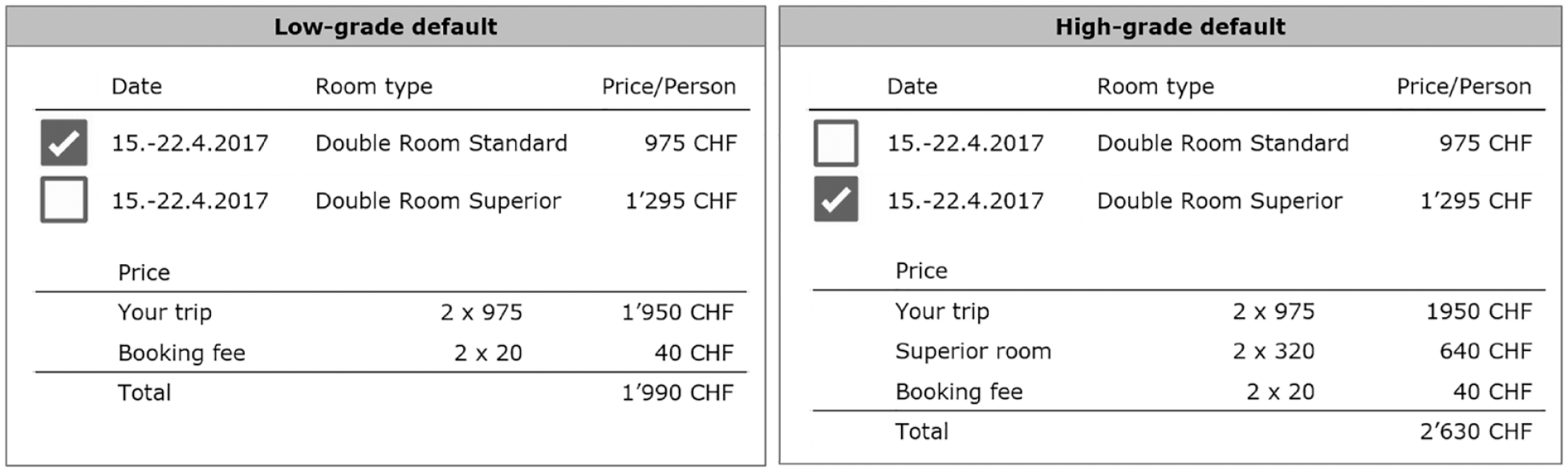
Treatment illustration (study 1).
To compare the high- and low-grade default condition, we used a nonequivalent control group design with a reversed treatment (Salkind 2010). The 26 travel packages of our sample were split into two groups. These groups were as similar as possible in terms of the number, duration, and type of the travel packages. The default options were then adapted sequentially for a total period of eight months. In the first four months (from October 5, 2016, to January 27, 2017), the default was switched to the superior room for the travel packages in set 1, and the standard room default was retained for the travel packages in set 2. In the second four months (from January 28, 2017, to May 21, 2017), the treatment and control groups were reversed, with the high-grade (i.e., superior room) default for the travel packages in set 2 and the low-grade (i.e., standard room) default for travel packages in set 1. Figure 2 provides an illustration. This procedure allowed us to control for a possible seasonal effect in the choice of room categories as well as potential differences between the two travel sets.
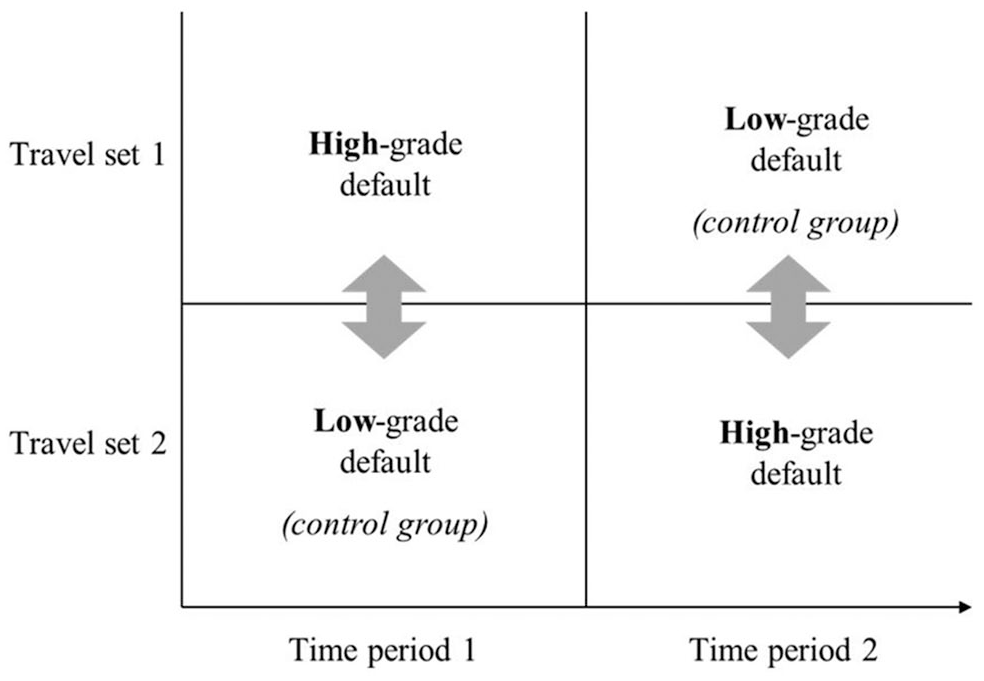
Experimental procedure (study 1).
Dependent and control variables
Participants chose between a standard room and a superior room. The default condition (low-grade or high-grade) indicated whether the standard or superior room was set as the default. The dependent variable was a dummy variable, indicating whether the superior or standard room category was booked. In addition to the room choice, we defined and measured guests’ travel mode (solo, couple, family, or group), age, and advance booking (in days) as control variables. We also controlled for variables related to the reversed treatment design: that is, the possibility that booking behavior differed between the two travel sets or over the time periods when the treatment and control groups were reversed.
Results
Figure 3 provides a descriptive analysis of the default effect at the level of the booked rooms. When the superior room was set as the default, we observe an increase of 11.2 percentage points in superior room bookings. The share of standard rooms in the high-grade default condition is accordingly lower. However, the chi-square test indicates that the differences in room bookings between the default conditions are not significant (p = 0.14).
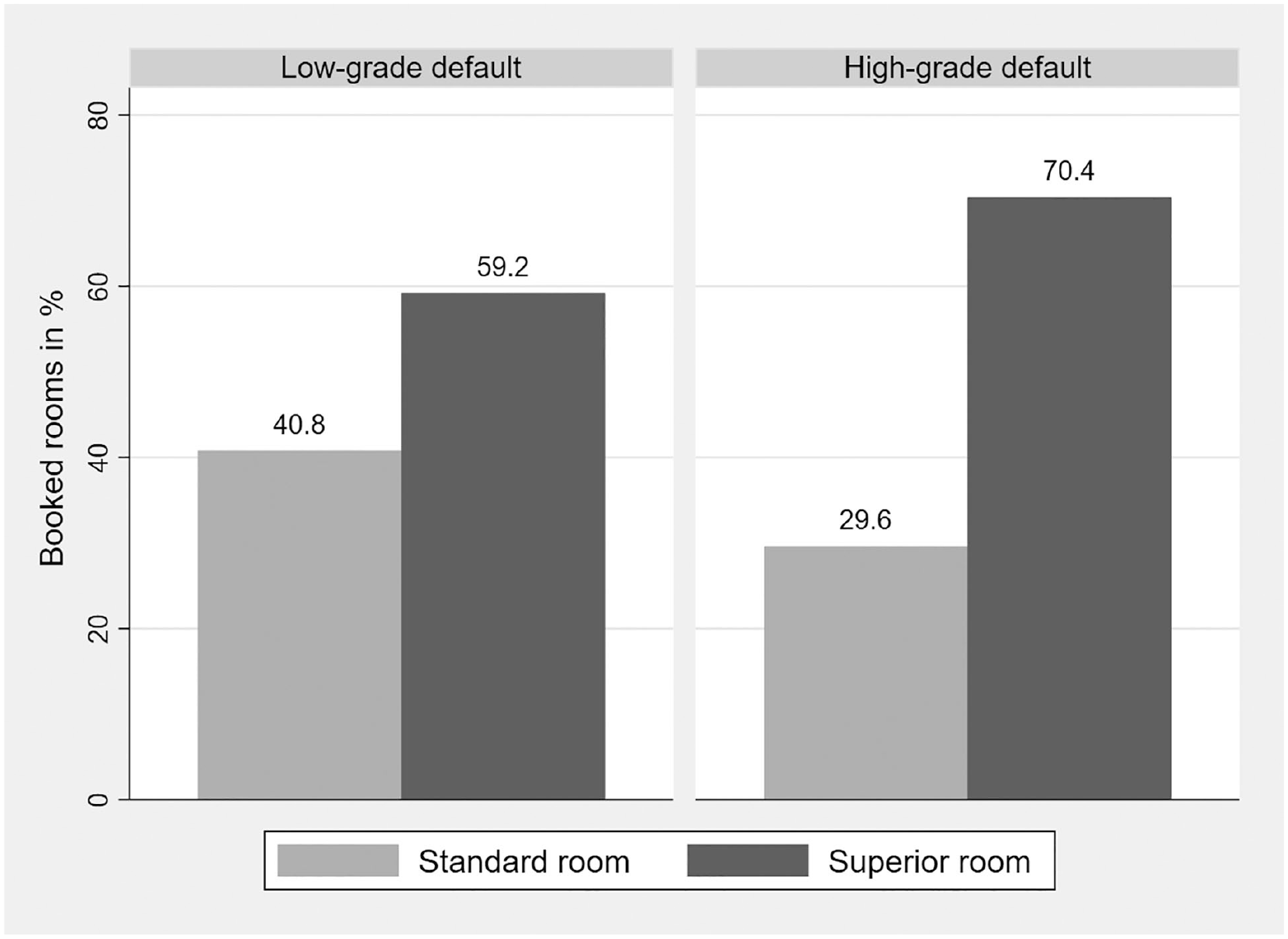
Default effect (study 1).
For a more detailed analysis of the default effect, we use the following logistic regression model,
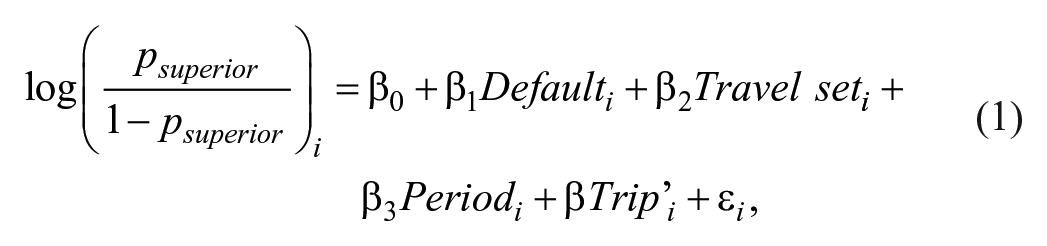
where the dependent variable is the probability that the superior room category is chosen in booking i. Defaulti is a dummy variable indicating the high-grade versus low-grade default condition. The vector Trip’i includes control variables for all traveler-related characteristics, such as the travel mode (i.e., whether guests were traveling alone, as a couple, with family, or in a group); the average age of the guests who booked; their number of previous bookings through the travel agency; and the number of days between the booking date and the travel date. The variables Travel seti and Periodi are design-related dummy variables indicating whether the travel was part of travel set 1 or 2, and whether the travel was booked in the first or second four months of the experiment.
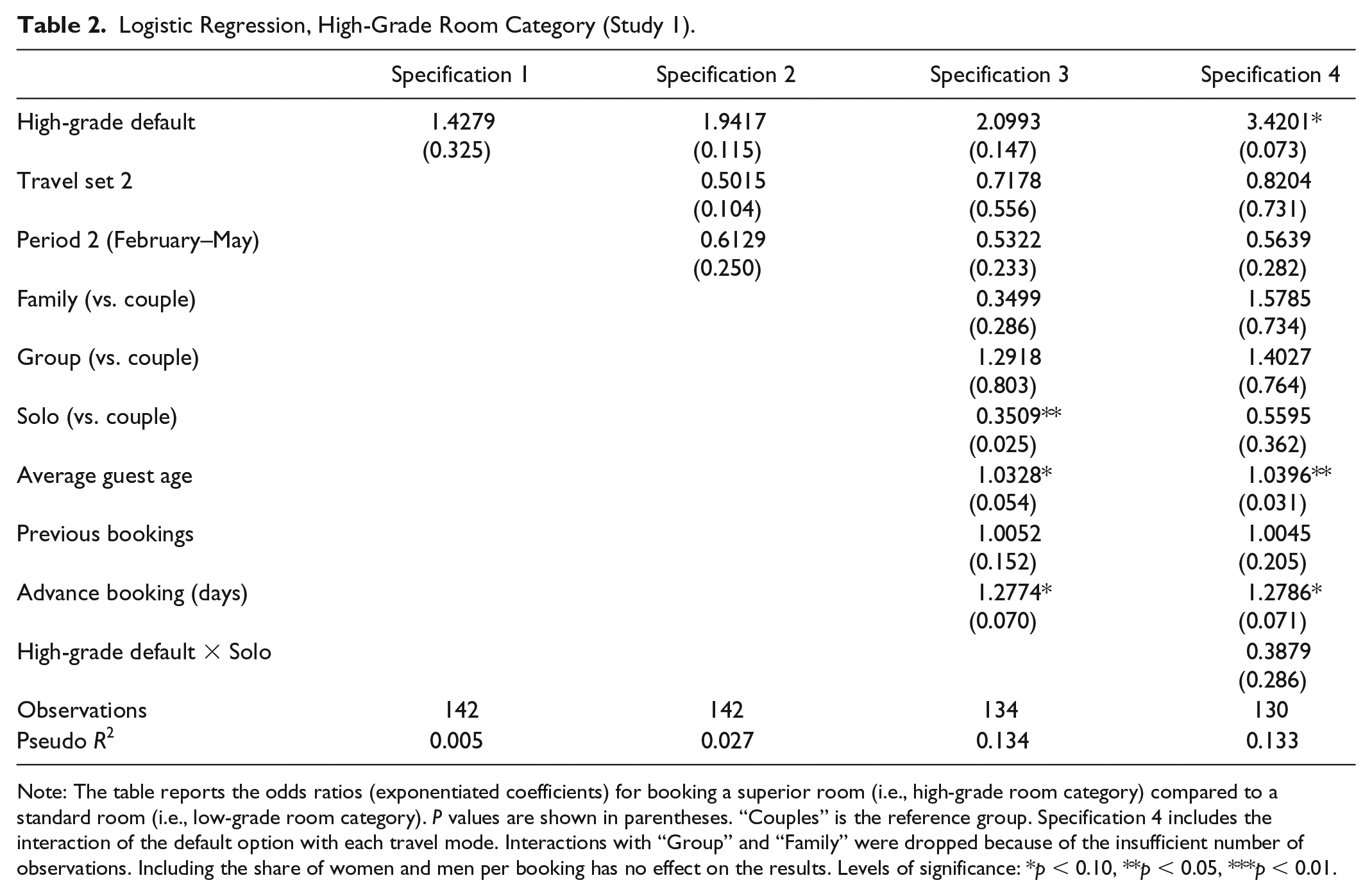
Table 2 gives the regression results for model 1. The coefficients are written as odds ratios—that is, the change in the odds of choosing the superior instead of the standard room category. An odds ratio greater than 1 indicates a positive association between superior room bookings and the covariate.
Logistic Regression, High-Grade Room Category (Study 1).
Note: The table reports the odds ratios (exponentiated coefficients) for booking a superior room (i.e., high-grade room category) compared to a standard room (i.e., low-grade room category). P values are shown in parentheses. “Couples” is the reference group. Specification 4 includes the interaction of the default option with each travel mode. Interactions with “Group” and “Family” were dropped because of the insufficient number of observations. Including the share of women and men per booking has no effect on the results. Levels of significance: *p < 0.10, **p < 0.05, ***p < 0.01.
Without the traveler-related control variables Trip’i, the odds of choosing the superior room category in the high-grade default condition compared to the low-grade default condition are 1.94 times higher, which is not statistically significant (p = 0.115; see specification 2 in Table 2). As indicated in specification 3, elderly guests and customers who book in advance are generally more likely to book superior rooms. However, the odds of solo travelers booking the high-grade room category are around three times lower compared to couples, who serve as the reference group (
We further investigate whether the high-grade default has a different effect for guests in varying travel modes. From the literature, we expect that customers have differing room preferences and, therefore, are differently susceptible to high-grade defaults, depending on whether they are traveling solo, as a couple, or in a group. To test hypothesis 2, we add an interaction term between the default condition and the guests’ travel mode in specification 4. Including this interaction reveals that the default effect is marginally significant for couples (the reference group). For couples, the odds of a superior room being booked are 3.4 times higher than in the low-grade default condition (p = 0.073). Solo travelers, however, show no reaction to the high-grade default (p = 0.664; p-value of the interaction term = 0.286). Apparently, this customer group cannot be influenced by a high-grade room default, sticking to the standard room as their clearly preferred choice instead. The interactions with “group” and “family” were dropped because of insufficient numbers of observations.
The results of model 1 remain robust when the design-related control variables (travel set and period) are excluded (Appendix A, Table A1). Further analyses also reveal that the default effect is marginally significant for first-time bookers and tends to decline as the number of previous bookings increases (Appendix B; Table A2).
Discussion
Overall, the results indicate that high-grade defaults can have a positive effect on selling high-grade room categories, but the size of the effect depends on the guests’ travel mode. Across all guests, a high-grade default is associated with an increase of 94% in the odds of selling a superior room, compared to the low-grade default. For the partner company, this corresponds to a revenue increase of 1.2% of the total package price that may be achieved by simply changing the default option from the standard room to the superior room category. However, because of the limited number of observations and unexplained variance in the field setting, the effect is statistically not significant. Guests’ real-world room choices seem to be influenced by various factors, which we could only partially cover with the data at hand (see pseudo R2 of specifications 1–4, Table 2).
The results further indicate that the size of the default effect is related to the guests’ travel mode, with a marginally significant influence on guests traveling as couples. Although the interaction coefficient is not significant, we assume that guests’ uncertainty about their room preferences drives the stronger reaction of couples to the high-grade default. Solo travelers, who are generally less inclined to book superior rooms in our sample and who already face a comparatively high expenditure for their single rooms, are presumably more certain about their room preferences than couples. This idea is also supported by additional analyses suggesting that regular customers—who are more experienced and, therefore, clearer about their travel preferences—are less affected by the high-grade default than first-time travelers. The default effect on first-time bookers, on the other hand, is marginally significant. This also mirrors previous evidence that the effect of default options is stronger when consumers are less familiar with a product and have little knowledge about it (Sunstein and Thaler 2003).
Study 2: Board Default Option
Methods
Participants and design
A total of 182 participants booked a travel package during study 2. As in study 1, the experiment employed a one-factorial design (low-grade vs. high-grade default). The conditions were manipulated between subjects.
The data set for study 2 contained 182 independent booking observations: 111 from July to October 2016 (low-grade default condition) and 71 from July to October 2017 (high-grade default condition). Table 3 shows that guests who booked a travel package usually traveled as a couple (40.7%) or as a family (27.5%). Due to the different target group, the sample is younger than that in study 1, with a mean age of 42.7 years (SD = 22.1). Guests also booked their trip fewer days in advance (M = 28.7 days, SD = 19.9). Data on the number of previous trips travelers booked with this partner company were not available.
Sample Characteristics (Study 2).
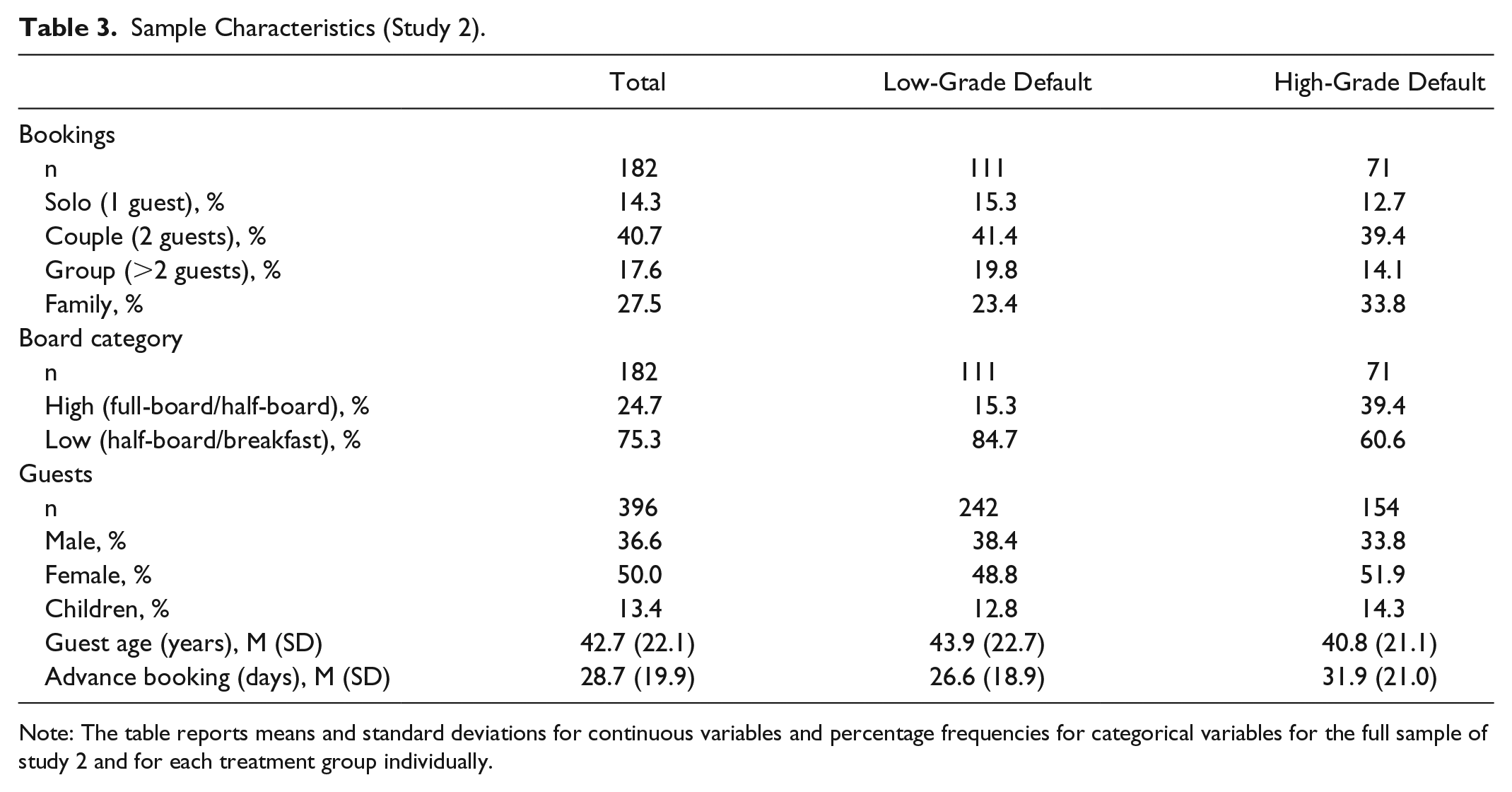
Note: The table reports means and standard deviations for continuous variables and percentage frequencies for categorical variables for the full sample of study 2 and for each treatment group individually.
In study 2, the mean expenditure for the bookings observed was US$684 per person, reflecting the low price segment of these travel packages. The average price increase for a high-grade board category was US$124 per person or US$226 per booking.
Manipulation and procedure
In study 2, the default options for the board categories were changed either from breakfast to half-board or from half-board to full-board, depending on the available dining options. Participants were either in the low- or high-grade default condition: that is, either the low-grade default (breakfast or half-board) or the high-grade default (half-board or full-board) was preselected. However, customers could choose the other option by clicking on it. Only travel packages with two board categories were included (either breakfast vs. half-board or half-board vs. full-board).
In total, the board default options were switched for 78 beach travel packages from July 5 to October 1, 2017. In contrast to study 1, the timeline of the project did not allow the default options to be sequentially adapted in a control group design with a reversed treatment. Therefore, we applied a simple pretest–posttest design (Millsap and Maydeu-Olivares 2009), in which the bookings of the high-grade default condition in 2017 were compared to the bookings of the low-grade default condition for the same set of travel packages during the same time period in 2016. To address the threats to the internal validity of such a design, we ran additional data analyses. In particular, we were concerned about ensuring that the board choices did not systematically vary between years. We therefore compared the bookings from June to September 2017 versus June to September 2016 (the treatment period) with the same travel packages booked from January to May 2017 versus January to May 2016 (the comparison period). This use of data from several preintervention time periods has been acknowledged as a design feature that allows the examination of various validity threats (Meyer 1995).
Dependent and control variables
Participants chose between the high- or low-grade board category. Depending on the year of observation, one of the two options was defined as the default. As in study 1, the dependent variable was binary, indicating whether the participants booked the high- or low-grade board category. In addition to the binary board choice, we measured guests’ travel mode (solo, couple, family, or group), age, and advance booking (in days) as control variables.
Results
Figure 4 provides a descriptive analysis of the default effect. Although there are fewer observations in the high-grade default condition, we still observe an increase in bookings of the high-grade board categories compared to the low-grade default condition. The chi-square test shows that this difference is highly significant (p < 0.001).
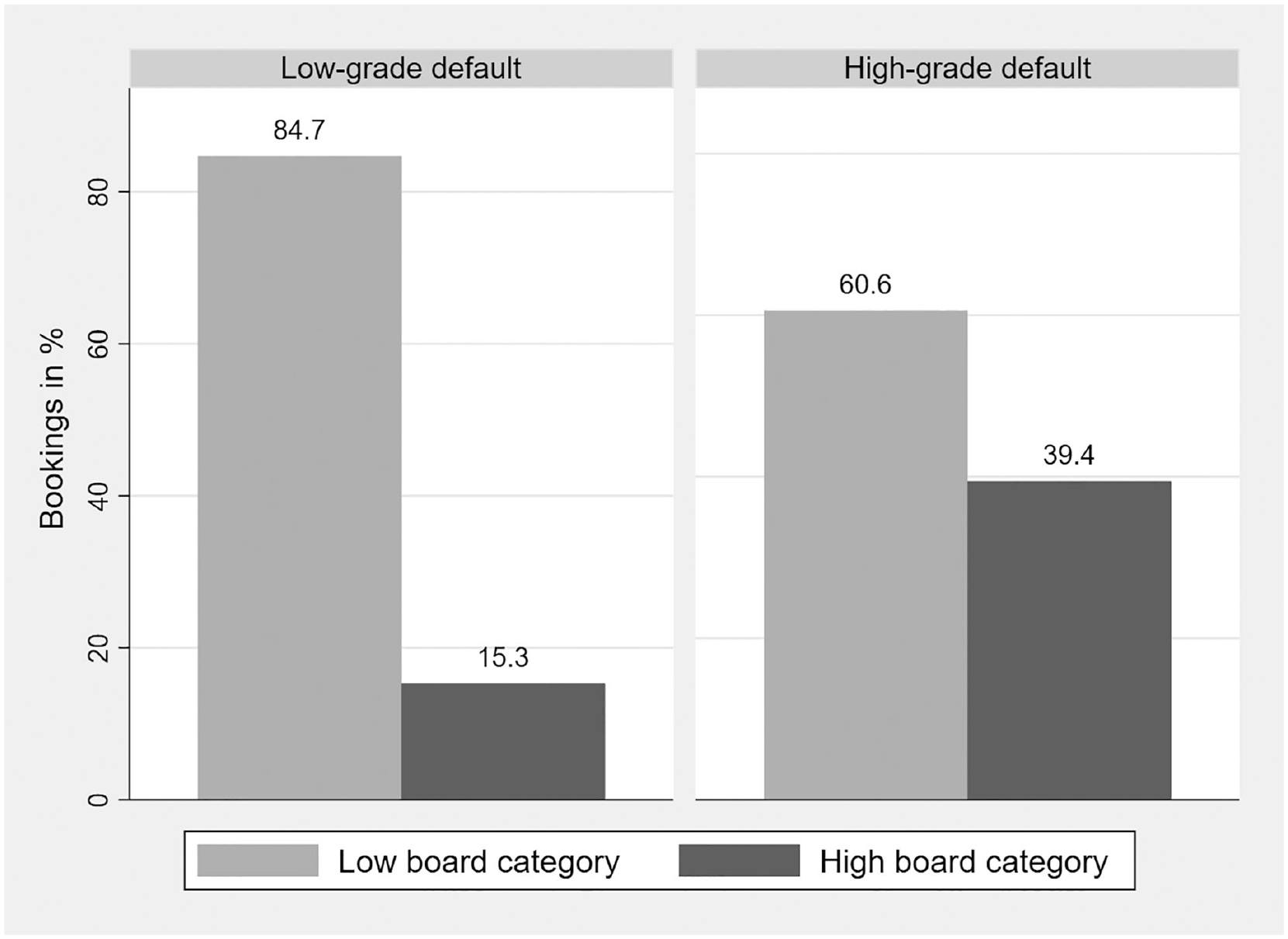
Default effect (study 2).
As in study 1, we further investigate the probability that travelers choose a high-grade board category in a logistic regression analysis. To do this, we use model 1 without the design-related control variables of the first study and define model 2 as

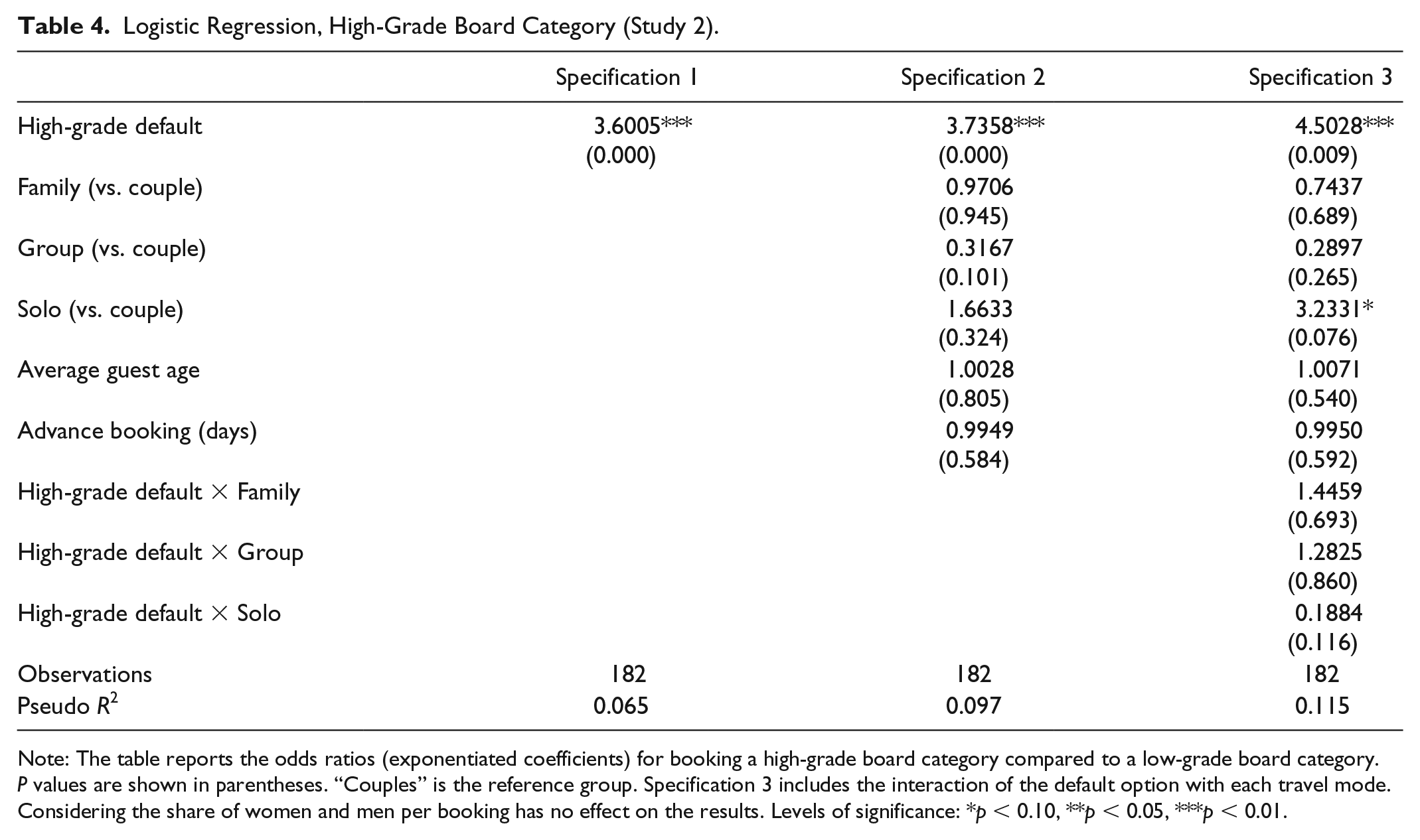
Again, the main variable of interest is Defaulti, a dummy variable indicating the high-grade versus low-grade default condition of booking i. The vector Trip’i contains control variables for the observed traveler-related characteristics of booking i, including guests’ travel mode, their average age, and the number of days between the booking date and the travel date. Table 4 reports the results of model 2.
Logistic Regression, High-Grade Board Category (Study 2).
Note: The table reports the odds ratios (exponentiated coefficients) for booking a high-grade board category compared to a low-grade board category. P values are shown in parentheses. “Couples” is the reference group. Specification 3 includes the interaction of the default option with each travel mode. Considering the share of women and men per booking has no effect on the results. Levels of significance: *p < 0.10, **p < 0.05, ***p < 0.01.
The regression results confirm the expected positive effect of the high-grade default. The odds that guests choose the high-grade board category are up to 3.7 times (or 270%) higher if the high-grade category (i.e., half-board or full-board) instead of the low-grade category (i.e., breakfast only or half-board) is set as the default. This effect persists when adding the traveler-related control variables in specification 2 of Table 4.
Regarding hypothesis 2, specification 3 further indicates that the effect of the high-grade default is related to guests’ travel mode. For couples, the odds of choosing the high-grade board category are 4.5 times higher in the high-grade default condition than in the low-grade default condition (p = 0.009). While the high-grade default is very effective for couples, solo travelers do not show a significant response (p = 0.853; p value of the interaction term = 0.116).
Because these analyses are based on a simple pretest–posttest comparison (July to October 2016 vs. July to October 2017), we are not able to rule out confounding factors in explaining the results. The major concern in the present design is seasonality—that is, the natural change in board preferences and booking behavior over time. We checked the possibility of time-related distortions by analyzing the same travel packages from January to May (the comparison period) in 2016 and 2017 and refer to the period from July to October as the treatment period. As shown in Figure A1 in Appendix C, there are no differences in board category bookings between 2016 and 2017 in the comparison period (p value of the chi-square test = 0.858). The results shown in Table A3 in Appendix C also confirm the default effect in a difference-in-difference regression analysis, including the treatment and comparison periods.
Discussion
Overall, the findings of study 2 confirm the positive effect that high-grade defaults can have in selling high-grade board categories. The results reveal a significant increase of 270% in the odds that travelers choose full- or half-board (instead of half-board or breakfast) compared to the low-grade default. For the partner company, this increase corresponds to revenue growth of approximately 4% of the total package price that can be achieved by simply setting the default on the high-grade board category.
Similar to study 1, the results also provide first indications that the effect of default options depends on the guests’ travel mode. Couples show slightly stronger reactions to high-grade defaults than solo travelers, who do not show a response. Although the interaction is statistically not significant, we presume that the default effect tends to be weaker for solo travelers, because in the study setting, they are generally more likely to book high-grade board categories. Therefore, solo travelers already comply with the high-grade choice (see specifications 2 and 3 in Table 4). This is contrary to the choice of room categories, in which solo travelers are also not influenced by high-grade defaults but have relatively low interest in superior rooms in general.
General Discussion
Theoretical Contribution
Online booking platforms provide broad, but rarely used, opportunities for the application of default options. The present studies demonstrate the benefits of high-grade defaults as a simple and cost-effective instrument for promoting high-grade travel packages. Specifically, the results indicate that high-grade defaults may be effective for promoting high-grade service categories for the core attributes of a travel package, such as board and lodging (Räikkönen and Honkanen 2013). For the choice of board categories, the results show a significant increase of up to 270% in the odds for choosing the higher available board category. This finding is in line with the existing literature that reports an increase in consumer spending when high-grade product options or add-ons are set as the default (Park, Jun, and MacInnis 2000; Levin et al. 2002; Herrmann et al. 2011). We also observe a similar, but weaker, trend in the area of room choices. A high-grade default leads to a marginally significant effect for guests traveling as couples, increasing their odds of booking a superior room.
Importantly, the effect of default options does not seem to be homogeneous across customers in different travel modes. While high-grade defaults in our studies particularly affect couples, these defaults seem not to influence the choices of solo travelers. This may be explained by two behavioral characteristics, which we observe for solo travelers in the data at hand. First, solo travelers have stronger preferences for high-grade board categories and, therefore, already comply with the default option in the area of meal choice. Second, and conversely, solo travelers have strong and stable preferences for low-grade room categories, which cannot be shifted by setting a high-grade room default. Therefore, clear preferences for either the high- or low-grade option seem to counter the default effect.
Solo travelers’ responses to high-grade defaults in the present studies reflect two general situations in which default options cannot induce behavioral change. The results suggest that default options fail when a ceiling effect occurs, meaning that the target group already conforms to the desired product option (as we observe for solo travelers in the area of board choices), or if preferences for the low-grade product option are particularly strong (as we observe for solo travelers’ room choices). These findings are in line with the assumption that consumers’ uncertainties regarding their preferences are a driving factor of the default effect (Park, Jun, and MacInnis 2000; Xiaoyu et al. 2015).
Practical Implications
For travel companies, the upselling potential that can be realized with high-grade board or room defaults seems to be economically substantial. In the study setting, raising the default is associated with a revenue increase of 4% (board default) or 1.2% (room default) for the corresponding travel packages. The use of default options is also interesting from a cost-based perspective, as switching defaults in online environments or travel brochures comes at almost no cost. This especially holds true when a product is vertically extended, and the default is set on a higher service category (e.g., a superior room instead of a standard room as the default) with the intent to upsell. In the area of travel packages, upselling is usually less cost-intensive than building new services and using defaults for cross-selling purposes. Adding day trips or car services to a travel package, for instance, may require new relationships with local business partners that can be time-intensive and costly to build.
Although default options are beneficial from a financial perspective, it is important to consider the potential downsides. Research has demonstrated that high-grade defaults can breed distrust and ultimately backfire when used as part of an attempt to mislead customers (Brown and Krishna 2004). To prevent such adverse effects, travel agencies should ensure that the default is a good choice for the majority of guests. Preset superior rooms or full-board categories may, for example, be inappropriate for city trips, where the perceived benefit of a larger room or included meals is negligible for most guests. A superior room default for honeymoon packages, however, is likely to be well accepted and effective.
Following the idea of smart defaults (Smith, Goldstein, and Johnson 2013), we propose a careful and selective use of high-grade defaults, depending on the product segment and target group. Smart defaults use customer information to create individualized default settings that are more likely to be optimal than a “one-size-fits-all” default (Smith, Goldstein, and Johnson 2013). Such smart defaults may also mitigate ethical problems that can arise from persuasive marketing techniques operating without consumers being aware of them (Thaler and Sunstein 2009). According to Smith, Goldstein, and Johnson (2013), consumers’ tendency to opt for the default is particularly problematic when preferences are heterogeneous or quite different from the default. Therefore, travel agencies should evaluate guest preferences and cost–benefit ratios before setting default options and consider the most common travel mode of their target group. Based on the present results, the proportion of solo travelers, in particular, should be taken into account.
Limitations and Future Research
Previous studies depict default options as hurting—as well as helping—consumers. Because of a potentially adverse effect, further investigation of the customer perspective would be beneficial for the effective use of default options in tourism practice. In contrast to previous studies, we did not measure how high-grade defaults are perceived or interpreted by guests or how default options influence guests’ satisfaction with the decision-making process or its outcomes. In addition, the inferences that guests make based on preselected travel categories (e.g., whether they perceive it as a recommended or most commonly booked choice) could be addressed in future studies (McKenzie, Liersch, and Finkelstein 2006).
Regarding methodology, the main limitation of this paper is that the field settings did not permit us to conduct randomized controlled trials in which we could take full account of confounding factors. In particular, it may be valuable to include additional tourist-related characteristics, such as tourist preferences or travel experience, in future analyses of the effect of defaults. Collecting a meaningful number of booking observations with complete data on various tourist-related characteristics was a major challenge in the present experiments. In study 1, for instance, the limited sample size did not allow an in-depth investigation of the default effect for all travel modes. Future field studies with longer time frames and larger data sets would allow a more comprehensive understanding of tourists’ board and lodging choices and may reveal more profound interactions between guest- or travel-related characteristics and the effectiveness of high-grade defaults.
Finally, the economic relevance of high-grade defaults for travel companies that operate in other segments than our project partners requires further research. For travel agencies that follow a niche strategy by focusing on a specific service segment and a highly individualized consulting, default options are presumably of minor importance. Increased insight into the applicability and benefits of preset choices for different types of travel or tourism companies would help promote the smart use of default options in tourism practice.
Footnotes
Appendix A
Appendix B
Appendix C
Acknowledgements
We gratefully acknowledge the cooperation and support of the two practice partners, which made this project possible.
Declaration of Conflicting Interests
The author(s) declared no potential conflicts of interest with respect to the research, authorship, and/or publication of this article.
Funding
The author(s) disclosed receipt of the following financial support for the research, authorship, and/or publication of this article: This work was supported by Innosuisse – Swiss Innovation Agency [18715.1PFES-ES].
