



Abstract
Foraging theory is a well established set of models and ideas in ecology, anthropology and behavioural psychology. Two areas of research, the behavioural ecology of consumption and information foraging, have made strides in the application of foraging theories in relation to consumption and related behaviours. These focus on online situations and restrictions in methodologies utilized allows application to only a small range of marketing problems. This paper broadens the application of these notions and introduces foraging ideas/terminology to a wider business and marketing audience by contextualizing and comparing with current research in marketing and related areas. The paper makes a number of suggestions for use of the foraging model in both academic and practitioner based environments. The paper ends with discussion of future research on the assembly and wider application of a foraging ecology model of consumer behaviour.
Introduction
Behavioural ecology and foraging theory provide a framework for answering questions about strategic feeding and consumption behaviour of animals (Stephens and Krebs, 1986), including behaviours such as search, identification, procurement, handling, utilization and digestion (Mellgren and Brown, 1987). It combines ideas from evolution, ecology and behaviour studies and has developed from a number of schools of thought (Krebs and Davies, 1997). Foraging theory has traditionally been used to study the behaviour of animals in naturalistic settings, via both quantitative and qualitative methodologies, and has been expanded to the operant experimental laboratory via behavioural psychology (termed behavioural ecology) (Williams and Fantino, 1994). In the tradition of the natural sciences the study of animal foraging behaviour has involved substantial research building precise quantitative predictions which have been tested and refined through extensive replication. Foraging theory has also been used to analyse both ancient and modern hunter–gatherer populations in anthropological settings exploring human foraging behaviour via observation (Smith and Winterhalder 1981; Winterhalder and Smith, 1981; Winterhalder, 1981; Kelly, 1995; Fitzhugh and Habu, 2003) and more recently, modern aspects of human behaviour such as the behaviour of serial killers by comparison with bees’ behaviour (Carpenter, 2008; Raine et al., 2009).
Evolutionary psychology is of central importance to foraging theory, especially the development of behaviour through a slow incremental process of variation, selection and improvement (Colarelli and Dettmann, 2003). The use of evolutionary bases to investigate the consumption behaviour of human consumers has gained attention over the last 10 years, exploring such behaviours as gendered consumption, beauty products/procedures, unethical behaviour, sexual activities, risky and conspicuous consumption, advertising responses, toy choices (Saad and Gill, 2000; Saad, 2006; Saad, 2007) gift giving (Saad and Gill, 2003), sun tanning (Saad and Peng, 2006), voting behaviour (Saad and Gill, 2000), reinforcement (Nicholson and Xiao, 2010) and more general marketing practice in line with food and marketing preferences (Colarelli and Dettmann, 2003).
Rajala and Hantula (2000) introduced the idea of foraging as a possible model of consumer behaviour, introducing initial suggestions as to the relevance of foraging as well as a specific model: behavioural ecology of consumption (BEC) (Rajala and Hantula, 2000; Hantula et al., 2001; DiClemente and Hantula, 2003a, 2003b). BEC applies mathematical models of optimal foraging theory (Stephens and Krebs, 1986) to human consumption through operant experimentation and is described as a synthesis of Darwinian theory, foraging theory and delay discounting (Hantula et al., 2008) building on the synergistic coupling between behaviour analysis and behavioural ecology (Fantino, 1985).
The BEC provides a different approach from that of Winterhalder and colleagues (who utilized an observational (quantitative and qualitative) approach) through its use of an operant perspective and experimental approach. The BEC has highlighted the potential of foraging in marketing, applying a number of foraging theories including the delay reduction hypotheses (DRH) and changeover delay (COD) to consumer online purchasing of CDs, and the marginal value theorem (MVT) to capital investing behaviour. Hantula and colleagues manipulated delay in store, temporal issues and in-stock probability to assess the time allocation of consumers and their switching behaviour within a simulated internet mall. Their research showed that consumers were sensitive to the programmed delays and that hyperbolic discount functions provide the best fit to the data. These quantitative conclusions are very similar to the work of researchers exploring animal foraging. Overall, the BEC has supported and developed a number of aspects of foraging within consumption and remains a vital and interesting approach.
However the BEC is not the only operant interpretation of consumer behaviour drawing on foraging theory. It is generally agreed that the first application of behavioural psychology to consumer behaviour was by J. B. Watson through his work at the J. Walter Thompson advertising agency (DiClemente and Hantula, 2003b). Nord and Peter (1980) considered a behaviour analytic perspective on marketing exploring the wider issue of reinforcement. Foxall and colleagues have also developed consumer behaviour analysis (CBA) research applying operant (via the behavioural perspective model) and behavioural economic (via matching – the tendency of animals and humans to distribute their responses between two choices in proportion to the patterns of reward received from each choice) principles to consumer choice patterns in fast moving consumer goods (Foxall, 2001, 2003; Hantula and Wells, 2010).
Operant methods have been extremely useful in assessing and exploring a wide range of consumer behaviours including brand choice (Foxall et al., 2007); substitutes and complements (Foxall, 1999, Romero et al., 2006; Foxall et al., 2010); price (Oliveira-Castro et al., 2005); and online behaviour (Fagerstrøm, 2010). Foxall’s work on matching states that consumers take part in patch sampling where consumers do not remain loyal to one brand/store but sample other brands/stores and rarely abandon a brand/store, but practise multi-brand purchasing. This supports the patterns exposed by Ehrenberg (1988) and helps to explain consumers’ outwardly unexpected behaviour.
Another area of exploration is information foraging (Pirolli and Card, 1999; Pirolli, 2005) which analyses information search and utilization behaviour and which developed in parallel to the work of Hantula. Pirolli suggests the importance of information scents to determine online links to follow and length spent on a particular website. Using both qualitative studies (e.g. studying a professional technology analyst and teams of MBA students [Pirolli and Card, 1999]) as well as extensive mathematical modelling (Pirolli, 2005), Pirolli and colleagues have attempted to determine the behaviour of ‘infomavores’ – those organisms hungry for information about the world and themselves (Pirolli, 2003). Information is an important part of consumers’ purchasing behaviour both as a product and also as a means to make decisions. It is certain that ‘informavores’ are within the purchasing world, especially as online purchasing and the purchase of high technology products and extensive pre-purchase search is more commonplace.
Both the study of information foraging and the work of Foxall are excellent examples of triangulation/mixed methods (Johnson et al., 2007) allowing a deeper understanding of the issue to emerge. The work of both Foxall and BEC, as is the tradition of foraging, has sought to replicate findings. Replication refines theory development and is a significant step for knowledge advancement (Easley et al., 2000; Evanschitzky et al., 2007).
To aid comparison, Table 1 summarizes the main empirical studies at the foraging consumption intersection. Only those studies that explicitly state foraging as the focus of attention are included and hence a range of studies are not included.
Summary of empirical studies at the consumption foraging intersection (in chronological order)
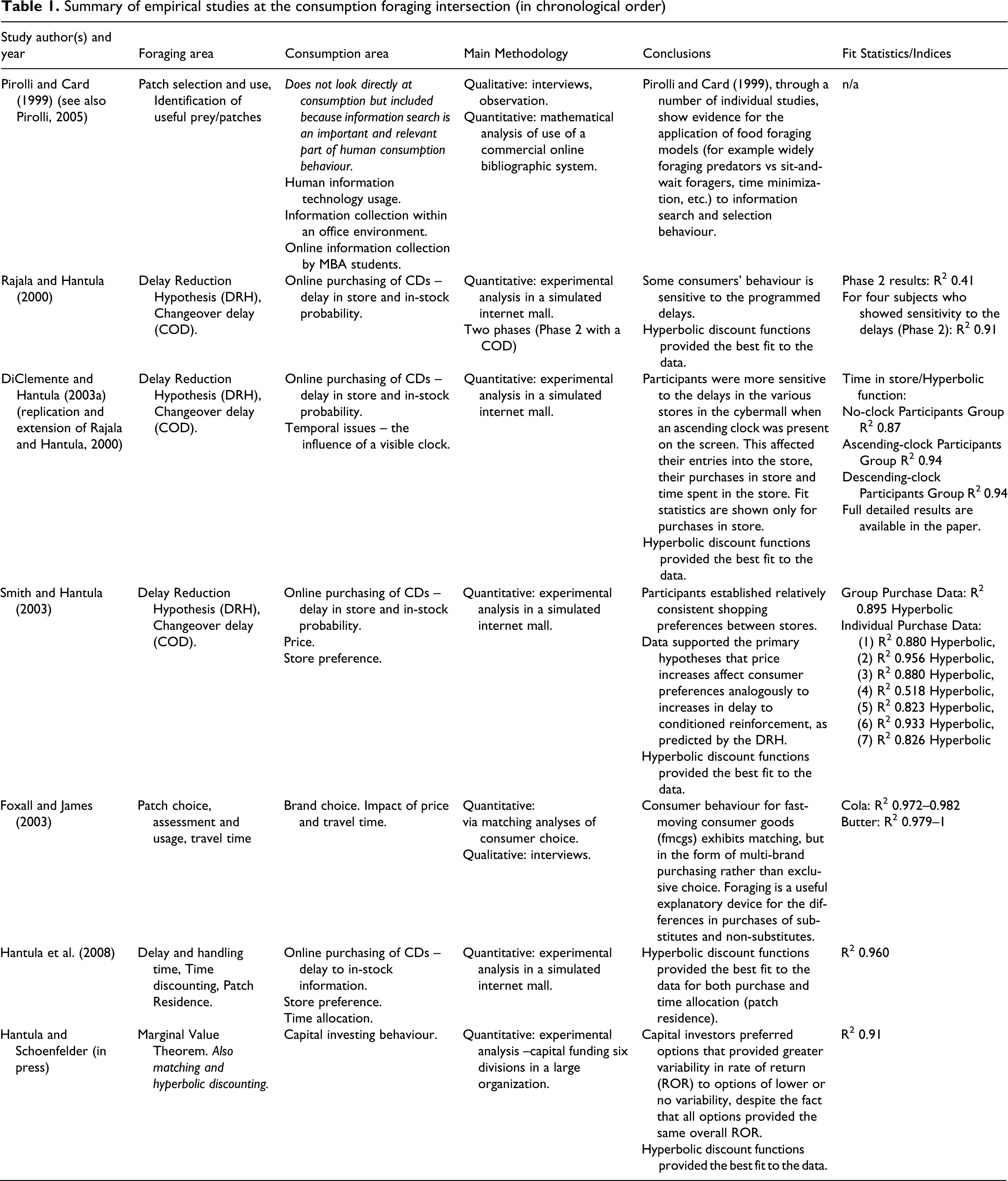
While the BEC and information foraging have established a base for a foraging analogy of consumption their focus has been, by choice and determined by their discipline, narrow. Their successful approaches allow for a wider ranging, holistic and integrative approach to a marketing/consumption foraging ecology. Rajala and Hantula (2000) and Foxall and James (2003) make a wider range of proposals for ecological aspects that could be applied to marketing; but a full assessment of this potential has not yet been made. Foraging has yet to be assessed alongside current marketing, strategy and consumer research in multiple areas and levels of consumption (for example pre-purchase, search, action and post consumption) and has not been fully and systematically assessed as a useful and realistic approach to many areas of consumer behaviour. To aid marketers, foraging terminology and theories will also need to be described in marketing terms.
Therefore, the objectives of this paper are to review research at the consumption/foraging intersection and to introduce foraging terminology and theories to a wider audience including less researched aspects of foraging, such as social foraging.
Foraging decisions
Winterhalder (1981) divides foraging into four decision sets: optimal diet breadth; optimal foraging space; optimal feeding period; and optimal foraging group size. These categories allow questions about (1) which items the forager will consume; (2) where in space the forager will seek food resources; (3) times when foraging will occur; and (4) the circumstances in which foragers will form groups. These categorizations will form the structure of the paper as these questions are as relevant for human consumption as for animals. In marketing terminology the questions determine: (1) brand and product choice; (2) retail choice; (3) temporal issues; and (4) social issues. Rashotte et al. (1987) separate foraging into two main choices – ‘within’ and ‘between’ patch choices. The suggestion is that patch choice would equate to brand/product choice (in-store choices) while between-patch choices would translate to retail choice (between store choices) (James, 2002). Figure 1 makes this comparison. Between-patch decisions relate to search, evaluation and decision/purchase. Within-patch decisions relate to decision/purchase, consumption and post-purchase behaviour.
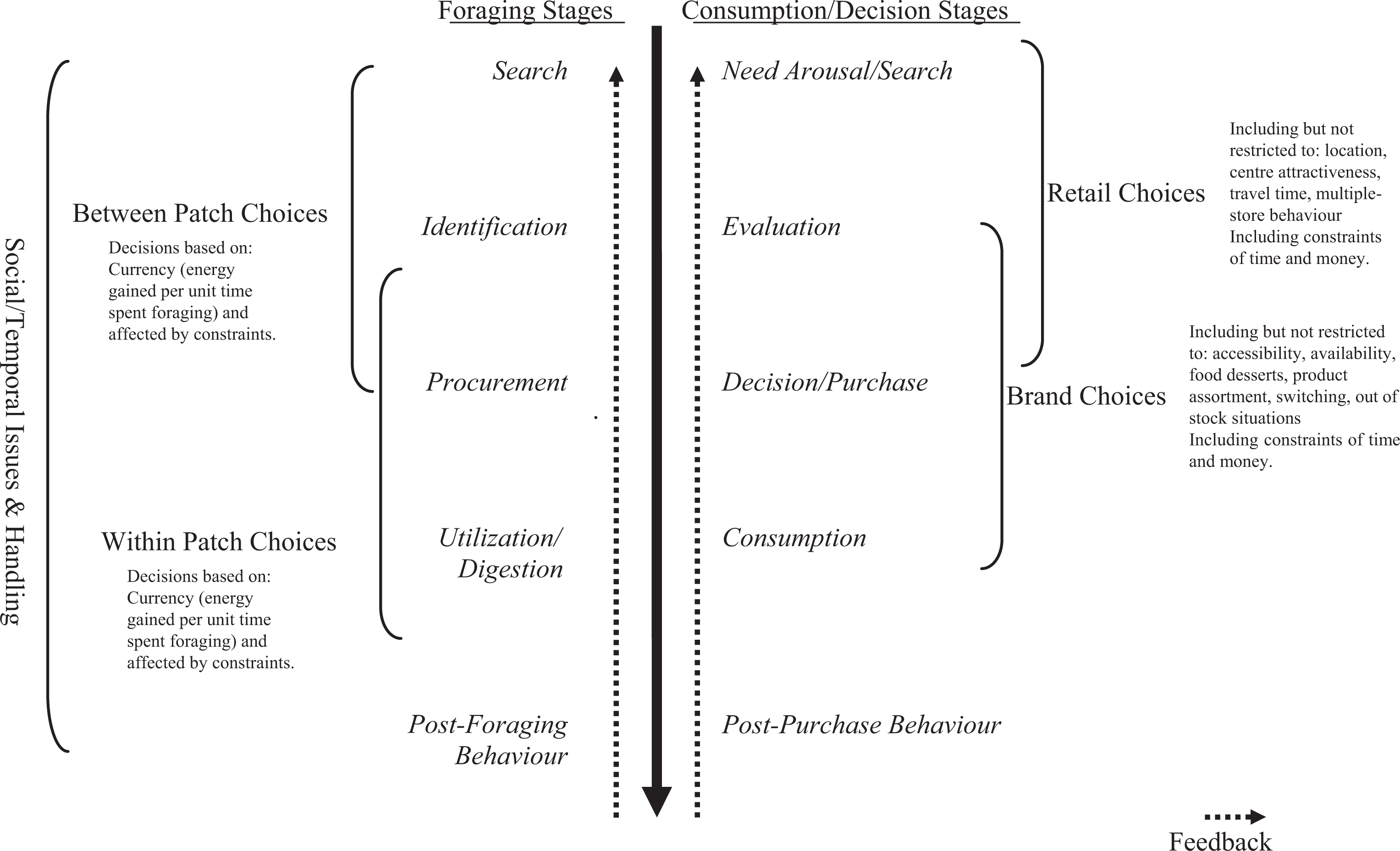
A diagrammatical comparison of foraging and traditional consumption models/theories
Social and temporal issues have an effect on both between- and within-patch decisions and so are represented across the range of decisions. Handling can also take place at all times and is also represented across the range of decisions, although it is most likely to happen at the point of decision/purchase, when for example consumers will try on a dress or test the firmness of fruit. Post-consumption behaviour, for example: disposal (Harrell and McConocha, 1992); complaining (Boote, 1998); information sharing and product evaluation (Gardial et al., 1994) are also included in the figure, as are post-foraging behaviours, for example: movement and distance away from the patch (Hoppes, 1987); perch type, seed dispersal (Chavez-Ramirez and Slack, 1994), which completes the full consumption experience.
There is extensive support for traditional theories and models in consumption, but few can comment on the whole of the consumption experience and encapsulate multiple levels of analysis. In textbooks, some authors outline the process and pay some attention to the linked nature of it, but this restricts itself to exploration and teaching at a low level. Deeper theoretical explorations have instead recently chosen to concentrate specifically and understandably on specific areas with multiple theories/studies available to consider any particular part of the consumption experience. This is changing (Hui et al., 2009) but not commonplace and some researchers are looking holistically at the whole shopping experience. A foraging ecology of consumption, as seen in Figure 1, provides the vehicle for a more holistic approach to the consumption experience using two overriding aspects (between- and within-patch choices) and two secondary aspects (social and temporal issues).
As noted, the remainder of the paper will first follow the Winterhalder (1981) classifications looking at product choice and retail choice, then going on to discuss temporal issues and social issues. The paper will end with a discussion of future research directions and conclusions.
Brand and product choice: What will the forager consume?
Consumption is the main within-patch decision and includes many of the component stages of foraging choices introduced earlier. Handling (Hantula et al., 2008: 147) ‘denotes time and energy devoted to a prey item after it has already been acquired or captured and before any energy can be derived from it’. While handling may not be a major stage within consumption behaviour it is an important one; microwave meals still need to be cooked, furniture may need to be assembled and packaging removed. In studying delay Hantula et al. (2008) describe handling as the conceptual centrepiece of consumer decision making. Each stage is important but time spent on each may differ depending on the purchase at hand. Rosati et al. (2006) found in their study on discounting that animals do not treat all temporal components of the decision-making process as equally relevant. Consumers may search extensively for a product that is risky or expensive. Recreational shoppers may search extensively (window-shop), clothes shoppers may handle the product (try it on) but never or rarely buy. Rosati et al. (2006) note that handling time is important in prey selection, with the amount of handling time being a key indicator in consumption decisions, with preferences adjusting to account for handling time especially when there are long delays. For example a consumer may prefer a piece of furniture which is already assembled and available immediately rather than one which is out of stock, especially if this delay is substantial.
In human consumption the prey could be considered the product, brand or service (Hantula et al., 2001). Foraging theory is based on the principle and goal of optimality (cost against benefit) described by Charnov (1976) as a point of view rather than a strict theory. DiClemente and Hantula (2003a) present Stephen and Krebs’s (1986) three components of optimal foraging models: decision assumptions; currency assumptions; and constraint assumptions. The first of these relates to which prey to choose and when to leave a patch and are dealt with elsewhere. The second component is currency. Within ecology the simplest and most common form of currency is the energy gained per unit time spent foraging (E/T) where energy can be a cost (energy expenditure) or a benefit (energy gained). However, currencies are as diverse as the adaptations they are used to study (Stephens and Krebs; 1986; Hantula [2012]) and include food, nesting materials, play materials or access to a mate. Within this there are both outcomes/benefits (energy) a well as inputs/costs (time) which together determine the currency (Stephens and Krebs, 1986; Shettleworth, 1988).
Any foraging model must begin by formal specification of the currency to be maximized (Winterhalder, 1981; DiClemente and Hantula, 2003) and although energy may be of some importance to human consumers, for the majority of consumption decisions, it is unlikely to be central and as with foraging animals there is a wider range of currencies that can be used. The consumer behaviour literature is full of potential currencies (both positive and negative) and determinant attributes which could be utilized and can be segmented into both outcomes and inputs. Outcomes might include pleasure (Staddon, 1980); experiential/hedonic aspects (Hirschman and Holbrook, 1982); utilitarian or informational reinforcement (Foxall, 1990); status of the product (Chao and Schor, 1998; Eastman et al., 1999); and sensation seeking (Zuckerman et al., 1978) among others. Inputs might include effort (Dall et al., 1997); monetary expenditure (Hantula, 2010); and sacrifice of time (Hantula, 2010), which could be weighted with the outcomes by the consumer (Desrochers and Nelson, 2006). As is the nature of much social science debate, no single currency has yet been, or is likely to be, determined as the best or most useful either as an outcome or an input, making determination of a single currency almost impossible. Some sort of multiple currency, or balance between particular outcomes and inputs may provide a more appropriate means of approaching this problem.
The third component, constraints, refers to factors that limit and define the relationship between currency and the decision. Within ecology constraints include the animals’ ability and tolerance (DiClemente and Hantula, 2003a); the amount of time which can be spent foraging or capacity to digest foods (Kelly, 1995); knowledge of resource distribution and perceptual constraints (Tregenza 1995). There are also constraints within consumers’ behaviour including time (Hantula, 2010); monetary expenditure (Hantula, 2010; Foxall and James, 2003); and budgets (Rhee and Bell, 2002).
Two separate themes of within-patch decision models have developed from the optimality approach, the classic prey selection models and the optimal diet model. Both approaches are similar and concern what a forager will do when it encounters items of different types and the range and variety of items that are harvested in different environmental circumstances. These models make a number of assumptions (Shettleworth, 1988) based on the idea that prey types differ in their profitability: (1) the predator is assumed to be able to recognize prey types perfectly and instantaneously (Hughes, 1979); (2) prey is included in the diet in the order of their profitability; (3) acceptance of a prey type depends not on its own abundance but on the abundance of higher-ranked types of prey (Pulliam, 1974); and finally (4) choice is all or nothing (a prey type should either always or never be attacked when encountered). The first assumption suggests a perfect knowledge, which is unlikely, but through suggested signal detection theory (Raschotte et al., 1987) the foraging situation might be more realistic. Signal detection theory suggests that ‘in some foraging situations, predators learn that certain types of feeding opportunities are signalled by the occurrence of environmental events’ (Raschotte et al., 1987: 153). The signal could be a light/noise (in the Pavlovian sense) or a discriminative stimulus (in the operant sense). In consumption terms a consumer’s reliance on brand names/marks could act as signal that the consumer will rely on rather than having perfect knowledge of every brand.
The second assumption relates to prey being consumed in order of their profitability. Consumers are likely to compare products based on their relative value (e.g. price versus quality) and they will likely purchase products with most value first, taking into account any constraints. However consumers often demonstrate inconsistent choices and Shettleworth (1988) suggests that partial preferences, rather than optimality, may in fact be the norm. Two main reasons for this are put forward: misidentification of prey, and sampling. The first suggests that there is the aim of optimality but perhaps due to a lack of knowledge or experience, incorrect choices are normal (in the consumption sense, incorrect purchases are where an incorrect purchase is defined as one that does not agree with the currency under which the consumer is operating). Sampling results in foragers trying less preferred prey because they could be potentially profitable. Long-term optimality is the aim but in the short term this optimality may be sacrificed and sampling may ‘fine tune’ preferences.
The third assumption, that acceptance depends not on its abundance but on the abundance of other prey types, concerns itself with the acceptance of food types and suggests that where there is a decrease in all food densities the less favourable food will become progressively more acceptable (Lea, 1982). Food and other consumable goods are densely available via modern retailing practices and for most consumers products that they want and need are easy to find and it is unlikely that consumers would (apart from due to other constraints) have to move to less acceptable food types. However, in other forms of consumption where the prey (product/brand) may be less available this type of behaviour may be observable. An animal cannot forage when there is no prey and similarly a consumer cannot consume an unavailable product. Consumers whose preferred products are not available will not be able to buy the product they most value and are likely to move to the product they value next. Moermond et al. (1987: 230) describe availability as ‘the relative abundance of potential food items … made up of relative detectabilities (i.e. proportion of each item usually encountered) and relative exploitabilities (e.g. ease of capture)’.
Retailers try to ensure abundance, but some products may not be available in certain seasons (fruit/vegetables) and some consumers may not always encounter products because of where they live and the shops available (Skerratt, 1999) or their unwillingness to consume within a particular store. The idea that a change of patches will allow predators to encounter a different range of prey has close parallels (Moermond et al., 1987) and simply a change in the normal supermarket chosen will result in encounters with different products and brands. The acceptance of something new, different or rarely purchased could even result in long-term improved profitability. Food availability and its effects on product choice are of interest in public health and nutrition literatures. Comparisons between the availability of nutritional versus non-nutritional foods have shown that food availability has improved throughout the UK, with the increased availability of snack foods being blamed for a lack of interest in more nutritional foods (Barratt, 1997; Pettinger et al., 2007). This behaviour could certainly fit with a foraging model that suggests prey are consumed in order of their profitability and may help determination of the consumers’ currency and/or priorities in this situation.
The final assumption is that acceptance is all or nothing. In terms of human consumption we don’t have to buy a product just because we see it. Even if it is a product we prefer, if we have just purchased it or have some stored at home, we are not likely to purchase it.
Retail choice: Where will the forager consume?
Patches are physical areas within a habitat, often well defined, in which an animal can find prey. The obvious analogue for human consumers would be physical area such as a shop or a mall (Hantula et al., 2001). The patch however, does not have to apply to definite physical boundaries and might instead form the acceptable shopping area or the shops of which the consumer is aware. For example Finn and Louviere (1990) suggest a consideration set of those retail alternatives a consumer is aware of and evaluates positively. Winterhalder (1981) suggests an optimal foraging space that may encompass a range of differing patches of different qualities.
The decision to remain and forage or leave a patch or store is an important issue (Roche et al., 1996), as is the decision to return to a patch or store after a period of time. However, current consumer research concentrates on reasons for initially choosing the retail environment, incorporating for example location (Huff, 1964; Cummins and Macintyre, 1999
Both animal and human foragers may choose to visit one patch (if this provides all they need) especially when the distances between patches are great or the patch is large enough to sustain them; but animals will also forage in multiple patches (for example this could be different parts of a woodland or different woodlands in a period of time) as humans will shop in multiple shops, even on one shopping trip. Although much shopping can be done ‘under-one-roof’ (Pettinger et al., 2007), Brooks et al. (2008) suggest that single-shop models are unrealistic and seek to probe more complex, multiple shop behaviours. They propose that trip chaining is common with between 40% and 74% of shopping trips being multiple-stop trips, depending on the type of purchase.
This type of multiple shopping trip behaviour (either on- or off-line [Lee and Tan, 2003]) can be explored using foraging work exploring patch quality and assessment and also the reasons for and patterns of switching/sampling between patches. Patches provide levels of quality (taking into account the prey available), and if a patch were never to change in quality foragers would remain in the patch and forage or return to it repeatedly. However, this type of stability is rare and many theories in this area include problems of changing quality and depletion (Roche et al., 1996). Patch assessment has received considerable attention, and as with prey models, there has traditionally been an assumption of complete knowledge which is now replaced by more sophisticated models. Foragers generally move towards efficient patch use and a requirement of knowledge and information use is often implied.
Sampling of alternatives and switching between patches is one way in which foragers collect knowledge and experience and will therefore allow a patch choice based on reasonable understanding of what each patch offers and its relative quality. Memory will play a role here, storing information about places visited and the results of those visits (Olton, 1982). Rhee and Bell (2002) describe this store-specific knowledge as a benefit and suggest that consumers will be unwilling to move stores if they lose this knowledge or have to gain new knowledge.
The most popular sampling and switching models are the MVT and giving up times theories (GUTs). MVT (Charnov, 1976) suggests that ‘the forager should stay until its rate intake in the patch falls to the average rate for the environment’ (Shettleworth, 1988: 17). This suggests that if the forager detects a patch of equal quality to the one in which it is foraging they should move to it, if only to sample. Consumers will switch to another store when the perceived benefits of doing so outweigh the costs and may explain the multiple-stop trips. Travel time, and the effort involved, will also moderate the effect of patch quality. Studies advocate that when there is a longer travel time between patches the forager will remain for longer in their present patch, demonstrating a more persistent approach (Kamil et al., 1982; Roberts, 1993; Elliffe et al., 1999). Similarly, if a consumer were to experience an out-of-stock situation while supermarket shopping then the potential travel time to another supermarket may be considerable and require car travel or public transport that may influence any decision to switch. However, where more specialist products are available in limited stores consumers may be willing to make the extra effort overcoming the potential travel time.
This balance between distance and benefits has received some attention in the literature although is not fully developed. Rhee and Bell (2002) discuss the relative inconvenience of larger distances against the accumulation of other benefits such as low prices or preferred assortments. Both the work of Hantula and Foxall can be related to switching. Hantula’s work suggests consumers will move and sample other patches to reduce delay to reinforcement while Foxall, utilizing a matching analysis, suggests that consumers would use multiple patches/prey but in relation to the comparative reinforcement offered by each alternative. In comparison, GUT presents the idea that a forager should leave a fixed time after the most recent prey capture or in consumption there would be a fixed time before a consumer would give up or try elsewhere. No consumer based literature suggests what these timings might be, their stability or relevance.
Temporal Issues: When will foraging occur?
Many of the temporal issues relevant to a foraging theory of consumer behaviour have at least been touched on in other parts of the paper. Consumption behaviour, like foraging behaviour, is distributed across time; consumers have a limited amount of time and therefore foraging like consumption is a temporal issue. Hui et al. (2009) suggest that consumers enter a shop with a shopping time budget, and time pressure to complete tasks will become greater as time reduces resulting in differing strategies at different times. Underhill (2000) highlights a number of time relevant aspects of shopping, such as the importance of waiting time, browsing time and increasing time pressure. There are a number of different foraging models that cover specific temporal issues, for example, the delay reduction hypothesis (DRH) (Fantino and Abarca, 1985) studied by the BEC (Rajala and Hantula, 2000). While there may be similarities between the timing issues animals encounter and those of human consumers, Kelly (1995) suggests that human hunters often pursue game for a longer time than do non-human predators and that techniques used by human hunters require longer pursuit times. Underhill (2000) also shows how social issues can affect how long consumers choose to shop; women with a female companion or with children shopping for significantly longer if they are alone or accompanied by a man.
Forming groups: Social issues of foraging?
Two streams of foraging research have examined the social aspects of foraging: ideal free distribution (IFD) and social foraging.
IFD theory (Fretwell and Lucas, 1970) is concerned with the distribution of individuals across a habitat and considers that the suitability of any area of the environment will be a function of the density of competitors occurring there (Tregenza, 1995). That is, the suitability of the patch will decrease with an increase in the density of individuals there. As the number of foragers increases each individual gains a smaller proportion of the number of resources, such that the forager will do better to move to a different patch. IFD theory has been applied to human group behaviour showing an approximation to the IFD (Kraft and Baum, 2001; Madden et al., 2002) although not in the consumption area.
These central ideas of IFD are directly related to crowding research (Harrell and Hurt, 1976) where crowding influences the consumers’ confidence, confuses and lowers the consumers’ mood and is related to poor layout and retail design (Dotson and Dave, 2008). While some research suggests that crowding or the resulting crushing that comes from it (Underhill, 2000) will result in the consumer’s shortening the shopping trip (and leaving the patch) there is little comparable research to suggest whether or not the consumer would then move to a less crowded patch and how this would affect their shopping success overall.
The name ‘ideal free’ comes from the idea that organisms are assumed to be ideal in their judgement of the profitability/suitability of each of the sites, and the organisms are assumed to be free to move between sites (Sutherland, 1983). Other assumptions made within IFD theory are that foragers will act to maximize foraging efficiency, have perfect knowledge and are of equal competitive ability (Kennedy and Gray, 1993). A number of the assumptions within IFD theory have been tested, considered and altered or removed by advances in the theory (Tregenza, 1995).
There has been consideration of whether all individuals are of equal competitive ability which is a frequently violated assumption within IFD. Studies have shown that better competitors are over-represented in the better sites, while poorer competitors are over-represented in the poorer sites (Kennedy and Gray, 1993). But who are better consumers? Are better consumers those who are more satisfied with their purchases or those who get more value for money? Once that is decided this assumption could be tested. The perfect knowledge assumption has also been violated many times with a perceptual constraint on an organism’s abilities to detect differences between sites (Kennedy and Gray, 1993). It is unlikely that consumers would have total knowledge of either patches or prey and it is likely that in human consumption this assumption would also be violated. James (2002) shows that while consumers have generally accurate knowledge of brands and prices this is generally restricted to those which they often buy. Whether this knowledge extends beyond the familiar is debatable.
One major alteration to the IFD theory is the addition of competition influence. This has included discussion of interference, at its lowest level simply interactions that reduce search efficiency, to the extreme of kleptoparasitism (outright expropriation of food from its finder) (Sutherland, 1983; Kennedy and Gray, 1993; Tregenza, 1994, 1995; Moody and Houston, 1995). Again this may be related to crowding (being unable to get to a product or patch) or may also be related to shopping with others. At the extreme end of the spectrum aspects of consumer misbehaviour may also affect ability to consume; for example Lovelock’s (1994) Jaycustomers who include Family Feuders, who argue with their own family or staff, and the thief who steals goods and services and will affect the availability of goods and services and also make the retail environment less pleasant for other consumers.
The second area that has received attention has been social foraging. The criterion for social foraging is that two or more individuals concurrently influence each other’s energetic gains and losses and there are identifiable, mutual relationships. Mutual dependence results from an individual’s pay-offs and penalties whether this is during the search for food or during the division of food following its discovery. Giraldeau and Caraco (2000) (see also Vickery et al., 1991; Giraldeau et al., 1994) provide the most extensive overview of research in social foraging and their work concentrates on game theory modelling rather than empirical work. This includes the study of producers and scroungers (Barnard and Sibly, 1981; Beauchamp, 2000) and information sharing models and their effects on individual intake. Giraldeau and Caraco (2000) also make the distinction between aggregation and the social group.
Aggregation would be a group of people who happen to go shopping at the same time but do not know each other; a social group would be those who choose to shop together. Consumers who choose to shop together, whether due to family ties or friendship, are likely to affect both the product (prey) and retail (choices) as well as the currency of the shopping trip. For example a consumer may value the more hedonistic and recreational aspects of shopping and may therefore choose to forage socially as they know that this will increase the fun aspects of shopping. The suggestion is that social foraging can increase foraging efficiency and enhance learning capacities. The application to consumption may be that consumers will forage for different types of products and share information (for example about a new brand/shop) or the products themselves. The resultant significant search time and effort savings may make new patches/preys easier to identify, discover and sample.
Giraldeau and Caraco (2000) also note group size and the benefits/disadvantages of exploitation of particular resources as individuals and as a group, which are areas relevant for study within consumer and retail disciplines. For example foraging theory can address questions relating to ideal group size for shopping and what specific benefits/limitations arise from shopping as a group compared to an individual (the issue of cooperative hunting may be useful here (Packer et al., 1990)). Figure 1 highlights the fact that social aspects of foraging are prevalent throughout all stages in the consumer decision-making process and will affect what and where a forager will consume. However, overall Giraldeau and Caraco (2000) suggest that social foraging theory, due to the lack of research in the area, lacks unifying themes and clear recognition of the problems.
While IFD and social foraging form the core of social foraging research, other areas have received attention and may be useful in terms of human consumption behaviour. Social learning has been used to question how organisms learn from one another (Beauchamp, 2000) and learn and share both public and private information (Valone, 1989, Leadbeater et al., 2006) and how this affects their choices. Individual consumers share information and the behaviour of information-sharing foragers could be compared to, for example, the behaviour of opinion leaders (Shoham and Ruvio, 2008) and market mavens (Feick and Price. 1987). Another potentially useful viewpoint in foraging success may be social status (Gurven and von Rueden, 2006). Consumers are well known to purchase products via conspicuous consumption; but how far does this affect their success in consumption?
While the group and social aspects of foraging have received attention this is not in the magnitude of other areas of foraging research, largely due to the limited applicability in animal foraging situations and the problems of studying social behaviour in archaeological ecology. However, in terms of advanced human consumption, social foraging is likely to be important as an explanatory variable.
Future directions
This paper proposes a conceptual model of a foraging ecology of consumption, but future work is now necessary to ascertain and cement the usefulness of the model with a number of features requiring further discussion. Currency or determinant variables are of importance in foraging both at the prey and patch levels and are perhaps the area that needs the most detailed analysis.
Any foraging model of consumer behaviour needs to determine if it is in itself suitable for all consumption or is perhaps more suited to specific types (for example BEC concentrates on online buying situations). Foraging in its ecological form is about life and death choices. If animals do not forage and successfully find and capture prey they will not survive. In some situations consumption for humans is life and death, for example where food or other resources are scarce or consumers have a low income (Ekström and Hjort, 2009). Consumers may also feel pressurized in certain situations such as sales shopping where there may be a lack of resources, greater competition and greater pressure to get value from purchases. In other consumption situations, for many consumers in westernized societies, shopping is far from a life or death situation and the consumer is not under as much pressure to buy. The theories of complex/ affluent foragers (Koyama and Uchiyama, 2002), where foraging is not just about survival, may prove a valuable viewpoint on day-to-day consumption situations. The environments in which affluent foragers exist are described as productive rather than harsh and provide a richer suite of natural resources, hence the foragers are more sedentary and a higher level of economic complexity is seen (Koyama and Uchiyama, 2002).
Related to different levels of affluence, a range of other factors could affect the predictions of a foraging model of consumption and require further exploration, including demographics, geographic and individual factors. The age and gender of a consumer will affect how they shop and the products they choose (Underhill, 2000). Whether a consumer can be categorized as a recreational or economic consumer (Bellenger et al., 1977; Williams et al., 1985; Bloch et al., 1994; Underhill, 2000) would for example affect their choices significantly. Whether the consumer is a variety seeker or a large or small basket consumer, as well as their learning history, will have distinct affects on their behaviour. As Kelly (1995) suggests, generalization is important but an understanding of the underlying variability should be studied and not masked.
Primary data collection is necessary to further facilitate a foraging model of consumer behaviour. Both the BEC and information foraging have chosen to use experiments to study the behaviour of consumers. While there has been some tension about the realism (Hantula and Bryant, 2005) and relevance of laboratory work (Fantino and Preston, 1988; Rajala and Hantula, 2000) the experimentations do reflect many aspects of the online world in which consumers are regularly engaged. The experiments use the same equipment and interfaces to perform the same tasks that consumers do anyway (Hantula, 2005). They have impact and evoke valid psychological responses, and therefore have experimental realism (Furnham, 1997), and to a certain extent demonstrate mundane realism through aspects of similarity with the real world (McDermott, 2002; Rosnow and Rosenthal, 2005) and have internal validity. However, the simplification in experimentation (for example in the BEC fewer retailers and no budgets) reduces the external validity of findings (Fantino, 1985; Fantino and Preston, 1988). Both internal and external validity have importance in any research programme and Hantula (2008) and Hantula and Schoenfelder (in press) agree that there is a need to extend the generality of the findings beyond the laboratory setting. Foxall and James (2003) is the only work to begin this process, by exploring a wider range of consumption stages and aspects using an interview methodology outside of the laboratory, although only as part of a study exploring the applicability of matching to consumer choice. Fantino (1985) suggests the results of laboratory research gain external validity if they take into account outcomes and factors that appear through field research. This paper therefore suggests a need for more field research.
It may be the case that more qualitative and a more observational approach, as well as further conceptual development, is necessary to form the basis for more quantitative work. Bloch et al. (1994) suggest that there appears to be significant opportunities to investigate the mall habitat using qualitative or phenomenological approaches such as observation, videography and in-depth interviewing. Desrochers and Nelson (2006) propose that much relevant behaviour is impossible to discover even by scanner data and a more depth approach is required. Hui et al. (2009) suggest combining shopping path data with surveys collected before or after the shopping trip and asking consumers to state their goals, etc. All of the above could assist the development of a foraging model of consumption.
Conclusion
This paper has discussed a potential foraging ecology of consumption and compares themes and theories in both foraging and traditional consumption. The foraging ecology model is especially useful because of its simplicity. Both between- and within-patch decisions base themselves on currency/determinant variables and all models and theories within foraging work result from the assumption that maximizing currency is the reason for consumption. This allows researchers to discuss both retail and brand choices of consumers in the same terminology, allowing for easier discussion and further comparison between these two central aspects.
The BEC and information foraging have taken great strides in developing understanding of specific online applications of foraging but the potential of a foraging ecology of consumption as discussed in this paper goes much further. This paper introduces the topic to a wider audience as a call for further research with particular emphasis on a more integrated approach.
If foraging can explain, or at the least help to understand, the behaviour of consumers in natural settings and across the whole of their consumption experience, an ecology model of consumer choice could highlight managerial and practitioner implications for marketers and retailers (both on and offline) as well as suppliers, retailer designers, city and regional planners and architects. Hui et al. (2009) claim that their research is the first to develop fully all aspects (the exhaustive, sequential and interrelated decisions of visit, shop and buy) of a grocery shopping path; but a behavioural ecology of consumption would provide an alternative view, an arguably simpler and more interlinked appreciation of the full shopping trip, beyond grocery shopping to all consumption decisions, through choice of location to shop and brand choice, to post-purchase behaviour. The topic also offers the possibility of a rich partnership between scholars and practising managers to achieve resonance between practice, research and theory.