




Abstract
This study proposes a model to investigate the relationship between residents’ perception of tourism’s impact on their quality of life (QoL) and their emotional solidarity toward tourists. The social exchange theory was used as a framework to explain the relationship, and structural equation modeling to assess the hypothesized model. Data for this study were obtained from survey responses of 407 residents in Macau, China, characterized by an intense tourism activity in a small territory. Results indicate that residents’ perception of tourism’s impact on four life domains (material, community, emotional, and health and safety) influences their satisfaction with the corresponding life domains. However, these domains only partially contribute to their overall satisfaction with QoL. Moreover, overall satisfaction with QoL revealed to be a significant predictor of residents’ emotional solidarity toward tourists. The findings indicate the importance of considering QoL in examining residents’ attitudes toward tourists. Implications and opportunities for further research are proposed.
Keywords
Introduction
Residents’ attitudes toward tourism has been a subject of research for several decades (Andereck and Nyaupane 2011; Woosnam 2012). The studies show the importance of involving community residents in tourism planning and development (Nunkoo and Ramkissoon 2011; Uysal et al. 2016; Woosnam 2012). The residents of the host community are the ones mostly and directly affected by tourism development (Li and Wan 2017). Meanwhile, they also play an important part in the quality of tourists’ experiences in that community (Jennings and Nickerson 2006). Therefore, understanding resident–tourist relationship, from the local residents’ standpoint, is a key element of the sustainable development of tourism destinations (López et al. 2018).
Although many studies have been conducted to examine residents’ attitudes toward tourism development in general, the study of resident–tourist relationships was considered a research gap in the literature until 2014 (Sharpley 2014). Two years before, Woosnam (2012) also highlighted that the existing literature on residents’ attitudes was not paying attention to residents’ emotional feelings toward tourists. Woosnam and his colleagues adapted the concept of emotional solidarity, originally proposed in the context of sociology, to interpret the relationship between residents and attitudes (Woosnam 2012; Woosnam and Norman 2010; Woosnam, Norman, and Ying 2009). Since then, several studies have shed light on why some residents welcome tourists warmly while other residents view them with dislike (e.g., Joo et al. 2018). In the recent growing tourism research related to emotional solidarity, important contributions have been proposed regarding its antecedents (Li and Wan 2017; Joo et al. 2018; Woosnam et al. 2014). With special interest for this study, Joo et al. (2018, p. 254) concluded that further research should consider “variables internal to residents”, including perceptions of tourism’s impacts and life satisfaction, as potential predictors of residents’ attitudes toward tourists, which were measured in their study using the emotional solidarity construct.
The concepts of individual’s satisfaction with life and perceived quality of life (QoL) have been used interchangeably in tourism research (Andereck and Nyaupane 2011; Uysal et al. 2016). The research on QoL in the tourism context has experienced a tremendous growth since 1999, after Prof. Kaye Chon’s concerted efforts to address a variety of topics on both residents’ and tourists’ QoL issues (Uysal et al. 2016). It has been concluded that the general understanding of residents’ QoL could be described as how residents view their living conditions as a tourism destination and how such conditions affect their satisfaction in different life domains and overall life satisfaction. Once a community turns into a tourism destination, the lives of the community residents are affected in various ways (Woo, Uysal, and Sirgy 2018), and it is not certain that tourism development will improve residents’ QoL (Long 1996). An increase in income contributes to residents’ QoL; however, development that fails to address noneconomic elements may degrade residents’ QoL (Jennings and Nickerson 2006). Hence, both material and nonmaterial dimensions (i.e., community, emotional, and health and safety life domains) have been repeatedly used to measure residents’ QoL (e.g., Kim, Uysal, and Sirgy 2013; Woo, Kim, and Uysal 2015; Woo, Uysal, and Sirgy 2018).
The research about the effect of tourism impacts, positive and negative, on residents’ QoL in tourism destinations has been intense (Su, Huang, and Huang 2018; Uysal et al. 2016; Woo, Uysal, and Sirgy 2018). There are also some studies about the predictive role of community residents’ QoL in their support for further tourism development (Uysal et al. 2016). However, recent research points out that this topic needs further attention (Su, Huang, and Huang 2018; Woo, Uysal, and Sirgy 2018). Other authors go further, emphasizing that QoL studies should focus not only on residents’ attitudes and support of tourism development in general but also on their attitudes toward tourists specifically (Jennings and Nickerson 2006). The current study aims to overcome this research gap.
Considering the relationship between tourism impacts in the several dimensions of QoL and overall satisfaction with QoL, this study advances the aforementioned studies on perceived QoL by analyzing the connection of this construct to residents’ attitudes toward tourists, measured through the concept of emotional solidarity. In this sense, the study extends the research conducted by Woo, Uysal, and Sirgy (2018), contributing to fill the research gap pointed out by Jennings and Nickerson (2006) and Joo et al. (2018), by testing a model that incorporates the following concepts: residents’ perceptions of tourism’s impact on several life domains, overall satisfaction with quality of life, and emotional solidarity. The social exchange theory (SET) provides the theoretical support for the relationship between these constructs, and structural equation modeling is used to empirically estimate the proposed model. This article focuses on the case of Macau (China), a city that has experienced an intense tourism growth in a small-sized territory, where residents encounter tourists on a frequent basis. For the Government of Macau, tourism planners, and policy makers, the results of this study sheds light on residents’ perceptions of QoL due to tourism activity and how it affects their attitudes toward tourists, thus contributing to a more sustainable development of this touristic city.
Theoretical Framework and Research Hypotheses
Residents’ Attitudes toward Tourism/Tourists and Emotional Solidarity
Assessing residents’ attitudes toward tourism development, specifically the perception of tourism’s impact, has been of interest to scholars for around 40 years (Andereck and Nyaupane 2011) and has proliferated recently because of the importance of community involvement for the sustainable development of the tourism industry (López et al. 2018; Nunkoo 2016; Nunkoo and Ramkissoon 2011; Uysal et al. 2016). According to a search based on three key words (residents, attitude, and tourism) through an online search tool for academic work (Web of Science 2018), a total of 810 works was found. Not surprisingly, 756 of them were published after 2001, along with the growing attention to involve community for sustainable tourism development.
In response to the surge in studies on residents’ attitude in the tourism context, several literature reviews have emerged on this topic. One of the most recent reviews has brought up some debatable arguments based on a content analysis of 62 articles (Sharpley 2014). Interestingly, the author pointed out that most studies were only concerned with residents’ attitude to tourism development as a whole (e.g., Akis, Peristianis, and Warner 1996; Draper, Woosnam, and Norman 2011; Hao, Long, and Kleckley 2011; Li and Wan 2013; Vargas-Sánchez, Porras-Bueno, and Plaza-Mejía 2014; Wang and Pfister 2008; Woo, Kim, and Uysal 2015; López et al. 2018). Similarly, Woosnam (2012) and Sharpley (2014) also underscored that the existing literature did not consider residents’ emotional feelings and attitudes toward tourists.
Emotional solidarity can be conceptualized as “the feeling of identification a person has with another person that serves to strengthen bonds between such individuals” (Woosnam 2012, p. 316). The concept was originally derived from classical sociology (Durkheim 1893), which has also been adopted in anthropology, psychology, and gerontology (Woosnam, Norman, and Ying 2009). In an effort to extend this concept into tourism research, Woosnam, Norman, and Ying (2009) carried out focus group interviews with residents in South Carolina (USA) in order to identify measurement scales for each construct under Durkheim’s framework. Later, Woosnam and Norman (2010) empirically examined the psychometric properties of the proposed scales, concluding that the Emotional Solidarity Scale (ESS) should comprise 10 items under three factors: (1) welcoming nature (e.g., residents feel proud to have tourists in the destination, feel the benefits from having tourists, appreciate tourists for their contribution to the local economy, and treat the tourists fairly); (2) emotional closeness (e.g., residents feel close to tourists and make friends with some of them); (3) sympathetic understanding (e.g., residents identify with tourists, have a lot in common with them, feel affection toward them, and understand them). Since the ESS was introduced, it has been adopted in most of the subsequent research to examine residents’ emotional solidarity toward tourists. In some studies, the three factors are considered individually (e.g., Ribeiro et al. 2017), whereas in other studies, emotional solidarity is treated as a second-order construct, measured by its three first-order factors (e.g., Suess, Woosnam, and Erul 2020; Woosnam and Aleshinloye 2012).
Although the tourism research surrounding emotional solidarity has less than a decade, the ESS has been found as a reliable psychometric measure of residents’ emotional solidarity toward tourists in various study sites: Cape Verde, India, Japan, Macau, Malaysia, Nigeria, and the United States (Joo et al. 2018; Patwardhan et al. 2019). Some studies have addressed the consequences of emotional solidarity. The most studied consequence concerns residents’ perceptions of tourism’s impacts and support for tourism development (Hasani, Moghavvemi, and Hamzah 2016; Lai and Hitchcock 2017; Li and Wan 2017; Woosnam 2012). There are also some studies about the effect of emotional solidarity on tourists’ destination loyalty (Ribeiro et al. 2017); tourists’ expenditures in the destination (Woosnam, Dudensing, and Walker 2015); tourists’ sense of security in a destination (Woosnam et al. 2015); social distance toward tourists (Aleshinloye et al. 2019; Joo et al. 2018); and support and sense of feeling safe with Airbnb (Suess, Woosnam, and Erul 2020).
Residents’ emotional solidarity toward tourists has also been considered as an antecedent construct in some studies. For example, previous studies suggest that residents with a high level of community attachment are likely to obtain a higher degree of emotional solidarity toward tourists (Li and Wan 2017). Length of residence was also identified as a positive significant predictor of residents’ emotional solidarity (Woosnam et al. 2014). Inversely, a negative relationship was found between travel distance and emotional solidarity (Joo et al. 2017). More recently, Joo et al. (2018) suggested that residents’ perceptions of tourism’s impact and their life satisfaction could also be possible predictors of residents’ attitudes toward tourists. This suggestion opens an avenue for this study to examine whether residents’ emotional solidarity can be influenced by the way in which community residents’ lives are impacted by tourism.
Tourism and Residents’ QoL
The definition of quality of life has been a contentious topic debated by many researchers since the 1960s (Woo, Kim, and Uysal 2015). Andereck and Nyaupane (2011) even underscored that there were more than 100 definitions for QoL. Despite the numerous definitions, QoL is generally understood as the individual’s satisfaction with life and feeling of fulfilment based on his or her experiences (Andereck and Nyaupane 2011). Specifically, from the standpoint of residents’ perspective in the tourism context, QoL can be referred to as how residents view their living conditions in a tourism destination and how such conditions affect their satisfaction in different life domains and their overall life satisfaction (Uysal et al. 2016). Although the elements contributing to QoL may vary from culture to culture, QoL is still considered as a universal value (Andereck and Nyaupane 2011).
The expression “quality of life” and “well-being” are used interchangeably in the tourism literature. Tourism research related to QoL focuses on its interrelationship with residents’ perception of tourism’s impacts, and has begun in the 1980s (Uysal et al. 2016). Tourism can potentially affect the living standards of the local community residing in a tourism destination positively and negatively (Andereck and Nyaupane 2011). Numerous studies suggested that tourism can result in better QoL through perceived positive impacts (e.g., Kim, Uysal, and Sirgy 2013; Roehl 1999; Yu, Chancellor, and Cole 2011), such as generating employment opportunities. Conversely, tourism can also degrade QoL through perceived negative impacts (e.g., Nichols, Stitt, and Giacopassi 2002), like traffic congestion.
Given the proliferation of research on QoL in the tourism context, Uysal et al. (2016) reviewed 36 research works on residents’ QoL and concluded three main observations. First, tourism’s impact plays a significant role in residents’ QoL, positively and negatively, as noted above. The recent study conducted by Su, Huang, and Huang (2018) supports this finding. Second, not all residents have the same perception, which may differ along different personal variables. This is supported by the recent work of Woo, Uysal, and Sirgy (2018), showing that residents affiliated with the tourism industry have more positive perceptions of tourism’s impact than those who were not. Third, residents’ attitudes and their level of QoL are likely to depend on the stage of tourism development, with most of the benefits being realized in the early stage.
QoL has also been studied as a predictor variable in tourism research. For instance, Andereck and Nyaupane (2011) examined how residents’ QoL can be a predictor of tourism’s role in the local economy. Woo, Kim, and Uysal (2015) found QoL as an effective predictor of residents’ support for further tourism development. Later, Uysal et al. (2016) argued that further research was still required to examine QoL as a predictor variable of residents’ attitudes toward tourism development. This aspect was again suggested in Su, Huang, and Huang (2018) and in Woo, Uysal, and Sirgy (2018). More recently, Ouyang, Gursoy, and Chen (2019) advanced the understanding of perceived QoL’s effects in explaining residents’ attitudinal and behavioral responses by applying the means–end theory (Gutman 1982) in tourism research. These authors showed that residents’ perceptions about the impact a specific event can have on their QoL can positively affect their support for the recurrence of that event.
While there are already some studies on QoL’s predictability, the existing QoL studies have only considered residents’ attitudes and support of tourism development in general, rather than their attitudes toward tourists specifically. Jennings and Nickerson (2006) highlighted that it is particularly important to address QoL issues because the quality of tourists’ experiences depends on a receptive host population. They suggested that there is a linkage between residents’ QoL and their reaction and interaction with tourists. This idea is in line with the suggestion of Joo et al. (2018) that residents’ perceptions of tourism’s impact and their life satisfaction as a predictor of residents’ attitudes toward tourists should be considered. This linkage has not been empirically tested yet, and it represents the research gap that this study intends to overcome.
QoL Measurement
The measurement of QoL usually has two dimensions, an objective dimension, which is external to the individual (e.g., household income), and a subjective dimension that reflects the feelings and perceptions of the individual toward various aspects (Andereck and Nyaupane 2011; Jennings and Nickerson 2006). Considering that individuals can have different perceptions of QoL even living in similar conditions, Andereck and Nyaupane (2011) suggested that QoL is best studied from the individual’s own perception. Thus, subjective indicators were adopted in our study. Different researchers have developed different indicators to measure the QoL construct. Woo, Kim, and Uysal (2015) argued the insufficiency to simply measure residents’ QoL in a unidimensional perspective. Instead, they suggested a multidimensional approach to consider how the overall life satisfaction is determined by various life domains of an individual.
Based on the review of existing literature, a variety of life domains have been used to measure residents’ QoL (e.g., Andereck and Nyaupane 2011; Kim, Uysal, and Sirgy 2013; Uysal et al. 2016; Woo, Kim, and Uysal 2015; Woo, Uysal, and Sirgy 2018). For instance, Kim, Uysal, and Sirgy (2013), Woo, Kim, and Uysal (2015), and Woo, Uysal, and Sirgy (2018) adopted four different life domains, namely, material, community, emotional, and health and safety. Material life domain is considered as one’s economic and living situation, income level, standard of living, housing, and socioeconomic status (Cummins 1996), and it is found as an undisputed domain in measuring QoL (Dolnicar, Yanamandram, and Cliff 2012). Community life domain is related to the community’s public space, facilities, and services (Puczkó and Smith 2011). The emotional life domain is associated with the fulfilment of one’s spiritual needs, including the activities that could drive such fulfilment (Woo, Kim, and Uysal 2015). Lastly, the health and safety life domain is also viewed as an uncontested element related to QoL (Dolnicar, Yanamandram, and Cliff 2012; Woo, Kim, and Uysal 2015).
The study by Kim, Uysal, and Sirgy (2013) suggested that tourism’s impact has significant influence on residents’ satisfaction with all four domains. Woo, Kim, and Uysal (2015) and, more recently, Woo, Uysal, and Sirgy (2018) adopted these four domains in their studies in the United States. They revealed that the perceived value of tourism development has a predictable effect on residents’ satisfaction with material life and nonmaterial life (comprising community, emotional, and health and safety domains). Moreover, Kim, Uysal, and Sirgy (2013) found that the satisfaction with a particular life domain, in turn, is influenced by the perceived tourism’s impact related to that domain. Accordingly, the following hypotheses are proposed by our study: Hypothesis 1: A more positive perception of tourism’s impact in the material life domain leads to a higher level of satisfaction with QoL in the material life domain. Hypothesis 2: A more positive perception of tourism’s impact in the community life domain leads to a higher level of satisfaction with QoL in the community life domain. Hypothesis 3: A more positive perception of tourism’s impact in the emotional life domain leads to a higher level of satisfaction with QoL in the emotional life domain. Hypothesis 4: A more positive perception of tourism’s impact in the health and safety life domain leads to a higher level of satisfaction with QoL in the health and safety life domain. Hypothesis 5: Residents’ satisfaction with the material life domain positively affects the level of overall satisfaction with QoL. Hypothesis 6: Residents’ satisfaction with the community life domain positively affects the level of overall satisfaction with QoL. Hypothesis 7: Residents’ satisfaction with the emotional life domain positively affects the level of overall satisfaction with QoL. Hypothesis 8: Residents’ satisfaction with the health and safety life domain positively affects the level of overall satisfaction with QoL.
Social Exchange Theory as the Study Framework
This study uses the social exchange theory (SET) as the theoretical framework to support the relationship between residents’ perceptions of tourism’s impact on their life satisfaction and their attitudes toward tourists, measured by the ESS. SET has been the predominant research framework to explain residents’ attitudes in tourism research (García, Vázquez, and Macía 2015; Nunkoo and Ramkissoon 2011; Ribeiro et al. 2017; Vargas-Sánchez, Porras-Bueno, and Plaza-Mejía 2014). From a tourism perspective, the SET theory can be defined as a sociological theory “concerned with understanding the exchange of resources between individuals and groups in an interaction situation” (Ap 1992, p. 668). Under this theory, residents’ attitudes toward tourism within their community is influenced by their evaluation of actual and perceived outcomes generated by tourism (Woo, Uysal, and Sirgy 2018). A number of studies support this theory and found that community residents are prepared to participate in an exchange with another party if they perceived that a positive net benefit will result from such exchange (e.g., Gursoy and Rutherford 2004; Nunkoo and Gursoy 2012; Nunkoo and Ramkissoon 2011; Woo, Kim, and Uysal 2015), including research in our study site—Macau (Li and Wan 2013, 2017).
The type of exchange underlying the SET, the social exchange, must be underlined, especially in the tourism field. Indeed, tourism is a social phenomenon resulting from people moving away from their regular residence and temporarily staying in another place, with hosts and guests interacting with each other and sharing the same spaces in a process that affects individuals’ perceptions, thoughts, and even lifestyles (Sharpley 2014). Moreover, from the standpoint of tourists, interactions with residents play an important role in the quality of their travel experience (Jennings and Nickerson 2006). Applying SET to our study, if residents perceive that tourism has more positive impacts on their QoL than negative impacts, resulting in increased overall satisfaction with QoL, then they will be more prone to have social exchanges with tourists. This could result in stronger emotional ties with them that would be manifested in the way they welcome tourists, have sympathetic understanding, and feel emotionally close to them (the three dimensions of EES). Thus, with the support of SET, the current study will test the impact of residents’ overall satisfaction with QoL on their emotional solidarity toward tourists by proposing the following hypothesis: Hypothesis 9: Residents’ overall satisfaction with QoL positively affects their emotional solidarity toward tourists.

Proposed model and research hypotheses.
Method
Study Site
The city of Macau is a Special Administrative Region (SAR) located on the southeastern coast of China, to the west of Hong Kong. Macau, with a land area of just 30.5 km2 (DSEC 2017) and a population of about 653,100 people (DSEC 2018a), has become increasingly popular among tourists. The recorded visitor arrivals increased from 22.9 million in 2008 to 32.6 million in 2017, comprising 17.25 million overnight visitors and 15.35 million same-day visitors (DSEC 2018b). The majority of the visitors is from Mainland China (68.1%), followed by Hong Kong (18.9%) (DSEC 2018c).
Macau is known for its casino gambling industry, which has a gross revenue, US$33.02 billion (DICJ 2017), that already surpassed Las Vegas. The city is also famous for its cultural heritage by virtue of the inscription on UNESCO World Heritage List in 2005 (UNESCO 2005). Not surprisingly, the economy of this small city is based enormously on tourism. According to WTTC (2018), 61.3% of the city’s GDP was derived from travel and tourism, which supported 213,000 jobs. With the dramatic boom and continuous growth of tourism activities, Macau residents’ QoL has been highly affected by tourism development and visiting tourists. Indeed, numerous problems were generated among the community, such as increasing crime rate, traffic congestion, pollution, energy consumption, and land use conflicts (Wan et al., 2013). Hence, it is important to understand Macau residents’ perception on QoL and its association with their attitude to tourists. On the other hand, with the high visitor resident ratio (50:1) and tourist–resident ratio (26:1) in a small territory, it is almost unavoidable for Macau residents to encounter with visitors in their daily life. This aspect makes the city an ideal place for our study.
Sampling and Data Collection
The target population of this study is the residents in Macau. Permanent residents (i.e., with minimum residency length of seven years), aged >18 years, were considered as the potential participants, in order to ensure familiarity with the changes resulting from tourism development. Considering the number of residents in Macau, a confidence level of 95% and a margin of error of 5%, the target sample size was determined to reach 384 individuals.
In western countries, systematic mail survey is a good way to apply a probability sampling method. However, because of the cultural differences, Macau residents tend not to return mail surveys as they may sense a risk to disclose their personal information linked with their residential addresses (Lai and Hitchcock 2017). Therefore, some researchers have adopted systematic phone call sampling in Macau, by choosing the respondents from a local telephone directory (e.g., Li and Wan 2013). However, with more households cutting their landline phone services (131,378 users as of January 2018 [DSEC 2018d]), the representativeness of the population of 653,100 is questionable. Conversely, the usage of Internet services has an increasing trend comprising 398,892 users as of January 2018 (DSEC 2018d). In the absence of an adequate sampling frame and to be consistent with the previous resident–tourist relationship studies in Macau (Lai and Hitchcock 2017; Li and Wan 2017), a convenience sampling method was adopted. This survey was conducted by using an online survey tool (www.google.com/forms/about/). After the survey was established, the survey link was then shared to high-traffic online forums and social media groups in Macau. The sampling was undertaken in April and May in 2018, and a total number of 415 questionnaires were collected. Out of these, eight were excluded as their length of residency was less than seven years and/or they were at the moment living abroad. Consequently, 407 usable questionnaires were employed for data analysis, accounting for 98.1% of the total sample.
Survey Instrument
For testing the hypotheses, a questionnaire was developed based on a review of the existing literature. It was initially designed in English and was then back-translated into Traditional Chinese characters, the written language commonly used in Macau. Two bilingual individuals assisted in verifying the translation to ensure the comparability. Next, the Traditional Chinese version was pilot tested using a convenience sample of five Macau residents holding a bachelor’s degree on tourism related studies. After the Traditional Chinese questionnaire was finalized, it was then established in the aforementioned online platform.
The survey instrument included questions to measure three constructs: (1) residents’ perception of tourism’s impact in four life domains; (2) residents’ level of satisfaction with four life domains and overall satisfaction with QoL; (3) residents’ emotional solidarity toward tourists. A final section inquired about sociodemographic information.
The perception of tourism’s impact on QoL and the related satisfaction level were measured with the same items under material, community, emotional, and health and safety life domains (Woo, Kim, and Uysal 2015; Woo, Uysal, and Sirgy 2018). However, the two dimensions were measured in different question settings, by asking, “How does tourism affect your life in Macau?” and “How satisfied are you with your life?” in an array of items corresponding to the life domains. A total of 26 indicators were borrowed from Woo, Uysal, and Sirgy (2018), with some minor modifications for better adaptation to the study site.
Residents’ emotional solidarity with tourists was measured in three factors (sympathetic understanding, emotional closeness, welcoming nature), by adopting the 10-item Emotional Solidarity Scale developed and refined by Woosnam and colleagues (Woosnam 2012; Woosnam and Norman 2010). Numerous researches have adopted the measurement and repeatedly confirmed the three-factor structure (Joo et al. 2018).
Data Analysis
Descriptive analysis was first undertaken to evaluate the sample’s characteristics by using SPSS 24, followed by the adoption of the partial least squares structural equation modeling (PLS-SEM) method to estimate our conceptual model by using SmartPLS 3 (Ringle, Wende, and Becker 2015). The PLS-SEM method is particularly suitable for exploratory studies, for theory development and when data do not follow a normal distribution, as in our study (tests of normality: p = .00) (Hair et al. 2014, 2018). Under PLS-SEM, the measurement model and the structural model are assessed subsequently. The relationships between the constructs and the corresponding indicators were evaluated through reliability and validity analyses of the measurement model (of first order and of second order). The two-stage approach was employed to include emotional solidarity in the model (Hair et al. 2014; Henseler and Chin 2010). Indeed, regarding hypothesis 9, we propose that residents perceiving an overall increase in their QoL will develop stronger emotional solidarity, reflected in the three dimensions of ESS. Hence, following Suess, Woosnam, and Erul (2020) and Woosnam and Aleshinloye (2012), the construct emotional solidarity was measured in our study as a reflective second-order factor. The two-stage approach was employed to include this construct in the model (Hair et al. 2014; Henseler and Chin 2010). Then, the research hypotheses were tested by examining the signal and the significance of the path coefficients in the structural model.
Results
Sample Characteristics
The demographic characteristics of our sample are summarized in Table 1. The sample comprises of slightly more females (62.9%), and is relatively young as the majority of the respondents (52.3%) were in the age group of 25–34 years. Around half of the respondents were single. The vast majority were born in Macau (83.0%) and most lived in the Macau Peninsula (79.1%), which is similar to the residential statistics in Macau (DSEC 2016). In terms of length of residency, respondents had lived in Macau for 29.4 years on average. Overall, most respondents were well educated with at least a bachelor’s degree (81.3%), were employed in the private sector (65.8%), with a monthly net income of at least MOP 20,000 (72%), which is the median earnings of the employed residents in Macau (DSEC 2018e). In comparison with the demographic statistics in Macau, the sample had a similar distribution in gender and residential area, while it tended to be younger and better educated, resembling the studies by Li and Wan (2017) and Woosnam, Aleshinloye, and Maruyama (2016) on residents’ emotional solidarity in Macau and in Nigeria, respectively.
Background Characteristics of the Sample.

Descriptive Analyses of the QoL Construct and ESS Factors
Respondents’ perception of tourism’s impact on QoL was measured on a 5-point impact scale (1 = very negatively affected and 5 = very positively affected) (Table 4). The factor grand mean of tourism’s impact on material life (M = 3.36) was the highest, followed by emotional life (M = 2.62), health and safety life (M = 2.52), and community life (M = 2.40), all between neutral and negatively affected. The more positively rated items occurred regarding the material life.
In terms of respondents’ satisfaction level under the same items, which was measured through a 5-point scale (1 = very unsatisfied and 5 = very satisfied), the factor grand mean ranked in the same way as the tourism impact. Material life satisfaction (M = 2.75) is the highest, followed by the emotional life (M = 2.68), health and safety life (M = 2.60), and community life (M = 2.57), all between neutral and unsatisfied. For the overall life satisfaction, the grand factor mean (M = 2.76) was derived from six items, on a 5-point agreement scale (1 = strongly disagreed and 5 = strongly agreed).
In relation to respondents’ emotional solidarity toward tourists, which was measured on a 5-point agreement scale (1 = strongly disagreed and 5 = strongly agreed) (Table 2), the welcoming nature factor had a higher grand mean score (M = 3.54) than those of emotional closeness (M = 3.07) and sympathetic understanding (M = 2.88). The lowest-rated items were under sympathetic understanding, namely, having a lot in common with the tourists (M = 2.59) and identifying with them (M = 2.73).
Results of the Measurement Model (Stage 1).

Note: AVE = average variance extracted.
aEach item was asked on a 5-point Likert-type scale: 1 = strongly disagreed and 5 = strongly agreed.
Measurement Assessment
In order to measure emotional solidarity as a second-order factor, the two-stage approach was adopted (Henseler and Chin 2010; Hair et al. 2014). Stage 1 intends to determine the scores for the first-order latent variables, which were welcoming nature, emotional closeness, and sympathetic understanding. This was done by estimating the model that links these constructs with the other latent variables (perception of tourism’s impact on QoL, satisfaction with the dimensions of QoL, and overall satisfaction with QoL). As shown in Table 2, individual reliability was observed for most of the indicators, obtaining factor loadings above 0.707 (Hair, Ringle, and Sarstedt 2011), with the exception of indicator SU1 (loading = 0.699). Nonetheless, this indicator was retained since its factor loading was very close to the reference value and eliminating it would not improve the model (Hair et al. 2014). In terms of composite reliability, the results show coefficients ranging from 0.880 to 0.899 (Table 2), all above the recommended value of 0.7 (Fornell and Larcker 1981).
Turning to the convergent validity, Table 2 shows that the three constructs reported an average variance extracted (AVE) higher than the cut-off value 0.5 (Hair, Ringle, and Sarstedt 2011). Furthermore, the bootstrapping t statistics show that the indicators of each first-order latent variable were significantly measuring the proposed latent variable (t > 1.96, significant at the 0.05 level or t > 2.585, significant at the 0.01 level), which also confirms convergent validity (Table 2).
Regarding the model’s discriminant validity, the Fornell and Larcker (1981) criterion was verified. Indeed, the square roots of each AVE exceeded their intergroup correlations as desired (Table 3). To further assess the discriminant validity, the heterotrait-monotrait (HTMT) ratio criterion was verified, where all HTMT ratio values were lower than the threshold value of 0.85 (Table 3). The results show that all indicators were measuring the proposed factors validly. Based on the observations, the first-order constructs obtained an overall satisfying reliability and validity.
Correlations Among Latent Variables and HTMT Ratio Values (Stage 1).

Note: AVE = average variance extracted; HTMT = heterotrait-monotrait. The square roots of the AVE are on the diagonal and shown in bold. The HTMT ratio values are indicated in parentheses.
The correlations between the constructs are shown in the lower left off-diagonal elements in the matrix.
Results of the Measurement Model (Stage 2).
Note: AVE = average variance extracted.
aFor this construct, results for PLM4. PLM5, PLM6, and PLM 7 are shown.
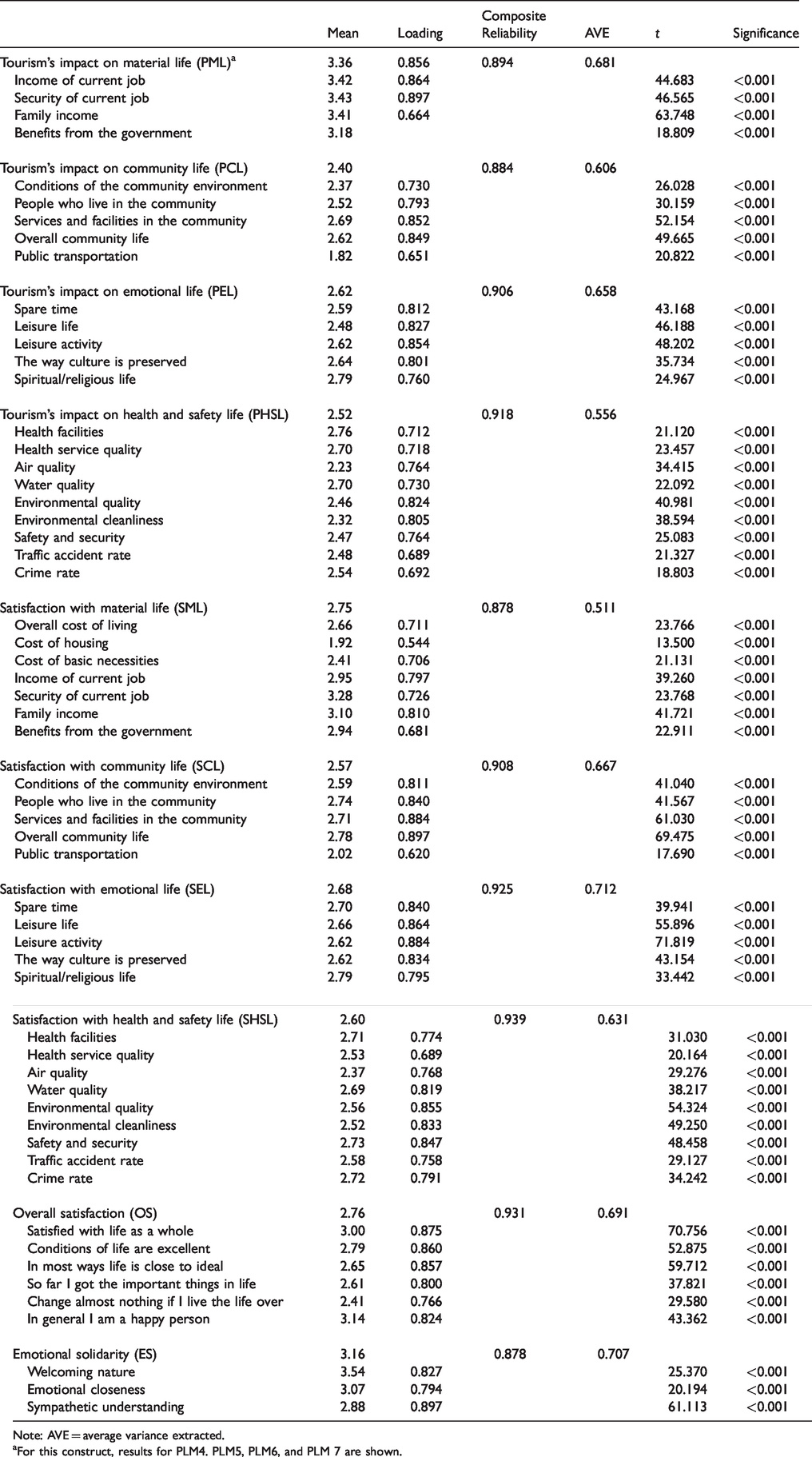
Stage 2 uses the estimated scores for the first-order constructs as measurement items to estimate the second-order factor emotional solidarity. According to the results shown in Table 4, individual reliability was observed for most of the indicators, loading appropriately on the corresponding constructs, with values above 0.707. However, three indicators of the construct Perception of Tourism’s impact on material life (PML1, PML2, and PML3) were eliminated from the model because of their loadings below the minimum acceptable value of 0.4 (Hair, Ringle, and Sarstedt 2011; Hulland 1999). The indicators PML7, PCL5, PHSL8, PHSL9, SML2, SML3, SML7, SCL5, and SHSL2 (loadings ranging from 0.544 to 0.706) were all retained as the eliminations would not improve the composite reliability of the model (Hair, Ringle, and Sarstedt 2011). Ultimately, composite reliability was verified with the results for the composite reliability coefficients (Table 4) ranging from 0.878 to 0.939, surpassing the reference value of 0.7 (Fornell and Larcker 1981).
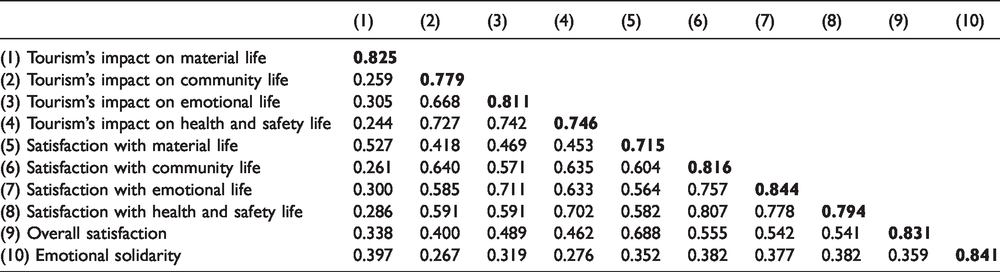
Concerning the convergent validity, the results were adequate as all AVEs (Table 4) were above the recommended cut-off of 0.5 (Fornell and Larcker 1981) and all the t statistics from bootstrapping were above 2.585 (thus significant at a 1% level). Turning to the model’s discriminant validity, almost all the square roots of each AVE exceeded their intergroup correlations as desired (Table 5), with the exception of “satisfaction with health and safety life” (SHSL). SHSL’s correlation with “satisfaction with community life” (SCL) (0.807) was higher than the square root of its own AVE (0.794). The results from the HTMT ratio criterion were also verified. All HTMT ratio values (not presented because of space limitations) were lower than the value of 0.9, as liberal criterion, yet three of them above 0.85 as conservative criterion (Henseler, Ringle, and Sarstedt 2015): SCL, SHSL, and “satisfaction with emotional life” (SEL). Therefore, the results indicated that most of the indicators were validly measuring the proposed latent variables.
Correlations among Latent Variables (Stage 2).
Structural Model
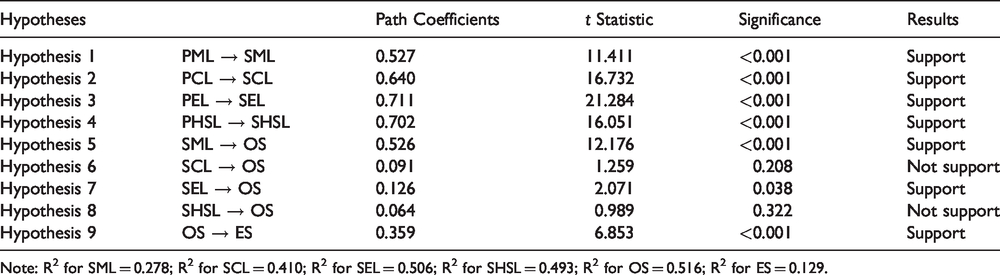
In respect of the structural model, the results are shown in Table 6. Hypotheses 1–4 were supported, with the path coefficients ranging from 0.527 to 0.711, statistically significant at the 1% level. These findings provide evidence for the strong roles that positive tourism’s impact in the four life domains (material, community, emotional, and health and safety) plays in increasing residents’ satisfaction with the corresponding life domains. Regarding the influence of the satisfaction with the four life domains on the overall life satisfaction, the path coefficient for hypothesis 5 was 0.526, significant at the 1% level, indicating the strong role played by satisfaction with material life in determining the overall life satisfaction. Unlike the satisfaction with emotional life, the path coefficient for hypothesis 7 was 0.126, significant at the 5% level; thus, its effect on overall life satisfaction was mild. Furthermore, hypotheses 6 and 8 were rejected as their path coefficients were close to zero and not significant at the 5% level. Thus, we can conclude that satisfaction with community life and health and safety life do not have a significant impact on overall life satisfaction in our study. Subsequently, hypothesis 9 was supported with the path coefficient of 0.359, significant at the 1% level, providing evidence that a higher level of overall life satisfaction was associated with higher a level of emotional solidarity toward tourists.
Result of Structural Model and Hypotheses Testing.
Note: R2 for SML = 0.278; R2 for SCL = 0.410; R2 for SEL = 0.506; R2 for SHSL = 0.493; R2 for OS = 0.516; R2 for ES = 0.129.
Discussion and Conclusions
This study is the first of its kind to link the concepts of QoL and emotional solidarity together to examine residents’ attitudes toward tourists. We attempted to measure how residents of Macau perceived tourism’s impact on their QoL and how these perceptions affected their satisfaction with QoL in four domains (i.e., material, community, emotional, and health and safety). The contributions of satisfaction in different life domains to the overall life satisfaction were also estimated, as well as the impact of the QoL construct on the ESS construct (i.e., welcoming nature, emotional closeness, and sympathetic understanding).
Overall, the results provide evidence that residents who perceived s more positive impact of tourism on their QoL report a higher level of life satisfaction, which positively affect their emotional solidarity toward tourists, expressed in the way they welcome the tourists, feel emotionally close to them, and have sympathetic understanding. On the contrary, residents who perceived a more negative impact are more unsatisfied with QoL and thus had a lower level of emotional ties with the tourists. Indeed, the findings indicated that most proposed hypotheses were supported, except the contribution of residents’ satisfaction on community life and health and safety life to overall life satisfaction (hypotheses 6 and 8, respectively). Thus, excluding these two hypotheses, our findings support the conclusion by Uysal et al. (2016) and Woo, Uysal, and Sirgy (2018) that the impact of tourism development plays an important role in residents’ QoL. The findings also support the assumption by Joo et al. (2018) that the perception of tourism’s impact and life satisfaction can be predictor variables of residents’ emotional solidarity (hypothesis 9).
Regarding hypotheses 1–4, similar to other studies, this study found that residents’ perceptions of the impacts of tourism on material and nonmaterial life domains have significant effects on their life satisfaction in the corresponding life domains (Kim, Uysal, and Sirgy 2013; Woo, Uysal, and Sirgy 2018). Regarding hypotheses 5–8, the studies of Woo, Kim, and Uysal (2015) and Woo, Uysal, and Sirgy (2018) found that residents’ satisfaction with material and nonmaterial life (comprising community, emotional, and health and safety domains) contributes to their overall life satisfaction. Our study is in line the findings by Kim, Uysal, and Sirgy (2013) that when the effect of the three nonmaterial life domains are tested separately, community and health and safety domains have no significant effects on residents’ overall life satisfaction (hypotheses 6 and 8, respectively). This is also compatible with Yu, Chancellor, and Cole’s (2011) findings that overcrowded communities and overused recreational resources by tourists have no significant effect on residents’ QoL.
More importantly, hypothesis 9 provides evidence regarding Joo et al.’s (2018) suggestion of life satisfaction’s influence on residents’ attitudes toward tourists. Based on the supportive results of hypothesis 9, respondents’ negative perception and dissatisfaction with life can help explain the low emotional solidarity scores. Moreover, among the three ESS factors, welcoming nature obtained the highest mean score. This result is commonly seen in other studies on different tourism destinations (e.g., Hasani, Moghavvemi, and Hamzah 2016; Joo et al. 2018; Lai and Hitchcock 2017; Woosnam 2011; Woosnam, Aleshinloye, and Maruyama 2016). However, the low degree of sympathetic understanding factor (below neutral) is rarely seen. More importantly, the mean scores of emotional closeness and sympathetic understanding factors have dropped by 4.7% and 9.6%, respectively, when compared to Lai and Hitchcock’s (2017) survey measuring the same items in Macau in 2015. This may be due to the continuous growth of visitor arrivals and insufficient efforts to minimize the negative impact perceived by the residents. As SET suggests, when tourism’s impact on QoL is perceived negatively (costs exceed benefits), residents may no longer show a positive attitude toward tourists (withdraw the exchange), thereby threatening the future success and sustainability of the tourism industry. This is supported by the results of our study.
Furthermore, as following, this study has both theoretical implications for academics and practical implications for the Government of Macau, tourism planners, and policy makers.
Theoretical Implications
Albeit scholars suggested that residents’ attitudes toward tourists are likely to be explained by their life satisfaction (Joo et al. 2018), the potential relationship between QoL and emotional solidarity was yet to be studied. The relevance of addressing this research gap was previously pointed out by Jennings and Nickerson (2006), who proposed that there is a connection between residents’ QoL and their reactions and interactions with tourists. Therefore, the main theoretical contribution of this study is in testing this relationship using the existing QoL and ESS scales, represented by hypothesis 9. Thus, our study provides evidence for Joo et al.’s (2018) suggestion, highlighting the utility of SET in explaining the relationship between the two constructs. As our study demonstrates, and according to SET, residents are more willing to participate in the emotional exchange when they perceive more benefits than costs derived from tourism (i.e., an improvement in their QoL). In other words, our study extends the use of SET by explaining residents’ attitudes toward tourists rather than their attitudes toward and support for tourism development as a whole, already demonstrated in previous studies (e.g., Ribeiro et al. 2017). Although the analysis of the new relationship requires further development, testing, and refinement, this is a first step toward a more precise measurement and understanding on how residents’ emotions toward tourists are influenced by the way tourism is perceived as influencing QoL.
Moreover, this study advances knowledge about the possible drivers of residents’ feeling of solidarity toward tourists, which were identified in previous research (e.g., in Li and Wan 2017), by adding a new one—overall life satisfaction, therefore contributing to research about residents’ attitudes toward tourists. In the same vein, this study advances research on tourism’s impacts on QoL—a topic approached, for example, by Ouyang, Gursoy, and Chen (2019)—by identifying a new factor that can result from it: emotional solidarity with tourists. Finally, the affirmative results of hypotheses 1–5 and 7 also contribute to tourism research by reinforcing earlier findings (e.g., Woo, Uysal, and Sirgy 2018) about the positive effect of residents’ perception of tourism’s impact on their satisfaction with QoL in four life domains, as well as the contribution of satisfaction with material life and emotional life to residents’ overall life satisfaction.
Managerial and Practical Implications
Tourism has been growing and became a vital industry in many cities, including Macau. Sustainable tourism development in these cities is conditional on the perception of the local residents (López et al. 2018). The findings of this study allow tourism planners and policy makers to better understand which factors may enhance or degrade residents’ attitude to tourists. With residents perceiving rather negative impacts from tourism, dissatisfied with their QoL, and indicating low sympathetic understanding to tourists, there are clear signs of tension between residents and tourists in Macau. In short, the current level of tourism development affects residents’ QoL negatively. Therefore, and according to hypothesis 9, residents may no longer identify with, have affection toward, and see what they have in common with tourists.
Realizing that it is nearly not possible to create residents’ emotional solidarity toward tourists (Woosnam 2011; Woosnam, Aleshinloye, and Maruyama 2016), efforts can be put in helping residents to better understand how tourism may enhance their QoL (e.g., create better job opportunities, better infrastructure, and better environmental protection), or in helping residents to avoid perceiving tourism as contributing to the degradation of their QoL. If residents perceived more positive impacts and higher satisfaction with QoL, it may ultimately translate to greater emotional ties with tourists, thus contributing to attain a more sustainable development of tourism in the destination.
Macau’s population density was reported as the highest in the world (Macau News 2016), and the surge of visitor arrivals has made the community further overstretched. In order to prevent residents from perceiving tourism as contributing to the degradation of their QoL, the Government of Macau may consider (1) being mindful when allocating resources between tourism development and public needs (e.g., land use for building hotels or public housing); (2) putting effort into managing the number of visitor arrivals in order to avoid exceeding the bottom line of the city’s carrying capacity; (3) conceiving educational campaigns that highlight the benefits of tourism to the city and the solutions that are being developed to overcome the negative impacts from tourism; (4) improving the mobility of people and vehicles in the places shared by residents and tourists, including closing critical streets to transit; (5) providing smart parking to help residents in finding parking close to tourist attractions; (6) offering more diversified tourism attractions to reduce the number of tourists visiting the most archetypal cultural heritages at the same time, thus lessening the concentration of people in these spots; and (7) monitoring the residents’ perceptions by conducting regular surveys and encouraging their involvement in tourism planning, especially in finding solutions to balance the residents and tourists’ needs.
Notably, the visitor satisfaction recorded a decline in 2017 (Macau Daily Times 2018). This may be caused, among other aspects, by the negative attitude from the residents, and/or by the degradation of QoL (e.g., poor air quality and public transportation) experienced by visitors. Therefore, it is crucial to increase residents’ QoL in order to make the destination more sustainable and competitive.
Limitations and Directions for Future Research
As with all types of research, there are potential limitations associated with this study, which also provide opportunities for future research. The first limitation is the use of an online survey instrument to collect data for the study (Cole 2005). The online respondents tend to be younger and better educated because of their familiarity with using technology (Yetter and Capaccioli 2010). Moreover, online respondents also tend to be more politically active and travel more, which can introduce some bias in the findings (Duffy et al. 2005). Therefore, the results of this study should be interpreted carefully, and future research, using more diversified (and random) samples, are recommended.
Moreover, as this study was conducted during a particular point of time, the result may not be able to reflect the full frame of residents’ attitudes (García, Vázquez, and Macía 2015). Li and Wan (2017) stressed that residents’ attitudes are dynamic. Hence, future research could consider a longitudinal approach to explore the residents’ attitudes over time. Besides, destination characteristics should also be considered. Macau is an intensely developed destination where residents’ attitudes may differ from destinations in a different culture, tourism type, and/or development stage. The result of this study may be useful for small-sized destinations with an established tourism industry, especially those seeking to have a better understanding of the residents’ attitudes in a mass tourism setting. Wherefore, more studies on residents’ attitudes toward tourists should be undertaken in different destination settings, in order to allow other destinations alike to benefit from the lessons learnt.
Additionally, this study exclusively focused on four life domains (i.e., material, community, emotional, and health and safety) that may connect with residents’ attitudes. Given that community life and health and safety life had no impact on residents’ overall life satisfaction, qualitative research is suggested to identify a more appropriate set of indicators that best suit in measuring residents’ QoL in the study site. In another respect, other life domains may also be considered in future studies.
Lastly, aside from considering residents’ emotional solidarity, future research should consider examining how QoL associates with emotional solidarity among different stakeholders, such as tourism workers’ attitudes toward tourists. It is conceivable that tourists’ satisfaction is directly influenced by local guides, restaurant servers, and hotel receptionists. If we could obtain insight into how to enhance the tourism workers’ emotional solidarity toward tourists, then a relevant contribution could be given to the sustainability of both private corporations and the destinations as a whole.
Footnotes
Acknowledgements
The authors would like to acknowledge the support provided by the Foundation for Science and Technology And the European Regional Development Fund by CRESC Algarve 2020
Declaration of Conflicting Interests
The author(s) declared no potential conflicts of interest with respect to the research, authorship, and/or publication of this article.
Funding
The author(s) disclosed receipt of the following financial support for the research, authorship, and/or publication of this article: This study was financed by National Funds provided by the Foundation for Science and Technology, through projects UIDB/04020/2020 and UIDB/04007/2020, and also through funds provided by the European Regional Development Fund by CRESC Algarve 2020, through the project SAICT-ALG/39584/2018.
