



Abstract
Despite growing interest in leisure well-being and life satisfaction, there is still limited research concerning the role of perceived financial status on leisure travel experiences. The main objective of this preregistered research is to test the prediction that satisfaction with shopping experience during leisure travel contributes to the satisfaction hierarchy moderated by financial concerns. Through two surveys of online panel members in the United Kingdom, we found that satisfaction with shopping has a positive influence on satisfaction with leisure travel, which in turn has a positive influence on satisfaction with leisure life and life overall. We also corroborated that the shopping satisfaction–leisure travel satisfaction relationship is negatively moderated by overspending on shopping during travel, while the leisure travel satisfaction–leisure life satisfaction relationship is negatively moderated by current money management stress. Finally, expected future financial security has a direct positive influence on life satisfaction overall. Theoretical and managerial implications are discussed.
Keywords
Introduction
There has been an increased research interest in the tourism and leisure literature on the leisure travel experience and its contribution to the tourists’ life satisfaction. Leisure travel experiences are known to meet a variety of travelers’ psychological needs, thus contributing to satisfaction with life overall (e.g., Chen, Huang, and Petrick 2016; Kruger et al. 2015; Uysal et al. 2016). Also, leisure travel experiences, as the representative type of experiential consumption, are known to enhance life satisfaction more persistently compared to consumption of material goods through the mediation of positive feelings occurring in anticipation of consumption and after consumption (Carter and Gilovich 2010; Kumar and Gilovich 2016; Kumar, Killingsworth, and Gilovich 2014; Nicolao, Irwin, and Goodman 2009).
More recently, scholars are beginning to study shopping activity during leisure travel and explore its consequences. Specifically, research has shown that satisfaction with shopping experiences during leisure travel contributes to the destination satisfaction, overall leisure travel satisfaction, positive word of mouth, and revisit intention (e.g., Lo and Qu 2015; Lu et al. 2015; Sharma, Chen, and Luk 2018; Sirakaya-Turk, Ekinci, and Martin 2015; Vega-Vázquez, Castellanos-Verdugo, and Oviedo-García 2017).
Meanwhile, research on financial well-being has been gaining ground given its demonstrated impact on the sense of well-being (Hamilton et al. 2019; Hoffmann and McNair 2018; Netemeyer et al. 2018). Through rigorous research, Netemeyer et al. (2018) have shown that perceived financial well-being is composed of two factors, namely, current money management stress and future financial security. Past research has demonstrated that perceived financial well-being affects decision making and consumption, interpersonal relationships, family well-being, work well-being, as well as subjective well-being (Evans 2004; Mittal and Griskevicius 2014, 2016).
Despite the strong and pervasive influence of financial concerns on life satisfaction, there is still limited understanding regarding the relationship between leisure life and financial life on overall life satisfaction. Recent statistics have shown that the average household with credit-card debt spends $2,211 per year on leisure travel while households without credit-card debt spend $3,118 annually (Stoller 2019). Although it is quite problematic that leisure travelers with financial issues are found to be unwilling to reduce leisure travel expenses significantly, one may question if they could enjoy their travel trip to the same extent as do those who are relatively free from financial worries. Research has shown that those under travel constraints do not fully recognize the benefits of leisure travel and the potential contribution to their overall life satisfaction (H. J. Chen, Chen, and Okumus 2013; C. C. Chen and Petrick 2016). Economic conditions of leisure travelers were mostly studied as a structural travel constraint that inhibits leisure travel (Nyaupane and Andereck 2008); however, there is no research uncovered concerning the interactive effects of financial well-being and leisure well-being on life satisfaction in the tourism literature. We believe that traveler’s perception of financial aspects experienced during leisure travel may moderate the impact of satisfaction with leisure life on life satisfaction overall.
The goal of this article is to report a study involving two surveys that examined the role of financial concerns in the way leisure travel experiences contribute to tourist’s life satisfaction. Specifically, we believe that financial concerns may dampen the effects of satisfaction with shopping (during leisure travel) on satisfaction with leisure travel, satisfaction with leisure life, and satisfaction with life overall. In the context of a satisfaction hierarchy, financial concerns are classified into three levels based on their level of abstractness, namely overspending on shopping during leisure travel, current money management stress, and expected future financial (in)security.
The remainder of this article proceeds as follows: First, we review past literature on tourist shopping experiences and financial concerns. Second, we develop a model to explain the impact of leisure travel satisfaction on overall life satisfaction as moderated by financial concerns. To corroborate its predictive power, this model has been preregistered, that is, published prior to data collection (https://dx-doi-org.web.bisu.edu.cn/10.23668/psycharchives.2351). Third, we present the results of two surveys of leisure travelers. Finally, in conclusion, we discuss several theoretical and managerial/policy implications.
Conceptual Development
Tourist shopping is an activity in which tourists purchase goods to take home during their travel (Jin, Moscardo, and Murphy 2017). This is different from “shopping tourism” in that purchasing goods outside of their usual environment is the major travel motive for tourists (Choi, Heo, and Law 2016). Tourists’ shopping motivation is either instrumental or expressive (Moscardo 2004). While instrumental shopping motivation is to obtain gifts, souvenirs, and other necessities during travel, the major motive underlying expressive shopping motivation involves pleasure, enjoyment, and relaxation.
Tourists’ positive shopping experiences play a critical role in influencing shopping satisfaction, destination satisfaction, and positive word of mouth (e.g., Lo and Qu 2015; Sharma et al. 2018). Shopping experiences during leisure travel may also produce adverse outcomes such as overspending. Specifically, studies (Brida and Tokarchuk 2015, 2017) grouped tourists into three categories based on the difference between their mental budget and actual expenditure (e.g., underspenders, on-budget spenders, and overspenders) and showed that overspenders tend to have a lower level of satisfaction with the shopping experience as well as the destination compared to the underspenders or on-budget spenders.
One may experience a great deal of financial anxiety when spending exceeds one’s financial means, a condition referred to as financial vulnerability. This construct is defined as the likelihood that an individual will experience financial hardship (O’Connor et al. 2019) and involves two dimensions, namely, objective and subjective financial vulnerability. Objective financial vulnerability is typically measured by objective indicators such as income, savings, insurance holdings, and debts, while subjective financial vulnerability is captured through perceptions of one’s financial status. Individuals identified as high on both objective and subjective financial vulnerability are regarded as experiencing the highest level of risk. However, studies on the relationship between financial burden and quality of life in the context of the health domain consistently have shown that subjective indicators of financial burden had a stronger effect on subjective well-being than objective indicators (J. E. Chen et al. 2018; Sharp, Carsin, and Timmons 2013). This is because one’s own assessment of financial burden may better reflect a cognitive average of financial conditions than actual money spent. An identical amount of spending could be interpreted differently among individuals. As such, the present study focuses on the subjective dimension of financial vulnerability.
Specifically, the construct of financial vulnerability of this study is based on one’s subjective interpretation of one’s financial status, and its operationalization is mostly based on Netemeyer et al.’s (2018) theory of perceived financial well-being. The central tenet of this theory is that satisfaction with financial life has a strong influence on satisfaction with life overall, and that satisfaction with financial life involves two dimensions, namely, (1) stress related to the management of money today (current money management stress) and (2) a sense of security in one’s financial future (expected future financial security). We use Netemeyer et al.’s (2018) two dimensions of perceived financial well-being and treat them as hierarchical concepts varying in their level of abstractness.
The conceptual distinction between the two domains of financial vulnerability is based partly on Maslow’s (1943) need hierarchy as it separates basic and short-term needs from higher-level and long-term needs. This distinction is also consistent with the psychological tendency to use differential information-processing strategies based on “psychological distance” (Chou, Parmer, and Galinsky 2016; Ruberton, Gladstone, and Lyubomirsky 2016). That is, people tend to think in abstract terms under a high temporal distance condition (i.e., anticipation for the future life), whereas they tend to think more concretely under a lower temporal distance condition (i.e., evaluation of current life). Therefore, current money management stress reflects a lower construal-level variable related to the current financial situation, whereas future financial security reflects a higher construal-level variable related to the future financial situation.
To establish conceptual symmetry with our satisfaction hierarchy involving three levels of abstractness, we developed a new construct coined as “overspending on shopping during recent leisure travel.” This concept is envisioned to be most concrete corresponding to the most concrete level of the satisfaction hierarchy.
Financial concerns are known to adversely affect one’s life satisfaction through reduced physical and mental health (O’Neill et al. 2005), reduced relationship quality among family members, and reduced work productivity (Williams, Haldeman, and Cramer 1996). Also, financial concerns could cause suboptimal decisions in pursuing happiness through consumption (Tully, Hershfield, and Meyvis 2015). That is, although choosing experiential goods generates more happiness than choosing material goods, consumers tend to prefer material goods given feelings of financial concerns. This may be due to anxiety expressed about consumption longevity. Consumption of material goods lasts much longer (high longevity) compared to the consumption of experiential goods (low longevity).
As shown in Figure 1, our model reflects a satisfaction hierarchy with mediating effects. This satisfaction hierarchy is based on much research in quality of life referred to as bottom-up spillover theory of life satisfaction (see in-depth discussion of this theory and supporting research in Diener 1984; Diener et al. 1999; and Sirgy 2012). The basic premise of bottom-up spillover theory is that life satisfaction is mostly determined by domain satisfaction (satisfaction with leisure life, work life, family life, social life, financial life, etc.). In turn, domain satisfaction is mostly determined by satisfaction with specific life events and concerns. In other words, concrete states of satisfaction influence abstract states (Andrew and Withey 1976; Campbell, Converse, and Rodgers 1976).
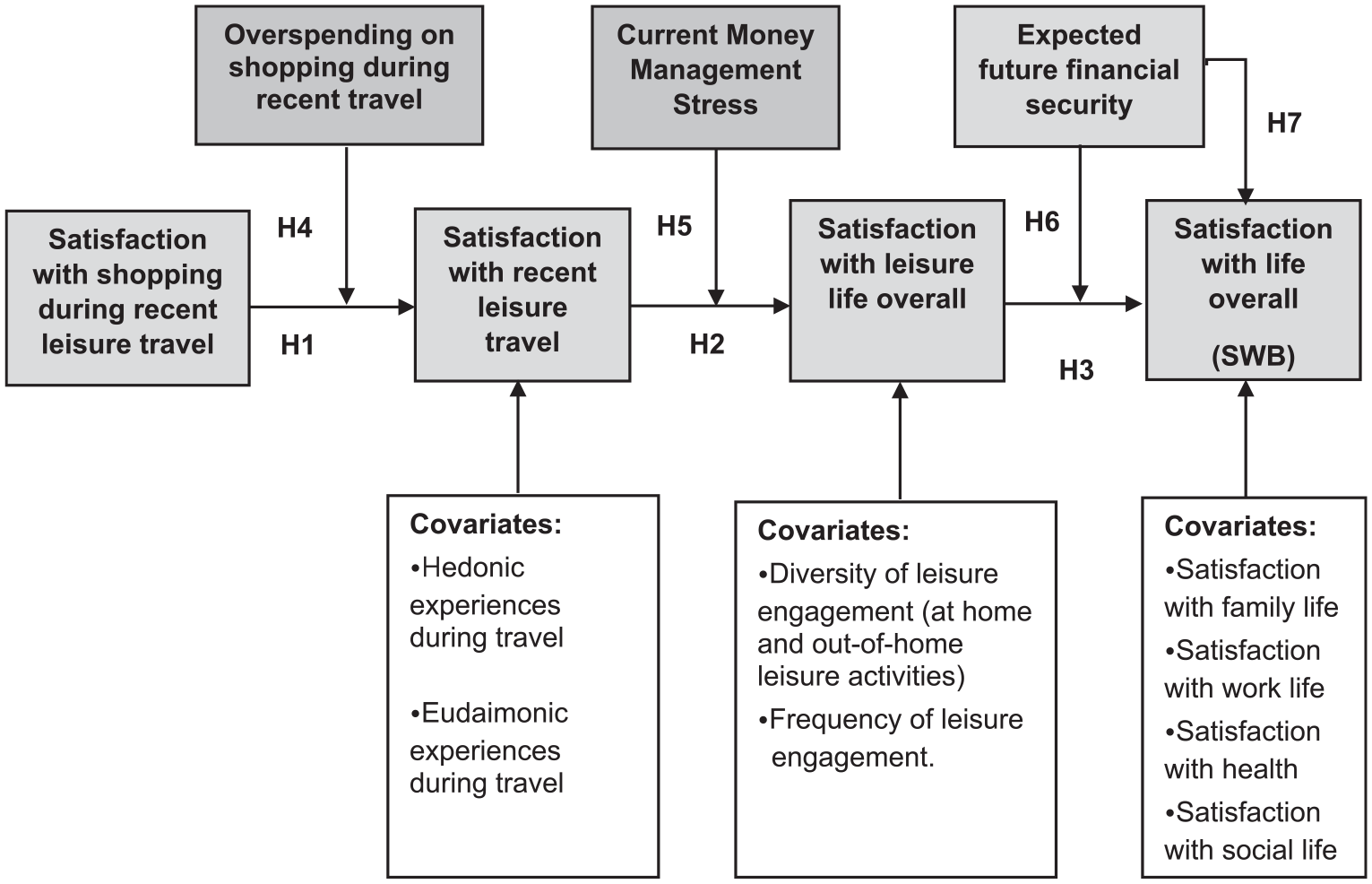
The conceptual model (preregistered).
In the context of leisure travel, satisfaction with life overall (the most abstract construct in the satisfaction hierarchy) is mostly determined by satisfaction with leisure life (as well as satisfaction with other life domains such as satisfaction with family life, work life, health, and social life—these are treated as covariates in the model; see Figure 1). In turn, satisfaction with leisure life is mostly determined by satisfaction with recent travel (as well as satisfaction with diversity of leisure activities at home and out-of-home, and frequency of leisure engagement—these are treated as covariates in the model). Furthermore, satisfaction with recent leisure travel is mostly determined by satisfaction with shopping during recent leisure travel (as well as satisfaction with hedonic activities during travel and satisfaction with eudaimonic activities during travel—these are treated as covariates in the model). Research in travel and tourism has provided much support for the satisfaction hierarchy (e.g., Neal, Sirgy, and Uysal 1999; Neal, Uysal, and Sirgy 2007). Guided by the concept of satisfaction hierarchy, we propose to test the following hypotheses.
Mediation Effects: Shopping Satisfaction, Leisure Travel Satisfaction, Leisure Life Satisfaction, and Overall Life Satisfaction
Tourist shopping satisfaction is defined as tourists’ subjective evaluation of their shopping experience during their stay in the destination (Wong and Wan 2013). Shopping seems to be the most popular leisure activity of tourists (e.g., TIA 2006). However, shopping during leisure travel is very different from regular shopping at home (e.g., Christiansen and Snepenger 2002). Not only is this limited to the fact that tourists tend to be more impulsive during travel but also that positive emotions associated with tourist activities tend to stimulate more impulse on shopping (Li, Deng, and Moutinho 2015). Shopping during leisure travel contributes significantly to satisfaction with the overall leisure travel experience (e.g., Lu et al. 2015; Sirakaya-Turk, Ekinci, and Martin 2015). In other words, tourists tend to experience satisfaction while shopping during the leisure trip, and this satisfaction plays an important role in feelings of satisfaction one has about the trip at large. Based on the discussion, we propose to test the following hypothesis:
Hypothesis 1: Satisfaction with shopping during recent leisure travel has a positive predictive influence on satisfaction with recent leisure travel.
Research in tourism has demonstrated that satisfaction with recent leisure travel does indeed have a positive effect on satisfaction with leisure life at large (e.g., C. C. Chen, Huang, and Petrick 2016; Neal, Uysal, and Sirgy 2007). Newman, Tay, and Diener (2014) introduced the DRAMMA model suggesting that satisfaction with leisure life is mostly determined by satisfaction of a set of needs:
Hypothesis 2: Satisfaction with recent leisure travel has a positive predictive influence on satisfaction with leisure life.
Research in travel and tourism has demonstrated that satisfaction with leisure life has a positive effect on satisfaction with life at large (e.g., Neal, Uysal, and Sirgy 2007; Sirgy, Uysal, and Kruger 2017; Walker and Kono 2018). Also, one’s perceived importance of leisure life domain moderates the impact of leisure life satisfaction on satisfaction with life overall. That is, the more important one’s leisure life to oneself, the bigger its impact on one’s life satisfaction. Studies show that leisure life domain is one of the most important life domains that determines one’s life satisfaction, and it is a key path to one’s well-being (Pressman et al. 2009; van Praag, Frijters, and Ferrer-i-Carbonell 2003). Liu and Da (2020) investigated the relationship between leisure and happiness through a graphic elicitation method and showed that the happiest moments were closely related to leisure time, leisure space, and leisure activities. Also, a meta-analysis indicated that leisure satisfaction is an important link in the relationship between leisure engagement and subjective well-being (Kuykendall, Tay, and Ng 2015). Based on this discussion, we propose to test the following hypothesis:
Hypothesis 3: Satisfaction with leisure life overall has a positive predictive influence on satisfaction with life overall.
Moderation Effects: Moderating Role of Financial Concerns in the Satisfaction Hierarchy
We will address moderation effects of financial concerns in the satisfaction hierarchy involving three levels, the most concrete level being the influence of shopping satisfaction on leisure travel satisfaction, the less concrete level being the influence of leisure travel satisfaction on leisure life satisfaction, and the most abstract level being the influence of leisure life satisfaction on overall life satisfaction.
Shopping satisfaction, leisure travel satisfaction, and perceived overspending
In the context of leisure travel, overspending (relative to an assumed travel budget) refers to situations in which the tourist allocates financial resources to shopping activities during a given trip and recognize that they have exceeded their allocation. This recognition occurs through a mental process known as “mental accounting” (Thaler 1985). Mental budgets have been widely studied in the context of grocery shopping, and much research suggests that consumers tend to control their spending when they shop for grocery items (Stilley et al. 2010). However, research also suggests that tourists do not exert much control on their spending in leisure travel; that is, they overspend (e.g., March and Woodside 2005; Tosun et al. 2007; Tyrrell and Johnston 2003). In other words, tourists engage in impulse buying (Li, Deng, and Moutinho 2015; Meng and Xu 2012) and this tendency is amplified under time pressure and shopping involvement (Sohn and Lee 2017). Brida and Tokarchuk (2017) categorized tourists into three categories based on the difference between their mental budget and actual expenditure (e.g., underspenders, on-budget spenders, and overspenders) and showed systematically different spending patterns among these groups. That is, while underspenders planned for the highest expenditure, overspenders planned for the lowest expenditure and their actual expenditure on average was over three times more than that of underspenders.
Given the fact that overspending reduces consumers’ satisfaction with the shopping experience (and perceived lack of self-control adversely affects one’s well-being in general), we believe that the extent to which shopping satisfaction during a leisure trip contributes to satisfaction with the overall trip is likely to be compromised by one’s recognition of their overspending (Van Ittersum, Pennings, and Wansink 2010). That is, the contribution of satisfaction with shopping on satisfaction with the overall trip is likely to decrease significantly for tourists who recognize that they overspent money on shopping during the trip compared to those who fail to achieve this recognition. Based on the discussion, we will test the following hypothesis:
Hypothesis 4: The positive effect of shopping satisfaction on leisure travel satisfaction is stronger under low than high conditions of overspending on shopping during recent leisure travel.
Leisure travel satisfaction, leisure life satisfaction, and current money management stress
Consumer studies have shown that financially constrained consumers focus more on monetary factors (e.g., price) than product-related factors, therefore they may not fully appreciate the consumption experience itself (Mullainathan and Shafir 2013). That is, because of the cognitive burden associated with financial difficulties, individuals with divided attention may not be able to focus on the experience at hand. Also, research has consistently shown that consumers with financial difficulties are more likely to think about opportunity costs and trade-offs (e.g., what they could have done differently instead of taking a leisure travel trip) (Shah, Shafir, and Mullainathan 2015; Spiller 2011). When applied to leisure travel consumption, this tendency may influence the travel experience and spillover unto leisure life in a negative way. That is, monetary stress of leisure travelers may hinder positive spillover from leisure travel satisfaction to leisure life satisfaction given the divided attention and counterfactual thinking.
Netemeyer et al. (2018) conceptualized current money management stress as feelings of being stressed and anxious about one’s current financial situation. Tourists perceiving that they are unable to manage money and unable to meet their financial obligations may underestimate the trip’s overall contribution to their leisure well-being. As such, we believe that the extent to which satisfaction with recent leisure travel contributes to satisfaction with leisure life is likely to be compromised by current money management stress. That is, the effect of satisfaction with recent leisure travel on satisfaction with leisure life is likely to decrease significantly for tourists who experience high than low current money management stress. Based on the discussion, we will test the following hypothesis:
Hypothesis 5: A positive effect of leisure travel satisfaction on leisure life satisfaction is greater under low than high current money management stress.
Leisure life satisfaction, overall life satisfaction, and expected future financial security
Expected future financial security is not only closely related to one’s perceived control over financial behaviors but also to one’s control over life overall (Strömbäck et al. 2017). This general sense of control may magnify the positive impact of domain satisfaction (e.g., leisure life satisfaction) on overall life satisfaction. Research has demonstrated that, when consumers feel generally stressed, they use their financial resources strategically to restore their sense of control by either saving more money or purchasing necessities to ensure their future security (Durante and Laran 2016). To achieve a financially secure future, the consumer must enhance her or his financial capability, which entails financial literacy, financial self-efficacy, and desirable financial behavior (Xiao, Chen, and Chen 2014). Netemeyer et al. (2018) conceptualized expected future financial security as a perception of having financially secure future meeting future financial goals. Using the same line of reasoning in relation to hypotheses 4 and 5, one can argue that expected future financial security is likely to moderate the predictive effect of satisfaction with leisure life overall on satisfaction with life overall. Specifically, the contribution of leisure satisfaction to life satisfaction is likely to be amplified under conditions of high than low expected future financial security. Based on the discussion, we will test the following hypothesis:
Hypothesis 6: A positive effect of leisure life satisfaction on life satisfaction overall is stronger under high than low conditions of expected future financial security.
Financial Security and Overall Life Satisfaction
Much research has demonstrated that satisfaction with financial life plays an important role in satisfaction with life overall (e.g., Andrews and Withey 1974; Campbell, Converse, and Rodgers 1976; Xiao, Tang, and Shim 2009; also see literature review in Sirgy 2018). One can argue that expression of satisfaction with financial life is likely to be mostly based on perceptions of having a financially secure future meeting future financial goals. Also, having a financially secure future means that one has a high level of control to mitigate potential financial threats (Durante and Laran 2016). Therefore, perceived financial security based on one’s ability to control potential financial threats and to pursue financial goals should positively influence their life satisfaction. Based on the discussion, we will test the following hypothesis:
Hypothesis 7: Expected future financial security has a positive effect on satisfaction with life overall.
The conceptual model is shown in Figure 1. As shown in the figure, satisfaction with recent leisure travel is hypothesized to be influenced directly from satisfaction with shopping during recent leisure travel, in addition to a host of covariates such as satisfaction with hedonic and eudaimonic activities during travel. The extent to which satisfaction derived from shopping contributes to overall satisfaction with the trip is likely to be dampened by overspending in shopping during the trip.
Satisfaction with the trip overall, in turn, should contribute to satisfaction with leisure life overall, in addition to a host of covariates such as diversity of leisure engagement (at home and out-of-home leisure activities), and frequency of leisure engagement. However, the effect of satisfaction with the trip on satisfaction with leisure life is likely to be adversely affected by current money management stress. That is, the higher the stress, the weaker the trip satisfaction effect on leisure life satisfaction.
In turn, satisfaction with leisure life should contribute to the overall life satisfaction, in addition to a host of other covariates such as satisfaction with family life, work life, health life, social life, etc. However, the extent to which satisfaction with leisure life contributes to overall life satisfaction is likely to be amplified by expected future financial security. Expected future financial security should also play a direct positive role on overall life satisfaction.
Method
This study used preregistration of the theoretical model being tested. A preregistration involves the reporting of the study hypotheses and analysis plans before collecting and analyzing data. This practice is now gaining increasing attention in social science journals (Nosek et al. 2018, 2019; Wagenmakers et al. 2018). Preregistration separates hypothesis-testing (confirmatory) from hypothesis-generating (exploratory) research. As such, this practice serves to improve the quality, transparency, and credibility of research (Nosek et al. 2018). The practice also contributes to improvements in the replication of findings by minimizing hindsight bias.
In this study, preregistration took place on January 10, 2019, and data collection followed between February 16 and 22, 2019. The preregistered conceptual model was tested through an online survey administered to a UK-based sample of a survey panel operated by ZPID–Leibniz Institute for Psychology Information located in Trier, Germany (https://leibniz-psychology.org/en/). The UK survey panel is composed of 50,000 representative panel members whose average response rate is 30%. In the recruiting process, a survey invitation e-mail was randomly distributed to the members, and only those who have engaged in leisure travel in the last six months either to domestic regions or foreign countries were surveyed (17.2% packaged group tour, 82.8% self-guided tour). That is, respondents without leisure travel experience were automatically screened out. Also, as we used quota sampling based on age and gender, respondents were unable to participate in our survey once the assigned portion for a specific group had been completed. The sample size was determined based on the number of variables and statistical power considerations (Hoogland and Boomsma 1998; MacCallum, Browne, and Sugawara 1996).
The demographic profile of respondents in this study is shown in Table 1. As shown in the table, respondents were equally distributed in terms of age (20s, 30s, 40s, 50s, and 60s) and gender. Also, there is a great deal of variability in their occupations.
Sample Characteristics (N = 500).
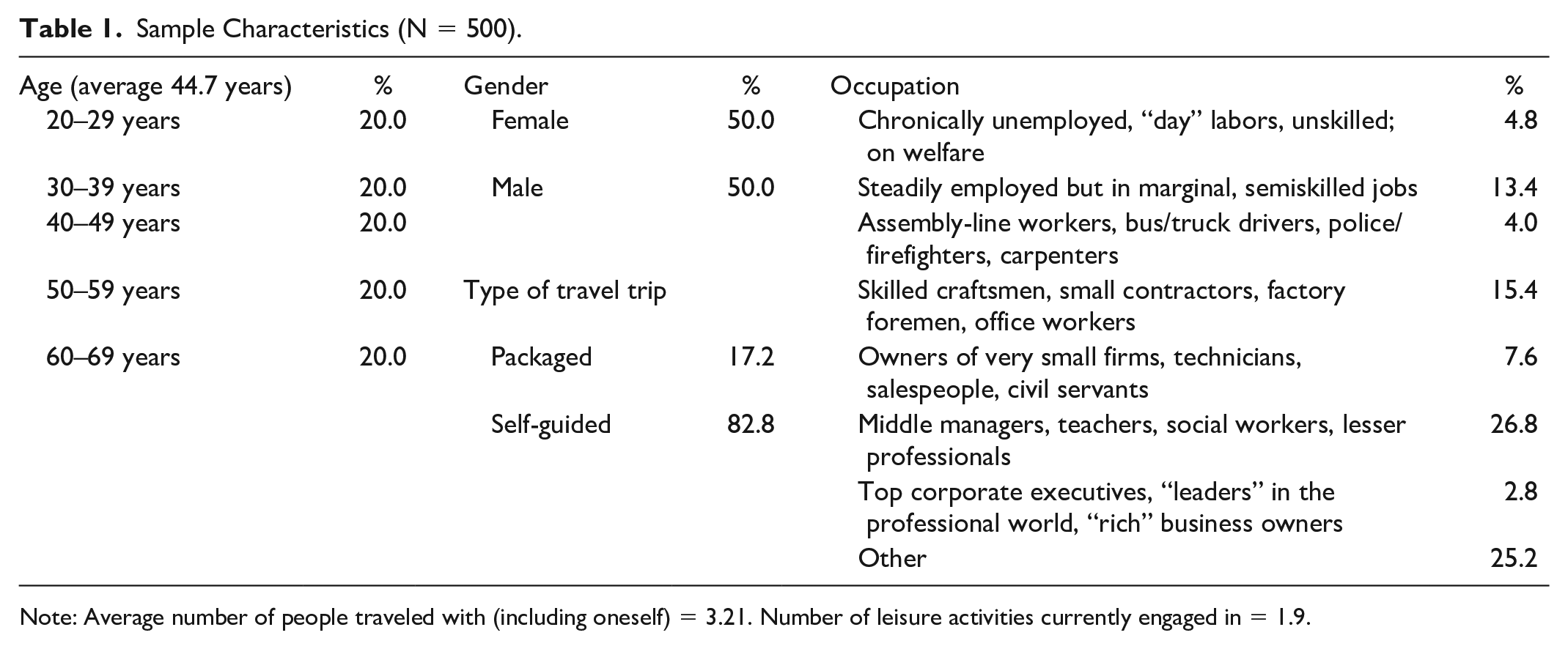
Note: Average number of people traveled with (including oneself) = 3.21. Number of leisure activities currently engaged in = 1.9.
Constructs and Measures
See all the measurement items in the online Appendix. Respondents were asked to answer questions about their recent leisure travel experiences in the following order.
Satisfaction with shopping
Satisfaction with shopping was measured by Wong and Wan’s (2013) tourist shopping satisfaction measurement, which contains four aspects: (1) service, product and environment, (2) staff service quality, (3) merchandise value, and (4) service differentiation. Responses to the items were captured on 5-point satisfaction scales with “not at all satisfied” (1) to “very satisfied” (5). See measurement items in the online appendix.
Overspending on shopping during recent travel
This construct was measured by adapted measures from Sotiropoulos and d’Astous (2013). Examples of survey items include: “I spent more during the trip (than before or after the trip)” and “I was less concerned with the price of products during the trip.” Survey responses were captured on 5-point Likert scales from “completely disagree” (1) to “completely agree” (5). See measurement items in the online Appendix.
Satisfaction with recent leisure travel
Satisfaction with recent leisure travel was measured using the Neal, Sirgy, and Uysal’s (1999) satisfaction with leisure travel measure. An example of survey items includes: “All in all, I feel that this trip has enriched my life. I’m really glad I went on this trip.” Survey responses were captured on 5-point Likert scales: from “completely disagree” (1) to “completely agree” (5). See measurement items in the online Appendix.
Satisfaction with leisure life
Satisfaction with leisure life was measured by an adapted measure from Walker and Kono (2018). The measure is essentially one item: “How satisfied are you, all in all, with your leisure life?” and responses were captured on a 5-point satisfaction scale varying from “not at all satisfied” (1) to “very satisfied” (5). See measurement items in the online Appendix.
Satisfaction with life overall
The Satisfaction with Life Scale (Diener et al. 1985) was used to capture this construct. The measure involves five items, and responses were captured on 5-point Likert scales from “completely disagree” (1) to “completely agree” (5). Examples of the items include “The conditions of my life are excellent” and “I am satisfied with my life.” The prompt read as follows: “Please try to recall how you felt about your life one month after the trip by responding to the following items.” See measurement items in the online Appendix.
Current money management stress
Netemeyer et al.’s (2018) measure of current money management stress was used to capture this construct. This measure involves five items and examples include “Because of my money situation, I feel I will never have the things I want in life” and “My finances control my life.” Responses were captured on rating scales varying from “does not describe me at all” (1) to “describes me completely” (5). See measurement items in the online Appendix.
Expected future financial security
Netemeyer et al.’s (2018) measure of expected future financial security was used to capture this construct. This measure involves five items including “I am becoming financially secure”; “I will achieve the financial goals that I have set for myself.” Responses were captured on rating scales varying from “does not describe me at all” (1) to “describes me completely” (5). See measurement items in the online Appendix.
Results
Testing the Measurement Model
To examine the psychometric properties of the measures used in this study, we assessed the convergent and discriminant validity of the constructs by conducting a confirmatory factor analysis (CFA) (see Table 2). Results showed that there is a good fit to the data, χ2 (p value) = 598.520 (0.00), df = 209; comparative fit index (CFI) = 0.945, goodness of fit index (GFI) = 0.909, normed fit index (NFI) = 0.918, root mean square error of approximation (RMSEA) = 0.059, and that all factor loadings are highly significant, composite reliabilities of all constructs are greater than 0.729, and all variance extracted estimates are greater than 0.692. In sum, these results demonstrate adequate evidence of convergent validity and reliability of the measures (cf. Fornell and Larcker 1981).
Confirmatory Factor Analysis.
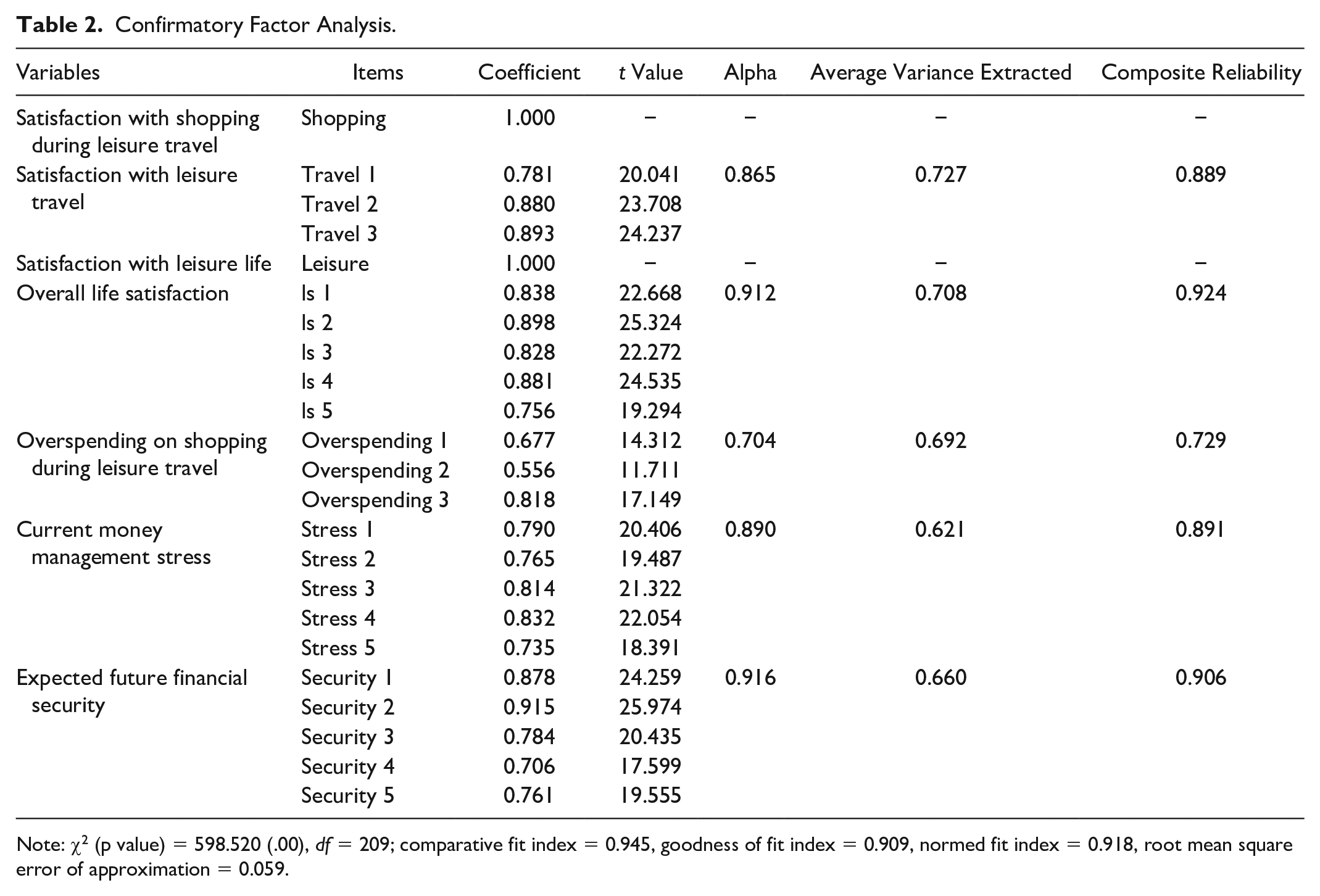
Note: χ2 (p value) = 598.520 (.00), df = 209; comparative fit index = 0.945, goodness of fit index = 0.909, normed fit index = 0.918, root mean square error of approximation = 0.059.
Regarding discriminant validity, the guidelines mandate that the square root of the AVE of each construct be larger than the correlation of the specific construct with any of the other constructs in the model (Chin 1998). Table 3 shows that the squared root of the AVE for each construct was greater than the off-diagonal elements in the corresponding rows and column, demonstrating discriminant validity (see Table 3).
Correlations among the Constructs (Phi Matrix).
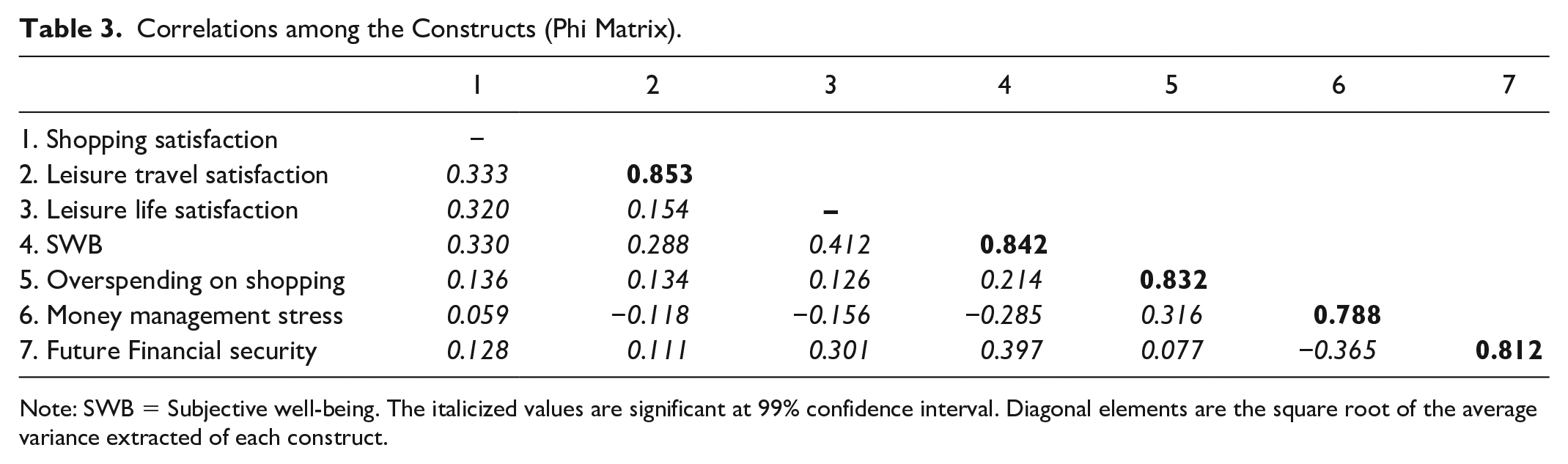
Note: SWB = Subjective well-being. The italicized values are significant at 99% confidence interval. Diagonal elements are the square root of the average variance extracted of each construct.
Test of Common Method Bias
As all the data were based on self-report, there is a possibility of common method bias. Following Cote and Buckley (1987), we tested for the potential of common method bias. Three models were estimated. M1 was the method-only model in which all items were loaded on one factor (χ²(230) = 4,564.530, p = .000; CFI = 0.386, GFI = 0.476, RMSEA = 0.230); M2 was a trait-only model in which each item was loaded on its respective scale (χ²(209) = 598.520; CFI = 0.945, GFI = 0.909, RMSEA = 0.059); M3 was a trait and method model in which a common factor linking to all the measurement items was added into M2 (χ²(181) = 578.894; CFI = 0.944, GFI = 0.910, RMSEA = 0.066). Comparing these three models, M3 and M2 showed much better fit than M1 to the data, and the fit of M3 is not significantly better than that of M2 given the difference in degrees of freedom. This shows that the trait rather than the common method factor explains most of the variance. These results provide sufficient evidence that common method bias is not a significant threat in this study.
Hypothesis Testing (The Preregistered Model)
We tested the preregistered hypotheses using structural equations modeling. The results indicate a good fit to the data, χ2 (p value) = 442.900 (0.00), df = 86, CFI = 0.929, GFI = 0.896, NFI = 0.914, RMSEA = 0.090, and are summarized in Table 4.
Path Analysis Results.
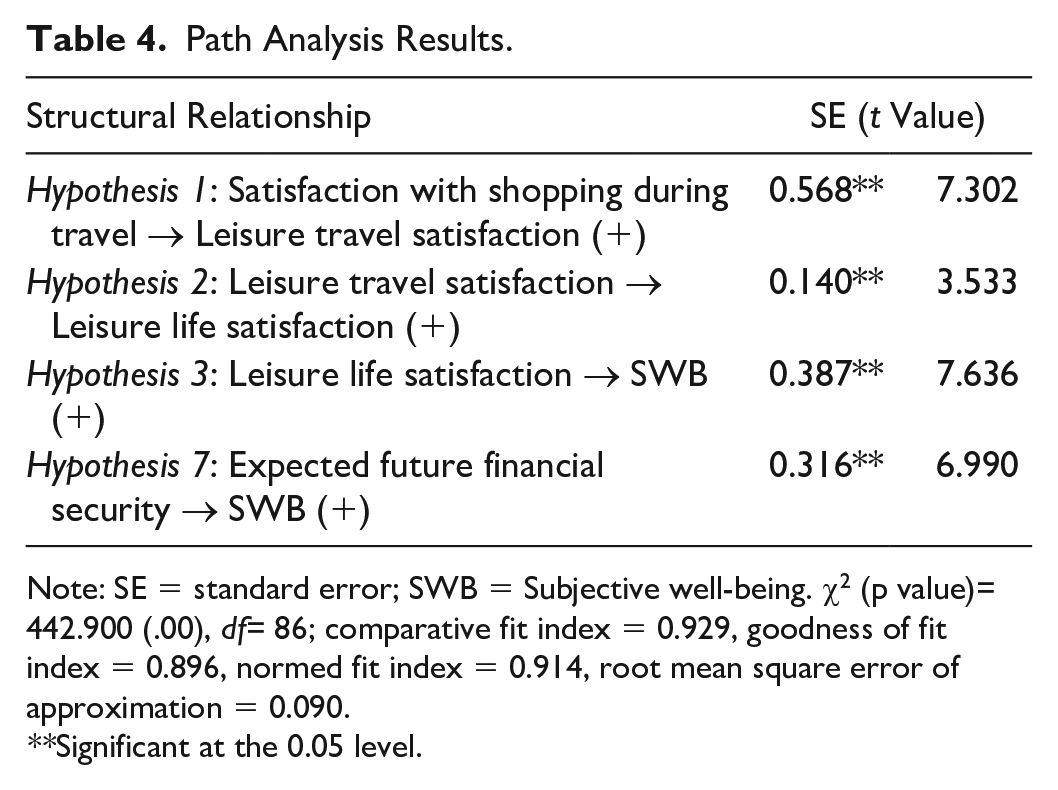
Note: SE = standard error; SWB = Subjective well-being. χ2 (p value)= 442.900 (.00), df= 86; comparative fit index = 0.929, goodness of fit index = 0.896, normed fit index = 0.914, root mean square error of approximation = 0.090.
Significant at the 0.05 level.
Hypothesis 1 states that satisfaction with shopping during leisure travel is a positive predictor of leisure travel satisfaction. The results indicate that satisfaction with shopping during leisure travel had a positive predictive impact on leisure travel satisfaction (standardized path estimate = 0.568; p < .05). This result supports hypothesis 1.
Hypothesis 2 states that leisure travel satisfaction is a positive predictor of leisure life satisfaction. The results indicate that leisure travel satisfaction has a positive predictive influence on leisure life satisfaction (standardized path estimate = 0.140; p < .05), supporting hypothesis 2.
Hypothesis 3 states that leisure life satisfaction is a positive predictor of overall life satisfaction. The results indicate that leisure life satisfaction has a positive predictive influence on leisure travelers’ life satisfaction (standardized path estimate = 0.387; p < .05), supporting hypothesis 3.
Hypothesis 4 states that the satisfaction with shopping during leisure travel–leisure travel satisfaction relationship is negatively moderated by overspending during shopping. Moderated regression analysis with mean-centered variables was conducted to test the interactive effect. Also, hedonic experiences during leisure travel and eudaimonic experiences during leisure travel were incorporated as control variables. The results show that there was a significantly negative interaction effect (β = −0.072, p < .10), partially supporting hypothesis 4 (see Table 5, Figure 2).
Interaction between Overspending on Shopping during Travel with Satisfaction with Shopping During Leisure Travel on Satisfaction with Leisure Travel.
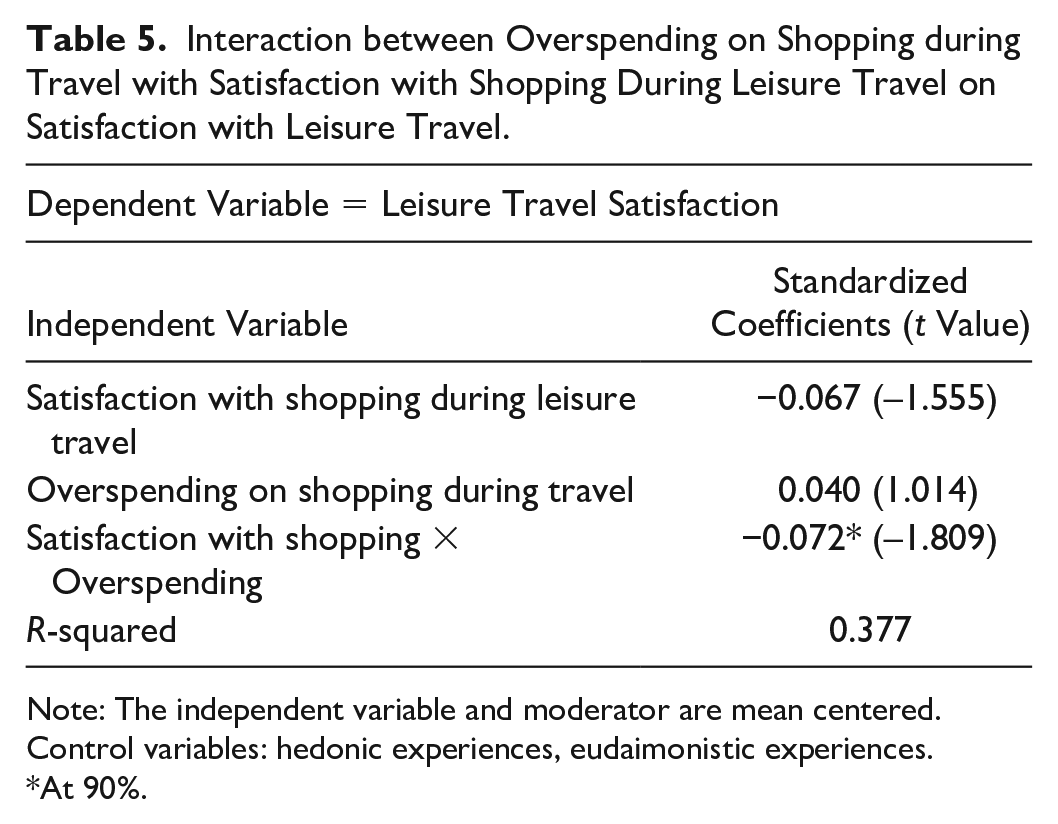
Note: The independent variable and moderator are mean centered. Control variables: hedonic experiences, eudaimonistic experiences.
At 90%.
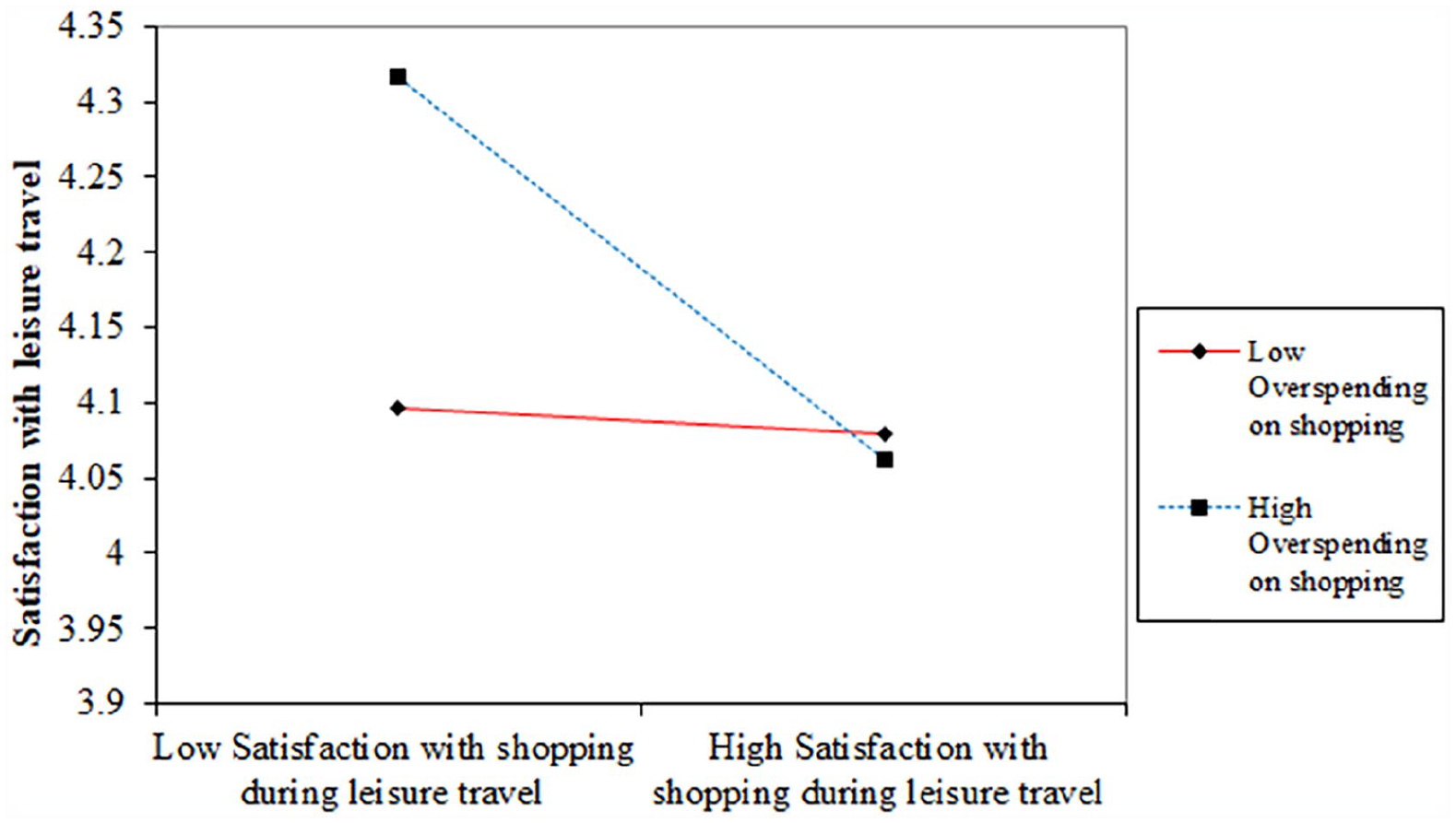
Interaction between overspending and satisfaction with shopping during leisure travel on satisfaction with leisure travel.
Hypothesis 5 posits that the relationship between satisfaction with leisure travel satisfaction and leisure life satisfaction is negatively moderated by current money management stress. Moderated regression analysis results show that there was a significantly negative interaction effect (β= −0.097, p < .05), after controlling for diversity of leisure engagement and frequency of leisure engagement, supporting hypothesis 5 (see Table 6, Figure 3).
Interaction between Current Money Management Stress and Satisfaction with Leisure Travel on Satisfaction with Leisure Life.
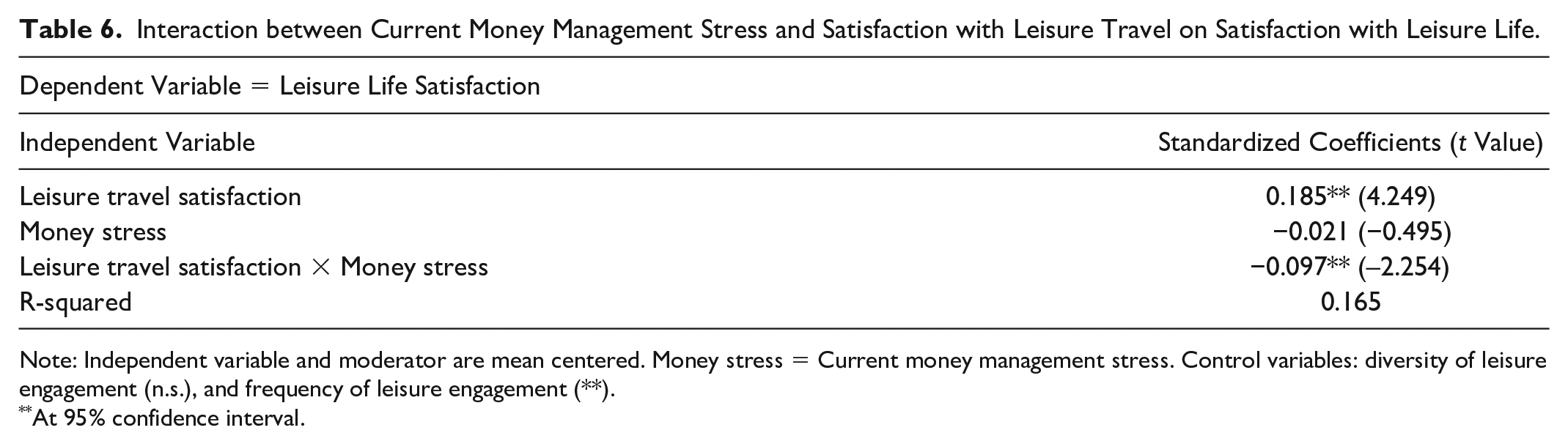
Note: Independent variable and moderator are mean centered. Money stress = Current money management stress. Control variables: diversity of leisure engagement (n.s.), and frequency of leisure engagement (**).
At 95% confidence interval.
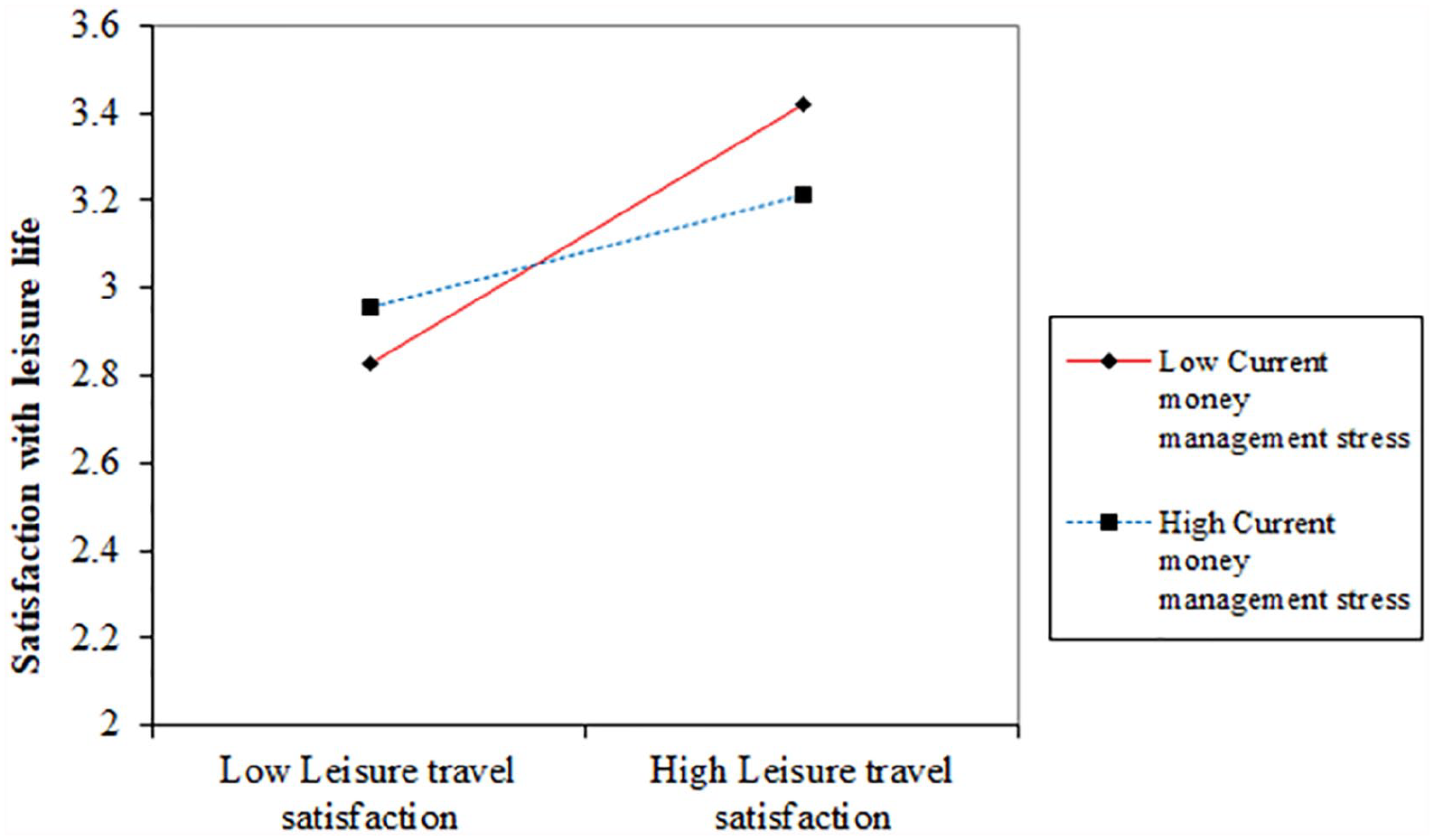
Interaction between Current Money Management Stress and Leisure Travel Satisfaction on Satisfaction with Leisure Life.
Hypothesis 6 postulates that the relationship between leisure life satisfaction and overall life satisfaction is positively moderated by expected future financial security. Moderated regression analysis results show that there was no significant interaction effect (β = −0.017, n.s.), after controlling for other life domain satisfaction, failing to support hypothesis 6 (see Table 7).
Interaction Expected Future Financial Security and Satisfaction with Leisure Life on Satisfaction with Life Overall.
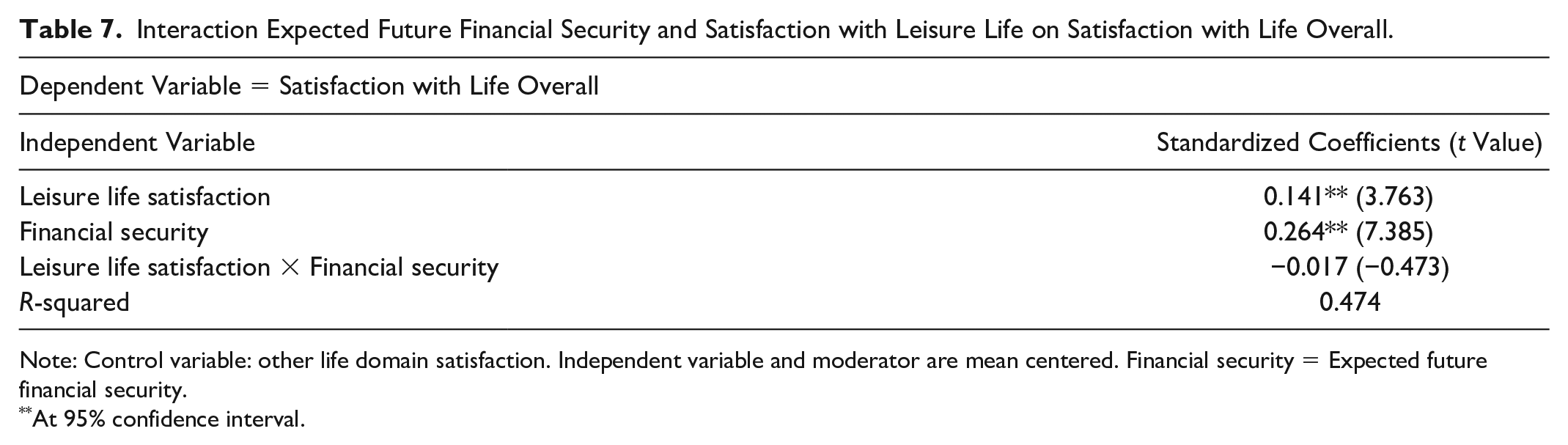
Note: Control variable: other life domain satisfaction. Independent variable and moderator are mean centered. Financial security = Expected future financial security.
At 95% confidence interval.
Hypothesis 7 states that expected future financial security is a positive predictor of overall life satisfaction. The results show that expected future financial security had a significant and positive predictive effect on overall life satisfaction (standardized path estimate = 0.316, p < .05), supporting hypothesis 7.
In order to rule out potential measurement order effect (J. Kim et al. 2018), reverse mediation analyses were also conducted using PROCESS Macro for Model 6 (Hayes 2013; version 3.3). In the PROCESS Macro model, we included several covariates, namely, other life domain satisfaction and diversity and frequency of leisure engagement. Results based on 10,000 bootstrap samples with a 95% confidence interval show that there is a significant impact of shopping satisfaction on subjective well-being mediated by leisure travel satisfaction and leisure life satisfaction (standardized indirect effect = 0.015, CI = 0.0004, 0.0084). However, the impact of shopping satisfaction on leisure life satisfaction mediated by subjective well-being and leisure travel satisfaction did not reach significant levels (standardized indirect effect = 0.0026, CI = −0.0002, 0.0067). Therefore, we conclude that there was no measurement order effect in the model testing.
One can argue that satisfaction with shopping experiences during leisure travel explains only the marginal variance of leisure travel satisfaction. Therefore, the original model has been revised to better explain overall travel satisfaction using a more comprehensive set of travel experiences namely hedonic and eudaimonic travel experiences (see Figure 4). These two variables were treated as control variables in the original model.
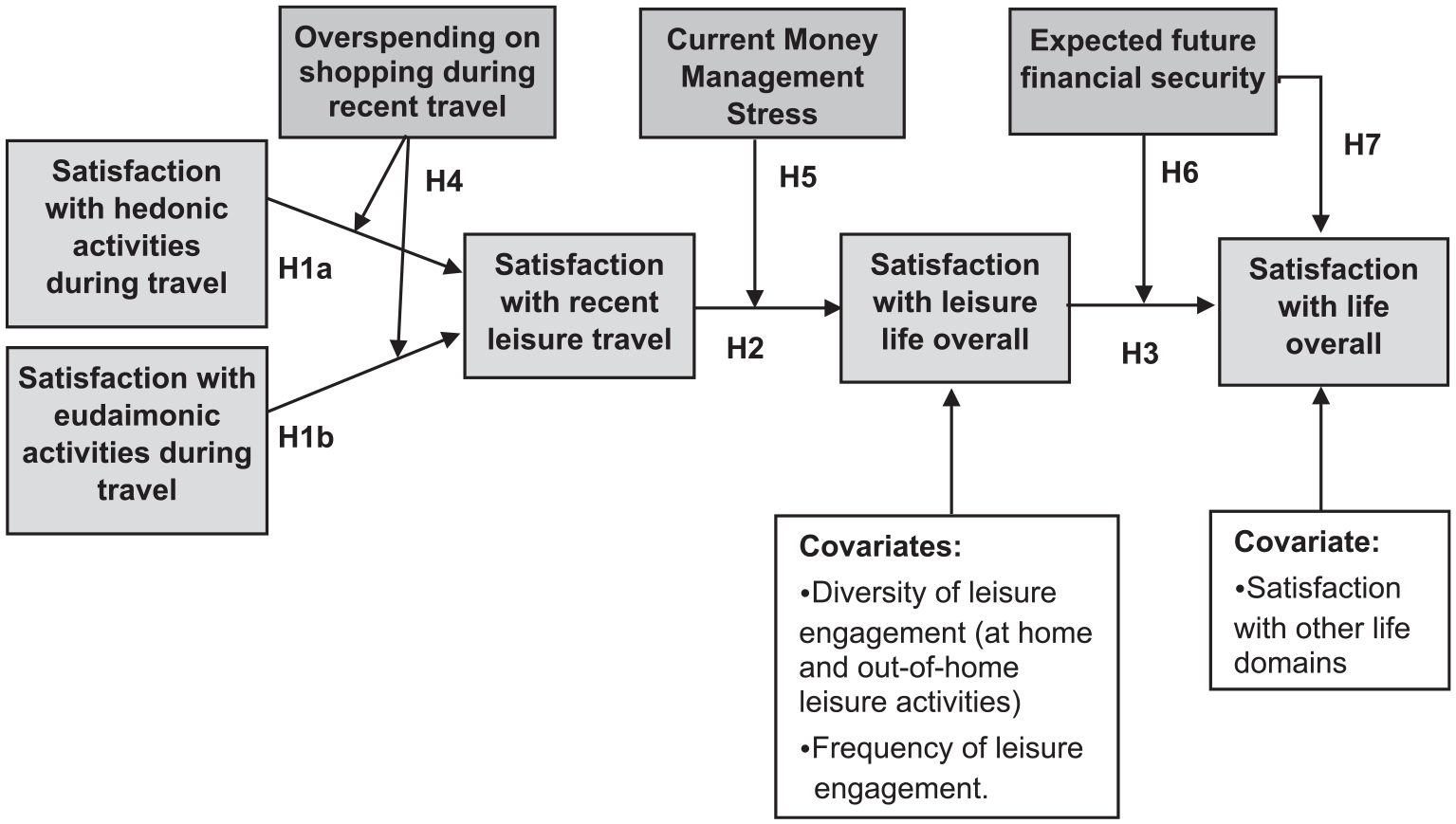
The revised model.
Revised Model Testing
In order to test this new model, a second preregistration took place on October 31, 2019, and data collection followed between December 11 and 19, 2019. The new set of data (N=503) was collected through an online survey administered to a UK-based sample of a survey panel operated by ZPID–Leibniz Institute for Psychology Information located in Trier, Germany (see Table 8). There were two major changes to the questionnaires. First, respondents were instructed to refer to only one destination even if they had more than one leisure travel experience. Second, one item was added (“When did you have the leisure travel trip?”), allowing to control for cognitive availability effects (i.e., recall bias) and using this construct as a control variable.
Sample Characteristics of the Second Data Collection (N=503).
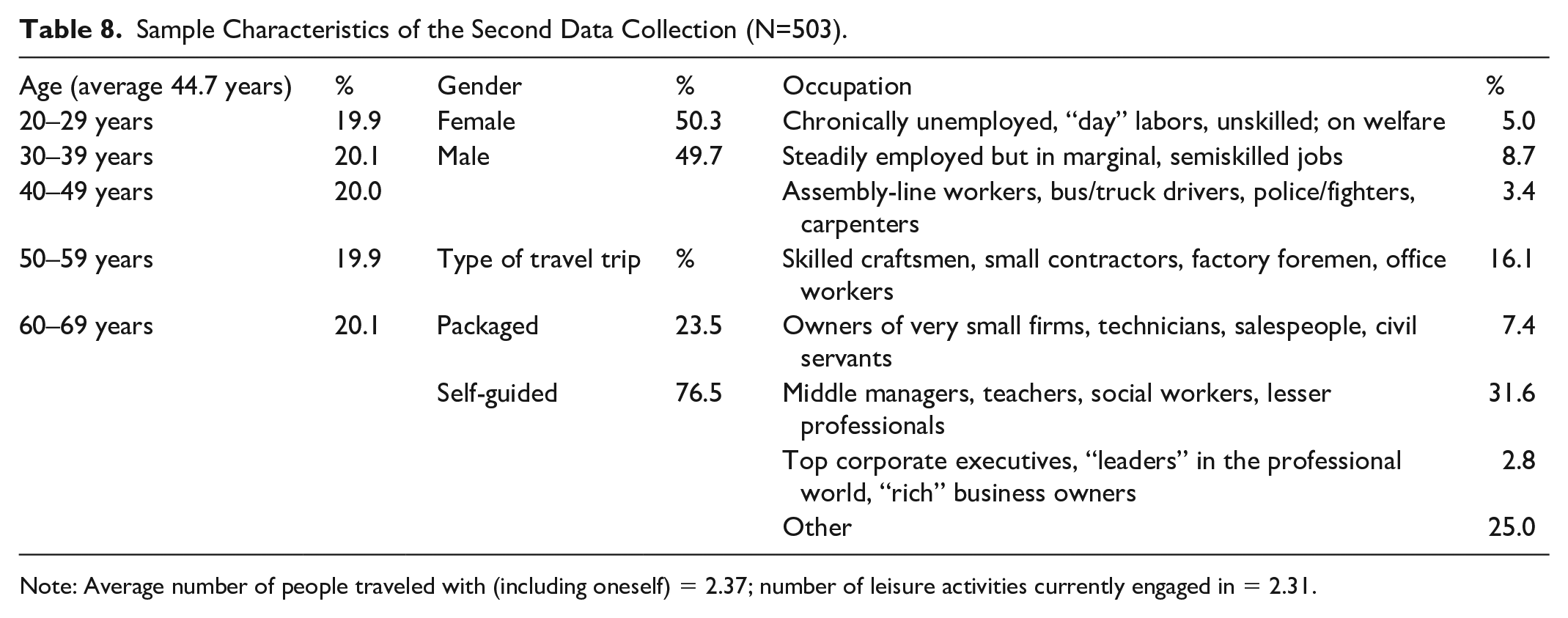
Note: Average number of people traveled with (including oneself) = 2.37; number of leisure activities currently engaged in = 2.31.
Model testing results using structural equations modeling indicate a good fit to the data—χ2 (p value) = 259.587 (.00), df = 58, CFI = 0.938, GFI = 0.925, NFI = 0.922, RMSEA = 0.084—and are summarized in Table 9. Results show that hedonic experiences during travel (hypothesis 1a) and eudaimonic experiences during travel (hypothesis 1b) both positively affect leisure travel satisfaction (hypothesis 1a: standardized path estimate = 0.537; p < .05, hypothesis 1b: standardized path estimate = 0.383; p < .05), supporting hypothesis 1. Results for hypothesis 2 (standardized path estimate = 0.368; p < .05), hypothesis 3 (standardized path estimate = 0.394; p < .05), and hypothesis 7 (standardized path estimate = 0.411; p < .05) were significant and consistent with the original model testing results, supporting hypotheses 2, 3, and 7.
Path Analysis Results.
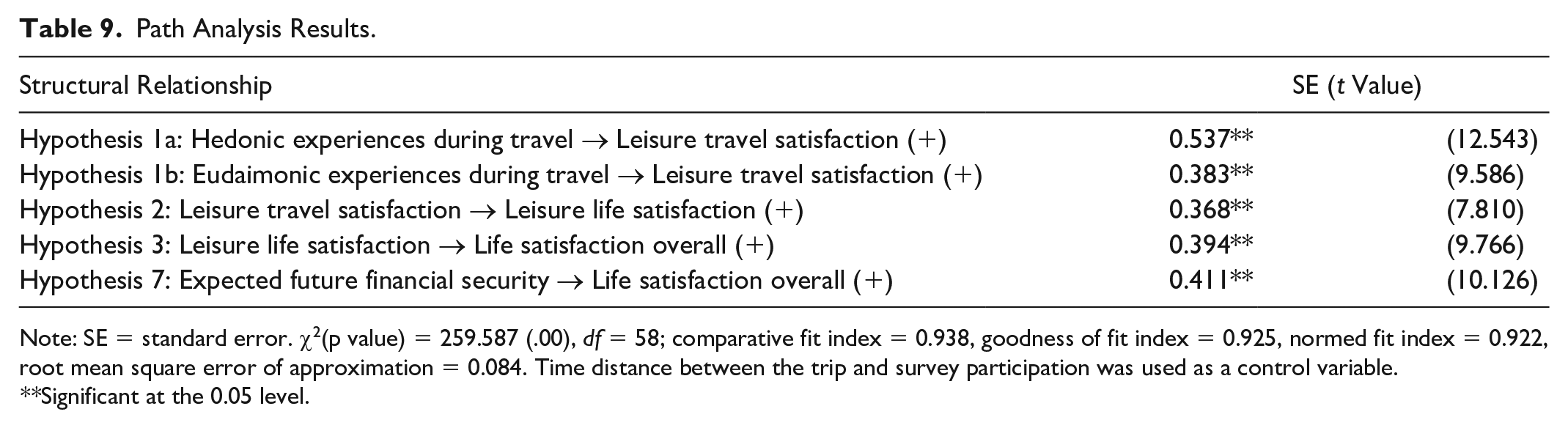
Note: SE = standard error. χ2(p value) = 259.587 (.00), df = 58; comparative fit index = 0.938, goodness of fit index = 0.925, normed fit index = 0.922, root mean square error of approximation = 0.084. Time distance between the trip and survey participation was used as a control variable.
Significant at the 0.05 level.
The revised model also posits that the relationships between leisure travel satisfaction and hedonic and eudaimonic experiences during travel are negatively moderated by overspending during leisure travel. Moderated regression analysis with mean-centered variables was conducted to test the interaction effect, and the results show that there was a significantly negative interaction effect between eudaimonic experiences during travel and overspending during travel only (hypothesis 4a: β = −0.004, n.s., hypothesis 4b: β = −0.088, p < .05), supporting hypothesis 4b (Tables 10 and 11; Figure 5). The moderation effects involved in hypotheses 5 and 6 were not supported.
Interaction between Overspending and Satisfaction with Hedonic Activities on Satisfaction with Leisure Travel.
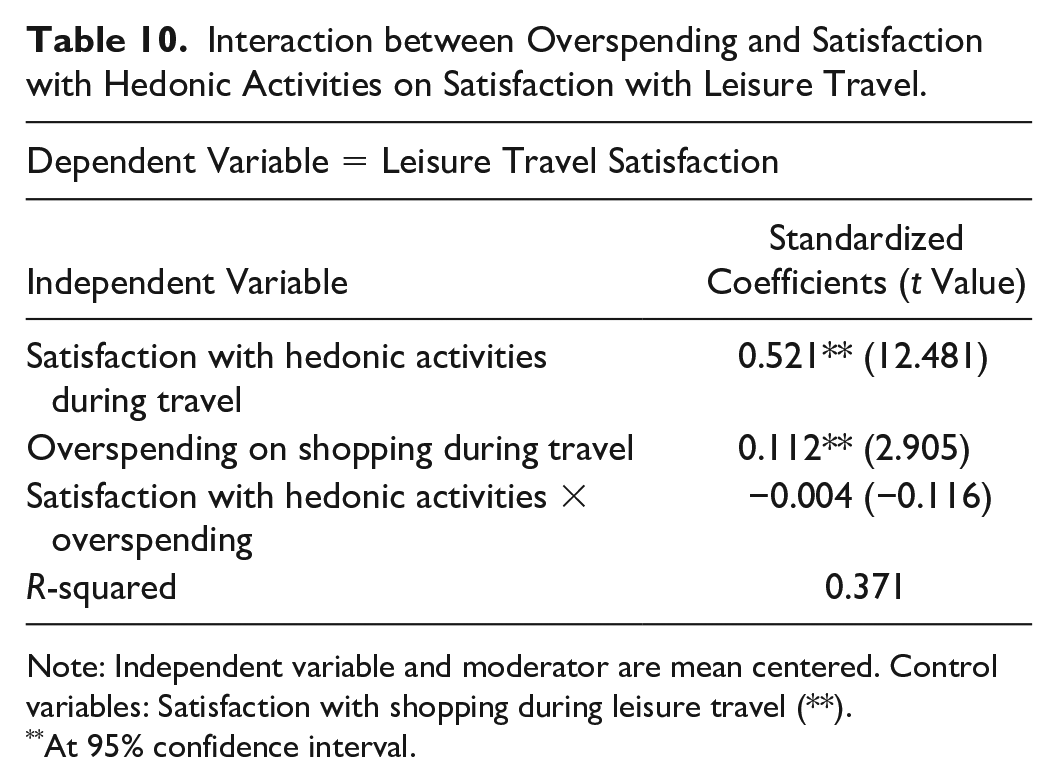
Note: Independent variable and moderator are mean centered. Control variables: Satisfaction with shopping during leisure travel (**).
At 95% confidence interval.
Interaction of Overspending and Satisfaction with Eudaimonic Activities on Satisfaction with Leisure Travel.
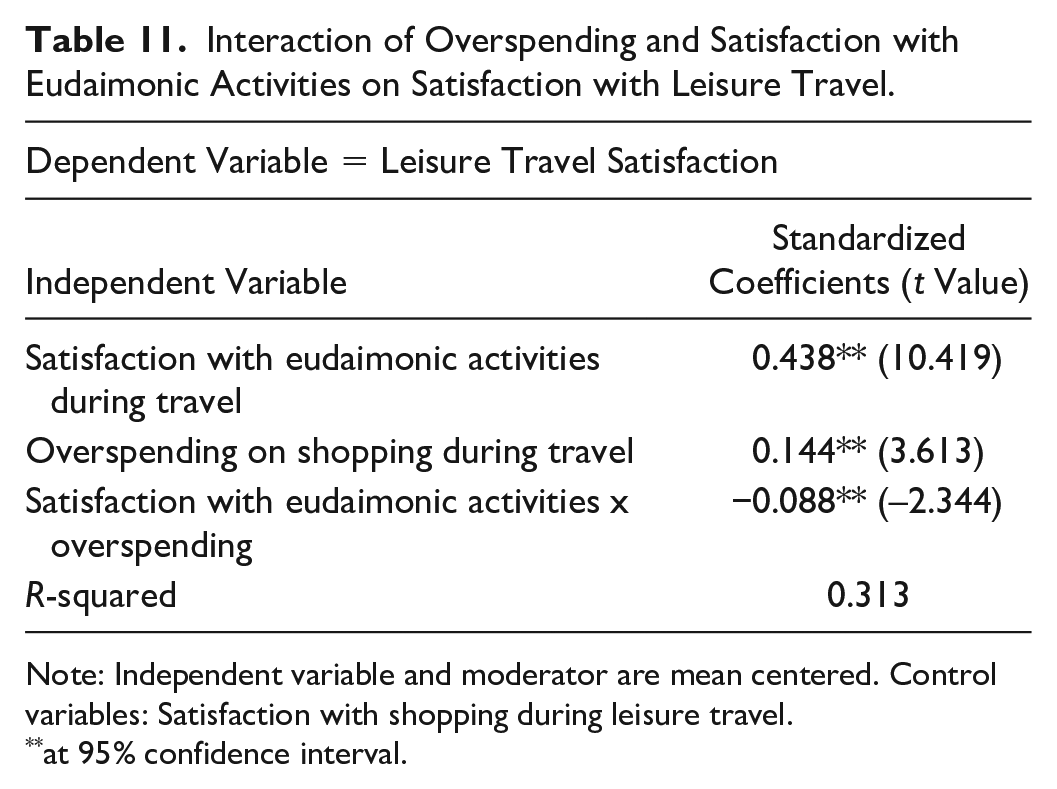
Note: Independent variable and moderator are mean centered. Control variables: Satisfaction with shopping during leisure travel.
at 95% confidence interval.
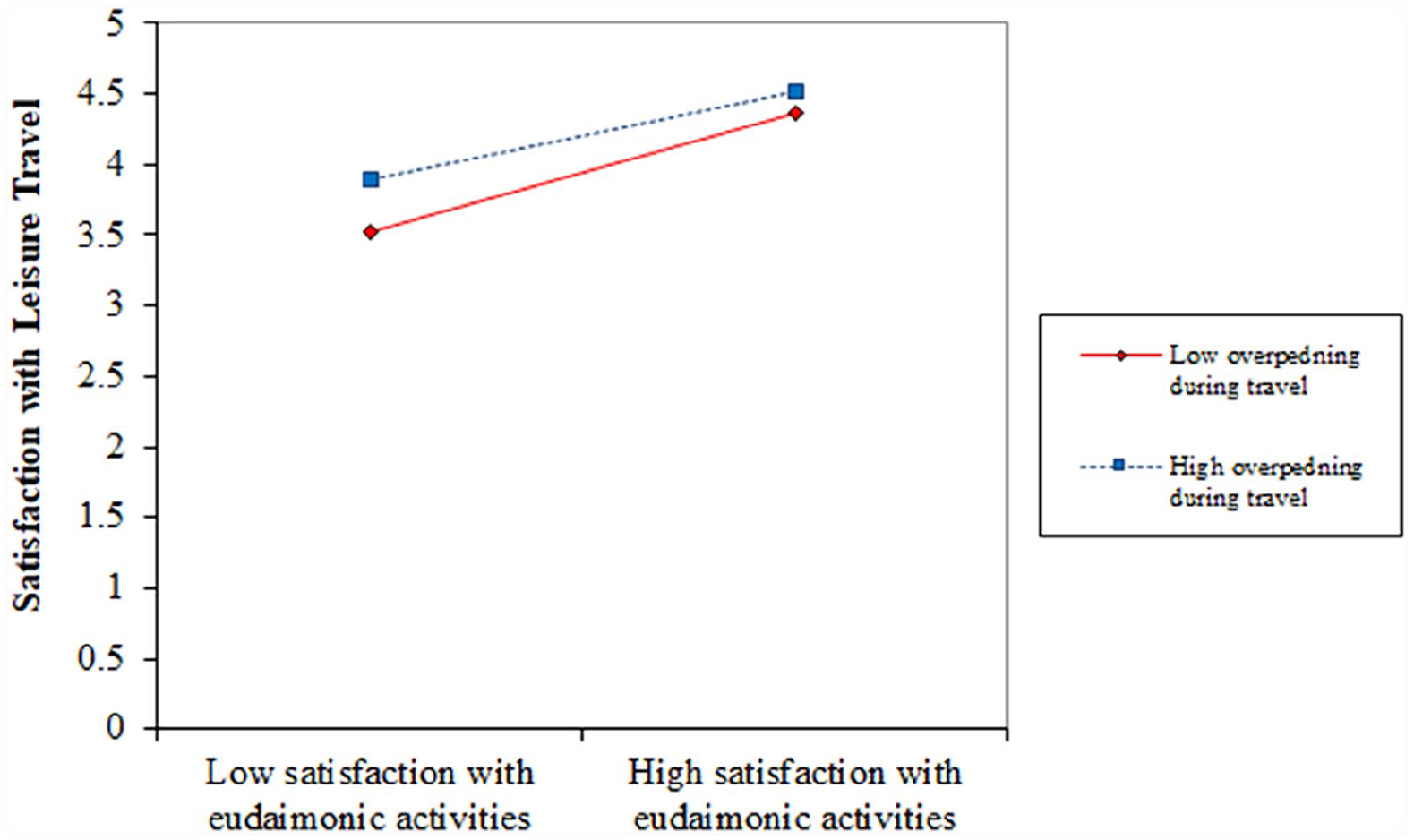
Interaction of overspending and satisfaction with eudaimonic activities on satisfaction with leisure travel.
Discussion
As indicated in the Introduction section, there is still limited understanding regarding the relationship between leisure life and financial life on overall life satisfaction. Past research has shown that leisure travelers with financial issues express unwillingness to reduce leisure travel expenses to avoid getting into further debt (H. J. Chen, Chen, and Okumus 2013; C. C. Chen and Petrick 2016; Nyaupane and Andereck 2008; Stoller 2019). Initially, we asked the question if leisure travelers could enjoy their travel trip to the same extent compared to those who are relatively free from financial worries. No research in the tourism literature was uncovered concerning the interactive effects of financial well-being and leisure well-being on life satisfaction. As such, we theorized that traveler’s perception of financial aspects experienced during leisure travel may moderate the impact of satisfaction with leisure life on overall life satisfaction. We designed our study to demonstrate that financial concerns play an important role in the way leisure travel contributes to tourist’s life satisfaction. Specifically, we hypothesized that financial concerns are likely to dampen the effects of satisfaction with shopping during leisure travel on satisfaction with leisure travel, satisfaction with leisure life, and satisfaction with life overall. We treated financial concerns in terms of three levels based on their level of abstractness, namely, overspending on shopping during leisure travel, current money management stress, and expected future financial (in)security. We found that satisfaction with shopping during leisure travel has a positive influence on satisfaction with leisure travel, which in turn has a positive influence on satisfaction with leisure life and one’s life satisfaction overall. We also found that the relationship between satisfaction with shopping and leisure travel satisfaction is negatively moderated by overspending during shopping. Current money management stress was also found to moderate the impact of leisure travel satisfaction on leisure life satisfaction negatively. These findings are mostly consistent with our original predictions (as documented in preregistration process) and therefore confirm that financial concerns of different levels play a significant role moderating the impact of shopping satisfaction on leisure travel satisfaction and leisure life satisfaction respectively. Although not formally hypothesized, we found that overspending on shopping during leisure travel moderates the predictive impact of eudaimonic travel experiences on leisure travel satisfaction negatively.
Theoretical Implications
This research contributes to literature pertaining to the consequences of tourists’ shopping experience (Lo and Qu 2015; Lu et al. 2015; Sharma, Chen, and Luk 2018; Sirakaya-Turk, Ekinci, and Martin 2015; Vega-Vázquez, Castellanos-Verdugo, and Oviedo-García 2017). Whereas previous research considers tourist satisfaction and a variety of immediate behavioral intentions (e.g., positive word of mouth intention, destination revisit intention), our study focuses on its contributions to leisure tourists’ overall life satisfaction. Although we are not certain about the lasting effect of leisure travel satisfaction on life satisfaction (Filep 2016), we believe that our study finding concerning the effect of shopping satisfaction on satisfaction with leisure life and overall life is informative. Note that our study was able to demonstrate this effect clearly by controlling for two types of travel experience satisfaction, namely, hedonic and eudaimonic experiences.
This research also contributes to the literature on leisure travel constraints (Gilbert and Hudson 2000; Jackson 2005; Nyaupane, Morais, and Graefe 2004; Nyaupane and Andereck 2008). Unlike past studies that consider the cost factor as one of major structural constraints hindering potential tourists from going on a trip, our study focused on the moderating role of one’s subjective perception of financial status on leisure travel experiences. Our study was able to demonstrate that tourists’ financial status determines not only whether they could participate in a leisure trip but also how it impacts the extent to which the tourism experience contributes to satisfaction with life overall.
Third, our study results demonstrate the sequential impact of leisure travel shopping satisfaction on leisure travel satisfaction, leisure life satisfaction and life satisfaction in a single conceptual model. Although it is not uncommon to find studies that uncover the positive impact of tourists’ shopping experience on leisure travel satisfaction or life satisfaction as a “snapshot,” it is quite rare to test the entire hierarchical process of travel experience–life satisfaction relationship simultaneously. Using two independent surveys, this study systematically demonstrated how satisfactory leisure travel experiences contribute to travelers’ life satisfaction while controlling for possible confounds.
Finally, to our knowledge, this study is the first to apply the preregistration method in tourism research. It is timely to introduce this type of research method. Preregistration is now increasingly recommended by more scientific journals and funders to ensure transparency and reproducibility and is accepted as a requirement in some research domains (e.g., clinical trials) (Nosek et al. 2018). Future research in tourism could also benefit from implementing preregistration. Exploratory studies that are preregistered are more likely to encourage follow-up research and increase credibility of research findings.
Managerial and Policy Implications
Our findings have important implications for destination marketers and public policy officials. The findings of this study suggest that overspending on shopping mitigates the positive impact of shopping satisfaction during leisure travel on leisure travel satisfaction. This is consistent with past research that suggests that overspenders tend to report less satisfaction with shopping experience and tourism destination, compared to underspenders or on-budget spenders (Brida and Tokarchuk 2015, 2017). Therefore, it is important for destination marketers and public policy makers to inform tourists about the importance of setting realistic mental budgets for shopping during leisure travel and its impact on their travel satisfaction.
The findings of this study also suggest that tourists’ current financial stress plays a significant role in reducing the positive spillover effect of leisure travel satisfaction on leisure life satisfaction. This finding is consistent with the study findings of C. C. Chen and Petrick (2016), who argued that tourists with travel constraints do not recognize the leisure trip’s potential contribution to their overall life satisfaction. Therefore, it is important for destination marketers and public policy officials to communicate health, psychological, and relational benefits of leisure travel to potential tourists to prompt the perception that tourism experience is more of a necessity and not luxury; that is, the financial cost of leisure travel could be a psychic investment, not a constraint. This is also consistent with past research suggesting that leisure travel constraints could be negotiated (C. C. Chen and Petrick 2016; Hubbard and Mannell 2001).
With respect to public policy implications, the study findings suggest that city governments of tourist destinations should develop low-cost tourism programs. Doing so should make leisure travel experiences more affordable to the general public.
Limitations and Future Research
There are limitations to this study. First, this study examined the moderating role of financial concerns on the leisure travel satisfaction spillover hierarchy using a cross-sectional survey. It is not possible to show the direction of causality with correlational data. Future longitudinal studies should be conducted to track the change of shopping satisfaction during travel, leisure travel satisfaction, and their impact on leisure life satisfaction, and overall life satisfaction over time.
Second, this study tested and found the moderation effect of overspending on the shopping satisfaction–leisure travel satisfaction relationship. Although, there was a negative moderation effect overall, this relationship could vary depending on tourists’ shopping involvement and motivation. It is possible to imagine that those who are highly involved in shopping are likely to be more satisfied with the leisure travel when their shopping experience during travel is deemed satisfactory. As such, they are likely to pay less attention to overspending. Future research should distinguish among tourists: those whose goal of taking the trip is to shop versus those who are not focused on shopping.
Third, this study tested and found support for the hypothesized moderation effect of current money management stress on the relationship between leisure travel satisfaction and leisure life satisfaction. Although this moderator was measured at a general level, one needs to recognize that leisure travel could cause conflict between leisure and financial life because of excessive spending on leisure travel. Therefore, future research should distinguish financial stress caused by leisure travel from one’s general money management stress.
Fourth, the moderation effect of future financial security was found to be nonsignificant. This may be because tourists’ perceived future financial security is rather too abstract to be directly related to only leisure concerns. Future research should develop a new construct of future financial security that is less abstract and more contextualized in leisure life. Also, this study focused on the subjective measurement of financial vulnerability and tested its moderation effects on the leisure travel experiences’ spillover effects on one’s life satisfaction. It is desirable for the future study to measure both subjective and objective indicators of financial vulnerability and test their impact on life satisfaction. Such a construct and a more refined measure may provide supportive evidence of the moderation effect of future financial security on the effect of leisure life satisfaction and overall life satisfaction.
Supplemental Material
Appendix_4_1 – Supplemental material for A Preregistered Study of the Effect of Shopping Satisfaction during Leisure Travel on Satisfaction with Life Overall: The Mitigating Role of Financial Concerns
Supplemental material, Appendix_4_1 for A Preregistered Study of the Effect of Shopping Satisfaction during Leisure Travel on Satisfaction with Life Overall: The Mitigating Role of Financial Concerns by Grace B. Yu, M. Joseph Sirgy, Michael Bosnjak and Dong-Jin Lee in Journal of Travel Research
Footnotes
Declaration of Conflicting Interests
The author(s) declared no potential conflicts of interest with respect to the research, authorship, and/or publication of this article.
Funding
The author(s) received no financial support for the research, authorship, and/or publication of this article.

Supplemental Material
Supplemental material for this article is available online.
Author Biographies
References
Supplementary Material
Please find the following supplemental material available below.
For Open Access articles published under a Creative Commons License, all supplemental material carries the same license as the article it is associated with.
For non-Open Access articles published, all supplemental material carries a non-exclusive license, and permission requests for re-use of supplemental material or any part of supplemental material shall be sent directly to the copyright owner as specified in the copyright notice associated with the article.
