



Abstract
This study investigates residents’ emotional and behavioral responses to environmental changes caused by tourism development. Statistical analysis conducted on a comprehensive sample of 1,001 residents from Amsterdam, the Netherlands, explores emotional responses as an underlying mechanism used to explain residents’ behavioral responses as well as their tourism concern as boundary conditions for this mediating effect. In contributing to the extant debate on the role of place attachment (i.e., the bond between people and their environment) in predicting residents’ supportive behavior for tourism development, the findings reveal that high levels of place attachment generally result in oppositional behavior. Moreover, results confirm that emotions, as evoked by tourism-induced place change, explain residents’ supportive and oppositional responses. Positive emotional responses to tourism decrease the likelihood of residents’ oppositional behavior. High levels of tourism concern diminish the positive influence of place attachment on positive emotions.
Introduction
Residents’ experiences with changing places have incited academic interest (Devine-Wright 2013; Von Wirth et al. 2016). Social and psychological processes have been analyzed to explain residents’ perceptions and support for tourism development (Chen and Dwyer 2018; Guo et al. 2018; Stylidis 2018; Tan et al. 2018; Wang and Chen 2015). However, the majority of these studies perceive tourism as an important source of restoring and revitalizing economic development and subsequently residents’ quality of life (Wang and Chen 2015; Woo, Kim, and Uysal 2015). Yet, at the same time, in this fast-changing, interconnected, and dynamic environment, decision makers in tourism are facing pressing issues. The recent debate about the fact that some neighborhoods are drastically changing to primarily serve the high number of tourists who visit has led to endangering the very unique character of cities, but, most importantly, residents don’t feel at home any longer (Lalicic 2019; Mody, Suess, and Dogru 2019; Novy 2018). As cities move to later stages of tourism development, where tourism starts to dominate the development of a city or even harm the quality of life in the city, residents’ interpretations and evaluations of their cities are crucial (Chen and Dwyer 2018; Lepp 2007; Stylidis 2018). Zheng and colleagues (Zheng, Ritchie, and Benckendorff 2020; Zheng et al. 2019) demonstrate that emotional responses stimulated by tourism performing arts, which implies that tourists are entertained through various performing arts like ballet, theater, or street performances that represent the local culture, predict residents’ supportive behavior in a tourism community. The perceived benefits of tourism result in positive emotional responses, such as feelings of pleasure and affection (Ouyang, Gursoy, and Sharma 2017). However, tourism also likely prompts negative emotions. Residents’ sense of place (i.e., a feeling that a person belongs to a particular place and feels comfortable [Rose 1995) stimulates intentions to initiate protective actions against tourism expansion to sustain certain elements in their communities (Tan et al. 2018). In case a known environment is destroyed, residents’ sense of place can be threatened as well as the imagined future of their homes. Feelings of temporal rupture and betrayal can lead to expressions of mistrust in the local government (Askland and Bunn 2018) and oppositional behaviors (Colomb and Novy 2016).
While the plethora of tourism researchers have quantified and monitored residents’ perceptions and support for tourism development, knowledge of residents’ emotional responses to tourism-induced place change and subsequently place-protective behaviors is not yet as elaborate as in other fields. Interestingly, tourism scholars have predominantly focused on the cost-benefit analysis or impact analysis following the social exchange theory, where one’s social behavior as a response to a particular exchange, such as tourism development in city neighborhoods, is based on the perceived balance between minimizing costs and maximizing benefits (Nunkoo and Ramkissoon 2011). Indeed, tourism research has been quite scarce on the topic of residents’ emotional responses to tourism development in general (Zheng, Ritchie, and Benckendorff 2020). Accordingly, research still lacks an understanding of the underlying psychological processes that may explain residents’ behavioral responses. Moreover, extant tourism research neglects the importance of place attachment in predicting residents’ behavioral responses to tourism-induced place change. The work of Stylidis (2018) represents an exception. However, this study does not integrate place attachment as a multidimensional approach, nor is it applied to the contemporary urban place context with its increasing number of pressing issues, such as overtourism, which is a result of a high ratio between residents and tourists in a given place (Novy 2018).
The overall objective of this research is to expand and advance the extant literature on residents’ behavioral responses to tourism-induced place change. In doing so, this study develops a comprehensive conceptual research framework regarding the influence of place attachment on behavioral responses in light of emotions evoked by tourism-induced place change as a mediating construct and tourism concern as a moderating variable.
Place Attachment and Tourism-Induced Emotions
The examination of the concept of “place” in order to understand human-environment interactions has gained prominence in the field of geography since the 1970s (Easthope 2004). The concept is complex and well debated. Jess and Massey (1995) refer to place as a social construct, wherein we actively “make” places, in keeping with the idea that a place stems from the society in which we live. As Jess and Massey (1995) state, the environment is a crucial part of a given place, but it is always an interpreted element. As people give meaning to a place based on their human experiences, relationships, emotions, and thoughts (Stedman et al. 2004), a place is a hub of social relationships and practices (Kearns and Gesler 1998), experiences, and meanings. The interaction with place leads to perceptions, which are created with mental pictures, ideas, meanings, and symbols of places and landscapes (Proshansky, Fabian, and Kaminoff 1983; Hay 1998). The consequent idea of “sense of place” forms a feeling that a person belongs to a particular place and feels comfortable there (Rose 1995; Jess and Massey 1995). Predominantly, the concept of place attachment is used to conceptualize the bond between people and their environment (Brown and Raymond 2007). Across disciplines, place attachment demonstrates its importance but shows its complexity to be measured. Many researchers have treated place attachment as a complex multidimensional construct (Hernandez, Hidalgo, and Ruiz 2013) and make the distinction between functional and emotional attachments (Lin and Lockwood 2014); place dependence and place identity (Brown and Raymond 2007; Kyle, Graefe, and Manning 2005; Lin and Lockwood 2014).
Place dependence can be explained as the functional bond of a place, where the conditions and features of a place enable the person to meet their needs. In doing so, the place will be evaluated positively compared to other places, and people will become more dependent on this place (Moore and Graefe 1994). Place identity, the emotional bond toward a place, emerges when a person becomes psychologically invested in a place by way of memories, ideas, feelings, and other people with whom she or he shares the place (Vaske and Kobrin 2001). Place identity can lead to a sense of belonging and provide feelings of control and security (Chen, Dwyer, and Firth 2014). This corroborates with the process of identity process theory by Breakwell (1993) and the four guiding principles (distinctiveness, continuity, self-efficacy, and self-esteem) that assimilate into one’s identity (Breakwell 1993). People are more likely to become psychologically invested in a place if they spend a lot of time there. Thus, the strength of place attachment depends on the amount of interaction, size, and location of the place as well as whether the place is threatened (Anton and Lawrence 2014). Social and demographic factors, such as owning a house, length of residency, income, gender, and age, also influence this process (Anton and Lawrence 2014; Hay 1998; Lewicka 2011). In other words, place identity represents the positive meanings people attach to place, which contribute to sustaining healthy well-being (Lovell, Gray, and Boucher 2017; Woo, Kim, and Uysal 2015). Higher place attachment leads to a higher quality of life and physical and psychological health as well as satisfying social relationships and physical environments (Anton and Lawrence 2014).
In tourism, the concept of place attachment has been a prevalent subject in understanding residents’ perceived image of a place, support for tourism development, and interactions with tourists (Stylidis 2018; Wang and Chen 2015). In general, residents with higher levels of place attachment are more likely to respond to place change and local government positively (Devine-Wright and Howes 2010; Stedman 2002). McCool and Martin (1994) reported that strongly attached residents perceive tourism positively. It seems that residents’ perception of the natural and built environment as well as the psychical shape of the city frame their support for tourism development (McGehee and Andereck 2004; Nunkoo and Ramkissoon 2011; Stylidis 2016). Clustering residents according to their perceptions of their home city reveals different levels of place attachment and support for tourism. If residents feel connected to a place, they will express more positive emotions toward any project that will improve the character of that place (Stylidis 2016, 2018). In line with these findings, we hypothesize the following:
Hypothesis 1: Place attachment increases positive emotions.
However, results reporting the influence of place attachment on residents’ responses toward tourism are mixed. Um and Crompton (1987) show that the more attached residents are to a community in terms of length of residency, the less positively they perceived tourism development. Similarly, Draper, Woosnam, and Norman (2011) observed that more attached residents tend to be less positive toward tourism development. One possible explanation for this finding is that a change in the physical and social characteristics of the place reduces residents’ sense of control (Devine-Wright 2013). In support of this notion, Lalicic (2019) introduced the concept of solastalgia, demonstrating that high levels of tourism concern can eventually lead to residents’ psychological distress as a result of tourism-induced place change in their home cities. As place attachment can provide stability, place disruption can jeopardize these feelings. Furthermore, Zheng, Ritchie, and Benckendorff (2020) have shown how residents’ concepts of fairness also influence their negative emotions toward tourism development. The importance of differing between positive and negative emotions and, consequently, the consideration of positive and negative emotions as two distinct factors have been emphasized in prior literature (Babin and Darden 1996; Laros and Steenkamp 2005). Indeed, the valence of emotions (positive vs. negative) has differential effects on persuasion, decision making, and memory (Fiske and Taylor 2014). Following this line of reasoning, we consider negative emotions as a separate construct in our conceptual framework and propose that
Hypothesis 2: Place attachment increases negative emotions.
Residents’ Behavioral Responses to Place Attachment and Tourism-Induced Emotions
Weaver and Lawton (2001) allocated residents to three different groups depending on their level of behavioral responses to tourism-induced place change. In the first group, supporters mainly see the advantages associated with tourism-induced place change and are willing to share the community with nonresidents. Other research confirms that residents’ adjustment reflects a common behavioral response to tourism (Horn and Simmons 2002). In the second group, neutrals recognize both the benefits and drawbacks of tourism. Accordingly, they accept the change caused by tourism developments. Public acceptance has not only been confirmed to represent an important construct in tourism but also in investigating public responses to infrastructure changes (Devine-Wright 2013). Hence, the conceptual framework introduced in this article considers both, “adjust” and “support,” responses as supportive behaviors. Finally, in the third group, residents exhibiting oppositional behavior have low contact with tourists and have a considerably lower favorable attitude toward tourism as compared to members of the first two groups (Weaver and Lawton 2001). Building on the cognitive appraisal theory, Zheng et al. (2019; Zheng, Ritchie, and Benckendorff 2020) evaluated residents’ supportive behaviors by analyzing their emotions. Zheng et al. (2019) have demonstrated that the role of positive emotions experienced by residents toward tourism, such as feeling happy about it, significantly influences their supportive behavior of tourism developments. Drawing on these notions, we propose that:
Hypothesis 3: Positive emotions mediate the influence of place attachment on (a) “accept” responses and (b) “adjust” responses.
In contrast, the lack of positive or even negative emotions likely results in oppositional behavior. Oppositional behavior has been observed by Smith and Krannich (1998). In their research, they have shown that economically satisfied residents have less favorable attitudes toward tourism as compared to less well-off communities. Therefore, the negative emotions experienced by residents, such as feelings of dislike and worry, only support tourism development if those negative emotions decrease (Zheng, Ritchie, and Benckendorff 2020).
Likewise, place attachment is directly associated with lower support for tourism projects. Residents who exhibit high levels of place attachment are more likely to engage in oppositional activities than supportive ones (Devine-Wright and Howes 2010). A recent study based on qualitative data reports on a sense of protection that residents exhibit toward disruptive place changes (Tan et al. 2018). Places whose symbolic meanings are significant to a person’s identity thus tend to influence residents’ efforts to minimize or reduce place change (Anton and Lawrence 2014) to protect their identities from disruptions (Antonsich 2010). Residents also tend to act negatively toward the people or organizations that are responsible for these changes (Anton and Lawrence 2014). Hence, we expect that
Hypothesis 4: High levels of place attachment increase “oppose” responses.
Hypothesis 5: Both positive emotions and negative emotions mediate the influence of place attachment on behavioral responses, so that (a) positive emotions reduce “oppose” responses and (b) negative emotions enhance “oppose” responses.
We further postulate that the role of concern can moderate the mediating effect of specific affective feelings on specific behavioral intentions. Although the relevance of tourism concern (i.e., residents’ concerns about tourism development) has already attracted research attention to some extent (Scheyvens 1999; Sinclair-Maragh, Gursoy, and Vieregge 2015), exploring the extent to which tourism concern influences emotional responses to tourism-induced place change are scarce (Litvin, Smith, and McEwen 2020; Zheng, Ritchie, and Benckendorff 2020). Nevertheless, tourism concern has been related to behavioral responses. Residents with higher levels of tourism concern are less likely to support activities promoting tourism (e.g., building more hotels) (Nepal 2008). Another study supports this finding, noting that community concern has been related to supportive activities in tourism (Gursoy, Jurowski, and Uysal 2002). In support of the relevance of tourism concern in explaining residents’ responses to tourism-induced place change, Lalicic (2019) demonstrates how residents’ concern that their homes may develop into something unfamiliar can lead to psychological distress as well as oppositional behavioral responses. Drawing on this literature, we propose that
Hypothesis 6: Tourism concern moderates the effects of place attachment on emotions, so that residents with higher levels of tourism concern have (a) fewer positive emotions and (b) stronger negative emotions.
Figure 1 illustrates the conceptual research framework of this study. We propose that place attachment influences behavioral responses, namely, that higher levels of place attachment are generally associated with oppositional reactions to tourism-induced place change. We further postulate that tourism-induced emotions mediate this effect, so that place attachment can stimulate positive emotional responses to tourism-induced place change, and that these positive emotions prompt supportive behavior in terms of acceptance of tourism and adjustment activities. We further postulate that positive emotions reduce oppositional behaviors while negative emotions enhance them.
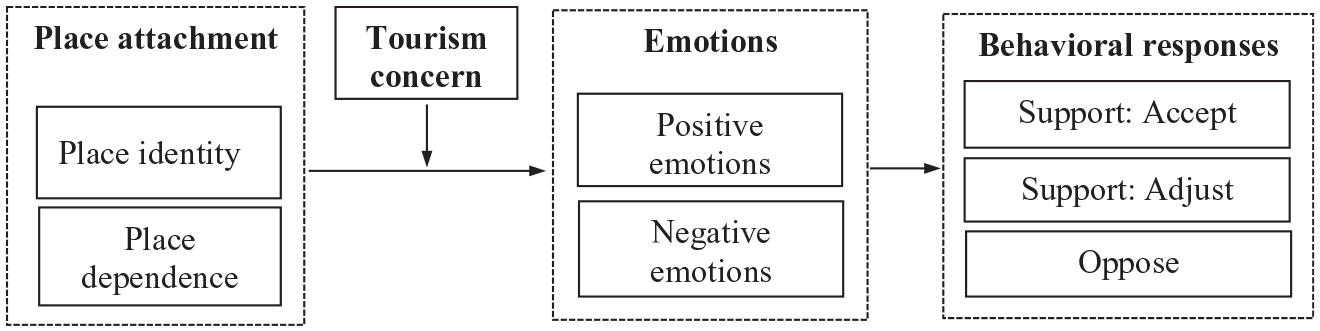
A conceptual framework for residents’ response to tourism-induced place change.
Research Design
Study Location and Context
This study was conducted in Amsterdam, the capital of the Netherlands, Europe. Since 2009, the city has experienced significant growth in the tourism sector. To recover from the economic recession in 2008, the city decided to make considerable investments in the tourism sector. In 2018, the city was one of Europe’s tourist hotspots, balancing a high number of tourist arrivals (18 million yearly) with a population of more than 850,000 (OIS Amsterdam 2019). In light of the high number of arrivals far beyond the population of the city itself, Amsterdam has redirected its marketing activities to areas and cities outside of the city center. The infrastructure and excessive masses of people concentrated in a limited space create tensions (Milano, Novelli, and Cheer 2019), and residents have already started protesting against tourism. As a response, the municipality is seeking to promote their destination with the philosophy of “value over to save their heritage, culture, and nature” (Iamsterdam 2018). Besides, Amsterdam is an interesting city for exploring residents’ emotional and behavioral responses to tourism-induced place change since red-light activities and visits to coffee shops are among the major drivers to visit Amsterdam as compared to other famous cities without these same attractions (Boffey and Henley 2020). The city of Amsterdam started experimenting with new policies to manage tourism by opening a public forum to integrate their residents more deeply into their tourism planning practices, thereby creating a good balance between all stakeholders.
Data Collection: Online Panel
First, a pilot test was conducted before the main survey that included forty residents to check for scale reliability and face validity. The average duration of the survey was between seven and nine minutes. After adjusting the wording, typos, and overall design of the survey, the final survey was sent to a panel to be administered to the residents of Amsterdam by the municipality of Amsterdam in January and February 2019. The final sample polls 1,001 residents of Amsterdam of at least 18 years of age who have been living in Amsterdam for at least one year, which implies a 67% response rate to the survey. Despite some limitations with online panels (i.e., high nonresponse and self-selection bias), online panel data generally do not suffer from high levels of sample bias as compared to other survey methods. Additionally, it usually displays higher reliability than data collected by phone or mail surveys (Nunkoo and Smith 2013). To further ensure the quality of the collected data, two different procedures were employed to check the respondents’ attentiveness. First, a visual inspection of the data tests the occurrence of straight-lining (i.e., selection of the midpoint category throughout the whole survey (Holbrook, Green, and Krosnick 2003)). Second, the time spent on the survey was investigated to avoid speeding (Paas and Morren 2018). A comparison between the average time it took respondents to complete the survey (i.e., eight minutes) and respondents’ actual time for completing the survey revealed that 92% of respondents completed the survey in eight minutes (or more). For the remaining 8%, the average time spent on the survey was six minutes. Completion of the survey of fewer than five minutes was deemed to be speeding behavior and resulted in elimination from the survey sample. These procedures resulted in a final sample of 1,001 respondents.
Measurement Scales
Place attachment was measured using two factors: place identity and place dependence. Place identity consisted of six items (i.e., “I feel the city is a part of me”) and place dependence five items (i.e., “no other place can compare with the city”) adapted from Brown and Raymond (2007) and Anton and Lawrence (2014). Emotions caused by the urban tourism-induced place change were measured by nine affective feelings, using four negative and five positive feelings based on the work from Devine-Wright and Howes (2010). For example, participants were asked to describe how well these listed feelings reflected their emotions toward tourism-induced place change in their city (i.e., “I feel frustrated”; “I feel proud”), using a five-point Likert scale with 5 representing “describes my feelings extremely well.” Behavioral responses were measured by three items borrowed from Sell and Zube (1986), capturing the behavioral responses of tourism-induced urban place change (accept, adjust, or oppose). Tourism concern was considered a moderating variable and was measured based on Chen and Tung’s (2014) environmental concern scale by adapting the five items (i.e., “I am extremely worried about the state of tourism and what it will mean for my future”). Additionally, trust in local politics on tourism governance was assessed using the scale developed by Nunkoo and Smith (2013) as a control variable, since trust has significant potential in explaining community acceptance of tourism (Nunkoo 2016; Nunkoo and Smith 2013). If not otherwise indicated in Table 1, all items were measured on a five-point Likert scale (1 = completely disagree to 5 = completely agree). Finally, a set of sociodemographic questions were asked (age, gender, education, length of residency). All constructs exhibit satisfactory scale reliabilities (see Table 1).
Summary Statistics: Measurement Constructs.

Results
Sample Description
The sample (N = 1,001) consists of 42% women, 57% men, and 1% other with an average age of 56 (SD = 13.46) and a relatively high level of education among 44.7% of respondents, who reported a graduate degree. In addition, 18% of respondents have a yearly income of less than €30,000; 35% have an income between €30,000 and €59,999; and 21% fall in the income range of €60,000 to €89,999. Ten percent of respondents did not indicate their income, and the remaining 16% have a yearly income above €90,000. The relatively high average age indicates a skewed distribution as compared to the Amsterdam population. However, given the fact that this study concentrates on place attachment, which evolves over time (Knez 2005), the higher average age is not of major concern but rather serves as a relevant characteristic for our study. In line with this reasoning, more than half of the respondents (59.9%) have lived in the city for more than 30 years; 31.2% have lived between 10–30 years in the city, and 8.9% have lived less than 10 years in the city. Only 3.3% indicated that they work in the tourism industry directly. There is an equal distribution of residents’ neighborhoods (city center vs. suburbs).
Hypotheses Testing
To test the conceptual framework, three mediation models, and one moderation model using the PROCESS v3 macro for SPSS (model 4 and model 7 with 10,000 bootstrapping samples [Hayes 2018]), were estimated (see Table 2). In all three models, place attachment was specified as the independent variable while positive and negative emotions were specified as mediating constructs. Trust and age were controlled for, as both variables might influence the tourism-induced place change emotions. For each behavioral response, one model was estimated (i.e., accept, adjust, and oppose). The analysis started with the estimation of the mediation model with the behavioral response accept as the dependent variable.
Direct and Indirect Effects of Three Mediation Models.
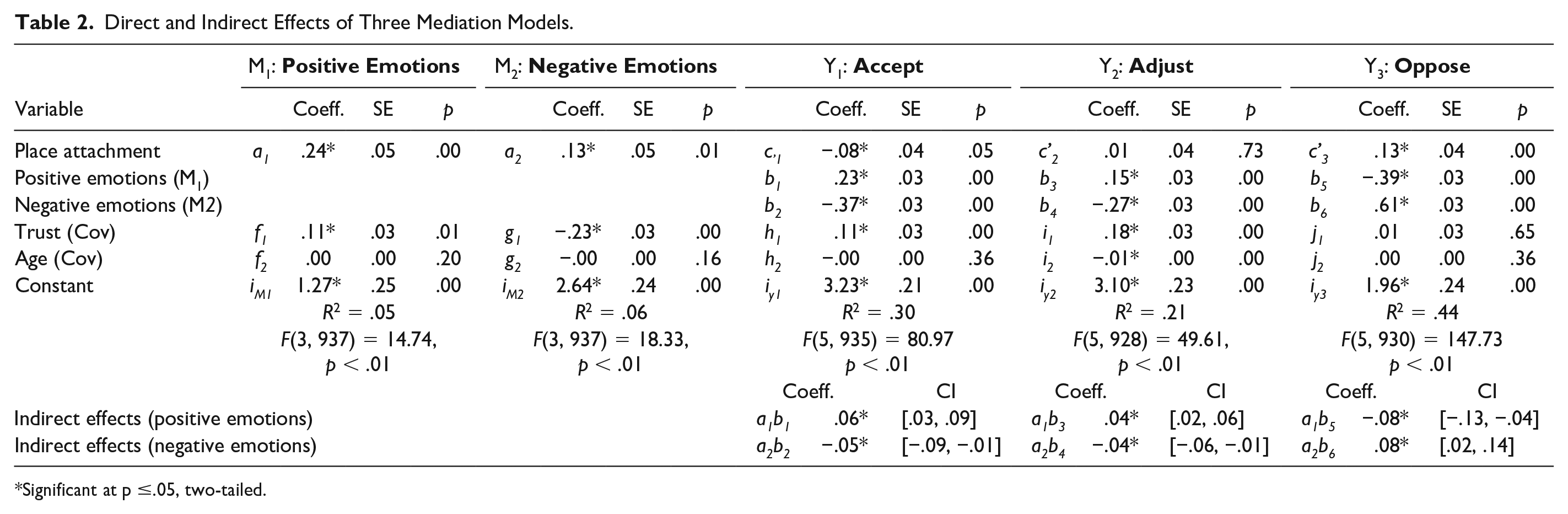
Significant at p ≤.05, two-tailed.
As seen from Table 2, results confirmed hypothesis 1, namely that place attachment increases positive emotions (a1 = .24, p<01). Supporting hypothesis 2, place attachment can also cause negative emotions (a2 = .13, p = .01). Hence, our results suggest that place attachment can cause positive emotions while, at the same time, low place attachment leads to negative emotions.
An inspection of the indirect effects confirmed that positive emotions mediate the influence of place attachment on accept reactions (a1b1 = .06, CI [.03, .09]). This result confirmed hypothesis 3a. Although not hypothesized, negative emotions (a2b2 = −.05, CI [−.09, −.01]) negatively mediate the influence of place attachment on accept reactions. A significant direct effect (c’1 = −.08, p = .05) of place attachment on respondents’ acceptance of change points to a partial mediation of emotions.
The analysis proceeded with the estimation of the second mediation model with adjust as the dependent variable. Again, and in support of hypothesis 3b, findings confirm the mediating role of positive emotions on the influence of place attachment on the behavioral response adjust (a1b3 = .04, CI [.02, .06]). Corroborating the results of the first mediation model, the indirect effect on adjust through negative emotions was also significant (a2b4 = −.04, CI [−.06, −.01], illustrating that negative emotions decrease adjust reactions (b4 = −.27, p < .01). In contrast to model 1, place attachment did not directly influence adjust reactions, revealing that emotions fully mediate the influence of place attachment on adjust reactions.
The third mediation model tested the postulated mediating effect of negative emotions on the oppose reaction. First, corroborating hypothesis 4, the model confirmed that higher levels of place attachment are associated with stronger oppose responses (c’3 = .13, p < .01). The model further reveals that positive emotions decrease oppose reactions (b5 = −.39, p < .01), and negative emotions increase oppose reactions (b6 = .61, p < .01). In support of hypothesis 5a, the indirect effect through positive emotions was significant (a1b5 = −.08, CI [−.13, −.04]). Likewise, and in confirmation to hypothesis 5b, the analysis did confirm the hypothesized negative indirect effect of negative emotions (a2b6 = .08, CI [.02, .14]).
These results demonstrate that place attachment can stimulate positive and negative emotions and that both kinds of emotions are important when investigating how place attachment influences behavioral responses. However, because positive and negative emotions do not fully mediate the effect of place attachment on accept and oppose reactions, it would be interesting to investigate other sources for the two different kinds of emotions. Of great importance for this study is the interpretation of the negative indirect effect on oppose reactions through positive emotions. It seems that positive emotions (as caused by place attachment) can reduce oppose reactions.
Finally, a moderation model tested the hypothesized moderating effect of tourism concern on positive emotions (hypothesis 6a) and negative emotions (hypothesis 6b). The model offered tentative support for hypothesis 6a. The test of the highest order of unconditional interactions revealed a marginally significant moderating effect of tourism concern on the influence of place attachment and positive emotions, F(1, 963) = 2.69, p = .10. Positive emotions decrease as tourism concern increases, thus proving hypothesis 6a. However, no moderating effect was observed for negative emotions, F(1, 963) = .90, p = .34; hence, hypothesis 6b is not supported by this study.
Conclusions and Discussion
This study explores how place attachment influences supportive or oppositional behavioral responses to tourism-induced place change. In expanding the extant literature, we considered place attachment as a multidimensional construct, consisting of two factors, namely, place dependence and place identity (Lin and Lockwood 2014). Furthermore, we offered deeper insights into the underlying mechanisms that drive residents’ behavioral responses by considering emotional responses evoked by tourism-induced place change as a mediating variable. A large-scale data collection that resulted in a final sample of 1,001 residents from Amsterdam provided the data for the estimation of three mediation analyses and one moderation analysis. The results offer important new insights into tourism-induced emotional and behavioral responses and also contribute to the extant literature in at least four important ways.
First, our study reveals that a high level of place attachment is significantly related to residents’ intentions to oppose changes induced by tourism. This finding contributes to the existing debate on the role of place attachment in predicting residents’ reactions in terms of supportive or oppositional behavior (e.g., Stylidis 2016, 2018). A possible explanation for the positive relationship between place attachment and oppose responses is that residents want their city to not deviate from the way that they identify themselves with the city and thus feel threatened if they feel this is the case (Colomb and Novy 2016). Thus, those residents that have a strong bond to the city they live in find ways to reduce tourism-induced place change by intentionally organizing protests or engaging in other forms of protest.
Second, this study shows that this process of oppositional reactions is negatively mediated by positive emotional responses to tourism-induced place change. In general, place attachment can prompt positive emotions toward tourism-induced place change; however, these positive emotional responses decrease the attendant number of oppose responses. Our findings also suggest a strong influence of negative emotions on oppose reactions. Nevertheless, the absence of a full mediation coefficient further suggests that positive and negative emotions do not emerge only as a result of different levels of place attachment but also by other drivers, which were not measured in the current study. Hence, future research might investigate other possible antecedents of positive and negative emotions that result in oppose behavior.
Third, the results of our study demonstrate that even cities with rapidly increasing contemporary tourism issues can have a positive influence on residents’ emotional reactions to tourism-induced place change and subsequently influence their residents’ behavioral responses. Favorable emotions have a positive influence on support responses and, at the same time, favorable emotions caused by tourism-induced place change decrease oppose reactions. In doing so, the study provides new significant findings related to residents’ levels of place attachment as well as psychological processes toward tourism development (Zheng, Ritchie, and Benckendorff 2020). The differentiation between adjust and accept responses offers a more nuanced perspective on support responses and therefore offers more detailed insights into possible residents’ reactions to tourism-induced place change.
These results are interesting from both a scientific and practical perspective. From a scientific point of view, these insights enhance our understanding of the relevance of positive emotions in explaining residents’ oppose and support reactions. Hence, it seems that the stronger residents’ place attachment is, the more positive emotions they experience as a result of tourism-induced place change. Accordingly, it seems that residents who have a strong bond to their city are less likely to be insecure when it comes to tourism-induced place changes. In turn, this stability makes this particular group react with positive emotions to tourism changes, which results in support responses. At the same time, the favorable responses to tourism-induced place changes caused by high levels of place attachment make residents less likely to react with oppose behaviors. Likewise, place attachment can also cause negative emotions. In line with prior research (Um and Crompton 1987), more attached residents might also react with negative emotional responses to tourism development. These negative emotions, in turn, mitigate support behaviors, and, importantly, negative emotions are a strong predictor of oppose responses. This finding emphasizes the relevance of considering both positive and negative emotions as an underlying mechanism to understand how place attachment predicts different behavioral responses.
Fourthly, the findings advance the extant literature by considering the role of tourism concern as a significant moderator in explaining residents’ response to tourism-induced place change (Nunkoo 2016; Nunkoo and Smith 2013). In this study, residents who are highly concerned with overtourism demonstrate less favorable emotions toward tourism. This study shows that for the case of Amsterdam, high levels of tourism concern can reduce positive emotions caused by tourism-induced place change. This knowledge might be valuable for related research fields as well. For instance, tourism concern might explain why residents do not engage in tourism planning. Residents’ participation in tourism planning has been an important factor in making cities more inclusive in their effort to integrate tourism into the urban agenda (Lalicic and Önder 2018). Future studies in this research stream might particularly consider residents’ tourism concern in exploring how to motivate residents to actively participate in tourism planning practices, thereby avoiding oppositional behaviors.
From a more practical perspective, these insights support urban planners and tourism marketers by carefully listening to and acknowledging their residents’ evaluations of tourism-induced place change. Given that place identity has proven to be the determining factor for these psychological processes of place change, planners should cautiously consider how to protect their city’s identity or adjust their practices to respond to their residents. Not only will this lead to higher levels of satisfaction, but a more coherent identity among all stakeholders can also be created and impending issues induced by tourism (i.e., disneyfication) might be tackled more efficiently. Furthermore, the study shows that planners need a better understanding of why residents would oppose certain changes and introduce participatory practices to start a dialogue about these rapid changes.
Finally, the empirical validation of the conceptualization of positive and negative emotions as two distinct constructs corroborates with extant consumer behavior literature (Babin and Darden 1996; Laros and Steenkamp 2005). Future studies exploring residents’ reactions to tourism might account for the two-dimensionality of emotions to offer further insights when positive or negative emotions prompt behavioral responses.
However, this study also recognizes its set of limitations, which offer avenues for future research. Despite the large sample size, the generalizability of the findings might be limited since the survey was conducted solely in Amsterdam. On the one hand, Amsterdam is one of the most well-known examples of a city struggling with tourist numbers, which might also influence the perception of its residents about this topic. Furthermore, tourism in Amsterdam might also be considered as ethical and morally questionable (e.g., red-light district, coffee shops), which might also influence the results. Accordingly, future research is encouraged to replicate our findings in other cities with various tourism-related problems. On the other hand, the sample of Amsterdam used in this paper is skewed as it entails older and more affluent residents compared to the current profile of residents of Amsterdam. However, as we were primarily interested in place attachment, the selection criteria of residency influenced the self-selection of respondents. Hence, a repetition among a broader sample might generate a more diverse response and thus more robust applicability of the model suggested in this study.
In terms of concepts used in this article, we suggest that in addition to the assessed behavioral responses in terms of accept, adjust, or oppose, it is also reasonable to assume that individuals may deny change at all. In such a situation, residents may not begin demonstrating against the negative consequences of these occurrences. However, residents’ coping responses could take the form of anticipatory detachment, meaning that residents begin to imagine themselves living elsewhere soon (Lalicic 2019). For future studies, it is recommended to collect additional behavioral responses to advance the taxonomy behaviors caused by tourism-induced place change.
Moreover, a more detailed exploration of the very specific elements of place attachment that evoke positive emotions would offer fruitful insights into the relationship between place attachment and emotions. For instance, one could include the four levels of place identity (Breakwell 1993), which would allow us to understand which part of place identity triggers residents to evaluate change and eventually oppose it.
In a similar vein, a more holistic approach and in-depth investigation of perceived urban space are needed, including, for example, the alteration of the sensory experience of a place (change of sounds, smells, lights). Furthermore, the alteration of the sensory experience of a place can also lead to new insights (i.e., unwelcome smells or sounds) to this psychological process of tourism-induced place change. In this context, understanding residents’ susceptibility to change based on cultural context (Sell and Zube 1986) and the perceived value of an optimal tourist destination within their urban space would also allow researchers to grasp a fuller picture of the particular changes caused by tourism and how they prompt residents’ responses.
Footnotes
Declaration of Conflicting Interests
The author(s) declared no potential conflicts of interest with respect to the research, authorship, and/or publication of this article.
Funding
The author(s) received no financial support for the research, authorship, and/or publication of this article.
