




Abstract
Drawing on the theory of social distance, this study examined the extent to which residents’ attitudes concerning tourism can predict a sympathetic understanding of tourists. Results from residents within the rapidly emerging inbound tourism market, Japan (n=1569), were analyzed. EFA was undertaken on both residents’ attitudes and social distance data. CFA was then undertaken to establish a measurement model, followed by SEM to examine model relationships. The SEM revealed that more negative attitudes concerning tourism were found to have the strongest impact on less sympathetic understanding of tourists and vice versa, revealing that residents’ attitudes toward tourists depend in part upon whether attitudes about tourism are positive or negative. This study expands residents’ attitude theory by exploring the outcomes of such attitudes, rather than focusing on antecedents. Practical implications are advanced concerning internal marketing strategies, such as disseminating the positive impacts of tourism development to residents.
Introduction
Over the years, there have been as many supporters as there have been critics of the “tourism–world peace nexus” (Tomljenovic 2010). Indeed, as far back as 1987, Krippendorf questioned the popular view (contended by many proverbs, politicians and society leaders) that tourism promotes cross-cultural exchange between tourists and residents, enhancing knowledge about one another’s cultures, resulting in greater mutual respect and understanding (Inskeep 1991). Krippendorf (1987) declared this view “idealistic” and stated that any evidence showing tourism to increase understanding between nations is nonexistent, and in fact, tourism may actually have the opposite effect. Despite this early debate, limited empirical data and research exists attempting to identify and understand the links between attitudes concerning tourism and tourism development and sympathetic understanding toward others (particularly toward international tourists).
It is now nearly 40 years since Pearce (1980, p. 230) stated that “the acceptance of travellers from foreign countries by residents of host communities is an often ignored but crucial consideration in the strategic planning of tourism development.” Although research has increased in this area throughout recent decades, we still lack empirical evidence highlighting what specific attitudes might influence acceptance of others, particularly attitudes involving the tourism industry. Indeed, Sharpley (2014) questions whether the significant amount of research undertaken into residents’ perceptions of tourism is commensurate with an increased knowledge and understanding of residents. How much do we actually understand about the outcomes of residents’ perceptions versus the antecedents of perceptions? The research reported in this article aims to address this dearth in knowledge, by investigating the relationship between residents’ attitudes concerning tourism and tourism development and sympathetic understanding toward visitors (measured through social distance).
It has been widely recognized that researching the social impacts of tourism is of vital importance; all stakeholders within the tourism industry benefit from understanding how the host community perceives the benefits and disadvantages of tourism (Deery, Jago, and Fredline 2012). Since the 1970s, extensive research has been undertaken investigating residents’ attitudes and the influencing factors thereof (Gursoy et al. 2019). Previous literature examining residents’ attitudes about tourism development has focused on segmenting residents according to their opinions and attitudes toward tourism (Davis, Allen, and Cosenza 1988; Ribeiro, Valle, and Silva 2013; Williams and Lawson 2001; Vareiro, Remoaldo, and Cadima-Ribeiro 2013) and uncovering predictor factors of resident support for tourism (e.g., Olya and Gavilyan 2017; Ouyang, Gursoy, and Sharma 2017). Also, within this stream, particular theories have been applied to explain the formation of residents’ attitudes, such as social exchange theory, community attachment theory, emotional solidarity, and social distance. However, less emphasis has been placed on how residents’ support for tourism might predict other attitudes and/or behaviors (Martín, de los Salmones Sanchez, and Herrero 2018), with only a few papers exploring any outcomes related to residents’ attitudes concerning tourism development (Rivera, Croes, and Lee 2016; Martín, de los Salmones Sanchez, and Herrero 2018). Extant research has often failed to take the next step to uncover direct connections between residents’ attitudes toward tourism and their attitudes toward the tourists who visit. Though the concept of emotional solidarity (Woosnam 2012; Woosnam, Norman, and Ying 2009) comes close to this, it falls short in capturing a more robust sense of the relationship between residents and tourists, namely, by failing to surmise the willingness of individuals to engage with others from differing cultural backgrounds. Furthermore, the work by Woosnam and colleagues treated measures of residents’ perceived relationship with tourists (i.e., emotional solidarity) as a predictor of residents’ attitudes of tourism, not the opposite (i.e., as an outcome).
This article aims to address this dearth in our knowledge, specifically whether residents’ attitudes about tourism development can predict sympathetic understanding toward the tourists visiting, particularly international tourists. Social distance is an established measure of sympathetic understanding between peoples (Bogardus 1933). Although rarely applied to a tourism context (Yilmaz and Tasci 2015), the construct is beginning to be investigated as an explanatory factor of attitudes between tourists and host communities (Sinkovics and Penz 2009; Thyne and Zins 2003; Thyne, Watkins, and Yoshida 2018; Woosnam and Lee 2011). Social distance measures the perceived psychological distance (through measures of behavioral intentions to interact) between members of different social groupings (in this instance, residents and tourists). We therefore propose that social distance can be an effective tool in uncovering how accepting residents are of the different visitor markets that National Tourism Organizations target. This is especially useful when the target markets are socially distinct (and possibly distant) to the residents. In addition, in the context of this study (data collected with Japanese residents), the residents and the prominent international target market (China) are steeped in a turbulent history. Measurements of social distance provide us the opportunity to understand these intergroup relations in gauging individuals’ willingness to engage with others.
Some studies have started to unpack the concept of social distance as an outcome, influenced by factors such as place attachment (Aleshinloye et al. 2020), exposure to visual information through movies (Tasci 2009), and frequency and nature of interaction and contact with tourists (Yilmaz and Tasci 2015; Joo et al. 2018). To date, however, what is missing from the literature is an understanding of how attitudes concerning tourism and tourism development may influence residents’ sympathetic understanding (i.e., social distance) of inbound visitors (Joo et al. 2018).
By addressing this gap, we begin to empirically test assumptions previously made around tourism promoting cross-cultural exchange and enhancing mutual respect (Inskeep 1991). Does tourism development and experience of, and within, this industry increase residents’ tolerance and sympathetic understanding of other nations and cultures? Our overarching research question therefore is to uncover whether attitudes concerning tourism can predict sympathetic understanding of tourists? In order to address this, our exploratory work will utilize two scales (i.e., one concerning residents’ attitudes of tourism and the other pertaining to residents’ perceived social distance with tourists) whose factor structures have not been established within extant literature to specifically (1) uncover dimensions of each scale and (2) assess the degree to which resulting attitudes of tourism dimensions may explain social distance dimensions. The theoretical contributions this study aims to make are to build on the work of Thyne, Watkins, and Yoshida (2018) by determining to what extent attitudes about tourism development translate to the relationship residents have with international tourists. Practical contributions of this work include aiding key Japanese destinations and the Japanese Ministry of Land, Infrastructure, Transport, and Tourism with information concerning specific tourism impacts to address, so as to potentially mitigate negative relations with Chinese tourists, thereby reducing social distance.
Literature Review
Residents’ Attitudes toward Tourism
Studies uncovering and exploring host community attitudes about tourism have proliferated over recent decades (Hadinejad et al. 2019; Nunkoo, Smith, and Ramkissoon 2013). Krippendorf (1987) stressed that the sociocultural effects of tourism are so significant they should be studied before everything else. In line with this, the past 30 years have seen a major shift to often place sociocultural impacts into the forefront of sustainable tourism planning and management. Resoundingly, tourism scholars, planners, developers, local governments, and operators agree that host community support is an essential component of the tourism offering and it is vital to continually monitor community attitudes toward tourism development and the tourists who visit (Gursoy and Rutherford 2004).
Reasons behind the substantial scholarly interest lie in the recognized relationship between sustainable tourism development and community support of the industry (Sharpley 2014; Stylidis 2018; Yu, Chancellor, and Cole 2011). The host community is inextricably linked to the tourism product within a destination, so positive perceptions of tourism are critical. A review of the relevant literature shows a shift from assumptions that residents’ attitudes about tourism development within communities are relatively homogeneous, assuming residents either support or oppose tourism development (Gursoy et al. 2019)—reminiscent of earlier destination life cycle studies (Plog 1974; Butler 1980). However, studies now widely recognize that people within the same community may not move through the same reaction stage, resulting in a number of resident segmentation studies (Davis, Allen, and Cosenza 1988; Ryan and Montgomery 1994; Sinclair-Maragh, Gursoy, and Vieregge 2015; Stylidis 2018; Williams and Lawson 2001). In addition to this work is an array of research focusing on unpacking the factors that might influence residents’ attitudes toward tourism: “the purpose being to both explain and potentially predict residents’ responses to tourism” (Sharpley 2014, p. 44). Influencing factors have often been divided into either intrinsic or extrinsic factors (Faulkner and Tideswell 1997). Intrinsic factors include characteristics of community members such as involvement with tourism (Sharma and Dyer 2009), attachment to the community (McCool and Martin 1994), length of residency (Gu and Ryan 2008; Sheldon and Var 1984), and distance from tourism zone (Alrwajfah, Almeida-García, and Cortés-Macías 2019; Belisle and Hoy 1980). Extrinsic factors refer to the characteristics of the destination, such as stage of tourism development (Smith and Krannich 1998), host–guest ratio (Vargas-Sánchez, Porras-Bueno, and de los Ángeles Plaza-Mejía 2011), seasonality (Vargas-Sánchez, Porras-Bueno, and de los Ángeles Plaza-Mejía 2014), and tourist type (Williams and Lawson 2001).
Alongside individual factors, researchers have also applied various theories to explain the formation of resident attitudes about tourism, including social exchange theory, which argues that perceived benefits of tourism significantly and positively affect support for tourism development and vice versa (Gursoy, Jurowski, and Uysal 2002; Gursoy and Kendall 2006; Gursoy and Rutherford 2004; Kaltenborn et al. 2008; Nicholas, Thapa, and Ko 2009; Nunkoo and Ramkissoon 2011; Vargas-Sánchez et al. 2015); community attachment theory, which focuses on the “extent and pattern of social participation and integration into the community, and sentiment or affect toward the community” and the role that this plays in forming resident attitudes (McCool and Martin 1994, p. 30); and social representation theory (Fredline and Faulkner 2000), where the “key to identifying social representations within a community is identifying commonality or consensus of residents’ perceptions” (Pearce et al. 1996, cited in Fredline and Faulkner 2000, p. 768). More recently, literature has called for an understanding around how residents’ feelings toward tourists might assist in formulating attitudes about tourism and tourism development (Deery, Jago, and Fredline 2012; Sharpley 2014) and studies have addressed this call through unpacking such elements as emotional solidarity between tourists and hosts, and how this might predict tourism attitudes (Woosnam 2012) and the impact that perceived social distance between hosts and tourists has on host attitudes (Joo et al. 2018; Thyne, Watkins, and Yoshida 2018). Such studies have contributed to the discussion around predictors of residents’ attitudes concerning tourism, neglecting to consider how these residents’ attitudes may indeed explain perceptions of the relationship with tourists. Indeed, the way in which residents treat tourists is largely contingent on the way they view tourism overall (Kastenholz et al. 2013; Milman, Reichel, and Pizam 1990; Pizam 1996).
The vast majority of residents’ attitudes research has considered perceptions of tourism impacts, rather than residents’ responses (the outcome of their attitudes or their related behaviors): “from a management perspective, it may be more fruitful to explore both the perceptions and the subsequent responses of residents” (Sharpley 2014, p. 47). In this quote, Sharpley (2014) stresses the need to understand the behavior (responses) of the resident toward tourism and the tourists, and how such behavior might be linked to their attitudes. Deery, Jago, and Fredline (2012, p. 64) also questioned the causal relationship between residents’ attitudes concerning tourism and their behavior toward tourists, pointing out that “it is crucial for industry, government tourism departments and agencies to understand how individuals within a host community as well as the host community overall perceives the benefits and disadvantages of tourism because of the potential hostile response to tourists if a balance is not achieved.” This study aims to understand this connection.
Residents’ Attitudes toward Tourists
Griffiths and Sharpley (2012) argue that tourism development depends on “balanced and meaningful tourist–host relationships”; where these do not exist, social tension and conflict may arise (Yang, Ryan, and Zhang 2013). Preceding social conflict are potential changes in sympathetic understanding of others (Meier and Stewart Jr. 1991; Nyaupane, Timothy, and Poudel 2015) and by understanding the antecedents to such change, we are better equipped to mitigate the more overt behavior (Crull and Bruton 1979; Hagendoorn and Kleinpenning 1991). Yet the research that has looked into how host community members sympathize with the various tourist groups who visit them has predominantly focused on how this knowledge can fit with general tourism attitudes—rather than attempting to understand the opposing link—how tourism development and residents’ perceptions thereof influence sympathetic understanding of tourists.
Early research into residents’ attitudes concerning tourists was largely descriptive, listing and describing residents’ attitudes about tourists, rather than attempting to uncover and understand the outcomes of such attitudes, or indeed the antecedents to these attitudes. Examples of earlier studies include stereotypes of tourist nationalities (Sheldon and Var 1984), perceptions of behavioral characteristics of tourist nationalities (Pizam and Sussmann 1995), perceived cultural differences between hosts and guests (Reisinger and Turner 1997a, 1997b, 1998), and residents’ opinions of targeting specific tourist nationalities (Lawson et al. 1998). More recently, there has been a shift to focusing on identifying antecedents to these attitudes, for example, the intensity of the social relationship between hosts and guests (Pizam, Uriely, and Reichel 2000; Teye, Sönmez, and Sirakaya 2002) and preexisting attitudes toward a specific nationality (Reisinger, Kozak, and Visser 2013).
Most recently, Martín, de los Salmones Sanchez, and Herrero (2018) published a model of residents’ attitudes toward not only tourism but also tourists. Martín, de los Salmones Sanchez, and Herrero (2018) point out that the majority of host–guest interaction research has focused on the tourists’ point of view rather than the residents’; they therefore set out to understand how residents’ attitudes concerning tourism and attitudes toward tourists are formed. Martín, de los Salmones Sanchez, and Herrero (2018) found some relationships between attitudes toward tourism and attitudes toward interactions with tourists. For example, attitudes toward interactions with tourists were positively influenced by residents’ perceptions of the positive economic and sociocultural impacts and negatively influenced by their perceptions of negative environmental impacts. Martín, de los Salmones Sanchez, and Herrero (2018) measured attitudes toward tourists via four items focused on residents’ perceived positivity surrounding interactions they have with tourists; whether they perceive these interactions as pleasant, enjoyable, funny or positive. Questionnaires were administered to residents of an area of Spain that attracts significantly more domestic tourists than international and is defined as a “nonmass” tourism destination (Martín, de los Salmones Sanchez, and Herrero 2018, p. 235). The authors of the article argue that they were measuring attitudes toward interaction; however, the article does not disclose the number of respondents who have (any) interactions with tourists in their daily lives or the willingness to engage in various forms of interaction, from superficial interactions to those of a more intimate nature. Furthermore, the work focuses primarily on domestic tourists. As such, it remains unknown how attitudes toward international tourists vary across multiple nationalities. In addition, Martín, de los Salmones Sanchez, and Herrero (2018) measure attitudes toward tourists as a function of the residents’ rated experience of the interaction (e.g., enjoy, pleasant, funny, positive). Arguably, these items are more relevant to the resident than the tourist, helping to demonstrate that our contribution to the literature surrounds how residents feel about the tourist per se, providing a more nuanced comprehension of (in this instance) sympathetic understanding and attitudes toward international tourist groups. As such, this allows our work to address the aforementioned belief that residents’ attitudes concerning tourism development will impact the understanding of others (Inskeep 1991), particularly in the context of cross-cultural exchange, as Teye, Sönmez, and Sirakaya’s (2002) research indicates.
In addition, we introduce the context of a developing tourism destination (Japan) where interactions with tourists, although increasing, are not as common and potentially intense as they are in other countries (such as Spain). Comparatively, Japan is relatively new to the industry of tourism, “having been isolated from even its closest neighbouring countries until quite recently” (Thyne, Watkins, and Yoshida 2018, p. 256). Factors that make Japan a particularly interesting context in host–guest relations include its rapid growth in inbound international tourist numbers (over the past 10 years for example, inbound international tourist numbers have increased from 8.4 million to more than 31.2 million; Japan Tourism Statistics 2019). Cheung and Li (2019) focus on visitor–resident relations in over-tourism in Hong Kong (specifically the impact that a large number of Mainland Chinese day-trippers have) and in their rationale for choosing this context is the “too rapid and uncoordinated growth of Chinese day-tripper numbers,” questioning whether rapidly growing destinations should continue to pursue volume growth strategies (Gossling et al. 2016, cited in Cheung and Li 2019). Japan is one such example of a country whose government is embracing and indeed encouraging rapid tourism growth, with China as the largest inbound visitor market. Japan is unaccustomed to large numbers of foreign visitors and has an “enduring rivalry” (He 2016) with China—their largest inbound tourist market. There remains relatively little understanding and knowledge of Japanese host attitudes concerning tourism development (Thyne, Watkins, and Yoshida 2018), and importantly how this might impact hosts’ sympathetic understanding of tourists. With Japan steeped in a strong in-group/out-group philosophy (uchi-soto) (Creighton 1997), we propose the theory of social distance as a viable platform in measuring how sympathetic Japanese residents are toward international tourists.
Social Distance
Sharpley (2014, p. 48) states that it is important to include the tourist in the analysis of residents’ attitudes toward tourism, and that we need a “deeper understanding of the interactions between residents and tourists and their responses to each other” to more fully understand residents’ perceptions of tourism. One theory that offers potential for providing this knowledge is social distance. The term social distance was first coined by Robert Park (1924, p. 340) who believed that we not only “have a sense of distance toward individuals with whom we come into contact but we have much the same feeling with regard to classes and races.” Bogardus (1933) operationalized this construct by developing a measure of social distance and refined its definition, outlining that social distance explains the cooperative behavior and sympathetic understanding that exists between people (Bogardus 1940). More recently, it has been defined as “the level of physical and emotional closeness an individual is willing to feel toward an individual from another group distinct from his/her own group” (Yilmaz and Tasci 2015, p. 115). It has been suggested that social distance can be easily understood by a wide range of people, and as a construct, it has been noted for consistent results and reliability (M. J. Anderson 1983; Hagendoorn and Kleinpenning 1991) when attempting to understand intergroup relationships (Nyaupane, Timothy, and Poudel 2015) and prejudice (Triandis and Triandis 1960).
The concept of social distance remains underresearched in the travel and tourism literature, despite tourism encouraging the coming together of different nations, races, and ethnic groups, with social distance having been described as a “useful construct in tourism research in gauging the relationship that exists between residents and tourists” (Joo et al. 2018). Having been mainly applied in the fields of psychology (Amir 1969; Brewer et al. 1987) and sociology (Bottero and Prandy 2003; Crull and Bruton 1979; Storm, Sobolewska, and Ford 2017), Thyne and Lawson (2001) were among the first to apply this construct to tourism. This involved the development of a social distance scale (building on Bogardus 1933) to be used in host–tourist relations. Thyne and Zins (2003) furthered this research by developing and testing a multiitem social distance scale. Applying social distance, Thyne, Lawson, and Todd (2006) found tourists’ nationality to be the most important factor in determining tourist type preferences, with residents less accepting of tourists more physically and culturally different to themselves. Since 2006, more studies have begun to examine the role that social distance plays in various aspects of tourism, including examining attitudes between hosts and tourists (Joo et al. 2018; Sinkovics and Penz 2009; Thyne, Lawson, and Todd 2006; Woosnam and Lee 2011; Yilmaz and Tasci 2015). Other areas within tourism research which have examined links with social distance include measuring social distance between people of different faiths visiting “sacred sites of others” (Nyaupane, Timothy, and Poudel 2015, p. 344); social distance of domestic tourists visiting within their own country (Çelik 2019); unpacking the impact of “frequency of interaction” and various types of “activities that residents engage in with visitors” on social distance (Joo et al. 2018, p. 245); understanding the extent to which place attachment influences social distance experienced by visitors (Aleshinloye et al. 2020); and applying social distance to voluntourism (Woosnam and Lee 2011). These studies all report social distance to be a useful concept in understanding and explaining the attitudes and behavioral tendencies of tourists and hosts. This current article is most interested in uncovering influencing factors on social distance, such as host attitudes to tourism, and whether positive tourism attitudes lead to more positive attitudes of social distance. Based on this literature, the following research questions are advanced:
Can attitudes about tourism and tourism development predict sympathetic understanding (measured as social distance) of tourists?
Do negative attitudes concerning tourism lead to a lower sympathetic understanding of tourists?
Do positive attitudes about tourism lead to a higher sympathetic understanding of tourists?
Methodology
Sampling and Data Collection
Data were collected across five main areas within Japan, chosen to represent five of the top destinations visited by international tourists: Tokyo, Osaka, Fukuoka, Kyoto and Sapporo (Japan Tourism Statistics 2019). Gathering responses was contracted to an international commercial research company, My Voice. The company ensured a nonprobability sample representative of each destination for age, gender, and income. Responses were completely anonymous and ethical criteria such as the respondent’s right to withdraw from the survey at any time were made clear in an introductory page. Informed consent was confirmed when respondents clicked through to the survey. There is evidence that nonprobability online panel samples provide similar levels of accuracy and validity to random-digit dialing telephone and random sample online Internet survey modes, while facilitating higher response rates (Ansolabehere and Schaffner 2011). A total of 1,569 responses were received, equating to just more than 300 responses per destination.
Instrument
A questionnaire was developed that included a validated scale measuring host community attitudes to tourism and its development (Williams and Lawson 2001), a validated social distance scale (Thyne, Lawson, and Todd 2006), and host characteristics and demographic information. The host community attitude scale was composed of 45 attitude statements (measured on a 1-7 Likert-type scale, 1 = strongly agree, 7 = strongly disagree), adapted from those designed by Lawson et al. (1998) and later used by Williams and Lawson (2001). The items were adapted to make them more applicable to a Japanese context. In total, 38 of the original 45 items were used, although many of these had slight wording differences because of the back-translation method in developing the questionnaire (e.g., “[City name] would probably become a lackluster place if international tourists did not come to visit” was expressed as “My town would be a dull place if tourists did not visit the town” in the original scale). Some items from the original 48 were not used in this study because they were deemed less relevant to the Japanese context and new items were developed to be more relevant. For example, Williams and Lawson (2001) included an item on driving (i.e., “I get frustrated with the way tourists drive”) but we believed it to be more appropriate to include attitudes toward the use of public transport in Japan (i.e., “I find it irritating that tourists use public transport”) and also toward pedestrians (“There are too many pedestrians in the city centre because of tourism”).
The multiitem social distance scale was originally developed and tested in New Zealand (Thyne, Lawson, and Todd 2006), and later adapted and applied in Austria (Thyne and Zins 2003) and Germany (Sinkovics and Penz 2009). In total, 64 items were used to represent varying degrees of social distance or social intimacy between a Japanese resident and international visitors. The original social distance scale used in the published studies above was developed from 68 items. The current study used 64 of those items and translated them into Japanese. The examples used in some of the items had to be changed for a Japanese context (e.g., “nightclub” was changed to “Karaoke box and snack hostess bar”), but most items remained as they were in the original scale. Four of the original 68 were deemed inappropriate for a Japanese context and were deleted (e.g., “seeing them fish in our waters”). Participants were asked to imagine several situations (using a third-person, projective technique) in which they would meet tourists, and indicate on the attitudinal items how comfortable or uncomfortable they would feel (ranging from 1 = very comfortable to 7 = very uncomfortable). Examples of these items include “Seeing them when going to tourist attractions such as Meiji Shrine”; “Seeing them at the local stadium”; “Seeing them walking around the city”; “Taking a picture for them when asked”; “Being watched by them when participating in leisure activities such as a tea ceremony”; “Seeing them taking photographs of your town and local people.”
Two bilingual researchers, one of whom is a Japanese national, were involved in the process of refining and adapting questionnaire item wording to suit the Japanese context. The final set of survey questions were translated into Japanese, following Brislin’s (1970) back-translation approach.
Projective techniques are a widely used and validated technique for sensitive topics or those with socially desirable responses, as they are less threatening and less apparently self-revealing; thus respondents feel able to express their opinions more honestly than they would to more direct questioning styles (Belk, Fischer, and Kozinets 2013). The use of a third-person projective technique was chosen as the most appropriate methodology given the sensitive nature of the questions (i.e., ethnic attitudes).
Results
Sample Description
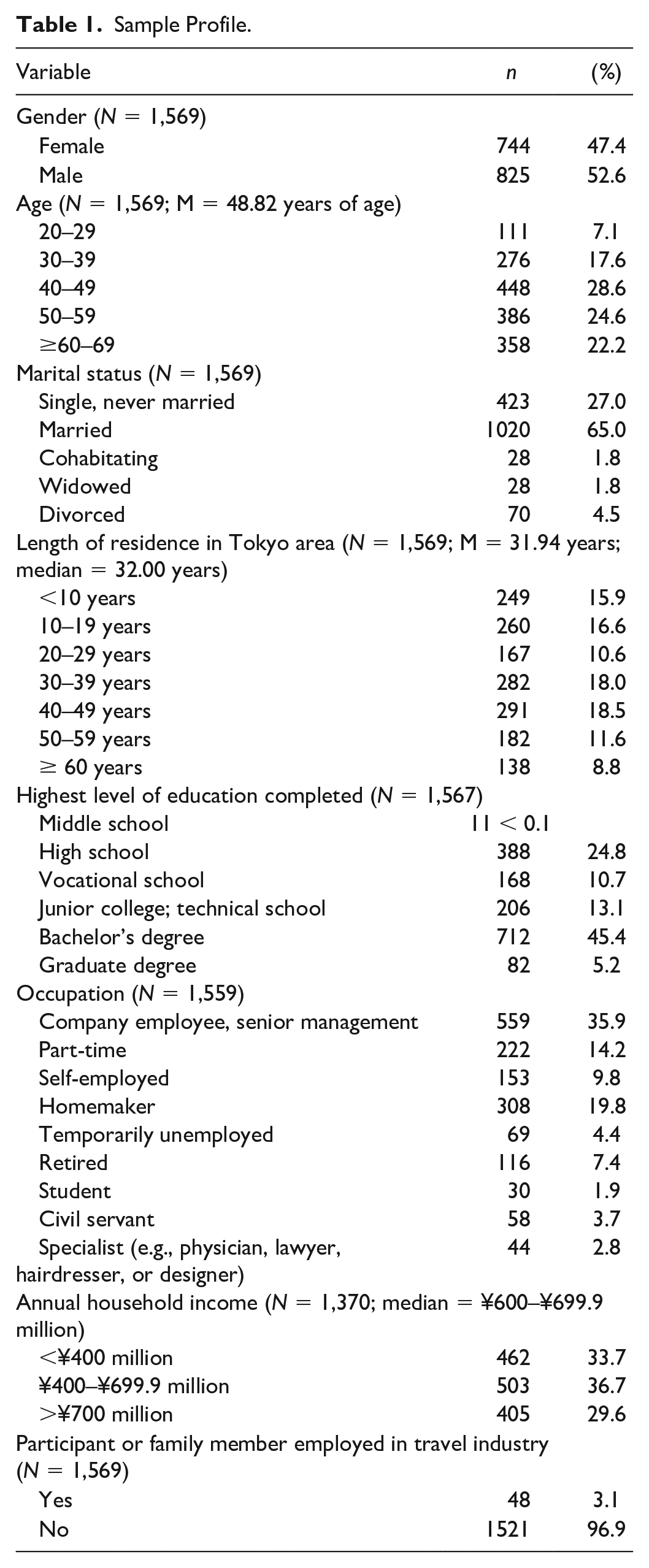
Demographic characteristics for participants are found within Table 1. The sample overall was fairly evenly split across gender (i.e., 47.4% female and 52.6% male). In terms of age (M = 49 years), the three largest groups were 40–49 years of age (28.6%), 50–59 years of age (24.6%), and 60–69 years of age (22.2%). A preponderance of participants was either married (65.0%) or single (27.0%). Respondents indicated they had lived within their particular region, on average, for 32 years (median = 32 years), though length of residence was distributed somewhat evenly across the seven categories. Nearly all participants had completed high school, with nearly half (45.4%) of the individuals holding a bachelor’s degree. The three most-reported lines of employment were company employee/senior management (35.9%), homemaker (19.8%), and part-time employee (14.2%). Participants’ annual household income (median = ¥600–¥699.9 million) was somewhat uniform across three levels: less than ¥400 million (33.7%), ¥400–¥699.9 million (36.7%), and more than ¥700 million (29.6%). Only 3.1% of the respondents indicated that either they, or a member of their family, was employed within the travel industry.
Sample Profile.
EFA for Residents’ Perceptions of Tourism
Prior to examining the relationships between residents’ perceptions of tourism and perceived social distance with visitors to Japan, each construct (and corresponding items) was subjected to exploratory factor analyses (EFAs). Given that neither of the scales that Williams and Lawson (2001) and Thyne, Lawson, and Todd (2006) created had ever been examined through factor analysis, EFA was undertaken for two primary purposes: (1) to reduce potentially superfluous items within each scale and (2) to gain an initial sense of the factor structure for each scale. As such, the overall sample (N = 1569) was split in half to undertake the EFA (N = 784), followed by a CFA/SEM (N = 785) with the remaining sample to confirm the factor structure, assess factor psychometrics, and examine model relationships. This is in keeping with the work of Hurley et al. (1997).
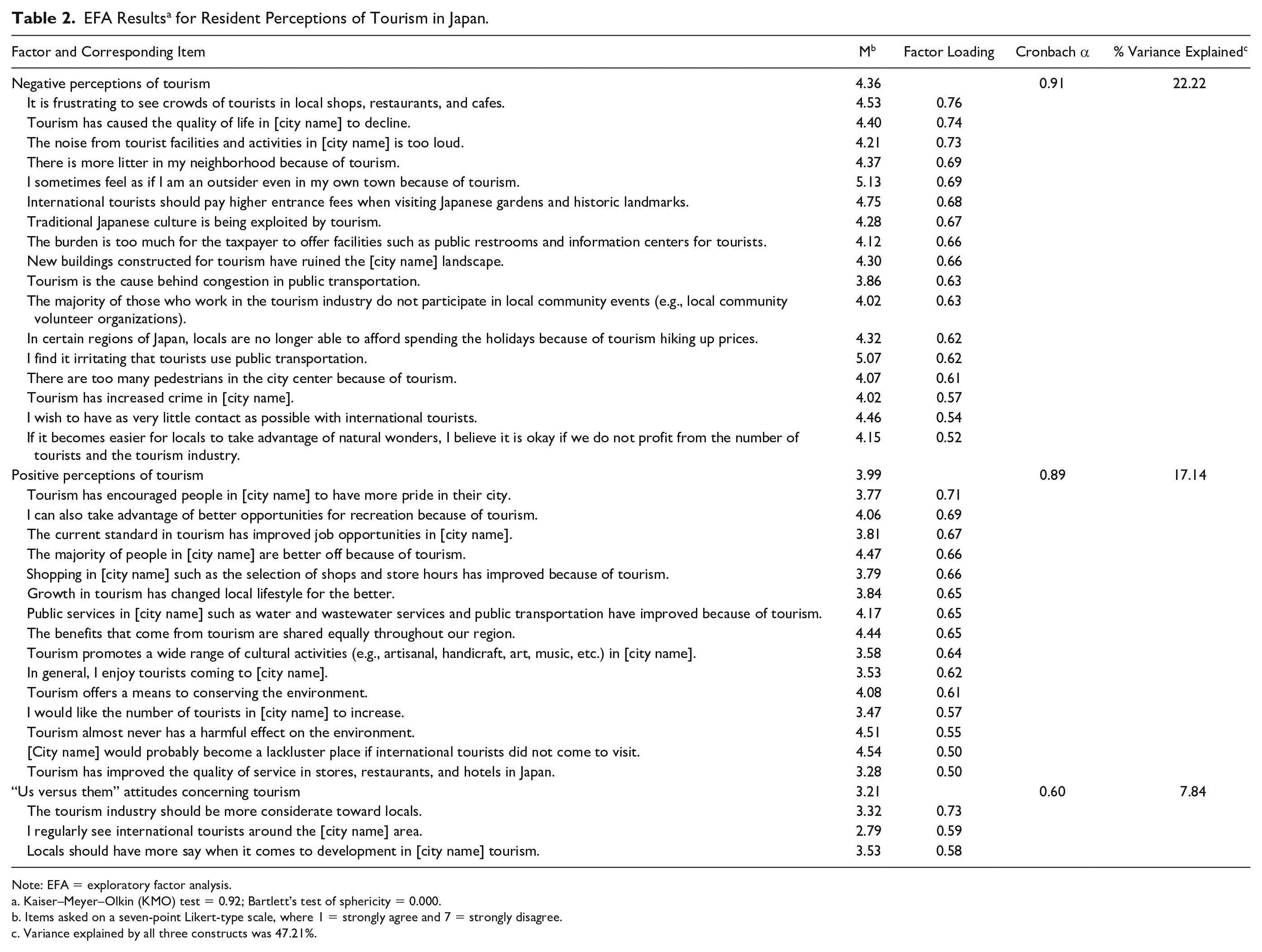
Prior to subjecting the residents’ perceptions of tourism scale to EFA, both the Kaiser–Meyer–Olkin (KMO) measure of sampling adequacy and the Bartlett’s test of sphericity were requested using IBM SPSS v.26. The KMO coefficient was 0.92. The scale yielded a significant (p < 0.001) Bartlett test. These estimates demonstrate it was acceptable to proceed with the EFA (Tabachnick and Fidell 2019). An EFA (Table 2) was then conducted with the 45 items using principal axis factoring extraction with a varimax orthogonal rotation procedure. Factors were determined based on two criteria: eigenvalues in excess of 1.0 and an examination of the scree plot (Mertler and Reinhart 2016). Items that loaded onto multiple factors (with coefficients in excess of 0.30) or items that did not load onto factors very strongly (i.e., coefficients less than 0.50) were removed (i.e., 10 items). This resulted in 35 items across three unique factors, explaining 47.21% of the variance in the construct.
EFA Results a for Resident Perceptions of Tourism in Japan.
Note: EFA = exploratory factor analysis.
Kaiser–Meyer–Olkin (KMO) test = 0.92; Bartlett’s test of sphericity = 0.000.
Items asked on a seven-point Likert-type scale, where 1 = strongly agree and 7 = strongly disagree.
Variance explained by all three constructs was 47.21%.
The first factor, negative perceptions of tourism, was composed of 17 items (M = 4.36, with means ranging from 3.86 to 5.13). The second factor, positive perceptions of tourism, included 15 items (M = 3.99, with means ranging from 3.28 to 4.54). The final factor, “us versus them” attitudes concerning tourism, had three items (M = 3.21, with means ranging from 2.79 to 3.53). To determine the reliability of each factor, Cronbach α estimates were assessed. Reliabilities for the three factors were 0.91, 0.89, and 0.60, respectively. According to Nunnally (1978), reliability estimates in excess of 0.60 are adequate when initially assessing scales through EFA.
EFA for Residents’ Perceived Social Distance with Visitors to Japan
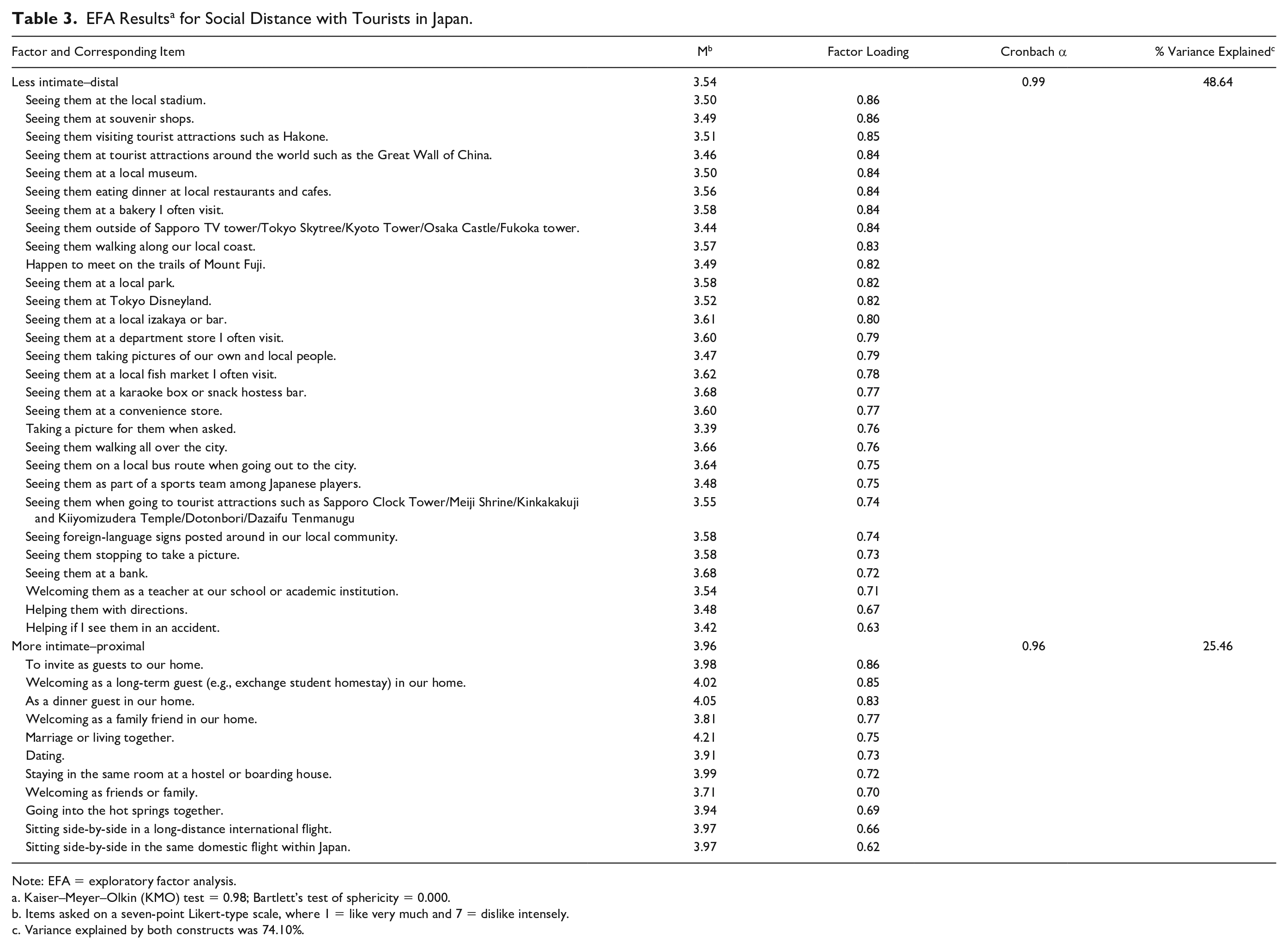
An identical procedure was undertaken with the 64 items within the social distance scale developed by Thyne, Lawson, and Todd (2006). Prior to undertaking the EFA, however, the KMO estimate and Bartlett’s test of sphericity were examined. The former was 0.98, whereas the latter was significant (p < 0.001). Considering the same criteria for exclusion, 24 items were removed from the EFA. The remaining 40 items loaded onto two distinct factors, explaining 74.10% of the variance in the construct (see Table 3).
EFA Results a for Social Distance with Tourists in Japan.
Note: EFA = exploratory factor analysis.
Kaiser–Meyer–Olkin (KMO) test = 0.98; Bartlett’s test of sphericity = 0.000.
Items asked on a seven-point Likert-type scale, where 1 = like very much and 7 = dislike intensely.
Variance explained by both constructs was 74.10%.
The first factor was labeled less intimate–distal and included 29 items (M = 3.54, with means ranging from 3.39 to 3.68). The second factor was named more intimate–proximal and included 11 items (M = 3.96, with means ranging from 3.71 to 4.21). Reliabilities were high with Cronbach α estimates of 0.99 and 0.96 for the two factors.
CFA for Measurement Model
Prior to proceeding with confirmatory factor analysis (CFA), we assessed the common methods bias (CMB) due to the cross-sectional nature of our study. We used Harman’s single-factor test to assess whether CMB was present in the data collected from residents in Japan (Podsakoff et al. 2003). All items were loaded onto a single factor using an exploratory factor analysis (EFA) procedure. The general amount of variance explained by a single factor was 35.43%, indicating that CMB did not represent a threat to the data (Podsakoff et al. 2003). Additionally, we assessed the normality of data, and no major concerns were identified because the statistics for both skewness and kurtosis provided by IBM AMOS output were lower, 2.0 and 3.0, respectively (Ribeiro, Pinto, et al. 2018; West, Finch, and Curran 1995), indicating that the data collected from residents in Japan are normally distributed, ultimately providing support for the assumption underlying maximum likelihood estimation using structural equation modeling.
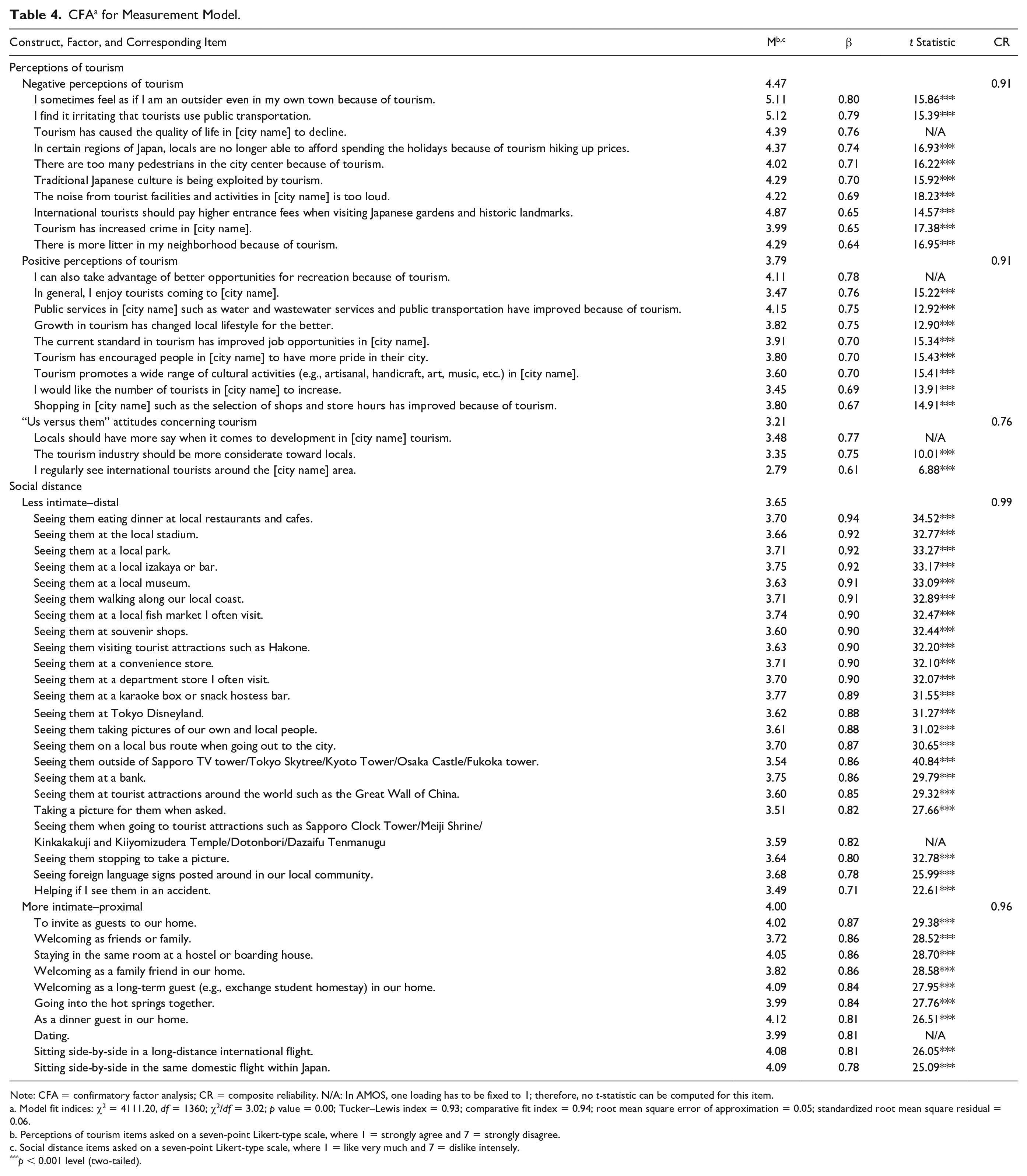
Afterwards, based on the established five-factor structure across the two constructs from the EFA, a CFA was undertaken to establish a measurement model. In essence, this served as the first of two steps (i.e., CFA to establish a measurement model followed by SEM to examine the relationships between factors) (J. C. Anderson and Gerbing 1988). As such, CFA was undertaken on the second half of the sample (N = 785) using IBM AMOS v.25. The CFA (see Table 4) began with the addition of each factor (and corresponding items) one after another to develop an ideal model. Though this ideal model had numerous cross-loaders and error covariances specified, the model was trimmed to remove error terms to arrive at the final, acceptable measurement model (Woosnam et al. 2018). Items were removed from the model if the standardized factor loadings fell below 0.50 (Hair et al. 2010) or if they loaded onto incorrect factors. Using these criteria, 20 items were removed from the CFA: 7 from negative perceptions of tourism; 6 from positive perceptions of tourism; 6 from less intimate–distal; and 1 from more intimate–proximal.
CFA a for Measurement Model.
Note: CFA = confirmatory factor analysis; CR = composite reliability. N/A: In AMOS, one loading has to be fixed to 1; therefore, no t-statistic can be computed for this item.
Model fit indices: χ2 = 4111.20, df = 1360; χ2/df = 3.02; p value = 0.00; Tucker–Lewis index = 0.93; comparative fit index = 0.94; root mean square error of approximation = 0.05; standardized root mean square residual = 0.06.
Perceptions of tourism items asked on a seven-point Likert-type scale, where 1 = strongly agree and 7 = strongly disagree.
Social distance items asked on a seven-point Likert-type scale, where 1 = like very much and 7 = dislike intensely.
p < 0.001 level (two-tailed).
The final measurement model contained 55 items (i.e., 22 concerning perceptions of tourism and 33 pertaining to social distance): negative perceptions of tourism (10 items; M = 4.47, with β ranging from 0.64 to 0.80); positive perceptions of tourism (nine items; M = 3.79, with β ranging from 0.67 to 0.78); “us versus them” attitudes concerning tourism (three items; M = 3.21, with β ranging from 0.61 to 0.77); less intimate–distal (23 items; M = 3.65, with β ranging from 0.71 to 0.94); and more intimate–proximal (10 items; M = 4.00, with β ranging from 0.78 to 0.87). Only seven of the 55 items had a β falling between 0.61 and 0.69. The model yielded a χ2(df) = 4111.20(1360), χ2/df = 3.02, with the following fit indices: comparative fit index (CFI) = 0.94; Tucker–Lewis index (TLI) = 0.93; root mean square error of approximation (RMSEA) = 0.05; and standardized root mean square residual (SRMR) = 0.06. According to Browne and Cudeck (1993), a TLI and CFI of at least 0.90, indicates an acceptable incremental fit of the data. Also, an RMSEA and SRMR value below 0.07 is considered a good absolute fit of the data (Hu and Bentler 1999).
Psychometrics
All factors in the model indicated a good internal consistency according to their composite reliability estimates in excess of 0.70 (Hair et al. 2010). Construct validity was assessed through examining convergent and discriminant validity estimates. Convergent validity was demonstrated by three criteria: (1) β for each item greater than 0.50; (2) average variance extracted (AVE) in excess of 0.50; and (3) significant t values (p < 0.001) for each factor loading (Hair et al. 2010) (see Tables 4 and 5). Discriminant validity was examined by comparing the square root of the AVE for any two factors with interfactor correlations. In all instances, the former exceeded the latter (see Table 5), demonstrating discriminant validity for each of the five factors within the model (Fornell and Larcker 1981).
Discriminant Validity.
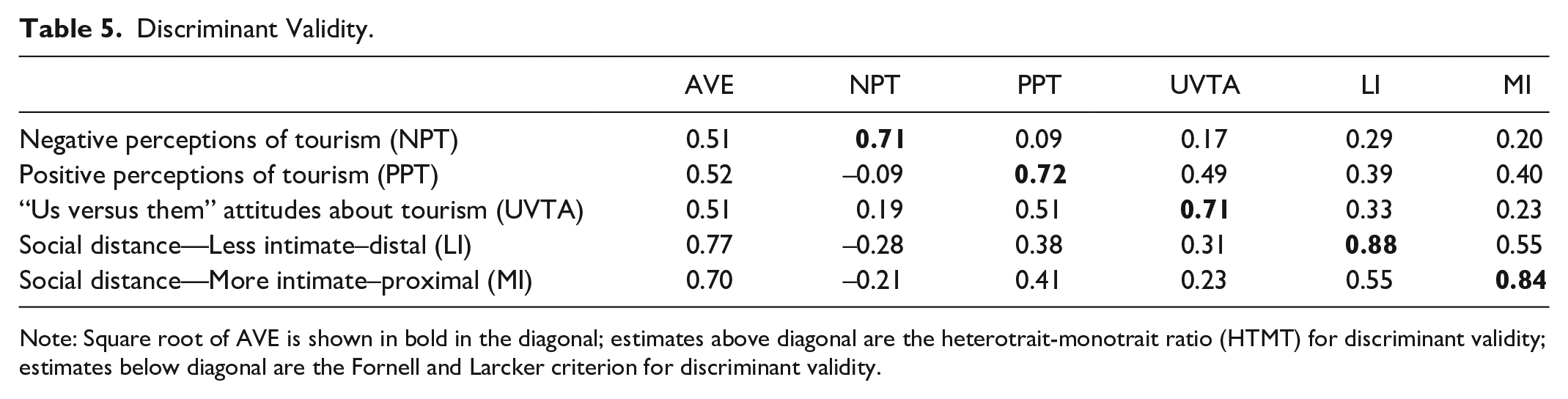
Note: Square root of AVE is shown in bold in the diagonal; estimates above diagonal are the heterotrait-monotrait ratio (HTMT) for discriminant validity; estimates below diagonal are the Fornell and Larcker criterion for discriminant validity.
SEM to Examine Model Relationships
Following the establishment of the measurement model, each of the relationships between model constructs (see Figure 1) was examined through structural equation modeling (SEM) using IBM AMOS v.25, resulting in six relationships to consider (see Table 6). The structural model yielded a χ2(df) = 4225.37(1361), χ2/df = 3.11, with the following fit indices: CFI = 0.93; TLI = 0.93; RMSEA = 0.05; and SRMR = 0.06 (Table 6). Of the six relationships, only one (i.e., “Us versus them” attitudes concerning tourism → more intimate–proximal) was not significant (p = 0.11). Each of the three resident perceptions of tourism (i.e., negative perceptions of tourism, positive perceptions of tourism, and “us versus them” attitudes concerning tourism) significantly predicted the social distance factor, less intimate–distal, explaining 49% of its variance (R2 = 0.49). Only two of the three resident perceptions of tourism (i.e., negative perceptions of tourism and positive perceptions of tourism) significantly predicted the social distance factor, more intimate–proximal, explaining 53% of its variance (R2 = 0.53). The direction of the relationships is shown in Figure 1 and Table 6.
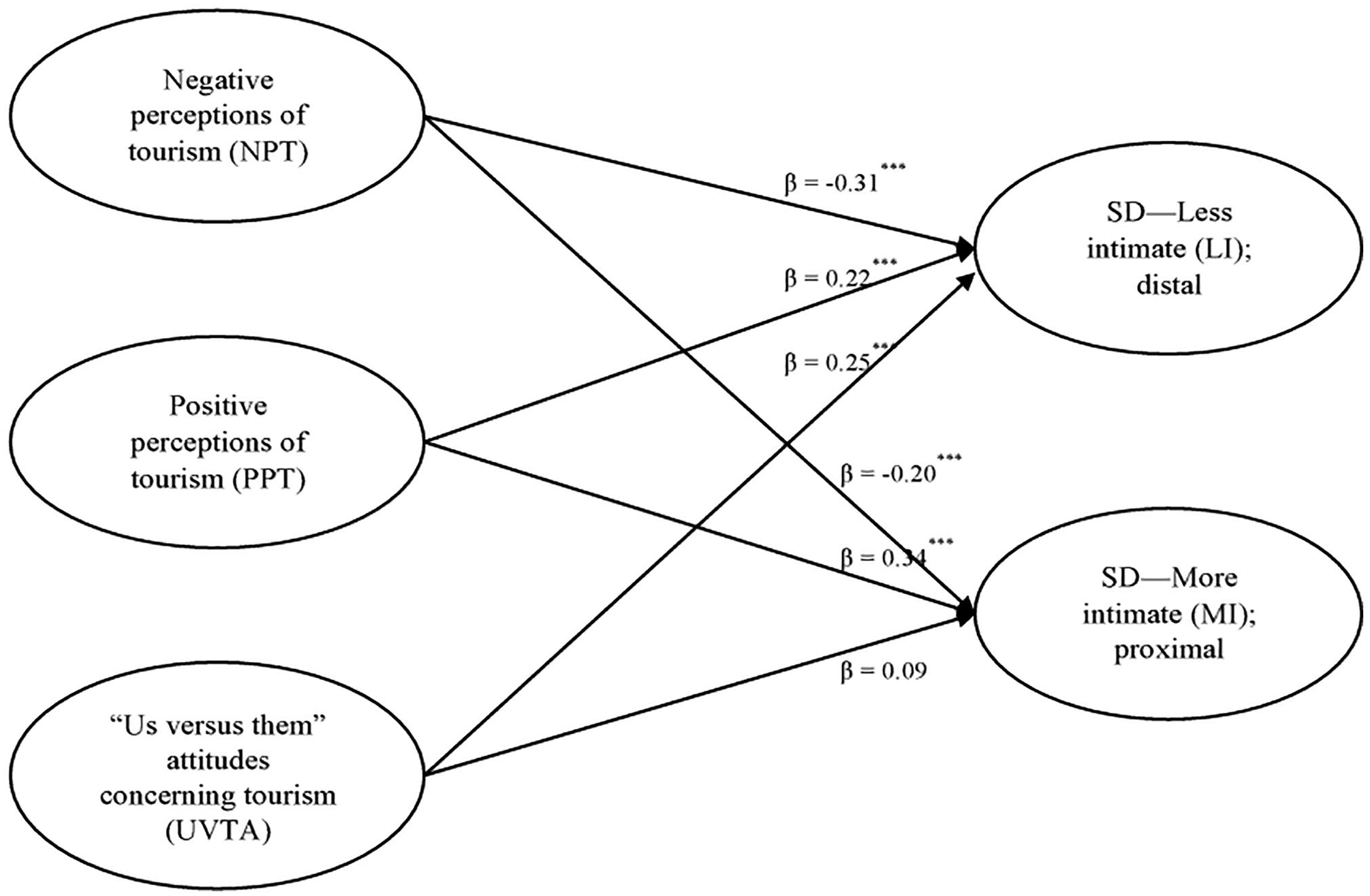
Structural model results.
Results of Structural Model a (Standardized).
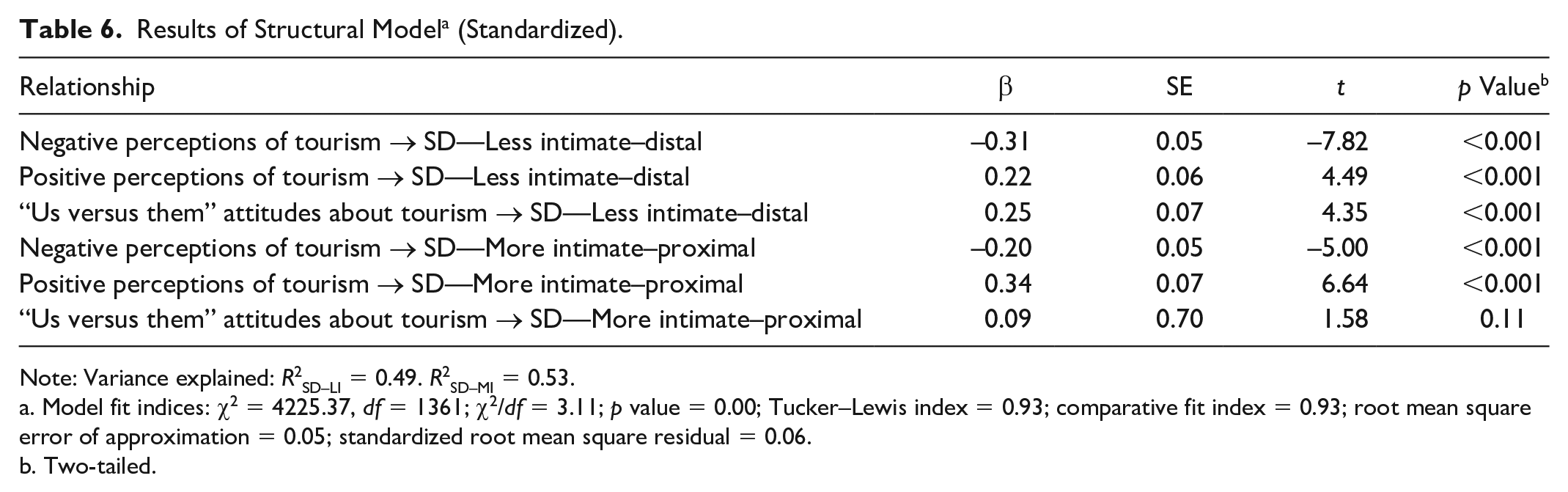
Note: Variance explained: R2SD–LI = 0.49. R2SD–MI = 0.53.
Model fit indices: χ2 = 4225.37, df = 1361; χ2/df = 3.11; p value = 0.00; Tucker–Lewis index = 0.93; comparative fit index = 0.93; root mean square error of approximation = 0.05; standardized root mean square residual = 0.06.
Two-tailed.
Discussion and Conclusions
Researching and understanding the social impacts of tourism is crucial in contributing to a sustainable tourism industry (Deery, Jago, and Fredline 2012; Sharpley 2014). However, we also need to go beyond understanding what the impacts are and explore any outcomes related to residents’ attitudes toward tourism development (Martín, de los Salmones Sanchez, and Herrero 2018). Previous studies have largely focused on antecedents of residents’ attitudes (Faulkner and Tideswell 1997; Gursoy et al. 2019; Vargas-Sánchez, Porras-Bueno, and de los Ángeles Plaza-Mejía 2011, 2014) rather than understanding the outcomes of such attitudes (Rivera et al. 2016). This study begins to address this dearth in our knowledge by examining the extent to which residents’ attitudes concerning tourism can potentially predict sympathetic understanding toward the international tourists visiting their community. Sympathetic understanding is determined by the distance or closeness we feel toward others, which contributes to either cooperation or conflict (Crull and Bruton 1979; Hagendoorn and Kleinpenning 1991; Nyaupane, Timothy, and Poudel 2015). By understanding changes in social distance attitudes, we may gain insight into potential social tension, and behavioral tendencies of the host community toward tourists, aiming to avoid hostile responses to tourists (Deery, Jago, and Fredline 2012). It was purported that the sympathetic understanding (measured through social distance [Thyne and Lawson 2001; Thyne, Lawson, and Todd 2006; Woosnam and Lee 2011]) that residents perceive toward visitors are a function of their attitudes about tourism. Exploratory factor analysis of the original 64 social distance items indicated two distinct factors (less intimate–distal and more intimate–proximal), while EFA of the 45 attitude items resulted in three factors: negative perceptions of tourism, positive perceptions of tourism, and “us versus them” attitudes. As such, six relationships were examined. To begin, negative perceptions of tourism, positive perceptions of tourism, and “us versus them” attitudes were proposed to significantly explain a less intimate–distal understanding of tourists. Following this, the same three predictors were then considered to significantly explain a more intimate–proximal understanding of tourists.
Testing of the structural model revealed that each of the three residents’ attitudes factors significantly explained approximately half of the variance in the social distance factor concerning a less intimate–distal understanding of tourists. However, only two of the predictors (i.e., negative perceptions of tourism and positive perceptions of tourism) explained slightly more of the variance in the social distance factor surrounding a more intimate–proximal understanding of tourists. Though no one clear residents’ attitudes factor stood out consistently as the best predictor (based on β estimates) of social distance, some noteworthy observations can be made around the outcomes related to negative perceptions of tourism versus positive perceptions.
As a construct, negative perceptions of tourism was found to have the strongest impact on a less intimate–distal understanding of tourists. The opposite was true for a more intimate–proximal understanding, as positive perceptions of tourism was found to demonstrate the strongest relationship with this social distance factor. These results show that while tourism development may impact residents’ attitudes toward tourists (Inskeep 1991), the impact (whether it be positive or negative) will depend on individuals’ attitudes toward tourism (whether that is positive or negative). This suggests that tourism may indeed promote cross-cultural exchange, resulting in greater mutual respect and understanding (Inskeep 1991), but only if the views about tourism are positive in the first place.
There are important outcomes related to residents’ attitudes to tourism that can be drawn from this study. Before now, research has largely focused on the antecedents of attitudes (Faulkner and Tideswell 1997; Vargas-Sánchez, Porras-Bueno, and de los Ángeles Plaza-Mejía 2011, 2014) rather than the outcomes of any attitudes held. If we believe that residents’ acceptance of the tourists coming into destinations is indeed a vital part of strategic and sustainable tourism development (Pearce 1980), then we need to understand the perceived relationship between the host and the guest. Our research provides evidence that the potential hospitality that tourists might receive depends on whether general tourism attitudes are positive or negative, raising the importance of encouraging positive perceptions of tourism among residents.
This study extends Martín, de los Salmones Sanchez, and Herrero (2018) by focusing on perceptions of international tourists and shifting the focus from interactions between residents and tourists to the sympathetic understanding that residents have toward tourists. We argue that the theory of social distance provides a more nuanced understanding of attitudes toward tourists, as it does not rely on the resident having had contact or an interaction with a tourist; rather it asks Japanese residents to consider situations in which they might meet tourists, utilizing projective techniques to elucidate a response.
Previous research concluded that social distance between residents and tourists will significantly explain residents’ attitudes concerning tourism (Thyne, Watkins, and Yoshida 2018); this article shows that this relationship also goes in the opposite direction—residents’ attitudes predicting social distance. More positive attitudes toward tourism will predict more positive attitudes about tourists. This finding, significant in any tourism destination, is especially important in an emerging destination such as Japan. Thyne, Watkins, and Yoshida (2018) have previously unpacked some of the potential reasons behind the social distance that Japanese residents feel, in particular increased social distance toward Chinese visitors and less distance toward Australasian tourists and tourists from the USA. These include factors such as post-occupation relations, shared history, nationalism, the “ladder of civilizations” theory and social identity theory as significant contributors (Thyne, Watkins, and Yoshida 2018). With this study, we now know that perceptions of tourism generally have an impact on social distance, and thus, social distance could be alleviated by developing and promoting internal marketing strategies around the impacts of tourism development to improve resident attitudes.
Theoretical Implications
As one of very few studies to focus on the outcomes of residents’ attitudes to tourism, and the first to uncover the direct relationship between residents’ attitudes and sympathetic understanding (social distance) of tourists, this study makes several theoretical contributions to the tourism and destination marketing literature. First, it extends tourism social impact theory by moving beyond a focus on uncovering predictions around resident support for tourism (Faulkner and Tideswell 1997; Vargas-Sánchez, Porras-Bueno, and de los Ángeles Plaza-Mejía 2011, 2014) and moves to understanding the impact or outcomes of these attitudes—in particular the impact on attitudes toward the tourists themselves (Sharpley 2014). This study shows that indeed there is a relationship between attitudes toward tourism (both positive and negative) and attitudes toward the tourists visiting. In doing so, we draw on social distance theory, as it provides theoretical support on how residents’ attitude toward tourism ultimately helps to understand residents’ sympathetic understanding toward tourists (Joo et al. 2018). Importantly, attitudes (positive and negative) lead to meaningfully comprehending residents’ social distance toward tourists. One straightforward proposition is that residents with positive attitudes toward tourism results in a proximal interaction with tourists, enhancing a perceived degree of intimacy among them (Chen et al. 2020), that ultimately reduces differences in judgment about self and others (Pronin, Gilovich, and Ross 2004). Conversely, those with more negative attitudes about tourism results in a more distal interaction with tourists (Joo et al. 2018). Taken together, because no study has tested this relationship, our primary contribution lies in theorizing and empirically testing the effect of residents’ attitudes about tourism on residents’ sympathetic understanding toward tourists through the lens of social distance theory (Nyaupane, Timothy, and Poudel 2015; Yilmaz and Tasci 2015).
A second theoretical implication lies in the contribution to the residents’ attitudes about tourists’ literature stream. Although this study does not focus on conflict as such, it does look at how sympathetic we are toward other ethnic groups (of international tourists). This understanding and the attitudes that follow may be the precursor to behavior (Sinkovics and Penz 2009; Tasci 2009); therefore, it is vital that we understand how residents sympathize with visitors. This thought is in line with previous insights put forth by Ribeiro, Woosnam, et al. (2018), who found that tourists’ levels of satisfaction and their willingness to revisit and recommend the destination are somehow triggered by the proximal relationships they develop with destination residents.
Our study adds an additional contribution to the social distance theory—having first been applied to other fields such as psychology, social distance theory is beginning to be situated within tourism contexts (Thyne and Zins 2003; Woosnam and Lee 2011)—especially with regard to attitudes between hosts and guests (Joo et al. 2018; Thyne, Watkins, and Yoshida 2018; Yilmaz and Tasci 2015). This study extends current literature in this field by focusing specifically on how tourism attitudes might predict social distance, giving us an understanding of antecedents to social distance, in a field where most studies use social distance itself as an antecedent to other attitudes or behaviors.
Finally, analyzing sympathetic understanding within a rapidly emerging tourism destination such as Japan has theoretical implications for understanding contexts in which there has been very little time given for residents to come to terms with international tourism, and where past relations with their biggest inbound markets are fraught with historic tension.
Practical Implications
The findings of this study contribute several practical implications, particularly for local and national tourism planners, government departments, and DMOs. Overall, the results show residents’ attitudes toward tourism to be significant predictors of social distance. If a resident, for example, holds negative attitudes toward tourism, it is more likely that she or he will feel more distant toward the tourists coming in and will have less sympathetic understanding of the tourists. As the cultural agents and the major social group through which tourism is delivered (Muler Gonzalez, Coromina, and Galí 2018), it is important to encourage residents to be receptive of visitors coming in, in the hope of encouraging positive hospitality experiences (Deery, Jago, and Fredline 2012). From this study, we now know that if residents are more positive about the industry, they will in turn be more sympathetic toward the tourists coming in and ultimately positively influence their future behavioral intentions (Ribeiro, Woosnam, et al. 2018).
As previous studies suggest (Aleshinloye et al. 2020), DMOs need to involve residents in the tourism planning process, to ensure that residents are not only informed but consulted in tourism development, aiming to promote positive attitudes to it. All too often, the resident is ignored in the marketing of destinations, despite their role in the tourism offering. A relationship needs to be formed between the stakeholders of the industry, and this includes the resident; it is vital that they feel informed and part of the decisions being made (Nunkoo and Ramkissoon 2016). A key of such internal marketing is educating residents with respect to tourism—education especially around the positive impacts of the tourism industry. A close collaboration between the local community and the government and DMOs is vital for sustainable tourism development. However, sustainable tourism can only be achieved if views of the local community members and other important stakeholders are acknowledged, encouraged, and included in the tourism planning strategy (Ribeiro, Pinto, et al. 2018).
Most often negative impacts fill the media; a concerted effort by DMOs and government departments needs to be put into disseminating the positive impacts of tourism development and growth. Social media forums can be used, for example, to announce the most recent impacts around the latest mega-event held in Japan—the 2019 Rugby World Cup. News releases are also important to ensure that residents understand the value of such events, with a recent article emphasizing the positive impacts on the Japanese sports industry through hosting mega-events: hospitality services for VIPs, stadium and arena management, sports-related tours and the offering of high-tech devices, such as sound and display systems for viewing sports as potential areas of expansion (Japan Times 2019).
It would also be useful to encourage interactive communication strategies such as questionnaires (possibly hosted on social media sites, and/or run through magazines and local newspapers). Such surveys would be useful in keeping abreast with any issues and concerns that residents hold about the tourism industry. It also means the resident is feeling part of, and valued, within the decision-making processes. Finally, educating younger residents is also important, in schools if possible. As Japan is a relatively young tourism destination, there is much scope for developing tourism and hospitality education from the high school level through vocational education and universities. The value of the tourism industry needs to be taken seriously, but also the challenges that come with this need to be recognized and researched within Japan, such as challenges around sustainability. The aim would be to normalize tourism industry needs within Japanese society, in the hope that benefits and the positive elements of the industry are easily understood and residents are given space, opportunity, and agency to report on their concerns around negative aspects.
Limitations and Future Research Opportunities
This work is not without its limitations. Though residents’ attitudes concerning tourism explained a significantly high degree of variance in social distance, the model only included one construct predictor. While this was our intention, room exists for improving the model (i.e., increasing variance explained in social distance) by including other theoretically derived predictor constructs of social distance and residents’ attitudes about tourism. For instance, frequency of interaction with tourists (Aleshinloye et al. 2020; Joo et al. 2018), nature of interaction with tourists (Joo et al. 2018), or residents’ place attachment (Aleshinloye et al. 2020) may be added to subsequent models explaining social distance. Additionally, residents’ attitudes about tourism could also be considered a mediator of the relationship between emotional solidarity residents perceive with tourists and social distance (Woosnam 2012). Furthermore, group differences based on sociodemographic characteristics of the sample were not assessed. As Sheth (1977, p. 136) contends, “demographics are here to stay with us for projection, identification, and segmentation of the markets so long as the census data of countries are limited to the socio-economic-demographic profile of the citizens.” Segmenting residents based on these demographics (i.e., age, gender, education level, length of residence, etc.) may go far in contributing to a greater understanding of the perceived social distance residents have with tourists. As such, models similar to ours that incorporate these demographics as moderators between predictors and social distance may be a fertile place to begin (see Ribeiro, Woosnam, et al. 2018).
Another limitation is that the population for this study was only derived from Japan. Although as argued in the paper, Japan provides a very suitable and valuable context for this research, deriving a sample from a larger population (across different countries, comparing a more established tourism destination with an emerging destination for example) may further validate our findings and contribute to greater generalizable results.
Regarding future research opportunities, we stress that more researchers should question and study the outcomes of residents’ attitudes concerning tourism (Sharpley 2014). There will be additional outcomes that have not been measured in this research and will be worthy of investigation, including outcomes around employment (within the tourism industry); encouraging and supporting friends and family to work in the tourism industry; and resident behavior—especially toward tourists. The tourism literature often focuses on researching perceptions of the industry, while there has been much less focus on researching behavior within the industry. Future research could consider the links between social distance and resident behavior, especially their interactions with tourists. This is especially important given the recognized complexities around attitudes as predictors of behavior (Armitage and Christian 2003).
Further, this research could be extended by uncovering which specific resident attitude dimensions impact sympathetic understanding toward certain nationalities. Is it attitudes around crime or congestion for example which lead to less sympathetic understanding? Uncovering such insight would enable more targeted internal marketing strategies to be developed.
Finally, this article began by discussing Inskeep (1991), and it is important to reflect on, and question, the impact that the culture of the residents and the tourists have on any associated attitudes and social distance. In this context, how desirable do Japanese residents find certain direct and indirect contact situations between themselves and various nationality and culture groups? Although Thyne, Watkins, and Yoshida (2018) uncovered higher perceived social distance between Japanese residents and Chinese tourists versus other tourist nationalities, the question remains as to whether attitudes toward tourism are related to the nationality or culture of the tourist. This is worth unpacking in future studies and would provide clearer guidance for targeted internal marketing strategies.
Although the data provided evidence in favor of the plausibility of our theoretically informed relationships among the construct factors, we encourage others to refine and extend this model in an effort to further our understanding of how residents develop varying degrees of perceived social distance with tourists coming into their communities.
Footnotes
Declaration of Conflicting Interests
The author(s) declared no potential conflicts of interest with respect to the research, authorship, and/or publication of this article.
Funding
The author(s) received no financial support for the research, authorship, and/or publication of this article.
