



Abstract
A plethora of research has concentrated on residents’ degree of support for tourism, albeit focused squarely on either attitudinal or intentional support, and with minimal consideration of how residents’ perceived relationships with tourists may explain support. The focus of this article is therefore to examine a complementary framework linking the theoretical framework of emotional solidarity with the theory of planned behavior to explain residents’ behavioral support for tourism. On-site survey data were collected from 740 residents of the highly popular coastal destination, Izmir, Turkey, to test the proposed model. Of the nine hypotheses examined, eight were supported. Emotional solidarity, attitudinal support for tourism, attitudinal contributions to community, perceived behavioral control, and subjective norms collectively explained 42% of the variance in residents’ behavioral intentions to support tourism. Behavioral intentions, in turn, uniquely explained 23% of the variance in residents’ behavioral support for tourism. Study implications, limitations, and future research suggestions are offered.
Keywords
Introduction
Spanning the last four decades, numerous studies have demonstrated how residents’ perceptions of tourism impacts, along with perceived personal benefits significantly predict their support for tourism development with destinations (Andereck and Vogt 2000; Chen and Raab 2012; Gursoy, Chi, and Dyer 2010; Gursoy, Milito, and Nunkoo 2017; Huh and Vogt 2008; H. Kim, Choe, and Lee 2019; T. H. Lee 2013; Martín, de los Salmones Sanchez, and Herrero 2018; Papastathopoulos et al. 2020; Rasoolimanesh et al. 2017; J. M. L. Wu, Tsai, and Lee 2017; Zuo, Gursoy, and Wall 2017). Complementing this work, a recent line of research (see Erul, Woosnam, and McIntosh 2020; Hasani, Moghavvemi, and Hamzah 2016; Juric, Lindenmeier, and Arnold 2021; Li and Wan 2017; Moghavvemi et al. 2017; Simpson and Simpson 2016; Suess, Woosnam, and Erul 2020; Woosnam 2012; Zheng et al. 2019) has focused on the social relationship between residents and tourists, moving beyond the financial exchange marking much of the relationships, to explain residential support for tourism and its accompanying development. Such work has demonstrated that residents’ degree of emotional solidarity with tourists (as measured using the Emotional Solidarity Scale [ESS]) contributes significantly to attitudinal support for tourism development.
Though the work concerning residents’ support for tourism is rather extensive, little work has measured the construct in terms of behavioral intentions in keeping with the logic derived from either the theory of reasoned action (Chen and Raab 2012; Kwon and Vogt 2010; Ramkissoon and Nunkoo 2011; Ribeiro et al. 2017) or theory of planned behavior (Erul, Woosnam, and McIntosh 2020; H. Kim, Choe, and Lee 2019; Nunkoo and Ramkissoon 2010; S. T. Wu and Chen 2018; J. M. L. Wu, Tsai, and Lee 2017). Recently, tourism studies such as Esfandiar et al. (2020), M. J. Kim, Hall, and Kim (2020), and Wang et al. (2020) have focused on residents’ actual behavior (i.e., residents’ environmental and pro-environmental behavior), and only a few studies have focused on residents’ behavioral support for tourism development (Martín, de los Salmones Sanchez, and Herrero 2018; Nunkoo and Gursoy 2012). However, Nunkoo and Gursoy (2012) focused exclusively only on a financial relationship (i.e., perceived benefits and economic impacts of tourism) considering the social exchange theory. Furthermore, Martín, de los Salmones Sanchez, and Herrero (2018) examined how residents’ attitudes toward tourism, as well as attitudes toward tourists, can influence residents’ behavioral support for tourism development. The authors found that both types of attitudes significantly explained residents’ actual behavior. Therefore, a need still exists in examining the factors that may help to explain residents’ behavioral support for tourism through using the theory of planned behavior (hereafter abbreviated as TPB). Considering emotional solidarity in tandem with the theory of planned behavior may aid in explaining this support (Woosnam 2012).
In light of the above-mentioned gaps, the current study intends to merge emotional solidarity with the theory of planned behavior to explain actual behavioral support for tourism within a destination. Such an approach of utilizing complementary frameworks to explain residents’ attitudes was championed by Ward and Berno (2011), and has been demonstrated in recent work (Chen and Raab 2012; Eslami et al. 2019; Gursoy et al. 2019; C. K. Lee, Kim, and Kim 2018; Ramkissoon and Nunkoo 2011; Su, Huang, and Huang 2018; Su and Swanson 2020; J. M. L. Wu, Tsai, and Lee 2017). Furthermore, this study is the first to consider emotional solidarity concurrently with the theory of planned behavior constructs, to not only explain residents’ behavioral intentions but also behavioral support for tourism development. To test the model that indicated the relationship between the ESS and TPB factors, 740 Izmir residents completed onsite self-administered questionnaires and the hypothesized relationships (proposed within our conceptual model) were analyzed via structural equation modeling.
In addition to such theoretical contributions, this work aims to contribute to practice by providing residents of Izmir, Turkey, a voice during the planning process for sustainable tourism. By understanding how residents perceive tourists, along with how such a degree of solidarity and the theory of planned behavior constructs (i.e., attitudes, perceived behavioral control, and subjective norms) may explain the various forms of residents’ support for tourism, planning officials within the highly popular coastal destination will be better equipped to make the most informed decisions in planning for sustainable tourism in a destination that continues to welcome a growing number of tourists each year (RTMCT 2018; UNWTO 2019).
Literature Review
Residents’ Support for Tourism Development
A rich body of literature focusing on residents’ support for tourism development has demonstrated that understanding residents’ support is vital for successful sustainable tourism (Andereck and Vogt 2000; Gursoy et al. 2019; Gursoy, Chi, and Dyer 2010; Gursoy, Milito, and Nunkoo 2017; Hasani, Moghavvemi, and Hamzah 2016; Huh and Vogt 2008; T. H. Lee 2013; Nunkoo and Gursoy 2012; Rasoolimanesh et al. 2017; Ribeiro et al. 2017; S. T. Wu and Chen 2018). However, most of this work has considered residents’ support for tourism development using attitudinal measures (Gursoy et al. 2019; Gursoy, Chi, and Dyer 2010; Gursoy, Milito, and Nunkoo 2017; Huh and Vogt 2008; Nghiêm-Phú 2016; Rasoolimanesh et al. 2017; Ribeiro et al. 2017; Su and Swanson 2020; Woosnam 2012; Zuo, Gursoy, and Wall 2017). For example, Ribeiro et al. (2017) found a direct relationship between residents’ attitudes and their support for tourism development. Similarly, Andereck and Vogt (2000) found that the more positive residents’ attitudes are concerning tourism, the more likely individuals will support tourism and sustainable development.
Despite numerous studies indicating a direct linear relationship between residents’ attitudes and their support for tourism development, some scholars have emphasized the importance of including residents’ behavioral intentions to support tourism development (Chen and Raab 2012; Choi and Murray 2010; Erul, Woosnam, and McIntosh 2020; Eslami et al. 2019; Megeirhi et al. 2020; H. Kim, Choe, and Lee 2019; T. H. Lee 2013; Nunkoo and Ramkissoon 2010; Ramkissoon and Nunkoo 2011; Su, Swanson, and He 2020; Zheng et al. 2019; J. M. L. Wu, Tsai, and Lee 2017). As Ajzen (1985) points out, an individual’s behavioral intentions are the main determinant of actual behavior, which depends largely on a set of variables, not a single linear relationship. For example, Choi and Murray (2010) examined the relationships among residents’ perceived impacts of tourism, sustainable tourism components (i.e., long-term planning, community participation, community attachment, and environmental sustainability), and intentions to support tourism development. Their results indicated that community attachment, perceived positive impacts, and tourism planning are positively related to behavioral intentions. Similarly, T. H. Lee (2013) found that residents’ community attachment and community involvement indirectly, positively, and significantly affected intentions to support sustainable tourism, while residents’ perceived benefits of sustainable tourism directly, positively, and significantly influenced their intentional support for tourism development. In addition to those, Eslami et al. (2019) found a direct and significant relation between residents’ overall quality of life satisfaction and intention to support tourism development, and Megeirhi et al. (2020) found that subjective norms were a significant predictor of residents’ intention to support cultural heritage tourism.
Recently, Erul, Woosnam, and McIntosh (2020), H. Kim, Choe, and Lee (2019), J. M. L. Wu, Tsai, and Lee (2017), and S. T. Wu and Chen (2018) examined the relationship between the theory of planned behavior constructs and residents’ intentional support for tourism development. Erul, Woosnam, and McIntosh (2020) postulated a model in which all three constructs (i.e., attitudinal support for tourism development, subjective norms, and perceived behavioral control) were significant predictors of residents’ intentional support. The authors considered residents’ attitudes as a function of residents’ emotional solidarity with tourists (i.e., welcoming nature, sympathetic understanding, and emotional closeness). To that point, H. Kim, Choe, and Lee (2019) found that all TPB factors were good predictors of residents’ intentional support for the development of the demilitarized zone (DMZ) Peace Park. Furthermore, J. M. L. Wu, Tsai, and Lee (2017) examined residents’ intention to support casino gaming development in Penghu through the application of the TPB. Researchers found that past behavior was a good moderator between two of the TPB factors (i.e., subjective norm and perceived behavioral control) and residents’ intention to support casino gaming development. Similarly, S. T. Wu and Chen (2018) used the theory of planned behavior constructs and residents’ perceived benefits to examine individuals’ intentional support for ecotourism development in Taiwan. Results showed that two of the three constructs (i.e., attitudinal support and perceived behavioral control) as well as perceived social benefits were significantly correlated with behavioral intentions to support.
Although these studies demonstrate a host of antecedent variables to significantly predict residents’ behavioral intentions to support tourism development, each stopped shy of assessing actual behavior (Palmer, Koenig-Lewis, and Jones 2013). Limited work has tried to explain actual behavior (Martín, de los Salmones Sanchez, and Herrero 2018; Nunkoo and Gursoy 2012). However, Nunkoo and Gursoy (2012) jumped directly to behavioral support without considering intentions to support. Similarly, Martín, de los Salmones Sanchez, and Herrero (2018) found a connection between residents’ attitudes toward tourism and their behavioral support for tourism development. As such, some studies have claimed that even though researchers have used behavioral intentions to predict actual behavior, intentions may not predict actual behavior by using the theory of planned behavior model (Hsu and Huang 2012). Thus, researchers should measure actual behavior instead of using behavioral intentions as a proxy (Ajzen 1991). This is especially the case in light of the current study that focuses on the role of the relationship between residents and tourists and how that translates to behavioral support for tourism development.
Emotional Solidarity
Development of the emotional solidarity concept and the groundwork of the theoretical framework originated from the late workings of the French classical sociologist, Emile Durkheim. As a structural-functionalist, Durkheim was concerned with how aspects (i.e., social facts) of society worked together and how degrees of intimacy and closeness are pillars of solidarity. Considering Australia’s Aboriginals at the close of the nineteenth century, Durkheim ([1915] 1995), within The Elementary Forms of the Religious Life, claimed solidarity arose out of rituals (i.e., sharing behavior) and deeply held beliefs among individuals. This work paved the way for the framework that Woosnam et al. (2018) highlighted in claiming that “as individuals within a particular religion interact with each other, share a common belief system, and engage in similar behaviors, they will experience a sense of solidarity with one another” (p. 277). To assess how residents’ degree of awareness of their relationships with tourists, Woosnam, Norman, and Ying (2009) first introduced the concept of emotional solidarity to the tourism literature. Shortly thereafter, the 10-item Emotional Solidarity Scale (ESS), which is composed of three unique factors—welcoming nature, emotional closeness, and sympathetic understanding—was created and validated through psychometric testing (Woosnam and Norman 2010).
Over the last decade, research using the ESS has been undertaken in various contexts to consider the constructs from residents’ perspectives (Erul, Woosnam, and McIntosh 2020; Hasani, Moghavvemi, and Hamzah 2016; Joo et al. 2018; Li and Wan 2017; Moghavvemi et al. 2017; Nghiêm-Phú 2016; Ribeiro et al. 2017; Woosnam, Erul, and Ribeiro 2017; Woosnam et al. 2018; Suess, Woosnam, and Erul 2020), tourists’ perspectives (Patwardhan et al. 2020; Ribeiro et al. 2018; Woosnam and Aleshinloye 2013; Woosnam et al. 2015), or collectively between the two groups (Juric, Lindenmeier, and Arnold 2021; Simpson and Simpson 2016; Woosnam 2011; Woosnam, Aleshinloye, and Maruyama 2016). Therefore, it is hypothesized that
Hypothesis 1a-c: Residents’ degree of interaction with tourists will significantly predict their degree of emotional solidarity (a: welcoming nature, b: emotional closeness, and c: sympathetic understanding) with such tourists.
Hypothesis 2d-f: Residents’ degree of shared beliefs with tourists will significantly predict their degree of emotional solidarity (d: welcoming nature, e: emotional closeness, and f: sympathetic understanding) with such tourists.
Hypothesis 3a-c: Residents’ degree of local patronage activities (as a dimension of shared behaviors) engaged in with tourists will significantly predict their degree of emotional solidarity (a: welcoming nature, b: emotional closeness, and c: sympathetic understanding) with such tourists.
Hypothesis 3d-f: Residents’ degree of cultural heritage activities (as a dimension of shared behaviors) engaged in with tourists will significantly predict their degree of emotional solidarity (d: welcoming nature, e: emotional closeness, and f: sympathetic understanding) with such tourists.
Hypothesis 3g-i: Residents’ degree of leisure recreation activities (as a dimension of shared behaviors) engaged in with tourists will significantly predict their degree of emotional solidarity (g: welcoming nature, h: emotional closeness, and i: sympathetic understanding) with such tourists.
Currently, some scholars (Erul, Woosnam, and McIntosh 2020; Hasani, Moghavvemi, and Hamzah 2016; Li and Wan 2017; Moghavvemi et al. 2017; Nghiêm-Phú 2016; Woosnam 2012; Woosnam et al. 2018) emphasize that emotional solidarity serves as a predictor of residents’ perceptions of tourism development. The results of these studies indicate that how residents perceive of their relationships with tourists is not only valid but also serves as a significant predictor of their attitudinal support for tourism in general. From all of these studies, only Erul, Woosnam, and McIntosh (2020) found that such attitudinal support (as a function of the perceived emotional solidarity residents experience with tourists) translates to behavioral intentions to support. However, it is still unclear as to whether residents’ solidarity with tourists directly predicts their intentional support and, ultimately, if those intentions can significantly explain actual behavioral support tourism.
Given this situation, it is difficult to explain the relationship between residents’ emotional solidarity with tourists along with the former’s behavioral intentions and actual behavior to support tourism development, relying solely on the emotional solidarity framework put forth by Woosnam and Norman (2010). Another theoretical framework must be incorporated. As Woosnam (2011) suggested, the emotional solidarity framework should be considered in tandem with other theoretical frameworks to explain the relationship between residents and tourists. Such a perspective was echoed by Ward and Berno (2011), calling for the complementary use of theories to explain residents’ perspectives of tourism. Given the established link between emotional solidarity and behaviors (Ribeiro et al. 2018), a logical theoretical framework to employ would be the theory of planned behavior, which purports attitudes are precursors to behavioral intentions and actual behaviors. Thus, it is hypothesized that:
Hypothesis 4: Residents’ degree of emotional solidarity (a: welcoming nature, b: emotional closeness, and c: sympathetic understanding) with tourists will significantly predict behavioral intentions to support tourism development.
Theory of Planned Behavior and Residents’ Behavioral Support for Tourism Development
In order to explain human behavior, the theory of planned behavior (TPB) has been employed within social science disciplines and fields for roughly four decades, considering constructs such as beliefs, attitudes, subjective norms, perceived behavioral control, behavioral intentions, and behavior, as Ajzen (1991) initially envisioned. Within the tourism literature, numerous works have demonstrated direct relationships between constructs in the theoretical model and behavioral intentions (Boley et al. 2018; Eom and Han 2019; H. S. Han 2015; H. Han, Hsu, and Sheu 2010; J. H. Han et al. 2019; Hsu and Huang 2012; H. Kim, Choe, and Lee 2019; Lam and Hsu 2006; Nunkoo and Ramkissoon 2010; Park, Hsieh, and Lee 2016; S. T. Wu and Chen 2018; J. M. L. Wu, Tsai, and Lee 2017; Zhang, Moyle, and Jin 2018). Although some researchers have applied the TPB framework in their efforts to understand why and how tourists make travel decisions (Boley et al. 2018; Eom and Han 2019; H. S. Han 2015; H. Han, Hsu, and Sheu et al. 2010; J. H. Han et al. 2019; Hsu and Huang 2012; Lam and Hsu 2006; T. H. Lee and Jan 2018; Park, Hsieh, and Lee 2016; Zhang, Moyle, and Jin 2018), relatively fewer applications of the theory have focused on residents’ perspectives (Esfandiar et al. 2020; Nunkoo and Ramkissoon 2010; S. T. Wu and Chen 2018).
Furthermore, many studies have extended the TPB by incorporating additional variables (H. S. Han 2015; Hsu and Huang 2012; Lam and Hsu 2006; Park, Hsieh, and Lee 2016; Quintal, Lee, and Soutar 2010). As such, individuals’ behavioral intentions within a tourism context have been explained using the TPB constructs, along with additional variables. Some variables that have served to increase explained variance include perceived impacts of tourism (Nunkoo and Ramkissoon 2010), social return (Boley et al. 2018), previous behavior (Lam and Hsu 2006), environment-related variables (Han 2015), motivation (Hsu and Huang 2012), perceived risk and uncertainty (Quintal, Lee, and Soutar 2010), place attachment (J. H. Han et al. 2019), potential benefits (S. T. Wu and Chen 2018), anticipated regret, anticipated emotions (Zhang, Moyle, and Jin 2018), and destination image (Park, Hsieh, and Lee 2016).
The current study uses emotional solidarity as a potential predictor of residents’ behavioral intentions to support tourism within the TPB framework, with the potential to explain actual behavioral support (see Figure 1). Emotional solidarity, most recently used in numerous contexts within the tourism literature, can potentially explain behavioral intentions to support tourism with its antecedent predictors, or work in tandem with TPB. Given this, the current study seeks to make numerous contributions to tourism literature. In addition to examining the role that emotional solidarity plays in explaining behavioral intentions to support tourism, this work will also focus on the role that attitudes toward tourism, subjective norms, and perceived behavioral control contribute to such behavioral intentions. Therefore, this study hypothesizes that
Hypothesis 5: Perceived behavioral control will significantly predict behavioral intentions to support tourism development.
Hypothesis 6: Subjective norms will significantly predict behavioral intentions to support tourism development.
Hypothesis 7: Residents’ attitudinal support for tourism development will significantly predict behavioral intentions to support tourism development.
Hypothesis 8: Residents’ attitudinal contributions to the community will significantly predict behavioral intentions to support tourism development.
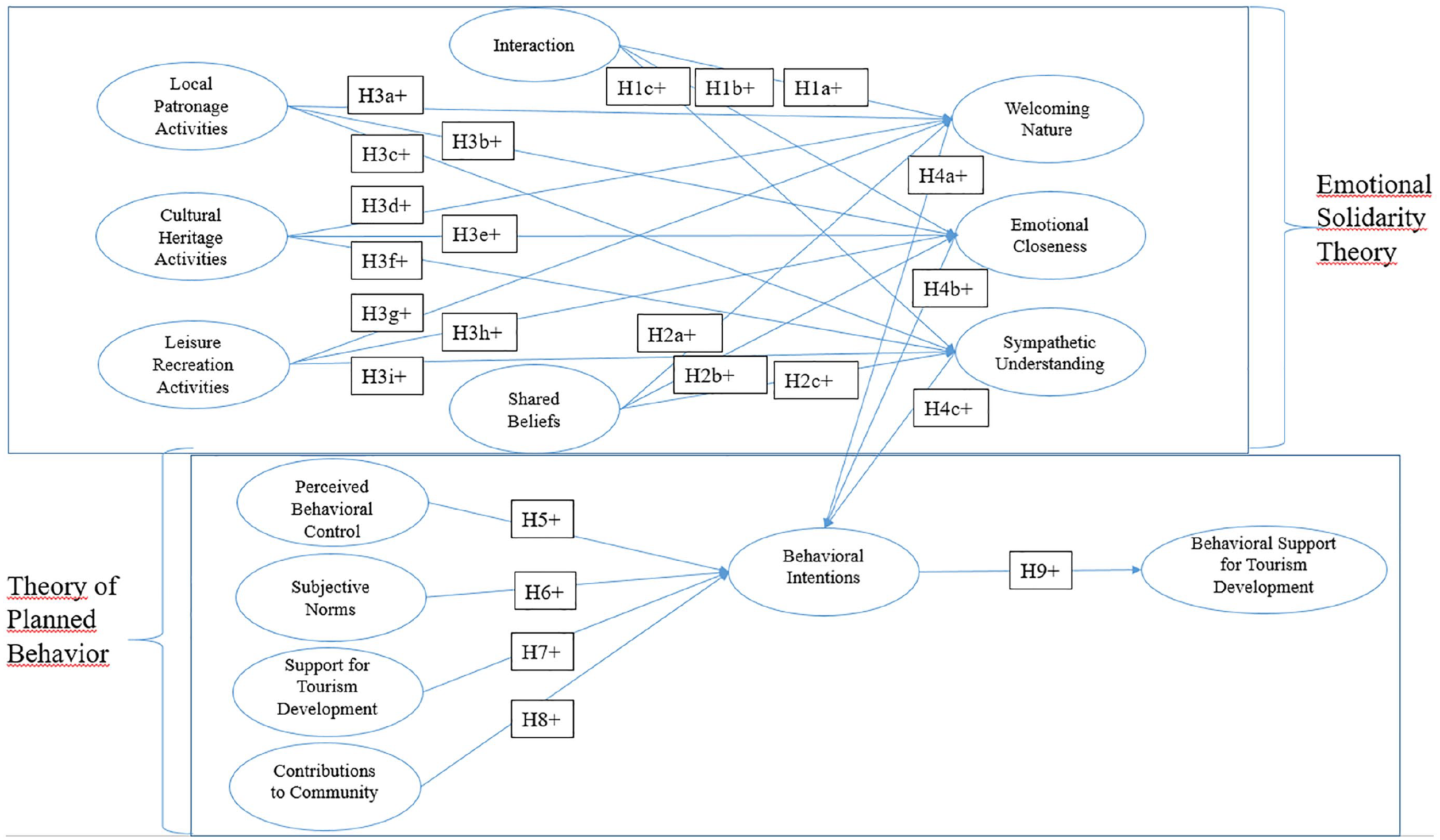
Conceptual model.
In the travel and tourism literature, limited work has sought to examine a correlation between behavioral intention and actual support. T. H. Lee and Jan (2018) found a significant relationship among nature-based tourists’ behavioral intention to engage in ecotourism and their ecotourism behavior by using the TPB. Environmental attitude, perceived behavioral control, and subjective norms all significantly explained 52% of the variance in tourists’ ecotourism behavioral intentions. Ultimately, ecotourism behavioral intentions, perceived behavioral control, and biospheric value explained 65% of the variance in tourists’ ecotourism behavior. However, T. H. Lee and Jan (2018) focused on tourists’ perspectives. As such, no study has focused on residents’ support for tourism development employing the TPB. To fill this gap in the literature, behavioral intentions to support tourism will be considered in explaining actual behavioral support for tourism. Thus, it is hypothesized that:
Hypothesis 9: Residents’ behavioral intentions to support tourism development will significantly predict actual behavioral support for tourism development.
Methods
Study Context, Sampling, and Data Collection
As the third largest metropolitan Turkish city, Izmir (with 4.3 million inhabitants) (TSI 2018) has attracted, on average, 1 million foreign visitors annually over the last 20 years (RTMCT 2018). Visitors are drawn to Izmir for the city and region’s outstanding cultural heritage, ancient history and architecture, Mediterranean coastline and beaches, thermal waters, as well as religious significance for Christians and Muslims alike. Couple these features with desirable climatic conditions, and it is no wonder why so many are attracted to the city.
Employing an on-site, self-administered questionnaire, heads of households (or spouses) were contacted at their residences and asked to participate (Woosnam 2011, 2012). Questionnaires were distributed door-to-door and left with individuals to complete and collected the same day. The use of a tally sheet (denoting street name, street number, and identifying features of each dwelling) helped the lead author return to collect each completed questionnaire. To secure the sample, a cluster random sampling strategy (i.e., visiting every fourth home on randomly selected streets within the four selected districts (i.e., Izmir city center, Çesme, Selçuk, and Menderes) was carried out between August and October of 2017. These four districts were selected given the concentration of tourism facilities in each. Three hundred eighty individuals declined to participate (from the 1180 residents contacted by researchers), which translated to a 68% acceptance rate. Of the 800 questionnaires that were distributed, residents completed 740 (a completion rate of 92.5%). All told, the effective response rate (i.e., multiplying the acceptance rate by completion rate) was 63%.
Measures and Data Analysis
To aid in assessing the nine proposed hypotheses within the theoretical model, 10 measures were employed within this study. Determinants of the Emotional Solidarity Scale (ESS) (interaction, shared beliefs, and shared behavior) and ESS (Woosnam and Norman 2010) were used to gauge residents’ relationships with tourists. The next four utilized measures were the theory of planned behavior constructs: attitudinal support for tourism and attitudinal contributions to the community (Woosnam 2012), perceived behavioral control (S. T. Wu and Chen 2018), and subjective norms (H. Han, Hsu, and Sheu 2010). Additionally, behavioral intentions to support tourism was used following the work of H. Han, Hsu, and Sheu (2010). The final measure was actual support for tourism development (Palmer, Koenig-Lewis, and Jones 2013). Two of the three ESS predictors (i.e., interaction and shared behavior) and the final scale measuring residents’ behavioral support for tourism (Palmer, Koenig-Lewis, and Jones 2013) were presented using a 7-point Likert-type scale of frequency (where 1 = never and 7 = all of the time). The remaining seven measures were presented using a 7-point Likert-type scale of agreement (where 1 = strongly disagree and 7 = strongly agree).
The analysis for this study was undertaken using both IBM SPSS v.25 and AMOS v.25. The former was used to conduct univariate (to identify potential outliers considering z scores from standardized data) and multivariate data screening (i.e., Mahalanobis’s distance) (Tabachnick and Fidell 2019). Descriptive analysis was also employed to profile residents based on a host of demographic measures. Prior to assessing individual hypotheses within the theoretical model, scales were assessed for skewness and kurtosis using AMOS v.25, which revealed no overarching concerns in the data distribution. At that point, a two-step analytical sequence (Anderson and Gerbing 1988) was undertaken to establish a measurement model through confirmatory factor analysis (CFA). This CFA allowed for the assessment of psychometric properties for each scale and corresponding items. Finally, structural equation modeling (SEM) was employed to assess each of the five hypotheses. AMOS v.25 was used for both the CFA and SEM to assess absolute fit indices, determine the significance of each predictor within the models, and explain unique variance in both the behavioral intentions and actual behavioral support for tourism.
Findings
Demographic Profile of Sample
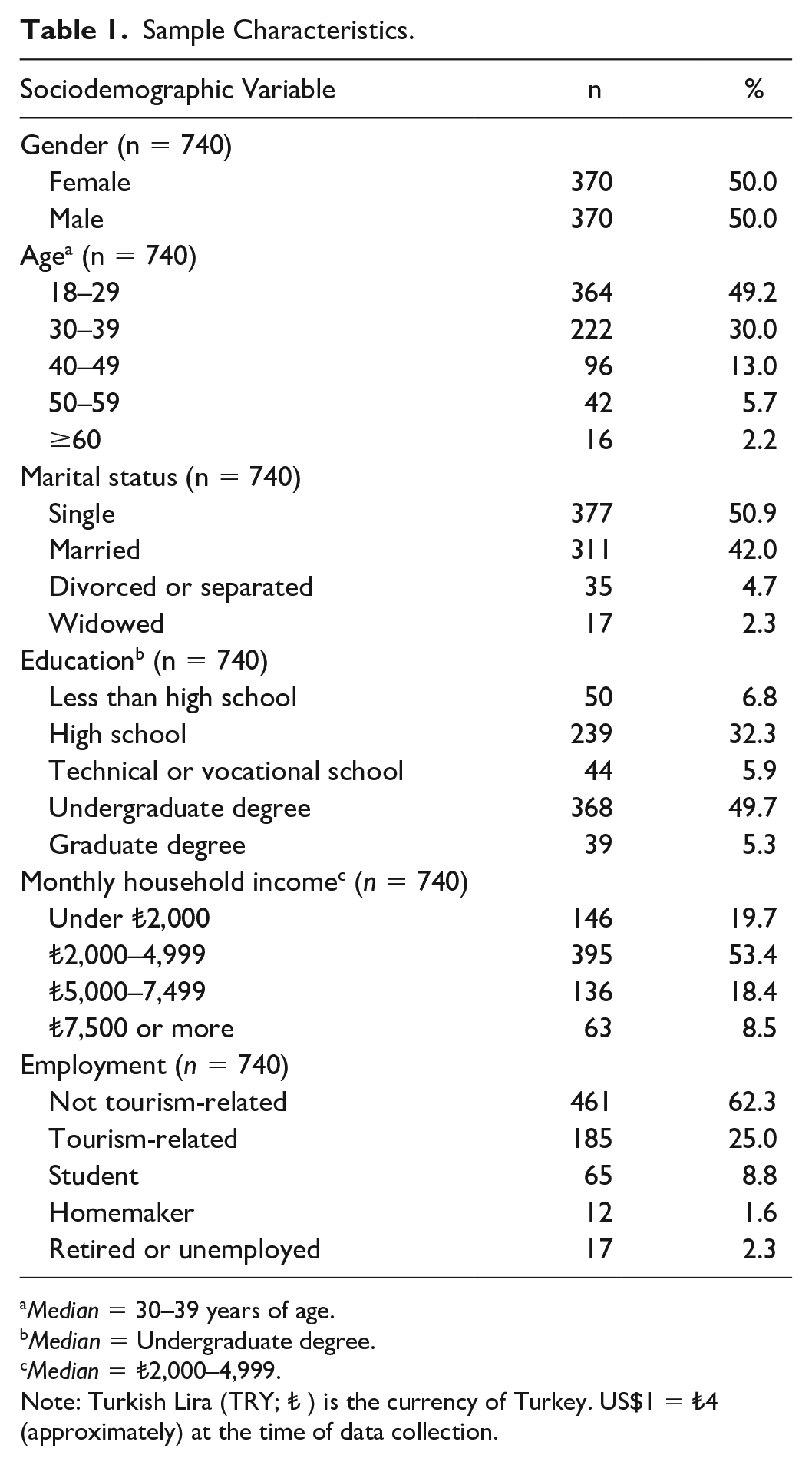
Table 1 conveys the demographic breakdown of the sample (N = 740). Though gender was split perfectly between women and men, the age of respondents was predominantly young (i.e., nearly 80% of individuals reporting ages <40 years). Not surprisingly, participants were either single (51%) or married (42%). In terms of education, nearly 55% of residents reported having attained at least an undergraduate degree. Median income ranged from ₺2,000 to 4,999 (i.e., US$500–1,249) per month. It should be noted that at the time of this study, 4 Turkish liras was the equivalent of 1 US dollar. Nearly two of three individuals reported employment in a nontourism sector, with only 25% holding positions in the tourism industry.
Sample Characteristics.
Median = 30–39 years of age.
Median = Undergraduate degree.
Median = ₺2,000–4,999.
Note: Turkish Lira (TRY; ₺ ) is the currency of Turkey. US$1 = ₺4 (approximately) at the time of data collection.
Measurement and Structural Models
Given that the data were collected using a single data source (and at one point in time), we undertook analyses to examine common method bias (CMB) so as to determine if our data were compromised (Jordan and Troth 2020). As such, we conducted a Harman’s one-factor test by subjecting all 45 items (across the 14 factors within the model) to an unrotated single exploratory factor analysis (Podsakoff et al. 2003). Results indicated that no single factor accounted for more than 15.43% of the variance among our variables—indicating CMB was not a concern within the measures. Additionally, in an effort to examine data normality, skewness and kurtosis values were assessed. AMOS output revealed the skewness coefficient to be under the critical value of 3.0, as the kurtosis coefficient was less than the 7.0 threshold. Such values provide evidence of the normality underlying the maximum likelihood estimation of SEM and the appropriateness of the survey data collected from the national panel (Ribeiro et al. 2018; West, Finch, and Curran 1995).
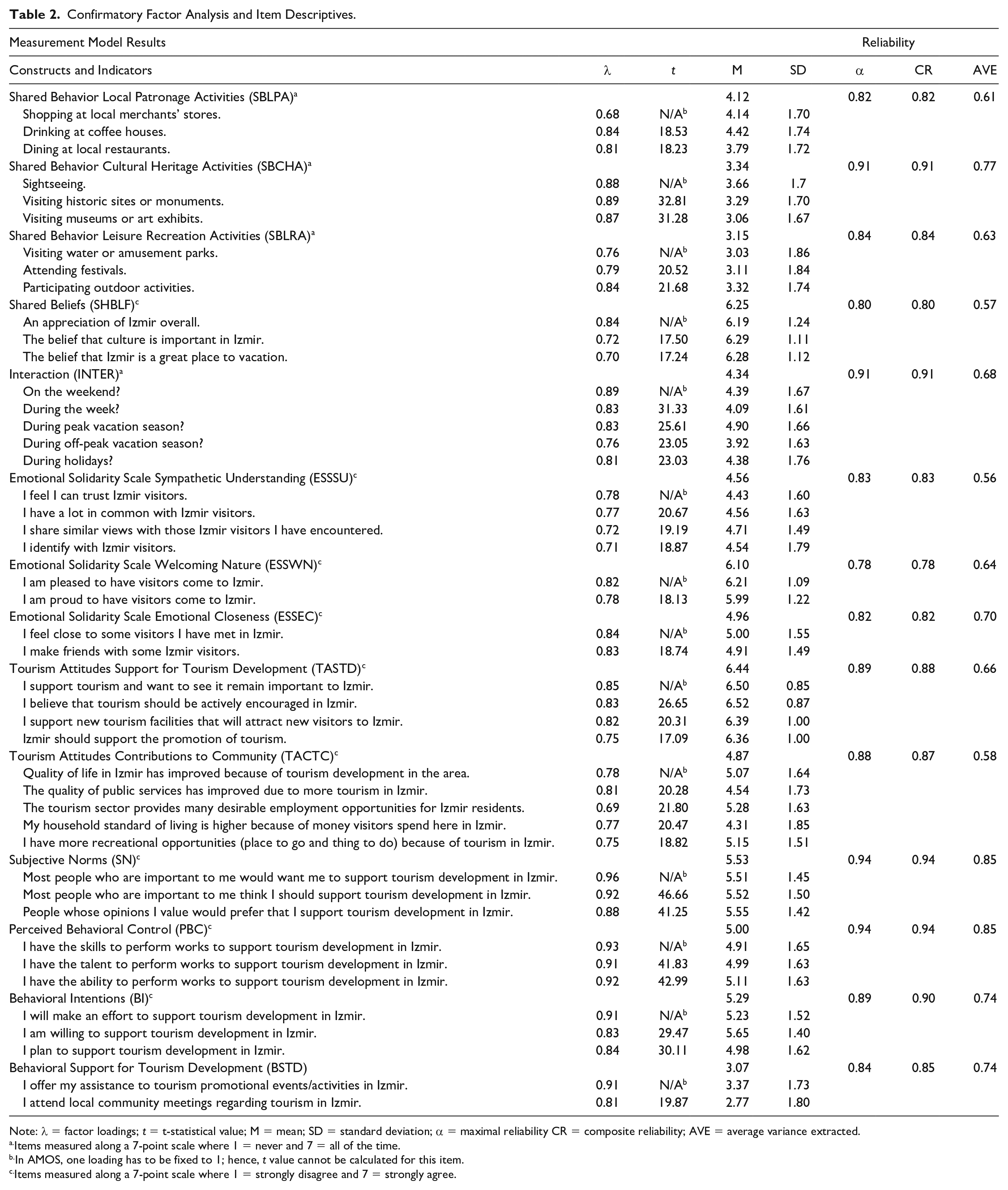
In undertaking the CFA, each factor within the proposed model was included. With each subsequent factor added, all error parameters (i.e., cross-loadings and error covariances) were also included. As such, eight items were removed as they were found to be cross-loading items (Tabachnick and Fidell 2019), contributing to high error covariances (Byrne 2016), or responsible for low AVE scores (Byrne 2016; Hair et al. 2019).Three items were removed from each of the Emotional Solidarity Scale (i.e., “I understand Izmir visitors,” “I treat Izmir visitors fairly,” and “I feel affection towards some Izmir visitors”) and Shared Beliefs Scale (i.e., “the belief that tourism is important in Izmir,” “A respect for the natural environment,” and “The belief that a wide variety of entertainment choices are available throughout Izmir”). Two items were removed from the attitudes scale (“Izmir has better roads due to tourism” and “Shopping opportunities are better in Izmir as a result of tourism”). The resulting measurement model demonstrated factor structures consistent with previous work (see Table 2).
Confirmatory Factor Analysis and Item Descriptives.
Note:
Items measured along a 7-point scale where 1 = never and 7 = all of the time.
In AMOS, one loading has to be fixed to 1; hence, t value cannot be calculated for this item.
Items measured along a 7-point scale where 1 = strongly disagree and 7 = strongly agree.
The CFA yielded a χ2 (843) = 1378.5, p < 0.001, incremental fit index (IFI) = 0.98, Tucker–Lewis index (TLI) = 0.97, comparative fit index (CFI) = 0.98, and root mean square error of approximation (RMSEA) = 0.03 (Table 3). Incremental model fit indices (i.e., IFI, TLI, and CFI) exceeded 0.95, with absolute model fit indices (e.g., RMSEA) less than 0.05—indicating excellent model fit (Hair et al. 2019; Woosnam 2012). All items within the measurement model exhibited standardized factor loadings greater than 0.50, which Hair et al. (2019) considers acceptable. From the measurement model, all factors demonstrated high reliability (i.e., composite reliabilities for each factor in excess of 0.70, ranging from 0.78 to 0.94) and high validity (i.e., the average variance extracted was in excess of 0.50, ranging from 0.56 to 0.85).
Fit Indices of Measurement and Structural Model.

CMIN = chi-square; DF = degrees of freedom; P = Probability level; IFI = incremental fit index; TLI = Tucker–Lewis index; CFI = comparative fit index; RMSEA = root mean square error of approximation.
Construct validity was also considered; both convergent and discriminant validity. Discriminant validity was determined by comparing the intercorrelations of factors to the square root of the AVE for each factor (Hair et al. 2019; Woosnam 2012), which revealed no issues (see Table 4). We also examined convergent validity, which was confirmed by significant t values for each factor loading, AVEs greater than 0.50, and standardized factor loadings in excess of 0.70 (Hair et al. 2019).
Discriminant Validity Analysis from Confirmatory Factor Analysis.
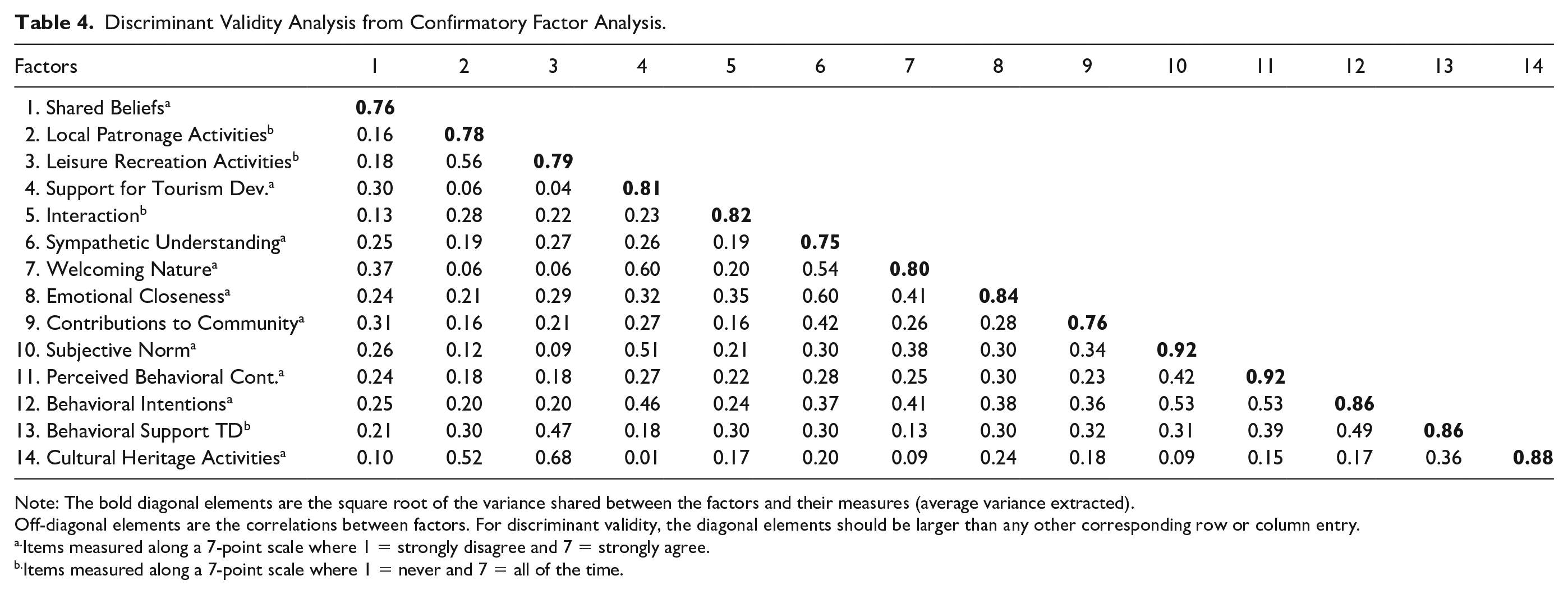
Note: The bold diagonal elements are the square root of the variance shared between the factors and their measures (average variance extracted).
Off-diagonal elements are the correlations between factors. For discriminant validity, the diagonal elements should be larger than any other corresponding row or column entry.
Items measured along a 7-point scale where 1 = strongly disagree and 7 = strongly agree.
Items measured along a 7-point scale where 1 = never and 7 = all of the time.
Structural equation modeling revealed that the data fit very well: χ2(945) = 2420.39, p < 0.001, IFI = 0.93, TLI = 0.92, CFI = 0.93, and RMSEA = 0.04. Furthermore, eight of nine hypotheses proposed in the theoretical model were fully and one partially (hypothesis 3) supported (p < 0.001) (Table 5). In other words, the first three hypotheses (hypotheses 1–3) demonstrated that the antecedents of ES explained 20% of the variance in welcoming nature, 22% in emotional closeness, and 16% in sympathetic understanding. Following this, residents’ emotional solidarity (as measured through the three dimensions) with tourists, perceived behavioral control, subjective norms, attitudinal support for tourism development, and attitudinal contributions to the community in tandem, uniquely explained 42% of the variance (R2SMC = 0.42) in behavioral intentions to support tourism (demonstrating support for hypotheses 4–8). Finally, behavioral intentions to support tourism than in turn, uniquely explained 23% of the variance (R2SMC = 0.23) in residents’ actual behavioral support for tourism (indicating support for hypothesis 9).
Hypothesized Relationships between Constructs and Observed Relationships from the Structural Model.

Note: ns = not significant
p < 0.05; **p < 0.01; ***p < 0.001.
R2 SMC: Welcoming nature = 0.20.
R2 SMC: Emotional closeness = 0.22.
R2 SMC: Sympathetic understanding = 0.16.
R2 SMC: Behavioral intentions to support tourism = 0.42.
R2 SMC: Behavioral support for tourism = 0.23.
Discussion
Conclusion
Woosnam, Norman, and Ying (2009) developed the Emotional Solidarity Scale within a tourism context. Later, Woosnam and Norman (2010) formulated and validated the ESS in additional contexts and Woosnam (2011) created a model of the constructs and expanded it within the field of tourism. The results of this study confirmed the results of previous research examining the relationship between antecedents of emotional solidarity and ESS (Woosnam 2011; Woosnam and Norman 2010; Woosnam, Norman, and Ying 2009).
Similar to Woosnam’s (2011) finding, that shared beliefs, shared behavior, and interaction explained 32% of the variance in ES, this study demonstrates that the antecedents explained 20% of variance in welcoming nature, 22% in emotional closeness, and 16% in sympathetic understanding. Such a result is consistent with the emotional solidarity theory offering that interaction between residents and tourists as well as the shared beliefs and shared behaviors between individuals determines the degree of perceived solidarity between representatives of each group (Woosnam, Aleshinloye, and Maruyama 2016).
Extant research has purported that modifying the theory of planned behavior model by either including additional critical constructs or altering paths can increase our understanding of behavior and our ability to predict individuals’ intentions to act in a certain manner (Ajzen 1991; Perugini and Bagozzi 2001). As such, this study is the first to consider emotional solidarity concurrently with the theory of planned behavior constructs, to explain not only residents’ behavioral intentions but also behavioral support for tourism development. Up to this point, only a few studies have either used the theory of planned behavior per Nunkoo and Ramkissoon (2010) or S. T. Wu and Chen (2018) to predict residents’ behavioral intentions to support tourism development; however, none have examined emotional solidarity with tourists in the process.
In considering emotional solidarity along with attitudinal support for tourism, perceived behavioral control, and subjective norms, the predictors explained nearly half of the variance in residents’ behavioral intentions to support tourism. Furthermore, on closer inspection of the regression weights (i.e., β) in the structural model, it is apparent that emotional solidarity served as the strongest predictor of behavioral intentions to support tourism. Similar to this study, Erul, Woosnam, and McIntosh (2020) used the theory of planned behavior factors (i.e., attitudinal support, subjective norms, and perceived behavioral control) to explain residents’ intentional support for tourism development. They also found that all TPB factors significantly predicted residents’ behavioral intention to support for tourism development. Contrary to the current finding, Ribeiro et al. (2017) were not able to demonstrate a significant relationship between emotional solidarity (only measured through the single factor of welcoming nature) and residents’ behavioral intentions to support tourism. Another contrary finding to our work was that S. T. Wu and Chen (2018) did not find a significant relationship between subjective norms and behavioral intentions to support tourism. In addition to this, Zhang, Moyle, and Jin (2018) found that positive anticipated emotions and only subjective norms determined park visitors’ pro-environmental behavioral intentions. In line with other research, our study revealed that attitudinal support (T. H. Lee and Jan 2018; M. J. Kim, Hall, and Kim 2020) were found to be among the weakest predictors in determining behavioral intentions to support.
In light of the inclusion of emotional solidarity in the model, this work can be compared with previous work that employed the theory of planned behavior to explain residents’ behavioral intentions to support tourism development. For example, Nunkoo and Ramkissoon (2010) only proposed the model but they have never tested it. S. T. Wu and Chen (2018) extended the TPB by adding potential benefits (i.e., economic, social, and environmental) to determine residents’ intention to participate in ecotourism development. The authors found that only potential social benefits, attitudinal support and perceived behavioral control (the strongest predictor) significantly predicted behavioral intentions. However, they did not mention the degree to which those predictors explained behavioral intentions. Hence, this study addresses such gaps. Though variance explained in behavioral intentions to support tourism was substantial (i.e., R2SMC = 0.42), variance explained in actual behavioral support was rather modest (i.e., R2SMC = 0.23). This further highlights the gap that exists between behavioral intentions and actual behavior (Hsu and Huang 2012; T. H. Lee 2013; Palmer, Koenig-Lewis, and Jones 2013). For example, T. H. Lee and Jan (2018) tried to find a relation between tourists’ ecotourism behavioral intentions and eco-tourism behavior by using TPB, and they found that intention was a significant predictor of behavioral participation. Although the variance explained in tourists’ actual behavioral support for tourism was modest, the current work marks a starting point for researchers’ continued investigation of the link between residents’ intentions and actual support for tourism. Such work will be especially timely as we move toward a greater appreciation of residents’ perspectives in planning for sustainable tourism.
Implications
This work contributes to theory surrounding residents’ support for tourism development in a number of ways. The first of which is providing a response to Ward and Berno’s (2011) and others’ (i.e., Eslami et al. 2019; Gursoy et al. 2019; C. K. Lee, Kim, and Kim 2018; Su, Huang, and Huang 2018; Su and Swanson 2020; J. M. L. Wu, Tsai, and Lee 2017) call for greater empirical research that utilizes complementary theoretical frameworks in assessing residents’ perspectives of support for tourism. This work highlights the value of considering how the relationship residents build with tourists can ultimately inform how the former not only intend to support tourism but also how they actually engage in supportive behavior for tourism. Previous emotional solidarity studies have typically focused on residents’ attitudinal support, with few exceptions. Ribeiro et al. (2017) examined the behavioral intentions of residents to support in extending the theory of reasoned action framework by adding one of the emotional solidarity factors to determine support for tourism, though the authors did not find a significant relationship. As such, the current study fills this gap and further demonstrates how future work should incorporate emotional solidarity into the modified theory of planned behavior and theory of reasoned action models.
This work not only confirms the extant theory of planned behavior model (explaining residents’ support for tourism), but it also provides support for the incorporation of emotional solidarity (and its constructs) as contributors to this framework. All too often, work has stopped short of assessing actual behavior (see Chen and Raab 2012; Choi and Murray 2010; Eslami et al. 2019; H. Kim, Choe, and Lee 2019; Kwon and Vogt 2010; T. H. Lee 2013; Nunkoo and Ramkissoon 2010; Ribeiro et al. 2017; J. M. L. Wu, Tsai, and Lee 2017). Only T. H. Lee and Jan (2018) have considered how the theory of planned behavior constructs inform behavioral intentions to support tourism, which ultimately explain actual behavioral support for tourism. They found that behavioral intentions were significant in predicting tourists’ ecotourism behavior within the travel and tourism literature. As such, this study is among the first to predict residents’ actual support for tourism development through employing the TPB. But beyond this, our model highlights the importance of residents’ social interactions and relationships with visitors and how that plays out in their intentional and behavioral support for tourism. As Stylidis, Woosnam, and Ivkov (2020) stated, it is difficult to divorce residents’ perceptions of the relationship that they have with tourists and their attitudes of tourism, especially in the context of support for the industry.
Based on empirical findings, this study suggests that policy makers and government officials should promote greater activities, festivals, and events so that residents are able to forge greater emotional solidarity with tourists, which ultimately can contribute to support for tourism within destinations. Though this work was not funded by any tourism planners or managers within Izmir, the local government official in charge of planning for tourism needs to regularly incorporate opportunities for local residents’ perspectives regarding tourism to share their perspectives. Whether that be through citywide surveys or attendance and participation at planning meetings, the potential to incorporate locals’ perspectives would go far to be inclusive and foster the greatest possibility for sustainable tourism within Izmir. If this has some traction among those in positions of authority (as well as among residents at large), a further plan may be to appoint key resident representatives to tourism planning boards. Such appointments would help to ensure even greater commitment toward planning and managing for tourism with sustainability in mind.
Limitations and Future Research Opportunities
As with all research, this study is not without limitations. The research was conducted in one destination, and as such, findings should be considered with caution in generalizing to comparable contexts. As J. H. Han et al. (2019) suggests, the best way forward would be to undertake similar studies across multiple destinations. Such an approach would further validate the results found here. Another limitation surrounding the sample pertains to its composition of young, highly educated individuals. Perhaps having greater diversity across these two variables may alter the findings. As many (Almeida-García et al. 2016; Látková and Vogt 2012; Papastathopoulos et al. 2020; Woosnam and Erul 2017) have found, age and education significantly impact residents’ degree of support for tourism. Subsequent work employing a comparable model may consider looking at the moderating effect of these two variables on the relationship between residents’ behavioral intentions to support tourism and actual behavioral support.
Though this study was conducted prior to the political coup d’état and current instability within Turkey, findings should be interpreted with that in mind. Would current Izmir residents perceive their relationship with tourists as strongly as they did in 2017, in light of the political climate throughout Turkey? That is uncertain, especially since trust in others is central to establishing emotional solidarity with visitors (Joo and Woosnam 2019). Interpretation of our work should also be done considering the current era of COVID-19 and what that means for our findings. Following the first portion of 2020, global travel has come to a screeching halt. For the immediate future and beyond, it will no doubt stay that way, taking considerable time to re-establish travel. Given the situation in which we find ourselves (especially residents who are used to have hordes of visitors in their communities), it would be interesting to see how perceived relationships with tourists and behavioral support for tourism may be viewed in light of the limited interactions locals have with tourists and the tourism economies that are no doubt struggling. One thing is certain, emotional solidarity is dynamic, as are the other constructs within the theory of planned behavior model. Future work should embrace this notion and consider undertaking more longitudinal research on residents’ support for tourism to capture this dynamism, especially research that could compare findings pre-COVID-19 with data collected in the midst of the pandemic.
Footnotes
Declaration of Conflicting Interests
The author(s) declared no potential conflicts of interest with respect to the research, authorship, and/or publication of this article.
Funding
The author(s) received no financial support for the research, authorship, and/or publication of this article.
